The Railway Children

Railway Children Cover

The Railway Children by E. Nesbit, 1906.

Railway Children toy train explodes

Three children in England live a comfortable and happy life with their parents. Roberta is the eldest, followed by Peter and Phyllis, the youngest. Their family has servants, their mother enjoys helping the children with their lessons and making up stories for them, and their father is clever at fixing broken toys. When Peter turns 10 years old, he is given an electric toy train (a relatively recent innovation for their time and the type of toy only a wealthy family could afford), which is a wonderful present because Peter wants to become a mechanical engineer. However, something goes wrong with the toy train, and it explodes at his birthday party! When Peter’s father comes home, he looks at the toy train and says that he thinks he can fix it, but before he can say much more, some strange men come to the house and want to talk to him. They spend a long time talking while the children’s mother takes the children upstairs. Then, their mother goes downstairs to see their father. When she returns, she seems very upset, but she doesn’t want to discuss it with the children. She only says that their father has been called away and that the children should go to bed.

The next day, their mother is gone for a long time, and the children are worried about what is happening with their parents. Their mother finally returns in the evening, tired and still upset. She tells the children that the men who came the night before brought very bad news and that their father will be away for some time, so she is going to need them to help her. She says that there will be times when she will have to be away for long periods and that she wants them to behave themselves and not fight while she’s gone. She doesn’t want to tell the children what the problem is or for them to ask her or anyone else any questions about it. She only says it’s about their father’s business and none of them really understand their father’s business. They know that their father works in a government office, so his business has something to do with the government, but their mother doesn’t want to say more than that.

Over the next several weeks, their mother is gone for long periods, leaving the children with the servants and with an older aunt who will soon be taking up a position as a governess for another family overseas. The children don’t get along with their strict aunt. The servants are usually more pleasant, but the children have the uncomfortable feeling that the servants know more about their father’s situation than they do. One day, in spite of his promise to behave himself for their mother’s sake, Peter plays a prank on the parlor maid, and the parlor maid angrily tells him that if he doesn’t fix his behavior he’ll go where his father has gone. The children don’t know what she’s talking about, and when they ask their mother, she dismisses the parlor maid. She wasn’t going to keep the parlor maid much longer anyway because she tells the children that they’re going to move to the country.

When they move, they can’t take everything from their house with them because the house in the country is smaller, and their mother says that they have to take the most useful things, leaving many of their prettier things behind. She tells the children that they’re going to have to “play at being Poor.” Readers will understand that they’re not just playing, but the children’s mother tries to frame their move as a great adventure rather than the misfortune it really is. For the children, it is a kind of adventure.

They take a train to the countryside, but when they arrive, they have to walk from the trains station to their new little house because there are no cabs there. A man brings their luggage in a cart. When they arrive at the house, which is called Three Chimneys, it is night, and the woman the mother hired to clean up the house and make supper for them is gone. The man with the cart says that she probably left because their train was late and that she probably left the house key for them under the door step, as people in the countryside tend to do. The key is there, but they discover that the woman hasn’t really done any cleaning for them, and she didn’t make supper. Fortunately, they do have some provisions, packed by the strict but thoughtful aunt, so they are able to put together a small meal for themselves.
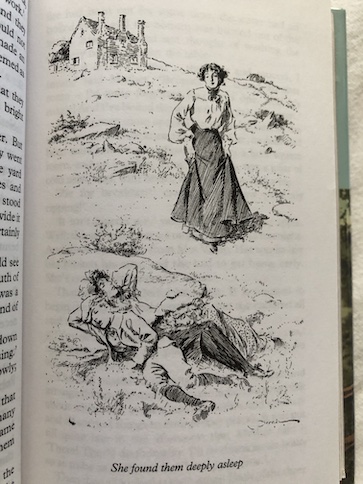
Railway Children falling asleep outside

In the morning, Roberta wakes Phyllis and points out that they have no servants in this new house, so they had better get up and make themselves useful. They get things together as best they can for breakfast, although they don’t really know what they’re doing or where everything is. They start the kettle going too soon, burn the kettle, and let the fire go out. The children explore the house’s yard and garden. They can see the train tracks and a tunnel down the hill from the house, and they fall asleep outside because they got up too early. When their mother wakes up, she gets everything ready, fixing their clumsy efforts, and finds a note from Mrs. Viney, the cleaning woman. In her note, Mrs. Viney apologizes for not having everything ready for them the night before because there was a family emergency. She had to leave early because her son-in-law broke his arm, but she promises to be there later that morning to help them.

Life in the country is very different from life in their old home. Their mother now tells them that they are really poor. It’s summer, and the children are not going to school, and their mother spends most of her time writing because she wants to sell stories for money. The children still don’t know where their father is, and it still worries them, but they gradually get used to their new life and to not asking questions about their father. Deep down, Roberta knows that something terrible has happened and that their mother is very upset about it, but because her mother seems like she would be even more upset if the children knew the full truth or just how upset she is, Roberta makes a deliberate decision not to notice anything that her mother doesn’t want her to notice. Whenever it seems like her mother has been upset or crying or whenever there’s been any hint about her father, Roberta deliberately looks away and pretends that she didn’t see anything. She tries to keep cheerful and enjoy this “adventure” that they’re living.

The children develop a fascination for the trains that run by their house, and they go to have another look at the train station. They are not accustomed to being at train stations just to observe them, only to either catch trains or arrive on trains. They are fascinated to notice the details of the station and the train signals. They notice a white mark where the coal is stored, and Peter asks the porter what the mark is for. The porter tells him it’s to mark the level of the coal so they can tell if someone has taken some, giving them a friendly warning not to steal any.

The children’s new poverty doesn’t mean much to them at first because they still have plenty to eat, but when there’s a wet and chilly morning and Peter wants to light a fire, their mother tells him that they can’t afford to light fires in June and that they must save their coal for when it’s really cold. There are other little economies that the family must make. The mother tells the children that they can have either butter or jam on bread, but not both at the same time. If they eat too much at once, they’ll run out before they can afford more.
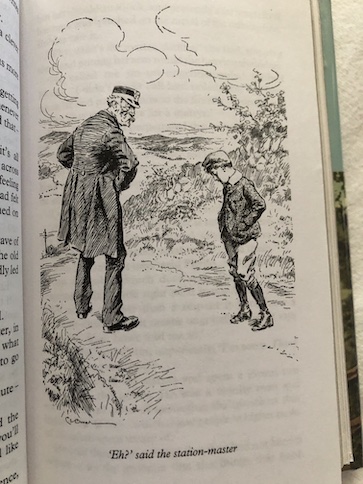
Railway Children station master

These small things that they can no longer afford give Peter an idea. He decides to stage a daring raid on the coal at the train station for the sake of their family. Although he knows that it isn’t really right, he doesn’t think of it as stealing but more like coal mining because he digs through the coal pile for the pieces underneath, which he figures they won’t miss. However, the station master catches him and insists that he and his sisters come into the train station and explain themselves. Peter explains how his family used to be able to afford fires on wet and cold days, but now they can’t because they’re poor. The station master becomes a little more sympathetic, but he gives the children a lecture about taking things that don’t belong to them. It’s still stealing, even if they think of it by another name. He lets the children keep what they’ve taken so far and lets them go with a warning not to do it again. Peter is horribly embarrassed by the incident, and he is uneasy for a while whenever he sees the station master, but the station master eventually lets him know that he is forgiven and gives them permission to visit the train station again.

The children enjoy visiting the train station and asking the friendly porter questions about the trains and how they work. The porter, whose name is Perks, likes chatting with them and answering their questions. The children watch the trains so much that they begin to recognize that each train is distinctive in its appearance. The trains no longer look all the same to them, and they start giving them nicknames, like the Green Dragon, because it’s pulled by a green engine. When Peter notices that individual trains have numbers written on them, Perks introduces him to the hobby of train-spotting, where people write down the numbers of trains that they’ve seen in a little notebook. (He doesn’t call it by that name, but that’s what he describes.)

The children become especially fond of the train they call the Green Dragon. Every day, they wave to this train, imagining that it’s a magical dragon that will carry their love to their father, wherever he is. Every day, a pleasant-looking older man who rides that train sees them and waves back to them. They begin to think of the man as a friend, waving to him and imagining that he’s also going somewhere to work on “business”, possibly with their father.

Railway Children Phyllis with note

Their new train friend turns out to be very important. When their mother becomes ill with a serious case of influenza, the doctor gives them a list of things they should get for her, most of which they just can’t afford. The children are willing to make do with a diet of bread and water to get her some of the things she needs, but even doing that won’t get her everything she should have. Then, the children come up with a desperate plan. They use a sheet to make a sign to tell the old man on the Green Dragon to look out at the station. When the train comes through the next time, everyone on that side of the train sees the sign, and they all look out at the station, confused because they don’t see anything unusual. It’s just Phyllis at the station, and she slips a note to the old man, explaining their situation and asking if he could get the things they need for their sick mother. The children promise that their father will pay him back or, if he’s lost all his money (as the children are starting to suppose is the case), Peter will pay him back when he’s a man. The nice older man is amused and touched by the message, and he sends them a package with all the things they asked for, plus a few more that he thought of himself. In the note accompanying the package, he says that they should tell their mother only that a friend who heard she was ill sent these things, although they should tell her the full story when she’s feeling well enough to hear it. The old man says that he knows their mother probably won’t be happy that they asked a stranger for help, especially not without asking her first, but he says that he thinks the children did the right thing.

The old man is right about their mother’s feelings. When their mother is well and realizes what the children did, she is angry, and she starts to cry. She says that, while they’re poor, they’re not destitute, and they shouldn’t go around asking strangers for things. Part of that is personal pride and shame at their family’s reduced circumstances. She still can’t bring herself to talk about what really happened to the children’s father and why they’re so poor now. However, they do come to rely on help from strangers and new friends, and they learn that people will help others if they’re asked. Even when they’re not rich themselves and could use some extra money, some people, like the local doctor, still let them them have services at reduced rates and take some pride in their ability to help someone who needs it and who appreciates the help.
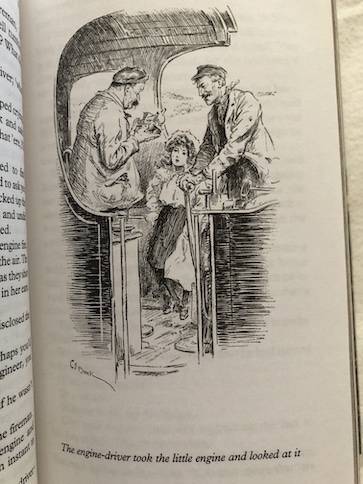
Railway Children train engineers

When Roberta decides to get help to fix Peter’s broken toy train, she accidentally hitches a ride on a train engine because she thinks that the train engineers know how to fix trains. The book explains that there are different types of engineers, from people who build engines to people who drive train engines and people who build things like bridges. Not all engineers do the same things, and the people who drive the engines don’t repair them. Fortunately, one of the train engineers has a relative who can fix things. Touched at the young girl’s request for help fixing her brother’s toy, he arranges for his relative to fix it.

The family also comes to experience what it’s like to help someone else who’s less fortunate when a man gets off at their train station, obviously ill and speaking a language that nobody understands or even recognizes. The only language the children have studied in school is French, so they decide to ask him if he speaks any French, even though they can tell that’s not the language he’s speaking. It turns out that the man does also speak French. Their mother speaks better French than the children do, and when she speaks to the man, she recognizes who he is. He is an author from Russia. He wrote a book about the plight of poor people and how to help them, which the mother has read and really appreciates. However, this book put him on the wrong side of the ruling class in Russia, and he spent time in jail as a political prisoner. He was later exiled to Siberia and put in a forced labor camp. The mother is surprisingly frank about the conditions in the camp and the forced marches where prisoners were whipped and left to die if they couldn’t go on. Since this man was able to get away, he has come to England in search of his wife and child. He heard that they had fled to England after his arrest, but he doesn’t know exactly where they are in England. At the train station, he was trying to explain that he was ill and that he lost his train ticket. The family lets him stay with them for a time while he recovers his health.

Railway Children flags

The children become heroes to the railroad when they witness a landslide that blocks the tracks and use the girls’ red flannel petticoats to make warning flags to stop the train. The children averted a terrible accident, and they are publicly thanked and given gold watches as a reward. The old gentleman from the Green Dragon is there, and the children learn that he is a railway director. They write him another note, asking if they can talk to him about an unfortunate prisoner.

The old gentleman meets with the children at their train station the next time his train comes through, and the children tell him about the Russian author, who is still looking for his missing family. The children say that the gold watches are a wonderful reward, but they’re willing to sell them or trade them back to the old gentleman in exchange for help locating the author’s wife and children. The old gentleman recognizes the author’s name and says that he has also read his book. The old gentleman knows some people in the Russian community in London, and since the author is a famous man, people in the Russian community are likely to know where his wife is currently living. He’s happy that the children’s mother is helping the author, and he says he will be glad to make some inquiries on his behalf. The old gentleman also asks the children for more information about themselves. He soon follows through on his promise to help the author, bringing the man’s wife and child to him.

Much of the book is about giving and the ways people help each other. When the children arrange a birthday surprise for Perks, he gets angry at first because he thinks they’re giving him charity. He changes his mind when the children tell him how they collected the birthday presents from various people in the community because they wanted to show him how much they all appreciate him and help that he’s given them in the past. His wife says that he’s been ungrateful for rejecting the presents, but Perks says that it’s not just about being given things but how and why they’re being given. If people gave him things because they thought that he couldn’t afford them or couldn’t work for them, it would have been an insult because he works very hard. If they’re given out of friendship and returned favors, it’s different.
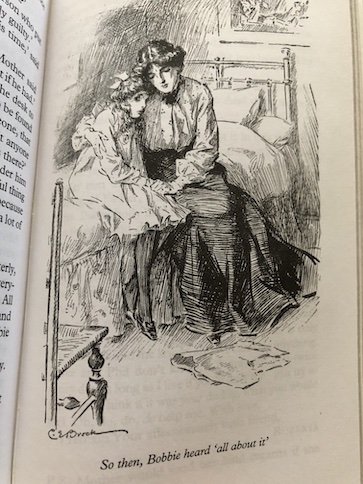
Railway Children Bobbie learns the secret

In the background of the story, there is always the question of what happened to the children’s father and why they had to leave their old home. At one point, their mother worries about why the children have stopped talking about their father and is afraid that the children are forgetting about him. Roberta admits that they talk about him when their mother can’t hear them because she can tell that their mother is sad whenever they mention him around her. Their mother admits that’s true, and she still doesn’t want to tell them the full reason why, only that something bad did happen, and it will be a while before their father can be with them again. The reason for the father’s disappearance adds an element of mystery to the story, although most of the book focuses on the children’s adventures in the countryside. There are clues along the way, from the men who came to get their father to the clothes that Roberta discovers that her mother is keeping for him. There is her mother’s reluctance to be sociable with other people and the way she talks when she describes how awful it is to be in prison, away from your family, and the reasons why a person might be arrested, which aren’t quite the same in England as the reason why the Russian author went to prison. These are the things that Roberta tries to ignore … until she finds something that starkly tells her what all of the adults already know. When Roberta understands the real problem, she can only think of one person who might be able to help: the kind old gentleman who helped them before.

The book is now public domain, so it is available to read online through Project Gutenberg and Internet Archive (multiple copies). There is also a LibriVox Audiobook on YouTube. It’s been made into a movie multiple times, and you can see the 2000 version online through Amazon Prime. It fits well with the cottagecore aesthetic! There is also a sequel movie, not based on an E. Nesbit book, which takes place during WWII, when the children in this story are adults and other children are evacuated to the countryside from London.

My Reaction and Spoilers

The Children’s Father

There are clues all the way through the story to what happened to the children’s father. He was framed for being a spy and a traitor in relation to his work with the government, although he didn’t do was he was accused of doing. People thought he was a traitor because there were letters found in his office that incriminated him, placed there by some unknown person, and these letters convinced the jury at his trial that he was guilty. The trial was conducted during those weeks when the children were at their old home with their aunt and were being told not to ask any questions. They left for the country after he was sentenced to prison. Their mother turns to writing, something that she already enjoyed, to earn money to support herself and the children, and she doesn’t want to see much of anyone because she doesn’t want to face their questions about her husband.

Railway Children the old gentleman

Roberta learns the truth about her father when Perks gives her some old papers with pictures in them to amuse Peter after he is injured by a rake the children were fighting over. The newspaper that is wrapped around the bundle has an article about her father. Roberta reads the article and then asks her mother for the full story. Roberta understands why her mother didn’t want to tell the children what happened because she also can’t bring herself to tell Peter and Phyllis what she now knows, but Roberta still wants to understand the situation herself, now that she knows about it. Her mother tells her that her father suspects that the real traitor and the person who framed him is the man who took his job when he went to prison, but he can’t prove it, and nobody believes him. Although her mother has told her not to ask people for things, the situation is dire, and Roberta can’t let her father stay in prison for a crime he didn’t commit, so she asks the kind old gentleman if he can make some inquiries into the situation on behalf of her father. She just can’t keep the matter to herself, and he’s the only person she knows who seems to have some authority and connections and might be able to do something. The old gentleman is happy to help, especially after the children help his grandson when he is injured.

In the end, the real villain is discovered, and the father is released from prison, but the readers and the children don’t see exactly how that happens because the old gentleman seems to take care of it in London, away from the children and their mother. The book ends with the father arriving at Three Chimneys, so the family is happily reunited, but we also don’t see what their lives are going to be like after that point. They no longer have their old home, and I find it difficult to believe that the father would want to return to his old job, like nothing had happened. If all of your co-workers believed that you were some kind of traitorous spy and seemed to like the guy who framed you, returning to that office would be far too awkward. It’s a life-altering event that might have potentially been life-destroying, not just a small misunderstanding. In the end, it seems like the family will be okay. The family has a wealthy supporter now, so the old gentleman might be able to help the father find a new job. The family has also come to enjoy living in the country and has some friends there, and the mother indicates that she wants to continue her writing, so they might not move somewhere else, at least not right away. It will take the family some time to sort out what they’re going to do, rebuild their family finances, and move on from this incident. We just don’t get to see all of that happening as readers. The book ends on the happy note that things are being set right, and the family is reunited.

The Meaning of Charity and Helping Others

I’d like to point out that there is a theme of rich people coming to the rescue of deserving poor people in many books from the 19th century and early 20th century, like in this book and The Five Little Peppers. People in these stories take pride in being self-sufficient and doing their best on their own, but in the end, it’s the recognition of their worthiness from someone with money and authority who is willing to supply support them that really makes a difference in their lives and saves the day. I’ve thought sometimes that the rich-person-to-the-rescue theme seems to contradict the do-it-all-yourself attitudes that the characters in these stories often have, but I think the key to understanding it is in what Perks says about his birthday surprises – it matters how and why gifts are given.

The same gift or act of kindness can take on different meanings, depending on the motives and attitudes of the giver. Perks would have been insulted if people gave him charity because, to him, it would be like people telling him that he was incompetent at getting things for himself and his family, which isn’t true. However, the same gifts take on different meanings when they’re meant as a salute to his friendship and helpfulness to others because he can tell himself that he did things to earn them. The children in this story earn the help they get from the kind old gentleman (who is never named in the story) and others in the community through their acts of kindness and heroism to the community, so they are demonstrating their usefulness and competence instead of asking for things they haven’t earned and don’t deserve. They can take pride in their competence and good deeds, so they’re not mere “charity” cases, who take without giving. At least, I think these are the implications of stories like this. I get the concept about personal pride, but I don’t feel the same way about it because I think there are more important priorities.

Railway Children Perks' birthday

Personally, I don’t have negative associations with the concept of “charity”, either giving or receiving. I’m more like Perks’s wife, who’s just grateful that somebody cares and that people think of them and are willing to give. I appreciate when things are getting accomplished, people are being helped, and objects are being put to good use by people who will actually use them. In situations like that, I’m more oriented toward the results than concerned about image. (My personal image has always been that of an oddball eccentric anyway. A basically pleasant and helpful oddball, but still an oddball. I like to maintain a certain level of eccentricity because I’ve discovered that there’s a kind of freedom in that. It’s like choosing to be a character actor instead of a teen heartthrob. Nobody can be a teen heartthrob forever, but being a character lasts a lifetime, and the ways you can do it are almost endless.) I have no objection to people giving me things I need or helping me accomplish things I want to do, and I’ve done the same for other people. It’s just life to me, and I think it’s best to focus on the good being accomplished and get on with doing things. (By the way, if you enjoy my nostalgic children’s book blog, please consider buying me a coffee to support the site! Proceeds will help support my book addiction, site maintenance, and future reviews and would be greatly appreciated.)

I’ve worked for nonprofits before, and people who work for nonprofits are there to do good and get the job done. They see needs in their communities, and they want to step in and supply them. There are people who make their lives and careers around making positive change. I certainly wouldn’t want people trying to stop those who are trying to do something good for others just because they have a negative attitude and no plan or effort for accomplishing positive change themselves. Of course, when you have a nonprofit or work for one, people come to you for things they need or to support your cause. They come to you because they’re in the mindset for making positive changes to their own lives or in the community, and that can also play into the concept of how giving is done. If someone just isn’t in the mindset of accepting help or gifts or making positive changes, there isn’t much to be done about it until they are in the mindset to do something.
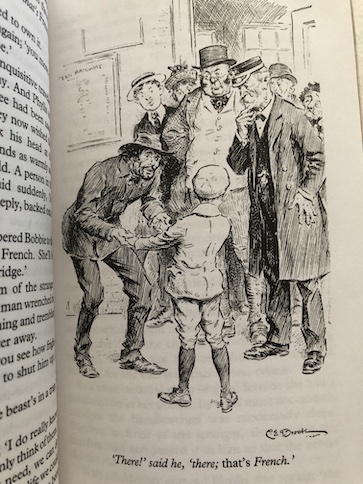
Railway Children the Russian author

I think this book actually does a good job of presenting that concept. The mother’s and Perks’s sense of pride and attitude toward the concept of charity contrast with the old gentleman, who seems willing to just go ahead and get the job accomplished when he sees what people need or what they’re trying to do. Both Perks and the mother seem to feel a blow to their pride when someone helps them or gives them something, yet both of them are happy to offer help to others who need it. Being the one offering something rather than receiving it seems to make them feel like they’re in a position of strength and competence. The mother takes in both the ill Russian author and the old gentleman’s injured grandson, not seeing those as insulting acts of charity. It’s when she’s both poor and ill herself and doesn’t feel strong or competent that receiving help from someone seems to remind her that she’s vulnerable. I think that’s the feeling that gives her a negative attitude toward charity – perhaps not that she’s fine without help but the thought that she’s in a position to need some help is scary. While she’s sick and has a high fever, Roberta tends to her through the night, and she hears her mother calling out for her own mother. It’s a moment of revelation to Roberta that, no matter how old a person gets, they still have moments of vulnerability, when they need someone else to comfort and help them, like a mother would. It can be a bit humbling to go through those vulnerable moments and have someone see you being vulnerable, but it’s human. The revelation that mothers are also humans who sometimes need other adults doesn’t make Roberta love or respect her mother any less. In fact, it makes her appreciate her mother more for what she goes through for her family and makes her more determined to be helpful and supportive to her mother.

Railway Children Perks

I think Perks experiences a similar a similar attitude to the children’s mother. There are hints that he’s had a rough life himself and has worked hard for the level of stability he has now. When the children try to give Perks money for carrying the old gentleman’s gift to their mother to the house, he gruffly refuses it because he doesn’t want to take money for helping their sick mother. His refusal of their money for his service could be seen as an act of charity to them, but it’s framed more that he’s doing a personal favor or like Perks thinks that the children are offering him a kind of charity by trying to pay him for a service he is willing to provide for free. He also helps other people in the community, and helping others makes him feel strong and competent. Receiving something from others makes him feel like there’s something wrong with him or his life or like other people think there is. Perhaps it reminds him of hard times in his youth. It really seems like it’s only the attitudes of the giver and the receiver that determines what forms of giving are acceptable, and it’s bit subjective. The old gentleman understands that when he writes the note to the children that he sends with his gift to their mother, but he also says that he thinks they did the right thing. Maybe there are some kinds of giving or asking for help that are objectively good or right for reasons other than people’s opinions.

This is a good time to point out that the author of this story, E. (Edith) Nesbit, believed in socialism, although she wasn’t a radical on the subject. I think that’s why she examines the subject of helping others and receiving help from the point of view of people from different classes in society in this story. All of the adults in the story take some pride in their positions in society and in maintaining the appearances associated with those position. Victorian society was very class-based, but the family’s poor circumstances take them out of their usual class and changes the situation for them and others. The children and their mother sometimes really do need the help of other people, whether they like it or not, but they still have the capacity to help others in different ways. One of the themes in the story seems to be that everyone needs something from other people at some times. There are times when what they need might be help and support from others, and there are times when it might be a chance to show that they have the capacity to help others or appreciation for help they’ve already given.

This story raises many questions about giving which don’t have firm answers and can be viewed from different perspectives. Are all of the various forms of giving and receiving only different forms of charity, or are they just the interactions of human beings who all care about each other? Are people’s intentions or the image of giving really what’s important, or is it the giving itself? It may be better to give than to receive, but without someone willing to receive, what is the point of the act of giving?

For another early 20th century book that considers the differences between different classes of people and the meaning and benefits of charity, I recommend Daddy-Long-Legs, which is about an orphan whose college education is funded by a mysterious benefactor. That book is set in upstate New York, and it falls under the Light Academia aesthetic.

Fun Stuff

I always like seeing old books and historical books with scenes where people are playing games because I made a website about Historical Games. In this book, the children play a game that resembles Dumb Crambo (which was a precursor to modern Charades) called the Advertisement Game. In the Advertisement Game, the children act out characters they’ve seen in advertisements for each other to guess. There is also a scene with some boys from a nearby boarding school having a Paper Chase, which is a cross-country outdoor game. One player is the Hare, and he leaves a trail of bits of paper for other players to follow as the Hounds.
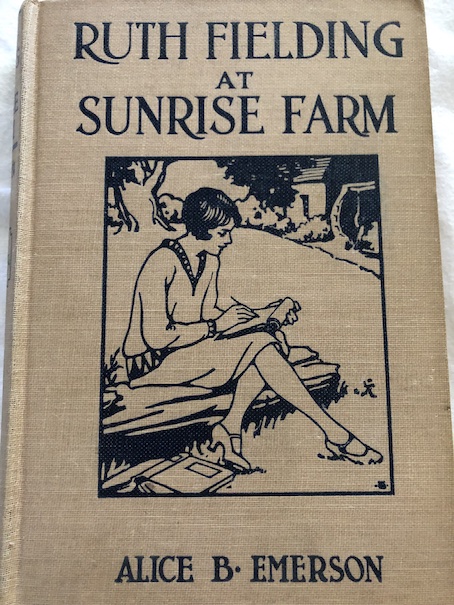
Ruth Fielding at Sunrise Farm

Ruth Fielding

Ruth Fielding at Sunrise Farm or What Became of the Baby Orphans by Alice B. Emerson (Stratemeyer Syndicate), 1915.

When the story begins, Ruth and her friends are at boarding school, and they are having a secret night meeting of their club, the Sweetbriars, to initiate some new members. Their initiation ceremony includes the story about the statue with the harp in the fountain that the girls were told during a scary initiation to another club in an earlier book, but the Sweetbriars are against tormenting and hazing new members. Instead of the scary ceremony, their initiation ceremony involves marching around the fountain while chanting a rhyme about the statue. There is supposed to be a mild prank of splashing the new members as if the fountain did it, but that’s as much hazing as the Sweetbriars will allow.

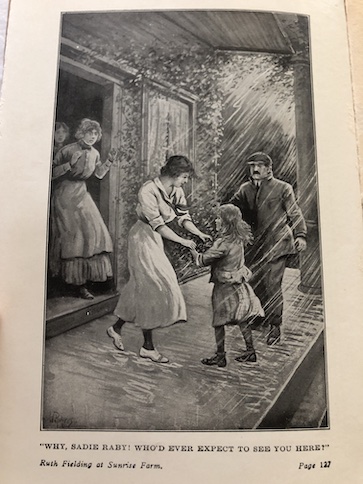
However, their ceremony is interrupted when one of the girls who is already a member of the club starts screaming. When everyone runs to see what happened, the girl who was supposed to do the splashing of the new members is all wet and says that someone pushed her into the fountain. She doesn’t know who did it, but she saw someone run away afterward. Ruth catches this mysterious lurker, and it turns out to be a younger girl who doesn’t belong to their school at all. The girl says that she had just been at the fountain, getting a drink of water. She says her name is Raby and that she ran away from some people called Perkins, who beat her. Ruth isn’t able to get much of Raby’s story that night, but she can tell that the girl is in trouble, so she says that if Raby will meet her the next morning, she can give her some money and help her.

The next day, Ruth’s friend, Madge Steele, invites Ruth and the other girls to spend part of the summer at a farm that her family bought near Darrowtown, where Ruth used to live with her parents before they died. The farm is called Sunrise Farm, and this trip is also meant to be a graduation party for Madge. Madge is older than the other girls, a senior at Briarwood, so these are her last few months at the school.

Ruth slips away from the others to bring some food to Raby, and she learns more about the girl’s plight. Raby explains that she’s an orphan. Raby is her last name, and her first name is Sadie. She was at an orphanage with her two younger brothers, a set of twins called Willie and Dickie. However, kids are only kept at the orphanage until about age 12, when they are put to work. Sadie is about 12 1/2 years old, and she was separated from her brothers when they were taken in by another family and she was sent to work for the Perkins family. The Perkins family acted kind in front of the adults at the orphanage, but they started treating her badly as soon as they got her to their home. Ruth is very much aware that she is also an orphan, and if it hadn’t been for her uncle and her friends, she would never have been able to go to a school like Briarwood and might have ended up in a situation very much like Sadie’s.

Ruth gets to see for herself what Mr. Perkins is like. While the girls are talking, he enters the school grounds to find her. Sadie runs away and hides, and Mr. Perkins grabs hold of Ruth. He has a whip with him, and he whips Ruth across the knees, demanding that she tell him where the runaway girl is. Mr. Perkins is interrupted by a stage driver, Mr. Dolliver, who sees what’s happening and yells at Mr. Perkins to leave Ruth alone and not to bother any of the girls at the school. Mr. Perkins claims that he didn’t know Ruth was a student, and Mr. Dolliver makes Mr. Perkins leave. When he’s gone, Ruth explains the situation with Sadie to Mr. Dolliver. Mr. Dolliver tells her that it’s against the law to help runaways. Ruth asks if that means that Sadie will be sent back to the Perkins family if she’s caught, and Mr. Dolliver says that’s probably the case: “Ye see, Sim Perkins an’ his wife air folks ye can’t really go agin’—not much. Sim owns a good farm, an’ pays his taxes, an’ ain’t a bad neighbor. But they’ve had trouble before naow with orphans. But before, ’twas boys.” Ruth says she hopes that the boy orphans also ran away from the Perkins family, and Mr. Dolliver says, “Wal—they did, by golly!” (Oh, surprise, surprise.)

Ruth begs Mr. Dolliver not to turn Sadie in if he sees her, and Mr. Dolliver says that his plan is to not see her, and he advises Ruth to do the same. Ruth tries leaving some food out for Sadie again, but she doesn’t return to the school. She hasn’t been returned to the Perkins family, either. Ruth is glad that she’s not with the abusive Perkins family, but she’s still worried about where Sadie went and what she’s going to do. As the school year comes to an end, Ruth gets a letter from Aunt Alvirah saying that her Uncle Jabez is willing to let her go to Sunrise Farm with her friends during the summer. Aunt Alvirah has hired a “tramping girl that came by” to help with the work around the Red Mill, so Ruth will be free for a relaxing visit. Ruth later learns that the “tramping girl” was Sadie, but Sadie has moved on to find work elsewhere by the time Ruth gets home from boarding school. Ruth hears stories about her from other people who employed her or helped her, and her best friend’s brother, Tom, says that he paid for her to get a ride on a train to a town called Campton.

Soon, it’s time for Ruth and her friends to go to Darrowtown and meet at Sunrise Farm. It’s an emotional journey for Ruth because she has bittersweet memories of Darrowtown from when she lived there with her parents, when they died, and the period when she was an orphan there, before she went to live with her great uncle. While she’s there, she stops to visit with Miss Pettis, a seamstress who looked after her before she went to live with Uncle Jabez. Miss Pettis is happy to see her, and the two of them spend some time catching up on what’s been happening to everyone since Ruth left Darrowtown.

When they all get to Sunrise Farm, Madge’s father is annoyed because he’s discovered that their neighbors, the Caslons, are having a bunch of “fresh air children” coming in the summer. (“Fresh air children” are children who come from the city, usually from unfortunate backgrounds, to experience the fresh air and wholesome activities of the countryside. There are still programs that do this, including the Fresh Air Fund in New York. In fact, I think that might be the program that the Caslons are supposed to be participating in as a volunteer host family during the story because it existed in this time period, and the series is generally set somewhere on the East Coast.) Mr. Steele thinks that the Caslons are bringing in a bunch of children to make noise and annoy him personally, but Madge says that she’s heard that they take in children like this every summer. Madge’s parents see this as a personal inconvenience to them. Ruth knows that Mr. Steele is a wealthy businessman who has always lived in the city. He doesn’t know much about the countryside, doesn’t understand the people who live there, and has little patience for any of it. When he bought Sunrise Farm, he did it with the idea of being kind of a gentleman farmer, but it’s starting to become obvious that he has little idea of what that means.

It turns out that Sadie’s little brothers are among the group of orphans who are visiting the Caslons this summer, and Sadie soon shows up, looking for them. At first, Mr. Steele thinks he should call the orphanage when Sadie shows up at Sunrise Farm, but after she rescues his young son from a runaway horse, Mr. Steele is grateful and decides not to. Instead, he plays host to Sadie and her brothers at Sunrise Farm. Then, they learn that a lawyer has been looking for the Raby family because they have inherited some property in Canada. When the Raby twins and some of the other “fresh air” boys run away and get lost on a prank, Mr. Steele and Mr. Caslon join together to find them and get a new respect for each other.

This book is now in the public domain and available to borrow and read for free online through Project Gutenberg.

My Reaction and Spoilers

This is one of the books in the series that is really more adventure than mystery. There are some moments of slight mystery, when Ruth wonders where Sadie is or where her brothers are, but those are cleared up pretty quickly, just by chance, without Ruth having to go out of her way to investigate. The Raby children’s unexpected inheritance is quite a convenient coincidence, but it still leaves the children’s custody to be decided. At first, I thought that they might stay with the childless Caslons, but Mr. Steele, having been won over by the children, agrees to look after them and manage their inheritance until they’re old enough to manage it themselves. It feels a little classist that rich Mr. Steele gets the children and manages their inheritance, but by the end of the book, the Steeles are getting along better with the Caslons, so I suppose they’ll be seeing each other on a regular basis. The Caslons will also probably continue to invite “fresh air” kids from the city to visit their farm.

I really appreciated the part in this book where Ruth gets emotional about returning to the town where she used to live with her parents before they died. Orphans are common in children’s literature, partly because their orphaned status can be a reason for leaving home and finding adventure. However, I’ve noticed that many children’s series don’t dwell on the loss of the parents for long after it occurs and the adventure starts. Even when a child grieves for the loss of a parent, that grieving doesn’t show up much in sequels in a series as the story focuses more on the orphan’s adventures and new friends, like they kind of got over it. The Boxcar Children, for example, rarely mention their parents at all, and their cause of death isn’t even described in the main series (except for the oldest edition of the first book, which has a really dark first chapter). Ruth Fielding, as a character, was kind of a precursor to Nancy Drew in the Stratemeyer Syndicate, and Nancy Drew also lost her mother, but she never really talks about it. Ruth is usually a pretty happy person, even in difficult circumstances, but I like this acknowledgement that she still feels something from the loss of her parents. Even though she tries to keep cheerful and busy, there are times when she can still get sad about their loss. It’s like that in real life. Even when someone has had a long time to get accustomed to a loss, they can still have moments when they think about it and feel sad. This is the type of character development that I like in the Ruth Fielding series that doesn’t appear much in other vintage children’s series.

This book also addresses the fact that, as orphans go, Ruth has been more fortunate than some. Ruth’s uncle isn’t rich, and he’s kind of a miser, but he still takes care of her, gives her a place to live, and makes sure that she gets an education. Uncle Jabez sometimes says that he doesn’t know what good a fancy education will do for Ruth and that other girls like her stay home to help with chores or go out and get jobs. However, Ruth’s friends are getting an education, so Uncle Jabez decided in earlier books that Ruth should go to the same school and not be left out. Ruth comes to see how other people look at orphans. People accept Ruth because she lives with her uncle and goes to school with girls from better-off families, but would they all look at her the same way if she’d been forced to grow up like Sadie?

Mr. Steele is rather self-centered, thinking only of his convenience in everything. He sees the presence of the young orphans next door as some kind of personal affront to him because he thinks they’re just there to cause noise and mess and make trouble for him. Madge and her mother don’t like that kind of talk, but Madge’s brother echoes everything his father says. Even some of the other guests at Sunrise Farm express similar sentiments about how troublesome the young orphans are or must be, even for the Caslons: “Just think of troubling one’s self with a parcel of ill-bred children like those orphanage kids.” However, when the young people talk to the Caslons, they learn that the Caslons love having the orphans visit them every year. While Mr. Steele tells himself (and anyone who will listen) that the Caslons have only decided to do this out of spite for him, they’ve actually been hosting orphans for years, long before they ever met the Steeles, and it has nothing to do with the Steeles. Their own two children died very young, and they find joy and fulfillment in helping to take care of other children. They know that kids cause a certain amount of noise, mess, and chaos, but they feel like the inconveniences are worth it because they truly enjoy the children and have fun with them.

There is also a theme in the story about neighbors, what makes somebody a good neighbor or a bad neighbor. Mr. Steele thinks that the Caslons are bad neighbors from the beginning, both because they invite the orphans to join them for the summer, which Mr. Steele thinks is going to cause him some kind of personal inconvenience, and because the Caslons refuse to sell their farm to him when he decides that he wants to buy them out, like he’s entitled to their farm and they’re somehow “bad” for not letting him have it when he wants it. From my perspective, Mr. Steele is the bad neighbor because he’s the one who comes in without knowing the things that people in this area do, and he expects everyone to change their plans even sell out to him just on his say-so. Mr. Steele wants everything to be about him, even when it takes place on someone else’s property, and it bothers him that other people’s property belong to them and not to him. It seems to me that various characters in the story rate their neighbors not on how their neighbors behave or what they actually do but on how they happen to feel themselves at that particular moment. Mr. Steele seems to be in a mindset where I would expect that anything a neighbor did on his own property would be some kind affront to him because what he really wants is the neighbor’s property itself. It feels to him like his neighbor is doing things to him because, in his mind, the neighbor’s property is already his, even though it’s not, so the neighbor is already committing a trespass just because they are on their own land and doing what they’ve always done there, which Mr. Steele doesn’t own outside of his own mind. Fortunately, Mr. Steele’s experiences with the Raby children and his acknowledgement that Mr. Caslon is more experienced with this area and better able to find the lost children than he is humble him a little and get him to take a different view of both the Caslons and the “fresh air” children.

Some of the characters seem to have poor priorities when it comes to figuring out who makes the best neighbors, and I think maybe they should take some of their neighbors’ actions under realistic consideration. I don’t know what Mr. Dolliver means when he says that Mr. Perkins “ain’t a bad neighbor.” That’s definitely not the impression I’m getting. When someone storms onto someone else’s property in a full rage and starts randomly grabbing and whipping a girl he’s never seen before, it’s not just a red flag anymore. A red flag would be a warning of potential danger, and this is full-on, uncontrolled physical violence in action in front of a witness! Ruth’s skin is described as having red welts from the whip! If this is part of Mr. Dolliver’s definition of a neighbor who “ain’t bad”, just how does he define a bad one? Honestly, where are the limits? It seems like the only thing Mr. Perkins has going for him is money from his “good farm” and “taxes”, which makes me think maybe the locals are easily bought off. As long as this neighbor seems to be contributing money (through direct or indirect means, through taxes) and there is the option to ignore his behavior, the local people seem content to ignore the behavior and accept the money.

From what Mr. Dolliver says about Mr. Perkins’s problems with other orphans before, his physical violence is repeated behavior. By Mr. Dolliver’s admission, the Perkins family has never had a different result with any orphan they’ve had in their custody. Each time, they mistreat the orphan and the orphan runs away in desperation, unable to return to the orphanage that’s supposed to be caring for them because the adults there seem to think that it’s more important to not say “no” to the Perkins family than to ensure the physical safety of children. I’m pretty sure they’re getting money for this, because otherwise, why in the name of all that is truly good, holy, and sane, would anybody ever let him have access to any other orphans after he’s already gone through multiple orphans in this fashion already? To very loosely quote Oscar Wilde, to lose one might be considered unfortunate, to lose two begins to look like careless, and to lose three or more brings everyone involved in the process into question. Insanity is doing the same thing over and over and expecting a different result each time. How many minors is the orphanage prepared to sacrifice to the Perkins family before they decide it’s enough, and at what point will it dawn on them that the Perkins family is the common element to the disappearance of all of the previous orphans?

I’m just going to say it: Mr. Perkins is a dangerous weirdo. He’s unsafe with vulnerable children or really anyone who gets in the way when he’s angry and is not in a position of authority or able to fight back. I’m sure his neighbors are either being bribed or they’re all in deep denial about it and that’s why they end up being complicit in the continuance and repetition of orphan abuse. I know that, as a character, Mr. Perkins is deliberately set up as a villain and an obstacle in the story to be escaped or overcome, but he’s such an over-the-top violent character, running around with a whip that he uses on total strangers, it just brings the orphanage, the neighbors, and everybody in the community who still calls this wacko a basically decent neighbor into question.

Ruth Fielding on Cliff Island

Ruth Fielding

Ruth Fielding on Cliff Island, or The Old Hunter’s Treasure Box by Alice B. Emerson (the Stratemeyer Syndicate), 1915.

Ruth Fielding and her friend, Helen, are waiting for their friend Jane Ann to arrive by train from her uncle’s ranch so they can all go off to boarding school together. Then, Helen’s brother, Tom, arrives with the news that the train has had an accident. They all get in Tom’s car and rush off to see if they can help Jane Ann.

When they reach the site of the train wreck, they discover that Jane Ann was rescued from the train by a young man named Jerry. Jane Ann is fine, but Jerry was hurt in the rescue. After a harrowing escape from a panther that was released during the train crash (Stratemeyer Syndicate books are like this. There has to be suspense and cliff hangers in every chapter.), they take Jerry to the Red Mill, where Ruth lives with her Uncle Jabez and have the local doctor come to treat him.

Jerry explains to the others that he wasn’t actually riding the train when it crashed. He had just been following the train tracks on foot while on his way to look for a job. Jerry used to live on Cliff Island with his Uncle Pete. Jerry is sure that his uncle actually owns the island because they always lived there, and he always said it was his. His uncle used to keep money and important papers in a lockbox hidden on the island because he didn’t trust banks, but there was a landslide that buried the box in its hiding place. After that, his uncle became distraught because the papers that proved he owned the island were in that box. Then, someone else, a man called Rufus Blent, claimed ownership of the land, and his uncle had trouble proving that the claim was false. Jerry’s uncle got into a physical fight with this man, and because he seemed so violent and unreasonable, the local authorities locked him up in an asylum, which is why Jerry is on his own now. Jerry is sure that Blent is on the island now, trying to find his uncle’s buried treasure box.

Jane Ann is touched by this story of injustice, and she immediately wants to write to her own uncle and get help for Jerry and his uncle, but Uncle Jabez urges caution, telling Jane Ann that they should verify Jerry’s story first before committing themselves to his cause. Uncle Jabez gives Jerry a job at his mill and a place to stay. Ruth and Jane Ann have plans to make for returning to boarding school and for preparing for Jane Ann’s first term there. Jane Ann doesn’t like her name, so they decide that when she starts classes, she’ll go by the name Ann.

Ann has a difficult time at school. She has never had formal education before, and she is behind the other girls her age. Some of the other girls at school tease her mercilessly about it, and after a particularly mean prank, Ann hits some of them until her friends finally restrain her. Ann is so upset that she thinks she can’t handle life at the school and doesn’t belong there. She thinks about running away, but she did that once before in a previous book, and after the last experience, she doesn’t want to do it again.

Ann later has a couple of opportunities to use some of the skills she learned from life on the ranch to save some of the other girls and an injured boy, and some of the girls who were mean to her apologize for the earlier prank. They say that they see her in a different light now and feel guilty about what they did earlier. The mean girls do start treating Ann better (their respect now having been bought), but the damage has already been done. Their belated improvement to the level of minimally-acceptable behavior isn’t enough to make Ann feel better before the school goes on winter break.

Mercy, who has been accustomed to being picked on by people because she uses crutches, understands Ann’s feelings and tells her that she should be mean back to people who are mean to her. Ruth thinks that sounds awful, but Mercy tells her that she doesn’t understand what it’s like. Mercy does use her disability to explain that she should have some allowances for her temperament and behavior, especially when people pick on her, although Ruth doesn’t think that’s quite right.

The conversation leads some of the girls to talk about their life goals. Mercy is glad that she’s able to go to school now because her disability made it difficult when she was younger. She’s determined to be the top of the class to show others that she’s as smart or smarter than they are, even if her legs don’t work as well. Mercy’s self-esteem suffered badly when she wasn’t able to walk, even with crutches, and people looked down on her (or at least, she felt like they did). Now that she can walk with crutches and go to school, she finds a new self-esteem in her ability to excel in her studies. That her ambitions are partly rooted in spite toward people who teased her in the past isn’t healthy, but she is determined to take her education as far as she can go and wants to get a scholarship to college. Other girls also start talking about their own ambitions and what they want from their education.

Rather than feeling better, Ann feels worse because she’s still not doing great at her studies, and she’s not sure about her own ambitions and what she really wants from her education. It makes her wonder what her real purpose is at the school and if she should really be there. The school friends are planning to spend the Christmas holidays together. Ann isn’t sure if she really wants to go with them after all, but they persuade her that she really does belong with them, and they want her.

Ruth hasn’t forgotten about Jerry and his situation. The family of a friend of hers at school, the Tingleys, has purchased some land on Cliff Island, where Jerry used to live, and they’re building a lodge there. The Tingleys have invited some of their children’s school friends, including Ruth, to the island over the Christmas holidays, and Ruth persuades them to hire Jerry to work at their lodge. Jerry is happy to be able to return to the island, and Ruth says that this will give him the opportunity to look for his uncle’s hidden box again. Jerry doesn’t have much hope of finding the box because it’s been buried, but Ruth thinks it could still be possible. Blent also seems to think it’s possible because he does everything he can to get Jerry fired and drive him away from the island.

The book is available to borrow and read for free online through Internet Archive (multiple copies) and Project Gutenberg (multiple formats).

My Reaction

Although books by the Stratemeyer Syndicate, especially the early ones, were criticized for being shallow and formulaic, I will say that they do have a way of making you care about the characters. In fact, I think that I found some of the characters in this book more personable than characters in the Nancy Drew books because there is more reflection on what people are feeling and why.

In particular, I really felt for Ann when she was being bullied, and I don’t blame her for hitting the ones responsible when she lost her temper. The other girls were deliberately mean and picked a fight. Learning that they get a fight when they pick one is a valuable life lesson. Actions have consequences, and these “girls” are too old to be doing this with any degree of innocence. I really wished that someone had made it clear to them that the situation was entirely their fault, not Ann’s, and that they failed in their obligations to behave respectfully to a classmate. A thoughtless prank that hurt someone unintentionally would be forgivable, but in this instance, it’s deliberate, calculated, and repeated cruelty. The book says that the mean girls pick on Ann even harder when they realize that they can hurt her and have hurt her, and deliberately hurting people who are obviously hurting for pleasure is really a very sick thing to do. I don’t like it that the book treats this behavior like it’s a normal thing for them to do. Even though I know this is something people do in real life, this type of behavior shouldn’t be normalized because causing pain for pleasure really is a disturbing thing to do when. The prank that broke Ann’s patience was dumb, but when you look at everything that led up to it and the emotions behind it, it says disturbing things about the nature of the people who did it. I always hate it when people give that sort of thing a pass without pointing out the full reality of their motivations to the people doing it.

I never really felt better about the mean girls during the course of the book, even after they started acting better because I didn’t like their motivations for fixing their behavior. The didn’t repent because they felt badly about hurting someone unfairly. Oh, no, they didn’t care that they had caused someone distress and hurt their feelings. No, they do it because Ann used her ranch skills to rescue people in danger. Not only that, but it took two such rescues, not just one, to get them shut their mean mouths. Yeah, it’s like in Rudolph the Red-Nosed Reindeer, if Rudolph had to do two missions to save Christmas instead of one. I now that the moral of Rudolph is supposed to be that people should be nice to other people because you never know if someone you don’t like might have something good to offer you later, but it leaves a bad taste in my mouth that they think that they’re entitled to be offered something in exchange for their good behavior instead of seeing good behavior and kindness as the minimal level of their own obligations. These mean girls (as all mean girls do) see themselves as being so self-important and such a high level of authority that other people have some obligation to prove themselves to them personally in order to be treated with even basic human respect, even though the reality from an objective observer is that the mean girls are nothing but a bunch of bratty, badly-behaved, immature children who should have their eyes opened to that reality. Their level of morality is that people have to buy their good behavior with some amazing deed or service. Otherwise, they’re fair game as bully prey. I’m not buying this, and I’m not buying their supposed reformation.

If relationships are really as transactional as the mean girls make them, someone should point out to them that they’re the most undeserving people of all because they have not offered Ann any sort of service to merit the payment she gives them. In fact, they are burdens to have around. If behavior is transactional, they’re actually in debt, and they’re not very good debtors. The whole thing about relationships being repaired when a victim becomes a hero to an abuser is a bad cliche. I think it sets terrible examples and warped views of human worth, but it’s admittedly a behavior I’ve seen in real life. When it comes to behavior, I prefer a line from an old Murder She Wrote episode, where a snobby man apologizes to being rude to Jessica Fletcher when they first met because he didn’t realize that she was “somebody” as a famous writer. She tells him that it’s perfectly acceptable to be polite to nobodies. Someone should really tell the mean girls that and make it stick. Fortunately, the mean girls do change their behavior for the long term. After they start treating her better, Ann has an easier time at school and can concentrate on her studies better.

There is a kind of parallel in the book between the way the mean girls at school treat Ann because they don’t think she’s good enough for “their” school (as if they owned it themselves instead of just being clients who have to pay money to go there) and how the local people, who are easily swayed by Blent, treat Jerry and his uncle. Mr. Tingley, who bought his property on the island from Blent, is appalled when Blent tries to not only drive Jerry away from the island but even gets together a posse to try to hunt him down with guns like an animal. The local authorities side with Blent because, first, they seem to be corrupt, and second, Jerry’s uncle was always a little strange, so they’re more than willing to believe that he was really crazy. Blent and his cronies even go so far as to kidnap Jerry and bribe the staff on a train to take him to another town, miles away. Tingley is horrified at the locals and what they’re doing. He recognizes that it’s difficult to fight them because they are presenting a united front in their wrongness and are laughing about his inability to stop them, so he has to call in some outside legal help. It’s not unlike the united school bullies, who think that their ability to get away with what they’re doing makes them superior and gives them the right to continue.

When Jerry’s uncle’s box is finally found, the papers inside establish the reality of the situation. Uncle Pete was in the process of buying the island from Blent, so Blent did originally own it. At the time of the box’s loss, Uncle Pete had paid most of the installments he owed to Blent, so although he hadn’t fully completed the transaction, it wasn’t true that he had no claim to the land, either. Blent covered up that he had already taken Uncle Pete’s money for the land or that they had been involved in a transaction at all, seeing it as his opportunity to not only keep Uncle Pete’s money but to make more by selling that same land to someone else. When his land fraud is uncovered, Mr. Tingley and Uncle Pete drag a humiliated Blent through the law courts. Since Mr. Tingley paid for the land he bought in good faith and with the entire amount, his sale stands, but Blent is forced to pay Uncle Pete back with interest. Mr. Tingley and Uncle Pete work out an arrangement where Uncle Pete will live on the island and work for Mr. Tingley, so Uncle Pete will be able to stay on the land he loves. Mr. Tingley also convinces Uncle Pete that banks are more trustworthy than hiding his money and important papers in a cave.

The Magic Nation Thing

The Magic Nation Thing by Zilpha Keatley Snyder, 2005.

Abigail O’Malley’s life was turned upside down when her parents divorced when she was in kindergarten. They sold the family home, and her father went to live in Los Angeles and pursue his law career while her mother opened a detective agency. Abby isn’t fond of her mother’s detective agency and has no such ambitions herself. In fact, she would be satisfied if she just has a nice, normal family someday. She misses the nice house where her family used to live and doesn’t like the shabby Victorian house where she and her mother now live and use as the office of the detective agency. Abby envies her friend, Paige Borden, whose family has plenty of money and who life a much more “normal” life. Abby’s mother, Dorcas, isn’t too enamored of the Bordens, thinking that the family is boring. She wishes that Abby would become interested in joining her detective agency someday because the truth is that Abby isn’t quite normal herself, although she doesn’t like to think about it much.

Abby’s mother, Dorcas, says that Abby has an ability to notice information that other people miss, but that’s not quite it. Dorcas says that people in her family have had a “gift” for doing unusual things, like reading people’s minds or finding missing objects. Dorcas is convinced that Abby has inherited this “gift.” However, Abby denies having any such “gift.” As far as she’s concerned, she just occasionally gets hunches about things, and once or twice, they’ve turned out to be right. Abby resents the idea of a special gift partly because she thinks that her mother’s crazy desire to be a detective has something to do with her belief that she also has this special gift, and Abby doesn’t think she does. Abby doesn’t like to think about any of her relatives having been that strange. She just wants a normal family, like Paige’s.

However, Abby’s gift is re-awoken when her mother accepts a case involving a missing girl, who is believed to have been kidnapped by her own father because her parents are divorced. When Abby holds a locket belonging to the little girl, she begins to have visions, not unlike visions that she’s had at other times in the past. Mrs. Watson, who owned the day care that Abby used to attend said these vision episodes were just her imagination, which Abby used to think of as her “Magic Nation.” Abby has spent years trying to ignore it, but this is one of those times when it’s impossible to ignore. Abby has a vision of the little girl at Disneyland with her father. At first, Abby doesn’t want to admit the existence of this vision, but thinking about how worried the girl’s mother is, Abby casually suggests to her mother that, if the girl was taken in a custody dispute, her father might have decided to take her somewhere fun, like Disneyland, to try to win the girl’s favor so she’d want to stay with him. Her mother follows up on the hint, and with the help of the police, the girl is found and reunited with her mother.

That’s the end of the kidnapping case, but it’s only the beginning of Abby’s acknowledgement of her “gift.” Dorcas’s success in the kidnapping case brings more business to her detective agency. As Dorcas gets busier, Abby feels neglected, but Paige’s mother offers to look after her after school to help out, helping Dorcas to feel better about Abby’s friendship with the Bordens. Abby enjoys spending more time with Paige after school, and the girls even start getting along better with Paige’s annoying younger brothers, Sky and Woody. The youngest boy, Sky, particularly comes to like Abby when Abby intervenes after he makes the family’s intimidating cook angry by spilling juice in the kitchen. Abby sensed the boy’s fear and went to the kitchen to find out what happened. Although Abby still wonders how much of her “hunches” are really due to some kind of “gift” because they don’t work all the time, she increasingly realizes that what she still thinks of as her “Magic Nation thing” is not something that she can simply ignore.

Paige is fascinated by Abby’s mother’s work, and she particularly idolizes her pretty assistant, nicknamed Tree. When Abby tells her that her mother and Tree are investigating a case of arson, Paige talks her into coming with her on a little stakeout of their own, which messes up Tree’s actual stakeout and Dorcas’s plans. Dorcas is angry with the girls, and Abby finds herself using her “Magic Nation thing” to try to learn something about the arsonist and make up for ruining the stakeout. Abby does discover who the arsonist is, although she still doubts the reality of her “hunches.” When she shares that information with Tree, Tree also becomes aware of what Abby can do. Tree has known that Abby sometimes gets “hunches” about things, and although Abby still isn’t sure what to think about them, Tree says she’s noticed that Abby’s hunches pay off more than her mother’s do. Then, after the arsonist is caught and Paige goes overboard in her idolizing of Tree for catching the arsonist, Abby lets it slip that she was the one who figured out who the arsonist was.

Abby had been trying to keep this weird and questionable “gift” a secret, but once she tells Paige that she was the one who found the arsonist, she has to explain how she did it. To Abby’s surprise, Paige believes her about the “Magic Nation thing” and thinks it’s really cool. She’s noticed before that there are times when Abby seems to know things that other people don’t or learns things more quickly that most, and Paige thinks that’s a product of her “Magic Nation.” Paige is so enthusiastic about Abby’s “gift” that she thinks the two of them should start their own detective agency, and she starts trying to find cases for them to solve. Paige’s efforts to find an exciting mystery for Abby to solve don’t lead to much, and Abby finds herself doubting her “gift” and its usefulness again.

Then, Abby goes on a ski trip with Paige and her family, and young Sky disappears. Abby realizes that, whether or not her “gift” is real or reliable, she has to try again for Sky’s sake.

The book is available to borrow and read for free online through Internet Archive (multiple copies).

My Reaction

I like Zilpha Keatley Snyder books. She’s also the author of The Headless Cupid. This story is well-written and fun to read, and I enjoyed seeing how Abby comes to understand and accept her “gift” and make it work for her. I particularly liked the way that Abby comes to understand her “gift” and accept its limitations. There are points when Paige is disappointed or angry that Abby can’t use it to come up with all of the answers that she wants on demand, but Abby can’t make the “gift” do what her friend wants, and she makes it clear that Paige is going to have to accept that. Sometimes, Abby isn’t even interested in trying to use her gift in the way Paige wants, just like she isn’t really interested in using her gift to follow her mother’s profession. Abby comes to realize that an important part of learning to live with her gift is making it clear that this “Magic Nation thing” belongs to her – it’s her gift, to use or not use, as well as she can, in whatever way she sees fit. It’s her right to create her own boundaries, even refusing to talk about her “gift” when she doesn’t want to. The “Magic Nation thing” can’t be forced, and Abby herself won’t be pushed or bullied, either. This personal development is actually a bigger part of the plot than any of the mysteries that Abby solves or attempts to solve.

We don’t know what will happen with Abby and her “gift” after the story ends. There are hints that Abby might be willing to use her powers again, if the situation is important enough and she’s still able to do it. It seems that her mother no longer gets the visions that she used to get when she was Abby’s age, which is why her “hunches” don’t work out as well as Abby’s do now. Dorcas isn’t going to be able to rely on her “powers” to make her a great detective, but Abby comes to appreciate that her mother still enjoys her work and is pretty good at it, not because she’s relying on psychic powers, but because she works hard and is attentive to details. It’s possible that Abby’s powers will also fade as she grows up, but even if they do, it will be okay because Abby can also have a fulfilling life doing the things she loves and is good at. Dorcas is still more enamored of the idea of their shared “gift” than Abby is, but the reality is that neither of them really needs to rely on it. It might be there in the future, if they need it, but it’s not their only strength.

There are some contemporary cultural references in this story that help set the time of the story. Paige is a Harry Potter fan, Abby says that she has some Lemony Snicket books, and they refer to Jennifer Lopez, the Olsen Twins, Leonardo di Caprio, and Britney Spears.

The Mystery of the Creep-Show Crooks

The Three Investigators

The Mystery of the Creep-Show Crooks by M. V. Carey, 1985.

The Three Investigators are at the beach when Bob finds a plastic tote bag that appears to belong to a girl. Trying to figure out who the bag belongs to, the boys look through it to see if there’s some kind of identification. They find a teddy bear, a copy of People magazine, a self-help book about achieving success, some makeup, and a pair of earrings, but nothing with the owner’s name on it. When Jupiter takes a closer look at the book, he realizes that it’s a library book from the Fresno Public Library. The boys decide to contact the library, tell them that they found the book, and ask how to contact the person who checked it out. However, this simple attempt to return lost property turns into a much bigger mystery.

The librarian in Fresno gives the boys’ phone number to a frantic woman looking for her missing daughter, Lucille Anderson. Sixteen-year-old Lucille apparently ran away to Hollywood to try being an actress. Her parents are worried, the police haven’t been much help, and the boys’ inquiry about the tote bag and library book is the first lead they’ve had to Lucille’s location. Since the Three Investigators are all about solving mysteries, they immediately decide to search for Lucille themselves.

The self-help book immediately offers a few clues. The premise of the book is that anyone can become successful at whatever they want to achieve by imagining that they’re already successful. This is actually a real theory that I’ve heard of before, after a fashion. In real life, the theory is that you will also adopt the positive habits of the successful person you envision yourself to be, therefore promoting positive change in your life. (“If your habits don’t line up with your dream, then you need to either change your habits or change your dream.”) The self-help book in this story doesn’t seem to go into those details, though. Judging by the pawn tickets that Lucille has used as bookmarks, it’s not going very well for her.

Mr. and Mrs. Anderson come to Jupiter’s uncle’s salvage yard to meet the boys and collect Lucille’s bag. The Andersons bring along pictures of Lucille, and they talk to the local chief of police. There isn’t much the police can do, and runaways of Lucille’s type are unfortunately all too common. However, the police chief vouches for the boys’ reputations as amateur investigators, so the Andersons agree to let the boys try to find Lucille.

The boys’ first move is to check out all of the pawn tickets. They discover that, at each place where Lucille pawned something, she used a different name, the name of an actress who is already famous. Lucille has also been using makeup to change her appearance. The boys spot her at a pizza place, but because of her disguise, she gets away from them before they fully recognize her. They talk to some other people at the pizza place who know her under the name Arianne Ardis. At first, Lucille’s new friends are reluctant to say much about her to strangers, but the boys explain that her parents are frantic and need to know where she is. Lucille’s friends tell them where Lucille has been living.

It turns out that Lucille is being helped by a kind woman named Mrs. Fowler. Mrs. Fowler owns a large house, and she sometimes takes in teenagers like Lucille and gives them a place to stay and some work to do while they’re getting themselves established in life. Mrs. Fowler met Lucille at the hair salon where Lucille works part time. Now, Lucille is doing some house-sitting and helping Mrs. Fowler’s housekeeper while Mrs. Fowler is on a trip to Europe. Lucille says that it gives her some security and time to take acting classes and look for acting work. It’s a pretty cushy position for a teenage runaway. When the boys convince her to call her parents and bring her parents to see her, Lucille is angry and says that she doesn’t want to go back home with them because she is actually getting somewhere with her life and acting career.

Lucille tells them that she’s been offered a leading role in a new horror movie called Dracula, Mon Amour. It’s supposed to be a sequel to the classic Dracula. It sounds cheesy, and her parents are understandably skeptical. Lucille’s father doubts whether this movie offer is legitimate, and he recruits the Three Investigators again to research this film company and the movie producer to find out whether they’re even real filmmakers.

It doesn’t take the boys long to determine that the supposed producer isn’t who he claims to be. He’s assumed someone else’s identity, and when the Three Investigators meet with the real producer, he says that the phony is probably out to take advantage of this girl in some way. He says that there are some real weirdos out there and tells the boys to warn the young actress to back away from this supposed movie offer. However, when they go to tell Lucille what they’ve learned, they discover that she’s missing and may have been kidnapped! Why would phony movie producers kidnap a teenage runaway/wannabe actress? To make matters worse, the Three Investigators start to suspect that this horror movie crew might have something to do with a series of robberies committed around town by people dressed as horror movie creatures.

The book is available to borrow and read for free online through Internet Archive.

My Reaction

For part of the mystery, while the characters are pondering the real identity of the movie producers and Lucille’s whereabouts, I found myself wondering why Lucille left her tote bag of stuff on the beach. I wouldn’t have expected a teenage runaway, who has few personal possessions and probably can’t afford to replace any she loses, to be so careless with her things. At first, I wondered if this was an oversight or plot hole in the story, but it’s not. Lucille’s tote bag and its contents are key to the mystery. They’re the reason why the criminals are interested in Lucille. In a way, this story reminds me of the movie Charade with Cary Grant and Audrey Hepburn. In both stories, there is a bag full of seemingly innocent contents, but someone wants something in the bag very badly. The challenge is to figure out what they want and what its significance is.

There are also a couple of twists about the crimes being committed. The main criminals aren’t doing all of the things everyone suspects them of doing, and there is another criminal involved because there is another crime that isn’t discovered until the end.

The Mystery of the Sinister Scarecrow

The Three Investigators

#29 The Mystery of the Sinister Scarecrow by M. V. Carey, 1979.

Jupiter Jones is going on a buying trip with Hans and Conrad, the men who work for his uncle’s salvage yard, to see someone who had some things to sell to his uncle. Jupiter’s friends, Bob and Pete, go with them, but they’re all stranded when their truck blows a tire. They look around for a place where they can call the salvage yard to explain their situation and get help, and they see a large house with a cornfield nearby.

However as Jupiter approaches the house to ask to use the phone, he is suddenly tackled by a man with a jagged rock in his hand! Hans comes to his defense, and the man is surprised and sorry when he realizes that he’s just tackled a boy. It turns out that the man is nearsighted and has lost his glasses on the ground. He starts to explain that he thought that he was tackling a scarecrow, and then, he suddenly stops and says that he’s been having trouble with trespassers. Jupiter asks him what meant when he talked about the scarecrow, but the man dodges the question. Instead, he asks them why they’re there, and they explain about wanting to use the phone.

The man invites them into the house to use the phone. The man isn’t really a farmer. His name is Dr. Wooley, and he’s an entomologist who’s working on a book. He’s studying army ants, which are carnivorous. He shows them the colony he’s studying, but the sight of all those ants just encourages them to finish their call and leave fast.

However, Jupiter is still intrigued about why Dr. Wooley seemed to attack him because he thought he was a walking scarecrow. He persuades Bob and Pete to return to the area with him to investigate. When they stop in a cafe, a man there hears them talking about the scarecrow, and he says that he’s seen the walking scarecrow himself. He works in the area, doing security for a nearby museum. The boys ask him for details about his sighting of the walking scarecrow, and he says that he saw it near the Radford house, which is where the boys met Dr. Wooley.

When they go to the place where the man saw the scarecrow, they meet a woman named Leticia. Leticia asks them what they’re doing, and they explain about looking into a sighting of a walking scarecrow. Suddenly, Leticia gets very excited. She has seen the scarecrow herself, but no one will believe her. She asks the boys if they will come to the house and explain to Mrs. Chumley that she really did see a walking scarecrow.

Leticia Radford is a jet-setting heiress who lives in the mansion by the cornfield. Mrs. Chumley has been with her family a long time as a secretary and housekeeper, but she’s been confined to a wheelchair for years after being in a car accident. Leticia spends most of her time traveling in Europe, but she returns home periodically, usually after one of her disastrous romances. She has phobias of both insects and scarecrows. Actually, her fear of scarecrows is related to her fear of insects and other creepy-crawly things. Leticia explains that, when she was a child, a scarecrow fell on her when she visited a pumpkin patch one Halloween, and when it broke apart, it had spiders in it, so she always associates scarecrows with bugs. Until the boys explain that other people have seen the walking scarecrow, Mrs. Chumley had thought that Leticia had imagined it.

Leticia blames Dr. Wooley for the walking scarecrow because he made a scarecrow after he moved into the cottage on the estate property to do his research on the ants. Dr. Wooley makes her nervous because she associates him with both bugs and scarecrows. Leticia says that the scarecrow seems to be targeting her because it has shown up multiple times, seemingly looking for her, and once, it hid in her car and threw bugs on her.

While the boys are in Leticia’s mansion, explaining to the other people in the house that Leticia hasn’t imagined the scarecrow, Dr. Wooley shows up, angrily accusing the boys of faking their car trouble the day before just to get into his lab. Dr. Wooley says that someone dressed as a scarecrow entered his lab, hit him on the head, and stole a jar of some of the ants he’s been studying. It doesn’t take them long to figure out where the ants went because Leticia finds them in her bedroom, along with the jar from Dr. Wooley’s lab.

It’s obvious that someone is purposely trying to frighten Leticia by dressing as a scarecrow and tormenting her with bugs, the two things guaranteed to terrify her. The boys are surprised when Dr. Wooley is the one who hires them to find the person tormenting Leticia. Dr. Wooley says that he isn’t responsible for frightening Leticia, but he can see that it all looks bad for him because he was the one who made a scarecrow and the ants in Leticia’s room were his ants. He doesn’t want his professional reputation ruined, and he also feels sorry for Leticia. Leticia can’t figure out why anyone would target her because she’s never been a threat to anyone, but she may be more of a threat to someone than she knows.

My Reaction

The combination of a mystery involving scarecrows and insects and someone who is afraid of both scarecrows and insects is a little strange, but I thought the author did a good job of explaining how the two are related in this story. Leticia’s two fears are connected because she thinks of scarecrows as being homes for bugs.

One of my questions during the mystery was wondering whether someone is trying to convince Leticia that she is crazy (“gaslighting” her, like in the movie of the same name) or just trying to drive her away from the house. I had a couple of theories about what could be going on. Some of what I considered turned out to be right, but someone I suspected turned out to be completely innocent.

At first, I also wondered if there would be an unexpected romance between Leticia and Dr. Wooley because the story establishes that they are both single, and there are points when they hang out together when they don’t have to. However, the story doesn’t end with any clear romance. Leticia is still afraid of insects at the end, which would make romance with an entomologist awkward. She does allow Dr. Wooley to continue his work on her property, though. The boys also notice that Leticia seems to branching out and finding new interests at home rather than running off to Europe again, so that might represent some new developments in her character and a possible turning point in her life.

The Mystery of the Whispering Mummy

The Three Investigators

The Mystery of the Whispering Mummy by Robert Arthur, 1965.

In the original editions of The Three Investigators, their cases were introduced by Alfred Hitchcock. Later editions of the books in the 1990s were rewritten to remove Alfred Hitchcock, but I’m using the version of this book that includes Alfred Hitchcock’s introduction for my review.

This story begins with two letters address to The Three Investigators. One of them is from an elderly woman in a wealthy area of town, who has heard about how The Three Investigators helped a friend of hers find her lost parrot in the previous book in the series. This lady would like their help to find her missing cat. Bob and Pete thinks that sounds like a simple enough case, but their other letter is from Alfred Hitchcock, so they decide to read that before committing themselves.

Alfred Hitchcock’s letter is incredible! He tells The Three Investigators about an old house that has been turned into a private museum by an archaeology professor. His museum has relics from his archaeological digs in Egypt. Recently, a mummy has arrived at his museum from a museum in Egypt. Professor Yarbrough was the one who originally discovered that particular mummy, but since it arrived at his museum, he has noticed a bizarre phenomenon. The mummy seems to whisper! Professor Yarbrough can’t figure out how the mummy can whisper, but it seems like the mummy is trying to tell him something important. Professor Yarbrough has consulted with a friend, Professor Freeman, who is a language expert, but the mummy only seems to talk when Professor Yarbrough is alone. Knowing how crazy this predicament sounds and what his other colleagues would say if he told them, Professor Yarbrough decides to tell his friend Alfred Hitchcock instead. That is why Alfred Hitchcock decides to tell The Three Investigators and see what they make of it.

Bob and Pete think that the mummy mystery sounds exciting but creepy. Since Jupiter is away on an errand, they decide that they would rather try to find the missing cat first. However, when Jupiter returns, he already knows about their prospective cases, and as predicted, he can’t wait to investigate the mummy. At first, Professor Yarbrough doesn’t have much confidence in the boys because they’re younger than he expected, but Jupiter persuades him to let them try. The professor’s butler, Wilkins, is very nervous and tells the boys that there is a curse on the mummy. Strange things are happening that make Wilkins think that the professor is in danger from the curse. The boys are there when a large statue in the professor’s museum suddenly falls over, almost striking the professor. Wilkins would rather send the mummy back to Egypt, but the professor doesn’t believe in curses. In spite of the talking mummy, the professor is sure that there must be a logical, scientific explanation for everything.

Jupiter also believes in scientific solutions, and his first theory about the whispering is that it’s being transmitted electronically, but they can’t find any electronics on or around the mummy. His next idea is to capture some of the mummy’s speech on a recording, which is successful. Professor Freeman says that the mummy seems to be speaking a form of ancient Arabic.

Then, Wilkins sees someone walking around in a jackal costume. Someone steals the mummy, and strangely, comes back a second time to steal the mummy case. Even the missing cat puts in an appearance.

Who wants the professor to think that the mummy is whispering and believe that it’s cursed? Who wants the mummy case, and why is that case even more important to the thief than the mummy itself?

The book is available to borrow and read for free online through Internet Archive (multiple copies).

My Reaction

From the beginning of the book, I had a couple of theories about who could be responsible for the mummy’s whispering and “curse”, but I was only partially correct. There are different people involved, doing different things and for different reasons. The main villain is one of the people I suspected, but I didn’t know this person’s motive until it became clear that the mummy case is what they really want. The missing cat is part of the mystery, but don’t worry, the cat is fine and being cared for!

The Mystery of the Mummy’s Curse

The Boxcar Children

The Mystery of the Mummy’s Curse by Gertrude Chandler Warner, 2002.

The Alden children are at the museum to get a sneak preview of the new Egyptian exhibit because the man in charge of the exhibit is the son of one of their grandfather’s friends.  When he shows them the mummy that will be the centerpiece of the exhibit, one of his assistants accidentally falls off a stepladder and breaks her ankle.  The museum personnel joke that it’s the “mummy’s curse,” although they quickly reassure the children that they don’t believe in curses.

With the opening of the exhibit coming soon, there’s a lot of work to do, including cleaning up the exhibit hall where it will be set up.  Losing the assistant has left the museum short-handed, so the Aldens volunteer to help with the cleaning and setting up.

However, the children notice other odd things about the exhibit when they’re helping to clean up.  They hear strange noises, as if someone were creeping around the off-limits areas where the artifacts are being stored and the exhibit getting set up.  Then, some of the artifacts that they noticed when they were first introduced to the exhibit disappear.  When they check to see what else is missing, they realize that some of the artifacts they’ve seen aren’t even listed on the official roster.  Jessie tries making her own list of artifacts in the exhibit, since the master list isn’t reliable, but someone steals it.

Who is stealing from the Egyptian exhibit?

The book is available to borrow and read for free online through Internet Archive.

My Reaction

I enjoyed the mystery. I was pretty sure that I knew early on who was responsible for the thefts, but mysteries involving museums, mummies, and stolen artifacts are my cup of tea!

I did think, as I was reading this, that few museums would let random kids help set up an exhibit like this, including valuable artifacts, even if most of what they were doing is just cleaning up. In the story, the eldest of the Alden children is 14, and I’ve done enough volunteer work to know that there are age limits and training requirements for certain volunteer tasks. There are really only two reasons why kids like the Aldens would be doing this. One, the requirements of the story: having the kids help set up an exhibit of Egyptian artifacts is exciting, something that plenty of kids would find fascinating, and it allows them to be in the right place to notice the thefts. Two, Grandfather Alden is rich: if the children’s grandfather wasn’t rich and well-connected, the Aldens wouldn’t be doing most of what they do in the stories. The second reason isn’t as charming as the first, and it never occurred to me when I was younger that the Aldens are actually very privileged to be in the position to do the things they do and meet the people they meet, but they are.

I wouldn’t say that the knowledge spoils the story for me, but it did make me stop and think. Sometimes, when adults, especially older adults, look back on books like the Boxcar children series, they talk about how independent the kids in these stories are and how willing to work, but the truth is that, in most of the stories, the kids’ grandfather sets them up with the opportunities for volunteer work or independence that the children have. The kids didn’t get this volunteer position because it’s an extension of special classes any of them are taking in history or archaeology or because they’ve done lower-level volunteer work for the museum before, working their way up, or because they applied for the position. They got it because of someone their grandfather knows. The Alden children are still willing to take advantage of opportunities that come their way and work hard at them and learn whatever they can, but when you think about it, it’s not quite the same as people who have to prove themselves and their merits first just to get the opportunity to do the same thing. So, I enjoy the story for the fun and mystery, but thinking about it now, as an adult who has done volunteer work for museums as well, I’m not quite so impressed with the way other, older adults compare the characters to real kids of non-rich, non-connected parents.

There are still volunteer opportunities for youths who want to get involved in museum work, but most of them require the kids to be older teens. One of the reasons for the age requirements is that there can be liability issues if someone gets hurt on the job, but people who hire volunteers also want to know about the skills the volunteers have, what kind of training they’ve had or need, and how much they can alreay do unsupervised. Rules can vary by location and position, but in the places I’ve been, kids under 14 are usually required to be supervised by an adult, 18 or over. Often, teens who do those sorts of jobs have already proved their skills or worked their way up in some way, applying for volunteer jobs and discussing their skills, taking related classes, being part of museum programs for younger children before, and/or volunteering in tandem with a parent first. The same is true of other places where I’ve volunteered, like animal shelters. So, the kids who seem more independent are that way because the adults in their lives took them through the preparation and training first and helped them connect with people who could take them further. This is a fun mystery story, but just understand that real children often aren’t like kids in mystery adventure books because they are real people in the real world, where circumstances are different from the ones in fiction. Real life has rules and regulations, and not everybody has a rich grandfather or family friends who are willing to treat them as special exceptions to the rules. If you want to see the kids around you get involved in a cause like this and gain some skills, the best way to go about it is to get involved yourself, both with the cause and with the lives of the kids, and give them the training and knowledge they need to go further on their own. Things like this don’t just happen on their own.

Haunting at Black Water Cove

Haunting at Black Water Cove by Norma Lehr, 2000.

Kathy is spending some time with her mother at the lake while her mother takes care of a friend’s lodge there.  Kathy’s great-grandmother and her brother used to live in the area, and her mother used to visit the lake regularly as a little girl.  Soon after she arrives, Kathy meets a new friend, Drew, a boy who lives with his older brother and is self-conscious about his asthma.  While the two of them are by the lake, Kathy thinks that she keeps seeing a raft that nobody else can spot.  Later, she sees the ghost of a young girl in a ragged dress with a blue aura around her. 

Drew writes a small local newsletter, and when Kathy accompanies him to interview an elderly woman, she learns that years ago, her great-granduncle, Duncan, was involved in the disappearance of the woman’s older sister.  Ruby Faye’s body was never found, but people believe that she must be dead, assuming that she must have drowned in the lake. They believed that Duncan must have somehow caused Ruby Faye to drown because he was with her at the time. Although Duncan had a reputation as being a bit of a hooligan, Kathy can’t believe that he would have harmed the girl, named Ruby Faye, or let her drown in the lake if he could have prevented it. Duncan himself lost the ability to speak because of whatever happened that day, so he could never explain to anyone what really happened, but it must have been something terrible to send him into such a shocked state. About a year later, Duncan died young of an illness without regaining the ability to speak.

Before Ruby Faye died, the water in the cove had been clear, and the place was called Sunny Bay. Since then, the water turned dark and cloudy, giving Black Water Cove its new name.  Kathy is sure that the ghost girl she’s been seeing is Ruby Faye, and she thinks the girl’s spirit is trying to tell her the truth behind her mysterious disappearance.

The book is available to borrow and read for free online through Internet Archive.

My Reaction and Spoilers:

I enjoyed this spooky book for the mystery it poses about the disappearance of a young girl many years before. Because Kathy has been seeing her ghost, readers know that she must have died, but there is still the mystery of how it happened and what left Duncan so traumatized. I love mystery stories, and this story was also interesting for me because it turns out that the secret of Ruby Faye’s disappearance relates to a real historical event. Duncan and Kathy’s other relatives lived in the area during the famous 1906 earthquake that struck Northern California. Ruby Faye disappeared the day after it happened. 

Spoilers

Ruby Faye and Duncan had been in love. Duncan had a raft that Ruby Faye helped him build, and when she disappeared, most people assumed that he had been goofing off on the raft and caused her to drown.  In fact, Ruby Faye did not drown at all; she died from a fall.  When Kathy goes to the spot by the lake where Duncan had left his raft years ago, she sees their spirits act out what happened that day.

Like Drew, Duncan had a handicap that made him self-conscious: one of his legs was shorter than the other, and he couldn’t walk without a crutch.  On the day after the earthquake, he and Ruby Faye were playing by the lake.  She was making a garland of flowers.  She decided to go up the nearby mountainside and get some more flowers.  Duncan warned her not to go because the place was dangerous, but she just laughed it off.  Shortly after she left Duncan, he heard her scream for help.  Duncan tried to go to her, but his crutch had fallen off the raft, and he couldn’t find it.  He tried to get up the mountainside anyway, but he couldn’t manage it.  There was no one else around to help.  While Duncan didn’t cause the accident that befell Ruby Faye, Duncan’s guilt and helpless anger at not being able to save Ruby Faye robbed him of his ability to speak. 

Kathy ventures up the mountainside herself to see where Ruby Faye went when she screamed and disappeared, and just as Ruby Faye did herself, falls into an open mine shaft.  The earthquake opened it up the day before Ruby Faye went there in 1906, but no one thought to look for her there because they were sure she had fallen in the lake.  Kathy manages to hang on until her dog alerts people to her danger, and they come to help her.  Drew is the first person to see Kathy’s dog, but like Duncan, he is unable to save Kathy himself because he gets upset and brings on an asthma attack.  However, he manages to get help from his brother and Kathy’s mother.  After Kathy tells Ruby Faye’s sister what really happened, the water in the bay clears, and Kathy sees the spirits of Ruby Faye and Duncan, happily floating together on their raft.

The Shimmering Ghost of Riversend

Kathy Wicklow is going to visit her Aunt Sharon at their old family home over the summer. The old family home, Wicklow Manor, is in Riversend, California, which is in an area where gold was found years ago. Kathy isn’t happy about the trip. She has to leave her dog behind because her aunt owns a cat. She doesn’t even really know her aunt very well. Aunt Sharon is her father’s sister, and her mother has said that she’s weird (which was not a good thing for her to say, both because it’s insulting and because that’s not something to make her daughter glad about spending time with her). Kathy blames her mother for going back to work. Because her mother is working and won’t be home with her, Kathy has to leave her home, her friends, and her dog for a month!

Although Kathy loves to draw, she doesn’t think that she’ll want to do that in a place she is sure she’s going to hate. She also thinks maybe her parents don’t trust her at home because of the weird dreams she’s been having. Kathy has dreams about things that later happen, although she doesn’t know why.

Her father has nostalgic memories of the old family home where he and Sharon grew up. Sharon has only recently returned there after living on the East Coast. Kathy’s father says that Sharon is looking forward to seeing Kathy again and getting to know her because she hasn’t seen Kathy since she was a baby.

Right from the first, Wicklow Manor gives Kathy the creeps. There’s even a small graveyard nearby where Kathy’s father says their ancestors are buried because people used to be buried close to their homes. When she can actually see the house, Kathy is also shocked to realize that she has drawn that house before! She thought that she had invented the house she drew from her imagination, but somehow, she had a vision of the real house. Her father thinks that she must have seen a picture of it somewhere or maybe was inspired by his descriptions of the place. However, Kathy has also done a drawing of Aunt Sharon’s pet cat, without knowing what it looked like before. When they meet Aunt Sharon, she mentions that she’s glad Kathy is there because the house has been lonely, especially at night. Kathy’s dad starts to ask her if something is still happening, but Aunt Sharon quickly denies it before he can finish the thought. Kathy can tell there’s some kind of secret between them.

Aunt Sharon has turned the family’s manor into an inn, and she’s expecting guests soon. It also turns out that part of the reason why Kathy’s mother says that Sharon is weird is that she’s into health food, and Sharon is aware that Kathy’s mother thinks that she’s a weird health nut. Kathy’s father volunteers her to help in the kitchen, although Kathy is a little worried that she won’t like the health food, although the lemonade that she makes with maple syrup instead of sugar is pretty good.

Still, Aunt Sharon gives Kathy a beautiful room with a balcony. Kathy also meets a boy named Todd who lives nearby with his great-grandfather, who is called Upstream Mike. Todd and his great-grandfather pan for gold in the nearby river, and Mike also takes his burro called Nugget into town so tourists can pay for rides on him and pictures with him. Todd is just a little older than Kathy, and he tells Kathy that he likes to write down stories that his grandfather tells him, especially scary stories about the old Wicklow Manor. Kathy asks if there are ghosts there, and Todd tells her to ask his great-grandfather about it. Kathy asks her aunt about ghosts, and Aunt Sharon tells her that Mike has told scary stories about the place for years that were apparently passed down in his family. Mike’s family lived in the area when the first Wicklows arrived.

Aunt Sharon shows Kathy some of the things in the house that belonged to their ancestors, including a portrait of a pretty young woman, who Aunt Sharon says was Jenny Wicklow, who died young by drowning in the river and was buried in the old family graveyard. One of their ancestors, James Wicklow, made his fortune as a banker during the Gold Rush days, and Jenny was his daughter. There is one room in the house where Kathy isn’t allowed to go, which is the old room in the tower. Aunt Sharon says that the staircase is broken, and she can’t have it fixed yet.

On her first night at the manor, Kathy sees a woman in a cloak with a lantern. When she asks Mike about it, he says that it’s a ghost or spirit of some kind that usually appears to young ladies at the manor, possibly a banshee or similar spirit that is a harbinger of death. Kathy worries about that, and Mike tells her the story about Jenny Wicklow. Jenny was one of three children of James Wicklow. She also had a sister named Lora and a brother named Daniel, and Kathy is a descendant of Daniel. After their parents died, Daniel went to work in the city and left the running of the manor and family farm to his sisters. The two young women hired a handsome young drifter to help them, but he started flirting with both of the sisters. The sisters seemed to develop a rivalry for him and argued with each other about it. Rumor had it that Lora was the one who pushed Jenny into the river so she could have not only her own inheritance but her sister’s as well and get the man they both wanted. After Jenny was dead, it seemed like all of their gold disappeared, and so did Lora. People assumed that Lora ran off with her lover and took the money. Mike thinks that the ghost is dangerous, and that Sharon is the one who’s in danger!

Kathy soon begins to learn that Mike is both right and wrong about the ghost. The ghost is Lora, but she’s not trying to hurt Sharon or anyone else. Something tragic happened at Wicklow Manor years ago, and Lora is trying to tell someone about it, if she can find anyone brave enough to listen … and to discovered what actually happened to Lora herself.

The book is available to borrow and read for free online through Internet Archive.

For a good part of the story, I wasn’t sure exactly what Lora’s ghost was attempting to accomplish, keeping me in suspense. I did have the sense that Lora wasn’t the one who had murdered Jenny and that she had probably been murdered herself, which was why nobody saw her after Jenny’s body was found.

Mike is correct that Lora is the ghost, but she was not Jenny’s murderer. Like Kathy, Lora was psychic. She has been trying to communicate with different girls in the family over the years to clear her name, but the other girls have all been frightened of her. Sharon claims not to believe Kathy at first about how Lora is trying to communicate with her, but she later admits that it was because she was frightened. She also saw Lora when she was young, and that’s part of the reason why she was afraid to return to the old family home for so long. She was afraid to admit that the house was really haunted and that she was afraid of the ghost. It was a long time before she could even tell her own mother and brother about seeing Lora because she was afraid of being different from everyone else in the family. Sharon is also psychic, and like Kathy was initially, she was afraid of her gift.

Kathy and Todd use the messages that Lora communicates through Kathy’s drawings and Lora’s old diary to learn the truth. Jenny was murdered by the man she loved. Lora didn’t actually love him at all. She saw that he was a violent person and tried to warn Jenny about him, but Jenny wouldn’t listen because she thought Lora wanted him for herself. Lora saw the murder that was going to happen in a dream, and she wanted to stop it by using her own inheritance to pay the man to leave her sister alone. However, Lora was unable to save her sister. After he killed Jenny, the man came after Lora and murdered her, too. Then, he stole both of their inheritances. He hid Lora’s body, which was why everyone thought she must have run away with him.

After Lora’s ghost leads Kathy to where her body is buried in the cellar and she is given a proper burial in the family graveyard, the haunting ends. However, Kathy learns to appreciate her psychic gift because of this experience. She finds it reassuring that she shares her abilities with other people in her family. When she reads in Lora’s diary that Lora thought of her own psychic abilities as a gift, Kathy also comes to think of being psychic as a gift rather than a weird defect or something to fear.

The mystery in the story was good, and I also liked the information about panning for gold that Mike gives to Kathy when he gives her a gold panning lesson. There is also a tie-in with real children’s literature because Kathy mentions that she is reading Down a Dark Hall by Lois Duncan. I’ve reviewed Down a Dark Hall on my site, and it is about girls with psychic abilities at a haunted boarding school who channel the spirits of famous people to complete their unfinished works. The channeling and spiritual possession in that book are dangerous and harmful to the girls doing it, but in this book, Kathy becomes reconciled to her psychic abilities and Lora’s gentle spirit, who needs her help.