Susannah and the Poison Green Halloween

Susannah and the Poison Green Halloween by Patricia Elmore, 1982.

This is the second book the Susannah Higgins mystery series.

Halloween doesn’t start out well for Susannah’s best friend, Lucy. Her father accidentally threw out her costume, thinking that it was trash because it was mostly made out of tin foil. (She was planning to be the Death Queen character from a comic book.) As she desperately tries to put together a last-minute costume for Susannah’s Halloween party, her father tries to buy her a costume at the discount store. Unfortunately, all the discount store left was a Little Bo Peep costume. Lucy thinks that she’s going to be mortified, showing up in something so childish when she told everyone her costume would be really cool. When another girl from school, Carla, comes by and teases her about her costume, Lucy gets the idea to make it a kind of double costume, painting her face an evil green so she can rip off her sweet Little Bo Peep mask and be the sinister Death Queen underneath.

Carla says that the secret identity costume idea is pretty good, but before she can go to the party, she has to buy a costume of her own. She had to wait for her stepfather’s pay day because her parents bought a new dress for her older sister, Nadine, for a high school dance earlier. As Carla explains about her delay in getting her costume, she mentions her sister’s social worker coming to dinner. Susannah asks why Nadine has a social worker, and Carla says that her sister got into trouble with drugs a couple of years before, but she’s not really supposed to talk about it. Lucy and Susannah want to do some trick-or-treating before the party, and Carla asks if they’ll wait for her to get her costume first. The other girls aren’t willing to wait, but they say that they’ll get some extra candy for her when they start out, and they’ll meet her at her family’s apartment at the Eucalyptus Arms apartment house. In her recounting of that Halloween night, Lucy says right out that it was at the Eucalyptus Arms that someone gave them poisoned candy.

When they reach the Eucalyptus Arms, Carla isn’t home yet, but they meet up with Knieval Jones (Lucy’s nemesis and Susannah’s occasional helper from the previous book), who is dressed like a vampire, and get some stale granola bars from Carla’s sister, Nadine. A nice lady name Mrs. Sweet gives them homemade cupcakes, and Mr. O’Hare, who is a vegetarian and thinks that sugar is poisonous, gives them organic treats from the natural food store. However, the strangest experience they have is in Mr. Mordecai’s apartment. Mr. Mordecai is a strange man with whitish eyes. He insists that they come in and pay their respects to the deceased “Jeremiah.” There is a coffin in the room with a wreath on it. The kids are spooked, but Susannah notices something odd about the wreath, which gives her an idea of who/what “Jeremiah” is. Mr. Mordecai gives them popcorn balls, and they leave.

They meet up with Carla, and Susannah’s grandfather, Judge Higgins, drives all four children to the party. However, Knievel and Lucy get into a fight over their treat bags, spilling both of them into the gutter and ruining their candy. Lucy is mad at Knievel, but then Knievel suddenly gets sick. At first, Lucy thinks that he’s just eaten too much because he’s been sampling his treats and stealing some of hers. Knievel misses the party because he’s sick, but it turns out to be much worse than that. The next day, the police come to the school to tell them that Knievel was poisoned and to interview the children about everything that happened the night before.

Because Lucy and Knievel spilled and ruined their bags of candy, it’s hard to say exactly what Knievel ate before he got sick, and Lucy never ate any of it. Carla had the same treats as the others, and she is also ill and being examined by a doctor, just in case she was also poisoned. Susannah turns her treat bag over the police for analysis. She never touched her candy because she had more than enough to eat at the Halloween party.

By process of elimination, they determine that the poisoned treats had to come from one of the apartments at the Eucalyptus Arms, and that it must have been in something homemade or unwrapped, not wrapped, commercially-made candy. Lucy says that they really know better than to eat unwrapped treats from a stranger, but Susannah points out that Knievel was hungry and ate treats almost as fast as he got them, regardless of whether they were wrapped or not. There are only a handful of suspects who could have handed out the poison in homemade or unwrapped treats, but which of them did it and why?

The title of the book is based on the fact that the apartment house is painted an ugly shade of green and all of the questionable treats the kids received were colored green.

The book is available to borrow and read for free online through Internet Archive (multiple copies).

My Reaction

One of the best things about this book for me is that it was originally published in the year I was born, and it’s a Halloween story, and I happened to be born only a few days before Halloween. Even if I hadn’t already read and liked the first book in this series, that would have endeared me to this book right away. I originally read the first book in the Susannah Higgins series as a child in elementary school, but I think that’s the only book in the series that I read at the time. It might have been that the library didn’t have the full series and the first book was the only one I could find or that book was one of the many that I found at a used book sale and the others weren’t there. It’s been so long that I can’t remember. I just remembered one scene from the first book for years, and it took me a long time to figure out what I was remembering.

Because I was very young during the early 1980s, it was a long time before I understood that this was a period when people were especially worried about the possibility of poison and razor blades in Halloween candy. Like other kids of the 1980s and 1990s, I had to watch those Halloween safety videos that warn you to be careful and to inspect candy for signs of tampering before eating it. (Specifically, I saw this video, which I found one day on YouTube. I watched this 1970s film on reel-to-reel when I was in elementary school because they hadn’t yet installed TVs and VCRs in the classrooms yet and they had a library of old films that I’m pretty sure they bought when they originally built the school in the 1970s. The sound quality wasn’t any better when I saw it for the first time, but it still cracks me up that the ultimate solution to the girl’s unsafe Halloween costume turns out to be gradually changing it to be a different costume.) In 1974, a father murdered his own son for the insurance money, hoping that some random sadist would be blamed for the crime because there were already urban legends about such things. Even though it wasn’t long before the truth of the father’s crime came out, this incident added to the urban legends, seeming to confirm the stories of Halloween poisonings. Because of this, my early Halloweens were very different from the ones my parents had in the 1950s. I was allowed to go trick-or-treating, but I never received any homemade treats, like the popcorn balls and candy apples my parents sometimes got. By the time I was trick-or-treating, only fully-wrapped, commercially made candy was considered safe and acceptable.

At first, I thought that the solution to this mystery would be that Nadine had made marijuana granola bars because we were told right away that she was involved with drugs in the past. There have been real-life cases of children accidentally getting into drugs owned by family members, including cases that have become part of the Halloween urban legends. However, that’s not the case in this story. Susannah’s Aunt Louise, who is a nurse at the children’s hospital, tells Susannah that marijuana was one of the first things they ruled out when they were testing to see what had poisoned the children. The children were vomiting and hallucinating, so Aunt Louise says that it appears to be an overdose of some kind of medicine.

Aunt Louise wasn’t mentioned in the previous book in the series, but she comes to stay with Susannah because her grandparents have to go out of town. Again, Susannah’s parents are simply not mentioned in the story. It’s never clarified whether Susannah is an orphan or living with her grandparents for another reason, although I think it’s implied that she’s an orphan by the parents’ absence and the lack of any mention of why.

Carla is a new character who didn’t appear in the previous book, but again, children in these books do not live in conventional two-parent households. Nadine is actually Carla’s stepsister, and the two of them haven’t known each other very long and are having problems adjusting to their parents’ remarriage and living together. Books with divorced parents or blended families were becoming increasingly common in children’s literature during the 1980s and 1990s, and they were a regular staple of books that I read when I was young. It was pretty common for there to be at least one character with divorced parents in the books I read, but this series stands out to me because it seems like every kid in it so far is either from a divorced family or lives with relatives other than their parents, for some reason. A mixture of different family situations is to be expected, but an overwhelming number of kids in almost the same situation just seems a little odd.

The author does a good job of making everyone at the apartment house look equally suspicious. A number of people at the apartment house have secrets, and some of them are truly dangerous. One of the characters in the story, a man Nadine and Carla call “Uncle Bob” because he’s a friend of Nadine’s father, seems to be showing inappropriate attention to the girls. Carla is afraid to be alone with him, hinting that things that he does when she’s alone with him make her uneasy or even frightened. Uncle Bob isn’t the poisoner, but he does seem to have inappropriate sexual interest in the girls. There isn’t anything explicit described in the story, but the way that the characters refer to Uncle Bob and the dirty magazine that Lucy says she found in his trash can along with a bunch of empty liquor bottles imply what Uncle Bob is like when other adults aren’t watching. Carla says that she’s tried to tell her parents about it before, but nobody believed her because Uncle Bob has been such a good old friend of her stepfather, and he can’t picture him doing anything wrong. When she finally confides the problem to Nadine, Nadine confirms that she’s had the same experience with him and that her father didn’t believe her either, but she’s going to make sure that he listens this time. Susannah also says that they are going to tell the police about it and her Aunt Louise, and while Uncle Bob may not have actually done anything that would cause him to be arrested, he’s going to get some severe warnings and maybe some professional help.

The Secret Secret Passage

Clue

#2 The Secret Secret Passage created by A. E. Parker, written by Eric Weiner, 1992.

At the end of the previous book of solve-it-yourself mini-mysteries, it looked like Mr. Boddy had been murdered, but at the beginning of this book, he explains that he was only knocked unconscious. All of the books in the series follow this pattern from this point on – Mr. Boddy seems to be murdered in the final story, but he’s okay again in the next book, mimicking the pattern in the Clue board game, where players solve our host’s murder in his mansion over and over again. There’s generally a humorous twist to how he survives and explains the situation.

The book is available to borrow and read for free online through Internet Archive.

Stories in the Book:

The Secret Secret Passage – Professor Plum accidentally stumbles on a secret passage in the mansion that nobody knows about it. As various other guests either try to rescue Plum or try to follow his explanation of what happened to him, they also get trapped in the secret secret passage, until someone eventually tries to shoot Professor Plum over it.

The Challenge – Colonel Mustard is in a bad mood because he lost a tiddlywinks tournament and starts challenging everyone to a duel. Mr. Boddy and the other guests try to calm him down, but Mr. Green, who won the tournament provokes him into losing his temper. The two of them actually fight a duel, and readers are challenged to keep track of which weapons they use. (Of course, everyone survives the duel to appear in the other stories.)

The Joke Contest – The guests start telling each other jokes, but then they start to argue about who’s the best at telling jokes. To settle the matter, they decide to vote on it by secret ballot. Mrs. White wins, but Miss Scarlet is angry about losing. She wants to get back at whoever voted against her, and then, she realizes who it must be.

Mrs. White’s Horrible Plan – Mrs. White discovers that all of the other guests have left her something in their wills, and she makes a plan to eliminate them, but it has unintended consequences.

Boddy Language – Mrs. Peacock is so obsessed with good manners that she gets upset about the new mystery movie that Mr. Boddy funded and wants to show to his guests when she finds out that there is a scene where a white horse walks through a mud puddle. She just can’t stand any kind of “filth” in films. Mr. Boddy refuses to call off the showing of the movie, so she decides that she’s going to do something about it herself, but various others notice her attempts and thwart her. Readers are asked to figure out which weapon she was holding when she was thwarted for the last time.

Plum’s Plasma – Professor Plum has invented a fantastic cure for injuries, and after a series of injuries involving the knife, the other guests could sure use it … if readers can help Plum remember which room he left it in.

A Show of Talent – Mr. Boddy and his guests are putting on a talent show. Unfortunately, because the guests include the various weapins from the Clue game intheir acts, people end up getting hurt.

Trick or Treat – Mr. Boddy invites his friends to a Halloween party, but when they all show up in costume and start scaring each other, Mr. Boddy has to admit that he’s confused about who is who. Can you figure out who’s wearing each costume?

The Wrong Briefcase – Professor Plum is going to give the guests a scientific lecture about relativity, but when he goes to check his lecture notes, he discovers that he has the wrong briefcase. This briefcase is full of money! Professor Plum’s first thought is that he must have picked up the wrong briefcase while he was at the bank and that he should call the bank to let them know. However, the other guests try to persuade him to keep the money … and share it with them. When that fails, naturally, they decide to steal it from Plum themselves.

Mr. Boddy’s Pyramid – Mr. Boddy has decided that, when he dies, he wants to be buried in the style of an Egyptian pharaoh. He’s had a pyramid built for the purpose on his property with secret doors and hidden chambers full of treasures that he plans to have buried with him. Of course, he tells his guests all about it, asking them to make sure this last request of his is fulfilled. Also of course, someone tries to kill him for the treasure.

Who Killed Mr. Boddy?

Clue

#1 Who Killed Mr. Boddy? created by A. E. Parker, written by Eric Weiner, 1992.

This book is a collection of short solve-it-yourself mini-mysteries based on the Clue board game. It’s the first in a series that uses the setting, characters, weapons, and other tropes from the board game. Each book in the series contains short mysteries that the reader is urged to attempt to solve before the characters do. The solutions to the mysteries come after each chapter.

The book, like others in the series begins with Reginald Boddy greeting you and welcoming you to his mansion. Then, he tells you about his other guests and asks you to be on the lookout for clues in case anything suspicious happens.

Most of the mysteries involve a crime of some kind, but not all. In the final chapter of the book, it seems like Boddy, our host, has been murdered, and the reader has to solve his murder, just like in a game of Clue. However, Mr. Boddy doesn’t actually die. It becomes a pattern in the series that he seems to have been killed in each book, but he always survives somehow to reappear in other books in the series.

The book is available to borrow and read for free online through Internet Archive.

Stories in the Book:

Who Killed Pitty-Pat? – Someone has killed Mr. Boddy’s annoying parrot!

Who Stole Miss Scarlet’s Diamonds? – Miss Scarlet asks Mr. Boddy to put her diamonds in his safe. Mr. Boddy is sure that he’s the only one who knows the combination to the safe, but someone else finds out.

Happy Birthday, Mr. Green – It’s Mr. Green’s birthday. Various guests give him presents that are the weapons in the Clue game, but Professor Plum really takes the cake by telling Mr. Green that one of his presents is a time bomb (which he says that he thought would be really exciting), and he can’t remember which room of the mansion it’s in. Can the guests find it before it goes off?

The Ghost of Mrs. Boddy – The guests hold a seance to try to contact Mr. Boddy’s late wife, Bessie. Mr. Boddy is happy when the seance is successful and his wife gives raps to indicate that she’s happy and waiting for Mr. Boddy. However, after he goes to bed, the guests realize that one of them was faking the raps just to make Mr. Boddy happy. (A rare instance where they care about his feelings.) Can you find the faker?

Hide and Seek – During a game of hide-and-seek, Mrs. White is accidentally knocked unconscious at the same time that the mansion catches fire. Can you help the other guests find her in time to save her?

Where There’s Smoke, There’s Fire! – There’s another fire in the mansion, and one of the guests is responsible. Can you determine from their statements which of them caused the fire?

The Secret Changes Hands – Mr. Boddy forms a photography club with his friends. However, Professor Plum, desperate for money to fund his research about which animal blinks the most, takes the opportunity to spy on Mr. Boddy and learn the secret of his discovery for making extra-long-lasting gumdrops to sell to a rival company. Unfortunately, he’s not the only one interested in Mr. Boddy’s secrets, and after he photographs Mr. Boddy’s secret documents, other people try to steal his roll of film. Can you find the person who ends up with it?

The Sleepwalking Killer – A member of Mr. Boddy’s house party starts sleepwalking. After having a midnight snack in the kitchen, this person finds a gun and thinks that they’re supposed to shoot someone. Who is the mysterious sleepwalker?

Miss Feather’s Gossip Column – One of Mr. Boddy’s guests writes a gossip column about the others. Since the gossip columnist is obsessed with analyzing everyone’s manners, it isn’t hard to figure out that it’s Mrs. Peacock. When the others confront her, she refuses to retract the article, and the other guests later try to attack her while wearing masks. Mrs. Peacock demonstrates that she knows who all of the masked people are and invites the reader to figure out who is who.

Who Was Fiddling Around? – Mr. Boddy invites his guests to join him for a musical evening. However, a strange, hunchbacked woman also shows up and plays the violin. Then, Mr. Boddy’s rare Stradivarius violin disappears. It seems that the strange woman took it, but who was the strange woman, really?

The Night the Maid Became a Zombie – Someone hypnotizes Mrs. White to steal Mr. Boddy’s new statuette.

April Fools – A series of April Fools jokes seems to end in murder.

Who Killed Mr. Boddy? – Mr. Boddy tells his friends how much he’s appreciated their companionship since his wife’s death and reveals that he’s made them all heirs in his will. Naturally, someone plots to kill him.

Encyclopedia Brown Gets His Man

Encyclopedia Brown

Encyclopedia Brown Gets His Man by Donald J. Sobol, 1967, 1982.

The Idaville police department has an excellent record, but that’s because the chief of police’s ten-year-old son is Encyclopedia Brown. People praise Chief Brown, and Chief Brown doesn’t feel like he can admit how much help his son gives him because he doubts anyone would believe him. Encyclopedia himself doesn’t want to admit to other people that he helps his father figure out tough cases because he doesn’t want to seem too different from the others kids at school. However, Encyclopedia also has a detective business, helping the neighborhood kids to solve their problems for only 25 cents a day, plus expenses.

I always liked Encyclopedia Brown books when I was a kid! There are a couple of instances in this book of underage kids smoking, but I’d like to point out that smoking isn’t portrayed as a good think. Bugs is shown smoking in a picture, but he’s a young hoodlum and Encyclopedia’s nemesis, not one of the good guys in the stories. In another case, there’s a kid who smokes coffee grounds with a homemade pipe because he’s too young to buy tobacco. At first, he thinks he’s clever for figuring out how to do that and sneak a smoke without his mother’s knowledge, but it ends up getting him into trouble, and he promises Encyclopedia that he’ll give it up if he helps him out. Encyclopedia doesn’t lecture him, but he does refer to smoking as “burning your lungs”, so it seems that he isn’t in favor of it.

The book is available to borrow and read for free online through Internet Archive (multiple copies).

Stories in the Book:

The Case of the Marble Shooter

Algernon Kehoe is a master at marbles, but when he beat Bugs Meany, Bugs took all of his marbles, including his best shooters. Can Encyclopedia get Algernon’s marbles back?

The Case of Bugs Meany, Detective

Bugs Meany resents Encyclopedia for interfering with his schemes, but he can’t fight him directly because Encyclopedia’s detective partner, Sally, is the toughest and most athletic girl in their grade at school, and she’s beaten Bugs in a fight before. However, this time, he thinks he’s come up with a great way to get revenge – turn his gang, the Tigers, into a rival detective agency and beat Encyclopedia at his own game.

Someone steals a violin from the kids’ friend, Mario, and Bugs shows off that he can get it back before Encyclopedia and claim the reward for finding it. Of course, the kids’ first thought is that Bugs stole the violin himself. Can they prove it?

The Case of the Underwater Car

Encyclopedia and some friends want to go camping, and his mother tells him that he ought to ask Benny to go as well. Encyclopedia and the other kids like Benny, but they don’t like to camp with him because he snores badly. Sure enough, that night, Benny snores again, and Encyclopedia and the other boys have trouble getting to sleep. Encyclopedia leaves the tent for awhile and witnesses a bizarre car accident. The car misses a turn in the road, and the driver jumps out, screaming for help. The driver claims that he fell asleep at the wheel and that he woke up just in time to save himself. He says that his back is now badly injured, and he’s making a large claim on his insurance. However, Encyclopedia knows how to prove that the whole accident was staged.

The Case of the Whistling Ghost

A boy named Fabius hires Encyclopedia because he thinks his camera was stolen by a ghost. Fabius likes to study bugs, and he went inside the old, abandoned Morgan house to see if he could find any interesting bugs there. He was about to photograph a spider when a white ghost came down the stairs, making scary noises and an odd whistling sound. Fabius got spooked and ran off, leaving his camera behind. Later, when he got up the nerve to go back for his camera, it was gone.

The Case of the Explorer’s Money

A famous explorer dies, and a large amount of his money disappears. With so many people coming to his estate to attend an auction of the explorer’s belongings, how can Encyclopedia figure out how the thief plans to evade the searches being conducted by the police and get the money out of the estate?

The Case of the Coffee Smoker

A friend of the kids is being blackmailed. Someone is threatening to tell his mother that he’s been secretly smoking coffee grounds (because he’s too young to buy tobacco and thinks he’s found a clever way around the problem). He promises to kick the habit if Encyclopedia can stop the blackmailer. It isn’t hard to figure out who the blackmailer might be, but proving it will take more thought.

The Case of the Chinese Vase

A friend of Encyclopedia’s has a job cutting lawns to earn extra money for his family. While he’s working on a job, someone breaks an expensive vase in his client’s house, and they accuse Encyclopedia’s friend of doing it. Encyclopedia knows that it was actually the daughter of the house who did it, even though he wasn’t in the house at the time himself. How?

The Case of the Blueberry Pies

This year, there’s been a change to the pie-eating contest because local mothers think that the usual eating contest is gross and unhealthy. To make it healthier, they’ve limited the eating portion to two pies and added a race portion to the event. (Because running is a good thing to do immediately after eating two whole pies quickly?) However, one of the contestants seems to win too easily. How did they cheat?

The Case of the Murder Man

Cicero, a boy actor, wants to put on a mystery play with himself as the star as entertainment for an interfaith youth gathering. The problem is that he doesn’t have a good mystery story in mind, and he recruits Encyclopedia to write one that the audience can solve along with the characters.

The Case of the Million Pesos

Encyclopedia’s friend, Tim Gomez, is worried about his uncle, who is in jail in Mexico. He’s a famous baseball player, but he’s been accused of robbing a bank. Tim thinks his uncle was framed by a man named Pedro Morales because the woman he loved married Tim’s uncle instead, and he’s jealous. Tim’s uncle has an abili, but it’s not one that would be easy to prove. Even though the robbery occurred in another country, Tim asks Encyclopedia to consider the problem and see if he can think of something that will help.

Encyclopedia Brown, Boy Detective

Encyclopedia Brown

Encyclopedia Brown, Boy Detective by Donald J. Sobol, 1963, 1982.

The Idaville police department has an excellent record, but that’s because the chief of police’s ten-year-old son is Encyclopedia Brown. People praise Chief Brown, and Chief Brown doesn’t feel like he can admit how much help his son gives him because he doubts anyone would believe him. Encyclopedia himself doesn’t want to admit to other people that he helps his father figure out tough cases because he doesn’t want to seem too different from the others kids at school. However, Encyclopedia also has a detective business, helping the neighborhood kids to solve their problems for only 25 cents a day, plus expenses.

This is the very first book in the series and introduces the character and how he begins solving mysteries. It also explains how he meets his detective partner Sally Kimball and his neighborhood nemesis Bug Meany, who is the leader of a gang of boys called the Tigers.

The book is available to borrow and read for free online through Internet Archive (multiple copies).

Stories in the Book:

The Case of Natty Nat

In Encyclopedia’ first case ever, he helps his father to find the real criminal in a robbery case.

The Case of the Scattered Cards

Deciding after his first success that he wants to be a detective, Encyclopedia starts his own detective business out of his garage. His first client is a boy named Clarence, whose tent has been stolen by Bug Meany and his gang of friends called the Tigers. This is the first time that Encyclopedia meets Bugs, who becomes his neighborhood nemesis.

The Case of the Civil War Sword

Bugs Meany offers to trade a sword that he says dates from the Civil War and was once owned by Stonewall Jackson to a boy in exchange for his bike. A real antique sword would be world a great deal more than a bike, but Encyclopedia can tell that it’s a fake.

The Case of Merko’s Grandson

Sally Kimball is one of the prettiest and most athletic girls at school, and she’s also one of the smartest. She wants to prove that she’s as smart as any boy and challenges Encyclopedia to a mystery-solving contest. It’s boy against girl, with Bugs Meany and the Tigers surprisingly rallying behind Encyclopedia. (Bugs has reason to resent Sally, who beat him in a fight after he was bullying another kid. He resents her more than he resents Encyclopedia.) Encyclopedia solves the mystery that Sally poses for him, but rather than becoming another nemesis, Sally joins Encyclopedia’s detective agency.

The Case of the Bank Robber

Encyclopedia and Sally go down to the bank to open an account for the earnings from the detective business, and they witness a robbery in progress. They see the robber collide with a blind beggar and run off, but when the police catch up with the robber, he doesn’t have the money from the robbery with him. A visit with the blind beggar settles what happened.

The Case of the Happy Nephew

A man with a criminal history is accused of robbing a shop. He says that he’s innocent because he only just returned from a long car trip, but his small nephew accidentally proves that can’t be true.

The Case of the Diamond Necklace

Chief Brown is embarrassed because a necklace that he was supposed to guard was apparently stolen from an event where it was supposed to be auctioned off. Encyclopedia notices an inconsistency in the witness statement that proves what really happened.

The Case of the Knife in the Watermelon

A member of a local gang of kids broke into the storeroom of a grocery store and tried to rob it. (It’s the Lions this time instead of the Tigers. First, I think it’s funny that they have the same name as a benevolent club, and second, I want to make a joke about how there should be a third gang in their town call the Bears – Lions, Tigers, and Bears, oh my!) Fortunately, he was frightened away before he took anything, but in his getaway, he accidentally tripped and stabbed a watermelon with his knife, leaving the knife behind. The owner of the grocery store becomes Encyclopedia’s first adult client (other than his father), hiring him to figure out which kid in the gang it was.

The Case of the Missing Roller Skates

Encyclopedia had Sally’s roller skates because he was fixing them for her, but before he can give them back, they’re stolen from the dentist’s office during his appointment. Encyclopedia tracks down the thief!

The Case of the Champion Egg Spinner

A kid has been winning an egg spinning contest against other kids after convincing them to bet some of their prized possessions. The other kids ask Encyclopedia to find out how he’s been winning.

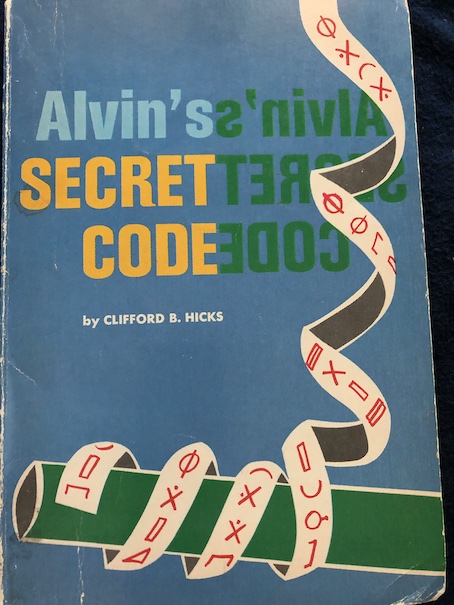
Alvin’s Secret Code

Alvin’s Secret Code by Clifford B. Hicks, 1963.

This book is part of the Alvin Fernald series.

Alvin has been reading a book about spies, and now, he and his best friend, Shoie (a nickname, his real name is Wilfred Shoemaker), are playing at being spies. One day, as the boys are walking home from school, Shoie stops to pick up another bottle top for his collection, and he finds a scrap of paper with a strange message on it. The words in the message don’t make any sense, and it looks like it’s some kind of secret code.

When Alvin gets home, his mother insists that he clean his room before he does anything else. Shoie helps him, and Alvin’s little sister, Daphne, insists that she wants to help, too, because she wants to see what the boys are doing. Daphne is fascinated by the things her older brother does and always wants to be included. When Daphne finds out that they’re being spies and have found a secret message, she also insists that she wants to be a spy and look at the message with them. They let her see the message, but they insist that she can’t be a spy because it’s dangerous and “work for men.” (That attitude comes up in mid-20th century kids’ books, especially ones for boys. I’d just like to point out here that, while dealing with spies would actually be dangerous, too dangerous for a young kid like Daphne, the fact is that both Alvin and Shoie are only twelve years old, so technically, they don’t count as “men”, either.) At first, the kids think maybe the message is meant for a secret Russian spy ring targeting the nearby defense plant. (This book was written during the Cold War, so that would be one of the first possibilities they would consider.)

Alvin comes to the conclusion that they need to investigate Mr. Pinkney, a relative newcomer to their town, because they found the message near his house, the message mentions an oak, and there’s one growing nearby. Alvin also thinks that they might need some help to break the code in the message, so he suggests that they visit Mr. Link, a WWII veteran who was also a spy during the war. He’s now an invalid who has a housekeeper who takes care of him, but he could still advise them about what to do with the mysterious message. Although the boys tell her that she can’t be involved with what they’re doing, Daphne still tags along with them when they go to see Mr. Link.

When the kids ask Mr. Link about his time as a secret agent during the war, he calls spying a “dirty, dirty business” but “something that must be done”, saying that he’s glad that it’s all over now. However, he’s perfectly willing to talk about secret codes and ciphers. Mr. Link has even written a couple of books on the subject. This story is a nice introduction to codes and ciphers for kids because it explains some of the terms and how codes and ciphers work. As Mr. Link points out, much of what people think of as secret codes are actually ciphers. The difference is that ciphers are actually secret alphabets that can be used to compose messages. When Mr. Link asks them if they’re trying to compose a cipher themselves, the kids tell him about the secret message and their suspicions that there could be a spy in their town.

Mr. Link doesn’t reject the possibility that there could be a spy in the area, but he tells them that they’re wrong to suspect Mr. Pinkney of being a spy because Mr. Pinkney is a friend of his, and he knows him very well. For a moment, Alvin wonders if they should suspect Mr. Link too, but Mr. Link anticipates the thought and says that he can prove that he’s trustworthy by telling them more about Mr. Pinkney and breaking the code for them. Mr. Link explains that Mr. Pinkney was lonely when he first came to town, and that’s how the two men started playing chess together regularly. Mr. Pinkney owns a factory that makes electronic devices, like transistor radios and intercoms, and one day, he told Mr. Link that he had a problem with his business. He suspected a business spy of trying to intercept his messages to his product distributors in Europe, and he needed a way to make his messages more secure. Naturally, Mr. Link suggested using a code, and he recognizes the coded message the kids found as one that Herman Pinkney sent to his distributors. Mr. Link shows the kids how each word in the strange message stands for another word or concept. Only someone who knew what the code words were supposed to mean would be able to read it.

Alvin is a bit embarrassed about jumping to the wrong conclusion, and Mr. Link says that he’s learned a couple of important lessons from this experience. First, you shouldn’t jump to conclusions about people if you don’t know them very well, and second, people who are full of tricks and deception are easily confused when they encounter straightforward honesty. In other words, while Alvin was spinning imaginative spy tales in his head, he overlooked the possibility that there could be a more innocent explanation. Alvin is still embarrassed, but he takes the lessons to heart, and Mr. Link tells them more about codes, how they have been used in history, and how codes are around them all the time, every day.

I liked Mr. Link’s explanations about how codes aren’t just for spies. He says that codes are used for all kinds of communications where only certain people are meant to read and understand messages. He explains about the product codes on things that the kids buy and wear everyday, showing them how to read the size codes on their shoes. Codes can indicate where and when products were made, and we still use product codes for that purpose in the 21st century. I used to work in a textbook store, and we used the codes on textbooks to tell which edition of a book students needed or whether a student needed just the textbook or if they needed books that came bundled with other, supplemental materials. Mr. Link says that ordinary people can sometimes figure out what product codes mean by studying them and looking for patterns that they recognize, like dates or sizes.

Since this book was written in the 1960s, they don’t talk about computers or the Internet, but that’s a major use of codes in the 21st century, and anybody can study and learn computer coding. Computer programming involves “coding” because, like with the other codes that Mr. Link describes, programming languages are also codes, using certain words and symbols to represent concepts that not everybody needs to read in order to use a computer, but which the computer can interpret so it knows what the programmer and user want it to do. Communications and transactions over the Internet also involve cryptography to protect the users’ information, using algorithms to convert a sender’s plaintext message to ciphertext to conceal its true meaning from any third party who might try to read the message and then back into plaintext so the intended recipient can read it. Codes really are around us all the time, even when we’re not fully aware of them or paying close attention to them.

The kids are fascinated by Mr. Link’s stories about how codes were used in history and the unusual methods people used to send secret messages, like writing them on someone’s head and then letting their hair grow out and cover it. He also shows them scytales, round pieces of wood that can be used for reading secret messages. The message would be written on a long strip in what appears to be jumbled letters. The message only makes sense when the strip is wrapped around the scytale so that the letters will align in the proper order to be read. That’s what’s shown on the cover of this book, although the picture also shows a message written with code symbols.

It’s all fun and games until a woman named Alicia Fenwick shows up in town with a puzzle that puts the kids’ abilities to the test. She comes to see Alvin’s father in his professional capacity with the police, looking for a man named J. A. Smith. Miss Fenwick explains an incident that happened to her family during the Civil War. The Fenwicks used to own a Southern plantation with slaves. (Daphne says that she doesn’t like the part of the story about the slaves, and Miss Fenwick says she doesn’t either although her great-great grandfather was apparently kind to his … which is what they all say, isn’t it? More about that in my reaction section below.) During the Civil War, her great-great grandfather was an old man. All the young men went away to fight in the war, but he stayed at home. When there were rumors of marauding bandits, he got worried that the plantation with would be a prime target for them with all the young men gone. He enlisted the help of a former slave he had freed before but who was still a friend to help him hide the Fenwick family’s valuables. They put everything they could into a chest and buried it. Unfortunately, when the bandits came, they forced the former slave, Adam Moses, to reveal the location of the chest by threatening to kill his young son. After they dug up the chest, they took Mr. Moses prisoner and forced him to help them take the chest with them further north. Eventually, Mr. Moses escaped from the bandits after they tried to kill him, and he wrote a letter to the Fenwicks saying that he was now in Indiana and that the bandits had forced him to help them rebury the chest. He said that he would try to retrieve the chest and return home with it, but sadly, he was later found murdered close to Riverton, the town where the children now live, probably killed by the same bandits who took the chest. However, the leader of the bandits was also killed shortly after that, so they never enjoyed their ill-gotten gains. The treasure chest was never recovered. The story was passed down in the Fenwick family for generations as an unsolved mystery until recently, when Miss Fenwick received a letter from J. A. Smith asking her for any information she might have about about the treasure. She told this person about the letter from Mr. Moses but didn’t hear from him again, so she’s trying to trace J. A. Smith and find out what he knows about the treasure.

Sergeant Fernald, Alvin’s father, says that there are people in town with the last name of Smith but nobody who has the initials “J. A.”. However, the kids say that Miss Fenwick’s story might explain some of the stories told by local kids about an area outside of town called Treasure Bluffs. Rumor has it that there was a treasure buried there years ago, although nobody knows exactly why or where. The kids start to think that the story really points to the location of the Fenwick treasure, but the bluffs cover a lot of territory, and before they can really search for the treasure, they have to find a way to narrow down the search area.

The kids’ new lessons in code-breaking pay off when they spot a man at the local library using the code books that Mr. Link donated. The strange man is trying to break a message that will reveal the secret hiding place of the Fenwick treasure. Can Alvin and his friends figure out who the man is and break the code themselves before he does?

The book ends with a section explaining more about codes and ciphers. One of the codes they explain is the pigpen cipher, which is a popular one for children and appears in other children’s books. This book says that it was used in the Civil War, which is true, but it’s actually older than that.

The book is available to borrow and read for free online through Internet Archive.

My Reaction and Spoilers

There are some elements in this story about boys thinking that they’re more capable than girls, like in the way that Alvin and Shoie talk to Alvin’s little sister, but Alvin also acknowledge, to his irritation, that sometimes Daphne thinks even faster than he does. When Mr. Link is explaining the size codes on the children’s shoes, 8-year-old Daphne actually catches on a little faster than 12-year-old Alvin and comes up with the answer to a problem Mr. Link poses before Alvin’s “Magnificent Brain” does. I liked that touch of imperfection on Alvin’s part and the acknowledgement of Daphne’s abilities, which help thwart any overconfidence or arrogance that Alvin might have about his “Magnificent Brain.”

I appreciated that, although Alvin is clever, he’s not a complete genius, and he is noticeably fallible. He’s not good at everything, like some heroes of children’s books. He is terrible at spelling, and when he tries to write that he’s a cryptographer, he spells it “criptogruffer,” which doesn’t inspire professional confidence. Daphne knows the correct spelling and spells it aloud for him, much to Alvin’s embarrassment and annoyance. Alvin is still pretty clever, and he breaks the final code that reveals the hiding place of the treasure, but it is nice that he’s not unbelievably perfect.

The final code in the book is easy enough that anybody could actually break it with minimal effort. I spotted it pretty quickly because there’s something that I always do with secret messages in books, and it often pays off. (There are one or two things in the Harry Potter books that this works on as well.) I’m not going to spoil it here, although I’ll give you a hint: When I was a kid, I read and liked a book about Leonardo Da Vinci.

I genuinely enjoyed the parts of the story about codes, which run through most of the book. Mr. Link is full of helpful information, and the section at the back of the book with more information about codes is a nice introduction to some basic types of codes. As I said above, I like the practical applications of the lessons, showing kids how they can read parts of product codes, if they understand what to look for. That’s a useful skill, and you can use similar techniques to interpret the expiration dates on food products when they’re only stamped with a code instead of an explicit date.

Like Daphne, I also didn’t like the part of the story about slaves. This book was written during the Civil Rights Movement, which makes its takes on the Civil War, slaves, and race interesting. The author wants to tell a story that bears on the Civil War, so he has to address this is some fashion, and he tries to get pass the uncomfortable issue of families owning slaves as quickly as he can to get to the adventure part of the story.

The Civil War and its associated legends of battles, ghosts, secret passages, hiding places, hidden treasures, and secret messages are staples of American children’s literature. It’s completely understandable because the Civil War was a major event that shaped life and history in the US, it was a traumatic event whose impact is still felt even into the 21st century, and it gave rise to many stories and legends that have further helped shape our culture. The idea of treasures hidden during the war and later forgotten is a popular trope and so are coded messages that point to secrets from the past. I’ve seen these tropes used in other children’s stories, like The Secret of the Strawbridge Place, The House of Dies Drear, and Mystery of the Secret Dolls, and they’re always fun. However, stories with a Civil War backstory can sometimes feel a little uncomfortable because they’re almost impossible to tell without involving slavery in some way because slavery was at the heart of the war.

When Daphne says that she doesn’t like hearing about slavery and owning slaves, they deal with the issue quickly, with Miss Fenwick saying she doesn’t like it, either, and adding that her great-great grandfather was apparently nice about it, and then continuing with the story. As I said above, yeah, right, that’s what they all say. In stories (and sometimes real life), when there are characters whose families owned slaves and plantations, they almost always add the idea that, while slavery was bad and horrible and slaves were mistreated elsewhere, this particular family was special and treated their slaves with kindness, and it was almost like they were one big, happy family. Yeah, right. To be honest, I probably would have accepted that as a kid and let it pass. As an adult, I’m not letting it pass without at least a few pokes in the side as it goes.

The idea of the grateful slave or ex-slave who loves the family he served has been a trope since the anti-Tom literature of the 1850s. I can’t swear that no slave never felt any kind of affection for members of the family that owned them because human nature is varied and unpredictable, surprising relationships can spring up, and if all else fails, Stockholm Syndrome also exists, so I suppose it could happen, but at the same time, I just don’t buy that whole “slavery is bad, but my family is kind, and our slaves loved us” type of narrative. Even if a given slave-owning family was “above average” in treatment of slaves, that doesn’t mean that they were “good” so much as “less bad” among a group of people perpetrating something bad. The “average” in this situation is so bad that there’s quite a lot above that level that still wouldn’t qualify as good, whether the descendants of slave owners believe those old school textbooks promoted by the United Daughters of the Confederacy (some of which were still in use during the Civil Rights Movement – children are shaped by the things they read and the people who gave them those books, and history is not written by the “winners” but by the people who write) or have really thought this through all the way or not. (You don’t have to take my word for it. You can hear about it from people who actually were slaves.) I suppose I can suspend my disbelief about this fictional family for the sake of this kids’ story, which is mostly about secret codes and a treasure hunt and spends little time on racial issues, but I’d just like to point out that I definitely do have a sense of disbelief about this that requires suspension.

Of course, I can see why the author had to include it. In order for us to be invested in the treasure hunt and care about the Fenwick family getting their fortune back, we have to believe that they’re great people, sort of removed or distanced from the responsibility for choosing to own slaves (“in those days, it was accepted throughout the South” is the only explanation we’re given), who were as kind to their slaves as possible, so kind that at least one loved them so much that he gave his life attempting to recover the family fortune, and that they will now use the treasure for some beneficial purpose. (We are told that the family now operates an orphanage, which badly needs money, although we’re also told that one of their former charges has since become a US Senator, so you’d think he could help raise some.) If we didn’t like this family at all, we might see the fortune that came from their plantation as the ill-gotten goods of exploiting someone else’s labor, its loss as poetic justice, and the profit from its recovery as probably something that should either go toward the slaves who did the work on the plantation or maybe some public cause, like a museum or something.

We are told that Adam Moses’s son survived the experience with the bandits, escaped from them when his father was captured, and was adopted by another family, but we are not told anything further about his descendants. While I was reading the book, I halfway wondered if a descendant of the Moses family would surface with some important clue to the situation and get some acknowledgement, but that doesn’t happen. Instead, there’s a person who’s related to one of the bandits, who thinks that he has a right to the treasure because his ancestor stole it from someone else. The characters in the story scoff at that logic, but when I consider the full context of the situation, it makes me think.

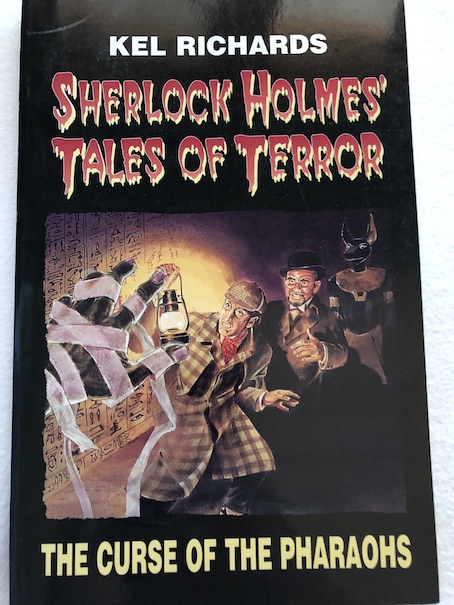
The Curse of the Pharaohs

Sherlock Holmes’ Tales of Terror

The Curse of the Pharaohs by Kel Richards, 1997.

This is the first book in a short series of spooky mysteries for children featuring Sherlock Holmes.

One foggy night, a woman named Laura Coffin comes to Baker Street to see Sherlock Holmes, and his friend, Dr. Watson. She’s very worried about her uncle, Professor Sloane Coffin, who is an Egyptologist, living in Scotland. He’s been very ill and is likely to die, but Laura is increasingly alarmed by his mental state. Her uncle has come to believe in the Ancient Egyptian religion and believes that, when he dies, he will return from the dead. He thinks this power to return from the dead and live forever will come from a diamond he found in a tomb in Egypt called the Eye of Osiris. Laura and her uncle’s doctor, Dr. Cabot, have also come to suspect that her uncle’s medical state may be due to poison, although they’re not sure who could be poisoning him. Laura has come to Sherlock Holmes because the local authorities don’t believe her.

The most likely suspects for poisoning the professor would be his lawyer, Mr. Grizzard, who has been staying in his house and seems to have a sinister and unhealthy influence over the professor; the professor’s manservant, who Laura suspects of plotting to steal her uncle’s diamond when he dies; and a mysterious Egyptian man who has been staying nearby and seems to be lurking around the professor’s property for unknown reasons. Sherlock Holmes promises Laura that he and Dr. Watson will come to Scotland and investigate her uncle’s condition. Privately, he tells Dr. Watson that he thinks that there is something else that’s bothering Laura, something that she’s not telling them.

When they arrive in Scotland, Laura is glad to see them, although Mr. Grizzard isn’t. Laura introduces them to Dr. Cabot and her uncle. Dr. Watson doesn’t recognize the disease that the professor is suffering from, and Dr. Cabot says that he can’t figure out why the professor is so sick. Based on the tests he’s done, the professor really shouldn’t be this bad, but he does look like he’s dying. The professor accuses his niece and everyone else of only being concerned about his diamond. The professor confirms that he believes everything that his niece said earlier. He says that he believes in Ancient Egyptian gods (he calls them “gods of darkness”, which doesn’t seem scholarly), and he believes that, through his diamond, they will bring him back to life, and he will live forever.

Soon after Holmes and Watson meet the professor, he suddenly dies. Mr. Grizzard explains the professor’s will and final wishes. Laura is the professor’s primary heir, but she cannot take possession of the estate until she is 21 years old, so Mr. Grizzard will be in charge of the estate as executor until then. The professor had an Egyptian-style tomb built in his backyard, and his wish was to be buried there, along with his diamond. Mr. Grizzard makes certain that the professor’s requests are carried out, including the requirement that the tomb must be able to unlock from the inside.

Holmes spots a man spying on the funeral. He and Watson take turns watching this man as he seems to be observing the tomb and waiting for something. As Watson watches this man during a storm, he sees the door of the tomb open and the professor come out! Unfortunately, Watson is knocked unconscious by a falling tree branch. When he wakes up, there is no sign of the professor, and the man who was spying on the tomb has been murdered!

Did Watson really see what he thought he saw? Did the professor really rise from his tomb and kill the man watching him? Why was this man watching the tomb in the first place? What will the professor do now, and what does he want?

My Reaction

When I first got this book, I wasn’t quite sure what to expect. Pastiches can take familiar characters in some unusual directions, and I had read a review criticizing this series for adding supernatural elements and Christian themes that weren’t found in the original Sherlock Holmes stories. I thought that the story would probably be a pseudo-ghost story, somewhat like Scooby-Doo mysteries, where it seems like something supernatural is happening, but there’s actually a rational, more physical explanation. However, I wasn’t completely sure for most of the book whether that would be the case or not. There’s room left for readers to wonder whether Professor Coffin has really risen from the dead or not.

For those who prefer the ghosts to have logical explanations … you won’t be disappointed. There is a rational explanation for everything that happens in the story, and there are multiple people who could be good candidates for the villain behind everything that happens. Some of my suspicions turned out to be correct, but there are actually multiple villains involved, which complicates the situation and offers surprises for readers.

The other reviewer was right that there are Christian themes in the story. The Christian themes don’t really come into the story until the end, when Holmes and Watson are discussing the case with Laura Coffin. Laura asks why God allows people to behave wickedly. Holmes and Watson say that it’s not so much a matter of God allowing it as people choosing to commit evil deeds, and reassuring her that, sooner or later, everyone faces the judgement of God. Laura feels disillusioned about some of the people she trusted, but they also reassure her that, as a wealthy young heiress, she has her life still ahead of her to enjoy, and she will find better people. The religious talk and the quote from the Bible do seem a little out of character because I can’t recall the characters focusing on religious morals in the original stories so much as the deductive process, but I didn’t think it was bad. It was just a brief conversation, not overdone. If the characters had talked that way all the way through the book, it might have been a bit much, but it seemed plausible enough for a brief conversation on the subject.

The themes of the story reminded me of the Sherlock Holmes computer game The Mystery of the Mummy, but the story in that computer game isn’t the same one in this book.

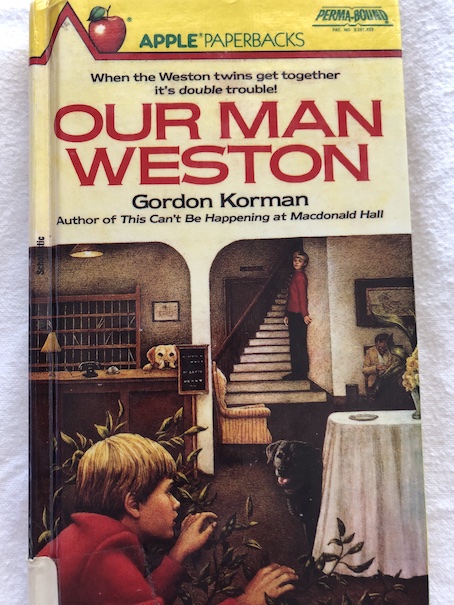
Our Man Weston

Our Man Weston by Gordon Korman, 1982.

Tom and Sidney Weston, a pair of identical twins, are excited about their first big summer jobs as service boys at a fancy resort hotel. Tom is thinking that the work is going to be easy and that they’ll have plenty of time to have fun, but then, he starts worrying about what kind of fun Sidney is going to try to have. Sidney mentions that they might see some interesting people at the hotel, and Tom remembers that Sidney thinks of himself as a detective and is always on the lookout for spies and criminals. It’s a real problem because Sidney is perpetually wrong in his suspicions about everything and everyone he tries to investigate. He’s gotten into trouble before for making false accusations, and because the two boys look alike, Tom sometimes gets blamed for things that Sidney does. Tom is really looking forward to this summer, and he’s determined that Sidney isn’t going to ruin their summer jobs.

Right from the first, Sidney is in detective mode. As the boys are picking up room service dishes, Sidney tries to study the dishes to make deductions about the people in each room. Tom tries to get Sidney to stop because their manager, Walter Parson, is a serious man with little patience, and he’s already annoyed that he has trouble telling the two boys apart. Sidney is excited when a hotel guest complains that her purse is missing, thinking that he’s found a case to investigate, but while he interviews her for details and pressing for details about a primary suspect, Tom just notices that the lady’s purse is still in her room. It wasn’t stolen, just misplaced. Tom uses this incident to emphasize to Sidney that he needs to give up this detective game because it only causes problems.

However, unbeknownst to the boys, there are real spies at the hotel, and they’re interested in the nearby air base, just like Sidney speculated might happen. The readers learn who the spies are right in the beginning, before the boys even know that there are spies. It’s a little like a Columbo mystery, where the identities of the villains aren’t a secret, and part of the suspense of the story is how the heroes will figure it out and prove it. Even though we know right away who the main villains are, Sidney is clueless.

Sidney continues investigating various guests as though they’re all spies or criminals, although he doesn’t seem at all suspicious of our real villains. He becomes convinced that Lawrence Waghorn is a spy when he’s actually a television writer who’s working on a script for a show about spies. He convinces the guest who temporarily lost her purse, Miss Fuller, that another guest, Mr. Kitzel, is a suspicious character, and she starts following him around and spying on him. In turn, Mr. Kitzel gets the idea that Miss Fuller either has an awkward crush on him or that she’s investigating him because he cheated on his taxes. He’s very nervous because she keeps following him around and tries his best to avoid her. Sidney steals his boss’s dog because he’s under the false impression that the dog is being trained to help the spies carry out their mission, and he seriously wants to inform the Prime Minister of Canada (where they live) and the President of the United States. Tom keeps trying to thwart his brothers’ various schemes and confiscate the spy equipment that he’s hidden around their hotel room. Confusion abounds, although some of its helps to inspire Waghorn, who has been suffering from a case of writer’s block.

Meanwhile, the real spy, Richard Knight (a pseudonym, county of origin unspecified), is trying to get his hands on a new airplane being tested at the nearby air base. He’s brought along a pilot named Bert Cobber. Cobber actually has military training and trained alongside the pilot testing the plane, “Wings” Weinberg. Weinberg has nerves of steel … except about anything related to his cadet days, having been partnered with Cobber, who is a skilled but reckless flier and nearly got him killed on many occasions while flying drunk, forgetting to put sufficient fuel in the plane, and repeatedly crashing. Weinberg hasn’t seen Cobber for years, but he practically has a nervous breakdown every time he relives those memories. A friend of Weinberg’s assures him that, if Cobber is really as reckless as Weinberg remembers, he probably got himself killed long ago, but Weinberg has the uneasy feeling that Cobber is still around somewhere.

Although many characters have the overall situation wrong, I appreciated those moments when some people got certain things exactly right. When Miss Fuller overhears Mr. Parson yet again mistaking Tom for Sidney and also quizzing him about why he’s getting mail from different government agencies, she steps up to tell him to stop his bullying, reminding him that mail is private and that the boy doesn’t owe him any explanation about his personal mail just because he works for him. She also tells him that he’s talking to Tom, not Sidney, and that he’s a fool for getting that wrong.

I also love it that the different government agencies that Sidney has been writing to already know who he is because Sidney has submitted many other inquiries to these various agencies. They’re all familiar with Sidney’s false accusations, and in their response letters to Sidney, they express both amusement for Sidney’s wild escapades and sympathy for whatever poor sap Sidney is suspicious of today. Sidney is never discouraged by their criticism of his wild theories or their requests for him to stop writing. It’s getting to the point where some law enforcement agencies are so fed up with Sidney that they wish they could find something to arrest him for.

Meanwhile, Richard Knight has noticed Sidney’s investigations, although he is unimpressed because he knows that Sidney is way off base. However, he hasn’t fully reckoned with the lengths Sidney is prepared to go to “save the western world”, and Sidney’s schemes interfere with Knight’s in completely unexpected ways.

My Reaction

I remember reading this book when I was in middle school, and I loved it. I remember thinking that it was really funny, although I’d forgotten a lot of the details since then. As an adult, I find Sidney more frustrating than I remember, and I feel sorry for poor, long-suffering Tom. As with the MacDonald Hall books by the same author but with different characters, Sidney’s crazy schemes end up working out for the best, and he ultimately saves the day, even though it’s largely by accident.

There are a couple of changes that I wish I could make to the story. First, I liked it that, while Mr. Kitzel isn’t a spy or a major criminal, he does have one guilty secret: he cheated on his taxes by claiming his dog as a dependent daughter. He becomes convinced that Miss Fuller is onto him for that. However, I’d like to create even more semi-guilty secrets for various guests at the hotel so that Sidney can be almost correct about some things while still missing the most suspicious person of all. As it is, Sidney is seriously way off base because he’s paranoid and delusional, although in a comedic sort of way. I don’t like characters that are intentionally stupid, so I’d like more secrets and petty crimes among the more innocent guests so Sidney can be almost right about them.

I’d also like to see Sidney develop some self-awareness during the course of the story. He is completely oblivious to his own failings and false conclusions and also to the way other people react to him, even when they tell him, in writing, that they don’t want to be bothered with his wild goose chases anymore. That’s part of the comedy of the story, but I find it a bit frustrating. Sidney does almost come to realize how other people look at him when he tries to persuade Miss Fuller that he was wrong about Mr. Kitzel being a spy, but she’s as impervious to correction as he is, so he ends up just letting her continue barking up the wrong tree. I think it would have shown more character development and maybe even have been more funny if Sidney comes to realize how Tom feels, trying to reign him in, if he had to try to control someone even more overly paranoid and determined than he is. The book ends well, but I think it would have been even better if, at the end, Sidney apologizes to Tom for everything he’s put him through, saying that, while everything worked out for the best, he realizes that he’s done a lot of things wrong and that he still has a lot to learn. Then, just when Tom thinks that things are going to calm down, he can see Sidney seriously reading a book about espionage or interrogation techniques and making notes or signing up for a summer correspondence course in criminal investigation, hinting that Sidney’s adventures aren’t over yet and leaving it open about whether he’s going to really learn something practical or just graduate to the next level of crazy.

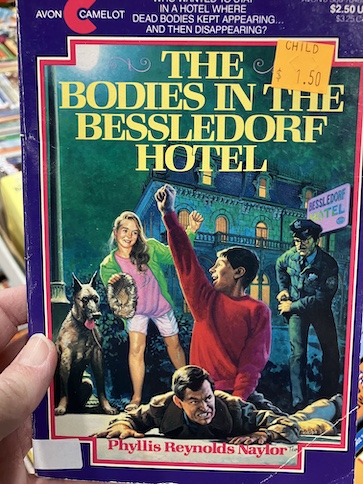
The Bodies in the Bessledorf Hotel

Officer Feeney is the first person who suggests that, someday, there might be a dead body at the Bessledorf Hotel. The hotel is coincidentally located next to the local funeral parlor, which is why the subject of dead bodies comes up, and Officer Feeney has a way of suggesting frightening things that scare Bernie Magruder, son of the hotel’s manager. Officer Feeney’s reasoning is that most people die in bed, so it only makes sense that some of them would be hotel beds. The hotel has 30 rooms, and with people coming and going, it’s surely just a matter of time before a guest dies there. It’s a morbid thought, although Bernie reasons that Officer Feeney is overestimating the number of people who pass through the hotel because it isn’t always full and some of the guests are long-term residents.

Still, Bernie gets a shock after he returns to the hotel, and the cleaning lady, Hildegarde bursts in on him and his parents, hysterical about finding a body in a bathtub of Room 107 with all his clothes on. Bernie’s father tells his wife to call Officer Feeney to write a report of the death and considers whether they can remove the body secretly, perhaps in a laundry cart, to avoid bad publicity for the hotel. Unfortunately, some of their guests already heard Hildegarde screaming about a dead body, so word is out. They want to know if it’s a case of murder or suicide and how it’s being investigated, and one of the long-term guests, who is a poet, has already written a short poem for the occasion.

However, by the time they all get to the room where Hildegarde saw the body, it’s gone. There is nothing in the bathtub, not even water. Officer Feeney shows up and demands to know what’s going on, and Hildegarde insists that she really saw something. The Magruders believe her, but they have no explanation for where the body could have gone. The guests speculate about body-snatchers and ghosts.

All they know about the man who occupied that room is that he gave his name as Phillip A. Gusset, he checked in the evening before, and he said that he would be leaving the next morning. Officer Feeney asks them if there was anything odd about him, like if he seemed nervous or unwell. Nobody remembers anything like that. They remember that he had a mustache and a hat with a red feather and just a single bag with him. He did kind of make Bernie’s parents uneasy, and he seemed to have a strange scent about him, although they find it difficult to describe what it actually smelled like. Officer Feeney says that, without a body or any evidence that something has happened, there doesn’t seem like anything to investigate. Bernie’s father is relieved that there won’t be any report of a murder or death occurring at the hotel because, otherwise, the owner might fire him. Bernie remembers that the man’s slippers were still in the room and goes to get them in case they’re evidence. When he gets there, he discovers that the slippers have mysteriously disappeared.

Bernie’s friends, Weasel and Georgene, think that people will probably never want to rent that hotel room ever again, and Bernie’s father renumbers the rooms so there will be no Room 107. Weasel convinces Bernie and Georgene to help him search the area for the body, thinking that whoever took it would most likely want to dispose of it quickly. They search down by the river, but they only find a bag of garbage that Bernie’s younger brother, Lester, left there to trick them.

Even though there’s no evidence that anything happened and the police aren’t investigating the situation, the incident of the disappearing guest appears in a newspaper in Indianapolis, where the hotel owner, Mr. Fairchild, lives. Mr. Fairchild calls the hotel to demand to know what’s going on. Mr. Fairchild says that he want the hotel to put on live entertainment in the evening on weekends to draw attention away from the incident and bring people in. However, he expects Bernie’s father to hire the entertainment out of his own money since Mr. Fairchild thinks this situation is his fault, and most entertainment is out of the Magruders’ price range. Fortunately, Bernie’s father has joined a barbershop quartet, so his group can do their singing at the hotel.

The singing goes well, but a strange woman with orange hair checks into the hotel and keeps making comments about dead bodies there. Then, one of the waiters finds this woman dead in her room, Room 321. Just like the first body, this body also vanishes. By this time, Bernie’s father suspects that the woman faked her “death” just to scare the waiter and ran away as soon as he was gone. As Bernie’s parents investigate the room, they notice an odd smell that reminds them of the first guest who disappeared. The smell really unnerves his father, but strangely, not his mother. It’s a faint smell that’s difficult to identify, but it conjures different images for both of them. Bernie’s father says it reminds him of sweaty clothes, cigars, and pastrami, while his mother says it makes her think of flowers and a porch swing in the evening.

The Magruders aren’t sure why someone wants to fake deaths at the hotel, but this latest faker didn’t pay for either her room or dinner, and somehow, the newspaper has heard about it and reported it again. Mr. Fairchild is angry, and Bernie knows that they need to figure out who the prankster is before they do it again!

The book is part of the Bessledorf mystery series, also known as the Bernie Magruder series. It is available to borrow and read for free online through Internet Archive (multiple copies).

Attempts to investigate the mystery alternate with the Magruders’ attempts at cheap hotel entertainment. The barbershop quartet works until one of the members gets laryngitis. Some of the guests start a food fight when the entertainment is bad. Then, Joseph gets some of his friends from the veterinary college who play instruments to come. Personally, I like the part where Lester suggests that they hold a haunted house at the hotel and take people on tours of the rooms where “dead” bodies have been found. They reject that idea, but there are hotels and bed-and-breakfasts that give haunted tours, and people come to investigate ghosts. That actually can be a successful gimmick. I once intentionally stayed in a supposedly haunted hospital that had been turned into a hotel in an old western mining town. A possible murder once occurred there, but I enjoyed the visit.

When a new guest shows up at the hotel with that same, strange scent, Bernie knows that it’s their culprit, back again in another disguise. Now that he knows who to watch, he starts planning how they’re going to trap the person.

I had a couple of ideas in beginning about who was doing all of this and why, but there are some surprising twists in the story. Bernie’s first attempt to catch the villain is weirdly thwarted by the discovery of a dead body that is actually a real, dead person. It’s not a guest; it’s a body stolen from the funeral parlor next door. The bad guy decided to change his tactics.

One of the clues to the person’s identity is that mysterious smell and the way it has an opposite effect on Bernie’s parents. It irritates Bernie’s father but makes his mother feel strangely nostalgic. The truth is that they’re both remembering the same thing or the same person, but although they can’t remember right away exactly what they’re remembering, they have very different feelings about it.

Surprisingly, although Mr. Fairchild threatens to replace Mr. Magruder with another manager, he actually shows up at the hotel himself and discovers that he likes playing detective and figuring out what’s going on. He’s also impressed with the way Mr. Magruder stayed to finish managing things even after he told him that he was planning to hire someone to replace him, and that secures the family’s position.

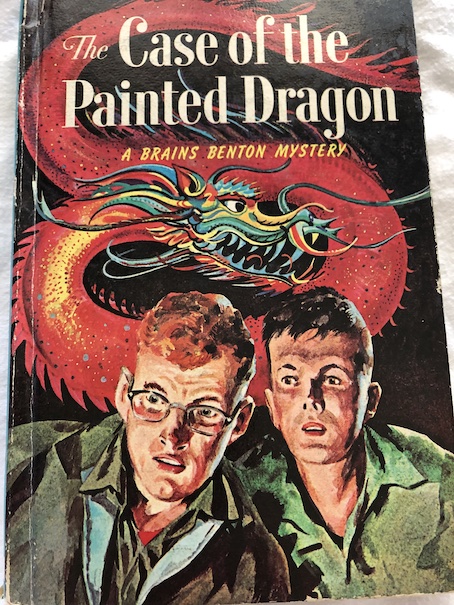
The Case of the Painted Dragon

Brains Benton

The Case of the Painted Dragon by by George Wyatt (Charles Spain Verral), 1961.

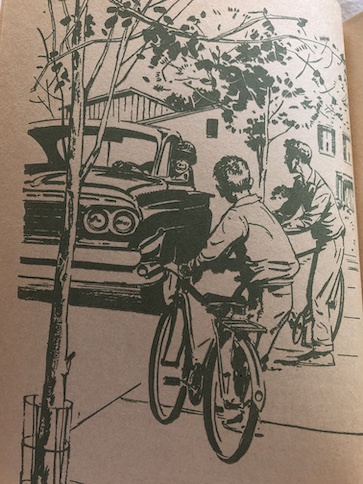
Jimmy and Brains are on their way to school when a strange man in a car stops and asks them if they know where he can find a Japanese kid. (He uses the derogatory terms “Jap” and “Nip”, and Brains disapproves. Also, the man is very unspecific about which kid he’s looking for. He offers no names, just that he’s looking for a Japanese boy about their age The town where the boys live is a fairly small college town, so I guess it’s supposed to be reasonable that there would only be one boy matching that description. I grew up in a larger university town, so the idea of there being only one person who could match any description and just expecting random people to know who it is seems really odd to me.) Brains just says that they don’t know anybody with Japanese ancestry, and the man drives away.

After the man leaves, the boy talk about how suspicious he was. They really don’t know who he could be looking for. The last Japanese family to live in their town was the Yamadas, but Mrs. and Mrs. Yamada were killed in a car accident the year before. (It was a point in the book’s favor that Brains doesn’t like derogatory racial terms, but the point is lost quickly when Jimmy is describing Mr. Yamada, who taught art at the boys’ school, and he says that Mr. Yamada “wasn’t one of those ‘inscrutable orientals’ you’re always reading about.” He says that Mr. Yamada was friendly and also coached the school’s swimming team. It’s nice that Jimmy liked Mr. Yamada, but the way he says it sounds a little back-handed. I suppose it’s a sign of the times when this book was written that the author thought it was reasonable for people, even kids, to “always” be reading about “inscrutable orientals”, but on the other hand, I’ve read other books from this time period and earlier that weren’t like that, so I’m inclined to think that it’s not really “always” and everyone.) However, the boys don’t remember the Yamadas having a son their age, so they doubt there’s a connection. They’re concerned because they think that the suspicious stranger might have bad intentions toward the kid he’s looking for.

After the boys get to school, Jimmy sees that stranger driving by the school, and he gets worried. Either the stranger is still looking for the Japanese boy, or he’s looking for Brains and Jimmy. Brains thinks that the best thing to do is try to find the Japanese boy before the man does. However, Brains doesn’t want to tell their principal or teacher about the stranger or the boy. Jimmy worries that maybe the stranger made up the Japanese boy as an excuse to get to him and Brain, and he decides to tell the principal about the stranger in the car, and the principal goes outside and demands that the stranger tell him who he is and what he’s doing, hanging around the school and scaring the students. Unfortunately, he confronts the wrong person in the wrong car, which is an embarrassing situation. (He did the right thing even if he confronted the wrong person. I give him credit for that, but they need to have a reason why the school authorities don’t do anything about the weirdo scouting the students.)

In the boys’ next class, they meet a new student, Mikko, who may be the Japanese boy that the stranger was looking for. The boys make friends with Mikko, inviting him to come to baseball practice with them. They want to warn him about the stranger, but before they talk to him about thr man who seems to be looking for him, they spot the car following them again. Mikko spots the car, too, and the boys ask him if he knows the driver. Mikko says, no, the man is a stranger. Aside from the people at school, the only people Mikko knows in town are Mr. and Mrs. Bevans, the people he’s staying with. Brains makes up a story about why the man might be following them because he doesn’t want to alarm Mikko too much and also because he doesn’t want anybody calling the police until he and Jimmy have had a chance to investigate the situation themselves. (This is a selfish move – Brains just wants a case to investigate, and he doesn’t want to share the case with the proper authorities. But, again, the story needs to provide a reason for Brains and Jimmy to handle the investigation without adult help.)

Jimmy’s mother knows about Mikko’s background and tells him about it when he gets home. It turns out that Mikko is the Yamadas’ son, but until recently, he had been living with relatives in Japan. Mr. Yamada was born in the US, but he worked in Army Intelligence during WWII, which is when he went to Japan and met his wife. Mikko had been born in Japan and was going to school there, but the Yamadas planned to move to the US permanently. Mr. and Mrs. Yamada had come first to get established, but they died in the car accident before they could bring Mikko to join them in the US. However, Mr. Yamada had wanted his son to become an American citizen, like him, and get an American education. The Yamadas had boarded with Mr. and Mrs. Bevans and became friends with them. The Bevanses’ have no children of their own, and they are considering adopting Mikko and giving him the American life that his father wanted him to have.

There is one adult who knows about the mysterious car following Mikko: Yama, an old family servant who accompanied Mikko from Japan to the US to make sure that he gets settled in his new home. Yama is a former sumo wrestler and a formidable man, and when Mikko tells him about the mysterious stranger in the black car, Yama says that he will protect him. However, when the Bevanses’ house is ransacked while the boys are playing baseball and they return and find Yama looking around Mikko’s room, they boys start to suspect that Yama may be involved with the mysterious stranger in some way. At least, he seems to know more than he wants to say about the situation because he refuses to call the police to report the ransacking.

After some further research, Brains and Jimmy learn that the Yamadas’ car accident might not have entirely been an accident, and Brains suspects that everything that has happened may relate somehow to Mr. Yamada’s former work in Army Intelligence.

My Reaction

This is the last book in the Brain Benton series, but it’s also more of a mystery than the previous books. In most of the books, it doesn’t take the boys long to realize who the villains are, and the mystery is more about how they’re going to prove it and stop the bad guys. However, in this book, Brains and Jimmy really do start off completely in the dark. First, they have to learn who the Japanese boy is that the strange man is looking for, and then, they have to learn the history of Mikko and his family. Brains and Jimmy do genuine investigative work, starting with old newspaper stories about the accident that killed Mikko’s parents. Little by little, they begin to reconstruct the past and learn why someone is looking for Mikko and what Mikko has that they want. Even when the boys know who the bad guys are and what they’re after, there is still the puzzle of where Mikko’s father hid it before he died.

I enjoyed the mystery in the book, but I didn’t like some of the ways Jimmy talked about Japanese people. I think it was good that he noted that derogatory terms are inappropriate, and I appreciated that he liked Mikko pretty quickly and pointed out good things about him. Those are good points. It’s just that, sometimes, even when Jimmy speaks favorable about some of the Japanese people in the story, it comes off sounding a little back-handed, like when he says that Mr. Yamada was actually a really nice and friendly guy and not “inscrutable” like characters Jimmy has heard about. I can see that it’s a positive point that someone who has been given a negative impression about certain types of people can consciously notice that the reality is both different and better than what he’s heard before. I think Jimmy is moving in a good direction in his attitudes. It’s just that compliments sound flat when they’re accompanied by a negative or implied negative. It’s like the difference between saying “He’s a really nice guy” vs. “He’s a really nice guy for being the kind of person I’ve always heard was really sinister.” It just adds an uncomfortable twist on the sentiment. I know that the reason Jimmy talks like this is because this book was written during the 1960s, when racial attitudes were changing, and the author probably felt like it was necessary to acknowledge old stereotypes, but I still don’t like it.