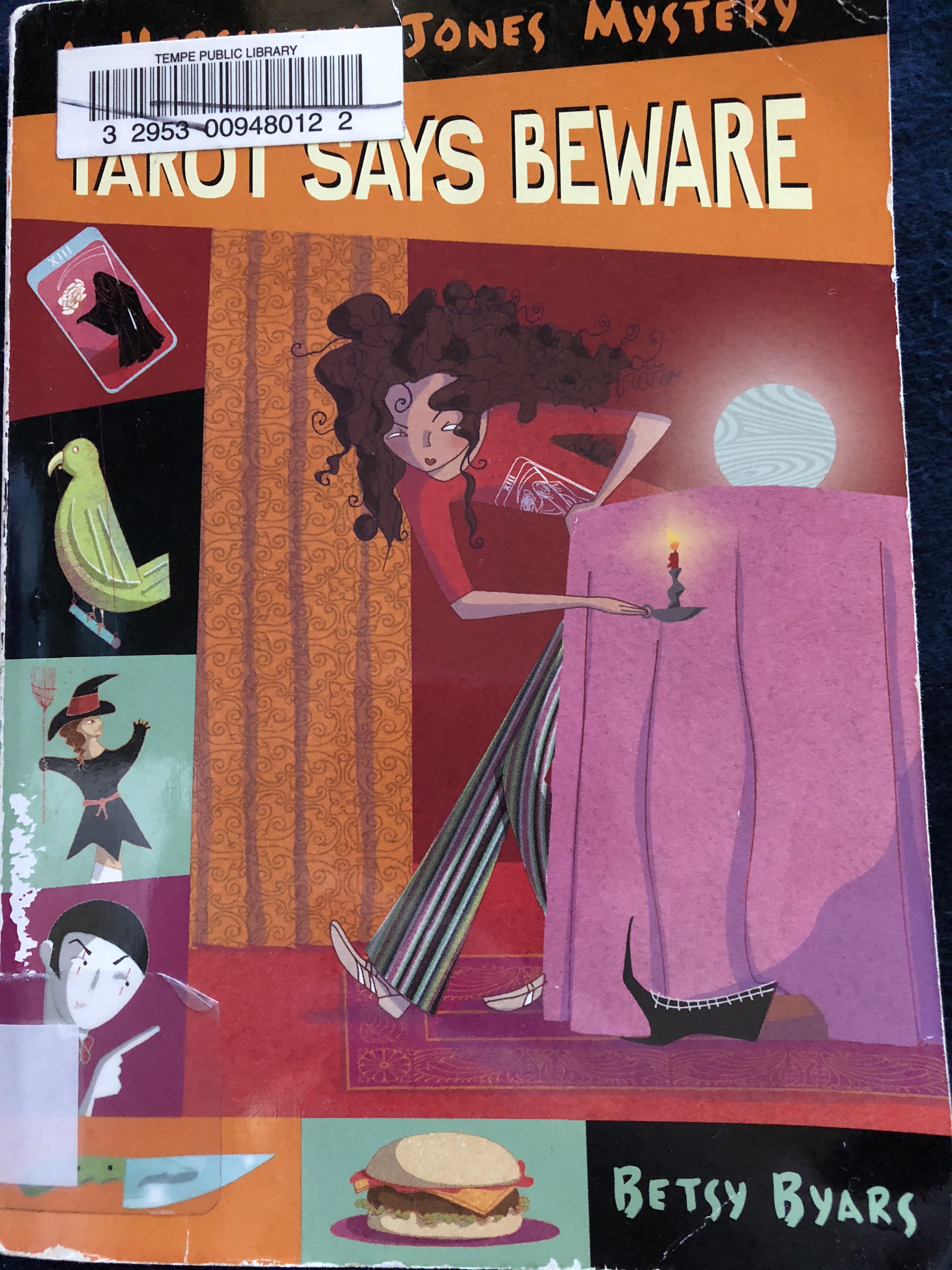
The Mystery of the Silent Nightingale

Three Cousins Detective Club

#2 The Mystery of the Silent Nightingale by Elspeth Campbell Murphy, 1994.

Sarah-Jane’s baby-sitter and friend, Kelly, is graduating from high school. Soon, she will be going away to college. Sarah-Jane is sad that she is leaving, but she is happy her family was able to find her a nice graduation present.

After they pick out their present, Sarah-Jane sees a locket with a nightingale on it in a store window. The nightingale is a Christian symbol for joy, and Sarah-Jane thinks that it would have made a nice present for Kelly if they didn’t already have one.

To everyone’s surprise, someone else buys the locket and leaves it at Kelly’s house. Sarah-Jane feels a little strange that someone else took the idea that she’d had for Kelly’s present. However, it is even more mysterious that there is no note or card with it to say who it is from. Kelly asks the cousins to help her find out who gave her the locket so that she can thank them. As it turns out, the present isn’t just an ordinary graduation present. It’s actually a thank you from someone who has been grateful to Kelly for a long time for a kindness she wasn’t even aware that she had done. Sarah-Jane even had a hand in it herself although she also wasn’t aware of it. Sometimes, it’s the smallest good deeds that can make the biggest difference in someone’s life.

The theme of the story is joy.

The book is available to borrow for free online through Internet Archive.

Themes and Spoilers:

The person who left the present for Kelly is Janice, who works for Kelly’s father. The kids had wondered why she seemed to recognize them when they stopped by Kelly’s father’s office early to show him Kelly’s graduation gown. It turns out that Janice has been grateful to Kelly for years for something kind that Kelly did for her when the cousins were very young. Kelly always used to read to the cousins when they were small, particularly Sarah-Jane. She took Sarah-Jane and the others to the library the day that Sarah-Jane got her first library card. That same day, Janice was also at the library.

Janice had never learned to read and was unable to finish her education. For a long time, she was ashamed to admit to anyone that she couldn’t read. Then, she heard about classes at the library for adults who had never learned to read and decided to go there. When she got to the library, she didn’t know where the classes were being held. She couldn’t read the signs, and she was too embarrassed to ask the librarian. There were some people she knew in the library, and she was so afraid of any of them finding out why she was there that she almost left. Then, Janice saw Kelly with Sarah-Jane and the boys. She saw how happy Sarah-Jane was to get her new library card, and she decided that she really wanted to learn to read, too. Janice knew that Kelly wouldn’t look down on her like some adults would, so she asked Kelly to help her find the class. Kelly helped her, even though she forgot about it later, and Janice was grateful to her for keeping her from backing out.

After Janice learned to read, she was able to finish her education. When she realized that the girl who had helped her years ago was her boss’s daughter, she wanted to give her a present. She wanted it kept secret at first because she was still embarrassed that it took her so long to learn to read. She was worried about what her boss would think of her. However, Kelly’s father doesn’t hold it against her, and Janice’s strict supervisor, Dorothy, even asks her to help tutor her grandson, who has been having learning difficulties.

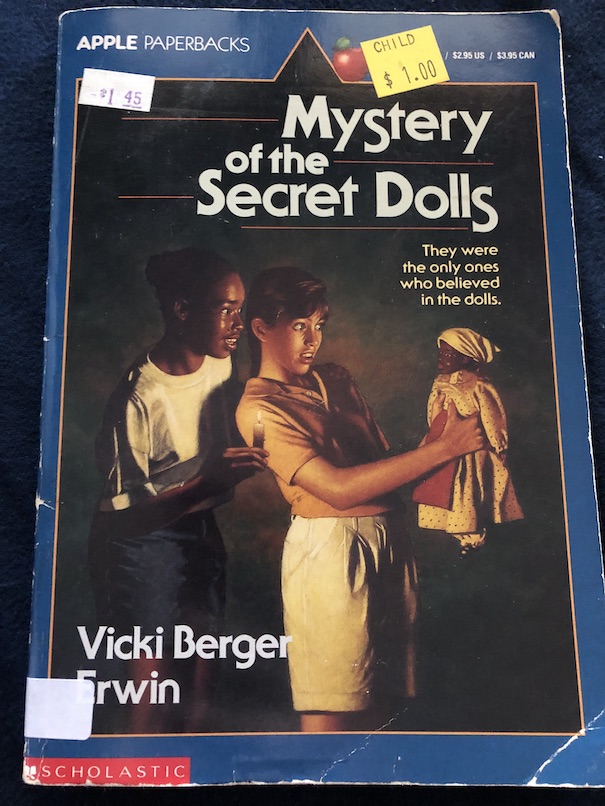
Mystery of the Secret Dolls

Mystery of the Secret Dolls Cover

Mystery of the Secret Dolls by Vicki Berger Erwin, 1993.

Bonnie Scott is visiting her great-aunts, Nell and Mollie, in Callaway County over the summer. Aunt Nell invited her to come and help set up her new doll museum, but Bonnie also wants to take advantage of the trip to work on a project about family history. Aunt Mollie has a restaurant, and Bonnie wants to talk to her about old family recipes that she uses and make a book about them. Unfortunately, when Bonnie arrives in her aunts’ town, she learns that Aunt Mollie has closed her restaurant and is helping Aunt Nell with her doll museum. From Bonnie’s awkward arrival, when no one comes to meet her at the bus stop and Marc, the grandson of the local doctor, Dr. Allen, has to help her find her way to her aunts’ house, she begins to see that things aren’t quite what she thought they were in her family and in her aunts’ town.

The reason why no one came to meet Bonnie is that Aunt Nell accidentally injured herself when she fell off a table she was standing on in order to change a light bulb. She broke her leg and had to go to the doctor. Now that Aunt Nell is in a wheelchair, she says that she will especially need Bonnie’s help, although Aunt Nell and Aunt Mollie also have a young black girl, Lynette Key, staying with them and helping out. Lynette is the daughter of an old family friend, and her family’s history is intertwined with Bonnie’s family. Through her aunts and Lynette, Bonnie comes to understand a little more about her family’s history with dolls and the relationship between Aunt Nell and Aunt Mollie.

Aunt Nell is the older of the two sisters, and she’s been bossing Aunt Mollie around for years, and she’s apparently the one who convinced Mollie to close her restaurant and help her with the doll museum project. The old family home belongs to both of them, although Mollie lived in another house while her husband was still alive. Now that both women are childless widows and Mollie has moved back into the family home, Nell has gone back to her old ways of bossing Mollie around. Bonnie is alarmed when Mollie reveals that there has been a break-in, vandalism, and a fire, apparently deliberate, at the museum, and she thinks that Nell should put off the opening, but Nell is trying to ignore the situation and charge ahead with the project, dragging Mollie and Bonnie with her. The aunts are going to have a security system installed at the museum.

Aunt Nell says their family, the Scotts, have made dolls for about 150 years. She shows Bonnie her doll collection, including the portrait dolls, startlingly realistic dolls made of every member of their family, including Bonnie’s ancestors, like her great-great-great-grandfather who fought for the Confederacy during the Civil War. Aunt Nell apparently strongly identifies with the South and Confederacy because she keeps trying to blame the troubles at the museum on “some Yankee.” Not in a specific sense and not necessarily with any particular person in mind (although there is one person who is also labeled as a Yankee who is a suspect for awhile), it’s more that she just generally associates Yankees with bad stuff, and she says that she hopes that Bonnie hasn’t turned into a Yankee from living in a big city like St. Louis. Although the dolls belong to both of the sisters, Aunt Nell really thinks of the dolls as being hers, and she’s determined to make Bonnie’s family history project about the dolls, whether Bonnie wants it to be or not. Aunt Nell says that Lynette’s grandmother used to work for her, making dolls, and she’s pleased that Lynette shares her interest in dolls, but Lynette privately tells Bonnie that the situation goes deeper than that.

As you might have guessed, Aunt Nell’s mental version of history, including the history of her own family, isn’t entirely accurate. Marc lends Bonnie a history book about the area written by his grandfather, but Lynette tells Bonnie not to let Aunt Nell see it because she and Dr. Allen have very different views about history, and Dr. Allen is a “Yankee.” Bonnie asks her what she means by that, and Lynette says that the Scotts have never gotten over being on the losing side of the Civil War. Dr. Allen, by contrast, believes that the Civil War turned out just fine with the South losing, which makes him a Yankee. It matters because Aunt Nell’s interpretation and attitude toward the past is affecting life in the present.

Although Aunt Nell is mentally on the side of the Confederacy, she doesn’t say anything in support of the idea of slavery and doesn’t seem to have bad feelings about Lynette being black. Nell is actually very fond of Lynette, treating her almost like a young niece, and I suspect that Nell probably mentally replaces the word “slave” with “servant” in her head, as some of the other characters in the book do until Lynette reminds them that there’s a difference and it matters. Nell’s attachment to her family’s grand history (which may not be quite what she makes it out to be) and her feeling that the doll-making business must pass to a blood relative keep her from fully seeing the potential that Lynette has to continue the doll-making traditions that their families both share, something that Lynette really wants to do.

Lynette says that women in her family have worked for the Scott women for generations, making dolls. They were originally slaves belonging to the Scott family, and they even shared the same last name because slaves were sometimes given the surnames of their masters. (In my home town, I’ve met black people with the surname White, which might seem a little odd and contradictory, but this is the probable reason why they have that last name.) Some slaves changed their last names after Emancipation, but not all. Lynette says that even after her ancestors were freed from slavery, one of her ancestors, Rosa, chose to keep the last name Scott because of her connection to the doll-making business.

Lynette points out a section in Dr. Allen’s history book about the Scott dolls having a connection to the Underground Railroad because some of them seemed to have been used as signals for escaping slaves. Margaret Scott, an ancestor of Bonnie’s, used to make black dolls, each with a distinctive little red heart sewn on the chest, and after she made one, a slave would mysteriously disappear. She eventually had to stop doing it because people in the area were getting suspicious of her and put pressure on her to stop. In fact, Lynette says Margaret’s own father, the Confederate colonel, tried forced her to stop, saying that he’d close down her doll-making business if she didn’t, but that Margaret and Rosa actually continued making the black dolls in secret, something that Aunt Nell doesn’t believe. The history book notes that the dolls are rare and valuable collectors’ items. Lynette says that Aunt Nell only has one of these black dolls, and she keeps it locked up for safe-keeping, denying that there even are others, but Lynette is sure that there are more, possibly hidden somewhere. Lynette wants to find these dolls, not only because they are valuable but because they can help prove her family’s connection to the Scott doll-making business. Lynette says that her ancestors never got the credit for the beautiful dolls they made because they were only ever slaves or employees of the Scotts, and the entire doll business was in the Scott family name.

Lynette wants to become a doll maker herself, but Aunt Nell really wants Bonnie to take over the family tradition, even though Bonnie has never really been interested in dolls and would prefer to talk cooking and recipes with Aunt Mollie. The realistic dolls portrait dolls actually kind of give Bonnie the creeps, but Lynette has a sentimental attachment to them because she’s been around them all her life, since her grandmother was a doll maker. Once Bonnie understands the history between her family and Lynette’s and Lynette’s doll-making ambitions, she sees why Lynette seemed a little cold to her at their first meeting, but she isn’t interested in learning the doll business or competing with Lynette to be Aunt Nell’s successor. Even though Aunt Nell is bossy and doesn’t understand Lynette’s deep desire to be a doll maker and continue the Scott doll-making business, Lynette kind of likes her and wants to show her that she is just as attached to the doll-making traditions as she is. Lynette and Bonnie make a deal that Lynette will help Bonnie get the recipes she wants from Aunt Mollie if Bonnie will talk to Aunt Nell about the black dolls and try to get more information about them.

Bonnie thinks that hunting for the long-lost dolls sounds exciting. It occurs to her that the valuable dolls might be the reason why someone broke into the doll museum. The aunts’ old house is spooky, right next to a graveyard, and on Bonnie’s first night there, someone leaves Margaret’s portrait doll (which looks a great deal like Bonnie) in Bonnie’s room with a note that says, “Don’t believe everything you hear.” What does the note mean? Who left the doll, and is it connected to the other strange things happening around the doll museum? Is someone trying to scare Bonnie? Are the missing black dolls still somewhere nearby, and can Bonnie and Lynette find them? What is the real truth about the dolls and what happened in Callaway years ago?

The book is available to borrow and read for free online through Internet Archive.

My Reaction and Spoilers

Although this story doesn’t quite deal with racism in the sense of people hating other people because of race, there is a lot in here about the nature of prejudice, on several levels. Aunt Nell has many preconceived notions about her family and how things in her family ought to be. She assumes from the beginning, when Bonnie contacts her aunts to talk about family history, that Bonnie will do her project about the dolls and the family’s doll-making history and that Bonnie will help her with her doll museum and eventually take over the dolls from her. Aunt Nell started out their relationship with a lot of assumptions, and her assumptions about Bonnie have blinded her to the possibility that Lynette could be the successor to the doll-making business and doll museum that she really wants because they share a common love of dolls and skill in making them. Lynette has already started learning the doll-making business, first from her grandmother and then from Nell, because she loves it, and she is willing to work at developing her skills. She has a similar vision to Nell about the doll business and museum, and the two of them get along well, in spite of Aunt Nell’s bossy personality. It’s only Aunt Nell’s narrow vision of family and sense that the doll-making business should pass to family that keep her from considering the possibility at first. Meanwhile, Bonnie and Mollie are both being forced to go along with Nell’s plans because of what Nell thinks they should do as family, while they both have very different interests and would like the freedom to pursue them. Aunt Nell also has been assuming many things about her sister Mollie for years.

Over 100 years earlier, Margaret Scott also belonged to a family that did not share her interests and her vision of the future. Although she used slave labor in building her doll-making business, she and Rosa found a way to use their craft to help escaping slaves. The Scott family took pride in the doll-making business for generations, but there were sides to Margaret and the dolls that they didn’t understand and appreciate. Before the end of the book, Aunt Nell comes to understand that their family has more variety than she had ever considered and that her goals might not be everyone’s goals.

The ending of the story makes sense and is realistic, but I’ll admit that there were a couple of points that I might have clarified or done differently if I had written the ending. Sometimes, when I’m not entirely satisfied by the ending of a book, I like to say what I would have changed about it, but it’s difficult to do that here without giving too much away. Part that I can say is that I wished that Nell and Mollie had thought of more creative ways to combine their separate interests, like how Bonnie’s final family history project ends up being a combination of both – a cookbook of family recipes, illustrated with pictures of the portrait dolls that represent the people who invented or enjoyed the different recipes. In fact, a cookbook of historical recipes with pictures of historical dolls sounds like a book that many people would actually be interested in buying if they published it professionally and even sold copies through the doll museum, and I found myself wishing that one of the characters would mention that before the end of the book.

The story ends with the impression that Lynette will keep working with Nell and the dolls because, while Bonnie says that she’ll come back and visit, she doesn’t have the interest in doll-making that Lynette does, but I also kind of wished that they would clarify more definitely that Lynette would be continuing the doll-making business. The girls are young yet, so maybe they didn’t feel the need to decide their futures definitely, and it’s enough just to show that’s how things are looking at the end of the book. I had half expected that it would turn out that Lynette and Bonnie are actually related because sometimes slave owners did have children with their slaves, and I suspected that one of the Scott family secrets might have been that Rosa was actually a blood relative and that was part of the reason why she was so close to Margaret and why she kept the Scott family name. The story doesn’t bring up that possibility, focusing on a different secret relationship instead, but I’m still keeping it in mind as a private theory. I like the idea because, if it was true, then it would strengthen Lynette’s ties to the doll-making business she loves, and I think that Nell would appreciate the idea of bringing her more fully into the business as a relative. But, perhaps it’s enough that they just both share the same interest in life

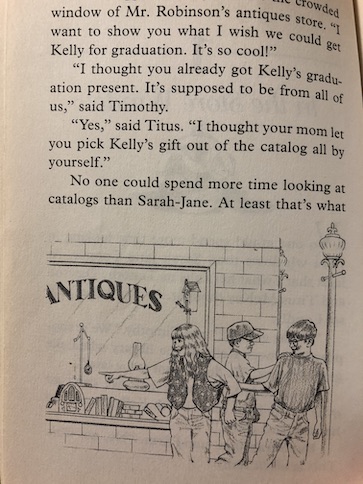
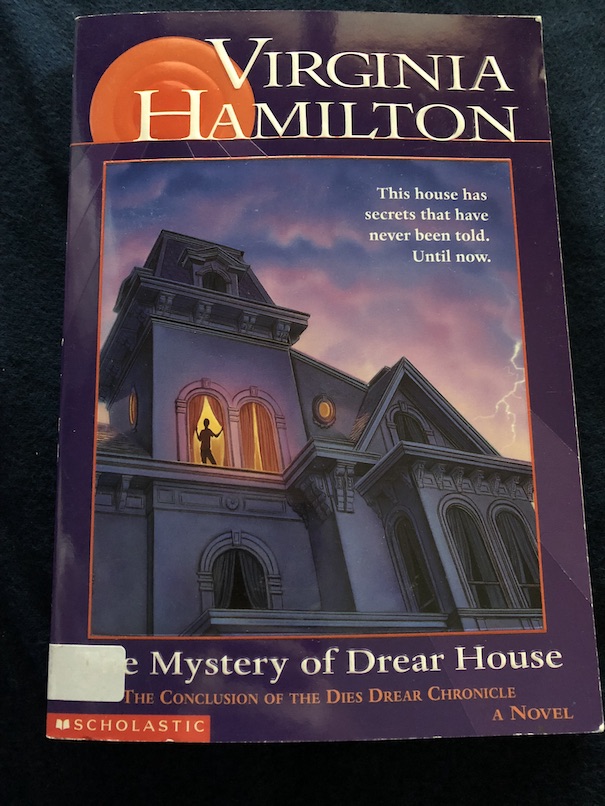
The Mystery of Drear House

The Mystery of Drear House cover

The Mystery of Drear House by Virginia Hamilton, 1987.

This book is the continuation of The House of Dies Drear, and the final book in the short series.

The Smalls are now settled into the house that formerly belonged to the abolitionist Dies Drear, who used secret tunnels to help smuggle escaping slaves to freedom as part of the Underground Railroad. Thomas Small’s father is a college professor, who finds the history of the house endlessly fascinating, especially now that they know about the hidden treasure that the caretaker, Mr. Pluto has been guarding for many years.

Apart from the Small family and Mr. Pluto, Pesty is only other person who knows where the hidden treasure is. Pesty (a nickname, her real name is Sarah) is the adopted daughter of the Darrow family, who live nearby. The Darrows are generally known to be nasty and scheming, and they have spent years looking for the treasure they know that Dies Drear hid. In the last book, Pesty helped the others to frighten off the Darrows when they were getting too close to the secret, but Thomas is still concerned that they might be a threat. He also privately questions Pesty’s loyalty, wondering if she’ll continue to keep the secret from the Darrows, although Mr. Pluto is confident that she will because she knew the secret of the treasure even before the Smalls did.

Mac, a boy about Thomas’s age, is the youngest of the Darrow brothers, and he’s not as mean as the rest of his family. Thomas kind of wants to be friends with him, but he’s not sure if he can really trust him. Mac tells Thomas that he can come over to visit sometime and that his mother is an invalid who sometimes spends months in bed. When Mac shows an interest in Thomas’s great-grandmother, who is coming to live with them, Thomas gets the idea to bring his great-grandmother over to the Darrow house to visit Mac and Pesty’s mother.

However, before they can visit Mrs. Darrow, she comes to visit them, entering their house through one of the secret passages that Thomas and his family haven’t learned about yet. She startles Thomas’s great-grandmother with her sudden arrival, and Thomas is irritated that Pesty didn’t tell him about that secret passage even though she knew about it. Pesty explains to them that her mother is mentally ill, a chronic condition of some kind, and she gets a little odd during times when she doesn’t take her medicine. Thomas’s great-grandmother seems to understand the situation, and she insists on escorting Mrs. Darrow home.

In the secret tunnel Mrs. Darrow used to come to their house, there are hidden rooms, and when they all arrive at the Darrow house, Mrs. Darrow begins telling them a kind of odd story, really little bits and pieces of stories that she has told Pesty and Mac before. Pesty seems to have a better understanding of what Mrs. Darrow is talking about than Mac does, but Thomas can tell that Mac has heard his mother tell these stories before and that he is also trying to get a better understanding of them. For some reason, Pesty seems to be holding back information from Mac as well as Thomas.

The story that seems to concern Mrs. Darrow the most is about an Indian Maiden (Native American). She seems to get upset at first when Thomas mentions that Mac had mentioned an Indian Maiden before. It turns out that the Darrows are part Native American, and the “Indian Maiden” is one of their relatives from the past. She played a role in the Underground Railroad with Dies Drear but lost her life when she was caught. The Indian Maiden was hiding secrets that Pesty is still trying to protect, and she has also been worried about Mrs. Darrow, who sometimes acts out part of the old story as if she were the Indian Maiden herself.

Meanwhile, it seems like someone is playing the ghost of Dies Drear and trying to frighten Mr. Pluto into telling him about the hidden treasure. Thomas and Pesty see the tracks of this person one day when they go to visit Mr. Pluto. The relationships between the different members of the Darrow family are complicated, and not all of them are really after the same thing.

The book is available to borrow for free online through Internet Archive.

My Reaction and Spoilers

Mrs. Darrow’s mental illness and the different motives of the younger Darrows vs. the older Darrow boys and their father are at the heart of much of the mystery and peculiarity of the Darrow family. Mac actually opposed his father and brothers the last time they tried to get the hidden Drear treasure, and since then, they’ve been shunning him. Pesty tries to look after Mrs. Darrow as best she can, but she’s been handling the job largely by herself, and at the same time, she could really use the support of a mother who can look after her. Pesty doesn’t really like all of the secrets that she has been forced to keep, but for a long time, she hasn’t felt safe in confiding the full truth of anything to anybody. She feels even more left out of the Darrow family than Mac is because she’s their adopted child, not a blood relative, even though she is always looking after Mrs. Darrow and thinks of her as her “Mama.”

The solution to many of the problems with the Darrows comes with the public exposure of the Drear treasure and the end to all the secrecy. The Smalls decide to give Mrs. Darrow the credit for finding the treasure, so although Mr. Darrow is angry that he will never get his hands on the hidden treasure that he and his family have searched for so long, they will get part of the reward money for finding it. The foundation that receives the treasure also gives jobs to Mr. Small and Mr. Darrow, changing the lives of the Darrows for the better. Even though Mr. Darrow didn’t get what his family originally wanted, they end up with something that improves their situation, and they no longer feel the need to hide Mrs. Darrow’s condition from everyone. The Darrows are freed from part of their past, and now, they’ll be able to go forward with their lives. Mr. Darrow also shows that he really cares about his adopted daughter.

The Darrows are a mixed race family, and their heritage is in keeping with real events in American history. People with mixed black and Native American heritage are sometimes colloquially known as “Black Indians,” and people with that type of mixed ancestry have existed in the Americas since Colonial times. By the end of the story, the Darrows’ full history isn’t completely explained in detail, but it seems that it was probably Dies Drear’s work with the Underground Railroad that brought their ancestors together. Freed and escaped slaves did sometimes intermarry with Native Americans.

The House of Dies Drear

DiesDrearThe House of Dies Drear by Virginia Hamilton, 1968.
Thomas Small, a thirteen-year-old African American boy, is moving from North Carolina to Ohio with his family in order to live in an old house with an unusual history.  His father is a history professor and has rented a house for them that was once owned by an abolitionist named Dies Drear.  Dies Drear was part of the Underground Railroad that smuggled escaping slaves out of the South around the time of the Civil War, and his old house still has secret passages from that time.  The local people believe that Dies Drear still haunts the house along with the ghosts of a couple of slaves who never made it to freedom.

The caretaker of this strange old house is a strange old man called Mr. Pluto.  He lives on the property in a cave that he has made into a house.  Mr. Pluto frightens Thomas, and Thomas is sure that he’s hiding something.

The Smalls’ new town is a close-knit community that doesn’t welcome outsiders. The people seem unfriendly and suspicious of the Smalls, especially the Darrow family.  They know something about the secret passages at the house, but Thomas’s parents don’t want him poking around the passages anymore after he is briefly lost in them.  However, that is where the real secret of the house lies.

Thomas comes to believe that someone is sneaking into the house at night, using the old secret passages.  One night, this person leaves three small metal triangles at the bedroom doors.  These mysterious triangles seem to fit together, but there also seems to be a missing piece.  The Smalls have no idea what these pieces mean or who put them there.  Mr. Pluto holds many of the answers, and he is going to need their help to protect the secret that he has kept safe for many years.

The book is currently available on Internet Archive (multiple copies).  The book won the Edgar Award for Best Juvenile Mystery in 1969.  There is also a made-for-tv movie version of the book.  Sometimes, you can find it or clips of it on YouTube.

There is a sequel to this book called The Mystery of Drear House.  There are only two books in this short series.

My Reaction and Spoilers

I love how the Smalls help Mr. Pluto deal with the Darrows in the end, using the ghost stories about the house to their advantage.  There are hints that besting the Darrows, although it hurt their pride, may actually lead to a better relationship with them in the future.

Thomas and Pesty (a nickname for the young adopted daughter of the Darrow family, her real name is Sarah) are also memorable characters.  Pesty is brave for learning the secret that her family has tried to learn but choosing to protect it instead of reveal it.  Thomas is a thoughtful boy who, because of his earlier upbringing, actually feels more comfortable around older adults than around people his own age.

If you’re wondering about why the abolitionist had a strange name like “Dies Drear”, it isn’t exactly explained.  At one point, the story says that he was from New England.  A possible explanation that I found online is that Dies might actually be another form of the Germanic surname Diess, which may be related to the Biblical name Matthias.  Perhaps Dies Drear might have some Germanic ancestry.  Some people use the mother’s maiden name as a first or middle name for a child.  But, that’s just a theory.

Some teachers use this book to introduce students to the concept of the Underground Railroad.  While I was researching the book online, I also found this pdf of classroom worksheets related to the story. (I had a link to a different set of worksheets before, but those were removed, and I found a different set.)  If you’re looking for additional lesson plans, I suggest looking at Teachers Pay Teachers, where teachers can buy lesson plans from other teachers.  (I’m not sponsored by them, I just know about them from a friend who is a teacher and think it’s a useful resource.)

One final point that I would like to make is that there are no white characters in the story.  Dies Drear was a white man, but he doesn’t actually appear in the book, having died over 100 years before.  Every character who does appear in the book is black.  The funny thing is that I can’t remember any point where the book explicitly describes the characters as black.  It might be my memory playing tricks on me, but I seem to remember knowing that they were all black as I read the book, but I can’t think now why I knew it, and I don’t remember a point where the book actually described anyone’s appearance.  I think I probably knew it partly from context, perhaps subtle hints in the story, but it might also be that I knew what the book was about before I read it because someone told me.  I might even have seen the movie version at some point before reading the book, although I’m not sure now because it’s been years since I first read this story, and I can’t remember if I read the book or saw the movie first.  The movie or clips of it sometimes appear on YouTube.  It’s also available on dvd, although I haven’t seen many copies available.

Mystery in the Apple Orchard

Mystery in the Apple Orchard cover

Mystery in the Apple Orchard by Helen Fuller Orton, 1954.

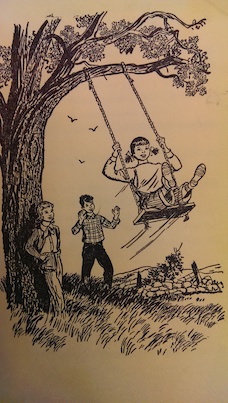
Mystery in the Apple Orchard swing

Dee Waters (age nine), her brother Ronnie (age eleven), and the other neighborhood children enjoy playing in the nearby apple orchard. The orchard was planted by Dee and Ronnie’s grandfather, and the trees are all different types of apple. Sometimes, the children take a lunch with them and spend hours climbing trees and playing. They like to watch the animals there, like the squirrels and crows, running around and hiding things in the trees. There is also a swing hung in one of the trees.

The Waters’ housekeeper, Mrs. Brown, lives in the city and commutes to her job in the country. She also has a son, Timmy, and she’s been concerned about him. Timmy is recovering from a broken leg. The bullies in his neighborhood dared him to climb a tall pole, and he fell. Although Timmy’s been out of the hospital, he hasn’t been getting enough fresh air and time outdoors in the city because they don’t live near a park. Dee and Ronnie don’t know Timmy, but hearing that he’s been unwell, they suggest that Mrs. Brown bring him along the next time she comes so that they can show Timmy the apple orchard. The children’s mother thinks that’s a good idea and also urges Mrs. Brown to bring Timmy for a visit.

Timmy is a little younger than Dee and Ronnie, and he can’t play many games with the children yet because he still walks with a crutch and can’t run. Still, he is fascinated by the animals in the orchard and enjoys watching them. He doesn’t see many wild animals in the city.

Most of the other children in the area are nice to Timmy, but Gloria is a little bit of a snob. Ronnie finds Gloria annoying because she is so prissy and extra careful about her clothes, and on Timmy’s first day in the orchard, Gloria shows up with a ring that she says has a real diamond and a family. The other children don’t believe her at first because it would be silly to wear an old, valuable ring to an apple orchard, especially when it looks so loose on her finger. Ronnie warns her that it could get lost, but Gloria tells him to mind his own business. She also tries to cheat when they play hide-and-seek, asking Timmy to tell her where everyone is because he can’t play the game anyway. Timmy refuses to help her cheat, and Gloria leaves in a huff. Because this is a mystery story, you can see where this is probably leading.

Mystery in the Apple Orchard play ticket desk

When Timmy comes the next time, the children decide to pretend that they’re going on trips by airplanes, with the trees in the orchard representing the planes. Timmy is sad that he can’t climb with the others, so they make him the ticket agent in the airport. Gloria shows up again, still with her diamond ring, and the other children again warn her that she could lose it in the orchard. Gloria says that’s impossible because she tied it to her finger, and she shows the the string. (What was it they said about the Titanic being unsinkable?)

Naturally, the ring gets in the way while Gloria is playing with the others, catching on a twig in a tree. They have to untie the string to get her loose. The other children tell Gloria to put the ring somewhere safe while she plays, suggesting that Timmy the ticket agent could watch it. However, Gloria decides to put the ring on a stone near the old well that has been filled in. (Considering that there are small animals in the orchard that happen to like shiny things, this was not the best decision.)

Mystery in the Apple Orchard digging

Sure enough, by the time Gloria comes down from her tree and her imaginary flight to Paris, her ring is gone. Naturally, Gloria is upset and admits that she was wearing the ring without her mother’s permission. (Gloria likes to show off.) She accuses one of the other children of taking the ring. Timmy seems like the most logical suspect, since he was on the ground while the others were in the trees, but he denies it, saying that he closed his eyes so he could imagine a flight, like the others were doing. Dee suggests that an animal could have taken the ring. Earlier, a chipmunk carried off the piece of string. On the other hand, crows also like shiny things. Could the crow have swooped down and carried it away?

Gloria still insists that Timmy took the ring, and she threatens to tell her mother that he stole it. Can the others find the ring before Timmy is labeled as a thief?

It take awhile for the other children to find Gloria’s ring, and because they failed to find it with the animals right away, some readers might wonder whether a human was responsible for taking. However, the mystery itself is very simple and wouldn’t really surprise anyone but young children. In the end, though, the important point is that Timmy is so motivated to find the ring and clear his name that he finds the courage to climb a tree again. He has healed from his broken leg more than even he thought he had. Before coming to the country, the doctor had told him that he could stop using his crutch, but he hesitated to do that because he was so afraid of re-injuring himself. Once he gets the courage to try not using his crutch, he discovers that he can also do many other things, although he does freeze up when trying to come back down the tree and needs the help of a couple of telephone linesmen to get back down. The linesmen tell him that it’s okay and that God has smiled on him for helping him to improve and do what he needed to do. Timmy is reassured by the discovery that he can do more than he thought he could, and his mother and Mrs. Waters decide that the Browns should move to the country permanently so that Mrs. Brown won’t have to commute to work and Timmy can have more fresh air, playing with the other children in the apple orchard.

This book is available to borrow for free online through Internet Archive.

Mystery in the Old Cave

Mystery in the Old Cave cover

Mystery in the Old Cave by Helen Fuller Orton, 1950.

Mystery in the Old Cave nut gathering

Andy and Joan Draper are excited about spending the fall and winter in the country. Usually, they live in an apartment in New York City and only go to their family’s vacation home in Vermont during the summer. However, this year, some friends of their father will be moving to New York, and they’ll need a place to stay because they are having trouble finding an apartment of their own. The children’s father has decided to rent their apartment to his friends while his family stays in Vermont. That means that the children will have to go to school in Vermont, but the children like the idea because they will be able to do things that they normally can’t do when the seasons change, like gathering nuts. When the first frosts come, the hickory nuts on the trees fall to the ground, making it easy to collect them.

After Andy and Joan collect nuts for the first time, they decide to store them in the old sugarhouse on the property. Normally, the family doesn’t use the sugarhouse for anything, but it used to be used during the times when their vacation house was a working farm and people tapped the maple trees for their sap to make maple syrup. They would process the sap in the sugarhouse. Sometimes, farm hands also used to sleep there during the harvest.

Soon, the children begin to suspect that there’s a stranger hanging around the property. Their dog, Ponto, barks at someone the children don’t see and comes running back to them, acting like someone kicked him. Later, a strange man approaches them and asks them if they know anything about a cave in the area. Andy and Joan don’t know anything about a cave. The man tells them that it’s supposed to be near the old sugarhouse, but if the children haven’t seen it, it might have caved in or something. He seems very secretive and doesn’t want the children to tell anyone that he’s been asking questions, and the children wonder if he could be the one who kicked their dog earlier. Later, someone (perhaps this strange man) steals many of the nuts that the children gathered and even some cookies. The children change their minds about storing things in the sugarhouse and decide to keep their gathered nuts in an unused room in the main house. The only clue to the identity of who’s been sneaking around is a red pencil that the person dropped.

Mystery in the Old Cave store

The children make friends with a boy named Phil who lives nearby. Phil is an orphan who lives with his Cousin John (who he sometimes calls Uncle John because he is so much older), a mean and stingy old man who doesn’t treat him very well and makes him work hard around the house instead of going to play after school with the other kids. He doesn’t even replace Phil’s clothes when they get old and torn. Phil gets a job at the local store to earn some money for a new sweater, but Cousin John even confiscates Phil’s earnings.

Mr. Lane, who owns the local store, is nice, and he tells Andy and Phil about how maple syrup and maple sugar are made, something that everyone in town used to participate in so that it was like a community party. The boys think it sounds like a lot of fun, and while they are talking about the old sugarhouse, Mr. Lane mentions that, once, some thieves joined in when they were making making syrup. Nobody knew they were thieves at first; they were just a couple of strangers who came along with everyone else and started helping out. Later, there were some robberies in the area, and the thieves were found hiding in a cave near the sugarhouse. Mr. Lane says that he and his friends used to play in that cave when they were young, and Andy and Phil decide that they want to find it.

Mystery in the Old Cave bones

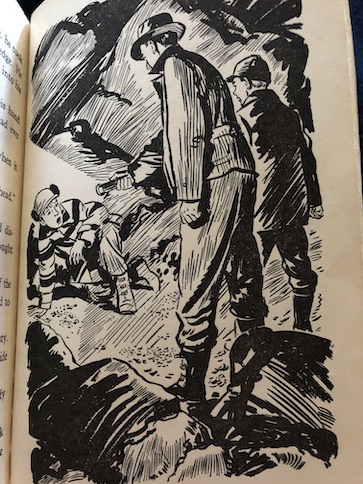
The boys take some tools with them while they’re looking for the cave, in case the entrance has been covered over, which turns out to be the case. Once they dig through the entrance, the rest of the cave appears intact. They find some old bones inside that probably belonged to a bear. They can’t look around much more because the cave is too dark, so they decide that they’ll return later with some lanterns. Mr. Lane tells the boys that there still might be stolen loot around because they never did find everything that the thieves took, including a pearl necklace that belonged to Andy’s grandmother, who was living there back then. Could these things be what the mysterious stranger is looking for?

Mystery in the Old Cave stove in store

During the course of the book, Mr. Lane begins to notice that Phil’s cousin isn’t giving him enough food. Cousin John denies Phil food when he refuses to turn over the extra money that he’s been earning to him. Mr. Lane gives Phil food from the store to eat. While Phil is at the store, he overhears the stranger, who calls himself Joe Williams, talking to Mr. Lane. Joe Williams admits that he’s looking for treasure in the area. Mr. Lane says that he doesn’t have high hopes that Joe Williams will find anything around the cave because the whole area was searched thoroughly years ago.

Phil tells Mr. Lane that he can’t stand living with his cousin anymore and wants to run away. Mr. Lane tries to persuade him not to go, saying that he can deal with Phil’s cousin, but Phil has had enough and worries that his cousin will make life hard for anyone who tries to help him. When Phil hides out in the old sugarhouse, he meets up with Joe Williams, who explains to him more about how he knows about the treasure that may be hidden in or around the cave. He’s about ready to give up the search, but Phil finds something that everyone else has overlooked.

In the end, Andy and Joan’s parents decide to take Phil in. Phil’s cousin agrees to sign over custody to the Drapers, provided that he gets to keep the money from Phil’s job that he took and the money that Phil’s mother left for Phil’s upkeep. I’m pretty sure that’s illegal and that the courts and social workers would have something to say about that if this story happened in real life in the 21st century, but in the story, Mr. Draper accepts the deal and basically uses the money that was meant for Phil to pay off his cousin to surrender custody of the boy. The story ends at Thanksgiving, with Phil sitting down to Thanksgiving dinner with his new family, who will really love him and treat him much better than his cousin did.

Mystery in the Old Cave hiding

This is one of those older mystery stories that’s really more adventure than mystery. There’s really only one suspect for the odd person sneaking around, and his reasons for sneaking around turn out to be exactly what he said they were. There is no other hidden purpose or secret past behind that man other than what he said, and in the end, he just kind of leaves the story. The kids don’t have many clues to the location of the stolen items, and in the end, Phil finds them more by accident than anything else.

Sometimes, when I’m unsatisfied by the ending of a story, I like to make up an alternate one of my own. If I were writing this, I’d have had Phil’s nasty cousin be involved in the robbery and the hunt for the hidden loot. For example, maybe he was actually one of the original thieves and had a falling out with his partners, and he’s secretly searching for the rest of the loot they hid for years. Maybe he’s had to redouble his efforts recently because they’re getting out of prison soon, and he wants to get to the hidden loot before they do. Cousin John is money-hungry enough that it could be plausible, and that would allow the story to end with him being sent to prison, which seems fitting.

This isn’t important to the story at all, but I just wanted to say that the copy I have of this book is damaged in a very odd way. On some of the beginning pages, someone has cut out a few of the words, ransom-note style. I don’t know why that happened. There aren’t enough missing for a real ransom note, and some of the cut-out words are still stuck in the pages, but since this is a mystery book, I kind of like the image of someone using it to write some kind of mysterious secret message.

I haven’t been able to find an online copy of this book yet, but Internet Archive has others by the same author.

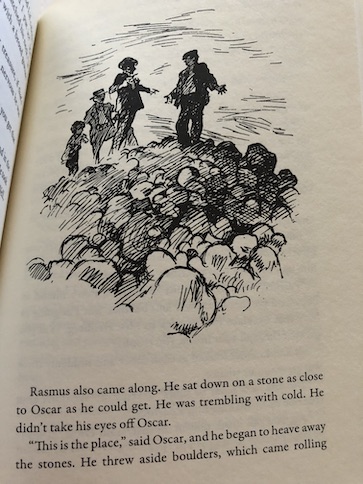
Rasmus and the Vagabond

Rasmus and the Vagabond by Astrid Lindgren, 1956.

Disclosure: I am using the 2015 edition of the book, published by Plough Publishing House.  Plough sent a copy to me for review purposes, but the opinions in the review are my own.

The Swedish author Astrid Lindgren is best known for her Pippi Longstocking series, but she also wrote other excellent books for children. This particular book is about a nine-year-old orphan boy and his adventures with a traveling vagabond (tramp) after he runs away from an orphanage.  There is an element of mystery, which pleased me, as a life-long mystery fan.

The dullness and unfairness of life at the orphanage gets to nine-year-old Rasmus. While the other children in the village get to play and go swimming, he and the other orphans are expected to work, doing chores like digging up potatoes in the garden or pulling nettles.  Mrs. Hawk, who is in charge of the children, doesn’t like them goofing off when they could be doing chores.  The work is necessary because orphanage sells produce and eggs to help support the children, and the children know that when they’re thirteen years old, they will have to start taking regular jobs to support themselves.  Mrs. Hawk doesn’t see much benefit in letting the orphans play, like other children do.

One day, while Rasmus is pulling nettles by the chicken coop, he finds what, to him, amounts to wonderful treasures: a single five-cent coin and a seashell!  He has no idea how they got there, but he has never found anything so wonderful before.  He rushes to tell his friend, Gunnar, about them. Gunnar tells him that someone is going to visit the orphanage and pick out a child to adopt. All of the children hope to be the one chosen for adoption, and Rasmus wonders if his lucky finds might be an omen that he will be the one chosen.

Unfortunately, he isn’t the one chosen. As Gunnar predicted, the couple who visit the orphanage pick a girl with curly hair, Greta, and Rasmus embarrasses himself by accidentally breaking the lady’s parasol.  Rasmus thinks that he’ll never get adopted, and he suggests to Gunnar that maybe they should try to strike out on their own and find parents. His reasoning is that, if they didn’t have to compete against the other children at the orphanage (especially the cute, curly-haired girls), they might have better luck at finding families.  Gunnar thinks that Rasmus’s plan is crazy, but Rasmus also knows that he has punishments ahead for his earlier escapades, and he’s decided that tonight is the best time to get away.

That night, Rasmus sneaks out alone, taking his five-cent coin with him and leaving the seashell for Gunnar to remember him by.  At first, Rasmus is terrified on his own, and when he gets hungry, he actually starts to miss the orphanage.  Fortunately, he soon meets a tramp who goes by the name of Paradise Oscar.  Oscar actually turns out to be pretty nice, sharing his food with Rasmus.  Rasmus asks if he can be a tramp like Oscar, and Oscar says that boys should really be at home with their parents.  When he learns that Rasmus doesn’t have parents, he takes the boy under his wing.  Rasmus starts to like the free life of a tramp.  They work when they want to and don’t when they don’t.  Sometimes, they make money by singing in the street.  They can sleep anytime they want, and they spend Rasmus’s coin on butterscotch candies.

However, trouble looms when Oscar is taken in for questioning by the police about a robbery.  Two masked men robbed the Sandhoe factory before Rasmus ran away from the orphanage, and the police think that Oscar may have been one of them.  Rasmus believes in Oscar’s innocence.  The police aren’t so certain, but they release him for lack of evidence.

Shortly after that, Rasmus witnesses another robbery.  At first, they’re afraid to go to the police, but they leave an anonymous note so that the robbery victim gets help.  One of the miscreants involved actually accuses Oscar of being one of the robbers, but some of what Rasmus witnessed points to the real villains.

Rasmus and Oscar are colorful characters, and their journey through the Swedish countryside is full of adventure, with Oscar running from the law and Rasmus still searching for the home and family he desperately wants.  There are some moments of suspense in the story, but it all ends happily, and Rasmus does find a home that’s just right for him, although it’s not quite what he had originally pictured. Rasmus’s experiences on the road change him and his ideas of what he wants in life and a family. When he started his journey, he wanted to be chosen by someone else, but in the end, it’s the choice that he makes that determines his future.

One part of the story that particularly fascinated me was when Rasmus and Oscar hide in an abandoned village, and Oscar tells Rasmus that the reason that the village is abandoned is because, years before, the people in the village all decided to emigrate to America together, specifically Minnesota (a popular destination for Scandinavian immigrants).  I remember from my first degree in history that mass emigrations of that sort also took place in other countries.  The Library of Congress has more information about Swedish immigrants and the major periods of immigration.  I think that the event that Oscar referred to was during one of the periods of high population and famine in Swedish history. I love books with interesting historical details!

As a fun fact, this book is also one of those books that appears in Swedish on Ikea shelves, just to help demonstrate bookcases or dress up one of their mock rooms. I spotted it there once. If you look for the name “Rasmus,” you’ll recognize it. The next time you see it, you’ll know what it’s all about!

This book is available to borrow for free online through Internet Archive, but it’s also back in print and available for purchase through Plough. If you borrow the book and like it, consider buying a copy of your own. This one’s a keeper!

What Eric Knew

What Eric Knew by James Howe, 1985.

After his friend, Eric, moves away, thirteen-year-old Sebastian Barth receives strange messages from him, hinting at a mystery in the small college town of Pembroke. Eric always used to rope his friends into investigating things and having adventures, but before his family moved away, he started acting strangely and suffered an accident falling downstairs and breaking his leg.

Sebastian shares the notes with his best friend, David, and with Corrie, the new minister’s daughter. Corrie’s family has moved into the house where Eric used to live, near the church and graveyard. Eric’s notes seem to refer to a local legend about the ghost of a prominent woman, Susan Iris Siddons, who used to live in their town and supposedly searches for her lost wedding ring. Corrie thinks she sees this ghost in the graveyard. There is also something mysterious going on in the church, where the Siddons family still maintains a tradition of ringing the bell regularly at 9 o’clock in homage to their ancestors, Susan and her husband, Cornelius.

The dark secrets of the past mix with the troubles still surrounding the Siddons family. Can Sebastian and his friends solve the clues and learn what their friend Eric knew?

The book used to be available to borrow online through Internet Archive, but when I checked recently, it was no longer there.

My Reaction

The story leaves some things unresolved. The kids are never entirely sure how much Eric discovered before he moved, but they do learn that he recruited a couple of friends to help create the appearance of the ghost, possibly to draw attention to the real problem in modern times, which has nothing to do with the supernatural, although there is another troubling secret about the past that the kids uncover, too.

Both sets of problems do center around the prominent Siddons family and the pressures that the current family members, especially the younger generation, suffer as they try to keep up appearances and live up to images of their supposedly perfect relatives. The past secret explains one of the reasons why the Siddons family isn’t as perfect as they had always pretended to be and helps to put the “ghost” of Susan Siddons to rest. This is not a mystery story for very young children because of the dark and serious nature of the problems with the Siddons family. I would say the book would be best for ages 10 and up. The only question at the end is how much of these things Eric really knew.

Disappearing Acts

Herculeah Jones

Disappearing Acts by Betsy Byars, 1998.

Herculeah’s friend, Meat, decides to take a comedy class at a local comedy club called Funny Bonz.  While he’s at the club for his class, he finds a dead body in the men’s restroom.  He quickly runs to get help, but when the club’s owner (who is also the teacher of the class), Mike Howard, goes to check, the body is gone.  It happens to be April 1st, so everyone assumes that it was just an April Fool’s Day prank.  However, Meat is sure that what he saw was a real dead body.

He tells Herculeah what happened, and he also remembers that he has proof of what he saw: a blue wallet that he picked from the floor near the body.  The ID in the wallet says is for a woman named Marcie Mullet.  Meat never got a clear look at the identity of the body because it was lying face down, but he remembers that it had a ponytail, so they assume that it was Marcie.  Marcie was supposed to be a student in the class, too, but she never showed up.  Meat and Herculeah assume that the body must have been Marcie.

However, Herculeah is somewhat preoccupied by something else.  She’s been getting strange vibes from a camera that she bought at a secondhand shop.  The camera was cheap, only a dollar, and there’s still a partially-exposed roll of film inside.  The camera was a great deal, but Herculeah’s hair is frizzling, and she senses danger approaching.

When she develops the film left in the camera, she realizes that the camera had once belonged to Meat’s mother, and the pictures show Meat’s father.  Meat has very little memory of his father because his parents separated when he was very young, and his mother has refused to talk about him for years.  Herculeah knows that Meat badly wants more information about his father, but she hesitates to show him the pictures because she doesn’t think that he’ll like what he sees.  He’s imagined that his father could have all kinds of cool professions, and she doesn’t know how he’ll react to his real one.

Self-perception is also very important to the solution to the murder.  Meat is the first to learn the killer’s true identity and is able to get the killer to confess and confide in him.  The killer was tired of the victim’s mean-spirited jokes, all of which were about the killer, who is fat.  The murder was unintended; the person just snapped when the victim gloated about using the mean-spirited comedy routine to become famous.  Meat understands how the killer feels because he hasn’t had a very good perception of himself and knows what it’s like to be fat.  There is a series of fat jokes in this part of the book, the meanest of which (the killer quoting the victim) are about a fat woman’s bra size.

When his father’s true identity is revealed, Meat is actually glad, which surprises Herculeah.  Meat’s father is very different from what he had imagined, but oddly, finding out that his father is a professional wrestler gives Meat something new to aim for.  Meat is sometimes self-conscious of his large size, but seeing his father makes him realize that he can change his fat to muscle and be really impressive.  The two of them meet, and Meat’s father apologizes for leaving so suddenly when Meat was young.  He explains that, much like his own father, he has trouble living anywhere for very long.  His own father had similarly abandoned his family when he was young.  Both of them just reached a point when they had an irresistible urge to pick up and move on.  However, Meat’s father makes it clear that he really does love him and is proud of him and says that he will continue to see him.  It’s a strange explanation, but Meat accepts it and forgives his father.

This book is available to borrow for free online through Internet Archive.

Tarot Says Beware

Herculeah Jones Mysteries

HJTarotBeware

Tarot Says Beware by Betsy Byars, 1995.

Madame Rosa is a fortune teller and one of Herculeah’s neighbors.  Herculeah has been taking care of Madame Rosa’s pet parrot, Tarot, when she goes out of town.  One day, Herculeah notices that Tarot has gotten loose and is sitting on the porch, so she goes to retrieve him.  When she takes the parrot back into the house, she doesn’t see Madame Rosa.  After investigating further, she finds Madame Rosa dead and calls her father, a police officer.

Herculeah is very upset about Madame Rosa’s death.  She had considered her a friend.  Even Meat said that he once consulted her for information about his father.  She told Meat that his father danced, and Meat’s mother was very angry when she found out because she never wanted Meat to know anything about her ex-husband.  She even said that she “could kill that woman.”  But, who would really want Madame Rosa dead, badly enough to murder her?  Was there someone else who didn’t like their fortune?  Did Madame Rosa know something that someone was afraid that she would tell?

It turns out that Herculeah’s mother holds an important clue.  Madame Rosa came to see her about a troubling client.  A woman visited Madame Rosa to ask if her son could kill someone.  The woman’s son had threatened her, and she wanted to know if he was capable of acting on his threats.  Madame Rosa had asked her to bring something that belonged to her son, and the woman brought her the knife that the son had used to threaten her.  That was when Madame Rosa had a vision of her own death.  It frightened her so much that she fainted, and when she woke up, the woman was gone.  Herculeah’s mother asked Madame Rosa what she’d like her to do, and Madame Rosa told her that she didn’t think anything could be done.  Later, Madame Rosa was murdered with a knife.

So, now Herculeah suspects that the woman’s son came and murdered Madame Rosa, but she has no idea who the woman or the son are.  Then, when Herculeah and Meat go to snoop around Madame Rosa’s house, Herculeah thinks that she sees Madame Rosa.  Is she a ghost, or could Madame Rosa really be alive?

The title of the book comes from the fact that Tarot the parrot always says “Beware” to strangers, but not to Madame Rosa herself.

The book is available to borrow for free online through Internet Archive (multiple copies).