Beware the Ravens, Aunt Morbelia

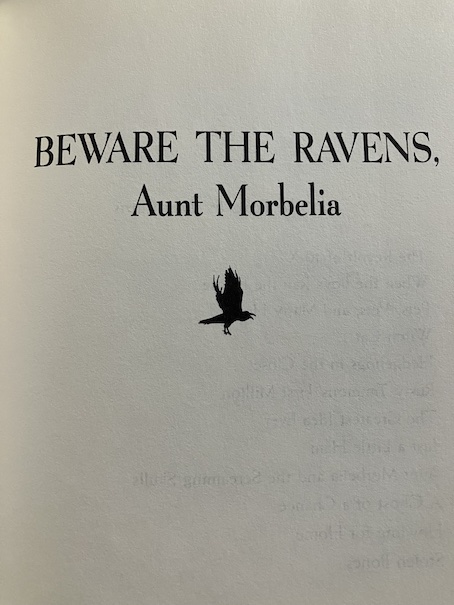
This is the sequel to Aunt Morbelia and the Screaming Skulls.

Years ago, Aunt Morbelia inherited the Fearing family estate, Harrowwood, after her cousin died.  Aunt Morbelia goes to England to inspect the estate and make some decisions about its future.  The estate is in disrepair, and taxes have been eating up the funds intended for its upkeep.  Todd and his friend, Jeff, also go to England with Aunt Morbelia to see the family estate and famous places in London. 

Some of Aunt Morbelia’s fascination with creepy stories becomes apparent as she recounts the dark history of the estate and the mysterious death of her wicked, possibly murderous, uncle.  He was apparently killed by animals after his cruelty to the animals on his estate was discovered.  When they spend the night at the estate, Todd and Jeff hear a frightening howl.  They are only too happy to move on to London and go sightseeing. 

At Harrowwood, Todd finds an old journal belonging to his aunt’s cousin, Albert, and he thinks it would be interesting to see the places that he visited when he went to London years ago.  Albert was an eccentric man who died in an insane asylum because people thought he was crazy for going around town making bird sounds all the time.  Still, Todd is fascinated by the strange drawings and cryptic notes in the journal.   Before Todd can figure out what they mean, he and Jeff spot mysterious characters following them around, and someone leaves a threatening note at the bed and breakfast where they are staying.  Todd is determined to find out who their mysterious stalkers are and put and stop to it!

The book is currently available online through Internet Archive.

The first book in this two-book series wasn’t a mystery, but this one is. (The first book in the series focused more on Todd and Aunt Morbelia getting used to each other when she moved in with Todd and his parents, and it had more discussion of Todd’s dyslexia in it than this one did.) There are things that Aunt Morbelia doesn’t know about her family and the family estate. The estate has meaning for her, but it has greater meaning for someone else, and so does the journal that Todd found. The Fearings have always been an eccentric bunch, and when they learn who has been following them around, Todd and Aunt Morbelia have some suggestions that change things for the better.

Aunt Morbelia didn’t know it, but her cousin had a son before he died, and he is bitter that Morbelia inherited the estate instead of him.  He and his family have been secretly living on the estate for years, and they are afraid that Morbelia will have them thrown off.  They admit that they were trying to scare Aunt Morbelia and Todd away so they could have the estate to themselves.  They also want the journal that Todd found and has been carrying around the whole time.  The journal contains Albert’s notes of his research on birds and bird calls.  Albert believed that he had discovered the language of birds and could communicate with him.  His son wants to carry on his strange work and maybe learn to communicate with other animals, too.  Todd gives the journal back to them, and Aunt Morbelia assures them that she will not throw them off the estate.  In fact, she suggests that they give nature lessons to tourists in order to support the upkeep of the estate.  Because they demonstrated their skill with disguises and acting while following them around London, she also suggests that they put on mystery plays and host mystery weekends on the estate.  They enthusiastically agree to the plan, and Aunt Morbelia and Todd talk about visiting next year to see how things are going.

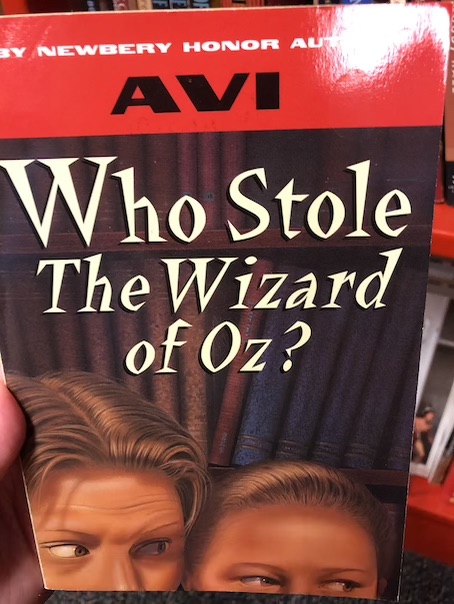
Who Stole the Wizard of Oz?

One summer, Toby and his twin sister Becky see the police go to their local library. To the children’s surprise, Mrs. Brattle, the librarian, phones their house and asks Becky to come down to the library and bring one of her parents.  The children’s parents aren’t home, so Becky and Toby go.  Mrs. Brattle doesn’t seem to want to say much over the phone, only that The Wizard of Oz was stolen, and they need to talk to Becky.

As Becky and Toby walk down to the library from their house, which isn’t far, Becky says that shortly before school let out for the summer, Becky’s teacher for sixth grade next fall handed out a summer reading assignment.  The kids have to write two book reports over the summer, and the books can’t be mysteries, fantasies, or romantic adventures.  Miss McPhearson, the sixth grade teacher, believes in only factual books.  However, Becky decided that the best thing to do was to get the book reports over as soon as possible, so she went to the library.  (Toby wasn’t involved because he has a different teacher.)  While she was there, she decided that she’d check out The Wizard of Oz for Toby, knowing that he likes fantasy books, but she was told that it was already checked out.  Mrs. Brattle told her that there would be a book sale at the library tomorrow and that she had a copy of The Wizard of Oz that Becky could buy for five cents, but since the librarian wouldn’t sell her the book that day and Becky didn’t want to make a special trip to the library the next day, she turned down the offer.

When they come to the library, the policeman accuses Becky of stealing the copy of The Wizard of Oz that the librarian showed her as well as some other children’s books.  According to the librarian, the books were actually valuable collector’s copies, worth thousands of dollars.  Becky asks the librarian why she offered to sell her one for nickel if they were so valuable and Mrs. Brattle says that it was a mistake.  The policeman says that if Becky has the books, she can return them now, and there will be no problem, but Becky is insulted and insists that she didn’t take them.  In the face of Becky’s denial, the policeman says that there isn’t much that he can do because there is only the librarian’s word that the books were valuable, and she doesn’t deny that she earlier tried to sell them for five cents each.  Missing children’s books worth less than a dollar isn’t exactly a police problem.  (I’d like to say here that I was very glad that the policeman took that attitude. I hate those children’s books where adults not only falsely accuse children of doing things that they didn’t do but also make petty incidents seem like major crimes. The policeman is correct that there is no proof that the books were as valuable as the librarian says and that this evaluation of their worth comes only after their sudden disappearance and after she was offering to sell them very cheaply.)

Even though the matter seems to be dropped for the moment, it bothers Becky that the librarian still thinks that she might have taken the books.  She suggests to Toby that they could investigate and try to find out what really happened to the books.  The first thing that they decide to do is to look for the original owner of the books.  After inspecting other children’s books at the sale and looking at the names in the front covers, they decide that Gertrude Tobias is the most likely former owner because many of the other books at the sale belonged to her.  Unfortunately, Gertrude Tobias died a few months ago.  However, it turns out that her niece is Miss McPhearson.  Becky hurriedly finishes her book reports so that she and her brother will have an excuse to visit Miss McPhearson and ask her about the books.

When they ask Miss McPhearson about her aunt, she calls her aunt a “foolish woman” who “didn’t know any better.”  However, she refuses to explain any further what she means, and the children see her crying before they leave.

When the children speak to Mrs. Chesterton, they get a very different picture of Miss McPhearson’s aunt.  When Gertrude Tobias was a young woman, she was wealthy. She could have gotten married if she wanted to, but most of the young men didn’t like women who seemed too smart, and Miss Tobias prided herself on her intelligence and cleverness.  She resented the idea that adults seemed to want women to play dumb to get a husband, so she refused to get married and spent most of her time in the company of children.  Mrs. Chesterton remembers her saying, “Children like me smart. Grown-ups want me stupid.”  She liked to read children’s books, and she often volunteered to read books to children at the library.  The children liked her and often confided in her, just like she was their aunt.  She spent a lot of her money buying children’s books for her collection.  Mrs. Chesterton says that Miss Tobias and her niece never really got along well and that Miss McPhearson used to tease her aunt about her love of children’s books.  However, Miss Tobias was rich, and Miss McPhearson didn’t have much money at all.  Miss Tobias told her that she would leave her all of her “treasure.”  When she died, it turned out that she had left her niece five children’s books – the five that are now missing.  The others were willed to the library.

At first, the picture seems like it’s becoming more clear: Miss Tobias had one last joke on her niece by giving her valuable children’s books that Miss McPhearson thought were worthless simply because they were children’s books, and the person who took them recognized what they were worth as collectors’ items.  However, the situation is actually more complicated than that.  A series of strange break-ins have been occurring around town. Nothing else has been taken, but someone is clearly searching for something.  Miss Tobias was clever, and her books have an even deeper meaning than most people have realized.  To learn Miss Tobias’ secret, Toby and Becky have to learn the secrets of the books themselves.

The book is currently available online through Internet Archive.

I really loved the puzzle in this book! There were parts that I got before the kids did and parts that they realized before I did. It isn’t a kind of puzzle that readers call fully solve before the characters in the book because it requires knowledge of their home town to get the full answer.

As an unmarried, childless adult who also enjoys children’s books, I could kind of sympathize with Miss Tobias. Children’s books, like some adults, are often very clever but go unappreciated by people who underrate them for what they appear to be. For example, Through the Looking Glass, which was one of the books featured in the story, involves a game of chess. The author, Lewis Carroll (real name Charles Dodgson), was a mathematician. His books are full of word games and logic puzzles, and the chess game described in Through the Looking Glass is an actual chess game that can be played with real pieces on a real board with a definite ending square, where Alice the pawn becomes Alice the queen (one of the clues to solving the final mystery in this book). To many adults who only know the basic story of Alice, it might just seem like a silly, nonsense children’s story, but they miss the real, clever puzzles planted in the story, just like Miss McPhearson did with her aunt’s legacy.

In the end of the story, Miss McPhearson never learns the truth about her aunt’s legacy, just as her aunt knew she would miss it. Toby and Becky come to an understanding with the real thief about Miss Tobias’ treasure that allows the library to benefit from the legacy, which is something that Miss Tobias would have appreciated. Miss McPhearson decides to give up teaching and leaves town to find another job, working with computers, a very “adult” field indeed. It’s only a pity that she wasn’t mature enough to behave nicely with her aunt and not tease her, so that her aunt would be more generous with her. People who play childish games are sometimes surprised when they meet a better game player.

Like Miss Tobias, I have little patience for people who try too hard to be “adult” or are too concerned with whether certain things are right for adults to do, especially when they show their immature sides in other ways. In the story, Miss McPhearson makes a point of being “adult” in all situations, but she wasn’t above childishly taunting an older woman about her hobbies, still expecting that woman to leave her all of her money. It reminds me of the kids I knew in elementary school who liked to act really grown up at age ten. Kids go through a phase where they start talking about doing grown-up things like having first boyfriends and girlfriends and wearing makeup and watching adult tv shows and listening to adult music, but in between doing all of that, they still act like childish brats because what they’re doing is trying on the trappings of adulthood without the real substance. Until they get some real maturity and better behavior, they’re just kids playing dress-up. Sometimes, I think that some people never quite leave that phase, which is how I view the character of Miss McPhearson.

I think of this every time I hear some adult my age or older talking about how real adults drink alcohol or real women wear high heels and lipstick. To hear them talk, there are quite a lot of rules to being grown up that very few people I know actually follow. Alcohol is expensive, plenty of people abstain for health or religious reasons, and driving drunk certainly isn’t mature behavior. High heels damage your feet the more you wear them. I’ve forgotten how much makeup I’ve thrown away because, most days, I’m just too busy to even think about putting it on, and they eventually dry out and get gross. It would be a waste of money for me to buy more, knowing I’ll never use it all. To my way of thinking, if you really are an adult and you know who and what you are, you have nothing to prove. If you aren’t mature as a person, things like high heels and lipstick aren’t going to help you, and alcohol just lowers your inhibitions and makes the immaturity more obvious. Maturity is a way of looking at things, assessing situations, and acting accordingly. It can be difficult to define, but you know it when you see someone living it, not just looking the part. Real adults don’t need to “act” like adults at all times because they aren’t “acting”; they’re just being themselves, confident that they are mature enough to handle what life throws at them along the way.

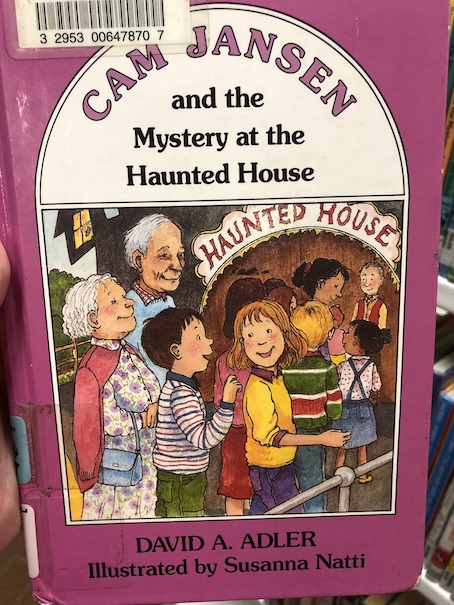
Cam Jansen and the Mystery at the Haunted House

Cam Jansen

#13 Cam Jansen and the Mystery at the Haunted House by David Adler, 1986, 1992.

Cam’s Aunt Katie and Uncle George take Cam and her friend Eric to an amusement park.  When they stop to buy food at the refreshment stand, Aunt Katie realizes that her wallet is missing.  She isn’t even sure exactly when it disappeared.  Cam thinks that someone stole her aunt’s wallet.  Who could have taken it?

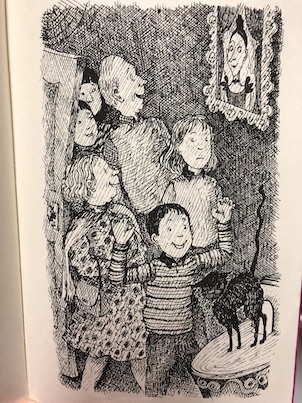
Cam thinks at first that it might have been a couple of boys on roller skates who ran into her aunt earlier, but it wasn’t them.  Cam notices that another woman is complaining about a lost wallet and realizes that she had gone through the haunted house just before they did.  Someone in the haunted house is taking people’s wallets!

When they all go through the haunted house a second time, Cam figures out that a man dressed in black has been stealing people’s wallets.  When they went through the haunted house the first time, he jumped out at them, and they thought that he was just a part of the attraction meant to scare them.  She spots the man leaving the haunted house and tells the park’s security guards.  Everyone gets their wallets back, and the park’s owner gives Cam four free passes to the park for a month.

The book is currently available online through Internet Archive.

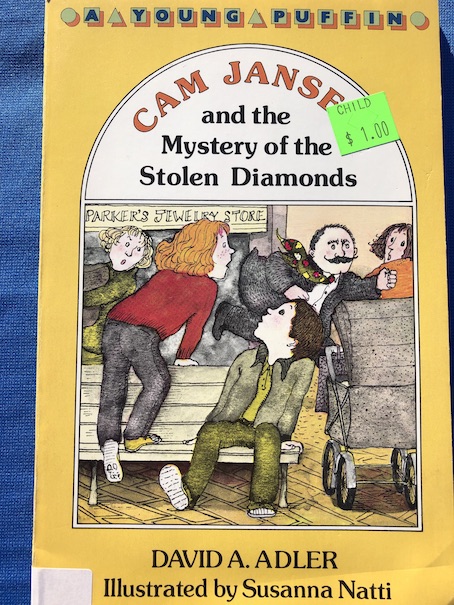
Cam Jansen and the Mystery of the Stolen Diamonds

Cam Jansen

#1 Cam Jansen and the Mystery of the Stolen Diamonds by David A. Adler, 1980.

This book is the first in the Cam Jansen series, introducing readers to her amazing photographic memory. Cam’s real name is Jennifer, but when people discovered her photographic memory, they started calling her “The Camera,” which was later shortened to Cam. When Cam wants to remember something, she says “click,” which she says is the sound that her mental camera makes.

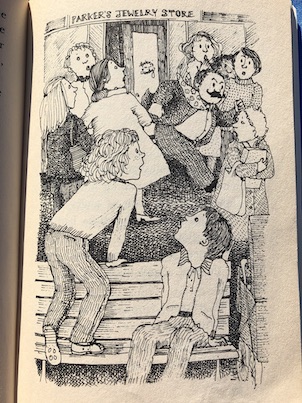
While Cam is at the mall with her friend, Eric, and his baby brother, Howie, a jewelry store is robbed.  The thief got away with some diamonds.  Although the police caught the man who ran away from the scene of the crime, the people who witnessed the crime say that he was not the thief.  As Cam goes over the pictures in her mind, she realizes that something strange is going on.

Partly, Eric and Howie give Cam the clue that she needs to solve the mystery. Cam is an only child, but as she watches Eric taking care of Howie, she realizes how much stuff a baby needs. Howie has an entire diaper bag full of supplies. However, a couple who left the jewelry store earlier appeared to have only a baby in a blanket and a rattle. Cam realizes that a couple with a real baby should have been carrying more than that.

The man and woman with the “baby” were the running man’s accomplices. It was that man who actually committed the crime.  The other man who ran was a distraction.  The couple carried a doll and pretended it was their baby.  They hid the diamonds in the baby’s rattle.  Cam realizes that they were strange because they didn’t have a diaper bag or anything else with them that parents would normally carry around for their baby, like the bag that Eric’s mother has for Howie. 

Cam and Eric follow the thieves to their hideout and then get the police, although there is a tense scene where Cam is caught by the thieves, and she must hide with Howie until the police arrive.

The book is currently available to borrow online for free through Internet Archive.

Alien Secrets

Alien Secrets by Annette Klause, 1993.

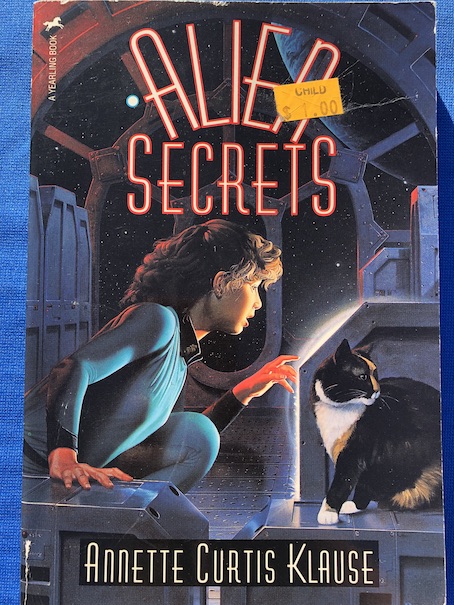
Robin Goodfellow, nicknamed Puck (her parents were fond of Shakespeare), is a human girl from Earth in the future.  When the story begins, she has been kicked out of boarding school on Earth and is traveling by space ship to join her parents, who are scientists who have been working on another planet.  They left Robin with her grandmother on Earth, who enrolled her in an English boarding school in order to give her some discipline and some friends her own age, but she was expelled for failing her classes (not to mention throwing a fit and burning her books when she discovered that she had failed).  Puck dreads what her parents will say when she arrives on the planet where they are now living because they had always hoped that Puck would also become a scientist and work with them, but this journey will change Puck’s life.

Before the ship she will be traveling on leaves Earth, Robin witnesses a man attacking someone else, possibly killing him.  Robin does not report the attack because she doesn’t know whether or not the other person was killed, and she doesn’t think that anyone will believe her anyway.  She witnessed this attack while sneaking around a place where she wasn’t supposed to be, and she is being sent to her parents in disgrace after being expelled, so she doesn’t sound like a very credible witness.  However, the man in the fight, Mizzer Cubuk (“Mizzer” is how they say “Mister” in the book), turns out to be traveling on the same ship as Puck.  All Puck can think of to do is to try to avoid him on the ship and hope that he didn’t get a very good look at her after she ran away from his fight.

To Puck’s surprise, the captain of the ship she is traveling on, Captain Cat Biko, asks her if she could make friends with an alien who is also traveling on the ship.  The alien is one of the Shoowa, who were enslaved by another group of aliens called the Grakk.  Now, he is free and finally traveling home to Aurora, the same planet where Puck is going.  The captain feels sorry for him and thinks that he might appreciate a friend and that he might find a human child less intimidating than an adult.

Later, Puck and other passengers are woken out of their sleep by the sounds of wailing and moaning.  One of the women on board, Leesa, says that she saw something that looked like a ghost that walked straight through her. Other people, who didn’t see or hear it, assume that it was nightmares or imagination, but Puck knows that it wasn’t.  One of the crew members, Michael, tells Puck that there have been rumors that the ship is haunted and that other people have seen and heard strange things.

Strange things are happening on the ship, and some of the passengers seem to be hiding something. Who can Puck trust, and who isn’t who they seem to be?

The alien who is traveling on board the ship understands Puck’s feeling of failure.  The alien, called Hush, says that he carries shame because he lost something important, something that his people were counting on him to take home to their planet.  Puck and Hush discuss how people from Earth had fought the Grakk and sought to learn about Grakk technology from Shoowa slaves who were freed after the war.  Even the ship they are now traveling on was once a Grakk ship.  The Earth people kept delaying sending the slaves home because they wanted to pump them for more information and because they were trying to decide if they could really trust them more than the Grakk.  After negotiating with the Earth people about returning home, the Earth people agreed, with some provisions.  They arranged for some of the Shoowa to stay on the Grakk home planet, still working with humans.  Some of them would travel on ships with Earth people, and some others could go home to their own planet.  Hush is the first one to head home, and he was entrusted carrying home an important symbol of his people that his family had protected for generations: a statue that represents a child because children are the future and a source of freedom, according to an ancient Shoowa prophecy. Unfortunately, the statue was stolen from Hush before he could return it to its rightful home. He reported the theft to the Earth security personnel at the station, but they didn’t take him seriously. They thought that he probably just lost it by accident.

The haunting is real in this book.  On a tour of the ship, Puck learns that the ship’s navigator has also seen the ghost aliens.  One of the characteristics of a ship’s navigator is the ability to see hyperspace, something that not everyone has the ability to do, although even scientists in Puck’s future time don’t seem to know why some people can do that and others can’t.  Slowly, it becomes evident that people who are able to see hyperspace are also able to see the ghosts.

On the journey to Aurora, Puck also learns that she is one of the rare people who are able to see hyperspace, giving her a possible future in navigating a space ship, something that she would really enjoy learning.  When she arrives at Aurora and is greeted by her parents, who have missed her while they were apart, Puck also comes to realize that her parents will always love her, even in spite of failing her classes. Even Hush’s people tell him that, although they are happy to have the statue back, his safe arrival was always the most important thing, and they wanted him to come home, whether he successfully brought the statue or not. Both Hush and Puck come to realize that their families will always love and value them even with their imperfections and failings.  With parents who love her and a new vision of the future ahead of her, Puck is ready to make a new life on Aurora.

The book is available to borrow and read for free online through Internet Archive.

Searching for Dragons

Searching for Dragons by Patricia C. Wrede, 1990.

This is the second book in The Enchanted Forest Chronicles, continuing the adventures of Princess Cimorene, although the story is told from the point of view of Mendanbar, King of the Enchanted Forest.  The Enchanted Forest is no ordinary kingdom, and Mendanbar is no ordinary king.  To be King of the Enchanted Forest means being a skilled enchanter.  Mendanbar can use the forest’s magic directly, making him more powerful than wizards.  Most of the creatures in the forest obey him, and unlike ordinary people, he can find his way around the forest almost automatically, even though things in the forest tend to move around.

At the beginning of the story, Mendanbar’s steward, Willin, pesters him about the subject of getting married.  Mendanbar hasn’t given the matter much thought since his father died three years earlier, but then, there’s been a lot to do.  Queen Alexandra has several daughters, any of which would be considered “suitable,” but Mendanbar doesn’t like any of them.  Mendanbar is annoyed because he’d just gotten the elf clans’ feud settled and was looking forward to a period of relative calm, so he decides that he’s going to give himself the day off, for a change.

He decides to take a stroll by the Green Glass Pool to relax, but on the way, he encounters a princess.  That’s not too unusual for the Enchanted Forest (home to many fairy-tale creatures and the events that make up fairy tales), but this princess strikes Mendanbar as a particularly scheming and ambitious one.  She tells him a great tale of woe in which her wicked stepmother cast her out that Mendanbar can tell is carefully rehearsed and might have even been the idea of the stepmother in question, with the idea of hooking an adventurous prince.  (Royal families do things like that, see the previous book in the series.)  However, Mendanbar is puzzled because the forest usually keeps out people who are obviously selfish.  Then, the princess mentions crossing an area of waste to get into the forest, and Mendanbar is alarmed because there shouldn’t be a wasteland there.  Forgetting about the princess, he hurries off to investigate.

Sure enough, Mendanbar discovers that a section of the forest is actually missing, destroyed to the point where there are just dead stumps.  Even the magic is gone.  Upon further investigation, Mendanbar finds dragons scales.  He isn’t sure why the dragons would want to attack the Enchanted Forest because they haven’t had any quarrels and mostly leave each other alone.  On the advice of a nearby talking squirrel, Mendanbar goes to see the witch Morwen.

After examining the dragon scales, Morwen demonstrates that, although they appear to be different colors and look like they’re from different dragons, they have actually been disguised.  They are actually from one dragon only.  Morwen also doubts that a dragon was really responsible for the damage to the forest.  After all, why would a dragon waste time disguising his scales when he could just pick them up?  Also, healthy dragons don’t shed that many scales.  Morwen is a friend of Kazul, who is the current King of the Dragons, and she advises Mendanbar to go see Kazul. 

Morwen also chides Mendanbar for not visiting Kazul when she became the king the year before.  Mendanbar feels a little guilty, saying that he’s just been very busy, which is true.  However, Morwen points out that what he could use is more effective help to organize things in the kingdom, not just making lists of things for him to do, like his steward does.  It’s part of the reason why people are saying that Mendanbar should get married.

Before Mendanbar can visit Kazul, he gets an unexpected visit from Zemenar, the Head Wizard.  Zemenar says that the wizards have been having problems with the dragons (again, see previous book) and that the dragons will not let them enter the Caves of Fire and Night.  He hopes that Mendanbar will allow them access from the Enchanted Forest.  Mendanbar doesn’t really trust the wizards, and he refuses the request on the grounds that he has something important to discuss with the King of the Dragons himself.  Zemenar tells Mendanbar about Kazul’s princess, Cimorene, blaming her for the the “misunderstanding” between the wizards and dragons.  Mendanbar at first imagines that Cimorene is much like the scheming princess he met that morning, but soon discovers that she’s anything but.  Taking the enchanted sword that only the kings of the Enchanted Forest can use with him, Mendanbar goes to visit the dragons.

At Kazul’s cave, Mendanbar meets Cimorene, who informs him that her official title is now Chief Cook and Librarian.  She tells him that part of the point of advertising this title is that it cuts down on the number of princes who come around.  Lots of princes want to rescue a princess, but few people want to rescue a Chief Cook and Librarian.  Mendanbar finds Cimorene a surprising change from the other princesses he’s met.  Mendanbar also makes a positive impression on Cimorene by using his sword to fix a broken sink, even if she describes the magic as being a bit “flashy.”

However, all is not well among the dragons.  Although Cimorene is reluctant to admit it at first, Kazul has mysteriously vanished.  She was planning to go out and search before Mendanbar showed up.  Kazul had been visiting her grandchildren when she decided to go by the Enchanted Forest to investigate someone growing dragonsbane.  Mendanbar shows Cimorene the dragon scales he found, and she indentifies them as belonging to Woraug, a dragon who was changed into a frog in the previous book.

It doesn’t take the two of them long to realize that the wizards are back to their old tricks and scheming.  However, what would they really have to gain by setting the Enchanted Forest and the dragons against each other?  And where is Kazul?

Like the other books in this series, this book is full of humor and a touch of mystery.  There are many parodies on fairy tale tropes, including an Wicked Uncle who’s not very wicked and does both a favor and an evil deed for his nephew by sending him to boarding school instead of abandoning him in the forest to have an adventure, as he’d hoped.  There is also romance between Cimorene and Mendanbar.  As you might have guessed, Cimorene is just the kind of practical princess Mendanbar needs to help him manage the magical chaos that is the Enchanted Forest and Mendanbar is the kind of king who is happy to find an intelligent princess who can do magic and rescue dragons.

The book is currently available online through Internet Archive.

Dealing with Dragons

Dealing with Dragons by Patricia C. Wrede, 1990.

This is the first book in the Enchanted Forest Chronicles.  The fun thing about this series is that it parodies many popular fairy tales and their tropes.  Some of the books in the series also take the form of fantasy mysteries with some puzzle or nefarious happenings that the characters have to figure out.

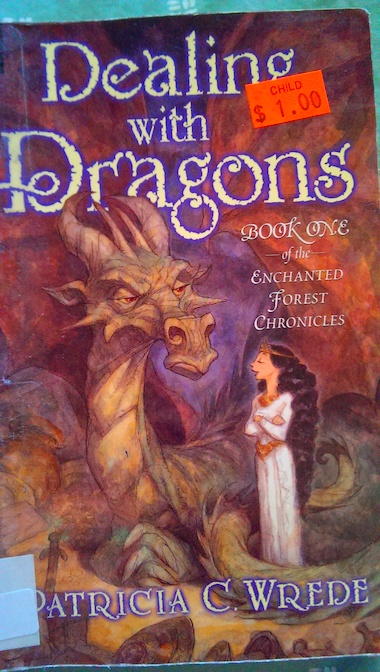
From when she was a young child, Princess Cimorene of Linderwall has been bored with the kind of life that is expected from ordinary princesses.  Unlike her six older sisters, Cimorene doesn’t have golden curls.  She has black hair, and she’s way too tall for a cute little princess.  She’s also very stubborn.  When Cimorene gets bored of the usual princess lessons involving dancing, embroidery, and etiquette, she pushes other people in the castle into giving her different types of lessons.  First, she convinces the armsmaster to give her fencing lessons.  Then, she gets the court magician to give her magic lessons.  She also arranges Latin lessons, cooking lessons, economics lessons, juggling lessons, and so forth.  Each time her parents find out about her unusual lessons, they put a stop to them because none of the subjects that Cimorene finds interesting are “proper” for a princess to study. 

When Cimorene’s parents try to arrange for her to marry a prince that she doesn’t like, she finally decides that enough is enough.  Cimorene meets a talking frog in the castle pond, and after talking over her problem with him and saying that she’d rather be eaten by a dragon than marry the prince, the frog recommends that she run away.  He even gives her directions on where to go after she leaves the castle.  Not having any other plan, Cimorene takes his advice . . . and ends up at a dragon’s lair.

It works out for the best, though.  Rather than being eaten, Cimorene asks the dragons in the lair if they are in need of a princess.  She isn’t quite sure what princesses who are taken captive by dragons do, but she can cook (as part of her earlier cooking lessons) and do other chores.  Although one of the dragons, Woraug, wants to just eat her, the dragon called Kazul takes her on as her princess.

Cimorene finds it interesting being a dragon’s princess.  She cooks for Kazul and also helps to organize her treasure hoard and library.  As is expected when word gets out that Cimorene is a dragon’s princess, knights come to try to rescue her.  They are shocked when Cimorene turns them away, and it takes awhile before Cimorene is able to convince them that she’s really happy with the dragons and doesn’t want to be rescued.

Cimorene even makes new friends.  Morwen, a witch friend of Kazul’s, comes to visit and teaches Cimorene more about magic.  Morwen is also very practical and suggests putting up a sign (something like “Road Washed Out”) to discourage knights from approaching Kazul’s lair.  It is while Cimorene is putting out the sign that she means the wizard Zemenar.  His presence in the area is suspicious because wizards and dragons do not get along.  Wizards do not use their own magic but use their staffs to soak up magic from magical places or magical beings – like dragons.  When wizards take magic from dragons, they actually take part of their essence, and give them a reaction that’s similar to allergies.  Zemenar is also head of the Society of Wizards, so it’s doubly suspicious if he’s been hanging around a dragon’s cave.  When Cimorene tells Kazul and her friends about seeing him, they become concerned, wondering what he’s after.

Cimorene also meets other princesses who are the captives of other dragons: Keredwel, Hallanna, and Alianora.  At first, they also have trouble believing that Cimorene actually volunteered to be a dragon’s princess and that she likes it.  Cimorene doesn’t like the arrogant attitudes of Keredwel and Hallanna, but Alianora is pleasant, and the two of them become friends.  Alianora tells Cimorene that, although she was taken captive by Woraug, her family basically set her up for it.  Like Cimorene, she was under a lot of pressure to do the things that everyone expects of fairy tale princesses, but she wasn’t much good at them, and things never turned out as one might expect.  The wicked fairy who came to Alianora’s christening when she was a baby didn’t curse her; she just enjoyed the party and had a wonderful time.  Alianora also didn’t prick her finger on the spinning wheel that her busy-body aunt gave her, and when she tried to spin straw into gold, she got linen thread instead.  When various fairy tale schemes failed to work for Alianora, her interfering aunt arranged for her to visit a village, knowing that Woraug was going to ravage it.  As Morwen noted, princesses who are taken captive by dragons and then rescued can expect to make good marriages.  Although being abducted by a dragon was a shock, Alianora says it’s not so bad; Woraug mostly ignores her since she doesn’t know how to cook, and it’s a relief for her to get away from her nagging aunt.  The only downside is that the other, more conventional princesses are really annoying.  Alianora and Cimorene bond over their unconventional lives as fairy tale princesses.  Cimorene gets the idea to send some of her knights and princes to go rescue Keredwel, thus taking care of two problems at once.  Alianora also helps Cimorene with her efforts to find a fire-proofing spell to protect the princesses from accidental burning from the dragons, and later becomes her ally when things get more serious.

Zemenar returns to Kazul’s cave and, while Cimorene tries to subtly pump him for information, he sneaks a look at a book about the history of dragons.  He seems to be interested in the section about how they settled in the Mountains of Morning, how they chose their king, and the Caves of Fire and Night, where they found the special stone that they use to choose their king.

Then, the king of the dragons is murdered, poisoned by dragonsbane.  The wizards have a confederate among the dragons themselves, and they want something that only the king of the dragons can give them.

By the time the murder is committed, Cimorene and Kazul have a pretty good idea of who the conspirator among the dragons is.  The wizards think that they’ve found a way to rig the ceremony for choosing a new king so that the dragon who supports them will win, giving them what they really want.  However, Cimorene foils their plan with the help of her friends.  The mystery/conspiracy elements of the story are great and help add weight to balance out the lighter, fairy tale parody elements.

The book is currently available online through Internet Archive.

Magician’s Ward

Magician’s Ward by Patricia C. Wrede, 1998.

This is the sequel to Mairelon the Magician.  When the book begins, it has been about a year since Kim and Mairelon’s previous adventures.  Kim has been living with Mairelon as his apprentice, and he has been teaching her both reading and magic.  (In the previous book, Kim was living on the streets of early 19th century London.  She did not know how to read, and at the end of the previous book, she learned that she had the ability to become a wizard, prompting Mairelon to take her on for training.)  Although Kim enjoys spending time with Mairelon and appreciates what he’s teaching her, other aspects of life with Mairelon’s wealthy family are less appealing.  Kim gets bored reading by herself while Mairelon continues his work with the Royal College of Wizards, and Mairelon’s aunt, Mrs. Lowe, is trying to turn Kim into a proper young lady.  The pressures of the social niceties and obligations wear on Kim, and even more worryingly, Mrs. Lowe has been considering Kim’s marriage prospects.

In order to be socially-acceptable, Mrs. Lowe thinks that Kim should be considering a socially-acceptable marriage for her future.  For most of her life, marriage was about the last thing on Kim’s mind.  She spent most of her youth pretending to be a boy in order to be safer on the streets.  Since she became Mairelon’s apprentice, the challenges of reading and magic have occupied most of her time.  When Mrs. Lowe brings up the subject of marriage, the idea seems ridiculous to Kim.  With her poor background, she can’t imagine what kind of “respectable” man would want to marry her, and she can’t imagine anyone among the upper-class people of London she would want to marry.  However, she sees Mrs. Lowe’s point that she won’t be able to stay Mairelon’s apprentice and ward forever.  At some point, she will need to decide what to do once her training with Mairelon is complete.  It’s a little worrying to her that Mairelon (known to most people by his real name, Richard Merrill) hasn’t discussed the future with her and doesn’t seem to be making any plans.

Then, one night, Kim overhears someone breaking into the library in their house.  At first, Kim can’t imagine what someone would want in the library.  She interrupts the thief, and he manages to escape.  After colliding with her in the hallway, the thief leaves behind one of his buttons and a small piece of wood that seems to be magic.  When Mairelon examines the wood, he says that it appears that someone stored a spell inside it temporarily, to be used by someone else.  Also, whoever put the spell together didn’t do a very good job and probably didn’t really know what they were doing.

As for what the thief was looking for in the library, Mairelon discovers that he was particularly looking through a collection of books that his father purchased years ago from a French wizard who had come to England after fleeing the French Revolution.  In particular, the thief seems to be trying to obtain the memory book that belonged to the wizard’s wife.  A memory book is exactly what it sounds like – a book that that keeper would carry around with him or her and use to record certain things that he or she would particular want to remember, a little like a journal but often containing bits of important instructions, like notes about favorite recipes or cold remedies (not necessarily the entire recipe, just general reminder notes) or, in the case of a wizard, notes about important spells.

As they investigate further, they learn that the wizard and his wife were part of a larger society of wizards in France before the Revolution and that someone has been trying acquire all of their old books and notes to learn the secret of one of their spells, specifically a spell for sharing magical power.  The person who wants this knowledge has a nefarious purpose for it, and when Mairelon tries to interfere with his plans, he uses the knowledge he has acquired to block Mairelon’s own magic!  This spell and its power-hungry master has already harmed other magicians, and now, Mairelon is in danger, too.

Meanwhile, Mairelon and his family have decided that, in order for Kim to truly be accepted in society, she must have a coming out party.  The mystery and intrigue of the story mix with Kim’s new lesson in dancing, fashion, and social etiquette and the unexpected attention that she receives from young men as she begins truly mingling with the upper classes of society.  Part of the mystery actually does involve the tensions between social classes, social mobility, and the extent to which birth and natural ability influence both.  As Kim discovers that she is more acceptable in society and desirable to at least some of the upper-class young men, she also finds herself becoming jealous of the attention that Mairelon receives from young women in search of a good husband.

Like the first Mairelon book, this one is a nice mixture of mystery, fantasy, history, and comedy of manners.  Both of the Mairelon books are a fun mixture of intrigue and humor, and this one also has a nice romantic element as Kim realizes that the only man she could ever see herself marrying is Mairelon.  He’s eccentric and sometimes aggravating, but she loves him, and he has loved her all along, from the time when she was just a thief in the marketplace to her beginnings as a wizard and her transformation into a young lady. The book ends with Kim and Mairelon engaged to be married, and I’m sorry to say that there are no more books in the series after that. I really wish that there were because I think that there’s a lot more room for character development.

The villain’s plot in this book hinges on the earlier established principle that wizards are born, not made.  Only certain people have the ability to use magic.  For some people, like Kim, the ability to use magic can lift them to higher positions in life, and it can be a source of real power.  For a person who is unable to use magic, there aren’t as many options.  The villain in this book thinks that he’s found a way around the problem, but as Mairelon guessed from the first, he doesn’t really know what he’s doing.

Even though this book has been a favorite of mine for years, I noticed something this time that hadn’t really occurred to me before.  Mairelon’s aunt and mother in the book look at fashion and social obligations in a similar manner to people in high society and the business and legal professions (categories that overlap) in modern society, whereas Mairelon, who is considered pretty eccentric for a man of his family’s social standing, and other wizards seem to look at fashion and social obligations more like modern day academics, engineers, computer programmers, and other tech experts (at least, the ones I know because those are the kind of circles I tend to move in).  Within each of these categories, some of these characters are more knowledgeable about fashion or more socially adroit or intuitive, but I noticed that there are two basic schools of thought going on here.  For the high society types, fashion is essential and social activities are their main focus in life because that is how they build their connections, make the best possible marriage matches, gain support from others, and generally move up the social scale, always aiming to do a little better that they did before or set the stage for their children to move up.  For the wizards and academic types, fashion and social obligations are of secondary importance because what makes the biggest difference in their lives is knowledge and skill.  They even say that wizards are always considered socially acceptable because of their abilities and professional standing.  Because of that, they’re socially allowed some eccentricities in personal habits and dress, and many of them take those liberties as much as possible because most of them are kind of socially introverted and prefer either the privacy of their own studies or the company of others who share their professions and interests. 

At first, Mairelon doesn’t do much about Kim’s social education because it is not a subject that’s important to him and he knows that she can go pretty far in the field of magic by putting most of her efforts into building her magical skills.  However, what Mairelon’s mother and aunt try to impress upon both Mairelon and Kim is that they both need some social skills in order to function in wider society.  This is kind of like how tech experts may have some great ideas for creating new software or a new form of online business, but in order to get their ideas off the ground, they have to have some business knowledge or connections.  Wizards may be allowed to be a little less social or more eccentric than other people, and it’s generally understood and expected, but they do much better if they learn to balance their preferences with society’s expectations.  Because the people who normally occupy high society love the latest fashions and attending prestigious social events, they can’t understand why other people don’t. As the story says, they would leap to the assumption that a wizard, who is always acceptable in society, would naturally want to participate in society, and if the wizard didn’t, it must be that they are either not really a wizard or at least not a good one.  In other words, they would assume that something was wrong with the person or their skills, not recognizing that their choices are simply a matter of personal taste.  In order for Kim and Mairelon to truly rise in their professions, they also have to learn to manage their social obligations.

In the book, Renee is an example of a character who has learned this type of social, professional, and personal balance.  She is a wizard, and as a single female, is regarded as something of an eccentric, but she understands that social skills are important.  She is a longtime friend of Mairelon’s, and she lectures him somewhat on his social obligations and acts as something of a big sister/fashion mentor to Kim, along with Mairelon’s female relatives.

The book is currently available online through Internet Archive.
Mairelon the Magician

Mairelon the Magician by Patricia C. Wrede, 1991.

This young adult book takes place in an alternate history version of Regency England.  In this world, magic is a normal and accepted part of society.  “Wizard” is an accepted profession, and there is even a Royal College of Wizards dedicated to magic.  Not everyone can be a wizard because not everyone has the ability to use magic.  It is a skill that people are either born with or born without, similar to people who have an innate talent for art or music, compared to people who are born tone-deaf or color-blind.

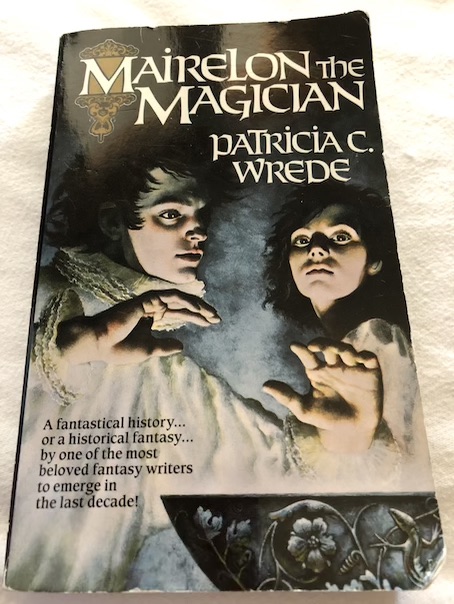
In this early 19th century world, there is a teenage girl, Kim, who lives on the streets and survives by her own wits, taking whatever jobs she can and committing a little petty thievery whenever she needs to.  She has spent most of her life dressing like a boy and pretending that she is one because life on the streets is even more precarious for a girl.  For a time, she was part of a gang of child thieves run by a woman call Mother Tibb.  As far back as Kim can remember, Mother Tibb was the only one who took care of her as a child.  Kim has no memory of her parents or any knowledge about what happened to them.  She doesn’t even have a last name.  However, before the story begins, Mother Tibb was caught and hanged for her crimes.  Some of the other child thieves were apprehended and put in prison or exiled to Australia, but Kim managed to escape.  Since then, she has been on her own.  So far, she has managed to avoid being pressured in to joining up with other gangs or turning to prostitution to survive, but the fear of that haunts her. Her future is uncertain.

At the beginning of the book, Kim is hired to sneak into the wagon of a traveling magician who is performing in the market and to see what he keeps among his belongings.  The man who hired her doesn’t want her to take anything, but he is particularly eager to see if the magician has a particular silver bowl in possession.  It’s a strange request, but the money that the man offers Kim is too good to pass up.

However, the magician, who calls himself Mairelon, isn’t quite what he seems.  He is not just an ordinary traveling entertainer using some sleight of hand to amuse people in the market.  Kim discovers that he can do real magic as she searches his wagon and is knocked unconscious by a real magical spell that Mairelon uses to protect his belongings.

When Kim wakes up, Mairelon and his servant, called Hunch, have tied her up.  Unlike Hunch, Mairelon has also realized that Kim is actually a girl, not a boy.  The two of them question Kim about why she sneaked into the wagon, and she tells them the truth about being hired to do it.  When she describes the man who hired her, it seems that Mairelon recognizes the description.  The part about the silver bowl also unnerves him.

Surprisingly, Mairelon makes Kim an offer to come with him and Hunch when they leave London.  He is fascinated by Kim’s skills in picking locks, even the lock on the booby-trapped trunk that knocked her unconscious, and he thinks that Kim might be useful to him and Hunch, perhaps helping with the magic act.  In return, he offers to teach Kim some of his magic tricks.  Hunch is dubious about Kim because she has obviously been a thief, and Kim also isn’t sure what to make of Mairelon.  She knows that he’s hiding something, but she isn’t sure what.  No one with real magical abilities like him would ordinarily be making a living with simple magic tricks in the market. 

However, Kim does accept the offer because she’s been worried about one of the major criminals in the area, Dan Laverham, who has been showing too much interest in recruiting her. He is heavily involved with a number of criminal activities, and he knows that Kim is a skilled lock pick.  If he found out that she was a girl, he would probably also press her into prostitution. Dan Laverham would be a good reason to get out of London for a while.  Also, Kim realizes that if she learns a few magic tricks from Mairelon, she might be able to set herself up as an entertainer and make an honest living, safe no matter who finds out that she’s female.  Besides, Kim realizes that if she’s not satisfied with the situation, she could always run away later.

Before leaving London with Mairelon, she returns to the man who hired her, at Mairelon’s suggestion, and tells him that she didn’t see a silver bowl in Mairelon’s wagon (which is true because she was knocked unconscious and didn’t see anything in the trunk).  The man is angry, but Mairelon, who followed her in disguise, helps to create a distraction so that she can get away from the man.  They leave London in the middle of the night because Mairelon says that he was spotted by someone who recognized him when he went out to get magic ingredients.

On the journey, Kim gradually gets to know Mairelon and his situation.  The silver bowl, which Mairelon does have, is actually part of a set of magical objects which, when used together, can compel people to tell the truth without interfering with their ability to answer questions intelligently.  Mairelon’s real name is Richard Merrill, and he is, or was, part of the Royal College of Wizards.  Years earlier, the Royal College of Wizards was analyzing this particular set of magical objects and the unique spell that they control, when they were suddenly stolen, and Merrill was framed for the theft.  At the time, Merrill was unable to prove his innocence (at least not without sounding as if he had done something inappropriate with a lady, which he also did not do – they were just together at the time of the theft because she was helping him and another friend with a magical experiment), but he was also recruited by his friend in the government to be a spy against the French, so the story of his supposed theft gave him a plausible reason for wanting to leave the country.  In the time since then, he and his friend have continued to look into the matter of the theft, and they have made some progress in tracking down the other pieces of the magical set.  At the time that Kim met him, he was on his way to the next piece of the set, a silver platter.

To their surprise, however, they soon discover that someone has been making copies of the platter.  The copies are not magical, but they do confuse the issue.  Who is making the copies and why would they want copies, since they do not have the powers that the original has?  As Kim and Mairelon investigate, they crash a house party at a lavish country estate and spy on a meeting of a rather inept society of druids.  All the while, they are getting closer and closer to finding the original thief.

I loved the combination of mystery, fantasy, history, and humor in this book!  It’s one of my all-time favorites.  It has a happy ending with Mairelon’s name cleared and the thief caught.  They also discover that Kim has the ability to use magic, and Mairelon offers to take her on as his apprentice, saving her from the streets forever.  There is a sequel to this book called Magician’s Ward, about Kim’s life and adventures as Mairelon’s student.  The hints of romance in this book are also much stronger in the next one.  There are only two books in this series, which is disappointing because the characters are so much fun, and I think that there is a lot more room for their development.  By the end of the next book, Kim’s future is looking more certain, but her past is still murky.  Originally, I had expected that there would be secrets revealed about Kim’s past because of her ability to use magic, possibly something that was passed on to her by her parents.  However, by the end of the second book, Kim still doesn’t know who her parents were/are, and it doesn’t look like there’s any chance that she will ever know.  Perhaps it doesn’t really matter. Sometimes, secrets are more tantalizing when you imagine the answers than when you actually find out.

The book is currently available online through Internet Archive.