Mystery Behind Dark Windows

MysteryDarkWindowsMystery Behind Dark Windows by Mary C. Jane, 1962.

Recent years have brought misfortune to the formerly wealthy Pride family.  First, Tony and Ellie’s father was killed while on a business trip on behalf of the family’s mill.  Then, the workers in the mill went on strike, and the children’s grandfather died.  Their Aunt Rachel blames the strikers for putting stress on her father while he was still grieving for his son, thereby causing his death.  Because of that and because she doesn’t believe that she can handle the running of the mill herself, she has closed down the mill, putting all of the workers out of a job.

The townspeople of Darkwater Falls struggle to get by without the mill and are angry with the remaining members of the Pride family for the lay-offs, but Aunt Rachel thinks that their suffering is earned and so does nothing to help.  If Aunt Rachel would be willing to sell the mill to someone who would put it back into good use and employ people, the community’s problems would be solved, but Aunt Rachel can’t bring herself to do that, in spite of the offers she’s received and the urging of the family lawyer, Mr. Ralph Joslin.  She has high hopes that Tony might revive the mill one day when he’s grown up, and in the meantime, she wants to punish the strikers with unemployment and underemployment.  However, Aunt Rachel, absorbed in her personal pride and bad feelings, is ignoring some serious issues.  The taxes on the disused mill are costing the family dearly, the equipment is rusting, and Tony isn’t even sure that he wants to go into the family business.  Tony and Ellie are unhappy with their family’s situation, their aunt’s bitterness, and the way many of the townspeople now look at them, but they’re not sure what to do about it.

MysteryDarkWindowsMillSearchThen, one night, Ellie goes out to look for her aunt’s missing cat and hears someone in the old, supposedly empty mill.  When she tries to tell Tony, he doesn’t take her seriously, but Ellie knows what she heard.  Ellie later goes back to the mill to take another look at the place, and she sees Jeff, a boy from Tony’s high school, hanging around.  Later, she confides what she’s heard and seen in Hank, an old friend who lives on the other side of the river, and Violet, another girl from her class whose family has suffered since the closure of the mill.  The two of them start helping Ellie to investigate.

Some people in town have become concerned about children in the area getting into trouble, and they think that maybe some of the local youths have formed a gang.  Ellie worries about Tony, who has started sneaking out of the house at night to hang out with friends.  Is he now part of a gang?  Are he and his friends the ones who were sneaking around the old mill? Or could it be some of the disgruntled townsfolk, bitter about the mill remaining empty and not providing much-needed jobs?

While the kids have a look inside the mill, they discover that someone has been using the place as a hideout.  A fire at the mill reveals a number of secrets and sheds light on a town and a family caught in a cycle of bitter feelings and revenge.  Aunt Rachel is stunned when some of the townspeople accuse her of setting the fire herself in order to get insurance money for the mill.  The fire was clearly arson, and since Aunt Rachel has gone out of her way to make life difficult for people in town, many of them would be ready to believe just about anything of her.  It’s up to the young people to put the pieces together and reveal the true arsonist before the mill, the town, and the Pride family are completely destroyed.

Many of Aunt Rachel’s decisions are guided by a mixture of grief and anger, but she is also stubborn and prideful.  The Pride family was aptly named.  Although they have suffered misfortune, their privileged position as the (former) main employer of the community has given Aunt Rachel the sense that she and others in her family could do no wrong.  Aunt Rachel is absorbed in herself, her own feelings (which she places above others), and the past to the point where she feels justified in deliberately causing harm to her community and the people in it, failing to see the consequences of her actions, even the effects that her attitude has on the orphaned young niece and nephew in her charge.  Ellie feels like they don’t have a real family because her aunt’s bitter feelings prevent her and her brother from getting close to their aunt.  Her aunt’s actions have also made it difficult for her and Tony to get along well with other members of the community, further isolating them from comfort in their own grief.

In a way, the fire brings Aunt Rachel back to reality, forcing her to see the consequences of her actions (and inaction).  It comes as something of a shock to her that, while she felt fully justified in her bad feelings for the town, they are also fully justified in feeling badly about her.  Somehow, it never occurred to her how someone, doing the things she’s been doing and saying the things she’s been saying, would look to the people she deliberately set out to hurt.  For most of the story, the only feelings that were real to Aunt Rachel were her own.  Even when she thought about how people hated her, she didn’t think that what they thought would matter until she began to see how it was affecting Ellie and Tony as well as the other children in town.  Ellie can see that many things would have been resolved sooner if both her aunt and her brother could open up and discuss things honestly, both within the family and with other people.  Although neither of them set the fire, their secretiveness and self-absorption at first create the impression that they did.  Ellie’s eventual outburst at her aunt and the real guilty person force both of them to acknowledge the reality of their actions and motives.

I was somewhat fascinated by the motives of the arsonist, who understands the effects that Aunt Rachel’s bitterness and revenge have been having on the young people in town, even her own nephew, better than she does.  This person was wrong in the path he tried to take to fix the situation, but he does correctly see that unemployed men not only lack the money they need to properly take care of their families but may also set a bad example for boys and young men, either through the habits and attitudes that they let themselves fall into or by becoming too absorbed in their difficulties to see what’s happening to their own children.  I also agree with his assertion that those responsible for putting people out of their jobs bear some responsibility for the results of their actions, something which resonates in today’s economy, where many people are still unemployed or underemployed.  The Pride family’s previous high standing in the community was directly because of their ability to employ people and improve the lives of others.  When they began making life hard for others and refused to use their ability to help people, they lost that standing.  Aunt Rachel was just the last to realize it, which was part of the reason why she was surprised to discover just how badly the town thought of her.  She didn’t have a good reputation because she had done nothing to earn one, no matter what her family used to do.  She was no longer using their powers for good, so she turned herself into a villain.  However, it’s important to point out that the arsonist isn’t really in the right himself because, as Ellie points out, the spirit behind his actions isn’t much different from her aunt’s.

Ellie is correct in pointing out that both her aunt and the arsonist were wrong, not just because of what they did, but because of the feelings and motives behind it.  In their own way, each of them set out to deliberately hurt others because they had each been hurt.  Which of them was hurt first or hurt worse ultimately doesn’t matter.  Their mutual desire for vengeance against each other not only hurt the people around them but kept each of them from doing what they needed to do in order to heal their own wounds.  That is also a message that resonates today, in these times of political division, with two large parts of society trying to one-up each other and even actively harm one another, largely because they can’t stand the idea of someone wanting something or believing something that they don’t.  Whatever the circumstances, when people focus on winning on their own terms, no matter what the cost, everyone loses in the end.

Toward the end of the story, as Aunt Rachel and the arsonist begin making grudging apologies to one another and reluctant steps to fix things, Ellie decides that grudging and reluctant aren’t good enough and finally gets up the nerve to tell them what she really thinks, what they most need to hear:

“Just selling the mill won’t make things better . . . It’s the way [they] feel about it that’s wrong. That’s what made them act the way they did in the first place. They just wanted to get even with people, and hurt people, because they’d been hurt themselves. And they feel the same way still. You can see they do.”

How much can people help what they feel? It partly depends on what people choose to do about their feelings.  Actions guide feelings, and feelings guide actions.  Aunt Rachel and the arsonist indulged their bad feelings, nursing them, amplifying them, and making them their first priorities, the guiding force of their actions.  As long as they keep doing that, Ellie knows that the problems aren’t really over, and everyone will remain trapped in this bad cycle.  Ellie’s honest outburst finally breaks through to both of them, showing them what they really look like to others and making them reconsider their feelings and priorities.

One of my favorite characters in this story was Mr. Joslin, the lawyer.  Although he looks a little suspicious himself for a time, he is actually a good man, who looks after the family’s interests and genuinely cares about them as well as about the town.  He is the one who convinces Tony to be honest with his aunt about the friends he hangs out with and helps persuade Aunt Rachel to see things from others’ point of view.  He loves Aunt Rachel, in spite of her faults, and is honest with her about those faults, telling her what she needs to hear.  Of all the characters, with the exception of Ellie, he seems to have the most insight into other people’s feelings and situations.  He supports what Ellie says, quoting Lord Bacon, “A man who studieth revenge keeps his own wounds green, which otherwise would heal and do well.”
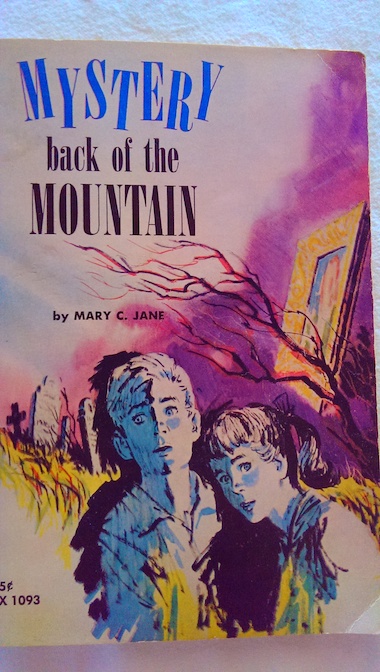
Mystery Back of the Mountain

MysteryBackMountainMystery Back of the Mountain by Mary C. Jane, 1960.

Anne and Stevie Ward are thrilled when they discover that their father has inherited a house in the country from a distant relative who has recently died. Neither of the children had met their father’s “Uncle” James (really a distant cousin of their great-grandfather), and even their father hadn’t seen him for years. Probably, the only reason Uncle James left him the old farm where he used to live was because he had no children of his own and the two of them shared the same name.

The children think that a country house would be a great place to spend the summer, and even their mother thinks that perhaps they should keep the house as a vacation home, but their father has some reservations about it. For starters, the old farm house, located outside of a small town in Maine, is kind of shabby and has no running water or electricity. It’s so isolated that people named the area Back of the Mountain. Then, there’s Uncle James’s reputation. Uncle James was the black sheep of the family, having apparently made his money in some unethical business dealings and then became involved in some kind of inappropriate romance that ended tragically. The children’s father isn’t completely sure of the details because he only heard whispered rumors about Uncle James when he was young, but he knows that the people of his town weren’t very fond of him, and he suspects that they might feel the same way about his relatives. He thinks that it might be better just to sell the house and forget about it. Nevertheless, he agrees with his wife that the family should go there and take a look at the house and decide what they’re going to do with it.

MysteryBackMountainMissingPictureWhen they get to Maine, they meet Uncle James’s lawyer, Mr. Palmer, to collect the key to the house.  Mr. Palmer tells them that the house has a few items in it that could be considered valuable antiques, including a portrait of the woman that Uncle James had wanted to marry, Drusilla Randall.  The children’s father asks Mr. Palmer more about Drusilla Randall, and he says that all he knows is that she had an argument with Uncle James and then disappeared.  He thinks that she just left town, although he says that there are rumors that Uncle James may have murdered her.  Mr. Palmer thinks that the rumors are ridiculous and doesn’t take them seriously, but Stevie and Anne are disturbed at the idea that their relative may have been a murderer, or that people thought he was.  Mr. Palmer also mentions that Drusilla’s sister, Marion, has decided to return to her family’s old house for the summer as well, so she’ll be living close to their farm.

MysteryBackMountainRunningThe house is certainly an isolated place, and their closest neighbors, the Hodges have an old grudge against Uncle James.  The unethical business deal that Uncle James did years ago involved buying some of the Hodges’s family’s best land.  Bert Hodges, who was young at the time, says that the deal ruined his father’s life, and it’s making his miserable, too, because he really needs that land to make his farm profitable.  Anne hears this from Bert’s young niece, Oleva, an orphan who has come to live with her aunt and uncle.  Although Uncle Bert is strict with her and somewhat bitter about the past and the family’s circumstances, Oleva likes her aunt and uncle and wishes they would adopt her, giving her the stable home she’s longed for since her parents died and she began being traded around among her relatives.  However, Bert doesn’t have much faith in other people, and even though he likes his young niece, is afraid to commit to adopting her.

MysteryBackMountainBridgeAnne feels badly that Uncle James’s land deal seems to have ruined people’s lives.  Oleva also tells her something disturbing about Drusilla, the girl that Uncle James loved.  They were supposed to be married when Drusilla turned twenty, but she disappeared before that happened, and most people think that she drowned in the natural pool on Uncle James’s property.  It’s deeper than it appears at first, and some things belonging to her were found nearby, so everyone thinks that she probably drowned and that her body is still somewhere at the bottom of the pool.  Whether her death was an accident, suicide, or murder is still unknown.

Mysterious things are happening around Uncle James’s property.  The portrait of Drusilla that Mr. Palmer said would be in the house is missing.  The family hears eerie howls in the night.  Oleva is sneaking around, doing something that she says her uncle would disapprove of, but which she insists that she can’t stop.  Then, Anne finds a poem engraved on a stone in an old graveyard, apparently written by Uncle James in Drusilla’s memory that points to the secret of their quarrel and her death.  The things that Uncle James did in his life still cast their shadow, and the only person who can tell them the full story of what really happened all those years ago and set things right . . . is Drusilla.

Uncle James’s problem, as the children eventually learn, was the nature of his ambitions.  He wanted to be a big man more than a good one.  It wasn’t that he was completely awful.  Drusilla herself (once the children learn where she really is and who she is) tells them that he could be charming, and she knows he never really meant to do anything wrong.  The problem was that he wanted to be important and admired by others to the point where “getting ahead” of others was all that really mattered to him.  There was a point when he could have used what he had to help his neighbors when they were in trouble, but instead, he used their troubling situation to his own advantage to take what they had for himself.  When he discovered something valuable on the land he’d acquired from Hodges family, something that would have saved them from their problems if they had known about it before the sale of the land, he could have turned it over to them to help make things right, but he refused to do it, which was the basis of his quarrel with Drusilla.  As far as Uncle James was concerned, he was entitled to what he found because he had bought the land legally, but Drusilla argued against keeping it on moral grounds, out of compassion for the Hodges.  In the end, Uncle James was admired by no one because of his selfishness, and Drusilla realized that wasn’t a quality that she wanted in the man she was going to marry.  Uncle James’s attempts to make people admire him for being wealthy and important ended up costing him friendships, relationships with relatives, and ultimately, the woman he wanted to marry.  Like others, Uncle James believed that Drusilla was dead, that she had drowned herself over their quarrel.

Uncle James’s drive to make people like him causes Anne to reconsider something that was bothering her as well.  She isn’t as good at making friends as her brother because her brother is more outgoing and good at sports.  The other kids always want Stevie to play for their team.  Anne often wishes that she could be more athletic, “to come in first,” so that other kids will like her better and want her to play with them more, instead of picking her last for every game.  However, she comes to realize that being “first” in things isn’t what really wins friends in the end.  Caring about others and being there for them when they need you wins real friends.  As Anne explores the old graveyard, she thinks about how just being alive and enjoying life is a great feeling by itself, whether you’re “first” or not, and sometimes, good things come to those who take their time instead of just rushing to be “first.”

Mystery on Nine-Mile Marsh

Nine Mile MarshMystery on Nine-Mile Marsh by Mary C. Jane, 1967.
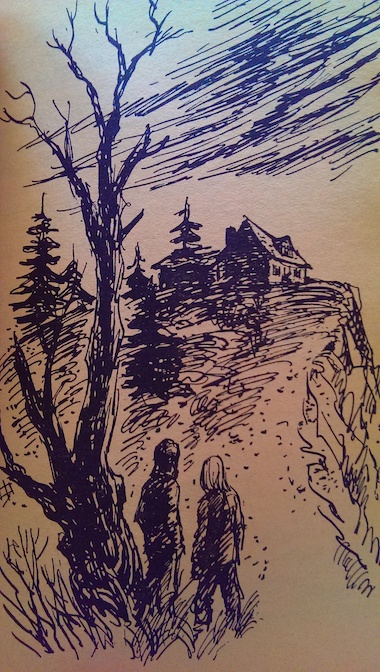
Lucille Pierce has been feeling lonely because her other friends joined a club with some other girls that meets over the weekend, and Lucille hasn’t been invited to join. The only people who are available to hang out with now are her brother Brent and his friend Kevin, and they don’t always want a girl hanging out with them.

When Brent and Kevin have an argument because Kevin laughed at Brent’s horrible spelling during a spelling bee (Brent is horrible at spelling because he never stops to think about what he’s doing, and he gets into fights fast because he also has a quick temper), Kevin invites Lucille to join him as he goes out to have a look at the old house on Moody Island before the new owners take over. The old farmhouse stands on an island in the marsh. Sometimes, people hear odd sounds coming from the house, and some people believe that it’s haunted by the ghost of John Moody, who was lost at sea years ago. Old Mrs. Moody, John’s widow, was a hermit in her final years, and now, the only living member of the Moody family is Clyde Moody, John’s nephew. Everyone had expected that Clyde would inherit the old Moody house, but instead, Mrs. Moody left it to a man named Arnold Lindsay, an apparent stranger. Miss Rand, who owns the diner not far from the Moody house thinks that Mrs. Moody should have left it to Clyde. Clyde has had problems with alcohol and hasn’t been able to hold any job for very long, and Miss Rand thinks that having the house to care for might have been good for him, providing him with some stability. No one even has a clue who Arnold Lindsay is.

Nine Mile Marsh HouseLucille and Brent take a bike ride out to the island, but a noise in the barn frightens them away. It isn’t that they really think there’s a ghost, but they’re concerned that someone may be trespassing on the property. They decide to keep an eye on the house to see if they can see anyone sneaking around, but they don’t.
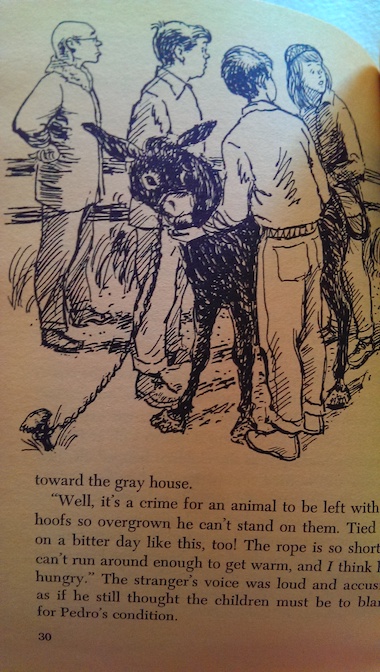
A short time later, Lucille, Brent, and Kevin meet Arnold Lindsay, who turns out to be a nice man. Like the children, he becomes concerned about the condition of Pedro, the donkey that the Turner family owns and leaves neglected in one of their fields. To give the donkey a better life, Mr. Lindsay buys Pedro, telling the kids that they can come out to the Moody house and visit him.

Mr. Lindsay doesn’t have any idea why Mrs. Moody left him the house, either. He’s a writer, but not a famous one. He just writes newspaper columns. All he or the children can think of is that Mrs. Moody must have been a fan of his columns. She didn’t get out, but she did read newspapers.

Nine Mile Marsh PedroMr. Linsday has also heard strange noises around the Moody house, and he asks the children what they know about it. They tell him the ghost stories about the Moody place, but they say that they don’t really believe that there’s a ghost. Mr. Lindsay is fascinated by the stories. He says that his impression was that the noises he heard came from the cellar, but he didn’t see anything when he investigated. He invites the children to help him investigate further sometime.
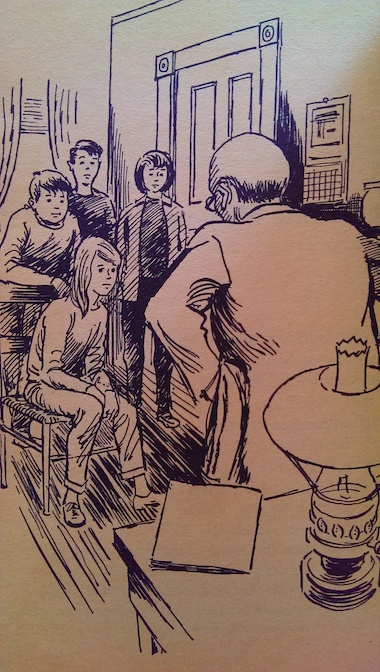
Meanwhile, Lucille tries to make friends with a new girl at school, Barbara Rosen. At first, Barbara doesn’t want to be friends because she thinks that Lucille is part of the Saturday Club with the other stuck-up girls, but she becomes friendlier when Lucille tells her that she’s not with them. Barbara had worried that the snobby girls didn’t like her because they thought something was wrong with her, but she really likes Lucille and thought for sure that she would have been asked to join the club, too, having been involved in a lot of other activities at school. Both girls find it reassuring that the fact that they weren’t asked to join the club doesn’t mean that that there’s anything wrong with them, but maybe with the girls running the club and their priorities in choosing friends. Having each other for friends makes them both feel less lonely, so they can stop worrying about the club and its members so much.

Nine Mile Marsh MeetingBarbara’s father owns a clothing store in town, and she says that some of his customers have been saying bad things about Mr. Lindsay. Some of them have even said that he might be a spy. Lucille thinks that’s ridiculous and that they’re only saying things because they wanted to buy the property or see it go to Clyde. Lucille has to admit that she doesn’t know much about Mr. Lindsay, so she can’t swear that the rumors aren’t true, but she still thinks that he’s probably just a nice guy, and she wants to see him keep the house so that Pedro will have a safe place to live.
With Clyde Moody and others sneaking around the property, seeming to look for something, and Clyde’s new accusations that Mrs. Moody was never legally married to his uncle and therefore had no right to will the property to anyone, Lucille, her brother, and their friends try to help prove that Mrs. Moody was really Mrs. Moody and that the house does rightfully belong to Mr. Lindsay.

Part of the theme of this story is about loyalty.  Lucille feels hurt that the girls she had previously thought were her friends abandoned her to join the Saturday Club.  She thinks that people who are real friends should stand by each other, no matter what other friends come into their lives.  However, looking back on her friendship with these other girls, she comes to realize that she was mostly friends with them because they were the girls who lived nearby, and neither of them really had other options.  In the end, they didn’t really have much in common, and she realizes that she doesn’t think very highly of them, so she is as free to move on and make new friends as they are.

Similarly, that is how some of the people in town feel about Clyde Moody.  It isn’t so much that they like him as he’s always been there.  He’s familiar to them, and it would have made sense for Mrs. Moody to will the Moody house to him.  It doesn’t make sense to them that she would leave her house to someone she’s never met, so they get upset about it and assume that there must be something wrong with the situation or with Mr. Lindsay himself.  However, nothing is wrong with Mr. Lindsay, and Clyde isn’t really worth their loyalty.  He’s a known troublemaker who associates with other troublemakers, like the Turners. Mr. Lindsay really is a better person.

In part of the story, the children catch Miss Rand sneaking around the property.  At first, they think that she was there to help Clyde or get Mr. Lindsay in trouble, but she tells Mr. Lindsay that she was actually there for very different reasons.  There was something on the property that she wanted to protect.  She wasn’t sure that she could trust Mr. Lindsay, and she knew that she couldn’t trust Clyde, so she was taking it on herself to look after it.

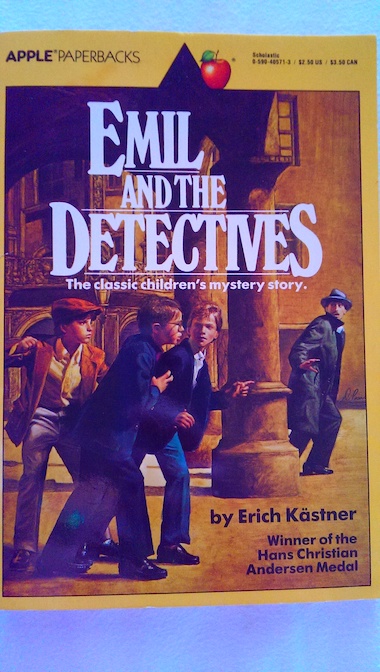
Emil and the Detectives

Emil

Emil and the Detectives by Erich Kastner, translated by May Massee, 1929, 1930.

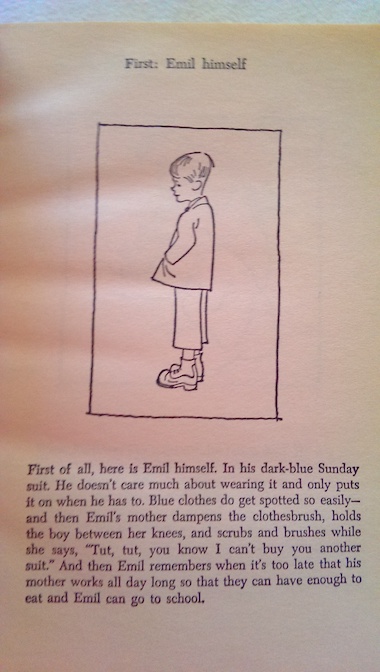
EmilHimselfThis book was originally written in German.  It was written in Germany during the period between the two World Wars.  The date of the story itself is never specified, but it may actually be earlier than when it was written, prior to World War I.  There is a sequel to the book that I haven’t read where Emil’s vacation ends early because he hears that war has broken out, an incident based on the author’s own boyhood experiences at the start of World War I.
The Emil books have an interesting history because of the time period when they were written.  This video explains how the book came to be written, the time period when it was written, and its cultural impact.  By the time the Nazis came to power, Emil and the Detectives had become popular and, as a harmless children’s book, was saved from Nazi book burnings.  The sequel story, Emil and the Three Twins, wasn’t so lucky, which is why it isn’t as well-known as the first Emil book, although it is available today.  The author, Erich Kastner, was known to be a pacifist and opposed to the Nazi government, which was why many of his works were burned during the Nazi regime and publishers were forbidden to publish new books from him.  (This video explains more about the book burnings and Kastner’s burned works.)  Although his political stance interfered with his writing, and he was questioned by the Gestapo several times, he chose to remain in Germany for the duration of the war.  Another of his children’s books, Lisa and Lottie, which was the basis for the Parent Trap movies by Disney, was written after World War II ended.

EmilTrainAt the beginning of this story, it explains that Emil Tischbein’s father died when he was very young and that his mother works hard as a hairdresser to support the two of them. When she can, she saves a little money for Emil’s grandmother as well. When the story begins, Emil is preparing for a train trip to Berlin to visit his relatives. Emil will be traveling by himself and will meet his relatives near the station when he arrives. His mother gives him some money to take to his grandmother and warns him to be careful. Emil pins the money inside his pocket for security.

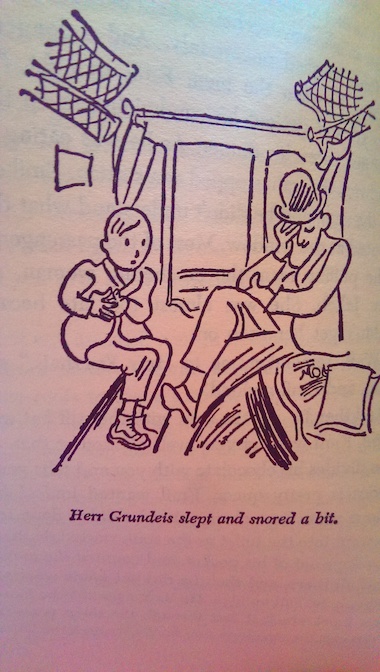
On the train, Emil talks to the people who share his train compartment. One of them, who calls himself Herr Grundeis, tells him tall tales about what Berlin is like and gives him a piece of chocolate, which is apparently drugged. Emil falls asleep on the train, and when he wakes up, he realizes that he’s been robbed!

EmilGustavDetermined to get the money for his grandmother back, Emil searches for Herr Grundeis and spots him getting off the train. It’s too soon for Emil’s stop, but he follows Grundeis off the train anyway, tracking him to a café.

While Emil is trying to decide how to handle the situation, another boy who carries a horn that he likes to honk, Gustav, spots him watching Grundeis. Gustav asks Emil what he’s doing, and Emil explains the situation. Emil isn’t sure how to get the money back from Grundeis. At first, he’s afraid to tell the police what happened because of a prank he and some friends pulled at home. He worries that perhaps the police have found out about the prank and that they won’t take him seriously. Gustav is sympathetic to Emil and tells him that he can get together some friends to help.

EmilPonyChocolateGustav recruits a bunch of other boys from the neighborhood, and they continue tailing Grundeis through the city to his hotel. The boys call another friend at home, who keeps track of their progress and gives them reports about what others have said.  Emil gets one of the other boys to tell his relatives that he has been delayed on important business, causing his cousin, Pony Hutchen, to come and tell him that everyone is worried and that he’s going to be in big trouble with his relatives if he doesn’t show up soon.  However, they still have the problem of deciding how to confront Grundeis and get him to return the money.  In this case, the detectives don’t need to solve the mystery of who the thief is.  The real problem is how to prove it.

This book is known around the world and has been made into movies several times, including a Disney version in 1964.  The Disney version still takes place in Germany, but for some reason, Emil’s train trip is changed to a bus trip, and the criminal’s plot is much more elaborate.  It’s available on dvd, and you can see the trailer on YouTube.

The book is currently available online through Internet Archive (multiple copies).

My Reaction and Spoilers

Overall, I liked the story, although I found the book difficult to read because the wording sounded strange and awkward in many places.  I think this is probably because of the translation between German and English.  I have the feeling that the translator was trying to be too literal in the translation instead of focusing on translating for meaning and tone.  Unfortunately, I can’t read German, so I can’t say what the original version was like.

EmilReportersThere was a note in the beginning of my copy of the book that says that many of the character names in the book are actually jokes on the part of the author. It’s not as obvious in English because the forms of the names sound reasonable for German names, but anyone who knows German would spot that they aren’t real names. For example, Emil’s last name is Tischbein, which means “table-leg,” and the thief’s alias, Grundeis, means “ground-ice.”

In the end, the boys use their numbers (they have about a hundred child detective recruits by the end of the story) to corner the thief in a bank, and when they confront him in front of the bank personnel, they manage to prove that Emil is the owner of the money using the pin holes in the bills, where Emil had pinned it to his jacket.  The author of the book also appears briefly in the story as a journalist who interviews Emil and his friends for a newspaper story about how they caught the thief. (I think he’s the one standing at the back of the group of reporters in the picture because the man’s hair looks like Kastner’s, combed back.)

Like in another of Kastner’s books, Lisa and Lottie, there is the theme of a child who behaves well because of the family’s poor circumstances.  Emil, like Lottie, is being raised by a single mother who has to work hard to support the two of them. Both Emil and Lottie understand that if they behave badly and get into trouble, it would create more hardships for their mothers.  They basically live hand-to-mouth, and the children understand that their mothers cannot take time away from work to deal with their discipline problems.  Each of them has had to shoulder some of the household burdens from an early age, and it has made them more serious and also a little closer to their mothers than many of the other children from more affluent families. Aside from Emil’s prank at home (which causes him some worry), he is obedient to his mother and also very concerned about her welfare.

Liars

LiarsLiars by P.J. Petersen, 1992.

Sam lives in the small town of Alder Creek in California. The town is so small that they only have a one-room school (well, two rooms, if you count the library/storage room). Sam’s friend, Marty, describes most of what happens there as SOT (Same Old Thing) or MOTSOT (More of the Same Old Thing). However, their town contains some disturbing secrets, which they are about to learn.

Uncle Gene, an old man in town, has a reputation for being a “water witch.” He has the ability to find good sources of water when they need to dig a new well. He lets the local kids watch him when he’s using his dowsing stick and even lets Sam and Marty have a try. Sam has never really believed that Uncle Gene has any special abilities, even kidding Marty for believing in it. However, when Sam takes hold of the dowsing stick, he finds it drawn toward sources of water, like a magnet. Uncle Gene says that Sam has the gift and is a water witch, too. Sam is still somewhat skeptical, thinking that there’s probably something more scientific behind what he experienced, but from that time on, he finds himself sensing other odd things from the people around him.

In particular, Sam can sense when people around him are lying. It sounds like it would be a handy gift to have, but it has some drawbacks. Even when he can tell that someone isn’t telling the truth, he can’t tell exactly what they’re lying about. Some lies are obvious, like those of classmates bragging about things or Mr. Lopez saying that he enjoys living in the small town when, apparently, he really doesn’t. However, Sam can’t always distinguish between small lies or serious ones. Some lies seem to affect him more than others, possibly because the liars themselves feel more guilty about those, but by itself, that doesn’t tell him whether the lie is serious or not. He knows about Mr. Lawlor poaching animals in the forest, so that lie is also obvious to Sam, and he later realizes that his wife is lying about her teaching credentials. When he exposes Mrs. Lawlor’s lies, everyone becomes aware of Sam’s gift.

This ability becomes disturbing for Sam because it seems like everyone around him is lying about something. It’s also somewhat unsettling for some of his friends, like Carmen, who worries about what he’ll think of her if he catches her in a lie. Even Sam lies somewhat himself, saying that he knows that Carmen wouldn’t lie to him when he’s already caught her. But, Carmen sees right through his reassurance, even without sharing Sam’s gift. She’s the one who points out to him that the problem with his gift is that, even though he can tell when someone lies, he can’t tell exactly what they’re lying about or why they’re doing it. She mentions the little white lies people tell to spare someone’s feelings, like saying that they like a person’s clothes when they really don’t, but also how people sometimes lie when the truth is none of someone else’s business. The lie that Carmen told Sam earlier was about why the two of them couldn’t hang out together one day. She said that her parents were expecting company that evening, but the truth was that her parents have been fighting a lot, and she didn’t want Sam to see it because their personal problems are no business of his. This incident, along with a time when Sam has suspicions about an innocent person because the person falsely thought that she might actually be guilty of a crime lead Sam to worry even more about his gift.

However, there are real crimes being committed in his town, and Sam’s gift might be the only way to find who is behind it all. First, someone tries to break into Uncle Gene’s house. Uncle Gene thinks he knows why. Supposedly, there’s a hidden mine in the area, and he’s been looking for it for a long time. He thinks that he’s getting close and that someone was after his maps. Later, his house is set on fire.

But, is the lost mine the real reason why someone is after Uncle Gene? He’s been poking around in some out-of-the-way places during his search, and the kids know that he’s reported someone for growing illegal marijuana. Is the grower out for revenge? With Sam’s own father lying to him about his whereabouts, Sam worries that he may have something to do with what’s going on. It’s only a pity that his gift can’t tell him what his father, or anyone else, is lying about. It only tells him that they’re liars.

With more places making marijuana legally these days, this part of the story might not seem so serious as it did back in the 1990s, when schools were emphasizing that kids should “just say no” to drugs. Marijuana was viewed as being as bad as any other drug, and in this book, the grower doesn’t seem concerned about the possible medical uses.

Sam’s father is not the villain of the story, although he is engaged in something that he doesn’t want to reveal to his son or the rest of the town immediately. There is also a subplot about the death of Sam’s mother. She is already dead when the story begins, but Sam and his father haven’t completely healed. At the urging of Marty’s mother, who also helps Sam to explore his gift, the two of them begin talking about her more, when they had been avoiding discussing her for some time because talking about her was too sad for them.

In the end, Sam thinks that he’s found a way to stop sensing people’s lies (the less he pays attention to what he senses, the less he feels it, so he thinks that ignoring his gift will cause it to fade over time), which is a relief to him because he didn’t like always wondering what people were really lying about, and as Carmen said, some lies are for the best and should be none of his business. I think that’s true, especially the part about lying about things that should be no one else’s business. Some people can be rather pushy in wanting to know the details of other people’s lives, and if they won’t accept “I don’t feel like talking about it” or “I don’t want to tell you” for an answer, a lie of some sort might be a person’s only recourse. Depending on the circumstances, a lie might be harmful or it might protect. Like with Sam’s gift, it may not be immediately obvious which it is, either. Not that people should make a habit of lying, but there are times when it might be the best course of action for all concerned.

I’d like to add that there are many different ways of being truthful as well as lying.  If there are partial lies, and there are partial truths as well.  Some people think that politeness is a kind of lying, like in Carmen’s example of pretending that you like someone’s clothes when you really don’t, but that’s not necessarily so.  Being polite doesn’t mean that you’re pretending but perhaps you’re just choosing which of your thoughts are the most important to mention. Many, perhaps most of us, don’t just think one thing when someone asks us what we think about something.  For example, when someone asks your opinion of their clothes, you might think something like, “Well, I like the color, but I don’t like the style.  At least, I don’t like the way that style looks on you.  But, maybe that’s just because I’m not used to seeing you wear things like that.  I might change my mind later.  Actually, later on, I’ll probably forget that you ever wore that because I don’t care that much about clothes anyway.  Still a nice color, though.”  At least, that’s what goes on in my mind frequently.  There’s no point in telling anyone those random, meandering thoughts, so I just pick the most important part and tell them that I like the color.  Why bother being critical in an effort to sound truthful when the real truth of the matter is that clothes in general aren’t that important to me and I’ll probably just change my mind later, if it sticks in my mind long enough for me give it a second thought?

Then, there are the lies that some people label as the truth for their own purposes. I’ve seen plenty of people say harmful and insulting things to others and then hide behind the defense that they are “just telling it like it is,” when they actually aren’t. Usually, when people say that, they’re actually telling it like it isn’t: lies, exaggerations, or just plain insults disguised as truth. In those cases, their intentions were not to point out some important truth for the benefit of anyone.  Often, they were just trying to hurt someone’s feelings and then further hurt them by accusing them of not being able to handle the truth.  My rule of thumb for distinguishing between people who are really “telling it like it is” and liars who are just pretending is the same as the one I use with assessing advertisements: If a company has to shell out lots of money to tell you something about their product, it’s because what they’re saying isn’t something that you’d ever notice by actually using it.  If it were obviously true, there would be no need to put so much effort into telling you because you’d just know.  I think it’s the same with people who “tell it like it is.”  If someone has to actually say that they’re “telling it like it is,” it’s a strong hint that they’re probably not.  Similarly, anyone who brags about being truthful and trustworthy is probably doing it because they know that no one else would ever think to associate those qualities with them without being told.

Coffin on a Case

CoffinCaseCoffin on a Case by Eve Bunting, 1992.

Twelve-year-old Henry Coffin’s father is a private investigator, and Henry hopes to be one himself someday.  He’s learned a lot by watching his father in action.  One day, a sixteen-year-old girl, Lily, comes to the office and asks for help in finding her missing mother.  Lily found her mother’s car in their driveway with groceries still in it, and her mother is nowhere to be found.  She doesn’t want to go to the police because she once called the police about her mother being missing only to discover that there was a mix-up and that her mother had tried to leave her a note that she hadn’t seen.  Lily has double-checked this time to make sure that there was definitely no note from her mother and none of her mother’s friends have heard from her, but she worries that the police would think that she’s being paranoid, so she decided to consult a private investigator instead.

Henry’s father is concerned about the disappearance of Lily’s mother, but he’s unable to take the case because he has to go out of town.  He tries to refer Lily to another investigator or a friend of his who is with the police, but Lily just storms out of the office.  Henry wishes that he could take the case for his father.  His own mother abandoned him and his father when Henry was just a baby, so disappearing mothers are of great concern to him.  Later, when Lily gets in touch with him, Henry agrees to help her without telling either his father or Mrs. Sypes, the housekeeper who has looked after him since his mother left.

At first, there doesn’t seem to be much to go on.  Lily’s mother makes wooden storks that she sells as lawn decorations to people who have recently had a baby.  She was going to sell a couple before going to pick up the groceries, but Lily says that there is an extra one missing.  Somewhere between the grocery store and home, Lily’s mother made an unexpected stop . . . and there are signs that someone other than Lily’s mother drove the car to Lily’s house.  But, who was it, and what happened to Lily’s mother?

The answers to these puzzles put Henry on the trail of some dangerous thieves who would do just about anything to cover up their crime.

The book is available to borrow and read for free online through Internet Archive (multiple copies).

My Reaction

Henry shows excellent deductive reasoning as he analyzes the clues and reconstructs Lily’s mother’s trail to learn what happened to her. Both Henry and his father are inspired by the fictional character, Sam Spade, and Henry makes frequent references to him in the story, thinking what Sam Spade would say or do in certain situations.

Throughout the book, Henry also considers his own mother’s disappearance years ago.  Her abandonment of her family was her own choice, not an abduction, which makes her situation different from what happened to Lily’s mother.  Henry has no real memory of his mother, which pains him somewhat.  He sometimes dreams that she’ll return home one day for a happy ending, like in the movies, but he also realizes that’s really just a daydream.  When Lily’s mother is finally rescued, Henry and Lily continue being friends, and Henry also considers whether a relationship would be possible between his father and Lily’s mother.  It’s a nice idea, but Henry also thinks that isn’t likely, and he’s okay with that.

A Clue in Code

ClueInCodeA Clue in Code by Marilyn Singer, 1985.

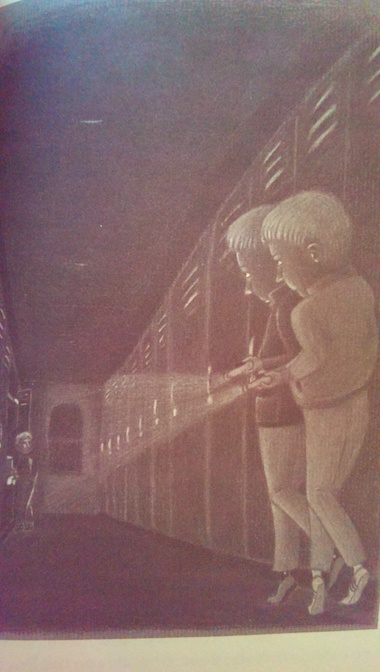
This book is part of a series about a pair of twin boys, Sam and Dave Bean, who solve mysteries with their friends.

One day, the boys’ teacher, Ms. Corfein, has one of their classmates, Roger, collect money from the students for a class field trip.  Ms. Corfien tells Roger to put the money in her locker, but later, the money is gone.

Anyone in the class could have taken it.  When Dave went into the classroom to feed the class’s pet gerbil at lunchtime, he saw Willie, the class bully, there as well as his friend Patti, who thought that it was her turn to feed the gerbil.  Of the two, Willie seems like the best suspect for the theft because he’s been in trouble before for stealing, but perhaps there was someone else in the room before any of them arrived.

ClueInCodeSneakingSam and Dave decide to begin their investigation with Willie.  His father is the school’s custodian, and Willie has been using a copy of his father’s key to the school to sneak around after hours.  To the twins’ surprise, when they confront Willie, not only does Willie deny stealing the money, but it turns out that he’s actually been scared and upset himself.  After being caught stealing the last time, his parents have been especially strict with him, sending him to bed early, limiting his time with friends, and not allowing him to watch tv or read comic books.  In fact, his father tried to get rid of his entire collection of comic books by throwing them in the trash, but Willie rescued them and has been hiding them in the school, sneaking away to read them when he can.  However, someone has discovered them and stolen them.  Willie wants his comic books back, but he can’t report them stolen because his father thinks that they’re already gone.  Worse still, his parents will be even harder on him if he ends up taking the blame for stealing the class’s trip money.

ClueInCodeMessageIn spite of Willie’s reputation, which he deserves, Sam and Dave think that he’s telling the truth about the thefts.  Then, they happen to find a strange message that appears to be written in code after some of their classmates were throwing paper airplanes.  With the help of Rita, a friend who is very good with codes, they decode the message and uncover a valuable clue that explains why the comic books were taken and leads them to the thief’s identity.
I was pretty sure, from the very first chapter, who had stolen the money, but I wasn’t completely sure of who had taken the comic books until the end.  At first, I thought perhaps Willie’s father had found his stash and got rid of it again, but that wasn’t the case.  The thief who took the comic books was the same person who took the trip money and for the same reason.  This person’s father has been out of work, and they need the money.  It turns out that Willie has a number of comic books that are now collectors’ items, and someone is willing to pay a lot of money for them.

The Mystery of Sara Beth

SaraBeth

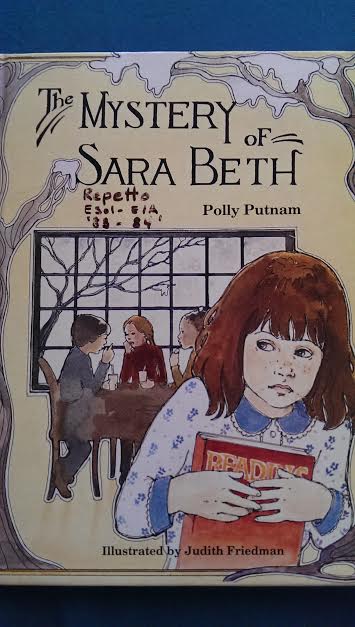
The Mystery of Sara Beth by Polly Putnam, illustrated by Judith Friedman, 1981.

This was one of my favorite books when I was young. It’s a nice mystery story for children in early elementary school.

When a new girl named Sara Beth joins their class, Becky and her friends go out of their way to make her feel welcome. However, Sara Beth barely acknowledges their attempts to make friends with her.

SaraBethPic2

Becky becomes concerned about Sara Beth and her lack of interest in making friends at school. Becky also notices some other odd things about Sara Beth’s behavior, which tends to change unexpectedly.  Sometimes, Sara Beth likes the class’s pet guinea pig, and sometimes she seems afraid of it.  One day, Becky catches Sara Beth taking a reading book home that was supposed to stay in the classroom.  Later, she sees Sara Beth hiding a cupcake from a class party to take home. Could these things help explain what Sara Beth is trying to hide?

The book is currently available online through Internet Archive.

My Reaction and Spoilers:

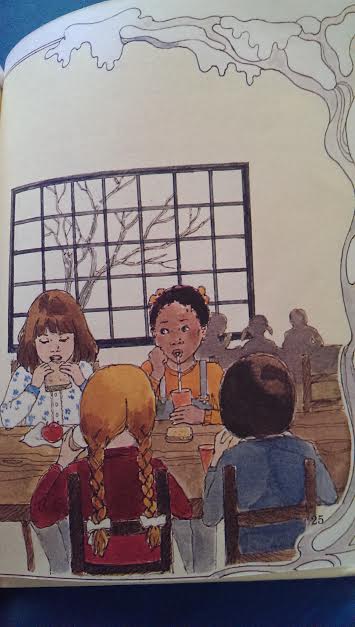
The solution to Sara Beth’s problem is quite simple, but it may seem bigger to younger children. The story presents a good example of the use of observation and logical thinking when approaching a problem. As Becky tries to determine why Sara Beth acts the way she does, Becky watches her closely and makes a list of her observations before coming to her final conclusion.  Becky is not only compassionate toward Sara Beth in trying to help her solve her problem and make friends at her new school, but she is also a very logical thinker.  I really enjoyed her as a character!

The artwork in the book is nice, and I thought it was clever how the borders of all of the images kind of give a hint to Sara Beth’s problem.  Even when the characters are indoors, the pictures are surrounded by snow-covered trees because it’s important to the story that it takes place in winter.  The snow is the root of Sara Beth’s problem.  The girls live in a cold climate and “Sara Beth” comes from a poor family.

(Spoiler: Becky correctly realizes that “Sara Beth” is actually a set of twins, Sara and Beth, which is why they behave differently each time they switch places.  Their family moved to the area from a warmer climate because the twins’ father is looking for work, but they only had enough money for one warm coat for the girls, so one of them has to stay home while the other goes to school.  They take turns going to school, and the one who goes to school brings the other one books, school assignment, and class treats so she can follow the lessons and not miss out.  When Becky confronts one of the twins, Beth, she admits that they were afraid of making friends at school because they knew that someone would find out the truth.  Becky persuades Beth to talk to their teacher, and the teacher arranges for the twins to receive an extra coat that was unclaimed from the school’s lost and found so that they can both come to school.)

In the back of the book, there’s a list of vocabulary words that appear in the story. It does not provide definitions for these words, though. I think that the most unusual words in the book were guinea pig and tetanus shot.

One more thing I thought that I would mention is that Becky, the main character, is African American. This is not mentioned at all in the text of the book and is not important to the story, but it is shown in the pictures.  I didn’t think about it much when I first read the book as a kid, but looking back on it, I found it interesting because it reminded me of the character of Adam in the Third Grade Ghosthunters series.  It fascinates me that there is something about these characters that people wouldn’t know without looking at the pictures, and I also like it that the characters themselves are not defined by race.  It’s just an interesting detail, not central to their characters.

The Happy Valley Mystery

Trixie Belden

TBHappyValley

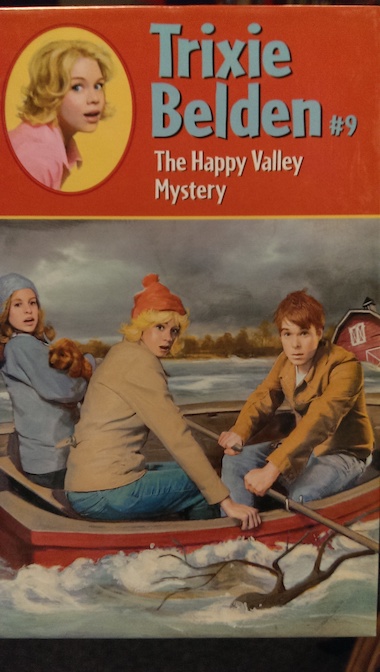
#9 The Happy Valley Mystery by Kathryn Kenny, 1962.

Trixie’s uncle, Andrew Belden, after hearing about the mysteries that the kids have solved, invites them all to spend a week on his sheep farm in Iowa. He won’t be there because he has to take a trip to Scotland, but the Gormans, who are taking care of the sheep, could use their help. Someone has been stealing sheep from the farm, and no one seems able to figure out who it is or how the sheep keep disappearing.

Although Andrew Belden mainly wants the kids to relax, have fun, and learn a little about taking care of sheep, Trixie just can’t resist the challenge to save her uncle’s sheep.  In this book, Trixie is teased a lot for her detective ambitions, and she embarrasses herself a couple of times by suspecting the wrong people. Part of the trouble comes from the fact that she doesn’t know the people in the area and who can legally be the area of her uncle’s farm.

There is a harrowing scene where Trixie and her friends are caught in a flood.  This book also develops the relationship between Jim and Trixie more.  For awhile, each of them is jealous because they think that the other likes someone else.  At the end, Jim gives Trixie a bracelet with his name on it as a sign that they are now boyfriend and girlfriend.

The book is currently available online through Internet Archive.

The Black Jacket Mystery

Trixie Belden

TBBlackJacket

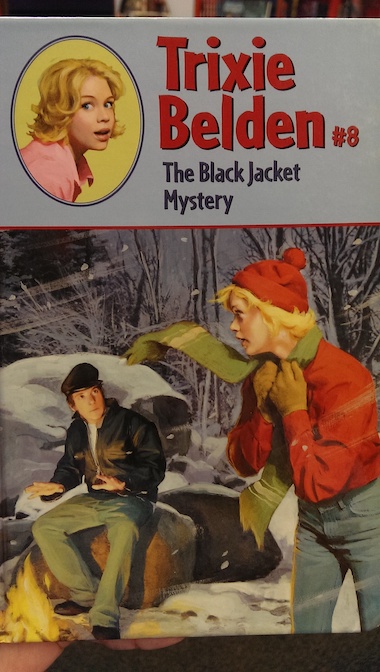
#8 The Black Jacket Mystery by Kathryn Kenny, 1961.

Trixie and the other Bob-Whites are concerned about their pen pals in Mexico because an earthquake has damaged their town. To help them rebuild their school library, the Bob-Whites decide to hold a benefit carnival to collect books.

While they are planning the carnival, Trixie becomes worried about Regan, who is in charge of Mr. Wheeler’s stable. She overhears him speaking to her mother about a problem, asking her advice, but saying that he doesn’t want the kids to know. Although Trixie doesn’t want to pry to into Regan’s business, she can’t help but worry about him and wonder what he doesn’t want them to know.

Then, a boy called Dan Mangan comes to live with Mr. Maypenny. Dan wears a black jacket and looks like a member of some kind of street gang. At school, he brags about brushes with the law. The Bob-Whites try to be friendly with him, but something about Dan gets on Trixie’s nerves.

When someone sells Honey’s missing watch at Mr. Lytell’s store, people begin to suspect that Dan may be a thief. But, soon, Trixie and the others start to suspect that someone else may be hiding out in the woods.

The book is currently available online through Internet Archive.