The Mysterious Code

Trixie Belden

TBMysteriousCode

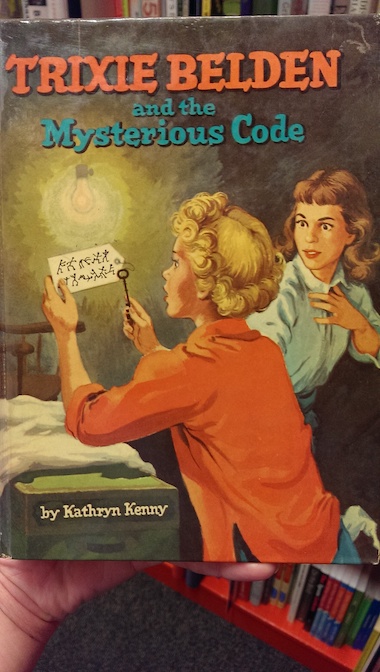
#7 The Mysterious Code by Kathryn Kenny, 1961.

TBMysteriousCodeBobWhites

The title is a little misleading because the code is really only a mystery for a small part of the book.

When the story begins, the existence of the Bob-Whites is threatened because there has been some vandalism at the school and there are fears of gang activity in the area. The school board is considering outlawing all clubs that are not directly supervised by the school and do not serve a specific purpose.

The Bob-Whites explain to their principal that they are a club that supports benevolent causes, but the principal says that they must demonstrate that they support something specific. Trixie suggests to the others that they raise money for UNICEF because it is a good cause and something that the school board would approve of. The Bob-Whites decide that they will hold an antique show to raise money, and they get people to donate items for them to exhibit and sell.  Honey’s mother says that they can have some things that were left in their attic by the former owner of the Manor House.

TBMysteriousCodeSwordIn the attic, Trixie finds a key with a tag on it. The tag is covered with a bunch of little stick figures, which turns out to be a form of code (one that fans of Sherlock Holmes would be likely to recognize). The key opens a box hidden in the attic, which contains a treasure that will raise a considerable sum of money for their cause. However, there is more mystery to come.

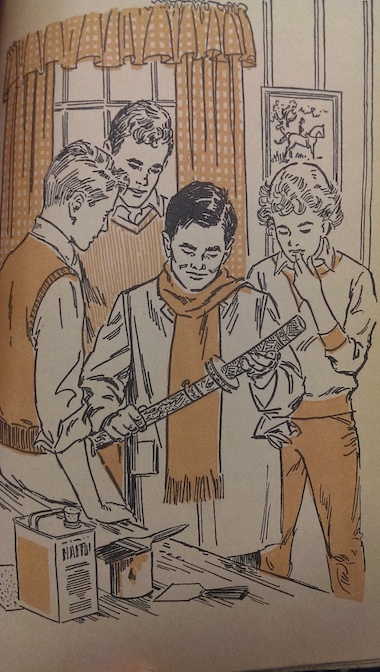
While Trixie and her little brother are on their way home from picking up an antique lap desk from a neighbor, they are attacked by three robbers, who steal the desk. A set of samurai swords is also stolen from the Bob-Whites, and someone attempts to burn their clubhouse. Can they find the criminals and recover the missing antiques, or will their antique show be ruined?

The One Hundredth Thing About Caroline

The One Hundredth Thing About Caroline

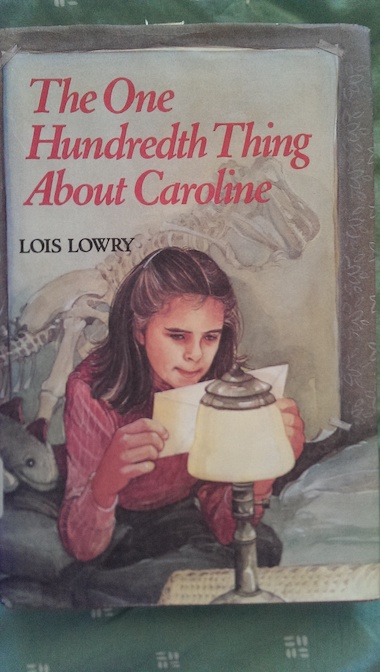
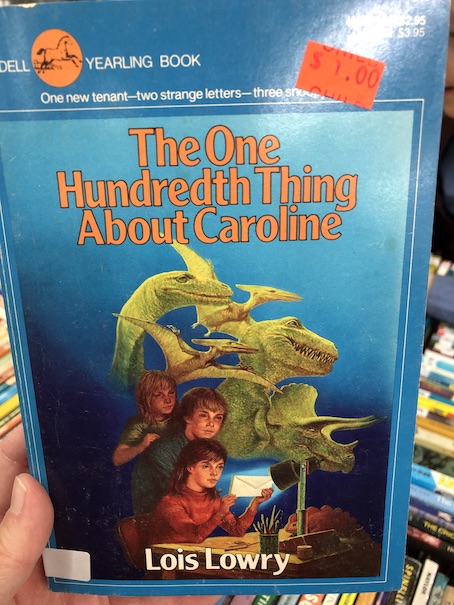
The One Hundredth Thing About Caroline by Lois Lowry, 1983.

Eleven-year-old Caroline Tate knows that she wants to be a paleontologist when she grows up, but she is also fascinated with her friend Stacy’s dream of becoming a great investigative reporter. For fun, the two girls begin investigating the people who live in their respective apartment buildings.

Caroline’s investigation focuses on the mysterious Frederick Fiske, who lives on the fifth floor of her building. In a wastebasket, she finds a letter written to him by a man she’s never heard of telling him to “eliminate the kids.” Also in the wastebasket, there is an overdue notice for Fiske from the library, and the book is about poisons. From this evidence, Caroline comes to believe that the strange Mr. Fiske is planning to murder some children.

The situation becomes worse when Mr. Fiske begins dating her divorced mother, and Caroline fears that the children Mr. Fiske is planning to murder are her and her brother, J.P.. Can Caroline, J.P., and Stacy prove that Mr. Fiske is a cold-blooded murderer before his relationship with the Caroline’s mother can go any further and before he succeeds in poisoning them?

The book is available to borrow and read for free online through Internet Archive.

My Reaction and Spoilers:

It’s a bit of a spoiler, but this is one of those stories where the mystery is largely based on a series of misunderstandings. The book is a comedy mystery.  Mr. Fiske isn’t really a murderer, although he has done some things which make the children suspicious.  It’s a humorous story, and the kids’ antics as they try to further their investigation and collect “evidence” against Mr. Fiske are hilarious.  Along the way, the kids end up helping Mr. Fiske with a problem he’s been having, and the kids realize that they’ve made a mistake about him and his intentions.  Whether Mr. Fiske learns of their suspicions about him or not is left to the imagination, although something at the very end of the story may bring everything out into the open.

The title of the book comes from a joke between Caroline and her mother.  Caroline’s mother is always talking about the things she loves about Caroline, giving them different numbers.

Mystery of the Silent Friends

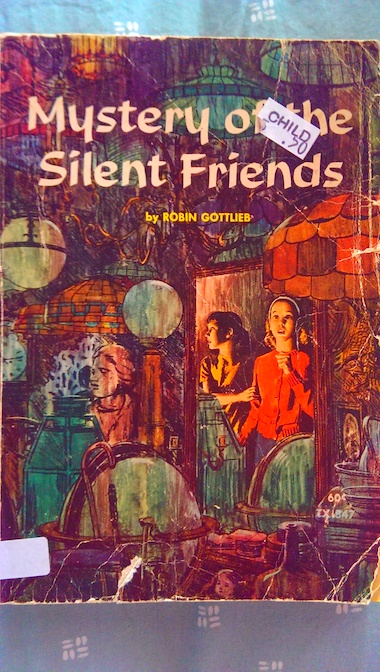
SilentFriendsMystery of the Silent Friends by Robin Gottlieb, 1964.

Nina Martin loves her father’s antique store. Although selling antiques is how her family makes their living, there are some that Nina finds it difficult to let go of when someone wants to buy them. Nina especially doesn’t want her father to sell the two automatons that she calls Henri and Henriette. The automatons are beautiful mechanical dolls that each do something special. Nina calls the boy doll “Henri” because he writes the name “Henri Bourdon” on a piece of paper. (Her father points out that it might be the name of the maker, not the doll itself.) The girl doll, Henriette, is a little more complicated and draws a series of different pictures. Most of the pictures seem to be of a little Swiss village, although one of them is oddly of a monkey that looks like the “speak no evil” monkey in the saying “hear no evil, see no evil, speak no evil.”

SilentFriendsAutomatonsFor a time, it seems like there’s no risk of the automatons being sold because no one seems particularly interested in buying them. Then, suddenly, two different men come to the shop and ask to buy the dolls. Weirdly, each of them tells the same story to Nina’s father: that their name is George Ballantine the Third, that their family once owned the automatons, that the dolls are actually part of a set of three, that they own the third doll (a girl doll that plays the spinet), and that they want to purchase the other two in order to reunite the set. Nina’s father is bewildered by these two men with identical stories and identical names and refuses to sell the automatons because of his daughter’s attachment to them and because he doesn’t know which of the two men to believe and doesn’t trust either of them.

Nina comes to think of the two men as “Red Ballantine” and “Brown Ballantine” because of their different hair colors. Brown Ballantine seems to be the more credible of the two. He invites Mr. Martin and Nina to his home in order to show them the third automaton and, hopefully, persuade Mr. Martin to sell him the other two. They visit Brown Ballantine’s apartment in an old brownstone, and he shows them the beautiful, spinet-playing doll as well as the rest of his collection of mechanical toys. However, Mr. Martin still refuses to make the sale.

SilentFriendsMechanicalToys

Nina tells her friend, Muffin, about the two mysterious Ballantines. The two girls are curious about which of the men is the genuine George Ballantine the Third and decide to investigate. When “Red Ballantine” comes to the shop again, trying to persuade Mr. Martin to sell the automatons, the girls ask if he would consider showing them the automaton he owns as a test. At first, the red-haired man is hesitant, but then he agrees that they can come and see his doll. Mr. Martin is embarrassed at the girls’ forwardness in asking, but he admits that he is also curious about the two Ballantines.

SilentFriendsSpyingAt first, they all expect that Red Ballantine won’t be able to show them the third doll and will give up trying to buy the other two, but to their astonishment, he takes them to the same apartment where Brown Ballantine said that he lived and shows them the exact same doll they saw before. Instead of clearing things up, the identities of the two men seem to get all the more confusing. However, Muffin notices something strange about the tune that the doll plays on the spinet that gives them a clue as to why the three dolls are so important.  Later, someone breaks into the antique store and uncovers a hidden secret about Henri as well.

Together, the three automatons are hiding a secret, and only by considering the message that each of them offers can the girls discover what it is.

The book is currently available online through Internet Archive.  There is also a sequel to this book called Secret of the Unicorn, which involves a secret message hidden in a tapestry.

My Reaction

Although I was pretty sure which of the two Ballantines was the genuine one, I was never completely sure until almost the end.  In a way, I was a little disappointed by the dolls’ final secret because I though it was something that was especially old, from when the dolls were first created, but the secret messages were actually a more recent addition to the dolls’ repertoire by an eccentric man with a treasure to hide and a taste for practical jokes and riddles.  Muffin is a habitual practical joker, and that partly figures into the solution of the mystery.

I thought it was kind of interesting, too, that Mr. Martin has the habit of walking around with a cigarette in his mouth that he never lights, like Inspector Cramer in the Nero Wolfe mysteries.

Who Stole Kathy Young?

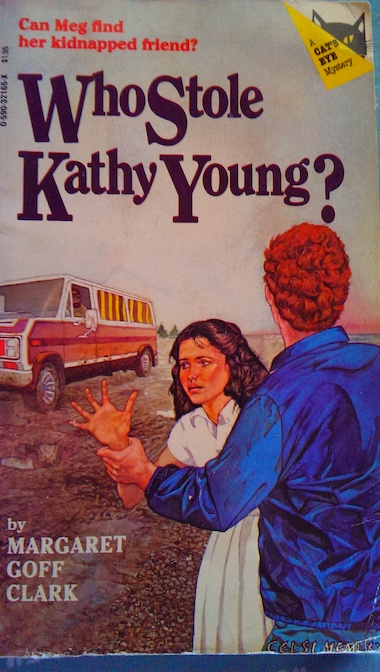
KathyYoungWho Stole Kathy Young? by Margaret Goff Clark, 1980.

Kathy Young has had her share of problems.  Her mother died a year and a half ago, and now, her father has a housekeeper with a sour personality.  A couple of months after her mother’s death, Kathy was seriously ill, and her illness caused her to lose most of her hearing.  She now depends on a hearing aid and her improving lip-reading and sign language abilities.

This summer, Kathy’s best friend, Meg, is staying with her while her parents are on a trip to Switzerland.  Meg was of great help to Kathy when she was trying to adjust to her hearing loss, practicing sign language with her during her special lessons.  Kathy’s dream is to become an artist, but Meg now wants to be a teacher for the deaf, like the teacher who taught Kathy.  Kathy is still very unsure of her abilities to cope with her deafness.  She had the opportunity to attend a special art workshop over the summer but passed it up because she was worried about whether she would be able to communicate with and understand her teacher and the other students, and she knew Meg couldn’t attend to help her.

Kathy has been enjoying Meg’s summer visit, but the girls have noticed something odd.  It seems like a couple of strangers, a man and a woman, have been hanging around everywhere they go.  Meg is worried about it, but Kathy doesn’t want to worry her father.  She thinks that they’re probably tourists, like the housekeeper said.  They nickname the strangers Heron and Toad because of their appearances.

One day, Kathy is kidnapped!  Some men in a van stop to ask her directions and when she tries to explain where they have to go, they pull her inside and drug her!  Meg witnesses the kidnapping, but is standing too far away to help Kathy.

When Kathy wakes up from being drugged, she finds herself on a boat.  Her abductors have cut her hair and changed her shirt to disguise her from anyone who might spot her.  They’ve also taken her hearing aid, hoping to render her helpless and keep her from finding out their plans because she can’t hear them.  However, Kathy isn’t as helpless as they think.  She can still read lips, and she can still think.

Kathy learns to rely on herself and her own wits as she tries to gather as much information as she can about her kidnappers and to figure out how she can save herself.  Through this experience, she develops more self-confidence, realizing that she can do more and handle more than she had thought was possible.

While Kathy is struggling in captivity and her father is dealing with the police and the ransom demand, her friend Meg is trying desperately to find her.  The story alternates viewpoints between the two girls as Meg aids the investigation into Kathy’s disappearance and puts together clues that Kathy leaves for her as her abductors move her from place to place.  The mastermind behind the kidnapping plot is closer to home than they think.

The book is available to borrow and read for free online through Internet Archive.

The Bassumtyte Treasure

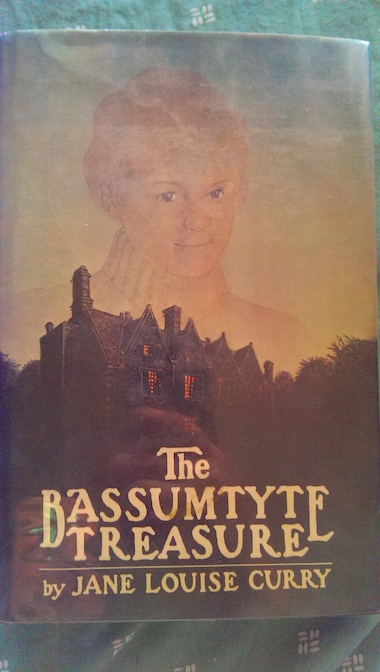
BassumtyteTreasureThe Bassumtyte Treasure by Jane Louise Curry, 1978.

When young Tommy Bassumtyte’s parents died, he went to live with his grandfather. However, his grandfather is now dead, and he is living with his 92-year-old great-aunt, who is in a wheelchair, and her 72-year-old daughter, who has recently had her driver’s license revoked due to her poor eyesight. Although the pair of them have taken good care of Tommy, neighbors have become concerned that they will not be able to do so for much longer because of their age and failing health. Rather than see Tommy sent to a foster home, they decide that he must go to the man who Tommy learns should really be his legal guardian, a distant cousin also named Thomas who lives in the family’s ancestral home, Boxleton House, in England.

The elder Thomas Bassumtyte, who should have taken Tommy when his grandfather passed away, has also since died, but his son, also named Thomas, agrees to take him. Tommy is quickly shipped off to England before there can be a custody hearing in the United States about him because the relatives fear that some official might try to prevent Tommy from being sent out of the country. Tommy is eager to go because he remembers fantastic stories that his grandfather told him about Boxleton House. The current Thomas Bassumtyte also lives there, although the place has become rather run-down, and he fears that he will not be able to keep the place much longer. Thomas was a mountain climber, but he was injured in a fall and hasn’t been able to work much since. He tells Tommy that the two of them might have to move when he is fully recovered and can do more work for the Foreign Office, but Tommy loves Boxleton House from the first moment he sees it and wants to stay.

According to the lore of Boxleton House, a distant ancestor of theirs hid a treasure there, but no one has been able to find it. If young Tommy and Thomas can find it, it would solve many of their problems, and they would be able to keep the house and restore it. All young Tommy has is the mysterious rhyme that his grandfather told him and the strange medallion that his great-grandfather brought with him when he went to the United States in the late 1800s. Thomas tells him that the treasure was supposedly hidden by a distant ancestor of theirs who was fond of riddles, called Old Thomas.

The Bassumtytes were secretly Catholic during the reign of Elizabeth I. Old Thomas was alive then and had a son called Tall Thomas. Tall Thomas traveled frequently and was mysterious about the places he went. One night, he returned to Boxleton House with a young baby, who he said was his son. He had married in secret, and his young wife had died shortly after giving birth. Tall Thomas also brought her body back to Boxleton for burial. However, that wasn’t Tall Thomas’s only secret. Although he remarried, giving his son a stepmother, and lived on for a number of years, he was eventually executed for smuggling messages for the captive Catholic queen, Mary, Queen of Scots. The family was stripped of its noble title and only barely managed to hang onto their house and land. If there was a treasure hidden during this time, it was probably something that the Bassumtytes were afraid would be confiscated by the queen’s soldiers as punishment for the family’s disloyalty or something that Mary had given to Tall Thomas to hide for her.

As Thomas tells Tommy more about the house and the family’s history, he points out Tommy’s uncanny resemblance to Small Thomas, Tall Thomas’s son, as shown in an old painting. Tommy feels a strange connection to Small Thomas, and begins seeing and hearing strange things. An older woman comforts him in the middle of the night, having him recite the same rhyme that his grandfather taught him. A small painting later reveals that this woman was Small Thomas’s grandmother. She appears to Tommy other times, giving him a glimpse back in time and clues to solve the puzzles of Boxleton House.

It is only when Thomas accepts the advice of a family friend who works for a museum that they come to understand the full significance of their family’s heirlooms and the hidden treasure. The treasure may not be quite what the Bassumtytes have always believed it was, but then, the Bassumtytes themselves aren’t quite who they always thought they were, either.

The book is available to borrow and read for free online through Internet Archive.

Magic Elizabeth

MagicElizabeth

Magic Elizabeth by Norma Kassirer, 1966.

Young Sally’s parents are away on a business trip, so she’s been staying with Mrs. Chipley, but now Mrs. Chipley has a family emergency to tend to. Mrs. Chipley’s daughter is ill, and Mrs. Chipley needs to go and help her with her children. While Mrs. Chipley is gone, there is only one other person for Sally to stay with: her Aunt Sarah, an elderly woman who Sally doesn’t really know. Aunt Sarah moved to California when Sally was just a baby, and the only reason why she has returned is that she has decided to sell her old house.

MagicElizabethArrival

Sally is a rather shy girl. She’s uneasy around Aunt Sarah, who is obviously unaccustomed to spending time with children, and Aunt Sarah’s creepy cat, Shadow. The house is old, chilly, and filled with strange things. However, Sally is enchanted with the bedroom that Aunt Sarah gives her and the portrait of a girl and her doll that hangs on the wall. The girl looks very much like Sally herself, and Aunt Sarah tells her that the girl was also called Sally and lived in that bedroom as a child, many years ago.

MagicElizabethKitchen

Fascinated by this earlier Sally and her beautiful doll, modern Sally decides to try to find the doll. Although her aunt tells her that she shouldn’t go poking around in the attic, Sally can’t help herself. She finds a trunk with Sally’s name on it full of girls’ clothes, just the right size for modern Sally to wear. There is a doll in the trunk also, but it’s not the same doll as the one in the portrait. When Sally reads the diary in the old trunk she learns the reason why. The doll in the picture, Elizabeth, was lost many years ago, when the earlier Sally was still young. As modern Sally plays dress up with the earlier Sally’s old clothes and studies herself in the mirror, she finds herself taken back in time, seeing the house through earlier Sally’s eyes. In the past, it was a busy and happy household with parents, an elderly aunt, earlier Sally, Sally’s little brother, and Sally’s pet cats.

A short time later, Aunt Sarah wakes modern Sally on the floor of the attic, and they assume that it was all a dream, but this look into the past changes Sally’s feelings about the house and her aunt’s cat, who suddenly seems friendlier and reminds her of the mother cat she saw in the past. Aunt Sarah also seems a little less stern as they discuss earlier Sally and her lost doll. Aunt Sarah says that no one ever saw the doll again after it disappeared on Christmas Eve all those years ago.  Earlier Sally had put the doll on top of the Christmas tree, like an angel, and after the family finished singing Christmas carols, the doll was gone.  They could never figure out what happened to her.  Modern Sally thinks that sounds very sad and wants to investigate the mystery of the missing doll, although Aunt Sarah isn’t very enthusiastic. She says that if the doll could be found, it would have been found long ago, and the earlier Sally has long since grown up and no longer needs it. Although, oddly, Aunt Sarah remarks that the earlier Sally had always thought that Elizabeth was “a little bit magic.”

Modern Sally continues to look for the doll anyway and also continues having moments when she sees the past as the earlier Sally did many years ago, especially when she looks into the mirror in the attic. One day, she invites a neighbor girl named Emily over, and while the two of them are looking around the attic, Emily finds Elizabeth’s old doll bonnet. The girls are excited because they now know for certain that Elizabeth is still in the house, waiting to be found. The girls are running out of time to find her. If Aunt Sarah agrees to sell the house, it will be torn down to build apartments. But, Sally falls ill with the flu, and it isn’t until Shadow gives her an important clue that Sally realizes where Elizabeth must be.

This book is currently out of print, but it’s one that I’d dearly love to see in print once more!  It is available to borrow and read for free online through Internet Archive.

My Reaction and Spoilers

Adults reading this story will probably realize before the children do (spoiler) that Aunt Sarah herself was the earlier Sally, the one who lost her favorite doll many years ago. “Sally” is a nickname for Sarah, like “Molly” can be for Mary and “Peggy” can be for Margaret, although any of those names can also be used by itself.  (In the Middle Ages, it was common for popular names to get different variations of nicknames by changing one sound in the original name and then changing one more sound in the first nickname to get another one, and sometimes even moving on to change one more sound to get yet another nickname that was very changed from the first. Those nicknames that look significantly different from their original names are a holdover from that practice, having lasted even into modern times.  John/Jack works on the same principle.  Fun fact!)  When Aunt Sarah grew up, she stopped using her childhood nickname, but the name was passed on to modern Sally.

At first, modern Sally sees her stern aunt as being witch-like, all dressed in black and fussy, but gradually, the memories of the past, her new relationship with young Sally, and the finding of her slightly-magical doll soften her. There are hints of Aunt Sarah’s youth in the attic, although Sally at first dismisses thoughts that some of the lovely things there could have belonged to her cranky old aunt because she has trouble thinking of her aunt as once having been young, pretty, and sweet. However, part of the theme of the story is that everyone was young once. Aunt Sarah is is bent and achy from arthritis, giving her the witch-like appearance and making her short-tempered at times. She also hasn’t been around children much for years, and part of her fussiness comes from forgetting what it was like to be young herself. Modern Sally, with her resemblance to her elderly aunt, and Elizabeth the doll both work their magic on her, reminding her what it was like to be a young girl and helping to revive a more youthful spirit in her.

I was happy that (further spoiler) Aunt Sarah decides not to sell the house after all, not just because she and Sally will get to spend more time together, but because old houses like that are rare these days. I like the idea that the old family heirlooms in the house will now be preserved, like the sleigh out in the old barn and the melodeon, a type of small organ.  I liked the way the book described the melodeon making musical sounds as people walk past it because of the way the floor boards move.  I also loved the description of the gas plant that Sally sees in earlier Sally’s memories.  If you’d like to see what a gas plant looks like when it’s lit, have a look at this video on YouTube.MagicElizabethMelodeon

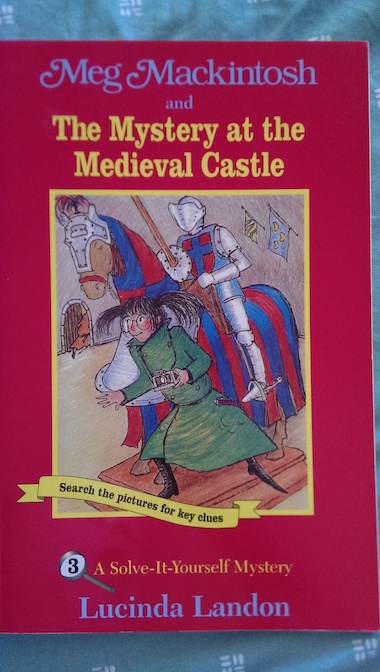
Meg Mackintosh and The Mystery at the Medieval Castle

Meg Mackintosh Mysteries

MMCastle

Meg Mackintosh and The Mystery at the Medieval Castle by Lucinda Landon, 1989.

Meg is visiting Dundare Castle with her teacher and some other students.  Dundare Castle is a special museum where people can learn about life in Medieval times, although it used to be a private home.  The owner’s family came from Scotland, and they built their home to look like their ancestors’ castle there.  Eleanor, the owner, now calls herself the Duchess of Dundare, and with her staff, dresses up to recreate the lives of people from the 1300s.

MMCastleTour

One of the Duchess’s prized possessions is a silver chalice studded with jewels that has been in her family for generations.  She keeps it on display in the castle’s “abbey,” guarded by the actor playing the part of a knight, Knight Henry.  But, when Meg and her classmates get to the abbey, the chalice is gone, and Knight Henry is lying on the floor, unconscious!

MMCastleTheft

Not long before they found Knight Henry, the kids had seen a robed figure run across the courtyard.  Monk William falls under suspicion, although the Duchess doesn’t really believe that he is guilty because he’s been with her family for a long time.  There are other possible suspects, and Meg believes that both the thief and the chalice are still in the castle.

The book is currently available online through Internet Archive.

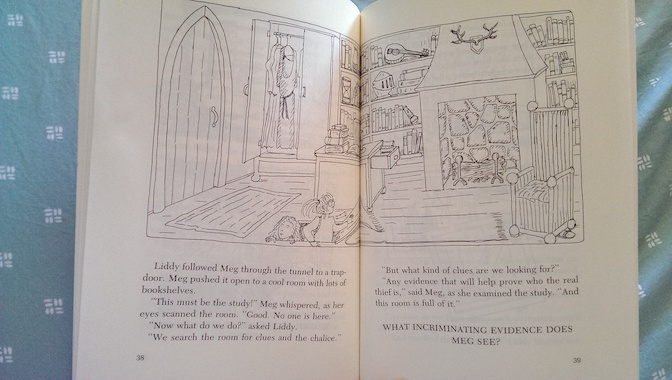
MMCastleSearch

My Reaction

I love this series because the books are interactive, giving readers the opportunity to figure out the clues and solve the mystery along with Meg. As Meg interviews the other actors in the castle and explores every room, readers are invited to study the pictures and consider the evidence to see if they can solve the mystery before Meg can.  At various points in the story, there are questions for the reader to consider, giving them the chance to pause and see if they’ve noticed what Meg has seen. I recommend that adults who are introducing children to the mystery genre read a couple of these stories along with them and discuss the clues as they go, helping children to learn how to notice details, solve puzzles, and think critically. It’s a good learning opportunity as well as a fun mystery!

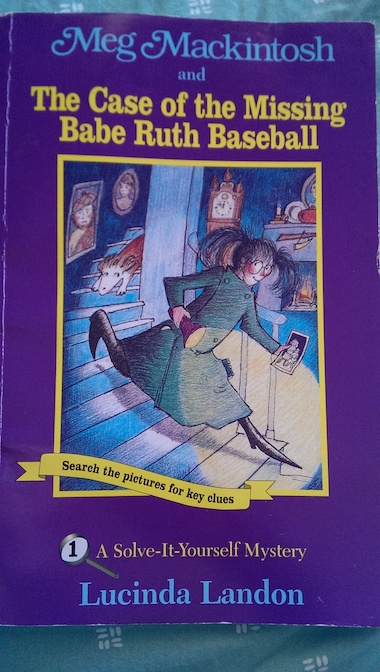
Meg Mackintosh and The Case of the Missing Babe Ruth Baseball

Meg Mackintosh Mysteries

MMBaseball

Meg Mackintosh and The Case of the Missing Babe Ruth Baseball by Lucinda Landon, 1986.

MMBaseballAlbumThis is the first book in the Meg Mackintosh series, and it was the first mystery story that I ever read, when I was about seven years old.  It started a life-long love of mysteries!

Meg’s grandfather shows Meg and her friend Liddy some old family photographs and tells them about the time when his cousin Alice took his prize possession: a baseball autographed by Babe Ruth.  Alice was a bossy girl who always liked to tease him, and so she created a kind of treasure hunt, challenging him to solve it in order to get the baseball back.  Unfortunately, he could never figure out the clues and still doesn’t know what happened to the baseball.

Meg’s brother, Peter, has a Detective Club, but he refuses to allow Meg to join, saying that she needs to prove that she can solve a mystery.  Seeing this as her chance, Meg decides that she’s going to solve this old puzzle and find the Babe Ruth baseball!  However, she also has competition from Peter, who thinks that he’s the better detective and tries to send Meg off in the wrong direction.

The book is currently available online through Internet Archive.

My Reaction

All of the books in the Meg Mackintosh series allow readers to try to solve the mysteries along with Meg, stopping periodically to ask them if they’ve noticed a clue that Meg has noticed or if they know what the significance of a clue is.  There are pictures to help, and readers are invited to stop and study the details before moving on. I think this is a good way to introduce children to puzzle-solving and help them develop critical thinking skills and an ability to notice details. I would recommend adults reading these books, or at least the first one or two along with children, so they can discuss the stories and clues with them, helping them spot clues as they begin to get used to the format of the books.

This is an excellent series for introducing children to the mystery genre for the first time! When I was young and just learning what mysteries were, I was fascinated to discover that I already had all of the knowledge I needed to solve this mystery along with Meg because all of the clues to Alice’s treasure hunt had to do with nursery rhymes. If you can recognize the rhymes in the book, you’re well on your way to solving the mystery!

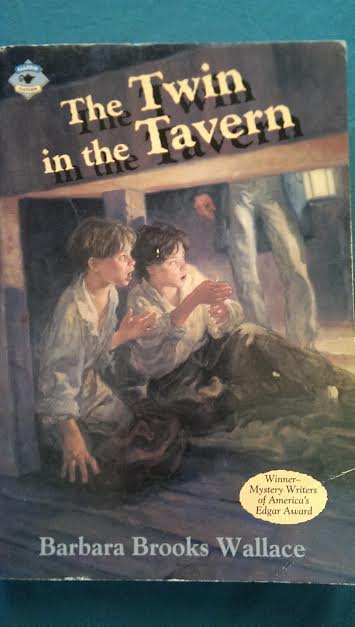
The Twin in the Tavern

TwinTavernThe Twin in the Tavern by Barbara Brooks Wallace, 1993.
Young Taddy has lived with his Aunt and Uncle Buntz in Virginia ever since he can remember. When they die during an epidemic, he is left completely alone and afraid that he will be sent away to a work house. Before his uncle dies, however, he tells Taddy something that gives him even more reason to be afraid. He tells Taddy that nothing is how it seems and that Taddy is not really their nephew. He says that Taddy will only learn the truth when he finds his twin, but he must beware because he is in danger. Unfortunately, he never says where Taddy’s twin is or what kind of danger he is in.

Before Taddy can decide what to do, a couple of thieves, Neezer and Lucky, come to rob the house because they heard that Mr. and Mrs. Buntz were dead. When they discover Taddy in the house, they bring him with them to Alexandria and make him work in their tavern. Taddy is only given scraps to eat and he must sleep under a table in the kitchen with another boy who works for Neezer called Beetle. However, by coincidence, Neezer and Lucky may have brought Taddy to the very place he needs to be to find the answers about his past and his true identity.

Danger seems to lurk around every corner in the city, and Taddy doesn’t know who to trust. Even when Neezer hires him out to work in the home of the wealthy Mrs. Mainyard and her two daughters, sinister characters surround him, from the suspicious Professor Greevy to the stern John Graves, who visits the family.  At one point, Taddy thinks that he’s found his twin, but the boy mysteriously vanishes. Will Taddy find his twin and the secret of his past, or will the danger that his uncle warned him about find him first?

This book was a BOOKLIST Editors Choice Book in 1993 and won the 1994 Edgar Allan Poe Award.  It is available to borrow and read for free online through Internet Archive.

My Reaction

This was one of my favorite mystery stories when I was a kid!  Orphans with mysterious pasts are staples of children’s literature and make for compelling mystery stories, and the addition of a secret twin makes it even better!  Secret twins can be somewhat cliche in stories, but this one is good because there’s an unexpected twist for Taddy that he never considered until the truth is finally revealed.

Many of Barbara Brooks Wallace’s mystery books involve sinister characters with hidden agendas and children who don’t know who to trust because they don’t fully understand the plot they’re caught up in.  This book is like that because Taddy doesn’t know the real source of danger to him.  Like other children in stories of this type, Taddy frequently depends on the help of other children because he doesn’t know which adults to trust.

The story is set at an unspecified time in the past, although it appears to be sometime in the 19th century.

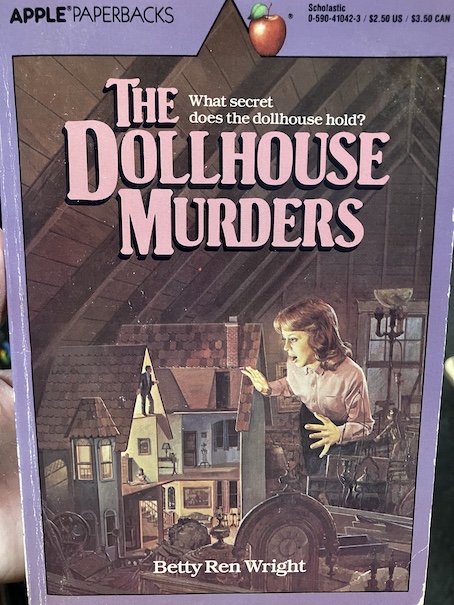
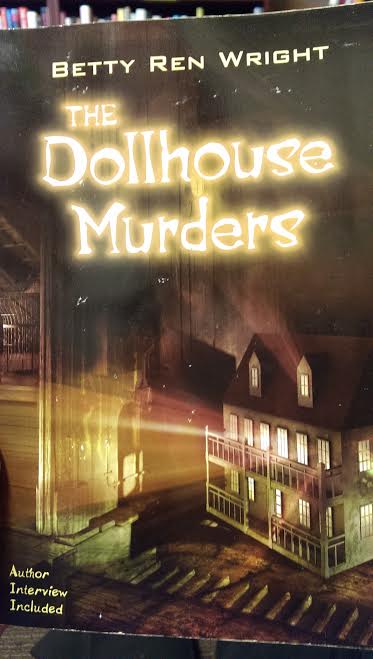
The Dollhouse Murders

The Dollhouse Murders by Betty Ren Wright, 1983.

Amy is upset because she constantly has to look after her sister Louann, who has developmental problems. Louann is only a year younger than Amy, but her condition makes her think and act like a small child all the time. Amy loves Louann, but having her around all the time makes it difficult for her do things on her own and to make friends.  It’s frustrating because the girls’ mother doesn’t seem to understand the pressure Amy feels.

One day, she has an argument with her mother about it and runs away to her aunt’s house. Aunt Clare normally lives in Chicago, but she has returned to her home town to sort out the things in her grandparents’ old house. Sympathizing with Amy, Aunt Clare offers Amy the chance to stay with her for a couple of weeks, without Louann.

Aunt Clare and her brother, Amy’s father, used to live with their grandparents when they were young, and Aunt Clare says that she has unhappy memories of that time.  While helping her aunt go through some of the old things in the house, Amy discovers that there is a dollhouse in the attic made to look exactly like the grandparents’ house and dolls which look like the grandparents, Clare, and her brother. Amy thinks the dollhouse is wonderful, but Aunt Clare seems to find it disturbing.

When Aunt Clare refuses to talk about her deceased grandparents, Amy looks at some old newspapers at the library to learn more about them. To her shock, she learns that they were murdered in the house and that the killer was never found. Soon, strange things begin happening with the dollhouse. The dolls move around on their own, mysterious lights appear, and crying noises can be heard. The dolls seem to be acting out the events of the night of the murder. After all this time, the dolls seem to be trying to tell them something, if they have the courage to listen.

The book is currently available online through Internet Archive (multiple copies). There was a movie version of this book made in 1992 (Sometimes called Secrets in the Attic), but it’s difficult to find copies of it now.  Sometimes, the movie or clips of it appear on YouTube.  Apart from that, it’s very difficult to see it.

My Reaction and Spoilers

dollhousemurders

I remember liking this book when I was a kid, although I was often a timid kid who was easily scared by scary stories. I think it was the mystery angle, solving the old murder, that intrigued me the most, although I also enjoyed the characters in the story. I felt impatient with both Amy and her mother at times, but I liked the way the family eventually worked through their problems and came to understand each other better.

Aside from revealing the murderer’s true identity, the dolls settle other troubling matters in Amy’s family.  For years, Aunt Clare has blamed herself for the way she behaved around the time her grandparents were killed.  She was afraid that something she did might have even led to their deaths.  But, none of it was really her fault, and her grandparents want her to know that she needn’t blame herself anymore. In some ways, I felt a little cheated by the answer to the murder mystery because the murderer is a person we never see and who has been dead for years, so there was no way readers could have known it was him, and he is never brought to justice. However, learning the identity of the murderer is important because it gives Aunt Clare some closure. When Aunt Clare realizes the truth, she feels like a great weight has been lifted from her.  She begins coming to terms with her past and appears to be headed for a better future. 

Amy also comes to terms with her sister’s condition and values her even more highly when Louann’s lack of fear of the dollhouse gives Amy the courage to see the dolls’ final message. Louann might have been less scared by the dolls than Amy was because Amy understands more of the situation behind the haunting, but the dolls aren’t actually malicious, and there’s no need for the girls to be afraid. Louann is a tender-hearted girl who loves the dolls and dollhouse immediately, and Amy finds that Louann’s willingness to see what the dolls have to show them gives her comfort and courage. Because Aunt Clare understand the feeling of guilt, she helps Amy to see that some of the ways that her mother behaves regarding Louann, babying her a little too much and trying to make Amy more responsible for her, also come from a feeling of guilt. There was nothing Amy’s mother could have done that would have changed Louann’s condition, but Amy’s mother feels guilty anyway. Her guilt is a problem because she’s been holding Louann back from experiences that would help her develop more and give Amy a little more freedom from having to look after Louann so much.  In the end, Amy’s family does make changes to help Louann become a little more independent and to allow Amy a little more independence of her own.