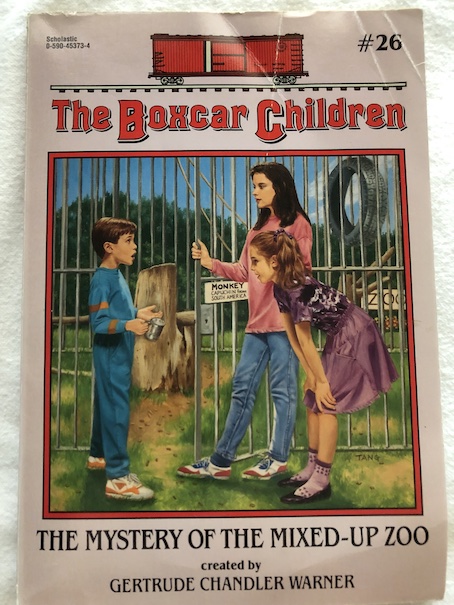
The Mystery of the Mixed-Up Zoo

The Boxcar Children

Boxcar Children The Mystery of the Mixed-Up Zoo
Boxcar Children The Mystery of the Mixed-Up Zoo wrong labels on animals

The Aldens are visiting an old friend of their grandfather’s, who owns a zoo. The friend, Edward, lives alone and isn’t very organized, so the Aldens offer to help him straighten up the house and do some cooking. Edward is pleased with their help and few home-cooked meals. However, strange things start happening at the zoo.

First, someone switches around all the signs identifying the animals, so each sign is next to the wrong animal. It looks like a silly prank, but then more things happen. Then, someone sabotages the electricity, making it difficult to keep and prepare the food for the animals. It gets worse when someone sabotages the temperature controls in the animals’ habitats, making it too hot for some animals and too cold for others. The Aldens help the zoo staff to fix the temperatures because the animals could actually be killed by being kept at the wrong temperature! Finally, someone steals the zoo’s monkey! Who could be behind these things?

Boxcar Children The Mystery of the Mixed-Up Zoo monkey in a cage

The man who owns the local bookstore helps the Aldens find books about animals, but he seems oddly reluctant to talk about the zoo. A local woman, Helen Brooks, thinks that the zoo should be shut down because supporting it costs too much money for taxpayers. She doesn’t care what happens to the animals, and although many local people love the zoo, she plans to bring up the issue at the next town council meeting. When someone tries to sell the monkey to the local pet store, the Aldens start to get the answers they’re looking for.

Boxcar Children The Mystery of the Mixed-Up Zoo giving seal water

I thought the mystery was all right, but I had some mixed feelings about the way the villain was handled. We see the villain and get to know the villain’s other role in the story before we know it’s the villains, but I just thought there could have been more build-up about the villain’s connection to the zoo before the person is revealed as the culprit. The attempted sale of the money kind of clinches the identity of the culprit without the Aldens really having to figure out why first.

I did think the book was interesting for the way they explain both how some of the pranks at the zoo are actually seriously dangerous to the animals’ health, like changing the temperatures in their enclosures. It also explains how the Aldens help the zoo employees to help take care of the animals, so the book has some educational quality.

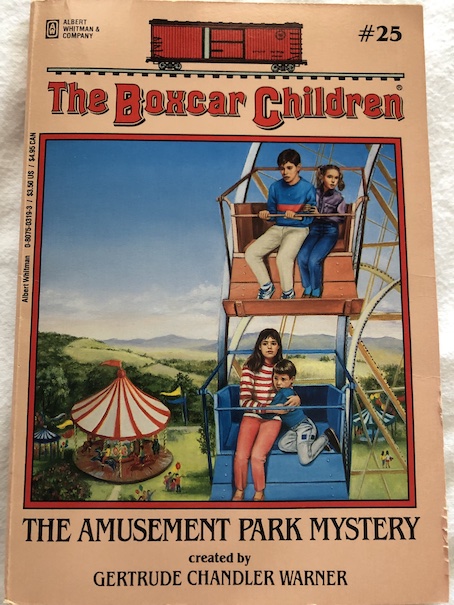
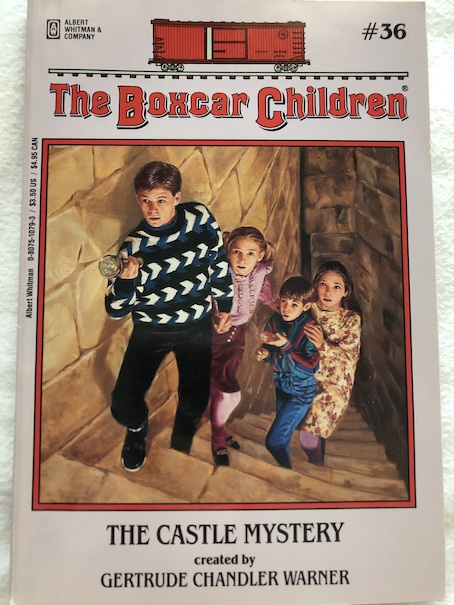
The Amusement Park Mystery

The Boxcar Children

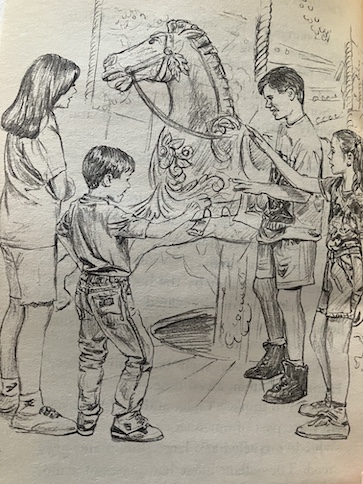
The four Alden children go to visit their cousin Joe and his wife Alice. They work at a museum, but one of the best parts of visiting them is the amusement park nearby. The amusement park has a charming, antique carousel with hand-carved horses. The horses are valuable antiques, and Alice says that they are wonderful examples of Americana (American folk art).

The Aldens, especially Benny, think the carousel is wonderful, but not everyone feels the same away about it. When they talk to the owner of the amusement park, Joshua, they learn that he loves the antique carousel but his daughter, Karen, who works with him, thinks that they should get rid of old rides like that and add newer, more modern ones. What she really wants to do is add a roller coaster to the park, something that would appeal to older kids and adults rather than young children. The Aldens don’t see how she can add a roller coaster because the park isn’t very big, and a roller coaster would take up about half the park. They hear Karen later talking about it again with her boyfriend, who is a golfer. They notice the boyfriend doing some sketches of horses that he doesn’t seem to want to let them see.

The first time the Aldens ride the carousel, they have a great time, and Benny chooses a dappled gray horse as his favorite. However, when they return to ride the carousel again later, it seems like something is wrong with the horse. It used to bob up and down during the ride, but now, it doesn’t move. When they return again, a couple of days later, the dappled gray horse moves but now has a long scratch on its side that wasn’t there before. The Aldens also begin to notice problems with other horses. Another gray horse has stopped moving, and a chocolate brown one oddly has an unpainted stomach when they were sure it was painted before.

They talk to Joshua about the horses, and he becomes concerned. He has an expert examine them, and the expert assures him that these are the authentic antique horses that were always there, but the Aldens are sure that something suspicious is going on.

If someone has been taking the original horses and substituting fakes, why did the so-called expert say that they were the original horses? Who could be behind it? Is Karen trying to sabotage the carousel to get the roller coaster she wants? Her boyfriend seems to need money, so he could be selling off the horses. What about the cotton candy seller and his disagreeable wife or the man who actually runs the carousel ride?

I thought the book did a good job of providing readers with multiple suspects to consider. We know Karen isn’t fond of the carousel and wants more exciting, modern rides, so she could be selling off antique carousel horses to fund her ideas. Her golfer friend also needs money, and his sketches of horses might be for planning how to create counterfeits of the originals. Then again, the cotton candy seller and his grumpy wife are always around and acting suspiciously, and the man who runs the carousel ride has obvious access to the horses. I like mysteries where there are multiple suspects to consider!

The concept of the antique carousel reminded me of the Nancy Drew computer game The Haunted Carousel, but that computer game was based off of a Nancy Drew book, not this one. It’s interesting to notice some themes that appear in different children’s series. Not every kids’ mystery series features an antique carousel, making it a charming and uncommon theme. However, amusement parks are common themes in children’s books, and a mysterious, antique ride offers that element of both quaint nostalgia and spookiness together.

Meg Mackintosh and The Case of the Curious Whale Watch

Meg Mackintosh Mysteries

Meg and her brother, Peter, are going on a whale watch trip with their grandfather. As they board the boat, their grandfather tells them that the captain is well-known as a treasure hunter, looking for pirate treasure.

On board the Albatross, they are greeted by Captain Caleb and meet his mate Jasper, and the other whale watch guests. The guests are Mrs. Clarissa Maxwell and her nephew Anthony, who seems to like gambling; a man named Oliver Morley, who likes stamps; a college student called Carlos de Christopher; and a marine biologist, Dr. Susan Peck.

Meg asks Captain Caleb about his treasure hunting, and he shows everyone an old map that’s been in his family for many years. The sailor who gave it to them also gave them a whale’s tooth with a scrimshaw carving of a whale on it. It’s supposed to help explain where the treasure is hidden. Some of the members of the expedition debate about how much money the treasure of the map would be worth, but Dr. Peck is completely opposed to treasure hunting because it’s disruptive to the environment.

The group enjoys watching the whales, although Meg’s grandfather has to go lie down for a while because he’s seasick, and lazy Jasper spends his time reading comic books in the lifeboat. When they encounter a storm, and everyone goes into the cabin to get out of the rain, they discover that the map is missing!

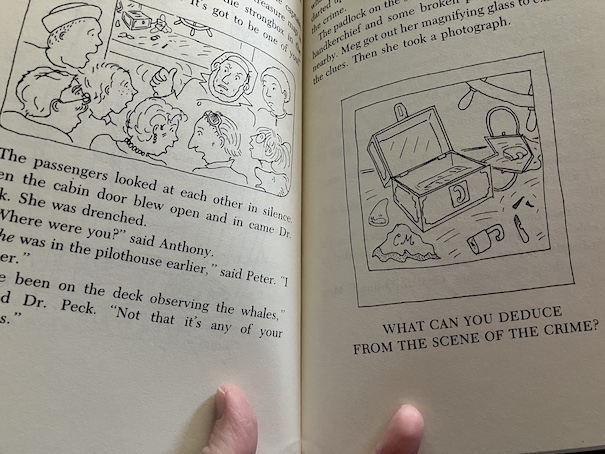
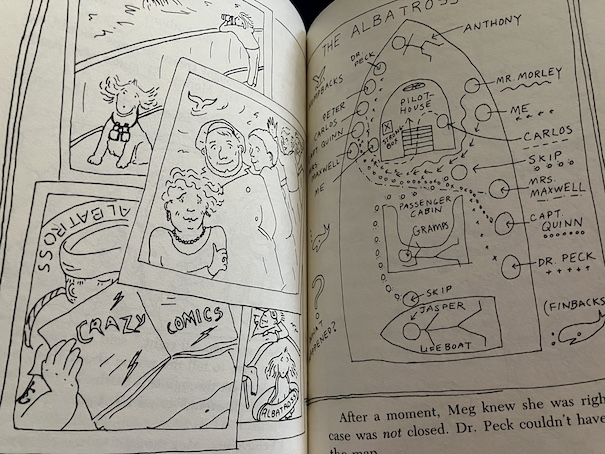
Who could have taken it? Various members of the whale watch have talked about their need for money, and Dr. Peck said that she thought the map should be destroyed to prevent damage to the environment. Meg goes over the pictures she’s take to find the thief!

The book is available to borrow and read for free online through Internet Archive (multiple copies).

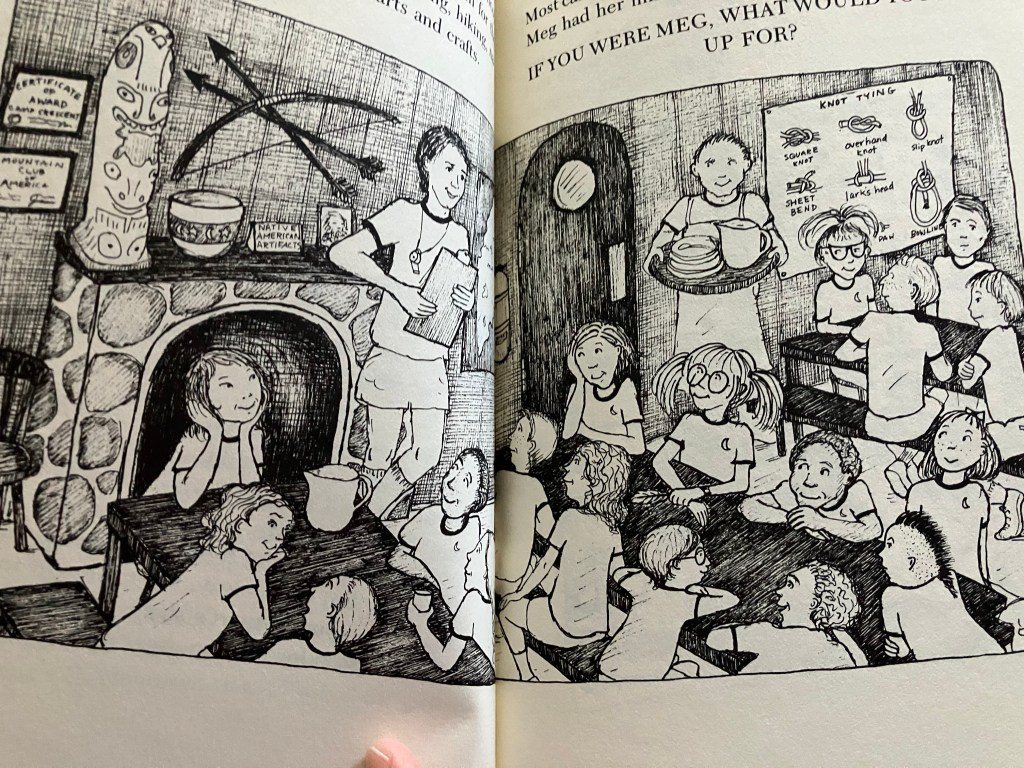
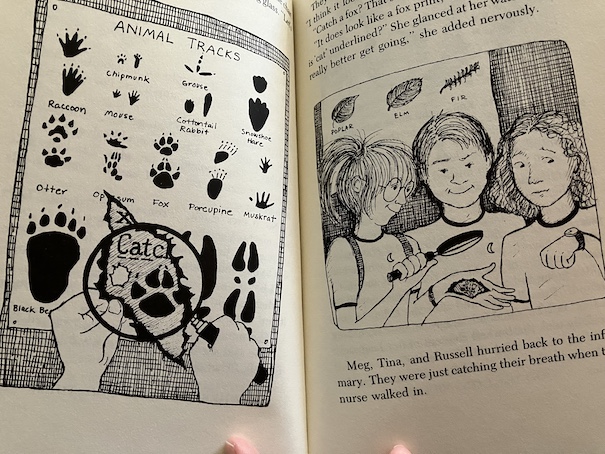
I like the Meg Mackintosh books because it’s fun to solve the mystery along with the heroine. Like other books in the series, readers are supposed to use the story and the clues in the pictures to solve the mystery. At various points in the story, the story pauses for readers to figure out something about what’s happening, and these are good points for readers to check that they’re on track and to review the information they know so far. The story isn’t very long, but there are multiple points for readers to figure out something about what’s going on.

I did figure out the answer to this one very quickly. It’s partly because I’m an adult and this is aimed at children, but more importantly, I’ve seen the movie Charade with Audrey Hepburn, which used a similar plot device. The story did a good job of making all the suspects look like they had a motive, but when you figure out what the thief’s real goal was, there’s only one person who qualifies. Kids in early elementary school would probably find the mystery more challenging.

Meg Mackintosh and The Mystery at Camp Creepy

Meg Mackintosh Mysteries

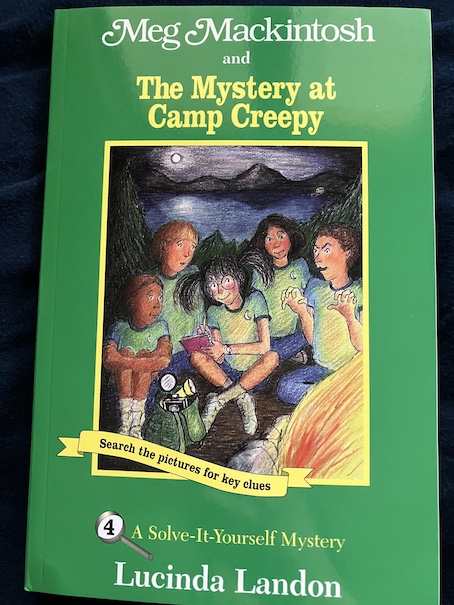
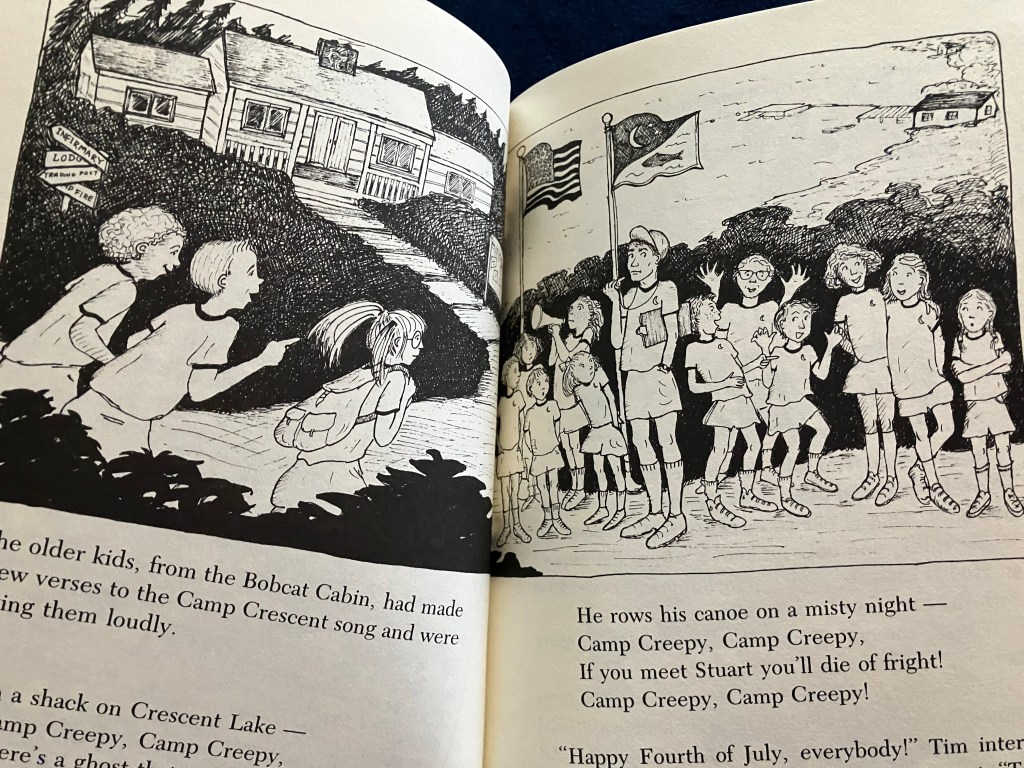
Meg Mackintosh is at a summer camp in Maine! The camp is called Camp Crescent, but it soon gets the name Camp Creepy because there’s a ghost story about the camp. The story says that an old man named Stuart once lived in the building that the camp uses for a boathouse and that he still haunts the camp. When people start hearing strange noises at night, the campers start thinking maybe the ghost story is true.

To celebrate the Fourth of July, the camp decides to hold a treasure hunt with puzzles for the campers to solve. Everyone is excited about the treasure hunt, but Meg is especially excited because she’s solved treasure hunts before. However, in her excitement to start the treasure hunt, she accidentally drops the first clue on the camp fire, and much of it burns.

Everyone is angry with Meg for messing up the treasure hunt because they’re supposed to solve it before nightfall to enjoy the prize. Although they don’t know what the prize is supposed to be, they’re told that it won’t be any good if they find it too late. While the others go on a hike, Meg fakes a stomach ache because she just can’t face the other campers again.

At the camp’s infirmary, Meg meets two other campers who are staying behind. Russell has a bad case of poison ivy, and Tina has been dealing with homesickness. They ask to see what’s left of the first clue, and Meg shows them. Something in the clue reminds Meg of something she saw at camp earlier, and the three of them begin thinking that they might be able to solve the after all. If they can just get past that first burned clue, they can continue the treasure hunt like normal.

Can the three of them manage to solve the treasure hunt and save the prize for all the other campers? Will they meet Stuart’s ghost along the way?

The Book is available to borrow and read for free online through Internet Archive (multiple copies).

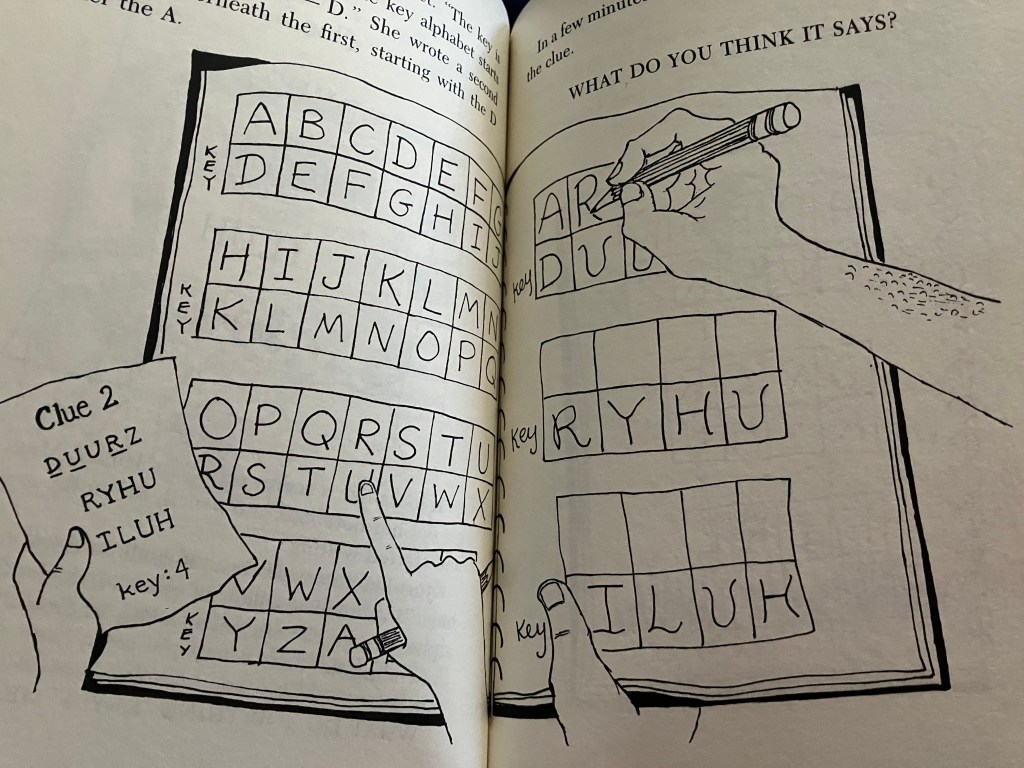
I always enjoy treasure hunt stories, and like other Meg Mackintosh mysteries, this story gives readers the opportunity to figure out the clues and puzzles along with Meg. The information readers need is in the pictures of the story.

Most of the focus of the story is on the treasure hunt, and the ghost is kind of a side plot. Maybe the ghost would seem a little spookier to young readers, but I have to admit that I found it difficult to think of anybody named Stuart as sounding very sinister. The legend of Stuart doesn’t even seem to carry any consequences for people who see him other than it just being spooky, so I didn’t think the story was that creepy.

Garbage Juice for Breakfast

Polka Dot Private Eye

This book follows an earlier book in the series, The Case of the Cool-Itch Kid, while Dawn is staying at her summer camp, Camp Wild-In-The-Woods. Her friend from school, Jill Simon, is at camp with her, and they’ve made friends with another character from the earlier book, Lizzie Lee, who started out as a rival/antagonist for Dawn. Both Dawn and Lizzie like mysteries and being private detectives, and they’ve bonded over that. There is still an element of rivalry between them, but it’s a friendlier rivalry than when they first met each other.

When their camp counselor announces that she has set up a treasure hunt for the campers to solve, Dawn is excited. As the Polka Dot Private Eye, she’s sure that she’ll be the first to solve the mystery! However, Lizzie is the Cool Cat Detective. (Each of them take their names from the detective kits that each of them own.) Dawn knows that Lizzie will be tough competition.

Because the kids in their cabin are from different schools and some were friends with each other before they came to camp, the campers in the cabin have favorites between the two girl detectives. Jill thinks that Dawn is the best detective and will solve the treasure hunt before Lizzie will, while Lizzie’s friends think that she’s going to be the one to solve the mystery. They decide to turn the treasure hunt into a contest to show which of the girls is the best detective.

The first clue is in the form of a rhyme. It seems to have something to do with horses, and the girls are starting to learn horseback riding. There is also a hint about taking a particular trail. It’s tough for both Dawn and Lizzie to investigate the same mystery without getting in each other’s way, following one another or being suspicious that they’re following each other, or accidentally giving each other hints. Is the competition between them really a good idea, or is teamwork what they really need?

The book is available to borrow and read for free online through Internet Archive (multiple copies).

I remember reading this book when I was a kid, and I loved it because I always loved treasure hunt books! There are parts of the treasure hunt that readers can solve along with the characters in the story, although it’s not one of those stories that pauses to ask readers if they’ve solved parts before the characters have. It’s just that the information necessary to solve each part of the treasure hunt is given in the story and shown in the pictures, so readers have the opportunity to think what the next step should be along with the characters or before the characters announce what they’ve figured out. Some of the clues point to features of the camp itself, like the names of the trails around the camp, but the story does provide that information to the readers, so there’s nothing that the characters know that the readers don’t. Other clues use pop culture references, like Donald Duck, because their camp counselor is a Disney fan and has items with Disney characters on them.

Dawn and Lizzie do compete with each other to solve the treasure hunt, until they solve the final clue. All through the book, Dawn struggles with the horse lessons because she’s actually afraid of horses. When reaching the prize means going through an area with a lot bugs, Dawn suddenly feels sorry for Lizzie, who is following her but struggling because she’s afraid of bugs. Understanding what it’s like to struggle with something that scares her, she feels some empathy for Lizzie and realizes that she can’t use Lizzie’s fear to get ahead of her and reach the treasure first. She tells Lizzie that they can go together to reach the treasure, so they are able to share the glory. The experience helps the girls a little with their respective fears, and they share the final prize.

The name of this book comes from a kind of mixed fruit juice that the camp serves in the dining hall. None of the campers know exactly what’s in it, nobody really likes it, and the camp rumor is that it’s just strained out of the garbage. It doesn’t really have anything to do with the mystery in the story, but it’s there for background color, the kind of stories that kids tell about food at camps and schools that they don’t like.

Aside from the mystery, the story has some fun camp atmosphere for beginning chapter book readers: horses and barns, the camp dining hall, a picnic with books, and a cozy, rainy night in their cabin with cookies.

Megan’s Island

School will be out soon, and eleven-year-old Megan and her best friend, Annie, are making plans for the summer. Megan’s family doesn’t have much money because her father died when she and her brother, Sandy, were very young, and her mother struggles to find a job that will pay enough to support the three of them. They’ve moved around multiple times in the last several years while her mother looks for better work, and they get by with some help from Megan’s grandfather. This summer, Megan’s family is planning to visit her grandfather at his cottage by the lake. Her grandfather is already staying there, recovering from an injured foot, and Megan’s mother agreed that Annie can come with them on the trip.

However, before school lets out for the summer, something happens that suddenly changes their plans. One evening, while their mother is in the kitchen, clearing up from dinner, she suddenly drops her favorite salad bowl, cutting herself on the glass. Megan and Sandy help her clean up the mess and bandage her cut, but they can tell that it wasn’t just clumsiness that made their mother drop the bowl. She really seems to be upset and even afraid of something. Since they didn’t have any phone calls or mail that could have given her upsetting news, they can only think that it must have been something she heard on the tv news. Their mother had been listening to the news on the small tv in the kitchen before she dropped the bowl, and she quickly turned it off when the children came to see what was wrong.

Their mother refuses to explain what upset her, and she tries to pretend that nothing is wrong, but she quickly tells the children to pack their things because she’s taking them to their grandfather at the lake early. Megan protests that school isn’t out yet, but their mother says that they’ve already finished their tests, so they won’t be missing anything important. Megan also worries that they’re leaving without Annie or even telling Annie that they’re going early, but their mother says it can’t be helped. Then, Sandy overhears their mother asking a friend of hers on the phone, asking her to put their things in storage for her while they’re gone, making the kids worry that they’re leaving for good and not just for vacation. Refusing to answer any more questions from the children, their mother hurries them through their packing and out of the house that very night. She drives them all through the night to get to the lake.

When they get to their grandfather’s cottage at the lake, he is surprised to see them, showing that their early arrival wasn’t something he had arranged with their mother. Later, Megan overhears them talking. Her grandfather urges their mother to tell them the truth about what’s happening because kids are more resilient than they seem, and whatever they’re imagining might be worse than the truth. However, their mother says that the truth really is upsetting, and while she knows that she has always insisted that her children tell the truth, telling them the truth now would mean admitting that she has already lied to them.

Megan is shaken by what she hears. What has their mother lied to them about? Is it something to do with her father? Megan barely remembers him, and their mother gets upset when she asks questions about him. Her mother seems to be hoping that this whole matter will just blow over, but her grandfather comments about how what happened eight years ago didn’t just blow over. He implies that whatever secret their mother is hiding is the real reason why the family has moved around so much, that it wasn’t just because she needed to find new jobs. Megan worries about what her mother could be hiding and what terrible thing could have happened eight years ago that would affect her family today. Then, Megan remembers that eight years ago is about when her father died.

Megan tells Sandy what she overheard and that their mother is hiding a secret, something that might have to do with their father’s death. Before either of the children can talk to their mother and ask her what’s going on, she tells them that she’s leaving them with their grandfather at the lake for a few days because there’s something she has to do. She won’t say where she’s going or what she needs to do, but she says that they’ll be safe there with their grandfather. Megan finds it disturbing that her mother made it a point to say that they’ll be safe because it implies that the reason why they left home so suddenly was that, for some reason, they weren’t safe at home. Megan also begins to wonder whether whatever danger there was at home might find them at the lake.

Sandy seems to find it easier than Megan to put aside whatever worries and secrets are following the family and just enjoy being at the lake, going fishing with their grandfather and exploring the area with Megan, although he later admits that he tried to ask their grandfather some questions while they were fishing that he refused to answer. Megan can’t stop wondering and worrying, though. She and Sandy agree that coming to the lake wasn’t just a vacation. Their mother brought them there to hide from something … or someone.

Megan remembers that, every time they’ve moved before, their mother refused to let them even write letters to friends they were leaving behind. Sandy says that she didn’t tell them not to write any letters this time, and with no phone at the cottage, there’s no other way for Megan to tell Annie what happened and to apologize for their ruined summer plans. Megan decides to go ahead and write to Annie. That letter to Annie changes everything for Megan and her brother.

Megan and Sandy go rowing out on the lake and find an island with a beautiful hiding place beneath an overhanging rock that’s almost like a cave. It becomes a special place for Megan, and she goes there to think. Then, one day, they meet a boy named Ben who’s also staying at the lake for the summer with his divorced father and has been exploring the island that Megan has started to think of as hers. Megan doesn’t like Ben at first because he’s bossy, but he proves to be someone she and Sandy can confide in when the adults won’t give them answers, and he become a useful ally in their troubles.

Ben tells the Megan and Sandy that his father said that someone in the nearby town is looking for a couple of kids with red hair, matching Megan and Sandy’s description. This man claims to be their uncle, but Megan and Sandy don’t have an uncle. Then, Megan spots a strange man prowling around the outside of their grandfather’s cottage. A letter that Megan receives from Annie says that people have been asking about them since they left town, and Ben correctly realizes that someone has traced them through Megan’s letter to Annie. Whatever trouble their mother has been hiding them from has found them. With their mother still away and their grandfather having gone to town for some x-rays on his injured foot, Megan and Sandy hide out with Ben in a tree house they’ve built on the island. The island seems to be their last safe place to hide while they wait for their mother and grandfather to return. But, when they do, will they finally get the answers they need? What terrible secret has their mother been hiding from them all these years?

The book is a winner of the Edgar Allan Poe Award.

I didn’t read this book when I was a kid, but I did read others by the same author, The View From the Cherry Tree and Baby-Sitting is a Dangerous Job. I really liked this book. I think one of the author’s strengths is her ability to create suspense. This story is very compelling. Right from the beginning, readers as well as Megan know that her mother is behaving oddly and that what she is doing has sinister or troubling implications. There isn’t a wholesome or happy reason why anybody decides to skip town suddenly in the middle of the night. I could hardly put the book down, wanting to get into the details of the situation. It was hard for me not to skip to the end to see what happened and what it was all about, but I made myself slow down a little to appreciate the journey.

I guessed, at the beginning, that this was going to turn out to be a case of a non-custodial parent kidnapping their own children after a messy divorce. We are told that Megan’s father died when she was very little and that she barely remembers him, and then, we are told that the family moves frequently because the mother has trouble getting work as a single parent. That, by itself, isn’t necessarily sinister, but after we see the mother rush her children away in the middle of the night and we learn that she has never allowed them to keep in touch with old friends after any of their other moves, it starts to look like a suspicious pattern. I had guessed that what upset her mother while she was watching the news was that there was an announcement about the father looking for his missing children. My other thought was that maybe they were in the Witness Protection Program, possibly because their father was murdered and the mother needed protection from the people who killed him, and that what alarmed the mother on the news was that his killer was being released from prison. That second theory of mine was way off. The first one was closer, but that’s still not quite the situation, although elements of that are close to what happens in the story.

Because the suspense in this was so good, I don’t want to spoil the ending entirely. The custody of the children is the reason for the mother’s panic, but there’s a twist on it that I wasn’t quite expecting, and as the story goes on, it becomes apparent that there are two sets of people hunting for the children instead of one. One set of searchers is who the mother was expecting, but the other set is someone else who has different motives and is an even bigger threat.

I thought it was interesting that the story brought up the question of a person’s right to disappear and whether that disappearance can sometimes be justified. The fact is that it’s not a crime if an adult decides to go voluntarily missing. It’s only a crime if the adult has committed a crime prior to disappearing or in the process of their disappearance or if the person is missing because they’re the victim of a crime. Otherwise, any adult has the right to walk away from their old life, cut off old relationships, change their name, and reestablish their identity somewhere else. People can do this for a variety of reasons, but it usually has something to do with overwhelming problems in the person’s life, mental health issues, and/or abusive relationships. It occurred to me that the mother in the story might be afraid of her ex-husband because he was abusive, and she was afraid of what he might do to the kids if she had to either give him custody of them or share custody with them. Again, that’s not quite the case here, although I was thinking about it through a good part of the story because it would explain the mother’s behavior.

If the mother was a non-custodial parent or had violated custody arrangements with the children’s father, then she would have committed a crime by taking the children. However, that doesn’t turn out to be the case here. The mother hasn’t committed any crime, but the fact that she has the children with her is the reason why someone is looking for them. Missing children is a matter of legal concern and can be a matter of humanitarian concern, although even then, the issue can be complicated. Not all runaway children are “saved” by being found or returned to legal guardians, and some of them have had very good reasons for leaving toxic or abusive home environments. The sad fact of real life is that, sometimes, the people who are searching for missing children can be the very threats those children are escaping. People who disappear have reasons for doing so, but giving them the type of help they need means discovering what those reasons are.

To be honest, I’m not completely sure of the legality of the person looking for the particular children in the story or publicizing their search for them, but it is telling that this individual is using a private investigator to look for them, not the official police. The official police are not looking for the family because the mother hasn’t committed a crime. She is their real mother and has legal custody of the children. The person who is searching for the children does not. When their mother reveals the truth to the children, Megan is forced to consider that a person might have good reasons or at least a compelling motive for wanting to get away from their past and not be found by people who are looking for them.

Part of the issue related to that is that Megan and her brother Sandy were never consulted about whether or not they wanted to separate from their old life or to live the kind of lifestyle they’ve been living. Up to this point, they’ve taken for granted that they’ve had to move and lose contact with friends repeatedly because their mom needed to look for work and had trouble finding jobs as a single parent. When they realize that what’s been happening to their family isn’t normal, that their lives have been disrupted, and that their mother has lied to them about important pieces of their past and even their own identities, the children are understandably shocked and upset. Megan is angry with her mother for the position she’s put them in, and she is right that she needs answers.

Fortunately, things do work out for the best for the kids and their mother in the end. It is a relief that the mother has not actually committed a crime because of what she’s doing. She apologizes to the kids for not explaining things to them sooner, but she explains that, when the whole thing started, they were only little toddlers and couldn’t understand the seriousness of what was happening or what was at stake for them. When Megan learns the full truth, she does come to understand her mother’s motives, and she realizes that it has also changed the way she’s always felt about her father, whose life and death turn out to be very different from what she’s always assumed. Perhaps, if she had found out the truth earlier, when she was much younger, it would have been harder for her to take. Now that she and her brother are old enough to speak up for themselves and the situation they were running from has changed somewhat, things are likely to be much better for them. We’re not entirely sure at the end how things will be for their family or where they will be living, but it seems like their days of hiding and running are over.

The addition of Ben as a character not only gives Megan and Sandy an ally during their worries and evading the people searching for them, but he also provides a different perspective on their situation, in more ways than one. While Megan struggles to come to terms with her family’s secrets and the idea that both she and her family are not quite what she’s always believed they are, she also considers how her situation compares to Ben’s situation with his family.

Ben isn’t a happy kid. He’s been in trouble at different schools and behaves badly because he’s deeply troubled about his parents’ divorce and his mother’s remarriage to a man who isn’t thrilled to be his stepfather. Part of Ben’s troubles with his parents and stepfather are because he’s been acting out, and they don’t know how to deal with him, but deep down, he feels like his parents don’t love him. In fact, he admits that he’s been getting into trouble at school on purpose to get his parents’ attention. He had hoped that things would be better while he was staying with his father over the summer, but his father is a writer and absorbed in his work. He doesn’t seem to care much about what Ben does as long as he doesn’t disturb him while he’s writing. Ben feels like neither of his parents really loves him or wants him.

One thing that Megan has always been sure of is that her mother loves her, and even though her mother hasn’t told her the truth about everything before, Megan can tell that she still cares about her, takes time for her, and does things to ensure her safety. Megan’s family has their problems, but they are still a family. Even though Ben still has two parents and a stepfather, he doesn’t feel like he’s part of a family or that he can really rely on his parents. Megan’s realization that she feels very differently about her mother is part of what convinces her to listen to her mother and understand her side of the story.

Things start working out for Ben by the end of the story, too. He admits that he knows the way his dad acts is because he’s also upset about the divorce. He hadn’t really wanted to divorce his wife, but Ben’s mother wanted to marry someone else. He also hasn’t meant to neglect Ben. He’s just been preoccupied. Before the end of the story, he finishes the book he’s been working on and apologizes to Ben about being so busy. He’s not a bad father, and he and Ben usually get along better with each other. Now that he’s finished with his project and has more time to concentrate on Ben, Ben will get more attention. Ben also reassures Megan and Sandy, who are worried about how other people will look at them when the truth about their family’s past gets out, that he doesn’t see them any differently because of what he knows and that real friends will know and like them for who they are, not judge them for what their family members did.
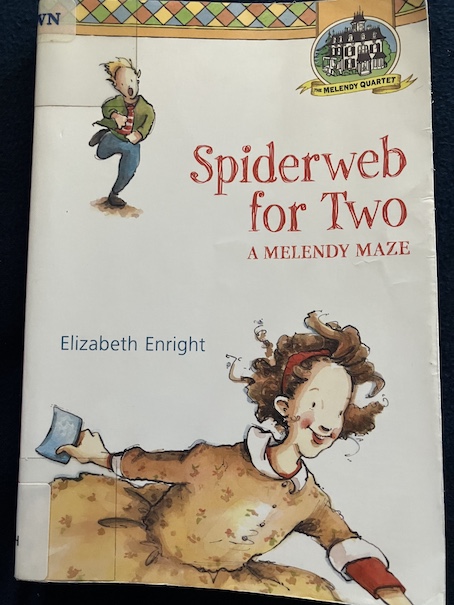
Spiderweb for Two

Randy Melendy is feeling morose because the three older Melendy siblings (Mona, Rush, and their adopted brother Mark) have all gone away to school. Rather than attending the local school as they used to, Rush and Mark have gone away to boarding school for the first time this year, and Mona is attending a school in New York City, where they used to live. Since Mona has started acting professionally on the radio, she’s been commuting back and forth from the family’s house in the country to her acting job in the city. This year, her father decided that, rather than continuing to commute back and forth, it would be best for her to remain in the city and go to school there, staying with a family friend, the wealthy Mrs. Oliphant, who is fond of the children. That leaves only Randy and her younger brother, Oliver, at the big Melendy house in the country, known as the Four-Story Mistake.

Since Randy is accustomed to having her very active siblings around her, always doing something interesting, Randy thinks that life is going to be boring and lonely from now on. She recognizes that the older siblings going away to school is just the first step in growing up and moving away from the family. She knows the next likely steps for them are college and marriage, and they will likely never really live all together again, at least not all the time. The housekeeper, Cuffy, tries to reassure Randy that she still has Oliver for company, but Randy isn’t reassured. Oliver is a few years younger than she is, and she doesn’t think they have much in common or much that they would like to do together. However, the two of them are about to be involved in a special shared adventure.
Cuffy sends Randy and Oliver to get the mail, and they are surprised to find an envelope addressed to the both of them in handwriting they don’t recognize. Inside the envelope is a poem that seems to be some kind of puzzle or riddle – the first clue to a treasure hunt! The mysterious letter writer tells them to keep it a secret, and the clue seems to point to a place where the shadow of a tree falls.

It takes Randy and Oliver a little time to decide which tree is supposed to cast the shadow, and their treasure-hunting is delayed by rain. However, when they dig in the correct spot, they find a tin box. Inside the box, there is a little golden walnut box with another clue. This time, the clue indicates that the next clue is being held by someone who loves them, although they don’t know it. It takes some effort for Randy and Oliver to solve this one. At first, they think it’s probably Cuffy or Willy, and searching their pockets or getting them to reveal what’s in their pockets without the kids explaining why they need to know is tricky. Eventually, it turns out that the next clue is hidden on the collar of Isaac the dog.

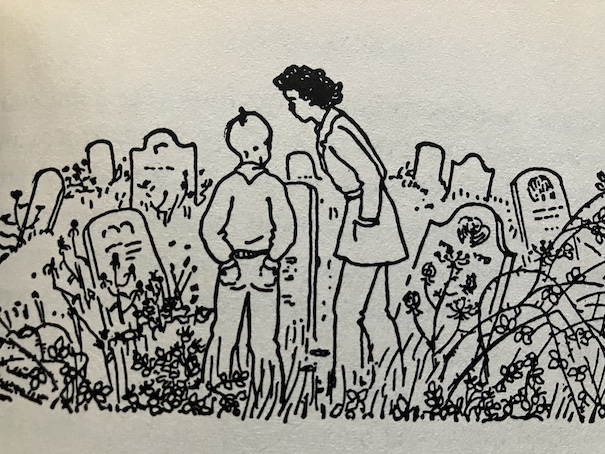
The treasure hunt continues in this way for the whole rest of the school year. The clues are written as poems on blue paper and send them various places around their own house, the houses of people they know, and various other landmarks, including a grave yard! Randy and Oliver figure out that this treasure hunt must be something their older siblings have created to keep them busy and entertained during their absence. The treasure hunt breaks off periodically when their siblings are home from school for Christmas before resuming after Christmas with another letter.

In between solving the riddles of the treasure hunt, Randy and Oliver do get to spend some time with their siblings. Over Christmas, the family decides to go caroling and visiting friends. For Easter, the girls make Easter bonnets, and Rush makes a special one for their horse. Randy and Oliver never discuss the treasure hunt with their siblings, though, because secrecy is part of the game.

Sometimes, Randy and Oliver get into trouble following clues, and sometimes, they accidentally make the hunt tougher than it has to be because they misinterpret where they’re supposed to go next. Eventually, the hunt leads them to a special surprise from an old family friend, and everyone shares in the surprise!

I liked the treasure hunt in this book because I always like books with treasure hunts that have riddles to solve and clues to follow. I’ve read other reviews of this book online, and other people remember this book fondly for the treasure hunt, although it does have a different feel from the other books in the Melendy Quartet, for several reasons. It’s partly because only two of the Melendy siblings are present for most of the story, although the others do appear sometimes and make their presence felt, even when they’re away. Readers will probably figure out before Randy and Oliver that their absent siblings have set up this treasure hunt for them to keep them busy and give them something to think about so they won’t be too lonely without the others.

This is also the only book in the series that doesn’t make references to WWII because it’s the only book in the series written after the war ends. The war wasn’t a main part of the plot of the other books, but it was always present in the other stories, with the children taking part in activities to help the war effort. The war also affected the attitudes of the children, making them want to do their parts for their family as well as their country. This book never mentions it once, and the focus is on how the children are growing up.

Randy knows that seeing her siblings go away to school is just the first step to them all growing up and moving away. When the older siblings come home for Christmas, they’re already showing signs that they’ve been doing more growing up during the few months they’ve been away from home. When Mona comes home for Christmas, she has a new haircut and is wearing lipstick, and Rush’s voice is starting to change. Eventually, Randy and Oliver will do these things, too, but for now, they’re the ones left behind as kids at home. Through their shared adventures with each other without their siblings, they grow closer to each other than they were before. Oliver was too young to join Randy and the older siblings on some of their previous adventures, but he is growing up, too, and he’s now able to join Randy in shared activities. During the course of their treasure hunt, they have adventures in the countryside, like the siblings did in other books.

Like other books in this series, there are also stories within stories. Sometimes, the main story departs from Randy and Oliver when other people tell them stories about exciting or interesting episodes from their own lives. This books has stories about how Cuffy saved a boy from drowning when she was young, their father’s search for a lost dog, and Mrs. Bishop remembering when she first noticed the patterns of snowflakes.

There’s only one full page picture in the book. The other illustrations are smaller ink drawings at the beginnings of chapters.

Dig for a Treasure

This is the second book in The Invisible Island series. It begins with the arrival of the Lennox family and their two children, Hugh and Barbie. The Lennox family has been staying with various relatives since the father got out of the army, but now, they’ve found a house to rent in the small town of Anchorage, Connecticut. The children are looking forward to having a yard to play in, and the mother wants to have a garden.

Unfortunately, when they arrive they are shocked to see that the house they were going to rent has been destroyed by fire. Their landlord, Mr. Prentice, is also on the scene, and he regretfully tells them that the fire just happened, although they don’t know the cause, and that there are no other houses in the area to rent. At first, they think that they will have to go back to staying with relatives, but Mrs. Lennox says firmly that they won’t. The family has had enough of staying with relatives, and they desperately need a place of their own. It’s summer, so her idea is that they can camp out on the property of the burned house for a few months while they look around for another place to rent. The children are excited about the idea of a camp-out. Mr. Prentice says that he wouldn’t have any problem with the family camping on the land, and he returns their rent deposit to them, saying that they can stay at his house that night and get some camping equipment the next day.

While Hugh and Barbie are exploring the area and looking for their cat, who ran off, they meet the children from the first book in the series. Hugh is about the age of David Guthrie, and Barbie is about the same age as Winkie Guthrie, the youngest of the children who play on the island they call “The Invisible Island.” Since the previous book in the series, they have finished their stone hut, and it has a grass and sod roof and four built-in beds for the four Guthrie children. Mr. Guthrie is an architect, and he helped the children build the house.

Hugh and Barbie admire the hut, and they say that they wish they had a stone house like that because it couldn’t catch fire. They explain to the other children what happened to the house that their family was going to rent, and they ask the children if they would consider renting the stone hut to their family until they can find another place to live. Mr. Lennox isn’t really happy about the idea of camping in tents because he lived out of tents when he was in the army.

At first, the Guthrie children and the Leigh children aren’t sure that they want to rent out their stone hut. They spend a lot of time there, and they’ve been trying to save up money to add improvements. The hut really belongs to the Guthries, who built it, but they want to add an extra room for the Leighs. However, after thinking it over, they realize that they can earn more money as rent from the Lennox family than they can by just doing chores, and while the Lennox family stays in the hut, they can camp out on other parts of their little island, like the woods that they call “Sherwood Forest.”

Since the little hut is just a one-room hut with no bathroom or other amenities, the children aren’t sure at first whether the Lennox adults would want to stay there or not. However, staying in a stone hut does sound better than in a tent, where they would also have no bathroom or amenities. Mr. Lennox is also intrigued by the pond, where he can go fishing. The children and the Lennox family talk things over with Mr. Prentice and the Guthrie children’s parents, and they all agree to renting the stone hut to the Lennox family.

The Lennox family still isn’t sure whether or not they’ll find another house for sale or rent in the area. They want to stay in the area because Mr. Lennox has a job nearby and Mrs. Lennox knows that some of her ancestors used to live in the area, although she doesn’t know much about them. However, Anchorage is a small town, and most of the houses already have people living in them. There is only one empty house in the area, but the owner has always refused to rent it or sell it. Mr. Prentice explains that the owner believes that there is a treasure in the house or nearby, a necklace that once belonged to a queen, and she’s been looking for it for years. Mr. Prentice doesn’t think that there really is a necklace or, if there once was, it’s probably long gone, but the owner insists that it exists and is still there, somewhere.

The children are fascinated, and they ask Mr. Prentice to tell them the story of the queen’s necklace. He says that during the time of Queen Elizabeth (Tudor), the ancestors of the Winthrop family who owned the house did something for Queen Elizabeth that caused her to reward them with a golden necklace that was passed down through the family for generations. When the Winthrops came to the colonies in America around 1650, they brought that necklace with them. However, when they came to this area and settled there, they had problems with the local Indians (Native Americans).

Mr. Prentice says that he can’t blame the American Indians for resenting strangers coming and taking over their lands and hunting grounds or for them trying to stand up for their rights, but the situation escalated with increasing violence. David Guthrie protests that American Indians scalped people and that, if he’d been there at the time, he’d “show them.” Mr. Prentice explains that was exactly the problem – everybody who was there at the time thought he’d “show them”, and that’s why the violence escalated. As for the scalping, Mr. Prentice says that white people committed their share of atrocities, too, and when David is older and learns more about it, he might not feel so proud of his side in this battle. (I thought that was an amazingly honest and self-aware interlude about European colonization and its effects on Native Americans for a book written in the late 1940s, when cowboy and western shows were becoming popular, and American Indians were mainly portrayed as violent enemies to be defeated. I was a little concerned at first when “Indians” entered the story, but I was relieved that the author took this attitude.)

Continuing with the local legend, Mr. Prentice explains that the colonists received warning one day that the local tribe was going to attack. In preparation for the attack, some families hid valuable items that they didn’t want stolen or destroyed in the coming battle. Some people buried valuables, and others hid their valuables in wells or caves. Presumably, the Winthrops hid their necklace, called the Queen’s Chain, during this time, but nobody really knows what happened to it. The colonists fled the area, and the American Indians burned the entire village to the ground. Every man-made structure was destroyed during this attack. Although people later returned to the area and rebuilt the town, it’s unknown what valuables they retrieved or when or if they ever retrieved them from their hiding places. Because all the buildings and some of the trees were burned, many landmarks were destroyed, so some people might not have found their hidden valuables again, even if they managed to return to look for them.

Mr. Prentice is related to the Winthrop family, and so is his cousin, Lizzie, who currently owns the rebuilt house known as the Winthrop house. Lizzie is firmly convinced that the Queen’s Chain is still there, somewhere. She thinks it was never hidden during the attack that destroyed the first house and was passed down through the family but hidden by a later generation, which is why she won’t sell or rent the house. Mr. Prentice, on the other hand, thinks that the necklace is lost forever. He thinks that either the necklace was hidden with other valuables that were never retrieved after the attack or that the family found the necklace and sold it to get money to rebuild the farm that was destroyed. Mrs. Prentice, on the other hand, sides with Lizzie, saying that nobody in the Winthrop family would have sold the necklace because it was part of a family trust.

The children are fascinated by the story, and they immediately begin thinking about searching for the necklace themselves. They talk to Miss Lizzie about the story Mr. Prentice told them and use some of the descriptions that she gives them of the old Winthrop property and the plants that once grew in their herb garden to see if they can pinpoint the exact location of the original house and the hiding place that the Winthrops might have used for their valuables. Even though everything manmade was destroyed in the attack, some plants have a way of coming back, and the remains of the old herb garden might still be there, even almost 300 years later.

The treasure hunt takes on greater importance when the Guthrie children learn that their family might not be able to buy the island from Mr. Prentice. Mr. Prentice is also the Guthrie family’s landlord, and the family has been saving up to buy their house from him. They had also hoped to be able to buy the island where the children have been spending so much time, but Mr. Prentice is reluctant to sell it. Lumber is valuable, and he’s thinking of cutting down the pine trees on the island to sell the wood. The children are horrified at the thought that their beloved “Sherwood Forest” might be cut down! Perhaps, if they can find the missing treasure, they can persuade Mr. Prentice to sell the land to them and Miss Lizzie to rent her house to the Lennox family.

The book is available to borrow and read online through Internet Archive (in audio form!).

There isn’t as much imaginary play as “castaways” in this book as their was in the first book in the series, but the theme still shows up in some ways. The kids still go camping on the island. They use tents when the Lennox family is living in their hut. The children’s search for treasure also offers plenty of outdoor adventure, and I really enjoyed the element of mystery in the story.

The children approach the treasure hunt from the assumption that the necklace is still hidden wherever the Winthrops hid their valuables. They do find that spot and recover some relics of the 17th century, but the necklace is not among them. Readers probably won’t guess exactly where the necklace has really been hidden, but there are a few clues to notice along the way. Mrs. Lennox says at the beginning that her ancestors were from this town, even though she doesn’t know much about them. I had guessed that they might have a connection to the Winthrops, especially when Miss Lizzie explains that the name of the girl who hid the family’s valuables before the attack was Elizabeth, and there are other Elizabeths in the family. Besides Miss Lizzie, Mrs. Lennox is called “Betty” when her husband addresses her by her first name, and Betty is another nickname for Elizabeth. When Barbie recognizes something that Miss Lizzie has as being like something her family owns, Miss Lizzie realizes that the Lennox family is related to her. By comparing what each of them has and what Miss Lizzie knows about their family, they figure out what really happened to the necklace. It not only solves the mystery of the necklace, but once Miss Lizzie realizes that the members of the Lennox family are relatives, she’s happy to have them living in the old Winthrop house.

The problem of what will happen to the children’s island and the trees on it is solved when the children win a bet with Mr. Prentice. In the first book, the children called their island “The Invisible Island” because it isn’t obvious at first that it really is an island, surrounded by water on all sides. So far, the children have kept the knowledge to themselves and their parents. When the children accidentally refer to the island in Mr. Prentice’s presence and realize that Mr. Prentice isn’t aware that it’s really an island, they start to explain. Mr. Prentice can’t believe that there’s actually an island on his land, and he says that he will give up ownership if they can prove that it’s really an island. The children easily demonstrate that it’s truly an island, showing him all of the waterways and bodies of water around it, and Mr. Prentice says that they’ve won. The Guthries end up with control of the island and the trees on it.

The Mystery of the Goldfish Pond

Three Cousins Detective Club

Timothy’s father wants him to sing at his boss’s retirement dinner. The boss’s wife heard Timothy sing once with his choir, and she wants him to sing a special song for her husband at the start of the dinner. His cousins are invited to come along so he won’t be the only kid there. Timothy doesn’t really want to do the singing, but his parents convince him to do it anyway because the boss’s wife is so fond of him and his singing.

Timothy’s father hopes that the dinner will go well because the boss has been worried about the possibilities of competitors getting their hands on information about their new product. Earlier, the boss temporarily misplaced an important memo about it, and he was worried that someone else got their hands on it.

Timothy’s song goes well, and after the dinner, the kids are allowed to walk outside in the garden while the adults listen to a series of speeches. The gardens outside the banquet hall are beautiful, and the kids start to enjoy themselves. Then, they accidentally overhear a couple of adults talking. They can’t quite catch everything they say, but something strange is going on, and something secret is hidden somewhere in the garden.

The theme of this story is Proverbs 11:13, “No one who gossips can be trusted with a secret, but you can put confidence in someone who is trustworthy.”

The book is available to borrow and read for free online through Internet Archive.

The crime that the adults were plotting involves the theft of information. The kids have to figure out the parts of the conversation they couldn’t hear clearly to figure out where the information is hidden. I thought that the clue the children try to figure out was fairly easy. Part of the conversation the kids try to figure out sounds like “-ake -urtle”, and there aren’t many words that sound like “-urtle.”

The boss’s wife seemed eager for the children to go outside, into the garden, and tell her about it later. The kids wondered why she seemed so eager for them to go outside and what she was hoping that they would tell her afterward. It sets the stage for the kids to expect that something unusual or mysterious might happen, which proves to be the case when they overhear the important conversation. The boss’s wife says later that she suspected something might happen because she knew her husband was worried about people stealing company information, and she realized that this dinner would be a convenient place to hand it off to someone.

We never learn exactly what kind of information or new company products the adults were concerned about. We also don’t know exactly who was trying to steal the information or what happens to that person later. The part that the children care about is that they were able to stop the hand-off of the information.

The Mystery of the Eagle Feather

Three Cousins Detective Club

Timothy is excited because he has a chance to meet his pen pal, Anthony Two Trees, for the first time. Anthony is a Native American, and he will be dancing at a powwow. Timothy’s cousins get to come along on the trip, too.

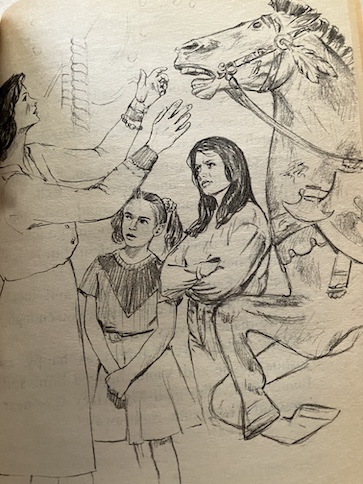
Soon after they arrive, though, they learn that someone has been taking pieces of the dancers’ costumes, like fans or headdresses made of eagle feathers. Who could be taking the costume pieces and why?

The costume pieces and the eagle feathers they contain are very expensive, and the kids realize that the thief might be thinking of selling them. It is illegal to deal in eagle feathers because eagles are an endangered species. Even the Native American dancers have to write to the government in order to get eagle feathers for their costumes from eagles that died in zoos. Therefore, the costumes are expensive and require a lot of effort to put together, and losing them is a real blow. The rarity and cost of the feathers might prove to be a temptation to a thief.

The theme of the story is self-control.

The book is available to borrow and read for free online through Internet Archive.

I wasn’t sure if I was going to like this story. I understand the fascination kids have with Native Americans and their costumes and dances. I felt like that when I was a kid, too, but there’s also an element of cringe to it. The cringiness comes from kids (and even adults) who get wrapped up in the fascination of the appearance of other people’s traditions and treat them more like playing dress-up than traditions with deeper, underlying meaning and significance or depicting Native Americans as being stereotypes from old movies and books rather than real, living people.

Fortunately, I was pleased at how this story shows that Timothy’s friend, Anthony, is a regular boy who shares his interest in baseball. They emphasize that Native Americans don’t live in tepees any more, and they don’t treat the Native American characters like stereotypes. I enjoyed some of the facts the story provided about Native American dances and costumes, like the regulations regarding the use of eagle feathers.