The Mystery of the Blazing Cliffs

The Three Investigators
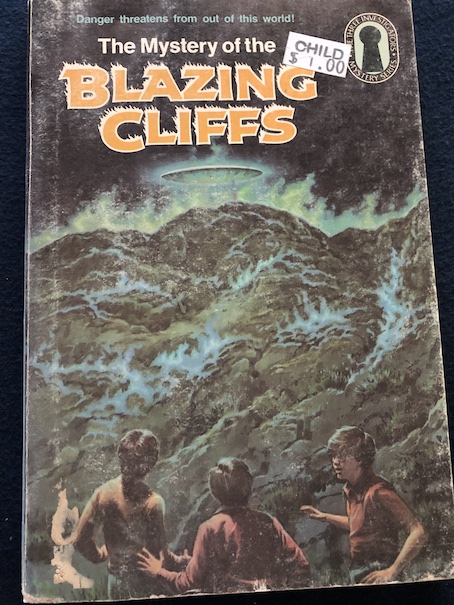
Jupiter Jones and his friends are helping out at his uncle’s salvage yard when they have a strange encounter with a disagreeable customer and his wife. Mr. Barron is a very demanding customer who throws a fit whenever something goes wrong, blaming other people when he’s at least somewhat at fault for what happens. He gets upset when one of the employees of the salvage yard tells him that they need to move his car because they’re expecting a delivery truck, and his car is in the way where he parked it. Mr. Barron gets angry because he parked his car “perfectly”, and he calls them incompetent for making him move.

The only reason why Mr. Jones puts up with Mr. Barron is that he’s buying a large amount of stuff, and it’s stuff that few other people would want, like a buckboard wagon, an old stove and stovepipes, and a broken butter churn. The weird thing is that Mr. Barron doesn’t seem interested in these things as antique collectibles or unique pieces of vintage decor, which would be what most people would use such things for. (I’m thinking of those restaurants where they have miscellaneous farm implements, wagon wheels, and antique/vintage items on the walls, and I think that’s what they’re thinking about, too.) Mr. Barron actually seems to want to fix them up and use them for their intended purposes.

Mrs. Barron glosses over her husband’s rudeness and talks about her belief in aliens as described by a popular book called They Walk Among Us. This book describes “the time for deliverance”, when our planet will be in danger from some kind of disaster, and aliens from the planet Omega will arrive to rescue people from the human race so our species won’t be lost. Mr. Jones thinks that the Barrons are crazy, but his own wife interrupts the conversation before Mr. Jones can say something that will ruin the sale.

Jupiter is intrigued by these weird people, and he persuades his uncle to let him and his friends go along on the trip to deliver all of the things they bought to their ranch up north. Jupiter’s friends are a little reluctant to see the Barrons again, but Jupiter points out that going on the delivery trip will allow them to also go on a buying trip at the same time, something that his uncle has promised them they can do. Jupiter has been wanting to take charge of a buying trip, but he also wants to learn more about the Barrons.

Before they leave, the boys do some research on Mr. Barron and learn that he came from a wealthy business family in the Midwest. However, he has been in and out of trouble with every business he’s ever run. He did pretty well at first after he inherited his family’s business, which made tractors, but then, workers went on strike for better pay and working conditions. Mr. Barron was forced to give them what they wanted, but he was so angry about the strike and being forced to make concessions that he sold that business and bought a different one. In his next business, he had problems complying with government anti-pollution regulations, so he sold that business and bought another one. In his third business, he was sued for discriminatory hiring processes, so he once again sold out and tried another business.

Since then, he has had a string of different businesses, and each and every time, he ran into some kind of problem with government regulations or labor disputes. Every time he has any kind of problem in business, he immediately quits that type of business entirely rather than sticking to it and working things out. He just can’t accept imperfection in any form, and he defines imperfection as anybody or anything that goes against what he, personally, wants to do, regardless of circumstances. He denies that he could be imperfect himself, that he needs to adjust to new or changing situations, or that he needs to improve in any way, blaming everyone else for all of his problems. Finally, unable to find any business where everything goes absolutely perfectly all the time, where there are no rules or standards to follow other than his own and nobody to check that he’s following them, and where he never gets any form of negative feedback, Mr. Barron decided to sell off his remaining business interests and buy a ranch in California, which is where he is now. He’s planning to use the ranch to experiment with new crops and self-sufficient living.

When the boys arrive at the ranch with one of Mr. Jones’s delivery drivers, Konrad, they realize that the ranch is a kind of commune. The people who work for Mr. Barron and live at the ranch show them around and explain how the ranch has its own power supply and water supply. Elsie, who is the cook at the ranch, tells them that Mr. Barron seems to be preparing for some kind of “revolution”, when there will be some kind of catastrophe and society falls apart. (Remember, for Mr. Barron, society and all other humans besides Mr. Barron are idiots and incompetents, so of course, everything is falling apart.) Most of the people at the ranch don’t really believe that’s going to happen. They’re there mainly because Mr. Barron hired them to work there. However, it seems like the Barrons are deep into this notion of a coming disaster.

Konrad thinks that this ranch is very weird, and he wants to leave, but the boys persuade him that they should accept Mrs. Barron’s invitation to stay for dinner. Konrad chooses to eat with the staff rather than face Mr. Barron again. During dinner, the boys are treated to Mr. Barron’s negative attitude about everything, from his disappointment in his adopted sons (and, by extension, in young people in general) to “the evils of plastic in almost any form”, from synthetic leather to polyester clothing. By contrast, Mrs. Barron is very fond of her adopted sons, one of whom is part of a rock band and the other of whom is a poet who supports himself by making wooden clogs. Mrs. Barron says that the rock drummer son will be coming to the ranch in August for the Blue Light Mission convention, a meeting of other people who also believe in aliens who will save humanity. The author of They Walk Among Us will also be there as a guest speaker. 

Although Mr. Barron seems to have at least some belief in the idea that society is falling apart because of “anarchists and criminals who want to take over”, his criticism of people in general also extends to his wife and the other people who attend these alien conventions and believe in They Walk Among Us. Even though he’s hosting this convention for his wife’s sake, he thinks that the convention attendees are a bunch of kooks and crazies who would victimize his wife if he didn’t keep an eye on her. Basically, both of the Barrons are conspiracy theorists, but they’re not following quite the same conspiracy theories. Mrs. Barron is the more positive and hopeful of the two of them, believing that things will somehow turn out okay when the aliens show up, cheerfully ignoring her husband’s negativity, and continuing to talk about how much she’s looking forward the convention and meeting other, like-minded people. By contrast, Mr. Barron thinks society is just going to fall apart, and it will be everyone for themselves, and that’s about it.

The Three Investigators’ involvement with the Barrons would have ended after their delivery errand and dinner, but when they try to leave the ranch, they are stopped by army officers. The officers tell them that the roads are closed because of orders from Washington. The boys and Konrad are forced to return to the ranch, and Mr. Barron is angry about the roads being closed. The army officers tell Mr. Barron that they are just following orders. They further say that something has happened in Texas, and because of that, there is no electrical power, and the telephones, televisions, and radios aren’t working. Elsie has a battery-operated radio, and she turns it on to find out what’s happening. They hear a speech, apparently from the US President, about unidentified aircraft being seen around Texas, New Mexico, and California and possible landings in those states.

Naturally, when confronted with this serious situation, Mr. Barron is ready to take charge and deal with it in his usual way – by immediately finding someone to blame, dishing out criticism, and calling other people stupid and incompetent. He complains that the President gave a stupid speech that doesn’t provide any useful information and that he can’t understand how this guy ever got elected in the first place. Then, he goes off on a rant against communists and anarchists. (Seriously, that’s how both this book and his thought processes go. In a way, he’s very 2020s, a man decades ahead of his time.) Elsie points out that the people at the ranch are safe, no matter what’s happening, because the ranch is designed to be self-sufficient. Mr. Barron may be an angry mess of paranoia and negativity, but he is thorough and has been planning ahead for disaster this entire time.

The military officers say that the roads are being blocked off to the public so they can be used for military vehicles. Mr. Barron becomes convinced that either some disaster has happened or that the politicians believe that one is imminent. He also thinks that the politicians blocked off the road to the ranch so they can come and shelter at his amazing, self-sufficient ranch themselves. (Once again, everyone else, from the government to the general public, is incompetent, and only Mr. Barron does things right. He further assumes that the rest of the world must somehow secretly know this, quietly envies him, and plots to take advantage of him.) There’s no sign of anyone else arriving, at least not yet, but Mr. Barron, who has a deep disdain for fools of all kinds, doesn’t like the idea of welcoming a bunch of political fools. However, he does show sympathy to the boys and Konrad because he can recognize that nothing that’s happening is their fault. He tells them that they’re welcome to stay at the ranch until this situation, whatever it is, is cleared up.

The Three Investigators decide that they need to find out what’s really happening in the cities outside of this ranch and verify what they’ve been told about the situation because everything was fine when they left home. Since they can’t leave by the road, they do a little scouting around the area to see if there’s a route they can use to walk to another town. Since it’s getting dark, they decide that it would be too dangerous to try hiking and climbing in the area at night. They plan to wait until morning to actually leave, but while they’re looking around, they witness something very strange. They see what looks like blue fire on the cliffs near the ranch and some kind of silver, oval-shaped object in the sky! Have they really witnessed a flying saucer? Is what Mrs. Barron believes about aliens coming to Earth true?

The book is available to borrow and read for free online through Internet Archive (multiple copies).

I love this Three Investigators mystery because the premise was so unusual! Three Investigators mysteries are often what I call Pseudo-Ghost Stories, like the mysteries in Scooby-Doo because any supernatural inevitably turns out to be faked in some way for some ulterior motive. This also applies to science-fiction other-worldly phenomena, like aliens. The great thing about this book is that the phenomena is so over-the-top that it’s difficult to think of a plausible way that it could be faked or a reasonable reason why someone would even do it. In this case, we know immediately that the boys see what looks like blue flames and a flying saucer, and there are either military personnel or people pretending to be military personnel blocking the roads out of the ranch. This is a plot that would seem to involve some impressive special effects and a significant cast of conspirators, and the purpose behind it doesn’t seem obvious.

Pretty early in the story, I had a couple of theories about who could profit from faking a UFO, but I had doubts about it because of the relatively small audience involved and because it seemed like there would be much easier methods of them accomplishing their goals. It is a pretty over-the-top plot, although it’s partially explained because Mr. Barron is a rather over-the-top figure to target. It is his paranoia and reluctance to call in authorities and outside help with anything that sets him up for this. Mr. Barron’s attitude that anything that contradicts him or his view of anything is inherently wrong cuts him off from the kind of reality checks he needs, even though he understands that his own wife can use some reality checks outside of her group of fellow alien enthusiasts. 

I knew that, for anybody to get the idea of doing this type of hoax and to plant the evidence to create the illusion of alien landings, one or more of the conspirators would have to be directly involved with the ranch. One of them is obvious, when you think about it, because it’s one of the people who directly supplies some of that evidence. Part of the mystery is about who else is involved. I could see multiple ways that could have gone, and I considered different possible masterminds for the scheme and different motives behind it. Most of what I considered turned out to be wrong, although my theory that Mrs. Barron could have engineered the whole thing with the help of her adopted sons and some friends from the alien conventions with the goal of demonstrating to Mr. Barron just how vulnerable his own paranoia and obsession with his personal conspiracy theories has made him would have been fun. Mrs. Barron may be gullible when it comes to her favorite alien conspiracy theory book, but I would have enjoyed a little role reversal, where she turns out to be more clued about human nature than Mr. Barron, who is so self-obsessed and ultra-skeptical about other people, refusing to receive information, advice, or criticism from anyone else, that he routinely fools himself without outside help. 

Alternatively, I though that the Barrons’ sons could have teamed up to pull this off to make both of the Barrons see the folly of their ways. In a way, I think that Mrs. Barron’s belief in the aliens is partly as a remedy to her husband’s relentless negativity. She believes him that disaster is impending because she actually thinks a lot of her husband and trusts his opinion on the way society is going, but being a more hopeful and trusting person, she has latched onto the idea of rescuing aliens because her husband doesn’t believe in fellow humans. Of course, Mr. Barron disdains that theory because he can tell that it comes from fellow human beings, who are all varying degrees of stupid, incompetent, and scheming, but Mrs. Barron clings to it as a hopeful thing that binds her to like-minded people because she needs that sense of hope and connection. At least, that’s how I read the situation. Mrs. Barron believes everything, even things she shouldn’t, and Mr. Barron refuses to believe anything, even things he should. There is a happy medium between believing everything other people say and allowing them to lead you around by the nose and being so paranoid that everyone is either wrong or out to trick you that you refuse to engage with the real world and turn aside legitimate sources of help and outside information. Neither of the Barrons represent that happy medium, and I would have liked the conspiracy to bring that to light. In a way, it does, but that’s not really the main focus. It’s more about taking advantage of the Barrons and their eccentricities.

I also considered the idea that the entire plot could have been a publicity stunt by the author of Mrs. Barron’s favorite book and the convention organizers. I even thought that Mrs. Barron might have been in on it as a true believer, trying to get her husband and others to believe. However, that’s not the case. The book and the convention just supply the inspiration for the conspiracy.

In a way, this story reminds me a little of the Sherlock Holmes story The Red-Headed League, where there’s a seemingly outlandish scheme to cover an ordinary theft. There is a twist to this one because nobody but Mr. Barron knows exactly where the thing they’re trying to steal is. In the end, only Jupiter reasons it out because he has really come to understand the way Mr. Barron’s mind works.

The mystery is intriguing because there are so many possibilities to consider. In a way, I preferred all the possibilities to the eventual resolution of the mystery, but the solution does make sense. It’s still an over-the-top plot that involves a significant number of people, equipment, and special effects, but it does appeal to my inner Scooby-Doo fan, who enjoys a good, complicated scheme and a villain behind the mask.

The Case of the Close Encounter

The Bobbsey Twins

#5 The Case of the Close Encounter by Laura Lee Hope (Stratemeyer Syndicate), 1988.

Before I begin, I’d like to acknowledge Sean Hagins, for supplying me with photos of this book! Usually, I take pictures of books myself, but I just couldn’t find a physical copy of this one. Sean is a big fan of the Bobbsey Twins, particularly the New Bobbsey Twins mysteries, and you can see some of his video reviews as well as videos about his photography work on his YouTube channel, SJHFoto. Thanks, Sean!

When Nan gets sick, her twin brother Bert, agrees to take over her babysitting job, looking after a 5-year-old boy named Artie. Artie has a reputation for being a troublemaker, but since he’s had experience looking after the younger set of twins in the Bobbsey family, Bert figures that he can handle Artie. Of course, Artie turns out to be a handful. Artie tries to paint his cat’s whiskers and juggle eggs, and he generally makes a mess. Then, he suddenly declares that they’re playing hide-and-seek and runs outside. When Bert goes out to look for him, he sees a bright light from the sky, and when he looks up, he sees what looks like a flying saucer!

Artie doesn’t see the flying saucer and thinks that Bert is making it up. Everyone is in bed when Bert gets home, so he phones the police and reports the UFO. He tells the rest of his family about it the next morning. He speaks to the police and a reporter from the newspaper where his mother works, but they all say the same thing: without more witnesses to the event or more information, there’s not much they can do. Since nobody seems to believe him, Bert decides that they only thing to do is to investigate the phenomenon himself.

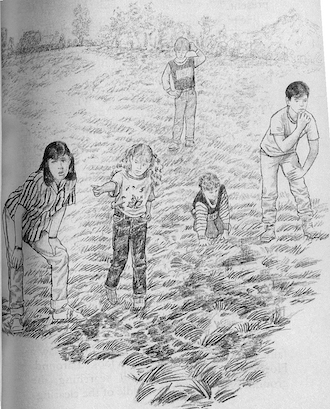
Bert and his siblings go to the area where Bert saw the UFO to look for clues about what it could have been. Artie tags along, although he’s more of a distraction than a help to them. In a clearing, they find large patches of grass that have been flattened and burnt. They look almost like footprints made by some kind of fiery dinosaur. The kids aren’t sure what to think of them. Then, while walking along the road, they’re almost hit by an angry man on a motor scooter. When they get back to Artie’s house, Artie’s father identifies the man as Felix Usher, who is renting a cottage nearby. There are stories that the house he’s renting used to be used by smugglers and gangsters and that they might have left some kind of treasure behind, but Artie’s father doesn’t really believe that.

On the way home, the Bobbsey twins stop off at a diner called the Flying Saucer Diner. While they’re talking with the owner, they learn that he bought the place from Mr. Stockton, the same man who used to own the house that Felix Usher is renting. When Mr. Stockton owned it, he called it the Cup ‘n’ Saucer Diner, which is the name on an old coffee cup that Artie found in the field with the burn marks. The kids wonder if there could be some kind of connection between the diner and the UFO Bert saw. Then, they find a tape cassette on Bert’s bike seat with a threatening voice on it, telling him that he saw nothing and he should say nothing, or else!

It seems like someone wants Bert to forget what he saw and stop trying to figure out what it was, but that’s just more confirmation that Bert really saw something and that what he saw was significant. What did Bert really see in the sky? Was it really a flying saucer, and were the burn marks really caused by aliens? Or is something else happening in their town?

The book is available to borrow and read for free online through Internet Archive.

My Reaction

I liked the premise of this mystery immediately! Unlike many mysteries, it isn’t immediately obvious that a crime has been committed. It falls more under the category of what I call Strange Happenings, where the characters know that something weird is going on, but they’re not entirely sure what it is or why it’s happening.

If I read this one as a kid, I didn’t remember the story, but I had a theory from the beginning about what Bert could have seen because I’ve seen the episode from the old Hardy Boys/Nancy Drew tv series The Creatures that Came on Sunday (older than this book) and an episode of Psych (newer than this book) with a similar premise, that someone had seen an alien spaceship or UFO. I guessed right on the type of flying object Bert saw, but I wasn’t sure what made the burn marks on the ground or how the situation could be related to the old house that might have treasure in it. There is also a woman who comes to see Bert and interview him about what he saw for a book she’s writing, but Bert has the feeling that she isn’t really an author, and she dodges questions that he asks her about her other research into UFOs and the encounters other people have had. There is some doubt from the beginning whether or not Bert’s UFO was an alien spaceship, but the book provides enough doubt and suspects to keep the story interesting as readers speculate about who is playing what roles in the mystery.

This book is from the late 1980s, and there are a couple of dated references to technology and pop culture, although it’s not too bad. It’s enough nostalgia that people who were kids in the 1980s would identify with it, but not too distracting for modern kids to enjoy the story. The kids use a very basic modem to connect to their local newspaper’s archives to do some research. It’s not how the modern World Wide Web works, but Internet use wasn’t popular yet at this time. This is still the early days of civilians having remote access to archives and databases through their computers. There wasn’t much to see, and there weren’t as many people who had the ability to see it yet. There is one instance of someone who seems to be talking to themselves in the story, and then, the kids realize that this person is actually using a radio. The modern equivalent is realizing that someone is actually talking on their cell phone, but cell phones were a relatively new invention around this time. They were expensive, brick-like, and heavy, and very few people had them. A radio or walkie-talkie would have been a more practical choice for this time period. There is also a point where the neighborhood bully and his friend tease Bert about seeing a UFO, and they make some references to popular sci-fi movies, like ET and Planet of the Apes.

The Secret of Grey Walls

Lone Pine Series

The Secret of Grey Walls by Malcolm Saville, 1947.

It’s shortly after Christmas, and Petronella (called “Peter” by her friends) is home from boarding school for the holidays. She has a strange dream about running through the woods with an unfamiliar girl and finding a house with gray walls, but she’s not sure where it is or what the dream means. She wakes up when there’s a fire in her dream.

Petronella and her father live by themselves in the countryside because her mother died when she was a baby. Her father misses her when she goes away to school, but he knows that it’s important for her to go, and although he would like to spend all of their holidays together, he also knows that it’s important for her to spend time with her friends.

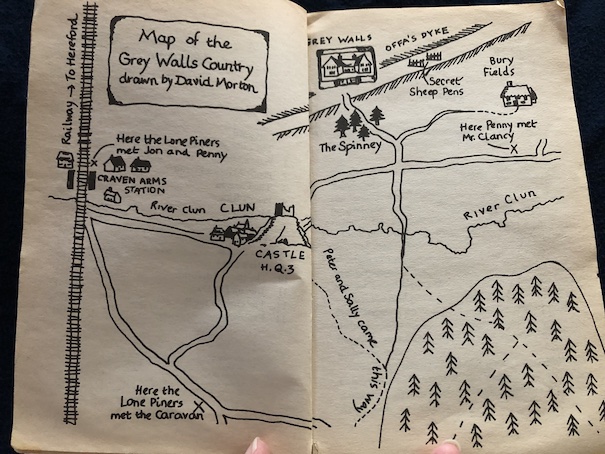
When Petronella goes to visit her friends, the Mortons, Mr. and Mrs. Morton and their housekeeper, Agnes all receive news that changes the children’s plans for the remainder of their vacation. (This is after Mr. Morton is home from the war after serving in the RAF.) Mr. and Mrs. Morton have to go to London to see a lawyer about some business, although they’re vague about the reasons why. Agnes’s news is that her sister is sick and in the hospital. With all of the adults leaving the Mortons’ house at Witchend, Mr. and Mrs. Morton wonder who they can have looking after David and the twins until they return. They consider different people they can ask, but Agnes says that all of the children can come to the village of Clun with her. Her sister has a very big house, and she’s been worried about not having anyone to look after the house while she’s in the hospital. There will be plenty of room for all of them, and Agnes says that she would appreciate the company in that big, old place. The children can even invite the other members of the Lone Pine Club to join them.

At this point in the series, not all members of the Lone Pine Club have actually met each other. David invited Jon and Penny, a pair of cousins, to join the club while visiting the hotel that Jon’s mother, who is Penny’s aunt, owns in another town. This trip will be an opportunity for the whole club to get together and get to know each other. Jon and Penny are very excited about the trip, especially Penny, who is a talkative girl who enjoys meeting new people.

On the train to meet the others, Penny strikes up a conversation with a man named Alan Denton, who brought a dog onto the train. Denton recently left the Navy and is heading home to manage his family’s sheep farm near Clun. He is very surprised when Penny says that they are also going to Clun because it’s a very small town, and few people visit there during the winter. The old house where they will be staying is usually run as a boarding house for summer visitors, but there won’t be anyone else there during the winter. The old house is called Keep View because it has a view of a crumbling old castle. There isn’t much else left of the castle other than the old keep. The children are fascinated as Denton describes the castle and other points of interest in the area, like a circle of standing stones. He says that visitors sometimes dig for old flint arrowheads.

The other kids are going to Clun by bicycle, except for Peter, who is riding her pony, Sally. Along the way, the kids meet up with a caravan of gypsies they know from a previous book. (Yes, this is a mid-20th century British children’s mystery adventure story, so of course, there are gypsies. The book spells it “gipsies,” and they also call themselves “Romany.” In the case of this series, the Romany are friends of the kids, not suspicious characters, as in many other children’s books from around this time.) The kids tell the Romany where they are heading, and they say that they’ve just left Clun. Ordinarily, they like the area, but there’s been some trouble there lately. Someone is stealing sheep from some of the sheep farms. The Romany know that people are often suspicious of Romany, so they thought that they’d better leave the area before someone accuses them of being involved with the thefts. Before the kids leave the Romany, the Romany remind them about the special whistle that they gave to Peter, saying that if she blows it, any Romany who hears it will come to help.

Peter, meanwhile, has a disturbing encounter on her trip to meet the others. She meets some men whose truck has broken down. The men behave oddly, and although the truck says that it’s a furniture truck, Peter is sure that she hears the baaing of sheep inside.

The kids don’t start to put together pieces of what’s going on until they reunite in Clun. While they are getting to know each other and exploring the area, they suddenly meet up with Alan Denton, who is distraught because his sheep farm has been the latest victim of the sheep thefts. Peter mentions to the others about the strange truck with the sheep sounds, although Denton dismisses the idea that Peter might have encountered the sheep thieves on her way to Clun because he doesn’t think that the thieves would have been able to load all the sheep onto a truck without being noticed.

Meanwhile, a strange man called Mr. Cantor rents a room at Keep View from Agnes. The boarding house doesn’t usually get boarders in the winter, and the children had counted on having the house to themselves during their stay. Mr. Cantor says that he’s recovering from an illness and needs some peace and quiet, which is disappointing to the children because that means that they’ll either have to spend most of their time outside or being very careful not to disturb Mr. Cantor. Although the children like being outdoors, it is cold, and they know they can’t be outdoors all the time, and a houseful of children isn’t usually quiet. Mr. Cantor seems a little strange, and some of the kids get the feeling that he isn’t quite what he seems to be, but he knows a great deal about the history and landmarks of the area. He entertains the children with stories about local history and ancient burials, and they begin feeling better about him.

However, something happens that causes them to becomes suspicious of Mr. Cantor. After a visit to Mr. Denton’s sheep farm, the children get lost. They find a strange grey house and try to ask directions there. Nobody answers their knocks or calls even though the children are sure that someone is watching them from inside the house. Then, they realize that someone is also watching them from the woods. They briefly see this person leaving, and this person has a bicycle that rattles badly. When the children get back to Keep View, they realize that the bicycle they heard belongs to Mr. Cantor because it makes that same distinctive rattle. Was Mr. Cantor spying on them? Who was in the house, and why didn’t they want anyone to see them. Does any of this have something to do with the sheep thefts?

The book is available to borrow and read for free online through Internet Archive.

My Reaction

I’m new to this series of mid-20th century British mystery adventure books. This is the first book I’ve read, so I’m really getting to know them as some of them are getting to know each other. I was a little disappointed that this particular book seems to be set after WWII is over because I knew that the series started during the war and that the war was part of the story, but that does put this book contemporary to the time when it was written.

This story and the series in general does have a similar feel to other British children’s mystery adventure stories and series written around the same time, especially the Enid Blyton books, such as Enid Blyton’s Adventure Series and The Famous Five Series. Like the characters in the Enid Blyton books, the members of this friendship club attend boarding schools and have outdoorsy adventures on school holidays. The Romany appearing in this book is also a common element found in Enid Blyton books and other children’s books written around the same time. In all such books, there are stereotypical elements surrounding the Romany characters, although I think the Romany in this book were treated more kindly than the ones in Enid Blyton books. The use of the word “Romany” as well as “gipsy” is one element of understanding, but also the Romany characters in this book are friendly and helpful characters, not suspicious ones. There are people who are suspicious that the Romany are involved in the sheep thefts, but our heroes know that isn’t the case, defend them publicly, and help to expose the real thieves.

I really liked the addition of Mr. Cantor in the story. Like other kids’ mystery books of this type, there is more adventure in the story than mystery, but the appearance of Mr. Cantor adds that needed element of mysterious. For much of the story, it’s difficult to say what Mr. Cantor’s motives are and whose side he’s on. The kids have the feeling from the beginning that he’s not quite what he seems to be, but they find themselves having mixed feelings and debating back-and-forth about him as the story continues. When he’s nice to them and telling them stories about the history of the area, they decide that they like him and that they were silly to be suspicious before. Then, when he seems eager to agree with the authorities that the Romany are responsible for the sheep thefts, they look at him suspiciously again. There are some funny moments when the youngest members of the group, the twins Dickie and Mary, make friends with Mr. Cantor and try to distract him and keep an eye on him while the others do some investigating. The twins are irritated at being left behind by the older kids, but they do throw themselves into the roles of spies and put a lot of effort into making Mr. Cantor their special friend, guilting him into spending time with them. Mary gets Mr. Cantor to entertain them by telling them fairy stories and acts sweetly enthralled, while Mr. Cantor struggles to come up with story ideas to keep the kids happy, and Dickie thinks that the whole thing is stupid and little-kiddish.

I was a little surprised at the way characters in the book talked to each other at times, both children and adults, although I suppose I really shouldn’t have been. They use words that sound rough and insulting, like “stupid” and “ass” in very casual ways, both in describing themselves and each other. I’ve heard that before in British movies and television shows, but it always surprises me because it sounds so ill-mannered. Nobody in the book or in any of the shows I’ve seen seems to mind it, though. It’s just surprising when you hear someone who seems like they’re from the upper classes or who is supposed to have some of the refinements of a boarding school education throwing around words that sound rude and insulting with no thought about it.

There is a foreword at the beginning of the book that says Clun is a real town, but the author took some creative liberties with the landmarks in the story.

Secrets in the Attic

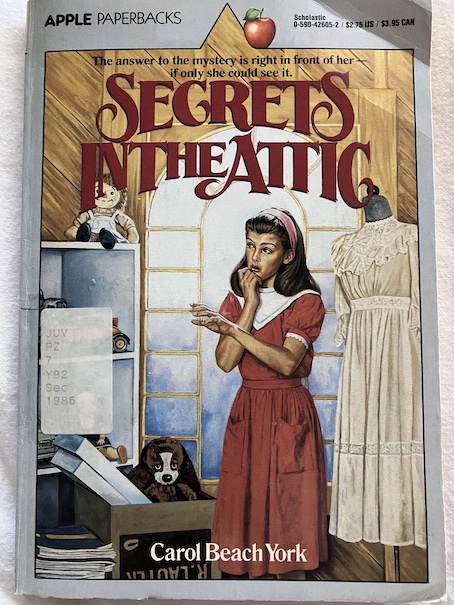
Following the death of Jodie and Peter’s father in a car accident, Jodie’s mother decides that she want to move to a new town and have a fresh start. For some reason, people have been gossiping about the family, particularly Jodie’s Aunt Claire. Jodie doesn’t really want to leave her old home, but she does make a new best friend in her new school. However, they don’t return to their home town of East Hill until Great Aunt Winifred invites them to visit for Christmas.

Jodie loves Aunt Winifred and her big, old-fashioned house with the old toys in the attic. She has fond memories of her whole family getting together for Christmas there, and she thinks that if they visit for Christmas, things will be like they used to be. Jodie’s mother knows differently. Things are not like they used to be with Jodie’s father gone and the gossip still hanging over the family, although Jodie doesn’t understand why. Her mother refuses to return to East Hill, but she says that Jodie can visit Aunt Winifred if she wants. Jodie doesn’t want to be away from her mother and little brother on Christmas itself, so they decide that Jodie can visit Aunt Winifred the week after Christmas, between Christmas and New Year’s.

Jodie still can’t understand why her mother doesn’t want to see Aunt Winifred, but it’s really Aunt Claire that she doesn’t want to see. Jodie’s mother explains that, around the time that Jodie’s father died in the car accident, some money was stolen from Mr. Carrington. Jodie’s father was a lawyer, and Mr. Carrington was once of his clients, and the theft was discovered after Mr. Carrington himself died of a heart attack. Aunt Claire accused of Jodie’s father of stealing the money, but since he was killed in the accident, he never had a chance to defend himself against the accusation. Uncle Phillip, Claire’s husband and vice-president of the bank where Mr. Carrington kept his safe deposit box, never believed that Jodie’s father took the money, but it was bad publicity for the bank when it was stolen. He was trying to get to the bottom of the situation, but he had been in the car with Jodie’s father during the car accident and was also killed. That may have been why Aunt Claire started making public accusations against Jodie’s father – to deflect any blame or suspicion of Phillip because of his role in the bank and maybe also because she blamed Jodie’s father for getting him killed in the car accident when they skidded on a snowy road.

In spite of everything that’s happened, and even because of it, Jodie feels like she has to return to East Hill to see Aunt Winifred and face Aunt Claire. She’s not sure how, but she thinks that if she goes back to East Hill, she might find something that will clear up the situation. There had been another suspect in the theft, a nephew of Mr. Carrington, who was known to be in debt, but nobody could figure out how he could have stolen the money. When it comes down to it, Aunt Claire herself spends more money than she should.

When she gets to East Hill, she realizes that her mother was correct that East Hill doesn’t feel like it used to. Jodie no longer feels like East Hill is her home. She likes her new town and misses her best friend. Her older cousin, Lisa, who is Aunt Claire’s daughter, used to get on her nerves sometimes because she was always the “perfect” child. She is very pretty and talented on the piano, always seems to look great and do everything right, and is also kind of a snob. When Lisa is at the train station with Aunt Winifred to meet Jodie on her arrival, Jodie realizes that Lisa bothers her even more than she used did before.

Lisa is still fussy and snobby and impatient with Aunt Winifred, who sleeps more because she’s getting old. One thing that interests Lisa about Aunt Winifred is that she’s heard that Aunt Winifred is making a new will, and she openly speculates about who is going to get the most out of it. Jodie is disgusted by this talk and asks her why anybody has to get more than anyone else, and Lisa matter-of-factly tells her that there is always a favorite and that the favorite always gets the most. (I can guess that her mother probably told her this.) From the way Lisa talks, Jodie can tell that she thinks of herself as the “perfect” favorite and, therefore, already entitled to receive the most. It disturbs Jodie that Lisa doesn’t seem to care that Aunt Winifred would have to die for her to get anything at all. One day, she overhears Aunt Claire lecturing Lisa that she needs to practice her piano music more while visiting Aunt Winifred because she wants Aunt Winifred to pay for Lisa to study music in Europe. Aunt Winifred seems to want it even more than Lisa does.

While Lisa busies herself with practicing at the piano and calling her friends on the phone, Jodie goes up to the attic to see the old toys they used to play with. When she looks in the attic, she is surprised that her feelings about the attic have also changed. There is something about the attic that now bothers her, but she can’t quite think what it is. She feels like something in the attic has changed or that she wants to change something there, but she’s not sure why. When she looks for a log cabin toy with little pioneer and Indian (Native American) figurines that her father always loved, she is surprised that it is missing. Aunt Claire doesn’t think much of it, suggesting that Aunt Winifred might have just thrown it away, not knowing that it was Jodie’s father’s old favorite toy. However, Jodie knows that can’t be it. Aunt Winifred never had any children of her own, and she loved her two nephews as if they were her sons. She was very sentimental about the toys that they loved, and Jodie doubts that she would just suddenly decide to get rid of one of them.

When Jodie finally figures out what happened to the log cabin toy, the whole truth about the theft comes out.

The book is available to borrow and read for free online through Internet Archive.

I liked the setting of the story. Big old houses like Aunt Winifred’s aren’t very common anymore, and I always wanted to live in a house with an attic that had a solid floor to it, like the one in the story. Jodie’s memories of playing with the old toys and dress-up clothes there sound fun. Although Jodie doesn’t spend Christmas itself at the house, she is still there during the Christmas season, so the Christmas tree with its unique, old ornaments is still there, and the family enjoys Christmas treats, like chocolates and mince pies.

I had theories about the mystery right from the start. I hoped that Mr. Carrington’s nephew, who we never met, wouldn’t be the thief because that felt too much like bringing in an outsider as the culprit. When Jodie meets a boy named Kenny and becomes friends with him, I thought his family might have something to do with the theft, but they don’t. He’s just a boy who likes Jodie and has fun with her, doing things that Lisa thinks she’s too grown-up to do anymore, like throwing snowballs and making a snowman.

I really suspected Aunt Claire as the thief from the beginning. She definitely has expensive tastes, and when she appears in the story, her clothes and hairstyle sound much more expensive than I would expect from a widow raising a daughter in a fairly small town. The way she and her daughter talk about getting their hands on Aunt Winifred’s money emphasizes how callous and money-grubbing she is. Even Lisa admits that she doesn’t really want to go to Europe to study music. Her mother is the one who wants to go to Europe, and she’s using Lisa as the excuse to get money so both of them can go there. Lisa doesn’t like her mother’s plans because she wants to stay at her school with her friends. It occurred to me that Claire’s accusations about Jodie’s father taking Mr. Carrington’s money could have been to cover up for herself doing it. Since her husband worked at the bank, she could have used his position to get access to the money herself. That’s not exactly what happened, though.

Claire is not the thief. In a way, she was the motive for the crime, so when the truth comes out, it’s still going to hurt. When Jodie discovers what really happened, she even feels sorry for her aunt because she knows that the truth will be hard for her to hear and will affect her reputation in this town in the same way that the suspicions about her father affected her mother. Jodie also feels sorry for Lisa, which I felt was more justified than sympathy for Claire. However, the story ends with Jodie finding out the truth for herself, and we aren’t shown the moment when she reveals it to everyone. We don’t get to see everyone’s reactions, and if it changes any of Aunt Winifred’s thoughts about her will, we don’t see that happen. We don’t know what arrangements Aunt Winifred made originally, so that doesn’t matter too much. The talk about the will is really to establish the moral characters of Aunt Claire and Lisa.

I suspected that Aunt Claire was set up as being so awful and unlikable that readers wouldn’t be sorry if she turned out to be the thief, kind of like how the people who get murdered in old episodes of Murder She Wrote are usually the people who are the most nasty to everyone during the first ten minutes of the show, so viewers are not too sad about them dying and can get on with the puzzle of figuring out who did it. Aunt Claire makes a great villain because I disliked her so much that I wouldn’t have cared no matter what she was guilty of or what happened to her. She’s the snotty kind of woman who says awful things about other people, both behind their backs and to their faces. She criticizes people she sees for being fat and offers unsolicited critiques of their clothes, like she’s the fashion police. She’s extremely manipulative of other people and their emotions for the sake of getting what she wants and making herself feel good, and this even extends to her own daughter. Basically, she’s one of those middle school mean girls who never grew up beyond that point. That she’s good at being awful to other people and getting things she wants is enough justification to her that she sees nothing wrong with being the way she is. I’ve known so many other horrible adults exactly like that in real life that I knew I would cheer to see her shoved under the proverbial bus.

I was expecting that her greediness and high maintenance lifestyle were her motives and that her nastiness was a set-up so readers could focus on the puzzle of how she gets caught. I even thought that the story might take a dark twist with her tampering with Aunt Winifred’s medicine to slowly poison her for the inheritance she expected, since Aunt Winifred said that her medicine was making her unusually sleepy. However, Aunt Claire isn’t an attempted murderer any more than she’s a thief. She’s just an awful person who uses people, and her high maintenance lifestyle was the motive for the real thief, who was probably also manipulated by Claire and her expensive tastes.

Lisa’s character softens a little during the course of the story. She’s still fussy and a little spoiled because of the way her mother is, but Jodie realizes that Lisa isn’t very happy with the way her mother is. Lisa likes music, but her mother is manipulating her as much as anyone else to further her lifestyle. Lisa knows what she wants for herself, and hopefully, even though the truth about the theft is going to hurt her, it might actually change things for Lisa’s benefit in the long term.

I also wondered whether the car accident had anything to do with the theft, but apparently, it doesn’t. It doesn’t seem to have been caused deliberately or by anything directly related to the theft. It was just an accident that took place at an unfortunate time.

The Mystery of the Golden Reindeer

Three Cousins Detective Club

#30 The Mystery of the Golden Reindeer by Elspeth Campbell Murphy, 2000.

Titus doesn’t really like to go Christmas shopping. The department store is always crowded around Christmastime, and he’d really rather just stay home, where it’s comfortable and quiet, and eat popcorn and watch videos. However, his mother really wants to go to the department store and so do his cousins, so they persuade him to come along. The three cousins are allowed to browse in the toys without adult supervision, as long as they stay together. They make arrangements to meet Titus’s mother for lunch in the store’s restaurant.

When they get to the toy department, they hear an announcement about a lost child, and to their surprise, their younger cousin, Patience, suddenly appears. She had been shopping with her grandmother when she spotted her cousins and started following them. As far as Patience is concerned, she wasn’t lost because she knew where she was. It was her grandmother who was lost, and she points out that she found her cousins instead of them finding her. The cousins manage to find Patience’s grandmother and reunite the two of them, and they invite them to come to the restaurant with them for lunch.

When they meet up with Titus’s mother, they all are surprised when she tells off Titus for wandering around the department store by himself when he was supposed to stay with his cousins. They all insist that Titus was with them the entire time. Titus’s mother was sure that she saw him riding the escalator alone, but none of them were on the escalator because Patience is afraid of escalators. Patience suddenly speaks up and says that she must have seen the “other Titus”, not the “real Titus.”

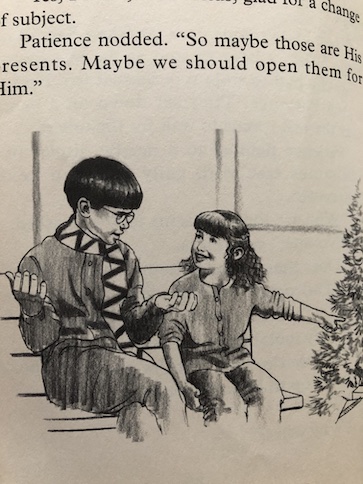
They enjoy the restaurant, which has a large Christmas tree, decorated with golden reindeer. During lunch, Patience tries to point out the “other Titus” to them, but nobody else spots who she’s pointing to. Patience is known for having an imaginary friend named Amy and for making up tall tales. She sometimes mixed up things she’s imagined with things that are real, so they’re not sure if she really saw the “other Titus” or not. (Personally, I thought this was silly on their part because they already know that Titus’s mother saw someone who looked a lot like him. Titus is wearing a distinctive black-and-white scarf, so I figured at this point that there’s someone wearing a scarf that’s also black-and-white.) Titus feels a little uneasy that there might be another him wandering around.

Titus’s mother wants to look at some furniture after lunch, and she asks Patience’s grandmother if she could come with her and give her opinion. The three cousins would rather go look at store windows instead of furniture, and Patience insists that they take her with them. The older cousins know that Patience can be a handful to look after, but Sarah-Jane knows that she would feel badly if they didn’t take Patience somewhere where she would have more fun than she would have looking at furniture. Patience promises that she’ll stay with her cousins and not run off anywhere, so the adults agree to let her go with them.

While Titus and Patience are looking at the Christmas tree together, Titus is surprised by a teenage boy who comes up to him and starts talking to him as if he knows him. The teenager says that he has a message for him and tells him, “Happy Birthday. The golden reindeer. Dish towels. Christmas tree.” Titus asks him what he’s talking about, and the teenager says that he was paid to deliver that message to him and that he must have been expecting him. When the other cousins come back from the restrooms, Titus and Patience tells them what happened, and they’re equally confused. All they can think is that this bizarre message was meant for the “other Titus.” But, who is the “other Titus”, and what does the message mean?

Theme of the Story:

“What you get from wisdom is better than the finest gold.”

Proverbs 8:19

The book is available to borrow and read for free online through Internet Archive.

My Reaction and Spoilers

This mystery does involve a lookalike for Titus. However, the mystery doesn’t quite end when they meet the other boy. He tells them that he got a phone call telling him to come to the department store for a special message about something that belongs to his family that was stolen. When the other kids tell him the message that was given to Titus, he finds it just as confusing as they do.

It’s Patience who really solves the mystery of what the clues in the message mean, and that’s both because she is nosy and because, as a young child, she doesn’t take certain things for granted, the way an adult or older child would. Sometimes, people see not what’s actually there but what they expect to see. Titus’s mother didn’t really see him on the escalator alone; she saw the other boy, who happened to be wearing a different black-and-white scarf. She just figured it was Titus because she expected the boy with the black-and-white scarf would be her son, and she didn’t look closer to notice that it wasn’t the same boy and that the scarf actually had a different pattern. It was the same with the teenager who was looking for the other boy. In the case of the clues, all of the older kids assume that the packages underneath the decorative Christmas trees in the department store are just empty boxes, wrapped up for decoration. Because Patience wants to check to see if they’re all empty, she’s the one who realizes that one of the packages isn’t like the others.

We never learn who stole the object that the other boy was looking for, but he does get it back. Also, Patience learns to get over her fear of the escalator.

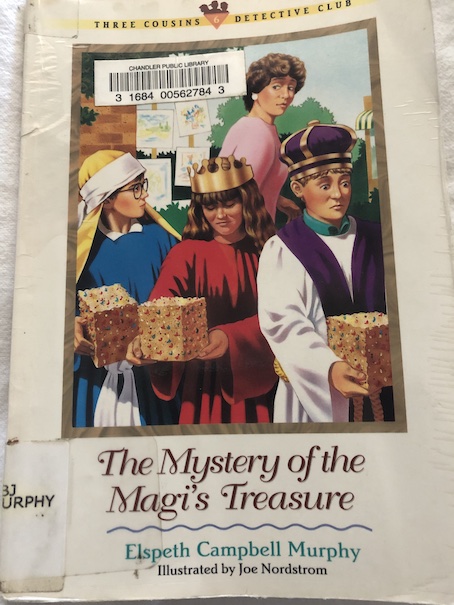
The Mystery of the Magi’s Treasure

Three Cousins Detective Club

#6 The Mystery of the Magi’s Treasure by Elspeth Campbell Murphy, 1995.

Timothy, Titus, and Sarah-Jane go to visit their grandparents in the resort town where they live over the summer. Their grandfather is the pastor of a church, and in their Sunday school class, there are three boys, all named Kevin, who are close friends and have a reputation for being troublemakers and goofs. The three cousins have little to do with the three Kevins, but it’s because of the three Kevins that they are recruited to help with the community’s Christmas in July art fair.

The community holds an art fair every summer, and this year, they’ve chosen Christmas in July as their theme. Some of the local churches are holding a special concert of Christmas music as part of the event, and someone through it would be a fun idea to have children dressed in costumes from the Nativity play, like shepherds and angels, to hand out flyers for the concert. The three Kevins get the roles of the Three Wise Men, but it becomes obvious pretty quickly that this arrangement isn’t going to work because they’re more like the Three Stooges than stately wise men. The choir director says that they need more reliable children to be the Three Wise Men, so naturally, he gives the roles to the three cousins. After all, their grandfather is the pastor, and their grandmother is always bragging about how well-behaved they are.

As soon as they put on the wise men costumes, Timothy realizes that there’s method to the Kevins’ madness. If you get a reputation for being reliable and doing good work, people give you more work. If you get a reputation for not doing anything right, nobody will even let you do certain jobs. The job of being wise men in July is anything but fun. The robes are too heavy and hot for summer. They can’t even complain because everyone says they look adorable, which is humiliating, and their grandmother keeps telling everyone how proud she is of them. It’s almost like they’re being punished for being good, and they can’t say a thing about it without disappointing Grandma.

Then, something really strange happens while they’re passing out flyers. A woman they’ve never seen before runs up to them and gives them three boxes. She says that they’re supposed to be part of their costumes, the gifts for Baby Jesus. She seems a little flustered and has trouble remembering exactly what the gifts are supposed to be, forgetting the words “frankincense” and “myrrh.” She tells the kids that she’s in charge of the props and that they have to take good care of these boxes and only return them to her. Then, she rushes off again.

The kids think that it’s an inconvenience to have to carry around the boxes as well as pass out flyers, but the woman’s manner struck them as strange. When they look more closely at the boxes, the workmanship also seems unusually good for objects used only for a Nativity play.

Then, the kids overhear a couple of artists talking about some artwork stolen from a fellow artist. Suddenly, they have an uncomfortable feeling that they know what was stolen, who took it, and where it is now. The big problem is that the thief is watching them.

Theme of the Story: Goodness.

The book is available to borrow and read for free online through Internet Archive.

My Reaction and Spoilers

After the kids hear about an artist’s work getting stolen, it doesn’t take them long to realize that the boxes they were give were probably the stolen artwork and that the “prop” lady who didn’t seem to know what she was doing was the thief. She was just looking for a convenient place to leave her stolen goods so she wouldn’t be caught walking around with them, and she happened to spot the children in their wise men costumes. Three fancy boxes look like what people would expect the gifts of the Three Wise Men to look like, so the thief could essentially hide the stolen goods in plain sight. The artists talking about the theft were uncertain exactly what type of art was stolen, so most people at the fair also wouldn’t know what to look for and would just assume that the boxes were props.

The Kevins got them into this mess in the first place, and they turn out to be the way out of it, too. The thief was counting on the kids being easy for her to watch because they stand out in their costumes but almost invisible to bystanders because everyone else just disregards them as being in costume and doesn’t look closer. What the kids realize is that maybe she also hasn’t looked closely enough to really recognize them and is only following the costumes, no matter who happens to be wearing them. Once the cousins explain to the Kevins what’s happening, it’s exciting enough for the Kevins to be more than happy to participate. They finally put their playacting and thrill-seeking to a good purpose!

Weirdly, the thief also unintentionally did a good deed for the artist. The artist has been doubting herself and the quality of her work. While stealing from her was a bad thing to do, the thief unintentionally confirmed that her work was so good that she was willing to steal it! It reminded me of a funny line from an old episode of Remington Steele with an artist whose work was stolen: “I’ve finally hit the big time! I’ve been stolen!”

The theme of “goodness” sounds somewhat generic, but the story is really about turning something bad into something good. The kids didn’t really like getting the roles of the Three Wise Men, but if they hadn’t taken them, they wouldn’t have found this mystery and saved the stolen artwork. Instead of goofing off and messing up like usual, the Kevins came through when it was really important. The woman who tried to take something that didn’t belong to her proved that it was something with value. The boxes themselves were made from pieces of junk, but they’re beautiful. It doesn’t mean that stealing becomes right if it unintentionally accomplishes something good, but the kids come to realize that even things that don’t seem like they’re worth anything can have unexpected good sides. Even Baby Jesus was born in a humble stable.

The Mystery in the Snow

The Boxcar Children

Boxcar Children Mystery in the Snow cover

The Mystery in the Snow by Gertrude Chandler Warner, 1992.

Boxcar Children Mystery in the Snow  arrival

The Alden children are disappointed because there is still no snow this winter, and they’ve really been looking forward to snow. Their grandfather tells them not to worry because, soon, they’ll have all the snow they want. A friend of his, Mr. Mercer, owns a ski lodge and has been urging him to visit and bring his grandchildren. There’s going to be a winter carnival there. The children are eager to go and have fun in the snow!

Boxcar Children Mystery in the Snow choosing teams

At the ski lodge, the Alden children meet a boy named Jimmy. Jimmy is a regular visitor to the lodge, but for some reason, he says that his parents never stay. There is also a girl called Freddie, which is short for Fredrica. Her parents aren’t at the hotel, either, because they’re visiting her sister, but she says that they will come later. Freddie could have gone to visit her sister, too, but she didn’t want to miss the fun at the ski lodge. She and Jimmy are both team captains for the winter games, which include skiing, skating, sledding, snow sculpting, and ice carving. Strangely, when the team captains get the box where kids are supposed to submit their names to join the teams, they can’t find the keys. The loss of the keys is worrying because, if they can’t find them, they won’t be able to get into the equipment shop for the equipment they need for the games. They still manage to put together the teams, and the Alden children also join.

Boxcar Children Mystery in the Snow  skates

Then, Mr. Mercer discovers that all four of the tires on his truck are flat. Grandfather Alden offers to drive him into town to get a pump for the tires and to talk to a locksmith about getting into the equipment shop.

While the adults tend to that, the kids talk about the try-outs for different events. The Aldens are all excited about different events. Violet notices that one girl, Nan, isn’t enthusiastic about the events at all and doesn’t want to try out for anything. Violet asks her why, and Nan says that joining in the games was her parents’ idea, not hers. They say it will be fun, but she never really enjoys herself at these things. She doesn’t think there are any events she can do, and she’d hate to be the one to lose an event for her team. To encourage her and build up her confidence, Violet suggests that they both sign up for the ice carving event, which doesn’t require a try out. Violet says that she doesn’t know how to do ice carving, and Violet says that’s fine because she doesn’t, either. She says that it would just be fun to try it out together. Nan points out that they would be competing against each other because they’re on opposite teams, but Violet says that doesn’t matter because they’re both equals, neither one of them knowing what they’re doing. Nan is cheered by Violet’s friendliness and signs up for ice carving.

Boxcar Children Mystery in the Snow  Watch the dog

Nan isn’t the only unhappy child involved in the games, and the Aldens begin to feel that the focus on competition instead of simply having fun in the snow is partly to blame. A boy named Pete is upset that he didn’t get selected for any of the events he tried out for, and he says he doesn’t want to be the time team’s time keeper, which is the default position. Pete says he no longer wants to be involved in any of it. Freddie is angry because she and Jimmy drew names for their team members at random, and she thinks that Jimmy ended up with most of the really good team members. She wants a way to even things out. When the Aldens ask Jimmy if his parents will come to the awards dinner at the end of the games, he seems upset and doesn’t want to talk about it much. They’re not sure if Jimmy is more upset about his parents not being there than he pretends or if he’s worried about the awards ceremony in general.

Boxcar Children Mystery in the Snow  smashed sculpture and footprints

It soon becomes apparent that someone is intentionally trying to sabotage the winter games. Someone smashes the snow sculptures that the Aldens made for their team. Then, someone steals a skier’s skis and ruins the ice sculpture made by the other team. The entire skating event has to be postponed when someone ruins the ice.

Who is doing these things and why? It could be someone who’s trying to make their team win the competition, but the sabotage has been aimed at both teams and at the event in general. Is it a kid who is unhappy with the contest or their position on their team? Jimmy seems eager to cancel events every time something goes wrong. Can the Boxcar Children figure out who is responsible?

The book is available to borrow and read for free online through Internet Archive (multiple copies).

My Reaction

Boxcar Children Mystery in the Snow  skis

There are themes in the story about competition and family. The Aldens aren’t accustomed to thinking competitively about other people because they’re used to doing things with each other cooperatively, as a team. Because they’re accustomed to thinking cooperatively, they are friendly with people on the other teams, like Nan, and they’re more focused on the fun of the events than on winning. That makes them different from some of the other kids, who are concerned about winning, but there are other issues in the book besides competition that matter more.

Boxcar Children Mystery in the Snow  knocking on the door

There are indications in the story that the parents of the children in the competition don’t always want the same things that their children want. Nan, for instance, didn’t even want to join contest, but her parents urged her to do it. Also, some of the children aren’t as good at others at conveying to their parents what they really want. When the most troubled child in the group finally manages to say what they really want, many things get straightened out.

I feel like there are many stories where the conflicts revolve around people who don’t really communicate with each other. In this story, there’s a character who blames others for not understanding how they feel, but even they have to acknowledge that they haven’t actually explained their feelings. They’ve just been expecting everyone else to know what they’ve been feeling. Some honest communication straightens out the problem, and that’s a good life lesson for kids and families.

Snowbound Mystery

The Boxcar Children

The school that most of the Alden children attend is closed temporarily because there was a fire and the building needs to be repaired. Henry is in college (this is one of the books in the early part of the series where the children age), but he doesn’t have to go back for another week, so the family is talking about what they’d like to do. Benny says that he wants to go up to the hunter’s cabin in the Oak Hill woods. Grandfather Alden belongs to the sportsman’s club that owns the cabin, but the hunters in the club don’t use it during the fall. It’s early for there to be snow, so Grandfather Alden thinks it will be okay. Grandfather Alden isn’t eager to go himself, but he thinks that it’s okay if the kids want to spend a week there.

The kids bring some food with them to the cabin, but they plan to buy more from the nearest store, which is a five-mile hike away. On their arrival, they choose the places where they’re going to sleep in the cabin, and they look through the cabin’s guest book for names they recognize. One name they recognize is the Nelson family. The Nelsons are the ones who own the store, and they kids wonder why they’ve visited the cabin three times recently because they wouldn’t have come there to hunt. They decide to ask the Nelsons about it when they go to the store.

The Nelsons are friendly and helpful at the store. When the kids ask about their trips to the cabin, Mr. Nelson just says that they sometimes like a change of scene. The cabin used to belong to the Nelson family before the sporting club bought it. However, the Nelsons’ young son, Pugsy, says that whenever they go to the cabin, they “look and look.” His parents stop him from saying more, but the Aldens wonder what the Nelsons could be looking for at the cabin.

The Nelsons give them useful advice about dealing with the squirrels at the cabin and about cooking. Mr. Nelson loves cooking and baking. In particular, he likes to make buns, but he makes an odd comment about how they’re not as good as they could be.

Back at the cabin, the Aldens find a hidden broom closet and a strange message that seems to be in some kind of code. They can’t understand what it means, and they wonder if this message could be what the Nelsons are looking for. Because they don’t understand the significance of the message, they’re not sure what to do about it. The Nelsons are nice, so the kids don’t want to think that they might be involved in anything bad, but if there’s an innocent reason for them to have this message, why are they being so secretive about it?

Although it is early for snow, a bad snow storm comes that leaves the Aldens snowbound in the cabin. Fortunately, they have plenty of supplies, and they can use their radio to hear about weather conditions. There are messages on the radio for people who have been separated from family members, and one of them is from the children’s grandfather, telling them to remain in the cabin and wait for help because he will get to them as soon as he can.

However, the Nelsons were also worried about the Aldens and made their ways through the snowy woods to check on them. The snow was worse than they thought, so now, the Nelsons are also stuck at the cabin with the Aldens. While they wait for their rescuers to arrive, the Aldens and Nelsons discuss the secret message and what the Nelsons are really looking for.

The book is available to borrow and read for free online through Internet Archive (multiple copies).

The Nelsons are actually a nice family, and there is an innocent reason for their behavior. Mr. Nelson’s father and grandfather also loved baking, and they had a special recipe that they used for making buns. Their recipe had a secret ingredient, but unfortunately, they both died before passing on their secret. Mr. Nelson thinks that, if he could make the buns like they did, he could become famous or at least earn more money for his family. He is a good baker, but the recipe is something special. The secret message is part of the recipe, but there’s still a missing piece of the puzzle. The Aldens and the Nelsons use their time when they’re snowbound in the cabin to look for the rest.

This story is equal parts adventure and mystery. Fans of the Cottagecore aesthetic will appreciate how the Aldens make do with the primitive conditions at the cabin, use plants as decoration, and gather nuts in the woods before the snowstorm.

Years after this book was published, another author wrote a cookbook based on food references in the Boxcar Children series, and she included a recipe for the buns in this story. The story never reveals the secret ingredient, and the author uses some shortcuts in preparing them, but it’s an easy recipe that kids can learn to make.

Revenge of the Mummy

Clue

This book is a collection of short solve-it-yourself mini-mysteries based on the Clue board game. Each book in the series contains short mysteries that the reader is urged to attempt to solve before the characters do. The solutions to the mysteries come after each chapter.

Most of the mysteries involve a crime of some kind, but not all. Sometimes, characters try to steal things from each other, but there’s also a scavenger hunt, an ice cream tasting party, and a hot air balloon race.

In the final chapter of the book, it seems like Boddy, our host, has been murdered, and the reader has to solve his murder, just like in a game of Clue. However, Mr. Boddy doesn’t actually die. It’s a pattern in the series that he seems to have been killed in each book, but he always survives somehow to reappear in other books in the series.

At the end of the previous book of solve-it-yourself mini-mysteries, it looked like Mr. Boddy had been murdered, but at the beginning of this book, he explains how he survived. All of the books in the series follow this pattern. There’s generally a humorous twist to how he survives and explains the situation.

The book is available to borrow and read for free online through Internet Archive.

The Lion Ring – Mr. Boddy has obtained a new treasure for his collection: an ancient and valuable ring with a lion on it that once belonged to an African king. Naturally, his sticky-fingered guests all want it for themselves.

Full of Hot Air – Mr. Boddy and his guests are having a hot-air balloon race. Who will be the winner?

Urge to Earn an Urn – Mr. Boddy stops Mrs. White and Mrs. Peacock from arranging flowers in an old urn they found in the basement. It turns out that it’s a valuable Greek urn, and when the other guests realize it, someone plots to steal it.

Please Don’t Sneeze – Miss Scarlet is coming down with a cold and spreading it among the other guests. Mr. Boddy introduces them to his grandmother’s secret cold remedy.

For Goodness’ Snakes! – Mr. Boddy’s guests are frightened of his new pet boa constrictor, but when they try to catch the snake, the snake catches one of them.

The Inky Trail – Mr. Boddy has discovered that someone attempted to forge his signature on a $250,000 bond. Fortunately, the forger tried to use the pen that explodes ink if anyone other than Mr. Boddy uses it. Mr. Boddy thinks that it’s going to be easy to track down the ink-stained guest, but it’s more complicated than he thinks.

The Scavenger Hunt – Mr. Boddy’s guests are bored one evening, so he starts a scavenger hunt with them.

Screaming for Ice Cream – Mr. Boddy has an ice cream tasting party with his guests to determine the best flavor. However, not everyone is willing to eat certain flavors of ice cream. Readers have to determine who is the only person who tried every flavor.

Caught Bare-Handed – Someone attempts a daring but unsuccessful theft of Mr. Boddy’s priceless chandelier, which sends it crashing. Who was the attempted thief?

Revenge of the Mummy – Mr. Boddy shows his guests the mummy case that he has recently acquired. The guests are a little too fascinated after someone mentions that mummies were buried with their valuables. Mr. Boddy warns the guests that the mummy may get angry and seek revenge, but they don’t believe it … until someone has an encounter with the mummy.

The Screaming Skeleton

Clue

This book is a collection of short solve-it-yourself mini-mysteries based on the Clue board game. Each book in the series contains short mysteries that the reader is urged to attempt to solve before the characters do. The solutions to the mysteries come after each chapter.

Most of the mysteries involve a crime of some kind, but not all. Sometimes, characters try to steal things from each other, but there’s also an apple-bobbing contest at a Halloween party, a snowball fight, and a pie-eating contest.

In the final chapter of the book, it seems like Boddy, our host, has been murdered, and the reader has to solve his murder, just like in a game of Clue. However, Mr. Boddy doesn’t actually die. It’s a pattern in the series that he seems to have been killed in each book, but he always survives somehow to reappear in other books in the series.

At the end of the previous book of solve-it-yourself mini-mysteries, it looked like Mr. Boddy had been murdered, but at the beginning of this book, he explains how he survived. All of the books in the series follow this pattern. There’s generally a humorous twist to how he survives and explains the situation.

The book is available to borrow and read for free online through Internet Archive.

Murder in the Cockpit – Mr. Boddy wants to take his guests for a flight on his private jet, but a fight breaks out over seating arrangements.

Baby Booty – Mr. Boddy has to watch his young nephew for a while, and he bribes his guests into helping him. Various guests take turns trying to make baby Frank happy, and readers are asked to figure out who has Frank.

Dance Until You Drop – Mr. Boddy and his guests were planning to have a croquet tournament, but they had to cancel it due to rain. To cheer everyone up, Mr. Boddy starts a dance party, but a couple of his guests take advantage of the situation and steal Miss Scarlet’s necklace.

The Halloween Costume Caper – Mr. Boddy is having a Halloween party for his friends, and he wants everyone to come in costume. When the guests arrive, no one is sure who is wearing which costume, but their identities are gradually revealed during a highly competitive game of bobbing for apples, where the guests are trying to find the apple that contains a “gold nugget.”

The Snowball Effect – It’s snowing, and the guests are getting on each other’s nerves because they’re cooped up inside. To change the mood, Mr. Boddy enlists everyone in a snowball fight. It’s up to the readers to determine who won from the information given.

The Case is All Sewed Up – Mr. Boddy is having an heirloom quilt restored, but the guests become interested when he says that one his ancestors hid the family treasures in the quilt during WWI. What are the Boddy family treasures, and who gets their hands on them?

Pie in Your Eye – Mr. Boddy is holding a pie-eating contest with his friends that unfortunately ends in a food fight. But, who is the winner?

Pea is for Pretender – The guests are talking about fairy tales when Miss Scarlet says that, like the Princess and the Pea, she would bruise if she tried to sleep on top of a single pea. The guests decide to put her claim to the test, and Mr. Boddy promises her a crown if she really bruises from sleeping on a pea. However, Miss Scarlet enlists the help of another guest to fake the results of the test. Who is her confederate?

The Thanksgiving Murder – Thanksgiving starts off peacefully enough with various guests volunteering to help Mrs. White prepare the meal and set the table … at least until Miss Scarlet realizes that Mrs. Peacock has removed her valuable jade ring and set it aside while helping. After Miss Scarlet swipes the ring, it changes hands several more times as others notice and take it for themselves. It’s up to the readers to figure out who finally ends up with it.

The Screaming Skeleton – Mr. Boddy unveils his latest acquisition – a skeleton made entirely of platinum. He’s planning to sell it to a museum, but of course, his guests plot to either steal the skeleton (or parts of it) or intercept the money from the museum. But, knowing his guests as he does, Mr. Boddy has also installed a security device on the skeleton that screams when someone tries to touch it.