Historic Communities
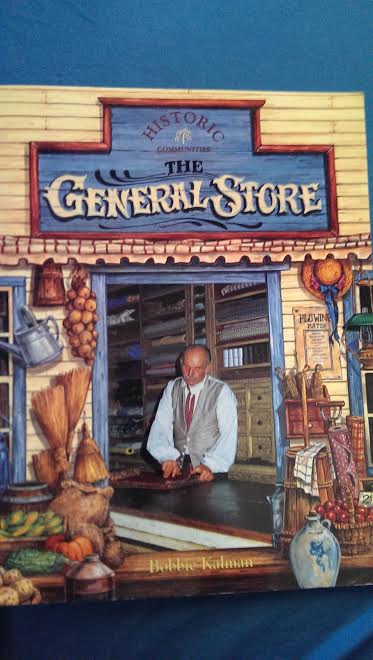 The General Store by Bobbie Kalman, 1997.
Besides providing 19th century communities with needed goods, general stores were often centers for community life. Everyone would need to come and purchase or barter for supplies they couldn’t make for themselves, and it was also where mail for the area was delivered and sorted. People gathered there to pick up what they needed and to exchange news and gossip with other members of the community. The book explains how general stores functioned, what kinds of goods they carried, and how they helped to build growing communities.
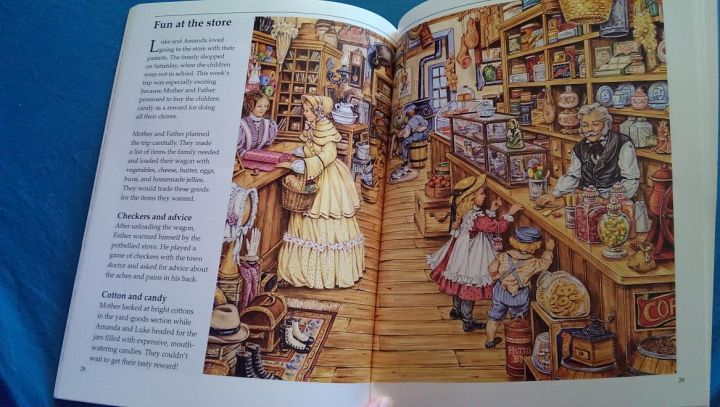
Basically, they were like small department stores, carrying a little of everything that people in the area needed, including food items, dishes and silverware, tools, plant seeds, ready-made clothes and shoes, bolts of cloth, books, newspapers, and medicine. Store owners had to decide what they would carry in their stores and how much of it to stock. If they stocked too little of an item everyone wanted, they would run out, and if they had too much of an item hardly anyone wanted, they would either have to sell it at a discount or keep it themselves. If someone wanted something that the storekeeper didn’t have on hand, they would have to ask the storekeeper to order it for them from a catalog or get it themselves by making a trip to a larger town where they could find what they were looking for.
 Store owners also had to decide how much they should charge for each item or how much they would be willing to take in trade. Farmers often bartered for goods with the produce from their farms, and it was common for store owners to use a form of credit to keep track of what their customers owed and what they owed to their customers. Farmers would typically sell their goods at harvest time, and the store owners would give them a certain amount of credit at their store, based on what they thought the farmers’ produce was worth. Then, the farmers could use the credit on their account at the store until the next harvest and selling time. If a farmer ran out of credit before the next harvest, the store owner would usually extend credit at the store to the farmer to allow him and his family to buy some necessities, knowing that the farmer could make up for it when he came to sell his next batch of produce.
To keep their customers from disputing the prices they charged at the store, store owners often used a kind of code to keep track of the amounts they spent to buy each item and the price they wanted the customer to pay in order to make a decent profit. The codes were usually something like a substitution code, using letters to represent numbers so customers would need the store owner to interpret the price tags and manage their credit account. This code system became less common after the 1870s because more people were simply using cash instead of bartering for goods, but I thought that it was a fascinating piece of history.
 Another odd kind of code that the book mentions was the kind that people would use on mailed letters. Instead of the sender paying the postage, as they do now, people receiving letters were supposed to pay for them when they picked them up from the general store. If a receiver returned a letter unopened, they wouldn’t need to pay anything, so some people would try to cheat the system by writing a message in code on the outside of the envelope so the receiver would know the most important part of what the writer wanted to tell them for free.
People who practiced special trades, such as blacksmiths or printers, would often set up shop near the general store, and that would be the basis for the main street of growing towns. Later, when railroads connected more towns, more people began ordering what they wanted themselves through catalogs (not unlike the way people have begun ordering more goods through the Internet). Mail started being delivered to individuals’ homes, and general stores were replaced by more modern department stores and specialty shops.
I loved the pictures in the book, a combination of photographs from living history museums and drawings.
The book is currently available online through Internet Archive.
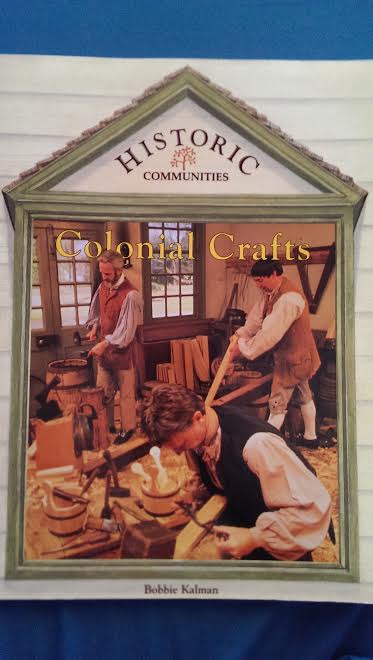 Colonial Crafts by Bobbie Kalman, 1992.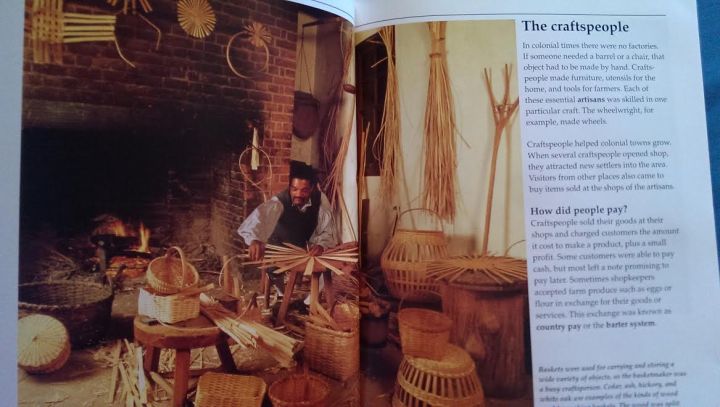


 Going to School in 1776 by John J. Loeper, 1973.
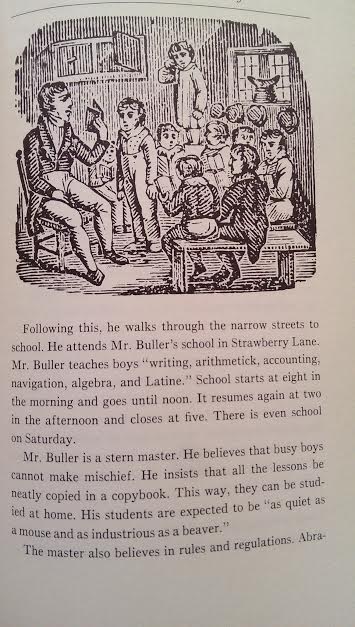 These explanations are told in story form, rather than simply explaining listing the ways children could live, learn, and go to school, trying to help readers see their lives through the eyes of the children themselves. The children’s lives are affected by the war around them. As the book says, many town schools in New England were closed during the war, so the students would attend “dame schools” instead. A dame school was a series of lessons taught in private homes by older women in the community. In other places, such as cities like Philadelphia, official schools were still open. Discipline was often strict, and school hours could be much longer than those in modern schools. Sometimes, children would argue with each other over their parents’ positions on the war.
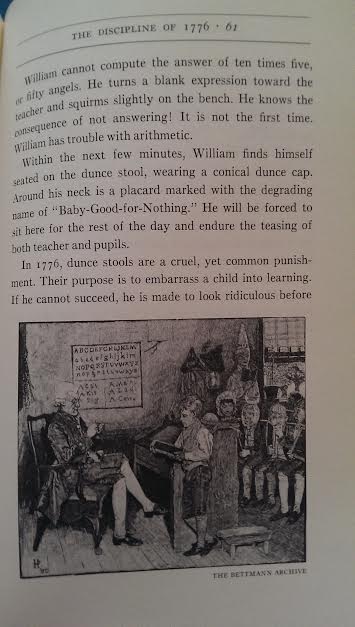 There were different standards for what girls and boys were expected to learn because their learning was guided by what they were each expected to do with their adult lives. A typical school might teach boys subjects like, “writing, arithmetick [sic], accounting, navigation, algebra, and Latine.” Generally, “reading, writing, arithmetic, and religion” were common elementary school subjects. Latin lessons and other advanced subjects were typically for boys who planned to become lawyers or clergymen. Girls were likely to receive little formal education beyond reading and writing, and black people were less likely to receive even that.

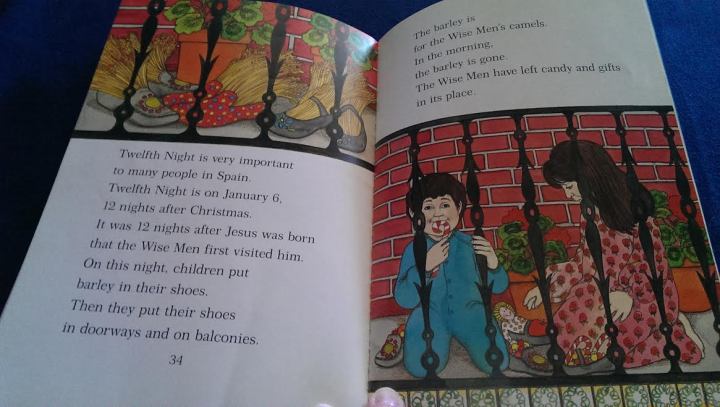
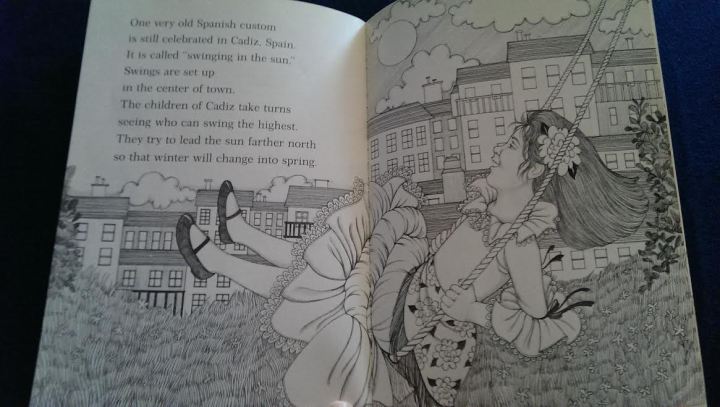
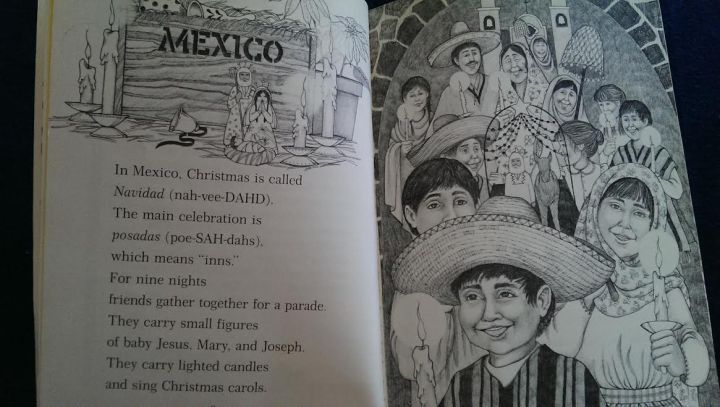
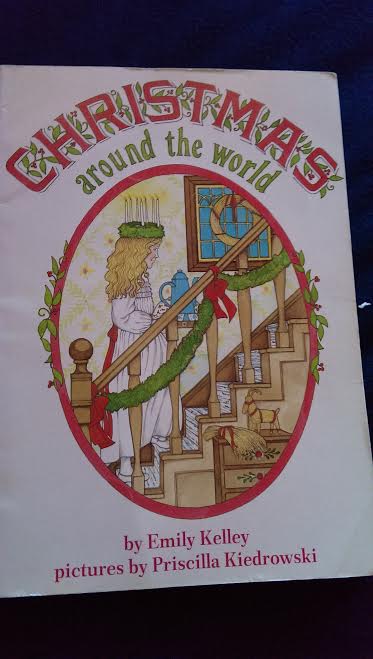 Christmas Around the World by Emily Kelley, 1986.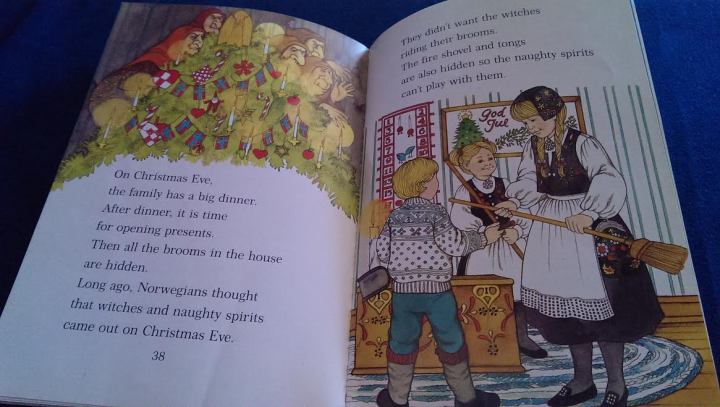
 Sarah Morton’s Day: A Day in the Life of a Pilgrim Girl by Kate Waters, 1989.
 Although much of Sarah Morton’s day is taken up with chores, she also discusses her relationship with her mother and her new stepfather. The death of a parent was something that pilgrim children often experienced. After her father’s death, Sarah’s mother remarried, and Sarah is concerned about whether her new father likes her.


 Jestress's Forgotten Books and Stories