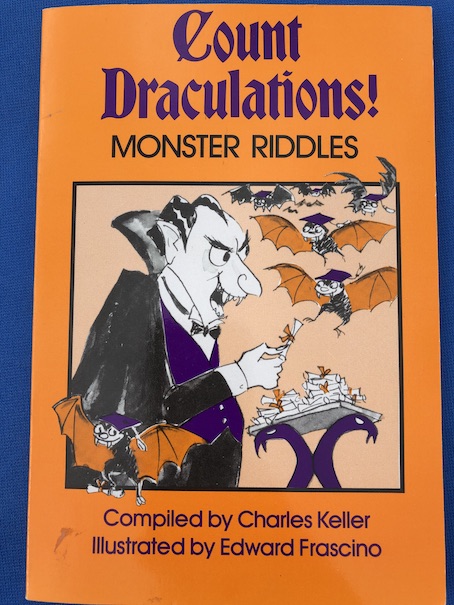
Count Draculations!: Monster Riddles compiled by Charles Keller, 1986.
This is
one of those themed joke books for kids that has monster and Halloween-themed
jokes. The jokes are the basic kid-friendly
question-and-response type with lots of puns.
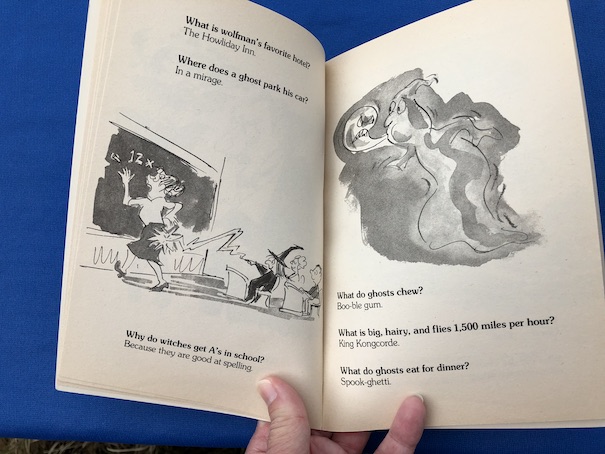
There are also some cute black-and-white illustrations.
Some of my favorite jokes:
Why do
witches get A’s in school?
Because
they are good at spelling.
How do
you get into a locked cemetery?
With a
skeleton key.
Why did
Frankenstein’s monster go to the psychiatrist?
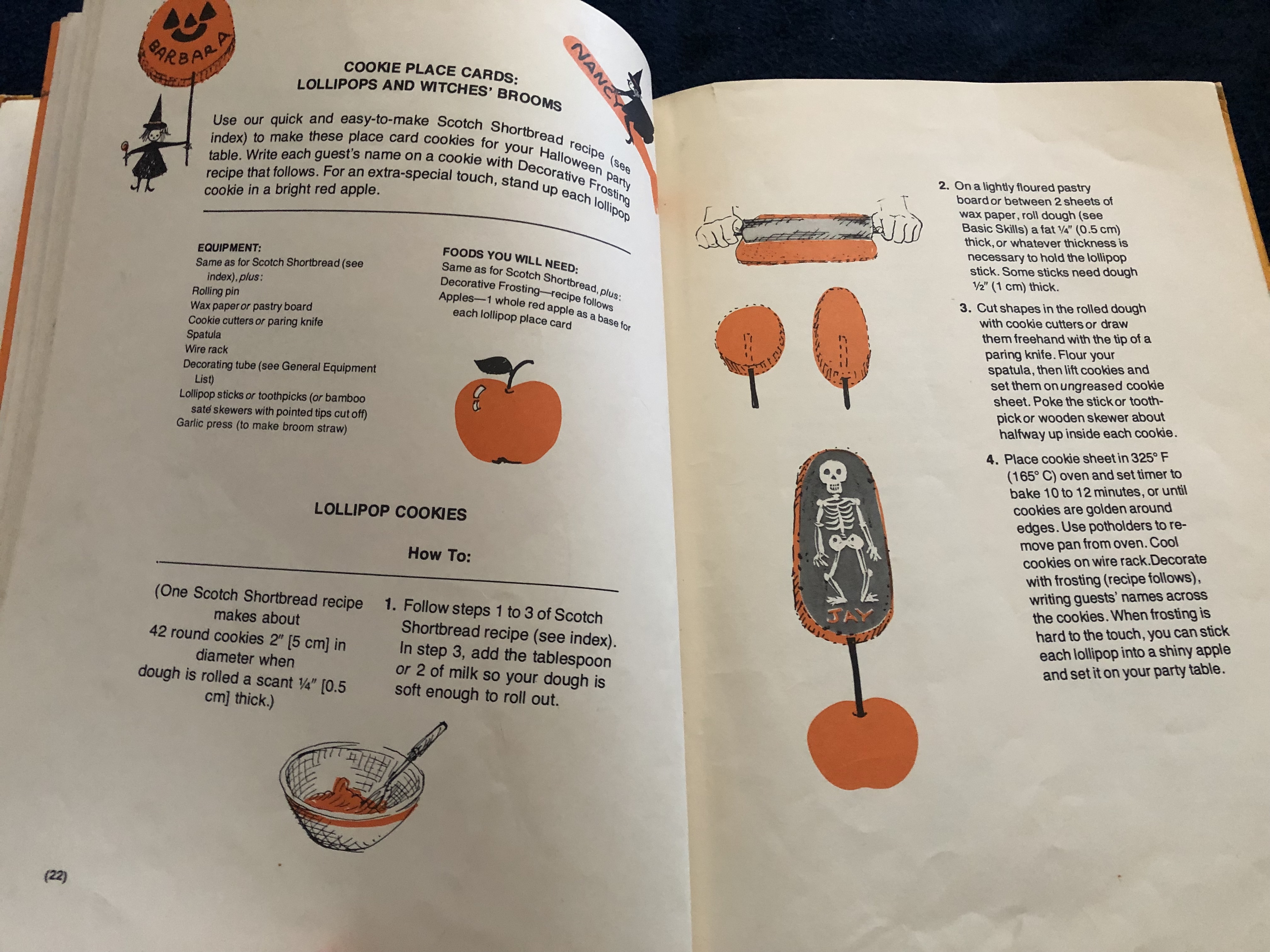
I remember getting this book from my school library when I was a kid. I never actually made anything from it because it was a little beyond my cooking skills. Still, I was fascinated by the recipes in the book, especially the stew inside the pumpkin.
Some recipes in the book use specifically Halloween shapes and colors, while others are more general fall and harvest-themed recipes. The recipes are organized by category with section for food that can also be used as Halloween decorations and other sections for brunch and lunch, vegetable dishes, meat dishes/main courses, and snacks and desserts.
Some of the recipes are old, traditional ones from around the world, such as the ones for Fried Pumpkin Blossoms (an Italian recipe) and the Indonesian Corn Fritters. A brief section at the beginning of each recipe explains a little about the recipe’s background.
In the beginning of the book, there are notes about converting between units of measurement, including converting between imperial and metric units. There is also a guide for converting between Celsius and Fahrenheit temperatures. There are other cooking tips for beginners, such as how to separate eggs (I’ve never done it with my hands, like in the book, but it’s useful to know) and how to chop onions and press garlic.
This is a fun book of jokes and tricks for Halloween or just having some spooky fun with friends, possibly at a sleepover. The book is divided into the following sections:
Making Monsters – How to make costume pieces and turn yourself into a bug-eyed monster, a warty witch, and more! There are also tricks, like making a ghost image appear on a wall, casting a glowing face on someone else’s shadow, and making Bigfoot footprints.
Screamingly Funny – A chapter of ghost jokes.
Ghostly Tricks – Magic tricks that look somewhat ghostly, like making a friend “float” in the air and making magical symbols appear on blank cardboard.
Monster Pranks & Practical Jokes – Tricks that produce ghostly illusions, like how to take ghostly pictures, produce taps with no obvious source, and cause ghostly flashes of light in a dark room.
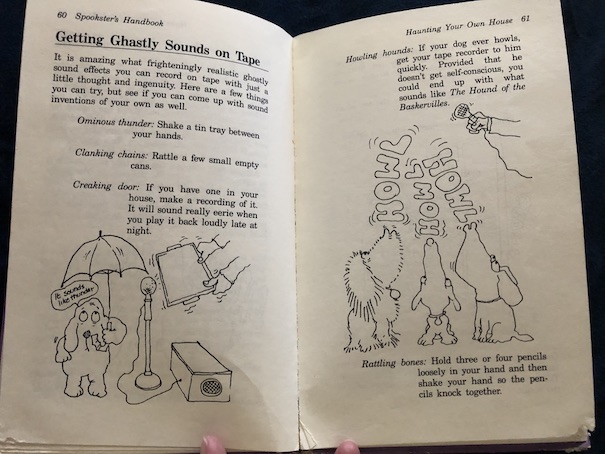
Haunting Your Own House – Describes typical do-it-yourself haunted house tricks for producing scary noises.
Monster Laughs – A chapter of monster jokes.
Scare Your Friends – Tricks and pranks for spooking your friends with a finger in a box, strange noises, or a glowing skull.
Terrible Trivia – Fun facts about superstitions and telling the future.
Fang-Tastic! – A chapter of jokes about vampires.
My favorite parts of the book are the superstitions and the ways to make scary haunted house noises. I haven’t actually tried the noise tricks yet, but at some point, I’m planning to try a few!
The book is available to borrow and read for free online through Internet Archive.
Six-year-old Ramona Quimby thinks of herself as brave. Now that she’s going into the first grade, she’s no longer just a little kid. She even stood up to some boys on the playground who were making fun of her older sister, Beatrice, for being called “Beezus.”
However, Ramona soon discovers that not every sees her the way she sees herself. Beezus is embarrassed at the way her little sister told off those boys and is sure that they’re now going to make a much bigger deal of the incident at school because of it. Beezus says that she’s sick of her silly nickname, which rhymes with “Jesus” and just wants to be called “Beatrice.” Ramona agrees with her, both because she feels bad that she accidentally embarrassed her sister and because it’s her fault that Beezus got her nickname. When she was smaller, Ramona couldn’t pronounce the name “Beatrice” very well and ended up saying “Beezus” instead, and the mispronunciation stuck. Ramona is trying hard to be a big kid now, and she doesn’t like to remember that she used to not even be able to say her own sister’s name. Ramona agrees to call her sister Beatrice in public and to only use the Beezus nickname at home.
Ramona wants to be taken seriously, and she hates it when her mother is amused by some of the silly things she does. (I know the feeling, and so do many other people!) The last thing she wants is to just be a silly little kid that people laugh at, and nobody seems to understand how she feels. She especially hates it when her sister keeps calling her a pest.
Fortunately, their mother understands that part of the problem is that the girls are getting bigger, and they’re starting to feel cramped sharing a room with each other. Mr. and Mrs. Quimby have decided to add an extra room onto the house so the girls won’t have to share anymore, and Mrs. Quimby is going to take a part-time job to help pay for it. Before the girls can start arguing about who gets the new room, Mrs. Quimby tells them that it’s already decided that they will take turns, trading off rooms every six months and that Ramona will have the first turn in the new room.
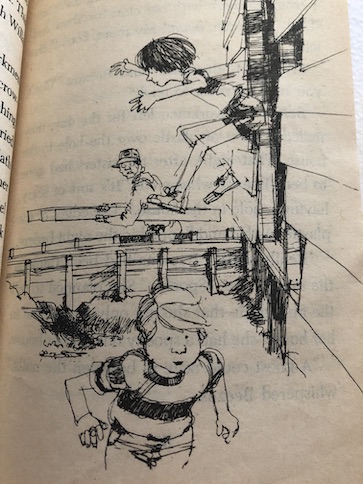
Watching the workmen make a hole in the wall of their house and build the new room is fascinating, although Ramona doesn’t have the patience for planning, methodical work, and learning how different tools are supposed to be used, like her friend Howie. Ramona prefers playing their made-up game of Brick Factory, where she and Howie smash old, broken bricks with rocks. Ramona takes the opportunity to put her special initial, a Q with cat ears and whiskers, into the wet concrete for the floor of the room, and she can’t resist the opportunity to jump through the new hole in the wall of their house. The workmen cover the hole with a sheet of plastic when they go home for the day, but the girls think it’s kind of spooky having a hole in the wall of their house. They imagine that something horrible could sneak in through the hole, like a ghost, maybe one that looks like a gorilla. Ramona can’t wait to tell the other kids all about it when she starts first grade!
Unfortunately, the new school year doesn’t start out the way Ramona hopes. Instead of everyone being excited about her news and how she watched the workmen chop a hole in the side of her house, everyone laughs because the teacher had just made a joke about her being Ramona Kitty Cat because she drew the cat ears and whiskers onto the Q on her name tag the way she always does. Ramona hates being laughed at and made to feel like a fool. Worse still, her friend Howie doesn’t defend her because Ramona said that they “chopped” a hole instead of “prying” it open with crowbars. Because of Ramona’s technical inaccuracy, Howie makes her sound like she was lying about the whole thing!
Then, when the kids make paper bag owls for Parents’ Night, Susan copies Ramona’s design, and the teacher, Mrs. Griggs, praises Susan to the whole class for coming up with the idea of having the eyes looking to the side. She doesn’t even notice Ramona’s owl. Ramona, afraid that everyone else will think that she’s the copycat because of Mrs. Grigg’s public praise of Susan’s owl, just like they all thought she was a liar and laughed at her before because of what Mrs. Griggs and Howie said on the first day of school, crumples her owl up and throws it away before anyone can see it. But, that doesn’t help relieve Ramona’s feelings at the injustice of the situation. She’s owl-less because of Susan stealing her idea. In a fit of temper, she crumples up Susan’s owl, too, and runs away when Susan tells on her even though Mrs. Griggs repeatedly says that she doesn’t like tattletales. (Honestly, I’ve never understood why adults tell kids that. It just encourages kids to behave badly and label others as “tattletale” when they complain, even when the complaint is just. It just gives bullies more power to act with impunity. I also think kids should be encouraged to talk about things, especially some of the more difficult things to talk about, and the whole “I don’t want to hear from tattletales” shuts down conversations before they even start. I’ve guessed that it has something to do with not wanting to take the time to deal with a lot of petty complaints, but at least hear someone out before you decide what they’re going to tell you and how important it is!) Even when Ramona explains the situation to her mother, she can tell that her mother doesn’t fully understand how she feels, and she is forced to apologize to Susan. Mrs. Griggs makes it all the more embarrassing by forcing Ramona to apologize in front of the whole class. Ramona knows that Mrs. Griggs doesn’t understand her and is sure that Mrs. Griggs hates her.
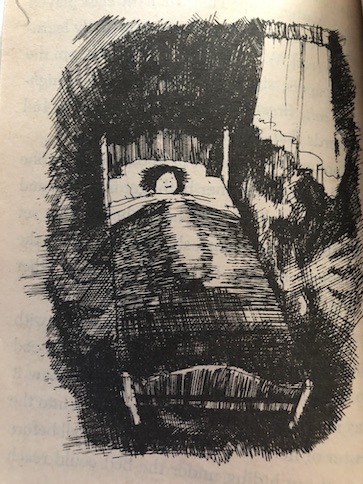
Ramona’s new room isn’t much of a comfort, either. She finds it a bit spooky, and when she’s alone in it, her imagination runs wild, like it did the night that she and her sister were imagining what kind of ghost could get in through the hole in the wall. Ramona certainly doesn’t feel very brave and grown-up about having a room to herself, but she refuses to admit it because she doesn’t want anyone to think that she’s a baby for being scared.
Things come to a head when Mrs. Griggs sends home a progress report that says that Ramona needs to use more self-control and keep her eyes on her own work. Ramona knows that it’s totally unfair because she’s been very self-controlled since the owl incident, in spite of Mrs. Griggs’s inconsiderate lack of understanding, and the only reason why she sometimes looks at the paper of the boy next to her is that he’s been seriously struggling with his work, and she’s been trying to help him. When Ramona is so fed up that she tells her family that she needs to say a bad word and the worst word she can think of to say is “guts”, everyone laughs at her, and Ramona bursts into tears, unable to take it anymore.
Tears and anger serve a purpose, though. Sometimes, an outburst is the only way to make someone understand, and understanding is what Ramona most needs. The family has an honest discussion about Ramona’s feelings, and Beezus tells her that she understands what it’s like to be little and laughed at for doing or saying something silly, reminding her mother about the times when she laughed about things she did, back when Ramona was too little to remember it. Beezus says that her mother’s laughter hurt her feelings when she was Ramona’s age, too, and Mrs. Quimby apologizes. Beezus also says that she never liked Mrs. Griggs very much when she was her teacher, either. Ramona asks if she could switch to the other first grade class at school, but her mother is reluctant to arrange it because her schoolwork has improved and because some of Mrs. Griggs’s criticism was correct and that Ramona does need to improve on her self-control. Mrs. Quimby also says that she wants Ramona to learn to understand and work with different types of people. Mrs. Griggs might not be her kind of person, and she might not always understand Ramona, but Ramona isn’t always easy to understand.
Personally, I didn’t think that last comment was a very good way to put it. One of the great things about the Ramona books is that Ramona’s feelings are easy to understand and identify with. Beezus certainly understood what Ramona meant about what it’s like to be laughed at for just being a kid. It’s something many of us experienced when we were kids, and we identify with how Ramona feels about it. (Didn’t Ramona’s mother ever go through this herself, or does she just not think about it? I kind of wondered when she didn’t seem to understand what her daughters were talking about at first.) I think it would have been better to put more of the emphasis on the idea that different types of people need to learn to respect each other and get along even when they don’t fully understand each other. Other people aren’t always easy to understand, but that’s not because Ramona herself is difficult to understand. Ramona’s feelings aren’t any less understandable than Mrs. Griggs’s, it’s more that not all people have the same capacity for understanding others because they don’t have as much empathy as others or the imagination to consider circumstances they haven’t personally been in themselves or are too focused on their own priorities and don’t have the time or patience for understanding. Adults often don’t consider things from a child’s point of view because their adult priorities in their busy adult lives take precedence, they discount the validity of what children think and feel because children are less experienced in life and sometimes express themselves clumsily, and they don’t slow down and take a step back or a second look or listen when they should. But, they could show a little more consideration for the child’s feelings even they don’t fully understand them. My own first grade experience wasn’t any better than Ramona’s, and I had my own “Mrs. Griggs.” Adults forget that kids can feel and experience things beyond their ability to fully explain them to others. One of the difficulties of being young, at least for me, was not having the vocabulary necessary to make myself understood or ask all the questions that I wanted to ask, and I often had to deal with adults who were short on patience. I can see that Ramona also struggles with finding the right words to express what she’s feeling or what’s really happening, like when she used the word “chopped” instead of “pried” to describe how the workmen opened a hole in the side of her house. I think that learning words and new ways to communicate with different people is an important part of the story.
Fortunately, Ramona’s father is right that the bad things will blow over, and Ramona’s situation improves. Some of the other kids in class become sympathetic to Ramona because they recognize that Mrs. Griggs shouldn’t have made her apology to Susan an embarrassing public apology. Ramona, although frequently bored in class, learns to read better, and she enjoys reading, finding that she can read more interesting stories when she knows more difficult words. She also meets her older sister’s teacher, and he calls her Ramona Q instead of Ramona Kitty Cat, like Mrs. Griggs did, making Ramona realize that there’s life beyond first grade and that better, more sympathetic teachers are waiting for her. She also becomes less afraid of her new room.
A scary encounter with a dog on the way to school that causes Ramona to lose one of her shoes also brings some unexpected sympathy and understanding from Mrs. Griggs. Ramona comes to understand that Mrs. Griggs is trying to be helpful when she offers her one of the old boots from the lost and found to replace the shoe she lost, that Mrs. Griggs simply doesn’t understand Ramona’s feelings about those old boots (they’re old, dirty, and kind of yucky), and that she isn’t likely to understand because she has her own priorities. Instead of getting mad at Mrs. Griggs for her lack of understanding, this realization causes Ramona to come up with her own creative solution to the problem. Ramona gains a better image of herself because of her creative problem solving and her bravery in a difficult situation. Mrs. Griggs also begins to show signs of understanding that Ramona is a creative person who needs a little room to demonstrate her creativity.
The book is available to borrow and read for free online through Internet Archive (multiple copies).
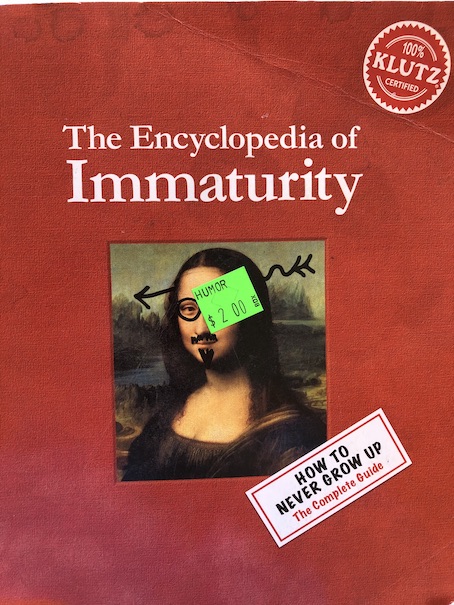
The Encyclopedia of Immaturity by the Editors of Klutz Press, 2007.
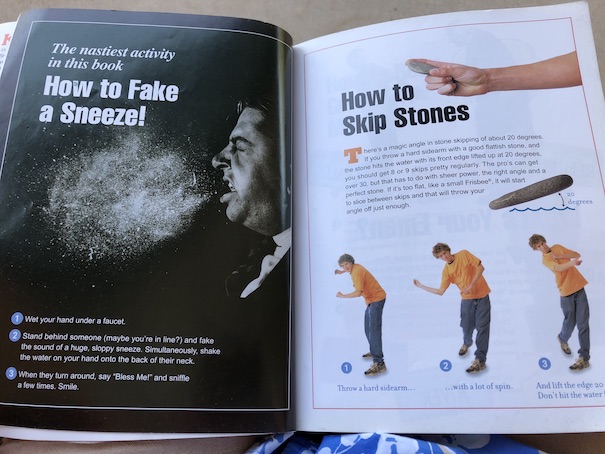
This book is part of the classic children’s hobby and activity series from Klutz Press. It’s a collection of pranks, stunts, and fun things to do. There is too much in this book to describe everything in detail, so I’ll just explain some general themes and highlights.
The stunts and activities are in no particular order, and the book isn’t divided into any special sections. Most of activity or stunts just takes up a page or two of explanation, but some are longer, about three or four pages. None of them are very long.
Some of the activities are classic kids’ activities or pranks, like skipping stones, hanging a spoon from your nose, and Peep jousting (a more modern classic – the book points out that you can do it with regular marshmallows, too, but I like Peeps for the imagery). I remember the one about how to blow a bubble gum bubble from your nose instead of your mouth (found on p. 271) being mentioned in Amber Brown Goes Fourth, when Amber’s new friend, Brandi, teaches her how to do it.
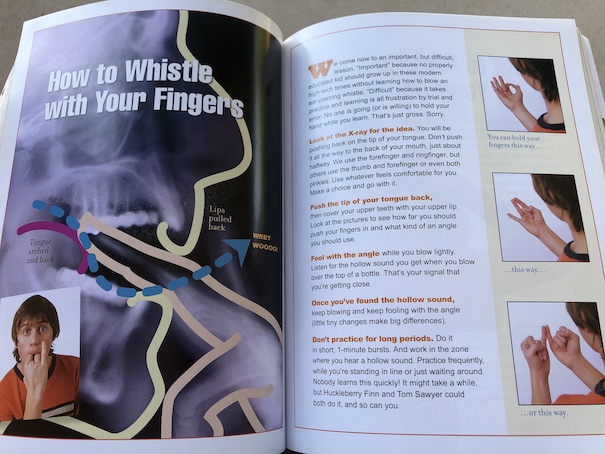
There are also some more difficult tricks to master, like how to do an ollie on a skateboard and how to do a wheelie on a bike. (At least, I consider things like that difficult because I’ve never been able to master them.) I also don’t know how to whistle with my fingers, although the book shows multiple ways to do it.
Some of the pages are designed to be cut out and made into things, like the page that provides a pattern for a paper fortune teller and the page where you cut a square of paper so that it’s possible for a person to go through it.
Some of the activities in the book were also in previous Klutz books, like juggling and how to use trick photography to take pictures that make people look like they’re small enough to pick up. I also remember the backseat rituals for long car trips being part of the Klutz Kids Travel book.
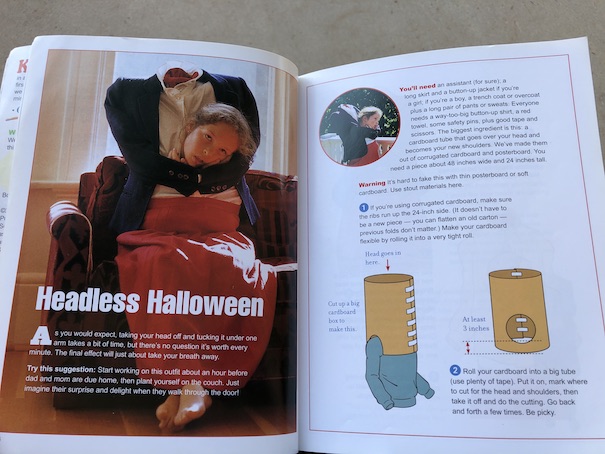
My two favorite sections in the book are the part about how to be a headless person for Halloween and how to sneak around. I never dressed as a headless person as a kid, but I like the idea, and might still do it. I did a lot of sneaking around as a kid because I always loved hide and seek.
There’s quite a variety of activities in this book, including some indoor activities and outdoor activities, and things that can be done on car trips. Some of these activities look kind of gross to me (and still would have when I was a kid because I wasn’t one of the kids who was into gross outs), like how to make fake dog barf, but there’s such a wide selection of activities, I’d say that there’s plenty here for anybody to find fun things to do!
The book is available to borrow and read for free online through Internet Archive (multiple copies), along with the sequel to the book, The Encyclopedia of Immaturity, Volume 2.
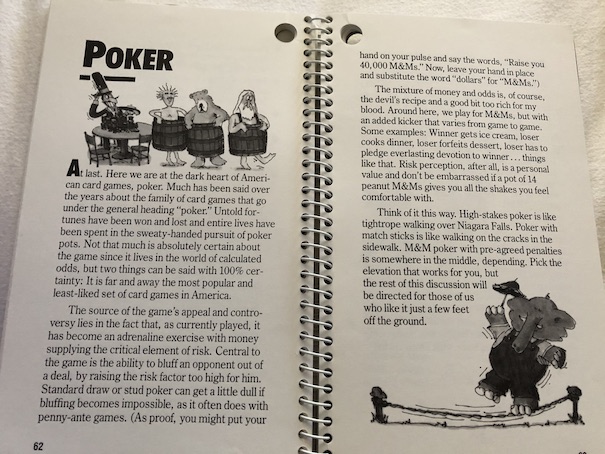
The Klutz Book of Card Games for Sharks & Others by the Editors of Klutz Press, 1990.
This book is part of the classic children’s hobby and activity series from Klutz Press. Originally, this book came with a deck of cards, which was attached to the book at the hole in the upper left corner.
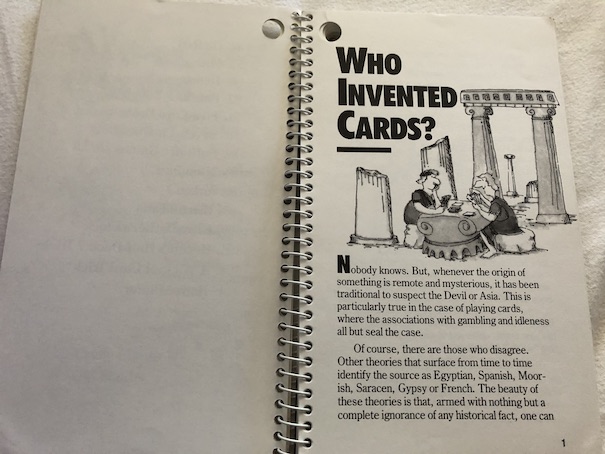
The book begins with a brief history of playing cards. The exact origins of playing cards are unknown, but the book describes some notable events in card game history, including the fact that people throughout history have often disapproved of playing cards, identifying them as signs of sloth or believing them to be associated with the devil (probably for their connection with gambling, although the book doesn’t get that specific). The book says that the modern form of the standard 52-card deck with 4 suits of 13 cards solidified around the late 1400s in Europe.
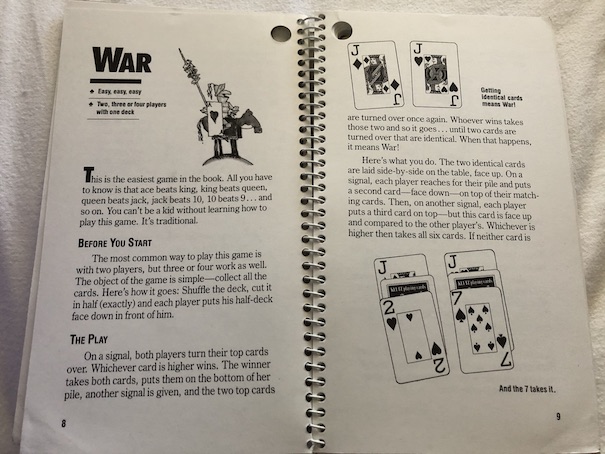
The book then gives instructions for playing various card games, including various types of solitaire and two-player games as well as games for larger groups. The book has the rules for different versions of Poker and Rummy and some childhood classics like War, I Doubt It, Crazy Eights, and Old Maid. For games that involve gambling concepts, like Poker or Michigan, they recommend using M&Ms.
Besides giving the rules for the games, each section also includes a few words about the history of games or some interesting thoughts or facts about them or tips for playing. Many of the thoughts (and some of the history facts) about games are joking, like the tip for Egyptian War, “This game is traditionally played on lunch or picnic tables, when you’re supposed to be taking your tray back.”
At the end of the book, there are instructions for two magic tricks with cards and for building a house of cards.
The book is available to borrow and free for free online through Internet Archive.
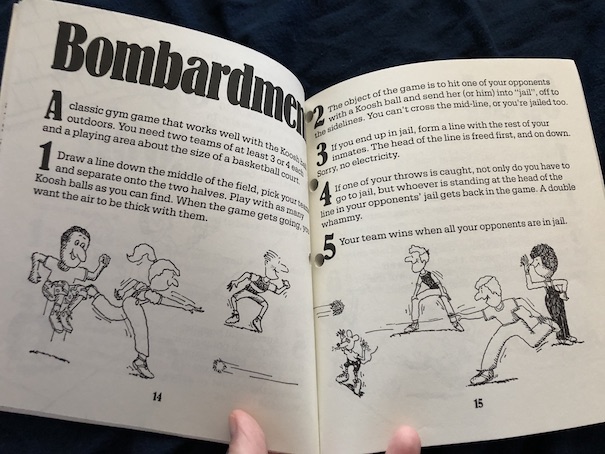
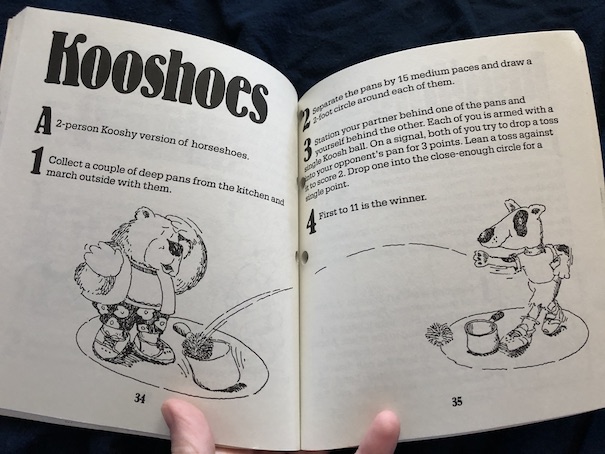
The Official Koosh Book by John Cassidy and Koosh ball inventor Scott Stillinger, 1989.
This book is part of the classic children’s hobby and activity series from Klutz Press. Originally, this book came with three mini Koosh balls, which were attached to the book at the holes on the left side of the book. I can’t remember now whether I actually got my set of mini Koosh balls with this book or if I bought them separately because my book was used. I’ve had this book for a long time, and my favorite activity in the book is juggling, a favorite staple activity of the Klutz series as well as a personal favorite of mine.
My copy of the book isn’t a first edition, and the introduction explains some changes that had taken place since the book was first written. John Cassidy of Klutz Press partnered with the inventor of the Koosh ball, Scott Stillinger, to write the book to explain various ways kids could use Koosh balls and games people could play with them when the toy was a new product. Since the book was first written, Koosh balls had become much more popular, and new varieties of Koosh balls were created, including the Mini Kooshes that came with the book.
Koosh balls are rubber balls covered with rubber filaments that are something like short spaghetti, making them feel soft, even if you get hit in the head with them while learning how to juggle. (I speak from experience.) This soft, painless-when-hit-with-one quality of Koosh balls was completely intentional on the part of the creator. It’s also the reason why they’re still a popular toy and the basis for many of the Koosh games in the book.
Many of the games in this book make use of the fact that it doesn’t hurt to be hit with a Koosh ball to give battle games like Dodge Ball and Bombardment a new twist. As the book says, “Dodge Koosh also fulfills the basic human need to bonk others of our same species.” I get that feeling some days, but when it’s done with Koosh balls, it’s pretty harmless.
Because Kooshes are soft, you can even play games indoors that usually wouldn’t work indoors because of the damage that could be done to things and people.
The book also suggests using Koosh balls for variations on Footbag (or Hacky Sack) or Horseshoes. Koosh balls work for these types of games because they don’t roll like regular balls. Because Koosh balls are made of rubber, they can also be used in a swimming pool.
The book is available to borrow and read for free online through Internet Archive (multiple copies).
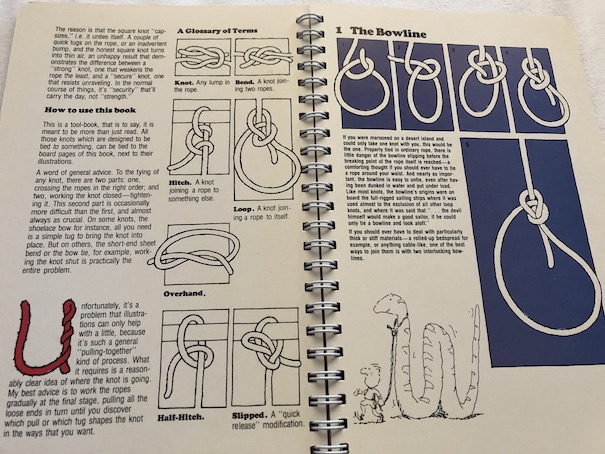
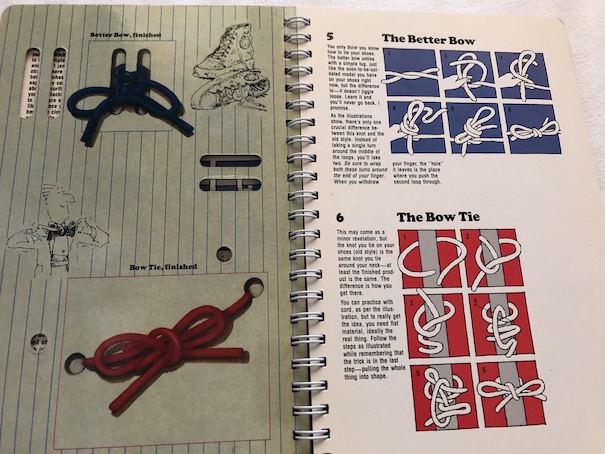
This book is part of the classic children’s hobby and activity series from Klutz Press, and it explains how to tie various useful knots. Originally, this book came with a two cords that could be used to practice the knots, one red and one blue, which were attached to the book through the holes in the front cover. The book begins with an introduction, explaining different categories of knots and how to use them: loops (knots for tying a rope to itself), bends (knots for tying one rope to another), and hitches (knots for tying a rope to something else).
One of the best features of this book is that there are holes, slits, and notches in the thick board pages of the book, so the knots can be practiced directly in the book.
The knots have a variety of uses, and the book even explains how to tie better, longer-holding bows in shoelaces and how to tie the type of bow used for a bow tie.
The book ends with instructions for a magic rope trick.
The book is available to borrow and read online through Internet Archive.
Tricky Pix: Do-It-Yourself Trick Photography by Paula Weed and Carla Jimison, 2001.
This book is part of the classic children’s hobby and activity series from Klutz Press and explains how to perform trick photography. Originally, this book came with a real camera that could be used to take trick pictures. The camera was a film camera instead of a digital camera, using 35mm film, but the film was not provided.
Now, digital cameras have almost entirely replaced film camera for popular photography, and film is actually much harder to come by, and not as many places offer film development services. In the very early 2000s, when this book was first published, digital photography was just starting to take hold, and digital cameras were more expensive, so a kid’s first camera was still likely to be a film camera. In just a few more years, that shifted abruptly with the increasing popularity of cell phone cameras and further developments that made digital cameras increasingly affordable for general use. The beginning of the book explains how the camera works and how to load the film.
The fact that this book was designed to be used with a film camera is important because this style of trick photography relies on physical illusions, not images that are digitally altered with Photoshop or similar software. In a way, this makes the pictures more interesting because they are largely unaltered from their original form. That is, you’re seeing what the camera saw at the moment that the picture was taken. The tricks involve using different perspectives and camera angles to achieve the illusions.
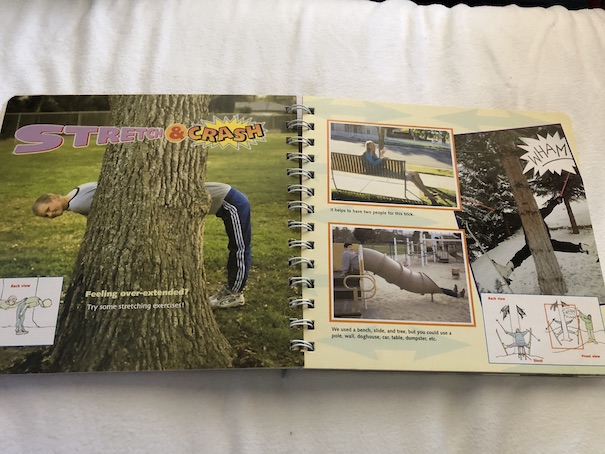
Strategic poses and the use of physical objects to block part of the scene can be used to create illusions like disembodied heads, people with extra limbs, or people with really long legs or bodies.
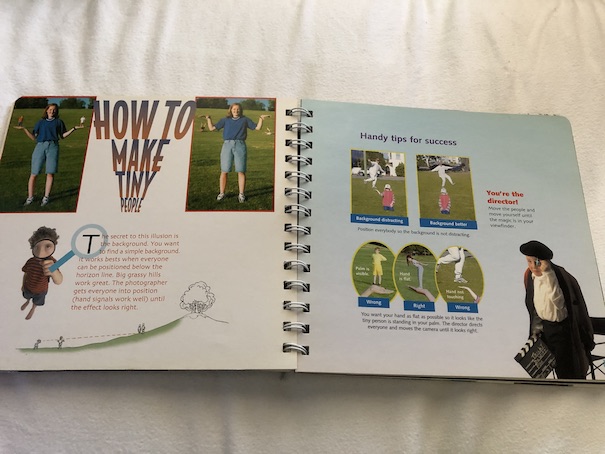
An often-used trick for making people look tiny enough to be picked up or stepped on by another person involves forced perspective – strategic positioning the subjects so that there is physical distance between them but no visual cues to indicate just how much distance there is between them so relative sizes are difficult to gauge.
When images in this book are altered, it’s with the old-fashioned method of literally cutting and pasting them onto each other, something that is now done digitally.
Personally, I enjoyed the fact that there was less of a reliance on software and digital technology in the production of these photographs. I think that learning how to do things without relying on technology to do most of the work can encourage creativity, and in particular, the use of physical illusions like forced perspective is also educational. Artists need to understand the use of physical space, perspective, and lighting, and these photographic tricks demonstrate these concepts well. Even though this book doesn’t make use of digital photography, any of the tricks in this book could also be performed when taking pictures with a digital camera.
The book is available to borrow and read online through Internet Archive.
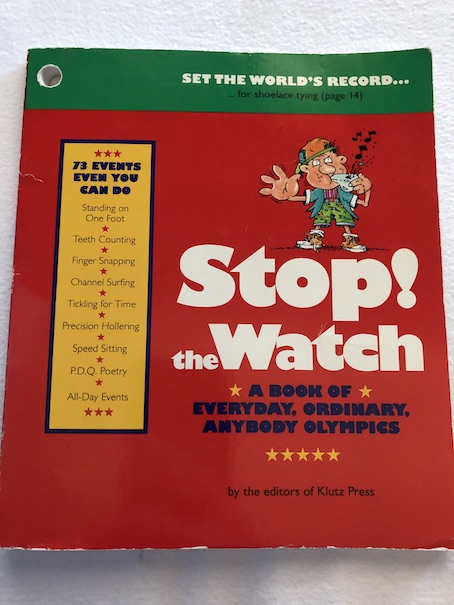
Stop! the Watch by the Editors of Klutz Press, 1993.
This book is part of the classic children’s hobby and activity series from Klutz Press. Originally, this book came with a working stopwatch in bright colors, which was attached to the book at the hole in the upper left corner. Unfortunately, I broke my stopwatch years ago, but I liked the book, and I got a new stopwatch to use with it.
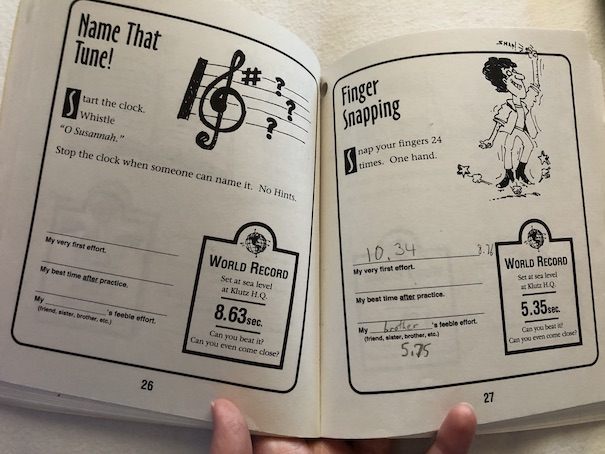
The book begins with instructions for using the stopwatch and then offers various timed activities and goals for kids to reach while using the stopwatch. Most of the activities involved kids performing various simple stunts and trying to do them as fast as possible, like counting to 126 by 7s, writing a verse from The Song of Hiawatha, tying shoelaces, singing “Happy Birthday” to Rumpelstiltskin, walking up a flight of stairs with a book balanced on the head, and drawing a picture of a gorilla. There are places in the book to record your efforts and your own time records and the records of your friends. (You can see in my copy where I made notes.)
There are also activities that participants are supposed to perform for a very specific amount of time, trying to keep as close to the allotted time as possible without actually watching the watch. For example, one of the events is hollering the word “Eeeeellllllskin” for exactly 17 seconds.
There are also some events that are meant to be completed by two people acting as a team, like leapfrogging, carrying your partner ten steps, singing “Jingle Bells” while alternating words between partners, and throwing something weird back and forth.
The original edition of this book included time records set by the author and others at Klutz HQ. Readers could compete against these records and try to beat them, and later editions of the book were printed with new records set by readers who reported their results.
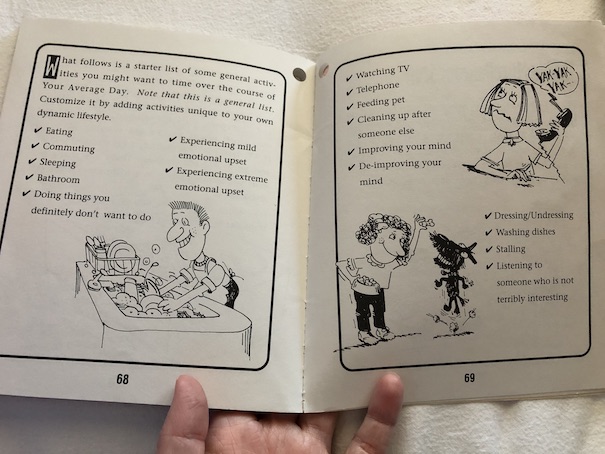
In the back of the book, there is a section explaining how to time daily events and predict about how much time you will spend doing those things throughout your life, like how much time you spend in the bathroom. Some of these things can be enlightening, like how much time you spend watching tv (Is it too much?), being emotionally upset (Have you been stressing too much?), or stalling when you’re supposed to be doing something else. There are also some educational ways of using time. The book explains how to tell how fast the car you’re traveling in is driving without looking at the spedometer by timing the distance between mile markers. It also explains how to tell how high you’ve tossed a ball by timing how long it takes to hit the ground.
The book is available to borrow and read online through Internet Archive.



























 Jestress's Forgotten Books and Stories