The Little Red Hen

The Little Red Hen pictures by Tadasu Izawa and Shigemi Hijikata, 1968.

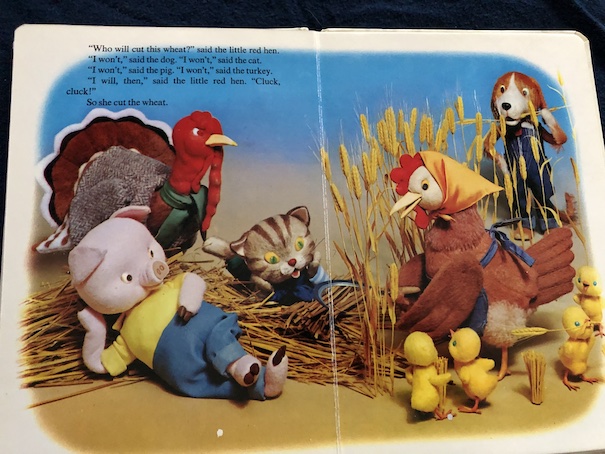
This cute picture book is part of a series of Puppet Storybooks. What makes it distinctive from other picture books is that the pictures are all photographs of tableaux with detailed puppets. The story is a retelling of the classic Little Red Hen folktale.
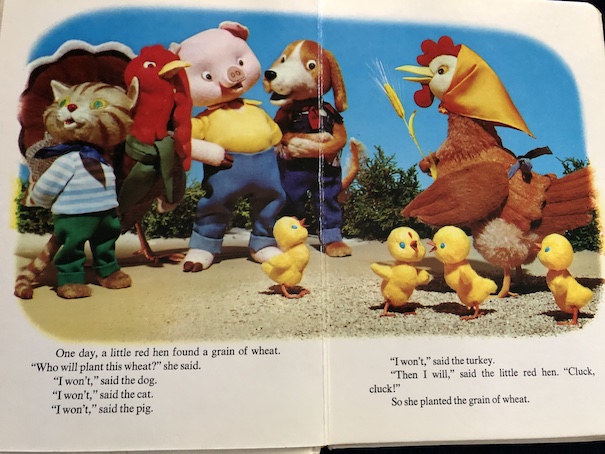
A hen finds a grain of wheat, but no one is interested in helping her plant it, so she does it herself. When it’s time to harvest the wheat, none of the other animals will help her, so she also cuts the wheat herself.
Because no one wants to help her, she takes the wheat to the mill to be made into flour and bakes it into bread all by herself.

When she has the nice loaf of bread that she has made, all of the animals who didn’t want to help before suddenly come to help her eat it. However, since none of them helped with making the bread, the Little Red Hen eats the bread herself with her chicks.

My Reaction

I’ve had this book since I was a little kid, and I always liked the pictures! The puppets are detailed and posed in realistic ways. The picture on the cover of the book is a 3D hologram, and I was fascinated by it as a young child. It was one of the first holographic images that I saw as a child!

(In my defense, I might not have been the one who scribbled crayon on that cover image. I was pretty good about not drawing on books when I was little, and most of my childhood books were used, so that scribble might have happened before I got it. I don’t remember anymore, so it’s hard to deny it completely, but according to my memory, my messy scribbles were done on the back wall of my closet, behind my clothes, because I knew that drawing on walls wasn’t allowed, and I was realized that if you’re going to draw on the wrong surface, it’s best to do it where nobody’s going to see it and complain. I was sneaky like that.)

While my copy of this book was printed in English, the books in the series were originally written, illustrated, printed, and bound in Japan. I never noticed that when I was a kid because I never bothered to look at the names of the illustrators and had no interest in where it was printed, but I found it interesting as an adult. It makes me think that there are probably also versions of this book written in Japanese, but I’ve never seen any.
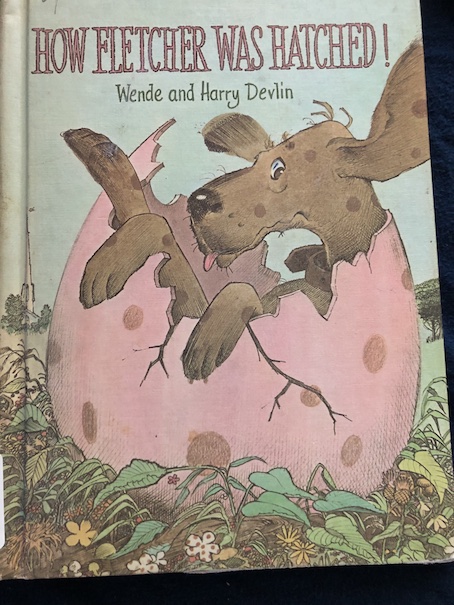
How Fletcher Was Hatched

How Fletcher Was Hatched! by Wende and Harry Devlin, 1969.

Fletcher the dog is sad and upset because it seems like his owner, Alexandra, is forgetting about him. She’s been playing with the new baby chicks, which she thinks are cute, and she’s been forgetting to pet her dog or even fill his water bowl!

Distressed, Fletcher goes to see his friends, Beaver and Otter, at the pond. Beaver and Otter don’t have human owners, so they don’t understand Fletcher’s feelings about Alexandra, but they try to think of ways to get her attention. They think it would help if Fletcher could make himself more like the chicks Alexandra has been obsessed with. Aince he can’t make himself small and yellow, they decide that he should hatch out of an egg, like the chicks do. Fletcher is skeptical about this plan, but Beaver and Otter think that hatching out of an egg will be like having a new beginning in his relationship with Alexandra.

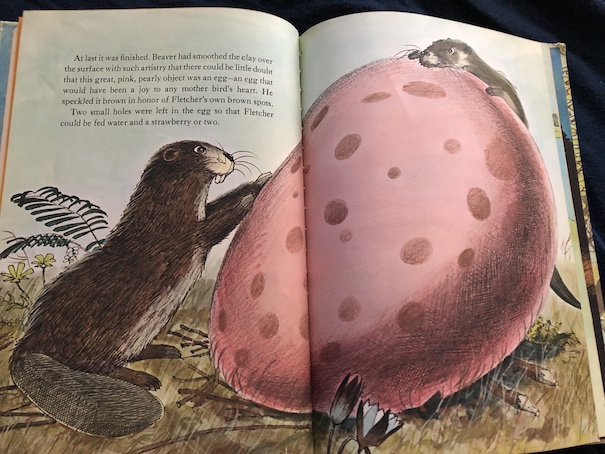
Beaver and Otter build an egg around Fletcher with reeds, grass, and clay from the river, leaving a little hole so they can give Fletcher water and food. When they’re done, it’s a very convincing but giant egg.

By the time they’re finished, it’s night. Fletcher is uncomfortable sleeping in the egg and wonders what Alexandra is doing. Meanwhile, Alexandra is having trouble sleeping because she’s worried about her lost dog.

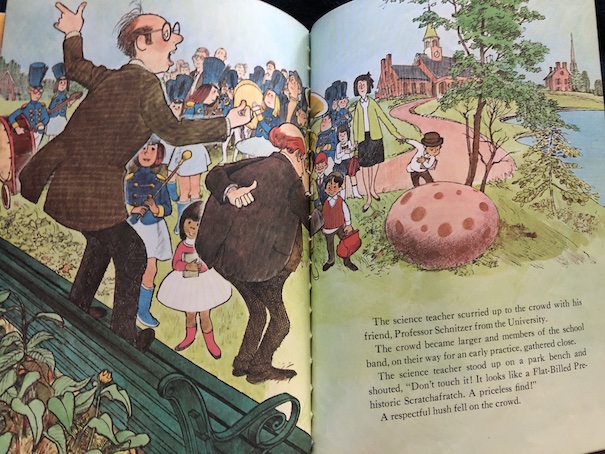
In the morning, Beaver and Otto roll the egg over to Alexandra’s school to make sure that she sees it. The first person who sees the egg, though, is the school’s custodian. He’s shocked at the sight of such a giant egg and starts yelling for the science teacher to come look at it.

Soon, the egg is surrounded by children and adults, marveling over what kind of it could be and where it came from. The science teacher brings a friend who is a university professor, and the two of them are convinced that the egg must belong to a rare creature, although they disagree about the type of creature it is.

Fletcher waits to hatch until he hears Alexandra. Alexandra’s friends are excited about the egg, but she’s just upset and only wants to go looking for her lost dog.

Fletcher decides it’s time to hatch, and he busts his way out of the egg. Alexandra is happy to see him, even though Fletcher’s attempt at peeping is a little weak. Everyone is confused, but Alexandra is just relieved that she has her dog back. Fletcher feels better, realizing that he is important to Alexandra, and she really cares about him, even though he’s not yellow and doesn’t peep.

The book is available to borrow and read for free online through Internet Archive.

My Reaction

I read this book as a kid, but I had forgotten much of the story. I remembered that Fletcher hatched out of an artificial egg and that he did it to get his owner’s attention, but I couldn’t remember why he needed attention. I can understand Alexandra being temporarily distracted by the little chicks on the farm, but forgetting to give her dog water is really bad for a pet owner. I felt like her parents should have noticed and said something. But, mostly, the situation is just set up for the purposes of this humorous hatching of a dog from a giant egg. Because the egg was created by animals, the humans in the story never find out how or why Fletcher got in the egg, which is actually the funniest part for me as an adult.
Barbie and the Missing Wedding Dress

The Missing Wedding Dress Featuring Barbie by Karen Krugman, illustrated by Laura Westlake, 1986.

This Little Golden Book is a cute mystery with Barbie and her younger sister Skipper.

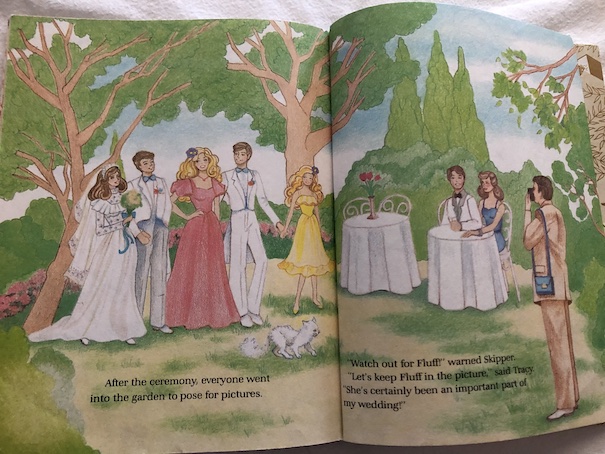
Barbie’s friends, Tracy and Todd, are getting married, and Barbie and Skipper are helping Tracy to get ready. Barbie is going to be Tracy’s maid of honor, and Skipper will be the flower girl for the wedding.

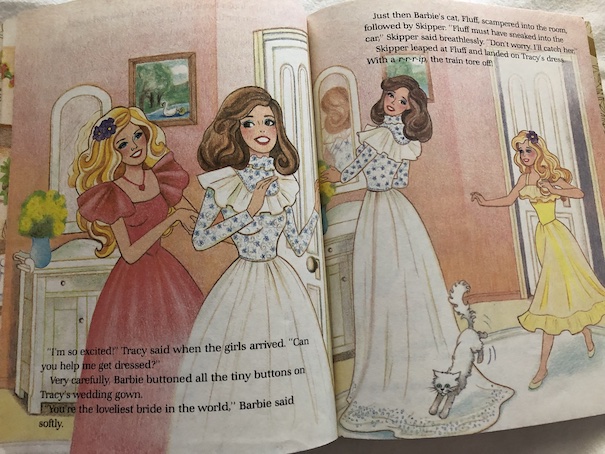
However, when they’re helping Tracy to get dressed for the wedding, Barbie’s cat gets loose and Skipper accidentally tears Tracy’s dress trying to catch the cat. The three of them take the dress to the dressmaker to be fixed.

After the dress is repaired, they stop at the shoe store to pick up Barbie’s shoes. However, when they leave the store, they suddenly realize that they no longer have the box with the dress in it. Instead, they have a box that contains several pairs of jogging shoes! Somehow, the boxes were switched, but how are they going to find the person with the right box?

Barbie, Skipper, and Tracy track the person with the dress across town, using the clues that the jogging shoes belonged to a woman in a floppy straw hat with a red van that says “Flo” on it.

The book is available to borrow and read for free online through Internet Archive.

My Reaction

I read this book when I was a kid and I liked to play with Barbies, and I thought that having them solve a kind of mystery was fun, although it’s a very simple sort of mystery, chasing down a lost object. I liked this book a lot when I was little.

Barbie fans might notice that Skipper doesn’t have her 2000s look, basically looking like a smaller version of Barbie herself, which was how she looked in the 1980s and 1990s, when I got my Barbie dolls. Since then, Mattel has changed Skipper’s hair. However, people who are younger than I am might not be aware that Tracy was also a doll from the 1980s, a friend of Barbie who came in a wedding dress. This 1982 commercial on YouTube shows bride doll Tracy with her groom, Todd. The Tracy and Todd dolls existed before this book was written, so the book was written to give the dolls a story, and the dolls weren’t created based on the book.

Baker Smurf’s Sniffy Book

Baker Smurf’s Sniffy Book by Peyo, 1982.

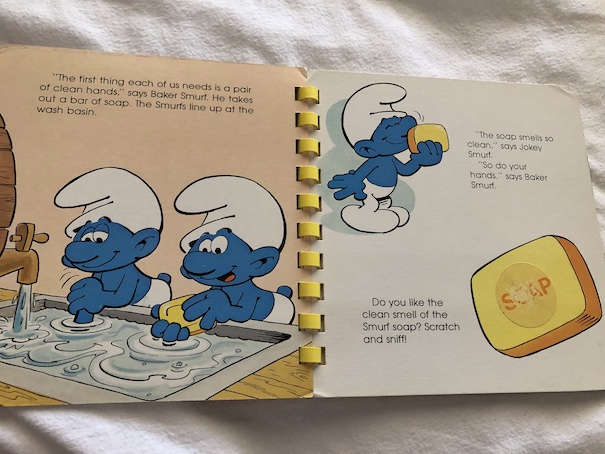
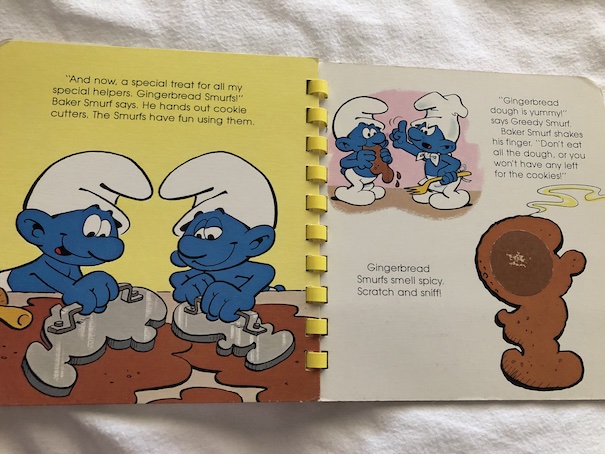
“Sniffy” books with scent patches for readers to scratch and sniff were a recent innovation in the 1980s and were popular with kids. Many books that included this feature used well-known characters from popular children’s cartoons, like this one featuring the Smurfs.

The Smurfs are making special treats as part of a surprise party for Papa Smurf’s birthday! The first scent in the book is the soap the Smurfs use as they wash their hands and prepare to help.

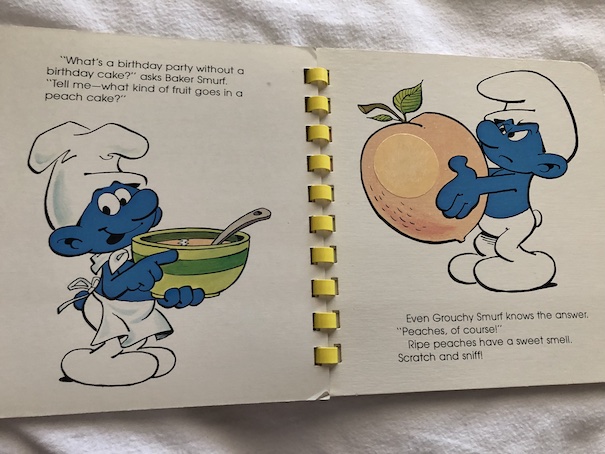
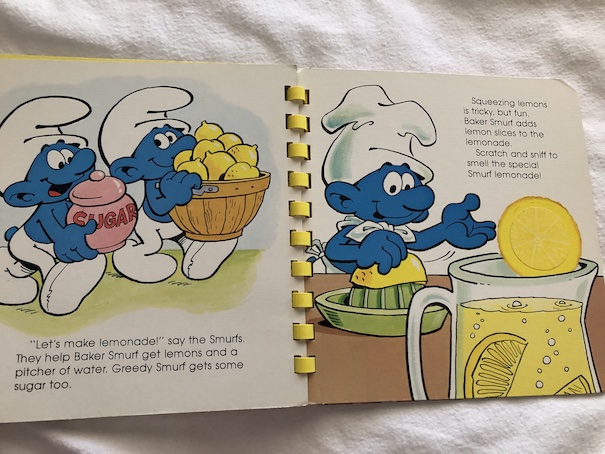
All of the rest of the scents in the book are ingredients they use to make the birthday treats. There is the jam that they put in the jelly rolls, the peach they put into the peach-flavored birthday cake, violets that they make into candied violets (not common in the US, but they can be used as decorations on desserts in real life), gingerbread that they make into gingerbread Smurfs, and lemonade.

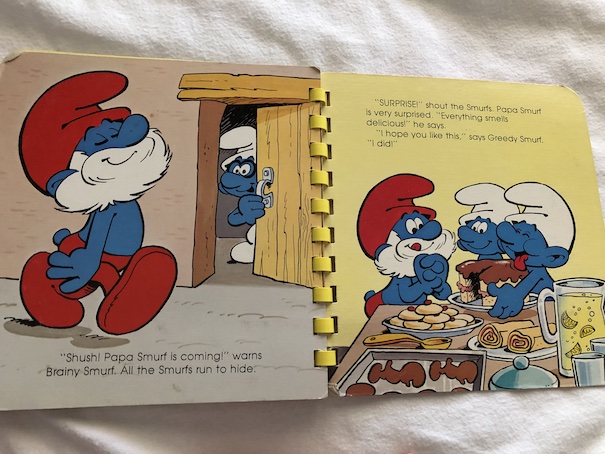
When everything is ready, they surprise Papa Smurf with their fun birthday feast!

My Reaction

We’ve had this book since I was a little kid. Sniffy books gradually lose their scents the more the patches are scratched, but we used this one pretty frequently, and the scents have held up surprisingly well. You can see the scratch marks on the scent patches in the pictures, and the scents aren’t as strong as they used to be, but even more than 30 years later, the scents are still there and recognizable as what they’re supposed to be. The one that held up the least well is the lemonade scent, but the others are pretty good for being as old as they are!

The Poky Little Puppy’s Naughty Day

The Poky Little Puppy’s Naughty Day by Jean Chandler, 1985.

This picture book book is part of the Poky Little Puppy series from Little Golden Books.

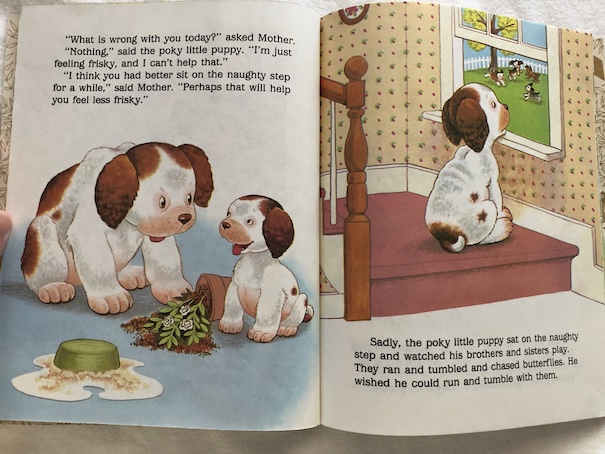
The Poky Little Puppy and his siblings are excited because they’re going to visit their grandmother. The Poky Little Puppy wakes up later than his siblings, and when he gets up, he feels playful and frisky. He keeps running around and knocking things over. He makes such a mess that his mother puts him in time out to calm down.

After while, his mother lets him go outside to play with his siblings, but she warns him not to get dirty because they’re going to visit his grandmother. However, the Poky Little Puppy doesn’t listen. Instead, he digs a hole under the fence and ends up in the neighbor’s yard, where he plays with some laundry and drags it through the mud, getting himself and the laundry all dirty.

As his mother and the other puppies start walking to their grandmother’s house, the mother sends the Poky Little Puppy back to apologize to the neighbor. Instead, the Poky Little Puppy gets into more trouble by chasing a butterfly through another neighbor’s flower bed. When he finally makes it to his grandmother’s house, he’s wet and muddy and leaves tracks all over his grandmother’s floor.

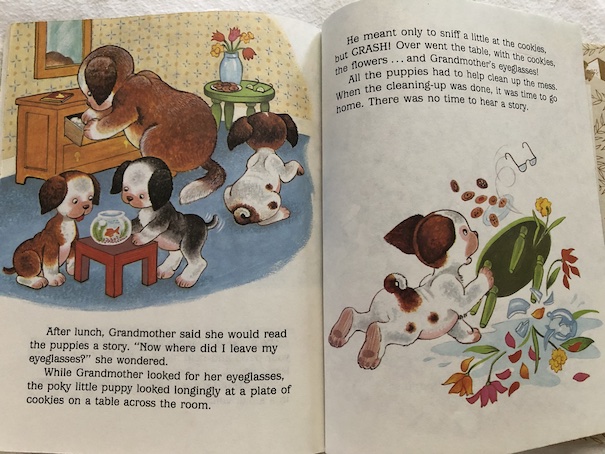
His grandmother makes him help her clean up, but even that doesn’t calm him down. Grandmother wants to read a story to the puppies, but the Poky Little Puppy is still too energetic. He knocks over a table and makes another big mess. By the time they get it all cleaned up, there’s no time for a story, and they all have to go home.

Finally, the Poky Little Puppy seems to have exhausted himself and is feeling badly about the trouble he’s caused today. When the puppies have their dinner and dessert, he is extra careful and doesn’t even drop a crumb. He later apologizes to the neighbors and promises to do better.

The book is available to borrow and read for free online through Internet Archive.

My Reaction

This is just a cute little story about the problems that young kids can get into when they’re feeling energetic and playful but are also acting thoughtlessly and going too far. Just being playful by itself isn’t a problem, but the Poky Little Puppy has to learn some self-control about how he plays, just like human children.

The Poky Little Puppy Follows His Nose Home

The Poky Little Puppy Follows His Nose Home by Adelaide Holl, illustrated by Alex C. Miclat, 1975.

This book is part of the Poky Little Puppy series of picture books from Little Golden Books.

The puppies’ mother allows them to go exploring a little outside of their own yard, but she warns them to stay away from the highway because the cars are dangerous and reminds them to be home in time for dinner. She also adds that if they get lost, they should rely on their sense of smell to get home.

As the puppies explore, they meet other animals in the countryside and stop to play. Eventually, they find themselves on the edge of the city. They are frightened of the noise of the cars, and a pigeon tells them that they’d better stay away from the city if they want to avoid cars.

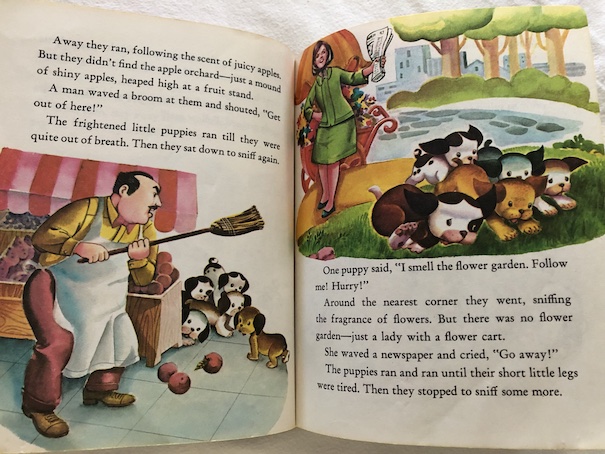
The puppies realize that they need to turn around and go home, but when they try to sniff for familiar smells to go home, they have trouble. When they try to smell the apple orchard, they accidentally find a stand where a man is ffselling apples instead. Trying to smell flowers leads them to a flower cart. Trying to sniff for animals smells leads them to the zoo.

Then, the Poky Little Puppy realizes that what they really need to do is sniff for their own smell so they can retrace their steps home. Sniffing for their own trail works, and the puppies get home in time for dinner!

My Reaction

Like other Poky Little Puppy books, the story is cute. Nothing very stressful happens in the story, making it a good story for bedtime. Even though the puppies get lost temporarily, it isn’t for very long, and they get home in time for dinner, as they do in other Poky Little Puppy books.

The Poky Little Puppy

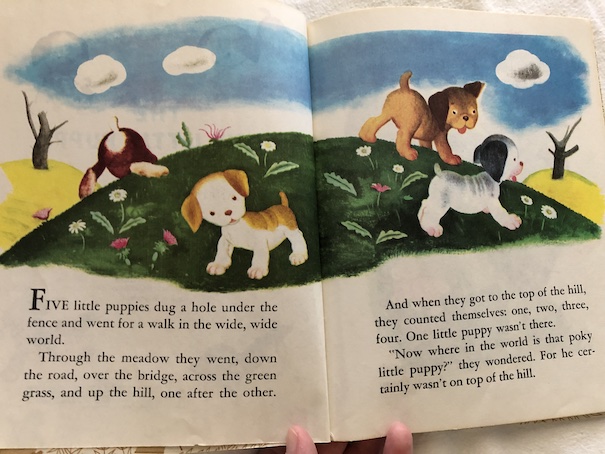
The Poky Little Puppy by Janette Sebring Lowrey, illustrated by Gustaf Tenggren, 1942, 1982.

This is a famous class children’s book, the first in a series from the Little Golden Books collection! In fact, it was one of the original first 12 Little Golden Books that were published in 1942.

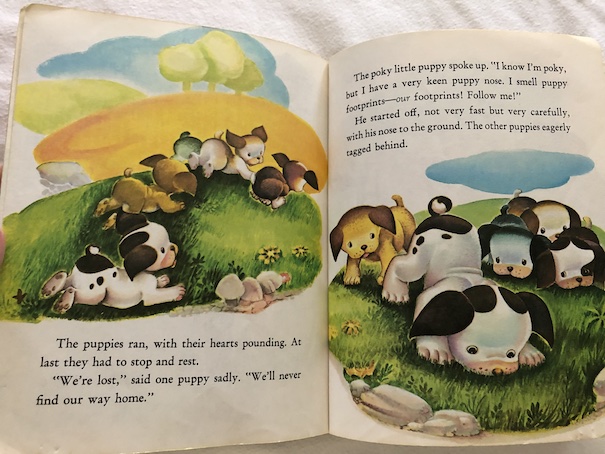
Five little puppies like to dig holes under the fence and go exploring. Then, four of the puppies realize that one of their brothers isn’t with them. They look around and find him sniffing at the ground. When they ask him what he’s doing, he says that he smells something.

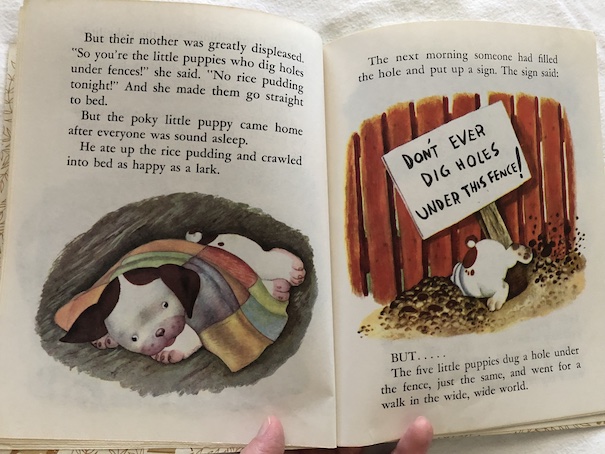
The puppies realize that the smell is rice pudding, and they hurry home to get some. However, their mother is angry about the holes they dug and sends them to bed without dessert.

The puppy who originally smelled the rice pudding is slower than the others (or “poky” as the book describes him, which is why he’s called the Poky Little Puppy). He comes home later than the others, and while everyone is asleep, he eats all the rice pudding himself.

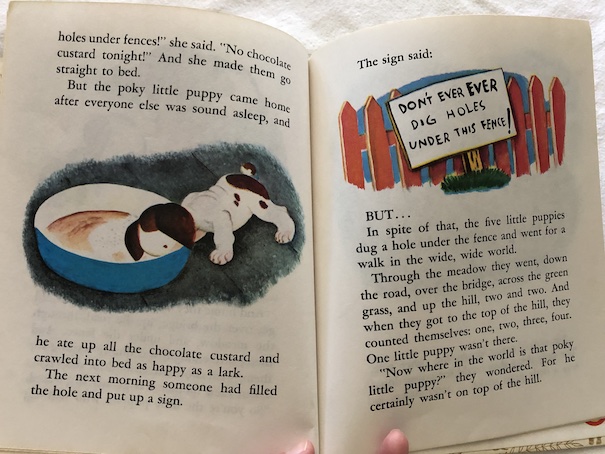
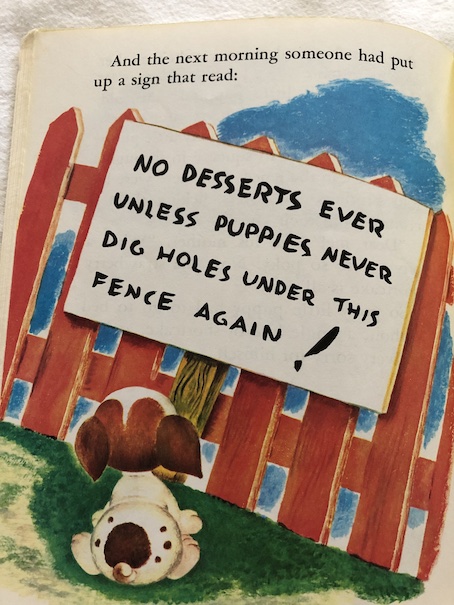
The next day, their mother puts up a sign telling them not to dig holes under the fence, but the puppies ignore it and dig holes anyway so they can go exploring. While they’re out, the Poky Little Puppy hears something.

The other puppies realize that it’s the sound of chocolate custard being dished up, and they hurry home to get some. Again, they’re punished for digging holes, and they’re sent to bed without dessert. And again, the Poky Little Puppy comes home last and eats all the dessert while everyone is in bed.

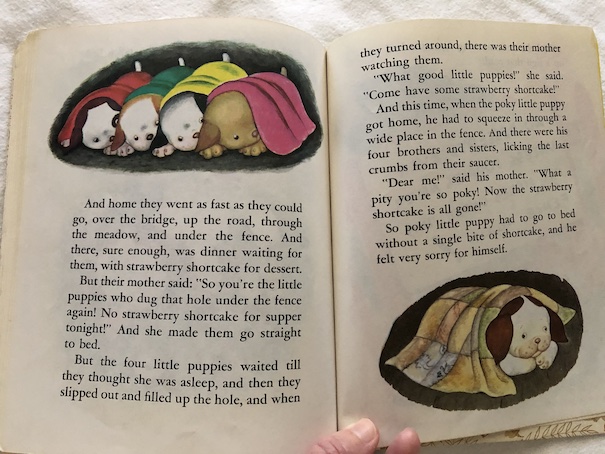
The next day, the puppies dig holes again, but this time, when they hurry home for dessert and their mother is mad at them, the four puppies who got home quickly fill in the holes they dug. Their mother, seeing that they fixed the holes, decides to let them have their dessert. The Poky Little Puppy, who came home late again, doesn’t get any because the others ate his share, too.

The book is available to borrow and read for free online through Internet Archive (multiple copies).

My Reaction

This is a very simple story, but I remember liking it as a kid. Kids like stories with repetition, so the repeated incidents in the book appeal to them. The Poky Little Puppy thinks that he’s found a trick to getting all the dessert by staying out late enough that his mother has gone to bed and can’t tell him to go to bed without dessert. But, his trick stops working when the other puppies clean up their act and get the dessert before he even gets there. In the end, all of the puppies learn that digging holes means no dessert for any of them anymore.

Where Will All the Animals Go?

Where Will All the Animals Go? by Sharon Holaves, illustrated by Leigh Grant, 1978.

This book is one of the Little Golden Book picture books.

A little boy named Matt goes to visit his grandfather on his farm. They notice a storm approaching, and Matt worries about where the animals will go when the storm comes. His grandfather tells him that the animals all know where to go.

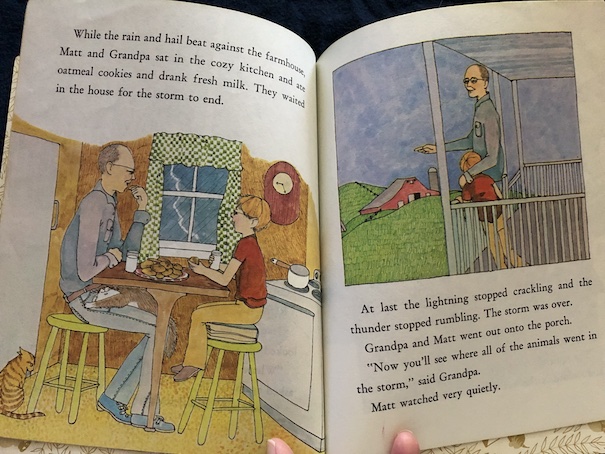
The animals also notice the approaching storm. When the rain comes, Matt and his grandfather go inside the house with the cats. After the storm is over, Matt’s grandfather takes him outside to show him where all the animals went during the storm.

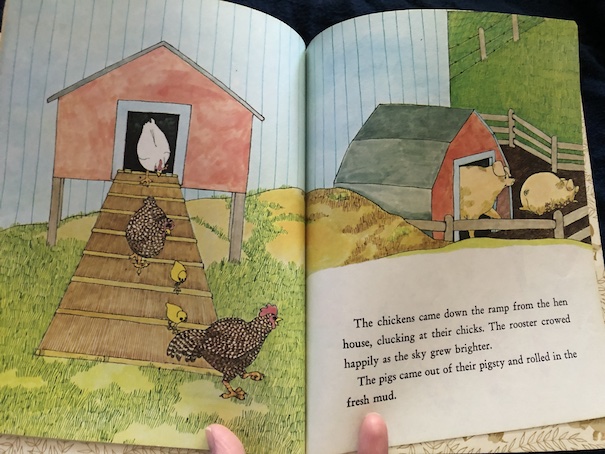
Matt watches as all of the animals, both the domesticated animals of the farm and the wild animals who also live there, emerge from their hiding places. Every animal has a place to go, and they’re all fine after the storm.

The book is available to borrow and read for free online through Internet Archive.

My Reaction

I like this story because it’s very calm. I think it could make a good bedtime story for young children. Although the boy in the story is concerned about the animals and where they will go during the storm, the animals are never in any danger. The grandfather knows that the animals will all be fine, and he reassures his grandson that they all have a place to go. It’s reassuring that the storm is natural, the animals know what to do when it happens, and the boy sees that everything is fine. The story ends with the boy and his grandfather watching the sun come out after the storm.

Usborne First Book of Nature

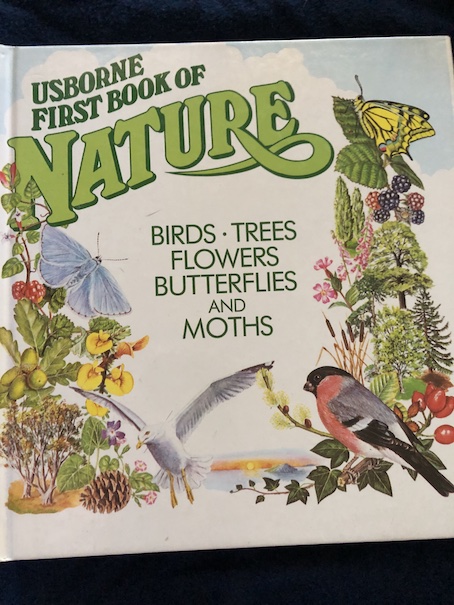
Usborne First Book of Nature designed by David Bennett, 1980.

I remember getting this book as a present from my grandmother as a child because my grandmother was an amateur naturalist. Although it’s a nonfiction book, I’m sentimental about it for that reason.

The book is divided into four sections covering different types of plants and creatures (each of which has its own book in the Usborne collection, but this book is a compilation):

Birds

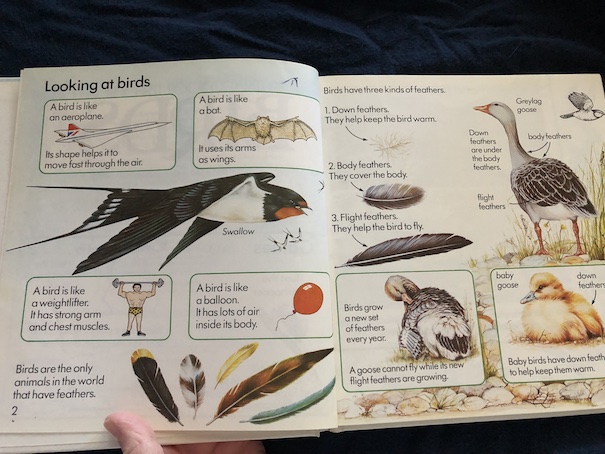
This chapter explains about the parts of birds, like the different shapes of beaks and feet different birds have, aspects of birds lives and behavior, and how birds fly.

Trees

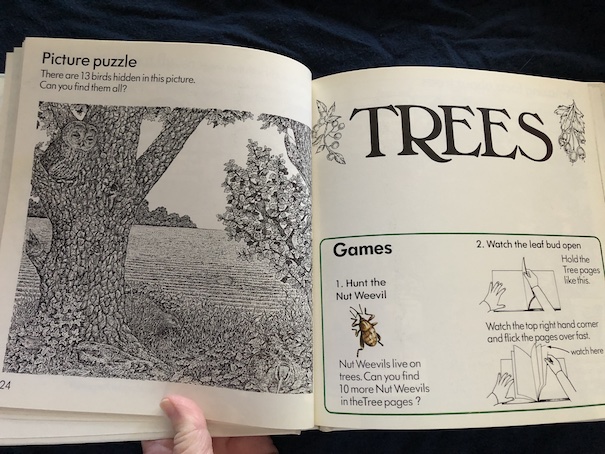
This chapter explains the parts of trees, like how roots and twigs grow and the differences between different types of leaves, tree flowers, and seeds.

Flowers

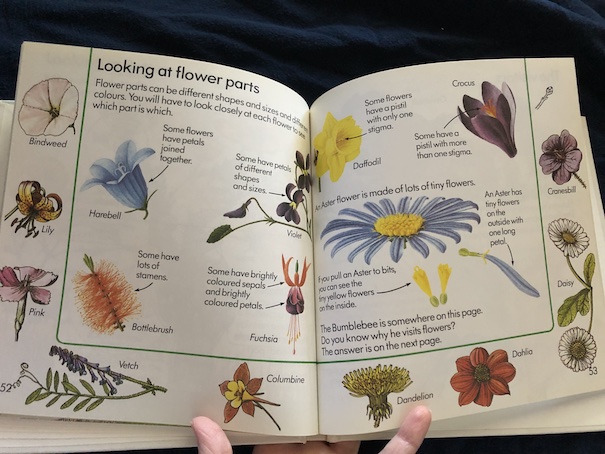
This chapter explains the parts of flowers and about pollen and seeds. It also points out the creatures that like to visit flowers, like bees and hummingbirds.

Butterflies and Moths

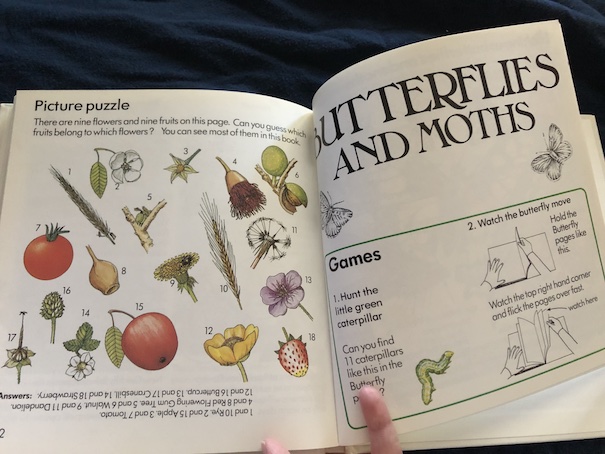
This chapter explains the similarities and differences between butterflies and moths and what their life cycles are like.

One of the best parts of this book is that it is designed to be interactive as well as informative. Some of the activities are explained at the beginning of each chapter, and there’s a puzzle or game at the end of each chapter. The upper right corners of each chapter have images that are meant to be used as a flip book. In the bird section, readers can quickly flip the pages to watch a bird fly. In the tree section, a leaf bud opens. In the flower section, a flower opens. In the butterfly and moth section, a butterfly opens and closes its wings.

Each chapter also has a game where you hunt for different creatures within the pages of that chapter and see how many you can find, and then, there’s another game or puzzle at the end. At the end of the bird chapter, there’s a picture puzzle where you have to find all the birds hidden in a black-and-white picture. At the end of the tree section, you have to find how many products are made from or come from trees in a busy market scene. At the end of the flower chapter, you have to match up different types of fruits with their flowers. The butterfly and moth section doesn’t have a game at the end.

This book is available to borrow and read for free online through Internet Archive.

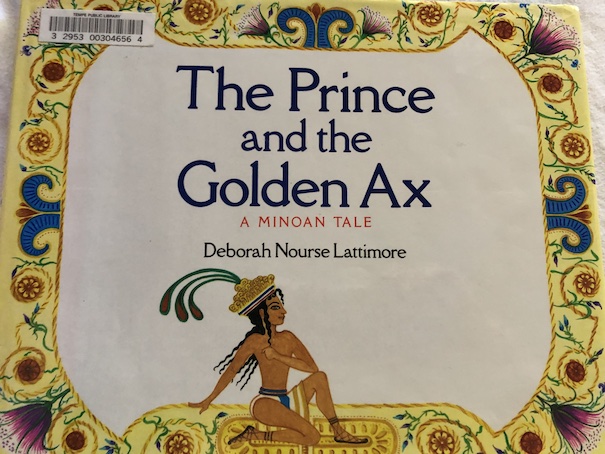
The Prince and the Golden Ax

The Prince and the Golden Ax by Deborah Nourse Lattimore, 1988.

This story is based around the ancient Minoan civilization and the destruction of the island of Thera. Thera was a real place, and it was actually destroyed, but the story itself is fiction, based upon the pieces of information that the Minoans left behind about their culture.

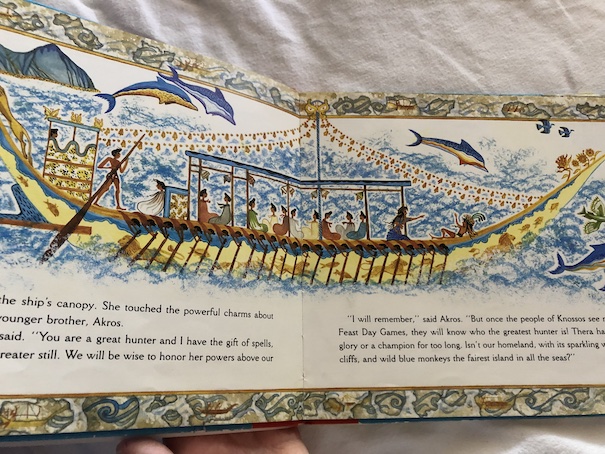
When the story begins, the city of Knossos on Crete is the home of the Goddess Diktynna. Princess Illyra and her brother, Akros, are on their way to Crete from Thera with their fleet of ships. Akros is eager to show off his skills at the games on this feast day, although Illyra cautions him to not show off too much and to remember to honor the goddess.

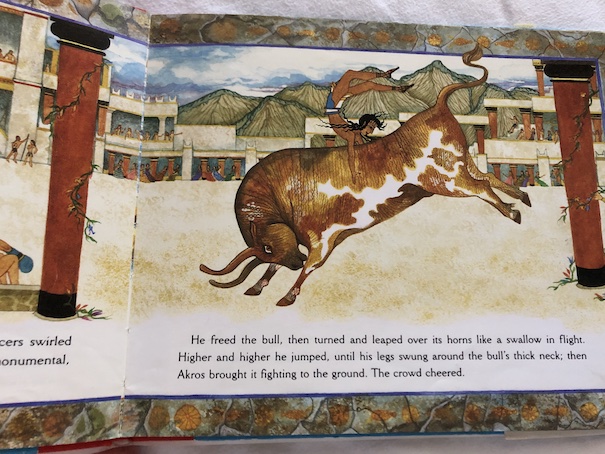
When they arrive at Crete, they are shown the goddess’s shrine with her statue holding the golden ax that is the source of her power. Akros is impressed by the golden ax and begins to think that if he had the ax, he could use it to bring glory to Thera. At the feast games, Akros shows off his ability to wrestle a bull. Full of pride for himself, he declares that he’s even better than the goddess because he did it without a golden ax. The goddess is angered by his comments and causes an earthquake.

The priestess says that Akros has challenged the goddess, and in order to make amends, Akros must find the golden-scaled fish of the Eastern Isle and obtain a bronze ax. If he fails to complete this task, the goddess’s golden ax will destroy Thera. Akros has no choice but to accept the challenge.

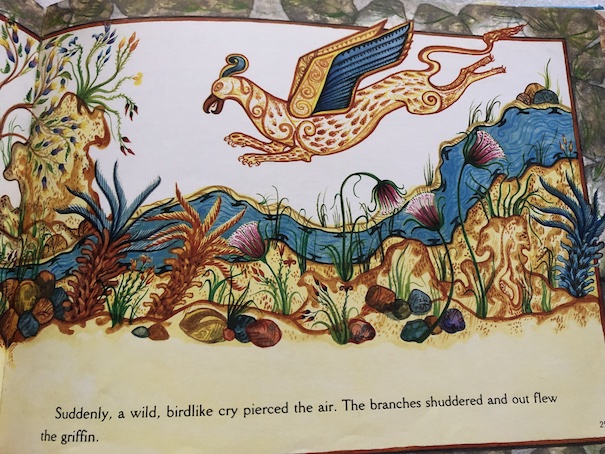
Illyria has the ability to use magic, and she helps her brother to complete the task successfully, but Akros can’t resist bragging about how easy it all was, angering the goddess again. This boast earns him a more difficult task, to capture a griffin and earn a silver ax.

Once again, Illyria helps Akros to succeed in his task, but when he is presented with the silver ax, Akros insists that it’s not good enough for him and that he wants the golden ax. The priestess says that only a godlike hunter can have that ax, and if he tries to get it, his homeland will be destroyed. Still, Akros insists that he can prove that he’s good enough by catching a creature that no one, man or god, has ever caught before.

What Akros has in mind is catching the blue monkeys on the island of Thera. This time, Illyria refuses to help him because the blue monkeys are sacred. At first, Akros thinks that he’s managed to capture the blue monkeys without her help, but they have abilities that he never expected. As promised, when Akros fails to accomplish his boast, the island of Thera is destroyed, and Illyria and Akros only narrowly escape.

The book ends with the discovery of the remains of the palace of Knossos centuries later, when the image of the goddess and a small ax are discovered.

My Reaction

I knew at the beginning of the story that there couldn’t be a happy ending because I already knew what happened to the real island of Thera, now called Santorini. The island was largely destroyed by a volcanic eruption during the Minoan period, a cataclysm that may have sparked the legend of the sunken island of Atlantis. However, this story does not mention Atlantis, instead using the statue of a goddess found in the remains of the palace of Knossos as inspiration. In spite of the ending, I wouldn’t call this a sad story. The book doesn’t dwell on the aftermath of the destruction of Thera, and we don’t actually see much of the civilization of Thera, so there isn’t much for us to miss when it’s destroyed. The colorful pictures throughout the book are beautiful and actually feel rather cheery.