Arthur’s Halloween

Arthur Adventure

It’s Halloween, and Arthur’s already getting spooked! His family is putting up Halloween decorations, and his sister, D.W., scares him with her costume when he wakes up on Halloween morning. Arthur is supposed to take D.W. trick-or-treating, although he doesn’t really want his little sister tagging along.

At school, Arthur has trouble recognizing everyone in their costumes. There are Halloween treats and games, though.

That evening, Arthur and D.W. go trick-or-treating with Arthur’s friends. Arthur’s friend, Buster, warns them not to go to a big, old house because a witch lives there, and the last person who went in on Halloween never came out again.

Arthur and D.W. lag behind the other trick-or-treaters, and when Arthur turns around, he sees D.W. going into the witch’s house! What choice does Arthur have but to go in after his sister to save her?

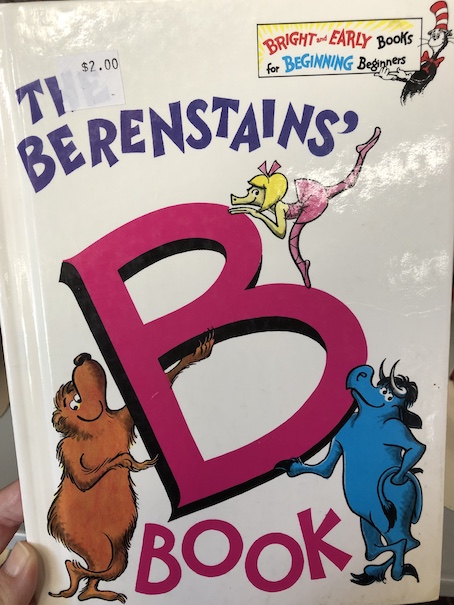
This book reminded me of the Berenstain Bears Halloween book The Berenstain Bears Trick or Treat. It’s another instance of an elderly woman who seems witch-like and scary, but the children enter her house on Halloween, discover that she’s really nice, and get some special treats. Entering a stranger’s house is never a good idea because, in real life, that could be very dangerous. I get the theme that appearances can be deceptive and things that seem scary aren’t so scary when you understand them, but I do quibble that this might not be the best way to demonstrate that to young children. All the same, I do have nostalgia for both the Berenstain Bears and the Arthur books.

I remember reading the Berenstain Bears Halloween book as a kid, but I don’t remember reading Arthur’s Halloween until I was an adult. Because of the similarity in the themes of the stories, I checked the copyright dates. They’re both from the 1980s, but Arthur’s Halloween is the older of the two books. I don’t know if the Berenstain Bears took inspiration from the Arthur story or if they were both inspired by something older or if the similar theme is just a coincidence.

One other odd thing about this story is that old Mrs. Tibble is human. Everyone in the Arthur books is some kind of animal, but not Mrs. Tibble. There is no explanation for this. In the cartoon version of Arthur, Mrs. Tibble is an animal, just like everyone else.

The Vanishing Pumpkin

An 800-year-old man and a 700-year-old woman live together in a little house. One day, they realize that it’s Halloween, and that means that it’s time to make pumpkin pie. However, when they go to get the pumpkin from their garden, it’s gone! Who could have taken it?

They set out in search of the pumpkin thief. The first person they meet is a ghoul, and they assume he’s the pumpkin thief. They demand to know where the pumpkin is. The ghoul looks all over the place, but doesn’t see any pumpkin. The old man threatens to do him a trick, and the ghoul says he wants to see him do one. The old man turns the ghoul so thin that he can look right though him, but the ghoul doesn’t have the pumpkin.

The old man and old woman set off again to look for the pumpkin thief, and the ghoul comes along to see more tricks. The next person they encounter is a rapscallion. When they ask him where the pumpkin is, the rapscallion looks around and can’t find any pumpkin, so he offers them a mushroom. The old man does another trick, turning the rapscallion upside down, but no pumpkin falls out.

The group, including the rapscallion, sets off in search of the pumpkin thief again. The next time, they encounter a varmint, and the old man turns him into a black cat with fleas. Yet again, the varmint doesn’t have the pumpkin, so they all set off again.

The pumpkin pursuit finally ends with the person who actually has the pumpkin. The wizard has turned the pumpkin into both a jack-o’-lantern and a pumpkin pie!

I remember someone reading this book to me when I was a little kid. I think it might have been the school librarian, but I’m not completely sure now. We don’t really know the story behind the 800-year-old man and 700-year-old woman, who is presumably his wife. They seem to be magical because of their ancient age and the fact that the old man seems capable of magic, but they aren’t described as being a witch and wizard or anything specific. It’s just left to readers’ imaginations. I think, when I was little kid, I assumed that they were witches or something similar.

The story is just for fun. It’s one of those repetition stories, where the characters encounter more people/creatures, similar things happen each time, and each new person/creature joins the group, until they finally figure out who has the pumpkin. Part of the fun of the story is the unusual people and creatures the meet. Most of them are not typical Halloween creatures, like a witch, a ghost, and a monster, although they are Halloween-ish. The words that describe them are real words – ghoul (which is a mythological creature), rapscallion, and varmint – but at the same time, it’s not entirely clear what type of creatures they are, and the book doesn’t explain. We can only go by what they look like in the pictures. The “varmint” looks like a large rat, the “ghoul” is a little green guy in a top hat, and the “rapscallion” is a little guy in a dark robe and hood.

Madeline in London

This book is part of the Madeline series about a little girl at a small boarding school in Paris. The son of a Spanish Ambassador, Pepito, lives next door to the girls. He’s a menace to them at first, but the girls make friends with him. However, in this book, Pepito moves to London because his father has been relocated for his job.

When Pepito and his parents go to London, Pepito is unhappy there because he’s lonely for Madeline and the other girls from the boarding school. With Pepito growing thin and depressed from his unhappiness, Pepito’s father arranges for the girls from the boarding school to visit for Pepito’s birthday to cheer him up.

When Miss Clavel and the girls arrive in London, there’s a happy reunion, but then, they remember that they didn’t bring Pepito a present for his birthday. Madeline remembers that Pepito has always wanted a horse, and they find an old, retired army horse who is still healthy and gentle.

However, when they give the horse to Pepito, they quickly discover that there are complications to owning a horse as a pet. The horse hears a trumpet, and reacting to his army training, he runs off with Pepito and Madeline on his back to join a parade.

Then, they forget to feed him, so he eats everything in the garden, making himself sick. It seems like the embassy in London is no place for a horse, but Madeline and her friends may have room for one at their school!

The book is available to borrow and read for free online through Internet Archive (multiple copies).

Giving someone a horse for a present without checking with their parents or making sure that they have what they need to take care of a horse isn’t something that people realistically do, but the Madeline books rarely worry about the practicalities of a situation. It’s all fun and adventure!

I was seriously worried about the horse after they forget to feed him and he helps himself to random plants in the garden, especially when they find him with his feet up in the air. Fortunately, everything works out okay, which is characteristic of Madeline books, too. How the trustees of Madeline’s school will react when they find out that the girls now have a pet horse, since they raised a fuss earlier about the girls having a dog, is anyone’s guess, but the story doesn’t worry about that, either.

Like other books in this series, the pictures in the book alternate between limited color images, mostly in black and yellow, and full color images.

Madeline and the Bad Hat

Madeline is a little girl at a small boarding school in Paris. The Spanish ambassador moves into the house next door, and the girls at the boarding school get to know his son. However, his son, Pepito, is a wild boy who Madeline starts calling the “Bad Hat.” He teases the girls, scares them by playing ghost, and worst of all, is cruel to animals.

However, Pepito is actually lonely, and he wants the girls’ attention. He tries to win them over by being polite and doing things to impress them. Unfortunately, his idea of what impresses people can be horrific, like building a guillotine for the chickens the cook will prepare and playing practical jokes.

One day, he goes way too far and tries to release a cat into a pack of dogs! The cat tries to evade the dogs by getting on top of Pepito’s head, so the girls and Miss Clavel have to rescue both the cat and Pepito himself from the dogs!

Because Pepito has now gotten hurt himself by one of his pranks, he swears to Madeline that he’s learned his lesson, and he won’t do anything to hurt another animal. He even decides to become a vegetarian!

The book is available to borrow and read for free online through Internet Archive (multiple copies).

I didn’t remember much about this book from when I was a kid. I vaguely remembered that Pepito was a troublemaker who played pranks and teased the girls, but I didn’t remember that he was cruel to animals. Actually, I was kind of horrified by the guillotine for distressed chickens and the cat that he attempted to feed to the dogs.

Pepito only learns his lesson when he gets hurt himself and discovers what it’s like to be on the receiving end of pain. I didn’t mind him showing off a bit or playing pranks like dressing up like a ghost. The cruelty to animals part, though, I found distressing, even as an adult. I don’t think I’d read this book again because of that.

Madeline’s Rescue

The Madeline stories are considered children’s classics, and this is one of the best-known books in the series. It starts out much like the first book in the series, introducing the old house in Paris where Madeline and her classmates stay for boarding school and describing how brave Madeline is. However, at the part that explains that Madeline knows how to frighten their teacher, Miss Clavel, Madeline falls from a bridge over the river while she’s trying to walk on the edge.

Fortunately, Madeline is saved from drowning by a dog that jumps into the water to save her. Miss Clavel and the other girls take Madeline and the dog back to the school, dry them off and put them to bed. The girls keep the dog and name her Genevieve. Genevieve is a smart dog, and soon, she’s a very pampered and happy pet.
However, when the trustees of the school come for an inspection, they raise a fuss about the girls keeping a dog in the school and turn Genevieve out! The girls are very upset, so they immediately go out and search for Genevieve.

Fortunately, Genevieve returns, and there is a surprise for the girls that finally settles all the arguments they’ve been having about whose bed the dog will sleep in that night!

The book is available to borrow and read for free online through Internet Archive (multiple copies).

As with the other books in the Madeline series, the beginning of the story echoes the first Madeline book, but this one expands on Madeline’s habit of walking on the edge of the bridge and frightening Miss Clavel, showing that Miss Clavel has reason to worry about Madeline’s stunts.

I remember reading this book when I was a kid and being really worried about what would happen to the dog, Genevieve! I always loved dogs, and I was worried about her when the trustees turned her out of the school. After Genevieve returns to the school, there’s no follow-up on how the trustees react and whether or not they approve of her and her puppies staying at the school, but it seems like everything will be okay. With plenty of puppies for the girls at the school, they no longer fight about who gets to sleep with Genevieve or give her attention. Staying at a boarding school where every girl gets a puppy of her own to look after would be a dream for many girls!

Something I noticed in this book is that the style of the pictures varies between cartoon style in black and yellow and a more impressionistic style with full color. This is also true in other Madeline books. The more colorful pictures tend to show more emotional or dramatic moments.

Madeline

“In an old house in Paris
that was covered with vines
lived twelve little girls
in two straight lines.”

The Madeline stories are considered children’s classics today, and these words, which are the opening lines in other books in the Madeline series, introduce Madeline’s school. Madeline is a little girl who lives in a small boarding school in Paris, tended by Miss Clavel.

Madeline is the smallest girl at the boarding school. She’s a brave girl, who isn’t scared of either mice or lions at the zoo, and she sometimes does daring stunts that frighten Miss Clavel.

One night, Miss Clavel wakes up because Madeline is crying. She calls the doctor, who examines Madeline and rushes her to the hospital because she needs to have her appendix removed.
After the operation, Madeline has to stay in the hospital for a while. Miss Clavel brings the other girls from the school to visit her, and they are impressed by all the candy and presents that Madeline has received from her family. Even more impressive, Madeline now has a scar that she shows to the other girls.
After the other girls return home and go to bed, Miss Clavel wakes up to find them all crying. Madeline has made having her appendix out look like so much fun, they all want to do it!

I wouldn’t say that I was a particular fan of Madeline as a kid, but I did read at least some of the books in the series. As an adult, I had forgotten that they were told entirely in rhyme, even though I still sometimes get those opening lines stuck in my head.

I remember thinking as a kid that I wouldn’t want to have my appendix out! Even if you get presents and an impressive scar, having an operation always sounded awful to me. It didn’t occur to me until I was older, but the Madeline cartoons and movie tended to portray Madeline as an orphan, but she isn’t. She’s just a student at a small boarding school. This book is one of the stories that mentions her family, with her papa sending her a dollhouse as one of the presents she receives while she’s in the hospital.

I also didn’t realize, until I was researching this series for the blog, just how old the first Madeline book was. It was originally published in 1939, on the eve of WWII. I don’t think the books ever have anything in them to tie the stories to any particular events, and they seem almost timeless, although I suppose that the girls’ school uniforms are a little old-fashioned. This timeless, idealized portrayal of Paris was popular with the book’s original audience of Americans during WWII.

I was curious about the author, Ludwig Bemelmans. He was born in Austria and grew up in Austria and Germany during the late 19th century and early 20th century. As a young man, he was apprenticed to his uncle, who owned a hotel, but Bemelmans was difficult to manage and got into trouble while working there. He later told a story about shooting and wounding a headwaiter who whipped him, although that might have been just a tall tale. Eventually, however, his uncle decided that he couldn’t deal with him, so he told him he would either have to go to reform school or go to the United States, where his father was living after having left him and his mother years before. He moved to the United States and lived there during WWI. He spent some time working in a series of hotels and restaurants. He eventually joined the US Army in 1917, although they wouldn’t send him to Europe because the US was at war with Germany, and he was German. He became a US citizen in 1918, and he developed an interest in art. He worked as a cartoonist before writing and illustrating children’s books. He wrote the first seven of the Madeline books, and the last one was published after his death. Since then, his grandson, John Bemelmans Marciano has written other Madeline books.

Carmen Learns English

Carmen is in kindergarten and has been learning English at school. Her little sister, Lupita, will start school next year, and Carmen thinks about how she wants Lupita to learn English before she starts school. The family is from Mexico, and the girls speak Spanish at home.

School hasn’t been easy for Carmen because the other kids don’t speak Spanish. They all speak English, and they speak fast, which makes it difficult for Carmen to follow their conversations. It helps that her teacher knows some Spanish. Her teacher’s Spanish isn’t very good, but in a way, Carmen finds that comforting because her teacher will understand if her English isn’t very good, either. People who are learning another language understand what it’s like when someone else is learning, too.

Carmen gradually learns new English words at school. When she gets home, she draws pictures of what she’s learned and teaches her mother and little sister the English words. At first, Carmen is too shy to say the words out loud at school because she isn’t confident about how she’s saying them, but she practices at home.

Sometimes, kids at school give Carmen a hard time. Some kids think that she talks funny. When she counts in Spanish instead of English, they think that she’s saying the numbers wrong. Her teacher helps by teaching all the class to count in both Spanish and English, so all the students will learn both languages. Carmen helps to teach the other students words in Spanish, and when she gets home, she teaches Lupita the English words that she has learned.

Because Carmen has been helping Lupita to learn English, Lupita will have an easier time at school than Carmen had when she started. Carmen realizes that she really likes teaching, and she thinks that she might like to be a teacher herself someday.

I thought this was a good story about a child starting school while having to learn a new language at the same time. My mother used to teach English language learners, and she liked the story, too. She said it reminded her of some of the students she used to teach.

I thought that the teacher’s approach, having Carmen teach the other kids some Spanish while she was learning English was a good idea. Some of the other students find Carmen a little strange and confusing at first because they don’t understand the way she speaks, but when they start trading words in different languages, they all start to understand each other better. The other students begin to understand the concept that people can speak in different languages and that there can be different words that mean the same thing, depending on the language they’re speaking. I think it also helps them start to identify with Carmen because, like her, they are also starting to learn an unfamiliar language. As I said, people who are learning a new language or who have studied another language before can understand the difficulties of now always knowing all the words they want to say or exactly who to say them and can sympathize with other people who are also learning new languages.

I also liked it that Carmen realizes that, if she helps her sister to learn some English before she starts school, her sister will have an easier time. She has compassion for her sister because of her own experiences and wants to make things easier for Lupita. By helping both her sister and her fellow students, she also learns that she likes sharing what she knows with other people. She discovers that she likes teaching and might want to be a teacher herself someday.

I read this book as an adult because it’s a relatively new book that didn’t exist when I was a kid, but it reminds me of another book that I did read as a kid, I Hate English, which is about a girl from China learning English. The Chinese girl has some similar troubles learning English and feeling uneasy around people who don’t understand her, although she also struggled with the fear that she would lose her native language or cultural/personal identity by learning a new one. Carmen doesn’t mention that in this story, but some of my mother’s old Spanish-speaking students had that worry when they were learning English, too. Perhaps part of the reason why Carmen doesn’t feel like that is because her teacher encourages her to teach the other students some Spanish, giving her the opportunity to keep speaking it from time to time and share the language with others. In a way, this story was closer to my experiences when I was younger because Carmen is like the kids my mother used to teach and because Spanish is what I studied in school myself.

Thank You, Mr. Falker

When little Trisha turns five years old, her grandfather introduces to her to reading in the same way he has done for other children in the family, with a taste of honey on a book, to remind her that knowledge is sweet. Trisha already loves books because her mother reads to her every night, and other members of the family also read to her. She’s looking forward to learning to read herself.

However, when she starts going to school, she finds that she has trouble learning to read. She likes drawing, and other kids at school admire her drawings, but for some reason, she struggles at deciphering the letters that other kids seem to learn so easily. When she looks at writing on a page, everything looks like wiggling shapes, and she has trouble figuring out what sounds they’re supposed to make. Other children move forward with their reading lessons, but Trisha struggles and starts to feel dumb.

Trisha asks her grandmother if she thinks she’s different from the other kids, and her grandmother says that everyone is different and that’s “the miracle of life.” Trisha asks if she thinks she’s smart, and her grandmother says she is. That makes her feel a little better, but why can’t she read like the other kids?

Trisha continues to struggle in school, even after the family moves from Michigan to California. She is in third grade at that point, and other children insult her and tease her when she struggles, and Trisha feels dumber than ever. She spends more time drawing and daydreaming, and she starts hating school, sometimes pretending that she’s sick so she won’t have to go.

Things only start to improve for her in fifth grade, when she gets a new teacher, Mr. Falker. Mr. Falker doesn’t cater to the teacher’s pets like other teachers do, and he notices Trisha’s artistic talent and praises her for it. He also stops the other kids from teasing Trisha in class when she struggles, although one boy, Eric, continues to bully Trisha terribly and get other kids to gang up on her when the teacher isn’t looking until Mr. Falker finally catches him.

Mr. Falker works with Trisha to improve her reading and reassures her that she is not stupid. He realizes that the reason she has struggled with reading is that Trisha doesn’t see letters the way other kids do, and he points out that she’s actually been clever in the way she’s managed to hide just how much she’s been struggling all this time.

Mr. Falker introduces Trisha to Miss Plessy, a reading teacher, and the two of them work with her to develop techniques that improve her reading skills. Gradually, Trisha begins to make real progress, and she begins to feel the sweetness of knowledge that her grandfather talked about.

The book is available to borrow and read for free online through Internet Archive.

The end of the book explains that the story is autobiographical. Patricia Polacco was the Trisha in the story, and she did have trouble learning to read until the read Mr. Falker realized how she was struggling and helped her. At the end of the story, the author says that she met Mr. Falker again years later and thanked him, telling him that she can become a children’s author.

There is a difference between real life and the story, though. In the book, Trisha is in the fifth grade when she gets help with her reading, but in real life, Patricia Polacco was apparently 14 years old and in junior high school. The book doesn’t say exactly what the cause of Trisha’s learning difficulties is, but she is apparently dyslexic, based on the description and because Patricia Polacco was dyslexic in real life.

I enjoyed seeing this part of the author’s childhood, although I found the part with the school bullies stressful. I do think it was important to include that part, though, because that can be part of the experience of children who struggle in school. Although Eric is an obvious bully in the story, the other kids also make Trisha miserable with their teasing and insults. It occurred to me that they may not all think of themselves as bullies, but at the same time, a person doesn’t have to think of themselves a bully in order to be one. Bullying is a behavior, and it exists independently of self-identity. Part of me wondered, if the girl and the teacher in the story are both real, were the bullies also real, and if so, did any of them ever read this story and recognize themselves? Maybe some did, and maybe they didn’t. Maybe not all of them would even care, if they had.

Regardless, I do think stories like this can be useful as a preemptive measure against bullying by showing kids how their behavior can affect other people and what may be going on in the life of a person they’re teasing or bullying. While I’m sure that everyone thinks of themselves as being the heroes of their own story, I think people sometimes need a reminder that, at the very same time, they are also supporting characters in everyone else’s story, for good or bad. In a way, we’re all self-casting in every story we’re in by the ways we choose to act as we go through life’s story in general.

The bully antagonists aren’t really the main focus of the story, though. They act as further obstacles to the problem that Trisha is trying to solve, but ultimately, the story is really one of gratitude toward the teacher. Part of what the teacher does for Trisha is to shut down the bullies so Trisha can focus on what she needs to learn and he can focus on helping her. Even more importantly, Mr. Falker helps Trisha to see that she is smart and capable. It takes a little more work for her to make progress than others because she has a condition to overcome, but with a little help, she can do it. It really opens up a whole new world for her, and she finally gets to taste that sweetness that comes with knowledge.

I’ve heard of the tradition of giving children a taste of honey before they begin their lessons. When I was a student, I thought I remembered a teacher mentioning this tradition to us as a Greek tradition. It might be, although when I tried to look it up, I couldn’t find anything about Greece. I found references to it as a Jewish tradition, which would make sense for Patricia Polacco’s family.

Patricia Polacco’s real-life grandmother also appears in the story, the same grandmother who appears in another of Polacco’s books, Thunder Cake. Her grandfather wasn’t present in that story, but he is in this one. Both of the grandparents are mentioned as dying before the story ends.

Cranberry Mystery

Antiques are being stolen from the people of Cranberryport, and no one knows who is responsible. People are looking at each other with suspicion.

After Annabelle, an old figurehead that used to belong to Mr. Whiskers’s grandfather, is stolen from Mr. Whiskers’s house, Mr. Whiskers sees a light on Sailmaker’s Island. He believes that the thieves are hiding on the island, but the sheriff will not listen to him. The only person who listens to Mr. Whiskers and believes him is young Maggie.

When Mr. Whiskers and Maggie set out to the island to find the thieves by themselves, they are captured!  How can they escape and get the authorities?

The book includes a recipe for Grandmother’s Famous Cranberry Pie-Pudding.

The story is more adventure than mystery. The thieves are strangers, not anybody from the town, so there’s no evaluation of different suspects, and Mr. Whiskers has a pretty good idea where the thieves are hiding, so there isn’t much searching for them. It’s more about how Maggie and Mr. Whiskers escape from the thieves and alert the authorities. It’s a nice story, but I just think that the “mystery” could use a little more mystery. The best part is when Maggie uses the old figurehead, Annabelle, as an improved raft to reach the authorities.

The season in this story is “Indian summer“, which is when it’s technically fall, but there’s a warm period. There are different names for this phenomenon, but the term “Indian summer” might be based on the concept that this is the time of year when Native Americans prepared food stores for the coming winter.

Look Up!

This picture book is about the life of Henrietta Leavitt, a “Pioneering Woman Astronomer” during the late 19th century and early 20th century.

The story says that Henrietta had a fascination with the night sky from a young age, often wondering just how high the sky was. When she got older, she formally studied astronomy, although most of the other students were men, and it was an uncommon profession for women.

After she graduated, she found a job with an observatory, although she rarely worked on the telescope. She was part of a team of other women who acted as human “computers”, doing basic calculations by hand and compiling information for others to use. Women like Henrietta were not expected to use this information themselves or draw conclusions from their own calculations, but Henrietta had her natural sense of curiosity and confidence in her ability to use her own mind.

She continued studying in her spare time, and while examining photographs of stars and doing her calculations, she began to notice some patterns that made her wonder about the explanations behind them. She studied an effect where stars seemed to become brighter and then dimmer, a kind of “blinking” effect.

She not only discovered that the existence of some of these stars had not been recorded yet, but she also found herself wondering about the pattern of this twinkling effect. Some stars appeared brighter and seemed to “blink” more slowly between bright and dim than other stars that weren’t as bright. By examining the relative brightness of the stars and the patterns of blink rate, she realized that it was possible to calculate the true brightness of the stars and use that to figure out how far away each star is from Earth. When she presented her findings to the head astronomer at the observatory, he was impressed. By using the chart Henrietta compiled, it was possible to calculate the distances of stars even beyond our galaxy. People of Henrietta’s time initially thought our galaxy might be the entire universe, but Henrietta’s finding shows that it was not and also that our galaxy is much larger than people thought.

The book ends with sections of historical information about Henrietta Leavitt and her discoveries and other female astronomers. There is also a glossary, some quotes about stars, and a list of websites for readers to visit.

I enjoy books about historical figures, especially lesser-known ones, and overall, I liked this picture book. The pictures are soft and lovely.

The only criticisms I have are that the book is a little slow and repetitious in places, and the subject matter is a little complex for a young audience. Some repetition is expected in picture books for young children, but how appealing that can be depends on what is being repeated. Henrietta’s work involves a lot of looking at pictures and figures and studying, so the text gives the feeling of long hours studying and “looking,” and many of the pictures are of her looking at books and examining photographs of stars through a magnifying lens. I found the story and pictures charming and in keeping with the Academic aesthetics, but I’m just not sure how much it would appeal to young children.

The story explains some of the concepts that Henrietta Leavitt developed and discovered, and it does so in fairly simple language. However, I still have the feeling that it would mean a little more to a little older child, who already knows something about astronomy, or to an adult like myself, who just enjoys the charming format of the story.

Part of me thinks that this story could have been made into a little longer book, perhaps a beginning chapter book, which would have allowed for a little more complexity. One of the issues with making the story of Henrietta Leavitt into a longer book is that, as the section of historical information says, “not a great deal is known about her life.” There just might not be enough known details about Henrietta’s life to put together a longer book.

Still, I really did enjoy the book, and I liked the presentation of 19th century astronomers and astronomical concepts. I especially enjoyed the way the story portrayed the concept of “human computers.” This type of profession no longer exists because we have electronic computers and computer programs that perform mathematical calculations faster than human beings can, but before that technology existed, humans had to do it themselves. “Human computers” had to work in groups to get through massive amounts of data and calculations, and it was long and tedious work, but their work was largely hidden from the public eye. As the story says, they were expected to do mathematical calculations and compile data, but they were compiling it for someone else’s use. Someone else would use their data to draw conclusions, and that person usually got the credit for whatever they discovered, ignoring all the people who did the grunt work that made it possible. Since women like Henrietta were more likely to be among the “human computers”, working in the background, they often didn’t get much credit for their work. The male astronomers were more likely to be the ones analyzing data and taking credit for the conclusions they drew, although they didn’t do the background calculations themselves. What made Henrietta different was that she stepped beyond the role of simply compiling information but also took on the role of studying patterns and drawing conclusions from the data she was compiling. She did all of it, from compiling data and making calculations to interpreting the data and laying out conclusions and discoveries from it.

Women once worked in similar positions as “human computers” at NASA. The 2016 movie Hidden Figures was about women working as “human computers” at NASA in the 1960s.