Ten Little Rabbits

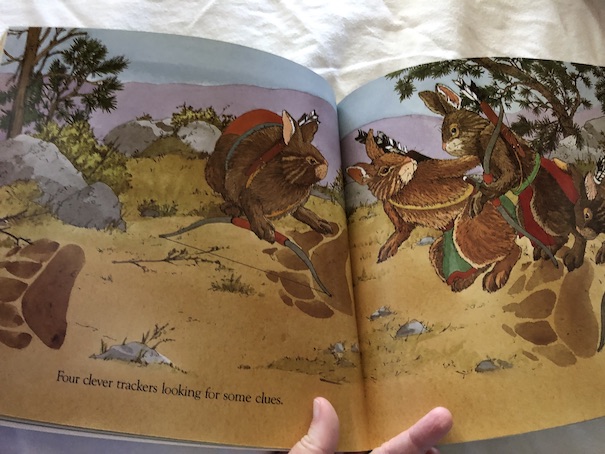
Ten Little Rabbits by Virginia Grossman and Sylvia Long, 1991.

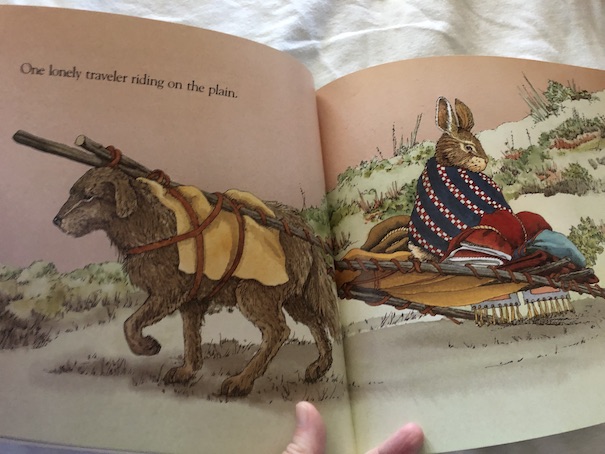
This picture book is loosely based on the Ten Little Indians counting rhyme, but with a twist. Instead of “Ten Little Indians,” it’s ten little rabbits. The rabbits in the pictures are dressed in traditional costumes from different Native American tribes. Also, unlike in some versions of the Ten Little Indians rhyme, none of the characters are eliminated during the course of the rhyme. The rhyme simply counts upward from one to ten.

The pictures are beautiful and detailed, and they do a good job of showing the rabbits in the poses of humans.

The book intentionally shows the rabbits acting out aspects of traditional Native American culture. Very young children might not fully appreciate what the book is trying to depict, but there is a special section in the back that explains which tribes the rabbits are supposed to belong to and what they are doing in the pictures.

The book is available to borrow and read for free online through Internet Archive.

Knots on a Counting Rope

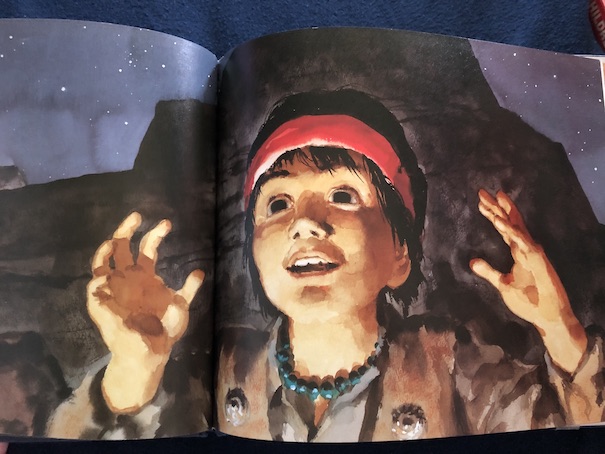
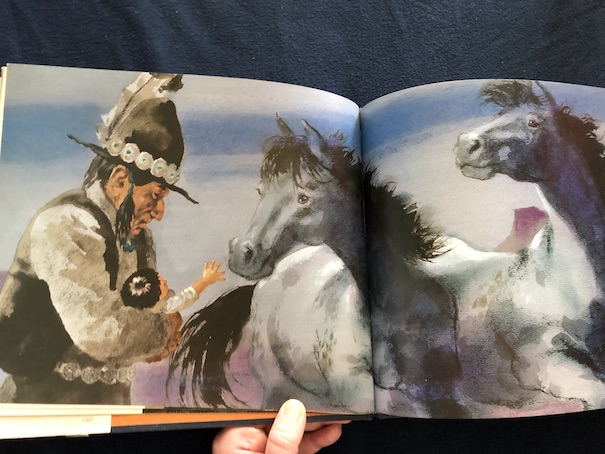
Knots on a Counting Rope by Bill Martin, Jr. and John Archambault, 1966, 1987.

The reason for the two copyright dates is that this book originally had somewhat different text and different illustrations.  I don’t have a copy of the original version, so I’m not sure how it compares to the 1987 version.

The story is told in the form of dialog between a young Navajo boy and his grandfather.  The story doesn’t explicitly say that they are Navajo, but they refer to hogans, which are a traditional type of Navajo house.  There are no words in the story other than what the characters say to each other, not even to indicate who is speaking, but you can tell who is speaking based on what they say.

The boy asks his grandfather to tell him the story of when he was born. The grandfather says that he already knows the story, but the boy persuades him to tell the story again.

The grandfather tells him that, on the night he was born, there was a storm, and it sounded like the wind was crying the word “boy.”  The boy’s mother knew that she was going to give birth to a son.  The grandfather quickly brought the boy’s grandmother to be there for the birth, and when the boy gave his first cry, the storm suddenly stopped.

When the boy was born, he was very frail, and everyone was afraid that he would die.  Then, when morning came, the grandfather carried him outside, and although he did not open his eyes to the morning sun, he lived his arms up to two horses that had galloped by and stopped to look at him.  The grandfather took it as a sign that the boy was a brother to the horses and would live because he had the horses’ strength.  The boy did become stronger and was given the name of Boy-Strength-of-Blue-Horses.

However, the boy was born blind. It is a hardship that he will always have to deal with.  Even though the word “blue” in his name, the boy says that he doesn’t really know what “blue” is or what it’s like because he’s never seen it.  The grandfather describes it as being like morning because the sky in the morning is blue, and the boy says that he understands what mornings are like because they feel and sound different from night to him.

The boy has a horse of his own, and the two of them have a special bond.  The two of them perform well at races, and the horse acts as the boy’s eyes when he’s riding.  His grandfather says that it’s like the two of them are one.

As the grandfather tells the boy stories about himself, he ties knots on the counting rope.  He says that when the rope is full of knots, the boy will have heard the stories enough that he will be able to tell them himself.  The grandfather says that he will not always be there to tell the stories, and the boy is frightened, wondering what he will do without his grandfather. The grandfather says that he will be all right because his love will be with him.

The book is partly about the relationship between the boy and his grandfather and the grandfather preparing his grandson for the day when he will be gone, making sure that he knows the family stories about himself and the knowledge that he will need for the future. It’s also about the boy’s own struggles in life, which the grandfather refers to as the “dark mountains” that he must cross. Because of the boy’s blindness, he lives in a world of darkness, and there are things that are challenging to him that would be less challenging to a person with normal vision. Yet, the boy has innate skills which allow him to do things that some people with normal vision can’t do. Not everyone has the affinity for horses that the boy has. He shares a special bond with horses, and when he rides, he and his horse are a team. Because he has skills and a strong spirit, the grandfather knows that his grandson will be all right in his future, in spite of the challenges of his blindness.

The book was featured on Reading Rainbow, and it is currently available online through Internet Archive.

A Woggle of Witches

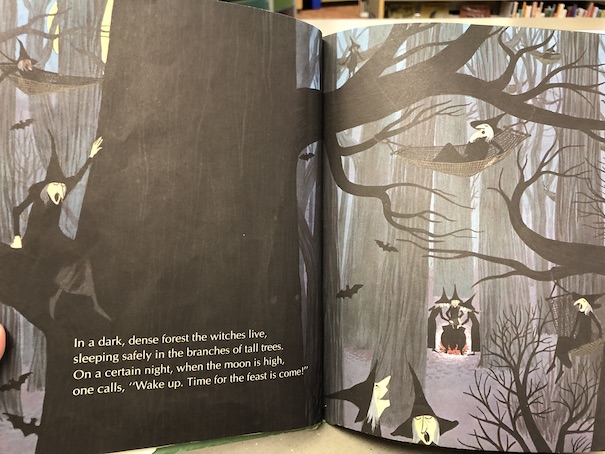
A Woggle of Witches by Adrienne Adams, 1971.

Witches live in a dark forest, sleeping in hammocks in the trees.  When they wake up on Halloween night, they have a feast.

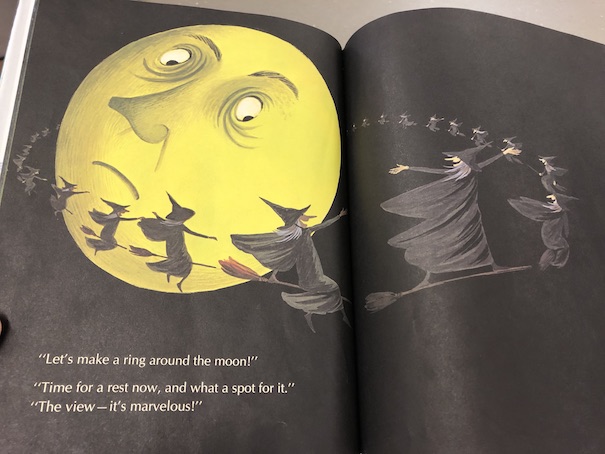
Then, they take to the skies and fly in fancy formations.  They fly in rings around the moon, even stopping on the moon to take a rest.

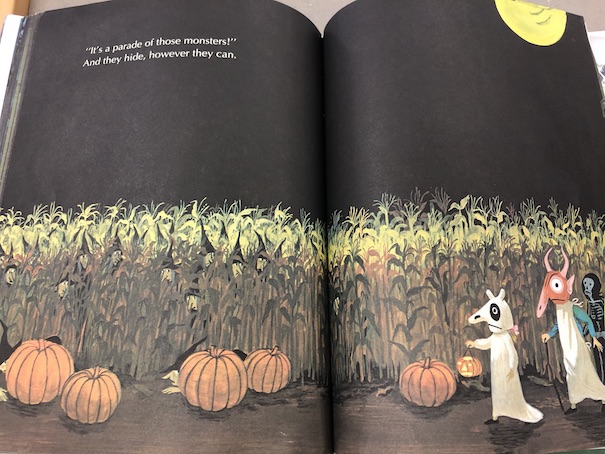
After they return to the ground, they are startled by some trick-or-treaters and hide from them, thinking that they’re monsters.

Finally, they return to their forest and go to sleep in their hammocks once again.

The story is minimal, but the pictures really make the book!

The book is available to borrow and read for free online through Internet Archive.

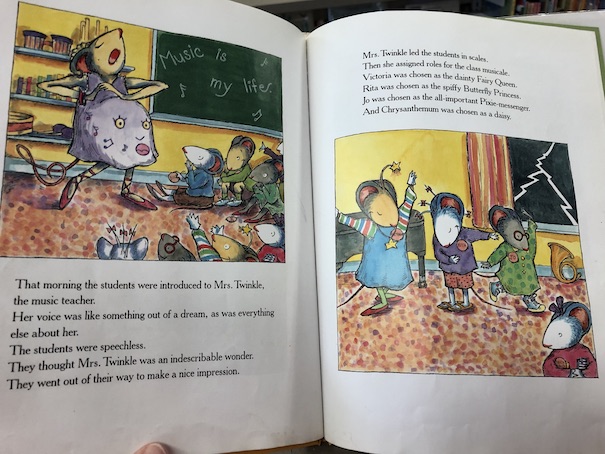
Chrysanthemum

Chrysanthemum by Kevin Henkes, 1991.

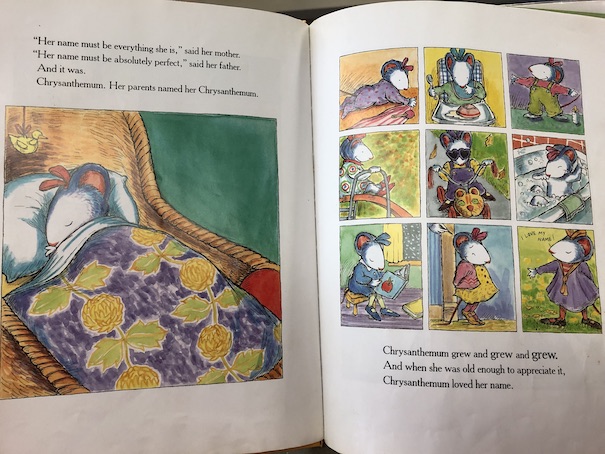
When little Chrysanthemum was born, her parents chose Chrysanthemum as her name because it just seemed perfect, as perfect as their little girl. As Chrysanthemum grew up, she loved her name, and she thought that it was perfect, too.

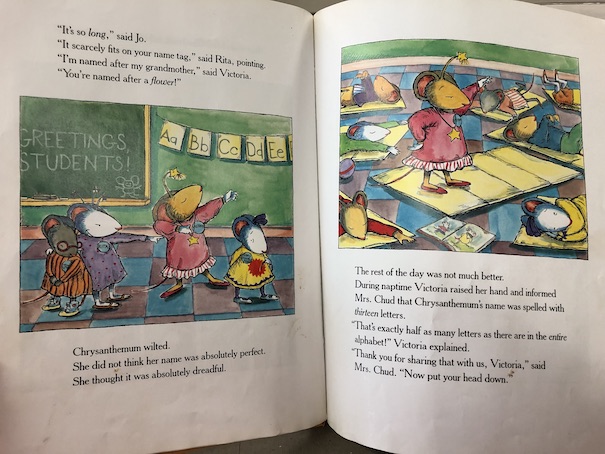
However, when Chrysanthemum starts school, the other kids point out how unusual her name is. Most of them have much shorter names. Chrysanthemum’s name is so long that it doesn’t really fit on her name tag. One girl, Victoria, is particularly mean about Chrysanthemum’s name, making fun of her whenever she can and encouraging other children to make fun of her.

For the first time in her life, Chrysanthemum starts hating her name. She wishes that she had a much shorter name, like Jane. Her parents comfort her and tell her that the other kids are probably just jealous, but their repeated teasing really bothers her.

Then, the children have music lessons at school with Mrs. Twinkle. Mrs. Twinkle is a fun teacher, and the kids are excited about her class. She gives the children roles to play in a class musicale, and Chrysanthemum is cast as a daisy. When the other kids laugh about her playing a different type of flower, Mrs. Twinkle asks them what’s so funny.

The other kids explain about Chrysanthemum’s name and that they think it’s funny because it’s so long and weird. That’s when Mrs. Twinkle tells them that her first name is Delphinium – another long, unusual flower name! She says that she really likes the name Chrysanthemum, and since she’s expecting a baby, she might name the baby Chrysanthemum if it turns out to be a girl. Suddenly, the other girls in class envy Chrysanthemum and wish they had flower names, too!

In the short epilogue at the back of the book, the baby does turn out to be a girl, and Mrs. Twinkle names her Chrysanthemum. Chrysanthemum also gets a laugh at Victoria’s expense when the class puts on their musicale, and Victoria completely forgets her lines.

It’s a nice book, and I appreciate some of the messages now even more than when I first read it when I was a kid. Now that I’m an adult, I know that Chrysanthemum’s name isn’t the real reason why Victoria picks on Chrysanthemum. Victoria is mean basically because Victoria is a mean person. Kids who want to bully others make the decision to bully first and then pick something to bully about second. From what I’ve seen, they’re usually out to make fun of someone or make someone mad just to do it, and they don’t really care how or why. Chrysanthemum’s unusual name was just a convenient thing for Victoria to single out and use for her bullying. If she hadn’t had that name, Victoria would have picked on her (or maybe some other, more convenient target) for something else. Maybe it would have been someone’s clothes. Maybe it would have been the way someone walks or the way someone talks or their hair or their eyes or the fact that they have fingernails or breathe air or take up physical space … you get the idea. Victoria is the way she is because that’s what she is and what she wants to be, and she doesn’t see any need to change until the end of the story. (Even then, she may be back to bully again over something different because she hasn’t yet learned not to bully in general, just not over that particular thing.)

My point is that the way Victoria is has nothing to do with Chrysanthemum and her name. I’ve heard parents who are considering names for their children working hard to pick names that can’t be used for teasing, and sometimes, it can help. However, at the same time, bullies are basically going to bully because that’s who they are and what they do, and most importantly, it’s what they want to do. They’ll find something to bully about anyway because they’re always intentionally looking for something to bully about.

For a time, because of Victoria’s meanness and bullying, Chrysanthemum’s enjoyment of her name is ruined. She even feels like Victoria is destroying her sense of identity. At one point, she has a nightmare that she is actually a Chrysanthemum flower and that Victoria plucks her petals, picking at her and picking at her and picking at her until there’s nothing left. That’s the kind of effect that bullies have on people, which is why I have such contempt for them. They ruin things, even really fun and cool things like a colorful name, and make people unhappy just by being the kind of people they are. (If you’ve read my other reviews of books with bullies, you’ve already heard that I have very strong feelings about this subject and absolutely no patience or sympathy for bullies.)

But, fortunately, the book takes a very positive tone and points out that Chrysanthemum’s name is not really ruined by Victoria’s meanness. Chrysanthemum’s music teacher also has a really unusual flower name, and naming her baby Chrysanthemum as well gives Chrysanthemum new status among the kids at school, to the point where some of them, including Victoria, wish that they also had flower names of the kind that might inspire someone to name their baby after them. Mrs. Twinkle is a fun and different kind of teacher, and her fun and different name fits her personality. Although it hasn’t occurred to the other kids yet, the world would be a pretty drab place without colorful and unusual people. The Victorias and Janes of the world may have very proper names and are reassuringly ordinary, but the Delphiniums and Chrysanthemums are the ones who bring color and excitement to life. So, although I wouldn’t deliberately give a child a name that might leave them open to teasing, I don’t see a need to go overboard and reject some of the fun names that are just a bit unusual. Different is good, and it should be appreciated for what it is, not for what a bully may or may not be able to say about it when they’re trying to be mean. (They’ll find something else to bully and complain about two seconds later anyway, so why bother considering them for longer than that?)

The book is currently available online through Internet Archive. It is part of Mouse Books series.

Lilly’s Purple Plastic Purse

Lilly’s Purple Plastic Purse by Kevin Henkes, 1996.

Lilly loves going to school, and she especially loves her teacher, Mr. Slinger. Everyone in class thinks that he’s great, and he inspires a lot of them, including Lilly, to want to be teachers themselves.

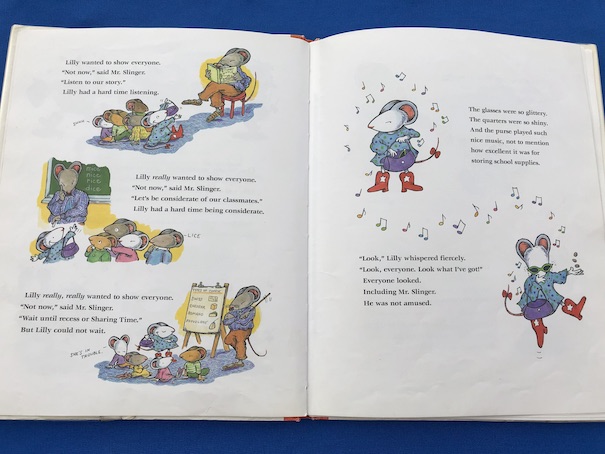
One day, after a special shopping trip with her grandmother, Lilly gains a some special new treasures: movie star sunglasses, some quarters, and a purple plastic purse that plays a tune when she opens it. Eager to show off her new things to her friends, Lilly brings them to school. However, she just can’t wait until recess or Sharing Time to show everyone. She keeps trying to draw attention to these things while the teacher is talking and opening the purse so it keeps playing its tune.

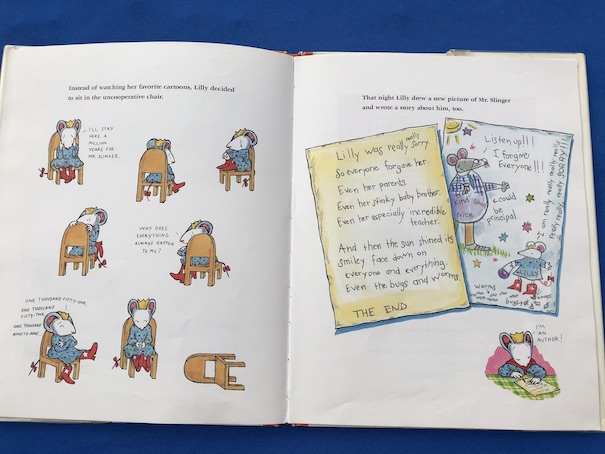
Finally, after repeated warnings, Mr. Slinger is forced to confiscate Lilly’s purse with its other treasures. Lilly is hurt and feels betrayed by her favorite teacher. Sad and angry at having her treasures taken from her, she draws a mean picture of her teacher as a purse thief, leaving the picture where she knows he will find it.

However, Mr. Slinger isn’t as mean as Lilly thinks that he is when he takes her purse. After he gives the purse back to her, she discovers a nice note from him inside, telling her that tomorrow will be a better day, and there’s even a little bag of snacks. Now, Lilly feels guilty about her mean picture. It’s too late to get it back, and she worries that her teacher will never forgive her.

The story is really good at showing how Lilly’s emotions change through the course of the day and how her sadness and anger grow more urgent the more she thinks and worries about them. It’s a good story to use when talking about feelings with young children (through the course of the story, Lilly is happy, excited, sad, betrayed, angry, guilty, worried, and embarrassed – some of these are stated explicitly and some are more implied) and how to deal with emotions. Adults can talk to children how one kind of emotion can lead to another (like how Lilly’s sadness turns to anger at her teacher for making her feel sad by confiscating her purse) and how some ways of dealing with emotions are better than others. It is both creative and appropriate that Lilly used her drawing ability to both insult her teacher and, later, apologize to him.

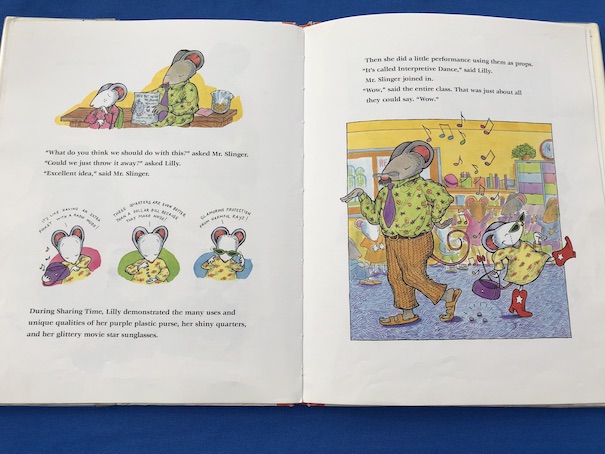
Fortunately, both Lilly’s parents and her teacher are very understanding. Her parents reassure her that her teacher will forgive her. Lilly draws a new, nicer picture of her teacher to go with her apology to him, and her parents give her some snacks to give to him as well. He does forgive her, and she finally gets to show everyone her amazing purple plastic purse at Sharing Time (being careful not to disturb anyone with them at other times.

The book is currently available online through Internet Archive. It is part of Mouse Books series.

Norma Jean, Jumping Bean

NormaJeanJumpingBean

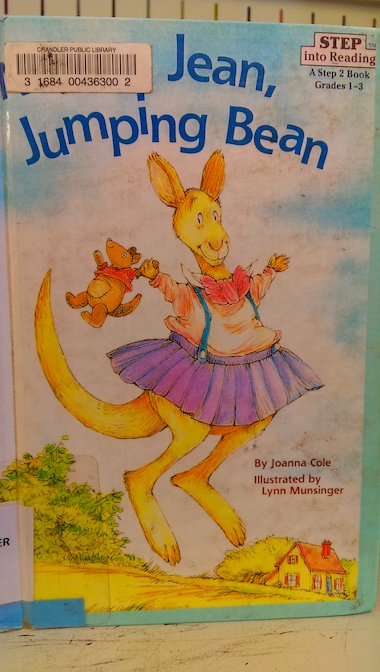
Norma Jean, Jumping Bean by Joanna Cole, 1987.

Norma Jean, a kangaroo, loves to jump!  She goes hopping and jumping everywhere, all the time.

NormaJeanJumpSchool

It’s pretty normal for a young kangaroo, but it sometimes causes problems.  She keeps wanting to jump when her teacher wants her to sit still and and listen.  Sometimes, accidents happen because she’s jumping around.

NormaJeanLunch

Without meaning to, she sometimes plays too rough with her friends because she has so much energy.  One day, when her friends stop wanting to play with her after a series of disasters, Norma Jean decides that the only thing to do is to give up jumping.  It makes her sad, but she doesn’t want to be thought of as a rough, clumsy klutz, who can’t sit still – a jumping bean.

NormaJeanSad

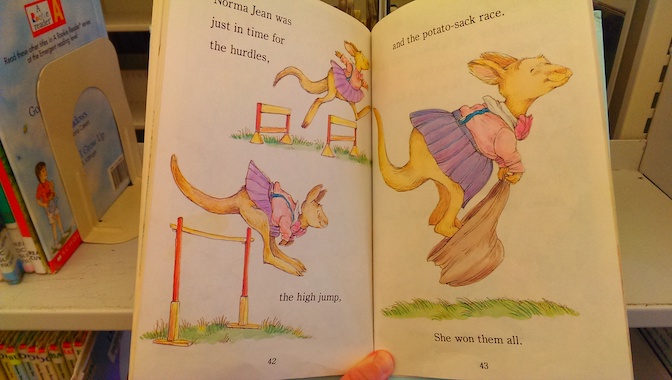
But, with the school’s field day coming up, Norma Jean realizes that jumping is okay, at certain times and certain places.
NormaJeanFieldDay

Kate Greenaway’s Book of Games

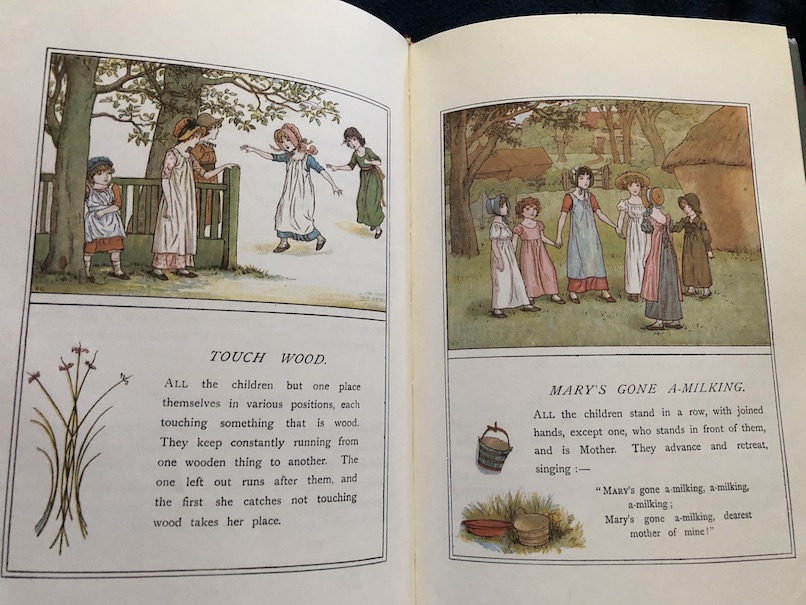
Kate Greenaway’s Book of Games by Kate Greenaway, 1889.

A book about children’s games with rules and general pastimes. The book doesn’t distinguish between the two, but I do because, to me, games have specific rules whereas more general pastimes and toys do not.
Many of the games and pastimes would be familiar to people in modern times and are still popular. Some games are like playground games (some of them are even still played on playgrounds today) that require running and motions, and others are more talking games (some of those have become classic road trip games, played in the car). Pastimes include making soap bubbles, flying kites, and using swings.

The book includes games like I Love my Love with an “A”, Blind Man’s Buff, Frog in the Middle, Russian Scandal (This is an old name for the Game of Telephone, before the invention of the telephone became really popular. I’ve also heard it as Russian Gossip, although I don’t know why it’s specifically “Russian.”), French and English (which is basically Capture the Flag), Oranges and Lemons (which is played like London Bridge is Falling Down, only with a different rhyme), and Twenty Questions. Some of the less familiar ones, especially to young Americans today, might be Puss in the Corner (a game that involves players running and changing places with each other and the person who is left without a place being “it” or the “puss”), Mary’s Gone A-Milking (a chase game with a song), What Is My Thought Like? (a talking/guessing game that involves creativity), and The Old Soldier and Judge and Jury (which are both talking games with words that are forbidden to say).

One of the interesting things about this book, besides noticing which games are still played and which are more obscure now, is that the children in the pictures are actually wearing clothes that are from an earlier part of the 19th century from when the book was written. This is a classic feature of Kate Greenaway’s illustrations, also seen in her other books. Modern people who are less familiar with the evolution of 19th century clothing might not notice that detail.

This book is still in print in modern times. It also available to borrow for free online through Internet Archive (multiple copies).

For more information about Victorian games in general, see the Victorian Games section of my Historical Games site. History and games are both hobbies of mine.

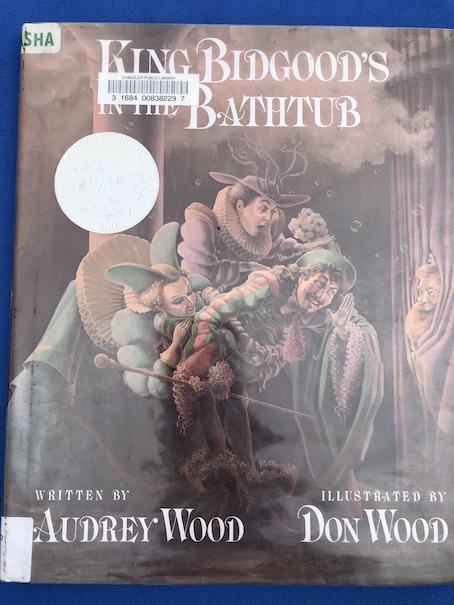
King Bidgood’s in the Bathtub

King Bidgood’s in the Bathtub by Audrey Wood, 1985.

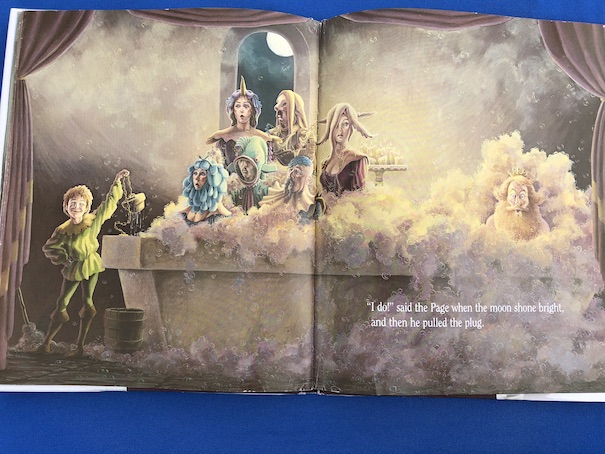
King Bidgood loves being in his bath, but one day, he just doesn’t want to get out!  When the young page realizes that the king is refusing to leave the bath, he calls out to the courtiers, asking what to do about it.

One by one, they try to interest the king in other activities, but each time, he keeps inviting them to join him (fully clothed, although he apparently isn’t, just mostly hidden by bubbles) in order to prove that absolutely everything can be done in the bath.

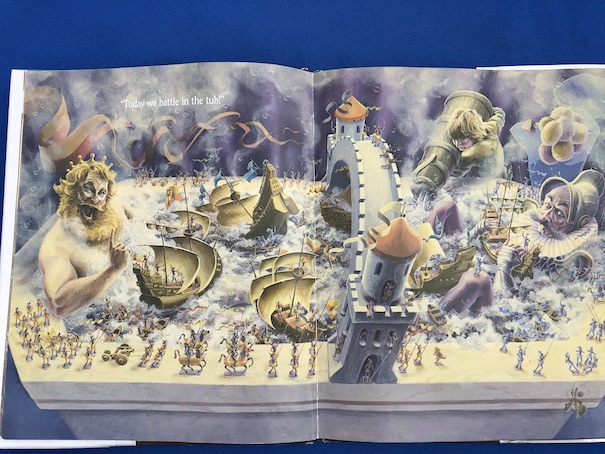
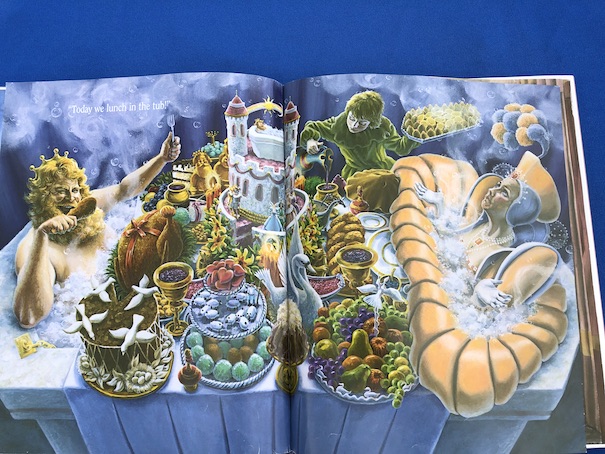
When the knight says it’s time for battle, they end up having a battle with toy ships in the tub.  When the queen tells him that it’s time to eat, they have a fancy feast right there in the tub.  The king’s activities eventually include a fishing trip and a dance.

In the end, the page is the one who figures out how to put an end to this never-ending bath.

I love the pictures in this book, and the repetition as each person steps forward with a suggestion should appeal to young children.  This book is a Caldecott Honor Book. It is currently available online through Internet Archive.

The Dragons Are Singing Tonight

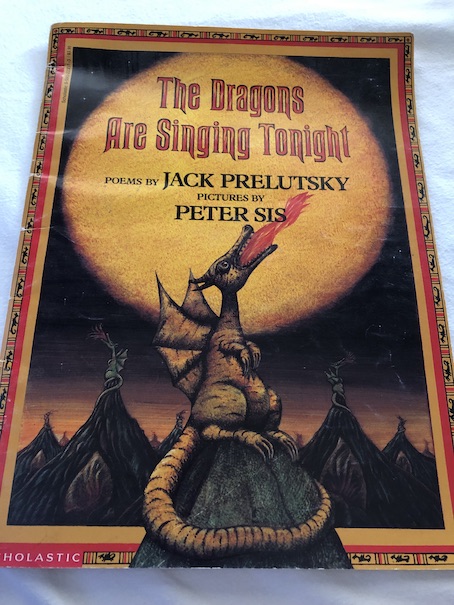
The Dragons Are Singing Tonight by Jack Prelutsky, illustrated by Peter Sis, 1993.

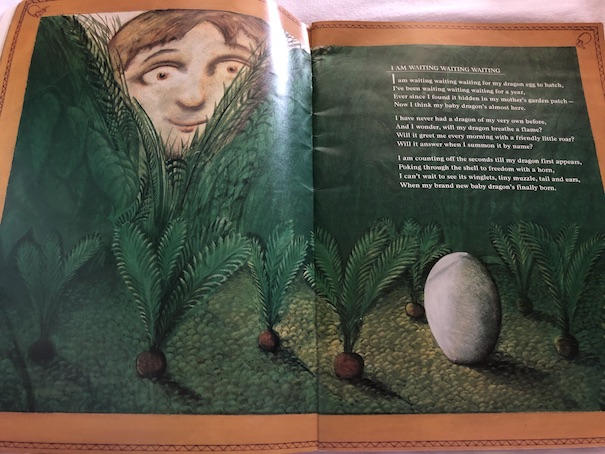
This is a picture book of poems about dragons, but that description doesn’t quite do the book justice.

Jack Prelutsky is best known for his books of humorous poems for children, but not all of the poems in this book are funny. Some of them are humorous or have humorous twists, but others are just about the magic and wonder of the idea of dragons, some of which only exist in the imagination. Sometimes, just believing in magic or imagining it can be magical by itself!

The pictures are all excellent, colorful, and fanciful, and they really bring the poems to life. The book is larger than average, and the pictures span full pages.

The book is currently available online through Internet Archive.

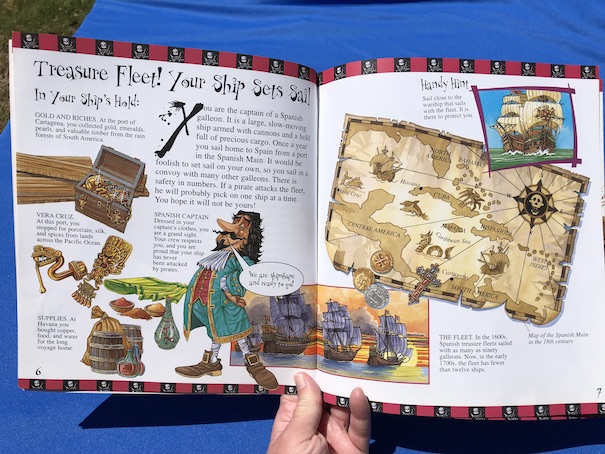
You Wouldn’t Want to Be a Pirate’s Prisoner

You Wouldn’t Want to Be a Pirate’s Prisoner by John Malam, 2002.

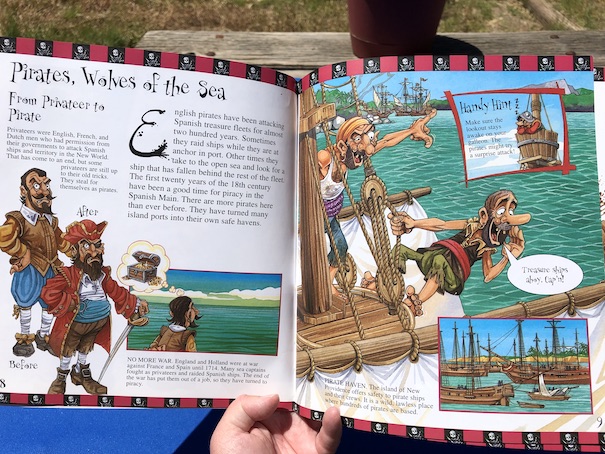
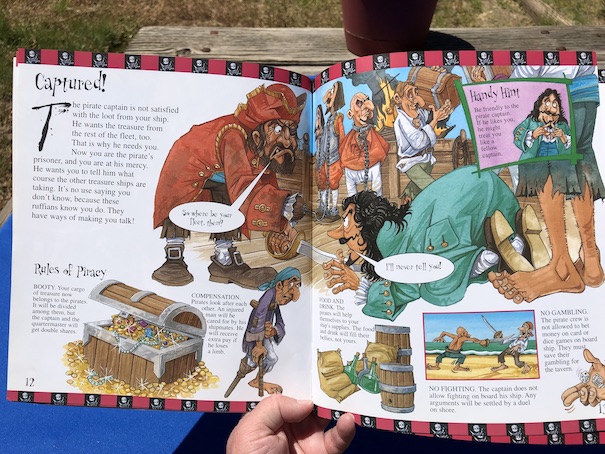
This picture book, which is part of a series, explains what it would have been like to be a pirate’s prisoner in the 18th century.  It sets the stage by casting the reader in the role of a Spanish ship captain in 1716.

The reason why the reader is cast as a Spanish captain, captured by English pirates, is because England and Holland had been at war with Spain until 1714.  During the war, the government of England (as well as Holland and France) authorized some ship captains to act as privateers, conducting raids on Spanish ships and outposts.  When the war ended and the privateers were dismissed from service, some of them continued to act as independent pirates.

The book explains the geography of the “Spanish Main,” the area between the southern coast of North America and the northern coast of South America – basically, the Caribbean Sea and its islands and the Gulf of Mexico.  Spanish galleons in the 18th century carried gold and treasures from the Americas to Spain as well as timber from the rainforests and goods that were transported to the Americas across the Pacific Ocean, such as spices and silk.  All of these goods made Spanish treasure ships tempting targets for English pirates.

As a Spanish ship’s captain, there were a few precautions that you could take against pirate attack.  One of the most basic was traveling as part of a convoy because pirates would be more likely to attack a lone ship than one that was part of a group.  A fleet of ships would have a warship traveling with them for protection, and the closer your ship sailed to the warship, the less likely a pirate ship would try to separate you from the group and attack.

If the worst situation happened and the ship was taken by pirates, a captain could try to dress like other members of the crew to disguise his rank, but that didn’t always work.  The captain of the ship was in danger of being taken captive because he might have information that the pirates would find useful, like the exact route of other ships in a convoy.

The gruesome part of this book (and the source of the title, because this series basically focuses on the gruesome parts of history) is the part where they describe different forms of torture that pirates might use on a ship’s captain to convince him to tell them what they wanted to know.  Besides the direct physical abuse, pirates could also keep a captive in squalid conditions to make him weaker, more vulnerable, and exposed to disease.  In the end, they might simply decide to maroon the captive somewhere, even if they got the information they were after.

However, pirates could also face gruesome fates if they were caught. They could be hung and their bodies displayed publicly, as a warning to others.