Rosie Monster’s parents worry about her because she just can’t seem to understand how monsters are supposed to behave. Monsters are supposed to be fearsome. They’re supposed to growl, fight, and break things. Rosie is just the opposite. She’s endlessly polite and sweet.
Rosie’s friend Prunella tries to teach her real monster manners, but no matter what, Rosie just can’t stop being polite.
It wouldn’t be such a problem for Rosie, except that she knows that her family and friends are disappointed in her.
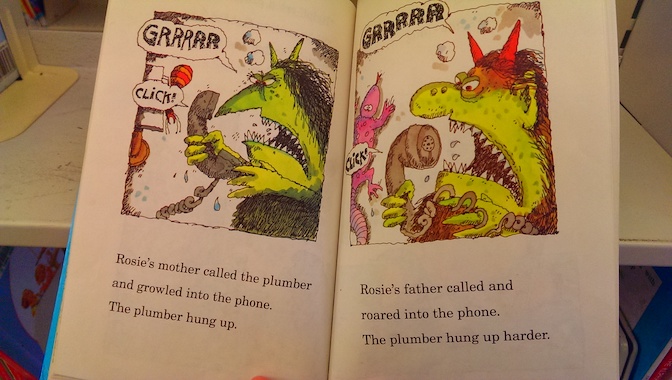
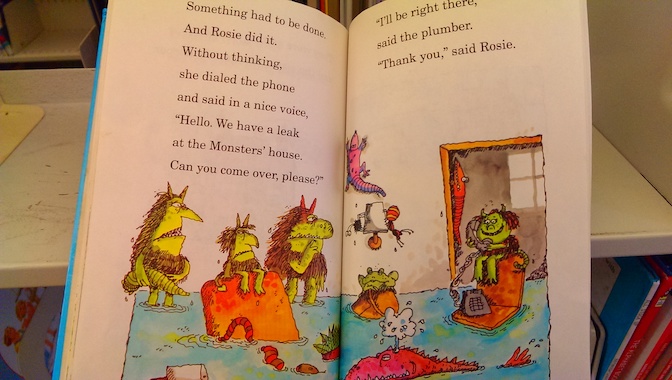
Then, a water pipe breaks at Rosie’s house. Although her parents, and even Prunella, try calling a plumber, they can’t get him to come to the house and help them no matter how loudly they growl into the phone.
It takes Rosie’s politeness to get the message across and get the help they need!
A friend of mine who works in customer service wishes that more callers would be polite or, failing that, that he could just hang up like the plumber in the story. Trying to help people who are determined to make the process of helping them harder than it has to be and who will curse and insult you for even trying is a frustrating experience.
The book is currently available online through Internet Archive.
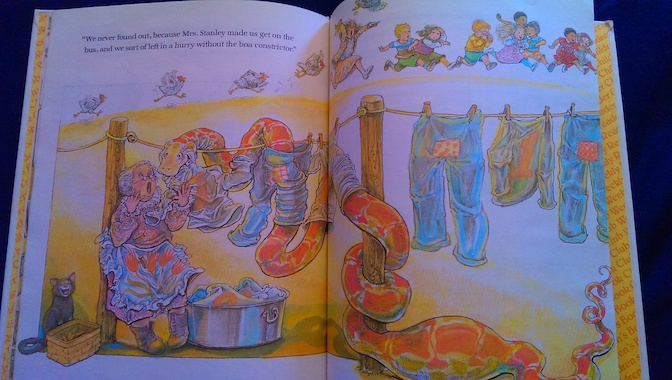
The Day Jimmy’s Boa Ate the Wash by Trinka Hakes Noble, pictures by Steven Kellogg, 1980.
The fun thing about this story is the backward way that the girl begins telling it, somewhat resembling The House that Jack Built, or better yet, the old No News Joke. The joke is really closer to the format of the story, with someone explaining the least eventful thing that happened as though it were the most important when it was just the end result of everything else.
A young girl (unnamed) arrives home, and her mother asks her how she liked her class trip to a farm that day. She says that it was boring until the cow started crying. When the mother asks her why the cow was crying, she says that the farmer wasn’t paying attention to where he was driving his tractor and knocked a haystack over on the cow.
As the mother continues to ask her daughter questions about what happened, backtracking through events, the real story begins to reveal itself:
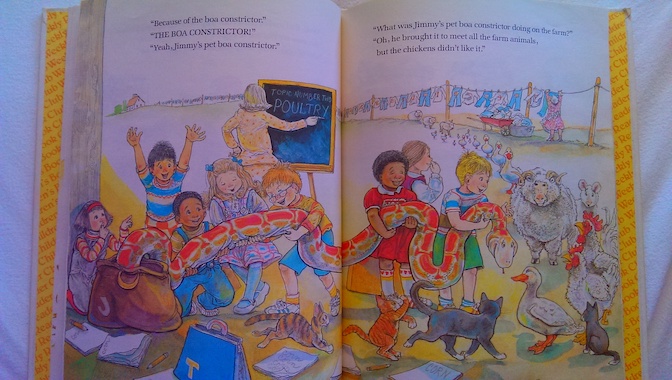
The girl’s friend, Jimmy, had a pet boa constrictor, and he brought it along on the field trip so it could meet all the farm animals.
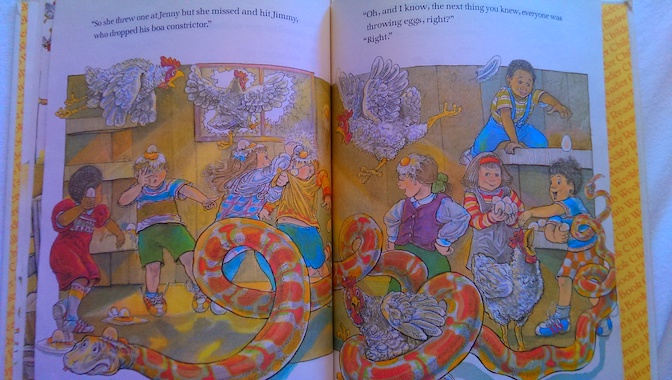
However, the chickens became frightened, and one of them laid an egg on one of their classmates. She thought that someone else threw it at her, so she threw another egg at him, which hit yet another student.
From there, it turned into one big food fight, with students throwing eggs at each other, and when they ran out of eggs, they threw corn at each other. The corn was for the pigs to eat, so the pigs wandered onto the school bus and started eating the children’s lunches. From there, chaos ensued until the farmer’s wife suddenly screamed, and the children’s teacher hustled the children onto the school bus to go home.
The children never knew exactly why the farmer’s wife screamed (although the reason is actually in the title to the book), but two things quickly became evident: Jimmy accidentally left his boa constrictor behind on the farm, but he has acquired a pet pig because there was still one left on the bus.
This summary doesn’t quite do the story justice because the backwards way the story starts out is part of the fun. The pictures in the book are hilarious, and the boa constrictor is shown at the end to have become a beloved pet of the farmer and his wife, even making friends with the chickens.
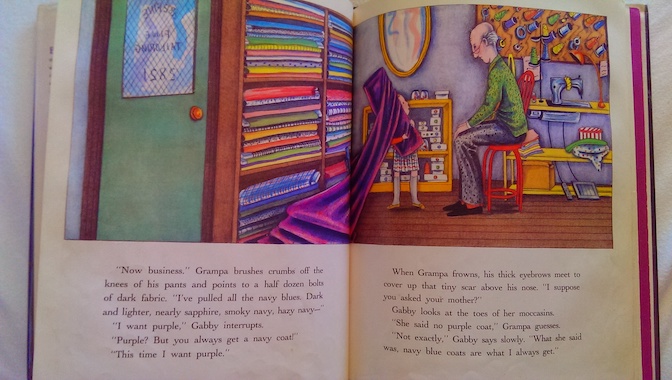
Every year in the fall, Gabrielle and her mother travel to the city to visit her grandfather’s tailor shop. While her mother shops at other stores, Gabby and her grandfather have lunch together (Gabby always eats the same kind of sandwich), and her grandfather makes her a new coat. Gabby always gets the same kind of coat, and it’s always navy blue.
However, this year, Gabby wants something different. She wants a purple coat! She also wants it in a different style than her other coats, and she wants it to have a hood. At first, her mother and grandfather can’t believe that she really wants something so different from what she usually gets, and they point out that navy coats are classic, but Gabby is insistent.
Gabby worries that her mother won’t let her get the coat that she really wants, but her grandfather remembers that when her mother was little, she once wanted something really unusual herself: a tangerine-colored dress. Sometimes, people do want to do different things, just to have a change and try something new. He also thinks of a way to give Gabby what she wants while allowing her to go back to her classic navy when she feels like it. Gabby’s new coat is reversible!
Miss Nelson Has a Field Day by Harry Allard and James Marshall, 1985.
Everyone at school is disappointed in the school’s football team. Even the team itself thinks that they’ll never have a chance at winning, so they don’t bother to practice. They refuse to listen to their coach and spend all of their time goofing off. Finally, the coach starts to crack mentally from the strain, and Miss Nelson decides that something needs to be done.
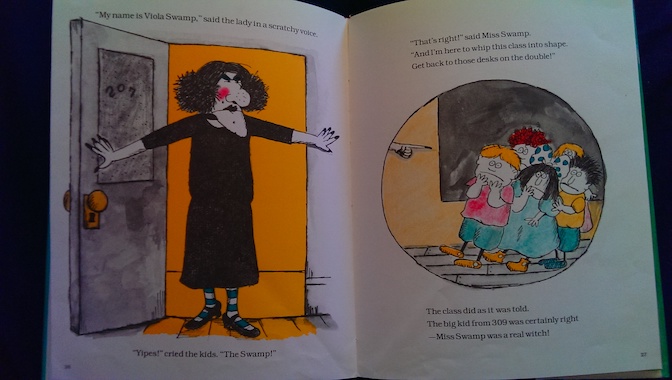
Some of the kids mention that if Viola Swamp, the meanest substitute teacher ever, were there, she’d know how to deal with the team. Not knowing how to contact The Swamp, the principal tries to turn himself into Viola Swamp, but his outfit is just goofy . . . then the “real” Viola Swamp shows up to coach the team. As usual, she takes no nonsense from anyone.
The Swamp undeniably gets results, however, the principal has started to wonder who Miss Swamp is and how she always knows when to show up. Unlike in previous books in the series, Miss Nelson is teaching her class as usual while Coach Swamp is out on the field with the team. Since the previous books pretty well established that Miss Nelson and Miss Swamp are the same person, how is this possible?
The book is currently available online through Internet Archive.
My Reaction and Spoilers
The story doesn’t contradict the other books, and Miss Nelson is still Viola Swamp, but there is one more surprising thing about Miss Nelson that nobody knows which can allow her to appear to be in two places at once . . . she has a twin!
Stories with a secret twin can sometimes feel like a bit of a cop-out, but this one is funny because this is the first and only time Miss Nelson has called on her twin to help her with her double act as Viola Swamp. Miss Nelson’s twin sister is actually the one who’s teaching the class as the nice teacher while Miss Nelson is out on the field coaching as Viola Swamp. There is a moment at the end of the book where the twins are together and Miss Nelson explains to her sister why Viola Swamp is necessary. Sometimes, students need a little tough love and discipline, but by using her alter ego to dish it out when necessary, Miss Nelson gets to keep her reputation as the nice, sweet teacher she really is.
Even though readers know what’s going on with Miss Nelson and Viola Swamp from the previous books, Miss Nelson’s twin adds a nice twist to the plot. The fun of the Miss Nelson books is watching how Miss Nelson carries out her identity swaps. In this book, I also loved the principal’s hilarious attempt to play the part of Viola Swamp in a Halloween witch costume!
Miss Nelson is Back by Harry Allard and James Marshall, 1982.
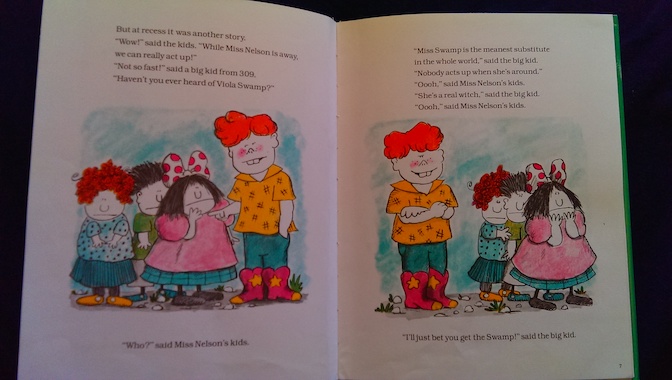
Miss Nelson, a teacher, tells her class that she will have to be away for awhile, having her tonsils removed, so someone else will be teaching their class. At first, the kids think that they’ll be able to get away with a lot while Miss Nelson is away, but an older kid warns them that their substitute will probably turn out to be Viola Swamp, the meanest substitute ever.
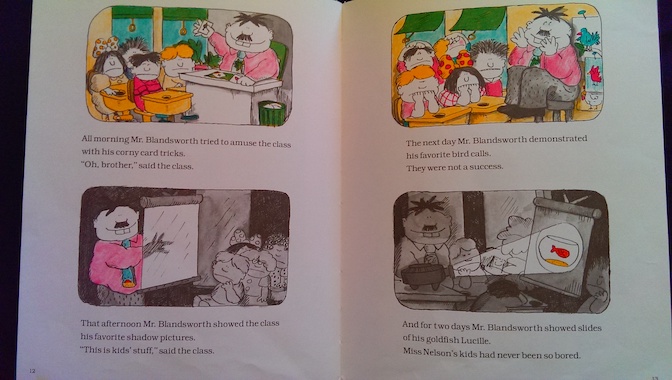
The kids are nervous until they find out that Mr. Blandsworth, the school principal, will be their substitute himself. The worst thing about Mr. Blandsworth is that he’s boring, and he tends to treat them like they’re little kids. They put up with it for awhile, but then, they realize that they can get rid of Mr. Blandsworth by convincing him that Miss Nelson has come back to school.
They put together their own Miss Nelson costume, with some of the kids sitting on each other’s shoulder’s to appear taller in the outfit. It’s cheesy, but it convinces the principal. But, the kids take it even farther than that. Now that there’s no substitute teacher, they can do whatever they want! Their “Miss Nelson” takes the class on an impromptu field trip to the movies and the ice cream parlor, and no one stops them because they’re with their “teacher.”
Unfortunately, they make the mistake of walking past Miss Nelson’s house, and she discovers what they’ve been doing.
Miss Nelson arranges for Miss Viola Swamp to come and teach the class a real lesson.
The book is currently available online through Internet Archive.
My Reaction
I actually like this book even better than the first book in the series because I think that the kids’ Miss Nelson costume is hilarious! Mr. Blandsworth is completely clueless about the kids’ deception, just as he never figures out what the real truth is about “Viola Swamp.”
As usual for the series, the story never explicitly states that Miss Nelson and Viola Swamp are the same person, but it’s heavily implied in the text (such as Viola Swamp’s scratchy voice from Miss Nelson having her tonsils out) and shown in clues in the pictures. Miss Nelson uses “Viola Swamp” as her alter ego whenever she needs to give her students some tough love, but that’s just a joke that Miss Nelson shares with the readers.
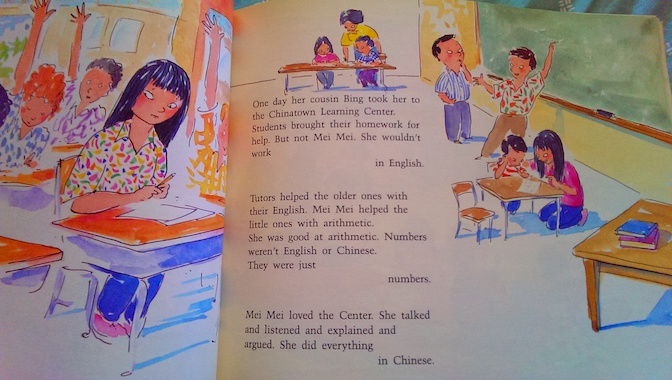
When Mei Mei’s family moves from Hong Kong to New York, she finds herself forced to go to a school where no one else speaks Chinese. She is expected to learn English and to read, write, and speak in English, and she hates it! To her, English is a very strange language, and the writing system is nothing like Chinese. For a time, Mei Mei refuses to speak in English, even when she understands what is being said around her, because she hates it so much.
The only part of New York that Mei Mei really likes is Chinatown and the Chinatown Learning Center. Mei Mei likes it because she is surrounded by people speaking Chinese. There, she can relax and be herself because people there understand her.
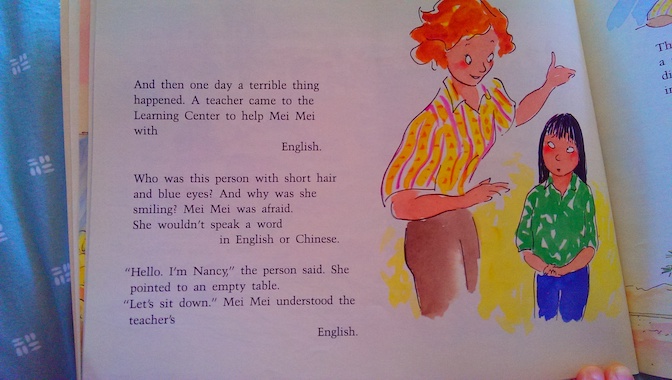
However, Mei Mei’s refusal to speak English isn’t helping her at school or anywhere else. It’s keeping her from speaking to anyone outside of Chinatown, and it can’t continue. When an English teacher, Nancy, comes to the Learning Center to help Mei Mei with her English, she resists learning at first. She feels like she’ll lose her Chinese and part of her identity if she uses English.
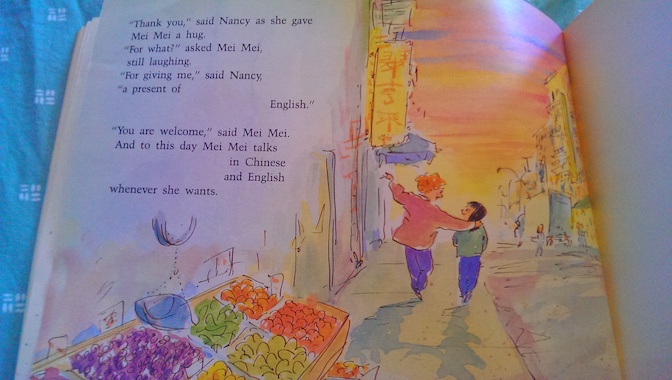
At first, Mei Mei’s worries about speaking English intensify with Nancy’s lessons. It disturbs her how English has words that would be difficult or impossible to translate into Chinese and English words seem to be coming more easily to her, even when she doesn’t really want to speak the language. Nancy explains to Mei Mei that English is necessary for her because she will need it to talk to many people in America, and there are many people who also want to talk to Mei Mei and be her friend, including Nancy. It’s only when Nancy overwhelms her by constantly talking in English and Mei Mei becomes desperate to talk about herself and be understood in English that Mei Mei realizes that speaking a new language doesn’t mean losing her identity. It’s just another way of expressing herself, and she can go back and forth between the two any time she wants.
Mei Mei’s feelings of strangeness in her new home and the difficulties of learning a new language are relatable. The hardest part of the experience for Mei Mei is feeling like she might be giving up a part of her past, her culture, and herself by switching from Chinese to English. But, refusing to speak English puts Mei Mei in the position of being someone who can only listen, never talk, limiting her ability to be understood and to make friends. In the end, she comes to realize that speaking a new language is not a matter of giving up anything, just adding to what she knows and making herself understood in a new way. It’s the beginning of expanding her horizons and building relationships with new people.
My favorite part as a kid was the part where Mei Mei and her friends went to the beach and cooked shellfish that they found. It was interesting to me because I never lived near a beach when I was young. The lifeguard at the beach tells Mei Mei and her friends that they can’t eat the shellfish, and they realize that he thinks that because he doesn’t know how to cook them. I never did either and still don’t, but I liked hearing about it.
The book is currently available online through Internet Archive.
Daily Life in a Victorian House by Laura Wilson, 1993.
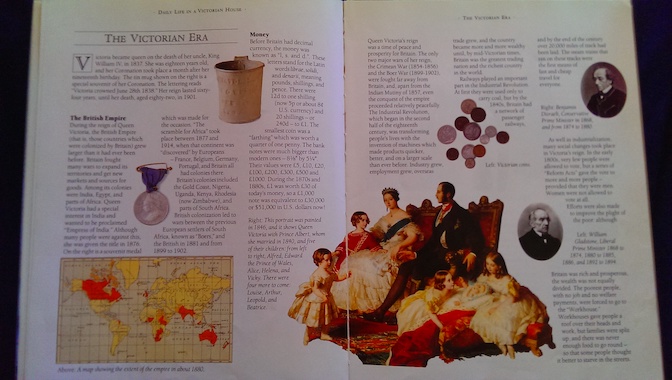
The book begins by giving some background on the Victorian era, which lasted from 1838, when Victoria became Queen of England, to Queen Victoria’s death in 1901. It was a time of expansion and colonization for the British Empire. Society was becoming increasingly industrialized and urban, although there was still great inequality about who had voting rights, and there were great gaps between rich and poor people.
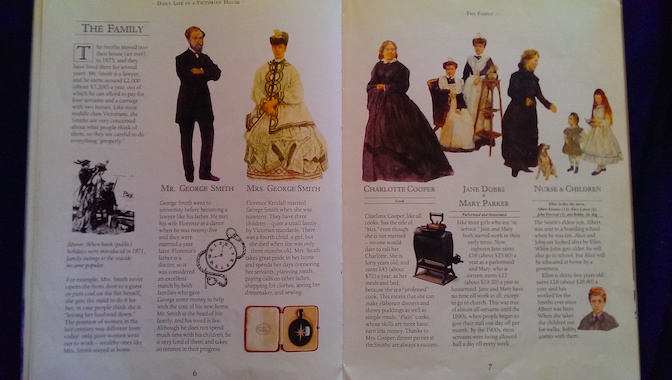
To explain what a typical day might be like for people living in the Victorian era, the book introduces a fictional upper middle class family, the Smiths. It explains some of the background of the Smith family and the members of the Smith household. Mr. George Smith, the head of the household, is a lawyer. His wife, Florence, does not need to work, so she spends her time overseeing the household servants, managing the household accounts (how much money is needed for household expenses such as food, clothes, and supplies), visiting friends, and shopping. Mr. Smith’s income is good enough to afford for the family to have a cook, two maids, and a nurse to look after the youngest children in the family.
The Smiths have three living children. One of their daughters died in infancy, which was sadly common for that era. The eldest boy in the family, Albert, spends most of his time away at boarding school. The two youngest children, Alice and John, are cared for by their nurse. When John is old enough, he will go away to boarding school, like Albert, but Alice will probably be tutored at home. Their parents spend surprisingly little time with them, even in the general course of a day.
There is a map of the Smiths’ house, and then the book begins explaining what each of the members of the house do at different times of the day. Each day, the servants are the first to get up because they need to light the fires to heat the house and start cleaning and making breakfast, which would be a large meal.
Something that I thought was interesting was that the cook typically purchased food from tradesmen who sold their goods door-to-door. This was also important to the maids, who are in their teens, because they worked such long hours that they really wouldn’t have had time to get away and met young men in any other way. Their suitors would likely be the young tradesmen. Of course, the young tradesmen would have met many young female servants at all of the households they visited during their daily rounds.
The maids would have spent their days cleaning, tasks that would have been more time-consuming without more modern inventions. Vacuum cleaners were invented toward the end of the era, in 1899. Cooking was also a time-consuming job, although the book does explain some innovations for the Victorian kitchen. Because Mrs. Smith had servants to do all of her cooking and cleaning for her, she never even went into her own kitchen at all. It was considered improper for a lady with servants to handle menial tasks herself, and the servants wouldn’t have welcomed her interference in their work.
I liked the sections of the book that explained about the lives of children in the Victorian era the best, although I was surprised at how little time children from well-off families would have spent with their parents. Generally, young children would see their parents in the morning for prayers and spend about an hour with their mother in the late afternoon. Other than that, they would spend most of their time in the nursery with their nurse, who would take care of them and didn’t welcome much parental interference any more than the cook would welcome the lady of the house supervising her work.
I also liked the sections about toys and games and entertainment as well as the description of what young Albert’s life would have been like at boarding school. The book also explains what life and childhood were like for less fortunate people during the Victorian era.
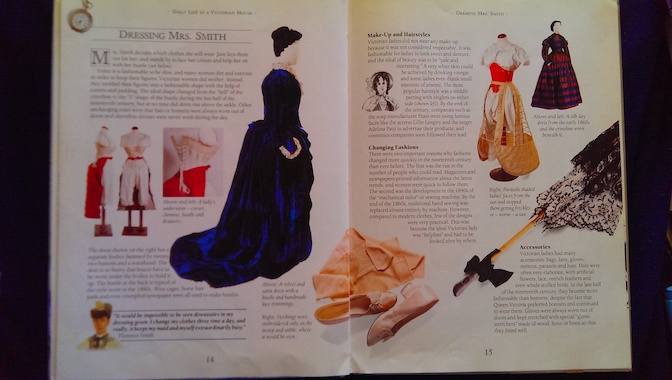
Overall, I really liked this book. It’s a good introduction to Victorian history and life, and it does one of the things that I really wish adult books would do more often: have pictures. Pictures really are worth a thousand words, and actually showing the objects that people of this time would have used in their daily lives is far more effective than pages of lengthy descriptions of them in words only.
The book is currently available online through Internet Archive.
Ira, a young boy, is happy when his friend, Reggie, who lives next door, invites him to sleep over at his house. Then, his sister asks him if he’s going to take his teddy bear with him. At first, Ira says no, but his sister points out that he’s never slept without it.
Ira starts to worry about whether he should take the teddy bear with him or not. He worries that Reggie might laugh at him for having a teddy bear. His parents say that he won’t and that Ira should go ahead and take the bear with him. However, his sister says that Reggie probably will laugh.
Ira tries to talk to Reggie and sound him out on the idea of teddy bears to see if Reggie will laugh, but Reggie ignores Ira’s questions. Reggie is excited about all the things that he and Ira can do at the sleepover and eagerly explains his plans. It all sounds like fun, but Ira gets nervous when Reggie mentions ghost stories.
Ira continues to debate about whether or not he should take his bear with him. Before going over to Reggie’s house, he decides to leave his teddy bear at home.
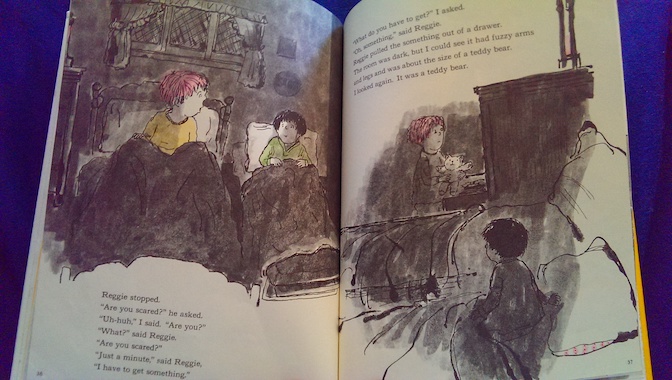
The two boys have a lot of fun playing together at the sleepover. At bedtime, Reggie starts to tell a ghost story, and both of the boys are a little spooked. That’s when Ira discovers that Reggie has a teddy bear of his own.
The book is currently available online through Internet Archive.
My Reaction
This is a nice story about how the things that we worry other people will find ridiculous or embarrassing are often more common and less embarrassing than we think. At first, Ira worries (because of what his sister said) that Reggie will think that his teddy bear, named Tah Tah, is silly and childish, but after discovering that Reggie has a teddy bear named Foo Foo, Ira realizes that Reggie will understand how he feels about his bear and decides to run home and get it. Reggie probably dodged Ira’s earlier questions about teddy bears because he was similarly worried about what Ira would think of his bear. Sometimes, when people really open up to each other and talk honestly about the way they feel, they learn that other people have shared their feelings and experiences more than they might have thought.
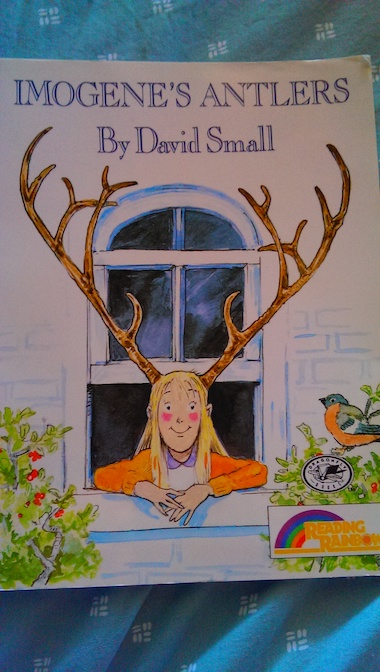
One day, a young girl named Imogene wakes up to find that she has sprouted antlers during the night. It comes as a shock to the rest of her family, and she finds that it’s very difficult to do things with large antlers sticking out of her head.
No one seems to know why Imogene has sprouted antlers or what to do about them. Imogene’s mother faints just about every time she looks at her daughter, and her attempt to help Imogene hide them with a specially-designed hat is pure disaster. Imogene’s brother, Norman, thinks that Imogene might be a rare kind of elk now.
However, Imogene still has a lovely day as the family maid uses her as a rack to dry towels and the cook decks out her antlers with donuts to feed the birds. She even puts candles on her antlers as an elaborate candelabra while she practices her piano lesson.
Still, it’s a most bizarre day, and her family is relieved when the antlers are gone the following morning. But, Imogene’s adventures may only be just beginning.
The book never offers an explanation for why Imogene grew antlers or why she now has a peacock tail, but it doesn’t really matter. This is just one of those books that’s fun to read because it’s silly. While Imogene’s mother panics over her daughter’s condition and tries to hide it under a ridiculously big hat at one point, readers don’t have to worry about the long-term implications of Imogene’s antlers (or any other animal transformations) because she just enjoys them for what they are. The peacock feathers may not have as many practical uses as the antlers did, but one can imagine that Imogene will make the most of them while she has them. I loved this book when I was a kid!
Mirette on the High Wire by Emily Arnold McCully, 1992.
About 100 years ago (the book says, so it’s around the 1890s), a young girl named Mirette and her widowed mother run a boardinghouse in Paris. Most of the people who live there are actors and performers of various kinds.
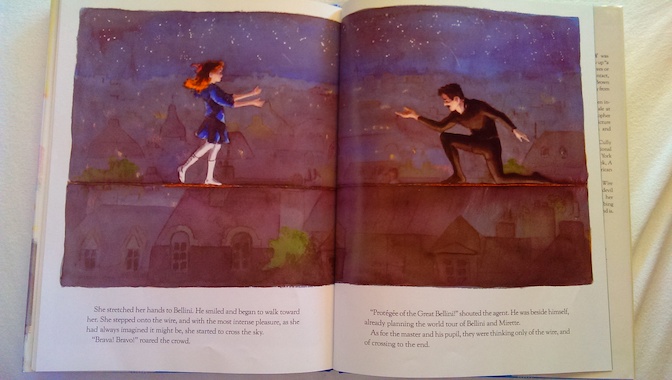
One day, a strange, quiet man named Bellini comes to stay at the boardinghouse. Most of the time, Bellini prefers to keep to himself, but then Mirette catches him walking on the rope they are using for clothesline in the courtyard of the house. It turns out that Bellini is a tightrope walker. Mirette begs him to teach her how to do it, but he refuses.
Not to be daunted, Mirette begins experimenting with tightrope walking herself. After repeated falls, Mirette eventually learns to balance on the rope. When she shows Bellini that she can walk the length of the rope, he is impressed with her perseverance and teaches her more things to develop her skills. However, he becomes very upset when she boasts that she will never fall again.
Mirette learns that Bellini was a world-famous tightrope walker until a friend of his was killed in a fall, and he lost his nerve. She talks to Bellini about it, and he says that he doesn’t know how to get over being afraid. Seeing Mirette’s disappointment and worry, however, gives Bellini the courage to try once again.
After talking with a performing agent staying at the boardinghouse, Bellini arranges a performance where he will walk a tightrope over a Paris street. When Mirette sees him hesitating at the beginning of the performance, she joins him on the wire, bolstering his courage and realizing her own dreams of becoming a real tightrope walker.
There are other books in a series about Mirette and Bellini, where they perform tightrope acts and have adventures around the world, but I think that the first book is really the best. The pictures are beautiful, done in an impressionistic style.
This book is a Caldecott Award winner. It is currently available online through Internet Archive.



















 Jestress's Forgotten Books and Stories