The True Tale of Johnny Appleseed

JohnnyAppleseed

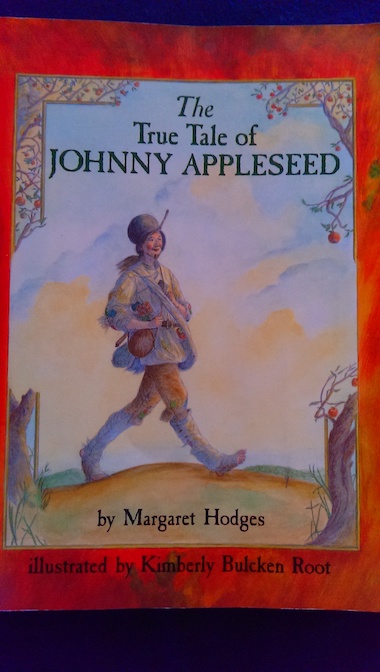
The True Tale of Johnny Appleseed by Margaret Hodges, 1997.

This American folktale was based on the life of a real person, John Chapman.

Johnny Appleseed was born as Johnny Chapman in 1774. His family lived in Massachusetts. There were plenty of apple trees there, and Johnny loved them. When he was grown, he started traveling west with the idea of spreading apple trees.

He carried very little with him, and some people said that he wore the pot that he used to cook his meals on his head as he walked. Everywhere he went, he planted apple seeds.

His reputation spread, and although people thought that traveling around just to plant apple seeds sounded crazy, they sometimes let him stay with them on his travels. Even Native Americans seemed to like him because he was friendly and helpful and interested in learning their languages. His legacy continued long after his death with trees that were enjoyed by generations of families across the Midwest.

There is a section in the back of the book that explains more about the history behind Johnny Appleseed’s story, including the end of the Revolutionary War and the beginning of westward migration in America. One of the things they mention is the effect that the War of 1812 had on relations between pioneers and Native Americans. Because pioneers were already pushing into the territory of Native Americans in the area that later became Ohio, the tribes there sided with the British in the war, hoping to push out the invading pioneers. After the war was over, though, the pioneers continued to come west, and when they did, they retaliated against the tribes that had been on the side of the British. The pioneers could be brutal, and part of the reason that Native Americans liked Johnny Appleseed was that he was different. He wasn’t trying to hurt anyone or take land for himself; he just wanted to plant trees. After he planted trees, he would build fences around them to keep animals from eating them while they were growing.

John Chapman’s life was unconventional.  He never married, and he acted as a Christian missionary in his travels as well as a planter.  Although he could be regarded as something of an oddball in the itinerant way he lived his life, he became a legend.

The book is currently available online through Internet Archive.

Paul Bunyan and Babe the Blue Ox

PaulBunyan

Paul Bunyan and Babe the Blue Ox by Jan Gleiter and Kathleen Thompson, 1985.

This story is based on an American folktale that was used to promote the logging industry. The book doesn’t explain the background to the story, but in a very literal sense, it is a “tall tale.”  The book is part of a series about legendary figures from history and myth.

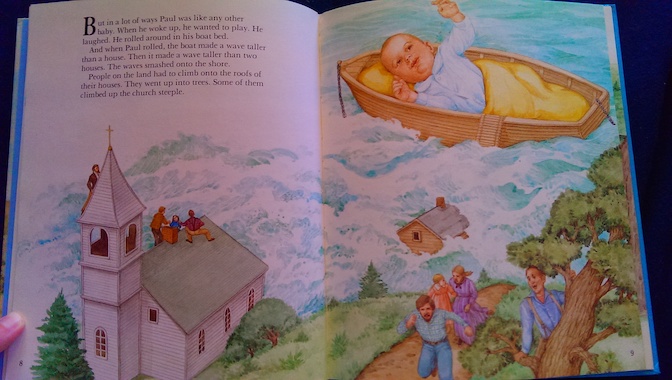
Paul Bunyan is a giant of a man, and he was a giant since he was a baby, even though his parents were both of normal human size (no explanation given). Because he was never small enough to fit in his parents’ house, they made a large boat for him to sleep in as a cradle, rocking him to sleep on a river. Needless to say, having a giant baby complicates everything and can pose a real risk to everyone. His parents had to teach him early about what he could and couldn’t do so that he would avoid hurting people.

PaulBunyanBaby

However, Paul discovered early that he was skilled with an ax, and because of his great size and strength, he realizes that he is good at cutting down trees. Because this was the frontier days in America, good loggers were in demand because trees were plentiful and wood was needed to build houses and railroads. (Paul Bunyan would not be such a hero for cutting down whole forests today.)

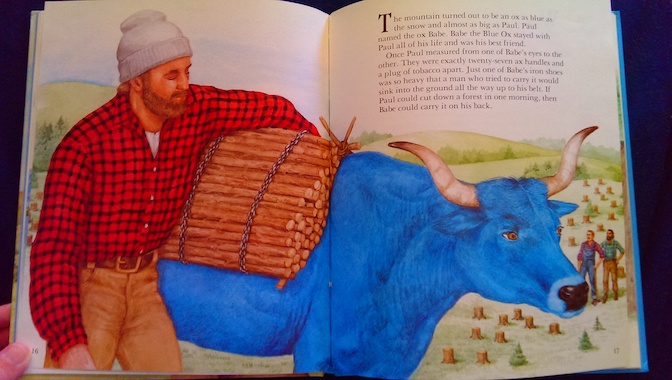
However, a giant of a man can also be lonely when there’s no one around his own size. Paul finds a companion in a giant blue ox. (Yep, that’s part of the traditional story.) He found the ox partly buried in a blizzard. After he dug it out, he named it Babe, and the two of them became lifelong friends.

PaulBunyanBabe

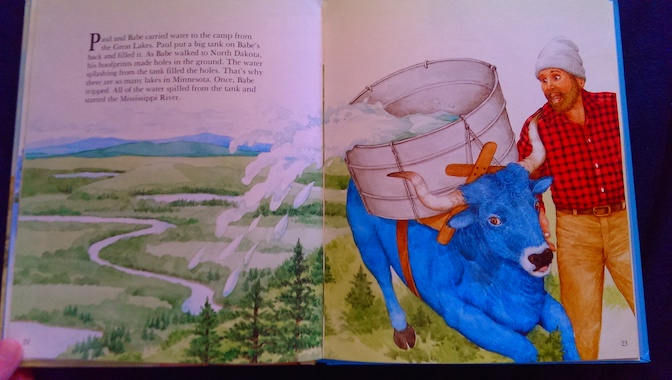
Part of the story is that the Mississippi River and all the lakes in Minnesota were caused by Babe accidentally spilling water that he was carrying on his back. Paul also supposedly dug the Grand Canyon by accident by dragging his ax behind him when he walked to California.

PaulBunyanBabeSpill

Paul also meets a man named Hals Halvorsen who is almost his size. After trees get cut down, Paul and Hals pound the stumps into the ground with their fists to finish clearing the land. Then, they try planting some corn to see how good the land is for farming, but the corn stalk grows up so high that Hals nearly starves to death while climbing it to try to find the top of it.

PaulBunyanHals

The part of the story I liked the best as a kid was when they made gigantic pancakes for Paul Bunyan and Babe, greasing their giant griddle by basically skating across its surface with grease strapped to their feet.

PaulBunyanPancakes

I can’t say that this was one of my favorite folktales as a kid, and my feelings as an adult about deforestation don’t make me feel good about it now. Still, it is an interesting piece of Americana and a little nostalgic.  As a side note, Paul Bunyan was used as a mascot for a pancake restaurant in an episode of Disney’s Phineas and Ferb (which has also been done in real life).  In that episode, Norm, a giant robot, accidentally gets the head of the Babe statue outside the restaurant stuck on his head, causing Phineas and Ferb to think that they are being chased by a Minotaur.  Now that I think about it, this joke’s use of Paul Bunyan and Babe the Blue Ox makes me smile more than the original version of the story.

The book is currently available online through Internet Archive.

Katy Comes Next

KatyComesNext

Katy Comes Next by Laura Bannon, 1959.

Ruth is little girl whose parents own a doll hospital. She has always been proud and fascinated by how her parents can make old or damaged dolls beautiful again.

KatyComesNextDollShop

However, Ruth’s own beloved doll, Katy, is in need of repair herself. As her parents rush around repairing dolls for their customers, they keep assuring her that Katy’s turn will come next.

KatyComesNextRuthsFather

After being put off repeatedly, Ruth starts to think that poor Katy will never get the attention that she needs.

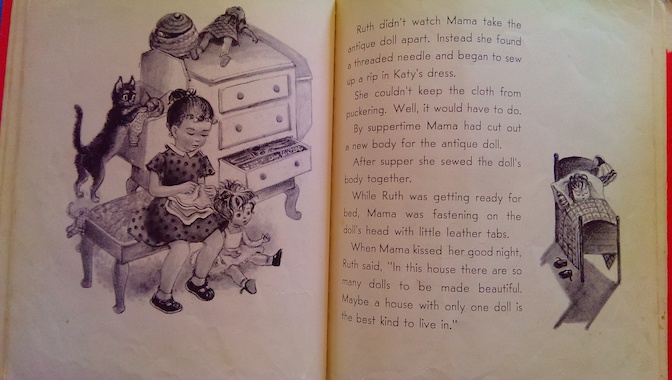
KatyComesNextRuthMending

When Ruth’s parents realize how discouraged she is, they decide to take a day off for Katy to come first.

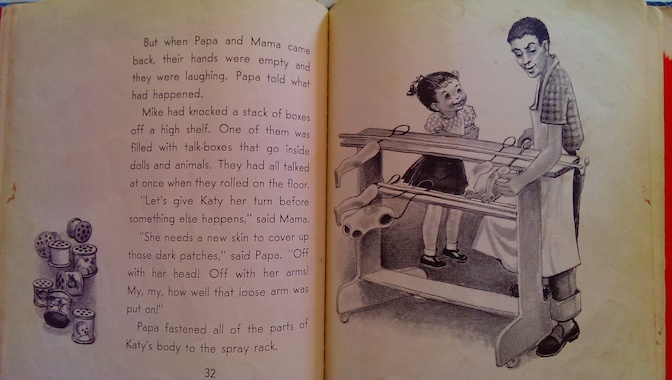
KatyComesNextFatherPaintSpray

This was one of absolute favorites when I was little!  The pictures alternate between black and white and color and show the process that Ruth’s parents go through to repair Katy, repaint her body and features, and give her new hair and eyes.

KatyComesNextWigs
KatyComesNextClothesTrunk

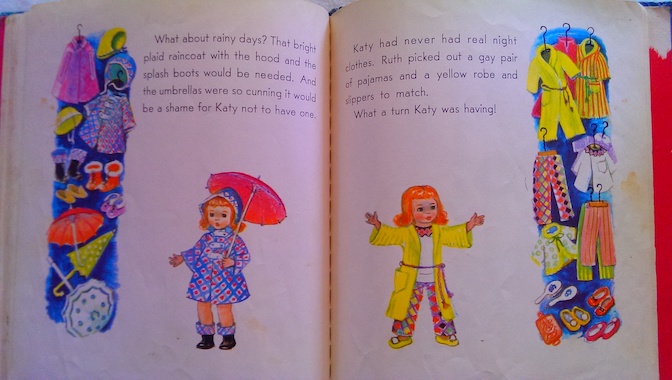
Ruth also gets to pick out an entirely new wardrobe for Katy. I was always fascinated with the description of how Ruth’s parents fixed the doll, and I enjoyed imagining the doll clothes that I would have selected from the ones they showed in the pictures.  Making the choices is half the fun!

KatyComesNextDresses
KatyComesNextPajamas

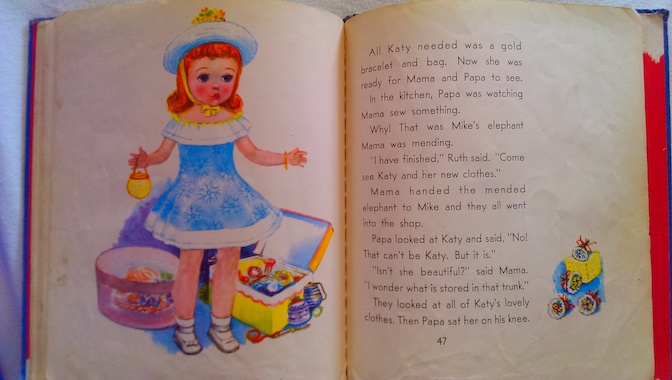
When Katy is finally finished, she looks beautiful, and Ruth is happy!  This is one of the many out of print children’s books that I wish would come back into print!

KatyComesNextPartyDress

The Stinky Cheese Man

StinkyCheeseMan

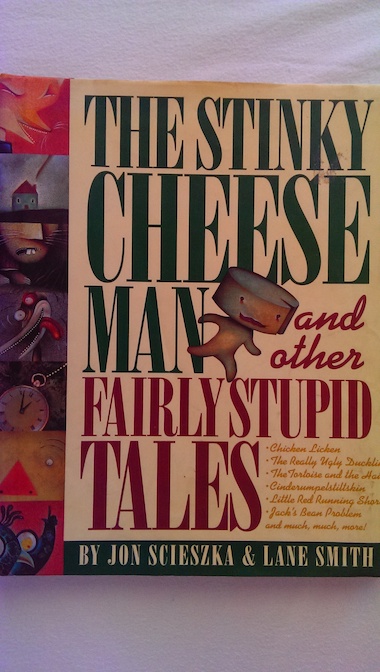
The Stinky Cheese Man and Other Fairly Stupid Tales by Jon Scieszka and Lane Smith, 1992.

StinkyCheeseManDuckThis book is a spoof on a number of classic fairy tales. As it explains in the introduction, the short stories included in the book are more Fairly Stupid Tales than Fairy Tales, giving the example of Goldilocks and the Three Elephants: A girl smells peanut porridge and wants to enter the elephants’ house to eat some and try out their furniture, but elephant furniture is too big for her to climb up on, so she just leaves, The End. That incredibly short story isn’t found anywhere else in the book, but it’s a good example of what the other stories are like.

Even the set up of the book is a joke, with the Little Red Hen showing up to demand help with her wheat only for Jack the Narrator to tell her that it’s too soon because they haven’t even had the title page yet. The title page has the words “Title Page” larger than the title itself, and the dedication is upside down because who would actually read it anyway? Then, Chicken Licken thinks that the sky is falling and that everyone should run and tell the President, but it turns out that what’s falling is actually the Table of Contents, which squashes everyone before Foxy Loxy can eat them.

Then, the rest of the stories begin:
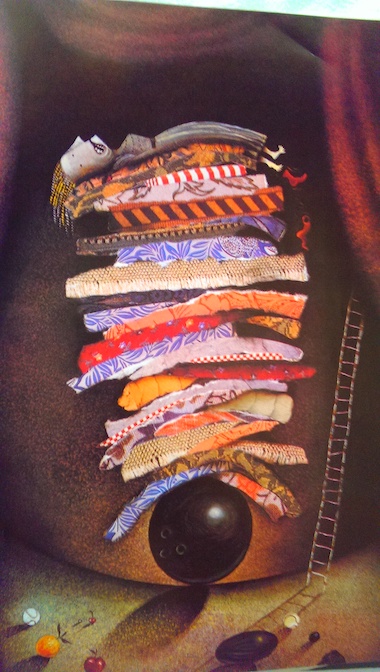
StinkyCheeseManMattressesChicken Licken – As described above

The Princess and the Bowling Ball – parody of the Princess and the Pea – Starts off like the original story with the prince’s parents testing princesses to see if they can feel a pea through a whole bunch of mattresses, but none of them ever do, so the prince takes matters into his own hands to rig the test in favor of the girl he really wants to marry.

The Really Ugly Duckling – parody of The Ugly Duckling – When the really ugly duckling grows up, he’s basically just an ugly duck. The End.

The Other Frog Prince – parody of The Frog Prince – The frog isn’t really a prince. He just said that because he wanted a kiss.

Little Red Running Shorts – parody of Little Red Riding Hood – Jack the Narrator accidentally spoils the story by revealing too much in his introduction to it, so the characters feel like there’s no need to act it out, and the Little Red Hen fills up the extra space, demanding to know why they haven’t gotten to her story yet.

Jack’s Bean Problem – parody of Jack and the Beanstalk – Jack the Narrator starts to tell his own story about defeating the Giant, but the Giant protests because he doesn’t like always being tricked and takes control and reads a story that he “wrote” himself, cut out of pieces of other random stories from different books. When the Giant threatens to eat Jack if he can’t tell a better story, Jack tells a story that constantly repeats until it transitions into the next one.

Cinderumpelstiltskin – parody of Cinderella and Rumpelstiltskin – Starts out like the usual Cinderella story, but Rumpelstiltskin shows up and offers to teach her how to spin straw into gold. Cinderella doesn’t see how that can possibly help her since he doesn’t have a gown for her to wear to the ball, so she ends up without either a gown or any gold.

The Tortoise and the Hair – parody of The Tortoise and the Hare – A rabbit tells the tortoise that he’s so slow that he can grow hair faster than the tortoise can run. By the end of the story, the tortoise is still running, and the rabbit is still growing hair.

The Stinky Cheese Man – parody of The Gingerbread Man – An old couple make a “child” for themselves out of stinky cheese. When he takes on a life of his own and run away, they don’t bother to chase him because they can’t stand the smell. Nobody else wants to chase him, either.

StinkyCheeseManCinderSo, why isn’t there a Little Red Hen story listed? At the end of the book, she shows up to complain about how she had to do everything herself to make the bread and nobody even saved space for her story (because Jack had to sneak away from the Giant after he fell asleep). The Giant wakes up and decides to make a chicken sandwich with the bread.

Understanding the jokes in the book requires a knowledge of the stories they’re spoofing, so this isn’t a book for very young children. Any kid who reads this should already know the classic fairy tales and be old enough to appreciate the humorous twists. I think kids feel clever when they realize that they can recognize the references in the stories and know where and how the parodies are different from the originals. Some of the humor has to do with the abrupt endings, simplifying issues that are more drawn-out in the original stories.  I remember liking this book when I was in elementary school!

The art style is very distinctive, with a number of cutout elements with different textures. It’s fascinating to see the way that the pictures were put together.

The book is currently available online through Internet Archive.
The Paper Bag Princess

PaperBagPrincess

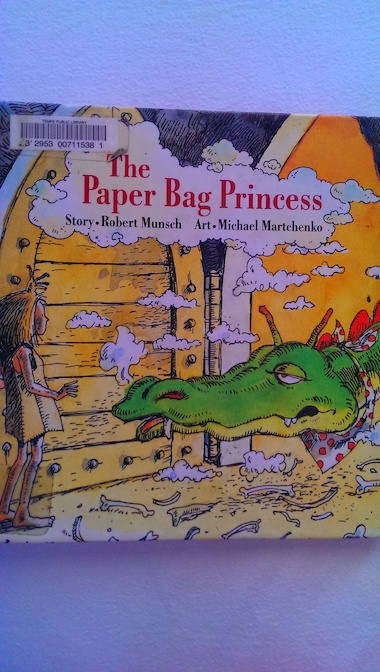
The Paper Bag Princess by Robert Munsch, 1980.

Princess Elizabeth is a stylish young princess, engaged to the handsome Prince Ronald. But, one day, a dragon attacks her castle, incinerating all of Elizabeth’s fine clothes and carrying Ronald off to its lair.

Donning the only thing she can find to wear, an old paper bag, Princess Elizabeth tracks the dragon down to rescue Ronald.

In this unconventional fairy tale story, Princess Elizabeth must defeat the dragon in a duel of wits in order to rescue her prince, but in a humorous twist ending, Ronald is somewhat less than grateful for her help because Princess Elizabeth is no longer stylish in her old paper bag.

The book is available to borrow and read for free online through Internet Archive.

PaperBagPrincessRonaldRescued

My Reaction

Books like these can be a good antidote to people who are tired of prissier princess stories with flamboyant gowns and a wedding (or at least kissing) at the end. The story is deliberately humorous and correct in pointing out that people who worry more about the clothes you’re wearing than the things you do for them are not worth bothering with.  Prince Ronald is shallow. He has the look of a prince but not much substance, caring more about appearances than about what his princess went through for his sake.

Ella the Elephant

EllaElephant

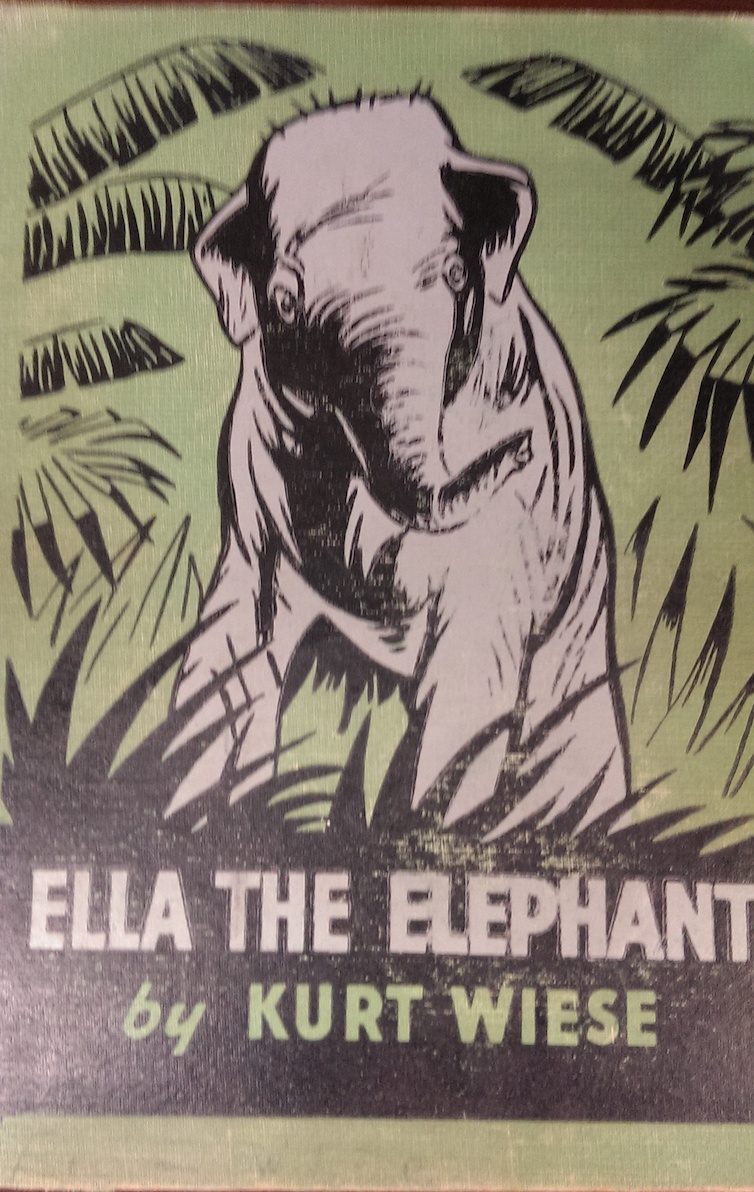
Ella the Elephant by Kurt Wiese, 1931.

EllaElephantMotherElla is a happy baby elephant in India.  Her mother takes good care of her, and she enjoys moving with the herd.  However, Ella’s carefree life with her mother ends abruptly when the herd is captured by humans!

Because Ella is small, she is able to escape when the other elephants can’t, but she finds herself alone and frightened in the jungle.  She doesn’t know what has happened to her mother, and she is in danger from predators in the jungle.

Other jungle animals help her, warning her of dangers and helping her to find out where her mother is.  She knows to look out for crocodiles in the river, and a peacock and some monkeys warn her about the presence of the tiger.  A kind water buffalo looks after her at night, using its size to intimidate and keep away the tiger.  The parrots help her to find the village where her mother is being held.  Eventually, she reunites with her mother in the human village after she is captured a second time.

I found this book at an antique store and included it here because I’d never seen it before, but I have mixed feelings about it.  The part about other animals helping little Ella is fun, but it’s somewhat disappointing that the story ends with both Ella and her mother in captivity.  The story ends with Ella’s reunion with her mother, and we don’t know exactly what happens to them after that. It appears that Ella and her mother will both be treated well by the humans who now have them, and they are relieved to see each other.  Still, to have them now living in captivity seems anti-climactic.

The Blind Men and the Elephant

BlindMenElephant

The Blind Men and the Elephant retold by Lillian Quigley, 1959.

This story is based on an old folktale from India.

Six blind men, who all live together, realize that although they have heard a lot of people talk about elephants, none of them has ever seen one and that they don’t really know what elephants are like.  They have heard that the Rajah, whose palace they live near, has many elephants, so they decide to go to the palace to learn more about them.

BlindMenElephantCourtyard

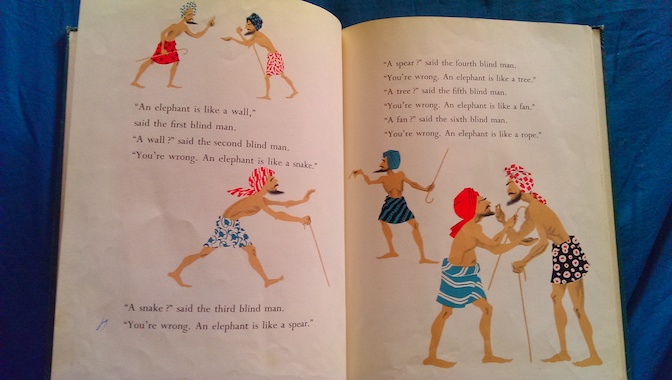
When they reach the palace, where a friend of theirs works, there is an elephant in the courtyard, so the blind men start feeling it with their hands.  Because the elephant is large, each of the men ends up feeling a different part of the elephant and coming to different conclusions about what the elephant is like.

BlindMenElephantImpressions

As they stop to take a rest, they begin arguing about their conclusions because their experiences of the elephant were very different from each other’s.  When the Rajah hears them arguing, he explains to them that the problem is that each of them is only talking about one part of a very large animal and that if they really want to know what elephants are like, they must consider all the pieces together.  Recognizing the wisdom of what the Rajah says, the men sit down and discuss what they’ve learned more calmly.

BlindMenElephantArgument

The book doesn’t explain the background of the story, but the folktale is famous and is often used to describe situations where people each understand only part of a larger truth or where people stubbornly argue about very complicated issues from very limited viewpoints without considering all sides.

BlindMenElephantEnd

Why Mosquitoes Buzz in People’s Ears

Mosquitoes

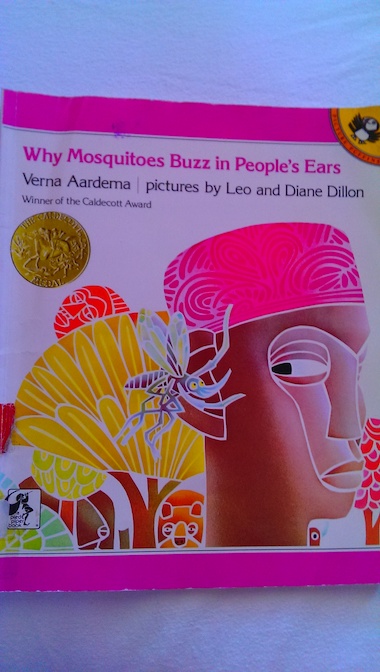
Why Mosquitoes Buzz in People’s Ears retold by Verna Aardema, pictures by Leo and Diane Dillon, 1975.

The story comes from a West African folktale, and all the characters are animals.

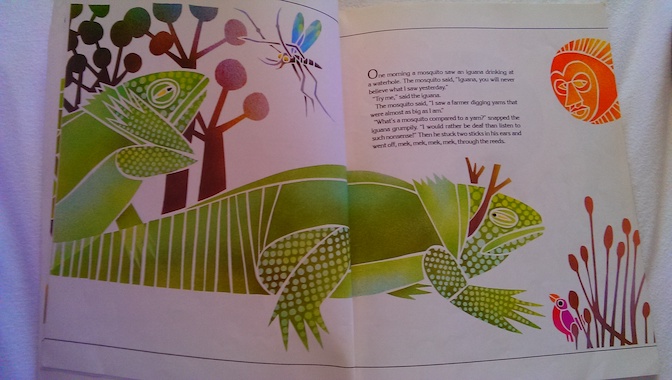
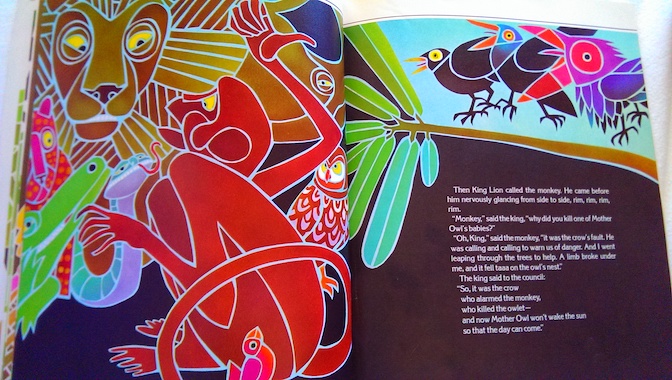
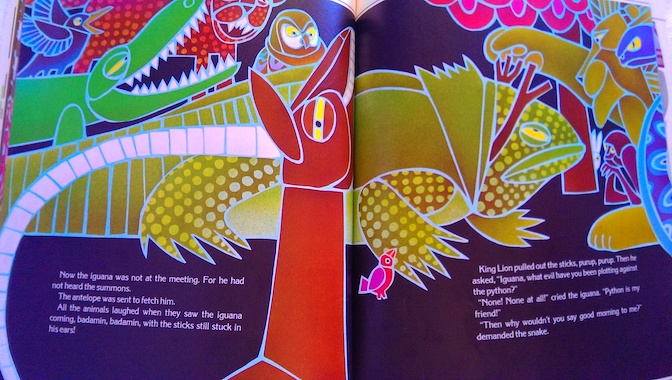
In the beginning, a grumpy iguana gets tired of hearing a mosquito telling tall tales. He sticks a couple of sticks in his ears so that he won’t have to listen anymore, and this decision leads to a series of unfortunate events that leads to the accidental death of a baby owl.

MosquitoesIguana

It starts with a snake trying to talk to the iguana, who does not hear him. The snake, thinking that perhaps the iguana is angry with him, goes to hide from him in a rabbit hole, startling the rabbit out. The chain reaction of events continues, with different animals startling each other, until a frightened monkey crashes through a tree branch, which breaks, killing the baby owl.

MosquitoesMonkeyTree

The Mother Owl is so distraught at the death of her baby that she doesn’t wake the sun so that dawn can come, as she usually does. When the other animals realize that dawn isn’t coming, King Lion calls a meeting to determine the reason why. Together, they trace the events backward to the iguana. The iguana is not at the meeting because he still has sticks in his ears and hasn’t heard a thing about it.

MosquitoesMeetingMonkey

When the other animals track down the iguana and take the sticks out of his ears, they demand to know why he wouldn’t talk to the snake. When he tells them that he had sticks in his ears because he couldn’t stand listening to the mosquito’s stories anymore, the mosquito ends up taking the blame for everything. The Mother Owl is satisfied with the explanation and hoots to wake up the sun, although the mosquito escapes punishment by hiding. So, ever since, the mosquito whispers in people’s ears to find out if everyone is still angry.

MosquitoesMeetingIguana

The art style in the book is a little unusual. When I looked at the pictures the first time, I thought of them as looking stenciled. However, there is a note in the beginning of the book, near the copyright information, that says that the pictures are a combination of watercolors and india ink. The artists used an airbrush and pastels, and they created the “cut-out effect” with frisket masks and pieces cut out of vellum.

This book is a Caldecott Award winner. It is currently available online through Internet Archive.

The Great Kapok Tree

KapokTree

The Great Kapok Tree by Lynne Cherry, 1990.

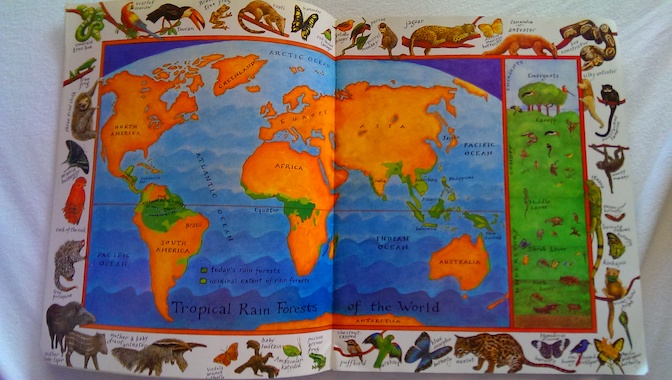
The book begins with a letter from the author, saying that she wrote the book in order to explain to people the importance of rain forests and why they should be preserved.

KapokTreeMap

Two men are walking through a rain forest. They are there to cut down the trees (probably for farming). The animals watch as one of the men begins chopping at a great Kapok tree with his axe. It’s hard work, and before the man gets very far with his chopping, he has to stop and rest.

As the man sleeps, the animals come to him and whisper to him not to chop the tree down. The boa constrictor tells him that his ancestors have lived there for generations. The monkeys tell him that if he chops all the trees down, there will be no tree roots to hold the soil in place, and it will wash away, eventually changing the land into a desert. The birds are worried because people use fire to help clear the forest, and it destroys everything. All of the animals are worried about where they will live and what they will eat if the forest disappears.

KapokTreeButterflies.jpg

The animals also point out to the man that destroying this forest would also be destroying his own future and that of his children. The forest produces oxygen for humans to breathe.

KapokTreeChild

Finally, a human child from the Yanomamo tribe that lives in the forest asks the man to wake up and look at him and all the animals. The man is startled and amazed by what he sees. He thinks about continuing his work, but seeing the child and all of the animals staring at him silently, hoping that he won’t, he decides that he can’t bring himself to do it and leaves.

KapokTreeEnd

I don’t remember reading this book when I was a kid, but I remember other stories very much like it.  Environmental issues like this were common topics of discussion when I was in elementary school during the early 1990s.  One of the movies of my childhood, FernGully, came out in 1992, a couple of years after this book was first published.  That movie is also based on a book, although it has even more fantasy elements than this story, which has talking animals.  Both of these stories demonstrate how many children during the 1990s were raised to be environmentally aware.

This is a Reading Rainbow Book. It is currently available online through Internet Archive (multiple copies).

Tawny Scrawny Lion

TawnyScrawnyLion

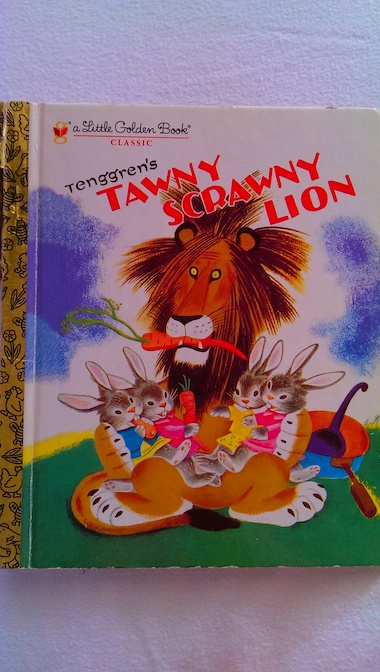
Tawny Scrawny Lion by Kathryn Jackson, illustrated by Gustaf Tenggren, 1952.

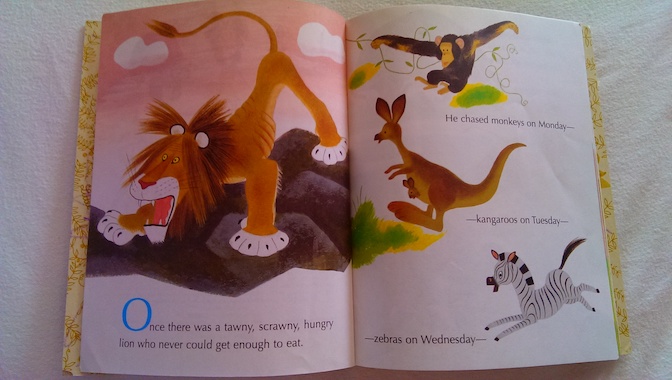
The tawny, scrawny lion can never get enough to eat! No matter how much he hunts and eats, he’s always hungry, and his ribs are showing. He thinks that it’s because hunting is so much work that he wears off anything he eats right away. If only the other animals didn’t run so much, trying to get away from him! (Gee, I wonder why.) He tries to tell the other animals that if they would just not run so much, he would have to eat less of them. Needless to say, that argument doesn’t impress them much.

TawnyLionHungry

Trying to get the lion to stop chasing the rest of them, the other animals convince the fat rabbit to go “talk things over” with the lion, thinking that if the lion eats the fat rabbit, he’d get fat for awhile and leave the rest of them alone.

Seeing how scrawny the lion is, the rabbit decides to invite the lion to join him and his siblings at his house for dinner. The lion likes the idea of going to the rabbits’ house, thinking of the nice dinner he could have on all the fat little rabbits, but things don’t turn out the way that the lion thinks they will.

TawnyLionRabbitTalk

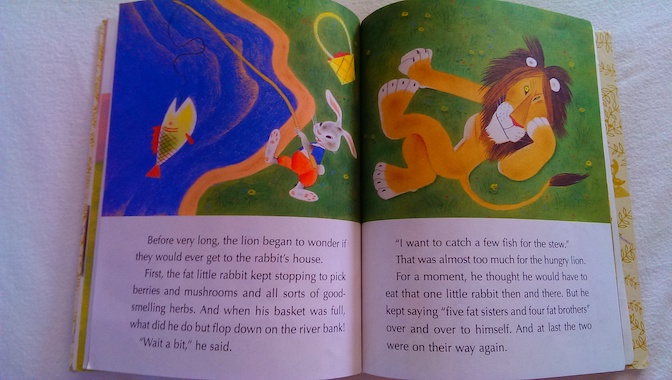
The rabbit tells the lion that they are making carrot stew tonight, but before they can eat, they need just a few more things for the stew. The lion follows the rabbit around as he gathers berries, mushrooms, and herbs and catches a few fish to add to the stew. By the time they’re done with all of that, the lion is too hungry and exhausted to chase the rabbits, so he accepts some of their stew instead.

TawnyLionFishing

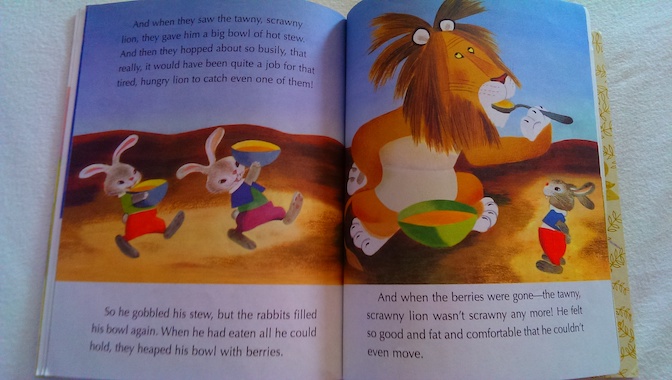
To the lion’s surprise, the stew is actually very filling, and when he has eaten it, he isn’t hungry anymore. For the first time, he feels fat and satisfied. Because of that, the lion ends up not chasing the other animals anymore but helping the rabbits catch fish and gather berries for more of their amazing, wonderful stew!

TawnyLionStew

This is a popular Little Golden book that kids have loved for generations! The stakes are high for the rabbits, who could be eaten by the lion, but I think kids know that the rabbits are going to find a clever way to satisfy the lion without getting eaten. I think it’s also not bad to have a story that points out that, if you aren’t healthy eating the things you’re eating, it’s okay to change.

It is currently available online through Internet Archive (multiple copies).