Josephine’s Toy Shop

JosephineToyShop

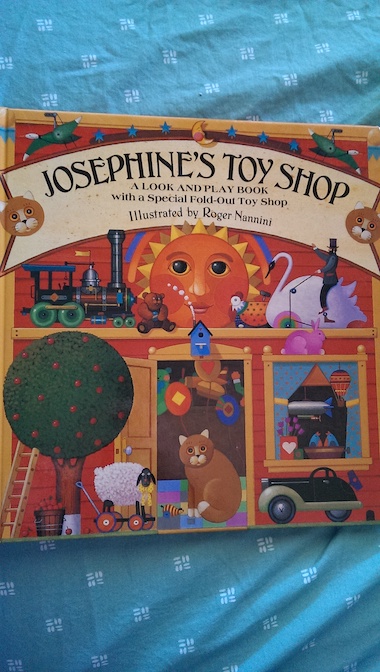
Josephine’s Toy Shop illustrated by Roger Nannini, 1991.

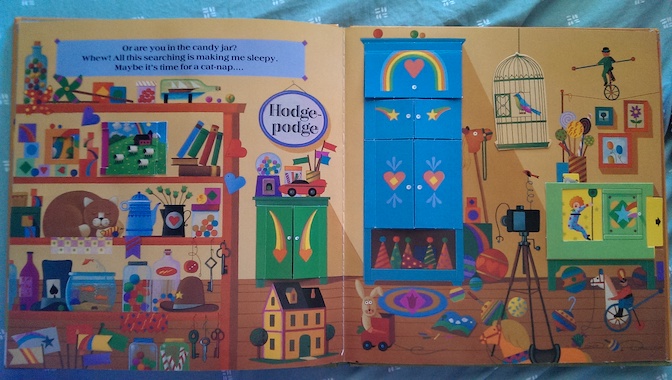
Josephine the Cat lives in a toy shop that bears her name.  The toy shop is full of all kinds of wonderful toys, but Josephine’s favorite toy is Toy Mouse.  There is also a real mouse in the shop, and Josephine is looking for it.

JosephineToyShopFlying

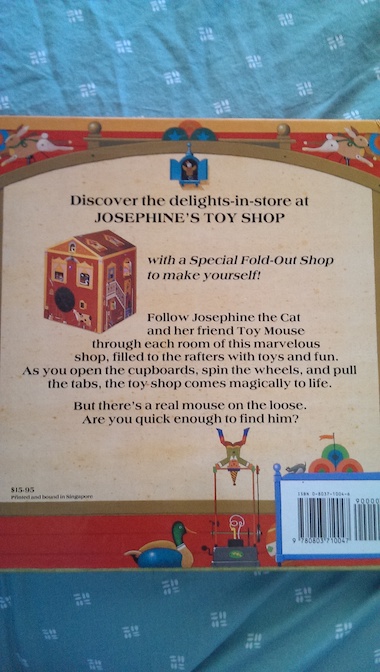
Readers follow Josephine and Toy Mouse through the shop, spotting them and the real mouse, hiding in the busy, colorful pictures.  This is also a lift-the-flap book so kids can look behind doors and pull tabs to move objects.

JosephineToyShopNap

In the back of the book, there is a fold-out model of the toy shop that readers can put together with the front of the book forming the front of the shop.

JosephineToyShopBack

The Surprise Doll

SurpriseDoll

The Surprise Doll by Morrell Gipson, 1949.

Mary is a little girl who lives by the sea. Her father is the captain of a ship, and he travels to different countries all over the world. Sometimes, he brings presents for Mary from his voyages. So far, he has brought six dolls for her:

SurpriseDollTeresaSusan – from England, with rosy cheeks

Sonya – from Russia, with a cute turn-up nose

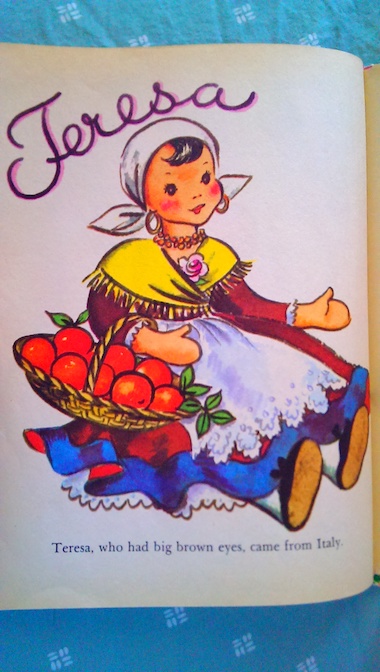
Teresa – from Italy, with brown eyes

Lang Po – from China, with raised eyebrows

Katrinka – from Holland, with blonde hair

Marie – from France, with a smile that brightens her whole face

Mary loves her dolls, but she realizes that if she had a seventh doll, she would have a doll for each day of the week. She asks her father if he will bring her another, but he says that she already has enough dolls.

When her father refuses her request, Mary pays a visit to the local dollmaker. She takes along her six dolls and explains to the dollmaker why she wants one more. After studying Mary and her dolls, the dollmaker agrees to make one for her as long as she’s willing to leave her other dolls with him for a week. At the end of the week, Mary returns to collect her new doll and receives a surprise!

SurpriseDollDollmaker

The “surprise” isn’t much of a surprise to the readers because the “surprise doll” is shown on the cover of the book, but it’s a cute story about how people around the world have many things in common. What the dollmaker notices about Mary and her dolls is that Mary shares certain qualities with each doll, the ones listed in the dolls’ descriptions above. So, he makes a doll for Mary that looks just like her by using her other dolls and their shared features as models. Her new doll, Mary Jane, is an American doll, but she has features in common with Mary’s other dolls from around the world, just like children in America can share qualities with children in other places. It’s a soft message about diversity and finding common ground.

SurpriseDollSeventhDoll

The Biggest, Most Beautiful Christmas Tree

BiggestChristmasTree

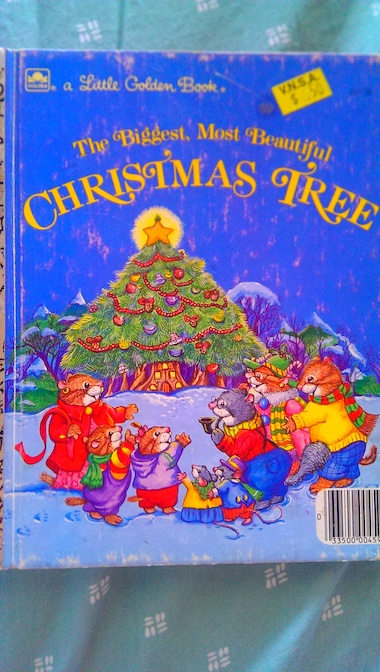
The Biggest, Most Beautiful Christmas Tree by Amye Rosenberg, 1985.

This is a Little Golden Book.

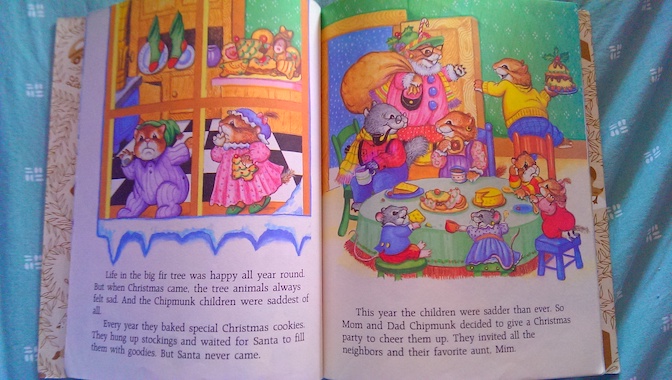
Every year at Christmas, the Chipmunk children, Nina and Nutley, are disappointed because Santa doesn’t visit their home in a large fir tree in the forest.  They always hang up their stockings and put out cookies, but for some reason, Santa never comes.

BiggestChristmasTreeDisappointment

However, this year, their Aunt Mim has figured out the reason why Santa passes them by and what to do about it.  Aunt Mim has realized that Santa can’t find their tree because it looks like every other tree in the forest.  What they have to do is to decorate their tree so that Santa can find it among all the others.

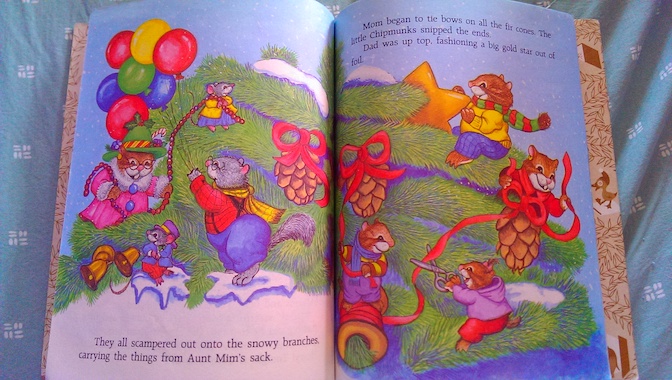
Aunt Mim brings lots of things they can use as decoration, and all of the other animals who live in the tree help with the decorating.  They tie bows on the pine cones, hang strings of berries, and paint balloons to look like large Christmas tree ornaments.

BiggestChristmasTreeDecoration1
BiggestChristmasTreeDecoration2

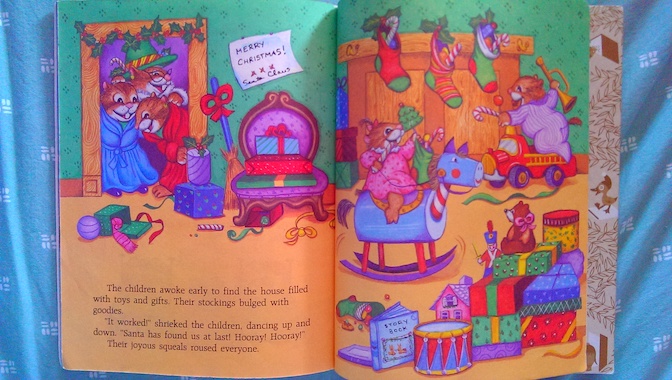
Sure enough, once Santa knows how to find the Chipmunk children, they get the kind of Christmas they’ve been waiting for!

BiggestChristmasTreePresents

This is just a cute picture book that I liked when I was young.  It is available to borrow and read for free online through Internet Archive.

Cranberry Christmas

CranberryChristmas

Cranberry Christmas by Wende and Harry Devlin, 1976.

Mr. Whiskers normally enjoys Christmas, but this year, he has problems.  To begin with, he can’t go skating on the pond near his house with the children of Cranberryport because his disagreeable neighbor, Cyrus Grape, claims that the pond is actually on his property, not Mr. Whiskers’, and has forbidden the children to set foot on it.  Mr. Whiskers is sure that he’s wrong, but he’s having trouble finding the paperwork to prove that the pond actually belongs to him.

Then, Mr. Whiskers’s sister, Sarah, is coming for Christmas.  She believes that Mr. Whiskers doesn’t take proper care of himself or his house, and she is trying to persuade him to come and live with her.  Mr. Whiskers doesn’t want to do that because he likes his independence.

To help impress Mr. Whiskers’ sister, Maggie and her grandmother help him to fix up his house for Christmas.  In the process, they discover something that helps to settle the question of who really owns the pond.

My favorite part was when Maggie and Mr. Whiskers made Christmas ornaments out of Mr. Whiskers’s seashell collection, which he had been keeping in his bathtub.

In the back of the book, there is a recipe for the cranberry cookies that Maggie makes.  The book is part of a series.

Amelia Bedelia’s Family Album

ABFamilyAlbum

Amelia Bedelia’s Family Album by Peggy Parish, 1988.

Mr. and Mrs. Rogers realize that they’ve never met the rest of Amelia Bedelia’s family, so they tell her that they’d like to give a party for her and family. Amelia Bedelia is happy about the party and shows Mr. and Mrs. Rogers some pictures of her relatives.

It turns out that her tendency to be extremely literal is a family trait. Her father is a telephone operator who operates on telephones and her mother is a “loafer” who makes loaves of bread. One of her uncles is a “big-game hunter” and has a checkers set that takes up an entire room, and another “takes pictures” in the sense that he is basically an art thief.

With each relative introduced, readers can pause for a moment to consider what each of Amelia’s relatives do, in a very literal sense, based on Amelia’s description, before turning the page to confirm it.  (I kind of identify with the “bookkeeper” because my room looks kind of like that, for similar reasons.)

In this picture book, Amelia Bedelia isn’t doing any chores or getting confused about instructions, like in other books, but all the occupation-related puns have the same feel as Amelia’s routine misunderstandings about the multiple meanings of words from the rest of the series.

The book is currently available online through Internet Archive.

ABAlbumReunion.jpg

The Little Indian Basket Maker

BasketMaker

The Little Indian Basket Maker by Ann Nolan Clark and illustrated by Harrison Begay, 1957.

By “Indian,” the author means Native American.  This book specifically focuses on the  Papago (Tohono O’odam) who live in the Southwestern United States, specifically Arizona.  The story is about a young girl who is starting to learn the traditional art of basket-making, and the book goes into the process involved in making baskets, step by step.   Although the use of “Indian” instead of Native American is somewhat antiquated, and Tohono O’odam is really the proper name for the Papago people, the book has something of an interesting history and the picture it provides of the practice of traditional crafts is fascinating. There is a section at the beginning of the book which explains a little about the history of the Papago (Tohono O’odam) people and where they live.

BasketMakerGrandmother

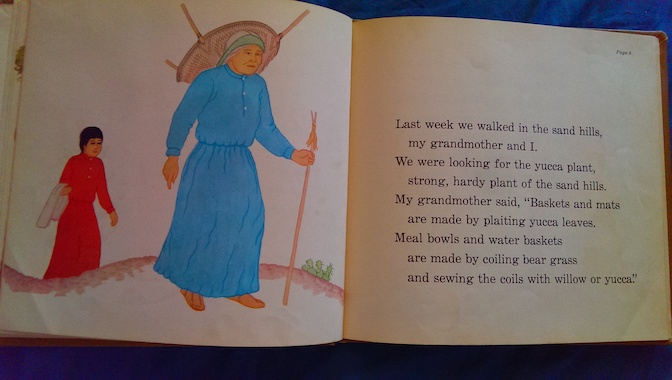
A young girl explains how her grandmother teaches her the traditional craft of making baskets.  They start by gathering the types of plants that they are going to use.

BasketMakerPlants.jpg

They also need special plants for the dye they will need in order to decorate the baskets.  The girl’s grandmother explains about the different types of decorations they traditionally use.

BasketMakerDesigns

Making baskets is a long process that includes cleaning the plants and tearing them into long strips, bleaching them, soaking them to soften them, dyeing strips used in the design, and weaving them together.

BasketMakerSoftening

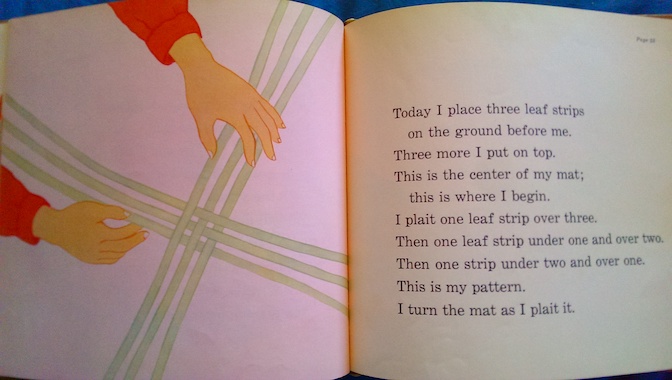
The girl weaves a mat that takes days to finish.  It is the first one that she’s made herself.

BasketMakerWeaving

She is very proud of herself when the mat is finished, and she is pleased with the quality of her work.

BasketMakerFinishing

I’ve owned this book since I was a young child, and it was my introduction to traditional crafts.  Later, I found a related book at a thrift store, The Little Indian Pottery Maker.  Until then, I hadn’t realized then just how old the books were and that there were more of them by the same author.

The book, which was written in the 1950s, was one of a group of stories (not exactly a series because they didn’t have a specific set of characters in common and the themes varied somewhat) written by a woman who was a teacher with the United States Indian Service.  The other books that she wrote, including The Little Indian Pottery Maker, focus on members of different Native American tribes.  She was not Native American herself, and the modern view of Indian schools is not favorable (for good reasons), so one might be a little suspicious of a book written about Native Americans by an Indian school teacher. However, these books interest me because of their explanation of traditional crafts. There are no white people in the stories at all, and they have a timeless quality to them.  Reading them, it’s hard to get a sense of exactly when the stories take place because it’s never mentioned, and there aren’t many clues (no mentions of modern technology, it’s all about the crafts).  I haven’t found any of the other books that the author wrote, but these two are very respectful in their tone, and they begin with explanations of the history of the tribes involved in the stories.  According to Andie Peterson in A Second Look: Native Americans in Children’s Books, the author was deliberately trying to write books that her Native American students could relate to.

The art style of the books vary because they had different illustrators.  The illustrator for this particular book was a Navajo painter.

The book is available to read for free online through Internet Archive.

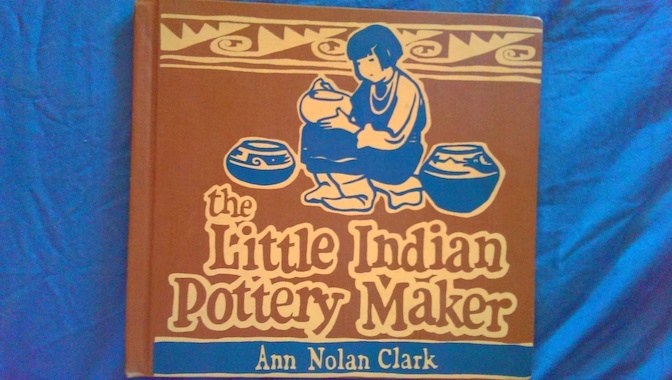
The Little Indian Pottery Maker

PotteryMaker

The Little Indian Pottery Maker by Ann Nolan Clark and illustrated by Don Perceval, 1955.

By “Indian,” the author means Native American.  This book specifically focuses on the Pueblo Indians who live in the Southwestern United States, specifically New Mexico and Arizona.  The story is about a young girl who is starting to learn the traditional art of pottery-making, and the book goes into the process involved in making pottery, step by step.   Although the use of “Indian” instead of Native American is somewhat anitquated, the book has something of an interesting history and the picture it provides of the practice of traditional crafts is fascinating. The beginning of the book explains a little about Pueblo Indians, their history, and where they live.

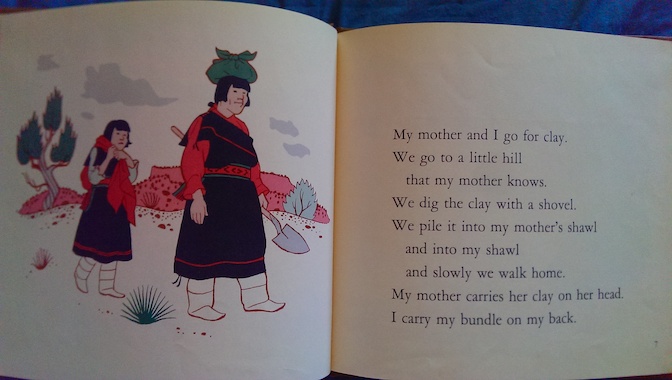
PotteryMakerGettingClay

The young girl tells the story of how her mother introduces her to the traditional craft of making pottery and teaches her how to make her first pot.  She describes every step in the process, from when they collect the clay themselves from a hillside until the pot is finally complete.

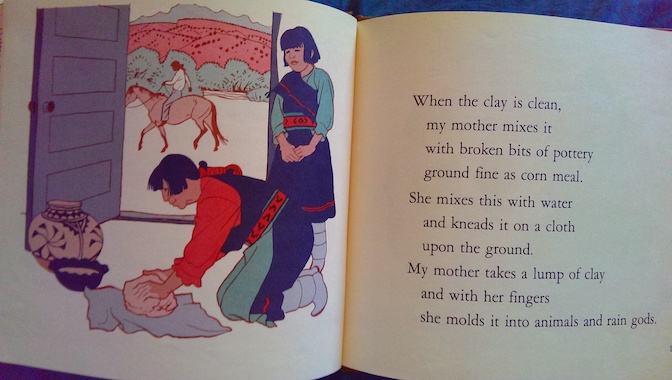
PotteryMakerMixingClay

The girl’s mother explains about the different methods used to make pots, and pictures show how pots are shaped.

PotteryMakerRollingClay
PotteryMakerMakingPots

Making pottery is a long process that takes days to complete, including shaping, scraping and smoothing the sides, drying, decorating, and finally firing the pottery.  The girl is proud of the first pot she has ever made.

PotteryMakerFiringPots

I found this book at a thrift store a number of years ago and recognized it because I already owned a related book, The Little Indian Basket Maker, that I liked when I was a young child.  I hadn’t realized then just how old the books were and that there were more of them by the same author.

The book, which was written in the mid-1950s, was one of a group of stories (not exactly a series because they didn’t have a specific set of characters in common and the themes varied somewhat) written by a woman who was a teacher with the United States Indian Service.  The other books that she wrote, including The Little Indian Basket Maker, focus on members of different Native American tribes.  She was not Native American herself, and the modern view of Indian schools is not favorable (for good reasons), so one might be a little suspicious of a book written about Native Americans by an Indian school teacher. However, these books interest me because of their explanation of traditional crafts. There are no white people in the stories at all, and they have a timeless quality to them.  Reading them, it’s hard to get a sense of exactly when the stories take place because it’s never mentioned, and there aren’t many clues (no mentions of modern technology, it’s all about the crafts).  I haven’t found any of the other books that the author wrote, but these two are very respectful in their tone, and they begin with explanations of the history of the tribes involved in the stories.  According to Andie Peterson in A Second Look: Native Americans in Children’s Books, the author was deliberately trying to write books that her Native American students could relate to.

The art style of the books vary because they had different illustrators.  The illustrator for this particular book was not Native American (unlike some of the illustrators of other books), but he was adopted into a Hopi tribe, apparently as an adult because of his accomplishments in representing Hopi culture in art.

The Legend of the Bluebonnet

LegendBluebonnet

The Legend of the Bluebonnet by Tomie dePaola, 1983.

This is a story about the Comanche People in what is now Texas, based on an old folktale.

There has been a severe drought and famine in the land for a long time, and many people have died.  The survivors pray to the spirits for help in ending the drought, and they receive a sign that it will not end until someone among the Comanches makes a sacrifice of the thing that is most dear to them.

LegendBluebonnetShaman

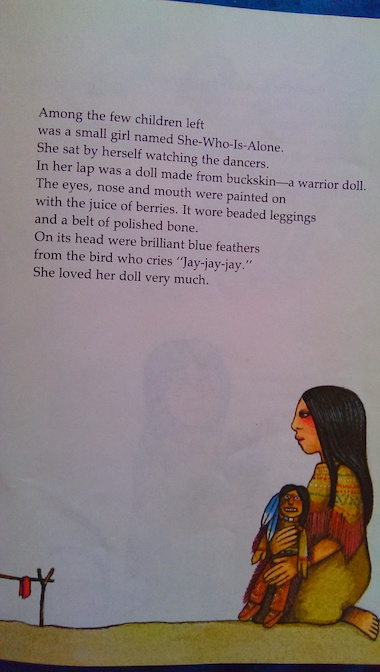
The people debate about who is supposed to make the sacrifice and what object the spirits could want, but one young girl thinks that the spirits are talking about her and her doll.  The girl is called She-Who-Is-Alone because she is the last of her family.  Her parents and grandparents are dead, victims of the famine.  The only thing she has left to remind her of them is her doll, a warrior with blue feathers in its hair, that her parents made for her before they died.

Desperate to end the drought and famine and to save her people, the girl makes the difficult decision to sacrifice her doll by burning it.  Her sacrifice is rewarded not only by the end of the drought but by the sudden appearance of a field of flowers as blue as the feathers in her doll’s hair.  The girl receives a new name from her people, acknowledging her sacrifice on their behalf.

LegendBluebonnetFlowers

A section in the back of the book explains a little about the Bluebonnet flower, which is the state flower of Texas, and the origins of the story in the book, which is based on a folktale.  This is also a little information about the Comanche People.

The book is currently available online through Internet Archive (multiple copies).

Giving Thanks

GivingThanks

Giving Thanks by Kate Waters, 2001.

This book describes the feast of 1621 that we think of as “the first Thanksgiving” from the point of view of two boys: Resolved White (a six-year-old English colonist) and Dancing Moccasins (a fourteen-year-old Wampanoag).  The book explains that the reality of this feast is somewhat different from the way many people think of it.  For one thing, the exact date is unknown, and it wasn’t really a single meal but a kind of harvest celebration that took place over several days.  The events of that celebration were re-created using reenactors from the Plimoth Plantation living history museum.

In the beginning of the book, Dancing Moccasins explains that his family has been harvesting their crops and preparing to move to the place where they live in the winter. Wampanoag lived in different places depending on the time of year, moving between them when the seasons changed.  At their winter home, they would continue hunting and fishing, returning to the place where they planted their crops at the end of winter.

GivingThanksBeginning

Similarly, Resolved’s family has finished harvesting their crops and have stored up food for the winter.  Now that most of the hard work is over, they have time to relax and celebrate.  The community is planning a feast.  Resolved and his friend, Bartle, follow some of the men, who are going out hunting and target-shooting.

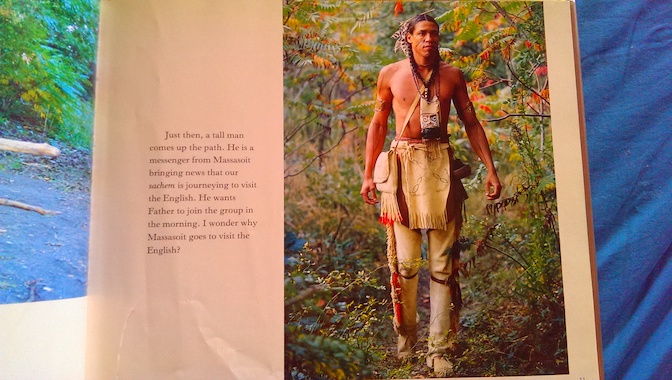
The colonists meet up with some of the Wampanoag, which is how Dancing Moccasins and Resolved first see each other.  Dancing Moccasins returns home and tells his father what he has seen.  Then, a messenger arrives from their chief, Massasoit, saying that he will be visiting the colonists soon, and Dancing Moccasins’s father is invited to come.

GivingThanksMessenger

Just as Dancing Moccasins is wondering about the purpose of this visit, Resolved is wondering the same thing because word has reached the colonists that they will soon be visited by the chief and representatives of the tribe.  (The book explains in the back that the exact reasons for the Wampanoag visit to the colonists are unknown today, only that it happened at the same time that the colonists were planning their harvest feast.) The two boys meet again when Dancing Moccasins accompanies his father on the visit to the colonists’ village.

GivingThanksGovernorDinner

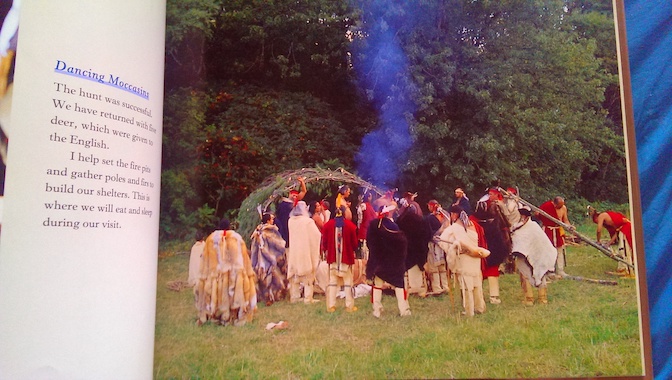
When the Wampanoag arrive at the village, they are treated as honored guests, and some of the Wampanoag go deer-hunting to provide a present for their hosts.  The chief dines with the governor of the colonists.  The Wampanoag build shelters for themselves, where they will stay during their visit.

GivingThanksShelters

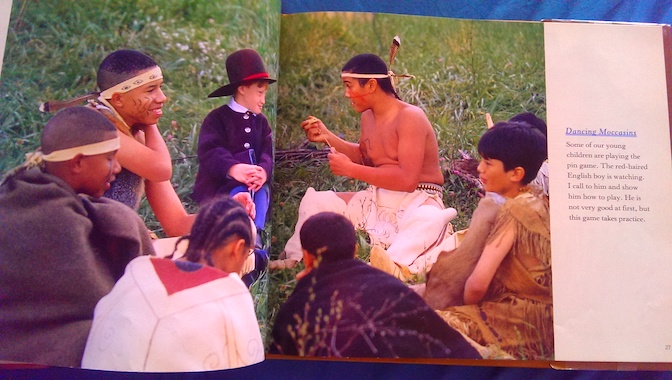
Eventually, Dancing Moccassins invites Resolved to play a game with him and some other Wampanoag boys when he sees him watching them.  Some of the Wampanoag men also join in the games that the English men play, like competing to see who can throw a log the farthest.

GivingThanksGames

At the end of the day, Dancing Moccassins and Resolved each eat with their own families, but there is plenty for everyone.

There is a section in the back with historical information about the harvest feast, traditions about giving thanks among both the colonists and the Wampanoag, and how Thanksgiving eventually became a national holiday in the United States.  There is also information about food and clothing in the time of the story and a recipe for samp (a kind of corn pottage eaten by the Wampanoag and later adopted by the English colonists).  The book also has some information about the Plimoth Plantation living history museum and the reeanctors.  It is part of a series of books by the same author about the lives of children in Colonial America.

The book is available to borrow and read for free online through Internet Archive.
Samuel Eaton’s Day

Samuel Eaton's Day

Samuel Eaton’s Day: A Day in the Life of a Pilgrim Boy by Kate Waters, 1993.

This is the story of a boy who traveled to America from England on the Mayflower and whose family lived in Plymouth, Massachusetts. The book focuses particularly on how a boy like Samuel would have helped with a harvest during the year 1627.  The role of Samuel in the book is played by a boy who is one of the reenactors at the Plimoth Plantation living history museum.

Samuel’s mother died when he was a baby, but his father remarried, and he now has a stepmother (whom he calls “Mam”) and a younger half-sister, Rachel.  Now that Samuel is seven years old, he is considered old enough to help the men bring in the rye harvest.  Samuel is eager to help because he wants to prove that he is no longer just a little boy and that he is capable of doing a man’s work.

The book begins with Samuel waking up and getting dressed in the morning.  He has a few routine chores to perform, such as getting water, gathering firewood, and checking a snare that he has set for catching wild game, before he and his father go to the fields to help with the harvest.  After breakfast, Samuel and his father meet up with a neighbor, Robert Bartlett, and go to the fields with the other men.

SamuelEatonBinding

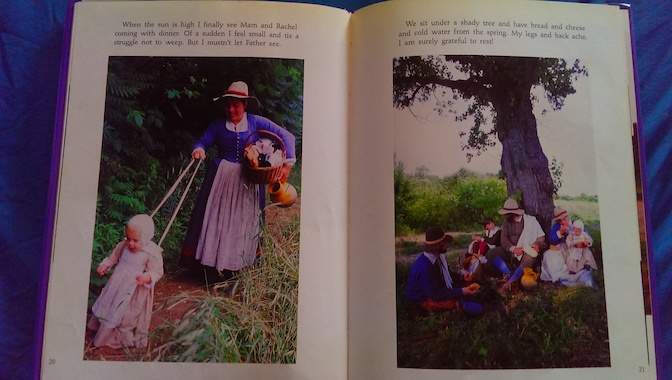
Robert Bartlett tells Samuel that it will take a few days for them to complete the harvest.  Samuel isn’t considered old enough to wield a sickle by himself, so he is given the task of gathering up the rye that his father and Bartlett cut and binding it into sheaves.  It’s hard work, and at times, Samuel wonders if he’s really up to the task.  When his Mam comes with lunch, she gives Samuel the chance to come home with her, if he is too tired, but Samuel is determined to stay and finish out the day.

SamuelEatonLunch

At the end of the day, Samuel is very tired and has blisters, but he is proud of the work he has done, and the men congratulate him.

The end of the book has a section that explains a little about the real Samuel Eaton, who eventually had his own farm when he grew up, and the boy who reenacted his life, Roger Burns.  There is also information about the clothing of the period, the Wampanoag people (seen briefly when Samuel is helping to gather mussels for the family’s dinner), the rye harvest, and the Plimoth Plantation living history museum.  The book also provides the lyrics to the song that Samuel and the others sing to entertain themselves while they’re working in the fields, The Marriage of the Frog and the Mouse.

Sarah Morton, a girl who was featured in an earlier book in the series, also appears briefly in this book.

The book is currently available online through Internet Archive.
SamuelEatonSarah