Samuel Eaton’s Day

Samuel Eaton's Day

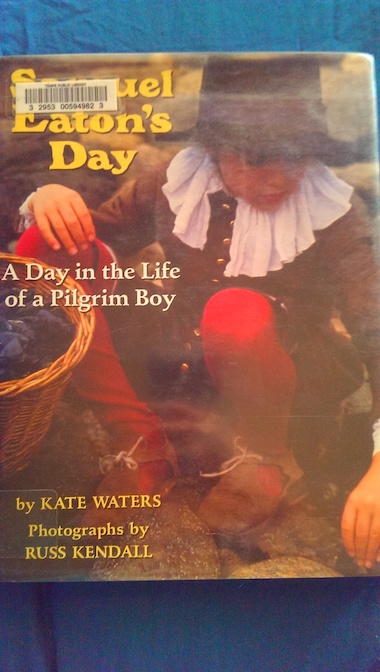
Samuel Eaton’s Day: A Day in the Life of a Pilgrim Boy by Kate Waters, 1993.

This is the story of a boy who traveled to America from England on the Mayflower and whose family lived in Plymouth, Massachusetts. The book focuses particularly on how a boy like Samuel would have helped with a harvest during the year 1627.  The role of Samuel in the book is played by a boy who is one of the reenactors at the Plimoth Plantation living history museum.

Samuel’s mother died when he was a baby, but his father remarried, and he now has a stepmother (whom he calls “Mam”) and a younger half-sister, Rachel.  Now that Samuel is seven years old, he is considered old enough to help the men bring in the rye harvest.  Samuel is eager to help because he wants to prove that he is no longer just a little boy and that he is capable of doing a man’s work.

The book begins with Samuel waking up and getting dressed in the morning.  He has a few routine chores to perform, such as getting water, gathering firewood, and checking a snare that he has set for catching wild game, before he and his father go to the fields to help with the harvest.  After breakfast, Samuel and his father meet up with a neighbor, Robert Bartlett, and go to the fields with the other men.

SamuelEatonBinding

Robert Bartlett tells Samuel that it will take a few days for them to complete the harvest.  Samuel isn’t considered old enough to wield a sickle by himself, so he is given the task of gathering up the rye that his father and Bartlett cut and binding it into sheaves.  It’s hard work, and at times, Samuel wonders if he’s really up to the task.  When his Mam comes with lunch, she gives Samuel the chance to come home with her, if he is too tired, but Samuel is determined to stay and finish out the day.

SamuelEatonLunch

At the end of the day, Samuel is very tired and has blisters, but he is proud of the work he has done, and the men congratulate him.

The end of the book has a section that explains a little about the real Samuel Eaton, who eventually had his own farm when he grew up, and the boy who reenacted his life, Roger Burns.  There is also information about the clothing of the period, the Wampanoag people (seen briefly when Samuel is helping to gather mussels for the family’s dinner), the rye harvest, and the Plimoth Plantation living history museum.  The book also provides the lyrics to the song that Samuel and the others sing to entertain themselves while they’re working in the fields, The Marriage of the Frog and the Mouse.

Sarah Morton, a girl who was featured in an earlier book in the series, also appears briefly in this book.

The book is currently available online through Internet Archive.
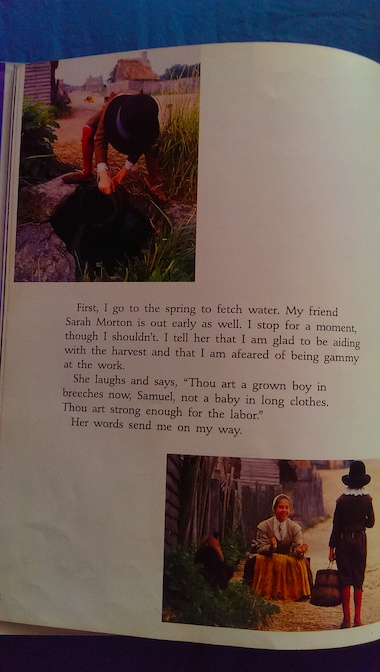
SamuelEatonSarah

Tapenum’s Day

Tapenum's Day

Tapenum’s Day by Kate Waters, 1996.

This is about a day in the life of a Wampanoag boy living in the area around Plymouth, Massachusetts during the 1620s.  His life is reenacted by Issac Hendricks, who was a participant in the Wampanoag Indian Program at the Plimoth Plantation living history museum.

In the beginning, Tapenum introduces himself, explaining a little about his people and the strangers who have only recently come to their land, the English colonists, whom the Wampanoag call wautaconuoag (meaning “coat-men”).  Tapenum has just learned that he was not among those young men chosen to train as pniesog, a special kind of warrior among the Wampanoag who also possessed spiritual powers and acted as advisors and diplomats for their chief.  It has come as a great disappointment to him that he was not chosen for training.  To improve his chances of being chosen later, Tapenum has decided to train himself to improve his strength and hunting abilities.

Tapenum's Day Begins

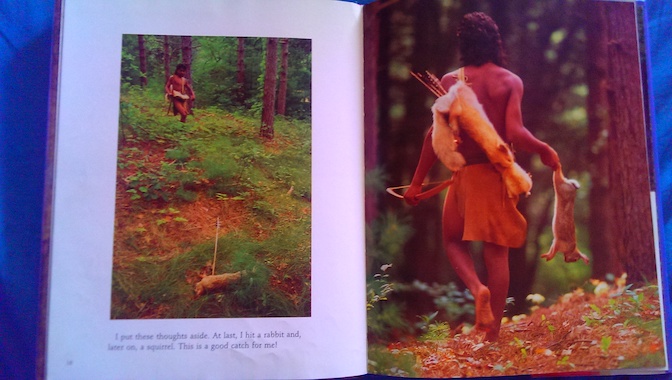
Tapenum goes out hunting early in the morning, while his mother and sister are still asleep.  He starts before eating anything because he says that being hungry “makes the hunter more serious.”  Eventually, he catches a rabbit and a squirrel.  His mother is pleased with his catch, although his father has done even better by bringing home a wild turkey, which is even more difficult.

Tapenum's Day Hunting Trip

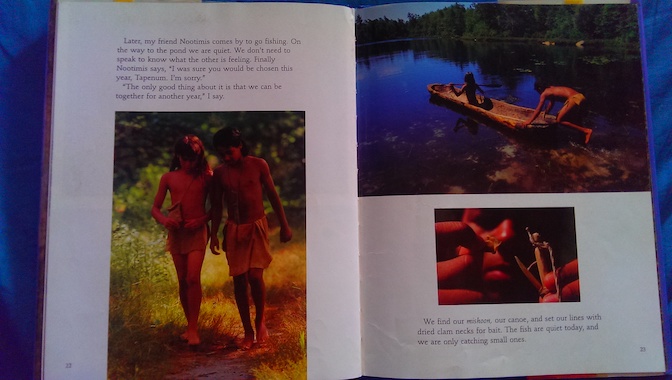
Later, Tapenum meets up with a friend, Nootimis.  The two of them go fishing in a canoe.  Nootimis knows that Tapenum is disappointed about not being chosen, but Tapenum says that at least he can still spend time with him before (hopefully) going away for training next year.

Tapenum's Friend

After fishing, Tapenum goes for a run as part of his training, and he sees smoke.  When he investigates, he finds an old wise man named Waban making a canoe.  Waban was a pniese himself when he was younger, and Tapenum offers him the fish he caught, hoping that Waban can tell him some things that will help him to be chosen for training.

Tapenum meets Waban

Tapenum ends up spending the rest of the day with the older man, learning and perfecting his skill at fletching arrows.  Waban also explains to him the importance of patience.  Tapenum is in too much of a hurry to grow up and begin serious training, but growing up takes time and so does developing the kind of strength and wisdom that he will need as warrior.

Tapenum learns some lessons

There is a section in the back of the book that explains more about the Wampanoag people, the the Wampanoag Indian Program, the Plimoth Plantation living history museum (now called Plimoth Patuxet), and the boy reenacting Tapenum’s life.

This is part of a series of books focusing on the lives of children in Colonial American history.  It is available to borrow and read for free online through Internet Archive.

Strega Nona

StregaNona

Strega Nona by Tomie dePaola, 1975.

Strega Nona is a witch who lives in a small town and uses her magic to help people in various ways, everything from small cures or love potions.  However, she runs into problems when she hires Big Anthony to help her around her house.  Big Anthony is helpful, but he doesn’t always pay attention or follow orders.

StregaNonaAnthonyPot
Strega Nona has a magical pot that makes pasta.  To get it to make a never-ending pot full of pasta, she recites a certain rhyme.  To get it to stop making pasta, she recites a different rhyme and blows three kisses to it.

Big Anthony is forbidden to use the pasta pot himself, but he can’t resist telling people in town about it.  At first, no one believes him because it sounds so strange.  Everything thinks he’s just making it up.  Big Anthony is offended that no one believes him, so one day, while Strega Nona is gone, he sets out to prove to everyone that this magical pot exists.

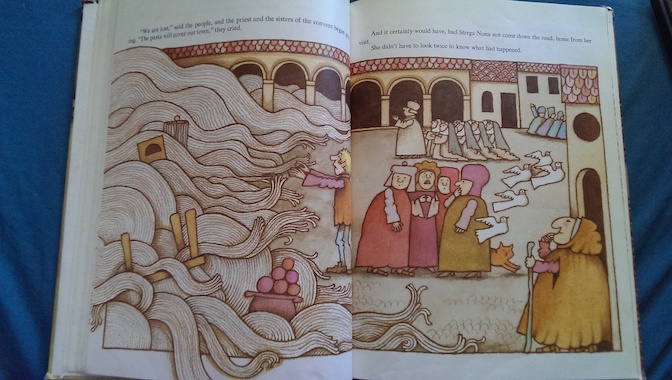
Big Anthony knows the rhyme to get the pot to start making pasta, and he uses it to make pasta for everyone in town so they will know that he was telling the truth.  Unfortunately, he doesn’t really know how to get it to stop because he didn’t know that Strega Nona blows kisses to the pot.  With the pot now sending a massive river of pasta through the town, what can Big Anthony do?

This is a Caldecott Honor Book.  It is currently available online through Internet Archive.

StregaNonaPastaRiver

The Five Chinese Brothers

FiveBrothers

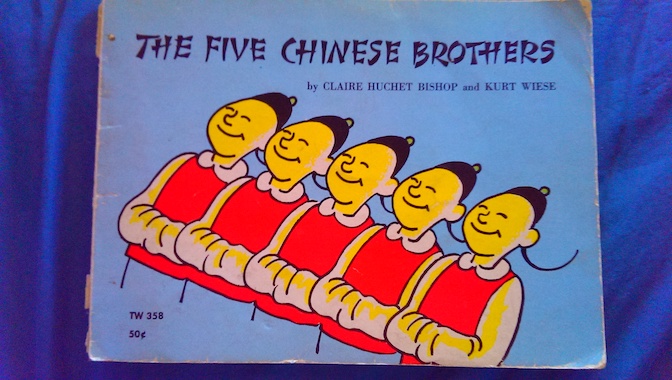
Although this picture book has faced some criticism for promoting Asian stereotypes (largely about the way the characters are drawn), it has nostalgic appeal for some people and is still in print.  What I find interesting about it is that it is actually based on an old folktale, Ten Brothers.  Folktales of this type, where people with different types of super-human powers must help each other to overcome obstacles, can be found throughout the world.  Another story on this theme is How Six Made Their Way in the World.

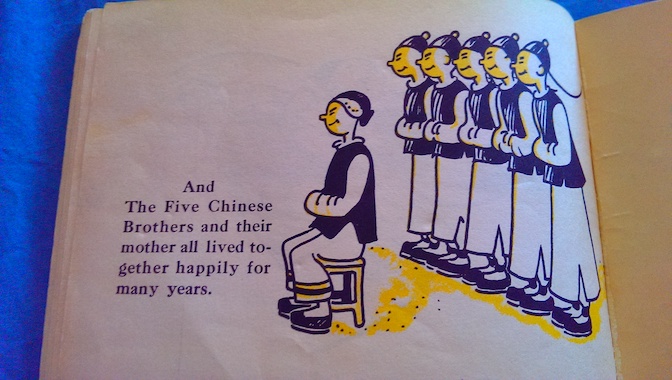
In this story, there is a family in China with five brothers who look alike, except that each brother has a unique super power (listed by birth order):

  • One can swallow the entire sea, although only for a limited amount of time.
  • One has a neck as strong as iron.
  • One can stretch his legs extremely far.
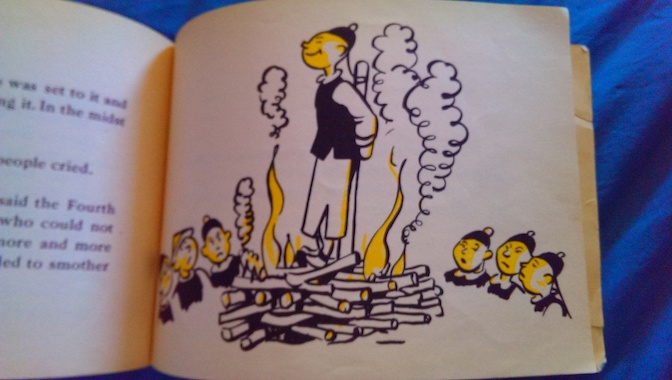
  • One is impervious to fire.
  • One can hold his breath for an unlimited amount of time.

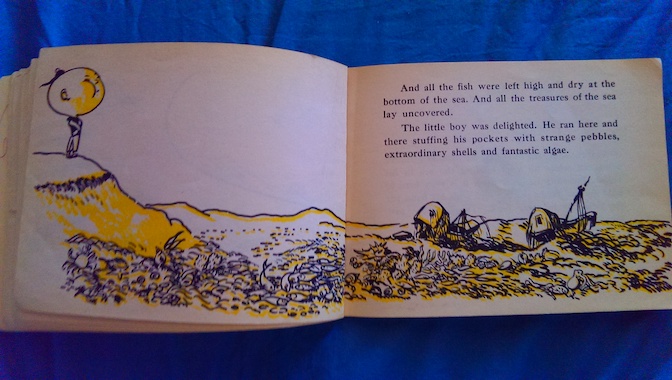
They live in a village by the sea and make at least part of their living by fishing.  One day, a young boy asks to go fishing with the brother who can swallow the sea (they don’t have names in the story, they’re just referred to by ability or birth order).  At first, the brother is reluctant to allow it, but when the boy begs, the brother agrees only on the condition that the boy obey him and return to his side as soon as he gives the signal.  The brother swallows the sea and allows the boy to collect as much fish as he likes from the empty sea bed.  However, the boy gets too wrapped up in all the amazing things he finds on the empty sea bed and ignores the brother’s frantic signals to return.

FiveBrothersSeaSwallow

Finally, the brother cannot hold back the sea any longer and releases it.  The boy drowns, and the brother is arrested for the boy’s death.  The judge decrees that the brother will be executed by having his head cut off.  Before the execution, the brother has a last request: that he be allowed to return home to say good-bye to his mother.  The judge allows it, and the brother switches places with his brother who has a neck like iron.

FiveBrothersHead

Needless to say, the execution doesn’t go as planned, and everyone is astonished when the executioner cannot cut off the brother’s head.  The judge decrees that he will be executed by drowning instead.  However, he does grant the brother’s request to say good-bye to his mother once again, giving him the chance to switch places with another brother who can safely face the next ordeal.

FiveBrothersBurn

The process continues through one form of execution and another as each of the brothers survives, using his own special power.  Finally, the judge decides that if the man (he doesn’t know there’s more than one, apparently) cannot be killed, he must be innocent and pardons him.

The book is currently available online through Internet Archive (multiple copies).

FiveBrothersFamily

Scary, Scary Halloween

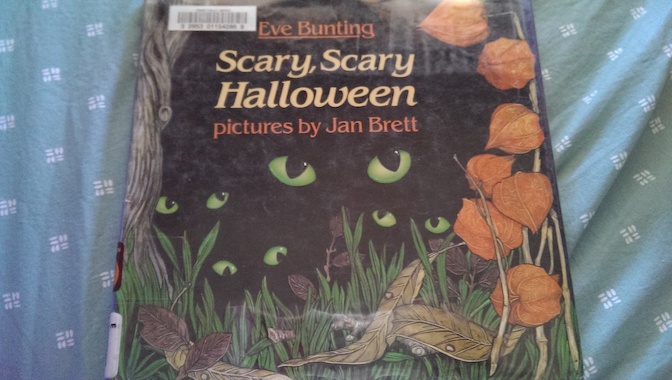
ScaryHalloween

Scary, Scary Halloween by Eve Bunting, pictures by Jan Brett, 1986.

I love the pictures in this book and enjoy the rhyming text of the story.  It’s a cute concept for Halloween, and young children will enjoy the repetition in the story.

ScaryHalloweenSkeleton

One Halloween night, unseen watchers observe children in costume trick-or-treating.  The mother cautions her children to remain hidden because of all the strange creatures that are out and about on Halloween.

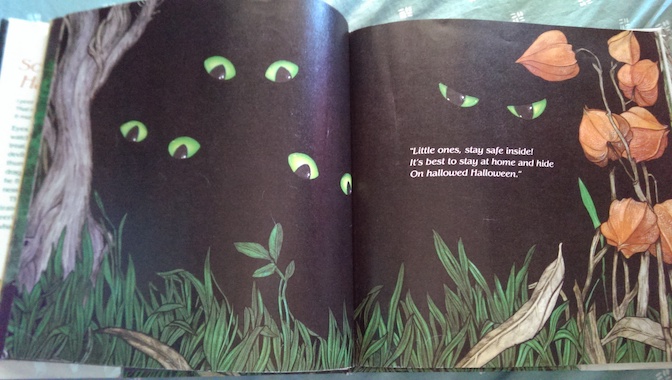
ScaryHalloweenEyes

Readers will know that the monsters are simply children in costume, but the watchers do not because they are cats, which is only revealed at the end of the story.  Throughout most of the book, they only appear as green eyes as they hide under the porch of a house.

ScaryHalloweenPorch

When all the trick-or-treaters are gone, the mother cat and her kittens are free to roam the night themselves.

ScaryHalloweenCats

I thought that it was cute how the mysterious tone of the book was due to the cats’ understanding of Halloween.  At first, it may seem very mysterious to young children as well, but completely understandable as it becomes more and more obvious that all the monsters are only trick-or-treaters and the little family hiding from them are cats, who think of themselves as being pretty fierce in their own right.

The book is available to borrow and read for free online through Internet Archive.

Jenny, the Halloween Spy

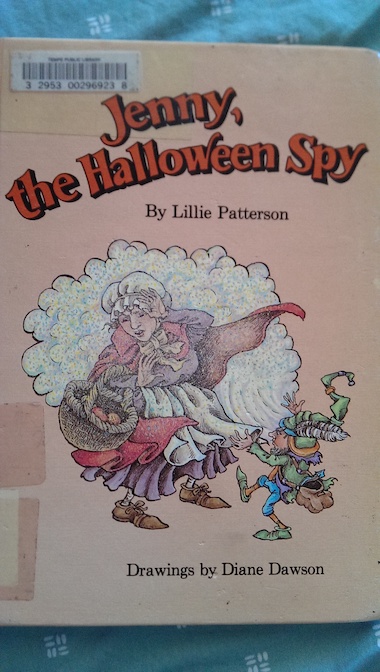
JennyHalloweenSpy

Jenny, the Halloween Spy by Lillie Patterson, 1979.

JennySpyWitchOne Halloween, Jenny goes to visit Nancy, a woman who local people say is a witch.  Jenny is curious about magic and, knowing that there are magical creatures abroad on Halloween, she wonders if she might see something unusual at Nancy’s house.

As she arrives at the house, Jenny peeks inside before announcing herself and sees Nancy putting some kind of oil in her eyes.  After Nancy welcomes her inside and offers her some cider, Jenny sneaks a little of this oil and puts it in one of her eyes to see what it does.  She discovers that the oil allows her to see magical beings that are hidden to most people.  There are fairies in Nancy’s house and rich furnishings that appear very ordinary to Jenny’s unaffected eye.

Using her new ability to see magical creatures, Jenny goes to the town market to see what is going on there.  However, when she catches a pixie stealing some fruit, the fairies and other “wee folk” decide to put an end to Jenny’s spying on their activities.  With some magic dust, the pixie removes her ability to see magical creatures and tricks her into getting onto an enchanted horse that takes her on a wild ride ending with a view of the devil!

The book is available to borrow and read for free online through Internet Archive.

My Reaction

JennySpyFairiesThis is a kind of cautionary story about the dangers of curiosity.  Jenny’s curiosity invites the attention of dangerous creatures and leads her into a frightening situation, something that she never wants to repeat.  For the most part, I think that curiosity is a trait that should be encouraged, but Jenny did deliberately seek out a person with a dangerous reputation and pry into the things she was doing, even trying some herself because she wanted to know more about it, so she could be considered to have gone looking for trouble.

In some ways, this book is very strange, but I can see where it draws on old folklore.  The end part about seeing the devil (accompanied by headless hounds) is a little bizarre and rather frightening for a modern children’s picture book but in keeping with folklore about Halloween and witches.  Although everything that happens to Jenny is supposedly really happening, part of me did wonder about the oil that she put in her eye because plants with hallucinogenic properties are used in folk medicine.  As far as the story is concerned, though, the magic and supernatural creatures are real.

The pictures are colorful and fascinating, but this book may be frightening for very young children.  Some of the fairies remind me a little of the pictures that inspired the Cottingley Fairy hoax.

The Little Old Lady Who Was Not Afraid of Anything

OldLadyNotAfraid

The Little Old Lady Who Was Not Afraid of Anything by Linda Williams, 1986.

“Once upon a time, there was a little old lady who was not afraid of anything!”

This is a cute picture book based on word and sound repetition.

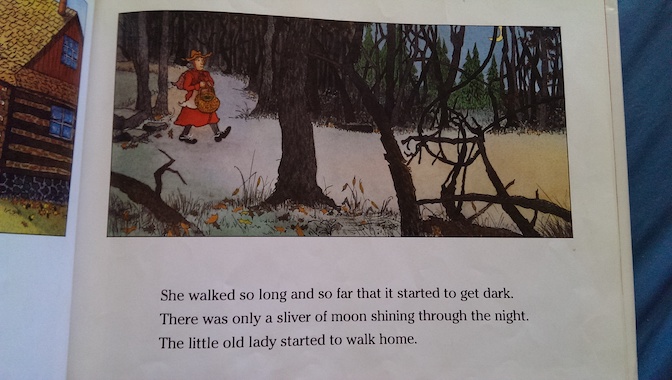
A brave lady ventures out into the woods one day, and as she makes her way home again when it gets dark, she begins to encounter some strange things.

OldLadyWoods

First, a pair of shoes with no one in them begin to follow her.  Then, she meets a part of pants with no one in them, and a shirt joins the parade of  clothes.  But, as weird as it is, nothing frightens the lady, not even the addition of a living jack o’lantern.

OldLadyClothes

OldLadyRun

When everything fails to frighten the woman (although she does look a little scared at one point), she has to help this strange collection of living clothes and pumpkin head to find a new purpose for themselves.

The book is currently available online through Internet Archive.
OldLadyScarecrow

What’s a Ghost Going to Do?

WhatGhostDo

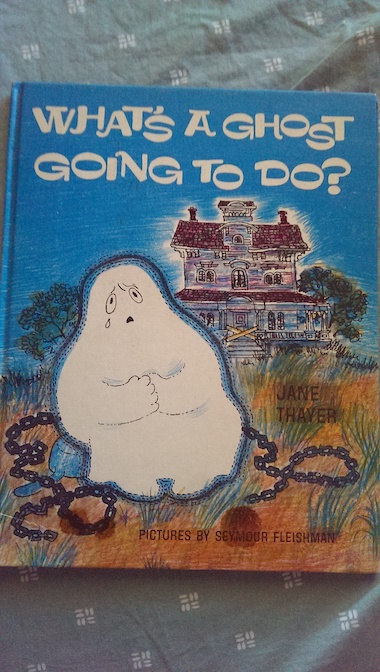
What’s a Ghost Going to Do? by Jane Thayer, 1966.

Gus is a friendly ghost who lives a quiet life alone in his old house, which is run-down and shabby, with winter visits from his mouse friend.  However, Gus discovers one day that the property is being sold.  The government wants the land to turn into a park, and if that happens, Gus’s house will be torn down!  If they decide to tear the house down, where will he go?

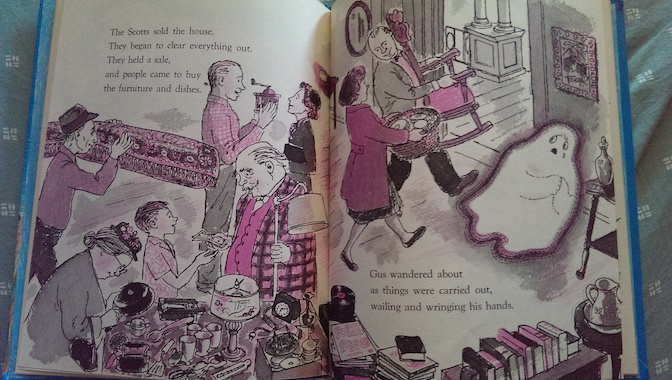
WhatGhostDoSale

For a time, Gus tries living with another ghost in another old house nearby, but that arrangement doesn’t work because the other ghost doesn’t like Gus rattling chains.  Then, Gus tries living in a hole with his mouse friend, but it’s really too small for him.  The only place that seems right for Gus is his old house, which is in danger of being destroyed!

WhatGhostDoHints

In desperation, Gus whispers in the ears of the man in charge of preparing the park for the government, Mr. McGovern, trying to get him to notice the virtues of his house.  Fortunately, Mr. McGovern accepts Gus’s vision of the house as a beautiful piece of the past and finds a way to restore it to its former glory so that Gus can keep his home and others can appreciate it, too.

WhatGhostDoRepairs

Gus’s house becomes a museum in the park, and Mr. McGovern also officially acknowledges Gus as the resident ghost.

The book is available to borrow and read for free online through Internet Archive. It’s part of a series.

WhatGhostDoMuseum

My Reaction

I’ve had this book since I was a little kid. I always felt sorry for poor Gus throughout the book, but the story has a nice ending, with Gus and Mr. McGovern finding a creative way to restore the house and put it to good use, filling it with antique furniture for both Gus and the public to enjoy. I haven’t read any of the others in the series yet because this is the only one I’ve ever had.

Old Black Witch

OldBlackWitch

Old Black Witch by Wende and Harry Devlin, 1963.

OldWitchChimneyA boy called Nicky and his mother are looking for a new place to live somewhere in New England.  The mother wants to buy an old cottage with the idea of turning it into a tea room.  At first, they have trouble finding a place, but finally they buy an old house that badly needs fixing up, not knowing that there is an old witch living there.

The witch (whom they call Old Black Witch, since she’s dressed all in black and sooty and doesn’t seem to have any other name) has been sleeping in the chimney of the house for about a hundred years, and they wake her the first time they try to start a fire in the fireplace.

The witch is furious to discover that the house has new owners and worried about where she’s going to live because she needs an old house to haunt.  Nicky and his mother invite her to stay and live in the attic, which has enough dust and cobwebs to satisfy her tastes, while they clean up the lower part of the house for the tearoom.

The locals have heard stories about the house being haunted, but the nice tearoom soon becomes popular with ladies in the area, especially after Old Black Witch decides to help out Nicky’s mother in the kitchen.  Old Black Witch’s blueberry pancakes are wonderful and win many fans for the tearoom.

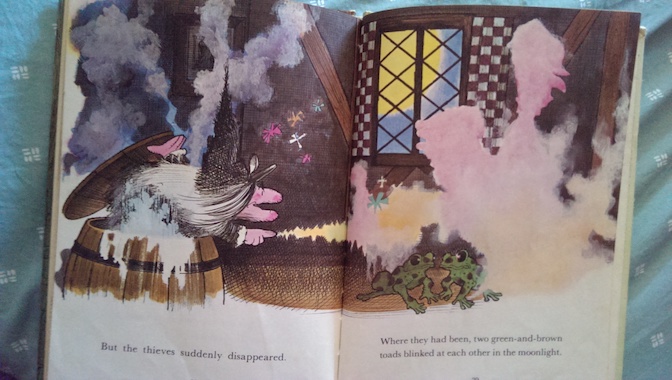
Then, one night, a couple of burglars break in.  Since Old Black Witch is kind of evil herself, she can’t really fault them for wanting to rob the place . . . until she suddenly realizes that they’re stealing from her, too, and uses her magic to fix the burglars for good and give herself the pet toads that she’s been wanting.

This book is available to borrow and read for free online through Internet Archive.

OldWitchToads

My Reaction

One of the things that I like about this story, which was a favorite of mine when I was a kid, is that Old Black Witch isn’t particularly evil although she isn’t too nice, either.  She’s as bad and disagreeable as a cranky old witch who’s lived in a chimney for over 100 years ought to be, but not so bad that she can’t make some new friends and help them out once in a while.  Friendly enough for the kids, but not too sweet to be a real witch.  It’s part of a short series, although I haven’t managed to find any of the other books yet.  Some of the pictures are in full color and some are in black and white.  Don’t ask me why she has a spoon in her hat because I’ve never been completely sure, either.  Somehow, on her, it looks good.

The back cover of the book has the recipe for the blueberry pancakes.

OldWitchPancakeRecipe

There was a short film version of this story from 1969 called Winter of the Witch.  It follows the book fairly well, but with some variations (there were no burglars).  In the film, the pancakes have the power to make people happy, and that’s what gives Nicky’s mother the inspiration to open a pancake parlor in their house.  The witch finds a new sense of purpose, although she still plans on going back to her old, wicked ways once the world is happy enough to need a good, old-fashioned scare.  I don’t think that it was ever released on dvd, but it is possible to see it on YouTube and Internet Archive.

Which Witch is Which

WhichWitch

Which Witch is Which by Pat Hutchins, 1989.

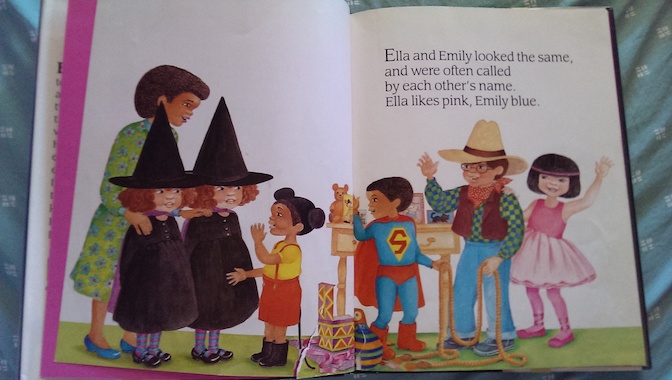
This is a cute picture book/puzzle book.  A pair of twins, Ella and Emily, are invited to a friend’s costume party, but they come dressed as witches in identical (or nearly identical) costumes.  Throughout the party, as the girls play party games, eat the party snacks, and give presents to their host, readers are invited to figure out which twin is which.

WhichWitchIntro

The main clue to the girls’ identities is that Ella’s favorite color is pink while Emily prefers the color blue.  Things that the girls have in those colors or objects that they select give away their identities

WhichWitchPresents

However, there are also other hints, like we are told what each of the girls ate at the party so that we can use the crumbs left on their plates (or the lack of crumbs) to determine which witch is which.

WhichWitchCake

The text of the book rhymes.  The illustrations are cute, and it’s a good book for teaching children how to notice details.

The book is available to borrow and read for free online through Internet Archive.

WhichWitchPlates