Gone Away

I haven’t found a copy with its dust jacket intact.

Gone Away by Ruth Tomalin, 1979.

Time flies?
Ah no.
Time stays.
We go.

Sundial motto from the beginning of Gone Away

Francie is an only child living on a farm called Goneaway Farm in Sussex in the 1930s. It’s a very old farm, and there’s a story about it that, hundreds of years before, another family once lived there, another couple with only one child. One day, this family went to a fair in another town, Alchester, and for reasons nobody understands, they never returned to this farm. The farm stood empty for a long time before it had a new owner. Because this old family went away with no explanation, the farm came to be called Goneaway. In spite of this strange story and the age of the farm, Francie has never felt that the farm was haunted or that there was anything sinister about it. Then, Francie finds herself staying in a real haunted house.

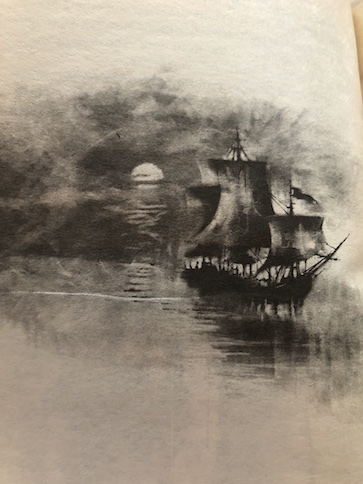
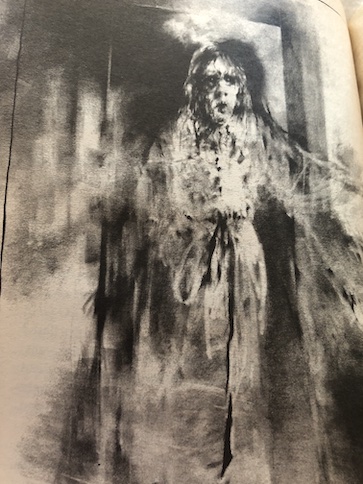
There are no illustrations in the book. It starts with this quote.

Because the farm where Francie lives with her parents is far away from local schools, Francie studies her lessons at home with her parents’ help, but she often gets distracted by the animals on the farm and doesn’t focus on her lessons. Francie’s great-aunts, Aunt Berta and Aunt Fanny, live in Scotland, but when they come to visit the farm, they see how Francie isn’t getting her schoolwork done. The aunts are also concerned at how isolated Francie’s life is. There are no other children living nearby to be friends with Francie, and they think that her life must be lonely. They talk to Francie’s parents about sending her to boarding school, but they say that they can’t afford it. They can’t even afford a car, which is why they can’t drive Francie to school in town. The aunts remind Francie’s mother that she used to board in a private house with a nice family so she could attend school when she was young. Boarding with a family wouldn’t cost as much as a fancy boarding school, and she could come home on weekends. Still, Francie’s parents are reluctant to send her away because they think she’s too young, and they’re not ready to part with her.

When the aunts leave after their visit and her parents don’t bring up the subject of school again for a while, Francie is relieved. She loves her life on the farm, and she doesn’t want to leave. Yet, she also finds herself oddly disappointed, too. She’s read stories about children at schools, and their adventures do sound exciting. She thinks it would be ideal if she could go to school during the day and come home afterward, like other children do, but that just won’t work with her family’s circumstances. Her parents’ attempts to find friends for her just aren’t working, either. Her parents start inviting other farm families to visit on Sundays, but Francie doesn’t get along with their children. The reasons why she doesn’t get along with them are largely because the other children don’t behave well, but these incidents convince Francie’s parents that maybe the aunts were right and that Francie could benefit from going to school and meeting a wider range of other children.

Her parents write to the high school in Alchester and inquire about registering Francie. They arrange for Francie to take entrance exams, but Francie has mixed feelings about it. On the one hand, the idea of boarding and going to school, with the knowledge that she will come home on the weekends, seems exciting, but on the other hand, she worries that the children at the school won’t be any more friendly than the children of the nearby farm families. Her mixed feelings continue through the day when she and her mother visit the school. At first, Francie thinks that maybe she’ll flunk the entrance exams on purpose so she won’t have to leave her farm. Then, after the initial tour of the school, Francie thinks that going there may be exciting after all, so maybe she’ll try to pass the exams. The exams are difficult, and she expects she’ll fail them after all because she really can’t do the work. Her parents tell her not to worry because, if she fails this year, she can always study more and try again next year. However, it turns out that she did pass. The arithmetic portion of the exam really was too difficult for her because the person giving her the exam accidentally gave her a higher level test instead of the basic entrance exam, but Francie did an excellent job on the writing portion of the test.

Since Francie will be attending the school in Alchester after all, she and her mother begin shopping for her school uniforms and other supplies. Francie is still worried about the prospect of boarding with strangers in town, and her mother isn’t sure how to find a house or family willing to take her. A boarding prospect turns up because Francie is too small and skinny for even the smallest available size of the school uniform, and she and her mother have to visit a professional tailor. The tailor, Mrs. Majendie, also has a few rooms that she rents out to boarders. Francie isn’t sure that she’ll like boarding with Mrs. Majendie at first because she and her house seem a bit grand, her dog seems oddly bored and unresponsive to Francie’s friendliness, and her other boarder is the headmistress of another school in town, the Chantry School. However, the available room is beautiful, with a four-poster bed and tapestries, and the room has a view of the nearby churchyard, where the children from the Chantry School are playing among tombstones in the old graveyard. Mrs. Majendie says that the Chantry School was once a chapel, and her own house was once an old inn. She also says that a new housekeeper will be moving in soon with her daughter, who will attend the Chantry School. It all seems like a fairy tale kind of place to Francie, and she is reassured that there will be another girl living in the house with her, so she tells her mother that she would like to board there.

When she actually starts school, it goes pretty well. The classes aren’t too hard, the subjects are interesting, and she gets along well with the other girls. There is an older girl called Trixie who likes to play pranks on the younger students, and some of the girls tease Francie about her height, but the older girl who is assigned to look after her, Verity, tells Francie not to take any notice of those girls. At first, Francie is able to use her bicycle to get from school to the train station, so she is able to go home every night, but then, as the days grow shorter, and it gets dark sooner, she can’t do that anymore, so she starts to board in town with Mrs. Majendie.

Her boarding experience turns out to be different from what she first thought, though. It turns out that the new housekeeper isn’t very friendly, and her daughter decided to stay with her grandmother instead of coming to town with her mother, so the house is lonelier than Francie had expected. The atmosphere is also different in the winter than in the summer, when Francie first saw her room. The room seems colder, darker, and a little more sinister in the winter, and in the evening, there aren’t any children playing in the churchyard outside. At night, she hears strange sounds, like a tapping and a wailing. When Trixie learns that the place where Francie is boarding is Falcon House, she implies that there’s something really wrong with the place, but Francie assumes it’s just another of Trixie’s tricks. Then, when other students try to get Trixie to shut up and remind her that they all promised not to talk about it in front of Francie, Francie realizes that there really is something weird about the house. She tries to get Verity to explain it to her, but Verity refuses, which just makes Francie angry and more scared. Now, she knows there is a real secret about the house, but she doesn’t know exactly what it is.

A strange man comes to visit Falcon House, and Francie sees that his card says he is Dr. D. Bone Fane from the Circle for Psychical Research. Francie doesn’t know what it means, so she asks some of the other girls at school if they know. One of them, Bryony, says that she’s met this man before. He’s a ghost-hunter from the United States, investigating supposedly haunted places. Bryony’s father teaches in the Abbey choir school, and this man has been pestering him about stories of a haunting there, although Bryony’s father thinks it’s all boring nonsense. From this information, Francie realizes that Dr. D. Bone Fane is interested in Falcon House because he thinks it’s haunted. She confronts Verity about it, and Verity admits that there are stories of hauntings at Falcon house. Nobody’s ever actually seen the ghost that haunts the house, only heard things, and the only people who have heard the ghost are children. According to the stories, Mrs. Majendie’s own children were the last children to be haunted by the ghost, and they were so scared of the house that they begged their mother to send them to boarding school so they could get away from it. Francie is the first child to live in the house since the Majendie children grew up. Francie realizes that this is why the housekeeper didn’t bring her own daughter to the house and why she seems uneasy about Francie’s presence in the house. Mrs. Majendie even gave her nightlights as a gift because she was expecting Francie to be frightened. The headmistress at Francie’s school told everyone not to talk about the ghost stories, not because she believes in them, but because she was afraid that Francie would believe them and get scared. Everyone but Francie has known about the ghost stories from the beginning, and they’ve all been waiting to see what she will experience in the house, if anything.

The more Francie thinks about it, the more she realizes that she sensed the presence of the ghost on her first visit to the house. Besides the noises she’s been hearing at night, the dog in the house reacted to something at the top of the stairs, as if an invisible hand was petting him. When Francie returns to Falcon House after visiting Verity, it’s a stormy night, and she’s terrified about what might be waiting for her at the top of the stairs. However, when she gets there, and she realizes that it’s just her, the dog, and the ghost, she suddenly realizes that the ghost isn’t a menacing presence. The dog likes it, and it seems a little teasing, but it doesn’t mean Francie any harm. Strangely, its presence begins to feel reassuring to Francie because she’s no longer alone in the house, the only child among adults. The ghost is a child, too. In fact, it’s the ghost of the child from Goneaway, the one who disappeared hundreds of years ago, along with its parents.

The more that Francie investigates, the more she comes to realize that the ghost needs her help. Helping the ghost means learning the truth about the family who once lived on the farm that Francie calls home.

This book was originally published in the UK. The book is available to borrow and read for free online through Internet Archive. There is a sequel to this book called Another Day.

My Reaction and Spoilers

This book fits well with the Dark Academia aesthetic, and it could also be considered Dark Cottagecore because of the farm and countryside themes. When Francie is on the farm, she describes the animals and plants in the countryside. Francie’s school isn’t a boarding school, but she does have to board in a spooky place to go there. There are many literary references throughout the story, and there’s a note in the beginning of the book about the poetry references. Francie reads The Story of the Amulet by E. Nesbit for fun, and her class at school reads Treasure Island. She uses stories she’s read to help her understand what is happening around her. When she makes friends with a girl named Geraldine at school, Geraldine also uses story references to explain what she thinks is happening with the ghost.

When Francie first begins to interact with the ghost, she is only able to sense its presence but not really see it. As the ghost begins to interact with her, it gradually begins becoming more visible. At first, Francie can’t even tell whether the ghost is a boy or a girl, only that it’s a child about her size. She wonders why the stories she’s heard about this child and its parents never mention whether the child is a boy or a girl or what its name and age were. She thinks it’s sad that so many little piece of history get lost.

What she eventually realizes is that the child and its parents were probably plague victims because they disappeared around the time that the plague came through this area in the Middle Ages. She thinks that they probably caught the plague when they came to town for the fair and were buried in one of the unmarked mass graves she’s heard about, and that’s why they were never able to return home. When she talks it over with Geraldine, Geraldine realizes that the children who have been able to see the ghost were all suffering from homesickness when they first arrived at Falcon House. The ghost is awakened by feelings of homesickness in other children because that’s what the ghost has been feeling the entire time. What it wants is to go home to the farm, and Francie has to find a way to help bring it home with her. There is a twist in the ghost story later that leaves Francie wondering how much of what she’s perceived about the ghost is her imagination and another girl, the housekeeper’s daughter, sneaking around the house. However, there really is a ghost, and Francie does figure out how how to help it. It comes home for Christmas with Francie.

During the story, Francie struggles with the difficulties of being away from home and going to school for the first time, and she also starts to consider what it’s going to mean for her future. She still thinks of herself as living at Goneaway Farm, but then, the wife of a farm hand refers to her as becoming a “visitor.” Francie feels uneasy about that because she knows that the woman’s son also went away for school and decided that he would rather do something other than farming, so he now lives somewhere else. Francie still thinks of the farm as her home, and it upsets her to think of the farm without her or her life without the farm in her future. But, is that really what she wants? Before her great-aunts raised the issues of school and friends, Francie was content with her life and didn’t realize that either of those things was something she was missing or might want. Now that she’s going to school in town, meeting new friends, and experiencing some independence to explore the town on her own, what else might she discover that she wants and never knew she could experience before? Will the new things she learns and wants to experience mean giving up her old life, which she still loves? These are all questions that people have as they’re growing up and pursuing an education.

Nobody really knows where life will lead them when they’re just starting out, and that can be scary, but at the same time, growing up does mean change. The changes that Francie experiences are ones that she would have experienced anyway, eventually. Her mother understands some of how Francie feels because she also boarded as a child so she could go to school, but at the same time, Francie realizes that her mother doesn’t understand everything that she’s going through because she isn’t there with her every day. Her mother doesn’t fully know what her classes or teachers are like or what the other people she meets and lives with at Falcon House are like. For the first time in Francie’s life, she and her mother are starting to live different lives, and there are some things that Francie must experience and make decisions about on her own.

The practice of children from rural areas boarding at a private house to attend a day school in town is a real part of history, both in the UK and in the US. I covered that earlier when I reviewed Sixteen and Away From Home, a book set in the 19th century Midwestern US, and The Secret School, when a teenage girl named Ida wants to go to high school in the 1920s. Anne Shirley did the same in Anne of Green Gables, which is set in 19th century Canada. This is what children from rural areas in different countries have had to do if they wanted more schooling than they could get in their area.

There is a scene in the story with some gyspies. The book calls them both “gypsies” and “travellers.” One of them tells Francie’s fortune, which gives her hints about what to do. There is also a scene where girls from Francie’s school put on a performance, and there is a dancing dragon and a student who is dressed as a “Chinese boy” for part of it. The “Chinese boy” costume is only mentioned briefly and not described in detail. It’s the sort of thing that is discouraged now in school, people dressing up as people from other races.

Haunting at Black Water Cove

Haunting at Black Water Cove by Norma Lehr, 2000.

Kathy is spending some time with her mother at the lake while her mother takes care of a friend’s lodge there.  Kathy’s great-grandmother and her brother used to live in the area, and her mother used to visit the lake regularly as a little girl.  Soon after she arrives, Kathy meets a new friend, Drew, a boy who lives with his older brother and is self-conscious about his asthma.  While the two of them are by the lake, Kathy thinks that she keeps seeing a raft that nobody else can spot.  Later, she sees the ghost of a young girl in a ragged dress with a blue aura around her. 

Drew writes a small local newsletter, and when Kathy accompanies him to interview an elderly woman, she learns that years ago, her great-granduncle, Duncan, was involved in the disappearance of the woman’s older sister.  Ruby Faye’s body was never found, but people believe that she must be dead, assuming that she must have drowned in the lake. They believed that Duncan must have somehow caused Ruby Faye to drown because he was with her at the time. Although Duncan had a reputation as being a bit of a hooligan, Kathy can’t believe that he would have harmed the girl, named Ruby Faye, or let her drown in the lake if he could have prevented it. Duncan himself lost the ability to speak because of whatever happened that day, so he could never explain to anyone what really happened, but it must have been something terrible to send him into such a shocked state. About a year later, Duncan died young of an illness without regaining the ability to speak.

Before Ruby Faye died, the water in the cove had been clear, and the place was called Sunny Bay. Since then, the water turned dark and cloudy, giving Black Water Cove its new name.  Kathy is sure that the ghost girl she’s been seeing is Ruby Faye, and she thinks the girl’s spirit is trying to tell her the truth behind her mysterious disappearance.

The book is available to borrow and read for free online through Internet Archive.

My Reaction and Spoilers:

I enjoyed this spooky book for the mystery it poses about the disappearance of a young girl many years before. Because Kathy has been seeing her ghost, readers know that she must have died, but there is still the mystery of how it happened and what left Duncan so traumatized. I love mystery stories, and this story was also interesting for me because it turns out that the secret of Ruby Faye’s disappearance relates to a real historical event. Duncan and Kathy’s other relatives lived in the area during the famous 1906 earthquake that struck Northern California. Ruby Faye disappeared the day after it happened. 

Spoilers

Ruby Faye and Duncan had been in love. Duncan had a raft that Ruby Faye helped him build, and when she disappeared, most people assumed that he had been goofing off on the raft and caused her to drown.  In fact, Ruby Faye did not drown at all; she died from a fall.  When Kathy goes to the spot by the lake where Duncan had left his raft years ago, she sees their spirits act out what happened that day.

Like Drew, Duncan had a handicap that made him self-conscious: one of his legs was shorter than the other, and he couldn’t walk without a crutch.  On the day after the earthquake, he and Ruby Faye were playing by the lake.  She was making a garland of flowers.  She decided to go up the nearby mountainside and get some more flowers.  Duncan warned her not to go because the place was dangerous, but she just laughed it off.  Shortly after she left Duncan, he heard her scream for help.  Duncan tried to go to her, but his crutch had fallen off the raft, and he couldn’t find it.  He tried to get up the mountainside anyway, but he couldn’t manage it.  There was no one else around to help.  While Duncan didn’t cause the accident that befell Ruby Faye, Duncan’s guilt and helpless anger at not being able to save Ruby Faye robbed him of his ability to speak. 

Kathy ventures up the mountainside herself to see where Ruby Faye went when she screamed and disappeared, and just as Ruby Faye did herself, falls into an open mine shaft.  The earthquake opened it up the day before Ruby Faye went there in 1906, but no one thought to look for her there because they were sure she had fallen in the lake.  Kathy manages to hang on until her dog alerts people to her danger, and they come to help her.  Drew is the first person to see Kathy’s dog, but like Duncan, he is unable to save Kathy himself because he gets upset and brings on an asthma attack.  However, he manages to get help from his brother and Kathy’s mother.  After Kathy tells Ruby Faye’s sister what really happened, the water in the bay clears, and Kathy sees the spirits of Ruby Faye and Duncan, happily floating together on their raft.

The Shimmering Ghost of Riversend

Kathy Wicklow is going to visit her Aunt Sharon at their old family home over the summer. The old family home, Wicklow Manor, is in Riversend, California, which is in an area where gold was found years ago. Kathy isn’t happy about the trip. She has to leave her dog behind because her aunt owns a cat. She doesn’t even really know her aunt very well. Aunt Sharon is her father’s sister, and her mother has said that she’s weird (which was not a good thing for her to say, both because it’s insulting and because that’s not something to make her daughter glad about spending time with her). Kathy blames her mother for going back to work. Because her mother is working and won’t be home with her, Kathy has to leave her home, her friends, and her dog for a month!

Although Kathy loves to draw, she doesn’t think that she’ll want to do that in a place she is sure she’s going to hate. She also thinks maybe her parents don’t trust her at home because of the weird dreams she’s been having. Kathy has dreams about things that later happen, although she doesn’t know why.

Her father has nostalgic memories of the old family home where he and Sharon grew up. Sharon has only recently returned there after living on the East Coast. Kathy’s father says that Sharon is looking forward to seeing Kathy again and getting to know her because she hasn’t seen Kathy since she was a baby.

Right from the first, Wicklow Manor gives Kathy the creeps. There’s even a small graveyard nearby where Kathy’s father says their ancestors are buried because people used to be buried close to their homes. When she can actually see the house, Kathy is also shocked to realize that she has drawn that house before! She thought that she had invented the house she drew from her imagination, but somehow, she had a vision of the real house. Her father thinks that she must have seen a picture of it somewhere or maybe was inspired by his descriptions of the place. However, Kathy has also done a drawing of Aunt Sharon’s pet cat, without knowing what it looked like before. When they meet Aunt Sharon, she mentions that she’s glad Kathy is there because the house has been lonely, especially at night. Kathy’s dad starts to ask her if something is still happening, but Aunt Sharon quickly denies it before he can finish the thought. Kathy can tell there’s some kind of secret between them.

Aunt Sharon has turned the family’s manor into an inn, and she’s expecting guests soon. It also turns out that part of the reason why Kathy’s mother says that Sharon is weird is that she’s into health food, and Sharon is aware that Kathy’s mother thinks that she’s a weird health nut. Kathy’s father volunteers her to help in the kitchen, although Kathy is a little worried that she won’t like the health food, although the lemonade that she makes with maple syrup instead of sugar is pretty good.

Still, Aunt Sharon gives Kathy a beautiful room with a balcony. Kathy also meets a boy named Todd who lives nearby with his great-grandfather, who is called Upstream Mike. Todd and his great-grandfather pan for gold in the nearby river, and Mike also takes his burro called Nugget into town so tourists can pay for rides on him and pictures with him. Todd is just a little older than Kathy, and he tells Kathy that he likes to write down stories that his grandfather tells him, especially scary stories about the old Wicklow Manor. Kathy asks if there are ghosts there, and Todd tells her to ask his great-grandfather about it. Kathy asks her aunt about ghosts, and Aunt Sharon tells her that Mike has told scary stories about the place for years that were apparently passed down in his family. Mike’s family lived in the area when the first Wicklows arrived.

Aunt Sharon shows Kathy some of the things in the house that belonged to their ancestors, including a portrait of a pretty young woman, who Aunt Sharon says was Jenny Wicklow, who died young by drowning in the river and was buried in the old family graveyard. One of their ancestors, James Wicklow, made his fortune as a banker during the Gold Rush days, and Jenny was his daughter. There is one room in the house where Kathy isn’t allowed to go, which is the old room in the tower. Aunt Sharon says that the staircase is broken, and she can’t have it fixed yet.

On her first night at the manor, Kathy sees a woman in a cloak with a lantern. When she asks Mike about it, he says that it’s a ghost or spirit of some kind that usually appears to young ladies at the manor, possibly a banshee or similar spirit that is a harbinger of death. Kathy worries about that, and Mike tells her the story about Jenny Wicklow. Jenny was one of three children of James Wicklow. She also had a sister named Lora and a brother named Daniel, and Kathy is a descendant of Daniel. After their parents died, Daniel went to work in the city and left the running of the manor and family farm to his sisters. The two young women hired a handsome young drifter to help them, but he started flirting with both of the sisters. The sisters seemed to develop a rivalry for him and argued with each other about it. Rumor had it that Lora was the one who pushed Jenny into the river so she could have not only her own inheritance but her sister’s as well and get the man they both wanted. After Jenny was dead, it seemed like all of their gold disappeared, and so did Lora. People assumed that Lora ran off with her lover and took the money. Mike thinks that the ghost is dangerous, and that Sharon is the one who’s in danger!

Kathy soon begins to learn that Mike is both right and wrong about the ghost. The ghost is Lora, but she’s not trying to hurt Sharon or anyone else. Something tragic happened at Wicklow Manor years ago, and Lora is trying to tell someone about it, if she can find anyone brave enough to listen … and to discovered what actually happened to Lora herself.

The book is available to borrow and read for free online through Internet Archive.

For a good part of the story, I wasn’t sure exactly what Lora’s ghost was attempting to accomplish, keeping me in suspense. I did have the sense that Lora wasn’t the one who had murdered Jenny and that she had probably been murdered herself, which was why nobody saw her after Jenny’s body was found.

Mike is correct that Lora is the ghost, but she was not Jenny’s murderer. Like Kathy, Lora was psychic. She has been trying to communicate with different girls in the family over the years to clear her name, but the other girls have all been frightened of her. Sharon claims not to believe Kathy at first about how Lora is trying to communicate with her, but she later admits that it was because she was frightened. She also saw Lora when she was young, and that’s part of the reason why she was afraid to return to the old family home for so long. She was afraid to admit that the house was really haunted and that she was afraid of the ghost. It was a long time before she could even tell her own mother and brother about seeing Lora because she was afraid of being different from everyone else in the family. Sharon is also psychic, and like Kathy was initially, she was afraid of her gift.

Kathy and Todd use the messages that Lora communicates through Kathy’s drawings and Lora’s old diary to learn the truth. Jenny was murdered by the man she loved. Lora didn’t actually love him at all. She saw that he was a violent person and tried to warn Jenny about him, but Jenny wouldn’t listen because she thought Lora wanted him for herself. Lora saw the murder that was going to happen in a dream, and she wanted to stop it by using her own inheritance to pay the man to leave her sister alone. However, Lora was unable to save her sister. After he killed Jenny, the man came after Lora and murdered her, too. Then, he stole both of their inheritances. He hid Lora’s body, which was why everyone thought she must have run away with him.

After Lora’s ghost leads Kathy to where her body is buried in the cellar and she is given a proper burial in the family graveyard, the haunting ends. However, Kathy learns to appreciate her psychic gift because of this experience. She finds it reassuring that she shares her abilities with other people in her family. When she reads in Lora’s diary that Lora thought of her own psychic abilities as a gift, Kathy also comes to think of being psychic as a gift rather than a weird defect or something to fear.

The mystery in the story was good, and I also liked the information about panning for gold that Mike gives to Kathy when he gives her a gold panning lesson. There is also a tie-in with real children’s literature because Kathy mentions that she is reading Down a Dark Hall by Lois Duncan. I’ve reviewed Down a Dark Hall on my site, and it is about girls with psychic abilities at a haunted boarding school who channel the spirits of famous people to complete their unfinished works. The channeling and spiritual possession in that book are dangerous and harmful to the girls doing it, but in this book, Kathy becomes reconciled to her psychic abilities and Lora’s gentle spirit, who needs her help.

Blackbeard’s Ghost

Blackbeard’s Ghost by Ben Stahl, 1965, 1976.

This is the novel that the live action Disney film Blackbeard’s Ghost from 1968 was based on. My copy is a later edition designed as a tie-in with the Disney movie, based on the cover, but it contains the text of the original story.

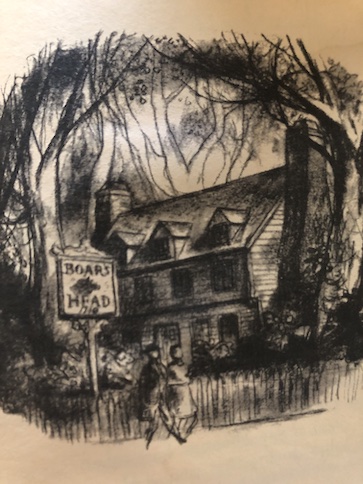
The story begins with a prologue that explains how Blackbeard the pirate evaded execution for piracy by offering to collect tolls from ships on behalf of the colonial governor, Governor Eden, in the town of Godolphin. However, instead of collecting tolls from the ships, he decided to use his position for his own benefit. Knowing that he would eventually need a source of stability on land instead of spending the rest of his life at sea, he looted wood from various ships and used it to build a tavern for himself called the Boar’s Head. He hired a woman rumored to be a witch, Aldetha, to tend the tavern for him. In the end, though, Blackbeard was killed by someone who wanted to collect the bounty on him for piracy. After his death, the poor woman who tended his tavern was burned at the stake for witchcraft.

(Note: The witch burning is historical inaccuracy because no witchcraft executions in North America involved burning, at least not in English-controlled parts of the American colonies. Accused witches in North America were typically hanged. None of this story is meant to be historically accurate, but I always feel compelled to point that out in stories that make that mistake. The town of Godolphin and the Boar’s Head Tavern are fictional. In real life, Blackbeard did receive a pardon from the real Governor Eden in Bath, North Carolina, and he was eventually killed in 1718 in a battle with Lieutenant Robert Maynard and his crew, as he did in this story. However, in the book, the tavern is now owned by a descendant of Maynard’s, and in real life, Maynard didn’t have any children.)

Most of the story takes place in the 20th century, when two 14-year-old boys, J.D. and Hank, talk about how the old Boar’s Head Tavern is about to be torn down because the former owner sold it, and there’s going to be a gas station built on the land instead. They think it’s a shame because they’ve heard ghost stories about the place and think the old tavern is fascinating. The boys go to watch the workmen tearing down the old tavern, but the workmen haven’t made any progress so far. Although they’d love to loot some of the expensive woods from the old tavern, they just can’t seem to dismantle the building. They’ve been able to dismantle some of the newer additions to the building, but somehow, they can’t seem to touch the original structure. The site has been plagued with mysterious accidents. Their equipment fails, heads fall off the ends of their hammers, and workmen keep getting injured in small accidents, not enough to seriously hurt anyone but enough to keep them away from their work for days at a time.

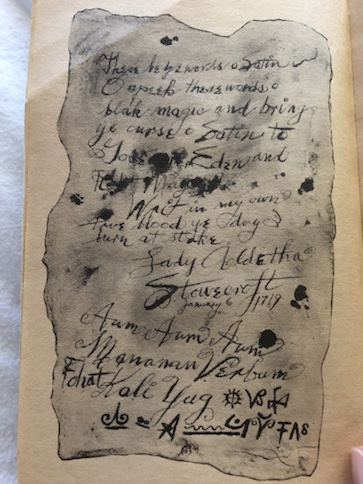
When J.D. and Hank see the workmen leaving the building in frustration soon after arriving, they decide to go inside and look around to satisfy their curiosity and see if there’s anything of value that they can salvage before the tavern is demolished. They don’t find much of value, but they do find their way into Blackbeard’s secret dungeon under the tavern. There, they find a piece of old parchment with a satanic curse written by Aldetha. (So, apparently, people were actually right about her being a witch. Plot twist!) Inspired by this creepy message from the past, the boys realize that they can make money from other kids by capitalizing on the ghost stories about the old tavern and holding seances to contact the spirits. They don’t really believe that seances are real, but they figure that, if they can get enough ghost-story fans to come to their seances, they can make a profit from this enterprise.

Of course, the boys’ seance awakens the ghost of Blackbeard. Blackbeard is invisible to everyone except for the boys, but he’s a solid ghost, who can manipulate physical objects. The boys quickly realize that Blackbeard can be a dangerous ghost, and he’s not at all happy when he finds out that a descendant of the man who killed him wants to have his tavern torn down.

The book is available to borrow and read for free online through Internet Archive. The Disney movie is available to buy or rent through YouTube or Amazon Prime. There is also a sequel to this book called The Secret of Red Skull, which involves spies and is also available online through Internet Archive.

My Reaction and Spoilers

There is some humor in this book because only the boys are able to see and hear Blackbeard, but by the end of the story, adults become aware of Blackbeard’s ghost, too. The boys’ history teacher is helpful in finding a way to appease the ghost by helping him to negotiate to buy back his tavern using his hidden treasure. When it becomes obvious both to Maynard and the company he tried to sell the tavern to that it’s haunted, they’re willing to accept pirate gold in exchange. The company also sees that it can use the building for public relations purposes by sponsoring a pirate museum in the old tavern. It’s good news for the teacher, too, because he gets to be the director of the museum. There, he can show off his collection of pirate memorabilia and indulge his love of pirate history. The tavern continues to be haunted by the ghosts of Blackbeard and his witch friend, leaving the story open for the sequel.

As expected of Disney films, the Disney movie version of the story is quite different from the book. In the movie, the person who can see the ghost is a college track coach who is staying in the old inn, which is still being operated by elderly descendants of Blackbeard’s old crew. There is a track meet in the movie that never appeared in the book, and at the end of the movie, Blackbeard disappears, having been freed from his haunting by performing a good deed.

I prefer the concept of the boys being the ones who accidentally summoned Blackbeard’s ghost, but the boys got on my nerves at first. In the early part of the book, they bickered a lot and didn’t seem to like each other enough to be best friends, although they seemed to be friendlier with each other later, when they were both trying to figure out what to do about Blackbeard. I think the teacher character was my favorite. He takes the matter of the ghost in stride, coming up with a practical solution that helps everyone.

Something Upstairs

Something Upstairs cover

Something Upstairs by Avi, 1988.

This story begins with a famous quote:

Those who cannot remember the past are condemned to relive it.

Santayana

It’s an appropriate quote for the story, which is about memory and a repeated wrong that has led to a seemingly endless cycle of violence. The story is framed as having been told to the author by the boy who actually had this frightening adventure.

Kenny Huldorf is unhappy when his parents decide to move the family from California to Rhode Island. Kenny was happy in California, the weather was much better there, and the streets and buildings in Rhode Island all seem small and old. The house they move into is called the Daniel Stillwell House, and it was built in 1789. Right from the beginning, the house gives Kenny a strange feeling, like there’s something or someone there when there shouldn’t be anyone or anything.

Kenny starts to feel better when his parents give him the big, renovated room with the private bathroom in the attic of the house. He likes that room, but there are two smaller rooms off the attic that haven’t been renovated, and they give Kenny a strange feeling. His parents think they were probably old servants’ quarters. One of them has a stain on the floor that makes Kenny think of death, and even more frightening, Kenny gets an odd sense that, somehow, it’s a death he may be responsible for. For a time, Kenny tries to tell himself that it’s nothing but an old stain and occupies himself with unpacking and getting settled. Since school hasn’t started yet, Kenny gets bored and does some exploring of the area. He starts wondering about the history of the town and the house.

Then, one night, Kenny hears a strange sound from the room with the stain. When he goes to investigate, he sees a pair of ghostly, glowing hands reaching up out of the stain on the floor. The hands pull the rest of the ghostly person out of the floor, and Kenny can see that it’s the figure of a boy. When the boy tries to reach out to him, Kenny reacts defensively, and the ghost boy seems frightened and vanishes. The next day, Kenny asks his parents if they believe in ghosts. His father says he doesn’t but that Providence is a very old town and a lot of things have happened there over the years. His mother later says that she doesn’t really believe in ghosts either, but she believes that places have memories. Kenny’s parents conclusions seem to be that Kenny is sensing the general history of the town, but Kenny feels that it’s something more specific than that, that the ghost he saw is a specific person from a specific incident in the history of the house.

The family was given a scrapbook with a list of former owners of their historic home, so Kenny decides to do some research about the past owners and see if he can learn more about where the ghost came from and who it is. When he arrives at the local Historical Library, Kenny is surprised to find out that someone there is expecting him. He is directed to the office of an historian named Pardon Willinghast. Willinghast tells Kenny that he keeps track of the owners of historic homes, which is how he and others at the library recognized his last name, and he expected that someone from the Huldorf family might come to ask about the house. Kenny gives him the list of past owners and asks what Willinghast can tell him about them. Willinghast looks at the list of names and says that there probably won’t be much about them in the library but that he’ll do some research and see what he can find. Kenny also gets the idea to have the local pharmacy test a sample of wood from the stained floor to find out what the stain is.

The next time Kenny sees the ghost, he tries to talk to the ghost boy and ask him who he is. The ghost has trouble talking but manages to communicate one word: “slave.” The pharmacy tells Kenny that the stain on the wood is human blood. They can tell that the stain is more than 100 years old, which is why they haven’t reported it to the police, like they’d have to with a recent blood stain. When Kenny talks to Willinghast again, he wants to know about people who lived in his house over 100 years ago who might have owned slaves, which limits the scope of his investigation to the first three families who owned the house. Willinghast is oddly vague in his reply, and when the subject of abolitionists comes up, he makes vague references to “agitators” and people who want to “rush history.” When Kenny tries to ask him about a murder that may have occurred in the house, Willinghast becomes agitated himself and tries to discourage Kenny from inquiring further. He says that if a slave was murdered, it probably wouldn’t even have been reported in a newspaper because it wouldn’t have been considered important.

However, now that Kenny understands that a young slave was murdered in his house and is still haunting it, he can’t leave the situation alone. He continues trying to communicate with the ghost boy, and the ghost gradually finds it easier to talk to him. He says that his name is Caleb and indicates that he is tied to the stain on the floor. He can’t seem to move very far from it. He says that he’s a memory of what happened there. He is aware that he was murdered, but he doesn’t know who did it because he was killed in his sleep. He senses that he was killed by someone who wanted to keep him a slave because he and other black people were trying to free themselves from slavery. Kenny asks Caleb if there’s anything he can do to help him, and Caleb asks him to find his murderer. Kenny asks how he can do that when the murder happened so long ago.

Then, the attic changes, and Kenny finds himself back in the past, in Caleb’s time. Kenny looks out the window and sees a strange man in a black cape watching the house. As he explores the town, he witnesses a public argument about slavery and someone asks him to deliver a note. The next morning, Kenny is back in his own bed, in his own time. When Kenny talks to the ghost again, he describes what he saw in the past, and Caleb recognizes these events and people as being part of the circumstances that led to his death. He has trouble believing that Kenny really cares about what happened to him so long ago. He says that white people have broken their promises to him before, but Kenny insists that he does care and that he wants to not only solve his murder but prevent it so Caleb can finally be free from haunting that room.

However, that’s going to be even more difficult than Kenny thinks. On his next trip into the past, he discovers who their true enemy is: Pardon Willinghast. Willinghast isn’t just an historian. Almost like Caleb, Willinghast is memory, a piece of the past that keeps coming back to haunt the people who live in Caleb’s old house and who have tried to help Caleb before. Willinghast has figured out that if someone from the future comes to the past and they lose something they’ve carried with them or if they get hurt or change themselves in some way, they can get stuck in the past, seeming like ghosts to the people there. (Or, so he says.) He has used this knowledge before against other people who have tried to help Caleb, blackmailing them into helping him instead. Now, he has the lucky key chain that Kenny always carries with him. Until Kenny gets this key chain back, he’s stuck in the past, and Willinghast won’t return it until Kenny does what he wants. In fact, he implies that Kenny is already doing what he wants, leaving Kenny to wonder if he’s accidentally leading Caleb into a trap while trying to help him escape from one.

Kenny set out to help Caleb, but he’s in danger of becoming a part of the same cycle of murder that has been repeated over and over for almost 200 years. As Kenny tries to help Caleb, he knows he’s being manipulated by Willinghast into playing a role in a very old story, but since he doesn’t have a copy of the script, he struggles to figure out what has to change to break the cycle. Can he find a way to break cycle and escape without either himself or Caleb losing their lives?

Th book is available to borrow and read for free online through Internet Archive (multiple copies).

My Reaction and Spoilers

This is a book that I remembered from when I was a kid, but strangely, I’m sure that I never heard the end of it back then. I’m having trouble remembering exactly why I never heard the end. I think it might have been one that a teacher was reading aloud, and maybe I was absent the day she finished it. Either that, or I started reading it myself and chickened out before the end because I was spooked.

This book poses a kind of “gun-to-your-head” type of decision, forcing both Kenny and the readers to consider what they would do if they were forced to make a choice between two horrible options. In this case, Kenny is put into the position of being pressured into committing a murder or being trapped forever in the past. Willinghast committed the original murder, and he tells Kenny that the only way he’ll return his keychain to him and let him go home is if he shoots Caleb himself this time. Willinghast is confident that he can force Kenny to do what he wants because he’s done the same to others before him. Other past owners of the house have tried to help Caleb before, but Willinghast has manipulated each of them into betraying Caleb and shooting him instead. These are the betrayals that Caleb referred to earlier. Willinghast claims that each of these people has lost their memory of what they’ve done when they return to their own time, so Kenny won’t have to worry about feeling guilty about killing Caleb. But, if Kenny gives in, he knows that Caleb will remain a ghost, and someday, someone else will also be in Kenny’s position, another pawn in Willinghast’s sick game of endlessly repeated murder. As long as Willinghast gets his way, not only is Caleb going to be his perpetual murder victim, but every person who tries to help will continue to be victimized and forced to participate in his bloody crime.

There is also a deeper theme to this story. Violence begets violence, and hate begins hate. Murder, revenge, hatred, and yes, also slavery and racism, are part of violent cycles that draw other people into them long after the original deed was done. People are haunted by the past in many ways … especially those who feel like they’ve got something to prove about it. It’s a theme that’s been very much on people’s minds in the early 21st century, and there are many, like Kenny, who are unwilling to be pulled into going along with violence, murder, racism, and everything that goes with it just to save some past people’s public images or some modern people’s egos.

Willinghast has correctly realized that the reason why he’s able to come back is because he’s a part of Caleb’s memory as his original murderer. Every time Caleb’s ghost tries to solve his murder and change the past, Willinghast gets reawakened to interfere. In his role posing as the historian, he rewrites the accounts of Caleb’s death in the archives to trick the people trying to help him. He’s not about truth but manipulation, much like the pseudo-historians who resurface to tell “their truth” when certain controversial topics come up. He has a vested interest in lying to cover up his own shameful deed and to force others into helping him get things his way. Willinghast does not care either about accurate history or about the welfare of future generations; he only uses them to cover up his own misdeeds. He’s used other people to repeat his dirty work before, and he’ll do it again, blaming Caleb each time for bringing it on himself by trying to survive instead of just accepting his own murder and staying dead … unless things are different this time around. The violence ends when someone finally says no and refuses to play along. So, what Kenny is really looking for, in this situation where he seems to be given a choice between two horrible options, is a third option that allows both him and Caleb to escape.

Because the story is framed as one being told by Kenny to the author later, readers know from the beginning that Kenny finds another solution to the problem that doesn’t include murdering Caleb or being trapped in the past as a ghost. The suspense comes from the readers wondering how he’s going to do that. Kenny’s solution isn’t entirely peaceful (spoiler) because he ends up shooting Willinghast, but that could be seen as an act of self-defense, not only saving himself but also Caleb and all of Willinghast’s future victims. It seems like eliminating Willinghast was the only way to end the cycle of murder because it wasn’t really Caleb’s attempts to save himself or bring his murderer to justice but Willinghast’s attempts to cover up his crime that kept the cycle going. Willinghast blames Caleb for trying to avoid being murdered, but the truth is that it’s his original act of murder that created this situation from the beginning and his continual cover-up and recruitment of unwilling abettors that has kept the cycle going. Readers can debate whether there was another way to solve the problem, but once Willinghast is gone, the cycle is broken.

Some might also point out that the reason why Willinghast targeted Caleb in the first place was that Caleb shot one of Willinghast’s associates first, but the reason why Caleb did that was that Willinghast’s associates were violently targeting a black neighborhood, and Caleb was trying to hold them off. Once again, violence begets violence until someone decides not to participate. In the end, Kenny commits a violent act, but the cycle ends because he gets the one person who was at the center of all of the other violence from the beginning. Kenny also remembers everything that happened when he returns to his own time, which brings up a point that I’ve already mentioned but I’d like to explain in more detail: Willinghast is a liar.

The only reason why Kenny knows, or thinks he knows, that Willinghast has power over him and can prevent him from returning to his own time as long as he holds one of his belongings is because Willinghast says so. Nobody else in the story says that, and frankly, Willinghast is a known liar. He was never a real historian. He’s only another ghost from the past masquerading as one to trick people into doing his bidding. He fakes historical records to manipulate people. He is an admitted murderer. He said that Kenny wouldn’t remember what happened in the past when he returns to his own time, so he wouldn’t have to feel guilty about shooting someone, but Kenny remembers everything. This didn’t occur to me when I first encountered this story as a kid, but looking at it now, I can’t help but think, why the heck should Kenny believe anything that Willinghast says about how the time travel works?

At the point in the story where Willinghast tells Kenny that he’s trapped in the past as long as he has his key chain, Kenny already been to the past once and returned from it without either Willinghast’s help or interference. Kenny did not get to the past by Willinghast’s power, but through Caleb’s memories. Willinghast was counting on Kenny to be frightened and confused so that he would rely on his word for what’s going to happen to him in the past and feel like he had something real to lose for not going along with his plans, but even as I read the story, I doubted him. I think what he said about Kenny needing his key chain to return home might have just been another of Willinghast’s lies. I don’t recall seeing anything in the story that proved that Willinghast was right, and it seems that none of his other victim/accomplices put his lies to the test to find out. There is no one else trapped in the past as a ghost because we never see any such people in the story. So, if that hasn’t actually happened to anyone before, how would Willinghast or anyone else know that such a thing was even a possibility?

The fact that Kenny remembers shooting Willinghast also suggests that everything Willinghast said may have been a lie. He claimed that none of the other time travelers retained their memories, so Kenny wouldn’t remember if he shot Caleb. If Kenny wouldn’t remember shooting Caleb, how would he be able to remember shooting Willinghast? Unless Willinghast needs to be alive after Caleb’s death to rewrite people’s memories, it sounds like the idea that Kenny wouldn’t remember what happened in the past was a lie. We never see or hear from the other people Willinghast manipulated, so we don’t know for sure that they had no memories or guilt over what happened. That could be another subject for debate among readers, but from what I saw in the story, I’m thinking that Willinghast should be considered a liar on everything he said. I think the real trap wasn’t that Willinghast was holding Kenny in the past so much as Willinghast was making Kenny believe that he was. Although he tried to make Kenny believe that he only had two choices, Kenny himself found a third one. Perhaps there were other possible choices, but we know that there was at least one more option than Willinghast led Kenny to believe he had.

Because there are violent themes in this story, it isn’t for very young kids, but it does combine some historical details with excitement for kids who enjoy scary stories. There is also some use of the n-word on the part of the villains in the story, so be warned. The story is thought-provoking on the subjects of history and personal choices.

In the end, after Kenny has finished telling his story to the author, he says that he knows that Caleb survived the room where he was murdered before and no longer haunts it. Caleb ran away after Willinghast was dead, but Kenny doesn’t know where he went after that or what happened to him. He finds himself worrying that the violence caught up with him again somewhere else and that maybe he’s just haunting a different house now because the memory of all that was done to him will never end. This is the final question the story leaves readers. Is that how it really is? Is there an end to the wrong, or are Caleb and others like him still ghosts who haunt us all?

This story reminds me somewhat of a YouTube video made by Kaz Rowe in 2022 about the history of ghost hunting. While talking about the history of belief in ghosts and our society’s fascination with ghosts and ghost stories, Kaz Rowe points out that many of our historical American ghost stories focus on moments when our society failed and innocent or vulnerable people suffered. The ghosts that haunt our society often represent unresolved situations – unpunished crimes, unacknowledged injustices, perpetuated wrongs, and tragedies that can’t be undone. There is a feeling that there was more that our society could have done and should have done to prevent needless death and suffering, and that’s probably true. Perhaps some of these problems were the result of people who thought (or convinced others) that they only had one option or just one choice between two bad options – black-and-white thinking, if you will – so they made terrible choices, never considering or choosing to acknowledge that there might be other ways. One of the difficult parts of studying history is considering the choices not made and the things people of the past left undone. It does create an unsettling a sense of the unresolved, that the past is still with us and haunting us today. What Kaz Rowe was talking about is that part of the interest in communicating with ghosts is that sense of the unresolved. There were people in the past who needed help and didn’t get it, people whose voices weren’t heard when they needed someone to listen, and people who suffered when no one seemed to care. When people reach out to ghosts, they seem to be saying that, even if no one heard them or cared about them in their time, someone does care now and wants to hear what they have to say. We don’t have the ability to go back and change the past, like the character in the story, but there may be the hope that caring and listening can, in some way, offer peace to the ghosts of the past because someone finally understands what they went through and how they felt.

Do I think Caleb and others are still haunting us? Yes, after a fashion, I think so. There is the haunting feeling of a past that can’t be changed or entirely made right. Caleb isn’t haunting Kenny’s house anymore, but he is haunting Kenny’s mind because of the shared trauma of what they went through and Kenny’s lingering fears about Caleb’s life after the events.

In that sense, I would say that maybe the ghost hunters have it right. Maybe the best thing to do with the ghosts of the past is not to be afraid of them but to pay attention to them and see them and their situations for exactly what they were. The haunting in the back of our minds comes from our inability or unwillingness to see what we can sense is there and is begging to be seen. That feeling comes from the human impulse to investigate and understand. It’s the unknowables and uncertainties in life that are the most frightening. When you know, even when you know the worst, you stop worrying so much about it. There are no more unanswered questions and things that just don’t add up, the questioning little voices in your head fall quiet, and the ghosts have nothing more to say because they’ve been heard and seen.

The Dark-Thirty

The Dark-Thirty: Southern Tales of the Supernatural by Patricia C. McKissack, 1992.

There are ten short, scary stories in this book, not thirty. The author explains in the beginning that the name of the book comes from an expression kids used when she was young. The “dark-thirty” was the last half hour of light before it became truly dark outside, when the kids had to hurry home so they wouldn’t be out after dark, when the monsters came out. The author was African American, and the stories in this book have African American themes. They were based on stories that the author heard from her grandmother when she was young.

This is a book that I remember a school librarian introducing to us when I was in elementary school, probably around age 10 or 11. My memories of it are a little vague. I had forgotten most of what the stories were about, although the title stuck with me, and I remembered thinking that I should read it again someday. I have to admit that most of the emotions that I experience while reading this book as an adult were anger and frustration. The sad truth is that those are the emotions that permeate much of African American history, from the harsh conditions of slavery to the injustices of racism, and those are the aspects of the stories that stand out to me most as an adult. As I recall, I did think more about the ghost parts of the stories when I was a kid, but I didn’t have as deep an understanding of the background of the stories then. Maybe part of the lesson here is that human monsters are more terrifying than anything supernatural, partly because it’s the people who are or should be closest to you in a shared humanity are the ones who have the most opportunity to cause harm, if that’s what they’ve decided to do. That’s a rather dark thought, but these are dark stories with dark themes.

On a lighter note, I found the stories that introduced pieces of folklore fascinating. I’ve had an interest in folklore since I was a kid, which is part of why this book stuck in my mind for so many years.

I wouldn’t recommend this book for kids younger than 10 years old because of the dark themes. There is also derogatory racial language in the stories (including the n-word), particularly used by the villains, which helps show why they’re villains. I think, before kids are ready for this book, they need to have some background information on the subjects of racism and slavery to understand what’s going on, and they should also know that there are certain words they shouldn’t use themselves, even if other people do.

The book is a Newbery Honor Book. It’s available to borrow and read for free online through Internet Archive.

Stories in the Book:

The Legend of Pin Oak

The story is set during slave days. Harper McAvoy, a plantation owner, has resented one of his slaves, Henri, since they were both young. Harper was neglected by his father after his mother died giving birth to him, and years later, when his father finally returned to their estate, called Pin Oak, he learned that his other had another son with a free black woman, Henri. Their father had hoped that the two boys might be friends and that Henri would help Harper run the estate one day, but Harper always resented Henri for being more like their father than he was and for receiving the attention that his father never showed him. After their father died, Harper thought that he could sell Henri and be rid of him forever, but Henri has actually been a free person all along because his mother was free.

When the slavers try to take Henri anyway, he and his wife run away with their baby. They apparently die jumping to their deaths at a waterfall, although some say that they actually turned into birds and flew away while Harper is killed pursuing them. Others think that Henri and his family may have survived by jumping into a cave behind the waterfall, although there is evidence that Henri didn’t know there was a cave there. Their fate is left ambiguous.

We Organized

As part of the government’s effort to get people back to work during the Great Depression, the Library of Congress employed writers to record the stories of people who had been slaves. This chapter is a poem based on one of those stories.

Justice

This story is about the Ku Klux Klan. A wealthy and influential man called Riley Holt is murdered. The identity of the murderer is unknown, but local people are so shocked and angry at the crime that they are determined to get “justice” … one way or another. A bitter and suspicious local man called Hoop Granger blames a young black man named Alvin Tinsley. However, Alvin has an alibi, and the chief of police, knowing that Hoop is a bully and a liar and has a history of pushing Alvin to take responsibility for things he’s done himself, asks Hoop if he has an alibi, too. He says that he was working at his service station and his friends will vouch for him, but Chief Brown doesn’t think much of any of them as witnesses.

Hoop is a member of the KKK, and to throw suspicion for the murder from himself, he convinces his fellow KKK members that Alvin is guilty and needs to be punished. They capture Alvin and lynch him, but before Alvin dies, he promises to come back and prove his innocence. Hoop and his friends tell everyone that Alvin hanged himself after confessing to Holt’s murder. Not everyone in town believes the story, but they have no way of proving it’s a lie, and the authorities seem satisfied with the explanation (mainly because the mayor’s son was also part of lynch mob, and the mayor is forcing everyone to cover for him). However, Hoop can’t forget what Alvin said about coming back to prove his innocence. He seems haunted by Alvin’s words. Soon, he starts seeing things and becomes convinced that Alvin is coming back for him. Is it really a restless spirit or Hoop’s own guilty conscience?

The 11:59

This story is about train travel and the Brotherhood of Sleeping Car Porters. The Brotherhood of Sleeping Car Porters had stories that they liked to tell each other, like this story about a phantom train called the Death Train or the 11:59.

A retired porter enjoys telling the younger porters stories about how the Brotherhood was formed and the truly great men among the porters. Many of his stories are tall-tales. One of his stories is about the 11:59. When a porter hears the whistle of this phantom train, he only has 24 hours left to live, and nobody can escape it. Not even old Lester.

The Sight

There’s an old superstition that babies who are born with a caul over their heads will have psychic abilities and could be able to see the future or spirits. A boy named Esau gets “the sight” and is able to tell the future from a young age. However, people with “the sight” have to be careful who knows they have that power because some people will try to use them for unethical purposes, which might cause them to lose their gift, and Esau’s father is a con man. Esau knows that his father can’t be trusted, but when he feels compelled to warn his father of danger, his father learns what Esau can do. His father forces him to help him win at gambling with his gift until the gift finally fades. Then, his father deserts him and his mother. Esau’s mother says maybe it’s just as well to lose the sight, and Esau agrees, not liking it when he sees that bad things are about to happen.

Years go by, Esau grows up, and he eventually becomes a soldier in WWII. He manages to make it home safely, but he is surprised by the sudden return of his gift just in time to save his family.

The Woman in the Snow

This story involves the bus boycott in Montgomery, Alabama in the 1950s.

Grady Bishop, a white man with a bad history and a chip on his shoulder, has recently started working as a bus driver, although he’s never happy when he has to take the less prestigious route through the city, where a lot of black people catch the bus. Driving makes him feel powerful, but he considers this route beneath him.

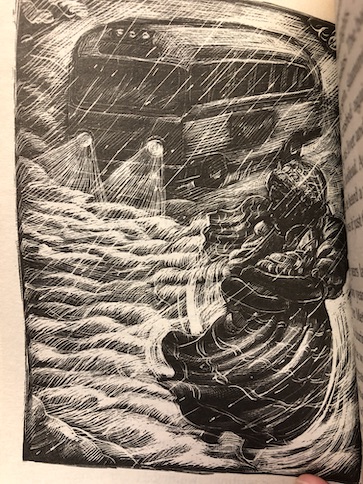
One day, during a bad snow storm, a poor woman with a sick baby begs him for a ride although she doesn’t have money to pay. She’s afraid if she can’t get the baby to the hospital, she’ll die. Grady refuses to give her a free ride, convinced that she’s making too much out of nothing and just trying to get a free ride. Later, he hears that the woman and baby froze to death in the storm. A year after that, he sees the same woman again on the same route. Startled, Grady crashes his bus and is killed.

Years later, a black bus driver has that route, and other drivers tell him about the ghost lady with the baby that they see whenever it starts snowing. He becomes the last person to see the ghost lady … because he’s the first to give her a ride.

The Conjure Brother

This story explains that “conjure women” were women who sold herbal cures and practiced folk magic to help people change their luck.

A girl named Josie is tired of being an only child and wants a brother. However, her mother shows no signs of being pregnant, even though Josie keeps asking her for a brother. When she hears a couple of women talking about the local conjure woman, Josie decides to go see her and ask if she can help her get a brother. The conjure woman gives her a set of instructions to follow, but Josie performs the ritual too early at night. Instead of getting a baby brother, Josie gets an older brother, called Adam. Her parents act like Adam has always been their oldest child. Adam is bossy, and some of the things that used to belong to Josie now belong to Adam. Josie starts to think of Adam as a pest and returns to the conjure woman to ask her to do something about Adam, but instead, she learns an important lesson about sharing her life and house with a sibling.

Boo Mama

This chapter talks about the tumultuous times of the late 1960s and the assassinations of Martin Luther King, Jr. and Robert Kennedy. Some people felt so overwhelmed by everything that was going on that they just wanted to “drop out” of society and ignore the chaos around them.

Leddy has been a social activist since she was in her teens, but then, her husband is killed in the war in Vietnam, leaving her with a young child. After the deaths of Martin Luther King, Jr. and Robert Kennedy soon after her husband’s death, Leddy feels completely overwhelmed. She’s been putting forth all of the effort she has for a long time, and the deaths of the man she loved and the people who inspired her feel like too much. She has a breakdown and starts questioning whether everything she and her friends have done has really accomplished anything. Deciding that she needs a change of scene for her and her son, she moves to a rural community in Tennessee.

At first, her young son seems to do better in the countryside, and Leddy finds the change of pace relaxing, but then, her young son disappears. He wanders away while his mother is hanging out the laundry. The locals put together a search party. They search for days, but all they can find is the boy’s teddy bear. Everyone is convinced that he’s dead, but Leddy can’t give up hope that her son is still alive. Her son does turn up, but he is strangely different. Where has he been, and what has happened to him?

The Gingi

There is an old superstition that “Evil needs an invitation.” Among the Yoruba people of West Africa, there is a belief that evil spirits need someone to welcome them into a house before they can enter, so they will try to trick unsuspecting people into giving them an invitation. They use special talismans called gingi to guard against evil.

A woman named Laura is fascinated by a strange statue that she sees in a shop window. However, when she tries to buy it, the shopkeeper says that she’s never seen it before and warns Laura that evil spirits sometimes disguise themselves to trick people into taking them into their homes. Laura thinks this is just superstition and insists that she wants the statue. The shopkeeper charges her a price that’s too high to discourage her from buying the statue, and it almost works, but for some reason, Laura feels compelled to buy it and pays for it anyway. Seeing that she can’t prevent Laura from taking the statue, the shopkeeper insists that she take a small complementary talisman and keep it with her. The talisman is a small doll, and she gives it to her young daughter to play with.

The Chicken-Coop Monster

The final story in the book is semi-autobiographical, inspired by the author’s feelings when her parents got divorced when she was a child.

A young girl named Melissa is upset about her parents’ divorce. Her parents send her to stay with her grandparents in Tennessee while they’re sorting things out, but she becomes convinced that there’s a monster living in the chicken coop on her grandparents’ property. She and her friends are part of a group called the Monster Watchers of America. Melissa’s grandmother doesn’t believe in the monster, but her grandfather teaches her an important lesson about facing up to life’s monsters.

The House on Hackman’s Hill

House on Hackman's Hill cover

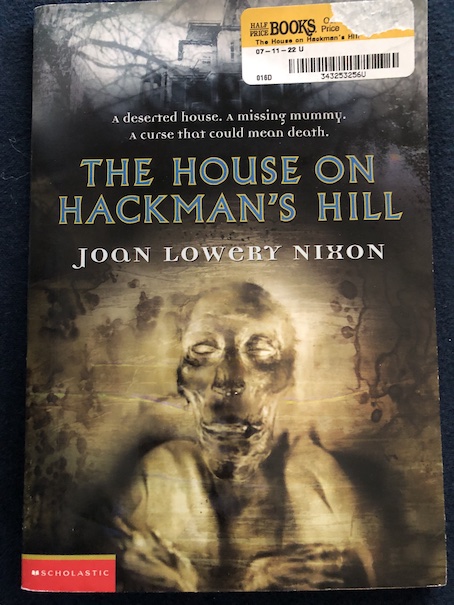
The House on Hackman’s Hill by Joan Lowery Nixon, 1985.

This creepy book is interesting partly because it is told in two parts. About half the story is a flashback that explains the history of the house and the mummy inside it, and the rest continues in the present day.

The very beginning of the story is in the present, starting with a pair of cousins. While they are visiting their grandparents, Jeff tells his cousin Debbie that he’s found out about an old, abandoned house nearby that supposedly contains a hidden mummy and that there’s a reward for anybody who finds it. Debbie doesn’t believe him at first, but he says that he heard all about it from their grandparents’ neighbor, Mr. Karsten. Jeff persuades Debbie to come with him to check out the old house. Debbie comes and takes pictures of it because she’s interested in entering a photo contest.

The place looks really creepy, and they have the odd feeling like somebody is watching them, even though the house is supposed to be empty. Debbie says that they should ask their grandparents what they know about the old house. At first, the grandparents don’t want to talk about it. They just say that it’s an old house and not very interesting. Debbie asks them directly about the mummy, and they say that there are a lot of rumors about the old place, but they don’t really believe them. The kids decide to talk to old Mr. Karsten again. Mr. Karsten says that he knows all about the old house on Hackman’s Hill because he lived there for awhile when he was young, back in 1911.

Paul Karsten’s Story

Paul Karsten’s mother was a secretary, and she went to work for Dr. Hackman, the former owner of the house, after the death of her husband. Dr. Hackman was a strange man with changeable moods. He was pleasant enough to Mrs. Karsten, but he hated children and didn’t really like having her son Paul in his house. Dr. Hackman was a history professor, specializing in Egyptology. He was approaching retirement, and he wanted to devote himself to his papers and his collection of Egyptian artifacts. Mrs. Karsten’s job was to help him catalog his collection, and Dr. Hackman offered such a good salary, Mrs. Karsten couldn’t refuse. The mummy was delivered the same day that Paul and his mother moved into the house.

Paul was given a room in the tower of the house, and while he thought that it had a great view at first, he got nervous when he noticed how the tower room was situated on the edge of a cliff. One of Dr. Hackman’s servants, Jules, makes a comment about how Paul should be careful because they don’t want “another accident”, refusing to say more about whatever “accident” occurred there before. Paul was uncomfortable with the house and with Dr. Hackman. He tells his mother that the house frightens him and that he wants to leave, but his mother reassures him that the place only looks strange because of the Egyptian artifacts. Paul found the artifacts he once saw at a museum exhibit frightening and he’s particularly disturbed by a statue that Dr. Hackman has of a man with an animal head, but his mother says that’s just a statue of an Egyptian god.

Paul had notice earlier that a long box had been delivered to the house, and he gives into temptation and tries to look inside. However, he is stopped by Jules. Jules and his wife Anna warn Paul that this house isn’t very good for children and that Dr. Hackman doesn’t like people nosing around or messing with any of part his collection. At dinner, Paul admits to Dr. Hackman that he tried to look in the box and apologizes for his curiosity. Dr. Hackman accepts the apology, and before Paul goes to bed that evening, Dr. Hackman shows him the mummy case that was in the box. Paul asks him if it’s real, and Dr. Hackman says it is. Paul says that he heard that it’s illegal to take real mummies out of Egypt, but Dr. Hackman says that there are ways, if you’re willing to pay for it, and he was. Dr. Hackman says that his eventual goal is to turn his house into a museum of Egyptian artifacts so that scholars will come there to study them and read his papers, and he will be famous. He also says that he knows how to protect himself from the mummy’s curse. The talk of curses scares Paul, but Dr. Hackman says that nothing has ever happened to him personally because of any tomb curses … implying that something might have happened to someone else.

When Paul tells his mother that Dr. Hackman has a real mummy, she is worried and upset. She doesn’t like the idea of people obtaining artifacts through unethical or illegal means, although she knows that the laws are poorly enforced. Mrs. Karsten doesn’t believe in superstitious curses, but soon, strange things begin to happen. While putting away his things in his room, Paul discovers a strange, triangular piece of gold metal with some kind of design on it. When he goes up to bed, he feels like someone is there in the room, although he can’t find anyone. During the night, he wakes up, sees that one of his windows is open, and feels an odd urge to walk toward it, but fortunately, his mother comes to check on him and stops him. Paul and his mother both realize that they were woken by the sound of a cry in the night. His mother supposes that it was some kind of night bird, but Paul knows that it was probably something to do with the curse.

Paul insists that Jules and Anna tell him about the accident that took place in his room. They say that they weren’t working for Dr. Hackman when it happened, but they know that the person who fell from the tower room was a guest of Dr. Hackman’s, he was from Egypt, he died when he fell, and his body was shipped back home. At first, Paul thinks that the gold piece he found probably belonged to the Egyptian guest, but that’s not quite it.

Dr. Hackman gives Paul the job of polishing some of his statues, knowing that they bother him. It amuses Dr. Hackman as a mean joke. However, Paul’s fear of them fades while working with them because he begins to appreciate their artistry. Dr. Hackman is surprised that Paul is able to see that and not just be afraid of the statues. Paul asks him about the statue of the man with the animal head, and he explains that it’s a statue of Anubis, the god of the dead, and scares Paul again by saying that Anubis is the one responsible for the curses on tombs. He says that Anubis’s head is a jackal head and that jackals hunt at night and have a bark like a cry. This confirms to Paul that the curse was responsible for the cry he and his mother heard.

Paul eventually comes to realize that the strange gold piece attracts the mummy and the mummy’s curse, which is why Dr. Hackman knows that he’s in no danger. Dr. Hackman put it in the tower room to make sure that the mummy’s wrath would only come to whoever was in that room … and that’s why he made sure that Paul was given that room, too. To protect himself and his mother, Paul knows that he has to get rid of that gold piece.

Mr. Karsten finishes his story by explaining to Jeff and Debbie where he hid the gold piece and how Dr. Hackman disappeared, apparently a victim of the curse. Nobody ever discovered what happened to Dr. Hackman, and the mummy disappeared that same night, but a museum has offered a reward for anybody who finds the mummy. Mr. Karsten says that various people have tried to stay in the house and find the mummy, but nobody has succeeded. Everyone has been frightened off after just a single night in the house.

Jeff doesn’t believe in curses, and Debbie agrees to accompany him into the old house to find the mummy and claim the reward.

Return to the Present

The rest of the story is about Jeff and Debbie’s adventures with the house on Hackman’s Hill. Jeff says that he thinks all the spooky curse stuff was just put on by Dr. Hackman, who was a mean old man having a joke by scaring a kid with all that talk of curses. Dr. Hackman was definitely a mean old man who enjoyed scaring young Paul Karsten, but questions still remain. How much of what Paul experienced was really real, and what happened to Dr. Hackman? If the curse was just something he made up, why did he scream the night he disappeared, and where did he go?

Jeff’s idea is that all the creepy stuff happened at night, so the best time to go look for the mummy would be during the day. (That’s actually pretty sensible. Why go to a supposedly haunted house during the night if you don’t have to?) The kids make a plan and put together a collection of useful supplies and food for their mummy hunt. They decide to go while their grandmother is busy watching her favorite soap opera and their grandfather is in town, arranging some sort of surprise for them.

When they enter the house, they discover that everything is still inside. All of the furniture and Egyptian artifacts are like Mr. Karsten described them. Debbie has an instant camera that with takes pictures that develop themselves. (No brand name mentioned, but basically, a Polaroid instant camera or something very similar. Those were popular when I was a kid in the 1980s and into the early 1990s, especially for families and amateur photographers. They’re not as popular now with the popularity of smart phones and digital photography, but they’re still around. Although police photographers now use digital cameras, instant cameras have been used in accident and crime scene photography because they produce quick results, the photos last for a long time, and because they develop immediately after being taken, they can’t be digitally altered. What I’m saying is that Debbie has made a good choice for recording their adventures and any evidence that they uncover, and it pays off almost immediately.) When Debbie takes a picture of the statues that Mr. Karsten told them about, she notices something frightening right away: the Anubis statue doesn’t show up in photographs.

Jeff discounts the photographic evidence because Debbie’s hand shook, and the picture is somewhat blurred. However, the kids start hearing noises in the house. Then, Debbie notices that a bad snow storm is approaching. She wants to leave the house immediately, but Jeff realizes that they can’t because they’d never make it back to their grandparents’ house by the time the storm hit. Night approaches, and the kids are about to see just how true Mr. Karsten’s story was. The kids are trapped in the house by the snow storm, but they’re not there alone.

The book is available to borrow and read for free online through Internet Archive (multiple copies).

My Reaction and Spoilers

I thought that this was a fun, creepy story. The creepiness is tempered somewhat in the first half of this story because it’s told in the form of a flashback. We know during the first part of the story that Paul survives his ordeals and lives to old age because he’s telling the story of what happened when he was young to Jeff and Debbie as an old man. When Jeff and Debbie go into the house themselves, it’s less certain what’s going to happen.

There are points in the story after Jeff and Debbie enter the house where it seems uncertain how much of what Paul Karsten experienced was supernatural and how much might have been due to the machinations of Dr. Hackman, who seems to have been a very disturbed man by himself. They soon discover that the house has secret passages that could allow Dr. Hackman to move around the house unseen and create some strange phenomena himself to scare or harm people in the house. There was a point where I thought perhaps everything would turn out to be part of some elaborate plot by Dr. Hackman or someone else, but (spoiler) there is real supernatural phenomena happening.

Before the end of the book, Jeff and Debbie discover both where the mummy is hidden and where Dr. Hackman hid the mummy’s golden eyes, which Anubis has been searching for all this time. They also learn what really happened to Dr. Hackman all those years ago. He apparently did become the victim of the curse that he had tried to evade by inflicting it on others. When the story ends, it seems that the curse is ended permanently, although Jeff and Debbie do manage to get some things out of the experience.

I liked how, even though the story does turn out to be supernatural, the author introduced the idea that it might not be because that element of uncertainty kept the suspense going for longer and introduced some interesting possibilities for readers to consider. It also made it a little more plausible that the kids would be willing to enter the house because they could believe that the house itself was harmless without Dr. Hackman there to continue his plots.

The Red Room Riddle

The Red Room Riddle by Scott Corbett, 1972.

The story takes place during the 1920s. (It doesn’t actually give a date, but it references the early days of radio and silent movies, which helps place it.) Bruce Crowell meets the new kid in the neighborhood, Bill Slocum, shortly before Halloween. Bruce is afraid of Bill at first because he’s big and has a mean look. Bill does turn out to be a bully, picking on him and shoving him into mud puddles as they walk home from school. Then, one day, Bruce fights back and gives Bill a black eye. Bruce expects that Bill will be mad, but when he points out that Bill didn’t have to shove him into a puddle, Bill says that he guesses that they’re even now, and the two of them end up becoming friends.

Bruce and Bill spend a lot of their time playing outside with other neighborhood kids, and they start making plans for Halloween. During the 1920s, kids mainly celebrated Halloween with pranks. Even though Bill isn’t very good in school, he likes to read nonfiction books, and he starts reading folklore about ghosts. Bruce is more into fiction, and he starts reading books of ghost stories. Bill is really into hard facts and doesn’t believe in ghosts. His reading about ghosts is because he wants to figure out why people would believe in something so silly. He reads about how people have faked ghosts before, and he comments that he wishes that there was a haunted house nearby so he could do some research.

Bruce tells Bill about a house in a richer neighborhood that’s supposedly haunted. Bruce has seen the house before with another boy named Virgil. Virgil’s father says that there was a story about a dead baby being chopped up and buried in the garden of the house or something. Bruce isn’t completely clear about the details, but he says that the house has been boarded up for years because there’s some kind of long-standing dispute about who owns the property. Bill asks Bruce what he saw when he and Virgil went to the house, but Bruce says that they didn’t see much because the house is surrounded by a high wall, and they couldn’t get past the gates. It’s impossible to climb over the wall because there’s broken glass on top that’s cemented in place to stop people from getting in.

When it looks like it’s going to rain on Halloween, Bill suggests that they go check out the haunted house instead of running around the neighborhood, playing pranks. Bruce is reluctant, but Bill talks him into it. They have trouble finding the house at first, and they stop to ask a mailman where it is. The mailman gives them directions, amused that the boys are looking for a scare on Halloween. Bruce doubts that they’ll be able to get near the house because of the wall around it, but Bill discovers that there’s a door in the wall that’s unlocked.

Inside the wall, they find a messy, overgrown garden. The house itself is three stories tall and badly damaged on one side from a fire. In the garden, the boys meet another boy, Jamie Bly, who says that he also snuck onto the property. Jamie has his dog with him, and he says that he’s not scared of the ghosts in the house, daring the other boys to come inside with him.

Inside, the boys have a frightening encounter with the half-blind caretaker of the house, who menaces them with a broken axe handle. The boys run outside again, and Jamie says that the old caretaker wouldn’t really hurt them. Jamie says that he comes there from time to time to spook him because he thinks it’s funny. The caretaker knows it’s him because he calls him by name when he chases him. Jamie says that the caretaker won’t be there much longer, though, because the house is going to be torn down soon, and if the other boys want to see some real ghosts, they should come to his house later that night.

Jamie claims that he lives in a real haunted house. The other boys don’t believe him, and at first, they don’t want to show up to meet Jamie that night because they think he’s really annoying. However, their curiosity gets the better of them, and they decide to show up and see whatever Jamie has to show them. They think at first that they’re just calling Jamie’s bluff and that they’ll prove that he’s a liar, but they’re about to be in for the scariest Halloween they’ve ever had!

When they meet Jamie that night, he leads them through an unfamiliar neighborhood to a house that seems as big as the other old house. It’s difficult for them to see the outside because it’s raining heavily, but the inside is lit with gaslight and oil lamps instead of electricity, something that immediately strikes the boys as odd. They don’t see anyone else at first, and Jamie says that his parents are out for the evening. Bill expects that there are probably servants somewhere in the house because it’s such a big place, and he actually seems to be enjoying himself, looking forward to the challenge of debunking any “ghosts” that Jamie might show them.

The scares start slowly. Something scratches Bill on the cheek before they enter the house. They don’t know what it is, but they assume that it’s some trick that Jamie set up. There’s a creepy maid who doesn’t seem to see them or acknowledge them. Lights go on and off mysteriously. Jamie makes a peanut butter sandwich. (That wouldn’t be scary except that the boys are seriously starting to be creeped out by Jamie, so everything he does is creepy.) Then, Jamie takes them upstairs to see the Red Room.

The Red Room is a bedroom where everything is red. It has a picture of the Slaughter of the Innocents and a tapestry with the same theme outside. It has a red marble fireplace. Even the ceiling of the room is red … and it looks red and sticky. Then, Jamie locks them inside. The room has no windows, and Jamie says that there’s a secret staircase out … if they can find it.

The book is available to borrow and read for free online through Internet Archive (multiple copies).

My Reaction and Spoilers

Getting locked in what looks like a creepy murder room is scary enough, but there are other scares, and the boys do see what looks like real ghosts. After their experience, Bill thinks that he’s reasoned out a good explanation, but there is one more punchline to the story when the boys go back the next day to confront Jamie about all the creepy things that happened.

This is one of those stories where you never get a full explanation. In the end, we still don’t know what the deal was with the theme of the of Slaughter of the Innocents and the dead baby that was once supposedly found on the property. However, when the boys talk to an impartial person at the end, they do learn that the house is the same one that they visited before and that Jamie probably did live there at some point in the past, back when people used gaslights. The Bly family who once owned the house seems to have had a dark and sinister history, and while it’s still possible that there was some kind of trick being played by a person who knows about it, the boys come to believe that they really did have a supernatural experience.

Because of the scary subject matter, I would say that this book would be best for older elementary school children who really like a good scare.

Personally, the parts I liked the best were the references to things that kids don’t often encounter in modern times. I liked how Bruce gives an estimated time period for the story by talking about silent movies that are accompanied by piano playing and how he and Bill learned the term “yellow” for cowardly from western films. When they first meet Jamie and don’t want to tell him their names, they give the retort of “Pudding Tane. Ask me again and I’ll tell you the same.” I’ve seen/heard that retort used in old books (like Ruth Fielding at Lighthouse Point) and tv shows, but it’s one that went out of style before I was a kid myself. I had to get my parents to explain it to me the first time I heard it on a tv show as a kid.

Scared Stiff

Kelly Anderson and her brother Chace rarely have visitors to their house because their parents are morticians, and there is no way to even get to the children’s bedrooms without passing a dead body somewhere because the family home is the mortuary. Their house is a big, old mansion in Maryland with the mortuary on the ground floor and the family quarters above. The kids’ parents say that it’s traditional for morticians to live at the mortuary, but Kelly still thinks that it’s creepy, even though she’s been around it her whole life. She also hates it that she always has to be quiet because there might be a viewing or funeral going on. When she was little, she was always afraid that they would accidentally bury someone who was still alive. However, her brother thinks living in a mortuary is kind of cool and makes jokes about it, saying that his parents are “professional boxers” and that they live in a “body shop.”

One evening, Kelly’s parents go out to a Chamber of Commerce banquet, leaving Kelly and her brother home alone with Chace’s friend, Matt. Before her parents leave, her mother says that she’s ordered pizza for them and suggests that Kelly go down to the video shop and rent a movie. She says that Kelly can also invite a friend over, if she wants, and Kelly complains that no girls she knows want to hang out in a mortuary. In fact, kids have been teasing her mercilessly and telling her that she and her family are gross and creepy. Chace just makes jokes about these comments, but they really bother Kelly. It bothers her even more that her best friend seems to be siding with other people who keep telling her not to take it seriously, especially now that she’s dating one of Kelly’s tormentors. (Yeah, it usually is the people dishing it out who want everyone to just be cool about everything they inflict on someone else. Insert eye roll here.) Kelly just wants someone to care about her feelings.

On the other hand, some of Chace’s friend’s are morbidly fascinated by what happens at the mortuary. Chace has been giving them tours of the embalming room where they prepare bodies for burial without his parents’ knowledge or permission. Chace says that the appeal for his friends is that they like to be scared. His friends are always afraid that a dead body will come to life, so Chace likes to grab his friends’ necks so they feel like the dead body was reaching for them. Then, they get scared and run away. It thrills Chace’s friends every time, although Chace says it’s all starting to feel a little routine. The kids’ parents would punish Chace if they knew what he was up to.

Before Matt comes over, he calls Chace and asks if any new dead bodies have arrived at the mortuary. Chace promises him that, if there’s no dead body to see, they can still look at the coffins. Kelly tells Chace that, for about the last month, she’s been having some premonitions that something bad is going to happen, but she’s not sure what it is. Her premonitions start getting worse when a sudden storm comes in.

At first, Matt’s visit seems pretty normal. The kids eat the pizza (which the pizza delivery guy just flung at the door because even pizza delivery guys are afraid of the mortuary), and the boys start playing video games. Then, Kelly hears that their mother’s grandfather clock chimes the wrong number downstairs. The clock is an antique, and it does that sometimes. Chace doesn’t want to go downstairs and fix the clock because he’s playing a game. Kelly is nervous about going downstairs because the mortuary gives her the creeps, but she doesn’t want to admit that she’s nervous in front of Matt, so she goes to fix the clock anyway. While she’s fixing the clock, she gets the odd feeling that there’s a dead body in the building even though Chace had told her that they didn’t have any “customers” that day. When she takes a look in the chapel, she sees that her parents have left a red light on by the door to the embalming room, which is the signal that there’s a body there.

When Kelly goes back upstairs, she asks Chace why he said that there was no body when there is. Chace says that the light was off earlier, and the three kids go downstairs to check. The light is definitely on, and Chace says that he must have made a mistake before. He’s surprised because their dad usually tells them when a body has arrived, and he didn’t this time. Matt asks them what their parents do with the bodies, and the kids describe the process of preparing a body for burial. Matt asks if he can see the body because he’s never seen one before. Kelly says that the boys shouldn’t go in there because it’s against the law for anyone but a licensed mortician to be in there, and also the body might be in a really bad condition if it’s been in an accident. Matt thinks that just makes it sound even more cool. Chace hesitates because, while he doesn’t usually mind giving his friends secret tours, he’s starting to get an odd feeling from the situation. Things aren’t like they usually are, and he’s starting to share Kelly’s premonition.

However, Matt insists that he wants to see the see the body, so Chace says that they’ll just take a quick look. Kelly goes upstairs and locks herself in her room, and the boys go in the embalming room. Although Kelly tells most of the story, she says that Chace told her later what they saw. There is a body on one of the tables in the embalming room, covered by a sheet. The feet sticking out from the sheet have ugly yellow toenails, and the toe tag says “J. L. Torbett.” Matt asks if he can see the face of the body. Both of the boys are nervous about moving the sheet because Chace still has an odd feeling, but Chace finally pulls back the sheet. J. L. Torbett turns out to be an old man with white hair, who is oddly wearing an orange jumpsuit. Chace’s odd feeling grows when he realizes that his father hasn’t even started to work on this body. He usually starts prepping bodies immediately upon arrival. Then, the body moans. At first, Chace tells Matt not to panic because it’s probably just air escaping from the body, and that happens with dead people. (That’s true. It is probably one of the factors of human decomposition that led to stories of vampires and other undead creatures. But, this is a scary story.) Then, the body sits up on the table, and Matt screams and runs. Chace hesitates for a moment, thinking that it might just be an odd nerve impulse that caused the body to sit up, but then, its head turns toward Chace, it opens its yellow eyes to look at him, and it starts reaching for him. Chace faints.

When Matt and Kelly come to find Chace, they find him on the floor of the embalming room, disoriented, and the old guy in the jumpsuit is standing in the middle of the room, swaying like he’s trying to get his balance. Kelly demands that the guy tell them who he is and what he’s doing in there. The boys tell her that he’s the corpse, but she says that’s impossible because he’s up and walking. The kids are terrified, but the man prevents them from leaving. The kids tell him that he’s in a mortuary and he’s supposed to be dead. The man is confused because he just remembers going to sleep in his cell and waking up there. The kids realize that he must be a criminal, but the man insists that he’s not. He asks the kids what day it is, and they say that it’s Friday, November 13. (Yep, Friday the 13th!)

That date excites Torbett. He says that he has spent 50 years in prison for a murder he didn’t commit, and the day has come to take his revenge by killing the people who sent him there. Of the twelve jurors, one is still alive, and so is the judge and a key witness. The kids realize that Torbett is talking about murdering three people. They also realize that, when he smashes some bottles in his agitation, he cuts his hand … and it doesn’t bleed. The kids try to run away, and Torbett grabs Kelly. Kelly realizes that his skin is cold and his eyes are lifeless. Torbett really is a walking dead man, brought back to life by his intense need for revenge. The kids struggle with Torbett, and Torbett runs out of the room, looking the children inside.

However, the embalming room has a telephone. Kelly remembers that her friend, Gretchen, is babysitting at the house where the old judge lives, and she wants to call her and warn her, but Matt says that they need the police and calls 911. Unfortunately, when the kids try to explain what the problem is, the operator doesn’t believe them and thinks its a prank. Kelly gets angry with the 911 operator, hangs up, and calls Gretchen, but the phone line at the house is busy. Matt says that, weirdly, the embalming room is probably the safest place for them to be because it’s the last place Torbett will want to return to, but that doesn’t help much. Torbett is still out to kill people, and if and when he does come back, the kids are trapped. What are they going to do?

The book is available to borrow and read for free online through Internet Archive.

I’ve been looking for this book for awhile because I remember reading it when I was a kid in elementary school. Actually, that kind of amazes me now because I’ve always been easily spooked, and I’m still kind of surprised that I read this and remembered liking it. I was also easily grossed out as a kid, and I still am, so, while I think that it’s really interesting that the author included some real details about the morticians’ professions, I have to admit that I still find it gross. There are reasons why I got a ‘C’ in health class in high school and declared myself to be a conscientious objector about dissection and did reports instead. I’m very squeamish.

Feeling the way I do about these things, I can’t remember why I decided to read this book when I was a kid, but I know why I finished it. The book is well-written, and once you become involved with the characters’ situation, it’s compelling to keep reading and find out what happens. Actually, the only parts of the story that I remembered before I re-read it where the very beginning and the very end.

The kids manage to break out of the embalming room and try to help the people that Torbett said that he would go after. They already know that it’s too late for one of Torbett’s victims because Kelly was talking to her on the phone and trying to convince her of the danger when Torbett broke in, but they know who and where the other two possible victims are, and they decide to try to reach them before Torbett does.

Part of the story that I had forgotten is that Matt comes from a bad neighborhood. One of the people Torbett is trying to kill also lives in that neighborhood, and when they go there, Kelly says that the neighborhood gives her the creeps. Then, she realizes that she might have offended Matt in the same way people have offended her for making fun of the place where she lives, and she apologizes to him. Matt says it’s okay, and he understands because it’s not a safe neighborhood. I liked that part of the story because I thought that it was an interesting comparison. There are different reasons why someone might have to live in a place that people consider undesirable (lack of money in Matt’s case, and their parents’ profession, in Kelly and Chace’s case), and it’s not always a reflection on the person so much as their circumstances.

In case you’re wondering if maybe Torbett is actually alive and was faking that he’d been dead, no, he actually is a risen corpse. At one point, he gets shot, and the hole is big enough for the kids to look right through it, and it doesn’t stop him. Torbett also isn’t lying about not being guilty of the murder he was sentenced for. Along the way, the kids learn who the real murderer was, and it’s one of Torbett’s victims.

The story has a kind of open ending. Just after the kids think that they’ve finally dealt with Torbett by cremating him, their parents come home from their dinner, saying that they had to leave early to pick up a body … at the state prison. It’s Torbett, and as the book ends, they see his head move under the sheet.

More Scary Stories to Tell in the Dark

More Scary Stories to Tell in the Dark collected from folklore and retold by Alvin Schwartz, drawings by Stephen Gammell, 1984.

This is the second book in a series of popular ghost stories and American urban legends. Many of us who were children in the 1980s and 1990s heard these stories on school playgrounds, at summer camps, or at sleepovers, even if we didn’t read them in this book first. I found the stories in the first book in the series to be more familiar to me from my childhood than the ones in the second book, but there are still many popular and familiar ghost stories here. There is a section at the beginning of the book where the author/compiler discusses why stories like these have been popular for generations. In the back of the book, there is another section with more detailed information about the origins of the stories and their variants.

The drawings in the book also complement the stories well. They’re all in black-and-white and have an ethereal look, as those they were composed of spirits or smoke.

The book is available to borrow and read for free online through Internet Archive (multiple copies).

Stories Included in the Book:

The stories are divided into sections by theme or by the effect that the stories are supposed to have.

When She Saw Him, She Screamed and Ran

This section has stories about ghosts.

Something Was Wrong – A man is walking down the street, but for some reason, everybody is afraid of him. What’s wrong?

The Wreck – A guy meets a girl at a dance … only to learn that she was killed before she got there.

One Sunday Morning – A woman goes to church on Sunday but discovers that this isn’t a normal church service.

Sounds – Some fishermen take shelter in an empty house during a storm and hear the sounds of a past murder.

A Weird Blue Light – The crew of a ship during the Civil War witness something very strange, possibly the ghost of a pirate ship.

Somebody Fell From Aloft – The ghost of a murdered sailor gets his revenge.

The Little Black Dog – A murderer is followed by the ghost of a dog.

Clinkity-Clink – A grave digger steals the silver dollars laid on the eyes of a corpse, but the dead woman wants them back. (This story is supposed to end with a jump scare, like ghost stories told aloud around a camp fire.)

She Was Spittin’ and Yowlin’ Just Like a Cat

This is a selection of strange stories about different topics.

The Bride – The famous story about a bride who plays hide-and-seek and accidentally gets locked in a trunk.

Rings on Her Fingers – A thief tries to steal the rings from a dead woman, only she may not be quite as dead as everyone thinks.

The Drum – Two young girls meet a gypsy girl with a special drum that controls dancing figures. The girls want the drum, but the gypsy girl says that she’ll only give it to them if they do bad things.

The Window – One dark night, Margaret sees something with glowing eyes outside her window. What is it?

Wonderful Sausage – A butcher murders his wife and turns her into sausage.

The Cat’s Paw – A woman turns herself into a cat.

The Voice – A girl hears a voice in her room at night, but nobody is there.

When I Wake Up, Everything Will Be All Right

This section has stories about dangerous and scary places.

“Oh, Susannah!” – A university student thinks her roommate is humming at night, but her roommate is already dead.

The Man in the Middle – A girl sees three men on the subway late at night, but something’s wrong with the one in the middle.

The Cat in a Shopping Bag – A woman accidentally runs over a cat, and she puts the body in a bag to dispose of, causing a thief to get a terrible shock.

The Bed by the Window – A room at a nursing home has only one bed by the window. When one man kills another to get the view, he gets a shock.

The Dead Man’s Hand – A group of nursing students resent a fellow student who seems too perfect and decide to play a prank on her.

A Ghost in the Mirror – This story explains the spooky sleepover game Bloody Mary. Kids (typically girls) go into a dark or diml-lit room and look in a mirror to see a scary face appear. (This is actually a psychological trick, sometimes referred to as the “strange-face illusion“. Humans instinctively look for faces and facial emotions, and when someone can’t see their own face in the mirror very well because the room is too dim, their mind will try to reconstruct the missing details and interpret them, creating some strange illusions, like it’s someone else’s face when it’s just their own. The book doesn’t explain that, but that’s basically what “Bloody Mary” really is.) In the game, the identity of “Bloody Mary” and what she’ll supposedly do if you see her varies. This story explains different versions of the ghost story associated with the game.

The Curse – A fraternity initiation results in the deaths of two pledges and a curse on the remaining members.

The Last Laugh

This section has spooky stories with a humorous twist.

The Church – A man takes shelter in an abandoned church during a storm and thinks that he sees ghosts inside, but they aren’t what they appear to be.

The Bad News – Two old friends who love baseball and wonder if there’s baseball in heaven. There’s good news, and bad news.

Cemetery Soup – A woman makes soup with a bone she finds in the cemetery.

The Brown Suit – A woman thinks that her dead husband would look better in a brown suit for his funeral, and the funeral parlor comes up with a bizarre solution.

BA-ROOOM! – A spooky song.

Thumpity-Thump – People move into a spooky house and hear a mysterious thumping noise.