The Dreadful Future of Blossom Culp

DreadfulFutureBlossomCulpThe Dreadful Future of Blossom Culp by Richard Peck, 1983.

This book is part of the Blossom Culp Series.

It’s 1914, and Blossom Culp is just starting high school. Although the principal of her old school tells her that this is a chance for her to make a fresh start, it looks like Blossom’s future is going to be very much a continuation of her immediate past.  In high school, she’s still a social outcast, looked down on by girls from better-off families, like Letty, the class president.  Also, despite her principal’s assertion that Blossom’s previous forays into the occult were imaginary, the product of the mental confusion that accompanies puberty, and that she is bound to grow out of them, Blossom knows that her psychic abilities are a natural gift and will not be ignored.

Blossom begins high school friendless because Alexander Armsworth has been ignoring her lately because of his important new position as class vice-president, his infatuation with Letty, and his friendship with a couple of local hooligans, Bub and Champ. Alexander is looking forward to his role in planning the school’s Halloween Festival, telling Blossom that he’s over their earlier, childish occult escapades and the Halloween pranks he used to pull.  Meanwhile, all of the other girls in school are infatuated with their handsome history teacher, Mr. Lacy, and so is the girls’ gym teacher, much to Blossom’s disgust.  Blossom thinks that Mr. Lacy is full of himself and denies that she has any such silly crush on Alexander.

Blossom makes an unexpected friend in a girl called Daisy-Rae, a girl from the country who has brought her younger brother into town to attend school and hoped to get an education herself but has been too afraid of the big town to actually attend classes.  Daisy-Rae hides in the school during the day and lives alone with her brother at night in the old chicken coop at the abandoned Leverette house.  It is through Daisy-Rae that she learns that Alexander and his friends aren’t so above childish pranks as they claim to be.  Blossom also discovers that Mr. Lacy has been romancing her old principal.  Mr. Lacy isn’t quite what he appears to be and has some unsavory secrets in his past.

Matters come to a head when Alexander (at Letty’s urging) tries to persuade Blossom to dress up and become the fortune teller for the haunted house that the freshmen class is doing for the Halloween Festival.  The haunted house is also a fundraiser, and Letty figures that they can get extra money from people if they’re willing to pay to have their fortunes told, and who would be better for the job than Blossom?  However, Blossom isn’t one to go out of her way to please others, especially Letty, and it turns out that they’re holding the haunted house in the Old Leverette place.  For some reason, that old house makes Blossom’s mother uneasy.  She seems to think that it’s haunted, but in an unusual way.  Blossom tells Alexander that she will not agree to be their fortune teller until he agrees to check out the house with her before Halloween and find out what’s wrong with it.  She figures that, since both of them are psychic, they can learn what’s so unusual.

As Blossom learns, her abilities don’t confine themselves to the past and people who have died but extend to the future and the people who haven’t yet been born.  Inside the Old Leverette house, Blossom suddenly finds herself entering the distant future, the 1980s.  In the 1980s, the Leverette house is once again lived in, and Blossom meets a boy named Jeremy who is a lonely social outcast, like herself.  Jeremy is a computer nerd, living with his divorced mother.  He takes Blossom on a tour of their town as it is in Blossom’s future, much larger than it used to be and with many familiar landmarks missing.  However, what Blossom sees in the future gives her the inspiration she needs to solve her problems in the past and hope that things will improve.  In return, she also proves to Jeremy that he is far from alone and has had a friend for longer than he ever imagined.

The time travel to the 1980s comes off as being a little corny (or so it seemed to me), but the writing quality of the book is excellent.  The author has an entertaining turn of phrase, and the book, like others in the series, is humorous and a lot of fun to read.

Besides being a kind of fantasy story, there are some interesting tidbits of history in the book, showing how people lived in the 1910s.  Blossom explains about the things she and her classmates did at school, like wearing beanies on their heads to show which year they were (freshmen, future graduating class of 1918).  At one point in the story, Blossom takes Daisy-Rae and her brother to their first movie, a silent film with an episode of The Perils of Pauline serial.  While Blossom worries about the future, readers can get a glimpse of the past!

As for what Blossom learns about her own future, she avoids finding out too much because she’d rather not know the details.  However, there are implications that she and Alexander may eventually marry and live in his family’s old house.

The book is currently available online through Internet Archive.

The Ghost Belonged to Me

GhostBelongedToMe

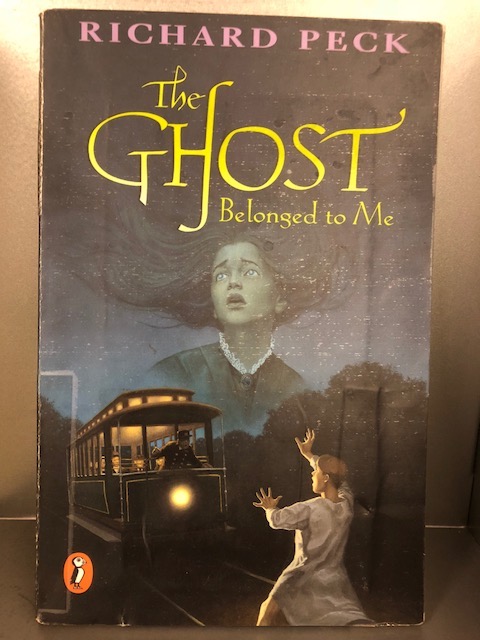
The Ghost Belonged to Me by Richard Peck, 1975.

The book takes place in the 1910s in a small town on the Mississippi River. Alexander Armsworth, a boy in his early teens, is approached by a girl from his class who tells him that the barn on his family’s property is haunted and that Alexander himself has the ability to see the “Unseen.” The girl, Blossom Culp, is a poor girl from a family of outcasts who has been known to tell tall tales, so Alexander isn’t sure he believes her at first. However, he can’t help but be curious, and when he sees a light coming from the barn at night, he decides to investigate.

Inside, he finds the ghost of a young girl who warns him of danger on the trolley tracks near his house and tells him that he must act fast to save everyone. Frightened, Alexander gets the trolley to stop and learns that by doing so, he has saved the lives of everyone on board from a disaster at the bridge further on. Naturally, everyone wants to know how Alexander knew to warn them. When Alexander explains, he is met with skepticism from his social-climbing mother and sister and unwelcome attention from news people and curiosity-seekers from town.

The ghost, who tells Alexander that her name is Inez Dumaine, is also in need of help before she can rest peacefully. Alexander will need the help of those who believe in him and the ghost to find Inez’s body and return it to her home in New Orleans.

In this first book in of the Blossom Culp series, Alexander is the main character, but the other books focus more on Blossom, who discovers that she also has the ability to see ghosts.  The book is available to borrow and read for free online through Internet Archive.

This is the movie that the Disney movie Child of Glass was based on, and the movie is available on dvd. Sometimes, you can also find it on YouTube, at least clips and reviews of it.

My Reaction

The story has sad and scary points, but those are balanced out by humorous situations. Alexander’s sister’s turmoil over the fiasco at her coming-out party is hilarious, and his mother’s change in attitude when she realizes that, instead of making them social outcasts, the ghost business actually attracts attention from one of the town’s leading citizens is a hoot. Blossom, of course, is wonderfully nosy, elbowing her way into Alexander’s life and selling tours of the haunted barn.

I was very young when I saw the Disney movie based on this book, Child of Glass (a live action movie that aired on television), and I was afraid of ghosts. However, years later, I took another look at the movie and decided to read the book that it was based on. When I did, I saw things I didn’t appreciate when I was young. The dialog and depiction of life in the early 20th century in the book are wonderful. It conjured up memories of Meet Me in St. Louis, especially the Halloween scene (which took place only about a decade earlier than this story). Unfortunately, this early 20th century setting wasn’t present in the movie version of this book because Child of Glass was placed contemporary with the time it was made, during the late 20th century.

The Disney movie was also different from the original book because it added the feature of the “child of glass” which didn’t exist in the original book. The “child of glass” was mentioned in a poem at Inez’s grave that explained how to lay her ghost to rest. At first, the Alexander and Blossom in the movie don’t know what it means, but it turns out to be Inez’s doll, which was lost when she was murdered by her wicked uncle. In the book, Inez died under different circumstances. However, the discovery of the doll in the movie uncovers the secret motive behind her murder, which is similar to the reason why Inez’s body was hidden in the book after she died in a riverboat accident.  In the book, Inez’s spirit finds rest after her body is found and taken to her family’s cemetery in New Orleans.  The Disney movie also turns this story specifically into a Halloween story, which wasn’t the case in the original book.

The Haunting at Cliff House

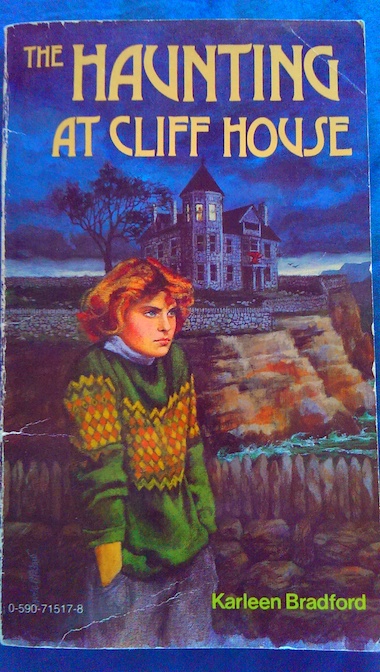
HauntingCliffHouseThe Haunting at Cliff House by Karleen Bradford, 1985.

This is a relatively short chapter book, but suspenseful, thoughtful, and well-written.

When her father inherits an old house in Wales from a distant relative, Alison, a young teenager, finds out that he plans for the two of them to spend the summer there.  Alison’s father is a university professor and is writing a book, and he thinks that the house in Wales sounds like a great place for him to get some writing done while he and Alison have a look at his new inheritance.  Alison isn’t enthusiastic about the trip, but she and her father are very close, especially because she lost her mother at a very young age.  Besides, the only place she could stay in Canada would be with her grandmother, and her grandmother didn’t seem enthusiastic about having her.

From the moment they arrive at the old house, called Pen-y-Craig or Cliff House by the locals, Alison has a bad feeling about it.  It stands on a lonely cliff by a small town.  The carved dragon over the door gives her the creeps, and there is something disturbing about a particular room in the house.  Sometimes, she can almost hear a voice calling out to her, and she has visions of another girl, about her age.  At first, she tries to tell herself that it’s all her imagination, but it soon becomes obvious that it’s not.

Some of the local people know that the house has an unhappy history, and Alison eventually learns that the great-aunt that her father inherited it from even refused to live there during her last years because it disturbed her too much.  A little more examination of the room that had disturbed her helps Alison discover the reason why.  After having a vision of a young girl hiding something behind a brick in the fireplace of one of the bedrooms, Alison searches the spot and finds a diary dating from 1810, written by a girl named Bronwen, who was the same age as Alison.  Like Alison, Bronwen was brought to the house by her widowed father and was unhappy about it, but those aren’t the only parallels between Bronwen’s life and Alison’s.

Alison becomes uncomfortable with her father’s new friendship with a Welsh neighbor, Meiriona.  Alison likes Meiriona’s younger brother, Gareth, but when it looks like her father’s friendship with Meiriona is turning into romance, Alison becomes jealous and fears changes in her close relationship with her father, a situation that mirrors Bronwen’s life when her father falls in love with her governess, Catrin.  Although Meiriona tries to be nice to Alison, Alison can’t bring herself to like her, and she argues with her father about it.

The only person who seems to understand her feelings at all is Gareth, and Alison confides her worries in him, both about Meiriona and about Bronwen, whose spirit keeps calling out to Alison to help her, although Alison doesn’t know how.  She struggles to read through the diary, whose pages are not all legible anymore because they’re damaged with age, to learn what happened to Bronwen and what Bronwen wants her to do now.  Gareth tries to reassure Alison that her father’s relationship with Meiriona will not be as bad as Alison thinks.  He thinks that the relationship would be good for both Alison’s father and Meiriona because they are both lonely, and he doesn’t think that Alison should worry about losing her father because he’s not worried about losing his sister, even if she goes to Canada to study and spend more time with Alison’s father.  At first, Alison isn’t comforted by these reassurances.  However, Gareth agrees that the matter of the ghost is serious, and he can feel her presence as well. Gareth warns Alison to be cautious about the ghost but to try to help if she can and to call out to him if she’s ever in danger.  Alison would really rather just go home to Canada, run away from her father and Meiriona, and forget the whole thing about Bronwen, but history seems to be repeating itself, and Bronwen’s voice calls out to her insistently for help that only Alison can give.

It’s a bit of a spoiler, telling you this, but although Alison at first thinks that the diary ends with Bronwen killing herself in despair, thinking that her father only loved Catrin and not her and that there was nothing left for her to live for, the truth is that Bronwen’s suicide attempt didn’t succeed and that she made another mistake that she wants Alison to help her to change.  Bronwen attempted to kill herself by going to a cave by the sea during a terrible storm, planning to allow herself to drown, but when the water started rising, she became too frightened and decided to leave by a secret entrance to the cave.  Not knowing that Bronwen was safe, Catrin attempted to save her and drowned in the cave herself.  As Bronwen was climbing to safety, she heard Catrin calling for her but was too frightened of the storm and angry at Catrin to go back for her.  Although Bronwen lived on after the incident, she could never get rid of her guilt at Catrin’s death, realizing that, even in the middle of her resentment toward Catrin, Catrin loved her more than she knew, even to the point of giving up her own life while attempting to save hers.

Now, the anniversary of Catrin’s death is approaching, and so is a storm very much like the one that killed her.  At the top of the cliff by the cave, Alison finds her time merging with Bronwen’s, and she will only have one chance to help Bronwen make the right decision the second time around.  Helping Bronwen to prevent the worst mistake of her life and to make a better choice also helps Alison to reconsider her own choices and future.  Just as Bronwen misjudged Catrin, Alison may have also misjudged Meiriona. Instead of losing her father or being forced to accept a poor substitute for her mother, Alison may be gaining a kind of sister who will love her more than she realizes.

A Ghost in the House

GhostInTheHouseA Ghost in the House by Betty Ren Wright, 1991.

At first, Sarah Prescott enjoyed her family’s new house.  The house wasn’t really new.  Other members of Sarah’s family had lived there before, but it was the first place where Sarah hadn’t had to share a room with her younger brother.  Then, Sarah’s Great-Aunt Margaret came to live with them, and everything changed, in more ways than one.

Aunt Margaret is the one who actually owns the house where Sarah and her family are living.  She’s is elderly and sick and has been living in a nursing home.  The rent that Sarah’s parents pay her pays for her care at the nursing home.  However, Aunt Margaret has been doing a little better, and she would like to come and live with the family.  Having her move in with the family would not only be good for her but for them because Sarah’s father has been in and out of work, and Aunt Margaret wouldn’t charge them rent or at least not much if they all lived together and they helped to take care of her.  However, it would mean some sacrifice on Sarah’s part.

Aunt Margaret had once slept in the beautiful room that Sarah has been using, and Sarah must give it up for her now that she will be living with them.  It’s difficult for her to deal with, but Sarah is also restricted on when she can have friends over because Aunt Margaret needs her rest, and the family’s lack of money means that Sarah won’t be able to go to the concert that everyone at school as been talking about.  These family problems and teen angst could be bad enough, but from the moment that Aunt Margaret moves in, strange and frightening things start happening that only Sarah and her aunt ever witness.

Whenever Sarah and Aunt Margaret are alone in the house, rooms get cold, and Sarah hears weird things like footsteps walking around when no one should be there and a girl’s voice singing that particularly unnerves her aunt.  Sometimes, Aunt Margaret’s things are moved around or broken, and there is something mysterious about an old painting that has been in the house for years.  Over time, Sarah begins to notice that the painting darkens, and sometimes she can see a man in the painting who wasn’t there before.  The presence of the painting also upsets Aunt Margaret, although she refuses to say why.  Although Aunt Margaret at first suspects that Sarah is the cause of some of the weird things that are happening, Aunt Margaret is the actual cause, and she is afraid to admit the dark secret from her past that has come back to haunt her.

A long time ago, when she was young, Aunt Margaret had a best friend called Anne, whose father painted the mysterious painting.  Anne had a very unhappy home life, and when the opportunity arose for Margaret’s family to adopt her, Margaret wasn’t sure if she wanted to share her home with her friend, although she cared for her a great deal.  Because of her hesitation, her parents decided not to adopt Anne.  In her old age, she admits that she was a spoiled girl.  Unfortunately, her friend went to live with other relatives and ended up dying in a fire, so Margaret never had a chance to make things right with her.  Although Anne’s death was a freak accident, Margaret felt guilty because Anne would have lived if her family had adopted her.  Anne’s father also blamed Margaret and her family for not doing more for his daughter, although it was his drunkenness and violence that ruined his home life and led him to give up his daughter in the first place.  Before he died, he threatened revenge against the family in some way.  Now, his vengeful spirit has found a way to use the old painting to reach Margaret once again, and unless Sarah can find a way to stop him, he will make sure that Margaret joins Anne in death . . . and possibly Sarah, too.  However, there is also Anne’s spirit to consider.  In life, Anne was the only person who ever stood up to her father.  Would she be willing to do it one more time for Margaret’s sake?

Part of the story is about being willing to sacrifice for the ones you love.  Years ago, Margaret hesitated to give up some of her pampered life for her best friend, and she regretted it forever after.  Sarah also comes to see how her earlier worries about giving up her room and about sleepovers and concerts were petty when compared to helping a relative who loves her.  She also sees how it’s important to do the right thing when there’s time because sometimes there is no opportunity to do it later.

In a way, I felt like the problem was solved rather easily, but there were some pretty scary incidents in the story and a failed attempt to get rid of the painting that brought some suspense.

The book is currently available online through Internet Archive.

The Dollhouse Murders

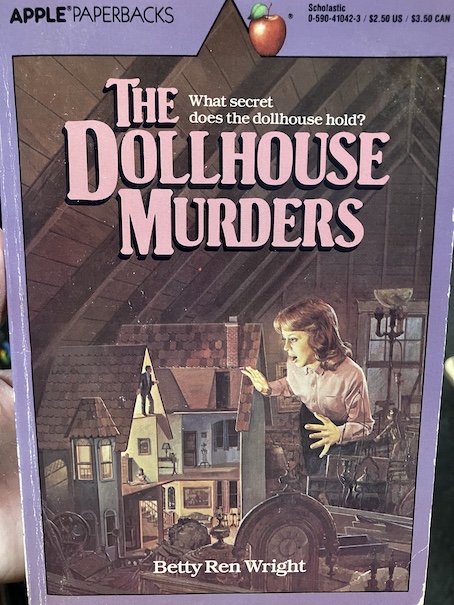
dollhousemurdersThe Dollhouse Murders by Betty Ren Wright, 1983.

Amy is upset because she constantly has to look after her sister Louann, who has developmental problems. Louann is only a year younger than Amy, but her condition makes her think and act like a small child all the time. Amy loves Louann, but having her around all the time makes it difficult for her do things on her own and to make friends.  It’s frustrating because the girls’ mother doesn’t seem to understand the pressure Amy feels.

One day, she has an argument with her mother about it and runs away to her aunt’s house. Aunt Clare normally lives in Chicago, but she has returned to her home town to sort out the things in her grandparents’ old house. Sympathizing with Amy, Aunt Clare offers Amy the chance to stay with her for a couple of weeks, without Louann.

Aunt Clare and her brother, Amy’s father, used to live with their grandparents when they were young, and Aunt Clare says that she has unhappy memories of that time.  While helping her aunt go through some of the old things in the house, Amy discovers that there is a dollhouse in the attic made to look exactly like the grandparents’ house and dolls which look like the grandparents, Clare, and her brother. Amy thinks the dollhouse is wonderful, but Aunt Clare seems to find it disturbing.

When Aunt Clare refuses to talk about her deceased grandparents, Amy looks at some old newspapers at the library to learn more about them. To her shock, she learns that they were murdered in the house and that the killer was never found. Soon, strange things begin happening with the dollhouse. The dolls move around on their own, and mysterious lights and crying noises can be heard. The dolls seem to be acting out the events of the night of the murder. After all this time, the dolls seem to be trying to tell them something, if they have the courage to listen.

The book is currently available online through Internet Archive (multiple copies).

My Reaction and Spoilers

Aside from revealing the murderer’s true identity, the dolls settle other troubling matters in Amy’s family.  For years, Aunt Clare has blamed herself for the way she behaved around the time her grandparents were killed.  She was afraid that something she did might have even led to their deaths.  But, none of it was really her fault, and her grandparents want her to know that she needn’t blame herself anymore.  When Aunt Clare realizes the truth, she feels like a great weight has been lifted from her.  She begins coming to terms with her past and appears to be headed for a better future.  Amy also comes to terms with her sister’s condition and values her even more highly when Louann’s lack of fear of the dollhouse gives Amy the courage to see the dolls’ final message.  Amy’s family also makes changes to help Louann become a little more independent and to allow Amy a little more independence of her own.

There was a movie version of this book made in 1992 (Sometimes called Secrets in the Attic), but it’s difficult to find copies of it now.  Sometimes, the movie or clips of it appear on YouTube.  Apart from that, it’s very difficult to see it.

The Headless Cupid

HeadlessCupidThe Headless Cupid by Zilpha Keatley Snyder, 1971.

This is the first book in the Stanley Family Mysteries series.  Some people might be put off by the occult themes in this book, but this is a mystery story, and all is not what it seems.  Read to the end or skip to the spoilers section to find out.

Eleven-year-old David Stanley has had to help take care of his younger siblings since his mother’s death.  In some ways, he feels like his mother knew that she was dying before anyone else did, preparing David to help his father by taking care of his younger sister Janie and the young twins, Esther and Blair.  David thinks that his mother might have been psychic because she tended to believe in some odd things and often knew things before other people did.

Now David’s father, a college professor, has remarried, to a divorced woman with a daughter of her own, Amanda, who is twelve years old.  David likes his new stepmother, Molly, who is an artist, and he appreciates having someone else to help take care of the other kids.  Amanda is a different story.  She was an only child before her mother’s remarriage, and she’s not happy to suddenly have step-siblings, some of whom are rather young.  Amanda has been unhappy in general since her parents’ divorce, and she wishes that she could go to live with her father full time. Her father says that he can’t take care of her because he has to work so much, but he spoils her whenever they spend time together.  David has doubts about the things Amanda says about her father, but he and the others try to make her welcome in their new home.

HeadlessCupidNewsWith their family suddenly much larger, David’s father bought a new house for them to live in.  Actually, it’s a very old house just outside of a small town.  People call it the Westerly house after the former owners.  Not long after the family moves in, they find out that people used to say that the Westerly house was haunted.  Mr. and Mrs. Westerly used to travel around the world with their two daughters because Mr. Westerly worked for the government, but after they settled down to a quieter life in this small town in the late 1800s, strange things started happening in their house.  Rocks would fly around the house, seemingly thrown by invisible hands, and someone (or something) cut the head off the carved cupid on the fancy staircase banister.  The head was never found.  These incidents were reported in the local paper, and people believed that the Westerly family was haunted by a poltergeist.  These hauntings seemed to center around the two Westerly girls, particularly the older one, Harriette, which made some people think that the girls were faking the poltergeist.  However, they were never able to catch either of the girls doing anything.  The strange activities finally ended when the girls were sent away to boarding school, but now that the Stanleys have moved into the house, strange things are starting to happen again.
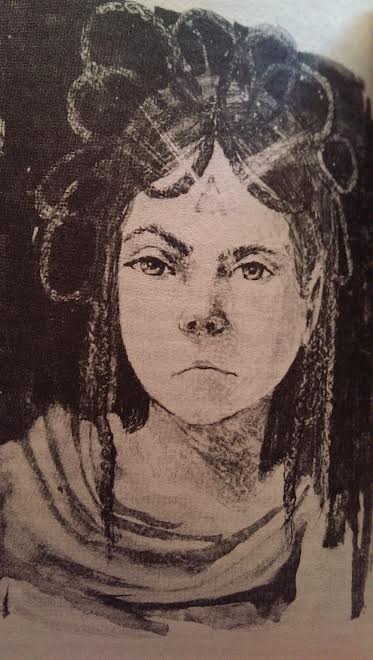
HeadlessCupidAmandaAmanda is fascinated by stories of the poltergeist.  A friend of hers where she used to live (one her mother didn’t approve of) was teaching her about the occult and how to do magic spells.  When David tells Amanda that he thought that his mother was psychic, Amanda is surprised, and she offers to teach David and the other kids about magic over the summer.  David eagerly accepts the offer because he finds the subject fascinating and because it’s the only thing that Amanda really seems interested in.  The other kids are also fascinated at the idea, even the littlest ones, which takes Amanda by surprise.  She had expected them to be scared.

Still, Amanda begins leading the kids through a series of rituals that will supposedly initiate them into the occult world, all of which have to be done in secrecy, without the parents’ knowledge.  They have to do some bizarre things like spend an entire day not talking (they have to take turns so the adults won’t notice, and it’s harder for some kids than others), spend a day where they can’t touch anything metal (mealtimes are awkward), offer “sacrifices” to the spirits (basically giving Amanda things she likes), and find animals to be their “familiars.”  As some of these rituals and the kids’ strange, secretive behavior cause problems, particularly for David’s stepmother, David begins to suspect that Amanda’s “rituals” have an ulterior motive that has nothing to do with magic at all.  Then, the poltergeist activity begins.
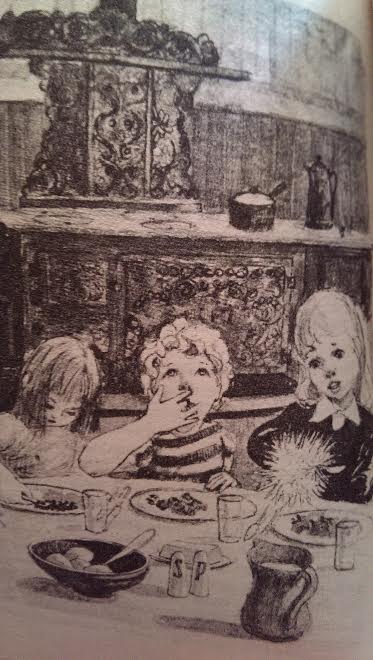
HeadlessCupidKidsJust as with the Westerly family years ago, rocks are thrown around the house or found just laying around.  Things are broken in the middle of the night.  Have Amanda’s rituals somehow awoken the poltergeist once more?  David has his doubts, suspecting that it’s part of Amanda’s playacting, but she is accounted for when some of these strange things happen.  The younger kids are still more fascinated than frightened by these strange happenings, but their stepmother finds them particularly unnerving.

Then, just when David thinks that he understands the situation and Amanda seems to be calming down her occult talk and behaving more normally, something happens which is really inexplicable: the missing head of the cupid suddenly reappears.

This is a Newbery Honor Book.  It is available to borrow and read for free online through Internet Archive.

My Reaction, Themes, and Spoilers

The reason why I want to explain some of this is because I think this book has received some unfair criticism because of the “occult” themes in the book, and I want to clarify the situation for the benefit of parents and teachers who have not yet read the book and may be concerned.  I’m putting “occult” in quotes because, as I said before, that’s not really what’s going on.  The book is a mystery story, and the “supernatural” stuff is largely window dressing for the real themes of the story, which have to do with unresolved feelings and revenge.  The story even contains a kind of warning about getting involved with the occult, which is another reason why I think the criticism of this book is unfair.

That Amanda is faking at least part of the haunting is pretty obvious even early on, so I don’t think it’s much of a spoiler to say that.  Amanda is an unhappy girl whose life abruptly changed with her mother’s remarriage, and her occult talk and fake witchcraft are part of her way of dealing with her feelings.  She admits to David at the end of the story that she was purposely trying to frighten her mother, trying to “get even” with her for turning her life upside down, first by divorcing her father and then by getting married again, forcing Amanda to move to a strange town where she has no friends and live with a bunch of kids she hardly knows.  Getting to know her new siblings better and sharing adventures with them helps, but it takes the frightening moment when the cupid’s head suddenly reappears to get Amanda to admit that real occult stuff scares her, too, and to confess the truth of what she did and her real feelings to her mother.

HeadlessCupidDavidAmandaThere are some elements of the happenings, particularly the reappearance of the cupid’s head, that are never fully explained, although David ends up knowing more than Amanda by the end.  Some aspects of the situation are hinted at.  There may be a real supernatural event at the end of the story.  Blair appears to have inherited psychic abilities from his mother, and there is a distinct possibility that the Westerly sisters who once lived in the house were just as unhappy with their parents for the changes in their lives as Amanda was with her mother.  Although the “poltergeist” as it first appears doesn’t exist, it may be that the “poltergeist” of the past remembers what it was like to be young and unhappy and that she wanted to make amends for past wrongs and to help another troubled young girl to make peace with her life and family.  But, if you don’t like that explanation, there is a more conventional, non-supernatural explanation that David considers, which equally possible.  Personally, I think it’s a combination of the two, but it’s not completely clear.  I think the author left it open-ended like that to make readers wonder and to preserve the air of mystery after the other mysteries have been cleared up.

As a kid, I enjoyed the creepy aspects of the story and the sense of wonder the kids experience as they go through their “rituals,” trying to bring some magic to their regular lives, wondering if things like ghosts and magic can really exist.  Now, I more appreciate how Amanda researched tricks used by fake psychics and mediums and used them creatively to her advantage.  When I was a kid, I liked magic tricks, and psychics and mediums make use of those types of stage illusions and psychological tricks in their acts.  I still have some books on the subject myself.  I also like the way David sensed the truth behind Amanda and the strange happenings even though he didn’t really understand how or why it was done at first.  David has some genuine curiosity about magic, but even after he realized that Amanda was faking things and was disappointed by it, he didn’t immediately tell the others.  He could have unmasked her as a fraud, but he knew that would only earn her resentment.  He wanted to understand her motives and help her feel better, giving her the chance to make peace with her mother herself and become part of their family.

This book has been frequently challenged because of the children’s inquiries into the occult, but I would like to point out that their “occult” experiments were all fake, pretty obviously so, and it is acknowledged that Amanda’s interest in the occult was fueled by her emotional distress (part of her urge to “get even” with her mother by causing problems).  By the end of the story, Amanda and her mother have an honest talk with each other about everything.  Amanda admitts her true feelings and makes peace with her mother, and she also says that her mother explained some things that Amanda didn’t know before.  The book doesn’t say exactly what Amanda’s mother told her, but from the context, it’s probably something about the circumstances behind her parents’ divorce, something that they might not have wanted to explain to her earlier.  I have a theory about it, although there’s nothing explicit that I could point to to prove it.  I suspect that Amanda’s father had an affair and that the affair is continuing, which I think is the real reason why he doesn’t want Amanda to live with him full time.  If Amanda were to live at his house, she would be sure to find out the truth.  Maybe his girlfriend is even the housekeeper Amanda referred to, the one who doesn’t help take care of children because she’s “not that kind of housekeeper.”  That possibility didn’t occur to me when I was a kid, but it seems kind of odd for a single man, living without children or other people in his house or other household staff to manage and who spends a large amount of time working away from home, to even have a housekeeper instead of simply hiring a maid or cleaning service to come in from time to time.  Households with fewer people require less maintenance.  There is less laundry to do, and single people who work tend to eat out or order in pretty often or make very simple meals, so I doubt he even needs much help with cooking.  But, that’s just my theory.  No one ever says why Amanda’s parents divorced in the story.  The reasons are less important to the story than Amanda’s feelings concerning the divorce.  Some of Amanda’s earlier resentment toward her mother was fueled by things that her father told her, making it seem like her mother was the one who caused the divorce.  After talking with her mother, Amanda seems to realize that some of the nasty things that her father said about her mother may not have been true and that her resentment toward her mother for causing the divorce was needless.  Much of the story involves unresolved feelings and the need to communicate them honestly.

The difference between reality and perceptions is also important to the story.  Although Amanda at first tries to convince the other kids that she is an expert on all things magic, David soon realizes that she’s not: she acts like ordinary, easily-identifiable wild flowers are rare herbs, she can’t control her “familiar” because she has no idea how to handle animals, and when things happen that Amanda can’t explain, she’s the first to be terrified.  In the end, Amanda gives up on the idea of the occult completely, realizing that the things she did were wrong and that she had gotten involved in something that she really didn’t want to be involved in.  Many kids wonder about the supernatural when they’re young, and I don’t think it’s bad to point out to them that they if they experiment with such things, they may be getting involved in something they could regret and that they should consider their motives for wanting to do so.  Playacting when you know it’s pretend is one thing, but not knowing if the scary stuff is real is another.

For further discussion of the dynamics of the blended family in this story, I recommend the SSR Podcast about this book.  The podcast also points out that there is an incident in this story which might be racially problematic.

Anti-Plagiarism Check

I’ve been thinking about how my reviews could be used for plagiarism ever since I caught a couple of those essay-writing companies trying to follow my blog.  It’s difficult for me to review certain books without giving spoilers, but I’d like to point out that none of my reviews explain everything there is to know about the stories.  That would be completely impossible without reprinting the entire text of the book, which plagiarists are too lazy to read anyway.  There are certain plot points which only a person who has actually read the book would understand and be able to explain.  Teachers who suspect that a student has plagiarized a book review or only pretended to read the book should ask them to verbally explain the points that I have not covered in my review, giving them no chance to try to look up the answers elsewhere or try to find them by quickly skimming the book.  I’m not going to print suggestions for questions to ask here because I don’t want to give the plagiarists a hint, and I doubt that teachers who have read the book recently themselves would really need a hint, but any teacher who contacts me via their official school e-mail address can discuss it with me.  I know these stories well because I’ve loved them for years, and I’ve started a file with suggested plot points to discuss.  I will not send this information to anyone who does not contact me from an official school e-mail address.  Keep in mind that I can easily look up the name of the person who contacts me to determine whether I’ve been contacted by a teacher or a student.

It’s one thing for a student to want to discuss the book with someone to clarify confusing plot points, but it’s another to ask someone to do their homework for them.  I know the difference, and I know homework when I see it.  Let me explain something.  All WordPress blogs have built-in analytics, and I’ve been studying SEO, so I pay attention to who has been visiting my site and how they get there.  I know whether you came here by using a search engine or whether you were referred by another site, and I can also see search terms that you used.  I added this note to this review specifically because I noticed that someone has been trying to Google what are plainly homework questions, and I just got a site referral from an online plagiarism checker.  Yeah, I see what you did there.  This is the Information Age, and when you go looking for information, sometimes, there’s someone else looking back at you, even if you can’t see them.  Not everyone with a blog pays that kind of attention to their traffic, but some of us do, and while some may not say anything about it, some of us are also a little more vocal.  I saw what you did, and I didn’t like it.  I don’t know you, but I know you’re a fool, and your teacher has just discovered it, too.  Now, we’re all aware.  It’s your own fault, and it’s too late to whine about it now.  I do sometimes help people who ask for it.  You should have asked for help when you needed it instead of cheating and stealing my words.  Maybe next time you’ll ask for what you need instead of just taking what you want.

The Mystery of the Haunted Trail

MysteryHauntedTrailThe Mystery of the Haunted Trail by Janet Lorimer, 1989.
Brian Kelly wasn’t too excited at first when his teacher assigned his class to write letters to students at a school in Hawaii.  He doesn’t really like to write, and the whole thing sounded boring, but it turned out to be pretty fun when his new pen pal, Alani, wrote back.  Brian discovered that he and Alani had a lot in common, and he even got to meet Alani when his family came to California on a trip.  Then, best of all, Alani’s family invited Brian to spend part of the summer with them in Hawaii!

Brian loves Hawaii from the moment he arrives.  Alani’s family lives in a rural area near Kalawa.  All of the families in the area raise their own vegetables and keep animals.  They depend on what they earn from selling food although some of them, like Alani’s mother, who is a nurse, have other jobs as well.  Alani’s father, like Alani’s grandfather, is primarily a farmer.  Alani’s grandfather lives with him on land that the family has owned for generations.

Alani and his family enjoy showing Brian around their island and talking about the history of the place.  Brian particularly likes the stories that Alani’s grandfather, who they call Kupuna, tells them, although some of them are frightening.  At the luau that the family and their friends have to welcome Brian to Hawaii, Brian overhears people talking about the Night Marchers.  They say that the Night Marchers have been seen recently and that bad things have been happening in the area, like crops dying and the nearby stream starting to dry up.  Some people seem to think that it’s a sign of bad luck and that maybe they should move away from the area.

According to Kupuna, the Night Marchers are a ghostly parade of the ancestors of the people who have lived there for generations.  Sometimes, it’s just ordinary people and sometimes it’s the souls of warriors.  Sometimes, Hawaiian gods may even walk among them.  But, when they march, any living person must either flee from them or, if that is impossible, they must lie down and hide their eyes.  At the head of the Marchers is a ghostly spearman who will strike down any living person who sees them, unless that person is related to one of the Marchers themselves.  They spare members of their own families.  People who are struck by the spear of the Marchers appear to have died of a heart attack.

The place where the Marchers supposedly walk is an old trail that leads to a sacred place where Alani’s ancestors are buried.  Brian is curious to see the place, but Alani warns him away, saying that they are not allowed to go there because it’s too dangerous.  However, Brian soon sees the Marchers himself one night in Alani’s family’s fields, and the next day, their crops are dead.  When Brian notices strange footprints in the fields as well, he realizes that some living people may be responsible for the awful things that have been happening in the area, but the only way he can prove it would be to explore the haunted trail himself and track the “ghosts” to their lair.

Janet Lorimer’s books are interesting because they are often a combination of mystery and ghost story.  There are logical explanations and living villains who are responsible for the things that are happening to Alani’s family and their neighbors, but there is also a definite supernatural element to the story as well.  Telling you where one ends and the other begins may be saying too much.  It may be more fun to let you find out yourself.

The book is currently available online through Internet Archive.

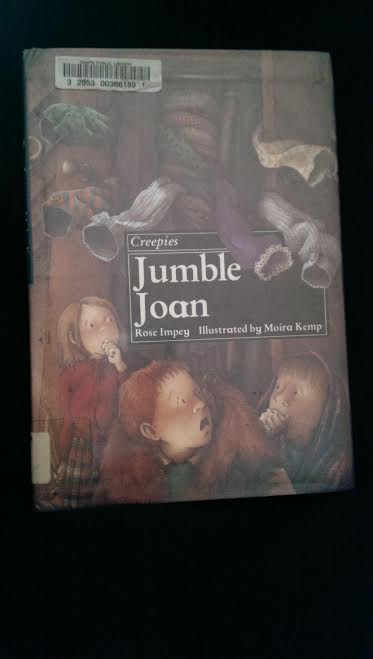
Jumble Joan

jumblejoanJumble Joan by Rose Impey, 1989.

A boy and his friend, Mick, take his little sister upstairs to explore their grandmother’s attic one evening.  The boys are hoping to scare the girl by telling her all sorts of creepy stories about the stuff they find in the attic, but if they’re scaring anyone, it might just be themselves.

A rocking horse becomes one of the dreaded “Ten O’Clock Horses” that might drag a child off into the night if she isn’t in bed on time.  An old stuffed parrot in a cage becomes “The Deadly Vampire Bat”, waiting to suck their blood.  But, the most sinister creature of all might be “Jumble Joan”, who hides by pretending to be a pile of old clothes, ready to steal away any little girls who might want to play dress up in their grandmother’s attic!

Although the brother narrates the story, the pictures show that his little sister knows exactly what the boys are trying to do, and she does things to turn the situation around.

This is one of the books in the Creepies Series.  Kids under the age of seven might find stories in this series a little scary because they focus on how stories about monsters can build in the imagination, even if you know that you made them up yourself.  Still, all of the books have good endings, and this one is pretty funny.

This book is available to borrow and read for free online through Internet Archive.

The Flat Man

flatmanThe Flat Man by Rose Impey, 1988.

Before Slender Man, there was . . . The Flat Man!  And he wasn’t quite as scary. As far as I know, there is no connection between the two fictional characters other than a similarity in name.  Still, the Creepies Series, while picture books, should probably only be given to children no younger than seven who like scary stories.  They might provoke nightmares in very young children and sensitive children.  I liked these stories as a kid for their imagination, but individual tastes may vary.

Like all the books in the Creepies series, The Flat Man features a child who enjoys being a little scared and makes up his own imaginary monster to battle with at bedtime.  The entire time, the boy knows that the monster is imaginary and prides himself on knowing just how to deal with him.

While lying in bed one night, the boy imagines the scary creature called the Flat Man for the fun of it.  He amuses himself with imagining that every sound he hears is the Flat Man, a paper-thin creature that can sneak in anywhere, squeeze himself through any crack. But, the Flat Man has weaknesses: he’s afraid of light and open spaces. The boy acts out his duel with the imaginary Flat Man, enjoying his triumph . . . right up until his father comes in to find out what’s going on.

This book is available to borrow and read for free online through Internet Archive.

My Reaction

Even though his imaginary creature is frightening, the boy enjoys it, comes up with his own solution for defeating it, and acts out a triumphant battle with it. Those who don’t mind a bit of spookiness will appreciate the boy’s imagination and may giggle at how he gets a bit carried away with his fantasy.

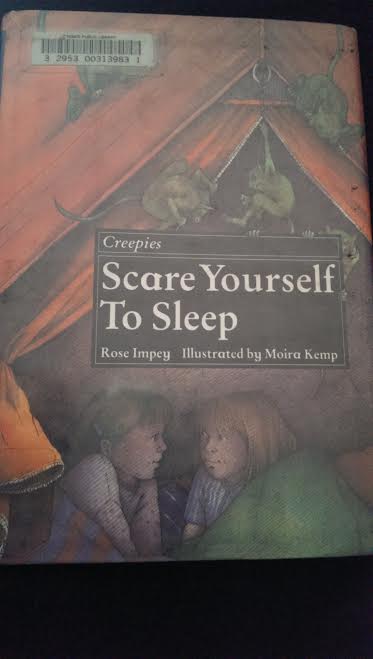
Scare Yourself to Sleep

scareyourselfScare Yourself to Sleep by Rose Impey, 1988.

A girl and her cousin are camping out in the backyard when they decide to play a game they made up themselves called “Scare Yourself to Sleep.” They take turns inventing and telling stories about monsters lurking out in the darkness. The winner of the game is the one who successfully scares the other.

They talk about the Garbage Goblins, who live in trash cans. The Flying Cat is a creature that is half-cat, half-moth. The Tree Creeper lives in trees and looks like a branch, just waiting to fall down on someone. But, the best of all is the Invisible Man!

However, their stories are interrupted by the girl’s brother, Simon, who is trying to scare them . . . at least, they think it’s probably Simon. The monsters are made up, aren’t they?

The book is currently available online through Internet Archive. It’s part of a series.

scareyourselfpic1

My Reaction and Spoilers

I first read this when I was about seven years old, and I’ve loved it ever since! The pictures show not only what’s happening in the girls’ imaginations but hint at what’s happening in real life, just outside their tent as Simon acts out the things in their stories. It might be a little too scary for very young children, but kids about seven and up will like it (provided that they also like creepy stories).

The illustrations are vivid and detailed, and readers may be wondering up until the very end how much is really imagined. All the books in the Creepies Series are about the power of imagination and how it can be fun to be a little bit scared.

scareyourselfpic3