The Girl Who Owned a City

A disease has killed off all of the adults on Earth, leaving only children. In a world without adults, all of the laws, rules, and structure of society are gone, and the children struggle to survive by themselves. When they run out of food in their own homes, they raid the grocery stores and other people’s homes to get more. However, even those sources of food are starting to run out, and they need to find new sources of food. Children are starting to form gangs and raid each other, desperate for food and resources.

In one particular neighborhood, a girl named Lisa Nelson, struggles to look after her little brother, Todd. She also begins to realize how much her friends in the neighborhood are struggling and the dangers around them posed by other kids. Lisa is more practical and organized than many of the other children, and she begins to emerge as the leader of their neighborhood.

Lisa considers where food comes from before it ends up in grocery stores, and she reaches the conclusion that it’s usually transported from farms and stored in warehouses before being shipped to individual stores. Since the adults died, nobody has been taking food from the warehouses to restock stores, so there are warehouses somewhere that are still filled with food and supplies. She recruits help from other kids in the neighborhood to find a warehouse of food and raid it. However, to maintain control and keep the other children organized, she claims ownership over the warehouse and the distribution of food from it. She even threatens to burn the whole thing down if people start raiding it for food without her permission.

If the children manage their resources wisely, they will be secure for a long time while they figure out how to begin producing new food themselves. However, a gang of children from another neighborhood led by a boy named Tom Logan have been raiding the area and attacking children from Lisa’s neighborhood. The children in the neighborhood struggle to defend themselves from Tom’s gang, but Lisa realizes that their neighborhood doesn’t provide adequate defense. The only way the kids from Lisa’s neighborhood will be safe is if they relocate to a place that offers more protection and will easier to defend.

Lisa chooses the high school, Glendbard, as the children’s new home. It’s an ideal location to create a fortress because it’s surrounded by fences and has a limited number of entrances and exits. It’s self-contained, offering many rooms with indoor corridors with facilities in place for the children to use. Lisa persuades the children from the neighborhood to relocate there, set up organized defenses, and move stores of food into their small fortified city.

Under Lisa’s leadership, the new little city of Glenbard is run efficiently, and it offers the children improved safety, but nothing for them is entirely secure. When Lisa is injured in a battle with Tom’s gang and retreats to a farm outside of town with some of her friends, the children consider what the future of the civilization they want to rebuild will be. Tom and his gang are the immediate threat, but sooner or later, there will be others. Tom knows how to raid and conquer, taking things from other people, but he doesn’t have Lisa’s ability to organize, govern effectively, produce new food and supplies, and inspire real loyalty. If everyone is going to survive, they need an effective leader, someone who can organize everyone and make use of their individual talents to grow and protect their society. If Lisa is going to be that leader, she has to not only learn to fight people like Tom but also help them to see her vision of the future.

The book is available to borrow and read for free online through Internet Archive (multiple copies). The book has also been made into a graphic novel, although some of the details from the original story were changed in the graphic novel.

I remember reading this book in a middle school English class when I was about 13! It has always reminded me of the episode from the original Star Trek series, Miri, about a planet of children living without adults because all of the adults were killed off by a disease that only affects people adolescents and adults. The Star Trek episode is from 1966, older than this book, so if there is a connection between them, it would have been the Star Trek episode that inspired the book.

In the Star Trek episode, when any of the children gets too old, they also start showing signs of the disease, and it eventually kills them, until the crew of the Enterprise figures out a way to cure it. In this book, it isn’t clear whether or not any of the children are going to be at risk as they get older. The implication seems to be that the disease died off with the last of the adults. Presumably, the children who are alive now will live to grow up and will rebuild their society, as long as they can figure out how to manage their resources, develop new food production, and maintain order well enough that they don’t kill each other off.

Dealing with their own fears is as much of a struggle for the children as simply finding food and supplies, and it fuels much of the violence between them. Children who lack resources more than the others and don’t have the imagination, knowledge, or skill to figure out how to get more turn to bullying and violence to get what they need. They are simply desperate for survival and doing what they know how to do, which for some kids, is more about taking from others rather than scavenging for themselves or about using violence and destruction instead of creating and building. Lisa is more successful than most because she’s a thinker and planner, and she has some knowledge about how the world usually works, which she can use to fill in the gaps left by the adults (like realizing the connection between farms, warehouses, and stores and that what’s missing now is people to produce food and transport it to the places where it’s usually stored and accessed by others, so she can trace resources back through the supply chain). Lisa realizes that thinking things through is the key to survival. She has her worries, like the others, but she manages her emotions and directs her focus on making plans and accomplishing things rather than panicking and taking out her feelings and needs on others.

Around the time this story was written, in the 1970s, there were a number of other dystopian books about people needing to rebuild society after a disaster. (See In the Keep of Time Trilogy for an example.) What makes this particular book different from other dystopian books of its time is that other books tended to focus on nuclear war as the reason for the society-ending disaster. The 1970s were part of the Cold War, and nuclear threats were on people’s minds. In this book, though, the cause of the disaster is a disease, and children are the only people left on Earth. All of the infrastructure is intact, and the primary challenge is for the children to figure out how to use it. The focus on children trying to build a society of their own is great for keeping children interested in the story!

One of the things I liked about this book when I was young was how the children adapted the school into a city. Sometimes, I used to imagine how it would be to live in other unconventional places – a library, a museum (like From the Mixed-Up Files of Mrs. Basil E. Frankweiler), or a shopping mall. Some of the features of the school do lend themselves to communal living or a small city. The school’s gates offer them protection from outsiders, the classrooms provide living space, and they have a library, an infirmary, and a cafeteria.

The school in the story is based on a real school. The story is set in Glen Ellyn, Illinois, which is a suburban area near Chicago, where the author lived, and the school, Glenbard, is a real high school there. The children in the story, Lisa and Todd Nelson, are named after the author’s own children.

There is a new graphic novel version of this book. I haven’t read the entire the graphic novel version yet, although I’ve read selections of it. In some ways, what I’ve read so far bothered me because it seemed to me that they made Lisa meaner in the beginning. In the original book, Lisa shares the spoils from her scavenging with other kids, telling them that she would be willing to help them, if they ask her. In the graphic novel, she makes it a point to tell Todd that they got everything they have because they’re smart and work hard, and other people should just learn to do the same. It’s a very conservative/libertarian attitude, but it isn’t completely faithful to Lisa’s original character or the themes of the original story. I have to admit, though, that there are strong connections in the story to libertarian/Ayn Rand philosophy that didn’t occur to me when I was 13 years old because I hadn’t heard of Ayn Rand at that age. As an adult, it jumps out to me more now, and there’s another book reviewer who has noted the connection. The original author was a firm libertarian, which is something else I didn’t know until I was an adult. It just seems to me that the graphic novel version of the book bore down on the callousness of libertarian attitudes, that “I’ve got mine, and screw everyone who doesn’t get their own because I don’t owe you anything that’s mine” kind of attitude, than the original book did.

In the original book, Lisa realizes that she is proud of herself and Todd for learning to survive by their own efforts rather than by resorting to violence and stealing, like other kids have, but that didn’t mean that she wasn’t also willing to share whenever she could or thought someone really needed help. The times when she was reluctant to share were when someone had already stolen from her, and she no longer trusted them, not merely because she thought that they weren’t smart enough, not hard-working enough, or too undeserving to merit help. In the original book, Lisa wants to rebuild community and society, and you just can’t be part of a community or society with people who would hurt and betray you if they thought they could get something they wanted for doing that. She does realize that working toward survival is useful for building community and also provides an individual sense of purpose. Like she points out to Jill, who has made it her mission to look after the youngest children, having chores to do and feelings of accomplishment are important to making the younger children feel less afraid because they can see that they have agency (although the book doesn’t use that term), that they are capable of making a difference in their own lives. Lisa works through her own fears and develops her own sense of self-confidence by realizing that she is capable of handling situations, and she wants to help the other kids build that sense of agency and capability. Lisa’s vision for building a new society is for the mutual protection and welfare of everybody, not just self-promotion or personal enrichment. At one point, she thinks to herself how she and her brother can’t focus on just their own survival alone or just getting things for themselves because, for the other kids to be willing to listen to her ideas, they have to be part of the same community with them, sharing their concerns and looking after their mutual welfare. She says to herself, “All the brilliant ideas in the world will be useless if the world collapses around me and I’m the only one left to steal from.”

That’s an issue that I often have in real life with fans of Ayn Rand. Ayn Rand focused a lot on how special her main characters were and that society didn’t appreciate how brilliant and how much better they were than other people and didn’t acknowledge how much more deserving they were than anybody else. Frankly, Ayn Rand’s characters strike me as a kind of wishful thinking Mary Sue. As others have pointed out, the only characters considered “good” in any respect in Rand’s books are the ones who agree with her philosophy, and she just completely trashes everyone else. It’s not that Randian heroes are never compassionate, but they only seem compassionate to people who support them or provide personal validation. To everyone else, they’re ruthless, and anybody who disagrees with them is a villain with no positive traits on purpose.

Lisa kind of represents an Ayn Rand type character in the sense that she has more vision of what is possible for the children as they attempt to rebuild society and better organizational skills, but the focus of the original book isn’t about “look how great Lisa is and other people should acknowledge her greatness as the superior person and defer to her.” Lisa has a sense of communal welfare and an understanding that, while she and Todd have managed so far on their own, they really do need other people. She doesn’t want only rugged individualism and competition with everyone else to prove her own worth or place herself above others. Lisa doesn’t seem to see her position as leader of her new society as some kind of reward for being special or better than other people, and she isn’t trying to hoard all she has for herself as the rewards of her hard work or some kind of token that she’s the most deserving of having things. What she gathers has a purpose beyond simply enriching herself and securing her own future welfare.

She is definitely not laissez-faire in her leadership style, either. When she reveals the existence of the warehouse to the other kids and claims ownership of it, she lets everyone know that she can supply them with things they need but she would rather destroy it all if any of them abuses or misuses it. She uses its existence as a tool to gain and keep their loyalty and get them to do what she tells them, which seems a bit authoritarian. However, there are no adults left, and it seems that Lisa has realized that there always has to be an adult in the room to provide guidance and direction. Although she might not realize it, she effectively creates a kind of welfare state that provides housing, mutual protection, food, and other essentials in exchange for labor and cooperation. Providing for everyone is necessary because they’re going to have to keep everyone alive while they’re preparing for their future. The warehouse has a lot of food in it, but it will run out eventually or things will expire, and to provide for their future, they’re going to have to study food production and get crops growing again. It’s going to take time, and for them to make it to that point, they need to regulate their usage of food and supplies. Lisa is acting as the adult to guide that process.

The other kids are expected to participate and contribute in their new society, although not all kids can contribute in precisely the same way or to the same degree because some of them are much younger than the others. This is something that she discusses with Jill, who thinks that younger kids need more protection. In some ways, they’re both right and wrong in their approaches. Lisa proves correct that younger kids are sometimes capable of more than Jill thinks and that they start to feel better about themselves and the frightening loss of their parents when they realize that they can accomplish small tasks. However, Lisa does sometimes expect too much of them, and Jill is correct that little children would be frightened to patrol as night guards and wouldn’t really make intimidating guards against the bigger kids anyway. Lisa has high expectations of others and high ambitions, but her friends help to keep her more realistic about what other kids can do and what their priorities as a new society should be. When Lisa gets carried away with their accomplishments so far and excited about all the things they can do now that they’re free to do anything they want without adults, she talks about learning to fly an airplane, and one of her friends has to remind her that their first priorities should be to secure sources of food and restore water and electricity.

It seems that Lisa provides goods equitably (she doesn’t seem to provide extra to special favorites, elites, or people she deems as more deserving than others in her society) as long as everyone is willing to go along with her plans. Her primary reason for wanting to be in control is to keep the system functional and equitable. She also relies on people like Jill, who have some altruistic motives and are willing to provide nurturing care for the very young and people who are sick or injured, those least able to help themselves without help from someone else. Lisa and Jill don’t have quite the same philosophy, but building a society requires different people with different types of focus. Both of these characters are necessary for building the new society. Jill even takes in Lisa and Todd after their house burns, so Lisa benefits from Jill’s altruism, which gives her the support she needs while she recovers and makes other plans.

In the original book, her leadership and the resources that she has gathered are treated largely as tool that Lisa uses to achieve her ultimate goal of rebuilding a society. Lisa doesn’t seem opposed to the concept of “common good”, and she really wants to be part of a society. She especially wants a society that actually cares about all of its members and provides what all of its members need, and she recognizes that any society that doesn’t care for its members or provide for them sufficiently isn’t going to survive because nobody’s going to want to join something that doesn’t care about them or provide what they really need. Many of these other kids are also her long-term neighborhood friends, so she has some personal feelings for them. They’re not just there as underlings, and they have worth beyond just serving the system or proving themselves as earners.

The original book’s philosophy has some strong libertarian leanings, but it didn’t strike me as being purely libertarian in the way that the graphic novel seems to. From what I’ve read, it seems like the graphic novel doubled down on the more callous and self-centered form of individualism and took away at least some of Lisa’s consideration for other people. For me, it made her a less likeable, sympathetic character and less inspiring as a leader, and these are frequently requirements of mine when I consider literary characters. Just as people don’t tend to join societies with nothing to offer them, I lose interest in books and characters that don’t offer me what I’m looking for. The graphic novel didn’t grab me in the same way the original book did because it took out some of the aspects that appealed to what I was looking for.

Because of the subject matter, this book is best for older children. According to Wikipedia, it’s recommended for ages 12 to 15, and that estimate seems about right to me. There is real violence in the story. The children start using weapons against each other, and Lisa gets a gunshot wound. When her friend is treating her wound, she gives Lisa alcohol to drink because they don’t have any better painkiller.
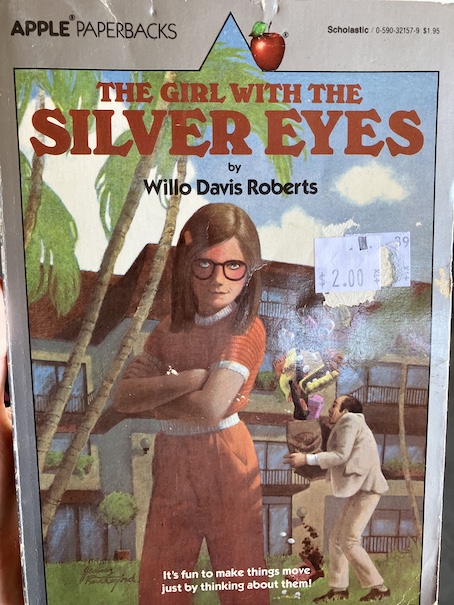
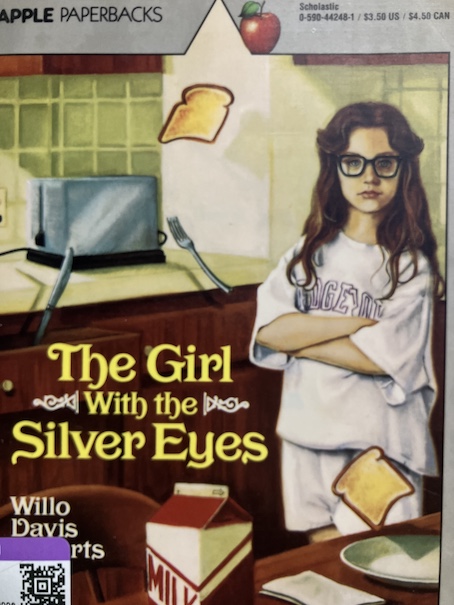
The Girl with the Silver Eyes

Katie has recently moved from the country to an apartment in the city to live with her single mother. Katie’s parents divorced when she was young, and for years, she lived with her grandmother in the country. However, her grandmother has now died, so she has gone to live with her mother. Katie has mixed feelings about living with her mother again after years of living without her, and she somewhat blames her mother for not keeping Katie with her instead of leaving her with her grandmother. Katie can’t live with her father because he moves around too much, and she doesn’t even know where he is right now.

At first, Katie wonders if things are going to be different in the city, but Katie soon realizes that the same problems that plagued her in the country have followed her to the city because she still has the same abilities she has always had and can’t resist using them. Katie has always made people nervous, including her own parents and grandparents because she’s not like other children. For one thing, she has strange, silver eyes that surprise everyone who sees them because they seem unnatural. For another thing, Katie has the ability to make things move just by looking at them and concentrating on them. She tries to use this ability only when no one can see her doing it, but people can’t help but notice that odd things happen when Katie is around. Somehow, things move around Katie without Katie apparently moving herself. Sometimes, when things happen by ordinary accidents, people blame Katie for them just because she was around, and they’ve all come to think of Katie as somehow causing strange things to happen. Secretly, many people think that there’s something seriously wrong with Katie, like she might be a witch or something, and they try to avoid her.

Katie knows that she’s never met anyone else like herself, but she wishes that she did because she’s often lonely. It’s hard to make friends when people think you’re strange or dangerous, and even your own family is distant with you because you frighten them a little. Although Katie tries to pretend normality as much as possible, the urge to use her powers is too strong, particularly when someone has made her upset. She subtly uses her powers to spook her mother’s crass boyfriend, Nathan, and her mean babysitter in the hopes of driving them both away.

After Katie succeeds in spooking the babysitter, she overhears her mother talking to Nathan about her. From their conversation, Katie learns things about her mother’s history and herself that she never knew before. Her mother, Monica, had lost another baby before her after being in a car accident, and then she went to work at a pharmaceutical company. She liked the work there and the other women she worked with, and she has stayed in touch with some of them. However, she left the job when she got pregnant with Katie, and some of the other women there also got pregnant around the same time. Originally, Monica had hoped to return to the job after giving birth to Katie, but the company stopped making the product they were working with, and none of the other women who had children returned.

Ever since Katie was born, Monica knew that Katie was odd because she never cried, and she’s always had those silver eyes, yet her mother has trouble thinking that anything could be seriously wrong with Katie because she seems healthy and is very intelligent. Nathan asks Monica whether the drug she was working with could have had some effect on Katie, and whether that could be why Katie is the way she is. At first, Monica doesn’t think so because she says, if that was the case, her friends from that time would have had children who were similar to Katie, and she thinks they would have said. Nathan asks her whether she’s sure that her friends would admit that their children were strange and a little frightening, and whether Monica has ever seen any of these children for herself. Monica has to admit that she hasn’t. Nathan suggests to Monica that Katie’s condition and whatever the conditions of her friends’ children might be could be the reason why the company stopped production of that medicine.

Katie is stunned at this information. She has always assumed that she was a random freak of nature, and it never occurred to her that there might be scientific explanation for her strange abilities. Although she still doesn’t like Nathan, she has to admit that his questions and his theory are sensible. She also begins to wonder about the children of her mother’s old friends and whether they are also like her, with silver eyes and the ability to use telekinesis. She secretly goes through her mother’s belongings to figure out who her mother’s old friends were so she can track them down and meet their children.

When Katie makes friends with a nice older lady, Mrs. Michaelmas, who lives in the same apartment building and persuades her mother that she would make a better babysitter than the others that her mother has tried, Katie finds someone to confide in for the first time. She isn’t alarmed when she discovers that Katie can talk to and understand her cat, and Katie finds herself telling her all about herself and the other things she can do. The older lady takes it calmly, saying that, at her age, she’s seen may things before and doesn’t get too worried about things. They talk about why people get scared of people who are different, and the older lady says that people are often afraid of someone they think might be somehow more powerful than themselves. Katie has powers that other people don’t have, and people are afraid of what she’s able to do that they can’t.

When a new tenant, Adam Cooper, moves to the apartment building, he seems open and friendly with Katie. Unlike other people, he doesn’t seem concerned about her silver eyes, and she wonders whether he could be a confidant, like Mrs. Michaelmas. At first, she thinks Mr. Cooper might be interested in her mother and could make a better boyfriend for her than Nathan, but then, she overhears him talking to her mother and asking questions about her. Mr. C seems way too interested in Katie and why Katie’s babysitters haven’t gotten along with her. In fact, it sounds like he’s planning to call her old babysitters and ask more questions about her. Katie doesn’t know why Mr. C is so interested in her, but she no longer thinks his intentions are merely friendly. When she hears Mr. C asking Mrs. M about whether Katie’s ever done anything odd around here, Katie is sure that Mr. C knows that she has powers that other people don’t have. Then, he tells Mrs. M that he’s been making inquiries about Katie in the town where she used to live, and some people there really think she’s a witch and that she may have caused her grandmother’s death. Katie is horrified because, while she knows that she didn’t do anything to her grandmother, it would be hard to prove because he grandmother died from an accidental fall downstairs. Even having someone open an inquiry into her grandmother’s death and suggesting that she could have been at fault would reveal Katie’s secret powers to the world!

Katie doesn’t know who Mr. C really is or what he wants with her, but she fears that, if he convinces other people that she’s dangerous, she could be locked up for life! She decides that her only hope is to find the other children who are like her. They may be the only people who could understand her and be willing to help.

I didn’t read this book when I was a kid, although I saw it around. For some reason, I just put off reading it, although it’s similar to other books that I did read about kids who have mysterious powers. When Katie eventually meets the kids of the other women her mother used to work with, they admit that they all feel like misfits and have wondered for years why they’re so different from everyone else. One of them says he thought that he might secretly be an alien, given to a human family to raise, which reminds me of Escape to Witch Mountain, which was written before this book. However, Katie and the other kids are all human, just mutated by the pharmaceuticals their mothers worked with.

Sadly, there are real-life cases of children changed by their mothers taking dangerous medications while pregnant, but in real life, those children are born with birth defects rather than psychic or telekinetic powers. A famous case of that was the Thalidomide scandal of the 1950s and 1960s, when babies were born with severe deformities after their mothers used the tranquilizer Thalidomide. Most of these cases happened in Europe because the FDA refused to approve the drug in the US due to inadequate testing.

In some ways, this book also reminds me of Matilda by Roald Dahl, but The Girl with the Silver Eyes was published first, so it’s not an imitation of that book. Like Matilda, Katie has powers of telekinesis and pointedly doesn’t like to watch tv but she loves books. I enjoy children’s books that also mention other, real children’s books, and Katie mentions some that she’s read. Among the books that the story mentions her reading are The View from the Cherry Tree, Gentle Ben, Charlie and the Chocolate Factory, The Boxcar Children, The Headless Cupid, and The Scarlet Pimpernel.

Mentions in the story of the dangers of child molesters and her mother has books that are inappropriate for children and stops her daughter from reading them. Katie’s mother thought she might be “retarded” when she was a baby.

I had several theories about who Adam Cooper could be and what he might want with Katie. At first, I wondered if Adam Cooper could be the father of one of the other children who are like Katie, secretly investigating the children of other women who worked with his wife to see if they all have the same condition. Then, I thought maybe Adam Cooper worked for the pharmaceutical company and was checking up on the children of their employees for years to find out what happened to them. I was hoping that he wouldn’t be part of a secret government organization, like the one in Stranger Things because that’s been done a lot, and sometimes, I feel like it’s become kind of a conspiracy theory cliche. Actually, none of those are the real explanation.

It turns out that there is an organization that has an interest in children like Katie. They don’t mean them any harm, but they are interested in studying the reasons why children like her end up with special abilities and helping these children to develop their abilities. He confirms that Katie and the children of Monica’s old friends aren’t alone, that there are other children with varying conditions and abilities, some also the children of people who worked with pharmaceuticals and others with no known cause. At the end of the story, Adam asks the children and their families whether the children want to come to the school his organization runs, which sounds a little like Professor X’s school from X-Men or The Mysterious Benedict Society.

However, the children and their parents aren’t entirely sure whether that’s a good idea or not. Adam assures them that the children wouldn’t be prisoners at the school, that their education and development would be prioritized, that they wouldn’t have to hide their abilities from anyone while they were at the school because they would be among others like themselves, and that they wouldn’t be treated like creatures to be merely studied. Still, the children don’t want to be separated from their parents, and the parents are concerned about sending the children away to this unknown school. One of the children asks, since there are four of them living in this area, whether they could form their own day school as a kind of satellite school to the main one, so they can continue living at home and being part of the regular world, not isolated from it. They don’t reach a full decision by the end of the story, but the adults discuss the possibility. Katie and the other kids feel like their lives have already changed for the better, just having each other and realizing that they’re not alone.

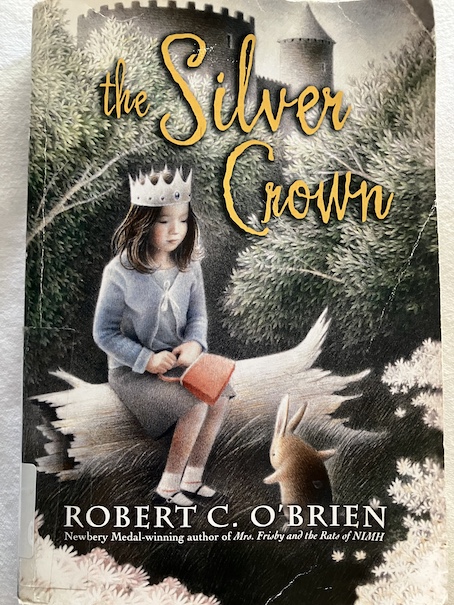
The Silver Crown

Ellen Carroll has always known, deep down, that she was a queen. Of course, everybody else sees this as a game of pretend, and it kind of is, but on her 10th birthday, her life changes forever, and there may be more behind Ellen’s feeling of being a queen than even she knows.

When Ellen wakes up on her 10th birthday, she finds a letter from her Aunt Sarah and a beautiful silver crown next to her on her pillow. Ellen loves the crown because Aunt Sarah is the only adult who seems to really believe Ellen when she says she’s a queen. Ellen takes the crown and goes for an early walk in the park, daydreaming about being a queen. When Ellen gets back to her house, she gets a real shock. In the brief period that she was gone, the house has completely burned down, and apparently no one else in her family survived!

Ellen, in shock, tries to talk to the firefighters and police about the fire and what happened to her family. She discovers that the fire was surprisingly sudden and fierce, there’s no indication that anyone survived, and they might only find bones when they finish their investigation. Ellen explains that this was her family’s house, but since her family hasn’t lived there very long. Nobody really knew her family, and nobody really knows her, and even the police seem to doubt her identity. However, a policeman says that he will take her to the station.

On the way to the police station, something else shocking happens. Ellen and the police officer witness a murder! A robber shoots a store manager, and when the policeman chases the robber, he is also shot. Alone and forgotten, Ellen watches more police come and investigate the situation, trying to figure out what to do. Ellen realizes that, with her family gone, what she really needs is a guardian or a next of kin. That would be Aunt Sarah. However, Aunt Sarah lives in Kentucky, and that’s hundreds of miles away. Ellen could write to Aunt Sarah, but it would take days for her to get the letter, and in the meantime, Ellen has nowhere else to stay. Then, Ellen decides that the thing to do is to go to Kentucky herself. She writes a letter to her aunt to tell her that she’s coming, and sets out to find a ride.

She accepts a ride from a nice man called Mr. Gates who says he’s a teacher and that he’s going to Kentucky, too. She considers it good luck until, during the ride, she begins to notice that there’s something weird about this man. He seems weirdly happy, all the time, and he sometimes repeats certain stock phrases at inappropriate moments. When Ellen gets a look inside in the glove compartment and sees something disturbing – a gun! Suddenly, something clicks in her mind, and she realizes that Mr. Gates was the man in the green hood who shot the store manager and the policeman! She escapes from Mr. Gates and runs into the woods.

While she hides from him in the dark woods, she hears Mr. Gates searching and calling for her. As she listens to him, he grows more disturbed and more disturbing. First, he tries to tell her that he’s going to take her straight to her Aunt Sarah, and Ellen realizes that she never told him her aunt’s name. Then, he begins raving, trying to command her to come out because “the king” has demanded that he bring her to him, and he will punish them if they don’t come. Ellen doesn’t know what he’s talking about, but in the woods that night, she has a strange vision where a man wearing a black crown that looks like hers seems to be commanding other people.

The next day, Ellen befriends a boy named Otto. Otto lives with his elderly mother in the woods, and they survive partly on things they salvage after trucks wreck on a dangerous section of road nearby. Otto and his mother invite Ellen to stay with them a little while to eat and get some sleep.

Ellen explains everything that’s happened to her to Otto’s mother, Mrs. Fitzpatrick. Mrs. Fitzpatrick is a wise woman, and she and Otto both sense that there’s something odd about Ellen’s crown. They sense that it has a power of some kind, but it’s the kind of power that only particular people can use. Whatever the crown does, Mrs. Fitzpatrick is sure that it will only work for Ellen. She questions Ellen about who gave her the crown, but she admits that she doesn’t really know. All she knows is that it was there when she woke up. Since it was her birthday, she just assumed that it was a birthday present. She talks her Mrs. Fitzpatrick about having this sense that she’s a queen and that her Aunt Sarah thinks so, too. Mrs. Fitzpatrick agrees, but she says the question, is what or where is Ellen the queen of? Ellen will need to figure that out before she can understand what the silver crown really is and what it does.

During the night, Mrs. Fitzpatrick shoots at someone who’s lurking outside their cabin, and they realize that someone is still hunting for Ellen. Ellen can’t stay there, and Mrs. Fitzpatrick points out a road that Ellen can take, and she insists that Otto go with her because he knows how to manage in the woods and can help Ellen. Mrs. Fitzpatrick admits that it’s also best for Otto to leave the area because he’s also in trouble.

At first, she’s vague about what trouble Otto is in, but gradually, Mrs. Fitzpatrick explains that Otto and his past aren’t what he believes or has chosen to believe. Mrs. Fitzpatrick found him as a very small child, abandoned on the nearby highway, and she has no idea who his birth parents are or what happened to them. Mrs. Fitzpatrick says she doesn’t really need the things that Otto has salvaged from the wrecked trucks, but for some reason, Otto believes that she does, so he’s been causing these accidents by using branches to hide the sign warning people of the dangerous curve ahead. It doesn’t seem to affect smaller cars, but bigger trucks can’t make it without warning. Ellen is horrified, but Mrs. Fitzpatrick says that she thinks that Otto needs to leave this place and the dangerous fantasies about himself and his life that he’s build, living alone in the woods.

Mrs. Fitzpatrick lets the children go with a warning to Ellen to keep the crown hidden and not to tell anybody about it. She also warns her to beware of any people or group who use the name Hieronymus. The first Hieronymus was a saint, but others have appropriated the name to study the occult and esoteric knowledge, and not for any holy purpose. Mrs. Fitzpatrick says that she has read about a crown like Ellen’s which is associated with these people, and she thinks this secret society is after Ellen now.

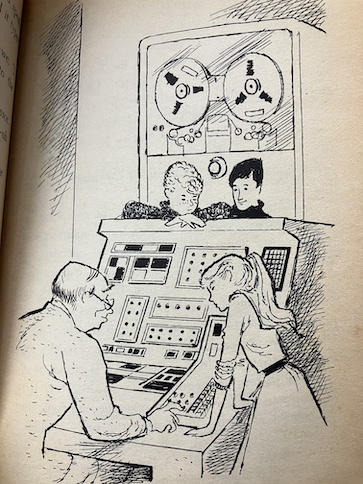
Ellen and Otto set out on a cross-country journey to reach Ellen’s Aunt Sarah, but they eventually find themselves trapped in a disturbing boarding school, run by the secret society they are trying to escape. The students in this school are controlled by the mysterious Hieronymus Machine, and they are being trained as soldiers in the service of “the king” to sow chaos in society. Ellen is close to learning the purpose of her crown, but she and Otto will need their wits to escape and put an end to this secret society’s evil plans!

Robert C. O’Brien is known for Mrs. Frisby and the Rats of NIMH, but The Silver Crown was his first book.

I was intrigued by this story from the very beginning. Strange things start happening very quickly – the appearance of the silver crown on Ellen’s birthday, the destruction of her house, the murder she witnesses, Ellen setting out on her journey to her aunt, and the strange and disturbing Mr. Gates attempting to kidnap her – all of these events, while confusing for Ellen, are related and part of a much larger story.

The parts of the book where Ellen and Otto are traveling cross-country, meeting people who help them escape from the people chasing them and continue their journey, seem almost like part of a fantasy book or fairy tale. This story is both fantasy and science fiction. (Spoiler) The Hieronymus Machine is an invention more than a thousand years old that controls minds by broadcasting feelings like radio waves. The school run by the society uses the Hieronymus Machine to control the minds of the “students”, and the students are all part of a larger experiment to test the powers of the machine and the ability of the black crown to control it. There is a pseudo-scientific explanation of how the machine works, which is the science fiction element, but the black and silver crowns that control the machine and the roles of “king” and “queen” associated with the crowns add the fantasy element. When Ellen meets the king, he explains to her how he discovered the machine and that the people who built it, although they called themselves monks, were actually sorcerers. I enjoy stories that are cross-genre, and I thought that this combination of fantasy and science fiction worked well.

Actually, I was surprised when Ellen and Otto ended up at the boarding school and started learning what the Hieronymus Machine is and what it does because it struck me as very similar to the plot of The Mysterious Benedict Society. This book is 40 years older than The Mysterious Benedict Society, and I wouldn’t be surprised if it inspired that later series. Both of them are based around the concept of mind control machines that work like radio waves and strange boarding schools that are used both for mind control experiments and for training/brain-washing people to serve a dark purpose. Both stories feature children who are orphans and/or separated from their parents and people whose identities are uncertain and whose memories are corrupted by the machine. (Spoiler) It turns out that Ellen’s family is still alive but being held captive by the secret society, but we never learn who Otto’s parents were or if they had any connection to the secret society themselves.

There are some differences between The Mysterious Benedict Society and The Silver Crown. Ellen discovers that the king, although seeming to be in control of everything initially, is also controlled by the machine. The machine controls everyone around it, to some extent. The king somewhat controls the machine through the black crown, but at the same time, he’s also carrying out the goals of the machine. Although he seems in command, he’s really just a tool of the machine itself and needs to be freed from it as badly as everyone else. This is a somewhat different scenario from The Mysterious Benedict Society, where there is one person who is definitely in control. Some people, like Ellen, have a natural resistance to the mind control effects because their minds work differently from other people’s, and that’s how Ellen is able to resist the mind control and use the silver crown. The silver crown is the one that actually controls the machine while the black crown allows the machine to control the wearer while giving him the illusion of control, which is why the king wants to control the silver crown and Ellen. On some level, the machine realizes that it needs Ellen and the silver crown to function. Ellen needs to learn how to use the crown and the knowledge it gives her about what to do to establish control over the machine and ensure that it can’t control anyone else again.

There are actually two different endings to this book, depending on whether you read the British version or the American version, and if you listen to Kent Kently’s reading on Youtube, he reads both of them at the end of the book. In the original British version, Ellen’s Aunt Sarah says that she sent Ellen the crown after finding it in a curio shop in Spain, where the shop owner seemed to think it was an old theatrical prop. This ending isn’t very detailed and leaves some things to the imagination. The American version has far more detail, and in that version, they conclude that the secret society had someone break into Ellen’s house and leave the crown for her because they were actively searching for someone who could use it. If you read other reviews of this story, some of them will differ from each other, depending on which version the reviewer read. Personally, I like the American version with its more detailed explanations better, but Kent Kently prefers the shorter, original version.

Danny Dunn and the Swamp Monster

Danny Dunn

Professor Bullfinch receives a cryptic message, which he says is written in the style of a telegram (he calls it “cablese” – a way of shortening messages because people pay for telegrams by the word). As Professor Bullfinch and Danny study the message further, they can draw more conclusions about the sender, who is not specified. They know it’s someone with money because the hotel it was sent from is expensive. From one of the terms used, they think the sender is a scientist, and because he sent a message written to be a telegram as a letter, he’s probably absent-minded. That description seems familiar to Professor Bullfinch.

Then, a strange man comes to the door who seems oddly distracted and confused. He greets Danny as if he were an old friend, but Danny has no idea who he is. He thinks the man is crazy, but Professor Bullfinch recognizes him as his old friend Dr. Benjamin Fenster. Of course, Dr. Fenster is the person who sent the confusing message. It turns out that Dr. Fenster meant to send that message to Dr. Ismail at the University of Khartoum, but he accidentally got it mixed up with the message he was going to send to Professor Bullfinch. Dr. Fenster is an absent-minded professor type, and he’s always doing things like that. Although, he does correct Danny when he mentions this, saying that he’s not actually a professor, and it’s not so much that he’s absent-minded so much as that he has a lot to think about and can’t think of everything at once.

Their conversation is interrupted when something goes wrong with the experiment that Professor Bullfinch and Danny were working on before Dr. Fenster arrived. A warning goes off, and Professor Bullfinch yells to Danny to shut off the machine. However, Danny can’t find the shut off switch, so he panics and pulls an electrical cord, sending an electrical current through the project before Professor Bullfinch turns off the switch. When they examine the results of the experiment, they’re surprised. Professor Bullfinch was trying to develop a new polymer, but the accident with the machine and the electrical current have turned the polymer into a superconductor and a very powerful ring magnet with a circular magnetic field.

While they’re examining the results of the experiment, Dr. Fenster wanders off, lost in thought. Danny worries if he’ll be okay, wandering around on his own, but Professor Bullfinch says that he’ll be fine. Dr. Fenster often does this when he’s thinking something through. Danny’s friends, Joe and Irene, arrive, commenting on seeing a man who was acting strangely and wondering if there’s something wrong with him. Danny explains to them who Dr. Fenster is and tells them about the ring magnet. Then, Dr. Fenster bursts back in, very excited, because he’s figured something out. He thinks the magnetic polymer ring might be the solution to a problem he’s been trying to solve.

Dr. Fenster is a zoologist, and one of his projects is to investigate accounts of legendary animals. Although many scientists tend to disregard stories of unknown animals as purely legendary, sometimes, they turn out to be previously unreported/undiscovered species. (“Undiscovered” in the scientific sense. Obviously, people have seen them, or they wouldn’t tell stories about them. These are species that haven’t been officially documented as having been discovered among the scientific community.) Investigating rare or possibly unknown species is what Dr. Fenster does.

Dr. Fenster is currently investigating reports of a creature called the lau, which apparently lives in swampy areas around the source of the Nile River in Uganda. The lau is supposed to be an enormous serpent with tentacles on its head. The legend around it says that if a person sees the lau first, the lau will die, but if the lau sees the person first, the person will die. When the others ask him if he thinks that’s real, Dr. Fenster says that he thinks that’s more metaphorical, like when someone says they felt petrified, it doesn’t mean that they literally turned to stone, or if someone says that their blood froze, it just means that they felt horrified. He thinks that the idea is that a serpent could kill a person, if they didn’t see it and disturbed it, but if the person saw the serpent first, they would kill it to avoid the threat.

The problem that Dr. Fenster has been trying to solve is how to move around the swamp and keep the area under observation during the night as well as the daytime, without possibly disturbing the creature he’s trying to find. It’s difficult to get around that swampy area in daylight, but it’s even more difficult at night, and he doesn’t want to use lights because that could frighten away the lau. He’s been thinking that he would like to mount some specialized cameras in certain strategic areas, but he couldn’t figure out how to mount them, and the cables he would have to use would be long and heavy. Having seen what the magnetic polymer can do, though, he thinks that could be the solution to the problem. It doesn’t weigh much itself, but when they test it, they discover it can support the weight of a grown man.

Dr. Fenster invites Professor Bullfinch and the children to join him on his expedition. He’s independently wealthy, and he can afford to pay for all them to come along. However, Danny’s mother has reservations about how safe this expedition is, and she can’t imagine that Joe or Irene’s parents will allow them to go on the trip, either. It takes time for Dr. Fenster to persuade the children’s families that the trip is safe enough for them. Eventually, they give in and allow the children to travel to Africa as a special Christmas present. Dr. Fenster doesn’t have any time limit on his own investigations, but the parents limit the children to only two weeks.

When they get to Africa, the first place that Dr. Fenster takes them is to Khartoum University in Sudan, where he introduces them to Professor Ismail, the Director of the Department of Zoology. Professor Ismail has helped Dr. Fenster with travel arrangements, equipment for the expedition, and the necessary government permits. Danny asks Professor Ismail what he thinks about the stories of the lau and whether it could be something like a dinosaur that has somehow survived. Professor Ismail says that many things are possible because there known oddities among animals, like the platypus, which lays eggs even though it’s a mammal. He shows them a fish called clarias lazera, which has the rare ability to leave water and live on land for a period of time.

The children get something to eat at a local cafe and talk excitedly about what the lau could really be and how its discovery could be “the most important discovery of the century.” Irene notices that a man in the cafe looks very interested in what they’re saying and follows them when they leave.

When the expedition reaches the site Dr. Fenster wants to investigate, they persuade some of the Nuer people who live there to show them where they’ve see the lau. They are initially reluctant and warn them that the lau is dangerous, but they do show them an area, and the members of the expedition start setting up cameras to watch it. As they begin exploring, they do find large trenches that are like the paths supposedly left by the giant serpents.

Dr. Fenster explains to the disappointed children that he won’t take them along to confront the lau directly, even if they do find it because of the possible danger. He and Professor Bullfinch will handle the creature, using the tranquilizer gun that Dr. Fenster brought along. They plan to have the children watch on the monitors and keep an eye on the base camp. However, the children see something unexpected when they’re looking at the monitors: the same strange man who was following them in Khartoum. Who is he and why has he followed their expedition?

When the children tell Professor Bullfinch and Dr. Fenster about him, they meet up with the man, and he introduces himself as a rare animal collector. He offers to join their expedition and help them, but Dr. Fenster refuses. One of the Nuer recognizes the man as a disreputable character who would do anything for money, and Dr. Fenster thinks he’s a poacher, who would try to capture rare animals and sell them, rather than simply study them scientifically. It seems that, aside from protecting themselves from the possibly dangerous lau while they study it, they might also have to protect the lau.

The book is available to borrow and read for free online through Internet Archive (multiple copies).

The lau is a cryptid in the real world as well as in the story, and the details Dr. Fenster offers about where it supposedly lives and historical mentions of the creature are accurate. Accounts of what the lau might actually be in real life vary. It could be a type of python or a very large fish, like a catfish. In the story, when they do find the lau, it turns out to be an enormous catfish, the kind that can live without water for a time and move on land, but it also turns out to be electrical, like an electric eel. Professor Bullfinch and Dr. Fenster decide that it’s related to the malapterurus, which is in keeping with real world theories about the lau.

The story makes some good points about known animals in the real world that are considered oddities because they have qualities that don’t normally apply to other animals of their type, like how the platypus is an egg-laying mammal. Just because something sounds unusual doesn’t mean that it’s impossible. There are wide variations among creatures in the animal kingdom. I thought it was interesting that they brought up the clarias lazera, which is a type of catfish that can live and move on land. A similar type of catfish that can live and move on land appeared in the children’s mystery book The Mystery of the Other Girl.

I’m not sure whether the accident that produced the magnetic polymer makes any reasonable scientific sense, but there a few interesting facts in the story. When they get to Africa, Dr. Fenster explains to them that there are actually two Nile rivers – the White Nile and the Blue Nile. They get their names because the soil they pass through gives them each a different color.

There are some words of another language included in the story when they reach Uganda, but I’m honestly not sure whether they’re real words or just made up to make it seem like Dr. Fenster can speak the local language. I tried putting them through Google translate to see if it could recognize them as anything, but it came out as nonsense. However, it’s supposed to be a language spoken by the Nuer people, so it might be something that Google translate doesn’t know.

Sometimes, I’m a little suspicious when I encounter obscure foreign words in old children’s books. I’ve read other old children’s books which use made-up words in place of an actual foreign language, probably because the writers didn’t know how to write something in a real foreign language but they wanted something that looked like it could be from another language. They were probably also acting with the assumption that kids wouldn’t know the difference, so it wouldn’t matter. I could be doing these authors a disservice by being a little suspicious here. Perhaps they did some extra research to learn a few phrases in a language that would be very obscure in the United States. It’s just that, having seen fakery elsewhere, it’s something I find myself looking for when I see instances of languages that would be difficult to fact-check.

Faking words in a real spoken language is less tolerated in the 21st century than it used to be, especially in a book that’s supposed to have educational qualities, so I hope they didn’t attempt to do that. Faking lesser details in a fiction book that’s supposed to have some real facts tends to cast suspicion on just how many of the other “facts” in the book are fake. This is an adventure story, not a textbook, so it’s true that some creative license is allowed. I still don’t know if their magnetic polymer concept is at all plausible, but the Danny Dunn stories are science fiction adventures, so some creative license there is allowed. However, readers like to feel that they can trust a certain amount of supporting detail to be correct. It’s also considered a cultural insult to use fake nonsense words in place of actual words from a language people really speak. Hopefully, that’s not the case here, but I wanted to point out the concept so readers can see how the use of real words strengths a story while faking them weakens it.

The story offers about the Nuer people, but I’m not sure how accurate they are. I don’t know where the authors got their information. They say that Nuer people don’t have chiefs and don’t follow orders from anybody, but according to the eHRAF World Cultures collection through Yale University, their clans do have headmen, and they also have sub-chiefs.

Danny Dunn and the Homework Machine

Danny Dunn

At the beginning of the book, Danny develops a device that allows him to do his homework and his friend Joe’s homework at the same time by using a system of pulleys and a board that holds two pens at once. (This seems like an unnecessarily complicated device, since he and his friend could accomplish the same thing just by sitting next to each other and talking over their answers as they both write them down at the same time, although Danny says that he plans to build a second pen board so Joe can work on their English homework at the same time as Danny does their math homework.) Danny thinks that it would save even more time if he could find a way to build a robot that will just do the homework for them, but Joe warns him to be careful because things often go wrong with his inventions.

Joe leaves to get more materials for their homework device, and suddenly, Danny is surprised by a tapping at the window, and he sees a girl’s face looking in at him. It’s surprising because Danny is on the second floor of his house. At first, he thinks that this girl who seems to be hovering in the air must be from outer space or something, but it turns out that she’s just an ordinary girl on a ladder.

The girl tells Danny that her name is Irene Miller and that her family just moved in next door. Her father, Dr. Miller, is an astronomer who will be working at Midston University. The reason why Irene is up on a ladder is that she’s built a weather balloon, and now, it’s stuck on the roof of Danny’s house. Unfortunately, she’s just discovered that her ladder isn’t quite long enough to reach the roof. Danny, who loves science, is intrigued by Irene’s weather balloon, and he helps Irene retrieve it by climbing out an attic window and onto the roof.

Danny shows Irene his device for doing homework, but Irene says it doesn’t seem quite honest because it’s basically like copying from someone else. Danny defends his idea, saying it’s not really cheating if the second person actually does know how to do the homework and would give the right answers anyway. He just sees it as a time-saving device. He also says that Professor Bullfinch, an inventor and physicist at the university, says that homework isn’t relevant to the learning kids do in the classroom. Danny’s father is dead, and his mother is Professor Bullfinch’s housekeeper, so Danny and his mother live with him.

Danny is surprised at how much Irene knows about science because he didn’t think girls would be into science. Irene says that there have always been female scientists, like Marie Curie, and she also wants to study physics. Although Danny has learned a lot from Professor Bullfinch, he’s a little intimidated that there are things that Irene knows that he doesn’t.

When Joe returns, he isn’t enthusiastic that Danny has made friends with a girl. When Joe is derisive about women and girls, Danny even defends Irene and how much she knows. Irene confesses to Danny that getting her weather balloon stuck on the roof wasn’t an accident. Her mother had already talked to Danny’s mother, so she knew Danny was interested in science. She purposely got the balloon stuck on the roof to get his attention and give them a reason for meeting. Joe uses that as part of his assertion that women are trouble.

Irene joins Danny and Joe’s class at school, and she starts making some other friends there. There is one boy in class, Eddie, who seems to have a crush on Irene. She’s a little flattered that he thinks she’s pretty, but she begins to feel uncomfortable with his attention because he keeps staring at her. Danny explains to Irene that people call Eddie “Snitcher” because he’s always telling on somebody for things they do, seemingly out of spite.

When Danny invites Irene to come to his house for cookies after school, Professor Bullfinch surprises them by telling them that he’s going on a business trip, and while he’s gone, he’s going to let Danny take care of his new computer. The computer is called Miniac, which is short for “miniature automatic computer.” It’s much smaller than most computers of its time. During the 1950s, computers could take up an entire room. The Miniac is about the side of a large sideboard.

Joe asks Professor Bullfinch how the Minaic works, and he explains that they can ask it questions through a microphone. The computer prints out answers with an electric typewriter. Irene asks if they can ask it a question to see how it works, and she asks the Miniac a question from their homework. Joe is amazed at how quickly the computer answers the question, and Professor Bullfinch explain a little more about how computer work, with a memory unit that stores information. He says that facts are stored on magnetic tape. (This was true at the time this book was written, although 21st century computers are constructed differently, in ways that allow them to be made much smaller than 1950s computers. What he says next about the nature of computer intelligence is still true, although I’m going to have some things to say about AI in my reaction section.)

Irene marvels at how the computer seems almost like something from science fiction (for her time) and how amazing it is to have a device that can give you the answers to everything. Professor Bullfinch explains to her that’s not quite true, and that there’s something more amazing: the human mind.

It is only a kind of supertool. Everything in this machine is inside the human head, in the much smaller space of the human brain. Just think of it — all the hundreds of thousands of switches, core memory planes, miles of wire, tubes — all that’s in that big case and in this console — are all huge and awkward compared to the delicate, tiny cells of the human brain which is capable of doing as much as, or more than, the best of these machines. It’s the human brain which can produce a mechanical brain like this one. … The computer can reason … It can do sums and give information and draw logical conclusions, but it can’t create anything. It could give you all the words that rhyme with moon, for instance, but it couldn’t put them together into a poem. … It’s a wonderful, complex tool, but it has no mind. It doesn’t know it exists.”

Danny’s assignment while the professor is away is to feed data to the computer. The professor has laid out the information and code tables that Danny will need, although the professor says that Danny can add some extra information if he comes across something new and interesting in Scientific American or one of the other science magazines he reads. Irene asks if she can help with this task because she finds it interesting, and the professor gives her permission. Before he leaves, he warns Danny not to get too carry away with his enthusiasm. He knows that Danny likes to experiment, and sometimes, he gets carried away when he has an idea, without stopping to think first. The computer is a tool, not a toy, and the professor wants him to treat it as such.

However, a few days after Professor Bullfinch leaves, Irene has a question about their homework that Danny and Joe can’t answer because they also don’t really understand the subject. Then, Danny gets the idea of asking the computer about it. Inspired by how easily the computer answers the question, Danny suggests to the others that they use the professor’s computer as a “homework machine.” After all, it can answer questions and supply them with information, and Danny thinks he could even program it to write short compositions. Irene is a bit dubious about it, but Danny amends his idea to say that the computer would “help” them with their homework.

The book is available to borrow and read for free online through Internet Archive (multiple copies).

One of the interesting things about reading a vintage book like this that focuses on the technology of its time is seeing how things have changed and how people’s perceptions of technology have changed. The kids in this book are amazed by the professor’s computer, which is cutting edge for their time, although 21st century children grow up accustomed to computers in their homes that they are allowed to use. Modern children do use computers as toys, playing computer games, and they are also tools for doing homework.

However, even though things have greatly changed in the decades since this book was written, some of the issues surrounding the ethical use of technology are still concerns in the modern world. This story brings up the issue of how much a reliance on technology to do homework borders on cheating and keeps students from gaining the skills they’re supposed to use. This has become a major issue in modern education in the 2020s, with the rise of AI technology. In the story, Professor Bullfinch says that a computer cannot write poetry, which might get a smirk from modern readers because AI has achieved compositional writing skills. What I’d like to point out, though, is that there are still limits on that. As of this writing, the ideal way to use AI in writing is as a starting point for writing and research but not as a replacement for human writers or the human mind to edit and control the content of the writing. AI also uses human writing as the basis for its compositions, not writing everything from scratch:

“… an AI writing tool will gather information based on what other people have said in response to a similar prompt. The bot will search the internet for information about what you’ve asked it to write, then compile that information into a response. While this used to come back as clunky and robotic, the algorithms and programming for AI writers have become much more advanced and can write human-like responses. … AI writers are, so far, limited in their abilities to create emotional and engaging content. Humans, by nature, are storytellers. We have been since the beginning. Robots, however, are not. They are limited by what they’re programmed to do, and AI bots are programmed to gather information and make an educated guess about what you want to hear.”

(AI Writing: What Is It And How Does It Work?, July 2023)

Computers, even those in the 21st century, which are both smaller and more efficient than the ones from the 1950s, still rely on input from human sources to do anything. AI work is not original, it only builds on what humans have given it to use. In spite of the word “intelligence” in the name “artificial intelligence”, it still “has no mind“, as Professor Bullfinch put it. It’s literally artificially intelligent. It knows nothing independently of human beings, and one of the current problems with AI is that, although it can write convincingly and sound almost human, it not only does so only because it’s basing its writing on human writing that has been supplied to it but also, it has no idea whether or not anything it says is true or not. As the Microsoft article points out, it’s only using predictive technology to guess at what you want to hear and just tell you what you want to hear. It still takes a human being to reason out how much sense AI writing actually makes or whether or not it’s accurate.

One of the current problems with AI in the 2020s is AI hallucinations. Sometimes, AI seems to make things up that aren’t true at all because the way it processes information sometimes produces errors, and by itself, AI has no way of knowing when this has occurred. It has no understanding of the subject its writing about. It’s only attempting to predict and supply what it thinks the human who supplied the prompt wants it to supply.

“AI hallucination is a phenomenon wherein a large language model (LLM)—often a generative AI chatbot or computer vision tool—perceives patterns or objects that are nonexistent or imperceptible to human observers, creating outputs that are nonsensical or altogether inaccurate.

Generally, if a user makes a request of a generative AI tool, they desire an output that appropriately addresses the prompt (that is, a correct answer to a question). However, sometimes AI algorithms produce outputs that are not based on training data, are incorrectly decoded by the transformer or do not follow any identifiable pattern. In other words, it “hallucinates” the response.”

There are currently problems with students relying too much on AI to do both their thinking and writing for them, and even professionals who rely too much on AI tools to get through their work faster sometimes fail to notice when the AI writing says things that don’t make sense or are just blatantly untrue. The AI doesn’t know what’s true or not, it’s just telling you what it thinks you want to hear, based on information given to it, put together, and rearranged in its logic programming. Because it doesn’t actually understand the information fed into it, it has no idea when it gets the story wrong. Computers are faster at processing data than a human, but actual understanding of information is still entirely a human quality. A computer cannot understand anything on behalf of a human mind because it “has no mind” of its own to do the understanding.

There have been cases where professional lawyers who have relied on AI writing instead of doing their writing themselves have been sanctioned when AI hallucinations included information that was not only inaccurate but actually fictitious, citing court cases that never actually existed. The lawyers who received disciplinary action about this did not proofread the writing produced by AI, just trusting it to do all of their writing and thinking for them. Yet, the errors jumped out immediately when actual humans read the writing.

The more complex the writing is, the more the limitations of AI become apparent. AI can sound convincing in a short article (especially if you’re not doing any fact checking to see whether it’s talking about something real or not), but it isn’t always consistent or coherent in longer writing. The drama department of one of the local colleges where I lived put on a performance of a play written entirely by AI as a kind of thought experiment, and the results were hilarious. It was a mystery play, and the script was confusingly written. The AI had trouble keeping track of which characters were currently on stage and which were not, so actors who were not actually present in particular scenes had dialogue. At one point, when the detective was questioning everybody, he even talked to the person who was murdered, and the corpse responded. The play didn’t make sense because the AI doing the writing didn’t really understand the story it was telling. It just told a story in the pattern that was requested of it. It was, technically, a complete play, and if you gave it a cursory glance, it would have looked like a fully written play. It’s just that it had absent people and dead people talking. Perhaps at some point in the future, AI can do its own proofreading and learn to catch these types of problems, but for it to do so with the accuracy of an actual human, it would have to have a human level of understanding about the world and the subject matter it writes about. That is, it would have to have real intelligence, not just artificial intelligence.

This video from Wired on YouTube features AI and machine learning professor Graham Morehead from Gonzaga University, answering common questions about the nature of AI. In the video, he explains some of the differences between how AI “thinks” and how a human brain thinks, which help explain why AI can do some things that a human being would find pretty stupid. AI often thinks in terms of two-dimensional images as opposed to the three-dimensional world we live in as humans, and it doesn’t always understand the consequences of actions because, to AI, everything comes down to simple numbers and data as opposed to a physical world where actions have context and consequences.

Overall, I think this story did a good job of evaluating the differences between the human brain and the electronic brain at a point in history where the technology was relatively new and evolving. It also did a surprisingly good job of anticipating some of the developments and problems associated with the use of artificial intelligence, although the form it takes in this story isn’t quite what we’ve seen in the 21st century, and the kids in this story encounter an issue that modern students attempting to use AI to do their homework aren’t likely to encounter.

At the end of this story (spoilers), Danny and his friends come to realize, to their surprise, that they’ve actually been doing more homework than their classmates in order to make their wonderful homework machine function. They had to teach the machine the subjects they’re studying in order to have it do the assignments because the machine doesn’t innately understand the subject matter. The kids have to supply the knowledge base for the machine learning to function, and that ultimately takes more work and study for them than simply understanding the subjects in their own minds and just doing the assignments themselves. Danny’s mother and his teacher allow the kids to continue using the machine once Danny’s mother explains to the teacher how the process works so the kids can experience how a seeming shortcut can actually take more effort.

This is a little different from the 21st century AI tools, where someone else has already done the basic programming work, and students don’t have to actually understand the subjects themselves to use the AI tools. Of course, if the student doesn’t understand the subject matter of the assignment, there’s less chance that they’ll even notice when the AI produces an AI hallucination and says something that isn’t true or doesn’t make sense. There is an incident in the book where the computer messes up and outputs something that makes no sense, and the kids have to figure out why it did that.

The kids also consider the issue of whether or not using the machine to do their homework is cheating or not. Irene has serious reservations about it at first, and their teacher and some classmates think it gives them an unfair advantage when they find out. Danny, on the other hand, defends it, thinking of the computer as just a time-saving tool, like a typewriter, although the computer is doing more for them than a typewriter does. Danny is only focused on the idea of saving time so he can do things other than homework because he’s confident in his own ability to understand the academic subjects and thinks that practicing his skills or proving his knowledge through homework is a waste of his time.

The only reason why the teacher agrees to let them continue using the computer is that Danny’s mother figures out before he does how much extra work he and his friends are doing to teach the computer how to do their homework. This becomes obvious after the teacher gives them a special assignment, beyond what was covered in class, so Danny and his friends have to work extra hard and spend far more time to understand the material themselves and then teach the computer to understand it well enough to do the work. The first assignments weren’t so hard for Danny and his friends to teach the computer how to complete because the kids are at the top of their class, and they do know the material. However, the more difficult the assignments get, and the less familiar they are with the subject matter, the harder it gets to program the computer to handle the assignments. This exposes the flaws in their system and highlights the need for them to understand the material themselves rather than depend on the computer to do their work for them or even necessarily do it more efficiently. The great use of computers is to do tasks more efficiently, but that depends on the task and whether or not the computer has accurate instructions and an efficient knowledge base to draw on to do it. Building the programming and the knowledge base takes the work of a human mind that knows what it’s doing and is willing to put in the effort to do it correctly and to troubleshoot errors.

In this book, we get a glimpse of school in the 1950s. Something that stood out to me was when the teacher mentions that the class sizes have grown considerably in recent years, meaning that she has less time to work with individual students than she used to. This was a real problem in the 1950s, due to the effects of the Baby Boom. This generation of children was much larger than previous generations, so there were shortages of teachers and class space, and teachers and students did complain that students got less individual attention. (This documentary on YouTube shows some of the overcrowding.)

The focus on science and technology in the Danny Dunn stories is also important to the 1950s because that was the beginning of the era of the Cold War technology race, exemplified by the Space Race. The capitalistic United States and its allies competed against the USSR and its allies for world supremacy following WWII, and one of the ways they did that was by trying to develop superior technology and technological skills. This need to compete in the areas of science and technology led to changes in the US public education system, emphasizing the skills that we would call “STEM” skills today (science, technology, engineering, and mathematics). Echoes of those changes still influence the way we think about education in the 21st century.

This technological and scientific focus also influenced children’s entertainment, as adults tried to encourage children to take an interest in science and technology. The Danny Dunn series is one example of this, showing children who are interested in science and new inventions and portraying them as fun and exciting. Another example was the educational tv show Watch Mr. Wizard, which was being broadcast at the time the Danny Dunn books were written and published. Watch Mr. Wizard featured the title character performing experiments in his laboratory and demonstrating scientific concepts to child visitors. It was very popular, and in the 1950s, there were science clubs for children based around this show. This show also helped inspired new generations of shows with a similar premise, such as Bill Nye, the Science Guy, which was popular when I was a kid.

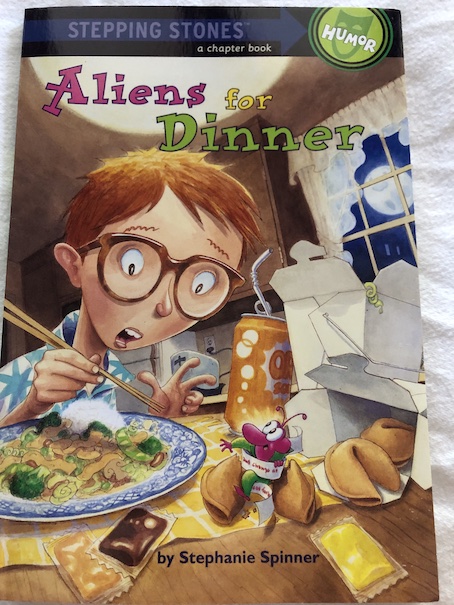
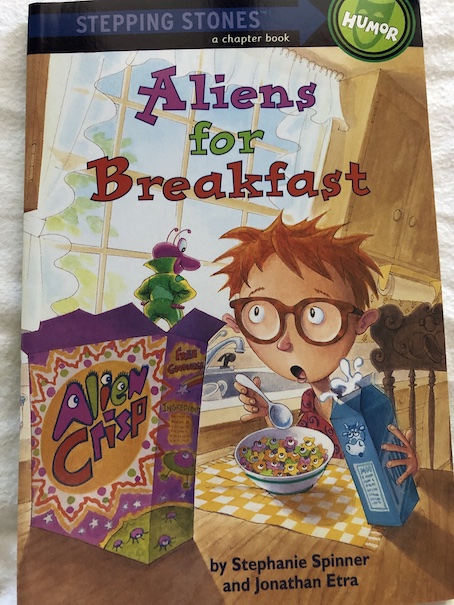
Aliens for Dinner

This book is part of the Aliens for Breakfast Trilogy, a short, easy chapter book series for elementary school children.

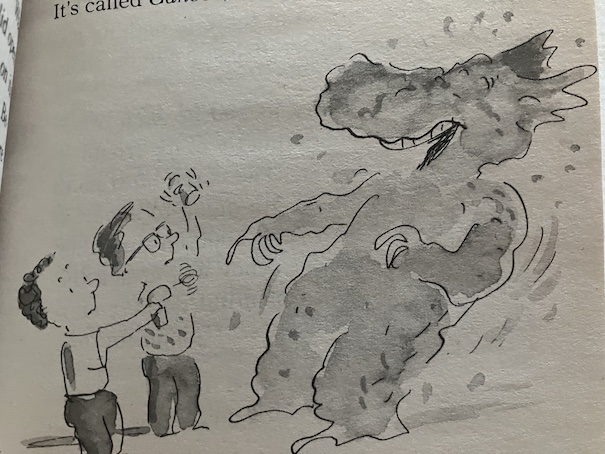
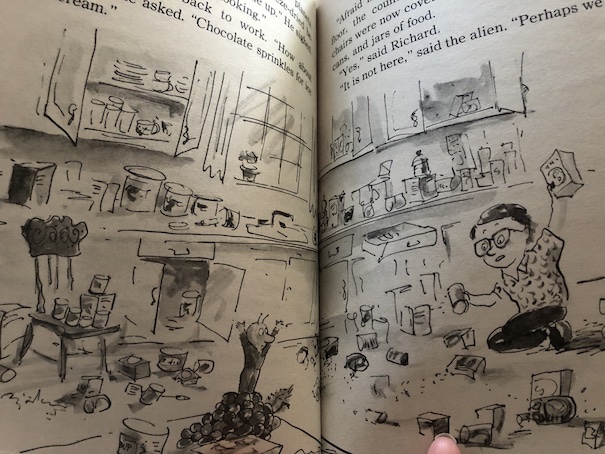
Richard Bickerstaff is unhappy because his mother has started dating a man named Bob Baxter. Richard thinks that Bob is weird, and he has an annoying habit of repeating himself. Then, one evening, when Bob is having dinner with Richard and his mother, Richard’s small alien friend, Aric, arrives with their Chinese food, hidden in a large fortune cookie. Aric is a commander of the Interspace Brigade, and they operate on a shoestring budget, so they often transport Aric in some form of food to save money.

Richard manages to slip away from his mother and Bob and takes Aric to his room, where Aric tells him about his latest mission. Earth is in danger from aliens from a planet called Dwilb. Dwilbs have a bizarre love of pollution, and pollution problems have gotten bad enough on Earth to attract their interest. The Dwilbs want to make Earth even more polluted so they can turn it into a pollution-themed amusement park for themselves called Toxic Waste Funland. Aric says that they’re so confident in their plan that they’re already running advertisements. Aric will need Richard’s help to stop them!

Richard asks Aric questions about what the Dwilbs are like. Aric says that they look like humans, but they have an odd habit of saying everything twice, and the repetition seems to have a hypnotic effect. Richard thinks that sounds familiar, and he remembers why when his mother and Bob come to say goodnight to him. Bob repeats himself! Richard starts to think that his mom might be dating an alien!

Meanwhile, the Dwilbs have caused a major oil spill nearby as part of their plan to pollute the planet further. Local people have been trying to help with the cleanup, but it seems like it’s just getting worse. Richard goes to take a look and sees Dwilbs splashing about in the oil, having fun! They love the oil spill, the exhaust from cars, and everything that’s dirty.

Richard asks Aric what they can do to stop the Dwilbs, but as often happens when Aric travels in the bizarre ways that Interspace Brigade sends him, has trouble remembering the Dwilbs’ weak point. While Aric struggles to remember, the Dwilbs start influencing the kids at Richard’s school, getting them hooked on a treat they call Sludgies. Under their influence, the kids start littering and stop caring about the environmental efforts their teacher is trying to talk to them about. Even Richard’s friend, Henry, is under their power and in no state of mind to help Richard.

Fortunately, there is a secret weapon right there at Richard’s school: the school principal and his ability to bore everyone almost to death. In the case of the Dwilbs, boredom is a serious threat!

The books in the Aliens for Breakfast Trilogy are humorous sci-fi stories, and the solutions to defeating the aliens always have some comic twist. The solution in this case is getting the school’s principal to speak to them and bore them out of their minds. Richard has to arrange for his principal to speak at a place where he knows all the aliens will hear him.

Richard has run into situations in previous books where strange people he knows turn out to be sinister aliens in disguise, and in this case, he thinks that Bob is one of the Dwilbs. However, there is a twist to this story. Bob isn’t one of the aliens. He’s a little odd, but he’s a human. His quirks just happen to resemble the Dwilbs. He has a habit of repeating himself, but he’s not at all bored by the way the principal speaks or the way Richard speaks when he imitates his principal. Bob is often a little boring himself. By the end of the book, Richard feels better about Bob when he discovers that Bob likes comic books as much as he does. The two of them start bonding by sharing comics. Bob has a collection of older comics that Richard has been wanting to read, and he lets Richard borrow them.

I like the references in the story to real franchises that fans of science fiction and comic books would know. Richard has a collection of X-Men comics.

The book was published in the 1990s, when I was still in school. I remember my teachers talking to us about environmental issues back them, especially about pollution and the importance of recycling. They often urged us to get involved and do our part to recycle and not litter. The environmental messages in this story, especially the ones Richard hears at school, bring back memories for me.

Aliens for Lunch

Aliens for Lunch cover

This book is part of the Aliens for Breakfast Trilogy, a short, easy chapter book series for elementary school children.

It’s spring break, and Richard and his friend Henry are bored. It seems like all of their friends have all gone somewhere for vacation, but they’re stuck at home. Richard’s mother leaves the boys home alone, telling them that there’s food for lunch in the refrigerator and a new sample of popcorn that arrived in the mail. The last time that a sample of a new kind of food arrived in the mail, Richard’s alien friend, Aric was hiding inside, and the same is true this time, too! Aric is back, and he needs Richard’s help!

Aric tells Richard and Henry that a valuable shipment of XTC-1000 was hijacked by aliens called the Graxians. XTC-1000 is the secret substance that makes all desserts taste wonderful. (I always thought that was sugar, but okay.) Aric’s planet ships XTC-1000 to other planets, and each shipment is supposed to last for thousands of years, but the Graxians are greedy, and they used up their supply too quickly, which is why they hijacked a shipment bound for another planet. It’s a real problem because, if that other planet’s desserts suddenly turn bland because they’ve run out of XTC-1000, they’re bound to start raiding desserts from other planets, like Earth.

Aric’s Interspace Brigade was supposed to send weapons to help Aric and Richard face off against the Graxians, but as always, they’re on a strict budget, and the weapons they sent somehow failed to arrive. Richard and Henry do the best they can to improvise weapons with things they find in Richard’s kitchen, but they’re not very terrifying. The Graxians take Aric, Richard, and Henry prisoner after they board the ship. Can the boys manage to free Aric and discover what they need to subdue the Graxians?

I don’t think I read this book as a kid, although I remember reading the first book in the series. The Aliens for Breakfast Trilogy is a short series of funny science fiction stories as Richard and his alien friend do battle against the villains of the galaxy with food! I like the fact that even the aliens they fight find their efforts laughable when they try to use things that just don’t make sense, like when they try to use the kitchen gadgets as weapons. I also enjoyed the pun that the secret substance that makes desserts good is “XTC”-1000. (No, I don’t think they mean the illegal drug.) There is also a running gag that Aric’s space organization is always operating on a shoestring budget, which is why they often have to improvise weapons and modes of travel. The stakes are high but laughable at the time time, and somehow, they always manage to save the day! There is an extra joke at the end of this book where Aric gives both of the boys jackets from his space organization, telling them that girls find them irresistible. When the boys try wearing them for the first time, they come to the conclusion that neither one of them is ready to be irresistible.

Aliens for Breakfast

This is the first book in the Aliens for Breakfast Trilogy, a short, easy chapter book series for elementary school children.

There’s a new student in Richard Bickerstaff’s class at school called Dorf. In spite of his strange name, Dorf is a good-looking blond boy with an irresistible smile. Everyone in class admires him and imitates him. Even Richard finds himself admiring Dorf’s clothes and wishing that he could wear the same thing, even his stupid bowling shirt. Then, when Richard sits down to breakfast one morning before school, he learns something startling about Dorf that changes everything.

Richard’s mother gives him a sample of Alien Crisp that came in the mail. She thinks that Richard will love it because of his love of science fiction, but right away, he can tell that this is no ordinary cereal. When he pours milk on the cereal, it comes to life! Actually, he has revived a small alien called Aric, who was sent to Earth from another planet in freeze-dried form in the cereal. Aric is a Commander of the Interspace Brigade, and he’s here to stop an alien invasion on Earth. His target is Dorf.

Dorf is no ordinary boy. He’s an alien in disguise and a dangerous one. His type of alien multiplies, and if that happens, Earth is doomed! There’s only one thing that can stop Dorf … and Aric has forgotten what it is. Being freeze-dried for the trip to Earth has scrambled his memory, but he knows that the weapon they need is an ordinary type of food from Earth.

While Aric struggles to remember what that secret weapon is, Dorf’s hold over Richard’s friends and teachers becomes stronger. Everyone is charmed by Dorft, and everyone wants to do whatever Dorf does. Only Richard resists, and that identifies him to Dorf as an enemy.

Dorf uses his powers to make Richard start dissolving. If Aric doesn’t remember that secret weapon soon, both Richard and Earth are history!

I remember reading this when I was in elementary school, although I forgot most of the story. I remembered the alien arriving in the cereal box, like those little toys we used to get in cereal as kids. I also remembered that he was under threat somehow and that Aric told him that he hoped he didn’t have big plans for the weekend, with the implication that, if they don’t do something, he won’t make it to the weekend.

There’s a lot of humor in the story. I was alarmed at how Richard’s fingertips start bleeding when the dissolving begins. That part sounds a little scary. He bleeds rather than starting to fade out, and I had forgotten about that part in the story. However, there is humor in the story that helps to soften it, and the solution is a simple one that works right away.

The story has some references to real life science fiction, like Yoda from Star Wars and the starship Enterprise from Star Trek.

A Watcher in the Woods

The Carstairs family is moving from Ohio to a small town in Massachusetts because Professor Carstairs will be taking a new job as head of the English department at the local college. Fifteen-year-old Jan knows that she will find the move harder than her parents or her younger sister. Her father will be busy with his work, and her mother will make friends with the wives of other faculty at the college. Jan knows that her little sister, Ellie, is still very young and in elementary school, and she won’t find changing schools as difficult as she will. Jan isn’t looking forward to trying to fit in at the local high school.

The family’s first difficulty in moving is finding a house in this new town that they like. Because it’s a small town, their options are limited, and it seems like there’s something wrong with each of the houses they see. Then, their realtor suggests that they view the old Aylwood place outside of town. Living there would mean a longer distance to drive to the college and the girls’ schools, but it’s a nice, big house with some land attached to it. The land includes woods and a pond. Elderly Mrs. Aylwood can’t afford to maintain the place anymore, but she has been reluctant to sell the house. She is very attached to it and she wants to make sure that, if she sells, that she will sell it to the right kind of people, who will take care of the land and woods.

From the first time that Jan and her family visit the house, it gives Jan a strange feeling. She has the oddest feeling that someone (or something) is watching them from the woods, and it frightens her. However, when she tries to explain her uneasy feelings to her mother, her mother thinks that it’s her imagination. Jan can’t deny that the house and wood give her the feeling of a fairy tale and that Mrs. Aylwood reminds her of a fairy tale witch.

For some reason, Mrs. Aylwood becomes more welcoming to the Carstairs family after she sees Jan, and she begins asking Jan some rather odd questions about herself. Mrs. Aylwood admits that Jan reminds her of her own daughter, Karen, who she lost 50 years ago when she was only 15 years old. Jan begins to understand that Mrs. Aylwood’s attachment to the house is because it’s a link to her daughter’s memory, but she soon begins to realize that there’s more to it than that. Mrs. Aylwood asks Jan what kind of person she is and makes a cryptic comment about how Jan is a human but there are other things besides humans.

Jan’s uneasy feeling of being watched continues, and mirrors in the house are inexplicably broken in an x-shaped pattern. When she befriends a neighbor, Mark, and talks to him and his mother about the house, she learns that Karen did not die but that she disappeared 50 years ago. She apparently went out for a walk to the pond in the woods one summer morning and simply vanished with no explanation. Searches for her never lead anywhere. Most of the local people believe that Karen ran away from home, although it would have been out of character for her to do that. Jan begins to wonder if the watcher she senses in the woods could be Karen, somehow hiding out or having returned after all these years, although Mark says that doesn’t make sense. Then, remembering Mrs. Aylwood’s comment about things that aren’t human, Jan wonders if the watcher could be Karen’s ghost. What if she died all those years ago, and her spirit haunts the woods?

It seems like someone or something is communicating with Ellie. Ellie seems to hear something speaking or humming when Jan can’t. Something even suggests to Ellie that she name her new puppy Nerak, which Jan realizes is “Karen” spelled backwards. Is Karen trying to communicate with them, or is it something else?

The book is available to borrow and read for free online through Internet Archive. This book has been made into movie versions twice, but the Disney movie from 1980 is more faithful to the original story. I’ll explain why below, but it involves spoilers.

When talking about my opinion of this book, I really need to include some spoilers. This is a very unusual book because it isn’t obvious until about halfway through what kind of story it really is. From the beginning, it’s set up like a ghost story, with Karen’s mysterious disappearance, the sense of something watching the house and family from the woods, and something trying to communicate through Ellie. It’s very suspenseful and mysterious, but this is not actually a ghost story. It’s really science fiction.

Karen isn’t dead, but she has been trapped in an alternate dimension since she disappeared 50 years ago. A being from that other dimension has also been trapped in our world since then. This other being is the mysterious watcher in the woods. Jan correctly senses that this other being is also female and a child, although beings of its kind live extraordinarily long lives because time works differently in their dimension. What has been 50 years for everyone else has only seemed like a day to her. She wants to return home, but she has had to wait for conditions to be right. She also wants to help Karen, and she has been struggling to communicate with Mrs. Aylwood and Jan and her sister so she can tell them what they need to do.

In the Disney movie, there are a couple of major changes from the original book. The first is that the location is changed from the US to England, although Jan and her family are Americans. It also features a kind of initiation ritual that Jan was undergoing just as her switch with the creature from the other dimension happened, adding an element that seems supernatural, although it is still science fiction. At the very end of the Disney movie, Jan brings Karen back from the other dimension, but in the book (Spoiler!) Mrs. Aylwood goes to join Karen in the other dimension instead.

In the book, Jan’s mother worries about what life would be like for Karen if she returns, aged 50 years in what must have seemed like only a day, having lost most of her life, or what it would be like if she has not changed at all but her mother has aged 50 years, and the world has been through so many major changes since she left. It isn’t clear whether or not Karen has aged in the other dimension, but Jan’s mother’s point is that the world she came from has definitely changed. Karen can’t go back to her old life, and there is some sadness about that and about what Mrs. Aylwood has been going through since Karen disappeared. However, Mrs. Aylwood decides to join Karen in this other world, where she’s been. We don’t really know what Karen’s condition is in the other dimension because we don’t see her. She may have aged very fast there, although I think they imply that she has not aged at all because time works differently in the other dimension. Since time works differently there, it seems like they either won’t age further there or will do so much more slowly than they would on Earth.

Between the two movie versions, the Disney movie version of this book from 1980 is more faithful to the original story because it maintains the concept that this is a science fiction story and that the watcher in the woods is a being from another dimension. The movie version from 2017 turns the story into a ghost story with no science fiction elements. In the ghost story version, Karen is also still alive and hasn’t aged after being gone for many years, but the watcher in the woods is a ghost who is holding her captive. It’s a spookier version, but I think the logic of the original book, with its science fiction theme, makes more sense. 

The premise of the ghost story didn’t make as much sense to me because the ghost’s motives seem confused. First, the ghost takes Karen captive because she was staging a stunt for some friends where she appeared to be mocking the way he died. Then, he seemed to want to keep a girl for company, which is weird because it doesn’t seem like he interacts with Karen while he has her. He tries to make a bargain where he would be willing to release Karen in exchange for Ellie, but in the end, it turns out that human company isn’t really what he wants. (Spoiler!) He wants a ritual for his death that he was deprived from having when he was killed. The story just seemed to be all over the place with the ghost’s motives and desires. Is he out to punish Karen for her disrespect, lonely without human company, or just trying to get attention from the living to fulfill his final wishes? Even he doesn’t seem clear about that, which is why I prefer the sci-fi version. 

I also thought that the premise of the sci-fi story was more original, and I enjoyed the twist of a story that seems like a ghost story but really isn’t. If any sufficiently advanced technology might look like magic to someone who had never seen it before, as Arthur C. Clarke said, it makes sense that any being who was sufficiently different from the human experience might appear to be some kind of supernatural creature to human beings who didn’t know what they were perceiving.

The Disney version from 1980 actually has multiple endings because the first endings they filmed didn’t quite work and didn’t get a good reaction from audiences. If you’re curious about what the three endings are like, Jess Lambert explains them in her YouTube review of the movie.

The Power Twins

Fritz (real name Richard) and Helen Price are twins, and their mother runs a seaside guesthouse. Their younger cousin Jonathan, called Tubs (a nickname that annoys him), comes to visit during the summer, although the twins find him annoying. It isn’t really Tubs’s fault; it’s just that he’s three years younger than they are, and they find him childish. Then, one day, Tubs tells them that Uncle Grigorian is coming to visit.

Fritz and Helen say that they’ve never heard of Uncle Grigorian before, and they ask their mother about him. She says that Uncle Grigorian hasn’t come to see them since the twins’ father died in a car crash, and Uncle Grigorian came to the funeral. The twins’ father originally came from Poland as “more or less an orphan”, and his family was split apart during “the war.” Even he wasn’t sure exactly how many brothers he had, and he never heard from the rest of his family after he arrived in Britain.

(The implication is that he was probably one of the children brought to Britain by the Kindertransport, which transported refugee children from Nazi Germany and Germany-occupied territories, including Poland, to Britain between 1938 and 1940 and placed them with foster families or in temporary homes. The Kindertransport prioritized particularly vulnerable children, especially Jewish children whose parents were already in concentration camps or who were homeless, living in poverty, or were already orphans. The hope was that many of these children would be reunited with their parents after the war, but many of them never saw their families again and continued living with their foster families because their parents were likely killed during the Holocaust. The father in this story was likely very young at this time or even an infant and so didn’t understand his family’s full situation, didn’t have many memories of them, and never learned their ultimate fate. None of this is stated explicitly in the story, but it fits with the father’s apparent age, the time period, and Poland during “the war.”)

Uncle Grigorian was living in Germany at the time the father died about 10 years earlier, but he said that he happened to be on a business trip in England at the time the father died and saw the notice in the newspaper, so he came to pay his respects and check on the family. Now, Uncle Grigorian has bought a farm in Wales, and since he will be living in Britain, he would like to spend more time with the children and get to know them better. Although Tubs is related to the twins on their mother’s side rather than their fathers and isn’t a blood relation to Uncle Grigorian, Uncle Grigorian invites all three children to visit him on his farm. The children’s mother admits that the guesthouse is very busy at this time of year, and a family has shown up with more children than they originally said they would bring, so it would be helpful if the children went on a visit, and the children are excited about seeing the farm.

At first, this seems like just a fun farm visit. Uncle Grigorian is indulgent with the children, letting them eat as many chocolate cookies as they want, teaching the boys how to drive a tractor, and letting Helen play with the lambs. A man named Mr. Rhys manages the farm, and Mrs. Rhys is his cook and housekeeper, making them all a big, traditional, full English breakfast. Things get complicated when Tubs asks Uncle Grigorian what he does while Mr. Rhys manages the farm.

Uncle Grigorian shows the children his office in the farmhouse. At first, it just seems like an ordinary office. Then, Uncle Grigorian opens the filing cabinet, which contains dials and switches instead of files. The room changes so the ceiling and walls become transparent, and the children have a view of Earth from space. Tubs says that it looks like they’re on the moon. Fritz thinks that it’s just a trick with projectors, but Uncle Grigorian says that Tubs is actually correct, and they are on the moon. At first, Fritz doesn’t believe him, so Uncle Grigorian changes their location again, taking them to Trafalgar Square in London. Since they’re on Earth now, he invites Fritz to step outside and check their location. He does, and to his astonishment, they really are in Trafalgar Square. He buys a newspaper, and it has the current date on it.

Uncle Grigorian explains to the astonished children that the office actually contains his spaceship, which is about the same size as the room itself. He can travel through space easily, but traveling around Earth is more tricky because he can’t risk colliding with other objects. He has to know the exact coordinates for where to land, so it’s best for him to go to rooms that he has already rented as office space, where he will know the exact coordinates and knows that the room will be the right size for the spaceship.

At this point, Fritz begins to suspect that Uncle Grigorian, whose oddly-positioned thumbs were already a source of curiosity for them, might not actually be human. Tubs had earlier joked about those thumbs meaning that he’s from outer space, and once again, Tubs is more right than anyone else suspected. Uncle Grigorian admits to the children that they’re not actually related at all. Uncle Grigorian is a kind of sociologist from a planet called Klipst, and he’s also a kind of secret agent for the Galactic Empire. He studies societies on different planets and keeps an eye on planets that are just starting to discover space travel. He latched onto the children’s family as a cover for his identity and activities, specifically because their father had been a war orphan who didn’t know much about his family or what happened to them. Most people would be suspicious about an unknown relative suddenly turning up, but with their family, it would be entirely plausible for them to have an uncle they knew nothing about. He says that Earth is getting close to discovering hyperdrive travel, and when it does, the Galactic Empire will need to decide whether or not to admit Earth to the community of planets.

The reason why Uncle Grigorian is telling them all of this is that he needs the children’s help. There is a dispute that needs to be settled between planets, and he asks the children to be arbiters in the dispute. The planets involved specifically want the arbiters to come from outside the Empire, and they don’t want politicians, who would probably be motivated by biases and self-interest. They have decided that they want child arbiters to hear the dispute because children have a great sense of fairness, and adults are often hardened to the unfairness of life in general. Children would be completely unbiased in this situation and not have a jaded point of view. Uncle Grigorian tells the children that it’s up to them whether they would be willing to accept this mission or not. Tubs is eager to accept and go to outer space, but the twins are more hesitant. They’re not sure if they know enough or would be able to be arbiters in an intergalactic dispute. Uncle Grigorian tells them that, if they accept the mission, he will give them something that will change that, and they decide to accept.

Uncle Grigorian says that he will give them “the Powers”, which is a special mental weapon that’s only been recently developed. It works a little different for everyone, but it enhances people’s mental abilities. Anything that a person has as talent will be enhanced so they become a natural expert in it. To gain these powers, the children have to sleep for the night in Uncle Grigorian’s spaceship while wearing special earpieces.

In the morning, he checks on them and asks them if they notice anything different about themselves. Helen can tell right away that Fritz isn’t telling the truth when he says no because she has acquired the ability to read people’s emotions and body-language like an expert. Uncle Grigorian calls her a Reader because of her ability to read people. Further, Helen can tell that the reason why he denied noticing anything was because he wanted to hear what the others would say first. Fritz admits that this is true. He says that what he has noticed is that he went to sleep trying to figure out how the ship can travel such long distances so quickly, and when he woke up, the answers just came to him. Uncle Grigorian calls him a Synthesist, someone who can put together pieces of information quickly, seeing how things relate to each other and how they work.

At first, Tubs can’t figure out if anything about him has changed or not, but Uncle Grigorian tries giving him a small, round, fuzzy creature called a Petball. (Sort of like one of the Tribbles from Star Trek.) Tubs loves it immediately. It also seems to like him, and Tubs gives it the name Glob. Uncle Gregorian says that his attachment to the creature is a sign that he’s a Maverick. Petballs are strange creatures, and they don’t like everyone, but they do like Mavericks. Maverick Powers are difficult to understand because people who have them have an odd way of saying or doing unusual things that turn out to be the right decision or reaching conclusions that turn out to be unexpectedly correct. It’s hard to say exactly when or how Tubs will use his Power, other than getting along well with Glob, but Uncle Gregorian says that it will be there at the right time for him to use it.

Tubs’s Power begins to show after they arrive at Palassan, the capital of the Galactic Empire. A strange girl comes up to them soon after their arrival and tries to offer a flower to Helen. Without him being able to explain exactly why, Tubs automatically reaches out and knocks the flower to the ground. When it hits the ground, it breaks, and they realize that is it really an electronic device that was supposed to transmit a subliminal message to Helen. Someone is already trying to influence the children as arbiters in the dispute. Soon after that, Fritz begins to notice how closely they’re being guarded, but are the guards there for their safety or because they’re now prisoners?

When the kids begin hearing about the dispute, they are told that a new planet has been discovered in a place where there has not been any planet before. It is not near any star, and there doesn’t seem to be any explanation of how it got there. An expedition to the planet discovered that what looks like “clouds” is actually some kind of vegetation that emits light, and there are worm-like creatures living on the surface. The problem is that these large Worms spin a substance called Unilon, which is very valuable. Since the Worm World was discovered, people have flocked to the planet to harvest it for selling. Some of them have captured Worms and forced them to spin continually until they die. The League of Life says that it is concerned about the welfare of these creatures, and the Unilon Harvesters Association says that it’s concerned about jobs. With her Power, Helen can tell that neither side in this dispute is telling the truth. Fritz does some research and uncovers some ulterior motives and hidden sides to both sides of the dispute. He decides that finding a solution means going to the Worm World itself, but learning the secrets of the mysterious world will put them all in danger.

The book is available to borrow and read for free online through Internet Archive.

I thought that the premise of this story was interesting, a mysterious “uncle” who is actually an alien in disguise who gives the kids a mission in space and special powers. The secret of the Worm World is also intriguing. It turns out (spoiler) that the world itself is alive, and they have to find a way to communicate with it. It’s a plot that sounds a little like some of the early Star Trek episodes or maybe inspired by them.

Most of the emphasis of the story is on the twins, even though there are three kids involved. Tubs helps in the story, but I was expecting that he would be more central to the solution of the problem or that the solution would be more of a cooperative effort than it was. I was a little disappointed at how quickly the story ended.

One thing I’d like to point out that, even with their enhanced “Powers”, the kids aren’t perfect at them. Fritz puts information together pretty easily, but he still has to do research and observe things directly to get the information he needs. Even when he has it, he doesn’t necessarily understand its full significance right away. His comment about how it looks like they’re being held prisoner rather than being simply guarded for their protection turns out to be more accurate than I thought it might be at first, but he doesn’t seem to have fully realized the reason why or who they can’t trust. Even Helen, with her ability to read people’s emotions and body-language doesn’t realize at first that their guard isn’t trustworthy. She could tell that he was uneasy, but she attributed his uneasiness to the wrong reason.

Actually, I think the part about Helen not being perfect at reading people is a good callback to the argument between the children about Tubs’ nickname at the beginning of the story. Helen argues that Tubs shouldn’t mind his nickname because Fritz never complains about his, but Helen hasn’t accurately read even her own twin’s feelings about his nickname. The truth is that Fritz doesn’t like his nickname any more than Tubs likes his, but the book says that he’s old enough to have figured out that, if he makes a fuss about not liking it, people will use it even more. I know that people can be like that, but being even older than Fritz is, I’m old to have figured out that this rule only holds true as long as the people involved decide it does. This isn’t something everyone does naturally or all the time; it’s a thing that some people do habitually because they’re pushy and like provoking reactions from people. When they get a negative reaction from someone, they just push harder to get more reactions rather than realize that they’re getting on that person’s nerves and cutting it out. What I’m saying is that Fritz seems to have correctly realized that Helen is that type of pushy person, which is why he doesn’t complain to her about how much he hates his nickname, while Helen has totally missed both Fritz’s real feelings and the fact that he’s figured her out. We’re supposed to accept that Helen already had a natural ability to read people even before getting her enhanced “Powers”, but the whole nickname incident had me rolling my eyes about Helen’s ability to read even her own family members and wishing that she would get a clue.

I expected that the characters would eventually revisit this situation with Tubs’ nickname before the end of the book and that Tubs would do something to help the situation that would earn his cousins’ respect. However, neither of those things happened. Fritz is the one who mainly solves the problem, and he does so rather quickly toward the end of the book. I was surprised at how quickly the book ended. Because the kids all keep their powers and Tubs is able to keep Glob at the end of the story, I wondered if maybe the book was originally intended to be the first in a series, with further adventures and more character development in later books, but if that was the case, I can’t seem to find anything about it.

I found the issue of language in the story interesting. People in the Galactic Empire speak a common language that Uncle Gregorian describes as being sort of like Esperanto, no matter what planet they come from. The treatment that gave the children their powers also gave them the ability to speak and understand this language, even when they’re not fully aware that they’re doing it. I liked the idea of a common language that’s a kind of conglomerate of other languages with Esperanto as the inspiration. Because the characters aren’t fully aware of that they’re hearing or speaking this language, we don’t have any hints of what it would be like, but I just thought the concept was interesting.