
Eleven Kids, One Summer by Ann M. Martin, 1991.
People who recognize the name Ann M. Martin probably know it from the Baby-sitters Club series, although she has written more than just that. This book is the sequel to Ten Kids, No Pets, which introduces the Rosso family. I’ve read the book, although I don’t currently own a copy. Mrs. Rosso has a system for everything (which is important in a family with so many kids, especially since Mr. Rosso is absent-minded), and one of the first systems she invented was the system for naming her children. She chose their names from a book of baby names in alphabetical order, giving the first A name under the girls’ section to her first child (Abigail), the second name under B in the boys’ section to her second child (Bainbridge) and so on. It was an efficient system, but many of the children have strange names now, which fits their eccentric family life. Fortunately, the children assert their own personalities and give themselves nicknames, which also is part of their family life. In the first book, the Rosso children decide that they really want a pet, something they’re forbidden to have because their parents think it will be too much to handle with their big, busy family. By the end of the book, they do succeed in getting a pet, and their mother gives birth to her eleventh child.
In Eleven Kids, One Summer, the entire Rosso family (including the cat Zsa-Zsa) is spending the summer in a rented house on Fire Island. Like the first book, the second is series of short stories, one about each child in the family and how they spend the summer. Because the children are all part of the same family, the stories all connect, but splitting them up gives some focus to each of the children and allows readers to see events from different perspectives (which is important to really get the full story of some of the things that happen over the summer). The special things about summer vacation are the possibilities for adventure and the experiences that may change you by summer’s end.
Abigail and the Train-Trip Disaster — Abigail, the oldest child in the family and the most responsible, introduces her family for the benefit of new readers and talks about their chaotic trip to the island where they will be spending the summer. Even though traveling with such a large family can be a hassle, it gives her the chance to meet a movie star and make some new friends.
Calandra and the Mystery Next Door — Calandra (called Candy) is the dreamy, imaginative child in the family. She becomes convinced that the old house next to her family’s beach house is haunted. There’s just something odd about the place, and it’s starting to give her nightmares.
Faustine and the Great Fish Protest — Faustine has always loved animals. When she watches some fishermen on the island and sees the way fish flop around before they die, she gets angry and decides to become an animal rights activist. From this point on, she refuses to eat meat or wear anything made of animal products. But, the hardest part of having a cause that you care deeply about is accepting that not everyone else will feel the same way.
Hannah and the Ghosts — Hannah feels like the odd child out in her family. None of the other children really share her interests, and she doesn’t have a close, special friend. That’s why she plays practical jokes on the others. She’s bored, and feels the need to liven things up and get attention. Some of her jokes are mean, though. Hannah knows that Candy thinks the house next door is haunted, so she’s decided to convince her that it’s true. At least, until Hannah finds the friend she really needs.
Ira and the Hospital Adventure — Ira catches Lyme disease when he is bitten by ticks and has to go to the hospital. At first, he’s very scared, but everyone does their best to cheer him up.
Janthina and the Beauty Treatment — Jan feels bad sometimes because she used to be the baby of the family, and since Keegan was born, she doesn’t get as much attention. When her grandparents come to visit, she hopes for some extra attention and maybe that special pink Puffin’ Pal doll that she wants. Instead, her grandparents bring along her aunt and uncle and younger cousins. What can Jan do to get some attention?
Dagwood and the Million-Dollar Idea — Dagwood (called Woody) is looking for ways to earn extra money. There are just so many things he wants to buy! One of his brothers, Eberhard (called Hardy), gives him the idea of going into business, and when he spots some young children getting money for drawing things on seashells, he realizes that he can do the same thing. In fact, he can do better by making animals out of seashells. If only some of the other boys on the island would just leave him alone.
Gardenia and the Movie on the Beach — Ever since Abbie met the teenage movie star and learned about the movie that they’re making on the island, various members of the Rosso family have spent time talking with the movie people and their friends and watching the filming. Now, all the Rosso kids get a chance to be extras in a crowd scene on the beach. But, that’s not enough for Gardenia. She wants to be a star!
Bainbridge and the Case of the Curious Kidnapping — Bainbridge (he’s never found a good short form for his name) is fourteen years old and interested in girls. Things are going well with the girl he’s just made friends with, but their time is cut short when she has to leave the island suddenly due to do a family emergency. With nothing better to do than do help Woody sell his seashell creations, Bainbridge thinks his last days on the island are going to be dull. Then, he meets Blaire, a pretty girl with a name almost as strange as his own (so she says). But, while he’s talking to her, his baby brother Keegan disappears!
Eberhard and the House of the Cursed — Hardy wants to be a detective and loves opportunities to practice his skills. His sleuthing senses are on high alert after Hannah runs off with Keegan while Bainbridge is talking to a pretty girl and is found following Keegan’s stroller as it seems to roll by itself down the boardwalk. Hardy knows Hannah’s tricks and figures that she’s up to something. Then, Candy asks him to help her clear up something that’s been bothering her all summer: the mystery of the haunted house next door. Although everyone has told Candy that it’s not really haunted, that it’s just her imagination and some mean tricks of Hannah’s, Candy is still convinced that there’s something mysterious about the place. She thinks that the ghosts there might have even influenced Hannah to do the things she’s done. Detective Hardy is on the case!
Keegan and the End of Summer — As a baby, Keegan doesn’t understand a lot, but he loves his family, and he listens as Abigail explains to him that summer is over, and it’s time for them to go home.
This book is currently available online through Internet Archive.
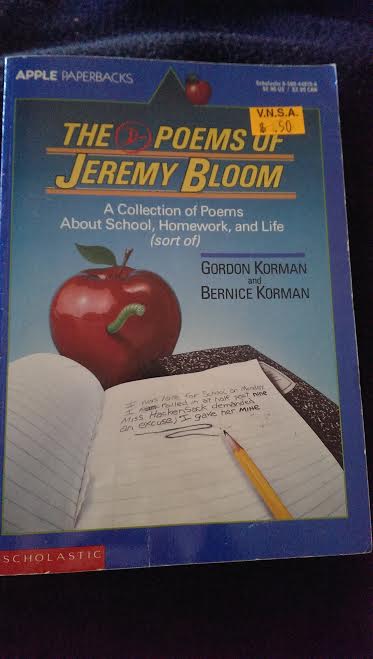 The D- Poems of Jeremy Bloom by Gordon Korman and Bernice Korman, 1992.
 Jeremy tries to make the best of things, but somehow (partly through his own fault and partly by accident), he continually manages to do things to annoy his poetry teacher, Ms. Terranova (or, as the kids call her, Ms. Pterodactyl, thanks to a mistake Jeremy made when he said her name on the first day of class). Every single poem Jeremy writes during the year receives the same grade: D-. The book is divided into different periods of Jeremy’s work, along with an explanation about what Jeremy did during each period to tick off his teacher. At the end, the reader can be the judge: Are Jeremy’s D- grades because he’s a terrible poet or because his teacher is mad at Jeremy for everything else he does during the year? (The answer is pretty obvious.)
 Wayside School Gets a Little Stranger by Louis Sachar, 1995.
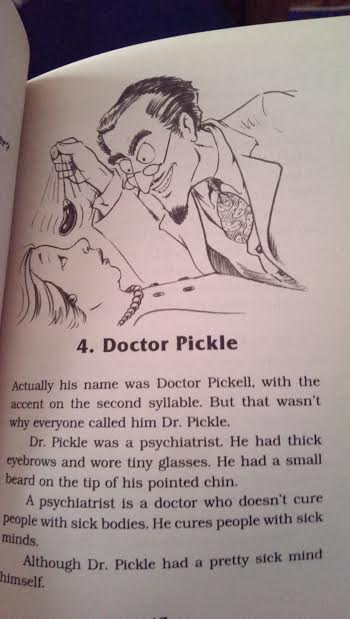 Meanwhile, the principal declares that “door” is a very bad word and that everyone should say “goozack” instead. Mrs. Jewls tells the children to write poems about colors, but some colors rhyme better than others. Kathy tries to convince everyone that Santa doesn’t exist. Miss Zarves (who also doesn’t exist), laments about how difficult teaching really is.
 Wayside School is Falling Down by Louis Sachar, 1989.
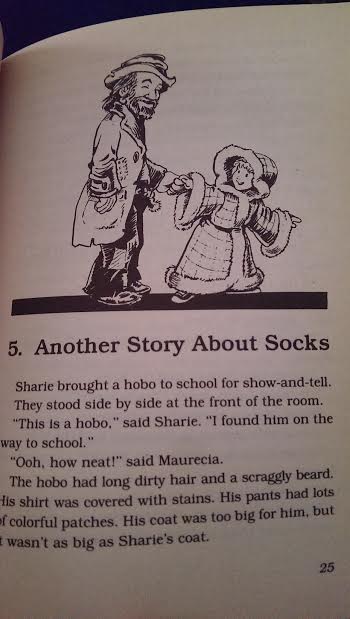 Socks figure into many of the stories, with a special jingle invented by Mac, who used to be named Nancy until he traded names with a girl. It’s fortunate that Mac invented the jingle because Allison uses it to free herself from the non-existent 19th story. Myron chooses freedom over safety, emancipating himself from the school’s rules. Bebe invents a younger brother, and things turn around for Leslie when her pigtails pull Paul. Rondi fears that she’s no longer cute now that her front teeth have grown in. Joy learns the best thing about the toy dog that Todd brought to school, and Ron actually tries the school lunch.
 Each of the books contains thirty stories, like the school (ha, ha!). It would take awhile to describe them all, but there are stories about each of the kids in Mrs. Jewls’s class. Mrs. Jewls took over the class on the 30th floor after Mrs. Gorf accidentally turned herself into an apple. She used to turn her students into apples when they made her mad, but most forms of revenge backfire eventually. Mrs. Gorf ends up turning herself into an apple when one of her students holds up a mirror, and then, Louis the yard teacher eats her.
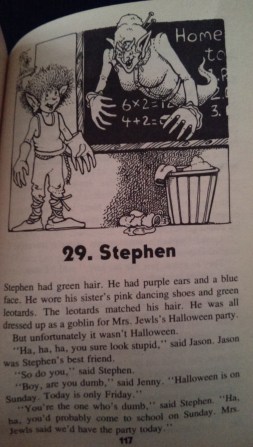 Mrs. Gorf does make one more reappearance on the Friday before Halloween. Mrs. Jewls and the children argue that she can’t haunt the school if it’s not Halloween, but when Halloween falls on a weekend, schools have to have their Halloween party on the Friday before. Stephen’s just happy that the ghost of Mrs. Gorf justifies his costume.
 Jestress's Forgotten Books and Stories