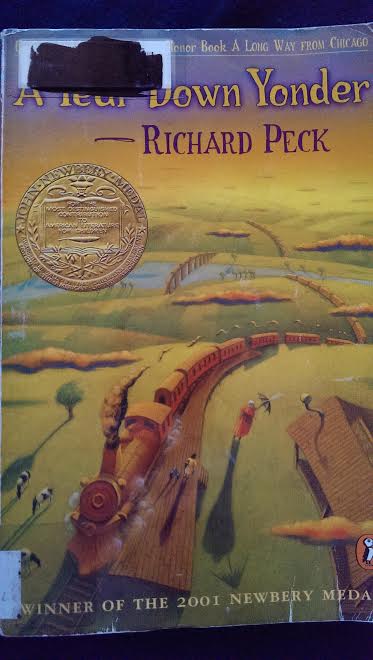
 A Year Down Yonder by Richard Peck, 2000.
This is the sequel to A Long Way from Chicago. The story takes place shortly after the Great Depression, in 1937.
Times are still hard, and a recession has left a lot of people out of work again. Mary Alice’s father is out of work, and her brother Joey is out west working for the Civilian Conservation Corps. Because her family has to move to a smaller apartment, fifteen-year-old Mary Alice leaves Chicago to stay with her Grandma in the country for the year. Times are hard in Grandma’s small town as well, but Mary Alice’s Grandma is as wily and eccentric as ever.
Like the first book, this book is really a series of short stories about Mary Alice’s adventures with her Grandma during their year together. The stories generally have a hilarious turn as Grandma gets the better of everyone, often in the name justice or a good cause. (Although, Grandma’s sense of justice is debatable since it involves “borrowing” pumpkins from the neighbors in the dead of night and other questionable activities.)
These stories present a detailed picture of rural life during the 1930s, from pranks played on Halloween to how Armistice Day was celebrated in the years following World War I, when people were still alive who had strong memories of that war. The stories also capture some of the personalities and politics of life in a small town, from a disreputable family of outcasts to the local elite, who have more money than the others and brag about having ancestors who fought in the Revolutionary War (which may or may not be so).
Rich Chicago Girl: Mary Alice arrives in Grandma’s small town and is enrolled in the local school. She meets the class bully, and Grandma helps her to deal with her.
Vittles and Vengeance: At Halloween, Grandma gets revenge against a group of pranksters and raids her neighbors for ingredients to make the school Halloween party better.
A Minute in the Morning: Armistice Day, November 11, has more meaning for people who have actual memories of The Great War (World War I). Grandma makes sure that those who can afford it pay what they owe to the veterans of that war and shows Mary Alice the price that some soldiers paid for supporting their country.
Away in a Manger: Mary Alice is picked to play Mary in the school’s Christmas Nativity play. The baby Jesus turns out to be a surprise for the whole town, and Grandma arranges a special surprise for Mary Alice.
Hearts and Flour: The head of the local branch of the DAR pushes Grandma to make cherry tarts for their annual tea in honor of George Washington’s birthday. Since she will neither allow Grandma to join the DAR (because Grandma doesn’t have the proper lineage) nor pay Grandma for her work (she thinks Grandma should ‘volunteer’ her services as part of her patriotic duty), Grandma insists that if she bakes, she must host the tea as well . . . with a couple of special surprise guests. Meanwhile, a handsome new boy named Royce joins Mary Alice’s class at school.
A Dangerous Man: An artist working for the WPA rents a room from Grandma, treating Mary Alice and Royce to a scandalous but hilarious sight when his subject matter gets out of hand.
Gone with the Wind: A tornado sweeps through the town, and Grandma and Mary Alice go to check on residents who live alone. Mary Alice also prepares to return home to her parents in Chicago.
Ever After: The final story in the book is about Mary Alice’s wedding, years later, toward the end of World War II.
This book is a Newbery Award winner. There are multiple copies currently available online through Internet Archive.
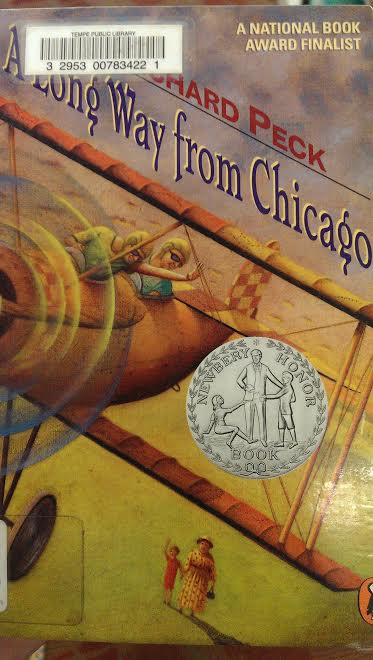 A Long Way from Chicago by Richard Peck, 1998.
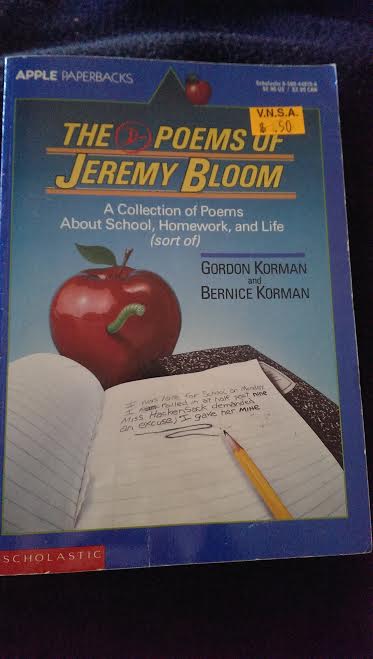 The D- Poems of Jeremy Bloom by Gordon Korman and Bernice Korman, 1992.
 Jeremy tries to make the best of things, but somehow (partly through his own fault and partly by accident), he continually manages to do things to annoy his poetry teacher, Ms. Terranova (or, as the kids call her, Ms. Pterodactyl, thanks to a mistake Jeremy made when he said her name on the first day of class). Every single poem Jeremy writes during the year receives the same grade: D-. The book is divided into different periods of Jeremy’s work, along with an explanation about what Jeremy did during each period to tick off his teacher. At the end, the reader can be the judge: Are Jeremy’s D- grades because he’s a terrible poet or because his teacher is mad at Jeremy for everything else he does during the year? (The answer is pretty obvious.)
 Wayside School Gets a Little Stranger by Louis Sachar, 1995.
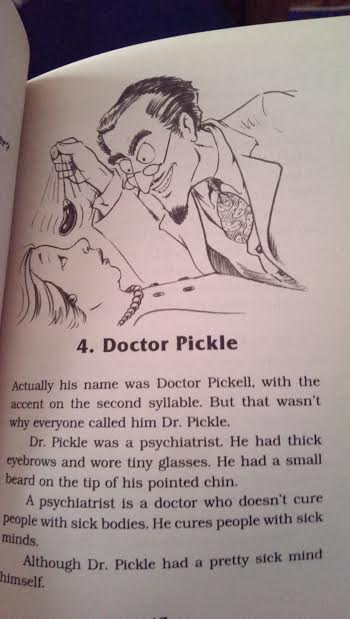 Meanwhile, the principal declares that “door” is a very bad word and that everyone should say “goozack” instead. Mrs. Jewls tells the children to write poems about colors, but some colors rhyme better than others. Kathy tries to convince everyone that Santa doesn’t exist. Miss Zarves (who also doesn’t exist), laments about how difficult teaching really is.
 Wayside School is Falling Down by Louis Sachar, 1989.
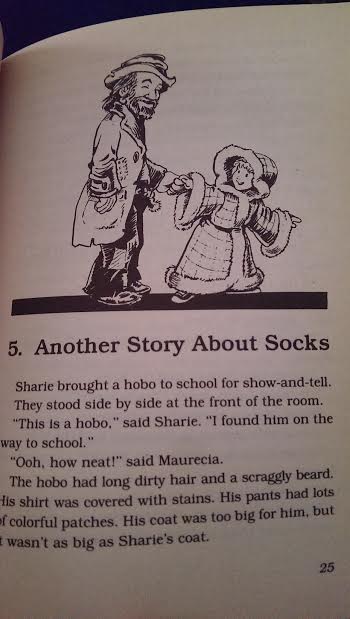 Socks figure into many of the stories, with a special jingle invented by Mac, who used to be named Nancy until he traded names with a girl. It’s fortunate that Mac invented the jingle because Allison uses it to free herself from the non-existent 19th story. Myron chooses freedom over safety, emancipating himself from the school’s rules. Bebe invents a younger brother, and things turn around for Leslie when her pigtails pull Paul. Rondi fears that she’s no longer cute now that her front teeth have grown in. Joy learns the best thing about the toy dog that Todd brought to school, and Ron actually tries the school lunch.
 Each of the books contains thirty stories, like the school (ha, ha!). It would take awhile to describe them all, but there are stories about each of the kids in Mrs. Jewls’s class. Mrs. Jewls took over the class on the 30th floor after Mrs. Gorf accidentally turned herself into an apple. She used to turn her students into apples when they made her mad, but most forms of revenge backfire eventually. Mrs. Gorf ends up turning herself into an apple when one of her students holds up a mirror, and then, Louis the yard teacher eats her.
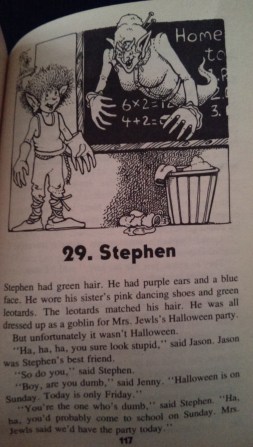 Mrs. Gorf does make one more reappearance on the Friday before Halloween. Mrs. Jewls and the children argue that she can’t haunt the school if it’s not Halloween, but when Halloween falls on a weekend, schools have to have their Halloween party on the Friday before. Stephen’s just happy that the ghost of Mrs. Gorf justifies his costume.
