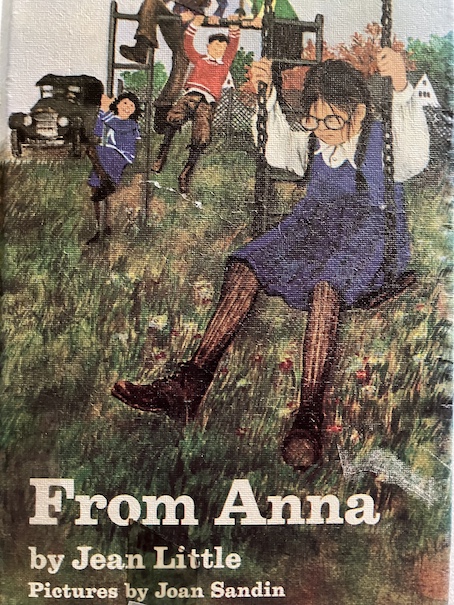
From Anna by Jean Little, 1972.
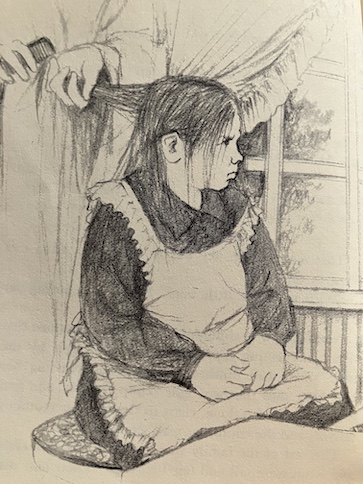
Anna Solden is the youngest in a family of five children living in Frankfort, Germany during the 1930s. Anna has a difficult relationship with her family, partly because she is the youngest of all of them and partly because they treat her badly. It’s not that there is no affection for Anna, but her mother and siblings think of her as not being very smart or capable. She is physically clumsy and has learning difficulties at school, and they have no patience for her. Her teacher at school thinks that she’s just “stubborn” and doesn’t want to learn, but Anna knows that she really tries.
For some reason that Anna doesn’t understand, other people just seem to have an easier time than she does. She’s also awkward at home, and she seems unable to learn things like sewing or knitting, like the other girls. Anna just doesn’t understand how the others can do things, like finding the eye of a needle to put a thread in it. There is something wrong with Anna, but nobody seems to understand, and after the years of criticism and teasing she’s received from her impatient mother and older siblings, Anna doesn’t even try to explain anymore. She only knows that there’s something wrong with her that makes her unlike her siblings.
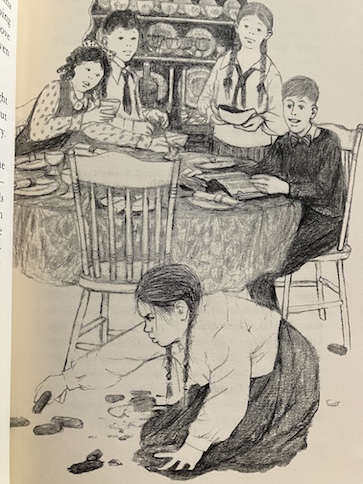
Her mother sometimes jokes that each of her children is her “dearest child” whenever one of them does something particularly helpful or admirable, but she has never really thought of Anna as her “dearest child.” She has called her that once in a while, but more for the form of the thing and trying to make her feel less left out rather than actually meaning it, and Anna can tell that she never means it. The only person who seems to truly care about Anna is her father. Her mother thinks that Anna is an unaffectionate child, but that’s because she feels so uncomfortable with her mother and siblings because of the way they treat her and talk about her. She can’t get comfortable around them even when she wants to because she just knows she’s going to do something wrong, and they’ll all jump on her again. Her eldest brother, Rudi (short for Rudolf), gives her the nickname “Awkward Anna”, and her other siblings call her that, too. Only her father ever intervenes and tells the others to stop teasing her, although they continue to do so anyway.
Things change for the family with the rise of the Nazi movement. Suddenly, there’s a new headmaster at the children’s school who bans them from singing certain songs, and the children can tell that all of the teachers are afraid of him. Then, disturbingly, people they know start disappearing. Jewish people are dismissed from their jobs, and people who are sympathetic to Jewish people become targets. So far, Anna’s father has managed to keep his job as a teacher at a private school, but his sympathies are known, his sister is married to a Jewish man, and Anna overhears him telling her mother that he doesn’t think his position will be safe for much longer. Even little Anna knows that things aren’t right and that something disturbing is happening, and her father is very worried.
When her father tells the family that he’s decided that they have to leave Germany, her mother balks at it. She doesn’t think things are really so bad, and Germany has always been their home. She doesn’t want to leave, and she tries to use Anna as an excuse to stay. With Anna struggling in school, she says it would be bad to uproot the family and take them all to another country, where they wouldn’t even know the language. However, Anna’s father insists that Germany is becoming more dangerous, and the family needs to leave while they can. If they wait, they may lose their chance to get away at all. Rather than making things harder for Anna, it turns out to be the best possible thing that could have happened to her, and it changes her life forever.
When Anna’s father’s brother, Karl, who was living in Canada, dies and leaves him his property, it settles the family’s plans. Karl wasn’t a wealthy man. He only owned a house and a small grocery store, and Canada is affected by the Great Depression, just like everywhere else. Still, going to Canada to claim the inheritance will give them the excuse they need to leave the country without anyone being overly suspicious, and the grocery store will provide them with a living while they’re getting established in their new country. Anna’s father makes arrangements with Karl’s lawyer, and he insists that everyone in the family study English. Anna’s mother still protests the move, but her father insists. Anna listens to the others practicing, but only her father seems to notice that Anna picks up more words than the others realize. She doesn’t have the confidence to use what she knows, and she is accustomed to her siblings telling her that she does everything wrong. Her father has noticed that Anna has a talent for learning words, songs, and poetry by listening to them, although she has difficulty reading them. The twins in the family, Fritz and Frieda, start to brag about going to Canada, but their father stops them because he doesn’t want to get attention from the authorities.
Strangely, on the ship to Canada, Anna finds the voyage easier than the others. While they are all seasick, she feels fine, and she even enjoys the rocking motion of the ship. For some reason, she is able to feel the motion better than the others and move with it, and she’s less clumsy on the ship than she is on land.
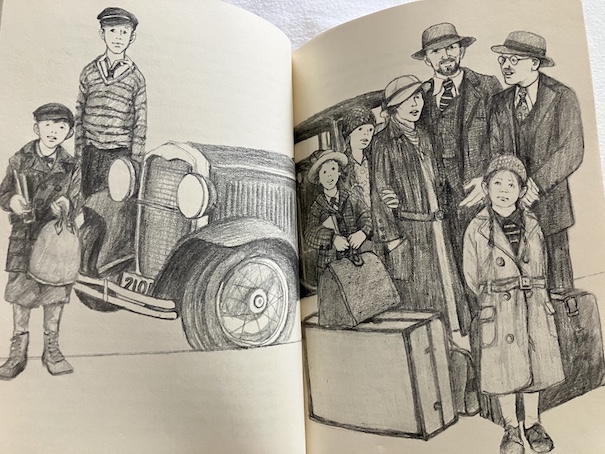
When the family arrives in Canada, the lawyer, Mr. Menzies, meets them, and he introduces them to Karl’s friend, Franz Schumacher, who is a doctor. The family is relieved to have a friend in Canada who is also German because they’re still struggling with English and will need some help getting adjusted to life in Canada. However, Dr. Schumacher becomes much more important to Anna. He’s the one who realizes what Anna’s real trouble is.
Back in Germany, Anna’s mother only took her children to a doctor when they were seriously ill or injured. She prided herself on knowing how to treat all the minor illnesses herself. However, soon after the family arrives in Canada, they all go to Dr. Schumacher for a checkup, the only one they’ve ever had without being obviously ill. In fact, Anna has never been examined by any doctor in her entire life because she has never been considered seriously ill, and that’s the reason why nobody has ever realized what Anna’s real problem is. During this one examination, Dr. Schumacher tests Anna’s vision and immediately notices what everyone, from her teachers to her parents have completely failed to realize: Anna has extremely low level vision and is almost blind. After his examination of Anna, Dr. Schumacher immediately goes to the waiting room and sternly demands of her parents, “Did you know that this child can’t see?”
Anna’s parents don’t know what he’s talking about at first because Anna isn’t technically blind. She can see some general things, but her extremely poor vision is the reason why she has such trouble reading, why she can never find the eye of a sewing needle or make even stitches, why she can’t see that there is still dust on the furniture she’s just dusted, why she constantly bumps into things or trips over uneven surfaces, and all the other problems Anna has always had. Dr. Schumacher tells her parents that she could have been wearing glasses for years, and he immediately takes them upstairs at his medical office to see an eye specialist, who gives Anna a prescription for glasses.
With Dr. Schumacher acting as translator between the eye doctor and Anna’s parents, who are still struggling with English, the eye doctor and Dr. Schumacher make them understand that Anna’s vision is not normal. The new glasses will help, but even with glasses, Anna will not have completely normal vision. The doctors say that, instead of going to the regular school with her siblings, Anna will have to attend special a Sight Saving Class at a school for children with vision problems. Anna is very upset, although Dr. Schumacher insists that she will like it.
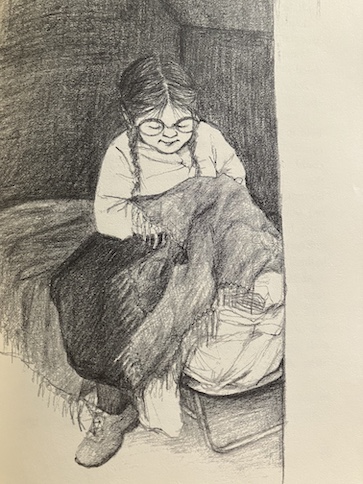
When her new glasses arrive and she puts them on for the first time, she is immediately surprised at how her vision improves. She is started by all the details of the world around her that immediately jump out at her, like the little wrinkles around her father’s eyes that she has never seen before. Unfortunately, Frieda ruins the moment of wonder and revelation by joking about how much Anna looks like an owl in her new glasses. Anna hates the way her siblings and other kids have always laughed at her, so she wants to take off the glasses, in spite of the way they help her, but her father insists that she continue to wear them and that she will get used to them. Although her first sight of better vision was a little soured by teasing, Anna does continue to marvel at all the things she can now see that she could never see before, like the details of her own fingernails and the fuzzy little hairs of her wool blanket.
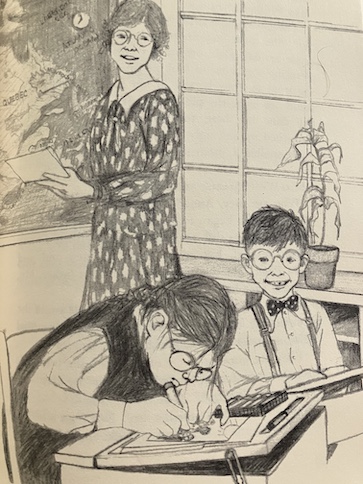
Dr. Schumacher helps Anna to get settled at her new school and introduces her to her new teacher, Miss Williams. Anna is very nervous, being at a school without her siblings for the first time, where the lessons are all in English. Dr. Schumacher is still helping the family with translations, but Anna is going to have to really learn English to cope. However, to Anna’s surprise, this new school is much better than the one she attended in Germany. Miss Williams is more kind than her last teacher, and she understands Anna’s vision problems and how to help her with her lessons. Anna begins making more progress than she ever has before at school. To Anna’s surprise, she discovers that she really likes reading, once she can see well enough to do it and is given the time and support she needs to improve.
The other children are also nicer to Anna. Although she is shy and defensively prickly with everyone at first, they all take the time to get to know Anna and make friends with her. Because everyone in the class has the same types of vision problems, nobody gives Anna a hard time or laughs at her. At Anna’s old school, people were always comparing her to her older siblings, not unlike the way Anna’s mother compares her children to each other, but nobody at Anna’s new school have ever met the rest of her family. When Anna gets over the feeling of uncertainty, going to an unfamiliar school that none of her siblings has attended before, she realizes that there are benefits to being with people who are not comparing her to the rest of her family and who approach their relationship with her on her own terms and without any expectations. For the first time in her life, she is free from the shadow of her critical, teasing, and non-understanding family, and she is able to try new things without worrying about failure and criticism.
However, her problems with her family continue. After all of their years of belittling, criticizing, and dismissing her, Anna only feels comfortable confiding in her father, and even then, she can’t bring herself to tell him everything. She doesn’t want to tell her mother or siblings anything about what she’s been learning at her new school. She doesn’t want to speak English around them, even though she has become fluent or almost fluent. When her new teacher gives her a book as a present, she insists on hiding the book in her desk at school and not bringing it home. She doesn’t want her family to tease her again and ruin the progress she’s been making and her good feelings and new friendships at school. At home, her siblings still think of her as strange and incapable. Miss Williams can tell from Anna’s behavior that something is wrong at home for Anna, although she’s not entirely sure of the reason, and Dr. Schumacher is concerned about Anna. Anna becomes attached to both of them, getting the support and reassurance from them that she’s never really had from her family.
As Christmas approaches and the family has little money, Anna’s siblings begin planning some special surprise presents for their parents, some homemade things and some small items they can buy with a little money they earn. Nobody really expects Anna to participate in this secret present plan because they know that she can’t do the things they can do to earn money, and she can’t knit or sew, like her older sister Gretchen. Finally fed up with everyone being dismissive of her and acting like she can’t do things and doesn’t count, Anna defiantly tells them that she will make her own present arrangements.
The problem is, Anna doesn’t know how she can possibly do that. They are correct that she has no way of earning money, and although her glasses have helped her considerably, there are still many things she has trouble doing with her vision problems. Everyone at school can see that she is depressed, and when they finally convince her to confide her problems in them, Anna discovers that she’s far from alone in her experiences. The others at school also know what it’s like when family members get impatient with them and can’t understand why they have trouble doing certain things. They also wish that there was something they could make that would impress everyone.
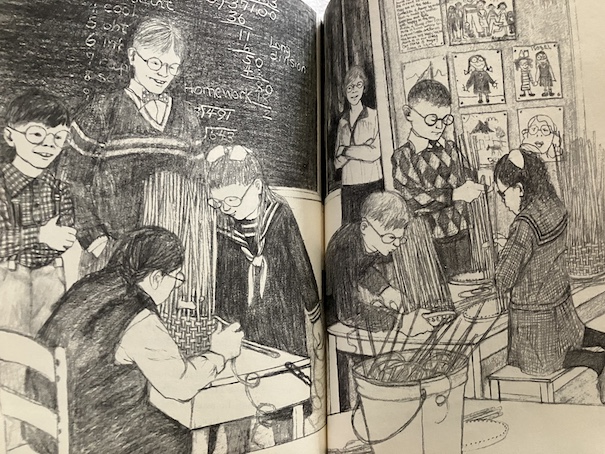
With Miss William’s creativity and some help from Dr. Schumacher, they arrange their own special surprise, and Anna also plans some other surprises for her new friends, who appreciate them. When Anna gives her parents her own special present, just from her, and Miss Williams and Dr. Schumacher are their Christmas guests, Anna’s family finally begins to see Anna in a new light.
The book is available to borrow and read for free online through Internet Archive. There is a sequel to this book called Listen for the Singing.
My Reaction
Anna’s Disability
We are not told exactly what the cause of Anna’s vision problems is. We just know that she suffers from low level vision, not completely blind but severely limited, especially without glasses. She may be what we might call “legally blind“, although the story doesn’t use that term. Apparently, while glasses offer her some improvement, even with them, her vision isn’t what that of an unimpaired person would experience, and she still needs some extra help. The author, Jean Little, writes about Anna’s perspective well because she also suffered from partial blindness since she was a baby due to scars on her cornea.
Through the first half of the book, Anna has this sense that there is something wrong with her because she can’t do the things her siblings do, even when she tries really hard. When she does something clumsy, she honestly can’t figure out what went wrong. Anna has no idea just how bad her vision is because she’s apparently never been able to see any other way. I thought that the author did a good job building up Anna’s condition, not by describing what Anna can or can’t see (because Anna has no basis for comparison to know what she’s been missing), but by describing the things Anna can or can’t do and her confusion about why things don’t work for her like they do for other people. Since the author drew inspiration from her own experiences, Anna’s experiences feel real and make sense once readers understand Anna’s vision problems.
For the first part of the story, descriptions of what Anna can do and what she can’t feel almost like the author is planting clues to Anna’s true condition as well as just describing her experiences. Anna has difficulty reading, and she has trouble doing things when people show her what to do, but her father has noticed and points out her ability to learn things by listening rather than reading or looking. In other words, alert readers might begin to notice the pattern – there’s nothing wrong with Anna’s memory because she has a good memory for things she’s heard, and there’s nothing wrong with her hearing, but she struggles or fails at everything that requires sight. She and her father notice some of these little clues, although Anna has trouble articulating what she experiences, and her father isn’t quite sure what to make of them. They really need an expert to bridge the gap and help interpret the situation.
Disability Words
People have often struggled with ways to describe people with disabilities. Disabilities are not positive things because they do make life harder for the people who have them, but at the same time, we don’t want to describe them or the people who have them in an overly-negative way. We don’t want to give the impression that people who have disabilities are somehow at fault for them or to imply (as the characters in this story initially do to Anna) that people with disabilities are completely incapable just because they struggle in some areas of their lives.
When Anna’s sister Gretchen talks to their father about Anna, their father tells her that Anna is “special” and that she has a lot of love in her. The word “special” has been used as a kind of euphemism to refer to people with various disabilities, and because of its use as a euphemism, it has acquired a kind of stigma. However, when Anna hears her father refer to her as being a “special” person, she doesn’t feel insulted because she thinks of the positive aspects of “special.” As Merriam Webster defines it, “special” can mean “held in particular esteem” or someone or something that stands out from others of its kind for having unique qualities. That’s not a bad thing to be, especially for someone like Anna, who is often compared to her older siblings. She likes the notion that she stands out from the others in a positive way and that her father values her for the qualities that she does have, like being a loving person.
When Dr. Schumacher introduces Anna to her new teacher at her new school, he says that he’s brought Miss Williams “a challenge.” Anna is still struggling with English at that point, and she’s not sure what to think of being “a challenge.” When she asks her father what the word means, he defines it as, “something to be won, maybe. Something special that makes you try hard to win it.” That is one way of looking at it, sort of in the sense of “an invitation to compete in a sport” with the idea that there is a prize to be won, and it’s a more positive description than thinking of a “challenge” as “a stimulating task or problem” or a difficulty to be overcome. Dr. Schumacher was trying to convey to Miss Williams that Anna might not be an easy student to deal with because she’s only just starting to learn English and has only just become aware of her vision problems and will need more effort and extra support, but at the same time, she represents an interesting and rewarding case to study and watch as she develops. Anna’s father is emphasizing the aspect of her as being rewarding and special, so Anna likes the notion that she is a “challenge” in that sense.
Anna’s Relationship with Her Family
Although members of Anna’s family do intentionally tease her and hurt her feelings, they also frequently do it unintentionally. At one point, Gretchen says, “Oh, papa, why is it that Anna makes you feel so mean when you know you haven’t been?” When Anna is later praised for her imagination at her new school, she comes to think about whether her siblings have imaginations, and she realizes that Gretchen doesn’t, really. Gretchen doesn’t understand how the things she says or does are wrong and hurtful to Anna because she doesn’t have the imagination to look at things from her sister’s perspective. She is aware, from Anna’s reactions, that what she says or does has a bad effect on her, but because she can’t seem to look at things from someone else’s perspective, she can’t figure out that the things she’s said are hurtful or why.
I would argue that this lack of imagination is also at the root of why nobody in Anna’s family has realized what Anna’s real problem is for years. They live with her all the time, and yet, they’re only aware of the results of Anna’s problem – her difficulty in learning things and her physical clumsiness – but they never really seem to examine the reasons why these things happen. They just assume that Anna must not be trying hard enough or may be incapable of doing things. They only make the most shallow assessments of the situation, not looking for any deeper reason for why Anna doesn’t seem able to make more of an effort or unable to accomplish more than she has. They don’t seem to grasp the mental concept that there might be a deeper reason or a problem that needs some attention.
Most 21st century families, confronted with a child who seems to be struggling or not developing in the way other children do would probably take that child to a doctor, explain what’s happening, and ask if there’s something wrong with the child. When Anna finally gets examined by a doctor, for the first time apparently since her birth, he sees what’s wrong immediately. Anna’s problem gets addressed in a single day. Prior to this, though, her critical mother apparently never though to do this even once during all the years of struggling. It’s almost mind-blowing. Anna’s family has been acting like she’s dumb for years, but yet, they’re the ones who have missed the obvious points and the easiest path to improvement – get an expert opinion. All this time, they’ve been cursing the darkness (criticizing Anna for struggling) rather than lighting a candle (considering other possibilities and getting expert help).
Admittedly, I got rather judgemental about Anna’s mother and siblings, particularly the mother, throughout the story, but it wasn’t just because they didn’t understand Anna’s problem or because they missed earlier opportunities to diagnose or address it. I would have viewed them much more kindly if they hadn’t dished out so much blame and criticism themselves. As the story points out, nobody is perfect, and everybody has their flaws or needs help at some point. However, the more critical a person is with someone else, the more likely other people are to be extra critical with them when their flaws and screw-ups become apparent. Some people get so accustomed to dishing it out that it can come as a terrible shock to them when someone gives them exactly what they’ve been giving to others. They never imagined that what they’ve said to or about others might be equally true or them, possibly even more so in some respects. I experienced that feeling with these characters, even more so because it’s their critical and condescending nature that makes the problem even worse than it otherwise would have been. They’re not the cause of Anna’s disability, but they do cause extra problems because of the way they react to it and how they treat Anna. I was less judgemental about Anna’s father because, even though he also didn’t understand Anna’s problem, he was dishing out less blame and criticism. He was more observant about Anna’s behavior and feelings, and he was making more of an effort to understand and help. Possibly, his more helpful approach comes from him being a teacher, a profession that depends on an ability to accurately observe a student’s progress and look for ways to help them improve.
After Anna’s family realizes that Anna’s real problem is that she can’t see, her parents do get glasses for her and have her attend the special classes she needs. They do care about her, but at the same time, her mother still seems to look at her as a disappointment, and her siblings still regard her as a problem. I get it that they’ve spent years trying to help Anna do things that she really couldn’t do and probably have some built-up frustration about how their efforts to help her never seemed to work. Helping a person with a disability can be frustrating, especially when the helper doesn’t really know how to help, and nothing seems to help certain problems. The fault I find with Anna’s family is their failure to recognize their own role in this. Anna’s inability to get close to them and open up to them is because of their teasing and criticism, and that hampered Anna’s ability to communicate her real issues to them. Then, they can’t seem to recognize that things are not instantly fine between them and Anna when she gets glasses but they don’t change their behavior.
There are some times when Gretchen tries to say something reassuring or helpful to Anna, and Gretchen is offended when Anna rejects her efforts. The problem is that Gretchen’s attempts at kindness are often accompanied by a putdown of some kind, and Gretchen doesn’t see that her approach is flawed. It’s not that Anna’s family doesn’t care at about her at all, but their own interpersonal skills are flawed. Nobody’s perfect, but everyone has been kind of looking at Anna as the problem child for so long, it doesn’t really seem to dawn on them until almost the end that they all have some problems, and that there are times when they need a little help or correction, too.
There’s too much teasing and criticism in their family dynamic in general. I think this is part of the reason for their poor interpersonal skills, and I ultimately blamed the mother, who seems to be the instigator of this type of behavior. The father of the family is usually the adult in the room who tries to tell the children when they’ve gone too far, and there were times when I wondered why the mother wasn’t being more of an adult and doing some behavioral parenting or modeling better behavior herself. Adults who behave in immature ways are trying, and adults who encourage children to behave in that way are downright infuriating.
There were even times when Anna’s mother seemed a bit resentful of her father’s fondness for Anna, calling Anna his “darling.” When she did that, I got the uncomfortable feeling that she regarded Anna as not being truly deserving of being anybody’s “darling.” She does apparently make some efforts to tell her children that she loves them all and, once in a while, calls Anna her “dearest child” at least for the form of the thing. Anna’s mother does care about her but at the same time seems frustrated and disappointed that Anna isn’t “normal”, like her siblings, and Anna is aware of how her mother feels. She isn’t fooled by her mother going through the form of telling her that she’s a “dearest child”, and she resents her mother starting that “dearest child” thing in the first place. In fact, I think the the mother did unintentionally set all of her children a little bit against each other through her promotion of criticism and blame when someone does something wrong and starting some rivalry among the children as each somewhat competes to be thought of as the “dearest.” Although Anna takes much of the flak throughout the story, there are times when the other children fight among themselves or push blame onto each other and onto Anna when something goes wrong and they want to deflect criticism from themselves. Although Anna gets the worst of it, it seems like all of the children in the family feel that competitive pressure to either please their mother or avoid harsh blame, criticism, and teasing from the mother and each other. Their relationships with each other aren’t totally bad, but they’re not as good as they might have been without that element. I think this has a definite effect on their communications and relationship skills.
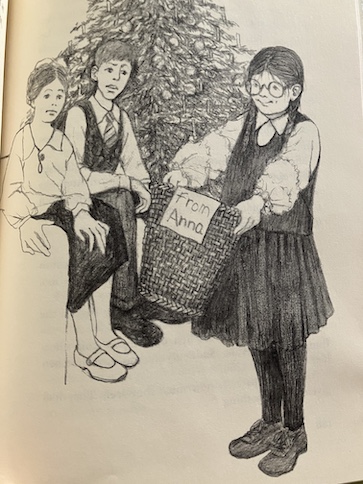
Anna’s relationship with her family shifts abruptly at the end of the story. There are smaller shifts earlier on, where Anna gets fed up with her siblings and talks back to them, and Anna is unaware that her father lectures them about their behavior out of her hearing. At the end, when Anna surprises everyone with the present that she made for her parents at school, her siblings, especially Rudi, try to ruin it. Rudi is the first to speak up because he was jealous, thinking that he had the best present and resentful of Anna taking the attention by doing something unexpectedly impressive. Rudi accuses her of not making her present, at least not alone. Anna speaks up to him, although it’s difficult for her, and she admits that the students in her class had help with the project (a woven wastepaper basket) to get started but that she did do all the weaving herself. Anna’s father turns on Rudi and points out that he also had some help in getting his present, and so did the others. To Anna’s surprise, her mother actually joins her father in lecturing the other children (for the first time ever, I believe), pointing out all the times when each of them had help from their father, even when he was tired from working. She hasn’t been as oblivious to what her children have been doing as she has seemed, and she can now see the toll that Anna’s siblings’ criticism has had on Anna. Anna’s mother recognizes that this project is a triumph for Anna, and she refuses to let Rudi ruin it to usurp the attention for himself.
Anna’s mother comments to Anna that everyone has been blind, meaning that no one in Anna’s family has seen her for who and what she really is or what she’s capable of doing. Anna’s mother doesn’t quite admit it, but I think that she may have realized that she bears some responsibility for the years Anna suffered from having her vision problems go unaddressed and being blamed for something that wasn’t her fault at all. Anna’s mother prided herself on only taking the children to the doctor when absolutely necessary, and she never took Anna because it just never seemed necessary to her, even though Anna was showing obvious symptoms that something was seriously wrong with her. Her mother’s pride in her ability to handle things without professional help, never even considering that there might be something physically wrong with Anna that was beyond her knowledge, was what left Anna undiagnosed and frustrated for so long. If she had taken her even once for an examination, Anna could have had glasses years ago, and she would have lived a much happier life, learned her schoolwork much faster, and not had all the disappointment and criticism heaped on her by her non-understanding family. After the lecture to the siblings about criticizing Anna and how each of them has had help at various times, Anna’s siblings feel guilty about their treatment of Anna, although the parents quickly cheer them all up to avoid ruining Christmas.
WWII Refugees
Many books about refugees from Germany and Europe during and just prior to the beginning of WWII focus on Jewish families, but the family in this book is Christian. While Jews were the primary targets of Nazi Germany, this book points out that other people also felt repressed and even in danger from the Nazi regime and that even people who might not be in immediate danger still found life under the Nazis unlivable and unacceptable and wanted to escape. As Anna’s father says to his wife, “It is not just the Jews who are in danger, Klara. Anyone who disagrees, anyone who speaks up too loudly …”





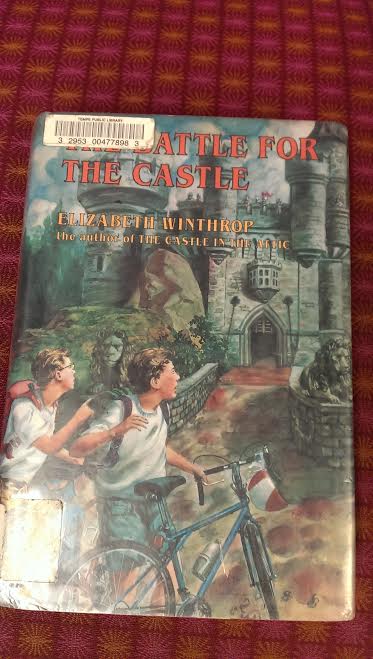 The Battle for the Castle by Elizabeth Winthrop, 1994.
