Alissa, Princess of Arcadia

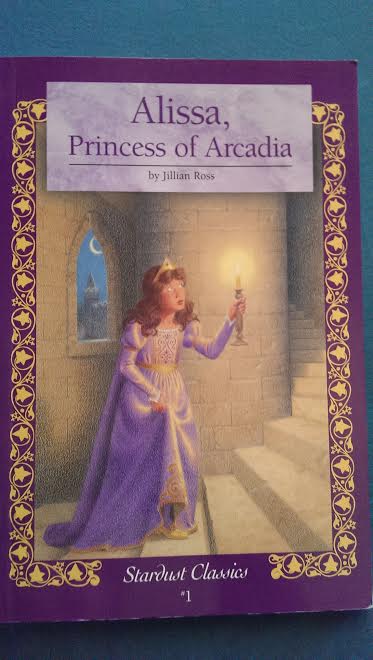
AlissaAlissa, Princess of Arcadia by Jillian Ross, 1997.

Alissa, the only child of King Edmund of Arcadia, feels like her life has taken a turn for the worse since she turned ten years old.  Before, she lived a basically care-free life, but now, her family has become more serious about her education and training as the future Queen of Arcadia.  Her great-aunts are mainly in charge of her education now, and they find Alissa to be ill-mannered, impatient, and stubborn.  In some ways, she is.  Alissa is bored with her lessons in the standard school subjects and hates her “deportment” lessons, where she learns etiquette suited to the royal court.  More than anything, she wants adventure and excitement.

To Alissa’s surprise, she meets a strange old man one evening while walking in the garden who promises her the adventure that she’s looking for.  At first, Alissa doesn’t know what to think about this strange old man, Balin, who seems to know everything about her, even what she’s been thinking.  He sets Alissa a “quest”, to solve a riddle to determine where to find him.  After pondering it for awhile, Alissa realizes that the riddle says that Balin lives in the oldest tower of the castle, where no one ever goes anymore.

AlissaBalinIt turns out that Balin is a wizard.  He’s lived in the tower for centuries and hardly ever leaves, so most people have forgotten that he’s there.  He offers Alissa lessons in magic and the kind of quests that she’s been craving.  He once taught Alissa’s father similar lessons, although he thinks that King Edmund has also forgotten that he exists.  Alissa eager accepts the offer of magic lessons.

At first, the only other person who knows about Alissa’s lessons with Balin is Lia, a servant of one of Alissa’s great-aunts.  Lia had been about to run away from her position as servant because she didn’t think that she was very good at her job, but Alissa caught her the night when she was going to find Balin in his tower.  The two of them became friends, and Alissa makes Lia her lady-in-waiting. Alissa enjoys having someone her age to share her secrets and adventures.  Her great-aunts disapprove of her choice of lady-in-waiting, but Alissa’s father appreciates Lia because she sees the better side of Alissa, her bravery and kindness, and somewhat helps Alissa’s impatience because Lia is a more patient, cautious person.

AlissaKingWhen Alissa first begins her lessons with Balin, she thinks that studying magic is turning out to be as boring as her other lessons.  Balin makes her do little chores, like dusting things in his tower, and he has her read books and memorize words.  Alissa is impatient to get on with the exciting magic, but Balin impresses on her that she needs to start out slowly and to recognize that magic is not the solution to all things.

Meanwhile, Alissa’s father is preparing to hold a banquet to celebrate a new alliance with a neighboring kingdom.  Now that Alissa is old enough to participate in such banquets, she learns that she must not only attend the banquet but be the dinner partner of the invited king, who she has heard is a stern man who is a stickler for proper manners.  Alissa is terrified that she will make a mistake during the banquet, anger the king, and ruin everything.

Her fears grow worse when Balin tells her that he has seen impending disaster in his crystal ball and a threat to the alliance.  Alissa begs him to tell her more, but he says that something is preventing his magic from seeing more.  All he has to offer Alissa are a few vague hints which take the form of another riddle.

Balin believes that Alissa is the only one who can solve the riddle, stop the danger, and save the alliance, but Alissa doubts herself.  She’s still afraid that she isn’t up to the task and will ruin everything, and she wishes that Balin would give her some magic spell to prevent her from doing anything wrong.  However, the best weapons Alissa has are the ones she already possesses: her wits, her desire to work hard for what she wants to achieve, and the new patience that she is just starting to learn.

One of the things that I liked about the story was that the visiting king, for all of his sternness and demanding nature with others, is surprisingly understanding with Alissa.  Some adults still remember what it was like to be young and awkward and impatient to grow up.

This book does not have extra information or activities in the back, as other books in the Stardust Classics series do.  It is currently available online through Internet Archive.

Basil in the Wild West

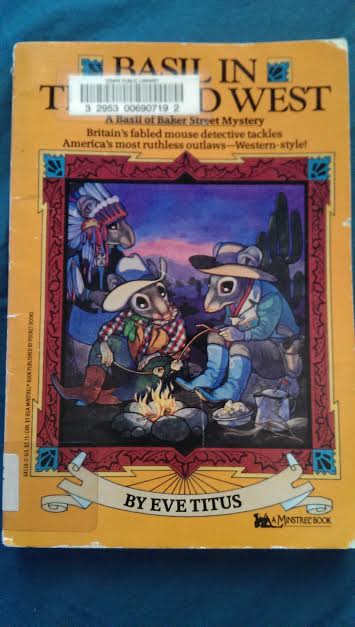
BasilWestBasil in the Wild West by Eve Titus, 1990.

This book picks up right after the previous book in the Basil of Baker Street Series, Basil in Mexico.

After leaving Mexico, Basil and his best friend Dr. Dawson journey north into the western territories of the United States.  There, some friends of their ask them to investigate a smuggling operation.  Mice have been illegally bringing Mexican antiquities across the border.

Basil realizes that the smugglers have been smuggling the antiquities in the open, pretending that they are ordinary replicas, the kind that tourists often buy.  Because the border guards aren’t experts in antiquities, they haven’t been able to tell the difference between harmless souvenir replicas and the real thing.

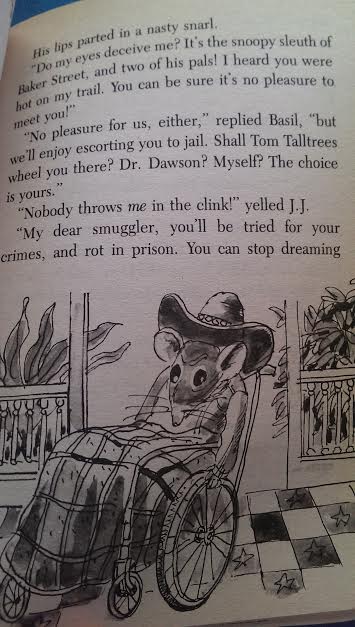
When they catch one of these smugglers, they learn that the mastermind behind the scheme is a mouse called J.J. in a town called Moriarty in New Mexico (the name of the town irritates Basil).  They go to the town with the help of some friendly horses and confront J.J..  At first, they think it won’t be too difficult because, although J.J.’s house is well-guarded, he is confined to a wheel chair because of an accident.  However, the wheel chair is an act, and J.J. is no ordinary mouse.

BasilWestPic2Although J.J. escapes, Basil and Dr. Dawson decide that the smuggling ring has been defeated and it’s alright to continue their sight-seeing.  However, their adventures are not over!

Basil and Dawson want to see the Grand Canyon, but it turns out that the hotel where they are staying is being terrorized by a weird, glowing Thing.  Nobody knows what it is, but guests think it could be some kind of ghost or monster, and many of them are too afraid to stay.  The owners of the hotel ask Basil to discover what the Thing is and stop whoever may be behind it before their hotel is ruined!

This book is really two stories in one, and neither has any direct bearing on the other.  In that way, it’s kind of disjointed.

The book is currently available online through Internet Archive.

Basil and the Pygmy Cats

BasilPygmyCatsBasil and the Pygmy Cats by Eve Titus, 1971.

Mouse detective Basil’s arch enemy, Professor Ratigan, has taken over the Asian country of Bengistan, near India.  Basil discovers that he is holding the real ruler of the country captive so that he and his gang can loot the country for everything they can get, keeping the populace in subjugation.  Basil is determined to go there and free the rightful ruler so they can vanquish Professor Ratigan!

When Dr. Edward Hagerup of the British Mousmopolitan Museum hears that Basil is heading to Asia, he asks him to investigate an historical mystery for him.  There have been tales of a race of pygmy cats, no bigger than mice, but new evidence has been found that suggests there is more truth behind the stories than anyone has realized.  Basil has an interest in archaeology and eagerly accepts this extra task as part of their mission.  Along the way, other mice who have heard of the expedition join up to help Basil.

At first, Basil’s original mission, stopping Ratigan, seems easy.  Basil and his friend Dawson allow themselves to be captured so that they can get into the palace and find the real Maharaja of Bengistan.  After solving a secret code in the dungeon, they find the Maharaja, who tells them that another acquaintance of theirs, the opera singer, Relda, is also a prisoner in the palace.  She was giving a performance there when Ratigan and his thugs took over, and Ratigan has forced her to stay, giving private performances for him.  During one of these performances, Basil and his friends manage to take Ratigan by surprise and capture him.

BasilPygmyCatsPic1Now, Basil thinks that he and his associates are free to continue their other mission, finding the lost civilization of pygmy cats.  However, that mission is fraught with danger and surprises, and they haven’t quite heard the last of Ratigan.

The story isn’t really much of a mystery.  It’s really more an adventure story.

Basil and his friends manage to locate the island of pygmy cats with the help of Jeannie (a sea serpent related to the Loch Ness Monster who lost her way back to Scotland after a family trip — I kid you not) and the Sacred Catfish (which they bribe with catnip — I also kid you not, and his nip trip is a little disturbing).

This is my least favorite of the Basil series, partly because of the lack of mystery and also because of “primitive” nature of the pygmy cats when they find them.  Basil makes it clear that the pygmy cats are inherently less intelligent than mice and that their greatest achievements were because of the influence of royal mice who washed up on the shores of their island years ago, only to be wiped out by a volcano.  (Really?  Really.  Basil, if these mice were so superior and the pygmy cats so inferior, why were the cats able to get away from the volcano when the mice didn’t, hmm?  Why didn’t the mice just go to the part of the island where the cats were until the volcano stopped erupting?  Just what kind of bill of goods are you trying to sell us, Basil?)  Basil comes off sounding like a 19th century imperialist, and the fawning adoration he gets for his discovery is really annoying.

In general, I don’t like the Basil stories that turn out to be more adventure than mystery, and Basil’s smug superiority at various points in the story are off-putting.  It’s true that that Sherlock Holmes (which this series parodies) had an ego as well, but these sort of imperialist attitudes in a children’s story are distasteful.  Although I like recommending nostalgic books for future generations, this is one that I really can’t recommend.  The brightest spot in this book was the secret code in the dungeon, which is more in keeping with the mystery theme.  If the book had made the plot to capture Ratigan and end his reign of terror in another country without all this stuff about an “inferior” species of small cats, it would have been a much better story.

Like other books in this series, this book contains a number of jokes on the original Sherlock Holmes stories.  Read a number of the names backwards, and you’ll see some familiar names from Sherlock Holmes as well as a reference to another series by Eve Titus.

This book is available to borrow and read for free online through Internet Archive.

Basil and the Lost Colony

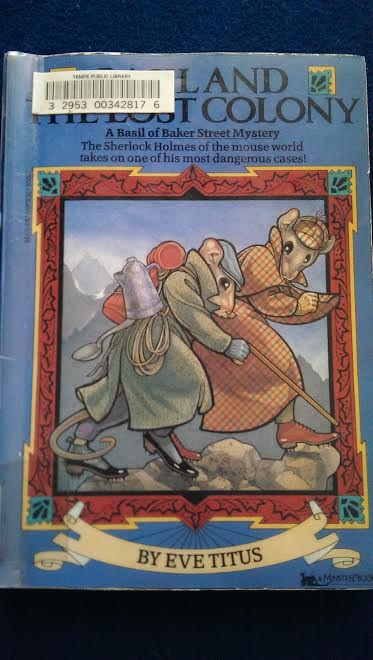
BasilLostColonyBasil and the Lost Colony by Eve Titus, 1964.

A Norwegian scholar from the British Mousmopolitan Museum approaches Basil about a letter that he has recently received along with an arrow.  The letter mentions a recent sighting of the mysterious Adorable Snowmouse (no, that’s not a typo, he’s big for a mouse, but really adorable and saves people lost in the mountains), and the arrow is evidence that points to the whereabouts of a lost colony of mice who fled Switzerland during the time of William Tell, about 600 years previously.  These particular mice lived in William Tell’s basement, and like Tell himself, the Tellmice (as they are called) left their home because they opposed the rule of a tyrant.  However, even after the tyrant’s reign ended, the Tellmice did not return home and no one knows for sure what became of them.

Basil is eager to join the expedition to search for the lost colony, but he is also concerned about opposition from his nemesis, Professor Ratigan.  Professor Ratigan has recently made attempts on his life, and he now knows about the expedition to find the lost colony, even stealing the evidence from Basil’s home.  Basil is sure that Professor Ratigan will do everything he can to prevent them from reaching the lost colony.

In Switzerland, the expedition is joined by a pretty and adventurous opera singer, Relda (a take-off on Irene Adler, from the original Sherlock Holmes stories, read her name backwards), who comes in disguise after Basil tells her that the mission is too dangerous for her.  That’s just one of the jokes on original Sherlock Holmes stories that appear in this book.  These jokes would go over the heads of kids who aren’t familiar with the original stories, but make the story more entertaining for adults.

Basil and his friends do meet up with the Adorable Snowmouse, find the lost colony, and defeat Ratigan (well, temporarily, at least).

Although the Basil of Baker Street Series is supposed to be about a mouse detective kind of like Sherlock Holmes, some of the entries in the series, like this one, are really more adventure than mystery.  The book is currently available online through Internet Archive.
The Mysterious Queen of Magic

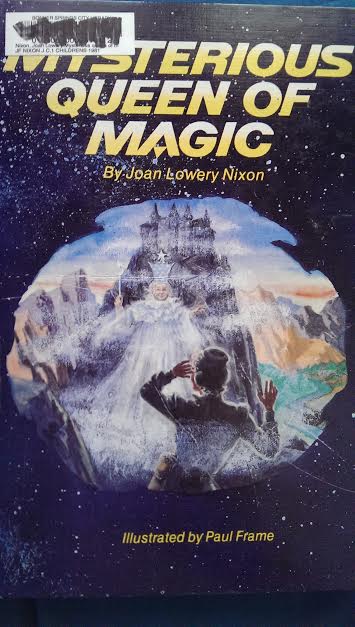
KleepQueenMagicThe Mysterious Queen of Magic by Joan Lowery Nixon, 1981.

This is part of the Kleep: Space Detective series.

Kleep and Till meet a strange young man who is looking for Kleep’s grandfather, Arko.  The young man, Mikkel, tells them a wild story, that an evil wizard is after him.  He is controlling Mikkel’s people on the planet Durth, putting them under a spell and forcing them to become his slaves. Mikkel believes that Arko may have the key to getting rid of him because an old wise man told him to ask Arko how to find Queen Stellara.  Queen Stellara was a legendary queen who could do magic, and Arko has some old write-rolls, scrolls of the kind people used to use before people began using computers alone for learning, that talk about her and her kingdom.  However, Arko doesn’t believe in wizards or magic spells or anything of the kind.

Kleep remembers Arko telling her the old stories from the write-rolls when she was little, and unlike her grandfather, she believes that wizards and magic may be real and wants to try to help Mikkel.  When Arko says that he doesn’t believe in magic and can’t help Mikkel, Kleep and her friend Till decide to use the scrolls to try to help Mikkel find Queen Stellara.  Taking Kleep’s robot, Zibbit, with them, they journey to the planet Loctar, where Queen Stellara was supposed to live.

Although this series is mostly sci-fi with a bit of mystery thrown in, this book is more fantasy.  When Kleep and her friends arrive on the planet Loctar, they discover that they must face a series of challenges to reach the legendary queen’s palace, like heros in a fairy tale.  Magic is real, and they must prove themselves worthy in order to meet the queen and ask her for the solution to the problem of the evil wizard.  But, their ordeal doesn’t quite end there because, while Queen Stellara provides them with the means to fight the wizard, they must face him themselves!

A little corny, but fun, although it’s not my favorite book in the series.  The others were more sci-fi, and this is more fantasy.  Also, for a “detective” series, there isn’t much mystery, more adventure.  It sort of reminds me of the original Star Trek episode Catspaw, except that the magical beings in this one are apparently really magical and not just aliens.  Like the other books in this series, I like the pictures, too.

KleepQueenMagicPic3

Kidnapped on Astarr

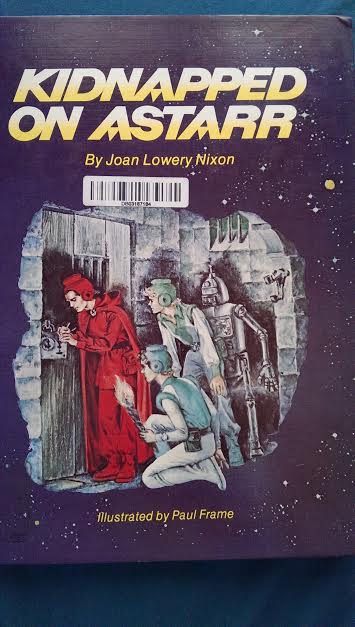
KleepKidnappedAstarrKidnapped on Astarr by Joan Lowery Nixon, 1981.

This is part of the Kleep: Space Detective series.

Till’s mother, Falda, has mysteriously disappeared, and Till is sure that someone has abducted her.  The only clue he has is an unfinished note that his mother left for him with the letters “RU” on it.  He takes it to Kleep and her grandfather Arko, and the three of them puzzle over what it could mean.  Arko and the kids decide that the two most likely things the letters could be part of are a kind of metal that Arko and Falda are using in the project they’re currently working on (“ruthenium”) or a group of people who are enemies of theirs, the Ruzenians.  The people of Ruzena lived on Astarr before Kleep’s people arrived from Ruel (another possible “RU” word that they ruled out) and have resented their intrusion.

Arko decides that he will first visit the mine where they get their metal, hoping that Falda has gone there in connection with their project to create a new way to anchor small space ships at outer space docks.  However, Kleep and Till can’t help but think that the Ruzenians have kidnapped Falda.  Arko wants them to stay at the house with the robot Zibbit until he returns, but they feel like they can’t wait and decide to take Zibbit with them to investigate the Ruzenians.

It’s a harrowing journey through Ruzenian territory, through a dark forest with giant worms and singing trees whose music threatens to overtake their minds, but they do discover that is where Falda is being held prisoner.  Unfortunately, Kleep, Till, and Zibbit are also captured.  With the king of Ruzena suspicious of the projects that Arko and Falda are working on (he thinks they’re designing weapons, but they’re not), what can they do to escape or get help?

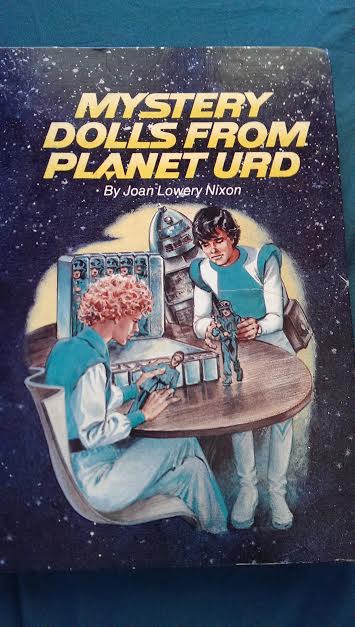
Mystery Dolls From Planet Urd

KleepDollsUrdMystery Dolls from Planet Urd by Joan Lowery Nixon, 1981.
This is part of the Kleep: Space Detective series.

Kleep’s grandfather is an inventor, and she loves it when she’s included in the gatherings of other inventors that her grandfather hosts.  They come from many different planets, and she loves to hear them talk about their work.  However, there are some other inventors that Kleep doesn’t like at all.  Slurc, who is from the planet Urd, takes no notice of Kleep until he overhears another inventor telling Kleep about something he has recently learned about that comes from the planet Earth.

Earth is unaware of other planets, like the planet Astarr, where Kleep lives, but people do visit Earth secretly to study the people and their habits.  Kleep’s own parents mysteriously disappeared on a mission to Earth, and Kleep is determined to find them one day.  Pili, an inventor from Ruel, knows that Kleep is interested in anything about Earth, so he gives her an Earth doll.

Children on Astarr do not play with dolls, so Kleep doesn’t really understand what purpose they serve, and it makes her nervous that it looks so much like either a small person or robot but is not alive and does not do anything.  Then, Slurc, listening to their conversation, tells her that children on Urd play with dolls, but theirs are much better, and he promises to send her some that she can share with her friends.  Although Kleep does not really like Slurc, she thanks him for the offer just to be polite.

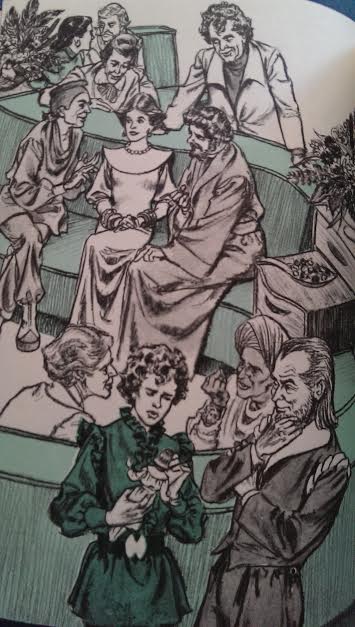
KleepDollsUrdPic1Sure enough, the dolls from Urd soon arrive, but they make Kleep even more nervous than the doll from Earth.  They seem a little too life-like, and one night, Kleep wakes up, certain that she heard them whispering to each other!

At first, her grandfather and her best friend, Till, think that she’s just imagining it because the dolls make her nervous.  However, when she gives a couple of the dolls to Till, he experiences the same thing!

The dolls from Urd are not normal, and Kleep is sure that they are there for a sinister purpose.  She and her friend must discover what it is and fast!

The setting and inventions on Kleep’s world are imaginative.  I especially like the idea of the learning devices that can send knowledge directly into your mind (maybe a little creepy, but certainly a time-saver).  The plot might seem a little far-fetched, but I liked it when I was a kid, and it’s still entertaining.  It’s my favorite book in the series.  I think of this book every time someone mentions Furbies or any similar sort of electronic toy that is supposed to speak to another.  Furbies especially talk to each other, and they look like they’re from outer space.  Who’s to say what sinister plots might be hatching in their furry little minds?

The Secret is Out

SecretIsOut

The Secret is Out: True Spy Stories by Teri Martini, 1990.

This is a non-fiction book about famous spies in history.  It begins with a discussion of spies in general and asks the question of whether spies are heroes or villains.  The answer depends on which side they’re on and which side you’re on.  Spies around the world and throughout history have been engaged in similar work, using similar tactics, although technology has changed the profession in modern times.  Even spies on opposite sides of a conflict use the same skills and tactics, they just employ them for the benefit of different countries or causes.

The book is currently available online through Internet Archive.

The stories contained in the book:

SecretIsOutPic1The Gentleman Spy — This is the story of Captain John Andre and General Benedict Arnold during the American Revolution.  John Andre was a British officer who was executed for his role in helping Benedict Arnold defect to the British side.

Abraham Lincoln’s Personal Spy — The famous Pinkerton detective agency, the first detective agency in the United States, played an important role in the American Civil War.

The Spy with “the Delicate Air” — Spies were not always part of an official organization.  Even a civilian could turn spy in the name of a cause she believed in as Belle Boyd did during the American Civil War.

The Black Chamber — In the early 1900s, agents of the Austro-Hungarian Empire tracked down a mysterious agent in the pay of Russia and discover that the person they were looking for was the man who had once been in charge of their own organization.

The Eye of the Morning — Mata Hari was one of the most famous spies of all time, although she wasn’t really successful.  It was more her reputation as a dancer and the manner of her death that made her famous.

SecretIsOutPic2The Phantom of the Desert — Lawrence of Arabia was actually Thomas Edward Lawrence, a British army Captain.  He helped the Arabs to fight against the Turks during WWI.

The Spy without a Country — A poor young man from Hungary with a habit of telling tall tales left home to seek his fortune and eventually ended up becoming a Member of Parliament in Britain under the name of Trebitsch Lincoln.  However, when Trebitsch Lincoln was in need of money during WWI, he decided to turn to spying.

Mincemeat Swallowed Whole — This is one of my favorite true spy stories!  During WWII, the British concocted a scheme to give false information to the Germans using a dead body that supposedly was a drowned British marine carrying important documents.

The Clenched Fist — Fritz Kolbe spied for the Allies from within Hitler’s foreign office during WWII.

The Third Man — Harold “Kim” Philby was a spy for British intelligence during the Cold War, but he was secretly working for the Soviet Union.s

The Spy Next Door — Colonel Rudolf Ivanovich Abel was a Russian spy who posed as an ordinary American, Emil Goldfuss, in New York City.  After he was captured, the Americans decided not to execute him, although that was the usual punishment for espionage.  Instead, he was held prisoner until he could be used for the famous prisoner exchange where he was traded to the Russians for the captured U-2 pilot, Francis Gary Powers.

The Codebreaker Kids

CodebreakerKidsThe Codebreaker Kids by George Edward Stanley, 1987.

Dinky Lakewood likes living in Washington, D.C. because it’s such an interesting place, and he loves the stories about spies and government intrigue that appear in the local newspaper.  His father, who deals in plumbing supplies, thinks that all this sneaking and spying is awful and threatens to move his family somewhere else when he hears about another spy being caught, but Dinky decides that he’s going to get in on the action because he has a special skill that the spies really need.

The newspapers say that the reason why the latest spy was caught was because he and his associates were so bad at cryptology — they either picked codes that were way too hard or way too easy to decode.  Although Dinky’s parents don’t like spies, they did give him a book about secret codes for his birthday: The Complete and Total Book of All the Secret Codes That Have Ever Been Devised and That Ever Will Be Devised.  Dinky has worked his way through all of the codes in the book, so he feels qualified to open his own Secret Code Service, helping spies to encode and decode their secret messages.

Dinky recruits his best friend Wong and a girl he knows from school named Lulu to be part of his organization.  Lulu is a little strange, but Dinky knows that she’s always wanted to be a spy, so he figures that she would be good for dealing with real spies.  Wong is more interested in the money because he wants to get a new bike.

Their first clients are a little strange.  One of them is an elderly lady, Emma, who wants to stop her younger sister from snooping in her diary.  She turns out to be a repeat visitor because her sister turns out to have a talent for breaking codes.  The next client is Boris, the world’s worst Bulgarian spy.  He admits that he’s horrible with codes because he cheated at spy school, copying off of a cute female spy.  Dinky and his friends help him, although they start to question whether they’re doing the right thing since he is obviously spying on their country and they might be guilty of treason.

They decide that Boris is protected under their pledge of confidentiality, but soon, Dinky is approached by someone from the State Department, who turns out to be tracking Boris the Bulgarian.  Can Dinky and his friends continue their service, helping both sides at the same time?  Also, will they ever figure out a code that Emma’s sister can’t break?

The premise of the story is a little corny, with spies and government agencies going to a kid’s backyard clubhouse for help with some pretty simple codes, but the book is a lot of fun and doesn’t take itself seriously.  It’s a good introduction to cryptology for children, starting out with very simple Caesar ciphers (basic substitution codes) and gradually moving on to more difficult ones, like Trithemius’s Square Table.  There are points in the story where readers are given the chance to decode messages before Dinky does, and in the back, there are some additional secret messages to decode using the codes presented in the book.

The book is currently available online through Internet Archive.  There is a sequel to this book, but unfortunately, I don’t have it and never read it.

Mystery of the Secret Message

secretmessageMystery of the Secret Message by Elizabeth Honness, 1961.

Penny lives with her aunt and uncle because her mother is dead and her father travels on business much of the time, dealing in Asian art.  Thanks to his travels, Penny and her aunt and uncle have quite a collection of Asian art themselves.  However, Penny has just been told that her father’s airplane crashed in the Pacific Ocean.  No survivors have been found, although Penny still has hope that perhaps her father survived and might yet be found.

At the same time, Penny and her aunt and uncle are moving into a house from the apartment where they used to live. Penny is happy about the move because she knows that she won’t have to worry as much about being quiet and not disturbing the neighbors, like she had to do in their apartment. This means that Penny can bring her friends over to the house to play and have parties. Also, their new house has a very special feature: its own private elevator.

Penny loves the new house and soon begins building a tree house with the help of Pete, a boy who lives nearby.  She tells Pete about her father and her hopes that he might still be alive.

However, events take a disturbing turn when Penny receives a package from Japan containing a beautiful wall scroll. The package appears to have been sent by her father, who meant it as a present for her new room in her new house. Was the package sent before his death, or did he somehow survive the crash?

There is also something odd about Penny’s new neighbors.  Penny’s new house is actually half of a duplex, and the new neighbors, the Carruthers, have also recently moved in after renting the other half. When Penny accidentally gets stuck in the elevator and hears voices coming through the wall, she starts to suspect that her neighbors might not be what they seem to be.  They show an unusual interest in her family’s collection of Asian art, asking to see pieces and borrow pieces for an exhibition that Mr. Carruthers is holding at his gallery.  One of Penny’s friends even catches Mrs. Carruthers sneaking around, looking at things uninvited.

When Penny and her friends have a sleepover on an evening when her aunt and uncle are out, someone sneaks into the house, leaving muddy footprints on the floor.  Penny isn’t sure that her aunt and uncle will believe her because they seem to like the Carruthers, so at Pete’s suggestion, she continues to spy on them, using the elevator to listen in on their conversations through the walls.

When her uncle catches her one day, using the elevator without permission (something she is not supposed to do), she finally explains her suspicions and what’s she’s heard the Carruthers say.  Together, Penny and her uncle discover a hidden secret about the wall scroll Penny recently received, which points to a number of secrets that Penny’s father kept from her and the rest of his family for years.  A stranger from the government helps Penny to fill in some of the blanks, but he has a favor to ask in return that requires Penny to take a big risk.

My Reaction and Spoilers

Although this book is much older than I am, it was a favorite of mine when I was a kid, yet another of my used book sale treasures! I actually got rid of my first copy years ago, when I was cleaning some things out, but I missed it, so I got another one. It’s actually a collector’s item these days.

I always liked the feature of the elevator in the story and how Penny uses it to find the right spot to hear what her neighbors are saying through the wall. I love intrigue, and as a kid, I liked the idea both having a house with an elevator and of overhearing clandestine conversations that reveal sinister secrets. There are points in the story where the two-faced Carruthers think that they have the upper hand, and Penny has to be careful not to let on just how much she knows.

As I explained, the neighbors are not what they seem to be, and Penny’s father was involved in things that his family knew nothing about. Since it’s not easy to get hold of this book right now, I’ll include a couple of spoilers. Penny’s father was acting as a spy for the US government, using his profession as an art dealer to travel to locations he needed to go and to smuggle information back to the US. He is apparently dead, killed in the plane crash, although there are hints that the crash wasn’t an accident, that it may have been intended to kill him. However, before his death, he managed to smuggle his last important information to Penny in the wall scroll that he sent her. When Penny manages to convince her uncle that something isn’t right about the Carruthers, he begins making inquiries and learns the truth about Penny’s father. A government agent speaks to the family and arranges a plan to fool the Carruthers into thinking that they’ve found what they were looking for, but the plan requires Penny to spend an evening in the house alone with them.