The Magic School Bus Inside the Earth

The Magic School Bus

MSBEarth

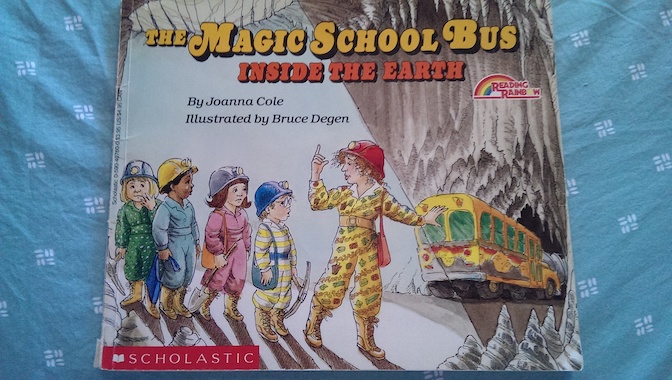
The Magic School Bus Inside the Earth by Joanna Cole, 1987.

Ms. Frizzle’s class has a new student, Phoebe, who is about to discover that Ms. Frizzle is no ordinary teacher and that her class trips are nothing like any other field trip.  Ms. Frizzle’s class is studying the earth and rocks, and she assigns the students homework to find a rock and bring it to class.

MSBEarthHomework

However, even though it sounds like an easy assignment, only one person actually brought a real rock to class.  The others either didn’t bring anything or brought in pieces of old Styrofoam, bits of broken glass, or chips of concrete from the sidewalk.  With only one real rock for the class’s rock collection, Ms. Frizzle decides that the class should to on a trip to collect more.

MSBEarthFieldTrip

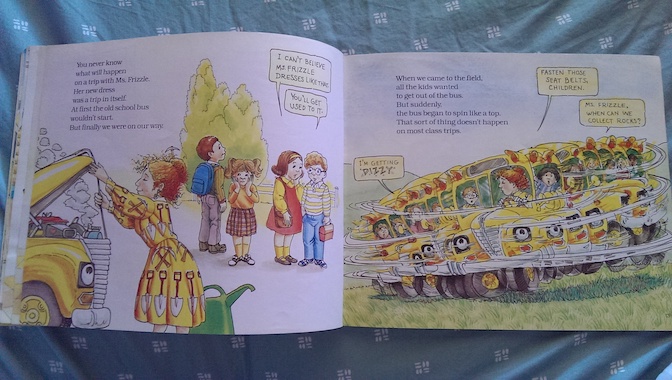
She takes the class on a field trip to a real field, but they’re not just going to collect rocks that they find lying on the ground.  The bus changes itself into a steam shovel, and Ms. Frizzle passes out shovels and jackhammers to the students.  They start digging down into the earth, uncovering new layers of rock as Ms. Frizzle explains what types of rocks are in the layers and how they formed.

MSBEarthDigging

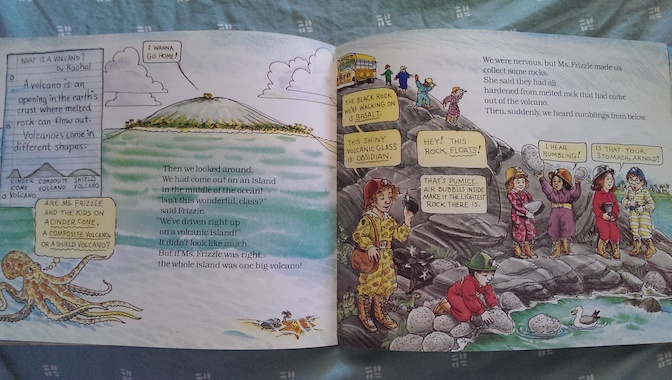
Before the field trip is over, the school bus, along with all the students, falls through the ground and into a massive cave.  They continue traveling all the way down through the center of the earth and out the other side, ending up on a volcano, where Ms. Frizzle calmly explains about volcanic rocks.

MSBEarthVolcano.jpg

I like the picture at the end of the book, after the kids return to school, which points out that there are things all around them that are made out of the different kinds of rocks and minerals that they learned about on their trip.  Each type of rock is also shown in the class’s rock collection along with notes about the type of each rock and how it can be used.

MSBEarthReturn

The book ends with a mock phone conversation between a reader and the author and artist about the impossible things that happen in the book but noting the factual information contained in the story.  The book was featured on Reading Rainbow.  It is currently available online through Internet Archive.

MSBEarthRockCollection

Cranberry Autumn

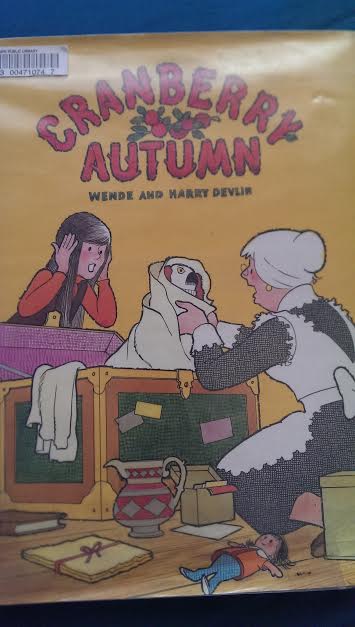
CranberryAutumnCranberry Autumn by Wende and Harry Devlin, 1993.

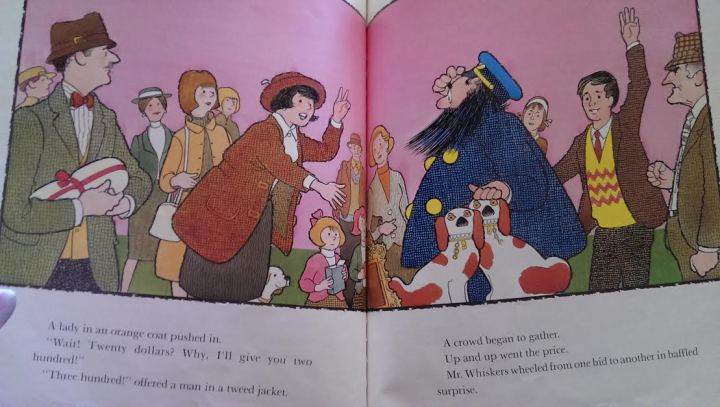
CranberryAutumnPic1School is about to start, and Maggie and her grandmother realize that they’re short of money.  Maggie needs new school clothes, and her grandmother needs a new coat.  They know that some of their neighbors could also use some more money, so Grandmother suggests that they hold a sale.  Some of them have some antiques and other interesting old items that they could sell.

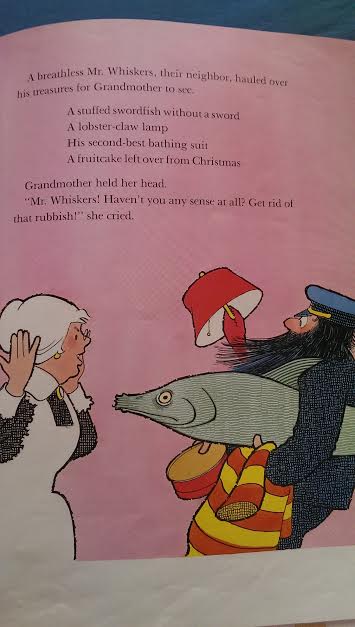
Mr. Whiskers tries to help, but he doesn’t have anything really interesting to sell.  At least, nothing Grandmother thinks that anyone would buy.  He’s disappointed because he really wants to help.

Mr. Grape, a greedy and dishonest neighbor of Mr. Whiskers, attends the sale and decides that he wants a pair of beautiful antique Staffordshire china dogs that Grandmother is hoping to sell for $200.  When he devises a scheme to cheat Grandmother and get the dogs for much less money, Mr. Whiskers gets his chance to help and to turn the tables on Mr. Grape.

As with other Cranberry books, this one includes a recipe that uses cranberries: Cranberry Squares.

CranberryAutumnPic2

CranberryAutumnRecipe

The Secret Life of the Underwear Champ

UnderwearChampThe Secret Life of the Underwear Champ by Betty Miles, 1981.

Ten-year-old Larry lives in Connecticut, but one day, while he and his mother are visiting his dentist in New York City, he gets spotted by the Zigmunds.  The Zigmunds own a modeling agency, and they think that Larry will be perfect for a series of tv ads.  At first, Larry is kind of excited about the idea of being on tv and earning extra money (maybe enough to get a new ten-speed bike!) until he realizes what he’s going to be advertising: underwear.

The Zigmunds like Larry because he’s a clean-cut, athletic kid who likes to play baseball, and the advertisements are supposed to feature a family playing sports together . . . in their underwear.  Larry also happens to have red hair, just like the girl already picked to play his sister in the commercials, Suzanne.  Suzanne has been in advertisements many times before, and the idea of advertising underwear doesn’t bother her at all.  The underwear kind of looks like athletic clothes and isn’t really revealing, but it’s still underwear.  Larry goes from feeling proud of his new tv advertising career to hoping that no one at school ever finds out about it.  But, how can Larry even hope for that when his underwear-clad form is going to be displayed on everyone’s tv set?

UnderwearChampPic1Now, Larry is wondering what he’s gotten himself into.  He worries about his filming schedule conflicting with baseball practice and makes up excuses about needing to visit the dentist when he has to film a commercial.  Money or no money, Larry just wishes that his life would return to normal!

After the filming is over, Larry starts to feel better about what he’s accomplished.  He and Suzanne have become friends (and she may possibly be his first girlfriend), and learning about the world of advertising was kind of fun.  But when the commercial actually makes it to tv, and Larry tells his best friend Robert about it, the dreaded teasing starts.

In some ways, Larry’s fears about teasing don’t turn out to be as bad as he fears, although it seems like it at first.  Robert laughs at him when he sees the first commercial and realizes why Larry’s been sneaking around and making excuses, but Larry tells him off for being mean and challenges him to think how he feels about it all.  Robert feels a little bad about laughing but says that he can’t help it and that other kids at school will react the same way.  He’s partly right, but he does help to put a stop to it, and the other kids do calm down.  Larry even enjoys some minor fame because he’s the only one of the kids to have been on tv at all.

There’s a lot of humor in the story, but it’s also surprisingly thoughtful as Larry considers why people find the idea of seeing someone in their underwear so funny.  After all, everyone wears underwear of some kind, even the President of the United States.  It’s a normal part of everyone’s wardrobe and a common part of everyday life.  The other people in the ad don’t act self-conscious while they’re being filmed in their underwear because it’s just part of their job, another part of daily life.  The book doesn’t mention sex, although the “mother” of the family in the ads gets a few whistles when she’s in her underwear, and Larry acknowledges that he and Robert sometimes giggle over advertisements with girls in their underwear.  Larry’s main conclusion is that people laugh about underwear because that’s just not how people normally see each other, so it seems weird.  After everyone has seen the commercial with Larry many times, people get used to the idea and it doesn’t seem so weird, so they get over the “funny” part and stop laughing.  Eventually, the other kids at school stop thinking so much about the underwear and just think it’s kind of cool that Larry was in a commercial.

The book is currently available online through Internet Archive.

The Best School Year Ever

BestSchoolYearThe Best School Year Every by Barbara Robinson, 1994.

This year at school, Beth’s teacher has assigned everyone a year-long project to think about good points about their classmates, but it’s difficult when one of your classmates is Imogene Herdman.  The Herdmans are generally awful.  They lie, steal, set things on fire, bully other kids, and have been kicked out of almost every building in town for one reason or another.

Mr. Herdman deserted the family years ago, and Mrs. Herdman works long hours at the shoe factory, so the six awful Herman kids are left to do pretty much anything they want most of the time, even if what they want to do is to walk off with Louella’s baby brother Howard and draw pictures on his bald little head and charge other kids a quarter to see the amazing “tattooed baby” like some kind of sideshow freak.  It’s difficult for the adults in town to tell them off because they never listen or punish them because no punishment ever seems to stick.  Mostly, when the Herdmans are around, the adults seem to focus on damage control.

So, Beth struggles to find anything good to say about awful Imogene, the oldest girl in an awful family, but throughout the school year, Beth does begin to notice that Imogene does have other sides to her personality.  The book is more of a collection of short stories about the Herdmans’ various antics and escapades and Imogene’s role in them than one single story as Beth thinks about the things Imogene does.  Imogene can’t really be called “nice,” and she definitely causes her share of chaos, but she does have occasional moments when she’s helpful or does something in the name of justice, like giving her old blanket to Louella’s little brother to replace the one he lost so he wouldn’t be sad.

Some of Beth’s compliments to Imogene at the end are somewhat generic because Beth struggles to get around some of Imogene’s genuinely awful behavior, but when she considers what Imogene’s best trait is, she finds something that really captures Imogene’s spirit, a quality that Imogene genuinely admires and may lead her on to better things in her life.

This is the second book in The Herdmans Series.  The books are funny because of the chaos that the Herdmans cause wherever they go, although you can’t help but feel a little sorry for them at times, too.  It’s part of that awful dilemma when you think that someone deserves a good spanking for what they’ve done but, at the same time, you see that it wasn’t entirely their fault.  While the Herdmans are responsible for the things they do, they’re also victims of neglect.  Their parents aren’t really raising them, and the other adults have mostly given up on them.  They do what they do because they can and because no one is there to make sure that they’re doing the right thing.  No one even really expects them to do the right thing, so if they do something right, it’s completely up to them.

Beth’s observations about Imogene show that there is hope for her.  Imogene has some good traits as well as bad ones, and occasionally, she does do good deeds as well as bad.  Beth realizes that Imogene could do some great things in her life because of her resourcefulness (a quality that Imogene likes when Beth points out that she has it), but she realizes that what Imogene eventually turns out to be is still in her hands, whether she uses her abilities to rob banks or run for President.  Adults will know that Imogene’s reality is likely to be something in the middle, but the point is that Imogene has more good points than it appears at first and more possibilities in her life than just being a trouble-making Herdman.

As in the first book in the series, there is also something of a contrast between Imogene and Beth’s friend Alice.  Alice is the perfect child (at least in her mother’s eyes, and her mother lets everyone know it), but she is also often shallow, bragging up her looks, talents, and perfect behavior to get attention and feel important (which is what Beth thinks is really the best compliment to give Alice because it’s the one she would most value).  When Alice is nice, it’s not so much because she is a nice person as she likes the praise she gets for doing it.  Really, neither Alice nor Imogene are especially nice; they’re just not nice in different ways and for different reasons (although both have good points, too, which is the point of the story).  When Alice gets a compliment, she sees it as merely her due for her perfection, but for Imogene, compliments come as a surprise because she doesn’t hear them much and she knows that she is far from perfect.

The book is currently available online through Internet Archive (multiple copies, actually).
The Candy Corn Contest

The Kids of the Polk Street School

CandyCornContest#3 The Candy Corn Contest by Patricia Reilly Giff, 1984.
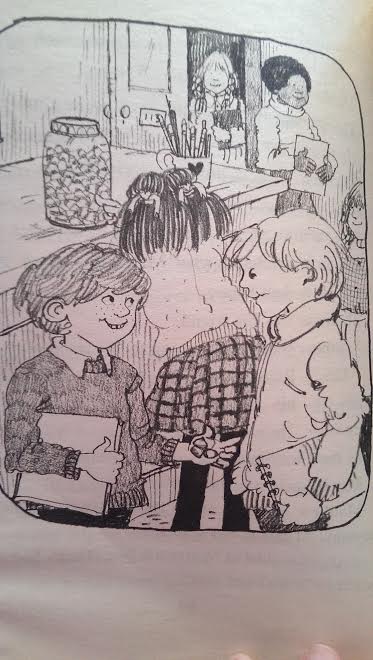
As Ms. Rooney’s class prepares for the upcoming Thanksgiving holiday, she gives them a contest: students can win the jar of candy corn on her desk if they can guess how many pieces of candy corn are in it (or get the closest to the right answer).  Richard “Beast” Best wants to win very badly because he loves candy corn and his mother never lets him eat many sweets at home.

The only problem is that students can only earn the ability to make guesses by reading books.  They get one guess for each page they read.  Richard has always been a slow reader, so he knows that this contest is going to be hard for him.  One day, while studying the jar of candy corn, trying to plan out his guess to make the best use of it he can, Richard gives in to temptation and eats three pieces.  Now, he doesn’t know what to do.  Ms. Rooney knows exactly how many pieces of candy there were in the jar, and if three are missing, she’ll find out.

CandyCornContestPic2While Richard is worrying over his mistake, he’s also worrying about the sleep-over party his parents are letting him have over the Thanksgiving break.  At first, he was looking forward to it, but some of the other boys in class can’t come and some of those who said they could are concerned because Matthew is coming.  Matthew and Richard are friends, and people in class generally like Matthew, but everyone knows that Matthew still wets the bed.  Some of the other boys are worried that they’ll have to sleep next to Matthew at the sleep-over.  As much as Richard likes Matthew, it feels like his problem is going to ruin the party, and when Matthew is nice to him, it only makes Richard feel worse.

For awhile, Richard is short-tempered with Matthew and says some things that he later regrets.  His mean comments make Matthew decide not to go to his party, but Richard feels terrible because he realizes what Matthew’s friendship really means to him. Richard’s apologies later help to fix the situation.  It also helps that Richard admits to Matthew that he ate three pieces of the candy corn.  Richard’s confession that he did something wrong (more than one thing, actually) and that he wants to fix it helps Matthew to forgive him.  Matthew helps Richard to decide how to solve his candy corn problem honorably, and Matthew’s mother gives Matthew a suggestion that will help him to avoid problems at the sleep-over.

The book is currently available online through Internet Archive.

Fish Face

The Kids of the Polk Street School

FishFace#2 Fish Face by Patricia Reilly Giff, 1984.

When there’s a new girl in Ms. Rooney’s class, Emily Arrow is happy at first that she’ll be sitting next to her and thinks maybe they’ll be friends.  However, that feeling doesn’t last very long.  Dawn Bosco doesn’t seem interested in making friends.  She doesn’t respond to the compliments that Emily gives her.  Instead, she brags about herself, saying things that Emily learns later aren’t true.  Worst still, she steals Emily’s toy unicorn, Uni.

Uni is Emily’s best friend, and she’s convinced that he brings her good luck.  Without him, everything seems to go wrong.  Emily even has trouble sleeping because she always sleeps with Uni.  When she tries to get Dawn to give Uni back, she denies taking him, but Emily knows that Dawn is hiding him in her pencil box.  She saw him there, but she just can’t get to him.  Will Emily ever get Uni back?

The book is currently available online through Internet Archive.

My Reaction and  Spoilers

FishFacePic1The title of the story comes from the fish faces that Emily was making, imitating the classroom pet fish.  She shows Dawn her fish face when she’s trying to joke with her, but Dawn just thinks it’s weird.  Dawn worries that she’s not making friends, but at the same time, she also seems determined not to like things and people at her new school and stealing Emily’s unicorn and lying about it was a sure way to make her angry.

I didn’t like this book as well as others in the series.  The kids in the series don’t always explain their actions or completely understand them, which is somewhat true to life.  Young children don’t always understand their true feelings or motives because they don’t have the words or the experience to explain what they feel.  However, this book felt more unexplained than normal.

Dawn steals Emily’s toy unicorn just moments after they first meet, while sitting in the desk next to her in their classroom.  Emily doesn’t get help getting her unicorn back right away, and by the time she does, it’s too little help, and Dawn gets away with keeping the unicorn.  We’re supposed to believe that Dawn did it just because she felt awkward in a new place with no friends, but that’s shaky because even a second-grader would know that stealing something isn’t going to win friends.  The kids later find a letter Dawn was writing to a friend at her old school, saying that she’d done something bad but that Emily was mean and that she was upset about not having friends.  So, she understands that she did something wrong, but still thinks Emily is mean for trying to recover her stolen property?  Children can say and do some odd, sometimes contradictory, things, but Dawn’s feelings seem to be all over the place and her character difficult to pin down.

It’s difficult to tell what, if any, lesson to take away from this story.  That if someone steals your stuff, it’s because they’re lonely and you just don’t understand them?  Things partly get resolved because Emily is interrupted in searching for her unicorn and ends up taking Dawn’s reader out of her desk.  Returning the reader seems to be what causes Dawn to have a change of heart, maybe because missing it made her understand Emily’s feelings about the loss of her unicorn, but we never really find out.

Fortunately, Dawn does become a more distinct character in other books, and later, because she wants to be a detective, she gets her own series of mysteries.  One of the mysteries in her spin-off series references this story because something else disappears in class, and Dawn is suspected because people know that she stole something before.  In that book, Dawn has to figure out the mystery in order to clear herself of suspicion.

One thing I did like about this book was that, although losing Uni was very hard for Emily at first, she does come to realize that she can do without him, that he is not her sole source of good luck, and that she can sleep without him at night.  She is pleased when Dawn agrees to give him back, but she does recognize that learning that she can be okay on her own is a sign of growing up.

The Beast in Ms. Rooney’s Room

The Kids of the Polk Street School

BeastMsRooney#1 The Beast in Ms. Rooney’s Room by Patricia Reilly Giff, 1984.
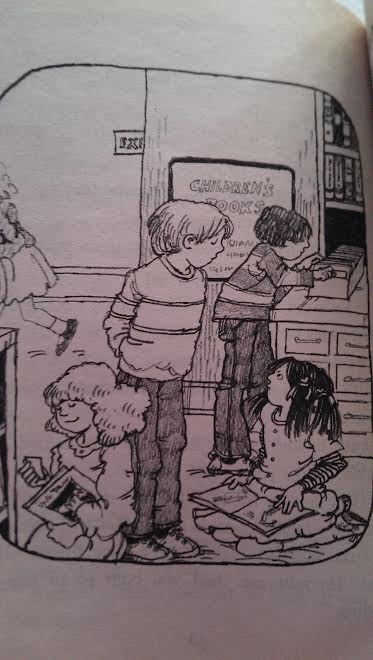
It’s the start of a new school year, and Richard Best (nicknamed “Beast”) is embarrassed to find himself in Ms. Rooney’s room once again because he was held back a year for his poor reading skills.  Everyone he knows has moved on to the third grade, and he’s still in a second grade class with kids who were first grade babies last year.  He feels awkward, being the tallest, oldest person in class, and kids in his old class tease him and refuse to let him play baseball on the playground with them because he’s a pathetic “left-back.”

At first, Beast tries to pretend that it was all a horrible mistake that will be straightened out soon, but that just makes him feel bad for lying.  The kids who are now in the same class he is, who he still thinks of as “babies,” try to make friends with him, but he doesn’t accept them at first because of his embarrassment at being older and still not as good at reading as some of them are.

BeastMsRooneyPic1However, even though he’s embarrassed at having to attend special reading classes with Mrs. Paris while most of the rest of his class has normal reading, these special classes really help him, not just to improve his reading skills, but to connect with other kids in his new class who have the same reading difficulties he does and who understand how he feels.

Beast discovers that it’s no shame to not know something or to have trouble doing something because everyone has different skills and it can take some people longer to learn certain things than others.  Emily Arrow, the girl who now sits next to him in class is a whiz at math but has as much trouble reading as he does.  Beast learns some new skills from his new, younger classmates and realizes that they’re not really babies.  They also really appreciate him and help him see some of the good things about himself.

The book is currently available online through Internet Archive.

Journeyman Wizard

JourneymanWizardJourneyman Wizard by Mary Frances Zambreno, 1994.
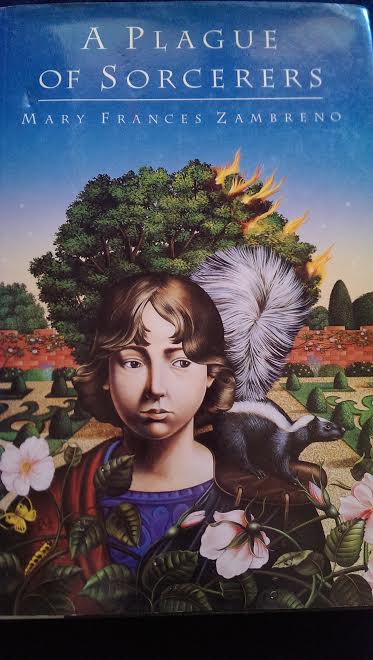
This book is the sequel to A Plague of Sorcerers.

Jermyn Graves has finished his apprenticeship and is ready to move onto his Journeyman studies.  As a Spellmaker, an especially rare type of wizard, he really needs to study with a Master Spellmaker, and for years, there has only been one in the Wizard’s Guild: Lady Jean Allons.  Jermyn’s current teacher, Theoretician William Eschar, once studied under her himself.

Mistress Allons is a formidable old woman, and Jermyn is nervous about going to live with her and completing the next part of his training. Master Eschar says that she is strict but an excellent teacher, and he has fond memories of her from his own youth.  However, much has changed for Mistress Allons since those days.

Mistress Allons lives in her manor house in the small town of Land’s End with her widower son-in-law, Duncan, and her granddaughter, Brianne, who is only a little younger than Jermyn himself. Since the death of her only daughter, Annalise, in a mysterious accident during a magical experiment, Mistress Allons has not really practiced magic and no longer even keeps a familiar.  As Jermyn soon learns, everyone in Land’s End is still haunted by Annalise’s death.

Although Brianne has magical talent, both her father and grandmother refuse to let her study magic.  In defiance and because her talent will not allow her to leave magic alone, Brianne has taken to studying magic with a local Hedgewitch, Maudie.  Hedgewitches, or Wise Women as they call themselves, practice a very natural form of magic, but it can also be very dangerous because of its raw, undisciplined nature.  Although magical accidents are usually rare, that type of magic is more prone to them than the more formal kind that Jermyn is studying.  Jermyn tries to convince Brianne of the danger, but Brianne sees it as her only hope for learning anything, in view of her father and grandmother’s opposition.

Jermyn is not there for very long before Mistress Allons herself dies, the victim of another strange magical accident. Was it really just a terrible accident, or was it actually murder?  Jermyn struggles to find the answers while some people believe that he may have been responsible for Mistress Allons’s death himself.

I enjoyed the fascinating combination of mystery and fantasy in this short series.  While Jermyn’s magical studies are fictional, the book has some interesting insights into cross-disciplinary studies as Jermyn comes to understand something that Mistress Allons was trying to explain to him about using lessons from art and science to solve magical problems because different fields of knowledge are connected and the principles of one discipline have some bearing on the other.

There is also something interesting that Jermyn says to the evil wizard who is responsible for everything about how he can’t really do all the things that he thinks he can do (specifically flying) because the kind of drugs that evil wizards use to boost their powers also cause hallucinations.  When I was in college, I did a report about witchcraft trials, and some of the plants used by supposed “witches” in their potions also had hallucinogenic properties, which is probably the origin of the belief in flying witches.  Just an interesting little cross-over from real history.

A Plague of Sorcerers

PlagueSorcerersA Plague of Sorcerers by Mary Frances Zambreno, 1991.
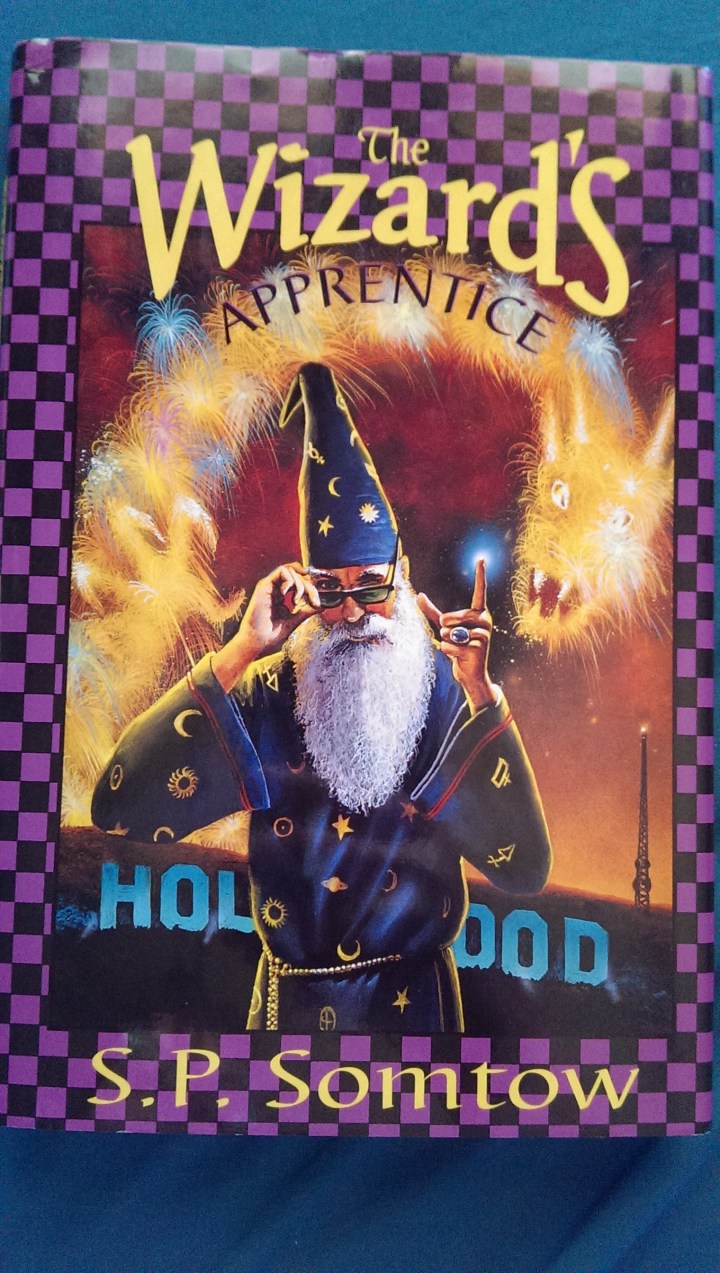
Jermyn Graves comes from a family of sorcerers, but although he seems to have the talent, it takes him unusually long to get his familiar. Familiars, animals with a special link to a wizard, assisting them in their magic, come to their masters when they are ready to begin learning magic, and without one, Jermyn cannot really be a wizard.

When Jermyn’s familiar finally appears, everyone is surprised to find that it is a skunk. Some people make fun of him for having such a strange familiar. No one is quite sure what the meaning of his familiar is, and the exact nature of Jermyn’s magical talent is still unknown. Still, his aunt apprentices him to a theoretician, a man who does not actually practice magic himself, but who studies the theory behind it. He can assist Jermyn until Jermyn’s true talents become known and he can study with a master who shares his specialty.

Jermyn likes his new master and the young orphan girl who lives with him. However, disaster soon strikes the city. Sorcerers are falling victim to a strange disease that sends them into a coma. Despite their best efforts, none of the remaining sorcerers can discover the source of the disease or its cure, and all the time, there are less and less sorcerers to continue the work. Time is running out, and Jermyn and his unusual familiar may be the only ones capable of finding the answer.

Jermyn does have a special talent which he comes to fully understand, and he uses it to save the other sorcerers and put an end to the mysterious plague.  Although the others had laughed at Jermyn’s skunk, he later comes to realize that she was the one keeping him from getting the plague himself because of some unusual qualities of her own.  The combination of mystery and fantasy is exciting, and there is a mysterious villain who may not even be aware of their villainy because of their own hidden sides.

This book is currently out of print, but there are used copies still available, and you can also buy an electronic copy from American Fantasy Press.

There is a note in the beginning of the book that says that the first two chapters are based on a short story written by the author earlier.  The book is currently available online through Internet Archive.  There is also a sequel to this book, Journeyman Wizard.

The Wizard’s Apprentice

WizardsApprentice

The Wizard’s Apprentice by S.P. Somtow, 1993.

WizardsApprenticePic1Sixteen-year-old Aaron Maguire thinks of himself as a typical teenager, even though his family is far from typical.  His mother is a buyer for a fashion boutique, and his father does special effects for monster movies in Hollywood.  They’re also officially “separated” and preparing for a divorce, even though they’re still living in the same house.  So far, they’ve just kind of divided the house in two in order to have their own space.  Aaron goes back and forth between the two halves of the same house as his parents share him.  It’s a little weird (and, to Aaron, also a little depressing), but there’s weirder to come.
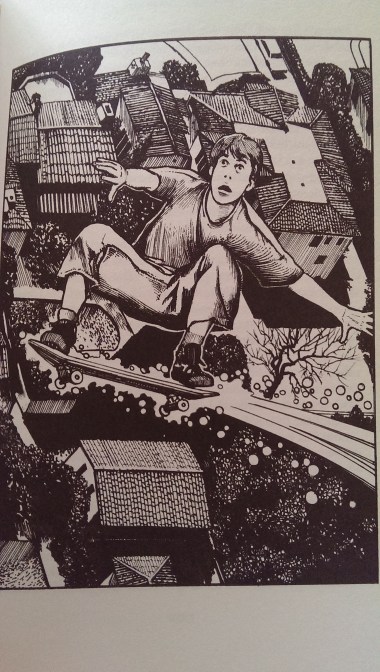
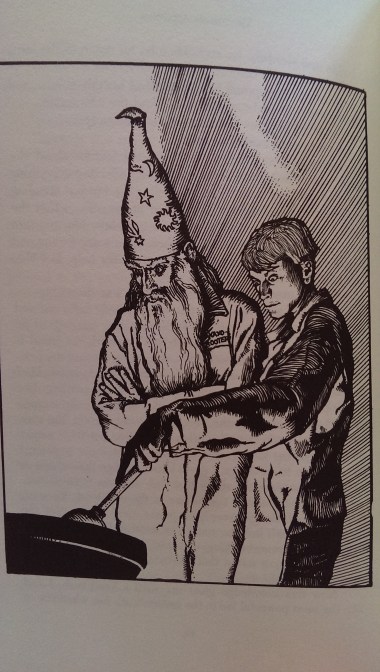
An old man approaches Aaron and tells him that he’s destined to be a wizard and that he will teach Aaron what he needs to know.  At first, Aaron thinks this man is nuts and probably homeless, but what he says is true.  The old man is the wizard Anaxagoras.  Anaxagoras demonstrates to Aaron how the skateboarding maneuver he had just pulled off defies the laws of physics and tells Aaron things about his personal life that no one should know (how angry he is with his parents about their separation and about his crush on Penelope Karpovsky, a girl he knows from biology class).  He also changes the dollar Aaron had offered him into a $100 bill and shows him that they can travel to magical lands and even through time.  Although Aaron still has trouble believing what he sees (his father does special effects for a living, after all), he becomes Anaxagoras’s apprentice.

Partly because Aaron still has doubts and needs something physical to convince him of the wizard’s powers and trustworthiness, Anaxagoras gives him a mirror.  It looks basically like an ordinary pocket mirror with a neon pink frame, but Anaxagoras invites him to ponder it and figure out what it does, telling him that what he does with it is important.

WizardsApprenticePic2However, when Aaron meets the divine Penelope for pizza and she asks to borrow a mirror to check her hair, Aaron lets her borrow Anaxagoras’s mirror.  He instantly regrets it because the mirror suddenly changes in Penelope’s hands.  Now, it has a tortoiseshell frame and is shaped like a heart.  Penelope, who has low self-esteem in spite of her prettiness, is suddenly really happy when she looks in the mirror and refuses to give it back, insisting that she wants to borrow it for a few days.  Because Aaron is in love with Penelope, he finally agrees to let her keep it for awhile.

When Aaron tries to tell Anaxagoras about Penelope borrowing the mirror, he doesn’t seem concerned.  He just hurries Aaron on to his next lesson, which involves a plumbing problem.  Anaxagoras’s lessons are pretty weird, although Aaron finds himself learning that there is more magic in the everyday world than he ever suspected.

Aaron later attempts his own feat of magical plumbing at the studio where his dad is working and encounters a creature of darkness.  The mirror gets out of his hands, and he enchants a car in order to chase it down.  Finally, a dare from some classmates causes him to unleash a dragon on the unsuspecting city, one that only Aaron can understand and defeat, once he realizes the true nature of his magical mirror.

Aaron has a distinctive voice as a California teenager, and his first experiments with magic lead him to some surprising discoveries about himself which help him to understand and reconcile his feelings about his parents’ divorce.