The Ghost in the Tokaido Inn

ghosttokaidoinnThe Ghost in the Tokaido Inn by Dorothy and Thomas Hoobler, 1999.

In feudal Japan, more specifically in 1735, the family you were born into determined what you were meant to be in life.  Samurai were born into families of samurai, and merchants were born into merchant families.

This is a terrible disappointment to Seikei, the fourteen-year-old son of a tea merchant, who would love nothing more than to be able to become a samurai.  He has studied the samurais and their ideals and greatly admires their bravery.  He even loves to write poetry, as the samurais do.

One day, Seikei accompanies his father on a business trip from their home in Osaka to Edo (the old name for Tokyo).  On their way, they stay overnight at an inn.  There, Seikei makes friends with the daughter of a paper merchant, and she entertains him with a ghost story.  During the night, Seikei sees a strange figure that attempts to enter his room, which he fears might be an evil spirit (like the one in the ghost story), but he is unable to get a good look at it before it disappears.

The next morning, Lord Hakuseki, a daimyo (lord, nobleman) also staying at the inn, says that a jewel was stolen from him during the night.  The famous Judge Ooka comes to the inn to investigate the crime.  The paper merchant and his daughter are accused of the theft because the jewel is found among their belongings.  Seikei recognizes the jewel as one that Lord Hakuseki showed to both him and the girl the night before when they each went to show him their fathers’ wares, and he also realizes that he saw the “evil spirit” holding it.

When Seikei tells Judge Ooka all of this, his father is angry, saying that Seikei must have imagined the whole thing.  However, Judge Ooka believes him.  He points out that the silent figure was no doubt the thief, who merely looked like an evil spirit to the boy who had just been startled awake, with a ghost story still on his mind.  Judge Ooka is also impressed with Seikei’s bravery when Seikei describes how he got up to try to get a better look at the figure, even though he believed that it was an evil spirit at the time.

Judge Ooka recruits Seikei to help him further investigate the crime, and they realize that the theft is only part of a much larger and more serious plot of revenge.  Judge Ooka, himself of the samurai class, also understands Seikei’s feelings better than his father does.  In the end, he offers Seikei a way of living the kind of life that he’s always dreamed.

This book is the first in a series.  Judge Ooka was a real, historical figure, although Seikei, his adopted son, is fictional.  Because the story contains violence and some religious oppression, I recommend it for middle school level readers.  The book is currently available online through Internet Archive.

The Vandemark Mummy

The Vandemark MummyThe Vandemark Mummy by Cynthia Voigt, 1991.

The Vandemark Mummy is an exciting mystery with believable characters. The story includes a bit of history about Ancient Egypt and side plots about the complications of family life, the role of women in society, and the nature of ambition.

Twelve-year-old Phineas Hall and his fifteen-year-old sister, Althea, have recently moved to Maine with their father, Professor Hall, because he got a job working at the small Vandemark College. Moving and starting over in a new place is never easy, but the move is more difficult for the kids because their mother didn’t come with them. Their mother is an ambitious, career-oriented feminist, and when she was offered an important job working for a congressman in Oregon, she could not bring herself to turn it down in order to go to Maine with the rest of the family.

Although the entire family talked the situation over, and everyone agreed to the current arrangements, no one is really happy about it. Althea particularly feels hurt. Even though she has shared her mother’s feminist ideals, she’s hurt by her mother’s apparent selfishness and the seeming ease with which she abandoned the family. Althea believes that her mother should have compromised on her career this time because her husband has made compromises for her in the past. To make herself feel better, Althea spends her time studying one of the oldest feminists, the Greek poet Sappho. Phineas, on the other hand, is just trying to be a normal kid and fight off boredom while waiting for the summer to end and school to start. But, boredom is the last thing on Phineas’s mind when the mummy arrives at the college.

The wealthy patriarch of the Vandemark family dies and leaves his collection of Egyptian antiquities (one of many collections he had) to the college, including a real mummy. The Vandemark family is a little disappointed because they had hoped that the collection might go to a much more prestigious institution, even though Vandemark College is named for their family. To the joy of the Hall family, Professor Hall is put in charge of the collection, which will be put on display in a new addition to the college library. Professor Hall lets Phineas and Althea go through the collection with him and another professor, Ken Simard. Although at first the collection does not seem to be particularly valuable, except for the unusually good condition of the mummy and the funeral wreath, it seems to be a lot more valuable to someone. After a failed attempt to break into the collection, someone later manages to steal the mummy. Then, Althea suddenly disappears. The adults suspect that Althea might have run away because of the troubles in their family, but Phineas knows better and begins a desperate hunt to find his sister.

One of the best things about the book is that it really takes both kids to unravel the entire mystery: Phineas for his persistence and decisive action and Althea for her more mature understanding of the thief’s motives. Although, even at the end, their family’s situation isn’t completely resolved, the kids’ experiences give them a new perspective on things. It would be a great book for middle schoolers.

The book is available to borrow and read for free online through Internet Archive (multiple copies).

Themes and Spoilers

I debated about saying more because I didn’t want to spoil the story too much, but after thinking it over, I can’t give my full opinion of it in this review without talking a little more about what Althea and Phineas learned from their situation.  If you’d rather not know more detail, you can skip the rest of this.

On the one hand, I was a little disappointed at the lack of complete resolution to the family’s troubles because, by the end of the book, I really cared about the characters and wanted to know what would happen to them, but I think the author purposely left the story open at the end so readers could imagine for themselves what the characters are going to do next.  However, there is one thing that is pretty well established at the end of the story: whatever happens to their parents, whether their separation is temporary, as they’d originally planned, or whether they end up divorcing, Althea and Phineas are going to be okay because they still have each other, their father, and their new friends in their new town.

In the beginning, their mother’s absence is worrying because they will now have to cope without her, and they don’t know what is going to happen to their family in the long run.  But, part of the children’s self-sufficiency actually does come from their mother and things that she taught them, whether she is with them or not.  The book does mention little things they learned from their mother.  It’s subtle, but she’s still with them because of the influence she’s had in their lives.  The kids also develop more of an appreciation for their own resources and abilities, which makes them less fearful.  One of Althea’s early characteristics was a long-standing fear of the dark.  After her ordeals, her father and brother expected her fear to be worse, but she tells them that she is actually less afraid now than she was before because she has learned something about circumstances she can control and ones she can’t.  She says, “I think, there’s a difference between being scared and not knowing how you’ll do, and being scared but knowing you’ll do okay.”  As she notes, if she goes to bed at home with the lights off and decides that she really can’t stand it, she can always get up and turn them on again.  She has realized that she has control in her daily life and actions she can take to make things better, which she didn’t have during parts of their adventure.  It gives her confidence.

The kids also learn lessons about the nature of ambition and about their own feelings.  In the beginning, Althea is more vocal about how she feels about her parents’ separation.  She feels betrayed because, although she learned her sense of idealism from her mother and thought that they shared the same views, her mother has now done something which she views as a selfish act, rejecting her family and her family’s needs solely in the name of her personal ambitions.  Phineas, on the other hand, doesn’t seem to know what to feel or is afraid to show his true feelings at first, just trying to keep busy so he doesn’t have to think about it too much because he thinks that his parents’ marriage is only their business.

At the end, the two alter their positions somewhat, coming a little more into agreement with each other.  Althea has the chance to contrast her parents’ marriage and ambitions with that of the villain’s (without naming names), and she sees the difference in the way each of them responds to the same pressures.  Although her father may have been hurt by his wife’s reluctance to make sacrifices in her ambitions for the sake of his and her preference for separation over compromise, he still genuinely cares about her and understands her ideals and what she really wants to achieve.  The fact that it’s only a separation, not a divorce, is a sign that the parents still care about each other and respect each other and hope that they will be able to reconcile eventually.  The villain doesn’t have those feelings, and unlike either of Althea and Phineas’s parents, really is motivated solely by selfish ambition.

Ambitions often require sacrifice in order to achieve them.  Revealing exactly what the villain sacrificed would say too much, but this person does end up losing pretty much everything in the end.  For the sake of her ambitions, Althea’s mother sacrificed her place in the family.  Although she thought that it would only be temporary, the hurt she caused her family members will probably have longer-lasting effects. When she calls them to find out what’s been happening, she learns what she’s been missing and the ordeals her children have faced without her, which leave her feeling both worried and left out, feelings that her husband understands and explains to the children (“One of the things she knew, without knowing how it would feel, is that we’d be able to get along fine without her.”), which shows that he is still in tune with his wife’s feelings.  Toward the end of the story, she is upset and seems hurt that Althea is too tired and busy talking to the police to talk to her much other than to briefly reassure her that she is now safe.  At that point, Althea needs her mother’s comfort less than her mother needs reassurance from her.  Althea feels a little bad about not being able to soothe her mother’s feelings because she is no longer as hurt and angry with her as she was before, but Phineas tells her not to worry if their mother’s feelings are hurt right now because she owes her daughter some hurt feelings.  In other words, Phineas has finally learned that it’s okay for him to have feelings and an opinion about the things happening in his family and to show them.  He recognizes how hurt and confused his sister was at their mother’s apparent betrayal, and he has decided that it’s okay for their mother to see that hurt and feel a little of it herself so that she will understand what’s really happening and what her children are really going through. They have coped without her, but the fact remains that she wasn’t there for her family during their time of crisis.

You’ve probably noticed that I’ve been focusing more on the mother’s ambitions and questioning her motives more than the father’s in the story.  That’s partly because that is the focus of the story.  The children do not see their father as abandoning the family for the sake of ambition because he didn’t.  They make it clear that he has supported his wife’s ambitions in the past, often at the expense of his own.  He mentions that the attraction of this new position that he has accepted is that it’s “the first job in fifteen years that I’m not over-qualified for, and I plan to enjoy it . . .”  He is primarily a scholar and has felt under-challenged intellectually.  Because he’s an academic, his schedule is more in sync with the children’s school schedule, which is why both of the children chose to go with him rather than with their mother.  He also makes time for his children and even involves them in his work when possible, supporting Althea’s interests in history and philosophy, which he shares.

At one point, Althea says to her father, “You and Mom don’t have exactly the same set of values, you know.”  The mother of the family is more concerned with money, climbing the occupational ladder, and achieving higher positions, higher salaries, and more influence.  She sees these things as ways of furthering the cause of feminism, and often works long hours away from her family for her jobs. In the past, she has used the fact that she earns higher salaries than her husband to convince him and the rest for the family to make accommodations for the sake of her jobs.  Althea says that her mother’s arguments aren’t honest and that her lack of support for her husband’s career as well as her own are a betrayal of the “equality” that she supposedly believes in.  It isn’t that Althea is completely opposed to her mother’s ambitions so much as she disapproves of the way her mother goes about achieving them. Her mother is apparently more concerned with status than the intellectualism that her daughter and husband crave.  Much of the conflict in their values comes down to what they think they need to feel fulfilled in their lives.  Because the characters seem to need different things, they are having trouble living a shared family life.  That’s the situation for the Hall family, as the book describes it.

In the end, this book is bound to spark a lot of opinions and discussions about the characters and their views and much speculation about what will happen next for the Hall family.  Will one or both of the parents change their view of the situation, just as Althea and Phineas have?  Will the mother, who admits that the job she took wasn’t what she had expected it to be, decide to quit and rejoin her family?  If she does, what will her role in the family be now that Althea and Phineas have become more independent than they once were?  Another character, who I haven’t mentioned before, is a female reporter in their new town who befriends the family and helps them through their ordeals in the mother’s absence.  In some ways, her values seem more in tune with the father’s than the mother’s are.  Is it possible that she could be the children’s eventual stepmother if the parents separate permanently?  Or will she only ever be just a supportive family friend?  Families in real life experience changes like these as children grow older and begin to forge their own identities and values in the face of changes in their lives, reevaluating their parents’ decisions and making ones for themselves.

Silver Days

silverdaysSilver Days by Sonia Levitin, 1989.

This is the second book in the Journey to America Saga.

Escaping from World War II Europe was only the first step for the Platt family. Now that they are reunited in the United States, survival is still a struggle. They have very little money, and Lisa’s father struggles to find work and a permanent place for his family to live. Along the way, they encounter people who are prejudiced against them, some because they are Jewish and some because they are German, and are forced to confront certain prejudices that they hadn’t realized that they held as they settle into their new country and learn to live alongside people from different backgrounds who live very different lives.

Lisa describes her family’s day to day struggles and adventures with understanding. In Germany, her father had his own business, selling coats, but he has to struggle to get into the clothing business in America. Her mother, who had once had her own servants in Germany, is forced to take a job as a maid to help make ends meet. Besides the basic problems of learning a new language, dealing with a lack of money, and trying to find work, she also describes the parts of American culture that take her family by surprise. There are religious issues because most of the people around them are Christian, and Lisa’s mother is upset when her youngest daughter, Annie, ends up getting a role in her school’s Easter play. Her mother also isn’t sure what to make of the Japanese family who lives next door when Annie makes friends with their daughter.

Meanwhile, the war that they had feared is becoming a reality. People in the U.S. are starting to support the war effort, collecting materials that the army can use, starting Victory Gardens to help support themselves during food rationing, joining the army, and volunteering as nurses. The Platts also experience survivor’s guilt as they hear reports of friends and family who weren’t lucky enough to escape the Holocaust.

The Platt family is realistic, and they have their arguments as the stresses of all these changes take their toll on them. But, they are a loving family and continue to support each other through everything. The title of the book comes from a song, “Golden Days”, about looking back on happy times. When Lisa’s little sister Annie asks her if these are their “golden days”, Lisa tells her that she doesn’t think so, but she thinks that they might be silver ones, days leading up to happier times ahead.

In some ways, the children of the family have an easier time dealing with all the changes than their parents. In the beginning, they are aware that they don’t quite fit in, although they desperately want to. However, they do manage to make new friends, and Lisa and her older sister, Ruth, even find their first loves. While the world around them is changing, the three sisters also change, growing up, finding new interests, and learning more about themselves and the kind of lives they want to live in their new home.

The book is currently available online through Internet Archive.

Journey to America

journeytoamericaJourney to America by Sonia Levitin, 1970.

This is the first book in the Journey to America Saga.  Like her heroine, Lisa, Sonia Levitin also fled Germany with her family during World War II, and her stories are semi-autobiographical.

Twelve-year-old Lisa Platt lives with her family in Berlin in 1938.  But, with the rise of the Nazis, events have taken a frightening turn for Jewish families like theirs.  There has already been violence toward Jewish people, and travel is restricted.  Lisa’s father fears for their family, and their mother believes that war is about to break out.  Reluctantly, her parents have decided that the only thing to do is to leave Germany and try to start over somewhere else.

Because of the travel restrictions, Lisa’s father has to leave secretly, pretending that he is only going on vacation.  In reality, he and Lisa’s uncle will go to America and try to get established before sending for the rest of the family.  But, it isn’t safe for Lisa, her mother, and her two sisters to stay in Germany, waiting for word from them.  Instead, they pretend that they are joining Lisa’s father for a holiday in Switzerland.  They can only take a little luggage with them, as if they were really just going on vacation, and very little money.

journeytoamericapicBut, getting on the train out of Germany is only the first step of their long journey.  Lisa and her mother and sisters live as refugees in Switzerland, waiting for her father to help arrange for their passage to America.  Often, they have too little to eat because they don’t have much money.  There are some people who help them, and they make some new friends, but the long wait is difficult.  Meanwhile, they must face the frightening events taking shape around them, around the people they left behind, and their own uncertain future.

There is something in the stories that I’d like to describe a little more because I didn’t quite understand it when I first read this book as a kid, but I can explain it better now.  At one point in the story, Lisa’s grandmother suggests that her mother send the girls to England because other families are doing it and it would ensure that the children get safely out of the country.  Later, in Switzerland, Lisa gets a letter from her friend Rosemarie that says she and her sister are now in England without their parents because their father didn’t didn’t feel like he could leave Germany.  What they’re describing is the Kindertransport, a rescue effort started by Jewish, Quaker, and British government leaders to transport unaccompanied Jewish minors, from babies to age 17, from Germany and German-controlled countries to England for safety after the events of Kristallnacht made it clear that Jews were in serious danger in Germany.  When the children reached England, they were placed in foster homes, schools, and anywhere else willing to take them, similar to the way children evacuated from London to avoid the bombings later would be placed in foster homes or on farms.  Grandmother Platt points out that this could have been an option for her grandchildren when she discusses the possibilities with their mother, but since, neither the mother or father of the family wanted to stay in Germany, the family decided that they should all leave together.  The Kindertransport program ended when war actually broke out, but by then, about 10,000 children had been brought to England.  Although parents who sent their children to England on the Kindertransport hoped to reunite with them in England, most of the Kindertransport children who went to England never saw their parents again because their family members who stayed behind in Germany were killed in the Holocaust.  I had lessons about the Holocaust in school in Arizona, but they never mentioned the Kindertransport because it wasn’t something that really affected the area where we lived.  I did see a Holocaust survivor who came to speak at my high school in the early 2000s.  There were Holocaust survivors living in my area of Arizona then, and there still are as of this writing because I heard that they were among the first to be vaccinated during the coronavirus pandemic in early 2021.  This video from the BBC Newsnight and this video from the University and College Union explain more about it and have interviews with people who were brought to England on the Kindertransport as children.  Rosemarie and her sister would probably be very much like the people in those interviews years later.

Although there are sad parts of the book, there are lighter moments, too, and the characters are realistic and engaging.  There is only one illustration in my copy of the book, a drawing of Lisa and her sisters getting their pictures taken for their passports.  Other editions of the book have different illustrations.

The book is currently available online through Internet Archive (multiple copies, in different editions).

Mystery of the Golden Horn

goldenhornMystery of the Golden Horn by Phyllis A. Whitney, 1962.

Vicki Stewart doesn’t mean to get into trouble. However, with her mother in the hospital with a back injury and Vicki in the care of her unsympathetic aunts, she has allowed her schoolwork to slide to the point where she cannot go on to the next grade. Faced with the prospect of admitting her failure to her friends, Vicki decides that she would rather leave school early and skip summer camp. Instead, she will join her father in Turkey, where he has been teaching at a girls’ college. The prospect of going to a new country and facing her father after her humiliating failure isn’t pleasant, either, but Vicki sees it as her only path to a fresh start. Indeed, her life will never be the same.

Vicki’s father rents his rooms from Mrs. Byrne, an American living in a palace that once belonged to a pasha along with her son, Ken, and her distant cousin and ward, Adria. Adria is about the same age as Vicki, and she has problems of her own. Adria’s parents are dead, and she has not been happy living with the Byrnes. Adria is something of a mystery to Vicki. She’s a dreamy, unpredictable girl who believes in magic spells and fortune-telling. A gypsy friend of Adria’s has told her that her fortune is to be found with a mysterious “golden horn,” and Adria’s single-minded pursuit of it has a tendency to get her into scrapes.

Unfortunately, Adria also tends to drag Vicki into trouble, partly because she is convinced that Vicki’s fortune is intertwined with hers. Vicki resents these complications in her life that add to her “problem child” reputation. However, she sincerely wants to help troubled Adria. Strange things are happening in the house, particularly in the spooky, disused haremlik, but not all of the strange things are Adria’s fault. As Vicki puzzles over these strange things and Adria continues her search for the golden horn, the girls gain new perspectives on their lives and their problems. The solutions aren’t as far-away and mystical as they think, but the girls will have to rely on themselves and each other to see them.

Phyllis Whitney’s books are wonderful for their colorful settings and insights on human nature. Vicki’s disappointment and embarrassment over her failure are true-to-life, and her struggle to change and redeem herself is something that everyone has experienced at some point. It’s a touching and reassuring story about how to deal with failure and life’s problems. The mystery is subtle (up until the end, you’re not quite sure how much of the trouble in the house is Adria’s doing and what her motivations are), and the setting is vivid and engaging. Whitney has also included interesting historical details about Turkey and comparisons between the past and present (by 1960s standards) culture.

The book is currently available online through Internet Archive.

Secret of the Tiger’s Eye

tigerseyeSecret of the Tiger’s Eye by Phyllis A. Whitney, 1961.
Benita Dustin’s father is a writer, just like she hopes to be one day. When her father announces that they will live for a year in South Africa with his Aunt Persis so that he can do research, it sounds like a grand adventure. The trouble is that her father’s editor has given permission for her son, Joel, to accompany them because she thinks the experience would be good for him, too. Benita’s little brother, Lanny, gets along well with Joel, but Benita and Joel fight and tease each other almost constantly. Benita gets annoyed with Joel’s obsession with facts and information, and Joel thinks that Benita’s stories and flights of fancy are silly.

Aunt Persis’s house is wonderful with a beautiful tower room where Benita is allowed to stay. There is even a fantastic story about the ghost of a tiger that Aunt Persis’s husband shot years ago in India haunting the grounds of the house and the little cave in the garden. Although Joel scoffs at the idea of a tiger ghost, Benita is captivated by the story, especially when strange things begin to happen around the house. Benita learns about the tragic death of Aunt Persis’s adopted son, Malcolm, and the strange theft of the emerald diadem that Aunt Persis received from the rajah that her husband saved from the tiger years ago. However, she will need Joel’s help to make sense of the situation, a difficult prospect at the best of times but almost impossible to ask for after Joel plays a cruel joke on Benita and tries to get Lanny to help gang up on her.  Then, Benita’s father tells her something that changes everything, and all the time, someone with sinister intentions is watching and waiting . . .

The book is available to borrow and read for free online through Internet Archive.

My Reaction

Besides the mystery, there is also a subplot about the nature of hate and prejudice. In South Africa, at the time the story was written, apartheid was still in force. Benita makes friends with a girl of mixed race called Charis, and they talk about racial issues in South Africa and the U.S. during the 1960s. Although Benita wouldn’t think of being prejudiced against anyone on the basis of race, she finds it harder to understand people with different personalities, like Joel.  Although the story focuses on Benita and the lessons she learns, I personally found Joel and his mistakes harder to accept.  Both Joel and Benita need to learn to be more understanding of each other, but in a way, I think Joel is worse because of his deliberately cruel pranks and because he already knows a couple of things that Benita doesn’t which should have influenced his behavior. Joel is deliberately trying to pick fights, and the book never really explains what he expected to accomplish by that.  Everyone needs a motivation, and Joel never really explains his, so he comes off seeming like he’s just there to be a mean character for no real reason.

I also wish that the parents in the story had more frank and straight-forward discussions with the kids.  As a professional writer and a professional editor, they should have been able to settle the kids’ arguments about imagination vs. facts or at least put the situation into perspective by explaining what they do in their jobs.  After all, Benita’s father is going to South Africa specifically to do research.  In other words, even fiction writers need to have a nonfiction background and real facts to use as a basis for their fictional stories.  Realistic backgrounds give stories the grounding they need in order to feel real to readers.  (Although that does depend somewhat on the type of story.  Fantasy stories don’t need to be based on real life, although they do have to have a consistent logic within the story so readers feel like they can understand the world in which the stories take place and the rules by which the magic in the story works.  If the story is meant to be surreal, the internal logic can be more loose.)  Editors, like Joel’s mother, fact check stories as well as ensuring that they are compelling for readers, helping to make decisions about where fictional stories need to be factually correct and where the author can depart from the facts for the sake of the story.  I think that Benita and Joel really should have had a better grasp of their parents’ professions and the balance between fact and imagination in fiction.  Of course, if they did, there would be less conflict in the story.

Fortunately, Benita and Joel work out their differences while confronting the mysterious situation and become friends when they learn to allow each other to be themselves and to appreciate each other’s good points.

Mystery on the Isle of Skye

mysteryisleskyeMystery on the Isle of Skye by Phyllis Whitney, 1960.
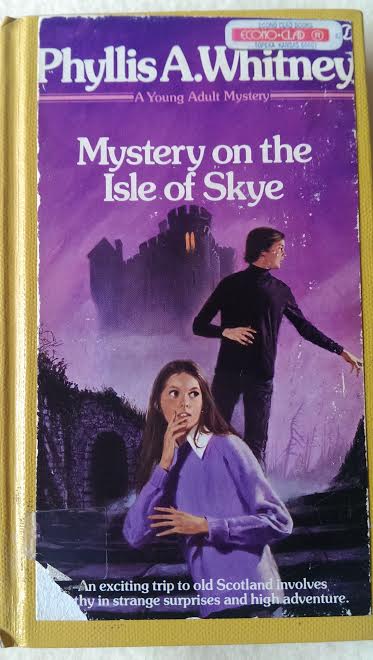
Cathy MacLeod has lived with her grandmother for years, ever since her parents died when she was very young.  Now, her grandmother is very ill and will probably have to live in a nursing home.  Cathy needs to find a new place to live, and her relatives are debating about who is going to take her.  So far, the only relative who has offered her a home is Aunt Bertha.  Cathy isn’t enthusiastic because Aunt Bertha only has a tiny apartment where she lives alone, and she’s only offering Cathy a home out of duty, not real affection.  Aunt Bertha hasn’t spent much time around children and doesn’t really understand them.

But, there is one other prospect.  Cathy’s other relatives, the Corbins, are taking a trip to the Isle of Skye, where Cathy’s grandmother came from originally, and her grandmother has arranged for Cathy to go with them while Aunt Bertha is on a business trip.  Uncle Jerry (Cathy’s mother’s brother) and Aunt Lila Corbin have two boys of their own, Don (who is about Cathy’s age) and Humphry, who goes by the nickname of Punch.  Cathy is happy about the chance to go with them to visit the island that her grandmother has told her so much about.

At first, Cathy feels a little awkward around the Corbins because she doesn’t really know them, and they don’t know her.  Aunt Lila is warm and welcoming to Cathy, but Uncle Jerry is a tease.  Don is a tease as well and very impatient with the whole idea of the trip.  He doesn’t care about the history or legends of Skye as much as Cathy does.  His only real interest is in photography.  Young Punch is friendlier, sharing the excitement of the trip with Cathy.

Before they left on the trip, Cathy’s grandmother gave her a mysterious box to take with her.  Cathy doesn’t quite understand it at first, but the box contains several smaller packages with instructions to open them at different times during the trip.  Some of the instructions are vague and force her to rely on other people to tell her when to open them and what to do with the contents.  The packages are part present, part “spell.”  Thanks to them, Cathy makes new friends in Skye and goes on an adventure that she will never forget.

My Reaction

There is no real magic in this story, no real magic spells, and there actually isn’t much mystery either, except for the mystery Cathy initially feels about what’s in the packages and what their real purpose is.  Cathy’s grandmother has a love of legend and mystery, and these special gifts are meant to serve special purposes: to acquaint Cathy more with her past on the Isle of Skye and share some special memories, to heal Cathy’s sadness, to help draw her closer to her other relatives, and perhaps, to help her find her way to a brighter future than the one she currently thinks is waiting for her back home.

The packages help Cathy to bond with her aunt, uncle, and cousins.  They’re meant to be a shared activity.  She has to open certain packages with certain relatives, and they have to take her to certain places to do certain things with the contents.  These shared experiences help draw them closer to each other.

Although this story doesn’t follow the traditional mystery format and it can’t even be called fantasy or pseudo-fantasy, it’s enchanting because of the subtle hints of mystery and fantasy surrounding Cathy’s surprise packages.  Readers get to wonder alongside Cathy what’s in them and where they’re going to lead her.  It’s a little slower and more subtle than most modern children’s books, but I find it refreshing and magical for those reasons.

The Twenty-Four Hour Lipstick Mystery

24hrlipstickmysThe Twenty-Four-Hour Lipstick Mystery by Bonnie Pryor, 1989.
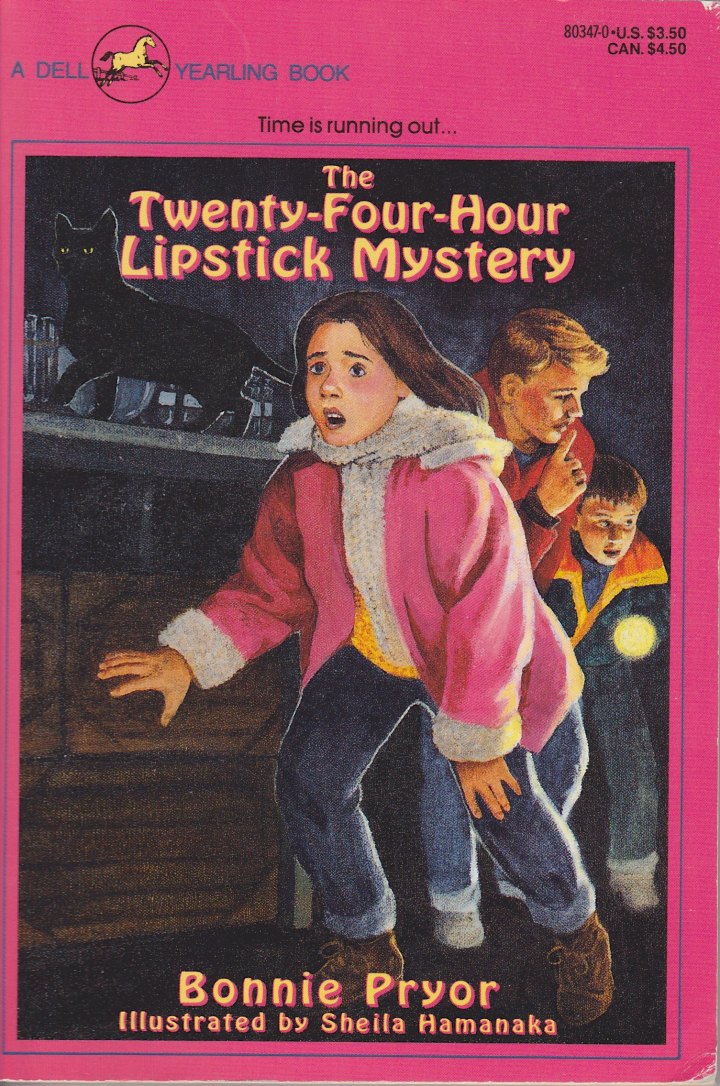
Cassie Adams, who is eleven years old, has never been happy with her looks, and now that her friends are starting to shave their legs and get interested in boys, she feels plainer than ever. One day, she sees an ad for Mrs. DuPrey’s School of Beauty and Charm and thinks that it might help her improve her appearance and develop confidence. The only problem is that she doesn’t have the money for it, and her parents won’t give her any. She decides that she needs to look for odd jobs in the neighborhood to help raise the money that she needs.

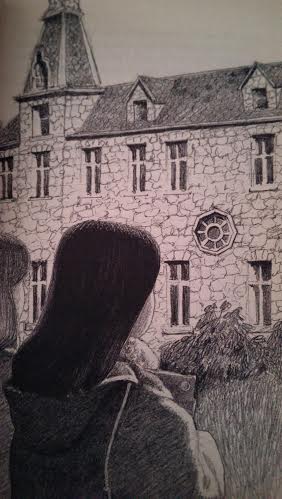
By coincidence, old Mr. Murdock’s granddaughter has recently moved into the old family house, which is huge and reputed to be haunted. In spite of the creepiness of the old place, Cassie finds a job there, helping Miss Murdock with cleaning and unpacking. Miss Murdock’s father made his money in cosmetics, and Miss Murdock employs a secretary named Victoria Presser, who used to be a model. Cassie admires Vicky for her beauty and elegance and looks forward to picking up some beauty tips from her. She also makes friends with Jason, a new boy in town, who also works for Miss Murdock, helping the gardener fix up the grounds. However, it isn’t long before Cassie, Jason, and Cassie’s younger brother, Danny, begin noticing that there is something odd about the old Murdock house.

lipstickmysterypicDanny is the first to notice that there is an octagonal window in the wall of the house, but none of the rooms has a window in that shape. Sometimes, lights can be seen through this window at night. Also, Cassie finds what looks like lab equipment among Miss Murdock’s boxes. Is Miss Murdock involved in something illegal? Does it have something to do with the burglaries that have been occurring around town? Why is the grumpy old gardener sneaking around? Just what is in that hidden room?

The book is currently available online through Internet Archive.

My Reaction

This is a good mystery for tween and early teen girls, who can identify with Cassie’s worries about being beautiful and popular. The moral of the story is that appearances are deceiving, and in the end, Cassie reconsiders what beauty really is and develops more confidence by appreciating the good qualities she already has and developing new interests.  While some of the other girls try to show how grown-up they are by looking grown-up, Cassie really grows up by taking responsibility for her life and the direction she wants it to go, making decisions about what she wants and who her real friends are.

The Valentine Star

The Kids of the Polk Street School

valentinestar#6 The Valentine Star by Patricia Reilly Giff, 1985.

Emily Arrow and Sherri Dent have been fighting ever since Emily refused to play a game with Sherri at recess.  It wasn’t because Emily didn’t like Sherri.  She was just having too much fun running around with her toy unicorn, Uni.  But, Emily made the mistake of running up on top of that huge snow pile near the school fence, the one that the kids aren’t supposed to play on.  Then, Sherri told on her to Ms. Rooney.  After that, it becomes a game of tit-for-tat, each of the girls telling on the other for little things.  While Emily is acting as room monitor while Ms. Rooney is out of the room, Sherri gets out of her seat to get a book instead of doing her work, so Emily writes her name down and tells Ms. Rooney.  Sherri promises that she’ll get even.

Around the same time, Ms. Rooney’s room gets a new student teacher, Ms. Vincent.  Ms. Vincent is very pretty and nice, and Emily likes her immediately.  The kids are making rhyming Valentine’s Day cards for each other because Valentine’s Day is just a few days away, and Emily wants to give a special one to Ms. Vincent.

valentinestarpic1But then, Emily and “Beast” (Richard Best) make a serious mistake.  It was hot inside at lunch, and they couldn’t resist the urge to run outside in the snow for just a couple of minutes without their coats.  Then, they got locked out and had to get Beast’s sister to let them in a different door.  They thought no one saw them, but a neighbor did and contacted the school.  Now, Emily is afraid of what will happen if their teacher finds out that it was her and Beast.  Will the school be angry enough to hold them both back a grade or maybe worse?  Maybe Emily will be spending Valentine’s Day in the school office instead of at the party, watching Ms. Vincent enjoy her special valentine . . . especially if Sherri happens to know what they did.

Many of the The Kids of the Polk Street School books are about the little problems that kids get into but that seem big because they’re young and inexperienced.  Ms. Vincent’s kindness and understanding help Emily and Sherri to work out their differences, and a President’s Day lesson about the honesty of both Lincoln and Washington help Emily and Beast to realize that tattling on yourself makes you a better person than tattling on others.

The book is available to borrow and read for free online through Internet Archive (multiple copies).

Valentine Blues

valentinebluesValentine Blues by Jeanne Betancourt, 1990.

This book is part of the Aviva Granger Stories series.  (It’s the only one I have in the series right now.)

In the last book, Aviva’s best friend, Josh, came to live with her, her mother, and her step-father.  Josh was living in an orphanage before that, and since he and Aviva were close, her mother and stepfather thought that it would be natural to invite him to be part of the family.  At the time, Aviva thought that it was a good idea, but being friends with someone doesn’t mean that it will be easy living with them, and Aviva’s family life is already complicated!

Aviva’s parents are divorced, and both her mother and father are already in new relationships.  Her mother has remarried, and Aviva not only has a stepfather but a half-sister (college age) and half-brother (baby) living in the same house.  Aviva’s father has a girlfriend, Miriam, and Aviva doesn’t get along well with her.  Miriam would like it if she and Aviva’s father had a child of their own.

When Josh comes to live with Aviva’s mother and her family, Aviva realizes that sharing a family and house with him makes things even more complicated.  He takes too long in the bathroom and makes her late to school.  He’s one more person for her mother to pay attention to, so Aviva gets less attention.  Even her dog seems to like Josh better now!

Then, shortly after Valentine’s Day, Aviva overhears Josh and his friend Ronnie Cioffi talking about girls and giving them ratings based on their looks.  Out of 10 points, Cioffi rates Aviva as a 2, and Josh agrees.  Josh has a crush on Louise, a girl they know from school, and she has a much better figure.

It isn’t that Aviva is in love with Josh, who she sees more as a friend/brother, but it hurts that he seems to be taking her place in the family and doesn’t even really appreciate her, joining in with his friend in making fun of her body.  With her time divided between two households, two parents who hardly seem to have time for her these days, and Josh moving in and taking over, Aviva worries that maybe she doesn’t really belong anywhere or to anybody.

It takes a night when Aviva sleeps out in the barn without telling anyone where she is to make the people closest to her realize how much she needs them.  A sleepover at Louise’s house (where the girls candidly discuss their own ratings for the boys they know) and Aviva’s anonymous question in sex ed class also help to put the rating system into perspective for all the kids.

The book has some Christian themes because the children go to a Catholic school, although this book mostly focuses on family life and girls’ and boys’ perceptions of each other.  The kids are eighth graders, and there is also some talk about sex ed.