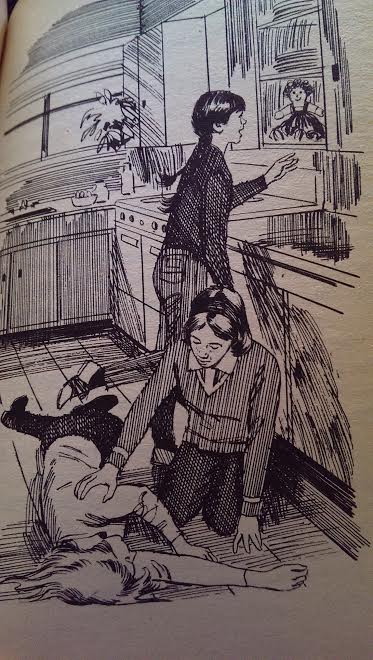
 Meg’s Uncle Hal takes her and her best friend, Kerry, with him on vacation to Merrybones, Maine. He has a cabin there, and it’s a good place to go fishing or exploring in the woods. However, Uncle Hal isn’t just there to relax this time. His friend, Emily Hawthorne, has asked for his help because she’s received some mysterious, disturbing messages.
Emily was born in Merrybones but moved away at a young age to live with an aunt on the west coast because she was orphaned after the death of her father. Her father’s death was mysterious, and Emily has had the feeling that people haven’t told her the full truth of it. It was known that he had a heart condition, and he was found dead in the woods one morning, apparently having died of a heart attack. Emily herself was also found wandering in the woods alone, frightened and talking about a “dark monster”, but she was very young at the time and no longer remembers what happened or what she saw that night.
 She has returned to Merrybones to teach in the local school, but people in this town look at her as an outsider because she has spent so many years away. Now, she has received threatening messages written in rhyme and signed with a star with the number 13 inside. Her pet black cat, Melissa, has also mysteriously disappeared, and Emily is worried about her.
Someone doesn’t want Emily to stay in Merrybones, possibly because they’re afraid of what she might remember about the past. Meg and Kerry soon learn that there are strange legends and stories of witches connected with a cave in the woods. They later discover that someone has been there recently, lighting candles and drawing pentacles like the ones on the threatening messages to Emily. In fact, Mrs. Stoner, the woman who owns the bed-and-breakfast where Meg and Kerry are staying because Uncle Hal’s cabin only has one room, has what appears to be a witch’s spell book hidden in the storage room next to where the girls sleep. To get the answers, Meg and her friends, including Mrs. Stoner’s own children, must summon the courage to go the cave once more and learn more about these mysterious “witches.”
The book is part of the Meg Duncan Mysteries. It is available to borrow and read for free online through Internet Archive.
My Reaction and Spoilers
A creepy mystery like this was just the sort of thing I loved as a kid, but this story kind of bothered me, reading it again as an adult. I had forgotten how it ended, but as I was reading about the secret society in the book and the clues that Meg and her friends uncovered about them, I found myself not just thinking that their spells and witch names were a little hokey for a secret society of adults (“Endorella” indeed!) but also getting angry at the juvenile way they behaved. Part of me thought at first that it was because the witches’ scariness was toned down for the sake of juvenile readers, but more and more, I found myself thinking of them as adults who never really grew up, whose mean, cliquish ways were carried over into adulthood, long after they should have grown out of them. There are adults in real life who are like that. To my surprise, that sense wasn’t just because their little rituals were toned down for children but was actually a genuine clue to the identities and motives of the “witches” and the origins of their secret society. Discovering that actually made me feel a little better. I also think the author did a good job of explaining how a little harmless “fun” can get out of hand and showing the adults’ embarrassment at being caught in their “game.” The secret society isn’t quite as mean or sinister as it first appears, which is also a relief.
There is an interesting twist to the story in who the real author of the threatening messages was. I was pretty sure who the writer was, and I guessed right, but I had expected that this person would be a member of the secret society, which wasn’t true. Also, the secret that the villain is trying to protect isn’t how the father died years ago, which turns out to be just because of his heart condition with no foul play, but the fact that someone stole the money that the father had in his possession at the time he died. The story does end happily, though, including the thief repaying Emily (this person had actually been trying to work up to it for a long time) and Emily agreeing to spare the person’s reputation. The kitty is okay at the end, too!
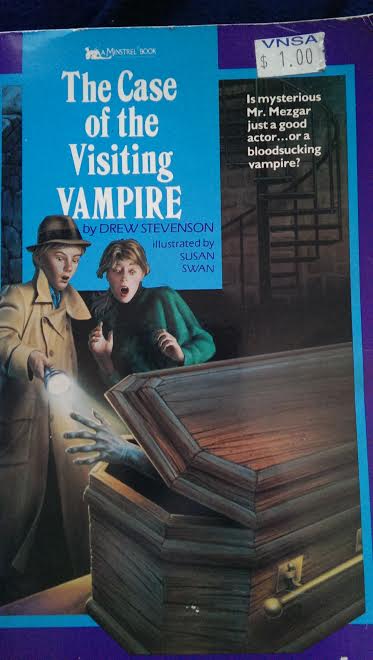 The Case of the Visiting Vampire by Drew Stevenson, 1988.
 The Case of the Horrible Swamp Monster by Drew Stevenson, 1984.
 The course of their investigation takes a strange turn when friendly Mr. Walton, who works as a janitor at the same bank where Huntley and Verna’s mothers work, is arrested for stealing money. The kids refuse to believe that he’s guilty and soon learn that there is a connection between the thefts and the mysterious monster and possibly the strange fisherman who has also been lurking around the swamp.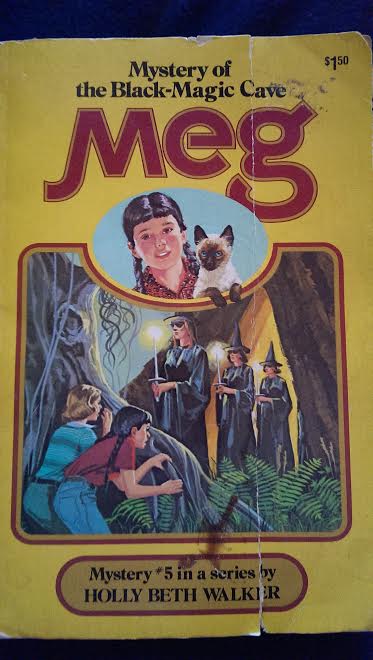
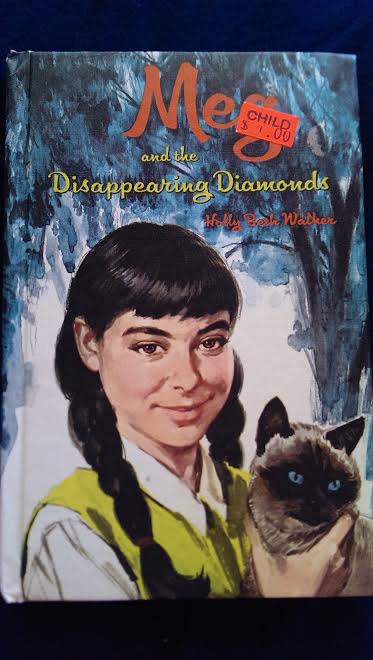 Meg and the Disappearing Diamonds by Holly Beth Walker, 1967.
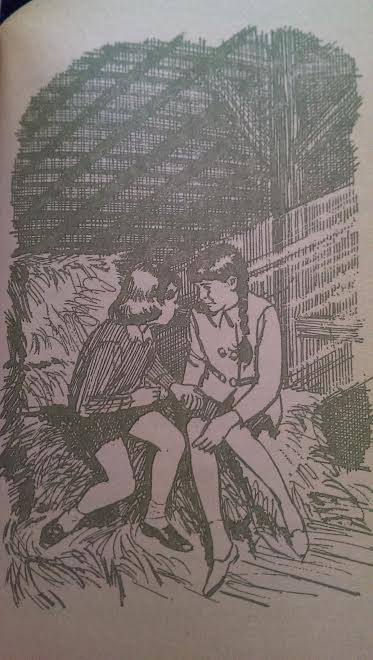 Mrs. Partlow invites a few friends to her house for tea to show them her jewelry and thoughtfully invites Meg and Kerry to join the women. Meg and Kerry are excited at the chance to attend a grown-up tea party and to see Mrs. Partlow’s fabulous jewelry. However, the party is crashed by Mrs. Glynn, a new woman in town. Mrs. Glynn has three trained dogs that she dotes on. She dresses them up in fancy costumes, and she can’t resist the opportunity to show them off when she wanders into the gathering in Mrs. Partlow’s garden. The dogs cause a disruption, and after it’s over, everyone realizes that Mrs. Partlow’s diamond jewelry is missing!


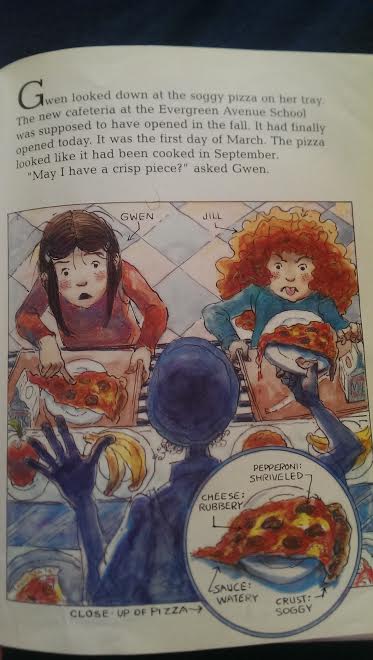 Ms. Lensky, the cafeteria lady at Gwen and Jill’s school, is just plain mean. All of the food that the cafeteria serves is yucky, even though the cafeteria is new. There will be a party to celebrate the opening of the new cafeteria, and even the kids’ parents and the mayor are invited. Gwen and Jill are happy because their class will get to help decorate the cake. However, Ms. Lensky, the M.C.L. (Mean Cafeteria Lady), doesn’t like the girls, and she blames them for a number of accidents that happen in the cafeteria.

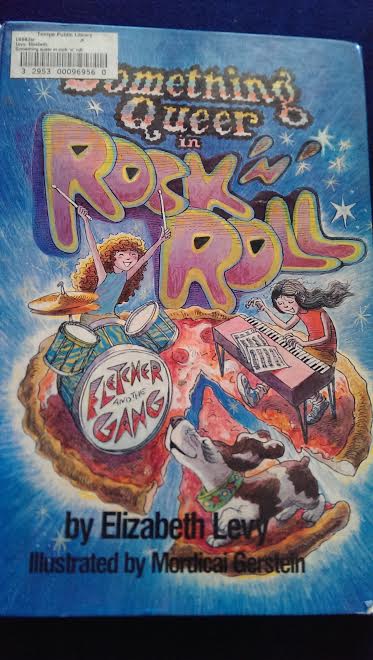
 Gwen and Jill join a couple of other friends in forming a rock band. They want to enter a rock contest run by a local tv station. In order to enter, they have to have an original rock song, so they write one about Jill’s dog, Fletcher. They discover that Fletcher loves pizza so much that he gives a spectacular howl when they offer him some. They make Fletcher and his wonderful howl part of their act.
 Fletcher is all right, but now, he suddenly hates pizza! It seems that Fletcher’s abductor fed him nothing but pizza until he started to hate it. Did someone do that on purpose to ruin their act for the contest? How would this person have even known about their act? Also, what can they do about the contest now that Fletcher is more likely to run from the sight of pizza than howl for it?
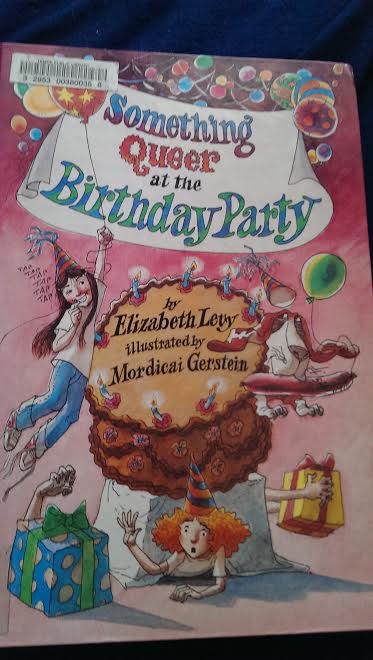 Something Queer at the Birthday Party by Elizabeth Levy, illustrated by Mordicai Gerstein, 1989.
 Gwen takes her party and all the guests on a hunt across town for her missing presents, but the big clues turn out to be right back where they started, and Fletcher leads them right to what they’re looking for.
 #28 Lauren’s New Address by Susan Saunders, 1990.
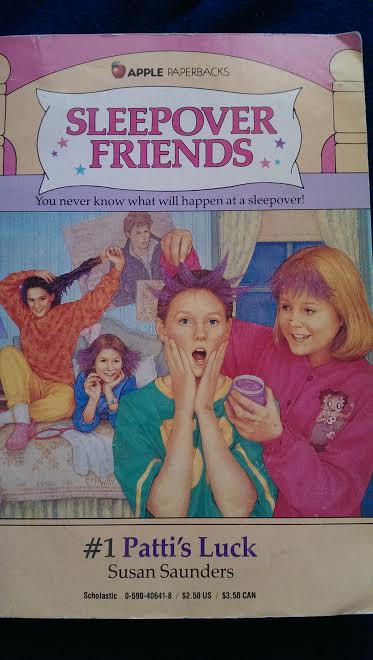 #1 Patti’s Luck by Susan Saunders, 1987.
 Jestress's Forgotten Books and Stories