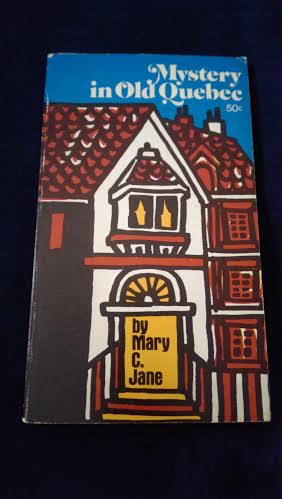
The Mystery in Old Quebec

mysteryoldquebecThe Mystery in Old Quebec by Mary C. Jane, 1955.

Mark and Kerry, a brother and sister, are visiting Quebec with their father, who is on a business trip. Their father allows them to explore the city on their own during the day while he works (something that would be unlikely to happen in modern times). The kids enjoy sight-seeing and learning French words and phrases.  They even make a new friend in the city, but they are troubled by events at the quaint little inn where they are staying.

On their first day there, Kerry’s coat mysteriously disappears and reappears with some strange messages in the pocket.  A boy wants them to take a message to someone in the city.  At night, Kerry hears someone crying in the next room. Is the boy being held prisoner at the inn? If so, why? Kerry and Mark are determined to help in any way they can, but time is running out.

The book is currently available online through Internet Archive.

My Reaction and Spoilers

mysteryoldquebecpicThe solution to the mystery involves family quarrels, custody issues, and racial tensions. In spite of that, this is actually a very gentle story.  In the end, the kids are dependent on the people the mysterious message was intended for to help a troubled, lonely child.  It turns out that the boy is an orphan, and some of his relatives are white, and some are First Nations (Native American). There is a fight for the boy’s custody, but the boy knows where he really wants to be.

The author describes the atmosphere of Quebec in some detail. The famous landmarks probably haven’t changed much, although I don’t know if all the descriptions are accurate anymore. I also thought it was interesting how the author includes some French phrases and their pronunciations and translations as the kids learn to communicate with French-speaking people in the city.

The Blue-Nosed Witch

BlueNosedWitchThe Blue-Nosed Witch by Margaret Embry, 1956.
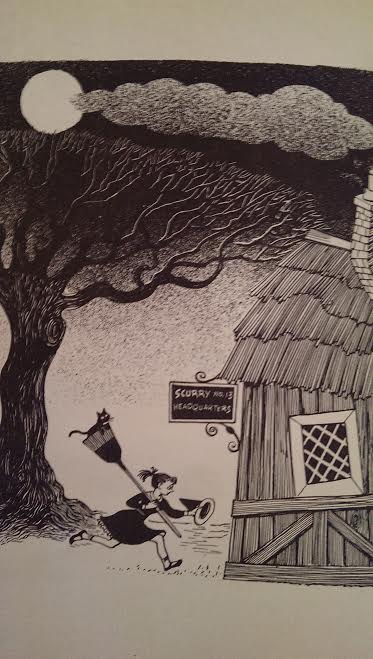
Blanche is still a very young witch, but because of her magnificent blue nose (which she can make glow at will), she’s allowed to join a group of adult witches, Scurry No. 13.  Their specialty is beautiful flight formations on their broomsticks, and they’re planning a special one for midnight on Halloween.

But, Blanche has a bad habit of being late to everything.  Some of the other witches have started complaining about her, saying that she’s too young and irresponsible to be part of Scurry No. 13.  If she’s late for the flight on Halloween, they might decide to send her back to Scurry No. 2 1/2 with the other young witches, where she’d only be allowed to ride a whisk broom.

To make sure that Blanche will be on time for Halloween, her friend Josephine sets her alarm ahead a couple of hours to give her extra time to get ready.  Unfortunately, Blanche doesn’t know that Josephine did that, so she sets her alarm ahead herself.  When she wakes up on Halloween night, it’s still early evening, instead of late at night.

BlueNosedWitchPic1Blanche looks for her fellow witches but ends up joining a group of trick-or-treaters by mistake.  They love her blue nose and introduce her to the idea of trick-or-treating.  Thinking that even the grumpiest man in town would be impressed by Blanche’s amazing nose, they stop at his house, too.  The old man isn’t impressed by anything and plays a mean trick on the kids.  However, Blanche is a real witch, and she and her cat Brockett give the old man a real Halloween scare.
Blanche is having fun on Halloween, but will she keep track of time well enough to join the other witches in their flight?

Even though this wasn’t written to be an historical novel, in a way, it kind of is now.  One of the interesting things about this book is that you can tell from the way the kids are trick-or-treating that it’s the 1950s.  Kids today don’t get jelly donuts or apples while trick-or-treating, and in this day of giving out only prepackaged treats for safety reasons, the kids would probably have to throw them away if they did (sigh).  Also, there is still the implied threat of Halloween tricks when the kids go asking for treats, something less common today.  Instead of saying “Trick or treat!”, the kids say “Candy or cake or your windows we’ll break!” (although the kids later promise the adults that they’re not going to soap any windows).  My mother said that the popular saying when she was young was, “We are the beggars of the street.  Do we soap, or do we eat?”

The book is available to borrow and read for free online through Internet Archive.

BlueNosedWitchPic2

Terror on Cemetery Hill

cemeteryhillTerror on Cemetery Hill by Drew Stevenson, 1996.
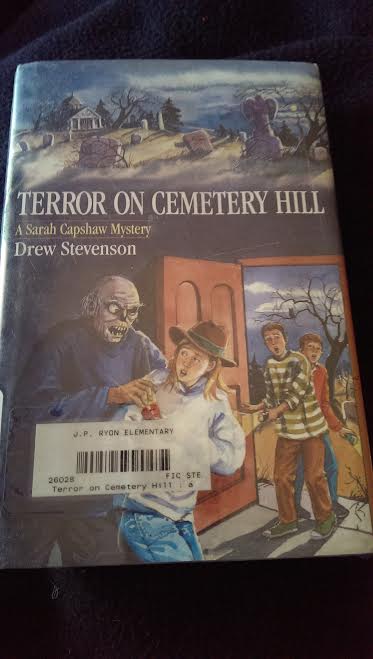
Halloween is coming, and spooky things are happening around Wilsonburg. Randall Davis, a new boy in town, comes to the diner looking for Sarah because he’s heard that she likes to investigate mysteries. Randall’s mother has recently become the caretaker of the cemetery, and Randall enjoys astronomy, so he decided one night to take his telescope up on top of Cemetery Hill. While he was there, he saw what looked like a hideous monster. Randall asks Sarah to have a look around the cemetery and help him figure out what he saw.

After some persuading, Sarah convinces Clark and Frog to come with her. Not only do they see the creature in the cemetery, but they find Mrs. Biddle, head of the town’s group of psychic investigators, unconscious in the Wilson family mausoleum. The Wilsons are the family that the town was named after. Mrs. Biddle and her group have been told before not to hold any ceremonies or investigations in the cemetery because they disturb people.  She insists that she was investigating the creature in the cemetery and that it pushed her and knocked her out. Something strange is going on in the cemetery, but is it a creature come back from the dead, or maybe something to do with the recent bank robbery in town?

Everyone believes that the bank robbery was just one in a series of robberies staged across the country by a robber known as the Village Bandit because he tends to rob banks in small towns.  However, Sarah has a different theory.

This is part of the Sarah Capshaw Mysteries series.  It is currently available online through Internet Archive.

Toying With Danger

toyingwithdangerToying With Danger by Drew Stevenson, 1993.
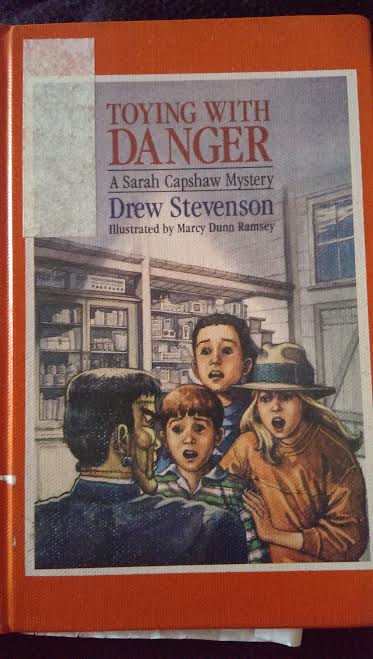
Sarah Capshaw is lamenting to her friend Clark that she hasn’t had an interesting case to solve since she and her parents moved to Wilsonburg when their friend Frog tells them that the local bully saw a monster at the old Harley farm outside of town.  Rumor has it that a mad scientist bought the place.  Naturally, Sarah wants to investigate.

It turns out that the “mad scientist,” Dr. Becker, is actually an eccentric toy inventor.  The “monster” is an electronic Frankenstein monster.  Dr. Becker is actually pretty nice and is even interested in seeing the detective board game that Frog is trying to invent.

Even though the monster wasn’t a real monster, there are still strange things happening in the woods surrounding the old farm where Dr. Becker’s workshop is.  The local bully is hanging around in the woods and trying to scare everyone away.  The kids also see a mysterious man hanging around, and Sarah wonders if he could be spying on Dr. Becker in order to steal his designs.

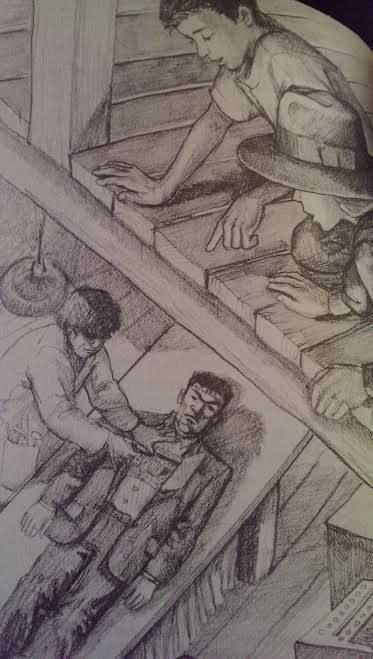
toyingwithdangerpic2It seems that Sarah is right that someone is trying to spy on Dr. Becker.  The kids learn more about the money involved in buying and selling toy designs when they visit the Too Wonderful toy company for a tour with Sarah’s grandfather.  Making toys is serious business, and companies guard their designs very carefully.  The Too Wonderful toy company wants to purchase some of Dr. Becker’s designs, but one of the members of the company says some strange things about Dr. Becker.  Can the kids trust him?  Can they trust the strange Dr. Becker?  Can Sarah catch the spy before it’s too late?
This is part of the Sarah Capshaw Mysteries series.

One Ghost Too Many

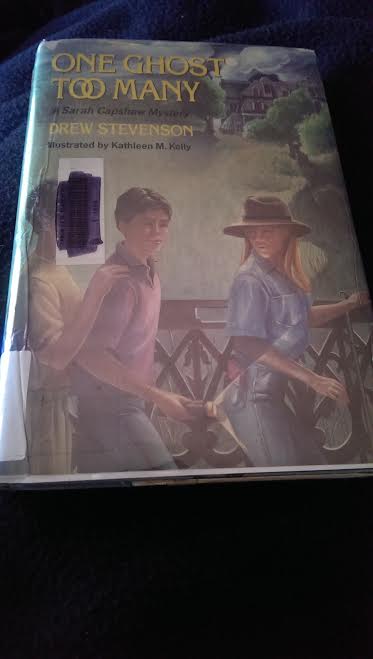
oneghostOne Ghost Too Many by Drew Stevenson, 1991.
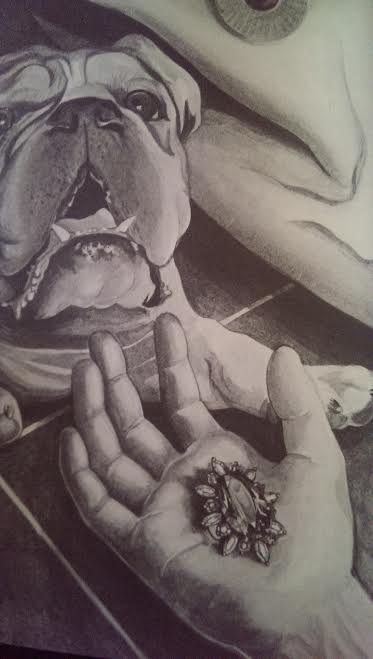
Clark Lannigan meets Sarah Capshaw by accident when she comes to spend the summer with her grandparents in Wilsonburg. Sarah’s grandfather, Conrad Capshaw, is a lawyer, and he is handling the estate of Rodney Maplewood. Rodney Maplewood used to be a museum curator and had an impressive collection of antiques which he kept in his large house, Maplewood Manor.

Maplewood Manor is the oldest and the spookiest house in town. It was once owned by the eccentric Antonia Whitemarsh, who was a spiritualist and believed that her father’s spirit still inhabited the house. Now, people in town think that Rodney Maplewood’s ghost is also haunting the house because lights have been seen in the house at night. Conrad Chapshaw also says that, although nothing is missing, some objects in the house have been moved around.

oneghostpic1Sarah persuades Clark and his friend “Frog” Fenniman to join her investigation of the house, but besides the resident ghost, they will also have to deal with a local group interested in psychic phenomena and a mysterious stranger who is paying the local bully to spy on the house.

This is the first book in the Sarah Capshaw Mysteries series.  Sarah and her parents move to Wilsonburg, and she has other adventures with Clark and Frog, all narrated by Clark.

The book is currently available online through Internet Archive.

Jumble Joan

jumblejoanJumble Joan by Rose Impey, 1989.

A boy and his friend, Mick, take his little sister upstairs to explore their grandmother’s attic one evening.  The boys are hoping to scare the girl by telling her all sorts of creepy stories about the stuff they find in the attic, but if they’re scaring anyone, it might just be themselves.

A rocking horse becomes one of the dreaded “Ten O’Clock Horses” that might drag a child off into the night if she isn’t in bed on time.  An old stuffed parrot in a cage becomes “The Deadly Vampire Bat”, waiting to suck their blood.  But, the most sinister creature of all might be “Jumble Joan”, who hides by pretending to be a pile of old clothes, ready to steal away any little girls who might want to play dress up in their grandmother’s attic!

Although the brother narrates the story, the pictures show that his little sister knows exactly what the boys are trying to do, and she does things to turn the situation around.

This is one of the books in the Creepies Series.  Kids under the age of seven might find stories in this series a little scary because they focus on how stories about monsters can build in the imagination, even if you know that you made them up yourself.  Still, all of the books have good endings, and this one is pretty funny.

This book is available to borrow and read for free online through Internet Archive.

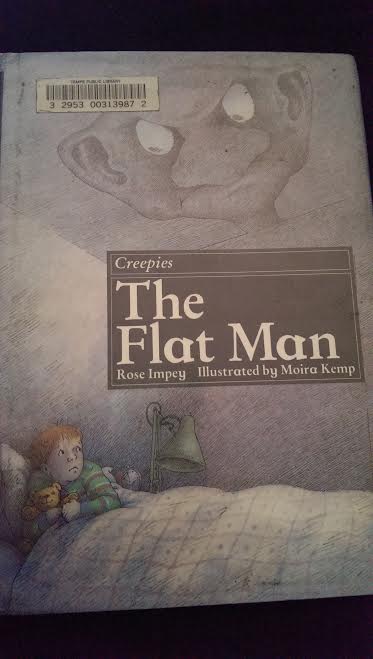
The Flat Man

flatmanThe Flat Man by Rose Impey, 1988.

Before Slender Man, there was . . . The Flat Man!  And he wasn’t quite as scary. As far as I know, there is no connection between the two fictional characters other than a similarity in name.  Still, the Creepies Series, while picture books, should probably only be given to children no younger than seven who like scary stories.  They might provoke nightmares in very young children and sensitive children.  I liked these stories as a kid for their imagination, but individual tastes may vary.

Like all the books in the Creepies series, The Flat Man features a child who enjoys being a little scared and makes up his own imaginary monster to battle with at bedtime.  The entire time, the boy knows that the monster is imaginary and prides himself on knowing just how to deal with him.

While lying in bed one night, the boy imagines the scary creature called the Flat Man for the fun of it.  He amuses himself with imagining that every sound he hears is the Flat Man, a paper-thin creature that can sneak in anywhere, squeeze himself through any crack. But, the Flat Man has weaknesses: he’s afraid of light and open spaces. The boy acts out his duel with the imaginary Flat Man, enjoying his triumph . . . right up until his father comes in to find out what’s going on.

This book is available to borrow and read for free online through Internet Archive.

My Reaction

Even though his imaginary creature is frightening, the boy enjoys it, comes up with his own solution for defeating it, and acts out a triumphant battle with it. Those who don’t mind a bit of spookiness will appreciate the boy’s imagination and may giggle at how he gets a bit carried away with his fantasy.

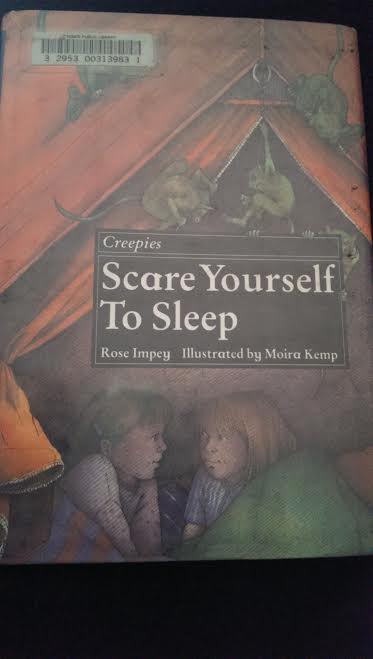
Scare Yourself to Sleep

scareyourselfScare Yourself to Sleep by Rose Impey, 1988.

A girl and her cousin are camping out in the backyard when they decide to play a game they made up themselves called “Scare Yourself to Sleep.” They take turns inventing and telling stories about monsters lurking out in the darkness. The winner of the game is the one who successfully scares the other.

They talk about the Garbage Goblins, who live in trash cans. The Flying Cat is a creature that is half-cat, half-moth. The Tree Creeper lives in trees and looks like a branch, just waiting to fall down on someone. But, the best of all is the Invisible Man!

However, their stories are interrupted by the girl’s brother, Simon, who is trying to scare them . . . at least, they think it’s probably Simon. The monsters are made up, aren’t they?

The book is currently available online through Internet Archive. It’s part of a series.

scareyourselfpic1

My Reaction and Spoilers

I first read this when I was about seven years old, and I’ve loved it ever since! The pictures show not only what’s happening in the girls’ imaginations but hint at what’s happening in real life, just outside their tent as Simon acts out the things in their stories. It might be a little too scary for very young children, but kids about seven and up will like it (provided that they also like creepy stories).

The illustrations are vivid and detailed, and readers may be wondering up until the very end how much is really imagined. All the books in the Creepies Series are about the power of imagination and how it can be fun to be a little bit scared.

scareyourselfpic3

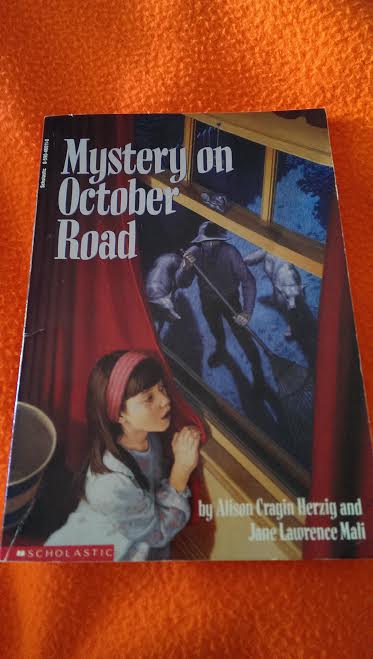
The Mystery on October Road

OctoberRoadThe Mystery on October Road by Alison Cragin Herzig and Jane Lawrence Mali, 1991.
A strange man has moved next door to Casey.  He always wears a bandana tied across the lower part of his face, like a bandit.  His pets are the strangest dogs Casey has ever seen, huge Irish Wolfhounds.  He’s started fixing up his new house, but for some reason, he only likes to work at night.

One day Casey and her friend Cats (really, they’re both named Catherine, but they each have nicknames) go to take the man some bread that Casey’s mother baked, and they’re frightened away by one of the dogs.  Casey goes back to get the bread they left behind, and the man tells her to go away and leave him alone.

Casey and her friends (Cats and Benny, a boy Cats likes) are curious about this strange man.  They even wonder if he could be some kind of gangster, hiding out.  At her friends’ urging, they sneak into his house one day to look around.  When the man comes back unexpectedly, her friends get away in time, but Casey falls and hurts her ankle.  The man finds her in his house, and she learns the truth about him.

The man isn’t a bad guy, and Casey even becomes a friend for him.  The story ends on Halloween, when the man creates a special Halloween display for Casey of beautifully carved pumpkins.  The part that always fascinated me was the way he carved them, by peeling the skin off the pumpkin and only leaving it in places where he wanted dark lines.

Part of the story is about how appearances can be deceptive.  The stranger is actually a good person, but he is physically disfigured, which is why he doesn’t like people to see him.  For part of the story, Cats isn’t really a very good friend for Casey, neglecting her feelings and the feelings of the mysterious stranger in order to impress Benny.  But later, when she realizes that Casey was right about the stranger and that she was really hurt in their little escapade, she shows that she can be a better friend, too.

The book is currently available online through Internet Archive.

The Talking Table Mystery

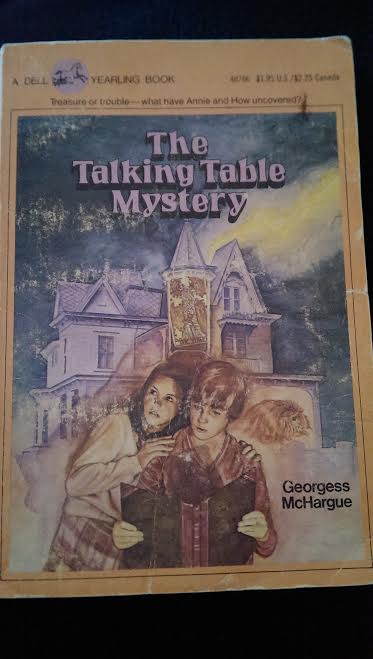
TalkingTableThe Talking Table Mystery by Georgess McHargue, 1977.

Annie Conway and her friend How are helping her great aunt to clear out her basement when they find a table that How thinks would work for his pet guinea pig’s cage. However, it’s not an ordinary table. It makes strange noises whenever they press on it, and in the box tied to the top of the table, they find a strange assortment of objects, including a little silver piccolo and some diaries.

Most of the diaries belong to Annie’s great grandfather, but there is one written by an unknown young girl. The girl apparently stayed in Annie’s great grandfather’s house years ago, and her diary refers to the girl’s mother’s strange behavior and the girl’s fears that something bad will happen. The diary itself is mysterious, but soon the kids start receiving threatening notes, telling them to hand over the diaries or something bad will happen. Who wants the diaries and why?

The book is available to borrow and read for free online through Internet Archive.

My Reaction and Spoilers

The basis for the mystery is 19th century spiritualism.  The former owner of the table was a spiritualist who used it for seances, creating rapping noises when the “spirits” were present.  Her daughter was the girl who wrote the diary.  She wasn’t happy about how she and mother kept moving around in search of new clients and how she had to help her mother by playing ghost during seances. They were staying with Annie’s great-grandfather because he was suffering from grief over the death of his young son, and the spiritualist was holding seances to try to contact his spirit.  At least, that’s what Annie’s great-grandfather thought.  The bad thing that the girl thought would happen was that she and her mother would be caught faking their seances, which turns out to be exactly what happened.  Annie’s great-grandfather was angry at being deceived and threw them out of the house, but he confiscated the rigged table and other things they used in their seances, including the girl’s beloved silver piccolo, so they wouldn’t be able to try their act on anyone else.

However, there is one more secret about Annie’s great-grandfather and the spiritualist. Annie and How eventually discover that they had a love affair during the spiritualist’s stay in the house. There is some discussion among the adults about how the spiritualist suffered more consequences and stigma for the affair than the great-grandfather did, although he was a married man when it happened.  As for what eventually happened to the girl and her mother after this incident, the clues are contained in the diary and with the people who now want them.

I thought that the use of the rigged spiritualist table in the story was fascinating. It’s basically like a piece of antique magician’s equipment that not everyone would know existed.  The story also introduces some interesting historical details about the concept of 19th century spiritualism and the types of people who followed it.  Annie’s great-grandfather was grieving for the loss of one of his young children, and like others of his time, he wanted to reach out to the spirit of the one he lost, in search of solace for the loss.  How much of the affair with the spiritualist was fueled by his grief and gratitude for someone he thought was helping him is unknown because we never hear his perspective on that, but his anger at discovering how he had been deceived shows that he did honestly believe that the seances were real and felt betrayed to realize they weren’t.  However, actions have consequences, and there were still some consequences from this incident that were never fully resolved.

The author is very knowledgeable on the subject of spiritualism, and she also wrote a nonfiction book on the subject.