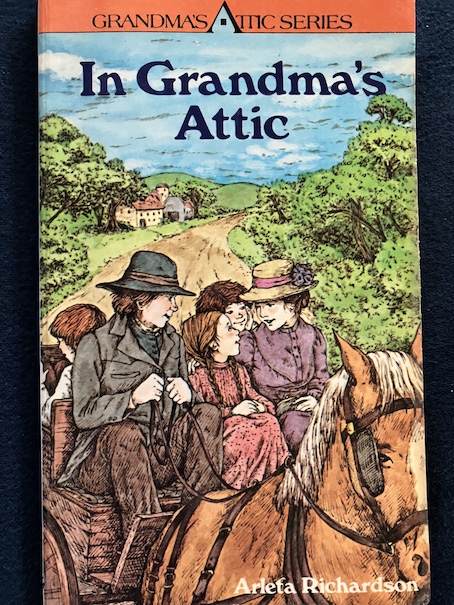
In Grandma’s Attic

The books in the Grandma’s Attic Series are collections of short stories (although I think later books in the series are novel-length stories) told by a grandmother to her granddaughter about life when she was young.  They typically begin with the young granddaughter (unnamed in the stories) asking her grandmother, Mabel, about an object in her house, and Mabel then tells the story about it.  These are usually short, slice-of-life family stories with a humorous twist, often with a moral (the stories generally have Christian/Biblical themes).  The inspiration for the stories was the author’s own grandmother, who grew up on a farm in Michigan in the 1800s.  I’m kind of sentimental about them because the books I have were presents from my own grandmother, who also grew up on a farm.

This series is good for discussing aspects of life in the 1800s. They include little details about daily life like the types of chores children did, how they got to school and what lessons were like, and other little household details like warming clothes on a wood-burning stove and throwing water from washing dishes outside because they didn’t have a modern sink.  They’re also good for talking about morals or making ethical decisions (it’s not just Christian themes, Mabel also talks about more general issues of growing up, like honesty, responsibility, and the awkward mistakes children make when they try to act more grown-up than they really are) or just for a good laugh because some of the stories are really funny (learn the perils of attempting to sit down in a hoop skirt without really knowing how)!

In Grandma’s Attic is the first book in the series and it is available to read for free online through Internet Archive.

Pride Goes Before a Fall

Mabel and her best friend, Sarah Jane, badly want to wear hoop skirts like the fashionable young ladies and have everyone admire them, even though their mothers say they are really too young. When they get the chance to wear them in front of everyone, they make a mistake and learn the lesson in the title of the story.

When God Knew Best

Mabel talks about a childhood disappointment that turned out well in the end because she was saved from disaster.  Sometimes disappointments are blessings in disguise.

The Red Bonnet

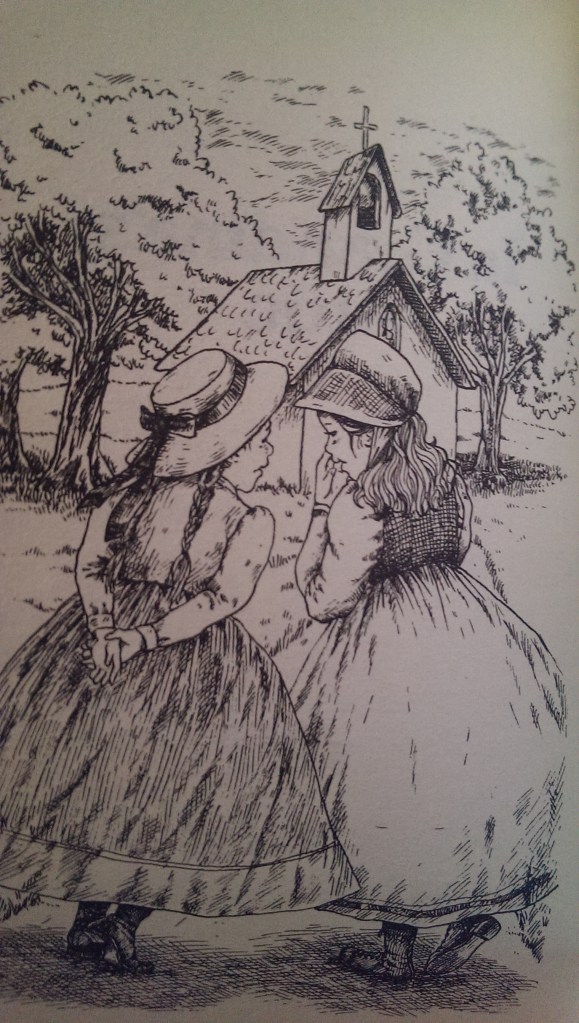
A lost bonnet gives everyone the wrong impression, and a search begins for a not-so-missing child.

Grandpa’s Apron

The other guys teased him when he asked Mabel to make him a work apron with pockets because aprons were supposed to be women’s clothing, but his comes in handy in some unusual ways.

Ma’s Busy Day

Being a mother is hard work, and when a hectic day leaves Mabel’s Ma no time to change her aprons when one after the other gets dirty, the layers of aprons she has on at the end of the day become a record of the day’s events.

Grandma’s Mistake

Mabel misunderstands something her mother says, and it causes her problems at school.

The Button Basket

A strange Indian (Native American) comes to the farm and trades a beautiful basket for food.  Unfortunately, they can’t speak the same language, so they never learn the reason why, and they marvel over the mystery of the basket’s origins.

The Little Gray Shoes

Mabel learns that vanity comes at a price when she insists that she wants a beautiful pair of gray shoes that don’t fit her properly.

Nellie and the Buttons

Why does their horse, Nellie, keep trying to bite the buttons on Mabel’s new coat? Nellie might be smarter than they think.

The Pearl Buttons

When Mabel has trouble fastening the buttons on her new dress, she finds a creative solution that causes her some embarrassment.

Nellie’s Trips to Town

When Mabel’s family makes a trip to town, their horse and buggy suddenly disappear.  Then, as soon as they get a ride from a friend, they are suddenly returned.  Why?

The New Pump

Young Mabel learns the hard way why it’s a bad idea to lick cold metal in the winter.

You Can’t Always Believe

When strange things start happening around the farm, Pa blames one of Mabel’s brothers but learns that it isn’t a good idea to be too quick to blame.

The Old Door

Mabel’s brother plays a trick that causes some embarrassment for their mother.

Pa and the Dishwater

Mabel’s fear of the dark makes it difficult for her to throw the dishwater outside after they wash the supper dishes.  When she thinks she’s found a shortcut for getting rid of the dishwater, it gets her into trouble.

The Dishes

Mabel tries to put off her chores so that she can play with her friend, but the guilt she feels takes the fun out of it.

Ma’s Birthday Cake

Mabel is so pleased to be making a cake for her mother on her birthday, but has she gotten the recipe right?

Grandma’s Warm Clothes

Mabel and her brothers used to warm their clothes by the stove on cold winter mornings, but Mabel’s attempt to make it easier on herself and her forgetfulness have unintended consequences.

Grandma’s Prayer

Mabel thinks that a selfish prayer she made may have brought bad luck to her family.

Molly Blue

Molly Blue the cow always gives Mabel trouble.  Her family thinks it’s funny until they see how much Mabel needs their help.

Grandma and the Gun

Gun safety is a big issue in modern times, and it was back then, too.  Mabel is a curious child and makes a mistake that almost has very serious consequences, but she learns an important lesson.

What Grandma Lost

When Mabel’s brothers are sick and she gets to take the family’s horse and buggy to school by herself (a special privilege for a child of her time), she decides to show off a little.  But, in her attempt to look more grown-up and responsible, she ends up proving that she’s not as grown-up and responsible as she thought.

What Did You Expect?

Not exactly a full story, but Mabel shows her granddaughter what a miracle looks like because she believes it can happen.
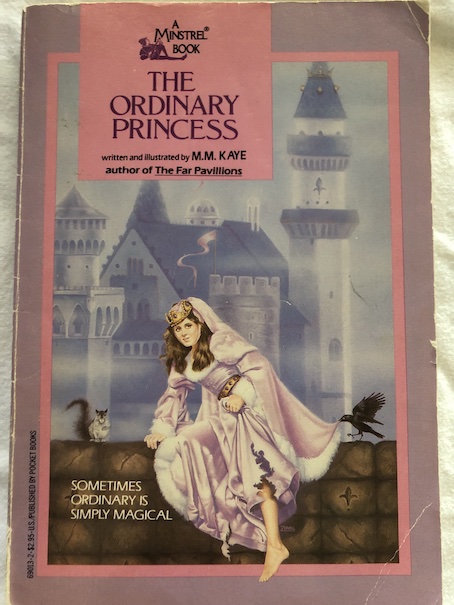
The Ordinary Princess

The Ordinary Princess by M.M. Kaye, 1986.

Lavender’s blue,
Rosemary’s green,
When you are king,
I shall be queen.

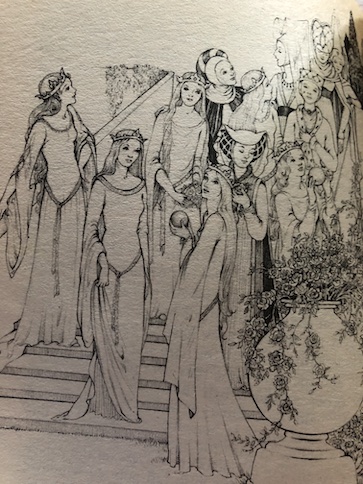
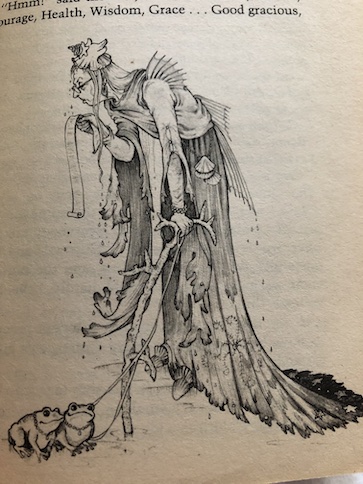
Everyone is excited when a seventh princess is born in the kingdom of Phantasmorania.  Everyone knows that seventh princesses are always the luckiest and the most beautiful.  Indeed, when Princess Amethyst Alexandra Augusta Araminta Adelaide Aurelia Anne is born, she is a beautiful baby who never cries and who has perfect blonde curls and blue eyes.  But, when one of her fairy godmothers, Old Crustacea, comes to the christening to give her blessing and sees all the perfect presents everyone has given her and little Princess Amethyst’s six perfect older sisters, she decides, “I am going to give you something that will probably bring you more happiness than all these fal-lals and fripperies put together.  You shall be Ordinary!”

Of course the king and queen are horrified, but there’s nothing to be done.  From that day on, Princess Amethyst becomes an ordinary baby who grows up to be an ordinary girl.  She cries when she’s hungry and tired.  Her golden hair darkens from golden blonde to a mouse brown and loses its curl.  She gets freckles!  Sometimes, she even makes spelling mistakes!

While everyone else is distressed at Princess Amethyst’s (now called Amy most of the time) lack of perfection, Amy realizes that Old Crustacea was right about it making her happier.  While her perfect sisters must behave themselves and keep their clothes clean, Princess Amy sneaks off to run and play.  She meets ordinary people, makes new friends, and has fun adventures.

But, eventually, all of her sisters grow up and get married.  When it’s Princess Amy’s turn, most of the princes aren’t interested because she’s not the beautiful, perfect seventh princess that she’s supposed to be.  Amy would be alright with that, but when her father and his advisors come up with an outlandish scheme to attract a prince that involves a dragon, Amy decides to put a stop to it by running away.

For a time, she lives a carefree life in the forest, but eventually, like all ordinary people do, she realizes that she’s going to need money to buy new clothes.  On the advice of Crustacea, she journeys to a neighboring kingdom and finds a job in the palace there as a kitchen maid. 

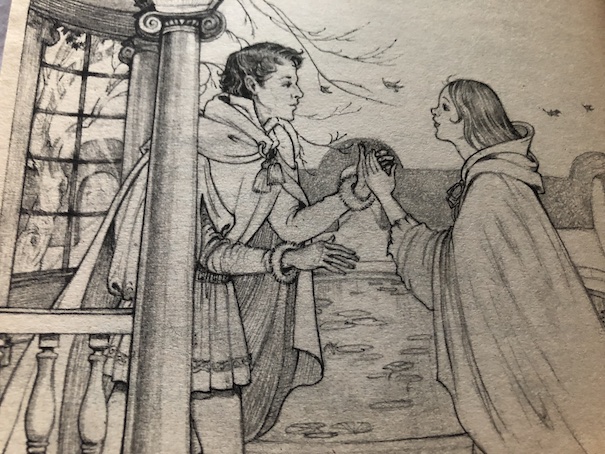
Actually, she finds more than that, finding her place in the world and someone who loves her for the ordinary princess that she is.

The book is divided into four parts, each of them titled after a verse from a version of the old folk song Lavender’s Blue (most versions say “lavender’s green” instead of “rosemary’s green”, although I do like saying “rosemary” better – this is the tune). The book also contains many small, black-and-white illustrations alongside the text.

It is available to borrow and read for free online through Internet Archive.

My Reaction

I think this is a beautiful book with a good message for girls. Being glamorous or trying to conform to someone else’s idea of perfection doesn’t bring as much happiness as knowing who you really are and finding someone who loves you and wants to live the same kind of life you do, imperfections and all. Not every “prince” out there is looking for the same type of “princess,” just the one that’s right for him. In the end, Amy finds a king who is just her kind of person.

Never Hit a Ghost with a Baseball Bat

GhostBaseballBatNever Hit a Ghost with a Baseball Bat by Eth Clifford, 1993.

Mary Rose and Jo-Beth are visiting another museum with their father, but they’re not happy about it.  Mary Rose is annoyed because there’s a boy she likes, and no matter what she does, he just won’t pay attention to her.  Jo-Beth is annoyed because she just turned eight years old, and well, . . . she just turned eight.  Nothing special happened on her birthday.  She doesn’t look different, she doesn’t feel different, and she just had to go to school like normal.  Their father, Harry, hopes that a visit to a strange museum dedicated to antique trolleys will help snap them out of their funks, although neither girl thinks so at first.

But, it seems like the trolley museum might be inhabited by a ghost.  The owner, Sam Thorne, doesn’t think so, but his assistant, Hoot Turner, can’t think of any other explanation.  Strange things are happening.  Food and other objects disappear.  Things are moved around.  Areas are . . . unexpectedly tidy?  What gives?  If it’s a ghost, it’s apparently a ghost that believes in cleanliness and doesn’t mind doing the dishes.  But, if the ghost is so friendly and useful, why do mysterious voices call out to them to beware?

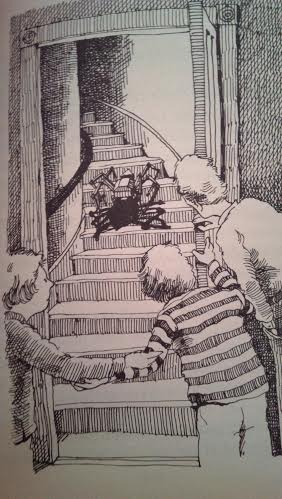
GhostBaseballBatPicThe girls explore the trolleys parked in the museum and admire the manikins dressed in old-fashioned clothing that are part of the displays in each trolley car, but more strange things happen.  A teddy bear seems to speak to them, even though it isn’t the kind with a string and a talk-box.  The manikins start to seem creepier.  Mary-Rose and Jo-Beth are only armed with a baseball bat from one of the displays and the old teddy bear (which terrifies Jo-Beth).  But, Mary Rose is determined to find the ghost, even if it’s the last thing she does!

Telling you about one of the themes of this story would spoil the ending, but both the girls come to realize that there are people in the world with much more serious problems than the ones that they were worried about at the beginning of the story.  There is a happy ending for everyone as Mary Rose turns her mind to something more interesting than a boy who takes no notice of her and Jo-Beth appreciates her birthday more by throwing a special party for someone else.

This is part of the Mary Rose and Jo-Beth Mysteries series. It is available to borrow and read for free online through Internet Archive.

The Dastardly Murder of Dirty Pete

DirtyPeteThe Dastardly Murder of Dirty Pete by Eth Clifford, 1981.
Mary Rose Onetree is starting to think that her father really likes her younger sister, Jo-Beth, better than her.  Her father seems to like Jo-Beth’s dramatic flights of fancy, and he likes to say things to make her laugh.  Mary Rose, on the other hand, is the sensible, practical one, and her father keeps getting irritated with her advice, especially when she frequently turns out to be right.

On their latest car trip, going to visit their Grandmother Onetree on the West Coast, Mary Rose warns her father not to leave the main road (something that he loves to do because he’s a newspaper man and can’t help being curious), and he does so anyway.  Mary Rose warns him that she can’t even find this little side road on the map, but when he sees the sign that says, “Inn of the Whispering Ghost on Skull Valley Road.  Two miles right at the first crossroad ahead,” nothing can stop him from going further to investigate.

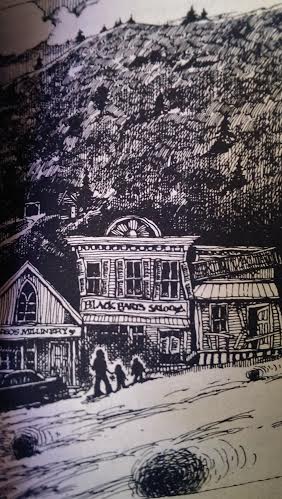
DirtyPetePicHarry Onetree and the girls find a ghost town with a hotel, an opera house, and several other buildings.  Although Harry only means to look around for a little while, he forgets to set his parking brake (something else Mary Rose warns him about, which he ignores), and their car rolls backward into a ditch.  Since it’s getting dark, they’re stranded in the ghost town for the night.  But, they’re not alone there.

They find some food in the hotel’s kitchen, and one of the chairs is warm, as if someone had just been sitting there.  In an old newspaper at the hotel, they read about Sorehead Jones, who murdered the hotel owner, Dirty Pete, back in 1905 in order to get his hidden treasure of gold.  But, Dirty Pete wounded Sorehead before his death, and Sorehead died shortly after, swearing that he’d seen the ghost of Dirty Pete.  Supposedly, Sorehead is also a ghost who wanders through the town whispering, “Where is the gold?”

Could the ghost be the mysterious person in the hotel?  But, why would a ghost need food?  Then, Harry realizes something about the town that changes everything, but they still need to confront the whispering ghost before they can leave.

The solution to this one concerns the difference between fantasy and reality, and the lengths that someone might go to in order to make someone else happy.  Mary Rose also comes to realize how much her father really loves her.

This is part of the Mary Rose and Jo-Beth Mysteries series.  It is available to borrow and read for free online through Internet Archive.

Scared Silly

ScaredSillyScared Silly by Eth Clifford, 1988.

Grandma Post has decided that Mary Rose and Jo-Beth Onetree are finally old enough and responsible enough to have an antique doll house that has been in their family for years. But Jo-Beth is irritated because her family thinks of Mary Rose as the responsible one, and Mary Rose doesn’t take her seriously. Jo-Beth is the dramatic one, a day dreamer.

Although Jo-Beth is determined to prove that she can be as practical and sensible as her older sister, neither she nor her father can resist a look at the Walk-Your-Way-Around-the-World Museum when they spot the sign for it on the way to their grandmother’s house to pick up the dollhouse.  Practical Mary Rose thinks they should just continue with their journey and not get distracted, especially because the weather has turned stormy. Then, the bridge they had to cross over collapses behind them, washed away by rising river waters, so they have no choice but to keep heading toward the museum and call for help.

The Walk-Your-Way-Around-the-World Museum is a museum dedicated to shoes from different periods of history and different parts of the world. It’s owned by the eccentric Harper family, who also owns the strange house nearby called Harper’s Abode. Gus Harper made his fortune in shoes, and he’s the one who came up who built the museum. He’s also an inventor who creates magic tricks for stage magicians, and he decorated Harper’s Abode with them, almost like a funhouse. His brother, Razendale Harper, lives there, too. Razendale was an actor, and he now teaches drama and entertains children at the local hospital while wearing giant rabbit costume. Their nephew, Erik, lives with them, and Daisy Dorcet manages the family’s affairs.

ScaredSillyPicWhile the Onetree family is visiting the museum, a pair of shoes that once belonged to a Chinese emperor disappears. Like the two Onetree sisters, Gus considers himself the sensible brother and doesn’t take Razendale, the dreamier sibling, very seriously. He thinks Razendale ran off with the shoes as a prank. But, Erik, who seems more sensible than either of his uncles, says that they can’t just accuse him without proof. Gus provides them with an invention that could settle the whole matter, but that depends on whether or not they can trust Gus.

This book is a little different from the others in the series in that there isn’t just one issue that the girls consider along with the mystery. Jo-Beth considers whether or not she’s going to remain a dreamer or try to be more sensible (at least, part of the time, like maybe once or twice a week). Mary Rose is surprised that Jo-Beth can come up with some sensible solutions when she puts her mind to it. Then, there’s the shoe thief, whose motives are more altruistic than anyone suspects and who raises the question of where certain museum artifacts actually belong.

This is part of the Mary Rose and Jo-Beth Mysteries series.  It is available to borrow and read for free online through Internet Archive.

Just Tell Me When We’re Dead!

JustTellMeJust Tell Me When We’re Dead! by Eth Clifford, 1983.

This is another book in the Mary Rose and Jo-Beth series.

Mary Rose and Jo-Beth are visiting their Grandma Post with their father while their grandmother is getting ready to go into the hospital for an operation. Their cousin Jeffrey, an orphan who lives with their grandmother, is supposed to come and stay with them until their grandmother is better, but he doesn’t want to go.

Jeff has never really gotten over the hurt from when his parents died. They used to travel a lot, but they would never take him along because he was too young. Then, one day, they were killed on one of their trips, which is why Jeff now lives with his grandmother. Now that his grandmother is going to the hospital, Jeff is afraid that she will die, too, and unable to face that, he runs away to be on his own.

JustTellMePic2The first place he goes is to an island in the middle of the lake near his house. The island has campgrounds and an amusement park, which is now closed for the season. Mary Rose and Jo-Beth, realizing where Jeff has gone, follow him there. But, the children are not alone on the island. When Jeff is captured by two criminals who are looking for loot that they stashed on the island years before, he has to keep his wits about him to find a way to summon help. Meanwhile, Mary Rose and Jo-Beth have no idea what they’ve just walked into.
At the end of the adventure, Mary Rose, Jo-Beth, and their father help Jeff to make peace with the loss of his parents and to understand that, even though unexpected and scary things can happen in life, his parents never meant to leave him. They loved him, and his grandmother and other relatives also share his sense of loss.

The book is available to borrow and read for free online through Internet Archive.

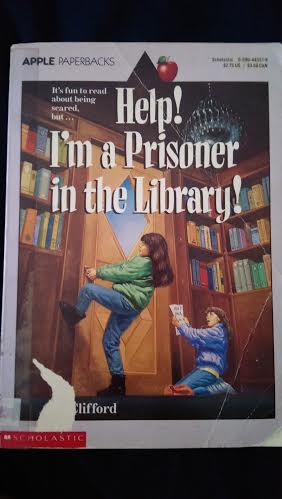
Help! I’m a Prisoner in the Library!

Help! I’m a Prisoner in the Library! by Eth Clifford, 1979.

Harry Onetree is taking his two daughters, Mary Rose and Jo-Beth, to stay with their aunt on a snowy evening because their mother is about to have a baby and will soon be in the hospital. But, Harry has a habit of being careless and doing things at the last minute. In spite of practical Mary Rose’s warning that they’re running low on gas, Harry doesn’t stop to get any until they finally run out, and he has to hike through the snow back to the last gas station they passed.

Before their father gets back, Jo-Beth, the younger sister, declares that she has to go to the bathroom. Long-suffering Mary Rose finds one for her in a nearby library just before closing time. But, it’s not an ordinary library. It’s actually an old mansion which has been converted into a branch library for children. It has some fantastic displays, including an old wooden wagon called a “kid hack” which was once used to carry children to school, like a school bus. Unfortunately, the girls get distracted by this strange library.  The girls forget about the library closing, and the librarian, not knowing that they’re there, locks them in for the night.

Meanwhile, the blizzard outside is getting worse, and their father has returned to the car and realized that they’re missing. The girls try to call the police, but they refuse to listen, thinking it’s a prank. Melodramatic Jo-Beth thinks that they’re doomed to starve to death in the library, trapped by the blizzard. Then, the girls hear a mysterious “thump” from upstairs. It turns out that they’re not alone in the library . . .

This is the first book in the Mary Rose and Jo-Beth Mysteries.  It is available to borrow and read for free online through Internet Archive.

My Reaction

The Mary Rose and Jo-Beth books are fun with the way Jo-Beth delights in imagining doom and gloom while Mary Rose tries to work out a practical solution to their problems. The books in this series are also frequently about something other than the immediate mystery that the girls face. In this case, the girls learn about the history of the old house, how it became a branch library, and how old buildings, even though they are beautiful and have a history to them, may face destruction if people don’t care enough about them or find a way to put them to some useful purpose.

Be a Perfect Person in Just Three Days!

PerfectPersonBe a Perfect Person in Just Three Days! by Stephen Manes, 1982.
“Some people want to be astronauts or ballet dancers or plumbers.  Milo Crinkley wanted to be perfect.”
So begins the story of Milo’s journey toward perfection.”Be a Perfect Person in Just Three Days!”  Milo can’t resist trying it when the book by that title falls off the shelf at the library, hitting him on the head when he’s looking for a scary monster book.  The picture of the author, Dr. K. Pinkerton Silverfish, looks a little strange, but Milo figures that it’s worth a try.  After all, the book practically jumped off the shelves at him, begging to be read.  Also, when Milo starts reading the pages, Dr. Silverfish practically seems to be reading his mind, even guessing that he’d try peeking at the end of the book to see how it ends.  (“Didn’t I tell you not to look at the last page of this book? Do you want to become perfect or don’t you?”)PerfectPersonBroccoli
But, Dr. Silverfish’s three-day program isn’t anything like Milo could have imagined.  Could wearing a stalk of broccoli around his neck for an entire day really be a lesson in perfection?  Or skipping all meals the next day?  Or drinking weak tea?  Dr. Silverfish is a bright man, and there are lessons to be learned, but as to whether or not Milo becomes perfect . . . don’t skip to the last page.

There is also a movie version of this book, but the last lesson is different in the movie version, giving the story a slightly different twist.  You can see a shortened version of this movie on Internet Archive. In a way, I kind of like the movie’s twist a little better than the book’s ending because it involves the reader doing something that he never thought that he could do.  The final lesson of the movie was that, while no one is ever perfect, people can do many things that they never thought they could do, which can give them more confidence.  The book focuses more on the boring nature of perfection.  Both of the movie and the book do have the same basic theme: that there may be other options in life that are even better than perfection.

The Dragon Charmer

DragonCharmerThe Dragon Charmer by Douglas Hill, 1997.

This is a great fantasy story about a girl who learns to face her fears and persevere in spite of them. It has a good moral and is encouraging to anyone who failed at something but wanted to try again.

Elynne Danneby is afraid of dragons, which is a shame because her family makes its living by dragon charming. Every year, the dragons stop by her family’s farm on their migratory path, and Elynne’s father puts on a show for people who come to see the dragons. By playing a special tune on his pipes, Dan Danneby can put the dragons into a trance and safely walk among them. Only certain people have the ability to charm dragons. Elynne possesses that talent, but she has been unable to use it since she made a mistake while trying to charm dragons when she was a small child. They tried to attack her, and her father had to save her from them. Ever since, the dragons have terrified Elynne, but she is still fascinated by them and desperately wants to conquer her fear in order to charm them like her father does.

DragonCharmerPicThen, one day, a rare crimson dragon comes to the farm and lays an egg. It is extremely uncommon to see a dragon’s nest or a baby dragon, and Dan is excited about trying to charm the baby after the egg hatches. However, Dan’s assistant is greedy and decides to steal the egg and sell it. Elynne overheard him talk about his plans before the egg was stolen, but because she wasn’t sure of what she heard, she didn’t tell anyone. Elynne feels guilty about not preventing the theft of the egg, and in spite of her fear, she is determined to get it back. In the process, she not only conquers her fear but learns about a talent that she never realized she had.
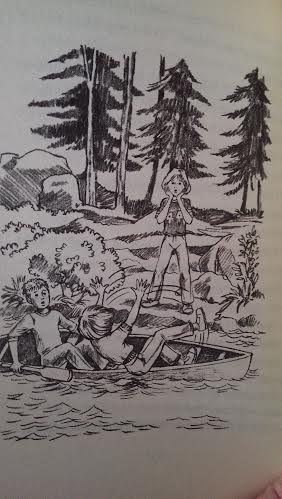
The book is full of black-and-white drawings in a sort of cross-hatch style.

The book is available to borrow and read for free online through Internet Archive.

Double Trouble on Vacation

DoubleTroubleVacation

Double Trouble on Vacation by Michael J. Pellowski, 1989.

The Daniels twins are at it again! Sandi and Randi are looking forward to spending their vacation at the lake with their family. Sandi is trying to work on her wilderness merit badge, and Randi just wants to go fishing. But, when Bobbi Joy, a bully they know from school, turns up at the lake, visiting her cousin, the girls make the mistake of accepting a bet from her. Randi bets Bobbi Joy that she can beat her in the fishing derby, not knowing that Bobbi Joy’s cousin, who is her fishing partner, is a fishing champion. Although the stakes are fairly harmless, just taking a jump in the lake with all her clothes on, Randi still can’t stand the idea of losing to Bobbi Joy.

Things get complicated when Randi is sprayed by the skunk that their little brother Teddy tried to befriend. Randi doesn’t want her team to be disqualified from the fishing derby, but she can’t go smelling like skunk! Instead, she talks Sandi into taking her place once again. But, Sandi has to give a speech later that day in order to get her merit badge. Can she help her sister and still make it in time to make her speech?

This book is currently available through Internet Archive.

DoubleTroubleVacationPicThis is the last of the four books I have in this series, but there are two other books in the series that I don’t have and haven’t read: A Double Trouble Dream Date and Double Trouble Mystery Mansion.  In A Double Trouble Dream Date, the twins conspire to get roles in a new music video with a teen star, when only Sandi is actually able to sing.  In Double Trouble Mystery Mansion, the girls are investigating a haunted house which holds a hidden treasure.  There is a real ghost in the story, but only Sandi has been able to see it.  At first, Randi doesn’t believe her that there even is a ghost, and the girls attempt another switch to see if they can convince the ghost to show himself to Randi, too.