The Railway Children

Railway Children Cover

The Railway Children by E. Nesbit, 1906.

Railway Children toy train explodes

Three children in England live a comfortable and happy life with their parents. Roberta is the eldest, followed by Peter and Phyllis, the youngest. Their family has servants, their mother enjoys helping the children with their lessons and making up stories for them, and their father is clever at fixing broken toys. When Peter turns 10 years old, he is given an electric toy train (a relatively recent innovation for their time and the type of toy only a wealthy family could afford), which is a wonderful present because Peter wants to become a mechanical engineer. However, something goes wrong with the toy train, and it explodes at his birthday party! When Peter’s father comes home, he looks at the toy train and says that he thinks he can fix it, but before he can say much more, some strange men come to the house and want to talk to him. They spend a long time talking while the children’s mother takes the children upstairs. Then, their mother goes downstairs to see their father. When she returns, she seems very upset, but she doesn’t want to discuss it with the children. She only says that their father has been called away and that the children should go to bed.

The next day, their mother is gone for a long time, and the children are worried about what is happening with their parents. Their mother finally returns in the evening, tired and still upset. She tells the children that the men who came the night before brought very bad news and that their father will be away for some time, so she is going to need them to help her. She says that there will be times when she will have to be away for long periods and that she wants them to behave themselves and not fight while she’s gone. She doesn’t want to tell the children what the problem is or for them to ask her or anyone else any questions about it. She only says it’s about their father’s business and none of them really understand their father’s business. They know that their father works in a government office, so his business has something to do with the government, but their mother doesn’t want to say more than that.

Over the next several weeks, their mother is gone for long periods, leaving the children with the servants and with an older aunt who will soon be taking up a position as a governess for another family overseas. The children don’t get along with their strict aunt. The servants are usually more pleasant, but the children have the uncomfortable feeling that the servants know more about their father’s situation than they do. One day, in spite of his promise to behave himself for their mother’s sake, Peter plays a prank on the parlor maid, and the parlor maid angrily tells him that if he doesn’t fix his behavior he’ll go where his father has gone. The children don’t know what she’s talking about, and when they ask their mother, she dismisses the parlor maid. She wasn’t going to keep the parlor maid much longer anyway because she tells the children that they’re going to move to the country.

When they move, they can’t take everything from their house with them because the house in the country is smaller, and their mother says that they have to take the most useful things, leaving many of their prettier things behind. She tells the children that they’re going to have to “play at being Poor.” Readers will understand that they’re not just playing, but the children’s mother tries to frame their move as a great adventure rather than the misfortune it really is. For the children, it is a kind of adventure.

They take a train to the countryside, but when they arrive, they have to walk from the trains station to their new little house because there are no cabs there. A man brings their luggage in a cart. When they arrive at the house, which is called Three Chimneys, it is night, and the woman the mother hired to clean up the house and make supper for them is gone. The man with the cart says that she probably left because their train was late and that she probably left the house key for them under the door step, as people in the countryside tend to do. The key is there, but they discover that the woman hasn’t really done any cleaning for them, and she didn’t make supper. Fortunately, they do have some provisions, packed by the strict but thoughtful aunt, so they are able to put together a small meal for themselves.
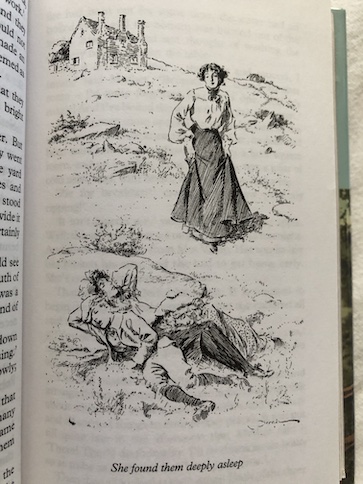
Railway Children falling asleep outside

In the morning, Roberta wakes Phyllis and points out that they have no servants in this new house, so they had better get up and make themselves useful. They get things together as best they can for breakfast, although they don’t really know what they’re doing or where everything is. They start the kettle going too soon, burn the kettle, and let the fire go out. The children explore the house’s yard and garden. They can see the train tracks and a tunnel down the hill from the house, and they fall asleep outside because they got up too early. When their mother wakes up, she gets everything ready, fixing their clumsy efforts, and finds a note from Mrs. Viney, the cleaning woman. In her note, Mrs. Viney apologizes for not having everything ready for them the night before because there was a family emergency. She had to leave early because her son-in-law broke his arm, but she promises to be there later that morning to help them.

Life in the country is very different from life in their old home. Their mother now tells them that they are really poor. It’s summer, and the children are not going to school, and their mother spends most of her time writing because she wants to sell stories for money. The children still don’t know where their father is, and it still worries them, but they gradually get used to their new life and to not asking questions about their father. Deep down, Roberta knows that something terrible has happened and that their mother is very upset about it, but because her mother seems like she would be even more upset if the children knew the full truth or just how upset she is, Roberta makes a deliberate decision not to notice anything that her mother doesn’t want her to notice. Whenever it seems like her mother has been upset or crying or whenever there’s been any hint about her father, Roberta deliberately looks away and pretends that she didn’t see anything. She tries to keep cheerful and enjoy this “adventure” that they’re living.

The children develop a fascination for the trains that run by their house, and they go to have another look at the train station. They are not accustomed to being at train stations just to observe them, only to either catch trains or arrive on trains. They are fascinated to notice the details of the station and the train signals. They notice a white mark where the coal is stored, and Peter asks the porter what the mark is for. The porter tells him it’s to mark the level of the coal so they can tell if someone has taken some, giving them a friendly warning not to steal any.

The children’s new poverty doesn’t mean much to them at first because they still have plenty to eat, but when there’s a wet and chilly morning and Peter wants to light a fire, their mother tells him that they can’t afford to light fires in June and that they must save their coal for when it’s really cold. There are other little economies that the family must make. The mother tells the children that they can have either butter or jam on bread, but not both at the same time. If they eat too much at once, they’ll run out before they can afford more.
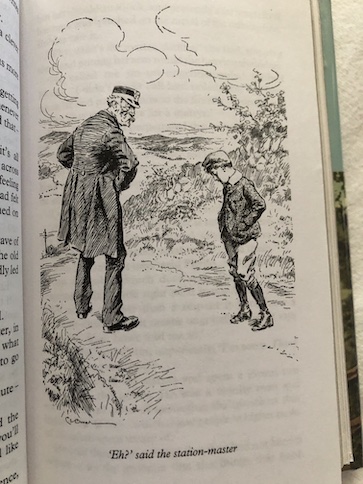
Railway Children station master

These small things that they can no longer afford give Peter an idea. He decides to stage a daring raid on the coal at the train station for the sake of their family. Although he knows that it isn’t really right, he doesn’t think of it as stealing but more like coal mining because he digs through the coal pile for the pieces underneath, which he figures they won’t miss. However, the station master catches him and insists that he and his sisters come into the train station and explain themselves. Peter explains how his family used to be able to afford fires on wet and cold days, but now they can’t because they’re poor. The station master becomes a little more sympathetic, but he gives the children a lecture about taking things that don’t belong to them. It’s still stealing, even if they think of it by another name. He lets the children keep what they’ve taken so far and lets them go with a warning not to do it again. Peter is horribly embarrassed by the incident, and he is uneasy for a while whenever he sees the station master, but the station master eventually lets him know that he is forgiven and gives them permission to visit the train station again.

The children enjoy visiting the train station and asking the friendly porter questions about the trains and how they work. The porter, whose name is Perks, likes chatting with them and answering their questions. The children watch the trains so much that they begin to recognize that each train is distinctive in its appearance. The trains no longer look all the same to them, and they start giving them nicknames, like the Green Dragon, because it’s pulled by a green engine. When Peter notices that individual trains have numbers written on them, Perks introduces him to the hobby of train-spotting, where people write down the numbers of trains that they’ve seen in a little notebook. (He doesn’t call it by that name, but that’s what he describes.)

The children become especially fond of the train they call the Green Dragon. Every day, they wave to this train, imagining that it’s a magical dragon that will carry their love to their father, wherever he is. Every day, a pleasant-looking older man who rides that train sees them and waves back to them. They begin to think of the man as a friend, waving to him and imagining that he’s also going somewhere to work on “business”, possibly with their father.

Railway Children Phyllis with note

Their new train friend turns out to be very important. When their mother becomes ill with a serious case of influenza, the doctor gives them a list of things they should get for her, most of which they just can’t afford. The children are willing to make do with a diet of bread and water to get her some of the things she needs, but even doing that won’t get her everything she should have. Then, the children come up with a desperate plan. They use a sheet to make a sign to tell the old man on the Green Dragon to look out at the station. When the train comes through the next time, everyone on that side of the train sees the sign, and they all look out at the station, confused because they don’t see anything unusual. It’s just Phyllis at the station, and she slips a note to the old man, explaining their situation and asking if he could get the things they need for their sick mother. The children promise that their father will pay him back or, if he’s lost all his money (as the children are starting to suppose is the case), Peter will pay him back when he’s a man. The nice older man is amused and touched by the message, and he sends them a package with all the things they asked for, plus a few more that he thought of himself. In the note accompanying the package, he says that they should tell their mother only that a friend who heard she was ill sent these things, although they should tell her the full story when she’s feeling well enough to hear it. The old man says that he knows their mother probably won’t be happy that they asked a stranger for help, especially not without asking her first, but he says that he thinks the children did the right thing.

The old man is right about their mother’s feelings. When their mother is well and realizes what the children did, she is angry, and she starts to cry. She says that, while they’re poor, they’re not destitute, and they shouldn’t go around asking strangers for things. Part of that is personal pride and shame at their family’s reduced circumstances. She still can’t bring herself to talk about what really happened to the children’s father and why they’re so poor now. However, they do come to rely on help from strangers and new friends, and they learn that people will help others if they’re asked. Even when they’re not rich themselves and could use some extra money, some people, like the local doctor, still let them them have services at reduced rates and take some pride in their ability to help someone who needs it and who appreciates the help.
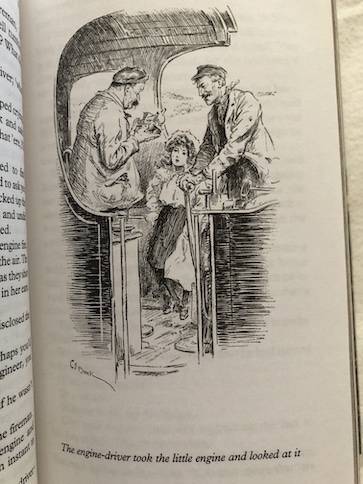
Railway Children train engineers

When Roberta decides to get help to fix Peter’s broken toy train, she accidentally hitches a ride on a train engine because she thinks that the train engineers know how to fix trains. The book explains that there are different types of engineers, from people who build engines to people who drive train engines and people who build things like bridges. Not all engineers do the same things, and the people who drive the engines don’t repair them. Fortunately, one of the train engineers has a relative who can fix things. Touched at the young girl’s request for help fixing her brother’s toy, he arranges for his relative to fix it.

The family also comes to experience what it’s like to help someone else who’s less fortunate when a man gets off at their train station, obviously ill and speaking a language that nobody understands or even recognizes. The only language the children have studied in school is French, so they decide to ask him if he speaks any French, even though they can tell that’s not the language he’s speaking. It turns out that the man does also speak French. Their mother speaks better French than the children do, and when she speaks to the man, she recognizes who he is. He is an author from Russia. He wrote a book about the plight of poor people and how to help them, which the mother has read and really appreciates. However, this book put him on the wrong side of the ruling class in Russia, and he spent time in jail as a political prisoner. He was later exiled to Siberia and put in a forced labor camp. The mother is surprisingly frank about the conditions in the camp and the forced marches where prisoners were whipped and left to die if they couldn’t go on. Since this man was able to get away, he has come to England in search of his wife and child. He heard that they had fled to England after his arrest, but he doesn’t know exactly where they are in England. At the train station, he was trying to explain that he was ill and that he lost his train ticket. The family lets him stay with them for a time while he recovers his health.

Railway Children flags

The children become heroes to the railroad when they witness a landslide that blocks the tracks and use the girls’ red flannel petticoats to make warning flags to stop the train. The children averted a terrible accident, and they are publicly thanked and given gold watches as a reward. The old gentleman from the Green Dragon is there, and the children learn that he is a railway director. They write him another note, asking if they can talk to him about an unfortunate prisoner.

The old gentleman meets with the children at their train station the next time his train comes through, and the children tell him about the Russian author, who is still looking for his missing family. The children say that the gold watches are a wonderful reward, but they’re willing to sell them or trade them back to the old gentleman in exchange for help locating the author’s wife and children. The old gentleman recognizes the author’s name and says that he has also read his book. The old gentleman knows some people in the Russian community in London, and since the author is a famous man, people in the Russian community are likely to know where his wife is currently living. He’s happy that the children’s mother is helping the author, and he says he will be glad to make some inquiries on his behalf. The old gentleman also asks the children for more information about themselves. He soon follows through on his promise to help the author, bringing the man’s wife and child to him.

Much of the book is about giving and the ways people help each other. When the children arrange a birthday surprise for Perks, he gets angry at first because he thinks they’re giving him charity. He changes his mind when the children tell him how they collected the birthday presents from various people in the community because they wanted to show him how much they all appreciate him and help that he’s given them in the past. His wife says that he’s been ungrateful for rejecting the presents, but Perks says that it’s not just about being given things but how and why they’re being given. If people gave him things because they thought that he couldn’t afford them or couldn’t work for them, it would have been an insult because he works very hard. If they’re given out of friendship and returned favors, it’s different.
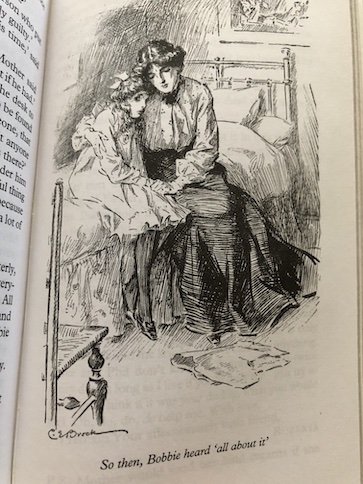
Railway Children Bobbie learns the secret

In the background of the story, there is always the question of what happened to the children’s father and why they had to leave their old home. At one point, their mother worries about why the children have stopped talking about their father and is afraid that the children are forgetting about him. Roberta admits that they talk about him when their mother can’t hear them because she can tell that their mother is sad whenever they mention him around her. Their mother admits that’s true, and she still doesn’t want to tell them the full reason why, only that something bad did happen, and it will be a while before their father can be with them again. The reason for the father’s disappearance adds an element of mystery to the story, although most of the book focuses on the children’s adventures in the countryside. There are clues along the way, from the men who came to get their father to the clothes that Roberta discovers that her mother is keeping for him. There is her mother’s reluctance to be sociable with other people and the way she talks when she describes how awful it is to be in prison, away from your family, and the reasons why a person might be arrested, which aren’t quite the same in England as the reason why the Russian author went to prison. These are the things that Roberta tries to ignore … until she finds something that starkly tells her what all of the adults already know. When Roberta understands the real problem, she can only think of one person who might be able to help: the kind old gentleman who helped them before.

The book is now public domain, so it is available to read online through Project Gutenberg and Internet Archive (multiple copies). There is also a LibriVox Audiobook on YouTube. It’s been made into a movie multiple times, and you can see the 2000 version online through Amazon Prime. It fits well with the cottagecore aesthetic! There is also a sequel movie, not based on an E. Nesbit book, which takes place during WWII, when the children in this story are adults and other children are evacuated to the countryside from London.

My Reaction and Spoilers

The Children’s Father

There are clues all the way through the story to what happened to the children’s father. He was framed for being a spy and a traitor in relation to his work with the government, although he didn’t do was he was accused of doing. People thought he was a traitor because there were letters found in his office that incriminated him, placed there by some unknown person, and these letters convinced the jury at his trial that he was guilty. The trial was conducted during those weeks when the children were at their old home with their aunt and were being told not to ask any questions. They left for the country after he was sentenced to prison. Their mother turns to writing, something that she already enjoyed, to earn money to support herself and the children, and she doesn’t want to see much of anyone because she doesn’t want to face their questions about her husband.

Railway Children the old gentleman

Roberta learns the truth about her father when Perks gives her some old papers with pictures in them to amuse Peter after he is injured by a rake the children were fighting over. The newspaper that is wrapped around the bundle has an article about her father. Roberta reads the article and then asks her mother for the full story. Roberta understands why her mother didn’t want to tell the children what happened because she also can’t bring herself to tell Peter and Phyllis what she now knows, but Roberta still wants to understand the situation herself, now that she knows about it. Her mother tells her that her father suspects that the real traitor and the person who framed him is the man who took his job when he went to prison, but he can’t prove it, and nobody believes him. Although her mother has told her not to ask people for things, the situation is dire, and Roberta can’t let her father stay in prison for a crime he didn’t commit, so she asks the kind old gentleman if he can make some inquiries into the situation on behalf of her father. She just can’t keep the matter to herself, and he’s the only person she knows who seems to have some authority and connections and might be able to do something. The old gentleman is happy to help, especially after the children help his grandson when he is injured.

In the end, the real villain is discovered, and the father is released from prison, but the readers and the children don’t see exactly how that happens because the old gentleman seems to take care of it in London, away from the children and their mother. The book ends with the father arriving at Three Chimneys, so the family is happily reunited, but we also don’t see what their lives are going to be like after that point. They no longer have their old home, and I find it difficult to believe that the father would want to return to his old job, like nothing had happened. If all of your co-workers believed that you were some kind of traitorous spy and seemed to like the guy who framed you, returning to that office would be far too awkward. It’s a life-altering event that might have potentially been life-destroying, not just a small misunderstanding. In the end, it seems like the family will be okay. The family has a wealthy supporter now, so the old gentleman might be able to help the father find a new job. The family has also come to enjoy living in the country and has some friends there, and the mother indicates that she wants to continue her writing, so they might not move somewhere else, at least not right away. It will take the family some time to sort out what they’re going to do, rebuild their family finances, and move on from this incident. We just don’t get to see all of that happening as readers. The book ends on the happy note that things are being set right, and the family is reunited.

The Meaning of Charity and Helping Others

I’d like to point out that there is a theme of rich people coming to the rescue of deserving poor people in many books from the 19th century and early 20th century, like in this book and The Five Little Peppers. People in these stories take pride in being self-sufficient and doing their best on their own, but in the end, it’s the recognition of their worthiness from someone with money and authority who is willing to supply support them that really makes a difference in their lives and saves the day. I’ve thought sometimes that the rich-person-to-the-rescue theme seems to contradict the do-it-all-yourself attitudes that the characters in these stories often have, but I think the key to understanding it is in what Perks says about his birthday surprises – it matters how and why gifts are given.

The same gift or act of kindness can take on different meanings, depending on the motives and attitudes of the giver. Perks would have been insulted if people gave him charity because, to him, it would be like people telling him that he was incompetent at getting things for himself and his family, which isn’t true. However, the same gifts take on different meanings when they’re meant as a salute to his friendship and helpfulness to others because he can tell himself that he did things to earn them. The children in this story earn the help they get from the kind old gentleman (who is never named in the story) and others in the community through their acts of kindness and heroism to the community, so they are demonstrating their usefulness and competence instead of asking for things they haven’t earned and don’t deserve. They can take pride in their competence and good deeds, so they’re not mere “charity” cases, who take without giving. At least, I think these are the implications of stories like this. I get the concept about personal pride, but I don’t feel the same way about it because I think there are more important priorities.

Railway Children Perks' birthday

Personally, I don’t have negative associations with the concept of “charity”, either giving or receiving. I’m more like Perks’s wife, who’s just grateful that somebody cares and that people think of them and are willing to give. I appreciate when things are getting accomplished, people are being helped, and objects are being put to good use by people who will actually use them. In situations like that, I’m more oriented toward the results than concerned about image. (My personal image has always been that of an oddball eccentric anyway. A basically pleasant and helpful oddball, but still an oddball. I like to maintain a certain level of eccentricity because I’ve discovered that there’s a kind of freedom in that. It’s like choosing to be a character actor instead of a teen heartthrob. Nobody can be a teen heartthrob forever, but being a character lasts a lifetime, and the ways you can do it are almost endless.) I have no objection to people giving me things I need or helping me accomplish things I want to do, and I’ve done the same for other people. It’s just life to me, and I think it’s best to focus on the good being accomplished and get on with doing things. (By the way, if you enjoy my nostalgic children’s book blog, please consider buying me a coffee to support the site! Proceeds will help support my book addiction, site maintenance, and future reviews and would be greatly appreciated.)

I’ve worked for nonprofits before, and people who work for nonprofits are there to do good and get the job done. They see needs in their communities, and they want to step in and supply them. There are people who make their lives and careers around making positive change. I certainly wouldn’t want people trying to stop those who are trying to do something good for others just because they have a negative attitude and no plan or effort for accomplishing positive change themselves. Of course, when you have a nonprofit or work for one, people come to you for things they need or to support your cause. They come to you because they’re in the mindset for making positive changes to their own lives or in the community, and that can also play into the concept of how giving is done. If someone just isn’t in the mindset of accepting help or gifts or making positive changes, there isn’t much to be done about it until they are in the mindset to do something.
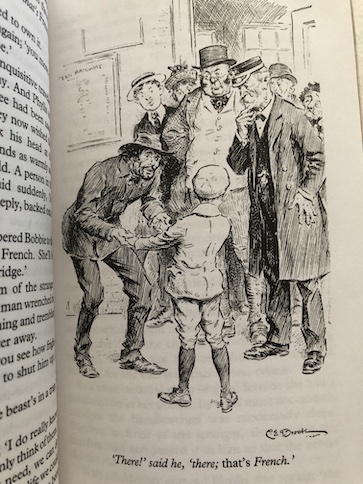
Railway Children the Russian author

I think this book actually does a good job of presenting that concept. The mother’s and Perks’s sense of pride and attitude toward the concept of charity contrast with the old gentleman, who seems willing to just go ahead and get the job accomplished when he sees what people need or what they’re trying to do. Both Perks and the mother seem to feel a blow to their pride when someone helps them or gives them something, yet both of them are happy to offer help to others who need it. Being the one offering something rather than receiving it seems to make them feel like they’re in a position of strength and competence. The mother takes in both the ill Russian author and the old gentleman’s injured grandson, not seeing those as insulting acts of charity. It’s when she’s both poor and ill herself and doesn’t feel strong or competent that receiving help from someone seems to remind her that she’s vulnerable. I think that’s the feeling that gives her a negative attitude toward charity – perhaps not that she’s fine without help but the thought that she’s in a position to need some help is scary. While she’s sick and has a high fever, Roberta tends to her through the night, and she hears her mother calling out for her own mother. It’s a moment of revelation to Roberta that, no matter how old a person gets, they still have moments of vulnerability, when they need someone else to comfort and help them, like a mother would. It can be a bit humbling to go through those vulnerable moments and have someone see you being vulnerable, but it’s human. The revelation that mothers are also humans who sometimes need other adults doesn’t make Roberta love or respect her mother any less. In fact, it makes her appreciate her mother more for what she goes through for her family and makes her more determined to be helpful and supportive to her mother.

Railway Children Perks

I think Perks experiences a similar a similar attitude to the children’s mother. There are hints that he’s had a rough life himself and has worked hard for the level of stability he has now. When the children try to give Perks money for carrying the old gentleman’s gift to their mother to the house, he gruffly refuses it because he doesn’t want to take money for helping their sick mother. His refusal of their money for his service could be seen as an act of charity to them, but it’s framed more that he’s doing a personal favor or like Perks thinks that the children are offering him a kind of charity by trying to pay him for a service he is willing to provide for free. He also helps other people in the community, and helping others makes him feel strong and competent. Receiving something from others makes him feel like there’s something wrong with him or his life or like other people think there is. Perhaps it reminds him of hard times in his youth. It really seems like it’s only the attitudes of the giver and the receiver that determines what forms of giving are acceptable, and it’s bit subjective. The old gentleman understands that when he writes the note to the children that he sends with his gift to their mother, but he also says that he thinks they did the right thing. Maybe there are some kinds of giving or asking for help that are objectively good or right for reasons other than people’s opinions.

This is a good time to point out that the author of this story, E. (Edith) Nesbit, believed in socialism, although she wasn’t a radical on the subject. I think that’s why she examines the subject of helping others and receiving help from the point of view of people from different classes in society in this story. All of the adults in the story take some pride in their positions in society and in maintaining the appearances associated with those position. Victorian society was very class-based, but the family’s poor circumstances take them out of their usual class and changes the situation for them and others. The children and their mother sometimes really do need the help of other people, whether they like it or not, but they still have the capacity to help others in different ways. One of the themes in the story seems to be that everyone needs something from other people at some times. There are times when what they need might be help and support from others, and there are times when it might be a chance to show that they have the capacity to help others or appreciation for help they’ve already given.

This story raises many questions about giving which don’t have firm answers and can be viewed from different perspectives. Are all of the various forms of giving and receiving only different forms of charity, or are they just the interactions of human beings who all care about each other? Are people’s intentions or the image of giving really what’s important, or is it the giving itself? It may be better to give than to receive, but without someone willing to receive, what is the point of the act of giving?

For another early 20th century book that considers the differences between different classes of people and the meaning and benefits of charity, I recommend Daddy-Long-Legs, which is about an orphan whose college education is funded by a mysterious benefactor. That book is set in upstate New York, and it falls under the Light Academia aesthetic.

Fun Stuff

I always like seeing old books and historical books with scenes where people are playing games because I made a website about Historical Games. In this book, the children play a game that resembles Dumb Crambo (which was a precursor to modern Charades) called the Advertisement Game. In the Advertisement Game, the children act out characters they’ve seen in advertisements for each other to guess. There is also a scene with some boys from a nearby boarding school having a Paper Chase, which is a cross-country outdoor game. One player is the Hare, and he leaves a trail of bits of paper for other players to follow as the Hounds.
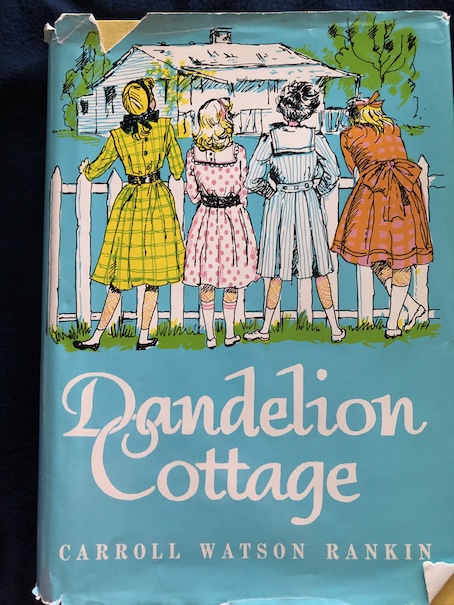
Dandelion Cottage

Dandelion Cottage by Carroll Watson Rankin, 1904.

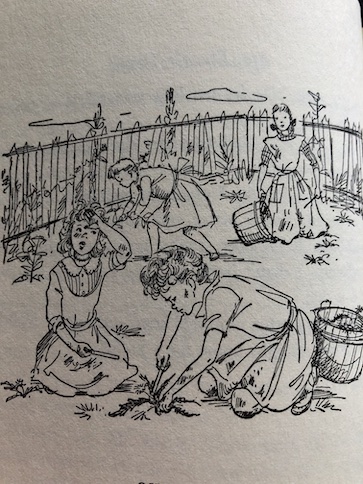
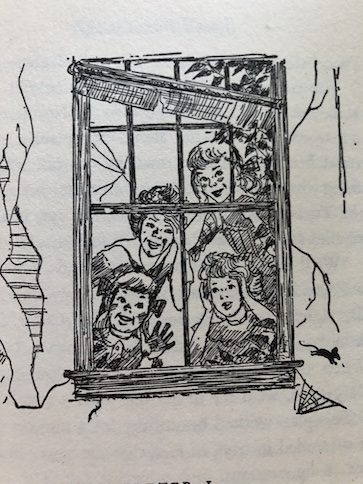
The small cottage used to be a church rectory, but it when Dr. Tucker was hired as the new minister, his family with eight children was too large to fit in the old cottage. By that point, the old cottage was in disrepair anyway, so the people of the church decided it was time to build a new, bigger rectory. Some people consider the small, old rectory to be an eyesore, but Bettie, the only daughter of Dr. Tucker, is fascinated by it. It’s true that the old house is run-down and that some of the windows are broken, but to Bettie, it looks almost like a little playhouse.

One day, Bettie suggests to her friends Jean, Marjory, and Mabel that it would be great if they could have the old cottage, now known as Dandelion Cottage for all of dandelions growing around it, as their own special place to play. All of the girls have noticed that, when the four of them play together, they tend to get on the adults’ nerves, making too much noise or seeming to be underfoot. Marjory is an orphan who lives with a strict aunt, and Bettie has seven older brothers. There just never seems to be enough room for the girls anywhere or adults willing to put up with them for very long. Marjory thinks that the chances of them being able to use Dandelion Cottage for themselves are slim, but she suggests that maybe they could arrange to rent the cottage somehow. None of the girls has very much money, so they aren’t sure how they can rent the place.

Mr. Black, the church warden, sees the girls looking at the cottage and asks them what they’re doing. They explain that they want to rent the cottage so they’ll have somewhere to play. They tell him how Marjory’s aunt won’t let her make paper dolls because cutting paper in the house makes a mess, and Bettie says that her brothers like to play Indians and pretend to “tomahawk” her dolls. (The books in this series sometimes get criticism for racial stereotypes and language, and this is one example. I do understand the part about brothers and dolls, though. My older brother once held one of my dolls for ransom when we were kids.) Not having any money to rent the cottage, the girls offer to clean it up in exchange for being allowed to use it. Mr. Black knows that some of the neighbors have been complaining about how the place has been overgrown with weeds. The church could hire someone to take care of the weed problem, but that would cost money, and they don’t have a lot to spare. Mr. Black tells the girls if they’re willing to pull all the weeds, he’ll let them play in the cottage all summer. The girls aren’t enthusiastic about pulling weeds, but they’re very enthusiastic about having their own playhouse, so they agree to do it. Mr. Black says that he’ll turn over the cottage key to them after they’ve pulled the weeds.
While the girls are pulling weeds, some of them play pretend games, like they’re fighting soldiers or Indians (as in Native Americans, another one of the objectionable points), and finally, they get the job done. Mr. Black is satisfied with the job they’ve done and pleased with their willingness to sow grass seeds and flowers where the weeds once were, so he gives them the key to the cottage for the summer.
The girls are thrilled at having a whole house to themselves all summer, although it needs serious cleaning before they can really use it. Mr. Black, a lonely widower with a fondness for children, (especially Bettie, who reminds him of his own daughter, who died young) stops by to see how the girls are doing. When he finds them exhausted from cleaning and trying to decide if they can manage to clean the floor before they give up for the day, he gives them some peanuts to eat and finishes the cleaning himself. He tells the grateful girls that they can thank him by inviting him to dinner at the cottage some day.

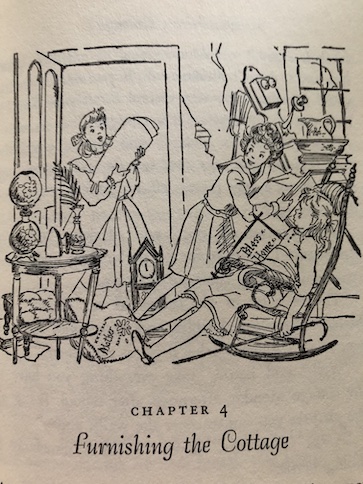
The girls’ parents completely support them playing in the playhouse because it does mean less noise and mess at home, although they refuse to allow the girls to stay in the cottage overnight for safety reasons. They let the girls have some old furniture to furnish the house, including chairs that are missing legs, beds that sometimes have the slats falling out of the bottom, and six clocks, four of which don’t work. The little cottage soon begins to look cheerful and lived-in, although the girls have to warn their visitors about which chairs are unsafe to sit in.

The girls worry at first that they won’t be able to afford to buy food to give Mr. Black dinner as they promised. They know that they could ask their parents for supplies, and even nice Mr. Black would probably provide something for them to cook if he knew that they couldn’t afford anything, but they feel like they really should find a way to buy the supplies for dinner by themselves. They try holding a lemonade stand, which works for a little while, but then, they misplace the money they earned.

Fortunately, their money problems are soon solved when they receive a request for a room to rent from a nice young lady. She is the daughter of the traveling organ tuner who is working on the organs at some local churches. She has arranged to take her meals at the boarding house where her father is staying, but she was unable to get a room there herself, so she is looking for somewhere inexpensive to stay nearby. She will only need the room for three weeks. The girls explain their arrangement regarding the cottage to her, and they show her their best bedroom. Miss Blossom, their new boarder, says that it will suit her just fine. Because the furniture is old and the house is still not in very good repair, they only charge her half rate to stay there, but that’s still more money than the girls have ever earned before! When Dr. Tucker learns who their lodger is, he approves of the arrangement, and Mrs. Tucker and the other parents give the girls some proper bedding and a few other supplies for their boarder. Miss Blossom turns out to be a nice boarder, who sometimes joins the girls in their games, delighting at her stay in their playhouse.

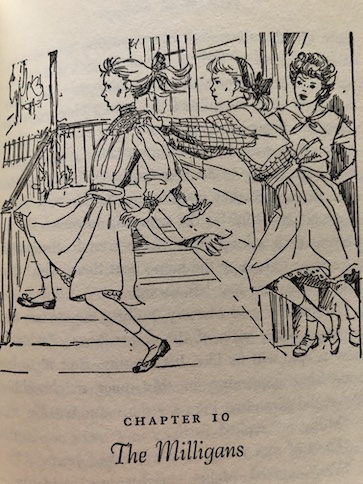
Then, an older woman who lives nearby moves away, and a new family moves into the house next door to the cottage. The Milligans aren’t a very good family. Mr. Milligan swears (the girls’ mother tells them not to listen and to keep the windows of the cottage closed while he’s chopping wood because of the things he says), and Mr. and Mrs. Milligan argue frequently. Laura, the daughter of the family, is the same age as the other girls, and she plays with them for a time, but the other girls stop playing with her because she’s mean to them. She teases them meanly, tries to boss them around, and eventually, steals from them. The stealing ends their friendship. Laura lies to her mother about what happened, blaming the other girls for slapping her and her baby brother and throwing them bodily out of the cottage. Mrs. Milligan comes to the cottage to lecture the girls about their behavior and refuses to believe them when they tell her the truth about Laura. To get revenge on the girls, Laura kills a plant in the girls’ cottage garden. The girls hadn’t purposely planted the plant, and they had been looking forward to seeing what it was as it grew.

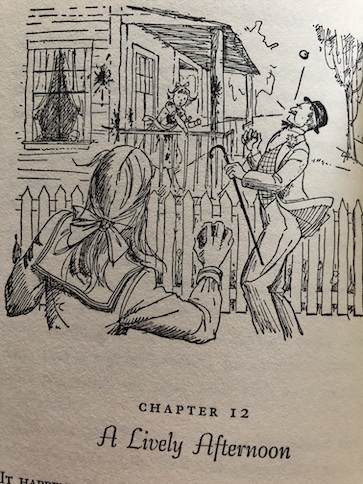
Laura continues to do horrible things to the girls, breaking a window of the cottage, throwing dirt through the window, messing up their porch, spreading molasses on their door, and sending her dog through their flower beds. One day, Laura starts a fight with the girls by yelling mean and insulting poems at them. Laura throws tomatoes at the girls, and Mabel throws apples back at Laura. Mabel isn’t normally good at throwing anything (something that Laura taunted her about), and she accidentally hits Mr. Milligan. Mr. Milligan, for once, sees his daughter misbehaving and is angry at her for throwing the tomatoes and wasting food, but he also threatens to have the other girls thrown out of the cottage for their misbehavior. Mrs. Milligan lies to their landlord, Mr. Downing, telling them that the girls have been playing with matches in the cottage. Mr. Downing manages the books for the church, so he evicts the girls from the cottage while Mr. Black is out of town.

The girls go to see Mr. Downing and argue that they’ve already paid their rent in full for the summer with their labor, but Mr. Downing says that their agreement with Mr. Black didn’t make good business sense and it’s “not binding”, so he’s breaking it. He wants to rent the cottage to a paying tenant, and Mr. Milligan himself has offered to rent it while someone else rents the house the Milligans are currently in.

The girls are heartbroken, but they have no choice but to move out. Although, the Milligans’ scheme backfires on both the Milligans and Mr. Downing. Mr. Downing wouldn’t believe the girls when they said that the cottage wasn’t in good enough condition to be anything more than their playhouse, and they were telling the truth. The cottage looked nice when the girls had their things there, but when they take them back and the girls’ brothers strip the house of some repairs that they had made for the girls’ sake, its real condition shows. The Milligans are stuck with a cottage that leaks in the rain, and they can’t move back into their own house because the new tenants have already moved in and don’t want to leave. The Milligans are forced to move out of the neighborhood entirely, so the girls never have to see Laura again. Mr. Downing, angry at the hassle the Milligans gave him over the whole issue, even blaming him for their furniture being ruined by the leaking roof, yells at the girls when they ask if they can move back into the cottage, which is now empty. However, when Mr. Black returns to town, he gives the girls the second key to the cottage, tells them that they can move back in, and has a talk with Mr. Downing about his treatment of the girls and their agreement about the cottage. The girls’ grateful families fix up the cottage even better than it was before, and Mr. Downing gives the girls an embarrassed apology and a peace offering, admitting that they are far better tenants than the Milligans.

The girls have made friends with a lonely older woman who lives near the cottage, Mrs. Crane. Mrs. Crane is a widow who has very little money, and she offers the girls friendship and sympathy during the time when they were evicted from the cottage. The girls feel sorry for her, having no children or other family to look after her. They try to help look after her themselves, and they become increasingly concerned about her when her boarder moves out. She relies on keeping a boarder for income, and she doesn’t know what she will do when he leaves. The girls wish that they were old enough to take her in themselves. One of the best things they do for her is to invite her to the dinner that they finally give for Mr. Black to thank him for all his help. The girls don’t know that Mrs. Crane and Mr. Black have a history with each other, but their parents realize that the two of them having dinner together is something that would be good for both of them.

The book is now public domain, so it is available to read online through Project Gutenberg and Internet Archive (multiple copies). There is also a LibriVox Audiobook on YouTube.

My Reaction

My copy of this book was a present from my grandmother, who told me that she had read it and liked it when she was young. My grandmother was born in November 1918, so the book was already about 20 years old or more by the time she could read it. She grew up on a farm in Indiana, so she was accustomed to small town life in the Midwest, much like the girls in this story. It was very different from my own childhood in a city in the Southwest, but I thought the story was charming, and I wished that my friends and I could have a house all to ourselves!

The books in this series receive some criticism for racial terms. I haven’t read all the books yet, but the issues I’ve spotted in this particular book relate to stereotypes about Native Americans when the children in the stories are playing pretend. The issues I’ve seen so far seem pretty tame compared to some parts in the Little House on the Prairie series, so anyone who is okay with Little House on the Prairie would probably be okay with these books, but since I haven’t read all the books yet, I can’t be completely sure how the rest of the books are. I recommend that adults read through the books first before giving them to children and be prepared to talk about things with child readers. As long as child readers understand that they shouldn’t imitate everything that they read in old books, I think they will be fine. There are also instances of bullying and fat-shaming in the mean things that Laura says to the girls, which kids should know not to imitate, either.

Apart from that issue, this book is a pretty calm, charming story. The book fits with the Cottagecore aesthetic that has been popular in the early 2020s. Modern kids and adults may still enjoy the girls’ sense of independence in their own cottage and how they fix it up and give it new life.

The cottage in the stories is based on a real cottage in Michigan, in the author’s hometown, Marquette. My copy of the book has an About The Author section on the back, with a picture of the author. The girls in the story and their adventures are fictional, but the town did once have a dandelion problem that may have been the inspiration for this story.

Six Crows

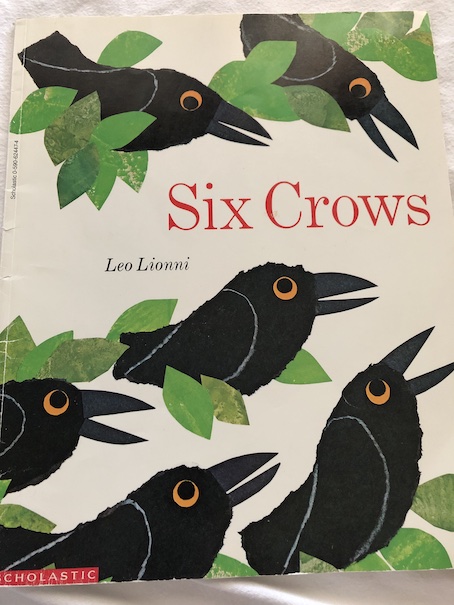
Six Crows by Leo Lionni, 1988.

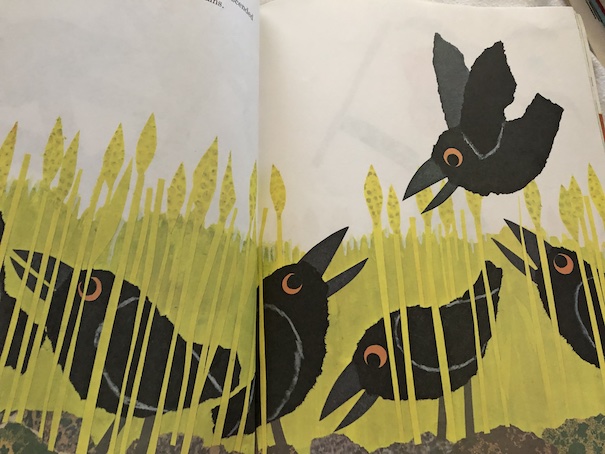
A farmer in the Balabadur Hills (the book doesn’t explicitly say that this story takes place in India, but it’s implied) has a good farm, but he also has a problem with the crows who live nearby. Whenever his wheat is ripe and about ready to harvest, the crows come and eat it.

Chasing the crows away doesn’t work because they always come back. The farmer decides to try building a scarecrow instead. It does frighten the crows, but with an unexpected result.

The crows decide that they must make their own scare-person, a kite that looks like a big, fierce bird, to scare away the scarecrow. When they fly over the field with their scare-person kite, the farmer gets scared and decides that he needs a bigger, scarier scarecrow.

The situation escalates, with the birds building an even bigger and scarier bird kite to scare the farmer.

Meanwhile, an owl who has been watching all of this unfold decides that it’s gone far enough and goes to talk to the farmer and the crows about the situation. The owl persuades both sides to speak to each other and work things out.

When they talk, the farmer and the crows realize that they don’t want to fight with each other. The crows depend on the farmer’s wheat for food, and the farmer realizes that he actually enjoys having the birds around. The owl fixes the mean-looking scarecrow to have a happy and friendly look.

I’m not sure that this is really a traditional fable because the book doesn’t provide any background information on the story and the author isn’t credited as doing a “retelling”, but the story is told in a folktale or fable format about conflict resolution. When the farmer and the crows are feuding, they continually escalate the situation with bigger and scarier “weapons” until the owl convinces them that the only way out of the situation is to talk it out and come to an agreement.

The book is available to borrow and read for free online through Internet Archive (multiple copies).

The Story of Ferdinand

The Story of Ferdinand by Munro Leaf, drawings by Robert Lawson, 1936.

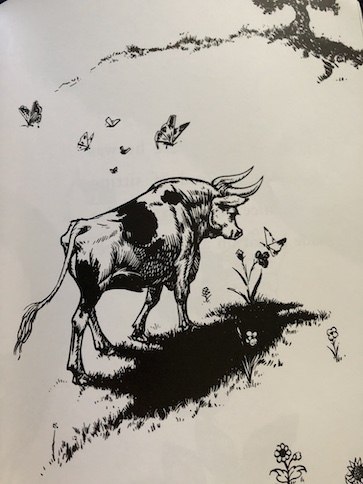
Ferdinand is a young bull living in Spain. He has been different from the other young bulls since he was a little calf. While the other young bulls liked to run around and butt their heads together, Ferdinand preferred to simply enjoy the peaceful countryside and smell the flowers. His mother sometimes worried about him, sitting all by himself under his favorite tree. She was afraid that he would be lonely, but Ferdinand told her that he just liked sitting under the tree and smelling flowers and that he didn’t want to play rough with the other young bulls. As long as Ferdinand was happy, his mother was content to let him do what he wanted to do.

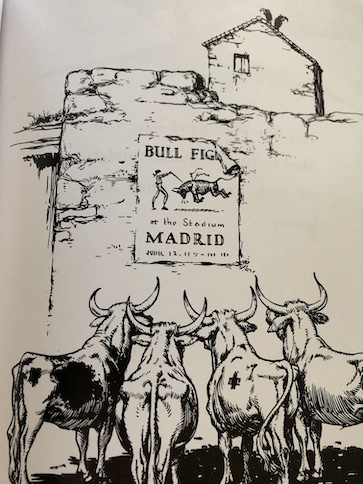
As time went on, Ferdinand and all of the other young bulls grew up big and strong. The young bulls who had always played rough together were fascinated by the bull fights held in Madrid. They thought that it would be exciting to be picked to participate in the fights. But, Ferdinand had no interesting in fighting of any kind. Although he was big and strong, he still preferred to just enjoy his flowers and his favorite tree.

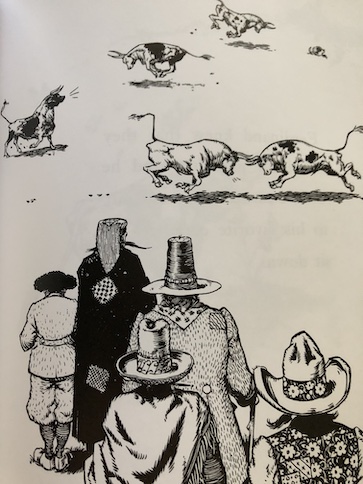
When some men come to the field to pick out bulls for the bull fight, the other bulls try to show off for the men. Ferdinand doesn’t, but by accident, he sits on a bee and is stung. When the men see him jumping around in pain, they assume that he must be the fiercest bull in the field!

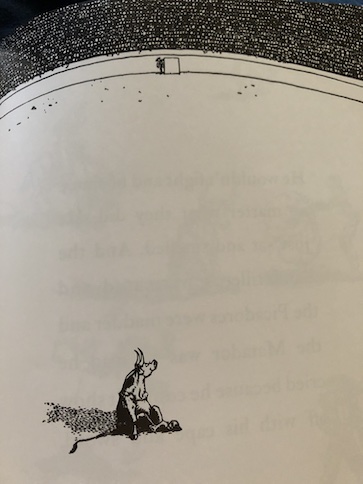
Poor Ferdinand is carted off to Madrid, but no matter what the bull fighters do in the arena, they just can’t get Ferdinand interested in fighting them. There is only one thing that interests Ferdinand, and that’s flowers. When the men put him in the bull fighting arena, he just sits and looks at the pretty flowers that the women in the stands are wearing in their hair, enjoying the smell. They are so disappointed at the lack of fighting that they put Ferdinand back in the cart and put him back in the field … which is exactly where he wants to be.

The book is available to borrow and read for free online through Internet Archive (multiple copies, including some in different languages). It has been reprinted many times. It has not been out of print since its first publication, and it has been made into a movie.

My Reaction and A Little History

I remember that I didn’t care for this book when I first read it years ago. I was really worried for poor Ferdinand when he was picked to join the bullfight. Because the book is for young children, it doesn’t make it fully clear that the bullfight is supposed to end with the death of the bull. The bullfighters all have spears and swords “to stick in the bull”, and the book says it’s to make the bull mad, but adults and older kids realize that they’re really going to hurt and kill the bull during the fight. There are vultures in some of the pictures as a clue that death is a real risk.

Fortunately, nothing bad happens to Ferdinand in the story. Because Ferdinand is a peaceful bull, who has no interest in fighting and only wants to enjoy flowers, he is not exciting enough for the bullfight, so he gets sent home to the field and the peaceful life he loves. The other bulls may not know that their lives could be much shorter because of their willingness to fight.

It’s also interesting to note that this book was written in the 1930s, when the world was headed for World War II. It was also published shortly before the Spanish Civil War. Because of its pacifistic themes, it was banned by both Franco and Hitler. The author, Munro Leaf, said that he didn’t really mean the story to be a serious one, but its themes resonated with even the adults of his time, in different ways, as this article from Sotheby’s notes:

“In 1937 Leaf wrote that he had published a book he “thought was for children… but now I don’t know” and in 1938 The New Yorker wrote “Ferdinand has provoked all sorts of adult after-dinner conversations.””

It wasn’t just Hitler and Franco who were suspicious of the book’s intentions. Some people also suspected it of being “Red Propaganda” or “Fascist Propaganda”, presumably because some people feared the pacifism in the story would encourage people not to fight communists or fascists. Some people also questioned the book’s message on the topic of masculinity. I could see that the story could be regarded as a commentary on men who think they have to tough, macho fighters, like the bulls. Even though Ferdinand might be regarded as a failure as a bull for not engaging in the fighting and rough play of the other bulls and not going through with the bullfight, he lives a happier, more peaceful, and ultimately, longer life because of it. Maybe he’s not a failure after all but just smarter than the average bull. Ferdinand is certainly a non-conformist who finds a way to make it work for him. How any reader might feel about that could depend on what they think conformity means and how they feel about that.

However, the book also received a lot of positive support. There is an anecdote that Gandhi loved it, and President Franklin Roosevelt requested a copy. The Sotheby’s article also recounts a story that I first heard from my children’s literature teacher when I was in college, that 30,000 copies of the book were sent to Germany after World War II as a peace gesture. When my teacher told the story, she explained that few children’s books were published during the war (and if you’ve already read my review of Emil and the Detectives, you already know that even children’s books were not exempt from book burnings if they had anti-war themes), so the distribution of the copies of The Story of Ferdinand were welcome, and the children who received them loved the story.

Marvin K. Mooney, Will You Please Go Now!

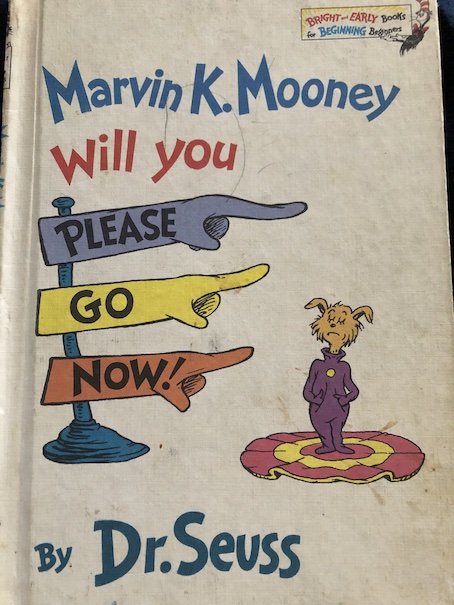
Marvin K. Mooney, Will You Please Go Now! by Dr. Seuss, 1972.

It’s time for Marvin K. Mooney to go, but he absolutely refuses. Where is going? We don’t know because the book doesn’t say. I imagine that he’s supposed to go to bed because it’s bedtime. He looks like he’s wearing footie pajamas, and the large hand that points for him to go looks like it might be a parent’s hand, but that’s just a guess. This book is just a nonsense rhyme.

The owner of the hand repeatedly tells Marvin to go, telling him that he can go in any way he chooses, as long as he goes.

In the tradition of Dr. Seuss books, all the suggested methods of going are nonsensical, and there are a few made-up nonsense words and devices thrown in.

Eventually, when the owner of the large hand insists, Marvin decides that it really is time for him to go.

The book is available to borrow and read for free online through Internet Archive (multiple copies).

My Reaction

I’m not a big fan of Dr. Seuss. I wasn’t even as a kid, mainly because my early introduction to Dr. Seuss was The Cat in the Hat and Green Eggs and Ham, two of the major ones people think of when they think of Dr. Seuss. I thought that the Cat in the Hat was way too pushy, and I was very concerned about the welfare of the pet fish in the story. When my teachers made the requisite eggs and ham and dyed them with green food coloring, I absolutely refused to eat them. I didn’t mind it when they turned milk bright green with food coloring for our earlier green-themed day because milk turned the color of mint ice cream looked good, but nothing that turns the shade of green of those green eggs and ham looks appetizing. Knowing that it was just food coloring didn’t help. Speaking of becoming more accepting of new experiences, Sam I Am really needs to learn how to take “no” for an answer.

Anyway, my early Dr. Seuss experiences didn’t appeal to me much, so I didn’t seek out Dr. Seuss books as a kid. I never encountered this particular Dr. Seuss book until I was an adult, and the one thing about Dr. Seuss that really appeals to me now is the knowledge that The Cat in the Hat was specifically meant to be a more interesting alternative for beginning reader than the Dick and Jane readers that were popular in the mid-20th century century. All Dr. Seuss books contain a limited range of simple vocabulary with a few made-up words thrown in to make it interesting, and they’re all meant to be funny and somewhat bizarre to keep young readers interested.

As I said, I don’t know for sure who is telling Marvin to go in this story or where he’s supposed to go. I think it’s probably bedtime, and he’s supposed to go to bed. It would be just like a parent to use a child’s full name to tell them that they’re supposed to do something when they’re not listening. But, it doesn’t really matter. There are some Dr. Seuss books that have a moral to them, but this isn’t one of them. It’s just supposed to be a simple story that’s fun for young children to read. You can imagine where Marvin goes yourself!

One Morning in Maine

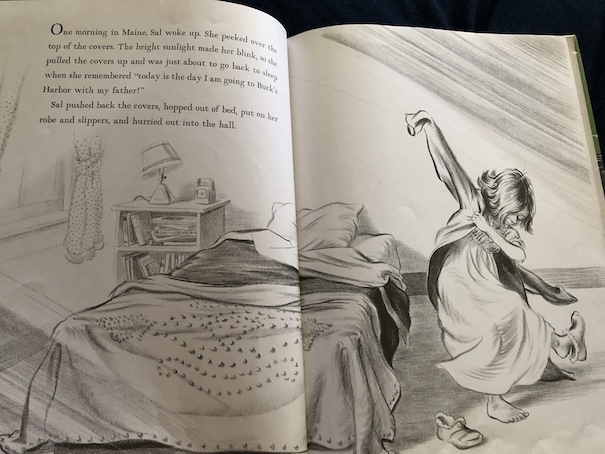
This cute picture book features Sal, a little girl who also appeared in Blueberries for Sal. She and her family live or are staying on an island off the coast of Maine. One morning, Sal wakes up and is excited because she remembers that she and her father will be going to Buck’s Harbor (a real place).

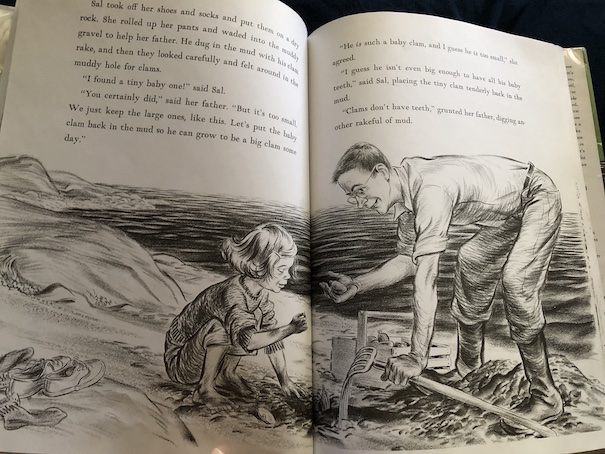
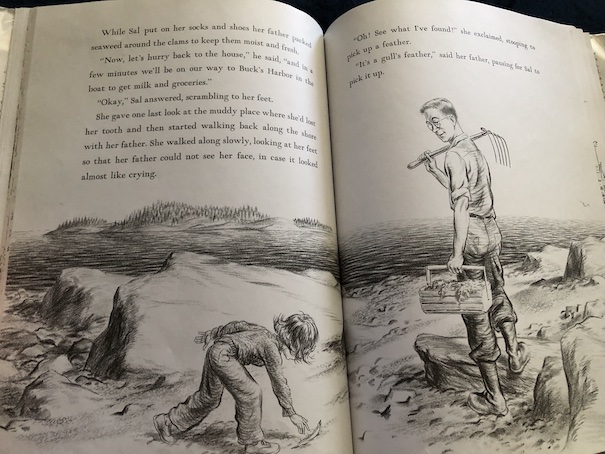
She helps her little sister, Jane, to get ready, and while they’re brushing their teeth, she feels that one of her teeth is loose. She’s never had a loose tooth before, and she runs to tell her mother. Her mother tells her not to worry about it because everyone loses their baby teeth when they’re growing up. She say that a new, bigger tooth will grow in when the old tooth falls out. Her mother says that if she puts her baby tooth under her pillow, she will get a wish, but she shouldn’t tell anyone what the wish is.

On her way to the beach, where her father is digging clams, Sal proudly tells all the animals she sees about her loose tooth. When she reaches her father, she tells him about the tooth, too. Then, she joins him in digging for clams.

Then, Sal realizes that she’s already lost the tooth somewhere. She’s really disappointed because she wanted to make a wish. As she and her father walk back to the house, Sal sees a feather that a gull lost. Since the feather is kind of like a tooth because a new feather grows in when one falls out, she decides that she can make her wish on that.

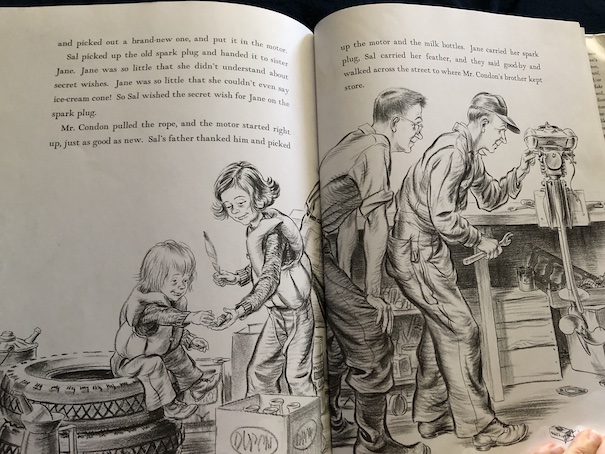
When it’s time to go to Buck’s Harbor, the motor on the boat won’t run, so the girls’ father has to row the boat. When they go to get the motor fixed, Sal tells the mechanic about her tooth. When the spark plug in the motor is replaced, Sal compares the old plug to her lost tooth and gives the old plug to Jane so she can have something to wish on, too.

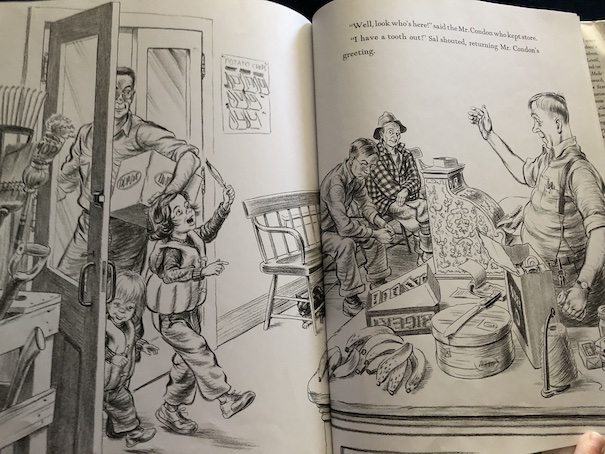
She also tells the men at the grocery store about her tooth, and she ends up getting an ice cream cone, exactly what she wished for! The book ends with Sal, her father, and her little sister all going home for clam chowder for lunch.

The book is available to borrow and read for free online through Internet Archive (multiple copies). It’s a Newbery Honor Book!

This is just a cute little story about a little girl who is proud of losing her first loose tooth. It’s a sort of rite of passage that all small children go through. Her parents don’t tell her about the tooth fairy or promise her money for her tooth, but she does get a wish. Because her wish is a simple one, it’s easily fulfilled.

The different animals that can be found on the coast of Maine would also be interesting to child readers. Sal and her father also talk about which of the animals have teeth and which don’t. The birds and the clams don’t have teeth, but seals do. Sal keeps making comparisons between her tooth and other things that have to be replaced eventually, like the bird’s feather and the old spark plug, finding a kind of magic in things that are discarded and replaced with something new.

Sal and Jane are based on the author’s real life daughters, and their family did live in Maine. The setting of the book is the family’s summer home.

Clocks and More Clocks

Clocks and More Clocks by Pat Hutchins, 1970.

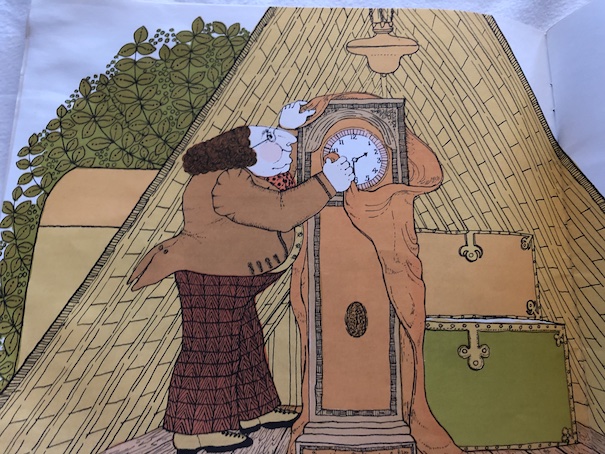
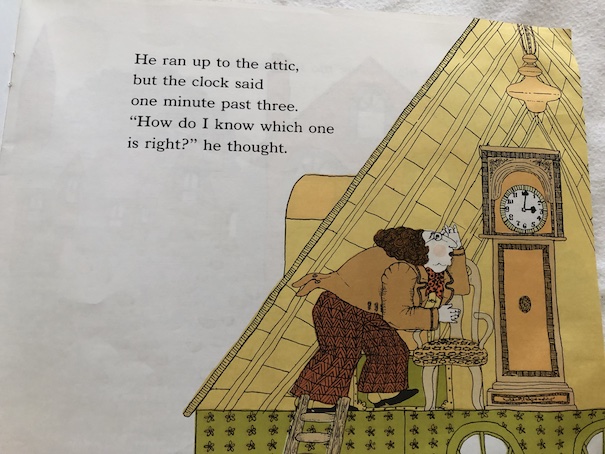
One day, Mr. Higgins finds an old grandfather clock in his attic. He likes the grandfather clock, but he wonders if it really keeps accurate time.

To figure out how accurate the grandfather clock is, he decides to buy another clock. He puts the second clock in his bedroom.

The problem is that when Mr. Higgins goes from his bedroom up to the attic, the clock in the attic reads one minute later than the one in the bedroom. Mr. Higgins isn’t sure which one is right.

Confused, Mr. Higgins decides to buy a third clock to compare to the other two. He puts this one in his kitchen. However, the same thing happens! Each time Mr. Higgins leaves one clock and walks to the next, they’re always a little different!

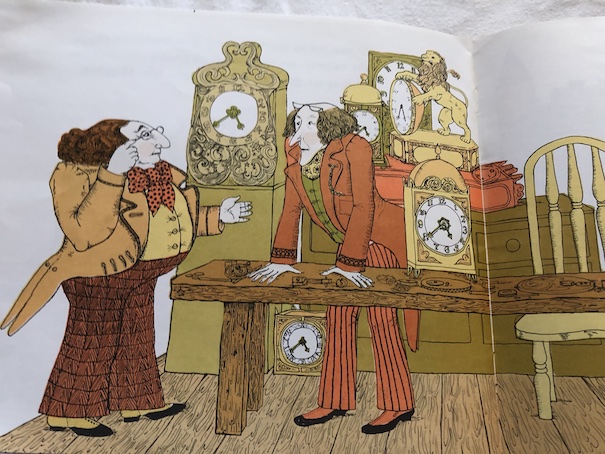
After purchasing a fourth clock gives him the same results, Mr. Higgins asks the Clockmaker what the problem is and he should do. The Clockmaker comes to Mr. Higgins’s house to take a look at his clocks.

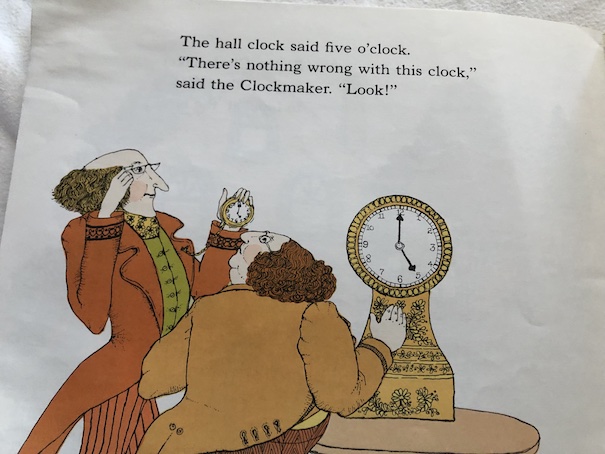
When the Clockmaker compares the time on his watch to the time on each of the clocks, each of the clocks is correct. All of Mr. Higgins’s clocks are working just fine. Suddenly, Mr. Higgins knows what he must do!

Mr. Higgins goes out and buys a watch like the one the Clockmaker owns. Since he bought his watch, all of his clocks have been reading correctly, and Mr. Higgins is happy.

The book is available to borrow and read for free online through Internet Archive (multiple copies).

My Reaction

This is a fun picture book, partly because even kids will begin to figure out what’s going on with Mr. Higgins’s clocks before he does. He never figures out that it takes him one minute to get from one floor of his house to the next. It doesn’t occur to him that the clocks he left behind in each room have been advancing since he walked to the next one. Even at the end, he still doesn’t seem to fully understand it. He just knows than, when he compares any of his clocks to his new watch, they’re always right! The reason why this happens is never explicitly explained. It’s just left for readers to notice and chuckle at.

The Invitation

The Invitation by Nicola Smee, 1989.

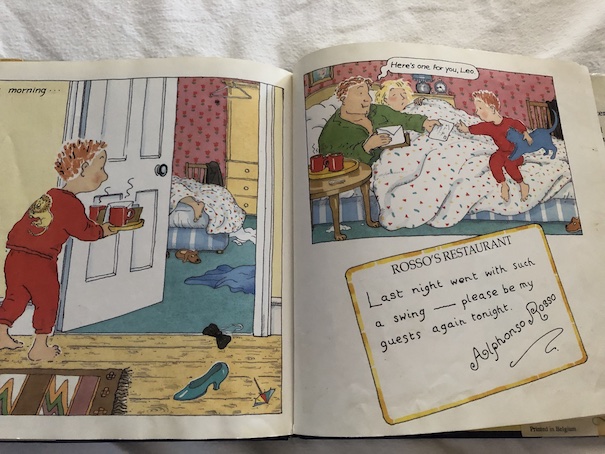
This fun picture book is written in comic book form. Almost all of the text is in speech bubbles in the pictures.

One morning, Leo finds an unexpected prize in his cereal box: an invitation to dinner at a fancy restaurant! He and his parents decide to accept the invitation, getting dressed up for the occasion.

The food is great, and Leo notices that there is a band playing. He asks his mother if she’s going to dance, and on a whim, she decides to dance with the waiter with the dessert cart.

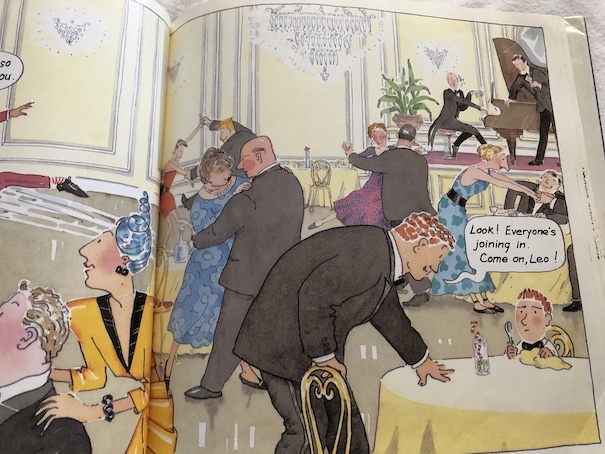
From there, the evening goes from good to great for everyone! The restaurant turns into a party with everyone dancing, Leo’s mother swinging from the chandelier, and the musicians having the time of their lives!

Then, a lady who is a dancing with Leo loses one of her diamond earrings. Leo volunteers to find it for her, and it turns up in an unexpected place.

The evening is such a success that the owner of the restaurant invites them to dinner the next night, too!

The book is available to borrow and read for free online through Internet Archive. It was first published in Great Britain.

My Reaction

In real life, fancy adult restaurants tend to serve foods that kids don’t like and require a level of etiquette that kids often find stifling, but in this fun, comic book style story, Leo and his parents have the time of their lives on this fun evening out! All of the adults in the story are open to some zany fun, and even the owner of the restaurant enjoys himself so much that he’d love to have them back the next day.

Like all picture books, it’s the details in the pictures that really make the story. The story doesn’t tell you that the reason why the cereal box prize was an invitation to this restaurant is that the restaurant owner also owns that brand of cereal, but it’s shown in the pictures, with his name on the box. When Leo and his parents arrive at the restaurant, the owner meets them and compliments them on their taste in cereal. Later, he’s shown eating a bowl of his cereal himself. I also loved the picture that includes Leo’s mother letting loose and swinging on the chandelier. The other people in the restaurant are also eccentrics. One of the dancing women is wearing a dress with a banana print and a matching hat with a banana on it, and while Leo is searching for the lost earring, he finds a lady in an elephant print dress and fuzzy slippers. There’s nothing dull about this elegant dinner or the people enjoying it!

Little Miss Curious

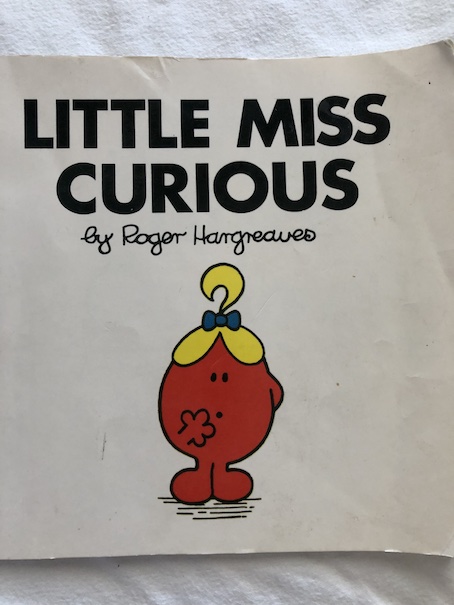
Little Miss Curious by Roger Hargreaves, 1990.

Little Miss Curious is a very curious person. She is curious about everything.

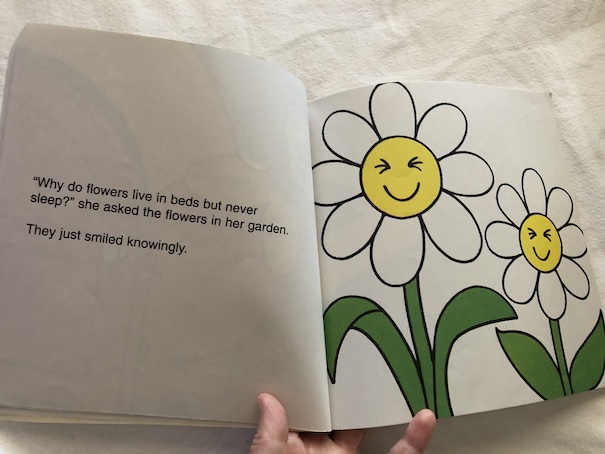
She wonders about all kinds of things and constantly asks questions. Most of the questions she has are silly nonsense, but Little Miss Curious can’t stop wondering things like why flowers are in beds but don’t sleep or why sandwiches don’t contain sand.

She finds out that sandwiches do have sand when Mr. Nonsense makes them, but this is the only question she gets answered in the book.

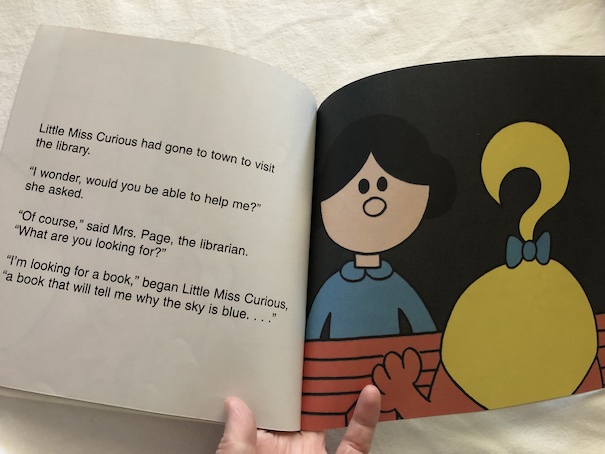
Little Miss Curious has so many questions that she decides to go to the library in town and find books that can answer all of her questions. It’s a sensible thing to do, but because books in this series are mainly nonsense, her library visit doesn’t go as planned.

Little Miss Curious takes so much time peppering the librarian with all of her questions that the other patrons get annoyed, and Little Miss Curious gets thrown out of the library.

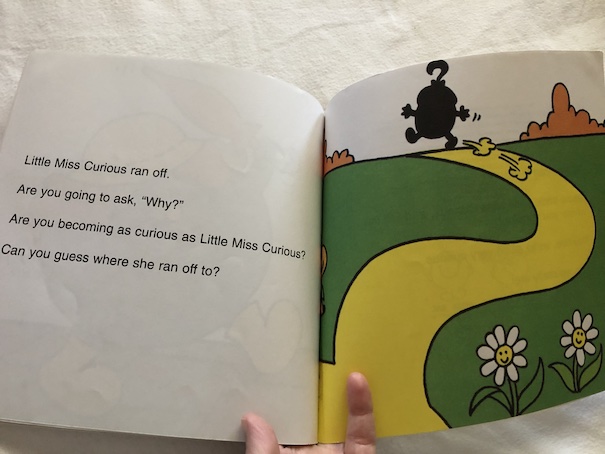
Little Miss Curious can’t understand why that happened or why people are giving her strange looks. The book ends with her running off down the road, and it invites curious readers to wonder why and where she’s going.

This book is part of the Little Miss series. It’s available to borrow and read for free online through Internet Archive (multiple copies).

My Reaction

Sometimes, books in this series emphasize morals by showing positive traits and negative ones, but even more often, the traits of the characters are played for humor, and that’s the case with this book. No morals are taught, and no lessons are learned. Miss Curious faces some consequences for wasting people’s time with ridiculous questions, but she doesn’t seem to understand the way people react to her. There is no change to her character, and the story has an open end, where readers are invited to be curious about where Little Miss Curious is going and what she’s going to do next.

Although Little Miss Curious’s curiosity goes overboard, curiosity is inevitable, and the reader can be as curious as anyone. In a nonsense book, that’s about as close to a moral as I can draw. Mainly, the book is for fun and humor. Readers can chuckle at the silly things Little Miss Curious ponders and indulge in a little curiosity of their own.

Fin M’Coul

Fin M’Coul retold and illustrated by Tomie de Paola, 1981.

This is a retelling of a classic Irish folktale. The story is fun and silly, but one of the parts of this story I like the best is the introduction of the Giant’s Causeway – a real place with a magical look. There’s a geological explanation of this rock formation, but this story introduces the folkloric explanation.

In ancient times, when Ireland was inhabited by giants and magical creatures, a giant named Fin M’Coul lived on Knockmany Hill with his wife, Oonagh. One day, as he is building a causeway between Ireland and Scotland, Fin M’Coul hears that another giant, Cucullin, is coming.

Cucullin has a fearsome reputation, and he has beaten up many other giants, just to prove how strong he is. So far, Fin M’Coul has been able to keep out of his way, but Cucullin is now looking for Fin M’Coul to beat him. In fact, he’s so close that there’s no time for Fin M’Coul to get away.

Fin M’Coul goes home to his wife and asks her what he should do. Oonagh says that he won’t have any peace until he gets this confrontation with Cucullin over with, but Fin M’Coul doubts that he could be a match for Cucullin in a fight. Oonagh decides that they’re going to have to defeat Cucullin with cunning rather than strength.

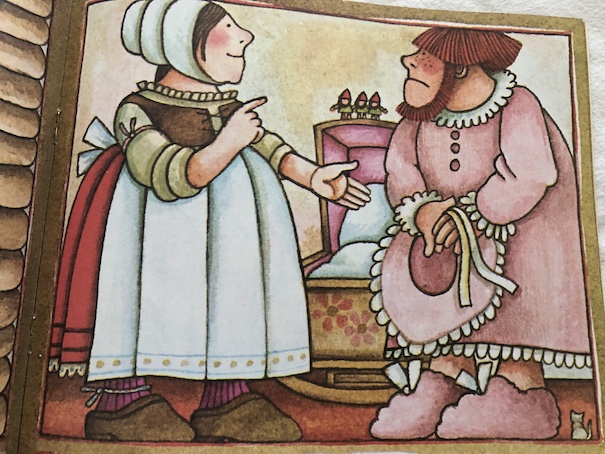
She quickly does a special charm to bring them success, and then, she begins setting the scene for the trick they’re going to play on Cucullin. She makes up a giant cradle and makes her husband dress in baby clothes and sit in the cradle. It’s ridiculous, but Oonagh has a plan.

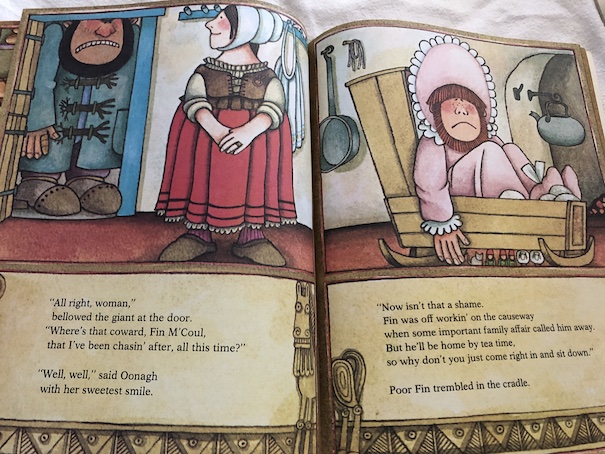
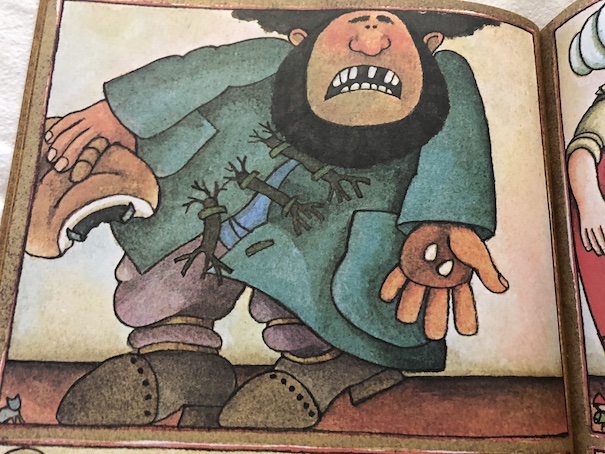
When Cucullin comes, Oonagh tells him that her husband isn’t home, but she invites him to come in and wait with her and her “baby.” Not only is the “baby” astonishingly large, even by giant standards, but Oonagh carefully convinces Cucullin of the baby’s unusual strength. She tricks him into thinking that the “baby” can eat bread and cheese that’s rock hard while giving Cucullin bread with a frying pan in the center and a real stone instead of cheese. Not only does Cucullin break his teeth on these things, but if Fin M’Coul’s “baby” can eat these things, how much stronger could Fin M’Coul be?

Oonagh’s tricks allow Fin M’Coul to get the upper hand against Cucullin and defeat him once and for all!

There is a brief section in the back of the book that explains a little about the background of the legend. I love the pictures in this version of the story. Tomie de Paola books always have fun illustrations, but if it weren’t for the little people and animals in the pictures with the giant characters, you might almost forget that the main characters in the story are all giants.

The book is available to borrow and read for free online through Internet Archive.