Ruth Fielding on Cliff Island

Ruth Fielding

Ruth Fielding on Cliff Island, or The Old Hunter’s Treasure Box by Alice B. Emerson (the Stratemeyer Syndicate), 1915.

Ruth Fielding and her friend, Helen, are waiting for their friend Jane Ann to arrive by train from her uncle’s ranch so they can all go off to boarding school together. Then, Helen’s brother, Tom, arrives with the news that the train has had an accident. They all get in Tom’s car and rush off to see if they can help Jane Ann.

When they reach the site of the train wreck, they discover that Jane Ann was rescued from the train by a young man named Jerry. Jane Ann is fine, but Jerry was hurt in the rescue. After a harrowing escape from a panther that was released during the train crash (Stratemeyer Syndicate books are like this. There has to be suspense and cliff hangers in every chapter.), they take Jerry to the Red Mill, where Ruth lives with her Uncle Jabez and have the local doctor come to treat him.

Jerry explains to the others that he wasn’t actually riding the train when it crashed. He had just been following the train tracks on foot while on his way to look for a job. Jerry used to live on Cliff Island with his Uncle Pete. Jerry is sure that his uncle actually owns the island because they always lived there, and he always said it was his. His uncle used to keep money and important papers in a lockbox hidden on the island because he didn’t trust banks, but there was a landslide that buried the box in its hiding place. After that, his uncle became distraught because the papers that proved he owned the island were in that box. Then, someone else, a man called Rufus Blent, claimed ownership of the land, and his uncle had trouble proving that the claim was false. Jerry’s uncle got into a physical fight with this man, and because he seemed so violent and unreasonable, the local authorities locked him up in an asylum, which is why Jerry is on his own now. Jerry is sure that Blent is on the island now, trying to find his uncle’s buried treasure box.

Jane Ann is touched by this story of injustice, and she immediately wants to write to her own uncle and get help for Jerry and his uncle, but Uncle Jabez urges caution, telling Jane Ann that they should verify Jerry’s story first before committing themselves to his cause. Uncle Jabez gives Jerry a job at his mill and a place to stay. Ruth and Jane Ann have plans to make for returning to boarding school and for preparing for Jane Ann’s first term there. Jane Ann doesn’t like her name, so they decide that when she starts classes, she’ll go by the name Ann.

Ann has a difficult time at school. She has never had formal education before, and she is behind the other girls her age. Some of the other girls at school tease her mercilessly about it, and after a particularly mean prank, Ann hits some of them until her friends finally restrain her. Ann is so upset that she thinks she can’t handle life at the school and doesn’t belong there. She thinks about running away, but she did that once before in a previous book, and after the last experience, she doesn’t want to do it again.

Ann later has a couple of opportunities to use some of the skills she learned from life on the ranch to save some of the other girls and an injured boy, and some of the girls who were mean to her apologize for the earlier prank. They say that they see her in a different light now and feel guilty about what they did earlier. The mean girls do start treating Ann better (their respect now having been bought), but the damage has already been done. Their belated improvement to the level of minimally-acceptable behavior isn’t enough to make Ann feel better before the school goes on winter break.

Mercy, who has been accustomed to being picked on by people because she uses crutches, understands Ann’s feelings and tells her that she should be mean back to people who are mean to her. Ruth thinks that sounds awful, but Mercy tells her that she doesn’t understand what it’s like. Mercy does use her disability to explain that she should have some allowances for her temperament and behavior, especially when people pick on her, although Ruth doesn’t think that’s quite right.

The conversation leads some of the girls to talk about their life goals. Mercy is glad that she’s able to go to school now because her disability made it difficult when she was younger. She’s determined to be the top of the class to show others that she’s as smart or smarter than they are, even if her legs don’t work as well. Mercy’s self-esteem suffered badly when she wasn’t able to walk, even with crutches, and people looked down on her (or at least, she felt like they did). Now that she can walk with crutches and go to school, she finds a new self-esteem in her ability to excel in her studies. That her ambitions are partly rooted in spite toward people who teased her in the past isn’t healthy, but she is determined to take her education as far as she can go and wants to get a scholarship to college. Other girls also start talking about their own ambitions and what they want from their education.

Rather than feeling better, Ann feels worse because she’s still not doing great at her studies, and she’s not sure about her own ambitions and what she really wants from her education. It makes her wonder what her real purpose is at the school and if she should really be there. The school friends are planning to spend the Christmas holidays together. Ann isn’t sure if she really wants to go with them after all, but they persuade her that she really does belong with them, and they want her.

Ruth hasn’t forgotten about Jerry and his situation. The family of a friend of hers at school, the Tingleys, has purchased some land on Cliff Island, where Jerry used to live, and they’re building a lodge there. The Tingleys have invited some of their children’s school friends, including Ruth, to the island over the Christmas holidays, and Ruth persuades them to hire Jerry to work at their lodge. Jerry is happy to be able to return to the island, and Ruth says that this will give him the opportunity to look for his uncle’s hidden box again. Jerry doesn’t have much hope of finding the box because it’s been buried, but Ruth thinks it could still be possible. Blent also seems to think it’s possible because he does everything he can to get Jerry fired and drive him away from the island.

The book is available to borrow and read for free online through Internet Archive (multiple copies) and Project Gutenberg (multiple formats).

My Reaction

Although books by the Stratemeyer Syndicate, especially the early ones, were criticized for being shallow and formulaic, I will say that they do have a way of making you care about the characters. In fact, I think that I found some of the characters in this book more personable than characters in the Nancy Drew books because there is more reflection on what people are feeling and why.

In particular, I really felt for Ann when she was being bullied, and I don’t blame her for hitting the ones responsible when she lost her temper. The other girls were deliberately mean and picked a fight. Learning that they get a fight when they pick one is a valuable life lesson. Actions have consequences, and these “girls” are too old to be doing this with any degree of innocence. I really wished that someone had made it clear to them that the situation was entirely their fault, not Ann’s, and that they failed in their obligations to behave respectfully to a classmate. A thoughtless prank that hurt someone unintentionally would be forgivable, but in this instance, it’s deliberate, calculated, and repeated cruelty. The book says that the mean girls pick on Ann even harder when they realize that they can hurt her and have hurt her, and deliberately hurting people who are obviously hurting for pleasure is really a very sick thing to do. I don’t like it that the book treats this behavior like it’s a normal thing for them to do. Even though I know this is something people do in real life, this type of behavior shouldn’t be normalized because causing pain for pleasure really is a disturbing thing to do when. The prank that broke Ann’s patience was dumb, but when you look at everything that led up to it and the emotions behind it, it says disturbing things about the nature of the people who did it. I always hate it when people give that sort of thing a pass without pointing out the full reality of their motivations to the people doing it.

I never really felt better about the mean girls during the course of the book, even after they started acting better because I didn’t like their motivations for fixing their behavior. The didn’t repent because they felt badly about hurting someone unfairly. Oh, no, they didn’t care that they had caused someone distress and hurt their feelings. No, they do it because Ann used her ranch skills to rescue people in danger. Not only that, but it took two such rescues, not just one, to get them shut their mean mouths. Yeah, it’s like in Rudolph the Red-Nosed Reindeer, if Rudolph had to do two missions to save Christmas instead of one. I now that the moral of Rudolph is supposed to be that people should be nice to other people because you never know if someone you don’t like might have something good to offer you later, but it leaves a bad taste in my mouth that they think that they’re entitled to be offered something in exchange for their good behavior instead of seeing good behavior and kindness as the minimal level of their own obligations. These mean girls (as all mean girls do) see themselves as being so self-important and such a high level of authority that other people have some obligation to prove themselves to them personally in order to be treated with even basic human respect, even though the reality from an objective observer is that the mean girls are nothing but a bunch of bratty, badly-behaved, immature children who should have their eyes opened to that reality. Their level of morality is that people have to buy their good behavior with some amazing deed or service. Otherwise, they’re fair game as bully prey. I’m not buying this, and I’m not buying their supposed reformation.

If relationships are really as transactional as the mean girls make them, someone should point out to them that they’re the most undeserving people of all because they have not offered Ann any sort of service to merit the payment she gives them. In fact, they are burdens to have around. If behavior is transactional, they’re actually in debt, and they’re not very good debtors. The whole thing about relationships being repaired when a victim becomes a hero to an abuser is a bad cliche. I think it sets terrible examples and warped views of human worth, but it’s admittedly a behavior I’ve seen in real life. When it comes to behavior, I prefer a line from an old Murder She Wrote episode, where a snobby man apologizes to being rude to Jessica Fletcher when they first met because he didn’t realize that she was “somebody” as a famous writer. She tells him that it’s perfectly acceptable to be polite to nobodies. Someone should really tell the mean girls that and make it stick. Fortunately, the mean girls do change their behavior for the long term. After they start treating her better, Ann has an easier time at school and can concentrate on her studies better.

There is a kind of parallel in the book between the way the mean girls at school treat Ann because they don’t think she’s good enough for “their” school (as if they owned it themselves instead of just being clients who have to pay money to go there) and how the local people, who are easily swayed by Blent, treat Jerry and his uncle. Mr. Tingley, who bought his property on the island from Blent, is appalled when Blent tries to not only drive Jerry away from the island but even gets together a posse to try to hunt him down with guns like an animal. The local authorities side with Blent because, first, they seem to be corrupt, and second, Jerry’s uncle was always a little strange, so they’re more than willing to believe that he was really crazy. Blent and his cronies even go so far as to kidnap Jerry and bribe the staff on a train to take him to another town, miles away. Tingley is horrified at the locals and what they’re doing. He recognizes that it’s difficult to fight them because they are presenting a united front in their wrongness and are laughing about his inability to stop them, so he has to call in some outside legal help. It’s not unlike the united school bullies, who think that their ability to get away with what they’re doing makes them superior and gives them the right to continue.

When Jerry’s uncle’s box is finally found, the papers inside establish the reality of the situation. Uncle Pete was in the process of buying the island from Blent, so Blent did originally own it. At the time of the box’s loss, Uncle Pete had paid most of the installments he owed to Blent, so although he hadn’t fully completed the transaction, it wasn’t true that he had no claim to the land, either. Blent covered up that he had already taken Uncle Pete’s money for the land or that they had been involved in a transaction at all, seeing it as his opportunity to not only keep Uncle Pete’s money but to make more by selling that same land to someone else. When his land fraud is uncovered, Mr. Tingley and Uncle Pete drag a humiliated Blent through the law courts. Since Mr. Tingley paid for the land he bought in good faith and with the entire amount, his sale stands, but Blent is forced to pay Uncle Pete back with interest. Mr. Tingley and Uncle Pete work out an arrangement where Uncle Pete will live on the island and work for Mr. Tingley, so Uncle Pete will be able to stay on the land he loves. Mr. Tingley also convinces Uncle Pete that banks are more trustworthy than hiding his money and important papers in a cave.
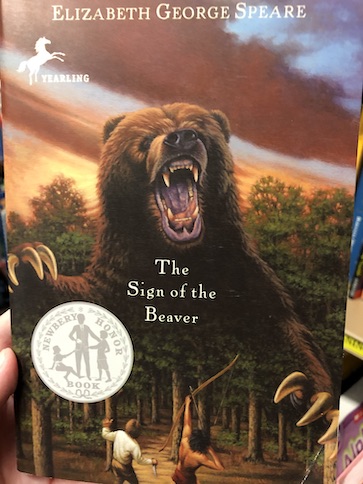
Sign of the Beaver

Sign of the Beaver by Elizabeth George Speare, 1983.

The story begins in the late 1760s with twelve-year-old Matt’s father leaving him alone in the log cabin that he and his father built for their family in the Maine territory. The rest of their family is still in Massachusetts, and Matt’s father is going to get them and bring them to their new home. Their family will be the very first to settle in what will soon be a new township. However, for now, Matt is alone at their cabin, surrounded by miles of wilderness, while he waits for his father to return and the rest of his family to arrive. Matt will be looking after the cabin and the field of corn that he and his father planted, but he finds the silence and solitude unnerving.

Before he left, Matt’s father left his watch and rifle with Matt. After his father leaves, Matt tries the rifle. He doesn’t hit anything, and he decides that it will take getting used to. He learns to hunt with it, and Matt finds that he is very busy with hunting, fishing, and chores, which helps pass the time. Every day, he makes a notch on a stick to mark the days that pass.

Gradually, Matt becomes aware that someone is watching him. Someone seems to be hiding and following him. Since there are no other white families living for miles around, he can only assume that it must be an “Indian” (Native American). They know that there have been some in the area, although they haven’t really met any yet. Matt finds the prospect a little worrying because he isn’t sure what to expect from them, but his father always told him that, if he met an Indian, he should just be polite and respectful. Matt is nervous that whoever is watching him is also hiding from him, though.

One day, Matt hears someone wearing heavy boots tramping in the woods, and Matt thinks that maybe his father has returned early for some reason. However, it turns out to be a stranger in a blue army uniform. Although Matt has missed having company, he finds himself reluctant to talk much to this stranger, and he doesn’t want the man to know that he is there completely alone. Still, the stranger is hungry, so Matt agrees to let him share a meal with him. The stranger, who calls himself Ben, stays the night with Matt, uninvited. Matt can’t bring himself to turn away someone who needs hospitality in the wilderness, and Ben tells him stories of his past adventures. Matt still has misgivings about Ben, and he’s sure his stories are tall tales. When Ben mentions leaving a town because there was trouble there, Matt thinks maybe Ben ran away because he’s a criminal. Matt plans to stay awake that night to keep an eye on Ben, but he eventually falls asleep. When he wakes up, Ben is gone, and so is his father’s rifle. Ben is a thief! Matt realizes that he was right to be suspicious of Ben and is angry that he let him get away with stealing the rifle.

Without that rifle, Matt can’t hunt. He can still feed himself through fishing, but he loses more of his supplies when he forgets to properly bar the door while he’s out fishing, and a bear eats most of the food in the cabin. Reduced to eating only fish, Matt gives in to temptation and tries to get some honey from some bees he finds in a nearby tree. It’s a bad idea, but this decision changes everything for Matt.

Matt is badly stung by the bees, and when he tries to escape them in the water, he nearly drowns. Fortunately, Matt is saved from drowning by the Indians who have been watching him. It turns out to be a grandfather and his grandson. The grandfather, Saknis, takes Matt back to his cabin, brings him food, and treats his wounds. When he realizes that Matt hurt his ankle and lost his boot in the water, he gives Matt a crutch to use for walking and a new pair of moccasins to wear.

Matt is both grateful for this much-needed help but also very self-conscious about it. He can tell that the grandson, Attean, doesn’t like him and thinks that he’s a fool for getting hurt like this, which is embarrassing. Matt also thinks that he should repay them for what they’ve given him, but he doesn’t have much to offer. The only thing he can think of to give them is the only book he owns, a copy of Robinson Crusoe. Matt is embarrassed when he realizes that the Saknis can’t read, and he thinks maybe he will be offended at this type of gift, but the older man realizes that Matt’s knowledge of reading is a gift that they badly need.

In broken English, the old man explains that his people have made treaties with white people before, but because they can’t read English, they never really know what’s written in the treaties. When white people break the treaties or tell them that they’re no longer allowed in certain areas of land, there isn’t much they can do, since they don’t even know for certain what was in the original agreements. He realizes that his people can’t afford to be ignorant. There are more white people moving into their territory all the time, and his people will have to know how to deal with them. Therefore, Saknis proposes a kind of treaty with Matt: they will continue to bring Matt food if Matt teaches Attean to read.

Attean immediately protests this plan. He really doesn’t like Matt, or any white people in general, and he doesn’t want these reading lessons. However, his grandfather is firm that this is something he needs to do. Matt also isn’t sure about this plan. He does owe them for their help, but he’s never taught anybody to read before. His own early lessons didn’t go particularly well, although he likes reading Robinson Crusoe now. Also, Matt thinks of Attean as being a “savage” and a “heathen” who doesn’t even really want to learn, so he’s not confident that the reading lessons are going to go well. Still, Matt does owe them for saving him and could use their continued help while he recovers from his injuries, so all he can do is try.

When Attean gets frustrated during the first reading lesson and storms out of Matt’s cabin, Matt thinks that the lessons are already over. Yet, Attean does return for more lessons. Gradually, Matt thinks of ways to make the lessons more interesting to Attean, reading the most exciting parts of Robinson Crusoe out loud to Attean to get him interested in reading the story himself and finding out what will happen to the main character. It isn’t easy to get Attean interested in learning because Attean is initially determined not to be interested or impressed by anything Matt has to say.

When Matt becomes curious about some of the things Attean and his tribe do, like how Attean hunts rabbits without a gun, Attean opens up a little and shows Matt some of the things he knows. Matt begins to admire some of the unique skills Attean shows him and learns to use them for himself. Matt is aware that his first efforts must look clumsy and childish to Attean as he tries to learn skills that Attean has known for years, but it puts the boys on a more equal footing with each other. Each of them has something to learn from the other, and it’s all right for each of them to look a little awkward to the other while learning. Matt gets embarrassed sometimes when he does something clumsy in front of Attean, but he learns that he must also persevere. Attean teaches him some good, practical skills for making things without using some of the manufactured goods that he and his father brought with them from Massachusetts. When Matt loses his only fish hook, Attean shows him how to make a new one. Attean teaches Matt to be self-reliant and to use new methods to accomplish his goals.

During the part where Matt reads the part of Robinson Crusoe where Robinson Crusoe rescues the man he calls Friday, and Friday, out of gratitude, becomes his slave, Attean protests that would never happen in real life. Attean says that he would rather die than become a slave. Matt is surprised because he never really thought that much about how someone like Friday would feel in real life. Matt learns to look at the story as Attean would, reading the best pieces to him, the ones that emphasize the friendship between the two characters rather than servitude.

Gradually, Matt and Attean become friends. Matt doesn’t think he’s very good at teaching Attean to read, but Attean does slowly learn. Although Attean resists learning to read because he’s trying to prove that he doesn’t need this skill that he associates only with white people, his spoken English becomes better as he and Matt talk. Attean admits that he tells parts of Robinson Crusoe to his people, and they enjoy hearing them, so Matt moves on to stories from his father’s Bible. Attean finds the Bible stories interesting and compares them to stories that his people already tell. (It is interesting, for example, how many civilizations around the world tell stories about great floods.) The boys are fascinated by the common themes in their stories.

The boys also enjoy doing things together, and Matt feels less lonely when Attean comes to visit. Matt doesn’t always like Attean because he has a disdainful attitude toward him, but they learn to trust each other, and they find interesting things to do together. Matt comes to realize that his irritation at Attean’s attitude is because it’s so difficult to earn Attean’s respect, and he really wants Attean’s respect. Although Matt doesn’t like Attean’s attitude toward white people, he does agree with Attean about some things, and he has to admit that he cares about what Attean thinks. Matt does get some respect from Attean later when the boys have a hair-raising encounter with a bear. Attean is the one who actually kills it, but Matt proves his usefulness during the struggle. Matt also comes to understand Attean’s resentment against white people when Attean eventually tells him that he’s an orphan and that his parents were killed by white people. That’s why he lives with his grandparents.

As time goes by, Matt becomes increasingly worried about whether or not his family will ever arrive. He worries that maybe something happened to his father and that the rest of the family won’t know where the cabin is and won’t be able to find him. When it passes the time when his family should have arrived, Matt fears that maybe they will never come at all. What if he is left alone? He has survived so far, with some help from Attean and his people, but can he live alone forever? Or could there be a place for him among Attean’s people?

Saknis has also been thinking about this, and he has noticed that Matt’s family has not yet come. He knows that it would be dangerous for the boy to remain alone in the cabin when winter comes. As the seasons change, the Native Americans are preparing to move to their winter hunting grounds. Saknis invites Matt to come with them, and Matt has to decide whether to accept the offer or stay and wait for his family.

This book is a Newbery Honor Book. It’s available to borrow and read for free online through Internet Archive (multiple copies).

My Reaction and Spoilers

This story reminds me a little of The Courage of Sarah Noble, where an 18th century white child who is afraid of Native Americans comes to learn more about them by living with them and interacting with them. I actually read The Sign of the Beaver when I was a child, and I only read The Courage of Sarah Noble as an adult. I’m not sure now if I prefer one of these books over the other. For a long time, I forgot the title of The Sign of the Beaver, although I did like this book the first time I read it. I remembered the concept of the boy living alone while he waited for the rest of the family to join him. One part that stuck in my mind the most was the part near the end of the story where Matt makes a cradle because he knows that his mother was expecting a baby when he last saw her and thinks that it would be nice to have a cradle ready for his new younger sibling, but when his family arrives, he is told that the baby died. That tragic image just stayed with me for years.

Some of the prejudiced language in the story, like “savage” and “heathen” and some anti-Catholic talk from Ben early on, is a little uncomfortable, but this is one of those stories about changing attitudes and overcoming prejudice. The main character has to show some fearful and/or prejudiced thoughts toward Native American initially for readers to appreciate how far he comes and how much his thinking changes after he makes friends with them and learns more about them.

Ben, of course, is a villain character, so his prejudiced talk is a reflection of that. He’s selfish and a thief, so his views of other people are based on what puts him in the best light or justifies things that he’s done. When he talks about the people of the last town he was in being against him and making trouble so he had to leave, both the readers and Matt realize that Ben was the one who started the trouble. Ben blames other people for problems he creates himself. The stories he tells Matt about his earlier, supposedly brave adventures are based around the French and Indian War, which is where the Catholics enter the discussion.

Several times during the story, Attean uses the word “squaw” to refer to women. I didn’t think too much about that sort of thing when I was a child because I assumed that both the author and characters in books that used that term knew what it meant and were using it correctly. Since then, I’ve heard that it actually has a rather vulgar meaning, although I’ve also heard conflicting information that it’s not always vulgar. The contradictory accounts make it a little confusing, but according to the best explanations I’ve read, the contradictions about the meaning of this word have to do with similar-sounding words in different Native American languages. Not all Native American tribes have the same traditional language, and some have words that sound like “squaw” and refer to females in a general way, while others have words with a similar sound that refer to female anatomy in a more vulgar way. For that reason, something that might seem innocuous to one native speaker might sound crude to another, and non-native speakers of any of the languages involved may not fully understand all the connotations of the word. In the end, I’m not sure how much of this the author of this book understood, but my conclusion is that it’s best not to use certain words unless you’re sure of their meaning, not only to you but to your audience. I only use the word here to make it clear which word appears in the book. Other than that, I don’t think this word is a necessary one, at least not for me. I understand what Attean is referring to in the context of the story, and I think that’s what really matters in this particular case. Whether that’s the right word for Attean’s tribe to use at this point in history would be more a matter for a linguist. I’m willing to accept it in the book as long as readers understand the context of the situation and are content to leave the word in the book and not use it themselves outside the context of the story.

When Attean talks about women in the story, it’s typically to point out certain types of work that he considers women’s work instead of men’s work. Matt is a little offended sometimes when Attean tells him that some chore he’s doing is for women instead of men. Matt’s family doesn’t have the same standards for dividing up chores as Attean’s tribe does, and the fact is that Matt is living alone at the moment. There are no women in Matt’s cabin, only Matt. Any chore that needs to be done right now is Matt’s to do because there simply is no one else to do any of it for him. I think when Attean tells him that he’s doing women’s work, he’s trying to needle Matt because, otherwise, he comes off as sounding a little dense. Sure, Attean. We’ll just have the women who aren’t here do this stuff that needs doing right now. During the course of the story, Matt comes to appreciate how the Native Americans live differently because it makes sense for the place where they live and their circumstances, but this is one instance where Attean could be a little more understanding about Matt’s circumstances.

One thing that I had completely forgotten about in this story was the part where Matt thinks about how Attean smells bad. Earlier, when I did a post about Mystery of the Pirate’s Ghost by Elizabeth Honness, I was irritated at the author for having one of the characters imagining smelly Native Americans because I had never heard of that as a stereotype before (I thought at the time), and I didn’t know where that idea came from. A site reader suggested that the trope came from the Little House on the Prairie series because there is talk like that in those books, but The Sign of the Beaver actually offers an immediate explanation as soon as Matt thinks about the cause of the smell. Matt realizes that Attean has smeared a kind of smelly grease on his body that is meant to repel mosquitoes. Matt has heard of people doing this before, and he understands that there is a useful purpose behind it, but he just hates the smell so much that he thinks he’d rather just put up with the mosquitoes. That explanation really helps to put everything into context. When there’s no explanation about things like this in stories, it makes it sound like Native Americans are just smelly because they’re “savages” who don’t bathe or something, but when you hear the explanation, it’s just that the smell is an inconvenient side effect from something that has a real, practical purpose. It might be unappealing to Matt, but there is a point to it. So, on the one hand, I feel a little bad about getting down on Elizabeth Honness for throwing that idea into her story without an apparent basis, but still irritated because, if she knew that was the explanation, she could have said something about it instead of just throwing that out there, like everyone reading the story would already know. I have similar feelings about some of the things Laura Ingalls Wilder put in her books, too. Context is important, and some authors are better at providing it than others. I also think that context is something that books from the late 20th century and early 21st century often provide better than books from earlier decades, although there are some exceptions.

At the end of the story, we don’t know for sure whether Matt and Attean will meet again. When Matt’s family arrives, they tell him that other white families will be arriving soon. Matt knows that the tribe he befriended will likely lose their hunting grounds to the town that will be built there. Matt is concerned for their future, but he is glad to be reunited with his family and still considers Attean his friend.

Sing Down the Moon

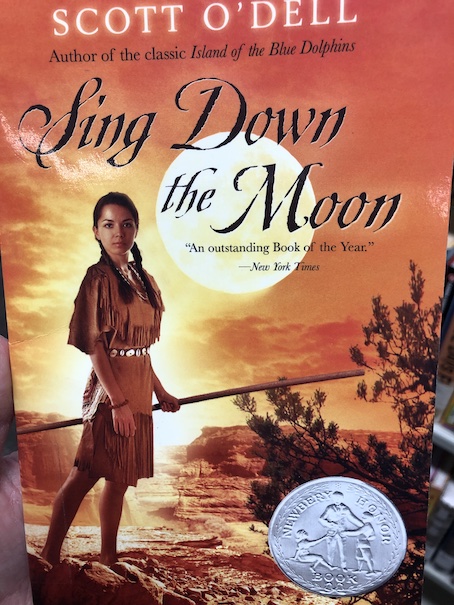
Sing Down the Moon cover

Sing Down the Moon by Scott O’Dell, 1970.

The story begins with a young Navajo girl, Bright Morning, admiring the beginning of spring, but she is caught in a storm and hurries home without the sheep she was supposed to be tending. When the girl’s mother realizes that she abandoned the sheep, she takes the girl back to the sheep, and they watch them all night. The sheep are very important to the family, and the girl’s mother refuses to allow her to take the sheep out by herself again for the rest of that spring.

When Bright Morning finally proves that she can be responsible and not leave the sheep to tend themselves, she is allowed to take them out again. Bright Morning likes to talk to the other girls, Running Bird and White Deer, as they watch all of their sheep together. The girls like to talk about their futures, who they will marry and what kind of children they have. They like to tease each other. Bright Morning’s friends know that she is likely to marry a young man called Tall Boy. The rumor is that Tall Boy’s parents want him to marry her because her mother owns so many fine sheep. Bright Morning knows that her friends tease because they are curious about Tall Boy and want her to talk about him, but she refuses. The girls know that he is supposed to be riding out with the warriors soon, and they tease that maybe he will bring back some other girl from the Ute tribe, but Bright Morning ignores them.

After the warriors have left for their raid on the Utes, the girls see some white men on horses approaching the village. The girls recognize them as oldiers and are worried that their village could be vulnerable to attack without the warriors. Later, the girls encounter more white men, but these men are not dressed as soldiers. They stop to talk to Bright Morning and Running Bird, asking them for directions, but the girls realize that they are slavers. They kidnap both girls and ride away with them!

They take the girls to a town of Spanish people and separate them from each other. They sell Bright Morning to a woman who uses her as a servant. The woman has other Native American girls as slaves, including a younger girl called Rosita. Rosita doesn’t mind her captivity or her life as a servant much. She came from a tribe that was very poor, and since she was brought to this woman’s household to work for her, she has had better food and clothing than she did at home. Rosita tells Bright Morning that the family they work for isn’t bad, and Bright Morning is allowed to keep her dog, who followed her when she was abducted. However, Bright Morning can’t stand her captivity. The woman who owns the house gives her new clothes, but Bright Morning doesn’t care. All she wants to do is find a way to go home.

Bright Morning is reunited with Running Bird when another captive girl comes up with a plan for the three of them to escape. They manage to steal horses and ride away from the town. Along the way, they meet up with Tall Boy and one of his friends, and the boys help fight off the Spaniards who are pursuing the girls. Unfortunately, Tall Boy is badly injured in the fight. He loses the use of one of his arms, and the other Navajos know that he can no longer be a warrior. Bright Morning still cares about Tall Boy, but her mother and sister tell her that she should no longer consider marrying him.

However, the Navajos’ troubles are just beginning. They haven’t heard the last of the soldiers. The American soldiers return and drive the Navajos off their land. They destroy all of their homes and eventually round them up and start them on a long march with little food, where many of them die. The Navajos fear that all of them will die. How will Bright Morning and her family survive, and will they ever see their homeland again?

The book is a Newbery Honor book. It’s available to borrow and read for free online through Internet Archive (multiple copies).

My Reaction

I remember reading this book when I was about 13 years old, in middle school! It takes place in my home state, the northern part, where the Navajo reservation is now, in the Four Corners region. I’ve been to Canyon de Chelly (“Chelly” is pronounced like “shay”, like in French) before, although I hadn’t been there at the time when I first read this book. Since I read this book as a kid, I’ve been to places and seen things that helped me understand the setting of the story better. As an adult, I appreciate the historical aspects of the story even more because I know more about the background. The book doesn’t give a date for the story until the postscript at the very end of the book, but the death march described in the story is Long Walk of 1863 to 1865.

The second half of the book is very depressing because there are horrible conditions and many deaths, including the deaths of children. I wasn’t sure that I really wanted to revisit this book at first because I remembered that it was depressing, but the book is well-written. The narrator describes events in an exciting, compelling way.

I had forgotten many details of the story, but there were some things that jumped out at me as an adult that I hadn’t noticed the first time. The postscript at the end of the story explains how life and Navajo culture changed after this traumatic event. If you see photographs of Navajo in “traditional” costumes now, they often include velveteen clothing, but that’s actually a relatively new tradition. The velveteen was adopted from white people during their captivity because they didn’t have access to wool to make their older style of traditional clothing. When Bright Morning was held captive in the Spanish town, she was given velveteen clothing there.

Another odd topic that is touched on only very briefly but that I know more about from other sources concerns the subject of flour. The book mentions that the Navajo were unused to eating wheat flour until it was their only form of rations during the Long Walk. Until then, their staple grain was corn, and when they started eating wheat flour, it made them feel sick. Their bodies just weren’t used to it. The book doesn’t explicitly explain this, but I know from other sources that the Long Walk and those flour rations were the origins of Navajo fry bread. Fry bread was not part of Navajo diet until that point. I grew up eating it on special occasions as a treat because it is greasy but good with powdered sugar, and it’s often served at carnivals and fairs here. However, as an adult, I came to realize that its origins as a food come from a very dark source. It was starvation food. It can keep you alive if there’s nothing else, but it’s not going to keep you healthy if you eat nothing else. It’s greasy and fatty, and it has little nutritional quality. Even now, I don’t have as much tolerance for it as I did when I was a kid. I can’t stomach it well these days if it’s too greasy or I eat too much.

That’s actually not a bad metaphor for the events described in this book. They’re heavy, and the more of it you understand and absorb, the sicker you feel. I absorb much more now than when I was a kid and only half understood the full significance of the events, and it makes me feel much worse than I did the first time.

So, do I recommend this book for kids? Actually, yes. I’m not a fan of depressing books with a lot of death, and I struggled through some depressing books when I was in school. If you had asked my 13-year-old self whether books with this much death and suffering were worth it, she might have had trouble answering that question, but time and further understanding have changed the way my adult self feels. There are some depressing topics that are worth the struggle to absorb them, but if I were the one teaching the lessons, I think I would do it a little differently than my teachers did for me back then.

I think this book is still a good introduction to topics that can be difficult to discuss. It’s worth reading once to understand the historical background of these events and what they really meant to the people who experienced them directly. It’s painful to read the bad parts, but it’s the kind of pain that leads to something better: real understanding. I recommend the book for kids in their early teens because I think that’s the best level for understanding it and accepting the bad parts. I think it should also be accompanied by nonfiction history lessons about the time period and events and discussion about their feelings about the story and historical events. I remember being told some of the history the first time I read this book, but I think that maybe there should have been more discussion about feelings.

I think it’s important to discuss feelings because they’re the hardest part of this book and they’re also the reason why it’s difficult to study some of the darker parts of history. I had a hard time with this when I was younger, and I still do in some respects, but I think understanding what causes those feelings is key to handling them. Reading books like this while discussing tools to handle difficult feelings could help students to better handle their emotions in other areas of life as well.

One of the first points that I think is important to understand and which my teachers didn’t really explain to me is that it’s natural to feel bad when you hear about bad things happening to other people, even when the bad things happened generations before you were born or even when those individual characters are fictional. (Bright Morning and her friends and family are fictional characters even though the events around them are historical. Real Navajos did experience what they experienced.) Empathy is a natural human emotion, and it’s an important tool for living with other people. Humans are social creatures. We live as part of larger groups, and we need at least some empathy to understand other people’s emotions and circumstances, how our actions affect them, and how to treat other people as we ourselves would truly like to be treated. The ability to experience empathy is a sign that you are mentally and emotionally healthy. It’s really only worrying when someone can’t feel it.

One of the most disturbing feelings about this story comes from realizing that the soldiers who are inflicting all of this death and pain either don’t feel empathy for the people they are harming or have actively chosen to ignore it to further their own purposes. That’s not a sign of being mentally or emotionally healthy or behaving in a moral way. When the readers feel repulsed by the soldiers and what they’re doing, it’s because they recognize that these people are a serious danger to others, and they are not functioning in a normal way. Your brain is warning you of a threat. It’s a past threat rather than an immediate one, but if you find the soldiers and their actions upsetting, it’s a sign that your brain has accurately assessed the risk associated with these people and the harm they do. You have accurately connected the suffering of other people for whom you feel empathy with the people who are the direct cause. I’m not saying that the soldiers were necessarily psychopaths, but lack of empathy and remorse and calculated manipulation are all symptoms of psychopathy and should raise alarms for anyone confronted with those signs. So, feeling bad about this situation and the people causing it is a sign that you yourself are mentally and emotionally healthy and have correctly recognized the seriousness of the situation and the harm being done to other people. What I’m saying is that, even when you’re feeling bad, it’s for good reasons, and that deserves recognition.

When I was young, I felt angry and frustrated by stories where people were doing terrible things to others. I still do because that’s part of empathy, but I also came to realize that part of my frustration when it came to historical situations came from my inability to change the situation. When harm has been done, it’s impossible to undo it. What was done was done. I can’t help the people who died, and I can’t even punish the wrong-doers because they’re dead now, too. It’s frustrating to find yourself confronted by a situation where nothing can change. But, I think it’s important to realize that change has happened and is currently happening. History is being written all the time, not even just through writing but through the ways that people live their lives every day. Even when a particular event is over, events and people keep moving. Bad events can cast long shadows, causing harm long after the initial event. That’s part of what makes them so bad. However, as time moves on, new people enter the scene, and new things happen, including things that people in the past would never have foreseen. It eventually reaches a point where the things that continue to happen rely on what we, the living, continue to do or allow to be done. History takes the long view, and I think people need to be reminded of that.

Do you suppose that the people in this story who act as villains thought of themselves like that? Further point, how much does it matter how they thought of themselves? Maybe they thought of themselves as winners at the time because they were getting their way and the people they were hurting were unable to stop them from hurting and killing them, but is that really “winning”? Lazy historians frequently brush things off by saying that “history is written by the victors“, but if that were really true, would we even be hearing or reading stories like this? Would we ever hear about slaves or care about the victims of war and atrocity? Would we ever consider the perspectives of people who died at all? Or does it change your mind about what “winning” really is and who’s really a “winner”? Maybe, in life and history, there aren’t any “winners” because neither of those was ever really a contest to begin with. (Or, as some put it, life is a collection of contests that people can simultaneously be both winning and losing. Personally, I think life is just for living, not for winning against someone else who is also trying to just live and probably couldn’t care less about you “winning” or not.) Apparent victories aren’t always real accomplishments, and people who see that reality are the ones who write the most accurate histories. Individual human lives only last so long, so any apparent “win” by an individual or group is never more than temporary. Our sense of what history includes and what people in the past were really like changes as we increase our knowledge of it and reconsider the context, not unlike the way my 40-year-old self has a deeper understanding of this book than my 13-year-old self did.

Remember that, at the beginning of this particular story, the Navajo warriors were going to raid the Utes. We never really find out in the book why they were going to do this, but does it matter anymore when the Navajos themselves get raided and subjected to something that might be even worse than what they were originally planning to do to their enemies? The story drops this subplot when the march begins. Life is like that, constantly moving, ever changing. History goes on and on. Sometimes, a young warrior who was praised for his prowess gets shot in the arm and can’t pull a bow anymore. Sometimes, a 40-year-old woman from the 21st century looks back on 19th century soldiers who may have thought of themselves as heroes and wants to tell them, to their faces, that they couldn’t be more wrong about that. If they’re not evil psychopaths, they’re doing a dang good job of pretending, and I never once thought of them as being “heroes” in my entire life. That’s life for you. Each of the people who have read this book or ever will read it are among the new people entering the story and its sequels, and we all have the ability to decide what role we want to play in the on-going story of history.

What happens after the book ends, is important, too. If I were teaching this, I would follow up this particular chapter of Native American and Navajo history by talking about some of the developments that continued to happen in their history, including some of the better moments, like the development of the written form of the Navajo language (for much of it’s history, Navajo was only a written language – that’s why the soldiers in the story couldn’t leave a written message in Navajo) and how code talkers used the Navajo language during WWII. The people who realized that these things were possible and something worth working toward were creative individuals. Rather than seeking to destroy something or repress it, they found creative ways to make use of what was there and put people’s talents to good use, helping others. The worst moments of history have been when people without empathy use others or seek to destroy them for personal gain, but the triumphant moments are when people take what they have and find a way to make it better. Noting these positive moments doesn’t make the bad parts of history any better than they actually were, but what we want is more of these positive moments of creativity and development and the type of people who are willing to work to make them happen.

It helps to balance out the explanations of what went wrong and people who did wrong with examples of what was better. Some teachers stress how we teach the bad moments so people learn from the past and don’t repeat it, and that’s true. However, I think we also need to add on what has worked and what we want people to do instead. A “don’t do this” needs to be followed up by “do this instead” to be an effective instruction. As a society, we don’t want more destroyers and takers. We want innovators and makers. We want creative people who find new uses for resources, including human resources and talents, and who are dedicated to truly helping others and human society as a whole instead of merely helping themselves to what others have that they want. This book demonstrates the dark side of humanity, but as I said, history is still being written every day with new players.

On the lighter side of this story, I enjoyed the descriptions of the coming-of-age ceremony for young women that Bright Morning has and the marriage ceremony later. During her time in captivity in the Spanish town, Bright Morning also attends Easter celebrations. She doesn’t understand Christianity and has never heard of Jesus before, and she doesn’t understand what the holiday is about or what’s going on. Rosita tries to explain to her who Jesus is in terms of Navajo religion. I found the explanation fascinating, but Bright Morning is still confused.

Native Americans

Native Americans by Jay Miller, 1993.

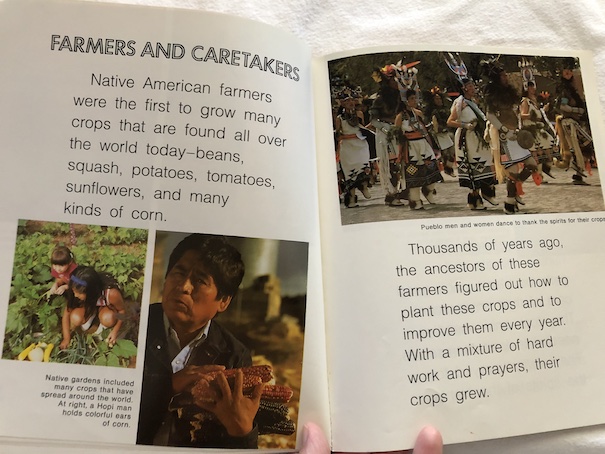
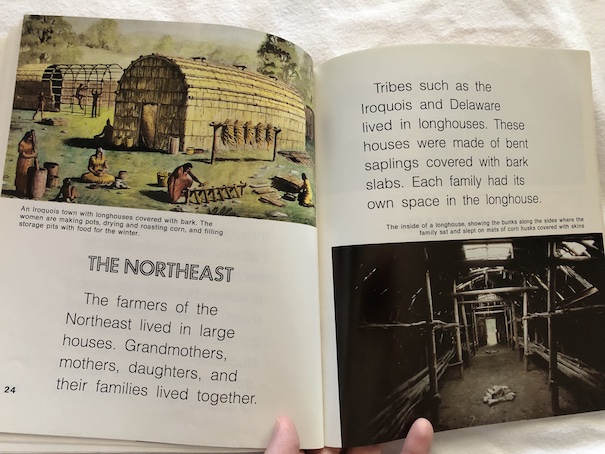
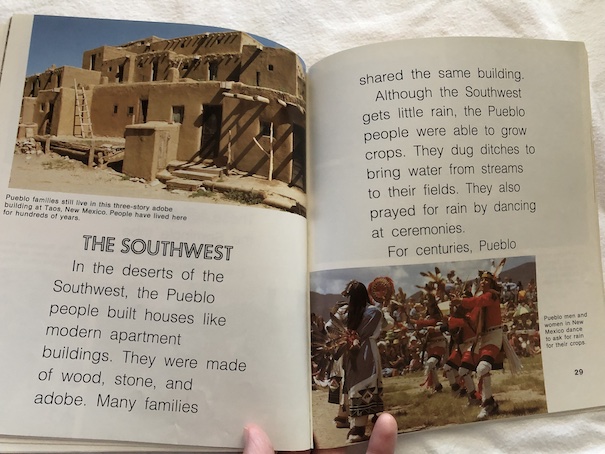
This book is part of the New True Books series, a series of nonfiction picture books on a variety of topics. This particular book gives an overview of the history and culture of Native Americans.

The book starts with some basic definitions and broad explanations of certain aspects of Native American culture, beginning with the explanation of why Native Americans are sometimes called “Indians.” The book notes that each tribe of Native Americans also has a name for itself. Each tribe has had its own culture, which it thought was better than other tribes’ cultures, but throughout history, tribes have interacted and traded with each other. One factor that made Native American cultures different from each other was whether tribes relied mainly on farming or hunting and gathering for food.

The book refers to hunter-gatherers as “caretakers”, a term that I can’t recall seeing before for hunter-gatherers. The reason why they use the term “caretakers” is they say that hunter-gatherers took care of their environments and only took the plants and animals they needed for survival, not wasting anything.

There are sections of the book that discuss some general aspects of Native American culture, like types of homes and tribal leaders. Of course, as the book notes, many cultural aspects varied, depending on the tribe, the environment where they lived, and whether they were mainly farmers or “caretakers.”

The book also has sections about the Native America tribes of various regions of North America, like the Northeast, the Southeast, the Southwest, the Northwest Coast, and the Plains.

The book ends with a brief section called Changes, which explains how Native American cultures were impacted by the arrival of Europeans in North America.

The book is available to borrow and read for free online through Internet Archive.

And This is Laura

And This is Laura by Ellen Conford, 1977.

Twelve-year-old Laura Hoffman feels out of place in her family. Her other three siblings are over-achievers. They all have particular talents and interests and earn awards for them or just have the ability to impress people. Laura gets good grades in school, but apart from that, she doesn’t seem to have any unique talents or interests. She doesn’t think there’s anything about her that would earn an award or impress anybody. Laura feels depressingly average next to the other members of her family.

It isn’t that her family is pressuring her to achieve anything in particular or to be like them or do what they’re doing. It’s just that Laura wishes that she had something more interesting and distinctive about herself. Other people who know Laura’s siblings keep comparing her to other members of her family. When she joins the drama club at school, one of her teachers seems a little disappointed that she’s not quite as good at acting as her older sister is. Laura’s friend, Beth, tells her that she’s good, but Laura feels like she’s never good enough, never as distinctive as she should be.

By contrast, Beth’s family is much more conventional. She only has one younger sibling, not three siblings, like Laura. Her mother is a lawyer, and their house is always neat and stylish. Laura’s house is noisy and chaotic, and she describes their household clutter as looking like a rummage sale. Laura thinks of herself as being a more ordinary, conventional person, and it occurs to her that she feels more at home in a conventional house. When Beth comes to visit Laura’s house, Laura worries at first that Beth will think her family is too weird. However, Beth is charmed by their eccentricity. In fact, Laura feels a little hurt at how interesting Beth finds the rest of her family. Laura worries that she’ll always be boring and ordinary compared to everyone else. However, Laura has a special talent that even she doesn’t realize that she has.

While Beth is having dinner with Laura and her family, Laura’s mind wanders from the chaotic conversation at the dinner table. She suddenly finds herself having a vision of her scientist father in his laboratory. She sees him meeting a man in a white shirt and then acting excited, like he’s just had an important discovery. The vision feels strange to Laura different from a daydream. When it’s over, she hears her father saying that he has a lot on his mind, and Laura absent-mindedly tell him that he’ll figure it all out tomorrow, after the man with the white shirt comes. Suddenly, everyone stops eating and stares at her, wondering what she meant, but even Laura herself isn’t sure. She’s aware that she knew her father was working on some difficult problem because he was juggling hard-boiled eggs earlier (something her eccentric father does whenever he needs to think), but she’s never had visions like that before and doesn’t know who the man in the white shirt is or what her vision really means. She just thinks it’s nice that everyone seemed to notice her.

There must be something to Laura’s visions because her father later tells her that he figured out his problem just like she said she would. Beth is intrigued by Laura’s apparent ability to predict things and tries to help her have another vision. Laura sees Beth on a stage with flowers at her feet and takes that to mean that she’ll be the star of the drama club play. However, Laura isn’t sure that her visions are always true because, when Beth tries out for the lead, she only gets the second best part in the play.

Another odd thing about Laura’s ability is that the girls realize that it doesn’t work well in a quiet environment, like Beth’s house. Laura gets visions when she’s surrounded by noisy chaos and starts to feel like she’s either outside of the situation or wants to be outside of it.

At first, Laura likes feeling special and noticed because of this unusual ability she seems to have, but it soon starts to worry her. She’s not sure that she can always trust her visions to be right or her ability to interpret them. She also begins to realize that it’s not so much that people are starting to notice her as a person but to pay attention to her ability, which is different. It starts to make her feel even more out of it than before.

Then, Laura has a terrifying vision where her younger brother, Dennis, is missing and her mother is frantic with worry. Is that vision real? Is something really going to happen to Dennis, or is there another explanation? The vision wasn’t clear on what would happen to Dennis, and if it is a real vision, can Laura do anything to protect her little brother?

The book is available to borrow and read for free online through Internet Archive.

My Reaction and Spoilers

This story starts off like many other kids’ books I’ve read, where a character feels out of place in their family or wishes that they had some talent that would make them stand out from their siblings. Then, it takes a turn for the mysterious when Laura begins to have visions that make it seem like she can predict the future. At first, Laura enjoys the feeling of being special and noticed, but then, her visions start to frighten her.

Another girl at school, Jamie, hears her talking about it with Beth, and she tells Laura that she’s fascinated by people with psychic abilities. She’s read about it before, and she points out to Laura that not being right all the time or not knowing what a vision means at first doesn’t mean that she isn’t gifted. When she explains to Laura how alarming visions can have perfectly innocent explanations because visions can be metaphorical, Laura feels better.

Jamie persuades Laura to give psychic readings to classmates for money, but the idea of turning her newfound ability into a business doesn’t feel right to her. Sometimes, she sees things that she doesn’t like, things that frighten her. It’s bad enough to predict that a classmate will fail a class, but another vision suggests that a classmate will die. He doesn’t die, but he does get into a car accident, and that’s bad enough. Laura realizes that it’s horrible to see that bad things will happen without having a way to do anything about it. Also, instead of being pleased and proud of her, her family finds the whole business unnerving and all of the kids who come to see her for psychic readings too chaotic, even for them.

There are also the disturbing visions that Laura keeps seeing about Dennis. She takes her friends and her old sister, Jill, into her confidence. Jill says that she will keep a close eye on Dennis to make sure nothing happens to him. Dennis does disappear during the story, and people worry about him, but nothing bad happens to him. Nobody in this story dies, and Laura uses her visions to figure out where Dennis is.

Toward the end of the book Laura talks to her parents about whether or not they’re proud of her because of her psychic abilities. They have a family talk about what it means to be proud of someone. The parents say that they’re not proud of their children for being talented because they don’t see themselves as being directly responsible for their talents. They love all of their children simply because they’re their children, and they’re good people, who do what they think is right and care about others. As far as talents and accomplishments go, the parents see their role as parents as making resources available to their children so they can develop whatever talents they have to the fullest, whether that means letting them have music lessons or encouraging them to try out for the school play. Whatever talents the children have are simply what they were born with, and their achievements are signs that they’re making use of what they have. The children accomplish what they work for themselves, and they’re doing it because they love doing it, not because the parents require it. What makes the parents proud of their children is when they find out what they’re good at and what they love doing. It doesn’t matter to them what their children’s talents are or how their talents compare to each other’s; they just want all of their children to find fulfillment in what they do.

In fact, her mother says that she thinks part of Laura’s trouble is that she’s good at too many things. She’s always gotten good grades in every class, so none of her subjects seems to stand out. If she only got mediocre grades in most subjects and good grades in just one, she would feel like she had a particular talent for that one subject. When she gets equally good grades for everything, nothing stands out to her as her special talent. Rather than being “boring” and “ordinary”, as Laura thinks of herself, she’s actually well-rounded and multi-talented.

Her parents have always been confident that Laura would find her own interests and talents in life. She just feels unaccomplished next to her siblings because, except for Dennis, her siblings are older than she is and have had more time to figure out what their interests are and build up accomplishments. Laura is also a good, caring person, who has been using her talent to help other people to the best of her ability. She looked into everyone else’s future but her own. Her parents say that having a lovable and loving daughter means more to them than any number of impressive accomplishments would be. Whatever anyone else in the world thinks about Laura and her abilities, her family loves her for who she is, not her abilities.

I like the parents’ attitudes, and it seems that the rest of Laura’s family feels the same way, especially her older sister, Jill. I enjoyed how supportive Jill was about both Laura’s psychic abilities and about her acting. When Laura tells Jill that she’s thinking about quitting the drama club because her teacher seems disappointed that her acting isn’t as good as Jill’s, Jill persuades her not to quit. Jill tells Laura that she would understand if she wanted to quit the drama club because she discovered that she really didn’t like drama after all, but she doesn’t want her to quit because she thinks she isn’t good enough. Jill says that Laura is good but that she just needs a little more coaching. She wants her sister to see that she is more talented and capable than she thinks and to make the best use she can of her talents, all of them.

There were a few instances of mild swearing in the book and one semi-dirty joke. When Laura thinks that she’s hopeless at acting because her teacher is disappointed that she’s not like her sister and says that she’s going to give up the drama club, Jill insists that Laura read the role for her so she can see what her performance is really like. Laura doesn’t really want to, but Jill insists that she stand up and read it properly because “You can’t act lying down.” Laura quips that “You can if you’re in an x-rated movie”, and Jill wryly tells her that she’s too young for that. The joke only works if the reader knows what an x-rated movie is, so it would probably go right over the heads of anyone too young to understand it.

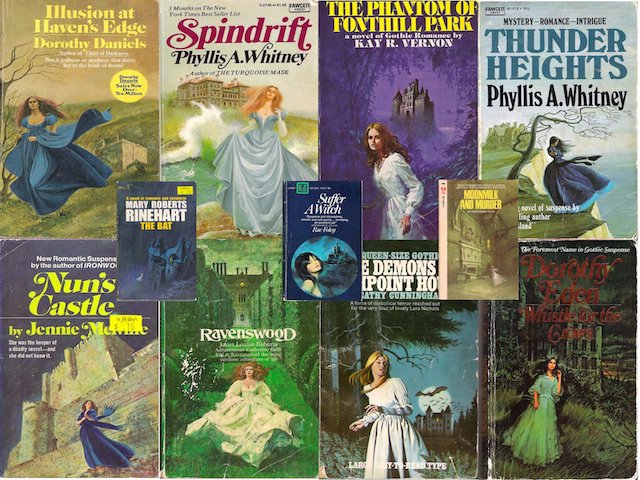
One part of this book that I thought was amusing was when Laura explains about her mother’s writing career. When her mother was younger, she played bit parts in movies, and now, she writes gothic romance novels and westerns. Laura doesn’t like the westerns, but she’s read a couple of the gothic romances, and she has noticed that her mother’s gothic romances are very formulaic – “heroines who go to live in crumbling old castles where dark family secrets are buried and everyone acts strangely and the heroine finds herself in Terrible Danger.” That is a concise and accurate description of that entire genre of books. Her mother says that’s part of the challenge of writing gothic romance – writing the same story over and over in different ways so readers can hardly recognize that it’s the same story at all.

The reason why that’s funny to me is that, years ago, my brother and I were sorting through some old books, and we found our mother’s old collection of gothic romance books. I was immediately struck that all the covers on the books looked alike. They weren’t completely identical, but they all had young women in dresses running away from crumbling old manor houses or castles while looking scared. Sometimes, the heroine had a blue dress and sometimes a red one. (More often than not, the dress was blue, but sometimes, there would be a girl in red, pink, or white. Other colors were rare.) There were a few where it looked like it was even the same girl or the same castle viewed from a different angle. I thought it was so funny, I picked up a couple more with very similar covers from a thrift store and made a couple of digital collages with them that I turned into backgrounds for my computer screen. The same story, told over and over in different ways. You can’t judge a book by its cover, but these covers do explain a genre. I’m not saying it’s not a fun genre, only that I find it funny. Whoever did the covers for these books was undertaking the same sort of challenge that writers like Laura’s mother did in writing them.

The Magic Nation Thing

The Magic Nation Thing by Zilpha Keatley Snyder, 2005.

Abigail O’Malley’s life was turned upside down when her parents divorced when she was in kindergarten. They sold the family home, and her father went to live in Los Angeles and pursue his law career while her mother opened a detective agency. Abby isn’t fond of her mother’s detective agency and has no such ambitions herself. In fact, she would be satisfied if she just has a nice, normal family someday. She misses the nice house where her family used to live and doesn’t like the shabby Victorian house where she and her mother now live and use as the office of the detective agency. Abby envies her friend, Paige Borden, whose family has plenty of money and who life a much more “normal” life. Abby’s mother, Dorcas, isn’t too enamored of the Bordens, thinking that the family is boring. She wishes that Abby would become interested in joining her detective agency someday because the truth is that Abby isn’t quite normal herself, although she doesn’t like to think about it much.

Abby’s mother, Dorcas, says that Abby has an ability to notice information that other people miss, but that’s not quite it. Dorcas says that people in her family have had a “gift” for doing unusual things, like reading people’s minds or finding missing objects. Dorcas is convinced that Abby has inherited this “gift.” However, Abby denies having any such “gift.” As far as she’s concerned, she just occasionally gets hunches about things, and once or twice, they’ve turned out to be right. Abby resents the idea of a special gift partly because she thinks that her mother’s crazy desire to be a detective has something to do with her belief that she also has this special gift, and Abby doesn’t think she does. Abby doesn’t like to think about any of her relatives having been that strange. She just wants a normal family, like Paige’s.

However, Abby’s gift is re-awoken when her mother accepts a case involving a missing girl, who is believed to have been kidnapped by her own father because her parents are divorced. When Abby holds a locket belonging to the little girl, she begins to have visions, not unlike visions that she’s had at other times in the past. Mrs. Watson, who owned the day care that Abby used to attend said these vision episodes were just her imagination, which Abby used to think of as her “Magic Nation.” Abby has spent years trying to ignore it, but this is one of those times when it’s impossible to ignore. Abby has a vision of the little girl at Disneyland with her father. At first, Abby doesn’t want to admit the existence of this vision, but thinking about how worried the girl’s mother is, Abby casually suggests to her mother that, if the girl was taken in a custody dispute, her father might have decided to take her somewhere fun, like Disneyland, to try to win the girl’s favor so she’d want to stay with him. Her mother follows up on the hint, and with the help of the police, the girl is found and reunited with her mother.

That’s the end of the kidnapping case, but it’s only the beginning of Abby’s acknowledgement of her “gift.” Dorcas’s success in the kidnapping case brings more business to her detective agency. As Dorcas gets busier, Abby feels neglected, but Paige’s mother offers to look after her after school to help out, helping Dorcas to feel better about Abby’s friendship with the Bordens. Abby enjoys spending more time with Paige after school, and the girls even start getting along better with Paige’s annoying younger brothers, Sky and Woody. The youngest boy, Sky, particularly comes to like Abby when Abby intervenes after he makes the family’s intimidating cook angry by spilling juice in the kitchen. Abby sensed the boy’s fear and went to the kitchen to find out what happened. Although Abby still wonders how much of her “hunches” are really due to some kind of “gift” because they don’t work all the time, she increasingly realizes that what she still thinks of as her “Magic Nation thing” is not something that she can simply ignore.

Paige is fascinated by Abby’s mother’s work, and she particularly idolizes her pretty assistant, nicknamed Tree. When Abby tells her that her mother and Tree are investigating a case of arson, Paige talks her into coming with her on a little stakeout of their own, which messes up Tree’s actual stakeout and Dorcas’s plans. Dorcas is angry with the girls, and Abby finds herself using her “Magic Nation thing” to try to learn something about the arsonist and make up for ruining the stakeout. Abby does discover who the arsonist is, although she still doubts the reality of her “hunches.” When she shares that information with Tree, Tree also becomes aware of what Abby can do. Tree has known that Abby sometimes gets “hunches” about things, and although Abby still isn’t sure what to think about them, Tree says she’s noticed that Abby’s hunches pay off more than her mother’s do. Then, after the arsonist is caught and Paige goes overboard in her idolizing of Tree for catching the arsonist, Abby lets it slip that she was the one who figured out who the arsonist was.

Abby had been trying to keep this weird and questionable “gift” a secret, but once she tells Paige that she was the one who found the arsonist, she has to explain how she did it. To Abby’s surprise, Paige believes her about the “Magic Nation thing” and thinks it’s really cool. She’s noticed before that there are times when Abby seems to know things that other people don’t or learns things more quickly that most, and Paige thinks that’s a product of her “Magic Nation.” Paige is so enthusiastic about Abby’s “gift” that she thinks the two of them should start their own detective agency, and she starts trying to find cases for them to solve. Paige’s efforts to find an exciting mystery for Abby to solve don’t lead to much, and Abby finds herself doubting her “gift” and its usefulness again.

Then, Abby goes on a ski trip with Paige and her family, and young Sky disappears. Abby realizes that, whether or not her “gift” is real or reliable, she has to try again for Sky’s sake.

The book is available to borrow and read for free online through Internet Archive (multiple copies).

My Reaction

I like Zilpha Keatley Snyder books. She’s also the author of The Headless Cupid. This story is well-written and fun to read, and I enjoyed seeing how Abby comes to understand and accept her “gift” and make it work for her. I particularly liked the way that Abby comes to understand her “gift” and accept its limitations. There are points when Paige is disappointed or angry that Abby can’t use it to come up with all of the answers that she wants on demand, but Abby can’t make the “gift” do what her friend wants, and she makes it clear that Paige is going to have to accept that. Sometimes, Abby isn’t even interested in trying to use her gift in the way Paige wants, just like she isn’t really interested in using her gift to follow her mother’s profession. Abby comes to realize that an important part of learning to live with her gift is making it clear that this “Magic Nation thing” belongs to her – it’s her gift, to use or not use, as well as she can, in whatever way she sees fit. It’s her right to create her own boundaries, even refusing to talk about her “gift” when she doesn’t want to. The “Magic Nation thing” can’t be forced, and Abby herself won’t be pushed or bullied, either. This personal development is actually a bigger part of the plot than any of the mysteries that Abby solves or attempts to solve.

We don’t know what will happen with Abby and her “gift” after the story ends. There are hints that Abby might be willing to use her powers again, if the situation is important enough and she’s still able to do it. It seems that her mother no longer gets the visions that she used to get when she was Abby’s age, which is why her “hunches” don’t work out as well as Abby’s do now. Dorcas isn’t going to be able to rely on her “powers” to make her a great detective, but Abby comes to appreciate that her mother still enjoys her work and is pretty good at it, not because she’s relying on psychic powers, but because she works hard and is attentive to details. It’s possible that Abby’s powers will also fade as she grows up, but even if they do, it will be okay because Abby can also have a fulfilling life doing the things she loves and is good at. Dorcas is still more enamored of the idea of their shared “gift” than Abby is, but the reality is that neither of them really needs to rely on it. It might be there in the future, if they need it, but it’s not their only strength.

There are some contemporary cultural references in this story that help set the time of the story. Paige is a Harry Potter fan, Abby says that she has some Lemony Snicket books, and they refer to Jennifer Lopez, the Olsen Twins, Leonardo di Caprio, and Britney Spears.

Happy Birthday, Little Witch

Happy Birthday, Little Witch by Deborah Hautzig, illustrated by Marc Brown, 1985.

This was one of my favorite Halloween books when I was a child, and so is the first book in the series, Little Witch’s Big Night. The first time I read these books, I read them out of order, but you really have to read the first book in order to understand Happy Birthday, Little Witch because it turns out that Little Witch still doesn’t understand the idea of trick-or-treating or that human children wear costumes on Halloween after meeting some children trick-or-treating on the previous Halloween. She really thinks that she met a small astronaut, pirate, and devil on Halloween, and that makes it difficult for her to find them when she wants to invite them to her birthday party.

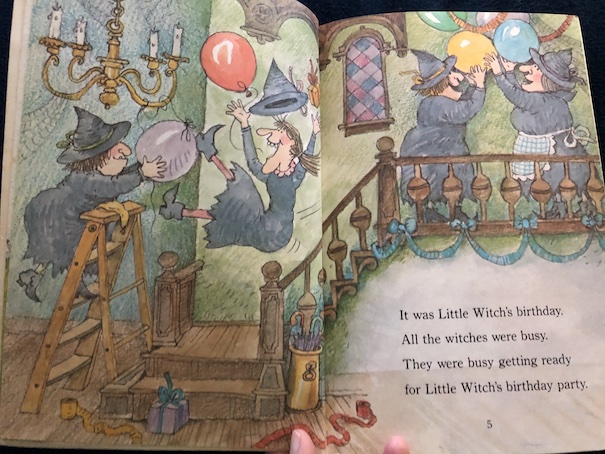
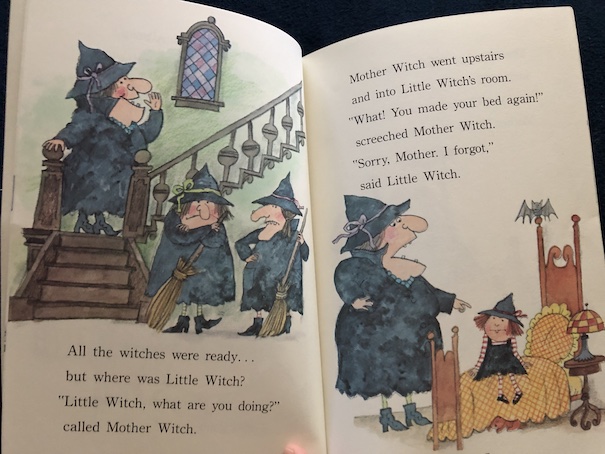
The witches in Little Witch’s family are decorating and preparing for Little Witch’s birthday party, but Little Witch is sad. Witches are generally bad and nasty, and Little Witch knows all the tricks her family will pull at her birthday party. Little Witch is nicer than the other witches, and she wishes that her party could be nicer, too. Then, she gets the idea of inviting the new friends she met on Halloween, who she only knows as Pirate, Astronaut, and Devil.

She doesn’t know her friends’ real names, so she tries to search for them in place where she thinks that a pirate, an astronaut, and a devil might hang out, taking her cat Bow-Wow and her pet bat Scrubby with her. She hitches a ride on a rocket ship, but her astronaut friend isn’t inside.

She checks out a pirate ship, but her pirate friend isn’t there, and the captain makes her walk the plank.

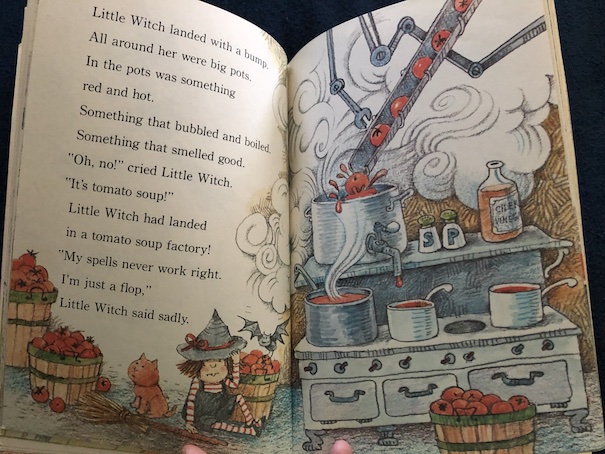
As for the devil, she thinks that she should try someplace that’s red and hot and ends up in a tomato soup factory (which I think is the funniest part if you’re reading this as an adult and you realize what kind of red, hot place she was really thinking of going to look for a devil).

However, the cook in the factory suggests to her that if she’s looking for her friends, they’re probably in school. At the school, Bow-Wow the cat gets frightened and runs away.

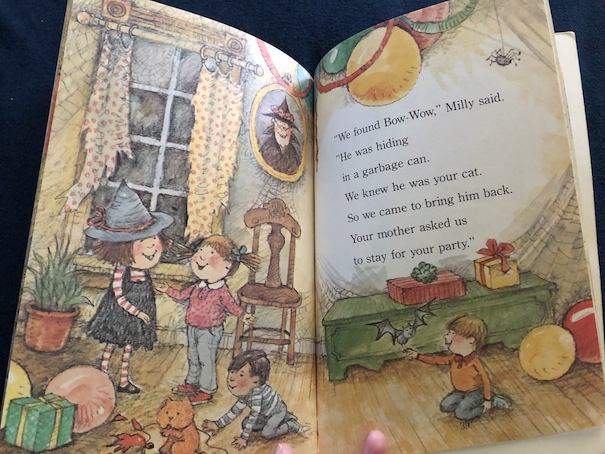
When Little Witch gets home, she finds out that her friends are ordinary children. They found her pet cat and brought it to her house, so her mother invited them to join the party. Her friends introduce themselves by name for the first time.

Little Witch’s party is nicer than it usually is, and she gets to play different games with her new friends. Little Witch’s mother says that she loves her, even though she is more good that most little witches.

Something that I didn’t mention in the review of the previous book is that both of these books were illustrated by Marc Brown, who created Arthur. The book is available to borrow for free online through Internet Archive.

Little Witch's Big Night

Little Witch’s Big Night by Deborah Hautzig, illustrated by Marc Brown, 1984.

On Halloween night, all the witches in Little Witch’s family are busy getting ready for their big broomstick ride. However, when Mother Witch sees that Little Witch has cleaned her room and made her bed, something too nice for a witch to do, she punishes her by telling her that she will have to stay home.

Because Little Witch is left at home, she is there to answer the door for three trick-or-treaters dressed as an astronaut, a devil, and a pirate. Since she doesn’t have any treats to offer them, she offers to give them rides on her broomstick.

The trick-or-treaters have a great time as Little Witch has her broom do tricks and she shows the pirate a real pirate ship.

The trick-or-treaters have so much fun that they promise to come back next year. Little Witch resolves to be good all year so that her mother will punish her again and make her stay home from the Halloween flight, so she will be there to meet her new friends when they come back.

However, when the other witches come back, Mother Witch says that she missed Little Witch on the flight and that she will get to come on the flight next year. Little Witch asks if she can bring some friends with her, and Mother Witch says that will be fine, as long as Little Witch isn’t too good.

This was one of my favorite Halloween books when I was a child, and so is one of the other books in the series, Happy Birthday, Little Witch. The first time I read these books, I read them out of order, but you really have to read the books in order to understand Happy Birthday, Little Witch because it turns out that Little Witch still doesn’t understand the idea of trick-or-treating or that human children wear costumes on Halloween. She really thinks that she met a small astronaut, pirate, and devil on Halloween, and that makes it difficult for her to find them when she wants to invite them to her birthday party. The Little Witch in this series isn’t the same as the Little Witch in the Little Witch Craft Books.

The book is available to borrow for free online through Internet Archive.

The Mystery of the Creep-Show Crooks

The Three Investigators

The Mystery of the Creep-Show Crooks by M. V. Carey, 1985.

The Three Investigators are at the beach when Bob finds a plastic tote bag that appears to belong to a girl. Trying to figure out who the bag belongs to, the boys look through it to see if there’s some kind of identification. They find a teddy bear, a copy of People magazine, a self-help book about achieving success, some makeup, and a pair of earrings, but nothing with the owner’s name on it. When Jupiter takes a closer look at the book, he realizes that it’s a library book from the Fresno Public Library. The boys decide to contact the library, tell them that they found the book, and ask how to contact the person who checked it out. However, this simple attempt to return lost property turns into a much bigger mystery.

The librarian in Fresno gives the boys’ phone number to a frantic woman looking for her missing daughter, Lucille Anderson. Sixteen-year-old Lucille apparently ran away to Hollywood to try being an actress. Her parents are worried, the police haven’t been much help, and the boys’ inquiry about the tote bag and library book is the first lead they’ve had to Lucille’s location. Since the Three Investigators are all about solving mysteries, they immediately decide to search for Lucille themselves.

The self-help book immediately offers a few clues. The premise of the book is that anyone can become successful at whatever they want to achieve by imagining that they’re already successful. This is actually a real theory that I’ve heard of before, after a fashion. In real life, the theory is that you will also adopt the positive habits of the successful person you envision yourself to be, therefore promoting positive change in your life. (“If your habits don’t line up with your dream, then you need to either change your habits or change your dream.”) The self-help book in this story doesn’t seem to go into those details, though. Judging by the pawn tickets that Lucille has used as bookmarks, it’s not going very well for her.

Mr. and Mrs. Anderson come to Jupiter’s uncle’s salvage yard to meet the boys and collect Lucille’s bag. The Andersons bring along pictures of Lucille, and they talk to the local chief of police. There isn’t much the police can do, and runaways of Lucille’s type are unfortunately all too common. However, the police chief vouches for the boys’ reputations as amateur investigators, so the Andersons agree to let the boys try to find Lucille.

The boys’ first move is to check out all of the pawn tickets. They discover that, at each place where Lucille pawned something, she used a different name, the name of an actress who is already famous. Lucille has also been using makeup to change her appearance. The boys spot her at a pizza place, but because of her disguise, she gets away from them before they fully recognize her. They talk to some other people at the pizza place who know her under the name Arianne Ardis. At first, Lucille’s new friends are reluctant to say much about her to strangers, but the boys explain that her parents are frantic and need to know where she is. Lucille’s friends tell them where Lucille has been living.

It turns out that Lucille is being helped by a kind woman named Mrs. Fowler. Mrs. Fowler owns a large house, and she sometimes takes in teenagers like Lucille and gives them a place to stay and some work to do while they’re getting themselves established in life. Mrs. Fowler met Lucille at the hair salon where Lucille works part time. Now, Lucille is doing some house-sitting and helping Mrs. Fowler’s housekeeper while Mrs. Fowler is on a trip to Europe. Lucille says that it gives her some security and time to take acting classes and look for acting work. It’s a pretty cushy position for a teenage runaway. When the boys convince her to call her parents and bring her parents to see her, Lucille is angry and says that she doesn’t want to go back home with them because she is actually getting somewhere with her life and acting career.

Lucille tells them that she’s been offered a leading role in a new horror movie called Dracula, Mon Amour. It’s supposed to be a sequel to the classic Dracula. It sounds cheesy, and her parents are understandably skeptical. Lucille’s father doubts whether this movie offer is legitimate, and he recruits the Three Investigators again to research this film company and the movie producer to find out whether they’re even real filmmakers.

It doesn’t take the boys long to determine that the supposed producer isn’t who he claims to be. He’s assumed someone else’s identity, and when the Three Investigators meet with the real producer, he says that the phony is probably out to take advantage of this girl in some way. He says that there are some real weirdos out there and tells the boys to warn the young actress to back away from this supposed movie offer. However, when they go to tell Lucille what they’ve learned, they discover that she’s missing and may have been kidnapped! Why would phony movie producers kidnap a teenage runaway/wannabe actress? To make matters worse, the Three Investigators start to suspect that this horror movie crew might have something to do with a series of robberies committed around town by people dressed as horror movie creatures.

The book is available to borrow and read for free online through Internet Archive.

My Reaction

For part of the mystery, while the characters are pondering the real identity of the movie producers and Lucille’s whereabouts, I found myself wondering why Lucille left her tote bag of stuff on the beach. I wouldn’t have expected a teenage runaway, who has few personal possessions and probably can’t afford to replace any she loses, to be so careless with her things. At first, I wondered if this was an oversight or plot hole in the story, but it’s not. Lucille’s tote bag and its contents are key to the mystery. They’re the reason why the criminals are interested in Lucille. In a way, this story reminds me of the movie Charade with Cary Grant and Audrey Hepburn. In both stories, there is a bag full of seemingly innocent contents, but someone wants something in the bag very badly. The challenge is to figure out what they want and what its significance is.

There are also a couple of twists about the crimes being committed. The main criminals aren’t doing all of the things everyone suspects them of doing, and there is another criminal involved because there is another crime that isn’t discovered until the end.

The Mystery of the Sinister Scarecrow

The Three Investigators

#29 The Mystery of the Sinister Scarecrow by M. V. Carey, 1979.

Jupiter Jones is going on a buying trip with Hans and Conrad, the men who work for his uncle’s salvage yard, to see someone who had some things to sell to his uncle. Jupiter’s friends, Bob and Pete, go with them, but they’re all stranded when their truck blows a tire. They look around for a place where they can call the salvage yard to explain their situation and get help, and they see a large house with a cornfield nearby.

However as Jupiter approaches the house to ask to use the phone, he is suddenly tackled by a man with a jagged rock in his hand! Hans comes to his defense, and the man is surprised and sorry when he realizes that he’s just tackled a boy. It turns out that the man is nearsighted and has lost his glasses on the ground. He starts to explain that he thought that he was tackling a scarecrow, and then, he suddenly stops and says that he’s been having trouble with trespassers. Jupiter asks him what meant when he talked about the scarecrow, but the man dodges the question. Instead, he asks them why they’re there, and they explain about wanting to use the phone.

The man invites them into the house to use the phone. The man isn’t really a farmer. His name is Dr. Wooley, and he’s an entomologist who’s working on a book. He’s studying army ants, which are carnivorous. He shows them the colony he’s studying, but the sight of all those ants just encourages them to finish their call and leave fast.

However, Jupiter is still intrigued about why Dr. Wooley seemed to attack him because he thought he was a walking scarecrow. He persuades Bob and Pete to return to the area with him to investigate. When they stop in a cafe, a man there hears them talking about the scarecrow, and he says that he’s seen the walking scarecrow himself. He works in the area, doing security for a nearby museum. The boys ask him for details about his sighting of the walking scarecrow, and he says that he saw it near the Radford house, which is where the boys met Dr. Wooley.

When they go to the place where the man saw the scarecrow, they meet a woman named Leticia. Leticia asks them what they’re doing, and they explain about looking into a sighting of a walking scarecrow. Suddenly, Leticia gets very excited. She has seen the scarecrow herself, but no one will believe her. She asks the boys if they will come to the house and explain to Mrs. Chumley that she really did see a walking scarecrow.

Leticia Radford is a jet-setting heiress who lives in the mansion by the cornfield. Mrs. Chumley has been with her family a long time as a secretary and housekeeper, but she’s been confined to a wheelchair for years after being in a car accident. Leticia spends most of her time traveling in Europe, but she returns home periodically, usually after one of her disastrous romances. She has phobias of both insects and scarecrows. Actually, her fear of scarecrows is related to her fear of insects and other creepy-crawly things. Leticia explains that, when she was a child, a scarecrow fell on her when she visited a pumpkin patch one Halloween, and when it broke apart, it had spiders in it, so she always associates scarecrows with bugs. Until the boys explain that other people have seen the walking scarecrow, Mrs. Chumley had thought that Leticia had imagined it.

Leticia blames Dr. Wooley for the walking scarecrow because he made a scarecrow after he moved into the cottage on the estate property to do his research on the ants. Dr. Wooley makes her nervous because she associates him with both bugs and scarecrows. Leticia says that the scarecrow seems to be targeting her because it has shown up multiple times, seemingly looking for her, and once, it hid in her car and threw bugs on her.

While the boys are in Leticia’s mansion, explaining to the other people in the house that Leticia hasn’t imagined the scarecrow, Dr. Wooley shows up, angrily accusing the boys of faking their car trouble the day before just to get into his lab. Dr. Wooley says that someone dressed as a scarecrow entered his lab, hit him on the head, and stole a jar of some of the ants he’s been studying. It doesn’t take them long to figure out where the ants went because Leticia finds them in her bedroom, along with the jar from Dr. Wooley’s lab.

It’s obvious that someone is purposely trying to frighten Leticia by dressing as a scarecrow and tormenting her with bugs, the two things guaranteed to terrify her. The boys are surprised when Dr. Wooley is the one who hires them to find the person tormenting Leticia. Dr. Wooley says that he isn’t responsible for frightening Leticia, but he can see that it all looks bad for him because he was the one who made a scarecrow and the ants in Leticia’s room were his ants. He doesn’t want his professional reputation ruined, and he also feels sorry for Leticia. Leticia can’t figure out why anyone would target her because she’s never been a threat to anyone, but she may be more of a threat to someone than she knows.

My Reaction

The combination of a mystery involving scarecrows and insects and someone who is afraid of both scarecrows and insects is a little strange, but I thought the author did a good job of explaining how the two are related in this story. Leticia’s two fears are connected because she thinks of scarecrows as being homes for bugs.

One of my questions during the mystery was wondering whether someone is trying to convince Leticia that she is crazy (“gaslighting” her, like in the movie of the same name) or just trying to drive her away from the house. I had a couple of theories about what could be going on. Some of what I considered turned out to be right, but someone I suspected turned out to be completely innocent.

At first, I also wondered if there would be an unexpected romance between Leticia and Dr. Wooley because the story establishes that they are both single, and there are points when they hang out together when they don’t have to. However, the story doesn’t end with any clear romance. Leticia is still afraid of insects at the end, which would make romance with an entomologist awkward. She does allow Dr. Wooley to continue his work on her property, though. The boys also notice that Leticia seems to branching out and finding new interests at home rather than running off to Europe again, so that might represent some new developments in her character and a possible turning point in her life.