The Illyrian Adventure

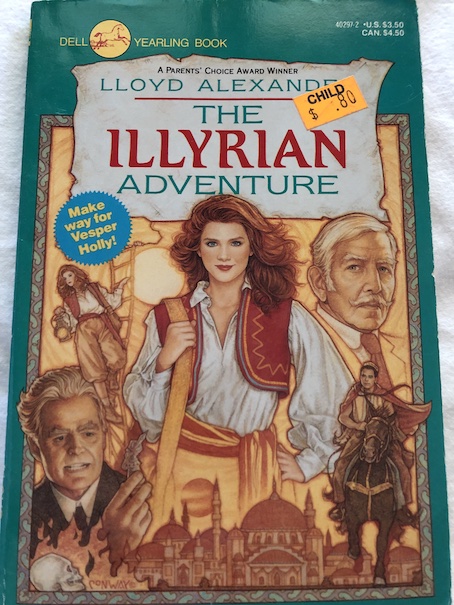
The Illyrian Adventure by Lloyd Alexander, 1986.

This is the first book in the Vesper Holly series. Vesper Holly is like a female Young Indiana Jones.
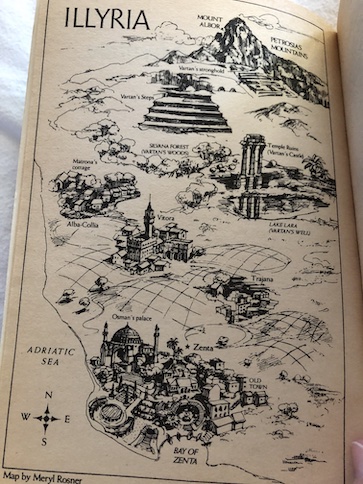
The story begins in 1872, when Professor Brinton Garrett and his wife, Mary, receive a letter saying that Professor Garrett’s colleague, Dr. Holly, has died overseas. Dr. Holly named Professor Garrett as executor of his will, gave him the rights to organize his person papers for publication, and made him the guardian of his 16-year-old daughter, Vesper. When Professor Garrett and his wife arrive at Dr. Holly’s country estate in Pennsylvania to meet Vesper and take charge, they at first expect that they will have to comfort a timid and grieving orphan. However, Vesper is anything but timid and seems to have gotten over whatever grief she was feeling and has quickly taken charge of the situation. She welcomes the professor and his wife, calling them Uncle Brinnie and Aunt Mary, and she quickly persuades them that, rather than her coming to live with them, it would be better for them to take up residence at the Holly estate, where there is plenty of room and Uncle Brinnie would have full access to her late father’s library and papers. At first, they’re reluctant to leave their own home, but Vesper Holly is practically a force of nature and very difficult to resist.

Vesper is intelligent and multi-talented, with interests in everything from science to women’s rights. (In some ways, she seems kind of like Mary Sue – impossibly talented and skilled at everything, with her main flaws seeming to be that she is difficult for everyone else to keep up with.) Uncle Brinnie quickly realizes that she is a daunting girl to have as his ward, and rather than he and his wife taking charge of her, Vesper has efficiently taken charge of them.

Soon after Professor Garrett and Mary settle in at the Holly estate, Vesper asks Uncle Brinnie if he’s read a piece of classic literature called the Illyriad and if he knows anything about Illyria. Professor Garrett has read this less-known classic piece, and while he’s never been to Illyria, he knows that it’s an incredibly unstable place. While the Illyriad is thought to be mostly legend, Vesper says that her father believed that there was more truth to it than most people know. He believed that the magical army described in the story may actually have been an army of clockwork automatons. Professor Garrett remembers Dr. Holly saying something like that before, but no one in the academic community took the theory seriously, and Professor Garrett says that he thought Dr. Holly had abandoned the idea. Vesper reveals that her father was still working on the theory and that, shortly before his death, he wrote to her, saying that he found something that seemed to support his ideas. Unfortunately, he died before revealing what he found. Vesper says that she wants Uncle Brinnie to take her on an expedition to Illyria so that she can finish her father’s work. Once again, Professor Garrett balks at the idea because of the dangerous political situation in the region, but also once again, Vesper’s powers of persuasion win.

Professor Garrett is sure that they won’t be granted permission to enter the country much less move around Illyria because of the unrest there, but to his astonishment, Vesper gets them permission to do both by writing to the king of Illyria himself. Although the king never met Vesper’s father, he has read Dr. Holly’s research and is fascinated by his theories, which is why he also grants Vesper a personal audience. Before their meeting with the king, Vesper and Professor Garrett are caught up in a riot while touring the city, and someone tries to stab Vesper! Although it could have been an accident during the riot, Vesper is sure that someone deliberately tried to kill her, and she tells the king about it at their meeting. The king is troubled by the news and admits that he had assigned someone to follow Vesper and Professor Garrett to protect them. It’s a failure on the part of his guard that they were attacked anyway.

The king’s vizier immediately says that they have to crack down harder on the native Illyrians, bringing up the cultural and political struggle that has made this country so dangerous. (Don’t worry too much about understanding it. This isn’t a real life historical situation with real groups of people.) Vesper boldly says that it doesn’t make sense to her that one half of the country crack down on the other half of the country, and she advocates for more respect for the native Illyrians and their wishes. The vizier is scandalized at a girl speaking up to the king like that, and the king tells Vesper that the situation isn’t that simple. The king has been trying to modernize and improve the infrastructure of the country with projects like building schools and railroads lines, but each of these projects has been ruthlessly sabotaged, apparently by the native Illyrians. The vizier has suggested hiring outside sources from other countries to complete the projects, but the king still thinks it’s important to keep the projects within the country. Hiring outsiders would be costly and would make Illyria dependent on outsiders. (Right about at this point, I was sure that I fully understood who the real villain of this story was and who was really responsible for the sabotage, and it wasn’t the native Illyrians. However, there is one more important character yet to be introduced.)

The king grants Vesper and Professor Garrett the ability to travel to the village Vesper wants to visit to pick up the trail of her father’s studies, but before they leave the palace, the king introduces them to anther visiting scholar, Dr. Desmond Helvitius. Dr. Helvitius is there to catalog the palace archives and conduct research for a book about the early history of Illyria. Dr. Helvitius says that, based on his studies, he believes that the army from the Illyriad Dr. Holly was researching never existed and was purely imaginary and says that the palace archives, which are thorough and complete, prove it. However, Vesper insists on seeing the archives herself, and she quickly notices that there is a gap in the records. Our heroes ponder what is missing and why Dr. Helvitius doesn’t want anyone to know that anything is missing.

As Vesper and Uncle Brinnie continue in pursuit of Dr. Holly’s theory, there are further attempts on their lives.

The book is available to borrow and read for free online through Internet Archive (multiple copies).

My Reaction and Spoilers

Although there are themes of history and archaeology in the Vesper Holly stories, I think it’s important to point out that all of the history and archaeology in the stories is fake. The locations they visit are fictional. The series takes place in the Victorian era, but this is not really a historical fiction series because they mostly focus on the history of places that don’t exist. The Indiana Jones and Young Indiana Jones franchise based their adventures on real places, people, artifacts, and legends that exist outside of the franchise, but that’s not the case with Vesper Holly. Really, the Vesper Holly series is just an adventure series. The locations and circumstances only exist to create the opportunities for adventure. That’s fine and fun, as long as readers understand that’s the case.

The name of Illyria comes from an ancient name for a region in the Balkans where people spoke a language that was called Illyrian, but Illyria didn’t exist as a country in the 1870s. People stopped referring to Illyria in the sense of a nation after the Ottomans invaded the region in the 15th century, and that was after it had already been under both Roman and Byzantine control. The term “Illyria” sometimes emerged after that in a cultural sense. The Illyriad doesn’t exist and seems to be based on the real piece of classical literature, the Iliad. I couldn’t find any references to a King Vartan, but there is a St. Vartan or Vardan, who was an Armenian military leader and martyr, who died in 451 AD. The political and social tensions in the story are between the ethnic Illyrians and the Zentans. The captial city of this fictional Illyria is Zenta, and I think it is based on the city now called Senta in modern day Serbia, which was the site of a battle in 1697, where the Ottomans were defeated and lost control of the region. So, my overall impression of the time period and location of the story is that it seems to take place in a sort of alternate reality of the Victorian world, semi-based on real places and historical concepts from Eastern Europe and the Mediterranean, especially the Balkans, but not adhering strictly to real history so the author could set up the adventure creatively.

The Illyrian characters in the book use words like “dragoman” (a term for a guide and interpreter, usually used in the Near East, particularly in areas with Arabic, Turkish, or Persian influence) and “effendi“, which is an honorific for a man of high status in eastern Mediterranean countries. It’s plausible that these terms would be used in the Balkans in the 19th century, but this isn’t really my area of expertise, so I can’t say how common that would have been.

The adventure in the story is good, and it has an element of mystery that adds an interesting twist to the ending. At the beginning of the story, Vesper and Professor Garrett explain that Dr. Holly had a theory about the historical events behind a legend described in a piece of classical literature. His theory was that this special army described in literature was actually some kind of mechanical or clockwork army, an army composed of something man-made rather than real humans. Professor Garrett and his colleagues never took Dr. Holly’s theory seriously because it does sound rather unbelievable, too technologically advanced for the time when the historical events took place. However, Vesper believes in her father and his theories, and now that he is dead, she wants to investigate and find the proof that her father wanted for the sake of his memory. If they had really found an amazing clockwork army, it would have been an incredible adventure, but I was pleased that what they actually found is a more plausible explanation that would have fit the time period. It turns out that Dr. Holly was half right; the legendary army was not composed of real people, but there is another kind of army that nobody considers until Vesper actually finds it. Legends tend to magnify things out of their original proportions. This particular legend not only exaggerated the army’s capabilities but also its size.

I liked the twists to the story, but Vesper herself got on my nerves a bit. Vesper only really makes sense if you look at her as being the kind of heroine of tall tales. She is overly perfect with no noticeable flaws. She rarely gets frightened or upset at anything, from the death of her own father to being threatened with death herself. She cheerfully pulls her new guardian into dangerous situations, and her guardian can’t even really get angry with her for doing it. Vesper is incredibly persuasive, whether it’s dealing with her guardian or a foreign king, and her guardian is adoring of her and constantly admires her intelligence and abilities. Like Sherlock Holmes with Watson, Uncle Brinnie is always one step behind both Vesper and the readers in figuring things out. Characters who are overly perfect can be a little grating, partly because there are times when they drag their friends into dangerous situations but, somehow, it’s never their fault because they’re perfect. In fiction, this kind of confidence and seeming perfection are strengths, but in real life, over-confidence is a sign of incompetence and lack of awareness. People who charge directly into dangerous situations in real life are just kind of clueless about the dangers they’re plunging into. The books in this series are just meant as fun adventure stories, not serious or true-to-life in either characterization or historical background, so Vesper’s amazing qualities, whether it’s her ability to eat all kinds of strange foods or learn new languages in barely any time at all or to compete intellectually with professional academics who are decades older than she is, fits with the story type. Vesper isn’t mean to be a real person so much as the ultimate teenage adventurer.

Kids can enjoy this teenage heroine who is on top of every situation, can rush into danger without any sense of fear, and gets her way with little argument from anyone. However, I think I would enjoy Vesper more if she did have a few more flaws and limitations. I would have liked it if Vesper had a definite fear of something, like Indiana Jones’s fear of snakes. It could be played for comedy, like in the Indiana Jones movies. I also would have liked it if Professor Garrett could have appeared more sharp than he did and provide more useful knowledge so that Vesper had to depend a little more on him professionally during their expedition. I felt like the story dumbed down the professor a bit so Vesper could appear more brilliant, and I don’t like it when characters are made to look stupid so another character can look more intelligent by comparison.

Vesper’s relationship with her deceased father is never really explained or developed, either. When we first meet her, she is well over being sad about his death and ready to embark on an adventure in his name. I would have liked it if she and her Uncle Brinnie had a heart-to-heart talk about her feelings during their travels. Dr. Holly seems to have spent a significant amount of time away from home or involved in his research work. Vesper is a motherless only child who does not seem to attend a regular school or have friends her own age. I would expect that this unconventional life would have an effect on her development and that she would have feelings about it. I would have liked her to explain more to Brinnie that her eclectic range of knowledge and expertise with languages comes from having been dragged around the world with her father from a young age, from spending time around her father’s professional colleagues and witnessing their discussions with each other, and from becoming an active research assistant to her father because their family consisted of only the two of them, and sharing his interests was a way for them to bond. I picture Dr. Holly reading pieces of classical literature to Vesper as bedtime stories because he would have little or no interest in the typical nursery rhymes or picture books.

If Vesper had more knowledge of ancient history and literature than things typical children know and like, that could also show character quirks and development. It might even be a flaw in the sense that Vesper knows more about how to speak to and relate to professional academics than girls her own age at a time when female academics were often not taken seriously. Vesper occupies an odd position in life but without the obvious awkwardness that would cause in real life. Her confidence and ability to stride forward in situations that would cause anyone else hesitation might actually come from the knowledge that, if she allowed anyone else time to think about what she’s barging into, she would never be able to accomplish what she wants to accomplish because other people wouldn’t accept it. She could be feeling more of the awkwardness of her position more than she lets on, and some discussion of her need to hide her own feelings, act more confident than she feels, or compensate for other people’s feelings about her would add depth to her character. It’s possible that later books in the series develop other sides of her personality and history more, but I would have liked more of that in this book.

Mystery at Kittiwake Bay

Mystery at Kittiwake Bay by Joyce A. Stengel, 2001.

Cassie Hartt has only recently moved to Kittiwake Bay, Maine with her mother and brother following her parents’ divorce. Her mother is a nurse, and she has found a job at the local hospital, which is actually 30 miles away from the little town where they were able to find a house. Because of her mother’s long commute, Cassie will need to look after her 7-year-old brother, Danny. Soon after arriving, she meets a nice boy named Marc Nolan, who is a little older than she is and loves boats, and a girl name Liz Painter, who likes photography and walks her cat on a leash. Liz is the one who introduces Cassie and Danny to the Beachcombers Club, which is a group for kids Danny’s age who like to go swimming and camping and the kids who hang out at the Sand Shack coffee shop. Marc is one of the Sand Shack kids, and so is a boy named Ryan Jerrick, who is Liz’s crush. Cassie is glad to be making friends and starting to get settled into her new home, but soon, there are complications.

One evening, on her way home from the grocery store with her dog, Sam (short for Samson), Cassie sees some mysterious figures sneaking around in the dark. She doesn’t know who they are, but the way they’re sneaking around worries her. She later learns that there have been robberies in the area.

Cassie develops a fascination for the large house that she saw on a cliff near the ocean, and Marc and Ryan tell her that’s a senior citizens’ residence called Waterview Manor. Both of them work there part time. Liz says that the house wasn’t always a senior citizens’ residence and that there are a lot of weird stories about the place. It was built by a rich man before the Civil War, but it became property of the town in the 1950s. One of the stories about the place is that it was once part of the Underground Railroad helping escaped slaves. The boys say that a woman named Mrs. Wentworth says that her grandfather was one of the people helping escaped slaves. There’s also a story about Captain Kidd hiding his treasure somewhere around the old house, although Ryan doesn’t believe any of these stories. He thinks Mrs. Wentworth just tells tall tales. Cassie thinks that she might like to volunteer at the house, like the boys did before they started working there as employees. If her little brother joins the Beachcombers Club, she’ll have some free time for volunteer work.

When Cassie goes to Waterview Manor to sign up, she witnesses an argument between Ryan and Mrs. Wentworth, who is confined to a wheelchair. Ryan was being disrespectful because Mrs. Wentworth was telling one of her stories about the history of the town that Ryan thinks is outlandish, and Mrs. Wentworth was telling him off. Ryan doesn’t actually like working at Waterview, but he has to keep his job because he needs the money. Cassie thinks he’s arrogant. Ryan has no patience for the fetching and carrying he has to do for the older people, and he thinks that Mrs. Wentworth’s mind is going. Cassie thinks that Mrs. Wentworth sounds like she still has her faculties and is sympathetic when Mrs. Wentworth laments about not being able to do things she used to do because her hands and feet won’t obey her anymore. Mrs. Wentworth is physically feeble these days, but she knows what she’s talking about when it comes to local history.

After she signs up to volunteer, Cassie can’t resist a peek into the forbidden East Wing of the house, and she meets Marc there. They both admit that they’re curious about the stories of treasure in the house. Unlike Ryan, Marc believes Mrs. Wentworth’s stories, and Cassie can’t wait to hear more!

Mrs. Wentworth used to be a history teacher, and she does know more about local history than Ryan gives her credit. She tells Cassie how her grandfather used to be a conductor on the Underground Railroad and how his friend, Mr. Palmer, who was the original owner of Waterview Manor, was a stationmaster, which meant that he hosted and hid the escaping slaves that Mrs. Wentworth’s grandfather conducted to him. Mrs. Wentworth’s grandfather told her about a secret room where they used to hide people and a secret tunnel that would take them to the landing site for the boat that would smuggle the runaways to Canada. When Cassie asks her about the story about Captain Kidd hiding his treasure somewhere in the area, Mrs. Wentworth said that her grandfather always believed he did, although Captain Kidd was much older than both her grandfather and the Manor. She explains a little about the life story of Captain Kidd and how it seems that most of his treasure was never found.

However, they soon have a more modern mystery on their hands. Whoever has been stealing things in the area recently seems to have started taking things from Waterview Manor. First, an expensive chess set belonging to one of residents disappears. Then, some jewelry and a coin collection disappear. Then, someone steals Mrs. Wentworth’s beloved lavaliere necklace, a special present from her late husband. For someone to both know about the residents’ valuables and to have access to them, the thief must be somebody working at the Manor! Who, could it be? Is it grumpy Ryan, who needs money? Is it John, another employee, who often acts a little strange? Could it even be helpful Marc, who seems nice but is often lurking around areas where both he and Cassie aren’t supposed to be? Or is it someone else Cassie wouldn’t even think to suspect?

The mysteries of the past start mingling with the mysteries of the present. Cassie sees signal lights from the tower of the old house that remind her of of the signals Mrs. Wentworth said the Underground Railroad used. Is someone now using them for a different purpose?

The book is available to borrow and read for free online through Internet Archive.

My Reaction

The Underground Railroad is a popular subject in US children’s books. There is something compelling about people sneaking around on clandestine missions and hiding in secret rooms and secrets passages, and since these things were used in the real life Underground Railroad, they make convenient devices for US children’s books with some historical flavor. The former Underground Railroad secret passage in Waterview Manor does play a role in this story. Someone is using it for a new purpose, just like they’re using signals from the tower.

The purpose of the Underground Railroad secret tunnel in the story is also to show that Mrs. Wentworth knows what she’s taking about when she tells her stories about local history. Ryan tries to discount her stories because some of them sound a little far-fetched and dramatic and because he thinks scornfully of the old people he serves in his job. Ryan has a negative attitude and looks at the elderly as being senile and demanding. Cassie feels differently because she has more empathy and, perhaps, because her mother is a nurse, which may make her more aware of the human condition and more comfortable helping other people. She seems to understand what Mrs. Wentworth means when she talks about finding it frustrating that she can’t do things she used to do, and she says that she agrees with Mrs. Wentworth when she says that she likes keeping her hair long even though a nurse at the Manor says it would be easier to care for if she cut it shorter. The nurse is probably thinking that short hair would be easier on those who might have to help Mrs. Wentworth wash and brush it, but Cassie understands when Mrs. Wentworth explains why she likes her hair long. Cassie thinks the people who live at Waterview Manor are interesting, and she admits to her mother that she likes to pretend that they’re her grandparents. She is fascinated by Mrs. Wentworth’s stories, and because she and Marc believe what she says, they are able to get to the bottom of the mysteries surrounding the Manor.

I was pretty sure I knew who at least one of the thieves was, and I was also pretty sure I knew why. I was correct in my first guess, but there were enough red herrings along the way to give me some doubts, so there was plenty of suspense in the story. One of them wasn’t fully aware of what he was getting involved with at first, but he does bear responsibility for what he did even after he knew.

This book also deals with the subject of divorce and how it affects families and children. Books like this were once rare, but they have been very common staples of children’s literature since the late 20th century, reflecting changes in American society and a growing willingness to discuss difficult topics with children. Moving to a new state and starting over after the divorce wasn’t easy for Cassie, her mother, and her brother. Cassie quickly becomes interested in the history of her new town, and it doesn’t take her long to find some new friends and a volunteer activity to keep her occupied. However, other aspects of the changes in her life and family will take longer to get used to. Her mother has to work long hours with a long commute, so Cassie frequently has to be responsible for her younger brother when he’s not at activities of his own, and her mother often isn’t home for Cassie to discuss things with her.

There is also some tension between Cassie and her brother because the divorce has changed their relationship with each other. Because Cassie has become more of a caregiver to Danny because her mother has to work, she has to make arrangements for Danny before she can do anything on her own, which sometimes makes things awkward for her. Danny also becomes jealous because Cassie does have more ability to do things on her own than he does and because she makes friends and settles into their new town more easily than he does.

One part of this book that I hated was when Danny intentionally left Sam outside alone to spite Cassie, and Sam is poisoned by one of the villains and nearly dies. Cassie is very upset with Danny because of this incident, understandably so, but I didn’t like it that the other characters were pressuring her to be okay with Danny and forgive him too quickly. They do this because Danny is young, they think that he left the dog out by accident, and Danny feels really badly about almost getting the dog killed. Cassie knows, although Danny doesn’t initially admit it, that Danny left the dog outside on purpose. That purposefulness maliciousness is not a thing that I think should be too easily forgiven, especially not because someone just “feels bad.” Let’s insist on a little empathy here, Danny. Cassie feels bad because you almost got her dog killed. Sam really feels bad because he’s the one who almost died! Maybe your feelings shouldn’t be given first priority here, since you were the one who caused the harm. Sam is a dependent animal. Under no circumstances should animal abuse be excused, and leaving a dependent animal outside alone to be lost, hit by a car, or yes, harmed by some other malicious person is abusive. Danny should not be given a pass for malicious behavior or animal abuse just because he “feels bad.”

Giving people that type of excuse for malice and abuse just encourages more of it in real life because the person finds that there are no consequences for their actions and it gets them the forgiveness and attention they want, so they keep doing it. It’s a dangerous thing to allow. The story makes it clear that Danny was acting out on bad feelings that he already had about the divorce and feeling neglected by both his mother and Cassie, but I think it’s important to make it clear to him that, even if he’s “feeling bad”, that does not give him the right to hurt other people or animals. Nobody has the right to hurt others just because they’ve got mixed-up feelings. I hate it that the other characters don’t seem to feel that way.

The story ends happily when Danny tries to make it up to Cassie by investigating the situation and Cassie rescues him from the bad guys. They have a heart-to-heart talk that makes Cassie realize how important Danny is to her and that she has to make time for paying attention to him and supporting him more during this difficult time. Still, I feel very strongly that the story and the other characters should emphasize to Danny that causing hurt because you feel hurt is wrong and damaging to relationships. The way the other characters tried to make Cassie feel bad about the situation also really felt like gaslighting. She had a real and serious reason for being angry with her brother, and it just made me really angry when they acted like she was the bad one because Danny was “feeling bad” and she wanted him to be accountable for his actions. He knew what he was doing, and he should have known it was dangerous to Sam, even if he didn’t know that someone was going to deliberately try to kill the dog.

I know that Danny has some emotional issues that need to be addressed, but I’m saying that he also has some behavior issues that also need to be addressed. There are helpful ways to deal with emotions and destructive ways to deal with emotions. Danny is not too young to understand the consequences of his actions and to accept them. I don’t think that learning that it can take awhile to regain trust after betraying someone’s trust is also an unbearable lesson. In fact, I’d call it a life skill. If it helps him to develop more empathy and consider other people and the consequences of his actions before he lashes out, it is worth it.

Gone-Away Lake

Gone-Away Lake by Elizabeth Enright, 1957.

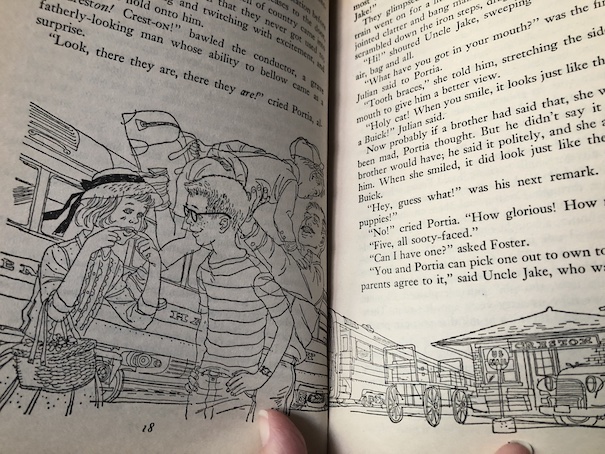
Eleven-year-old Portia and her six-year-old brother Foster are traveling alone by train to visit their aunt and uncle and twelve-year-old cousin Julian in the country for the summer while their parents are on a trip. Portia likes spending time with Julian because Julian is an amateur naturalist and tells her things about animals and birds. When Portia and Foster arrive, their aunt, uncle, and cousin tell them that their dog has had puppies. Portia is allowed to name them, and if her parents agree, she and Foster will even be able to keep one!

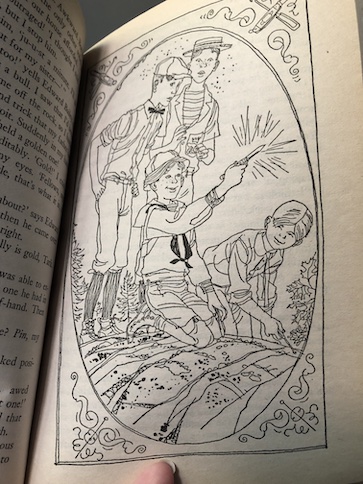
While Portia is out exploring the countryside with Julian one day, they find some garnets in a rock. They start chipping some out to take to Julian’s mother, and they find a carved inscription in Latin on the rock with the date July 15, 1891. They’re not sure what the Latin words mean. They figure out that part of the inscription refers to the Philosopher’s Stone, which was supposed to turn different substances to gold. Portia asks if this stone could be the real Philosopher’s Stone, but Julian says that’s impossible because they’ve been using knives to pry out the garnets, and they haven’t turned to gold. They continue to wonder what the inscription really means and why someone put it there.

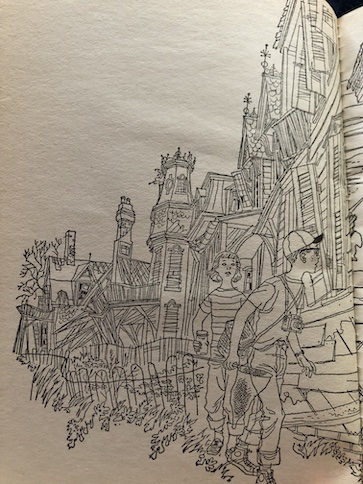
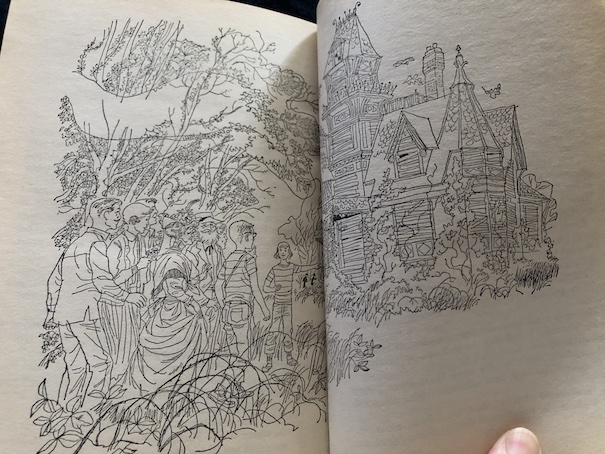
They explore the countryside further, getting lost. They aren’t too worried because they don’t need to be back soon. They follow a brook and find themselves in a swampy area. Strangely, they stumble over an old rowboat. Then, they spot a row of old, abandoned houses. The houses are in bad condition, but the kids can see that they were built in elaborate Victorian styles. The children wonder why those houses are there on the edge of swamp. Portia finds it a little creepy, but Julian wants to get a better look.

Then, the children hear a voice. Strangely, the voice is repeating an advertisement for medicine for indigestion. The children think it’s funny because no ghost would say something like that. Taking a closer look at the houses, they notice that one seems to be in better condition than the others that it has animals and a garden, so someone must be living there. Thinking about it more, Julian says that the swamp was probably once a pond or a lake, and that’s why it had houses and a rowboat. He hasn’t heard of a lake in the area, but he and his parents haven’t lived in the area for long. The children wonder who lives in the house and decide to find out.

They find an old woman in old-fashioned clothing, listening to a radio. The old lady is surprised to see them but welcomes them, saying that it’s been a long time since she has seen children. She invites them to come inside her house, and the children find themselves in a cluttered and chaotic parlor with each wall covered in a different kind of wall paper. The woman introduces herself as Minehaha Cheever.

The children explain how they ended up there by coming through the swamp, and Mrs. Cheever says that they shouldn’t go through the swamp because there is a dangerous sinkhole there that they call the Gulper. She says that when it’s time for the children to go home, she’ll have her brother show them a better and safer way. Mrs. Cheever says that there used to be a lake there, and that her family and about a dozen others had summer houses there, but the lake largely dried up when a new dam was built. After that, the summer houses were abandoned, and many of them were vandalized. However, her father and another woman locked up their houses with the furniture inside, thinking that they would come back and move them, but they never did. The large and fancy old Villa Caprice is still untouched, but Mrs. Cheever says that she supposes that much of the contents is probably deteriorated. She says that the Villa Caprice gives her the creeps.

The children ask Mrs. Cheever why she’s there, and she says that she used to live somewhere else. After her husband died, she didn’t have much money, and she remembered that the house at the former lake was still there. Her brother, Pindar, also wanted to retire somewhere quiet, so they decided to go live in their family’s old summer house. There was enough furniture and old clothes left there for the two of them, and it suits them. They keep animals. Pindar still has their old car, so he can sometimes go into town for things they need. “Pindar” was one of the words in the inscription on the rock.

Pindar explains that he and his best friend when he was a kid, Tarquin (another of the words on the rock), were the ones responsible for the inscription on the rock. Tarquin was three years older than Pindar, but they were still close friends. However, they had a temporary falling out when Tarquin was 13 years old. Tarquin had gone away to boarding school for the first time, and the next time they met at their summer homes, Tarquin had brought a friend from his new school with him, Edward. Tarquin and Edward were putting on airs and showing off how sophisticated they were because they were 13 years old and knew so much more now that they had been to boarding school. Pindar felt bad about his old friend shunning him and treating him like a little kid, so he started hanging out with his other best friend, Barney. Then, Pindar had the idea of showing Barney the big rock with garnets stuck in it where he and Tarquin used to meet and hang out together.

When Pindar and Barney got to the rock, they discovered that Tarquin and Edward were already there, and the older boys said that they had claimed the rock for themselves. They called the rock the philosopher’s stone and wrote the inscription labeling it as the philosopher’s stone in Latin, which they had learned at their boarding school. The older boys said that the younger ones were too little to be philosophers, like the two of them. Pindar’s feelings were hurt all over again, and he told his father about the situation. Pindar’s father was amused by the older boys and their sophisticated philosopher talk. He said that there was no age limit on who could be a philosopher and explained to Pindar what a philosopher’s stone was supposed to be and how it was supposed to turn things to gold. Then, he suggested a prank that Pindar and Barney could play on the older boys, convincing them that the stone really did have the power to turn things to gold. The older boys were temporarily fooled by the trick. At first, Tarquin was angry about being tricked, but then, he had to acknowledge that he had provoked Pindar and that the trick was a clever one. Tarquin made up with both Pindar and Barney, and he added Pindar’s name and his own to the inscription on the rock. Pindar still considers Tarquin and Barney to be his best friends, and they still write letters to each other in their old age.

Julian and Portia are fascinated by the stories that Pindar tells about the childhood summers he and his siblings and friends spent at this now-vanished lake. Mrs. Cheever said that she loves having children around the place again, and she suggests that Julian and Portia could use one of the old houses that is still in reasonably good condition as a kind of clubhouse. Julian and Portia love the idea, and Pindar and Mrs. Cheever suggest that they use the old house where Tarquin and his family used to stay. It’s in disrepair, but it’s much better than some of the other houses. There is plenty of furniture in the attic that the children can use, too. The children decide to invite some other kids to join them, and they call their club the Philosopher’s Club, after Pindar and Tarquin’s old group of friends.

Julian and Portia invite some other local children to join the Philosopher’s Club and spent a magical summer exploring this abandoned community, picking blackberries, learning about local plants and their uses, and scavenging things from old houses and trying on the clothes from Pindar and Mrs. Cheever’s youth. The boys help Pindar build a bridge over the large sinkhole they call “the Gulper” after Foster falls into it and has to be rescued. When Julian and Portia’s parents meet Uncle Pin and Aunt Min (as they come to call Pindar and Mrs. Cheever) and come to see Gone-Away Lake, the adults also experience the magical, dream-like qualities of this place, and Portia’s parents consider plans that may make the children’s future summers magical.

The book is available to borrow and read for free online through Internet Archive (multiple copies – including a couple of copies of the sequel, Return to Gone-Away).

My Reaction

I remember a teacher reading this book or part of it to us when I was in elementary school, but I couldn’t remember much about the story except for the lake that had gone away and caused the town to be largely deserted. For some reason, I had thought this story was a mystery story, but it’s not.

In many ways, I think this is the perfect nostalgia book because a large part this story is about the nostalgia that the elderly brother and sister in the story have for the place where they used to have their childhood summer adventures, even though the place isn’t what it used to be. Through the stories that they tell the children and the children’s own adventures and explorations of this largely abandoned summer community, they begin building their own attachments to the place and their own nostalgic summer memories.

Because the story takes place in such a unique location, I think it would make a fun kids’ movie with a vibe of nostalgic summer adventure. Although, because the story is largely low-key slice-of-life and the flashbacks of Uncle Pin and Aunt Min to incidents in their youth, I can see that the story might have to be changed a bit to fit the usual movie format, focusing on one definite problem or a particular adventure to give the story its climax. I picture the kids and their Philosopher’s Club making it their mission to preserve this vanishing community, which fits with the way the original story goes, although the kids in the book enjoy the old community for the magic of its dilapidated state rather than wanting to fix it up and restore it to its former glory. I think they could lean into promoting the preservation of nature and the ecosystem of the area, with Julian in particular pointing out what makes this environment unique and how it has become home to animals and insects since the lake changed to a swamp and most of the people left. The Philosopher’s Club might connect with a local naturalist society, and they could build the bridge in the story together to make the swamp safer to traverse for nature lovers and bird watchers. Uncle Pin and Aunt Min could remain on the site as its caretakers. Perhaps, the kids might even find some old notes and drawings in one of the old houses that show some interesting aspects of how the environment has changed and some of the unique animals that make their home there. That didn’t happen in the book, but it would be a sort of environmentally-connected treasure the children could find.

Ruth Fielding at Silver Ranch

Ruth Fielding

Ruth Fielding at Silver Ranch, or Schoolgirls Among the Cowboys by Alice B. Emerson, 1915.

In the last Ruth Fielding book, Ruth and her friends met a girl named Jane Ann who had run away from home. In this book, Ruth and her friends go to Silver Ranch in Montana, Jane Ann’s home, which is owned by her uncle, Bill Hicks. Ruth’s best friend, Helen, is surprised that Ruth’s Uncle Jabez let her come on the trip because he’s been very upset about the money he lost investing in a mine. Helen says maybe the investment will turn out fine after all, and Ruth says that the mine he invested in, the Tintacker Mine, is coincidentally nearby. It’s supposed to be a silver mine, although Uncle Jabez now doubts whether the mine is real or some kind of scam. The young man who talked him into investing hasn’t answered Uncle Jabez’s letters for months. So, while they’re staying at the ranch, Ruth plans to ask some questions in the area about the mine and see what she can learn.

On their first evening at the ranch, while they’re playing music, singing, and enjoying themselves, they suddenly get word that there’s a prairie fire up by Tintacker, and a cowboy says that it was probably set by “Bughouse Johnny.” (“Bughouse” is an old-fashioned slang word meaning “crazy”, so this is a descriptive nickname.) Ruth and her friends go to help the cowboys with the fire, and they watch as they slaughter three steers and use the carasses to smother the flames.

Ruth asks some questions about Tintacker, and the cowboys mention a new man who’s been hanging around that area. They don’t know much about him, but he’s pretty young, and they call him “the tenderfoot.” Ruth thinks he might be the young man her uncle has been looking for. She also asks them about Bughouse Johnny, but they don’t tell her much more than he’s a crazy guy who camps out in the area of Tintacker.

Ruth explains her uncle’s situation to Jane Ann’s uncle. Bill Hicks says that, as far as he knows, there’s no more silver left in the Tintacker Mine, and he thinks that Ruth’s uncle has been cheated. Ruth asks him if there’s any way that she can see the official papers associated with the mine, and Bill Hicks introduces her to a friend of his who is a lawyer, Mr. Savage. Mr. Savage confirms that ownership of the mine belongs to a man named John Cox, who bought out the other heirs of the mine’s original owners. Like Bill Hicks, Mr. Savage thinks that the mine isn’t worth anything, but if the young man Uncle Jabez invested with is John Cox, the investment is valid, just not one that’s likely to see a return. Ruth says that she will give the lawyer’s information to her uncle and that her uncle may ask him to act on his behalf later, depending on how he decides to handle this investment.

Ruth and her friends have some Western-style fun and adventures with Jane Ann, the cowboys, and the other locals. Jane Ann gets to show off her riding and ranching skills, and they all attend a local dance, where Ruth and her friends play matchmaker between a shy cowboy and the haughty schoolmistress he admires. They have a hair-raising encounter with a wild bear, and the man who saves them by shooting the bear turns out to be the man from Tintacker who Ruth wants to see.

When Ruth and one of Hick’s men go to see this man later, they find him deathly ill. If the man doesn’t recover, and if the mine turns out to be worthless, Uncle Jabez will lose his money, and there will be no way for Ruth to continue attending the boarding school she loves with her friends! However, the answer to the truth about John Cox’s identity is closer than Ruth and her friends suspect.

The book is available to borrow and read for free online through Internet Archive (multiple copies) and Project Gutenberg (multiple formats).

My Reaction

Like many other early Stratemeyer books, this story contains elements of a mystery but is really more of an adventure. I didn’t like parts of the adventure because there were repeated instances of characters being attacked by animals and then the animals needing to be killed. At one point, Ruth herself beats an attacking wolf to death, and I thought that was a shockingly violent scene for a Stratemeyer Syndicate book! Although, earlier Stratemeyer Syndicate books are quite different from the later ones.

The mystery part of the story focuses on the identity of John Cox, the man who convinced Uncle Jabez to invest in his mine, and the truth about his mine. I actually felt a little silly for not figuring out the true identity of John Cox sooner because he actually shares the same last name as one of the other regular characters in this series, and it’s not a coincidence. John Cox is Mary Cox’s brother.

Mary Cox, nicknamed “The Fox” by her schoolmates for being sly, is along on the trip with the other Briarwood Hall girls, although she is a nasty rival for Ruth in particular. Even though she has gotten along better with some of the other girls in the past, her snooty attitude and bad behavior have finally gotten on everybody’s nerves in this book.

When Mary is temporarily in control of a wagon Ruth and Helen are in, she does something reckless and almost gets them all killed until Ruth takes control of the reins and saves them. Everyone knows that the situation was Mary’s fault and that Ruth saved the day, and this is not the first time that Ruth has saved Mary from something. (By my count, it’s the third time.) However, Mary is ungrateful for her help and in denial that she did anything wrong (as usual). Just when everyone has decided that they’re completely fed up with her, the discovery of her brother changes things. While Mary is unmoved by Ruth saving her life, she is genuinely grateful to Ruth for saving her brother when he was ill and alone, which is astonishing for a girl who has never seemed to genuinely care about anybody else before. John Cox is an honest man, and Uncle Jabez’s investment turns out better than expected, guaranteeing that Ruth will be able to return to boarding school with her friends.

I want to warn readers that this is one of the Stratemeyer Syndicate books that has characters using racial slurs. The Ruth Fielding books were written before the Stratemeyer Syndicate revised its books in the mid-20th century to remove language like that. As in other Stratemeyer books, the use of inappropriate racial language is used to show which characters are crude and antagonistic, and in the case of this book, that character is Mary.

Mary Cox sneers at one of Bill Hick’s men, Jib, because he is of Native American descent, although Helen’s brother Tom stands up for Jib, pointing out that he’s much better educated than most of the men Mary knows, even though he works as a cowboy, and that Native Americans used to own the entire country before white people came, which is nothing to sneer at. Mary still insists on calling him a “savage”, mostly because Mary’s habitual method of communicating with people is to put someone else down so that she can look superior. This entire exchange takes place during an episode when Mary is trying to flirt with Tom, and bringing up racial slurs to put someone down during a flirtation with someone else is a very weird thing to do. It’s mostly a part of the story to show why Mary is such a pain. Tom just ends up being disgusted with her. It’s not the last time Mary uses racial slurs. At one point, she also calls the ranch cook a “fat and greasy Mexican squaw.” It’s pretty bad to see that kind of language in a kid’s book, even though it’s there to show that Mary has a nasty personality and behaves badly, which irritates and embarrasses people around her.

On a lighter note, the story is peppered with all sorts of Western words and slang. Since slang changes over time, and I’m not sure how people said things in the 1910s, I’m not sure how accurate the slang is for the time, but I’d like to call attention to a couple of words in the story that will be familiar to readers, but not in the way that they usually see them. “Cañon” is actually the Spanish word for “canyon”, pronounced the same way that we say in English, but the little tilde symbol over the ‘n’ adds the ‘y’ sound. The word that confused me the most was “kiotes,”, not because I didn’t know what they were talking about, but because that is not the Spanish version of the word. It looks like a phonetic spelling of the way we pronounce “coyotes” in English, but the Spanish word is also spelled “coyotes”, just pronounced a little differently. I didn’t know where the spelling “kiotes” came from, and I’d never seen it anywhere else before. I tried Googling it to find out more, and I saw a few mentions of the word with that spelling. One mention said that it was a Native American word, but it didn’t explain much more than that, so I can’t be sure. The book also uses the plural of “beef”, which is “beeves“, a word that used to be a joke with my brother and my friends the first time we heard it years ago because we thought it sounded funny. It also mentions the girls wearing “furbelow“, a word that I’d never heard before that means ruffles, pleats, or flounces in women’s clothing.

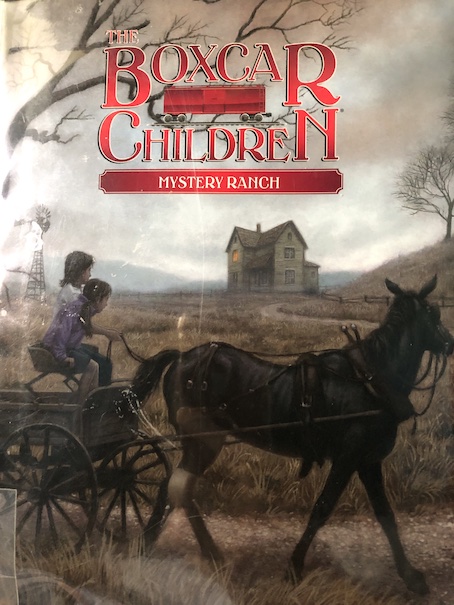
Mystery Ranch

The Boxcar Children

Boxcar Children Mystery Ranch

Mystery Ranch by Gertrude Chandler Warner, 1958, 1986.

Boxcar Children Mystery Ranch Grandfather

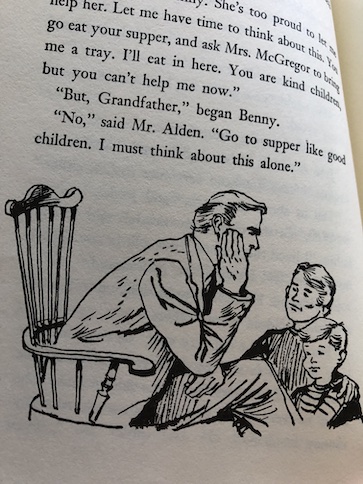
The children can tell that something is wrong when their grandfather, Mr. Alden, comes home and bangs the doors. When they ask their grandfather what’s the matter, he says that he’s worried about his sister, Jane, because he just got a disturbing letter about her. The children have never met their Great-Aunt Jane before, and she lives on a ranch out west. The trouble is that Jane is a difficult person to get along with. She can’t stay at the ranch alone because she’s elderly and needs help, but the person who was helping her before is leaving, and because Jane is such a difficult person, their grandfather doesn’t know where he’s going to find someone else willing to help her. Their grandfather admits that he doesn’t even get along with Jane himself, confessing that he hasn’t been very nice to her, either. (We never find out exactly why the children’s parents originally told them that their grandfather wasn’t a nice man, as established in the first book of the series, but this confession hints that he used to be much harder on his relatives than he is now, perhaps having mellowed a bit with age and experience.)

Boxcar Children Mystery Ranch wagon

Their grandfather says that the ranch where Jane lives is the ranch where both of them grew up. When he moved east years ago, Jane wanted to stay on at the ranch. He knows that Jane doesn’t have much money and doesn’t even keep many animals anymore, but because of her sense of pride and their past quarrels, Jane won’t accept any money or help from him. The children wish they could do something to help, and their grandfather says that he has to think things over. They ask who wrote the letter about Jane, and their grandfather says that it was written by the neighbor who has been staying with Jane. She says that she can’t put up with the bad treatment from Jane anymore. The letter further says that Jane wants to see Mr. Alden’s grandchildren. Naturally, the children say that they would like to see Jane themselves and try to help her. However, their grandfather isn’t sure that it’s a good idea because he doesn’t know how Jane would treat the children.

After talking it over some more, they all decide that the two girls, Jessie and Violet, will go to see Aunt Jane without the boys because Jane might find all four children at once to be too overwhelming. Mr. Alden says that if Jane gives them too much trouble, they should go to the neighbors, who are nice and will help them. When the girls get off the train at the town near their aunt’s ranch, they notice that a man gets off at the same time and quickly disappears. They are curious about him and wonder where he went. The townspeople are curious, too, because it’s rare that anybody comes to their little town, let alone a mysterious stranger.

Boxcar Children Mystery Ranch arrival of the girls

When the girls arrive at the ranch, the neighbor, Maggie, helps them get settled. Aunt Jane refuses to get out of bed, and Maggie says that she hasn’t been eating much and won’t let her eat much, either. The girls ask Maggie what’s wrong with Aunt Jane, and she says Jane feels like she doesn’t have anything to live for, so she’s kind of given up. Jessie and Violet insist that they’re all going to eat, and they fix some food. The girls and Maggie eat first, and then, the girls take Jane some orange juice with a beaten egg. Jane finds it difficult to refuse the girls, so she drinks it. Aunt Jane starts asking the girls questions about their brothers and says that she would like to see them.

Aunt Jane begins eating better because she finds these interactions with her young nieces interesting and because they speak more kindly to her than anybody else has for years, and she enjoys the attention. Maggie stays on at the house and continues to help because the girls have money and buy more and better food. Things seem like they’re getting better at the ranch, but when Maggie and the girls return from buying food in town, Aunt Jane says that three strange men came to the house while they were gone, even entering her bedroom, and they tried to badger her into selling her ranch to them. At first, Maggie doesn’t believe that, but Aunt Jane has the paper the men left to prove it. Of course, Aunt Jane refused to sign anything and told the men to go away, but she seems a little shaken by the experience.

Boxcar Children Mystery Ranch Jane and Benny

The girls miss their brothers, and Aunt Jane tells them that the boys can come and stay, provided that they’re not like their grandfather. When the boys come, Aunt Jane likes them, too. To the children’s surprise, she tells them that she’s decided to give her ranch to the four of them because she has no children of her own and she would rather they have it than those men who tried to get her to sell. The prospect is thrilling, but when the lawyer comes to arrange everything, they make sure that the arrangement includes providing for Aunt Jane, too.

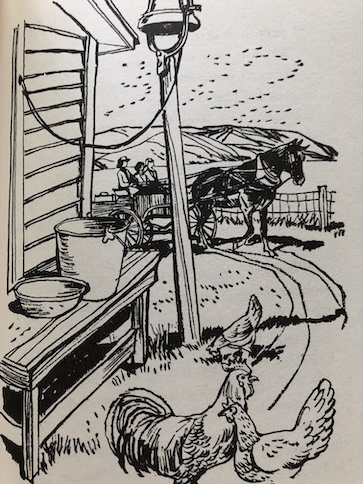
As the children explore their new ranch together, they see that things are as their grandfather described to them. The only animal Aunt Jane currently has is an old, black horse that Benny ironically names Snowball. However, they find an old hut that looks like someone has been living there recently. Who has been secretly camping out on Aunt Jane’s land? Is it the mysterious stranger who got off the train or the three tough guys who tried to get Aunt Jane to sell the ranch to them? Why would anybody even want the ranch anyway? The children find it charming, and while the girls like to imagine how they’d like to fix up the house, they know it isn’t worth much monetarily. There aren’t many animals, and while there’s fool’s gold on the land, there’s no real gold. Is there something else on the ranch that they don’t know about?

The book is available to borrow and read for free online through Internet Archive (multiple copies).

My Reaction and Spoilers

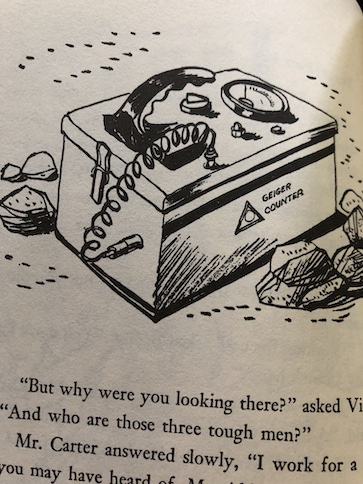
Boxcar Children Mystery Ranch geiger counter

As readers might have guessed, there is a resource on the ranch that the Aldens have overlooked for years, but other people have figured it out. However, more than the mystery, I like this book for the insights into the Alden family’s past. As I said, we never fully find out why Mr. Alden’s son and his wife had a falling out with him years ago and told the children he wasn’t very nice, but his sister’s feelings about him offer some clues to the type of boy and young man Mr. Alden was. Mr. Alden admits that he wasn’t always nice to his sister, and Jane says that he was always “bossy.” I get the feeling that Mr. Alden used to be the kind of man who thought that he knew best about everything and started feeling like he could tell everyone what to do. Perhaps his falling out with his son helped show him that he didn’t really know best about everything, including how to get along with his own family, but admittedly, that’s speculation.

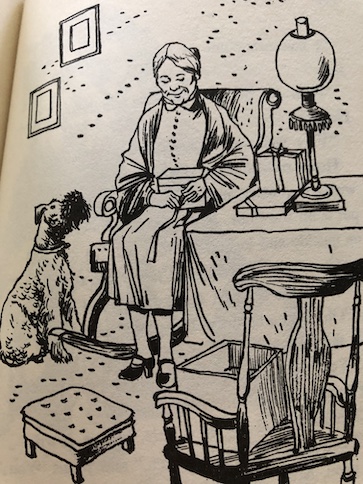
Boxcar Children Mystery Ranch Jane's Presents

Jane also admits to being difficult to get along with in other ways. Her major problem has been her sense of pride, which is one of the reasons why she never wanted to listen to her brother or go to him for help when she needed it. One of their chief disputes had been about the ranch itself. Years ago, her parents and brother were ready to give up the ranch and move east, but Jane felt more attached to it than the others and insisted on staying there and running it herself. Unfortunately, Jane admits that she didn’t really know how to run the ranch properly. There were points when she could have asked for help, but that would have been admitting to the others that she had been wrong to insist on staying, and she couldn’t bring herself to do that. Things gradually got worse over time because Jane wouldn’t listen to anybody or ask for help, which is how the ranch got into its current state.

The discovery of an important resource on the ranch brings more money to the family, greater security for Jane, and a chance for the brother and sister to make up. Jane invites Mr. Alden to the ranch to celebrate her birthday and to help her and the children arrange things. Mr. Alden is careful to arrange the situation so that the resources can be mined while not disturbing the old ranch house, so his sister can continue to live in the house she always loved so much.

Blue Bay Mystery

The Boxcar Children

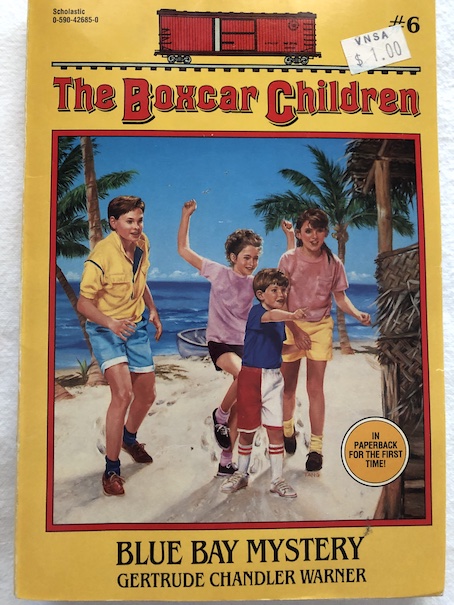
#6 Blue Bay Mystery by Gertrude Chandler Warner, 1961, 1989.

Grandfather Alden has a surprise for his grandchildren. He is arranging a special trip for them as an extension of a business trip of his. A business associate of his, Lars, has a ship going to Tahiti, and he offered to let them come along. However, rather than just having a tour of Tahiti, which would be pretty exciting by itself, Lars is going to take them to camp out on a tropical island. Lars found this island while escaping from a shipwreck himself. No one lives there, but there is plenty of fresh water and edible plants and no dangerous animals. Not every family would like to be on an uninhabited island when they could be in Tahiti, but the kids love camping out and do-it-yourself activities. Grandfather Alden has also invited the children’s friend, Mike Wood (who was introduced in a previous book), to join them. Mike is the same age as Benny.

The trip will take place during the school year, so their grandfather has arranged for the children to bring along some school supplies and lessons to study while they’re on the boat to the island. The lessons help not only to pass the time while they’re traveling but also to enhance it. They have science lessons about marine animals and how parts of the ship, like the radio room, work. Violet tells the others about how she’s been reading about Captain Cook and how he realized that eating certain types of food, like citrus fruit and sauerkraut, helped to prevent scurvy, even though he didn’t realize that the reason is that those foods are rich in vitamin C.

Once they reach the island, their grandfather says that they won’t have time for school lessons because they will have to set up their shelter and learn how to fish and forage for food, although he considers those to be educational lessons as well. They bring some supplies and tools with them so they won’t have to forage for everything, but the kids like assembling their own shelter and improvising things, like they did when they made their own home in a boxcar in the first book. They eat out of shells they find, whittle their own spoons, and use a huge turtle shell they find as a cooking pot.
However, they soon realize that they are not as alone on the island as they thought. Some of their food disappears, and they find some colored stones arranged in patterns. There is a stone with a carved face, sort of like the Easter Island heads, and the turtle shell they find has been carved with a knife. Later, they encounter a myna bird who keeps repeating the phrase, “Hello, Peter!” Someone taught the bird the phrase in English, but who is on the island, and why does this person seem to be hiding from them?

The book is available to borrow and read for free online through Internet Archive (multiple copies).

My Reaction and Spoilers

In the early Boxcar Children books, the children aged as the series progressed. After the death of the original author, when other authors continued the series, the children became frozen in age, but this book is one that was written by the original author. At the beginning of the story, the children’s grandfather mentions that the two oldest children, Henry and Jessie, are in high school, showing that they’ve aged about two or three years from the first book. This remark about the children’s ages only appears once at the beginning of the book, and their increasing ages aren’t really reflected in the story. The lessons the children have on the boat seem to be roughly about the same subjects, although it seems like the children’s lesson books aren’t identical because Violet seems like she’s the only one with the lesson about Captain Cook and scurvy.

This book also varies a little from the other books in the series because the children’s grandfather plays a larger role than usual. One of the hallmarks of the Boxcar Children books is that the children usually do things by themselves, with as little adult help or interference as possible. However, this time, their grandfather is with them on the island, sharing the adventure with them.

As with other vintage children’s mystery series, the early books of this series sometimes lean more toward adventure than mystery. The mystery in this story is pretty light, and the solution is pretty straight-forward. The children eventually find the person who’s camping out on the island with them. The person turns out to be a boy who was also shipwrecked. There was an adult sailor with him before, but the boy, Peter Horn, says that he went swimming one day and never came back, so he’s been alone ever since. The others say that he might have been attacked by a shark but they don’t dwell on it very long, as they do any time someone’s death is mentioned in one of the books in the series, so it doesn’t get too sad. Peter says his parents went overboard while they were escaping the shipwreck, and he doesn’t know whether they’re still alive. Mr. Alden says that he read about some people being rescued from a shipwreck, so it’s possible that they’re still alive. When they return to the mainland, Peter is reunited with this parents for a happy ending.

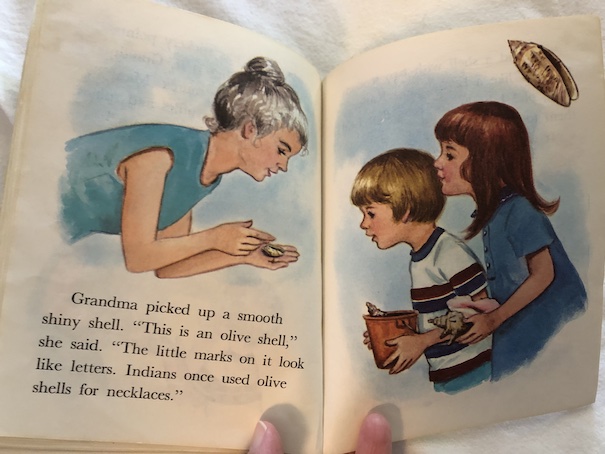
Seashells for Katie and Andy

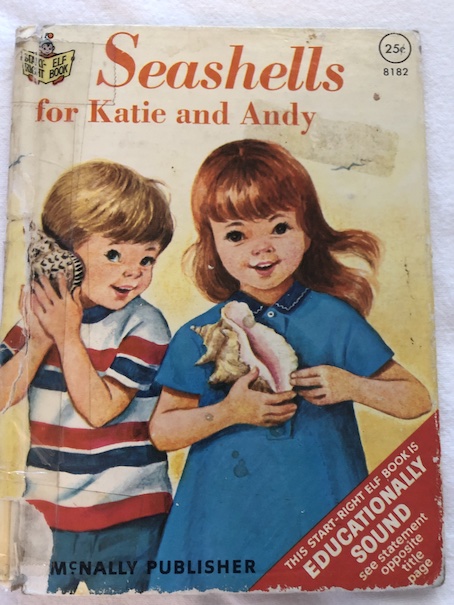
Seashells for Katie and Andy by Solveig Paulson Russell, illustrated by Marjorie Cooper, 1973.

This is a cute little picture book that presents information about seashells in story form.

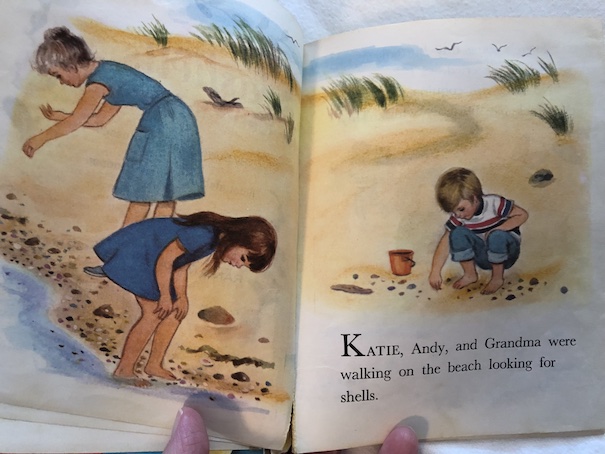
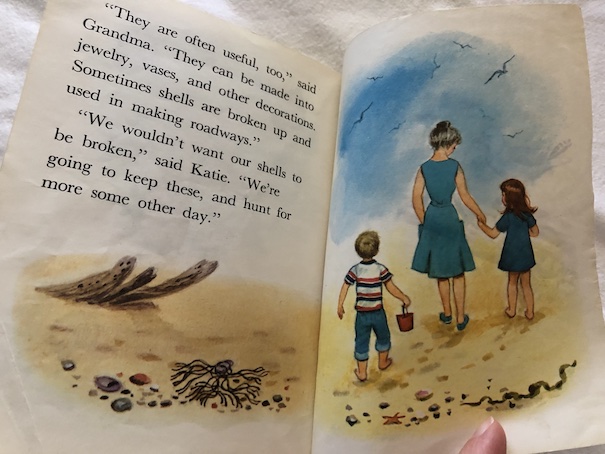
Katie and Andy are at the beach with their grandmother. As the children collect seashells, their grandmother tells them what kind of shells they are and a little about them.

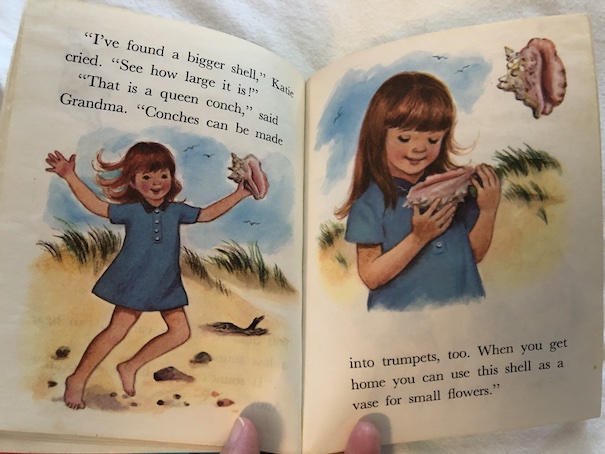
The shells included in the book are: coquina shells, cowrie shells, triton shells, conch shells, lace murex, olive shells, scallop shells, and limpets.

Toward the end of the book, the kids ask their grandmother if they can find shells anywhere else besides the beach, and she tells them about snail shells.

The grandmother also tells the children about different uses people have for seashells. She talks about how they can be used for jewelry, vases, and decorations of different kinds. She also mentions that they can be broken up and used in roads, but the children don’t like the idea of breaking shells.

My Reaction

This book is nostalgic for me because my own grandmother was an amateur naturalist, and she used to give us gifts of seashells that she found in her own travels. Some of the shells in my old collection still have labels with the names of the shells in my grandmother’s handwriting.

In the beginning of the book, there is a note to parents and teachers from the National College of Education in Evanston, Illinois about how the information in the book is educationally sound. I don’t have anything to criticize about the information in the book except one instance where the grandmother talks about “Indians” making necklaces from a certain type of shell. I’m pretty sure from context that they mean American Indians and not people from India, but I think that “American Indians” or “Native Americans” would be better terms to use for the sake of clarity.

They never say exactly where the beach in the story is, which would make a difference in the types of shells that the characters might find. Most of the shells covered in the book have a pretty broad worldwide distribution, but I suspect from the selection of shells given that the characters are probably in the Southeastern United States.

Klutz Kids Travel

Kids Travel: A Backseat Survival Kit from Klutz Press, 1994.

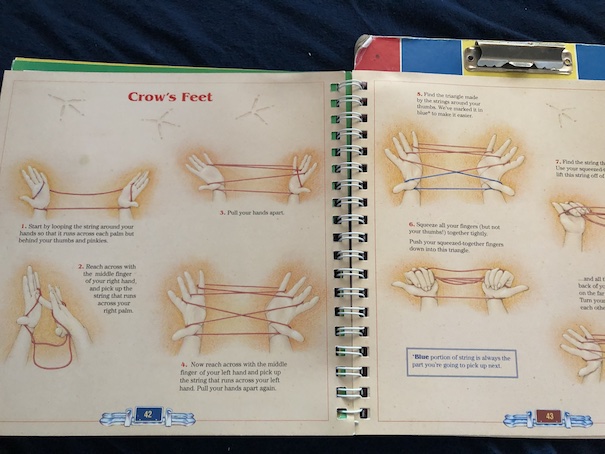
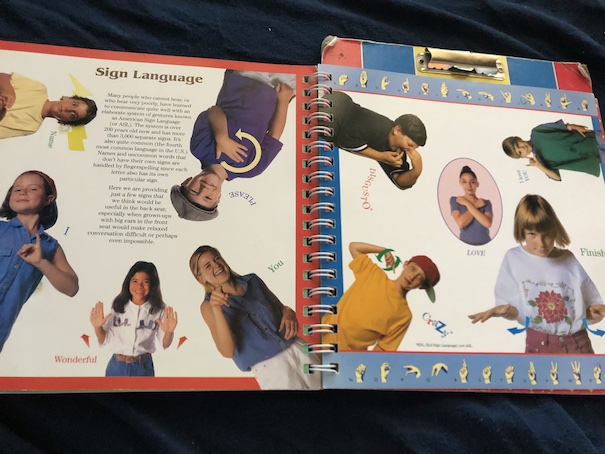
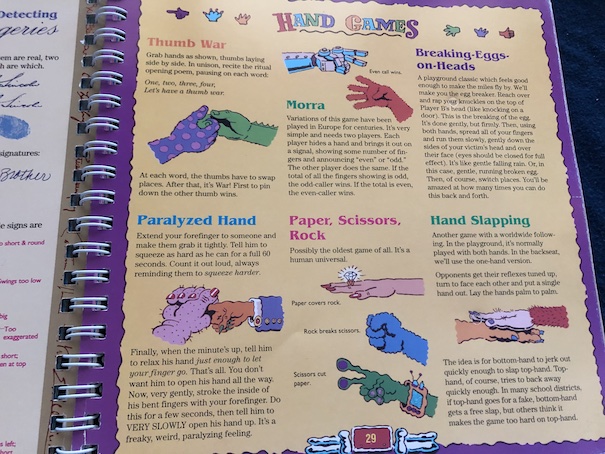
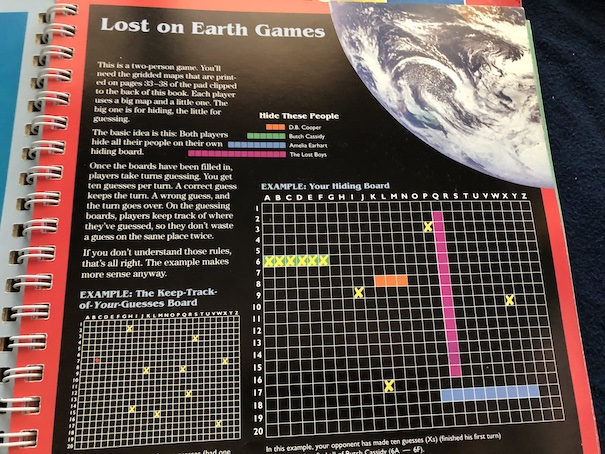
This was one of the Klutz Press activity books that I had as a kid! I used to take it on the long road trips we would take across the country during the summer. The reason why this book is called a “kit” is that it came with a pouch with some extra equipment that could be used for the activities in the book and a special activity pad on a clipboard in the back. I don’t have my activity pad anymore, but it had pencil and paper games and puzzles, like mazes, connect-the-dots pictures, and grids for a Battleship style game that they called Lost on Earth, where you would attempt to find famous missing people or things instead of finding your opponent’s battleships.

The Lost on Earth games are especially funny when you know the references for who the missing people or what the missing things are, like who Amelia Earhart or D.B. Cooper is/was. When I was a kid, I didn’t know about D.B. Cooper (this YouTube video from Buzzfeed Unsolved explains), but I think one of the missing people on the activity pad grids was Jimmy Hoffa, and I knew that name (Buzzfeed Unsolved also covered that). The great thing about these references is that, if you’re playing this game with a kid who hasn’t heard of some of these people or things, just explaining who or what they are is activity by itself.

The pouch contained a set of markers for drawing and doing the activities on the activity pad, embroidery thread in different colors for making friendship bracelets and hair wraps, a loop of colorful string for making string figures, a small sheet for the Grown Up Pop Quiz, and some gummy playing pieces and dice for playing Parchesi (a board was included on one of the pages in the book). The gummy pieces would stick to the page, but not so tight that you couldn’t get them off. I think I saw a later edition of this book that used a different style of playing pieces, but I’m not sure now. The gummy pieces do gradually lose their ability to stick over time.

The activities in the book are meant to be done in a car. In the front of the book, there’s a section where you can record which license plates you’ve seen from different states in the US. (A common car activity on US road trips because there are 50 states, and they all have different styles of license plates. In theory, you could see examples of plates from all 50 states in a single, long car trip, but I never did. I’ve seen most of the states during a single trip, but I’ve never been table to check off all of them during a single trip.) There are also rules for playing many classic car games, mostly games that involve talking or hand motions or can be played on paper, like Twenty Questions, Paper, Rock, Scissors, and Hangman. It also describes popular car trip rituals, like holding your breath while passing a graveyard, lifting your feet while going over a bridge, or ducking your head while going under a bridge.

However, even though most of the activities are meant for car trips, many of them would be good for airplane trips as well. When I was a kid, airplanes were quieter, and it was much easier to talk to the person in the seat next to yours than it is now, so the talking games are still better for car trips. However, making friendship bracelets are ok for planes and trains as well as in a car. There are also activities for folding a dollar bill and making a paper fortune teller, making string figures, drawing superheroes, writing things in secret codes, reading palms, and learning some basic sign language.

What I’ve always liked best about this book is the variety of activities. There’s something for everyone in this book, and I’m still amused by some of the games and activities. If there’s an activity that the reader doesn’t like or that won’t work for the current location, there are plenty of others to move on to. Many of the activities in the book are either mentioned in other Klutz books or have entire Klutz books dedicated to them. Also, every part of this book is meant to be used for something. There is a finger maze around the title and copyright page, and when you remove the activity pad in the back, there is a board behind it to use for a game called Penny Hoops, which involves flicking pennies onto target areas on the board to earn points.

Sadly, I don’t think this book and activity kit are being sold new anymore, although there are some copies being sold used (I think most of the used books don’t come with the extra items in the original kit), and the book is available to borrow and read for free online through Internet Archive.

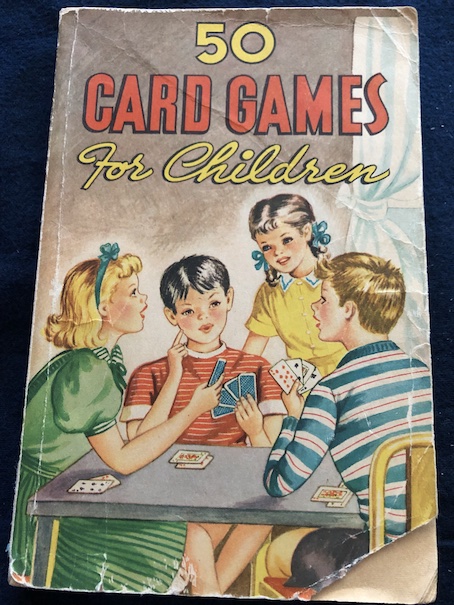
50 Card Games for Children

50 Card Games for Children by Vernon Quinn, 1933, 1946.

I love games of all kinds, and I was fascinated by this vintage children’s book about card games! Along with the card games, there is also a section in the book with card tricks. The vintage pictures in the book are also nice.

If you’re curious about what kind of card games children were playing during the Great Depression and around the time of WWII, this book offers some interesting insights! There were many games in the book that were already familiar to me, but there were some others that I had never heard of before.

The book is available to borrow and read for free online through Internet Archive.

Sections in the Book:

Card Games that Are Fun to Play

That struck me as an odd title for the very first section of the book, like whatever follows is going to be games that are not fun to play, but basically, this section contains multiplayer card games specifically aimed at children. It becomes clear when you study not only the contents but the titles of the other sections, which are about solitaire games, card tricks, and a section about popular card games that adults play.

I recognized a number of popular children’s card games in this section, like I Doubt It, War, Concentration, Hearts, Old Maid, and “Go Fishing” (which is what they call it instead of Go Fish, which is what I’ve always heard it called). There were some other games that I didn’t recognize, like The Earl of Coventry, Rolling Stone, Frogs in the Pond, and My Ship Sails.

Twelve Games of Solitaire

I was familiar with Klondike, Canfield, Pyramid, and Around the Clock (which I always called Clock Solitaire). I had never heard of Pirate Gold, Spread Eagle, Lazy Boy, or Down the Stairs before.

Twelve Card Tricks

These are magic tricks with cards. Some of them sound a bit complex when you’re reading the descriptions, but I think they would be more clean when actually trying them with a deck of cards.

Some Games That Grown-Ups Play

The games in this section are Rummy, Casino, Seven-Up (also known as High-Low-Jack), High Five, Cooncan, and Five Hundred. Actually, I have seen Rummy decks specifically for children, usually Animal Rummy, but that’s still a Rummy version, so that game isn’t just for adults.

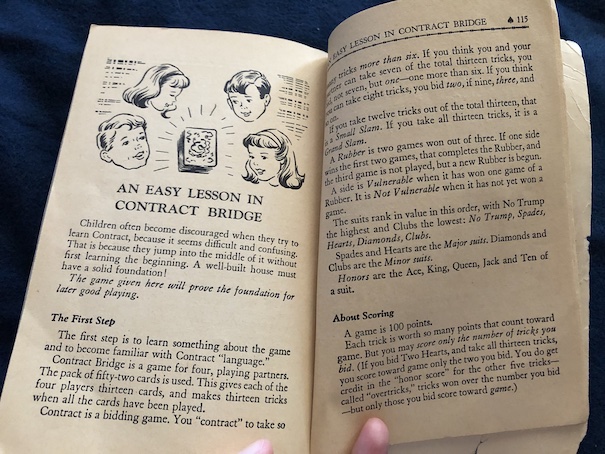
An Easy Lesson in Contract Bridge

I never thought of Bridge as being easy because I’ve always been intimidated by the concept of bidding. I understand trick-taking games like Whist, but I haven’t wanted to try Bridge because of the bidding. Actually, I think this basic description for children is a good tutorial for people like me, who find the bidding concepts confusing.

The Lettering Book

The Lettering Book by Noelene Morris, 1984.

I remember buying this book at a Scholastic book fair back in the early 1990s, and for a while afterward, I went through a phase where I kept trying to invent different types of decorative writing. I kept them in a notebook, and most look a bit silly, like the one where the letters were made of ice cream cones and the one where the letters were weird sheep with little feet, but I had fun!

The book is about types of lettering, but it’s really much more than that. The main focus is on designing a poster. The first part of the book goes into detail about planning your poster to convey your message to other people. It recommends making an outline of your information before beginning the project and deciding what visual elements you need to include, like diagrams and pictures. There are some useful tips about research and writing, if the presentation is part of a research project.

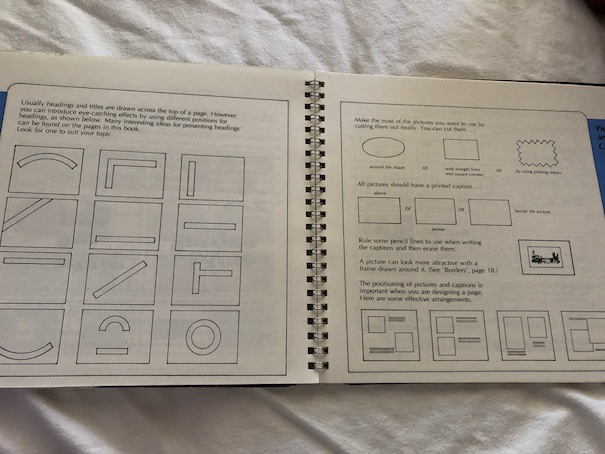
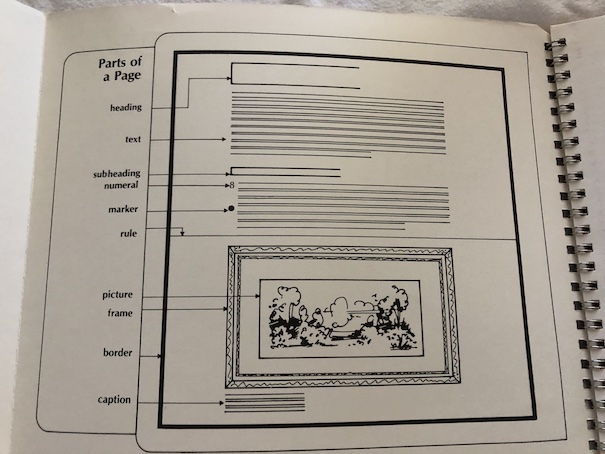
Then the book provides examples of how to design a page, showing different possible layouts for organizing page headings, text, and images. Although this book was planned around the idea of a printed poster, I think the layout suggestions and concepts could also be used for electronic media, such as web design or PowerPoint presentations.

There are also examples for the shapes of headings and pictures and the positioning of image captions.

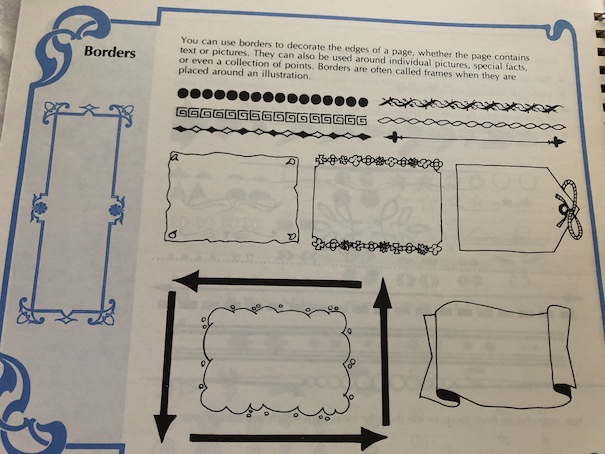
The book recommends using decorative markers, borders, and horizontal rules to add visual interest to the information, separate sections of a page, and make projects look more finished.

When it comes to making the lettering of the poster or page, it explains the elements that define a print style – height and width of letters, slope, line variations, pattern, color, 3D effect, and separation and spacing of letters or overlapping of letters.

A large part of the book shows examples of letters of the alphabet and numerals in different fonts. Some of them are recognizable as fonts that still used in word processing software and on the Internet.

There are also pages with examples, showing how certain styles of lettering can convey a mood or idea in headings and sample phrases.

The front and back flaps of the book fold out, and there is a chart of the parts of a page, a couple of grids like those used for planning lettering styles, and a glossary of terms used in the book.
I couldn’t find this particular book online, but a couple of related books by the same author are available to borrow and read for free online through Internet Archive. I think I also used to own The Lettering Book of Alphabets, probably purchased at the same time as this book, and that inspired my alphabet lettering phase. The Lettering Book Companion is a companion book to The Lettering Book, and it particularly focuses on decorative borders.