The Cartoon Book

The Cartoon Book by James Kemsley, 1990.

I remember buying this book at a Scholastic book fair back in the early 1990s. I didn’t draw a lot of cartoons, but I found the tips in this book to be helpful for drawing in general. The book begins with the useful advice:

“I believe that anyone can draw cartoons. All they need are a few hints to set them on the right track, self-confidence and heaps of PRACTICE, PRACTICE, PRACTICE!”

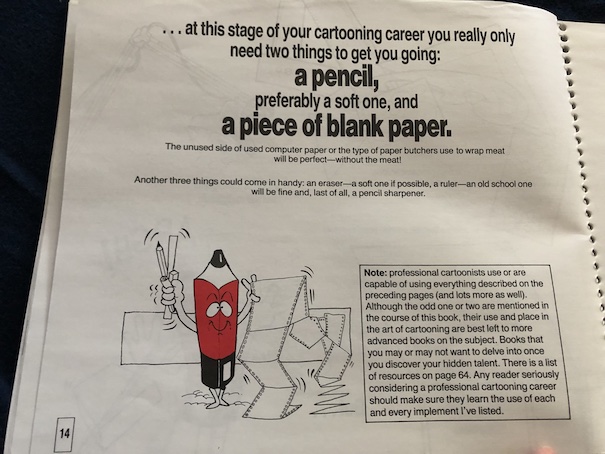
The book aims to make cartooning accessible and unintimidating to even the most basic beginners. There is a section where the author explains about the types of pens, pencils, markers, and other materials that a budding cartoonist can use, which seems overwhelming, but it ends by saying that all you really need is a pencil and a blank piece of paper. Our host is shown as a friendly cartoon pencil throughout the book.

The drawing tips begin with advice for creating character expressions, starting by focusing on the lines and shapes of the eyes. Then, it shows how to add those expressive eyes to heads. What I always liked about this book is that it says the heads can be any size or shape you want them to be. It doesn’t matter if they’re misshapen and lumpy because it’s a cartoon. It’s supposed to be fun and expressive, not perfect, which is very liberating. Even bodies can be different shapes, and they don’t have to be perfect!

Just draw a roundish shape on top of a body, give it expressive eyes, and add an expressive mouth that works with the eyes to show the character’s mood, and there you go!

From there, the book gives brief tips about adding clothes to the body and drawing hands, arms, and legs to show motion. It also briefly shows how to draw animals and animals that are like humans and how to add expressions to inanimate objects and make them characters.

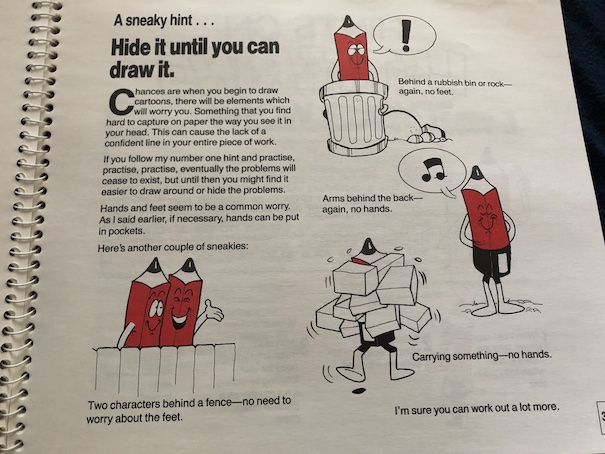
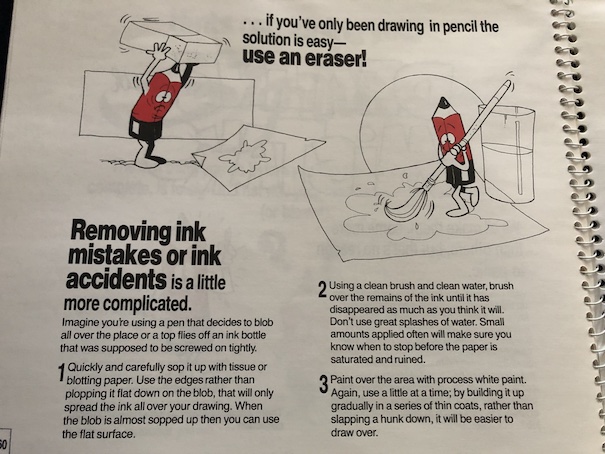
One of the tips that I’ve appreciated is the advice that it’s okay to hide things that you can’t draw well until you’ve learned to draw them better. For example, if you don’t draw hands well, you can just have characters hold their hands behind their backs. There are also tips for fixing mistakes along the way.

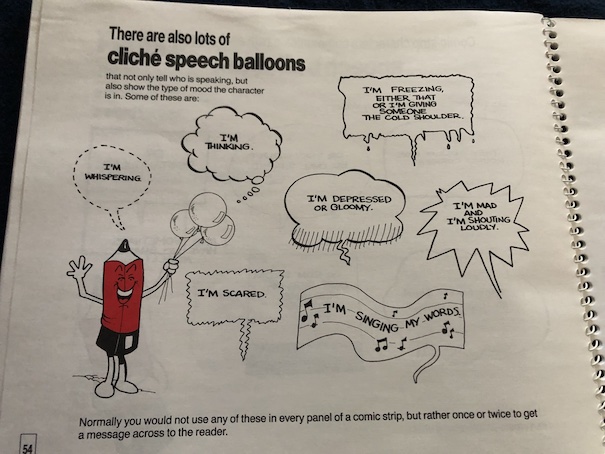
The book also explains how to plan and plot a comic strip. It discusses considering your audience, choosing the types of characters you want to use and giving them personalities, and developing your presentation style with different types of panel borders and speech balloons. It also explains the cliches that cartoonists use, certain common visual signals that cartoonists use to express certain types of speech or events or show movement. The light bulbs over a character’s head when they have an idea is an example of a cartoonist cliche.

The author of this book, James Kemsley, was an Australian cartoonist particularly known for his work on the long-running Ginger Meggs comic strip. I wasn’t familiar with Ginger Meggs when I was a kid because it didn’t appear in newspapers in my area, but I found it interesting to read about when I was looking into the background of this book’s author.

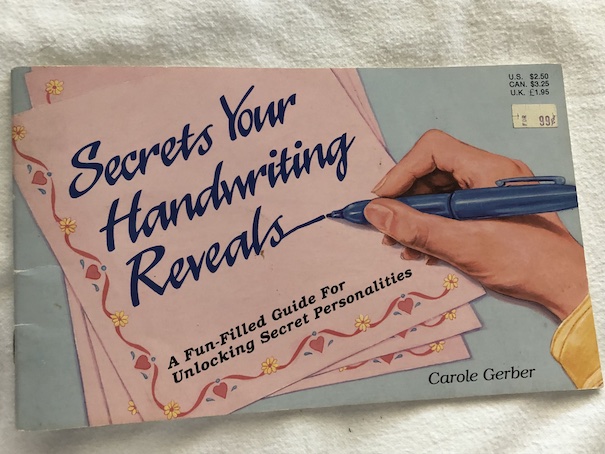
Secrets Your Handwriting Reveals

Secrets Your Handwriting Reveals by Carole Gerber, 1991.

I brought this little book at a book fair when I was a kid, and trying to analyze other people’s handwriting made me feel like a detective! As an adult, I know that graphology is considered a pseudoscience because the techniques used and the results are subjective. (Forensic handwriting analysis is different.) I don’t know how much faith I’d put in any of the tips in this book for reading someone’s personality, but as a summer activity for kids playing detective, it’s not bad.

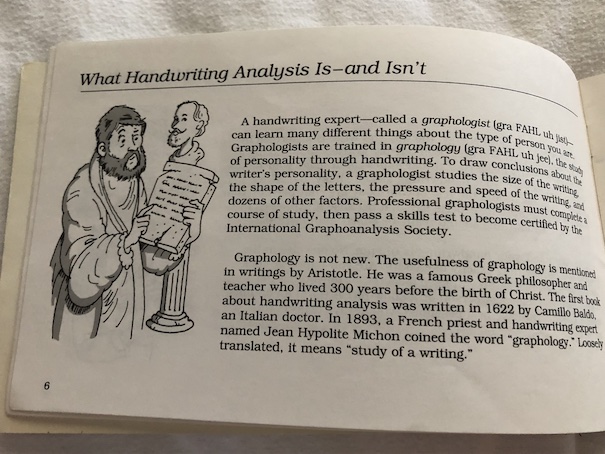
The book begins with an explanation of what graphology is and its history. Graphology has its origins in Ancient Greece, although the term “graphology” wasn’t coined until the late 1800s. The book discusses how graphology has been used in forensic situations, such as determining whether someone’s signature was forged, and how businesses sometimes using handwriting analysis as an indicator of which applicant would be the best for a job. I’m not sure how much stock I put in the second application, although the first one seems useful. The book also mentions that certain types of health problems can make a person’s handwriting shaky. I think that could be true since stable handwriting requires good muscle control, and muscle control can be weakened by disease. The book does say that a graphologist can’t diagnose disease from a person’s handwriting, but they can point out when a person seems to be weakened by a health problem.

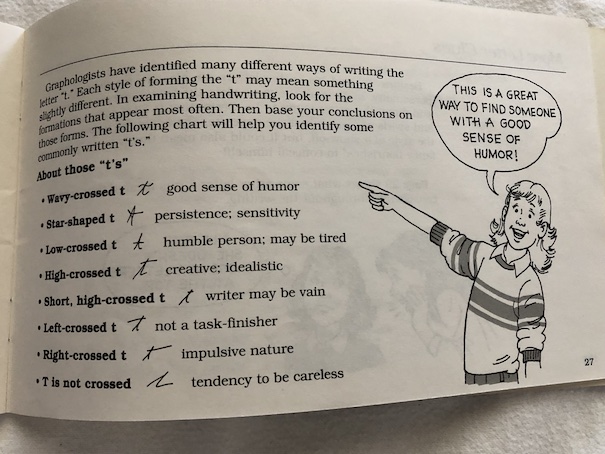
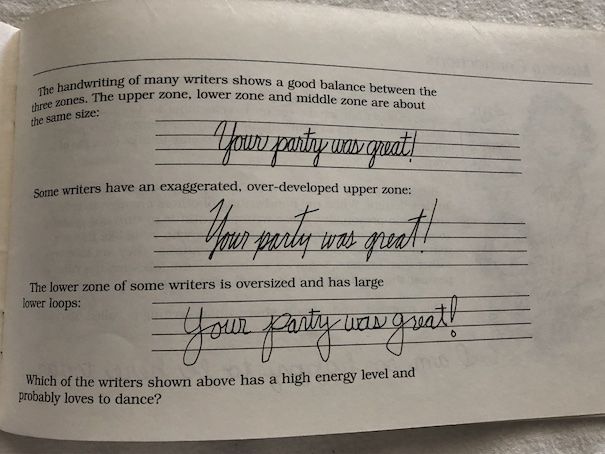
From there, the book explains features of a person’s handwriting to watch in order to identify different personality traits, from the way the writing tilts to how consistent the connections between letters are, to the different ways that letters can be shaped.

Some of what they say about different people’s handwriting makes sense, even from just a cursory glance. It would make sense to say that writing that is neat and even (not to mention showing proper spelling and grammar) is a sign of a well-organized individual, compared to writing that is sloppy and full of errors and scratch-outs.

I did notice (even as a child, I think), that some of the personality traits they point out in their sample handwriting analysis comparisons could be just as easily deduced from what the person says as what their handwriting looks like. I think that’s because the author knew what personality traits she wanted to point out and made sure that the samples were written in character.

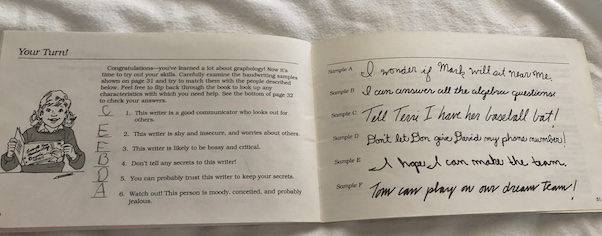
The book ends with a short quiz where readers are expected to match up handwriting samples with personality traits.

There is also a brief section at the very end that suggests that consciously changing your handwriting can help change your character. Personally, I doubt whether writing in a slightly different style by itself can help break bad habits, although I suppose if you want to be very conscious of a personal trait that you want to change, anything you do that helps keep it at the front of your mind can remind you to be more careful of your personal behavior and act differently than you might if you just weren’t thinking.

Winnie-the-Pooh and the Pebble Hunt

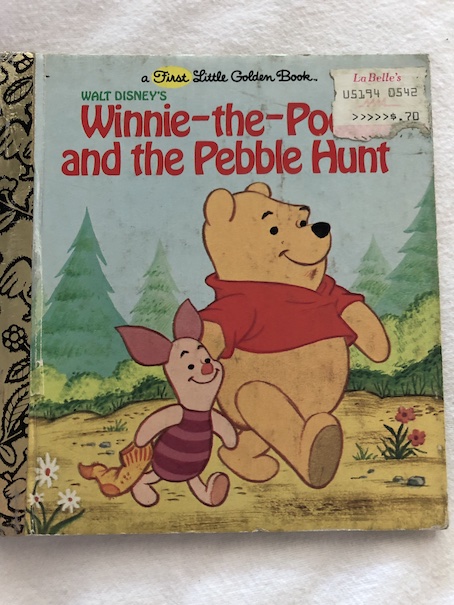
Winnie-the-Pooh and the Pebble Hunt by Walt Disney Productions, 1982.

This is a First Little Golden Book.

Winnie-the-Pooh and Piglet are trying to think of something to do. Piglet suggests a heffalump hunt, but Winnie-the-Pooh says that he would rather go on a pebble hunt because it’s easier to find pebbles.

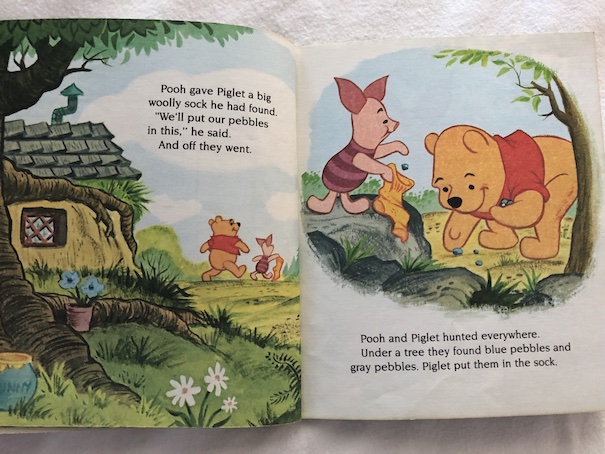
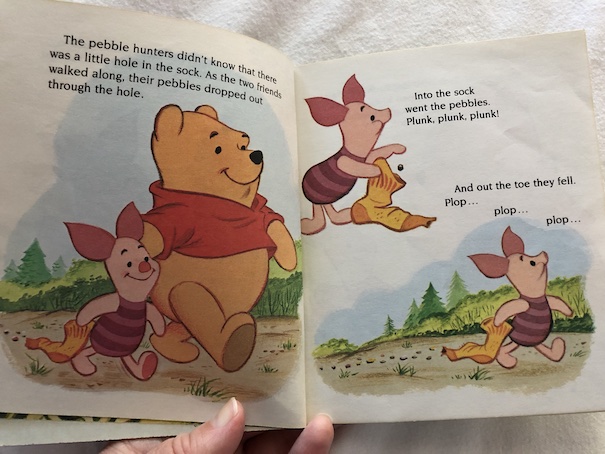
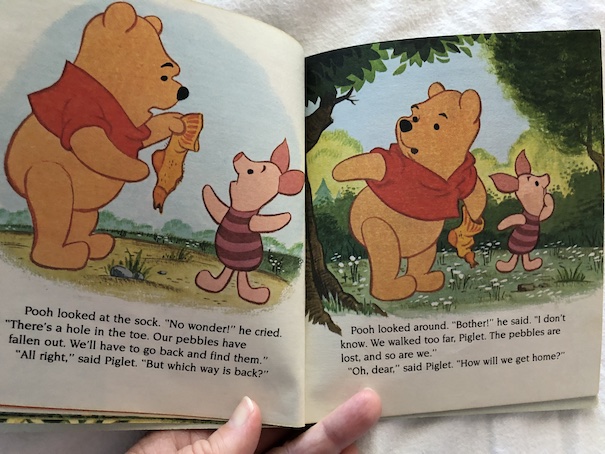
They get a sock to keep their pebbles in, and they start collecting pebbles. However, they don’t notice right away that there is a hole in the toe of the sock, and the pebbles they collect fall out as they go.

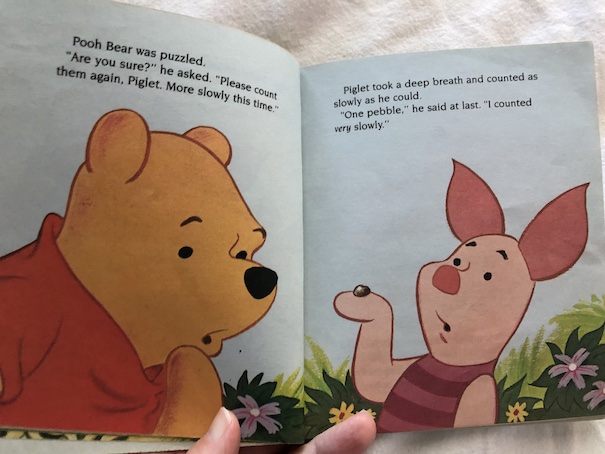
They discover the hole when they stop to count how many pebbles they’ve found, and they realize that there’s only one pebble left in the sock. Also, they suddenly realize that they’re lost.

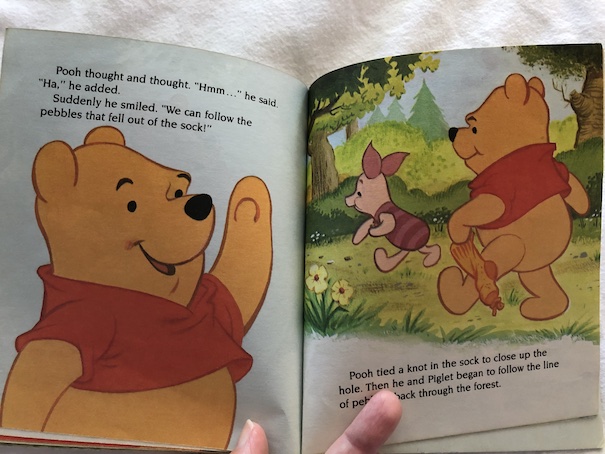
Fortunately, Winnie-the-Pooh realizes that they can follow the trail of pebbles they’ve lost to find their way back home. They tie a hole in the sock to stop the pebbles they’ve collected from falling out again, and they follow their pebble trail, picking up the pebbles again on their way home.

The book is available to borrow and read for free online through Internet Archive.

My Reaction

This is a cute and fun story where Winnie-the-Pooh and Piglet discover that their mistake in losing the pebbles they’ve been collecting is actually a stroke of good luck because their trail of dropped pebbles helps them find their way home when they’re lost. This little picture book was a favorite of mine and my brother’s when we were little, and my family still likes to jokingly quote Piglet when he realizes that there’s only one pebble left, and Pooh asks him to count again, slowly, just to be sure: “One pebble. I counted very slowly.”

The Little Red Hen

The Little Red Hen pictures by Tadasu Izawa and Shigemi Hijikata, 1968.

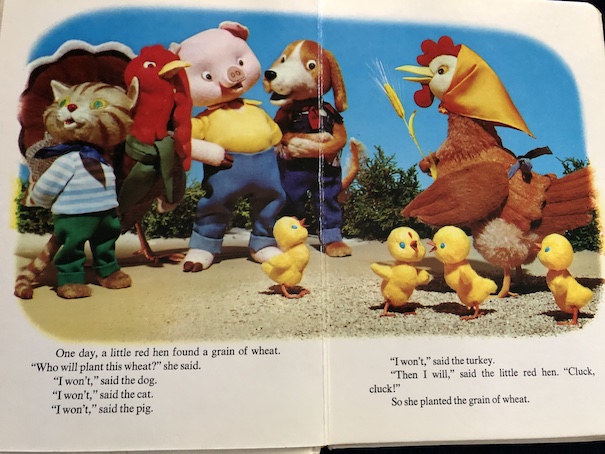
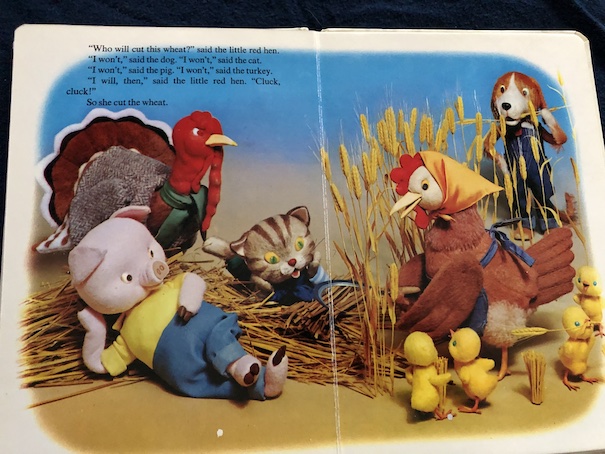
This cute picture book is part of a series of Puppet Storybooks. What makes it distinctive from other picture books is that the pictures are all photographs of tableaux with detailed puppets. The story is a retelling of the classic Little Red Hen folktale.

A hen finds a grain of wheat, but no one is interested in helping her plant it, so she does it herself. When it’s time to harvest the wheat, none of the other animals will help her, so she also cuts the wheat herself.

Because no one wants to help her, she takes the wheat to the mill to be made into flour and bakes it into bread all by herself.

When she has the nice loaf of bread that she has made, all of the animals who didn’t want to help before suddenly come to help her eat it. However, since none of them helped with making the bread, the Little Red Hen eats the bread herself with her chicks.

My Reaction

I’ve had this book since I was a little kid, and I always liked the pictures! The puppets are detailed and posed in realistic ways. The picture on the cover of the book is a 3D hologram, and I was fascinated by it as a young child. It was one of the first holographic images that I saw as a child!

(In my defense, I might not have been the one who scribbled crayon on that cover image. I was pretty good about not drawing on books when I was little, and most of my childhood books were used, so that scribble might have happened before I got it. I don’t remember anymore, so it’s hard to deny it completely, but according to my memory, my messy scribbles were done on the back wall of my closet, behind my clothes, because I knew that drawing on walls wasn’t allowed, and I was realized that if you’re going to draw on the wrong surface, it’s best to do it where nobody’s going to see it and complain. I was sneaky like that.)

While my copy of this book was printed in English, the books in the series were originally written, illustrated, printed, and bound in Japan. I never noticed that when I was a kid because I never bothered to look at the names of the illustrators and had no interest in where it was printed, but I found it interesting as an adult. It makes me think that there are probably also versions of this book written in Japanese, but I’ve never seen any.

How Fletcher Was Hatched

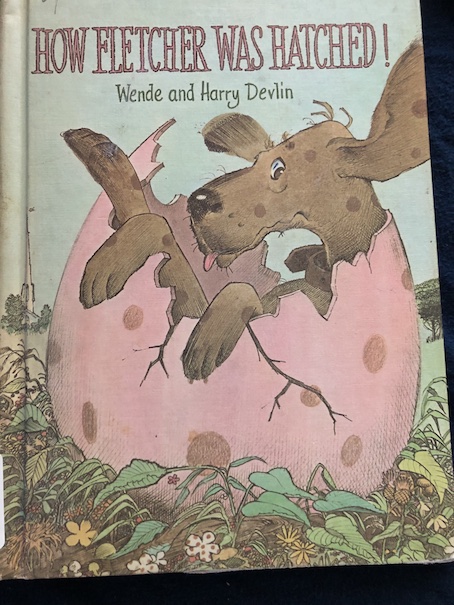
How Fletcher Was Hatched! by Wende and Harry Devlin, 1969.

Fletcher the dog is sad and upset because it seems like his owner, Alexandra, is forgetting about him. She’s been playing with the new baby chicks, which she thinks are cute, and she’s been forgetting to pet her dog or even fill his water bowl!

Distressed, Fletcher goes to see his friends, Beaver and Otter, at the pond. Beaver and Otter don’t have human owners, so they don’t understand Fletcher’s feelings about Alexandra, but they try to think of ways to get her attention. They think it would help if Fletcher could make himself more like the chicks Alexandra has been obsessed with. Aince he can’t make himself small and yellow, they decide that he should hatch out of an egg, like the chicks do. Fletcher is skeptical about this plan, but Beaver and Otter think that hatching out of an egg will be like having a new beginning in his relationship with Alexandra.

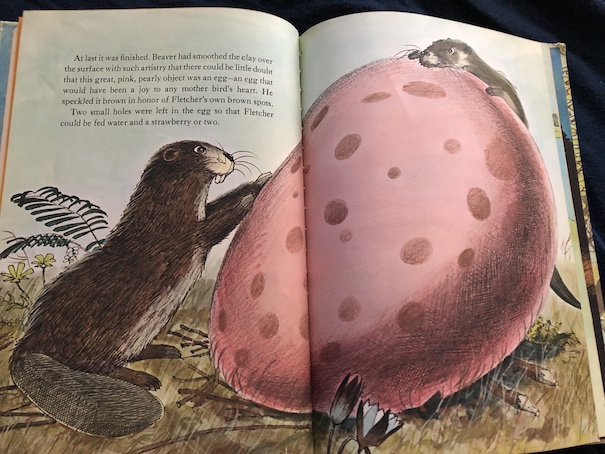
Beaver and Otter build an egg around Fletcher with reeds, grass, and clay from the river, leaving a little hole so they can give Fletcher water and food. When they’re done, it’s a very convincing but giant egg.

By the time they’re finished, it’s night. Fletcher is uncomfortable sleeping in the egg and wonders what Alexandra is doing. Meanwhile, Alexandra is having trouble sleeping because she’s worried about her lost dog.

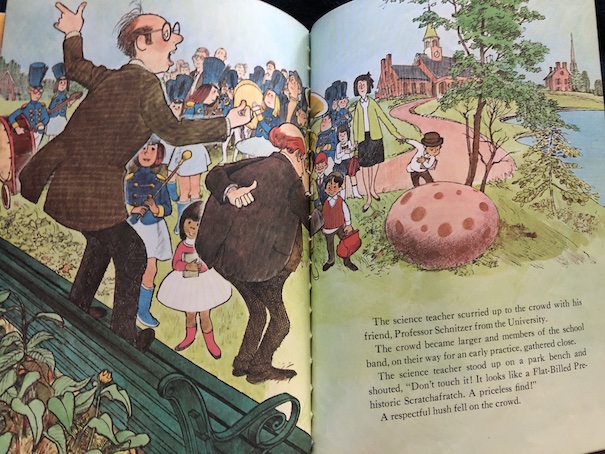
In the morning, Beaver and Otto roll the egg over to Alexandra’s school to make sure that she sees it. The first person who sees the egg, though, is the school’s custodian. He’s shocked at the sight of such a giant egg and starts yelling for the science teacher to come look at it.

Soon, the egg is surrounded by children and adults, marveling over what kind of it could be and where it came from. The science teacher brings a friend who is a university professor, and the two of them are convinced that the egg must belong to a rare creature, although they disagree about the type of creature it is.

Fletcher waits to hatch until he hears Alexandra. Alexandra’s friends are excited about the egg, but she’s just upset and only wants to go looking for her lost dog.

Fletcher decides it’s time to hatch, and he busts his way out of the egg. Alexandra is happy to see him, even though Fletcher’s attempt at peeping is a little weak. Everyone is confused, but Alexandra is just relieved that she has her dog back. Fletcher feels better, realizing that he is important to Alexandra, and she really cares about him, even though he’s not yellow and doesn’t peep.

The book is available to borrow and read for free online through Internet Archive.

My Reaction

I read this book as a kid, but I had forgotten much of the story. I remembered that Fletcher hatched out of an artificial egg and that he did it to get his owner’s attention, but I couldn’t remember why he needed attention. I can understand Alexandra being temporarily distracted by the little chicks on the farm, but forgetting to give her dog water is really bad for a pet owner. I felt like her parents should have noticed and said something. But, mostly, the situation is just set up for the purposes of this humorous hatching of a dog from a giant egg. Because the egg was created by animals, the humans in the story never find out how or why Fletcher got in the egg, which is actually the funniest part for me as an adult.

Raggedy Ann and Andy and the Camel with the Wrinkled Knees

Raggedy Ann and Andy and the Camel with the Wrinkled Knees by Johnny Gruelle, 1924.

This book is part of the original Raggedy Ann series by its creator, Johnny Gruelle. Unlike earlier books in the series, this book is a single long adventure rather than a collection of short stories.

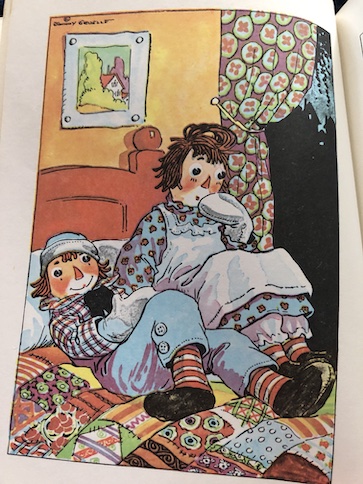
Raggedy Ann and Andy are lying in their doll bed in Marcella’s playhouse one night when they see a strange man sneaking up to the big house. They see him reach through a window, steal something, and run away. Wondering what just happened, they run to the house and talk the other dolls. The other dolls say that the thief just stole the French doll!

Raggedy Ann and Andy try to follow the man to rescue the French doll, but they can’t catch up to him because he flew away! As they try to figure out what to do, a fairy comes along. They explain the situation to the fairy, and the fairy says that they can fly if Granny Balloon Spider weaves a balloon for them. So, they go to Granny Balloon Spider weaves them a silken balloon, and they sail away into the air.

When Raggedy Ann and Andy decide it’s time for them to get off the balloon, they grab hold of a tree limb and untie the silken strings that have them tied to the balloon. When they jump down from the tree, they meet an old stuffed camel with wrinkled knees. They explain their situation to the camel, and the camel says that the man who took the French doll sounds like the one who kidnapped him from his owner, a small boy. The camel escaped from the man, but he thinks he could find him again, except that it was dark when he ran away, so he could find his way better if he couldn’t see.

Raggedy Ann and Andy tie a handkerchief around the camel’s eyes and climb on his back. At first, the camel just goes around in circles, but Raggedy Ann and Andy realize that he needs to run backward to retrace his steps, and then, they start getting somewhere.

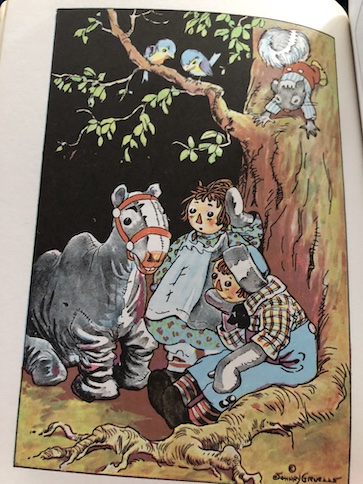
Along the way, they meet a girl named Jenny who is trapped in a patch of snap dragons. The snap dragons won’t let her go. When they try to help her, Raggedy Ann and Andy get trapped by the snap dragons, too. They don’t know what to do until a tired old horse comes and rescues them.

Jenny explains that she was searching for her brother, Jan, who was kidnapped by a magical creature called a Loonie. The tired old horse says that he knows where Jan is now, so they decide to rescue Jan before continuing their quest to find the French doll.

The Tired Old Horse leads them to the tree where the Loonie lives, and the Camel recognizes it as the place that he escaped from. They discover that the Camel as the ability to get inside the magical tree when he’s blindfolded, and he carries the others inside. From there, they find a trap door that leads to Loonie Land.

In Loonie Land, they are captured and brought before the king of the Loonies, who is a very silly king. The king insists that they won’t let Jan go until they answer three riddles. The riddles are very silly and make little sense, but Raggedy Ann and Andy figure out that the king doesn’t know the answers himself, so as long as they give him some kind of answer, they will be answering the riddles. The king is astonished that they are able to come up with answers and tries to insist that he has to ask them three more riddles, but Raggedy Ann and Andy insist that they’ve fulfilled the bargain already and that they’re going to take Jan. Raggedy Andy tweaks the king’s nose, and the king summons his looniest knight to fight them.

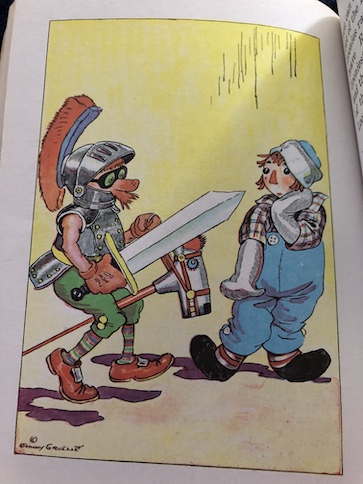
The looniest knight comes riding up on a hobby horse, but he’s afraid of Raggedy Andy and pretends that his hobby horse is acting up and that it has thrown him off. Since Raggedy Andy has “vanquished” the looniest knight, the king decides that they can take Jan and go.

With Jan rescued, they are able to resume their quest to find the French doll. Going further, they meet Winnie the Witch. The witch says that the man with the French doll bought some magic medicine from her, but he gave her a lead dime. Since he cheated her, the witch says that the magic medicine she made for him won’t work. The tired old horse asks if she has some medicine that will make him less tired. When he has her medicine, he becomes more energetic.

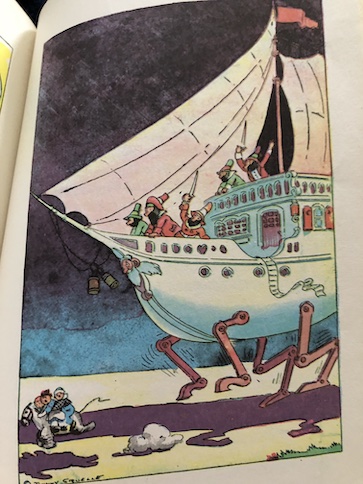
When they ask the witch how to find the man with the doll, she has them close their eyes and count to ten. When they open their eyes, they find themselves outside the tent of the man who took the doll. It turns out that Babette, the French doll, was kidnapped by pirates! Getting away from them is also going to be difficult because the pirates have a jumping house boat!

The book is available to borrow and read for free online through Internet Archive (multiple copies – including an audiobook). The LibriVox audiobook is also available on YouTube.

My Reaction and Spoilers

This story is cute, and I’m sure that it would be amusing for young children. Actually, I found it amusing as an adult because there are some silly jokes in the book that adults can enjoy, like how Raggedy Andy keeps talking while trying to tell the camel that he shouldn’t talk because Raggedy Ann is trying to think. At one point, the camel also gets confused about why the French doll is French when she has a china head. (Ha, ha. Groan!) One of my favorite parts was the part with the king of the Looneys and his nonsense.

The ending is also pretty silly. The tired old horse convinces the pirates to reform by offering them lollipops. It turns out that the pirates are actually a bunch of girls in disguise! These girls apparently had a deprived childhood, but they always liked to read stories about pirates and pretend that they were pirates. When they had a chance, they bought this magical jumping ship and started playing out their pirate fantasies, trying to get all the things that they didn’t have when they were younger, which is why they’ve stolen toys and are easily bribable with candy.

The story has a happy ending where the pirates help Raggedy Ann, Raggedy Andy, and the French doll get home. They reunite Jenny and Jan with their parents, and it turns out that the camel once belonged to Jan’s father. Jan’s father is happy to see his old toy and gives the camel to Jan.

Raggedy Andy Stories

Raggedy Andy Stories by Johnny Gruelle, 1920.

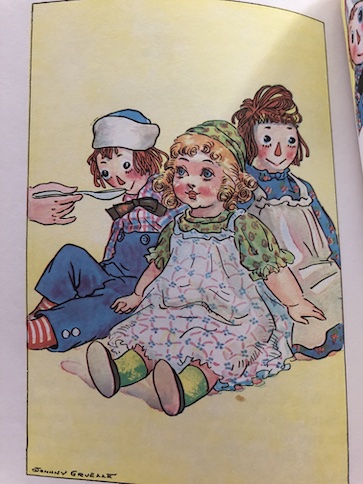
This book is part of the original Raggedy Ann series by its creator, Johnny Gruelle. The first book in the series was just about Raggedy Ann, but this book introduces a boy doll named Raggedy Andy. The explanation behind Raggedy Ann and Raggedy Andy (according to the book, not real life) is that the two dolls belonged to a pair of childhood friends. One girl owned Raggedy Ann, and the other girl owned Raggedy Andy. At the beginning of this book, Raggedy Andy arrives by mail to join Raggedy Ann and the other dolls in Marcella’s nursery, supposedly sent to the author by the daughter of the woman who owned Raggedy Andy.

Every night when the humans in the house go to sleep, Raggedy Ann and Raggedy Andy and the other dolls and toys come to life and have adventures. Each chapter in the book is its own short story. Some of the stories have morals to them about being generous and making others happy. Santa Claus and the Easter Bunny also make appearances.

These stories can make good bedtime stories for young children because there is nothing at all stressful about them. The book makes it clear from the very beginning that dolls cannot be hurt, so whatever they go through in their adventures, no real harm is ever done.

The book is available to borrow and read for free online through Project Gutenberg (multiple formats) and Internet Archive (multiple copies – including an audiobook). The LibriVox audiobook is also available on YouTube.

Stories in the Book:

How Raggedy Andy Came

The package with Raggedy Andy arrives, and the author is sees that Raggedy Andy and Raggedy Ann are glad to see each other again. The dolls cannot talk to each other in front of humans, but the author senses that they have things to say to each other, so he leaves them alone together.

The Nursery Dance

Raggedy Andy is brought to Marcella’s nursery with Raggedy Ann and Marcella’s other toys. When Marcella plays with her toys, she talks for them, but the toys have private thoughts of their own that they can’t say in front of her. After Marcella goes to bed, the toys begin to move about on their own and talk to each other. Raggedy Ann introduces Raggedy Andy to the other toys. Raggedy Andy has been stored in a trunk for a long time. Although, he was friends with a family of mice during that time, he is glad to be among other toys again.

The Spinning Wheel

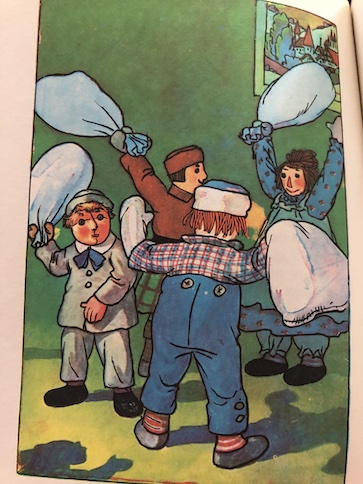
The dolls in the nursery have a pillow fight and get feathers all over the floor. They clean up the feathers, but one of Raggedy Andy’s arms fall off in the right. (This doesn’t really hurt him because, as the book explains, Santa Claus gives the toys he makes a special wish that prevents them from being hurt by anything.) Raggedy Andy says that his arm has been loose for a while. The dolls say that maybe Raggedy Ann could sew it back on, but they need to find a needle and thread first. The dolls go on a daring expedition to the sewing room to get them. As Raggedy Ann repairs Raggedy Andy’s arms, she tells the dolls about another time when she repaired Raggedy Andy’s arm.

The Taffy Pull

Raggedy Andy suggests to the other dolls that they have a taffy pull. At first, the others think it’s a new kind of game, but Raggedy Andy explains that it’s a way to make candy. This is a good time for them to do it because Marcella and her parents are away, visiting relatives, so there is no one home to notice the dolls using the kitchen.

(This story actually contains a pretty good description of making homemade taffy, although the dolls aren’t hurt by touching hot, sticky candy, and a human child would be.)

The Rabbit Chase

Marcella’s dog, Fido, knows that the dolls can talk and also talks to them. One night, Fido hears a strange scratching sound. He wants to bark at it, but the dolls don’t want him to bark because it will wake the humans. They let Fido outside so he can see what the sound is. It turns out to be a rabbit, and the rabbit tries to hide from Fido by running into the house and hiding in the nursery. Raggedy Ann tells Fido to leave the rabbit along and asks the rabbit why it was scratching at their house. The rabbit explains that he is an Easter Bunny, and he only came to leave a basket of Easter Eggs for the children of the house.

The New Tin Gutter

When the house gets a new tin gutter, the dolls have fun sliding down it until a couple of penny dolls get lost down a drain pipe. Then, Raggedy Andy gets stuck trying to rescue them! The other dolls don’t know how to get them out and are afraid that they are lost forever. Then, it starts to rain, and when Marcella’s father notices that the drain seems plugged, he calls some workmen to figure out why the drain won’t work. The adults assume that Marcella must have put Raggedy Andy down the drain pipe when she was playing.

Doctor Raggedy Andy

Marcella sometimes likes to pretend that her dolls are ill and gives them medicine made out of water and brown sugar. However, one day, she leaves the French doll lying in bed after giving her medicine, and the medicine hardens so that her open-and-close eyes are stuck closed. The other dolls try to figure out how to help her, but it’s Raggedy Andy who figures out what to do.

Raggedy Andy’s Smile

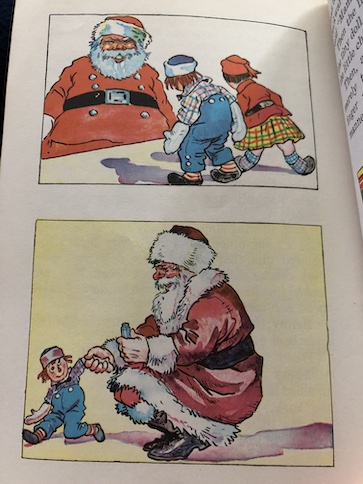
Raggedy Andy’s smile is wearing off because Marcella’s little brother fed him orange juice. (Little Dicky isn’t sorry that he did this because he is only two years old, and as the book notes, two-year-olds don’t have many sorrows.) Raggedy Andy still feels like the happy doll he is even with only half a smile left, but Raggedy Ann says maybe they should wash Raggedy Andy’s face. The others don’t think it will do much good. They go downstairs and are surprised to see a man there. Immediately, the dolls act like they can’t move because the don’t want the humans to know that they come to life. However, this isn’t an ordinary man. This is Santa Claus! Santa Claus fixes Raggedy Andy’s face and smile and also gives the other dolls new painted faces and repairs other problems the dolls have.

The Wooden Horse

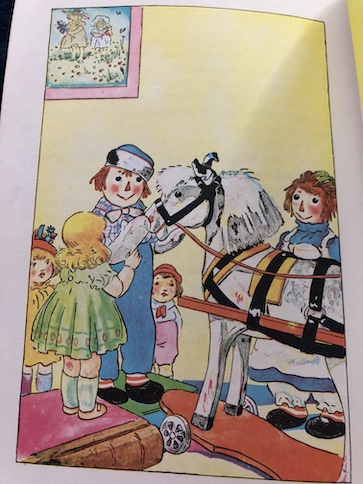
The children of the house get a new wooden horse on wheels for Christmas with a wooden wagon hitched to it. The horse takes some time figuring out how to move because he wasn’t used to moving when he was on a shelf in a toy shop. When the horse figures out how to move, he gives rides to the other dolls and toys. The other dolls think that the horse has more fun than anybody because people who make others happy are happier themselves.

Making ‘Angels’ in the Snow

Raggedy Andy has been away from the other dolls for a while because he got wet and frozen playing with Marcella in the snow at her grandmother’s house and needed to dry out and warm up. The others ask him how it happened, and he tells them about going sledding with Marcella and making snow angels. Then, Marcella left him outside on her sled, so he got frozen. In spite of this, Raggedy Andy thinks that it was an exiting time!

The Singing Shell

Marcella brings home a seashell from her grandmother’s house. At first, the dolls aren’t sure what to think of it. When the dolls listen at the mouth of the shell, they hear a whispering sound. As they listen, the whispering tells them the story of the shell and how it came from the ocean. The shell was found by a diver, who sold it to Marcella’s grandmother when she was young. The shell also sings, and the dolls enjoy hearing it sing.

The House at Pooh Corner

Winnie-the-Pooh

The House at Pooh Corner by A. A. Milne, 1928.

This is the last book in the original Winnie-the-Pooh series. Although other authors later wrote other stories about Winnie-the-Pooh and his friends, at the end of this book, Christopher Robin goes away to school and has to leave his toys and animal friends behind. It’s implied that his friends will continue to live and play in the woods without him and that they’ll all continue to be friends, but the ending is a little bittersweet because Christopher Robin realizes that he’s growing up and that things are going to be changing.

Each chapter in the book is its own short story. I didn’t read the original Winnie-the-Pooh stories when I was a child, but I was already familiar with many of the stories in this book from the cartoon versions that I saw on tv when I was young. I still think of the Pooh Sticks game whenever I cross a foot bridge (although, living in Arizona, few of the ones I cross have water under them). I also still joke about what Tiggers like best from time to time. (Tiggers apparently like everything best until they actually try it, and then they discover that they don’t really like it at all, not unlike the way my dog feels when she begs for food I’m eating that she wouldn’t really like if she actually got some.)

The book is available to borrow and read for free online through Internet Archive (multiple copies).

Chapters:

Ch. 1: In Which a House is Built at Pooh Corner for Eeyore

On a snowy day, Pooh gets the idea of building a house for Eeyore because he’s the only one who doesn’t have a house. However, Eeyore had built a house for himself, and strangely, it has disappeared. When Eeyore gets Christopher Robin to help him investigate, they realize that Pooh and Piglet have mistakenly taken the materials Eeyore used for his house and used them to build a new house for Eeyore in a different location. But, the new location is better because Pooh and Piglet built the new house in a warmer part of the woods, and they did a better building job. Eeyore thinks that the wind blew it to its new spot, and the others let him think that.

Ch. 2: In Which Tigger Comes to the Forest and Has Breakfast

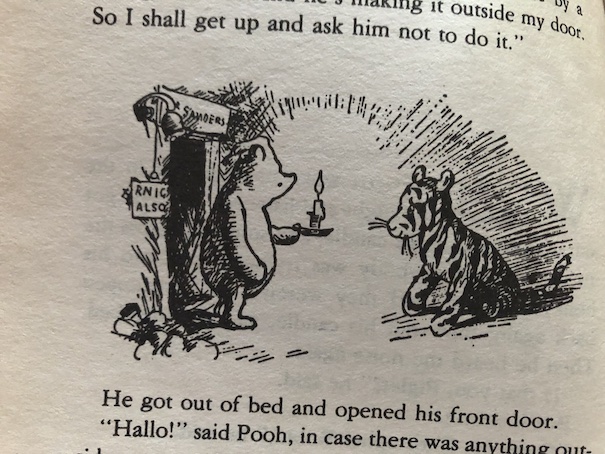
Pooh is woken up suddenly in the night by a strange noise. It’s Tigger, a very bouncy kind of tiger. They’ve never met before because he’s new to the woods, but Tigger knows Christopher Robin, so Pooh invites him to breakfast in the morning. However, Tigger doesn’t like the honey that Pooh serves for breakfast, so they go to see Piglet to see if Tigger likes acorns for breakfast. However, Tigger decides he doesn’t like those, either. They continue visiting friends to find things that Tigger will like. They finally find something Tigger likes when Tigger samples little Roo’s medicine, extract of malt, so Tigger decides that he will live with Kanga and Roo.

Ch. 3: In Which A Search is Organized, and Piglet Nearly Meets the Heffalump Again

Rabbit tells Pooh that he is organizing a search and tells him where to search without telling him what they’re supposed to be searching for. Confused, Pooh decides to look for Piglet to ask him what they’re supposed to be searching for. It turns out that Piglet has accidentally fallen down a hole, and Pooh falls into the same hole while looking for him. Pooh remembers that they dug holes like that as traps for Heffalumps, and they worry that they’re in a trap that the Heffalumps set for them. Fortunately, they accidentally find the person Rabbit was originally looking for.

Ch. 4: In Which It Is Shown that Tiggers Don’t Climb Trees

Tigger brags about all the things that Tiggers are good at doing, but it turns out that they’re not as good at climbing trees as he claims. Tigger and Roo get stuck in a tree, and the others have to help them get down.

Ch. 5: In Which Rabbit Has a Busy Day, and We Learn What Christopher Robin Does in the Mornings

Rabbit finds a note from Christopher Robin, but he has trouble reading it and figuring out what it means. Rabbit tries to figure out what Christopher Robin does every morning, and Eeyore tries to explain education to Piglet.

Ch. 6: In Which Pooh Invents a New Game and Eeyore Joins In

Pooh invents a game that involves tossing pine cones and sticks into the river next to a bridge and seeing which of them is the first to come out the other side of the bridge. While he and his friends are doing that, they find Eeyore floating on his back down the river because Tigger bounced him in. The others have to figure out how to rescue him.

Ch. 7: In Which Tigger is Unbounced

Rabbit has decided that Tigger’s bouncing has gotten out of control and that he needs to be taught a lesson. He tells Pooh and Piglet that they should take Tigger to a part of the woods he hasn’t been before, get him lost, and leave him there for awhile. Rabbit’s reasoning is that they can then rescue Tigger, and Tigger will be so grateful to them for rescuing him that he won’t be so bouncy. Pooh and Piglet have doubts about this plan, but they agree to help Rabbit. However, it turns out that Tigger’s don’t get lost, but Rabbit does, and Rabbit turns out to be the one who is grateful for a rescue.

Ch. 8: In Which Piglet Does a Very Grand Thing

One very windy Thursday, Pooh and Piglet decide to go around and visit their friends, wish them a happy Thursday, and have snacks with them. While they are visiting Owl, Owl’s tree falls over because of the wind. When the tree crashes, they’re trapped inside, and they have to figure out how to get out. Their plan requires Piglet doing something brave, which isn’t easy for such a small, timid animal.

Ch. 9: In Which Eeyore Finds the Wolery and Owl Moves Into It

With Owl’s tree down, Owl has to find a new place to live. Eeyore thinks that he’s found the perfect place: Piglet’s house. It’s a great house, but with Owl living there, where will Piglet live? Pooh says if Piglet’s house had fallen down, Piglet would come and live with him, so that’s what he can do now. Piglet is happy about living with his friend Pooh, so he decides that it’s okay for Owl to live in his house.

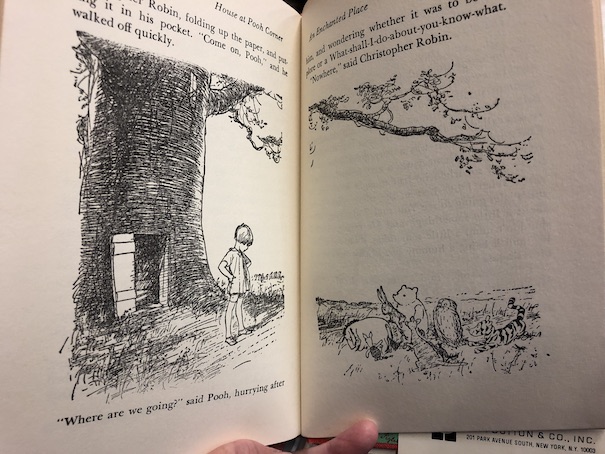
Ch. 10: In Which Christopher Robin and Pooh Come to an Enchanted Place, and We Leave Them There

All of the animals know that Christopher Robin is going away somewhere soon, although they’re not quite sure where he’s going and why. The story doesn’t exactly say it,but it’s implied that Christopher Robin is going away to boarding school. All of the animals say goodbye to him, and Eeyore writes a poem for the occasion. Christopher Robin and Pooh have a quiet walk and talk together. While Christopher Robin realizes that he’s growing up and things are going to be changing, the two of them agree that they’ll never forget each other, no matter how old they get. They’ll always have their favorite place and continue to go there, and some part of them will always be playing together.

Barbie and the Missing Wedding Dress

The Missing Wedding Dress Featuring Barbie by Karen Krugman, illustrated by Laura Westlake, 1986.

This Little Golden Book is a cute mystery with Barbie and her younger sister Skipper.

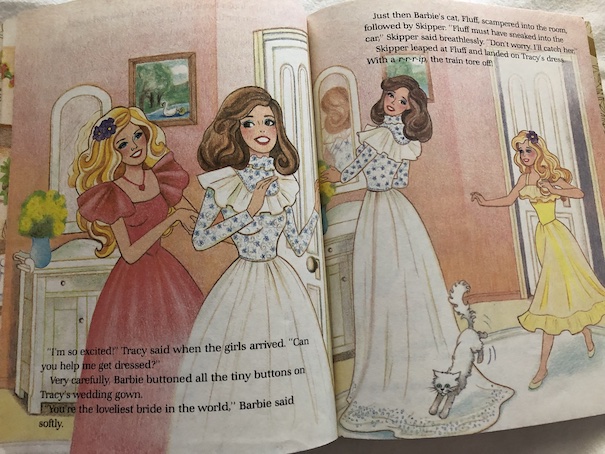
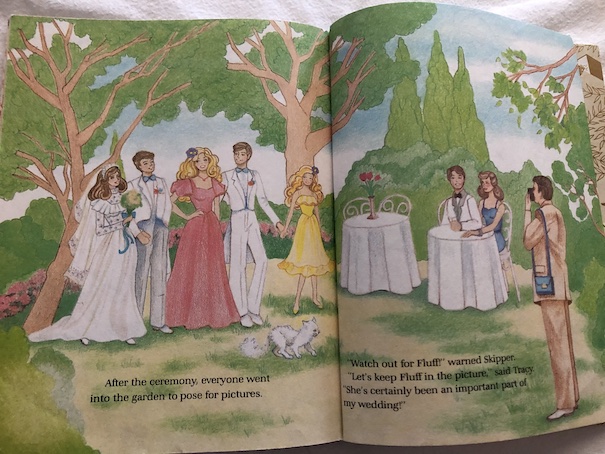
Barbie’s friends, Tracy and Todd, are getting married, and Barbie and Skipper are helping Tracy to get ready. Barbie is going to be Tracy’s maid of honor, and Skipper will be the flower girl for the wedding.

However, when they’re helping Tracy to get dressed for the wedding, Barbie’s cat gets loose and Skipper accidentally tears Tracy’s dress trying to catch the cat. The three of them take the dress to the dressmaker to be fixed.

After the dress is repaired, they stop at the shoe store to pick up Barbie’s shoes. However, when they leave the store, they suddenly realize that they no longer have the box with the dress in it. Instead, they have a box that contains several pairs of jogging shoes! Somehow, the boxes were switched, but how are they going to find the person with the right box?

Barbie, Skipper, and Tracy track the person with the dress across town, using the clues that the jogging shoes belonged to a woman in a floppy straw hat with a red van that says “Flo” on it.

The book is available to borrow and read for free online through Internet Archive.

My Reaction

I read this book when I was a kid and I liked to play with Barbies, and I thought that having them solve a kind of mystery was fun, although it’s a very simple sort of mystery, chasing down a lost object. I liked this book a lot when I was little.

Barbie fans might notice that Skipper doesn’t have her 2000s look, basically looking like a smaller version of Barbie herself, which was how she looked in the 1980s and 1990s, when I got my Barbie dolls. Since then, Mattel has changed Skipper’s hair. However, people who are younger than I am might not be aware that Tracy was also a doll from the 1980s, a friend of Barbie who came in a wedding dress. This 1982 commercial on YouTube shows bride doll Tracy with her groom, Todd. The Tracy and Todd dolls existed before this book was written, so the book was written to give the dolls a story, and the dolls weren’t created based on the book.
Baker Smurf’s Sniffy Book

Baker Smurf’s Sniffy Book by Peyo, 1982.

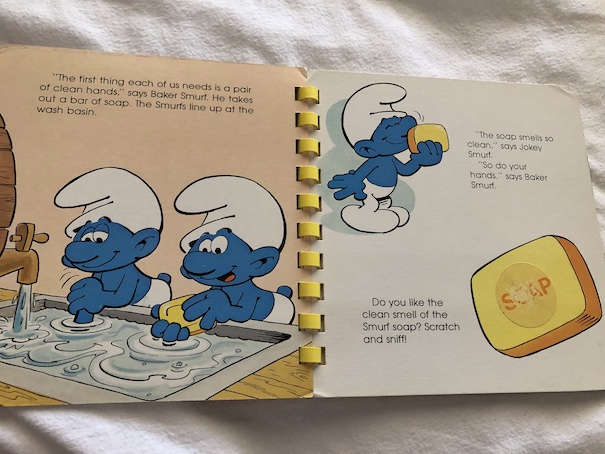
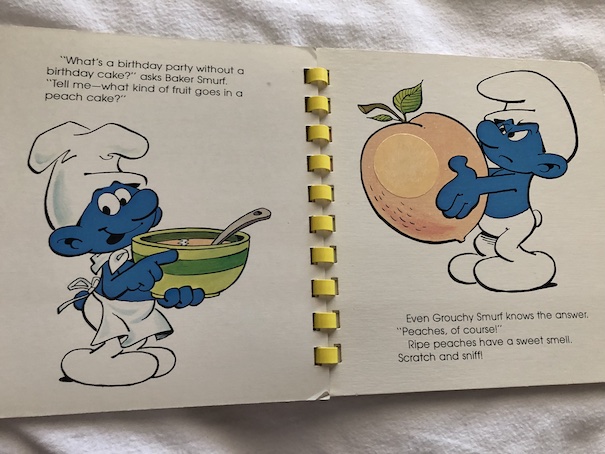
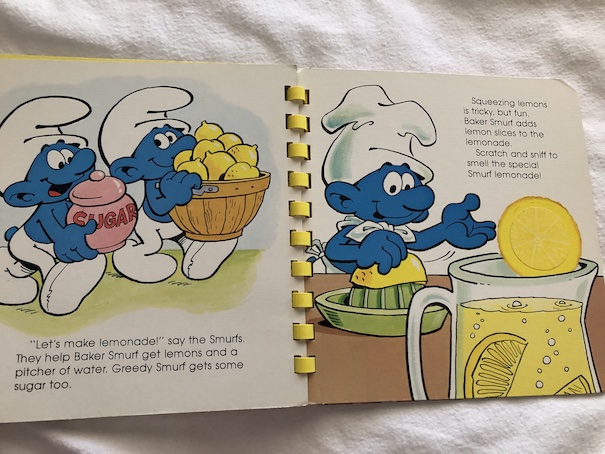
“Sniffy” books with scent patches for readers to scratch and sniff were a recent innovation in the 1980s and were popular with kids. Many books that included this feature used well-known characters from popular children’s cartoons, like this one featuring the Smurfs.

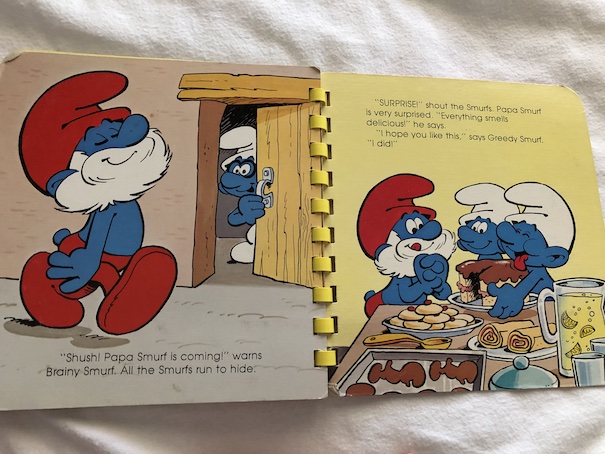
The Smurfs are making special treats as part of a surprise party for Papa Smurf’s birthday! The first scent in the book is the soap the Smurfs use as they wash their hands and prepare to help.

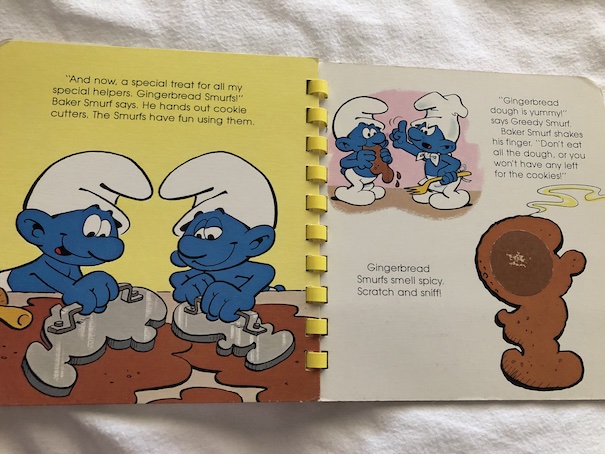
All of the rest of the scents in the book are ingredients they use to make the birthday treats. There is the jam that they put in the jelly rolls, the peach they put into the peach-flavored birthday cake, violets that they make into candied violets (not common in the US, but they can be used as decorations on desserts in real life), gingerbread that they make into gingerbread Smurfs, and lemonade.

When everything is ready, they surprise Papa Smurf with their fun birthday feast!

My Reaction

We’ve had this book since I was a little kid. Sniffy books gradually lose their scents the more the patches are scratched, but we used this one pretty frequently, and the scents have held up surprisingly well. You can see the scratch marks on the scent patches in the pictures, and the scents aren’t as strong as they used to be, but even more than 30 years later, the scents are still there and recognizable as what they’re supposed to be. The one that held up the least well is the lemonade scent, but the others are pretty good for being as old as they are!