Christmas in a Pandemic

Once in awhile, I feel like circumstances require me to make some comment about current events. Christmas this year is weird. There’s no denying that. This year has been dominated by the Coronavirus Pandemic, an event unforeseen at this time last year. In fact, the very first book post I made when this year began focused on the Influenza Pandemic of 1918, and I didn’t do it on purpose. I just happened to be reading Charlotte Sometimes around Christmas last year because it was a book many people said was good, and I’d been meaning to get around to reading it. I didn’t know on New Year’s Day 2020 that it was going to turn out to be weirdly appropriate.

So, everyone’s lives this year have been affected by the current pandemic. Many people aren’t going to spending Christmas like they did last year. Not everyone can travel to visit relatives, and some people, sadly, will be missing people who were with them last year. It’s okay to be sad about it. Circumstances aren’t good, and it’s okay to have feelings about it. It’s okay to be sad or angry and get those feelings out. Christmas tends to bring out strong feelings even in ordinary years because it’s the last major holiday before the New Year. It’s an event that not only marks a major Christian event, but also kind of caps off the year. It’s a time when people take a pause, and when people pause, they also tend to think. They think about what’s happened during the last year, where they are in their lives, where they expected to be, and what they expect or hope for during the next year. When I was in high school, a teacher warned us that it’s normal for some people to get depressed around this time of year, even though it’s usually considered a happy time. There are different reasons for that. Sometimes, it’s partly the weather, if you live in a place that gets dark and snowy around this time of year, but quite often, it’s about personal expectations. We all have expectations about our lives and how we think events are going to go, and it’s disappointing and sometimes frightening when things don’t go according to plan. Some people feel like they’ve failed when things in life don’t work out the way they wanted them to, and that’s depressing. They feel like they should have been able to control things better in the year leading up to Christmas and have the expectation that Christmas should be this perfect day where everything goes smoothly and everybody is perfectly happy. But, that’s not really how life goes, and not everything in life can be helped. Everyone encounters circumstances beyond their control that occasionally derail their plans, and that’s okay because it’s human, and that’s something that’s at the heart of the Christmas story, too.

For those who believe in the Christmas story, Jesus was born in a stable because there was no room at the inn for his parents to sleep in. There was literally nowhere else to go for them but the street, and the stable was a step up from that because it at least had some straw to lie on instead of the hard ground. It looks cute in nativity scenes with all the animals around, but anybody who’s been in a real stable or barn knows that they are smelly. Stables are for animals to live in, and animals poop. That’s one of the reasons why barns and stables have straw on the floor, to make it easier to clean up the animal poop and pee as well as providing animal bedding. In nativity scenes, Mary typically looks unusually clean in white and blue robes for someone who just gave birth while lying in a pile of straw. In real life, straw probably would have gotten all over her clothes and into her hair. This wasn’t a hygienic maternity ward with clean white sheets and soft pillows. It was a glorious event, but far from “perfect”, and even calling it “ideal” would be stretching it a little. It was what it needed to be for the people involved and the circumstances they were in. This is a story about people making something wonderful happen because they were doing the best they could with what they had in difficult circumstances. In a way, that’s part of what’s compelling about this story. If it had been a normal birth where everything went as one would expect, with no complications or unusual circumstances, it wouldn’t be special, would it? Everything about this story centers on the fact that this birth was unusual, not anything anybody would have expected. It was all surprising, from a prophetic star overhead to angels telling shepherds about the birth to wise men showing up with gifts to a homicidal king who starts looking for the baby, forcing the family to flee, to who this baby turned out to be. Nothing about this situation was normal. If it had been, we probably wouldn’t have a major holiday to celebrate it, and it wouldn’t be a story worth telling.

By the way, that’s my grandmother’s old Nativity set in the picture, and if you look at it closely, it’s also far from perfect. That picture isn’t the greatest, but also the figures are a mixture of pieces from different sets that my grandmother probably bought on sale or at a garage sale because she did things like that. You can kind of tell that it’s not just one set from the different styles of the figures and the bases that don’t match each other. Some are stamped “Made in Japan” and some are labeled “Made in West Germany.” Yep, West Germany. Some of the figures are broken. The guy in the back on the left is missing a hand, and some of the animals have to lean on something to keep from falling over. The angels aren’t in the picture, but they’re on top of the box that contains the scene, and one of them is missing a wing. We still use this set every year because we’ve had it for years and are attached to the pieces, even the broken ones. It’s possible to love something that isn’t perfect.

There are all kinds of expectations, and the type that really makes Christmas special is the expectation not that things will be perfect but that we will be pleasantly surprised by what happens. Pleasant surprises come when circumstances aren’t perfect, but good things still happen, and we have something to celebrate anyway. This is true even in the middle of a pandemic. So, forget what this year and this holiday were “supposed” to be! A lot of things have happened this year that nobody wanted (no matter what the conspiracy theorists say). It’s been hard for everyone, but there is some comfort in realizing that, no matter what you’ve been through this year, there are people around the entire world who have been going through the same thing with you every step of the way. You’re far from alone, and during this last week of the weirdest year of our lives, there are still some things to be glad about and some time to arrange a few last-minute treats for yourself and some nice surprises for other people.

Remember the Little Things

Life is in the details, and even in the midst of every insane thing that’s happened this year, there are still some little things that have gone right. Did you learn something new this year? Revive an old hobby during quarantine? Reconnected with an old friend online? Take care of some things you’ve been meaning to do but just never got around to doing until you just couldn’t get out to doing anything else? If you did, celebrate it! If you didn’t, you’ve still got about a week to do whatever it is you want to do before the year ends and then celebrate it!

Since my family started quarantining, I’ve gotten used to Zoom (which I’d been meaning to learn how to use and this year, I really had to). I managed to complete an internship remotely, and I’ve finished my final class to get the degrees I wanted. My dog has finally let my brother pet her because he’s been around more, and she’s finally started to trust him more. These are things that make a difference to me, and if you think about it, there may be things that you did that have changed your life for the better while you were worrying about larger events. Even just managing your life through a major pandemic is an accomplishment by itself. Think about the positive things you’ve done, big and small. Maybe write them down so you can see them and remind yourself of the good you’ve done.

I can’t say that I accomplished everything I wanted to do this year … or, even half of it. But, that happens every year. I just roll over all my uncompleted projects to the next one and add some more as the year goes on. It’s routine. It doesn’t matter how long I live, I’m the kind of person who thinks of more to do than I’m ever going to find time to do, and I’m used to that. As the year comes to a close, take a little time to appreciate the things you have done instead of brooding about what you didn’t or couldn’t. There is satisfaction in knowing that you’ve done things and taken care of what you needed to do. If, like me, your to do list is never-ending, then take a moment to appreciate being an ideas person with a constant supply of interesting projects and that you’ll never lack for direction in your life.

Celebrate an Old Tradition or Start a New One

Traditions can be a source of comfort, even if you’re not sharing them with the people you normally would. Traditions connect people with the past and the people who have shared those traditions before. They also remind us that there have been other Christmases before, and there will be more to come. This is just one year out of many. Whatever your situation is/was this year, it will probably be different by this time next year. Take comfort in that, and take some time do the things that you’ve enjoyed doing on Christmases before.

Watch some of the movies that you’ve liked on Christmases past, or if you’re just not feeling it this year, try something different. A simple Google search will show you just how many Christmas-themed movies there are to choose from. You don’t even have to watch something Christmas-specific, if you don’t feel like it. If it would make you happier to watch Star Wars tomorrow, do that instead. (I’d rather watch that than It’s a Wonderful Life any Christmas. Even though it has a happy ending, I find it wrenching to go through to get there.)

Most of my blog is about books, specifically nostalgic ones. Revisit some childhood favorites, or check out some of the ones I’ve reviewed! Most of the ones I’ve reviewed are also available online through Internet Archive, so if you don’t have them, you can get them with a couple of mouse clicks. (Internet Archive requires you to sign up to borrow books online and read them in your browser, but it doesn’t cost any money, and you might also find some old favorites there that I don’t know about yet.) Read them with your kids or just by yourself to relive the nostalgia!

Favorite books from Christmases past (plus more on my list of Christmas books):

Merry Christmas from Eddie (1986)

The adventures of a group of neighborhood children, leading up to Christmas. This are just calm, slice-of-life adventures that make nice bedtime reading, like the one about Eddie’s cookie mix-up and the time he played Santa for his family and how a toy horse became a zebra in the school’s toy drive.  One of the Betsy and Eddie books by Haywood.

The Best Christmas Pageant Ever

The Herdmans, the worst kids in town, unexpectedly show up at Sunday school (mostly to raid the snacks) and become interested in the Christmas pageant.  What will happen when the Herdmans decide that they want the starring roles?  Part of The Herdmans Series. This humorous book brings up what I mentioned earlier about the situation in the First Christmas not being perfect, and there’s also a movie version.

Merry Christmas, Amelia Bedelia

Amelia helps Mr. and Mrs. Rogers get ready for Christmas while they go to pick up Aunt Myra, who will be spending the holiday with them. As in all of her books, Amelia goes through her to do list taking absolutely everything literally, from “trimming the tree” by clipping its branches to “stuffing the stockings” with the same kind of stuffing that she would use to stuff a turkey.  Part of the Amelia Bedelia Series.

The Biggest, Most Beautiful Christmas Tree (1985)

The chipmunk children are disappointed because Santa has trouble finding their house among the other trees in the forest, so the animals decide to turn their home into a big, decorated Christmas tree.  A Little Golden Book.

The Nutcracker (1816, 1987)

A young girl receives a magical nutcracker for Christmas and learns how to break the spell that has changed him from a human prince. By E.T.A. Hoffmann, retold by Anthea Bell.

The Polar Express (1985)

A boy rides a magical train on Christmas Eve and goes to the North Pole to meet Santa and receive the first gift of Christmas.

Starlight in Tourrone

Children in a small village in France revive an old Christmas tradition that brings life back to their town.

Christmas Around the World

This book explains Christmas customs in various countries around the world. I’ve read it and reread it around Christmas since I was a kid! If you like this book, I also recommend the Anglophenia YouTube video about Christmas in Britain.

Some other books that I haven’t reviewed yet on my blog are:

The Night Before Christmas

A picture book of the famous poem with beautiful pictures and some historical information about the poem in the back.

A Little House Christmas: Holiday Stories from the Little House Books

This is a collection of the Christmas scenes from different books in the Little House on the Prairie series. There are some good Christmas stories in those books, where people often had trouble getting together, and the family had their own, homemade fun and enjoyed simple pleasures.

Christmas Cookbook

Christmas recipes from around the world!

Many people feel nostalgic about special foods and treats around Christmas. Even if you can’t get together and eat with as many people this year, you can still enjoy old favorites, and baking special Christmas cookies and making candy and other treats can be a good activity and something you can enjoy with children.

Of course, a classic Christmas activity is making a gingerbread house. Or, if you’re like me, using the shortcut of making one out of graham crackers or pop tarts. (Remember, it doesn’t have to be perfect, it just has to be fun. It’s always a little messy, and you’ll notice mine has old Valentine candy on it because it’s more fun to read candy hearts than eat them.) If you don’t have proper piping bags for the icing, you can always do what I do and put the icing in a sandwich bag or freezer bag and snip off one corner.

If none of these activities sound like your traditional activities, or if you don’t feel like doing what you ordinarily would do, consider starting a new tradition! Make a new kind of craft or try a new recipe you’ve never tried before. All traditions were new once, and if you like it, it might just catch on.

Be Good to Yourself

Whatever you decide to do this year, do things that make you happy. Christmas is a day to celebrate, to enjoy what you have and give yourself a special treat. Ask yourself what would make you the happiest and make it a point to do things that you enjoy. Read a favorite book (whether it’s about Christmas or not), eat your favorite snacks, have a bubble bath, make a pillow fort with the kids (or, heck, just make one for yourself – who’s gonna know?), run around in the park, drink hot chocolate, play games, whatever you like. Give yourself permission to relax for one day.

Even if you’re spending Christmas alone this year, there are still things you can do to be happy. Take advantage of the freedom of being alone to watch movies, listen to music, or eat foods you like but nobody else really does. Call people and wish them Merry Christmas. If you haven’t sent everyone a card yet, this is a good time to do that.

Surprise Someone

Hopefully, you’ve done all of your Christmas shopping, but there’s still time to surprise someone with something special. If it’s not a gift, it can be just something nice that you do for someone. Call or write to someone you haven’t talked to in awhile and let them know you’re thinking of them. Call into a local radio station and request a song you can dedicate to someone else. Arrange to do yard work for someone to help them even if you can’t have close personal contact with them. Seeing that you can do little things to help people and make them smile may make you smile, too.

If you want a sense of accomplishment, do something to help someone else or make plans to do it for the New Year. There are many groups to donate to, from pet shelters to organizations that help foster children. Do a little research and find out what’s happening in your community and look for a cause you’d like to support. You could donate money to help the homeless or make toys out of no-sew fleece for the local pet shelter. If you’re feeling lonely, there are even some organizations (like this one) that will match you up with a pen pal, like a home-bound senior, who could also use some companionship and emotional support. To find these groups, Google “write to the elderly” and add in your location to find a senior pen pal near you. Consider ways to connect with your community and the people in it, even if you can’t exactly gather yet. Nothing lasts forever, and by the time the pandemic eases, you may have made some new friends by connecting with a good cause.

Merry Christmas!
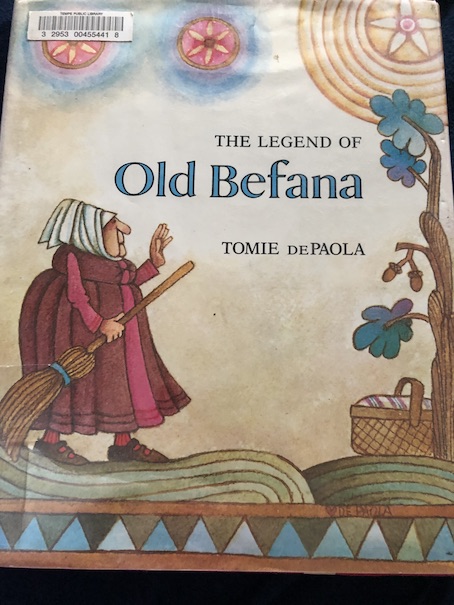
The Legend of Old Befana

The Legend of Old Befana by Tomie dePaola, 1980.

The story is based on a Christmas story from Italian folklore. According to Italian tradition, Old Befana visits the houses of children on January 6th, the Feast of the Three Kings, and leaves treats and gifts. Legend has it that she is on an eternal search for The Christ Child.

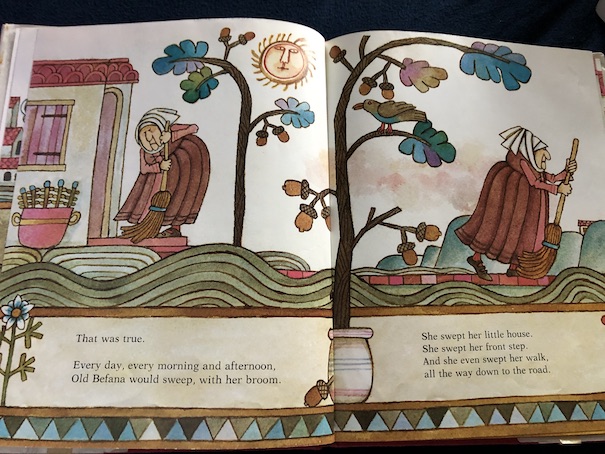
Old Befana is a strange old woman who living in a village in Italy. She is a grumpy woman who spends almost all of her time sweeping. Sometimes, she bakes good things to eat and sings lullabies, although she lives alone, so there’s no one for her to bake for or sing to. People think that she is crazy.

One night, Old Befana wakes up to see a bright light. There is a dazzlingly bright star in the sky, and it makes it difficult for her to sleep.

The next day, as she is doing her usual sweeping, she hears the sound of bells. A strange and beautiful procession comes over the hill. Among the procession are three men in royal robes.

The three kings stop and ask Old Befana if she knows the way to Bethlehem. She says that she has never heard of the place. The kings say that they are looking for “the Child,” but Old Befana doesn’t know what child they mean. They explain to her that this Child is a king and that His appearance was signaled by a bright star in the sky.

Old Befana confirms that she has also seen the star. A boy among the procession tells Old Befana that they are bringing gifts to the Child because He has come to change the world. The boy urges Old Befana to come with them, but old Befana says that she is only a poor woman and continues her sweeping.

After they leave, however, Old Befana continues thinking about what they said, and she starts to think that maybe she should go see the Child. She bakes all kinds of cookies and candies as gifts. She also decides to take her broom so that she can sweep the Child’s room because His mother will be tired. However, she stops to do her usual sweeping before she leaves her home.

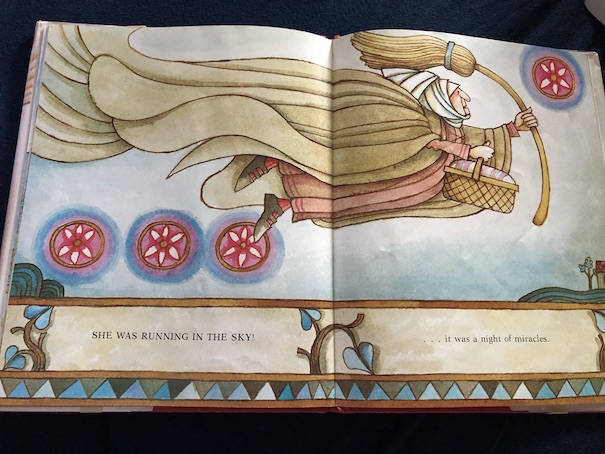
By the time she is finished with her sweeping, the procession is so far ahead that she is unable to catch up to them. Just as Old Befana laments that she cannot catch up to the procession, the angels declare that, “This is the night of miracles.” Suddenly, Old Befana can run fast, even running across the sky.

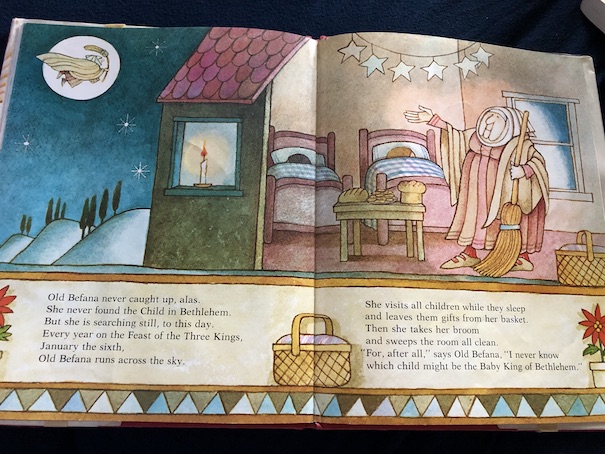
Unfortunately, Old Befana still doesn’t know the way to Bethlehem or who the Child is, so she doesn’t get to see the Christ Child. However, she still continues her search. Every year on January 6, she runs across the sky, carrying her broom and her basket of treats. At every house she finds with a child, she sweeps the room clean and gives the children gifts and treats because she never knows for sure which of them might be the Child she is seeking.

The book is available to borrow and read for free online through Internet Archive.

The Clown of God

The Clown of God by Tomie dePaola, 1978.

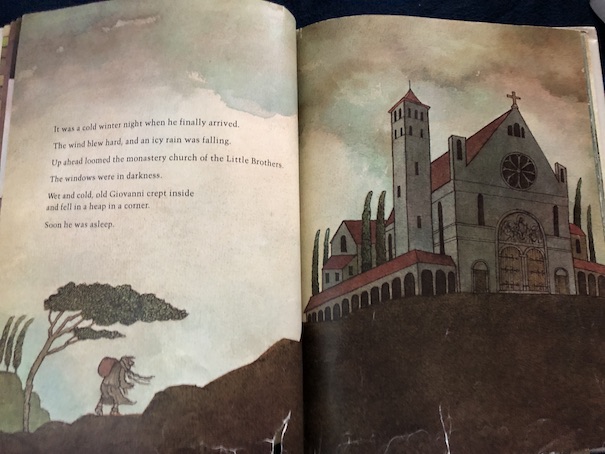
The book begins with a note that the story is based on an old French legend, although the story actually takes place in Italy.

A young boy named Giovanni has no parents and must live as a beggar, but he knows how to juggle. He juggles fruit and vegetables in the marketplace, and the produce sellers give him food in exchange for drawing people’s attention to their wares.

One day, Giovanni sees some actors putting on a play, and he asks for a job with the troupe. After he demonstrates his juggling ability, they agree to take him on in exchange for food and a place to sleep.

Over time, Giovanni’s juggling act becomes more elaborate. Eventually, he becomes famous in his own right and leaves the troupe to become an entertainer for many important people.

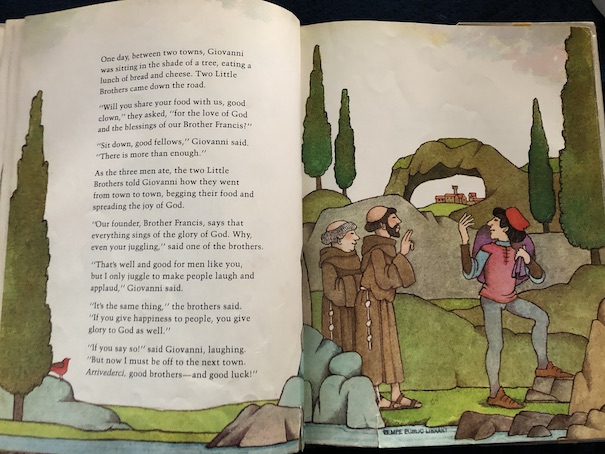
During his travels, he meets two monks, who ask him if he is willing to share his food with them. He agrees, and they tell him about Brother Francis, the founder of their order. (St. Francis of Assissi. They are Franciscan monks.) They say that everything in the world is a sign of God’s glory, even Giovanni’s juggling. Giovanni says that he never thought of it like that before. He just likes making people happy with his performance. The monks say that making people happy is a way of glorifying God.

Giovanni continues his performances, but as he gets older, people get tired of his act, and one day, he actually drops one of his juggling balls. For a time, he has to live as a beggar again. However, he eventually finds his way to the monastery where the Franciscan monks live.

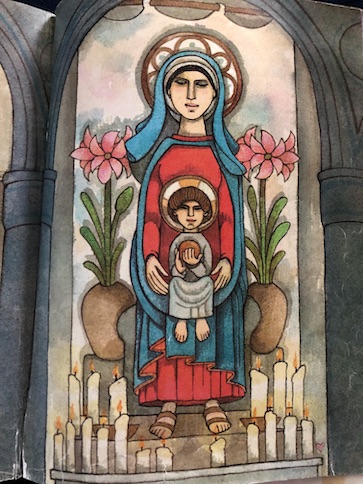
He arrives at the monastery at Christmas, and there is a special procession where people are offering gifts to the Christ Child, placing them in front of a statue of Jesus and Mary. Giovanni is struck by how serious the Christ Child looks in the statue, and so he decides to perform the act that used to make everyone smile.

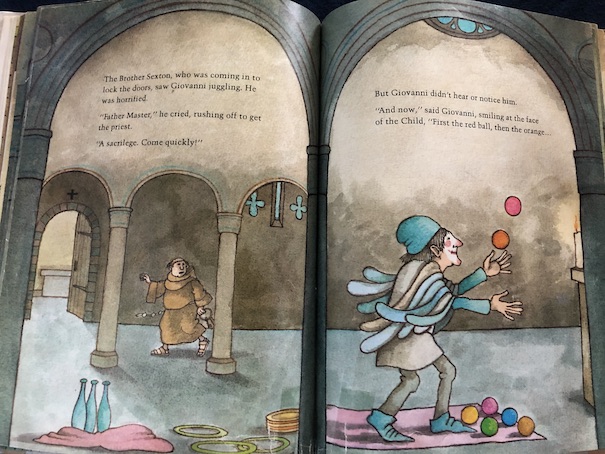
When one of the monks sees him juggling in front of the statue, he thinks that it’s a sacrilege and calls the priest to come see what Giovanni is doing.

The story is sad because Giovanni’s exertion in giving the best performance of his life causes him to have a heart attack and die. However, the priest and the monk notice that, suddenly, the statue is smiling and holding Giovanni’s special golden ball.

The story is about using talents to the fullest. The juggler’s talent, as the monks said, was a gift from God. For as long as he could, he used it to make people happy, and when he was too old to do so anymore, he gave his last, finest performance for Jesus.

The book is available to borrow and read for free online through Internet Archive.

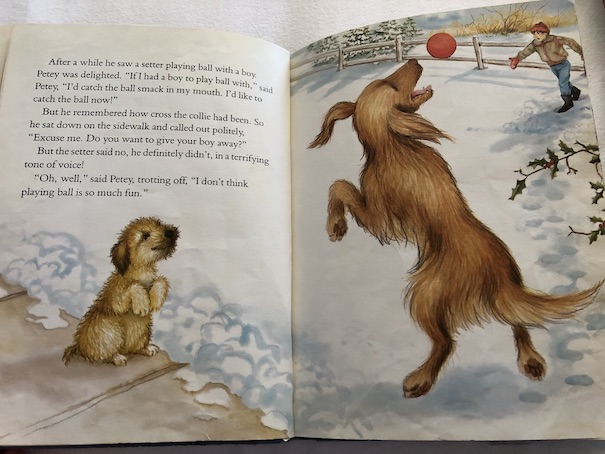
The Puppy Who Wanted a Boy

The Puppy Who Wanted a Boy by Jane Thayer, illustrated by Lisa McCue, 1958, 1985.

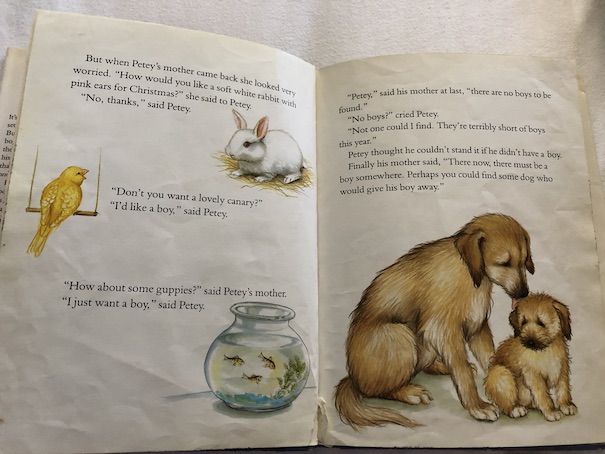
A puppy named Petey tells his mother that he wants a boy for Christmas. His mother says that he might get one if he’s good, and when Petey is a good puppy, his mother tries to find one for him.

Unfortunately, Petey’s mother just can’t seem to find a boy for Petey anywhere. She suggests trying to see if any other dog is willing to part with his boy. However, no other dog wants to give up his boy.

Eventually Petey comes to an orphanage with a sign that says Home for Boys. Petey decides that if the boys have no parents, maybe they could also use a dog. It’s Christmas Eve, and most of the boys are inside are singing Christmas carols, except for one boy, sitting by himself outside.

Petey jumps into the lonely boy’s lap, and the boy loves him right away. When a lady comes to check on the boy, the boy asks if he can bring the puppy in, and she says yes.

All of the boys in the home love Petey and want to keep him. The lady says that Petey can stay if his mother lets him, and Petey knows that she will. Instead of getting just one boy for Christmas, Petey found fifty!

The story was first published in 1958, but my edition is from 1985 and has different illustrations. In the older book, the puppy looked like a beagle.

The book is available to borrow and read online through Internet Archive (multiple copies).

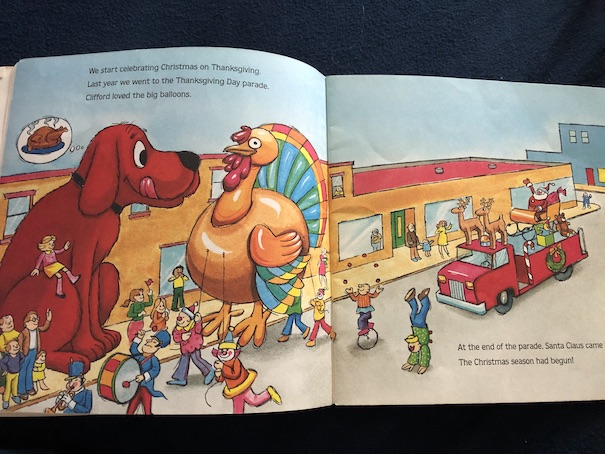
Clifford's Christmas

Clifford

Clifford’s Christmas by Norman Bridwell, 1984.

Christmas is coming, and Emily Elizabeth and Clifford are ready to celebrate! Emily Elizabeth talks about how the Christmas season begins with Thanksgiving. (That’s not how everyone regards it, but it is a common way to mark the season in the United States. The day after Thanksgiving, Black Friday, is considered the start of the Christmas shopping season, with people looking for bargains on Christmas presents.)

When it starts to snow, Emily Elizabeth, Clifford, and their friends have fun playing in the snow. They get a Christmas tree, prepare their stockings, and participate in other holiday activities leading up to Christmas. Clifford even gets a kiss under mistletoe!

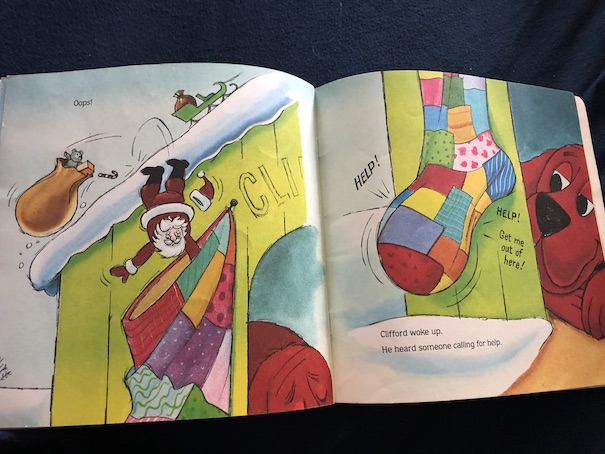
When Santa comes, he lands on the roof of Clifford’s dog house and accidentally falls into Clifford’s stocking, dropping his sack of toys. Clifford has to rescue him.

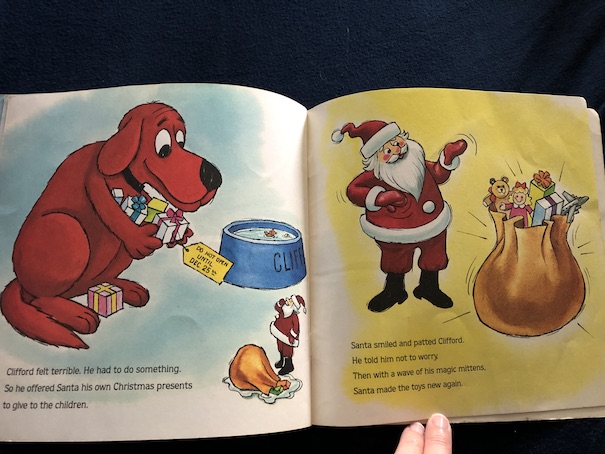
The toys fall into Clifford’s water bowl, but Santa fixes them with his magic. No harm done, and it’s a Merry Christmas after all!

This is just a cute Christmas story with a popular children’s books character. I loved the Clifford books when I was a kid, but I have to admit that they don’t look as good to be now as an adult. The entire plot of Clifford books revolves around Clifford’s enormous size, which is the very idea of the series. However, the plot of this is light, the problem is both caused and immediately solved by Clifford’s large size, and I think I’m just not interested in the usual trope of Famous Character Saves Christmas In Some Way anymore. I think that some Christmas stories with popular characters are still good, but for them to work, they usually have to have deeper, more clever, more interesting plots. This book isn’t bad, but I just didn’t think it was particularly great.

The book is available to borrow for free online through Internet Archive.

The Fun of Cooking

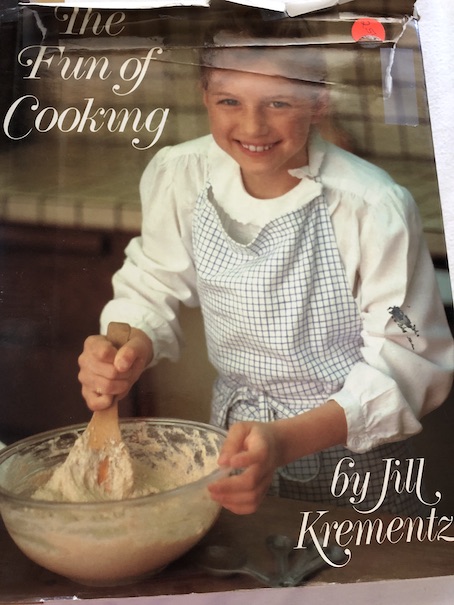
The Fun of Cooking by Jill Krementz, 1985.

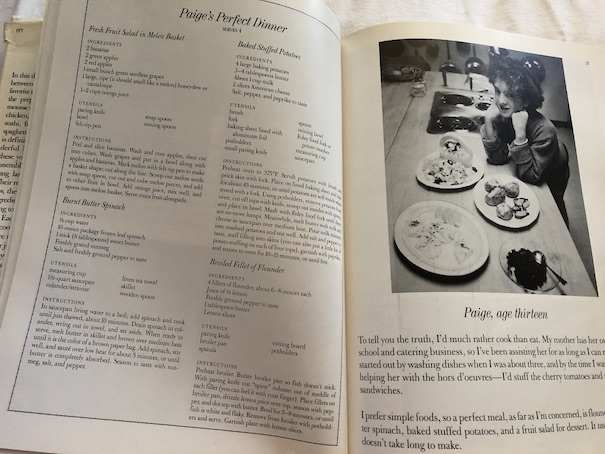
This cookbook was designed not only for children but includes real children making their favorite recipes, sometimes by themselves and sometimes with the help of their parents. The author, Jill Krementz, was also a photographer, and she photographed the children as they cooked. (Another interesting fact is that Jill Krementz was also married to Kurt Vonnegut, until his death. It’s not directly related to this book at all, just a fun fact.)

The recipes in the book aren’t arranged in any particular order, going back and forth between main dishes and desserts of various kinds. Some of the children included recipes for entire meals that included both main dishes and a dessert.

The children themselves are a range of ages from six to sixteen. The older children tend to make more complex dishes or meals, and the younger ones tend to make simpler ones, although even the younger children can make complex dishes with the help of their parents or grandparents. One girl, Michele, has a father who is a professional chef, and she says that it’s her ambition to be a chef, too. She and her father are shown making spaghetti together in the kitchen of his restaurant.

The children all seem to live in or around New York City, where the author lived, and they are from a variety of backgrounds. There are two girls who mention that they are Jewish, including the girl who makes matzo ball soup with her grandmother. There are also two black girls, and one boy with Greek ancestry. Not all of the children have obvious backgrounds like this, but I thought it was interesting where it was noticeable. I think that having a variety of children with different ages and backgrounds was a good idea because it could help many young readers to identify with different types of children.

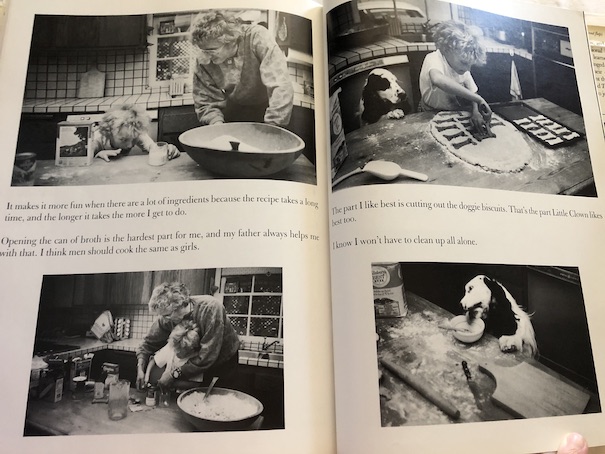
I also liked the fact that there were both boys and girls cooking their favorite recipes. Not only did Michele cook a recipe with her father, but there are other fathers in the book, helping with the cooking, too. One of the boys makes dog biscuits for his dog with his father, and he comments, “I think men should cook the same as girls.” It’s nice to see cooking characterized as something that anyone can enjoy doing, both men and women, as well as children of different ages.

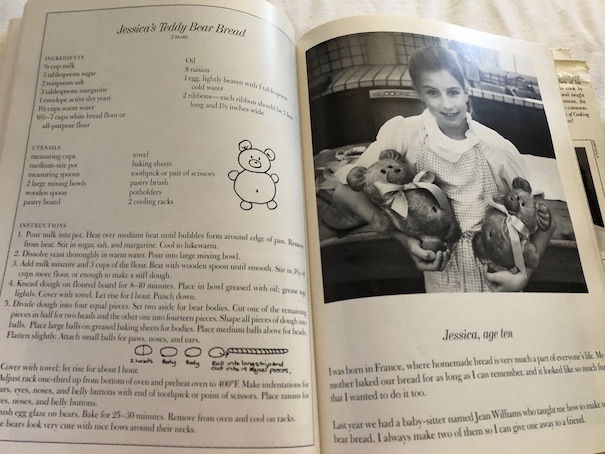
One of the cutest recipes is one for making loaves of bread shaped like teddy bears.

One of my favorite recipes was the one for pumpkin pie. I’ve made pumpkin pie from a whole pumpkin like this before, and it’s a lot of work, but it’s fun! The girl making the pie also roasts the pumpkin seeds.

The book is available to borrow and read for free online through Internet Archive.

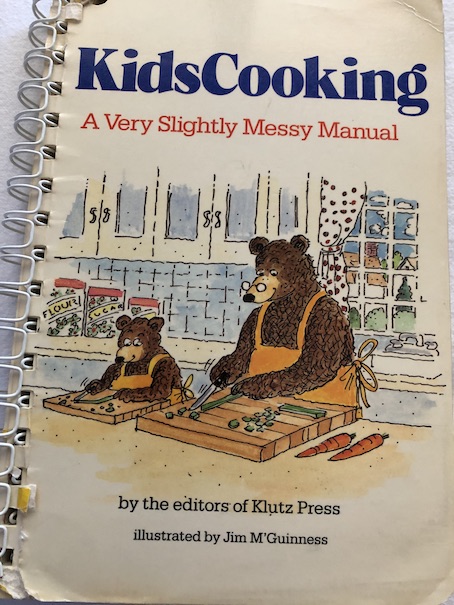
Kids Cooking

Kids Cooking: A Very Slightly Messy Manual by the editors of Klutz Press, 1987.

This book is part of the classic children’s hobby and activity series from Klutz Press. Originally, this book came with a set of plastic measuring spoons, which was attached to the book at the hole in the upper left corner.

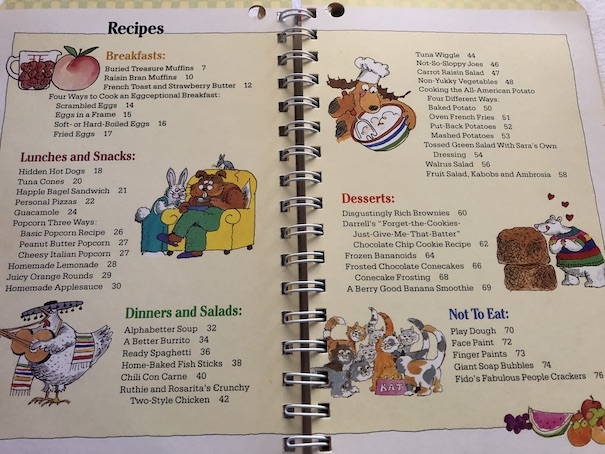
The recipes in the cookbook are listed in categories by the type of meal: breakfasts, lunches and snacks, dinners and salads, and desserts. There is also a section of recipes for non-edible things, like play dough and finger paint.

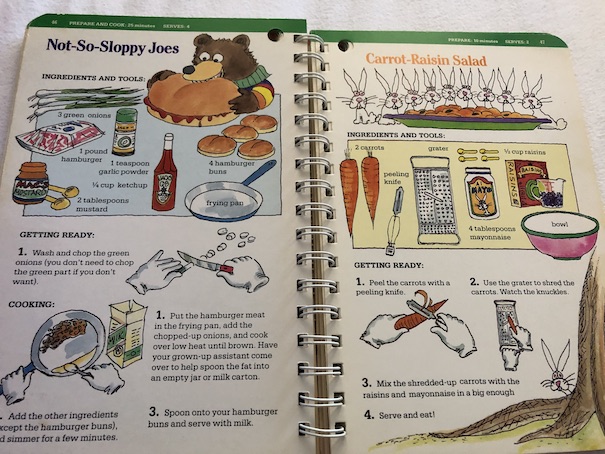
The food recipes are fairly simple, but not the overly-simple, boring recipes that I’ve seen in some children’s books, like how to make a peanut butter sandwich.

Kids can make these recipes, but they’re not for little kids who are still at the level of learning to make their own basic sandwiches. They do involve things like using stoves and ovens and chopping ingredients with a sharp knife. It’s common in the book to include “grown-up assistant with knife” under the list of ingredients and tools needed for recipes.

Some of the recipes in the book include multiple ways to cook something, variations on popular foods or different ways of seasoning a dish. For example, the breakfast section explains different ways to cook eggs, including scrambled eggs, fried eggs, soft or hard boiled eggs, and eggs in a frame.

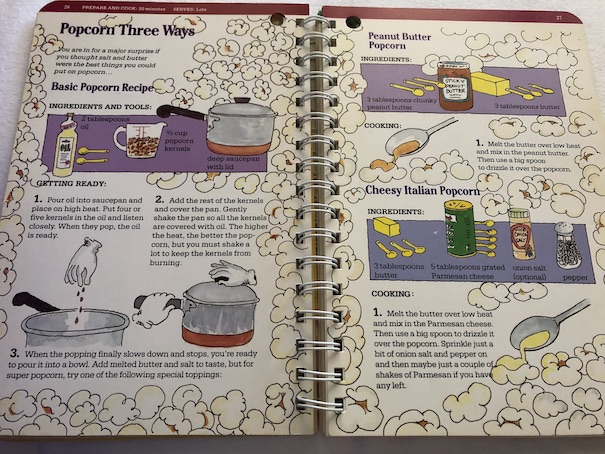
There are different ways of cooking potatoes in the dinner section, and I also like the popcorn variations in the snack section, which include different ways to flavor popcorn with cheese or peanut butter.

The dessert section includes brownies (“Disgustingly Rich”), chocolate chip cookies, and some more unusual desserts, like frozen bananoids, which are pieces of banana covered in chocolate and frozen.

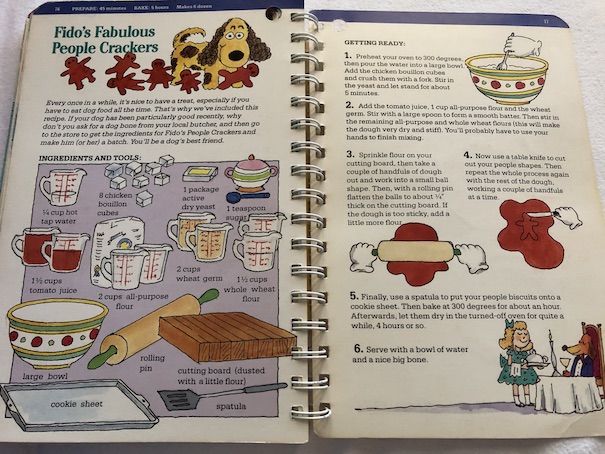
The section of non-edible recipes also includes a recipe for dog biscuits, Fido’s Fabulous People Crackers. They’re edible for dogs, just not something people would enjoy.

The book is available to borrow and read for free online through Internet Archive.

Children’s Quick and Easy Cook Book

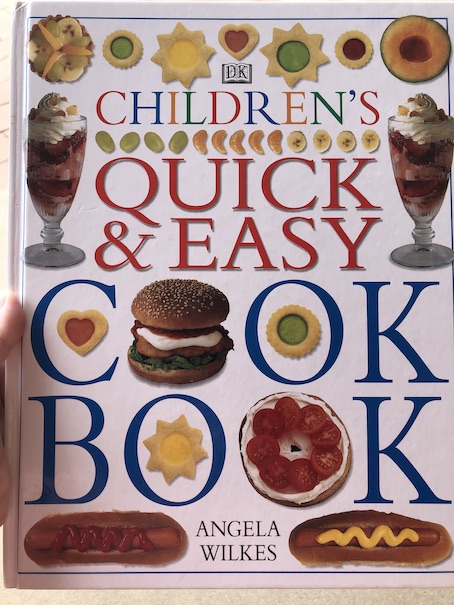
Children’s Quick and Easy Cook Book by Angela Wilkes, 1997.

When I was expanding my cooking skills as an adult, I started doing it using children’s cookbooks instead of cookbooks for adults because of the simplified instructions. When I bought this one, I hadn’t realized that it was originally a British book. I have the American edition, but the reason why I discovered that it was a British book is that the types of recipes the book offers includes some that are more common in the UK than in the US. A friend of my family, who was originally from England, spotted it and was happy to hear that I’d be learning to make some of these recipes. The recipes provide both metric and imperial measurements for the ingredients (another clue that this is an international book). There is a section in the beginning of the book that explains how to use the book and some general cooking safety tips. In the back of the book, there is a helpful Picture Glossary that demonstrates various cooking techniques and concepts used in the book, like how to use a marinade, how to core an apple, how to separate eggs, and how to roll out pastry. It’s all useful information for beginning-level cooks.

The recipes are divided into helpful sections, including snacks, meals, desserts, and sweets. The book is heavy on desserts, candy, and sweets, but many of the recipes under the snacks section are what Americans (and possibly British people, too, although I’m less sure there) might consider as breakfasts, lunches, and general light meals. In particular, the snack section includes sandwiches of various kinds. Some of the ingredients for the sandwiches sound uncommon for the US, although that might also vary by region. I can’t recall seeing salami and cream cheese together before, but I wouldn’t mind trying it sometime. Some sandwiches also call for ingredients like cherry compote and mango chutney. I think that serving grated chocolate on croissants or other bread items is also a European thing. I’ve seen it packaged just for that purpose at international grocery stores and import stores. Some of the snacks are more like snack items in American cook books, like flavored popcorn and smoothies.

The section of Speedy Meals include omelets, two kinds of soup, tacos, and pasta. Some recipes are common ones in the US, too, like chicken nuggets, chicken burgers, and fish sticks. The Turkish Meatballs with lamb, Falafel, Tabbouleh, and Chicken Curry and Rice are less common, but are still eaten here, especially if you live in areas with international restaurants and grocery stores.

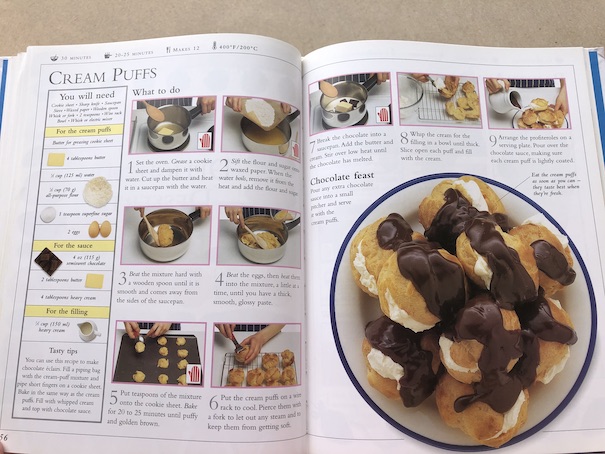
Of course, the desserts and sweets are particularly fun recipes. I particularly enjoyed making the cream puffs! There are different types of cookies included and candies like chocolate truffles and peppermint creams.

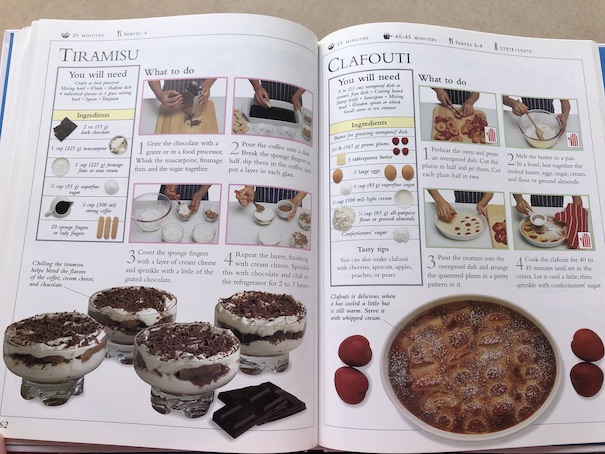
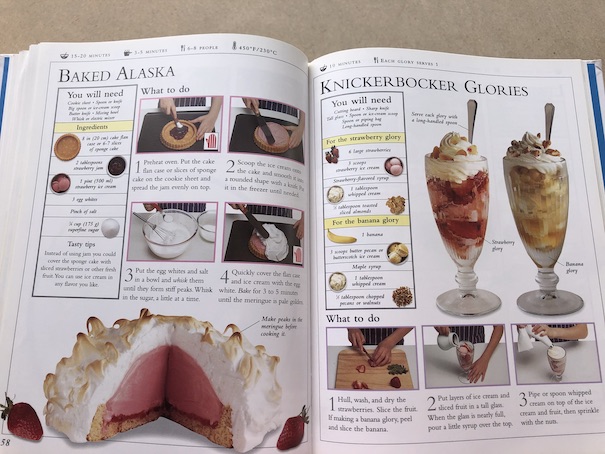
Many of the desserts would be familiar to Americans, like the chocolate cake, carrot cake, lemon cheesecake, and Baked Alaska. However, there were also a few desserts that were new to me. I had never heard of Clafouti before, and this was the first place I had heard of Knickerbocker Glories, a kind of parfait or sundae with layers of ice cream and fruit. (If you remember Harry Potter referring to a Knickerbocker Glory in one of the books, here is what it is!)

The book is available to borrow and read for free online through Internet Archive.

The Sleepover Cookbook

The Sleepover Cookbook by Hallie Warshaw, 2000.

This cookbook has easy recipes that kids can make with their friends at sleepovers, parties, or anytime they want to eat together and include cooking as an activity. Some of the recipes are made from scratch, and some include shortcuts, like using pre-packaged pie dough and crescent roll dough.

The recipes are divided into sections with two sections devoted to snacks, Starter Snacks and Sacktime Snacks (bedtime snacks). There are other sections for meals – dinners, breakfasts, and brunch or lunch. There is also one extra section for birthday treats. The introduction to the book says that it isn’t really important when readers use the recipes – if you want to use a starter snack as a bedtime snack or eat a dinner recipe for breakfast, it’s all up to you. The sections are just to make it easier to find certain types of recipes.

As expected in a book of sleepover recipes, there are plenty of sugary treats, but there is one specifically “healthy” recipe for each section in the book, marked by a heart in the table of contents. The snacks include traditional kid favorites like cookies, popcorn balls, and s’mores. However, even some of the recipes that aren’t specifically labeled “healthy” are still non-sugary, like guacamole and hot taco dip.

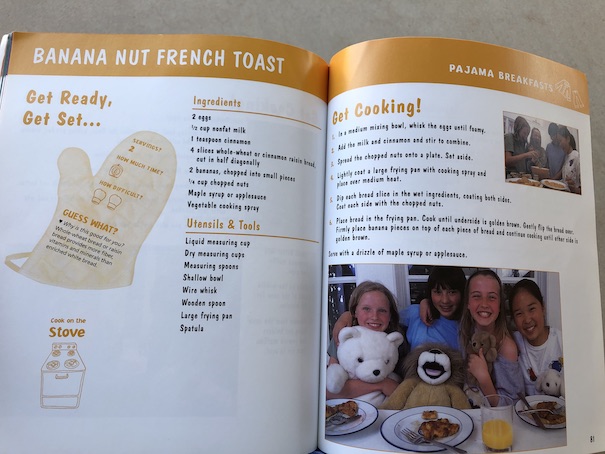
The meal recipes also include many popular favorites. Dinner recipes include chicken pot pie, taco salad, spaghetti and meatballs, and homemade pizza. Breakfast recipes include cream cheese and ham omelettes, chocolate chip muffins, and banana nut French toast. Lunch recipes include tuna melts (called Tuna Meltdowns), bow-tie pasta salad, chicken veggie sticks (kebabs), and turkey burgers.

The section of birthday treats has recipes for different types of cakes and a few non-cake treats like brownie sundaes and Fundue (chocolate dessert fondue).

Each of the recipes in the book comes with ratings, indicating the difficulty of the recipes, although none of them were are really very difficult in general, and the amount of time it takes to make them. One of the things that I liked about this book, besides the ease of the recipes is that the book, is that the pictures show boys cooking as well as girls. I think it’s good that the book portrays cooking as something that both boys and girls can do because it’s a useful life skill for everyone and something that anybody can do for fun.

The book is available to borrow and read for free online through Internet Archive (multiple copies).

Hester Bidgood

Hester Bidgood, Investigatrix of Evill Deedes by E.W. Hildick, 1994.

Hester Bidgood was a character in one of the McGurk fantasy mysteries, which involved time travel, and in this book, she investigates a mystery of her own in her own time, the late 1600s, Colonial America.

Goody Willson’s cat has been found, badly injured, with the shape of a cross burned into it. Some people are spreading the rumor that this is a sign that Goody Willson is a witch and that the injuries to the cat were a sign of God’s disapproval for Goody Willson’s “witchy ways.” Of course, Hester and her friend, Rob, don’t believe that. Old Mistress Brown worries that if the witch rumors go too far, everyone will soon be a potential witch suspect, like in Salem. Rob takes care of nursing the cat back to health, while he and Hester try to determine how the cat came to be injured in such a strange manner.

Rob knows what it’s like to be an outcast. Although he’s a white boy, he lived for a time among the Native Americans as a young captive and adopted many of their habits. He doesn’t know how to read, and Hester has been helping him. However, there are people in the community who don’t trust Rob because of his connections to the American Indians, and they call him derogatory names.

Hester and Rob consider that the mark on the cat could have been made by a branding iron. They go to the blacksmith and ask him if he has an x-shaped branding iron or if anyone has asked him to make one, but he says no. But, then Hester begins to consider that maybe the cross isn’t really a cross. A cross sign could also be made by putting two capital ‘T’s together at an angle.

Their investigations also take them to the old Morton homestead, where the entire Morton family was killed by American Indians some years before. Someone has been staying there in secret, and there are signs of blood, possibly from the injured cat. Gradually, Hester and Rob begin to put the pieces together, realizing who the person responsible must be and how this evil deed is actually connected to an earlier crime.

I didn’t really like this book because of the cruelty to animals. It wasn’t just what was done to the cat but also when Hester remembers Rob finding a dragonfly and considering taking off its wings. Hester stops him from doing it, but it’s still a disgusting thought. I thought that the villain was pretty obvious from the beginning, too, although I didn’t know the motive. When there’s a witch hunt, the person who is the most guilty is the first one to bring up the subject of witches.