The Indian in the Cupboard

The Indian in the Cupboard by Lynne Reid Banks, 1980.

Omri thinks that he’s starting to get tired of collecting and playing with plastic figures when his friend Patrick gives him a plastic American Indian figure that he doesn’t want anymore for his birthday. At first, Omri doesn’t think much of the Indian figure because it’s just a used plastic figure that doesn’t match any other figure sets he has, so he’s not sure how he can use it in his games. Then, his brother Gillon gives Omri a wooden cupboard that he rescued from an alley. Omri likes the cupboard, and his mother lets him have an old key that happens to fit the cupboard so he can lock it. His mother says that the key used to belong to her grandmother’s jewelry box, which fell apart years ago. As Omri tries to decide what he wants to keep in the cupboard, his mother suggests putting his American Indian figure in it because she found it in the pocket of his other pants. Omri puts the toy in the cupboard and locks it. Later, he hears sounds coming from the cupboard, and when he opens it, he discovers that his toy Indian figure has come to life!

Omri is startled to see that the Indian has come to life, and the tiny Indian is afraid of him. The Indian pricks him with his tiny knife and threatens to hurt him if he comes closer. The Indian insists that he’s not small, it’s Omri who is big. When Omri’s mother comes into the room, Omri quickly shuts and locks the cupboard so his mother won’t see that his toy has come to life. Later, when he opens the cupboard again, the Indian is just a plastic toy again. Omri is sure that he didn’t imagine the figure coming to life, but he’s not sure why that happened or why it’s just a toy again now.

Then, that night, after Omri locks the Indian in the cupboard again, he comes to life once more. This time, when Omri opens the cupboard and talks to the Indian, he asks the Indian what happened. The Indian replies that nothing happened, he just went to sleep. Then, he asks Omri for food and a blanket. Omri asks the Indian more about himself and learns that the Indian is named Little Bear and is the son of an Iroquois chief. He offers Little Bear a plastic teepee from his collection of toys to sleep in, but Little Bear recognizes that it’s not a real teepee and besides, Iroquois sleep in longhouses, not teepees. Omri can’t provide a longhouse, so he makes a better-looking teepee out of sticks and a piece of felt, so it’s at least not plastic. Little Bear accepts it.

Omri begins to realize that either his new cupboard or the key that he’s been using with it or both are magical and can bring toy figures to life. He begins doing experiments to see how it works and what else he can make real. The plastic teepee becomes a real one after being locked in the cupboard, but a metal toy car doesn’t change at all, making Omri realize that, for some reason, the cupboard only works with plastic toys.

Omri tells Little Bear that he’s in England now, not America, and Omri discovers that Little Bear approves of the English because the Iroquois fought with the English against the French and the Algonquins. Omri asks Little Bear if he also fought, and Little Bear brags about what a fighter he is and how many scalps he’s taken, but adds that they were French and not English. It sounds kind of stereotypical, but the author is referring to real battles that took place during the 17th century and 18th century around the Great Lakes area, during the French and Iroquois Wars and the French and Indian War, giving Little Bear a rough time period and location. This is meaningful not only for historical reasons, but also because it indicates that Little Bear isn’t just a toy with no personality or history. As far as Little Bear is concerned, he’s a real person with a past and memories and a life beyond being Omri’s toy. In fact, he doesn’t really know anything about being a toy sometimes in Omri’s time period. Omri also realizes that Little Bear’s history makes him a real person, somehow pulled more than 200 years into the future in miniature form, instead of just a toy brought to life.

Still, Omri delights in having adventures with Little Bear, introducing him to things Little Bear otherwise wouldn’t have. When Little Bear says that he’s never hidden a horse before because the Iroquois don’t have them in his time, Omri brings one of his plastic horses to life so Little Bear can ride. When Little Bear gets hurt, Omri brings a WWI medic from his set of toy soldiers to life so he can treat the wound. The medic, Tommy Atkins, is alarmed when he sees Omri and confused when he’s asked to treat an American Indian, but he does so anyway, deciding that it’s all just a dream. Omri lets him think so and then puts him back in the cupboard to send him home.

Omri does some research about Iroquois to learn more about Little Bear and his history. Patrick wonders about Omri’s obsession with the little toy figure he gave him, but Omri is reluctant to tell him. Then, when Omri buys another Indian figure, an old Indian chief, and brings it to life, the poor old man goes into shock at the site of Omri and dies. Omri feels terrible about causing the old man’s death, coming to recognize that the old man was also a real person, sometime and somewhere, and he wouldn’t have died if Omri hadn’t put him in the cupboard and brought him into his time as a miniature person. Then, Patrick gives Omri a plastic cowboy figure. Omri doesn’t want it because he doesn’t want the cowboy to come to life and hurt or kill Little Bear. Patrick is impatient, saying that’s how the game of cowboys and Indians goes and that’s what people do with figurines of cowboys and Indians, have them fight. That’s when Omri realizes that he needs to explain to Patrick that it’s more than just a game and there are real people involved.

Patrick is stunned when Omri shows him Little Bear, and when Omri tells him about the dead chief, he comes to realize that this game is serious. In spite of that, Patrick asks Omri to let him bring just one figure to life. At first, Omri tries to prevent Patrick from bringing another figure to life because the situation is already complicated enough, but Patrick does so anyway when Omri leaves him alone in his room … and the figure that Patrick picks is the cowboy.

Having an American Indian and a cowboy both in Omri’s room, even in miniature form is just as much trouble as Omri feared it would be. The two of them pose a very real threat to each other, and Omri tries to do his best to help them get along with each other. To make things more complicated, Little Bear says that he wants a wife, and the boys take him to the store to pick out a female American Indian from the plastic figures. The school principal sees the figures, but fortunately, decides that he’s just unwell and hallucinating. Meanwhile, Omri has to impress on Patrick that their little people are actually people and not toys simply to be played with. Of course, there’s only one way to ensure that their new little friends will be able to safely continue their lives: send them home!

Personally, I would have ended the game and sent Little Bear home as soon as I realized that he could die, like the chief in the story, but the boys keep their miniature living people for much longer. In fact, this is the first book in a series, and the boys have further adventures with Little Bear, Boone the cowboy, and other figures/people.

This book was commonly used in schools when I was a kid, and it might still be. When I was a kid, my teacher didn’t go into detail about Little Bear’s time period or explain about the context of his life and the conflicts with the French and Algonquin that he described. Now, as an adult, I have more context for understanding what he’s talking about. I also appreciate the author of the book pointing out that different types of Native Americans lived in different types of homes in the past, something that Omri didn’t understand at first, and I liked that Omri started doing his own research to better understand the Iroquois. The book never gives an exact date to Boone the cowboy or Little Bear’s time periods, but by context, Boone has to be more than 100 years younger than Little Bear, from sometime in the late 19th century. I appreciate having some historical details added to a fantasy story about toys coming to life, but the book isn’t very specific, focusing more on the complications involved in keeping miniature people from the past alive and secret in Omri’s bedroom.

There is also a movie version of this book. The book is available to borrow and read for free online through Internet Archive.

Mystery of the Melted Diamonds

Mystery of the Melted Diamonds by Carol Farley, 1986.

This is the last book in the Kipper and Larry mystery series.

This time, Larry has come to visit Kipper and his family on their farm in Kansas while his father attends a police convention in Florida and will be spending Christmas with them. At first, Kipper thinks that Larry probably regrets this visit because Kansas isn’t very exciting, and it’s snowing while Larry’s father is in sunny Florida.

The situation gets worse when Kipper gets into a fight with his friend Scooter when Larry and Kipper were supposed to be spending the night at Scooter’s house. Scooter apparently cheated at a game, and Kipper got so mad that he said that he and Larry would just go home. The problem is that the boys have to walk a couple of miles to reach the farm where Kipper’s family lives, and the snow has turned into a blizzard.

The boys start to get scared that they might freeze to death when Larry spots a light from a house nearby and heads toward it. Kipper thinks that it’s a dangerous mistake because the house with the light is the old Morgansterne house, and it’s been empty for years. However, when the boys reach the house, there are oil lanterns burning in the windows and a fire in a wood-burning stove. Out of desperation, the boys let themselves into the house to warm up, but then they start to wonder who lit the fire and the lanterns. They search the house to see if there’s anyone there, but they don’t find anyone. The only thing they find upstairs is an old box of Christmas ornaments.

The boys spend the rest of the night in the house without seeing anyone and continue to the farm in the morning. When they explain to Kipper’s mother what happened and where they spent the night, she’s concerned, both because the boys were out in the snowstorm and because nobody should be in the old Morgansterne house. Old Miss Morgansterne, who owns the house, has been living in a retirement home, and no one else is supposed to be there. Kipper’s mother decides to call the sheriff and have him look into it.

The sheriff comes and questions the boys about what they saw in the house, and they ask him about a robbery at a jewelry store in town that the family heard about on the radio while waiting for him to arrive. Larry wonders if there’s a connection between the robbery and the supposedly empty house that seemed to be occupied by someone before they arrived. The sheriff doesn’t see why there would be a connection between the two events, but Kipper’s younger brothers think that maybe the robbers were in the house the whole time, hiding in some kind of secret passageway, like in books and movies. The sheriff thinks that the boys have overactive imaginations.

However, there is more to the theory that the house and the robbery are connected than the sheriff thinks. Soon, the sheriff is alerted that the car that is believed to belong to the robbers has crashed into a pond near a dangerous curve in the road and the two men inside the car are dead. When they search the car, they find some of the jewelry from the robbery, the less expensive costume jewelry, so it seems that they were correct that these men were the robbers, but strangely, the most expensive jewels from the robbery, diamonds, are still missing. The sheriff says that it’s almost like they melted away, like the diamond-like snow that Larry commented on earlier.

It makes sense to the boys that the robbers were in the Morgansterne house before they were. They remember seeing a car like the robbers’ car along that road before the snow storm got bad, and it would explain why the house was empty all that night. The robbers accidentally saved the boys’ lives by lighting the stove in the house for them, but they never returned to their hideout in the empty house because they had their car accident. But, somewhere along the way, the diamonds they stole seem to have vanished. Can the boys figure out how?

The book is available to borrow and read for free online through Internet Archive.
My Reaction

Overall, I liked the story. I had more than one theory about where the diamonds were, and one of them turned out to be correct, but there was enough doubt in my mind to keep the story interesting until the end.

Mystery of the Fog Man

Mystery of the Fog Man by Carol Farley, 1966.

This is the first book of the Kipper and Larry mystery series. Kipper (real name Christopher) and Larry are 13-year-old cousins. The two boys meet each other for the first time in this book, when Kipper comes to visit Larry and his family in Michigan. The boys had written letters to each other before, but they were both excited to finally meet in person.

Larry and his father live in Ludington, on the shores of Lake Michigan, and Larry takes Kipper fishing soon after he arrives, which is when Kipper first encounters the mysterious figure known only as The Fog Man. This strange old man starts Kipper, and Kipper finds him eerie. Larry explains to Kipper that The Fog Man is kind of a local eccentric. He is apparently both deaf and mute. No one knows his real name. He apparently lives in the nearby forest, but during the summer, he comes to the beach to collect driftwood, which he sells to tourists, who are fascinated by this eccentric old man, and to the lady who runs the nearby gift shop, Miss Norton.

Shortly after this encounter, the boys learn that someone has stolen thousands of dollars from the safe on one of the car ferries that travel back and forth across Lake Michigan and Wisconsin. (Another book by the same author but in a different series takes place on one of these car ferries, The Case of the Vanishing Villain.) Kipper and Larry are able to see the scene of the robbery because of Larry’s father’s position as the local chief of police. However, the boys’ adventures are just beginning.

The most likely suspect in the robbery seems to be a man called Karminsky, who worked on the ferry. He disappeared around the time of the robbery, and Larry’s father thinks that he’s hiding out somewhere in the area, waiting for the police to stop looking for him so he can make his getaway. Larry is intrigued by the idea that the robber might be hiding out in the woods nearby. Although his father forbids the boys to go looking for the robber, they can’t resist checking out the woods anyway.

Larry confides in Kipper that he really wants to help his father catch this robber so that his father will be a big success and get public recognition. Larry sometimes feels bad that he and his father have been alone since his mother died when he was young. He thinks that, if his mother was still alive to help his father take care of him, his father would be able to do much more in his life and career, so Larry wants to be the help that he thinks his father really needs.

Soon, the boys think that they’ve found Karminsky’s hideout in the woods, but even though they lie in wait for him all night, they don’t manage to catch him there. The only person they see in the area is the Fog Man, and to Kipper’s shock, he sees the Fog Man walking without his characteristic limp!

When the boys later find the Fog Man’s coat and a fake white beard, they reach different conclusions about what happened. Kipper thinks that the Fog Man was involved in the robbery all along and that he was always in disguise from the beginning. However, Larry is accustomed to thinking of the Fog Man as a harmless old eccentric who has hung around town for the last few years, selling driftwood to tourists. Larry thinks that the Fog Man might be an innocent victim of Karminsky’s, that Karminsky may have killed him so he could take his place and blend in with the usual beach scene until he could make his escape.

Then, Larry’s father tells them that Karminsky has been found in another town, apparently having missed being on the ferry in the first place. So, if Karminsky was never on the ferry and never in Ludington, who stole the money and masqueraded as the Fog Man?

The book is available to borrow and read for free online through Internet Archive.
My Reaction

I bought this book because I always liked the Flee Jay and Clarice mystery story that I mentioned before and wanted to see more by the same author. I liked it because, while I thought that I understood things pretty quickly in the story, there are some surprising twists to the mystery. I thought that I had it figured out twice, but I was surprised both times, and the true identity of the Fog Man remains a mystery until the very end.

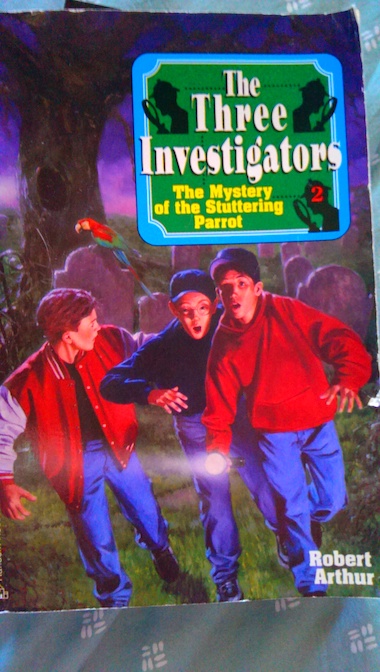
The Mystery of the Stuttering Parrot

The Three Investigators

The Mystery of the Stuttering Parrot by Robert Arthur, 1964, 1992.

Hector Sebastian, a detective who became a mystery writer, has become a mentor to The Three Investigators, and he has asked them to visit a friend of his, Malcolm Fentriss, who is a Shakespearean actor. Mr. Fentriss has lost his parrot and wants help to find it. That seems simple enough, but there’s far more to it than that. When Jupiter and Pete arrive at his house to talk to him about the case, they hear someone calling for help, and a man wielding an old-fashioned pistol marches them into the house. The boys believe that the man is Mr. Fentriss and tell him that Hector Sebastian sent them to help with his missing parrot. Mr. Fentriss reveals that the pistol is actually a decorative cigarette lighter and says that the whole thing was a test of bravery for them that he dreamed up after Hector Sebastian told him that the boys were coming. Unfortunately, he says that he no longer requires their help to find his parrot because the parrot came back, and that’s who they heard calling for help because he taught his bird to say that.

However, as the boys are leaving, Jupiter suddenly realizes that there’s a problem with the man’s story: there are no telephone wires leading to the house! That means that this house has no telephone, so Hector Sebastian couldn’t have called, that man isn’t the owner of this house, and the real Mr. Fentriss must have been the one who really called for help! (This clue marks this book as being earlier than the late 20th century/early 21st century. When I was a kid, people’s phone landlines were already being buried underground instead of strung overhead, and therefore, wouldn’t be easily seen anyway. In my area in the 1980s and 1990s, only the oldest neighborhoods in town still had overhead wires. With the later advent of cell phones, a person wouldn’t need wires to get phone calls at all.) The boys tell their chauffeur to take them back to the house so they can help Mr. Fentriss, and they see the imposter leaving in his car. They consider trying to follow the imposter, but they decide that they’d better see if Mr. Fentriss is alright instead. They find him tied up, and as they free him, they explain who they are and that Hector Sebastian sent them.

Mr. Fentriss tells them that he still wants their help finding his parrot, who is named Billy Shakespeare, after William Shakespeare. He tried to go to the police, but they didn’t want to help, saying that either his bird just flew away or he was making the whole thing up as a publicity stunt for his acting. According to Mr. Fentriss, his bird quotes from Shakespeare, except that he has a tendency to stutter. Instead of saying, “To be or not to be”, he says, “To-to-to be or not to-to-to be.” Jupiter is intrigued at the idea of a stuttering parrot. Mr. Fentriss tells him that he got the parrot from a mysterious Mexican peddler with a donkey cart because another friend also bought a parrot from the peddler. When this friend hear the other parrot quoting from Shakespeare, she thought the Mr. Fentriss would like him and told the peddler to visit Mr. Fentriss. Mr. Fentriss is also sure that Billy didn’t just fly away because both the bird and his cage are missing. Billy disappeared when he was out for a walk, and there were signs that a car had been at the house while he was gone, so Mr. Fentriss thinks that whoever drove the car took the parrot.

When the boys ask Mr. Fentriss about the man who tied him up, he says that the man called himself Claudius and that he claimed to be from the police at first, asking him questions about the missing parrot. In particular, he wanted to know what the bird said and whether or not he knew of anyone else who had bought a bird from the same peddler. Mr. Fentriss told him the bird’s phrase, leaving out the part about the stutter, and about his friend, also mentioning that the peddler also had another bird, a dark-colored one that didn’t seem well. Claudius seemed familiar with the bird, calling it Blackbeard. Claudius attacked him and tied him up when he started getting suspicious that he wasn’t really from the police and they heard the boys approaching. Jupiter promises that The Three Investigators will do their best to find the parrot.

As the boys leave Mr. Fentriss’s house again, they have a strange encounter with a man who has a French accent and asks them if they are friends of Mr. Fentriss and if there’s any news about Billy. The boys say that the bird is still missing, and the man says that he’s a friend of Mr. Fentriss who was just going to visit him to ask about his bird, but if the bird hasn’t been found yet, he won’t bother Mr. Fentriss after all. Jupiter notices that the man driving the Frenchman’s car has a gun holster.

Jupiter and Pete then go to see Mr. Fentriss’s friend, Irma, to ask her about her parrot, Little Bo-Peep, and discover that her bird is missing, too. From a description that Irma gives them of a man who almost knocked her down with his car when she went out to buy birdseed, it sounds like Little Bo-Peep was stolen by the man they know as Claudius. The boys promise Irma that they’ll find her parrot, too.

When Jupiter and Pete meet up with Bob, who wasn’t with them because he had to go to his part time job at the library, they tell him everything that happened. The boys know that they need to track down Claudius, but how are they going to find him again?

This is the book that introduces Jupiter’s idea of the “ghost-to-ghost hookup” (a play on coast-to-coast hookup, which is a term from early radio and television broadcasting). Basically, each of the Three Investigators calls five different friends, asking them to keep an eye out for Claudius and his distinctive car and also asking them to pass on the message to five other friends. It works almost like a chain letter, except that the message is spread by phone. As friends tell other friends, the message spreads across the city, and The Three Investigators promise a reward to the person who can give them the information they seek.

When someone does finally come to them with information, it turns out to be the young nephew of the peddler. The boys learn that the two missing parrots were actually part of a group of seven owned by a mysterious stranger who is now dead. This mysterious stranger, who called himself Mr. Silver, gave the birds colorful names from history and fiction and taught them to talk. Their messages, when combined, lead to something that Mr. Silver hid.

The the newer and older versions of this book are available to borrow and read for free online through Internet Archive.

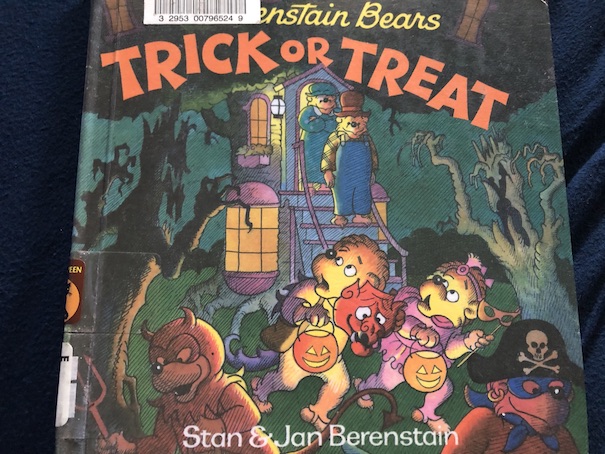
The Berenstain Bears Trick or Treat

The Berenstain Bears

The Berenstain Bears Trick or Treat by Stan and Jan Berenstain, 1989.

“Even little bears
expect a good fright
when they go out for treats
on Halloween night.”

Brother and Sister Bear are looking forward to trick-or-treating on Halloween night with their friends. Sister is going as a ballerina, and Brother is dressed as a monster. When Brother jumps out at Mama in his monster costume, she pretends to be frightened, and when he takes off his mask, Mama comments that “appearances can be deceiving.” Sister asks what that means, and Mama explains that “things aren’t always what they look like.”

This is the first year that Brother and Sister will be allowed to go out trick-or-treating without their parents. They plan to trick-or-treat with friends, and they talk about the houses that they plan to visit. The one house in the neighborhood that they don’t want to visit belongs to Miz McGrizz. Miz McGrizz’s house looks spooky, and the kids think that she might be a witch. Mama tells them that’s nonsense and that Miz McGrizz is a nice person.

As the young bears set out to trick-or-treat with their friends, some of the bigger, tougher cubs in the neighborhood try to talk them into joining them in some pranks. First, they want to decorate Miz McGrizz’s house with toilet paper.

However, before the cubs can do anything, Miz McGrizz comes out of her house, and seeing the cubs, tells them that she’s ready for them. Although the kids are frightened at first, it turns out that Mama really was correct about Miz McGrizz. Miz McGrizz is just a nice old lady who has a special treat for the cubs who are brave enough to visit her house.

In real life, trick-or-treaters shouldn’t go into the houses of people they visit unless they know them very well, but in this case, it’s not so bad because the cubs’ mother approves of Miz McGrizz and would be fine with the children visiting her.

The book is available to borrow and read for free online through Internet Archive (multiple copies).

Corduroy’s Halloween

Corduroy’s Halloween, based on the character created by Don Freeman, pictures by Lisa McCue, 1995.

I’ve seen this book as both a regular picture book and a lift-the-flap book. The basic story is the same either way, and the illustrations are similar in either copy. I just happen to have the lift-the-flap copy. This is one of the Corduroy books where Corduroy lives on his own with his stuffed animal friends and no humans are present in the story.

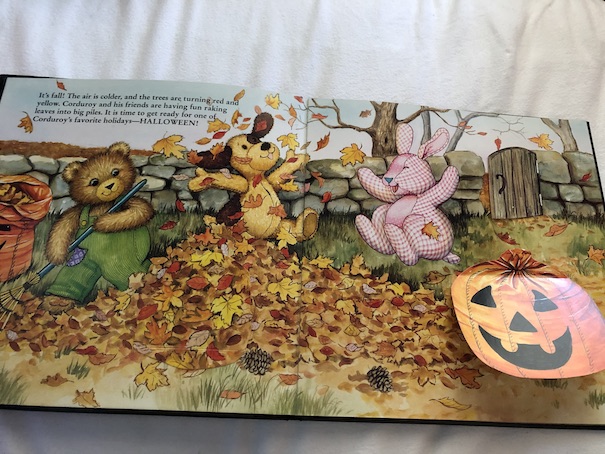
Corduroy and his friends are excited because Halloween is coming! There are many things to do, like raking leaves, choosing pumpkins for jack o’lanterns, and entering a window-painting contest.

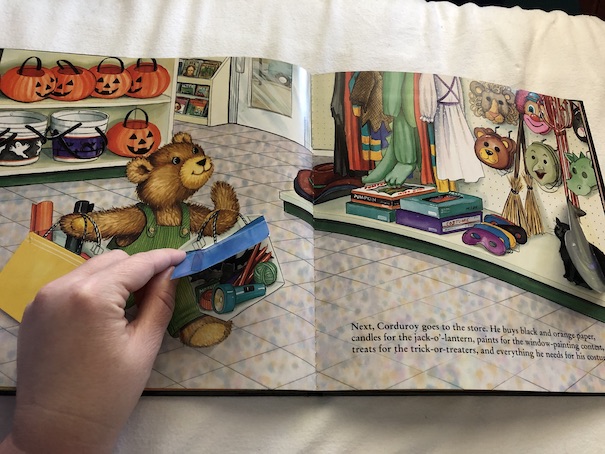
Corduroy shops for the supplies that he will need for his Halloween party.

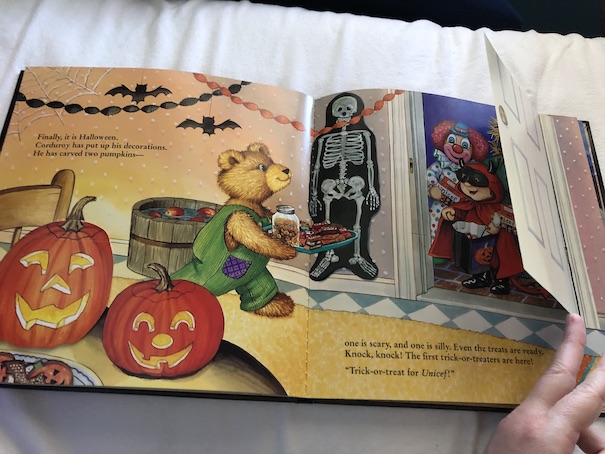
By Halloween night, all of the decorations are up, and Corduroy gets his first trick-or-treaters, including some trick-or-treating for UNICEF.

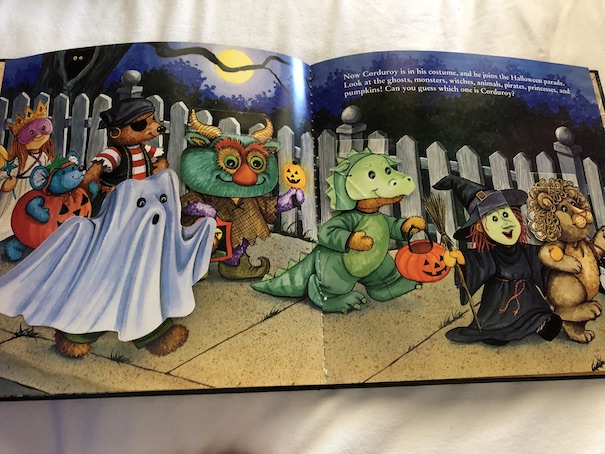
Corduroy and his friends also take part in the Halloween costume parade. In the lift-the-flap copy, you can lift up character’s masks and see their faces. I think that makes this a good book for helping to explain to young children that people in scary costumes are just ordinary people beneath the masks.

Then, they return to Corduroy’s house to have their party and bob for apples. Happy Halloween!

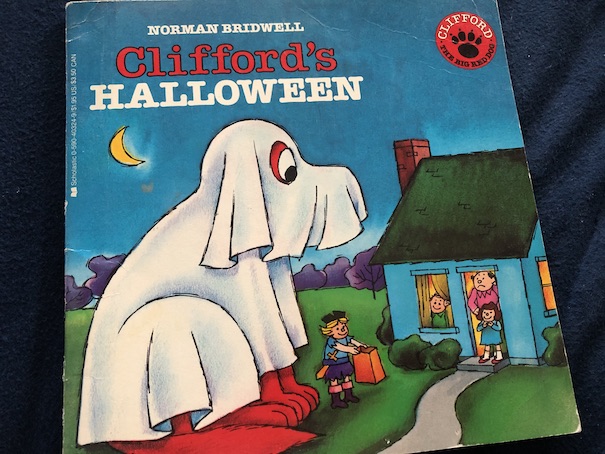
Clifford's Halloween

Clifford

Clifford’s Halloween by Norman Bridwell, 1986.

Halloween is Emily Elizabeth’s favorite holiday! Emily Elizabeth talks about the various holidays that she and Clifford enjoy, but Halloween is the one they enjoy the most.

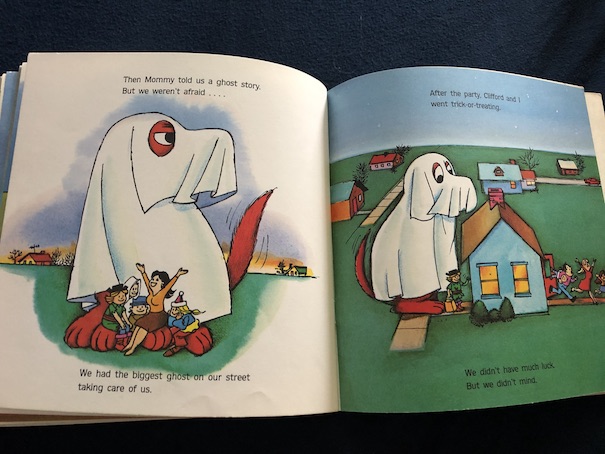
Last Halloween, she considered various costumes for Clifford, but Clifford decided that he wanted to be a ghost, covered with a giant sheet. (I love how they say that nobody could guess who the giant ghost is, like there could be someone else in the neighborhood that big.)

When you’ve got a giant dog, bobbing for apples doesn’t go the way you expect.

However, when you’ve got a giant dog, nothing else is very scary, either.

The book ends with Emily Elizabeth considering different costumes for Clifford for this Halloween, inviting the reader to think of other possible costumes.

I like the idea of letting kids consider which Halloween costumes they like the best from the ones that Emily Elizabeth considers. Kids like making choices, and trying to think of costumes that would work on a gigantic dog presents a creative challenge. When Emily considers dressing Clifford as a knight, they don’t consider where she’s going to get a suit of armor that size, but the books in this series don’t worry much about the logistics of caring for a dog the size of Clifford.

When I first read this book back in the 1980s (I was four years old when the book was new, although I can’t remember exactly how old I was when I first read it), I didn’t think too much about the Indian (Native American) costume with a pipe, although I wouldn’t think of suggesting that as a costume for anyone now. It’s partly because there’s something of a stigma against Native American costumes now. It’s not enough of a stigma to get people to stop wearing them and major costume retailers from selling them, but enough that some people raise eyebrows at them because of some of the connotations attached to them. If you read some of the reviews of Native American costumes on Amazon, like I did, it seems that more of them were purchased for school plays and projects or Thanksgiving plays than for Halloween. However, the part about this costume that particularly jumped out at me was the ceremonial pipe. Kids sometimes dressed as American Indians for Halloween when I was young, although the practice is discouraged now, but with all of the anti-smoking campaigns aimed at children when I was young, most of our parents wouldn’t have even considered giving us a peace pipe as part of a costume, even ignoring the social and cultural implications of that. I think that idea shows the age of the book’s creator. I grew up in the American Southwest, but I didn’t grow up on old western shows where peace pipes were a common feature. I didn’t see those shows until I was older, and by then, they looked pretty cheesy. I think that the book’s author was from the generation that was raised on those westerns and had nostalgic associations with them.

The book is available to borrow for free online through Internet Archive.

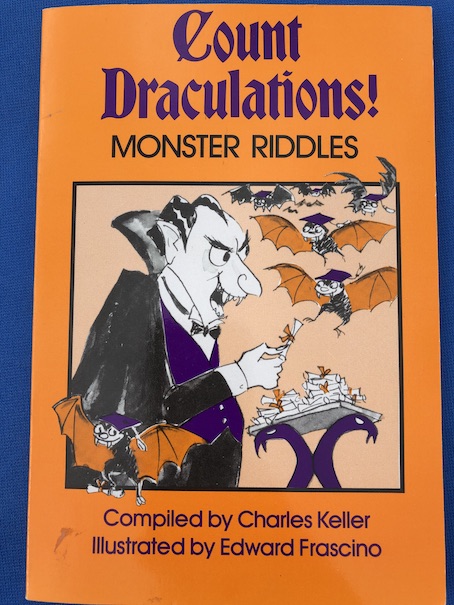
Count Draculations!: Monster Riddles

Count Draculations!: Monster Riddles compiled by Charles Keller, 1986.

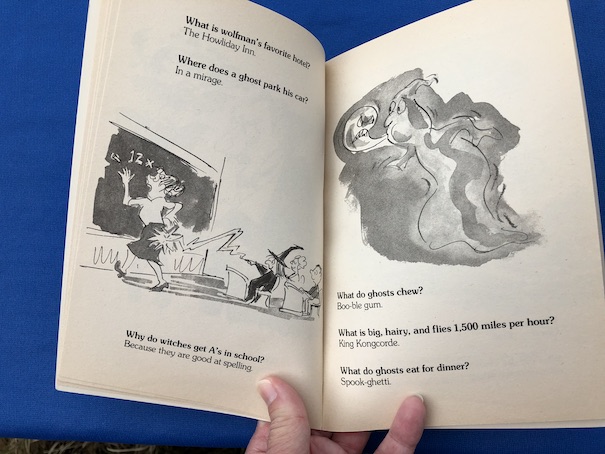
This is one of those themed joke books for kids that has monster and Halloween-themed jokes.  The jokes are the basic kid-friendly question-and-response type with lots of puns.  There are also some cute black-and-white illustrations.

Some of my favorite jokes:

Why do witches get A’s in school?

Because they are good at spelling.

How do you get into a locked cemetery?

With a skeleton key.

Why did Frankenstein’s monster go to the psychiatrist?

He thought he had a screw loose.

Why did the invisible man go crazy?

Out of sight, out of mind.

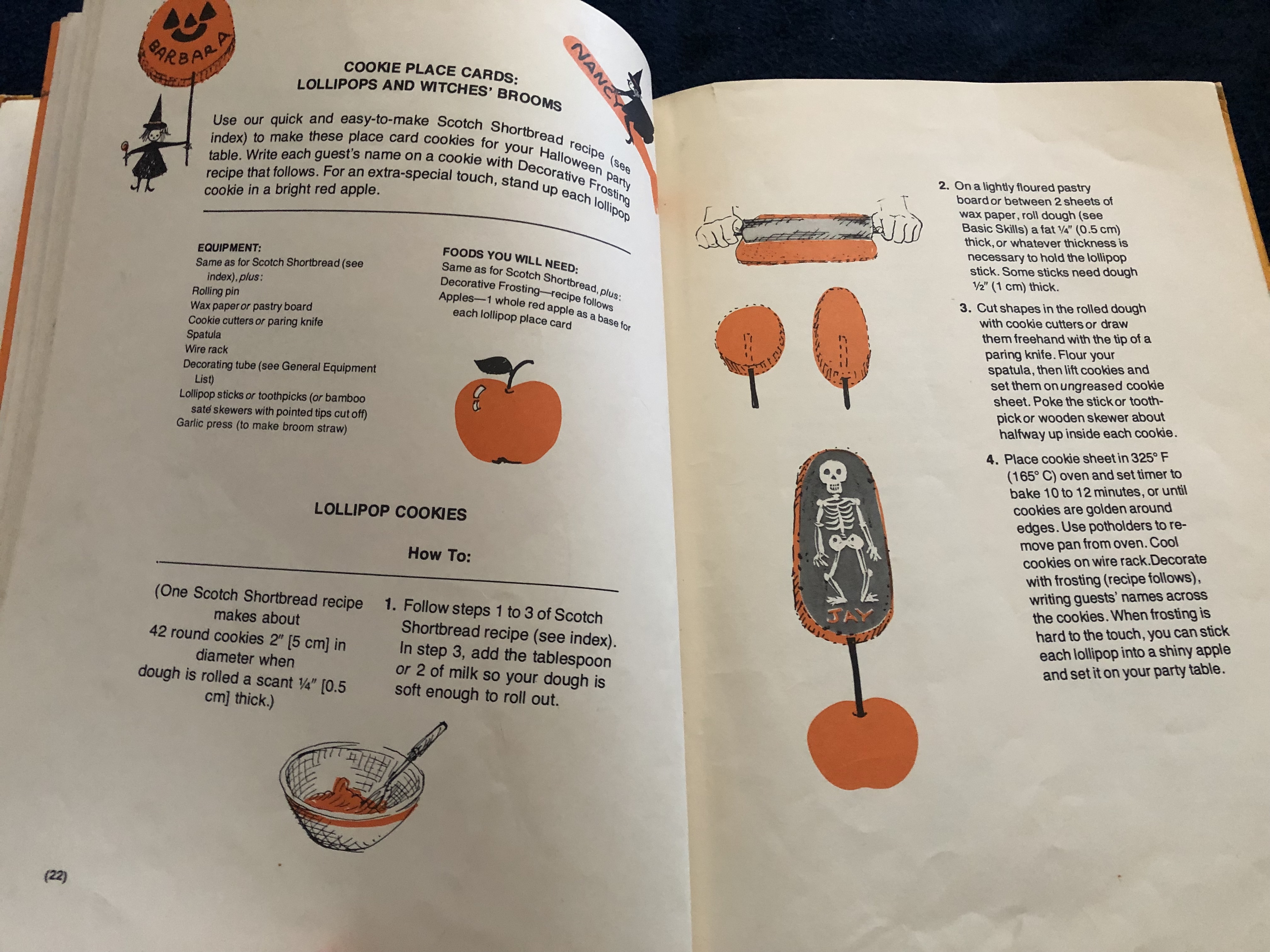
Halloween Cookbook

Halloween Cookbook by Susan Purdy, 1977.

I remember getting this book from my school library when I was a kid. I never actually made anything from it because it was a little beyond my cooking skills. Still, I was fascinated by the recipes in the book, especially the stew inside the pumpkin.

Some recipes in the book use specifically Halloween shapes and colors, while others are more general fall and harvest-themed recipes. The recipes are organized by category with section for food that can also be used as Halloween decorations and other sections for brunch and lunch, vegetable dishes, meat dishes/main courses, and snacks and desserts.

Some of the recipes are old, traditional ones from around the world, such as the ones for Fried Pumpkin Blossoms (an Italian recipe) and the Indonesian Corn Fritters. A brief section at the beginning of each recipe explains a little about the recipe’s background.

In the beginning of the book, there are notes about converting between units of measurement, including converting between imperial and metric units. There is also a guide for converting between Celsius and Fahrenheit temperatures. There are other cooking tips for beginners, such as how to separate eggs (I’ve never done it with my hands, like in the book, but it’s useful to know) and how to chop onions and press garlic.

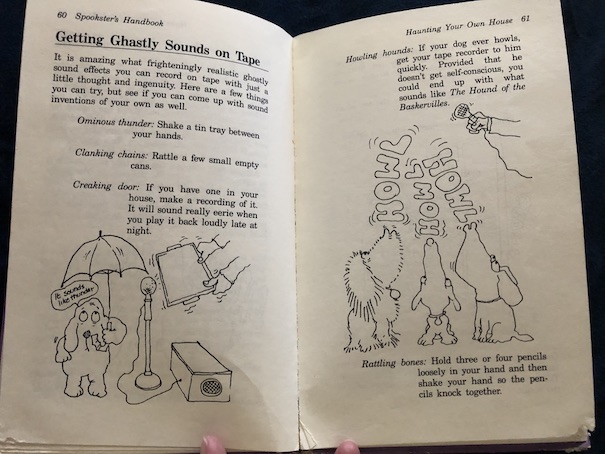
The Spookster’s Handbook

The Spookster’s Handbook by Peter Eldin, 1989.

This is a fun book of jokes and tricks for Halloween or just having some spooky fun with friends, possibly at a sleepover. The book is divided into the following sections:

Making Monsters – How to make costume pieces and turn yourself into a bug-eyed monster, a warty witch, and more! There are also tricks, like making a ghost image appear on a wall, casting a glowing face on someone else’s shadow, and making Bigfoot footprints.

Screamingly Funny – A chapter of ghost jokes.

Ghostly Tricks – Magic tricks that look somewhat ghostly, like making a friend “float” in the air and making magical symbols appear on blank cardboard.

Monster Pranks & Practical Jokes – Tricks that produce ghostly illusions, like how to take ghostly pictures, produce taps with no obvious source, and cause ghostly flashes of light in a dark room.

Haunting Your Own House – Describes typical do-it-yourself haunted house tricks for producing scary noises.

Monster Laughs – A chapter of monster jokes.

Scare Your Friends – Tricks and pranks for spooking your friends with a finger in a box, strange noises, or a glowing skull.

Terrible Trivia – Fun facts about superstitions and telling the future.

Fang-Tastic! – A chapter of jokes about vampires.

My favorite parts of the book are the superstitions and the ways to make scary haunted house noises. I haven’t actually tried the noise tricks yet, but at some point, I’m planning to try a few!

The book is available to borrow and read for free online through Internet Archive.