The Most Wonderful Doll in the World

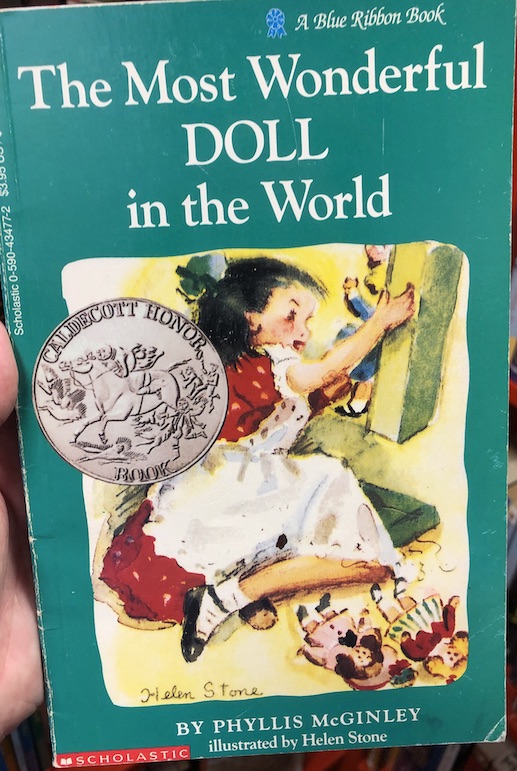
The Most Wonderful Doll in the World by Phyllis McGinley, 1950.

Dulcy is a little girl who is rarely satisfied by anything. She has a big imagination, and is always wishing for something better than what she has. Dulcy has an impressive collection of dolls, but even though she loves all of her dolls, she can’t help but think sometimes that some of them would look better with a different hair color or with different clothes or with some other small detail changed. No matter how good something is, it’s never completely perfect.

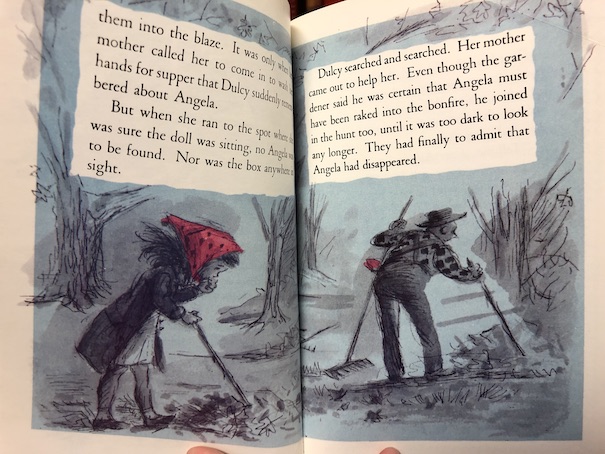
Then, one day, an elderly friend, Mrs. Primrose, gives Dulcy a doll named Angela. Dulcy likes Angela, although her immediate thought is that Angela would be even better if she had dark hair instead of blonde, finding a tiny fault as she always does. But, by accident, Dulcy loses Angela on the way home. She sets Angela’s box down when goes to help rake leaves into a bonfire, and when she goes to retrieve her, she can’t find her.

Once Angela is gone, Dulcy’s attitude changes. Dulcy is upset about the loss of Angela, realizing that Angela really was a precious and special doll. Her mother offers to get a replacement doll that looks like Angela, but Dulcy can’t imagine that any doll would be as special as Angela. As Dulcy describes the doll to her mother, she says that Angela was blonde with a blue dress and pinafore and eyes that could open and close. Those aren’t terribly unusual qualities for a doll, but Dulcy also adds that Angela had shoes with heels and could say “Mama” and “Papa” and sing Rockabye Baby. Those are more unusual, and Dulcy’s mother agrees that she probably won’t be able to find a doll that does all that.

However, readers soon begin to notice that Angela becomes increasingly wonderful each time that Dulcy describes her. When her father offers to buy her another doll, Dulcy adds that Angela could also walk and wave her hand. Dulcy tells her teacher about Angela’s little purse and gloves. She tells her friend Margery about Angela’s raincoat and umbrella.

The more Dulcy thinks about and talks about her wonderful doll, the less satisfied she is with her other dolls. None of them can compare to the amazing Angela! When her Aunt Tabitha gives her a skating doll, suddenly the missing Angela acquires the ability to skate as well. No doll that Dulcy has or ever could have could compare to the missing Angela!

Other children at school are fascinated by Dulcy’s descriptions of Angela and all of the marvelous things Angela had and Angela could do, which get more and more wonderful every time Dulcy tells the story. Then, people start getting tired of hearing about Angela. Dulcy’s friends don’t like hearing that their dolls aren’t as good as Angela, and people stop giving Dulcy dolls as presents because she always says that they’re not as good as Angela.

Then, one day, when Dulcy is playing with a new girl in the neighborhood, they find the box with the missing Angela. When Dulcy sees how the real Angela compares to the one that she dreamed about and imagined when she was lost, Dulcy comes to a greater understanding of the power of her imagination and the need to appreciate things being just the way they are.

Dulcy doesn’t completely give up imagining things and dreaming of perfection, but she does learn that part of growing up is remembering the difference between what she imagines and what is real. She realizes that when she was moping about the doll she didn’t have, she kept herself from having fun with the dolls she did have and discouraged people from giving her other nice dolls. Dulcy saves all the of the amazing qualities that she dreamed of for Angela and gives them to an imaginary doll called Veronica. Dulcy keeps Veronica as her perfect doll in her imagination, and she knows that Veronica is imaginary. As long as she can have her imaginary doll to be as amazing and perfect as she wants, she can be happy with her other dolls being just the way they are, and they make her happy, too.

The book is a Caldecott Medal winner. It is available to borrow for free online through Internet Archive.

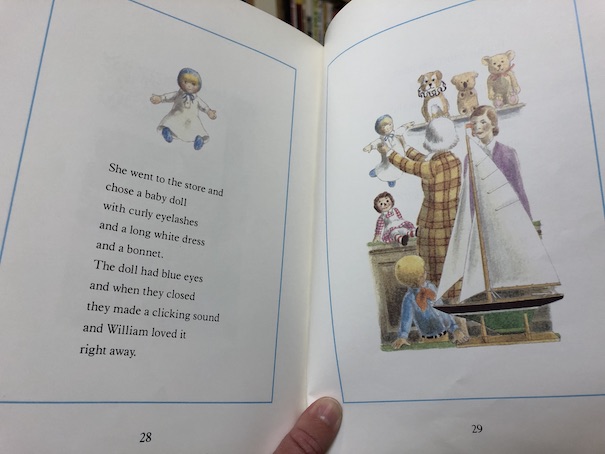
William’s Doll

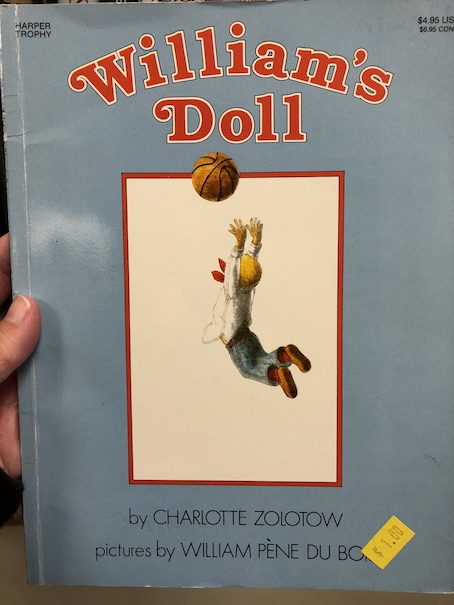
William’s Doll by Charlotte Zolotow, pictures by William Pene du Bois, 1972.

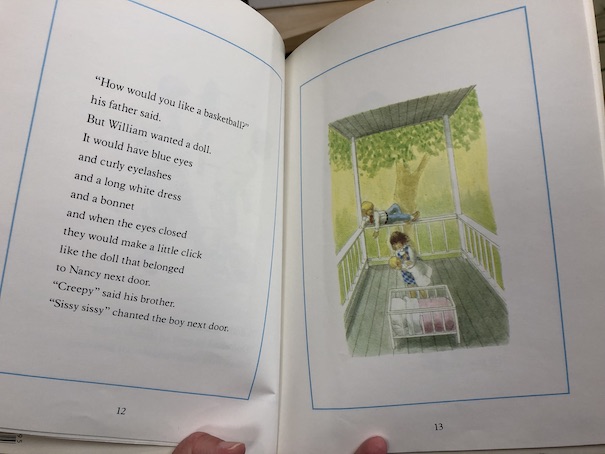
A boy named William wants a doll to play with, like the one the girl next door has.  Other boys make fun of him and think he’s a little strange, calling him a “sissy,” but he likes the idea of having a doll to love that he could treat like it was a real baby.

William’s father buys him toys that boys usually like, like a basketball and a train set.  William likes the train set and gets pretty good at basketball, but he still wants a doll of his own.

When his grandmother comes to visit, William tells her about wanting a doll, and she decides that it’s a good idea and gives him one.  William’s father worries about it, but the grandmother reassures him that there’s nothing to worry about.  William’s desire for a doll is a fatherly instinct, not because he’s a “sissy.”  William likes having something small to love and care for, like a father would for a real baby, and it’s a good thing for a boy to learn the gentleness and responsibility that he would need to know as a future father.

The book is available to borrow and read for free online through Internet Archive.

Further Thoughts and My Opinion

The book has two messages.  First, not everyone feels bound by gender when it comes to the things that they like, and there’s no reason to feel like they should.  Sometimes, people feel pressure to like what their friends like or what society think that they should like and to deny that they like certain things because they’re worried that people will think that they’re weird or uncool, which can be an uncomfortable position to be in.  Speaking as a childless adult who likes, collects, and reviews children’s books, I know how that is.  If it was going to stop me, I wouldn’t have maintained this blog for almost four years, and I wouldn’t have more than 600 books reviewed here, not to mention what’s hanging around my room right now. I’m not even halfway though my personal collection yet.

When you think about it, it does seem kind of unfair that even people who support a little girl’s right to play with traditional boys’ toys, like toy cars, can sometimes get uneasy about the idea of a boy playing with a doll.  People weren’t always so understanding when girls wanted to do “boy” things, like play sports, and there are times when they could be a little more understanding about boys who sometimes want to do “girl” things, too.  Some people might consider cooking to be more of a girl’s hobby than a boy’s hobby, but some of the most famous chefs in the world are men, and what woman wouldn’t be impressed by a boyfriend who can cook a romantic dinner?  People might think that sewing is a girl’s hobby, too, but many professional tailors and leather workers are men as well, and there are some guys who make their own costumes for historical reenactments.  To some people, poetry might sound girly and too sentimental for a boy, but try telling that to Shakespeare, Robert Louis Stevenson (who wrote, among other things, poems for children), Percy Shelley (“Look on my works, ye Mighty, and despair!”), and all of the other famous men who have been authors and poets.  Sometimes, people just aren’t looking at the big picture.  I think that, partly thanks to books like this, people have been loosening up a little on some of the “shoulds” in life – what they think people “should” do or “should” like.

No one in the story says anything about sexual orientation, although that may be part of the father’s worry and possibly the root of the “sissy” accusations. In the story, William is too young to be concerned about sexual relationships, and his wish for a doll has nothing to do with who he might want to date or marry in the future.  He has very specific reasons for wanting a doll, which he explains, and they have nothing to do with sex or romance. I’m not going to speculate about William’s potential orientation because it’s outside of the range of this story, and actually, I think that the story is stronger if his orientation is completely unrelated to his wish for a doll. If the other boys and William’s father think that the doll automatically points to homosexuality, they may be overstepping.  Part of the grandmother’s point is that emotions like love and caring go beyond the idea of sex, and gentleness and nurturing qualities are good things to encourage.  Also, William’s efforts to stand up for what he wants, even knowing that others don’t agree with him, could be seen as a first step to becoming his own man.  Who’s really more of a “sissy,” the guy who lets his friends lead him around by the nose and tell him what to think because he’s scared of being called a “sissy,” or the guy who will stand up and defend his baby, taking care of it no matter what?

The grandmother’s explanation leads to what I think is the second message, that having gentle, loving, and nurturing qualities doesn’t make a boy less of a boy or, by extension, a man less of a man.  These are human emotions, and all humans have some desire for these feelings.  These are the feelings that real relationships are built on: closeness, gentleness, and nurturing. These are qualities that women look for in husbands.  These are also qualities that make a man a good father, which is ultimately what William wants to be when he grows up.  Children have male parents as well as female parents, and it’s fine for William to want to be a good parent someday.

We don’t know, at the end of the story, how long William’s interest in the doll will last.  Children sometimes go through phases where they’re really interested in something, and a few months later (maybe sooner, depending on the kid’s attention span), they put it aside when something new comes along.  William is trying out a concept in his life, which is a large part of growing up, and once he’s tried it out, he may either build on it or move on to other things.  Given William’s interests and character, I think he will probably remember the feelings he’s had and the lessons he’s learned even after he puts the doll aside.  When he’s a little older, perhaps he’ll earn some extra money by babysitting younger kids in the neighborhood.  Maybe he’ll combine his varied interests and end up coaching a kids’ basketball class at the local community center.  He might end up being a teacher as well as a father, since he likes the idea of nurturing young children.

People who grew up in the 1970s may remember the story of William’s Doll from the cartoon and song on Free to Be… You and Me.  There was also a short live action film of the story. In the live action film, it was a grandfather who bought William a doll, and the grandfather reminds the father that he also had a doll for awhile when he was small, reminding him that children grow and change, and this phase in William’s life is just part of his path of growing up. The short film was later parodied on Rifftrax.

Blueberries for Sal

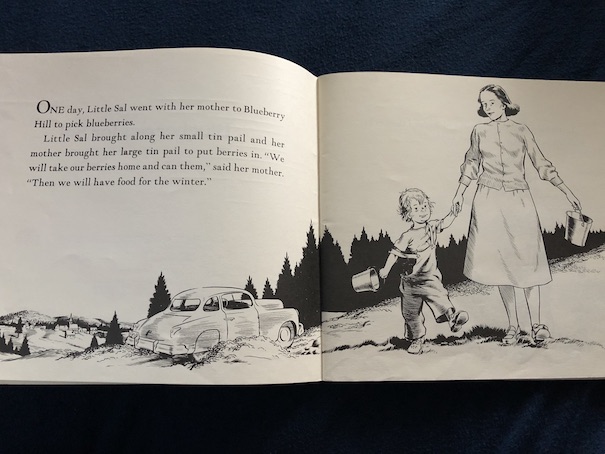
Blueberries for Sal by Robert McCloskey, 1948.

Sal is a little girl whose mother takes her to pick blueberries one day. The mother wants to can the blueberries for winter.

Sal gives in to temptation and eats the blueberries as she picks them.

Meanwhile, a mother bear and her baby come to eat blueberries.

Both Sal and the Little Bear lose sight of their mothers, and when they go looking for them, Sal accidentally finds the mother bear, and the little bear accidentally finds Sal’s mother.

Eventually, the mother bear realizes that Sal is following her when she hears the blueberries plunking into Sal’s pail. Sal’s mother realizes that a small bear is following her when he eats blueberries out of her pail.

Fortunately, nothing bad happens. The mothers just look around for their respective children and figure out where they are by the sounds they make. Then, the mother bear leaves with her baby, and Sal and her mother take their blueberries home.

At first, I was worried about Sal being with the mother bear and how Sal’s mother would react to the mother bear when she saw it, but the two mothers never meet in the story, and the children are fine.

The book is a Caldecott Honor Book. It is available to borrow for free online through Internet Archive (multiple copies).

Harold and the Purple Crayon

Harold and the Purple Crayon by Crockett Johnson, 1955.

Harold loves drawing things with his purple crayon. In fact, everything in the story is a creation of Harold’s, drawn with his purple crayon.

First, Harold decides that he wants to go for a walk in the moonlight. He draws a moon and a path that he can follow.

Along the way, he decides to draw a forest with an apple tree. However, he makes the mistake of drawing a dragon to guard the tree, and it frightens him.

Harold’s hand shakes, and he accidentally draws water and falls in. Fortunately, he also draws a boat and sails to a beach where he can have a picnic lunch.

After a series of adventures, Harold decides that he wants to go home, but he has trouble finding his home. He looks for his bedroom window, and then realizes that his window should look out on the moon, which is still in the sky.

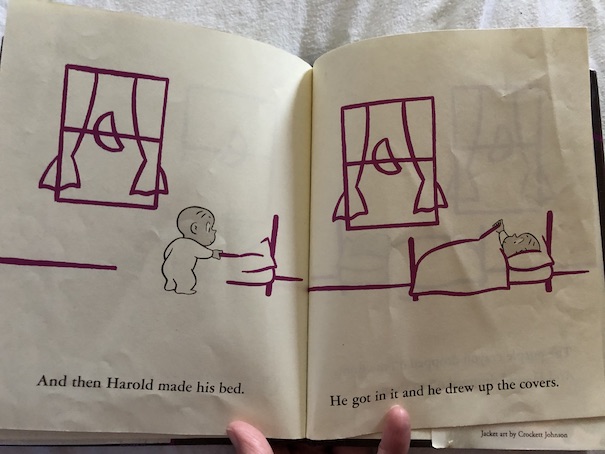
After drawing his window and bed, Harold goes to sleep.

The story is rather surreal. We never see Harold’s real home or any other people who are not drawn by Harold. All we see in the story is Harold and the things he draws with his purple crayon. This is a story about the power of imagination, and at the end, we can only imagine Harold’s real life because we never see him return to it.

The book is available to borrow for free online through Internet Archive (multiple copies).

Where the Wild Things Are

Where the Wild Things Are by Maurice Sendak, 1963.

One evening, Max puts on his wolf costume and starts causing trouble all over the house. His mother calls him a “wild thing” and sends him to bed early without supper.

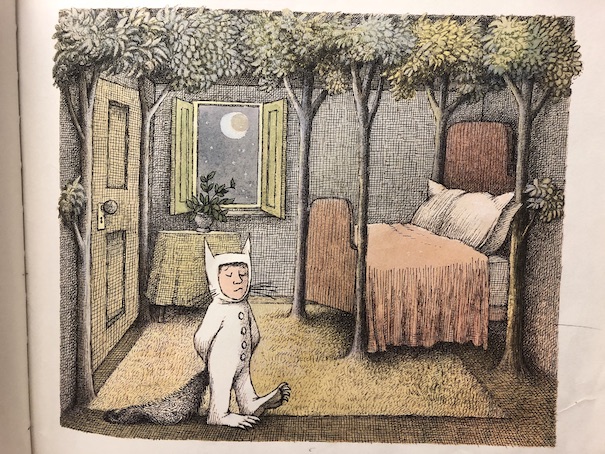
As Max mopes in his room, a forest grows around him, and Max climbs into a boat and sails away.

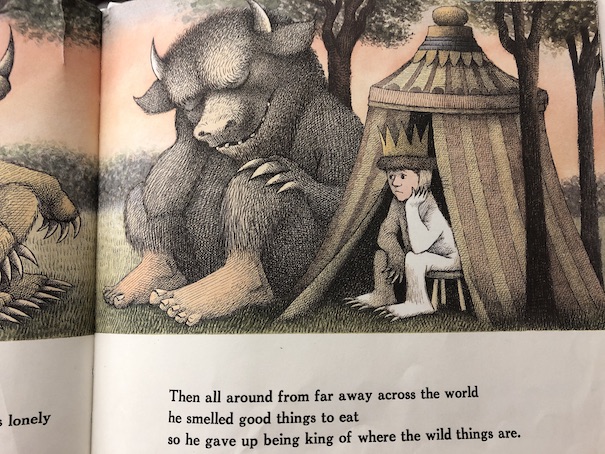
Max eventually arrives at “the place where the wild things are.” There are all kinds of wild beasts and monsters there, and they make Max their king because he’s the wildest of them all.

After they all go parading about and swinging from trees, Max sends all the wild things to bed and is lonely because he wants to be with someone who loves him.

So, Max sails home again to have his supper, which is waiting for him, still hot.

Max’s magical journey is in his own head. Angry and hurt at being told off for his behavior, he imagined himself far away from where he was being punished, in a place where he could act any way he wanted and tell other people what to do. But, that wasn’t satisfying because what he really wants is to be loved and cared for. Wild monsters don’t get the kind of nurturing that small human boys get from their mothers, so there are benefits to being a civilized human. This is a classic children’s book about the power of a child’s imagination and how love and human feeling wins out over anger.

The book is a Caldecott Medal Winner. It’s available online through Internet Archive.

Detective McGruff Sniffs Out a Thief

Detective McGruff Sniffs Out a Thief by Megan Durand, illustrated by John Sullivan, 1983.

Sniffy books, or scratch-and-sniff books, were popular during my early childhood in the 1980s, and they are still being made today. Scratch-and-sniff books are picture books with special patches that release a scent when they’re scratched. Kids like interactive books, so it can be fun for them to scratch a flower or some food in a picture and then smell it. I know from my old books that these scented patches eventually wear out, although I’m amazed that some of them still have a scent more than 30 years after the books were originally made. I had expected that the ones that my brother and I liked and scratched the most would be the ones that would eventually wear out the fasted, but it also depends on the strength of the original scent. The milder, more subtle scents are often more difficult to smell decades later. Scratching a little harder can sometimes help. This picture book is a mystery story, and I thought that it was clever, using the sniffy patches as part of the mystery story.

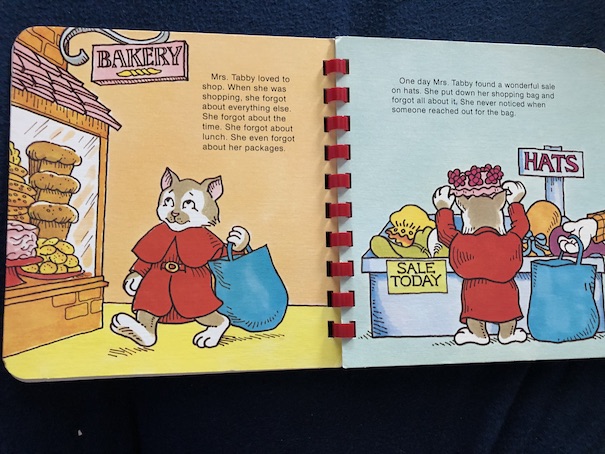
Mrs. Tabby loves shopping, but she often forgets to pay attention to her purchases while she’s looking at other things. One day, someone steals her shopping bag while she’s trying on hats at a sale. It’s terrible because the bag contained the chocolate cake for her son’s birthday.

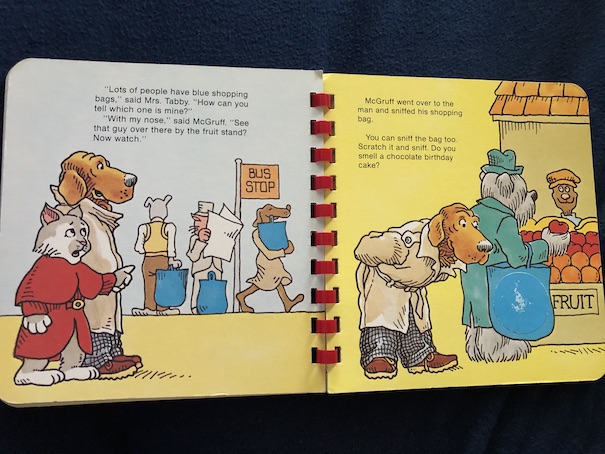
Fortunately, Detective McGruff is nearby when Mrs. Tabby realizes that her bag is missing. Unfortunately, finding it isn’t going to be easy because many people are carrying blue shopping bags that look like hers. Mrs. Tabby isn’t sure what to do, but McGruff decides to use his nose to sniff out the correct bag.

McGruff approaches various shoppers and gives their bags a sniff. All of the bags look alike, but readers can scratch and sniff the special patches on each bag and try to guess what they contain before McGruff reveals the truth.

After sniffing several bags, McGruff eventually locates the one that smells like chocolate and finds the cake. But, curing Mrs. Taffy of being forgetful is another matter.

Detective McGruff, or McGruff the Crime Dog, was created in the early 1980s as a mascot for anti-crime messages from U.S. police and law enforcement agencies through the National Crime Prevention Council, including anti-drug messages and information related to the issue of child abduction. Sometimes, police use McGruff costumes when visiting schoolchildren to talk to them about crime.

Peter Rabbit's Sniffy Adventure

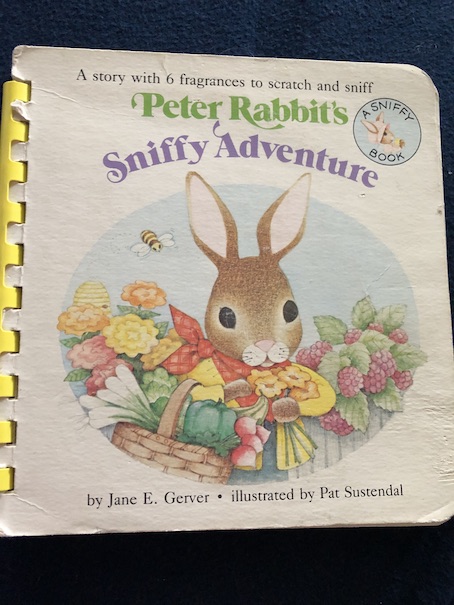
Peter Rabbit’s Sniffy Adventure by Jane E. Gerver, illustrated by Pat Sutendal, 1984.

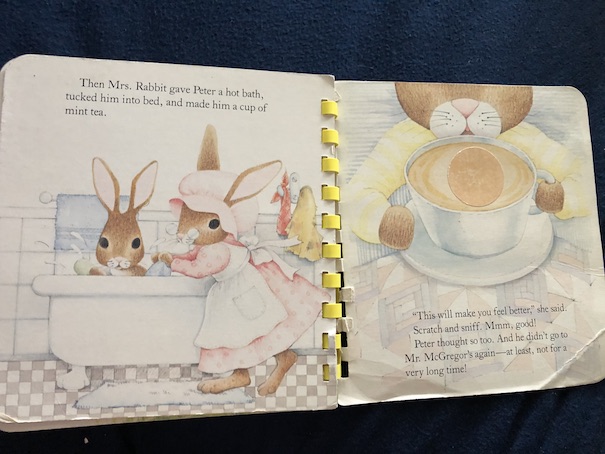
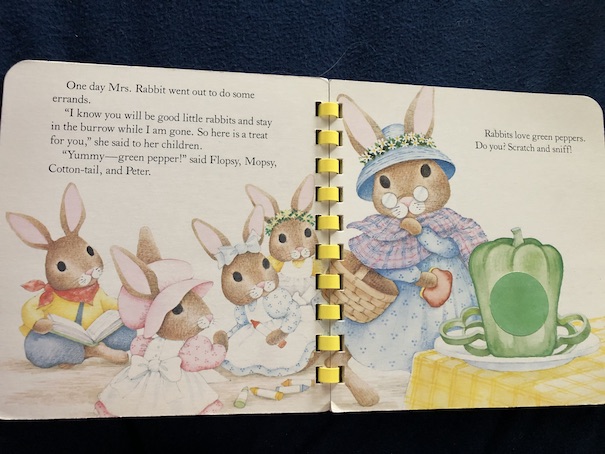
Sniffy books, or scratch-and-sniff books, were popular during my early childhood in the 1980s, and they are still being made today. Scratch-and-sniff books are picture books with special patches that release a scent when they’re scratched. Kids like interactive books, so it can be fun for them to scratch a flower or some food in a picture and then smell it. I know from my old books that these scented patches eventually wear out, although I’m amazed that some of them still have a scent more than 30 years after the books were originally made. I had expected that the ones that my brother and I liked and scratched the most would be the ones that would eventually wear out the fasted, but it also depends on the strength of the original scent. The milder, more subtle scents are often more difficult to smell decades later. Scratching a little harder can sometimes help. If you look carefully at the pictures of our old book, you can see where the round scent patches are on the illustrations.

This book is based on The Tale of Peter Rabbit by Beatrix Potter. It’s meant as a continuation of Peter Rabbit’s adventures.

Peter Rabbit lives with his mother and three sisters. One day, Mrs. Rabbit leaves her children alone while she goes to run some errands, giving them a green pepper to eat while she’s gone.

Then, Peter’s cousin, Benjamin comes by and asks Peter to come with him and visit Mr. McGregor’s garden. Peter is reluctant to go because of the trouble that he got into the last time, but Benjamin finally persuades him to come.

In Mr. McGregor’s garden, the bunnies eat raspberries, get into a sawdust pile, and stop to pick some flowers. Peter’s clothes become more dirty, stained, and torn through their adventures.
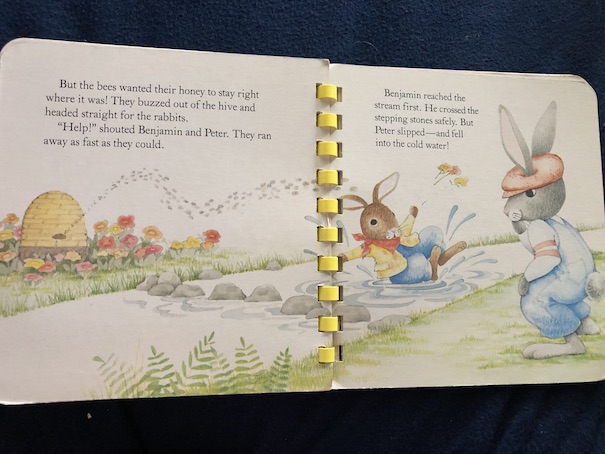
Then, Benjamin spots a beehive and suggests that they get some honeycomb to take home. They end up angering the bees, and Peter falls in a stream as they run away.

When he returns home, Peter is a mess, and he apologizes to his mother for going to Mr. McGregor’s, promising not to do it again. His mother gives him a bath and puts him to bed with a cup of mint tea.

Egg in the Hole Book

Egg in the Hole Book by Richard Scarry, 1967.

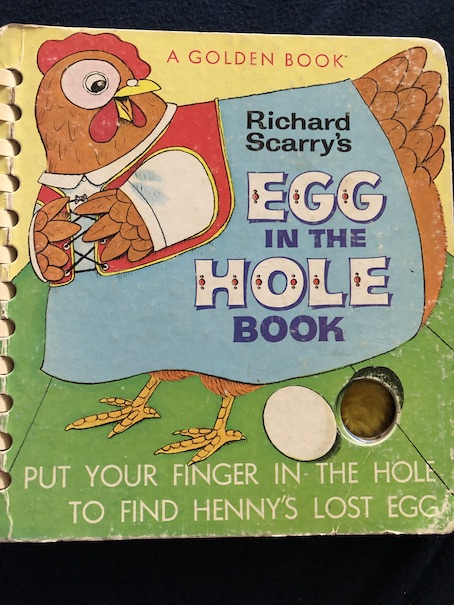
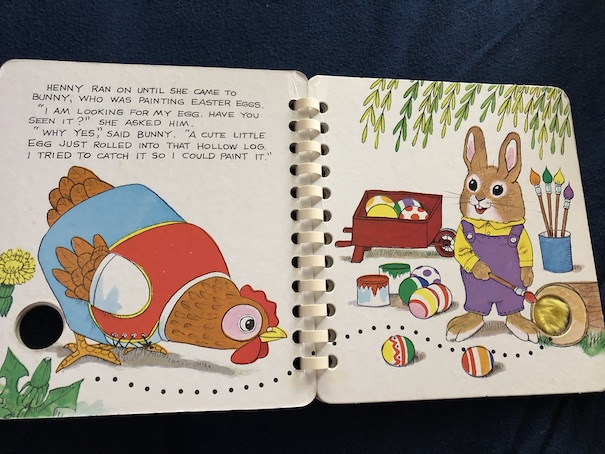
This is a board book with a very special feature: a hole that goes all the way through the pages to the back of the book. There is something yellow, soft, and fuzzy in the hole, and it becomes obvious as you read the book what it is.

Henny lays an egg in the barn’s hayloft, but she loses it when it rolls through a hole. The anxious chicken immediately chases after it.

Down below, Billy Goat tells her that the egg fell on the ice cream that he was going to eat for dessert and then rolled out the window.

From there, Henny follows the egg’s path along a rain gutter, out a down spout, through a fence, into a hollow log, and eventually, into a hole in the ground.

When Henny fears that her egg is lost in the hole, a mouse comes out to tell her that the egg broke, but it has hatched into Henny’s new baby chick! (The yellow, soft, fuzzy thing.)

My brother and I used to like this book when we were little kids. I think of it as a kind of Easter story because of the bunny painting Easter Eggs, although the book isn’t really about Easter. Baby chicks are also often associated with Easter. It’s cute how the egg’s path is marked by little dots as it rolls across the barnyard, and the gimmick with the holes in the pages is clever.

The book is available to borrow and read for free online through Internet Archive (multiple copies). Of course, you can’t quite enjoy the effect of the hole feature with the electronic copies.

The Sleepy Puppy

The Sleepy Puppy by Mary Jo Chamberlin, illustrated by Florence Sarah Winship, 1961.

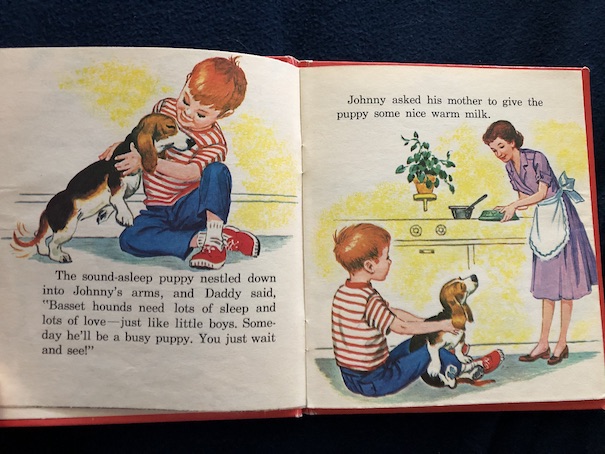
Johnny’s father brings a new basset hound puppy home to his son. Johnny is excited about his new dog, but the puppy is sound asleep. Johnny’s father tells him that puppies are like small children, that they need sleep and love, and when they grow bigger, they’ll be more active. Johnny has to be patient and let his puppy grow.

The puppy falls asleep in his dinner and on the grass outside when Johnny takes him out to play. The puppy seems to be able to sleep through anything, and Johnny wonders if the dog will ever be able to do more than sleep.

On the Fourth of July, Johnny tries to get his dog to pull a little cart in the pet parade, but Johnny ends up having to pull the cart with his dog on it instead.

Then, one day, Johnny’s puppy wakes Johnny because he wants to play. Suddenly, Johnny’s dog is full of energy, and Johnny can play with him!

The book is available to borrow and read for free online through Internet Archive.

My Reaction

I loved this book when I was a little kid, and I think it has a good lesson for young children about caring for pets. Animals, especially young ones, do require patience and time to grow, just like human children do. Johnny is bound to also learn that they also require some training once they get active, but there’s time for that, and that’s been the subject of other children’s books.

Things to Do During Coronavirus

People are cooped up in their homes as communities around the world quarantine in an effort to slow the progress of the virus, both to prevent hospitals from becoming overrun with too many victims at once (although that’s happening already in some places) and in the hopes of a vaccine to prevent further illnesses (vaccines are being developed and tested in multiple locations, but from what I’ve heard, they aren’t likely to be widely available until sometime next year).

Personally, I’m been in something of an odd situation from the very beginning. Not odd in the sense that my life has changed weirdly. I mean odd in the sense that it hasn’t changed much at all. I take online classes, I work on personal websites and blogs, I volunteer for a local organization that helps teachers, but all of those activities involve my computer. Even my volunteer work is often done remotely. Basically, I’m accustomed to spending a lot of time in front of my computer or reading books. Now, I’m still sitting in front of my computer and reading books. Although my direct contact with the outside world (beyond the internet and my communications with friends in other places) is minimal, basically only what I need to do in order to get supplies and walk my dog, I still worry that I could end up getting the virus in spite of my precautions, but that’s the risk we all take, and others are in far more danger than I am right now. I learned a long time ago that it just isn’t possible to control everything that happens in your life, and I’ve arranged everything I can control as best I can, which is about as much as anybody can do right now.

I like to consider wider events in terms of terms of the books I’ve been reading. I talked about the coronavirus a bit in my reviews of Charlotte Sometimes (which takes place partly during the 1918 influenza pandemic, and I did that review before I knew that we were headed into a new pandemic) and Will It Be Okay? (which I couldn’t get pictures for because the local libraries are closed, but you can still read it online). So, I’ll be starting to cover some children’s activity books and adding some resources for helping people to carrying out the activities in the books. However, after some thought, I’ve decided to go further and create a list of resources, including websites and videos, not just books and sources of reading material, to help people keep busy while they’re sheltering at home during the pandemic.

I don’t really mind spending extended periods of time at home because I actually have many interests and hobbies, not to mention all the books I still want to read, and I never get enough time to do everything I want to do. I’m also a definite introvert, so a lot of what’s important to me happens in my head, and I appreciate relatively uninterrupted periods when I can develop ideas that I’ve been toying with in odd moments. Of course, this also often leads to more projects and hobby concepts than I will ever actually do. The more I read and think about stuff, the more things I think of that I want to try. It’s a vicious cycle. I don’t get bored very often; I get boggled, trying to decide what to work on next. So, for the benefit of those who don’t go through this process, I’m going to present a bunch of random ideas for things you can do at home that don’t require any usual materials or any particular skill. In fact, I’ve decided to start a new blog with some of my ideas.

In the meantime, here are a few things to help you stave off the boredom. I’ve grouped them by subject, and I’ve made notes about books that relate to some of them. Most of these activities are child-friendly, but not exclusively so. These are things that adults can do as well.

Places to Read Books for Free Online

All or most public libraries offer books online these days (provided that you have a card for that library), and Amazon offers some free public domain books for Kindle. However, there are other places where you can find books that you can simply read in your browser, some of which also have audio. I have a list of places where you can read books for free online on my Resources page. I’ll reprint the list here for easy reference:

Internet Archive

“A non-profit library of millions of free books, movies, software, music, websites, and more.”  It’s free to use, but it requires you to sign up for an account.  It has more than just public domain books.  Various organizations, such as libraries and book-selling companies, have donated scanned copies of many books and also various audio recordings, some software (such as old computer games), and other materials.  There is even help for users with print disabilities.  Patrons may borrow up to 5 items at a time, and books can be borrowed for up to 14 days, with the option to renew. When your time is up, the book simply disappears from your list of loans, so there are no late fees. You can also turn in books early if you’re done with them and want to get something else.  Patrons can also place holds on books which are currently being loaned.

Project Gutenberg

Provides free e-books of books that are in the public domain.  Some of the older vintage series described on my site are here. There is no need to sign up for an account. E-books are available in multiple formats.

Internet Sacred Text Archive

This is a collection of public domain works, especially those about religion and folklore. Most of it isn’t for children, but some of the folktales and fairy tales overlap with children’s literature. For example, they have a complete collection of the Lang Fairy Books (also known as the Color Fairy Books because of the titles). There is no need to sign up for an account, you can simply read the texts in the page.

Lit2Go

An online collection of public domain works by the University of South Florida. The description on the main page states:

“Lit2Go is a free online collection of stories and poems in Mp3 (audiobook) format. An abstract, citation, playing time, and word count are given for each of the passages. Many of the passages also have a related reading strategy identified. Each reading passage can also be downloaded as a PDF and printed for use as a read-along or as supplemental reading material for your classroom. “

The collection contains more than children’s literature and is free for the public to use. You can listen to the audio version of a book while reading the text version of a book in your browser at the same time. You can search for books by author, title, genre (broad categories such as mystery, adventure, fantasy, and horror), collection (shows specific topics such as African-American Literature, The Princess Collection for stories about princesses, or specific series such as the Oz books or the Lang Fairy Books), or reading difficulty according to the Flesch-Kincaid grade level system.

Writing for Fun

Writing can be a lot of fun, and writing really well requires practice and skill. However, you don’t have to be Shakespeare or Dickens to have fun with writing. Don’t worry about being a great writer, especially if you’re new to it. If you write at all, you’re a writer. The best way to learn is just to keep doing it and see what works and what doesn’t. Think of your craziest ideas and just get them out there! Put them on paper or on your computer

When you’ve written something that you want to share with other people, you could get a free online blog, possibly through WordPress (like my blog) or Blogger (through Gmail). There are also special sites to submit your writing online where it can be read by the public, reviewed, or sometimes, entered in contests.

Fanfiction.net – Exclusively for fan fiction. This means that people write their own stories based on characters and worlds that already exist in books, movies, tv series, and video games. Free to use, but requires you to set up an account.

Fictionpress.net – This is for original fiction, using original characters. Free to use, but requires you to set up an account.

Inkitt – Accepts a wide range of fiction, holds contests, and offers publishing deals for stories that get a lot of positive attention.

Writing When You Don’t Know What to Write About

Don’t worry about coming with a great idea, just start writing about something, anything, and see where it takes you. Good writing is creative and shows a strong voice, so you can start with a very basic topic and just allow your personality or your characters’ personalities to carry it from there.

Fan Fiction

If you don’t want to take the time to build characters or worlds for them right now, you could start by writing some fan fiction, which involves taking characters and situations from already-existing fiction and putting your own twists on them. For example, you could make up a new situation to happen on the Enterprise from Star Trek or a fictional planet for characters from Star Wars to visit. You could write a story that could happen to the characters from Harry Potter that occurs between their established adventures in the books, or you could play “what if” and write about how things could have gone differently if something from the original stories changed. For example, suppose that Harry’s father survived, even though his mother died protecting him? Or vice versa?

Imaginary Vacation

Travel for fun isn’t a particularly good idea right now because of the coronavirus, but I remember reading an article a long time ago about how planning a vacation can be very stress relieving, even if you don’t actually go. (I’d put the link there, but it was so long ago that I can’t remember where it was.) It’s a kind of mental vacation. In a way, I think mental vacations can be even better than actual vacations because you don’t have to worry about staying within your own personal budget, making your travel connections on time, or the availability of tickets and hotel reservation.

Just pick a destination and look up local sites and hotels. Plan an itinerary for yourself, and look up YouTube videos of sites in the area to get an idea of what they actually look like in person. Look up the history of the area for local flavor. You can even plan meals at the best restaurants in the area, whether you could normally afford to eat there or not.

You can expand on your dream vacation by turning it into a story, writing in romance or intrigue, or just file it all away as a vacation you’ll take some day, when you can.

Writing When You’re Just Really Bad at Writing

Don’t let that stop you. When you can’t write well, writing badly, and have fun doing it! As I said, you don’t have to be a great writer, you just need to keep on doing it, and that’s how you get better. Besides, if you think you’re just really awful at writing, have I got a writing contest for you! I just have one question: Can you be really bad at writing on purpose?

The Bulwer-Lytton Fiction Contest appeals to me not just because I like writing but because the aim of this contest is to write badly.  Specifically, you have to pretend that you are writing the first sentence to a very badly-written book, and the winner is the worst one.  There are quite a lot of contenders, which is how they have been able to publish books full of past entries. I covered one of these books on my other book blog.  The namesake of the contest is Edward George Bulwer-Lytton, who has sometimes been credited with originating the hackneyed opening line “It was a dark and stormy night …” (although that expression had actually been around before Bulwer-Lytton used it).  This line was the inspiration for the contest and is part of the title of each compilation of past entries. Anybody can enter the contest, and you can submit as many horrible opening lines as you want. The only requirement is that your entries have to be one single sentence, but it can be a very long run-on sentence. I entered this contest myself about six times last year but didn’t win, which means that I’m either not bad enough at writing to win or not good enough to make myself sound really horrible on purpose. It’s a toss-up.

For inspiration, you can read past winning entries online. They’re pretty entertaining, and it’s fun to imagine what the rest of those stories would be like.

If All Else Fails

Write about your experiences during the coronavirus, even if it’s just a rant about your worries and the inconveniences of getting groceries and household supplies or staying at home with family members who drive you crazy. You’re living through a major historical event that is affecting the entire world right now. What you have to say about it will be of interest to people later, and if nothing else, getting your thoughts out will do you some good. If you need someone to rant to, go ahead and comment below. I rant regularly when I feel the need, and I don’t mind airing a few rants from others.