Samantha’s Surprise

American Girls

Samantha’s Surprise by Maxine Rose Schur, 1986.

This is part of the Samantha, An American Girl series.

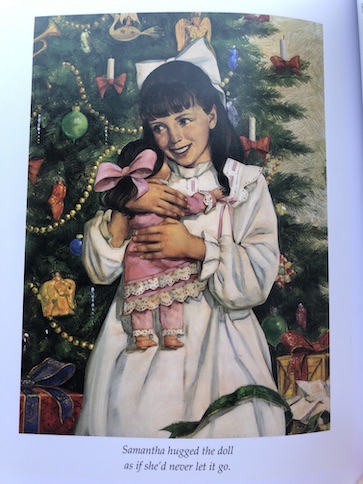
Christmas is going to be different this year for Samantha and her family. Uncle Gard is bringing his girlfriend, Cornelia, to spend the holidays with them. Christmas had started out so hopeful for Samantha, with an invitation to a friend’s Christmas party, elaborate plans for building a gingerbread house, and the secret presents that Samantha has been making for everyone. Cornelia’s visit changes Samantha’s plans.

For Samantha, Cornelia’s visit makes Christmas more difficult. At first, she says that she will help make Cornelia feel welcome and thinks to herself that she will have to get a present for Cornelia that is as elegant as she is. However, when Samantha tries to put up the usual homemade decorations that she made herself, the maid angrily takes them down, calling them “dustcatchers.” The house must be perfect for Cornelia’s visit, and Samantha is insulted that people see her decorations as an eyesore or inconvenience. The cook, who was going to help Samantha with her gingerbread house, says that there probably won’t be time for it now because her grandmother has asked her to make extra, special foods for Cornelia’s visit. Grandmary even tells Samantha that it would be better for Samantha to “stay out of the way” of their Christmas preparations.

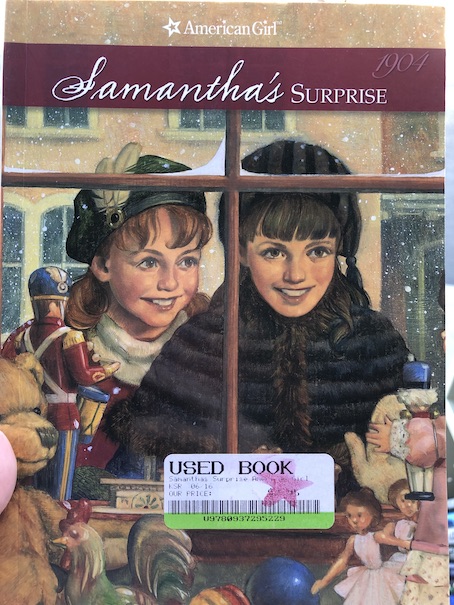
With Cornelia coming, no one seems to notice or care about Samantha. Samantha finds out that she won’t be able to attend her friend’s party because it is the night that Cornelia is arriving. It doesn’t seem likely that her grandmother will care about her secret Christmas wish for the beautiful Nutcracker doll in the toy store window. Samantha has been without a doll since she gave her own beloved doll, Lydia, to Nellie, who had never owned a doll before. Cornelia is an extra person Samantha needs to supply a present for, but she can’t summon up any enthusiasm for giving a present for someone who is making things so difficult for her.

Throughout the book, Samantha considers different presents that she could give to Cornelia, beginning with the most basic, convenient token gifts that she could give and then forget about, unlike her homemade, heart-felt gifts for everyone else. However, Samantha’s attitudes toward Cornelia change as she gets to know her better during the holidays and comes to see her as a source of fun and support.

When Cornelia actually arrives and begins participating in the usual Christmas activities, Samantha sees that she is far less fussy than the people who were preparing for her arrival. Unlike most other grown-ups, Cornelia is not too dignified to have fun while sledding or get messy while making gingerbread houses. Cornelia even suggests sledding, to Grandmary’s surprise. Cornelia always mentions how nice it would be to decorate a gingerbread house, like she did when she was a girl, Samantha says that she would like that too, but the cook is too busy to help this year. Cornelia says that is no problem because she and Samantha can make the gingerbread house themselves. Cornelia even makes sure that some of the decorations that Samantha made are prominently displayed on the Christmas tree.

By the end of the book, Samantha changes her mind about Cornelia completely. While everyone else seemed to be ignoring Samantha and going out of their way to make Cornelia feel welcome, Cornelia was paying more attention to Samantha and really thinking about what would make Samantha happy at Christmas. Cornelia is the one who correctly guesses what Samantha would really like for Christmas, and in return, Samantha decides to give her best present to Cornelia.

The story ends with Uncle Gard officially engaged to Cornelia.

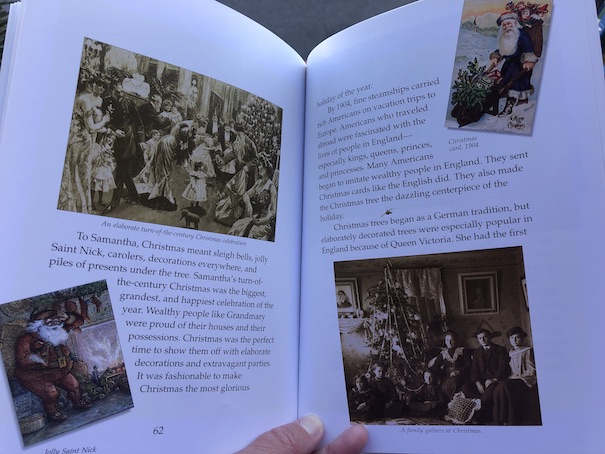
In the back of the book, there is a section with historical information about how people would celebrate Christmas during the early 1900s.

The book is currently available to borrow for free online through Internet Archive.

Happy Birthday, Samantha

American Girls

Happy Birthday, Samantha by Valerie Tripp, 1987.

This is part of the Samantha, An American Girl series.

Samantha is turning ten years old! She is having a birthday party with some other girls, and Aunt Cornelia’s younger sisters, the twins Agnes and Agatha, are coming to visit. Samantha’s grandmother is very strict, with very precise ideas about the way that things should be done. The twins are accustomed to being raised more permissively. When Samantha complains that her grandmother makes her wear long underwear for most of the year, even when it’s really too hot to wear it. Her grandmother thinks that it will help ward off illness. The twins encourage Samantha to think for herself. Few people wear long underwear anymore or believe that they will get sick by not wearing it, the twins say, and if Samantha doesn’t want to wear it, she should be allowed to make up her own mind about it. Samantha agrees that ten years old should be old enough to decide about simple things, like what kind of underwear to wear.

The twins have a lot of interesting ideas about how to do things differently, and they encourage Samantha to be a little more daring and try new things. When the cook talks about Samantha’s birthday cake and how it will have ten candles on it, the twins suggest that she could make ten smaller cakes, called petite fours, and put one candle on each of them. Samantha thinks that sounds so elegant that she wants to try it, although the cook thinks that it sounds a little strange for birthday cakes. They’re also going to have ice cream at the party, homemade. Samantha and the twins help to make it, although they are annoyed by Eddie, the nosy and bossy boy from next door, who shows up and tries to tell them what to do, hoping for a taste of ice cream himself.

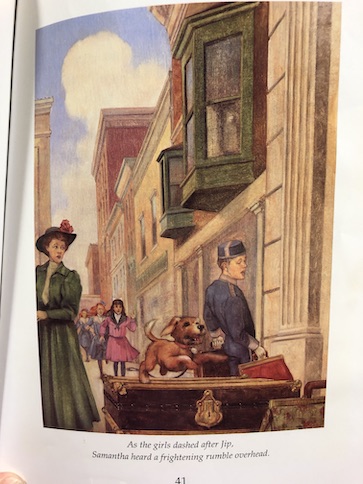
At first, girls the party act a bit self-conscious, trying to be polite and grown-up in their party clothes. After Samantha opens her presents, her Uncle Gard and Aunt Cornelia show up with a special surprise: a puppy named Jip. Jip is a little wild and doesn’t know how to obey commands. He runs off with Samantha’s new teddy bear (a recent invention in Samantha’s time), and the girls have to chase him and get him to drop the toy. Samantha distracts the dog by offering him her shoe, and Eddie, who was watching, picks up the bear. At first, he says that he’ll give it back if they give him some ice cream and let him play with the dog, but Samantha refuses because he was not invited to the party, and she doesn’t like him nosing in. Agatha wrestles the teddy bear away from Eddie before Samantha’s grandmother arrives and tells them that young ladies shouldn’t fight or make spectacles of themselves. Most of the rest of the party is elegant, and the girls are a little more relaxed, now that they look a little less elegant from chasing the dog. However, Eddie gets revenge on the girls by adding salt to the ice cream they made. Even though everything else is fine, including the petite fours, Samantha is still angry at Eddie for ruining the ice cream.

Since Samantha didn’t get to eat the ice cream at her birthday party, the twins and Aunt Cornelia suggest that Samantha return to New York City with them for a visit, and they can all go to a fancy ice cream parlor there. Grandmary agrees and says that she would like to go to New York City herself. On the way to Uncle Gard and Aunt Cornelia’s new house, Grandmary says to Samantha that she hopes that she thinks that the twins get too carried away with some of their ideas. She thinks that they’re too impulsive and don’t think before they act, and while they’ve been raised to be very modern children, she still thinks that some of the old ways are best.

When Grandmary and Samantha see a protest held by women’s suffragists, Grandmary is annoyed at the women, making public spectacles of themselves and inconveniencing passing traffic. She thinks that it’s just another “newfangled notion” that’s a lot of fuss and bother over nothing. She’s never had to vote in her entire life, and she doesn’t see why any other woman would need to. Samantha can tell that this opinion bothers Aunt Cornelia and the twins when Grandmary says it in front of them, but they don’t seem to want to discuss it further.

The twins and Samantha ask to take Jip to the park, and Aunt Cornelia says that’s fine. She has a meeting to attend, but she wants them back home in time to go to the ice cream parlor after her meeting. However, Jip gets away from the girls when they try to put him in Samantha’s doll carriage, and they chase him to the place where the suffragists are meeting. Although Samantha knows that her grandmother doesn’t approve of the suffragists, they have to go after the dog. There, the twins tell Samantha that Cornelia is also a suffragist, and she is speaking at the meeting.

Jip charges right up to the stage where Cornelia is giving her speech, and Cornelia lectures the girls about not thinking about the consequences of their actions and not following her instructions for taking proper care of Jip. Sometimes, they are too impulsive and don’t think ahead. Cornelia explains to the girls about the need to follow agreed-upon rules for safety and how that is different from the changes that her group is advocating. While Grandmary has been saying that the suffragists are also too radical and impulsive and making a fuss about nothing, Cornelia says that much thought, planning, and hard work has gone into their movement to ensure that the changes they’re advocating will be for the better. Grandmary doesn’t appreciate how much thought and preparation the group has done and how long it has taken them to get this far because she hasn’t really thought about the issues at all herself and she has not been to any of previous meetings, where the planning has taken place.

Note: The women’s suffrage movement was already decades old by 1904, when this story takes place, so it’s not really as “newfangled” as Grandmary describes it. It had been building for a long time. However, Grandmary may not have been aware of that because she never needed to be aware. Consider what her life has been like. Remember that Grandmary is a wealthy lady and that marriage and social connections have been the basis of her life. Her husband was wealthy, and she was likely born into a wealthy family. Her life has always been comfortable without her needing to have a job or vote or do anything other than be a wife and mother. Growing up, becoming a well-behaved young lady, and getting married set her for life, and up to this point, she hasn’t had any major problems with money or her lifestyle and hasn’t really needed to think much further than that. She’s used to letting the men in her life handle business and politics and provide her with money, and she now lives on the money that her husband left to her, which is more than ample. Mostly, what Grandmary has needed to manage in her life are the social graces necessary for entertaining her husband’s business associates and their wives and for helping to facilitate her children’s marriages and careers. Grandmary’s daughter was also married to a well-off man before their early deaths. Her son is also a wealthy man, who can provide for his wife, and Cornelia is also from a wealthy family in New York City, a natural extension of their social circle. Grandmary assumes that Samantha, raised in this wealthy social atmosphere, will also naturally meet and marry a wealthy man through the connections of her friends and family, one who will support her and their children in a comfortable fashion. She thinks that, besides caring for her future children, Samantha will likely occupy her time with good works for the less fortunate and that she will give elegant parties for the fashionably-dressed ladies of their social level to solidify their social connections. The elegant affair that her tenth birthday was supposed to be was also practice for her future, as Grandmary envisions it. Grandmary thinks that life will continue to follow this same general course in their family and that there will never be a need for anything different because her own life has been fairly smooth, comfortable, and predictable, largely unshaken, even by the deaths of her husband and Samantha’s parents. But, she’s about to change her mind.

The girls are a little disheveled when they go to meet Grandmary at the ice cream parlor because there is no time to go home and change. As they explain to Grandmary about why the girls look a little disheveled, she tells them that she already knows because she was there, watching the speech. When she saw that Cornelia was the one speaking, she decided to stop and listen, and she was impressed by what she heard. She liked the part where Cornelia talked about the importance of standing up for what is right, and that’s something that Grandmary believes in, too. She is now more open to the suffrage movement than she was before.

The story is partly about growing up and how Samantha realizes that she needs to learn to make her own decisions. She can’t always go by what her grandmother tells her, and sometimes, listening to the twins isn’t always the wisest choice, either. Samantha also begins to see that she has choices to make about the kind of young lady that she will grow up to be. She can be the elegant lady at the party or the public crusader for the causes she believes in or maybe something that combines aspects of both. In the end, Grandmary also begins to see the possibilities of change.

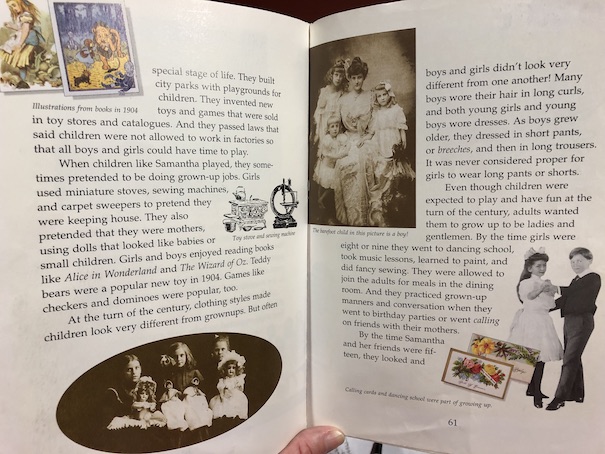
In the back of the book, there is a section about babies and children during the early 1900s. It discusses what children liked to do for fun and how adults would begin training children to be young adults early in life, emphasizing social skills, like dancing, how to behave at the dinner table, and how to engage in polite adult conversation. A girl from a wealthy family, like Samantha, might go to a finishing school instead of college after completing her basic education. At finishing school, she would learn how to manage a household, including how to manage servants (how to hire them, how to tell if they were doing a good job, etc.) and how to throw elegant dinner parties. She might have a coming out or debutante party to introduce her to society as an adult, which meant that she would be ready for introductions and dates with young gentlemen and would probably soon be considering marriage. (This is likely the path that Samantha’s grandmother took in life and the one that she is considering for Samantha.) However, some young ladies did go to college, had careers, or become suffragists, and some did some combination of the above. Samantha’s life is full of possibilities, and her future hasn’t been decided yet. Because Samantha was ten years old in 1904, she would have been eighteen in 1912. For an example of what college life would have been like for an eighteen-year-old girl at a college in the eastern United States in 1912, see the novel Daddy-Long-Legs.

The book is currently available to borrow for free online through Internet Archive.

Home for Christmas

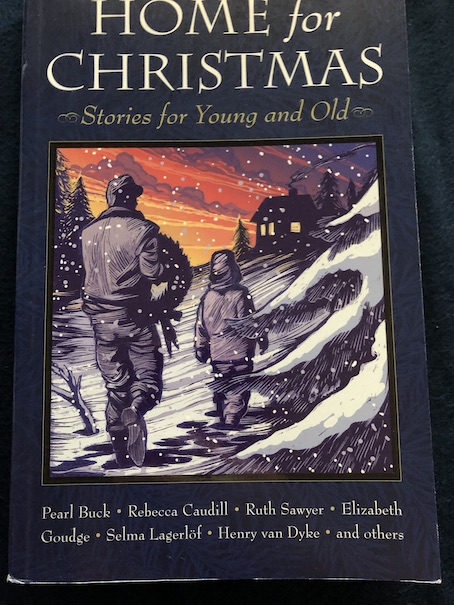
Home for Christmas: Stories for Young and Old compiled by Miriam LeBlanc, 2002.

Disclosure: Plough Publishing House sent a copy of this book to me for review purposes, but the opinions in the review are my own.

This is a collection of short Christmas stories written by famous authors from around the world. One of the things that I found interesting about the selection of authors in the book is that many of them are better known for writing on very different themes. Among the authors in this book are Madeleine L’Engle, who is known for writing science fiction, such as A Wrinkle in Time; Elizabeth Goudge, who wrote the mid-20th century classic children’s fantasy story The Little White Horse (later made into the film called The Secret of Moonacre); Katherine Paterson, known for her children’s novels, including Bridge to Terabithia, Jacob Have I Loved, and historical novels set in Asia, such as The Master Puppeteer; and Pearl S. Buck, author of The Good Earth.

Although the book is intended for children and families and many of the authors are known for writing for children and young adults, I think that many of the stories wouldn’t particularly appeal to children, especially younger children, because children wouldn’t be likely to understand them or they have darker themes, like bitterness that must be overcome and grief at the death of a child. The stories generally end well, but for young children, something simpler and lighter in subject matter, like the short stories in Merry Christmas from Eddie, would be more appealing. Really, I think this book would be best for adults, although I noted some of the more child-friendly stories.

One thing that I wished the book included is sections of information that explain a little more about the stories behind the stories. I recognized the historical references behind some of the stories, but other readers, particular children, might require a little more explanation to fully appreciate them. I think that’s another good reason why the stories might appeal more to adults.

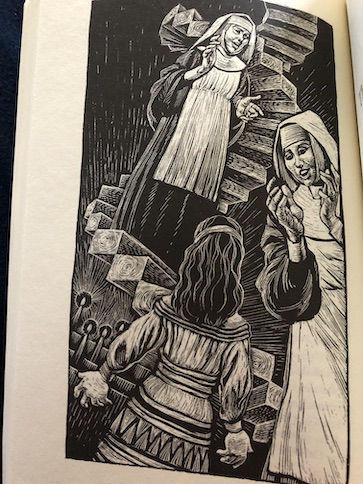
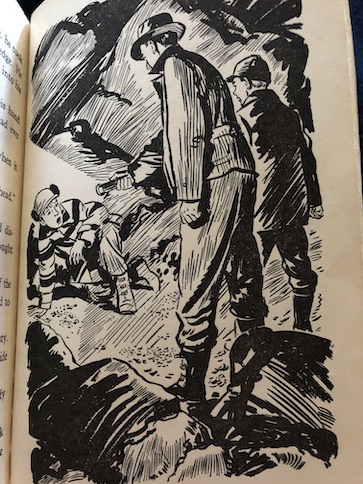
There are 20 stories contained in the book. Each of the stories in the book has one black-and-white picture in an old-fashioned woodcut style.

I don’t think that there are any copies of this book available to read for free online, but this book is available for purchase through Plough Publishing House.

The stories contained in this book are:

Brother Robber by Helene Christaller

A young monk sends three robbers away without food before Christmas because they are violent criminals, but an older monk convinces him to have compassion and to find them and give them the food they have asked for.

The compassionate brother, Brother Francis, is St. Francis of Assisi, although it is not explicitly explained in the story, and the younger brother, Brother Angelo, is the main character. The story of St. Francis, Brother Angelo, and the robbers is an old one that has been told before in other forms, but this is a good rendition.

Three Young Kings by George Summer Albee

Three boys at a school in Cuba are given the role of playing the Three Kings in their school play as well as delivering presents to the rest of the children in their community, giving them presents that their parents have already bought for them. However, their task proves harder than they thought when they see how upset the poor children are that they pass their houses and leave nothing because their parents couldn’t afford presents. What can they do?

This is a good book for talking about making choices. In the end, the community is satisfied with the boys’ choice, but a good topic for discussion after this story would be what the community will choose to do next year, when new boys become the Three Kings.

Transfiguration by Madeleine L’Engle

A nun in New York City struggles to answer a poor man’s questions about why Christmas should be so “merry” when there are so many poor people and bad things happening in the world. The real answer comes to her after the man tries to rob her.

The Cribmaker’s Trip to Heaven by Reimmichl

Willibald Krautmann spends his life making manger scenes for Christmas, and he is sure that his work will earn him a place in Heaven. Unfortunately, when he dies, he is not received in Heaven as he thought and, confronted with the history of his faults that prevents him from entering, he must seek an advocate to help him plead his case. However, it’s not too late for him to mend his ways, and the reader is left to imagine how much was real and how much was dream.

The Guest by Nikolai S. Lesskov

Timofai was a bitter young man, an orphan defrauded of his inheritance by his uncle. After a violent fight with his uncle, he is sent into exile in Siberia. Even after his life improves and he marries and has a family of his own, he still finds himself bitter about the injustice that was done to him. Is there anything that his friend and brother-in-law can say that will help him? When he finally meets his uncle again, after many years, will they both get the closure they really need?

Christmas Day in the Morning by Pearl S. Buck

An older man and his wife decide how to spend Christmas now that their children are grown and living their own lives, separately. As the man reflects on Christmases past, he realizes that love is what makes Christmas special and what you do to show other people how much you love them.

This is one of those stories that I think adults would understand more than children, although it’s a good thought to explain to older children.

The Other Wise Man by Henry van Dyke

The story of a wise man who set out to follow the star at Christmas, like the others, but didn’t arrive at Bethlehem with them because he stopped to help someone. Although he arrives too late to see the Christ Child, he is in the right places to help people because he set out on the journey. At the end of his life, this wise man does actually see Jesus at his crucifixion.

This is a famous 19th century story.

The Miraculous Staircase by Arthur Gordon

In Santa Fe, New Mexico, in 1878, an unusual carpenter promises that he can build a staircase to a church choir loft, even though the original architect didn’t leave space for stairs. Even though other carpenters had failed to find a solution to the problem, the mysterious stranger solves it. But, who was that mysterious carpenter, and how did he do it?

This is actually based on a true story! I’ve been to the church in Santa Fe, the Loretto Chapel, and I’ve seen this staircase myself! The short story ends with a few details about the history of the event.

No Room in the Inn by Katherine Paterson

When an eighteen-year-old boy’s parents leave him alone at the family’s inn, which is closed for Christmas while they visit his sister’s family, he’s a little sad at spending Christmas alone but also looking forward to some freedom to relax. However, a mysterious stranger who needs a place for the night changes his plans.

The Chess Player by Ger Koopman

The Christ Child must help an old man to forgive his estranged daughter on Christmas. Can the Christ Child soften a hardened heart over a game of chess?

The Christmas Lie by Dorothy Thomas

A poor young girl from a large family invents a story that some friends have invited the whole family to join them for Christmas dinner when, in fact, no invitation has been made. It had really been more of an impulsive wish that they had been invited, but when her family believes her and begins preparing for the event, can the girl find the courage to admit the truth? What will happen when everyone realizes that she lied?

This is one of the better child-centered stories in the book.

The Riders of St. Nicholas by Jack Schaefer

A group of cowboys have to decide which of them are going into town to celebrate Christmas and which of them will be staying on the ranch. The ones who get left behind plan a small feast for themselves as consolation for being left out of the fun. However, their plans change when they rescue a neighbor who got drunk and almost froze in a snowstorm.

Grandfather’s Stories by Ernst Wiechert

An old coachman tells stories that his grandfather told him. One Christmas Eve, his grandfather’s grandfather was driving a coach and saw a strange, smiling boy who seemed to be asking for something. Although his employer wanted him to drive on, the coachman gave the boy a ride, and it turns out to be the beginning of a miracle. In another story, a cruel master is changed for the better when he sees that the victim of his cruelty is Christ.

The Vexation of Barney Hatch by B.J. Chute

A panhandler gets recruited as a store Santa and helps a poor boy who only wants a harmonica.

The Empty Cup by Opal Menius

King Herod, knowing of a prophecy that a new king would be born, attempted to kill the new king to preserve his own power. Unable to tell which baby would be the prophesied king, Jesus, he ordered all of the boy babies in the area to be killed.

This story focuses on a man whose only child was killed. His wife seems unable to get over the shock and grief of their son’s death until another little boy teaches her how to get over a loss.

The Well of the Star by Elizabeth Goudge

The Well of the Star is a well where legend has it that the Wise Men stopped on their way to see Jesus. David is a poor shepherd boy who is left behind when the other shepherds go to see the baby Jesus. He is visited by the archangel Michael, who sends him to join the others, meeting the Wise Men on the way.

This is one of the better child-centered stories in the book.

A Certain Small Shepherd by Rebecca Caudill

Jamie’s mother died shortly after his birth, and for much of his young life, Jamie is unable to talk. When he begins going to school, he does well, except that he can’t answer questions out loud in class and not at all if he doesn’t know how to spell the word that he wants. It’s frustrating. However, when his teacher makes him a shepherd in the school Christmas play and his family has some unexpected visitors in a snowstorm, things change.

This is one of the better child-centered stories in the book.

The Carpenter’s Christmas by Peter K. Rosegger

The carpenter’s wife thinks that he isn’t be pious enough on Christmas, but he has an important job to do for someone less fortunate.

What the Kings Brought by Ruth Sawyer

In Spain, the tradition is that the Three Kings bring presents to children on Twelfth Night. A traveler in Spain shortly before Twelfth Night meets a poor young boy who is desperately trying to raise money to buy a new burro to help his father on his farm. The traveler and his friend come up with an idea to help the boy without it seeming like charity.

This is one of the better child-centered stories in the book.

The Christmas Rose by Selma Lagerlof

A Robber Mother trespasses on monastery ground and angers the monks when she tells them that their beautiful herb garden cannot compare to the way the forest looks on Christmas Eve. Abbot Hans decides to pay the Robber family a visit on Christmas, although it ends up being his last.
Mystery in the Apple Orchard

Mystery in the Apple Orchard cover

Mystery in the Apple Orchard by Helen Fuller Orton, 1954.

Mystery in the Apple Orchard swing

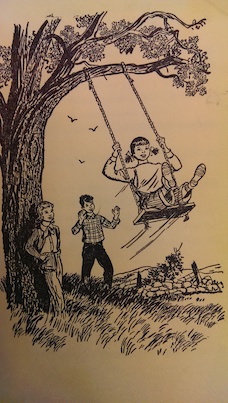
Dee Waters (age nine), her brother Ronnie (age eleven), and the other neighborhood children enjoy playing in the nearby apple orchard. The orchard was planted by Dee and Ronnie’s grandfather, and the trees are all different types of apple. Sometimes, the children take a lunch with them and spend hours climbing trees and playing. They like to watch the animals there, like the squirrels and crows, running around and hiding things in the trees. There is also a swing hung in one of the trees.

The Waters’ housekeeper, Mrs. Brown, lives in the city and commutes to her job in the country. She also has a son, Timmy, and she’s been concerned about him. Timmy is recovering from a broken leg. The bullies in his neighborhood dared him to climb a tall pole, and he fell. Although Timmy’s been out of the hospital, he hasn’t been getting enough fresh air and time outdoors in the city because they don’t live near a park. Dee and Ronnie don’t know Timmy, but hearing that he’s been unwell, they suggest that Mrs. Brown bring him along the next time she comes so that they can show Timmy the apple orchard. The children’s mother thinks that’s a good idea and also urges Mrs. Brown to bring Timmy for a visit.

Timmy is a little younger than Dee and Ronnie, and he can’t play many games with the children yet because he still walks with a crutch and can’t run. Still, he is fascinated by the animals in the orchard and enjoys watching them. He doesn’t see many wild animals in the city.

Most of the other children in the area are nice to Timmy, but Gloria is a little bit of a snob. Ronnie finds Gloria annoying because she is so prissy and extra careful about her clothes, and on Timmy’s first day in the orchard, Gloria shows up with a ring that she says has a real diamond and a family. The other children don’t believe her at first because it would be silly to wear an old, valuable ring to an apple orchard, especially when it looks so loose on her finger. Ronnie warns her that it could get lost, but Gloria tells him to mind his own business. She also tries to cheat when they play hide-and-seek, asking Timmy to tell her where everyone is because he can’t play the game anyway. Timmy refuses to help her cheat, and Gloria leaves in a huff. Because this is a mystery story, you can see where this is probably leading.

Mystery in the Apple Orchard play ticket desk

When Timmy comes the next time, the children decide to pretend that they’re going on trips by airplanes, with the trees in the orchard representing the planes. Timmy is sad that he can’t climb with the others, so they make him the ticket agent in the airport. Gloria shows up again, still with her diamond ring, and the other children again warn her that she could lose it in the orchard. Gloria says that’s impossible because she tied it to her finger, and she shows the the string. (What was it they said about the Titanic being unsinkable?)

Naturally, the ring gets in the way while Gloria is playing with the others, catching on a twig in a tree. They have to untie the string to get her loose. The other children tell Gloria to put the ring somewhere safe while she plays, suggesting that Timmy the ticket agent could watch it. However, Gloria decides to put the ring on a stone near the old well that has been filled in. (Considering that there are small animals in the orchard that happen to like shiny things, this was not the best decision.)

Mystery in the Apple Orchard digging

Sure enough, by the time Gloria comes down from her tree and her imaginary flight to Paris, her ring is gone. Naturally, Gloria is upset and admits that she was wearing the ring without her mother’s permission. (Gloria likes to show off.) She accuses one of the other children of taking the ring. Timmy seems like the most logical suspect, since he was on the ground while the others were in the trees, but he denies it, saying that he closed his eyes so he could imagine a flight, like the others were doing. Dee suggests that an animal could have taken the ring. Earlier, a chipmunk carried off the piece of string. On the other hand, crows also like shiny things. Could the crow have swooped down and carried it away?

Gloria still insists that Timmy took the ring, and she threatens to tell her mother that he stole it. Can the others find the ring before Timmy is labeled as a thief?

It take awhile for the other children to find Gloria’s ring, and because they failed to find it with the animals right away, some readers might wonder whether a human was responsible for taking. However, the mystery itself is very simple and wouldn’t really surprise anyone but young children. In the end, though, the important point is that Timmy is so motivated to find the ring and clear his name that he finds the courage to climb a tree again. He has healed from his broken leg more than even he thought he had. Before coming to the country, the doctor had told him that he could stop using his crutch, but he hesitated to do that because he was so afraid of re-injuring himself. Once he gets the courage to try not using his crutch, he discovers that he can also do many other things, although he does freeze up when trying to come back down the tree and needs the help of a couple of telephone linesmen to get back down. The linesmen tell him that it’s okay and that God has smiled on him for helping him to improve and do what he needed to do. Timmy is reassured by the discovery that he can do more than he thought he could, and his mother and Mrs. Waters decide that the Browns should move to the country permanently so that Mrs. Brown won’t have to commute to work and Timmy can have more fresh air, playing with the other children in the apple orchard.

This book is available to borrow for free online through Internet Archive.

Mystery in the Old Cave

Mystery in the Old Cave cover

Mystery in the Old Cave by Helen Fuller Orton, 1950.

Mystery in the Old Cave nut gathering

Andy and Joan Draper are excited about spending the fall and winter in the country. Usually, they live in an apartment in New York City and only go to their family’s vacation home in Vermont during the summer. However, this year, some friends of their father will be moving to New York, and they’ll need a place to stay because they are having trouble finding an apartment of their own. The children’s father has decided to rent their apartment to his friends while his family stays in Vermont. That means that the children will have to go to school in Vermont, but the children like the idea because they will be able to do things that they normally can’t do when the seasons change, like gathering nuts. When the first frosts come, the hickory nuts on the trees fall to the ground, making it easy to collect them.

After Andy and Joan collect nuts for the first time, they decide to store them in the old sugarhouse on the property. Normally, the family doesn’t use the sugarhouse for anything, but it used to be used during the times when their vacation house was a working farm and people tapped the maple trees for their sap to make maple syrup. They would process the sap in the sugarhouse. Sometimes, farm hands also used to sleep there during the harvest.
Soon, the children begin to suspect that there’s a stranger hanging around the property. Their dog, Ponto, barks at someone the children don’t see and comes running back to them, acting like someone kicked him. Later, a strange man approaches them and asks them if they know anything about a cave in the area. Andy and Joan don’t know anything about a cave. The man tells them that it’s supposed to be near the old sugarhouse, but if the children haven’t seen it, it might have caved in or something. He seems very secretive and doesn’t want the children to tell anyone that he’s been asking questions, and the children wonder if he could be the one who kicked their dog earlier. Later, someone (perhaps this strange man) steals many of the nuts that the children gathered and even some cookies. The children change their minds about storing things in the sugarhouse and decide to keep their gathered nuts in an unused room in the main house. The only clue to the identity of who’s been sneaking around is a red pencil that the person dropped.

Mystery in the Old Cave store

The children make friends with a boy named Phil who lives nearby. Phil is an orphan who lives with his Cousin John (who he sometimes calls Uncle John because he is so much older), a mean and stingy old man who doesn’t treat him very well and makes him work hard around the house instead of going to play after school with the other kids. He doesn’t even replace Phil’s clothes when they get old and torn. Phil gets a job at the local store to earn some money for a new sweater, but Cousin John even confiscates Phil’s earnings.

Mr. Lane, who owns the local store, is nice, and he tells Andy and Phil about how maple syrup and maple sugar are made, something that everyone in town used to participate in so that it was like a community party. The boys think it sounds like a lot of fun, and while they are talking about the old sugarhouse, Mr. Lane mentions that, once, some thieves joined in when they were making making syrup. Nobody knew they were thieves at first; they were just a couple of strangers who came along with everyone else and started helping out. Later, there were some robberies in the area, and the thieves were found hiding in a cave near the sugarhouse. Mr. Lane says that he and his friends used to play in that cave when they were young, and Andy and Phil decide that they want to find it.

Mystery in the Old Cave bones

The boys take some tools with them while they’re looking for the cave, in case the entrance has been covered over, which turns out to be the case. Once they dig through the entrance, the rest of the cave appears intact. They find some old bones inside that probably belonged to a bear. They can’t look around much more because the cave is too dark, so they decide that they’ll return later with some lanterns. Mr. Lane tells the boys that there still might be stolen loot around because they never did find everything that the thieves took, including a pearl necklace that belonged to Andy’s grandmother, who was living there back then. Could these things be what the mysterious stranger is looking for?

Mystery in the Old Cave stove in store

During the course of the book, Mr. Lane begins to notice that Phil’s cousin isn’t giving him enough food. Cousin John denies Phil food when he refuses to turn over the extra money that he’s been earning to him. Mr. Lane gives Phil food from the store to eat. While Phil is at the store, he overhears the stranger, who calls himself Joe Williams, talking to Mr. Lane. Joe Williams admits that he’s looking for treasure in the area. Mr. Lane says that he doesn’t have high hopes that Joe Williams will find anything around the cave because the whole area was searched thoroughly years ago.

Phil tells Mr. Lane that he can’t stand living with his cousin anymore and wants to run away. Mr. Lane tries to persuade him not to go, saying that he can deal with Phil’s cousin, but Phil has had enough and worries that his cousin will make life hard for anyone who tries to help him. When Phil hides out in the old sugarhouse, he meets up with Joe Williams, who explains to him more about how he knows about the treasure that may be hidden in or around the cave. He’s about ready to give up the search, but Phil finds something that everyone else has overlooked.

In the end, Andy and Joan’s parents decide to take Phil in. Phil’s cousin agrees to sign over custody to the Drapers, provided that he gets to keep the money from Phil’s job that he took and the money that Phil’s mother left for Phil’s upkeep. I’m pretty sure that’s illegal and that the courts and social workers would have something to say about that if this story happened in real life in the 21st century, but in the story, Mr. Draper accepts the deal and basically uses the money that was meant for Phil to pay off his cousin to surrender custody of the boy. The story ends at Thanksgiving, with Phil sitting down to Thanksgiving dinner with his new family, who will really love him and treat him much better than his cousin did.

Mystery in the Old Cave hiding

This is one of those older mystery stories that’s really more adventure than mystery. There’s really only one suspect for the odd person sneaking around, and his reasons for sneaking around turn out to be exactly what he said they were. There is no other hidden purpose or secret past behind that man other than what he said, and in the end, he just kind of leaves the story. The kids don’t have many clues to the location of the stolen items, and in the end, Phil finds them more by accident than anything else.

Sometimes, when I’m unsatisfied by the ending of a story, I like to make up an alternate one of my own. If I were writing this, I’d have had Phil’s nasty cousin be involved in the robbery and the hunt for the hidden loot. For example, maybe he was actually one of the original thieves and had a falling out with his partners, and he’s secretly searching for the rest of the loot they hid for years. Maybe he’s had to redouble his efforts recently because they’re getting out of prison soon, and he wants to get to the hidden loot before they do. Cousin John is money-hungry enough that it could be plausible, and that would allow the story to end with him being sent to prison, which seems fitting.

This isn’t important to the story at all, but I just wanted to say that the copy I have of this book is damaged in a very odd way. On some of the beginning pages, someone has cut out a few of the words, ransom-note style. I don’t know why that happened. There aren’t enough missing for a real ransom note, and some of the cut-out words are still stuck in the pages, but since this is a mystery book, I kind of like the image of someone using it to write some kind of mysterious secret message.

I haven’t been able to find an online copy of this book yet, but Internet Archive has others by the same author.

On The Mayflower

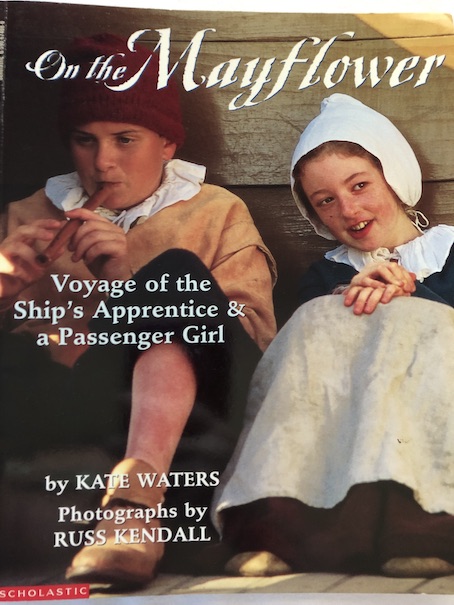
On the Mayflower by Kate Waters, 1996.

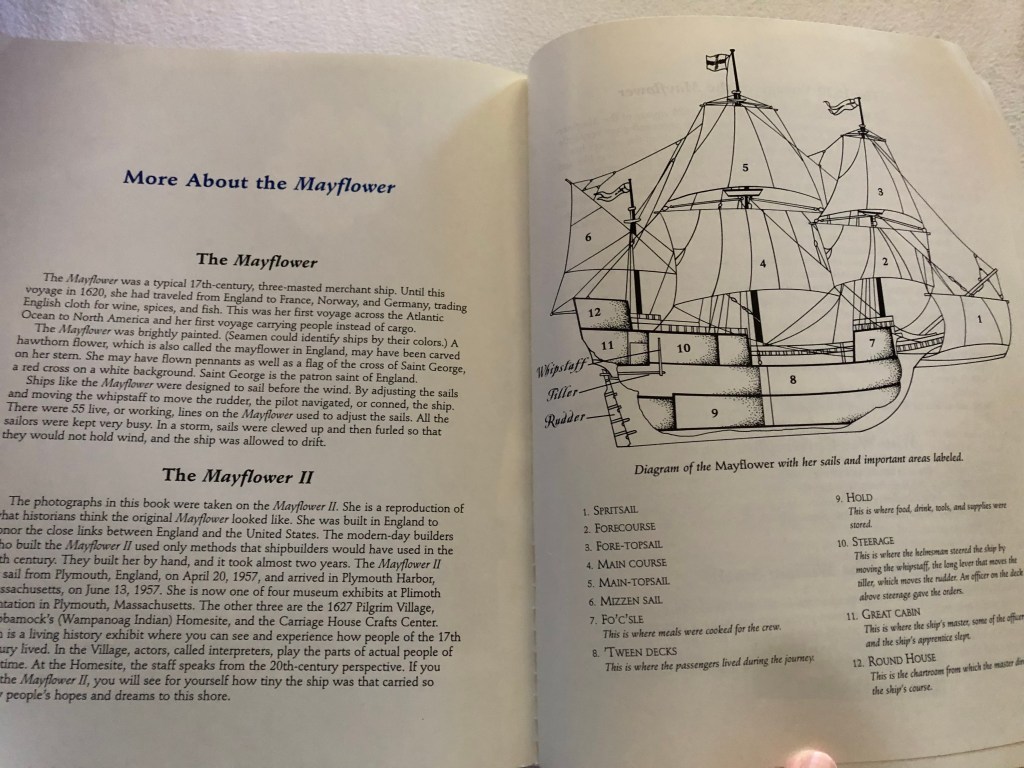
This book is part of a series by same author about children growing up in Colonial America. Each of the books is the series has photographs of historical reenactors portraying real people from Colonial history. This book focuses on two children who are traveling on the Mayflower in 1620, heading to what would become the Plymouth colony. One of the children is a girl who is a passenger on the ship, and the other is a boy who is part of the crew, a ship’s apprentice. In the section of historical information in the back of the book, the author explains that the girl was based on a real girl who was a passenger on the Mayflower, although the boy was not based on a specific apprentice; he is just meant to show what a ship’s apprentice would have been like at that time and to help explain the duties of the various crew members as he assists them.

The ship’s apprentice is called William Small. He is specifically apprenticed to the ship’s master, Christopher Jones (historical character). As an apprentice, he is learning basic navigation skills and assists the regular crew members with various tasks, including serving food.

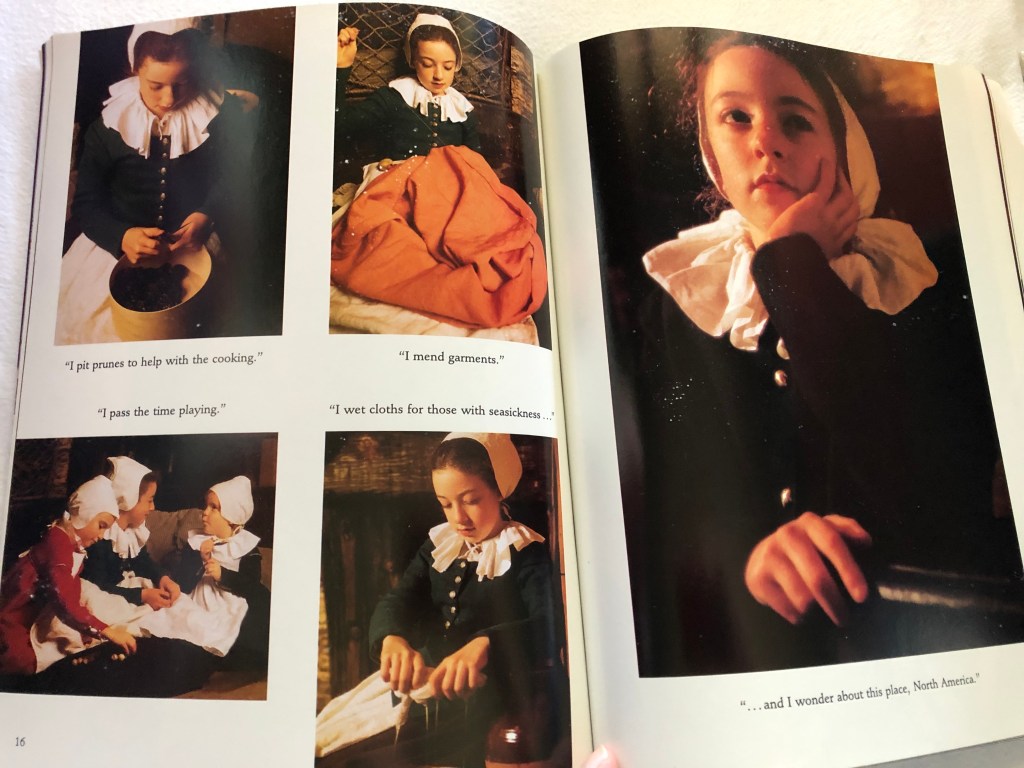
The girl is named Ellen Moore. She and the other passengers are traveling in cramped quarters, and people are often seasick or trying to find ways to keep themselves occupied during the long journey. Ellen is traveling with younger siblings, and she plays with them in between performing routine chores, like sewing and preparing food.

During the voyage, there is a terrible storm, and the passengers are all confined below deck without light because lanterns and candles would pose too much risk of fire while the ship is rocked during the storm. William has to help the ship’s carpenter to repair leaks. Before the storm is fully over, Mrs. Hopkins, one of the passengers, gives birth to a baby she names Oceanus (historical person, the real Oceanus made it through the voyage although he sadly died young, possibly about age six, but the date of his death is uncertain).

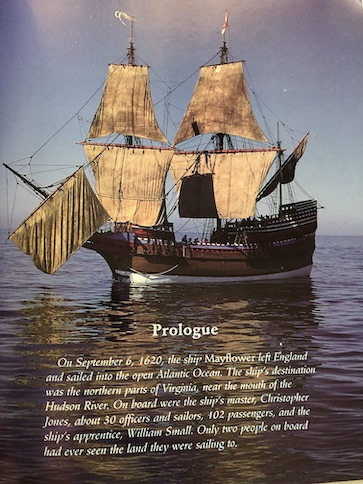
The book ends with their arrival in the Americas. Because the storm blew them off course, the Mayflower did not arrive at its intended destination in Virginia but further north at Cape Cod in what is now Massachusetts. Because winter was setting in, the passengers decided not to risk further travel and established their colony there, 65 days after their ship first left England.

In the back of the book, the section with historical information explains more about both the characters in the story and the reenactors. The historical Ellen Moore and her siblings were traveling to the colony without their parents, under the guardianship of the other families, acting as young servants in their employment. The book mentions that the Moore children were without their parents because of a family tragedy but is not specific about what it was. I looked it up, and the story is both sad and bizarre. I can see why the author didn’t want to explain it in a children’s book. Apparently, the children’s parents had an arranged marriage and were not happy being married to each other. The children’s mother had a long love affair with another man, and also apparently, all of the children were the biological children of her lover. The mother’s husband began to notice that the children physically resembled his wife’s lover. The couple bitterly divorced, and after the husband was granted custody of the children (which, apparently, weren’t his anyway), he decided to send them away to the Americas with the departing pilgrims, paying for them to be taken on the voyage, never seeing them again. Sadly, Ellen probably did not survive the first winter at the Plymouth colony because she disappears from the historical record during that time. Out of the four Moore children traveling on the Mayflower, only one survived to adulthood, Ellen’s young brother Richard. Richard married twice in his life and had seven children of his own. He became a sailor and ship’s captain and eventually died an elderly man in Salem, Massachusetts, during the 1690s, not long after the Salem witch trials. None of this information about Richard is mentioned in the book, but I thought it was interesting background information. In the book, there is also additional information about the ship, The Mayflower, and the reproduction ship used in the pictures, The Mayflower II.

The book is available to borrow for free online through Internet Archive.

The Colonial Cookbook

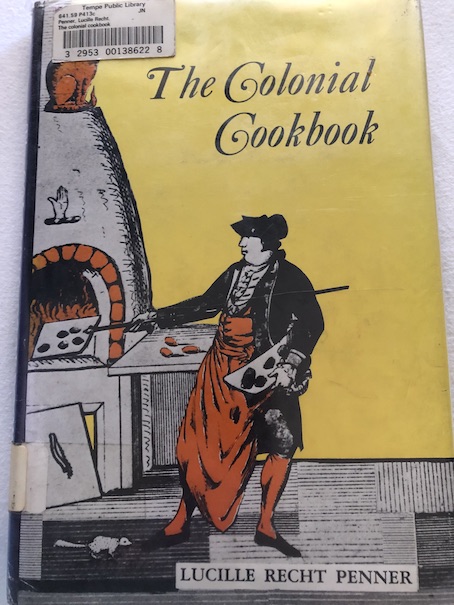
The Colonial Cookbook by Lucille Recht Penner, 1976.

This cookbook explains the history of food, cooking, and dining habits in Colonial America and provides recipes that readers can make themselves.

The first part of the book provides most of the historical background, although each section of recipes also has some additional information. The earliest European colonists in North America had to struggle to feed themselves. In many ways, they were unprepared for their lives as colonists, and not all of them had planned to stay as long as they did. The ones who hadn’t planned to stay long had heard stories about gold and silver in the New World, and they had hoped to stay only long enough to seek their fortunes and return home rich. The realities of life in North America did not meet their expectations and survival turned out to be harder than they thought.

The colonists ended up relying on Native Americans (called “Indians” in this book) to help them survive. As they used up the stores of salted beef and hard biscuits that they had brought with them, they began trading for food with the Native American tribes. From the Native Americans, they also learned farming, finishing, hunting, and foraging techniques that they used to help themselves survive. There were many edible plants and animals at hand, but the early colonists were unaccustomed to which plants in the Americas were edible and how to find them and where to find and trap animals. One of the chores colonial children were given was to gather wild plants for the family to eat, like nuts, mushrooms, dandelion greens, wild leeks and onions, and wild fruit, like plums, cherries, melons, and berries.

Gradually, as the colonies grew, the colonists established farms and farm fields. They needed more land for farming to support their population than modern farms would use to support the same number of people because farming has become more efficient since the colonial era. Later, new colonists came and brought livestock with them. Men and boys usually took responsibility for the livestock on family farms. After animals were butchered, the women and girls would clean and prepare them for eating. Food required much more work to prepare because the colonists had to do all the preparation themselves. Families would not only butcher their own animals but make their own cheese. The book provided details about the processes and tools that colonists used for making their food.

The more specific eating habits of colonists changed over time and varied depending on where the colonists lived in North America and where they had originally come from. For early colonists, meals were eaten off of trenchers made from pieces of stale bread, and the day began with a breakfast of mush or pudding with cider or beer to drink. Later, foods became more varied. People in New England often ate fruit pies for breakfast, and people in the Middle Colonies liked scrapple (a cornmeal mush with pork scraps) and oly koeks (a kind of holeless donut containing bits of fruit). (Neither scrapple nor oly koeks appear as recipes in this book, but there are recipes online.) Southern plantation owners had elaborate breakfasts with many different kinds of food, including ham, eggs, pastries, and more, but poor people typically had mush and scraps of leftovers.

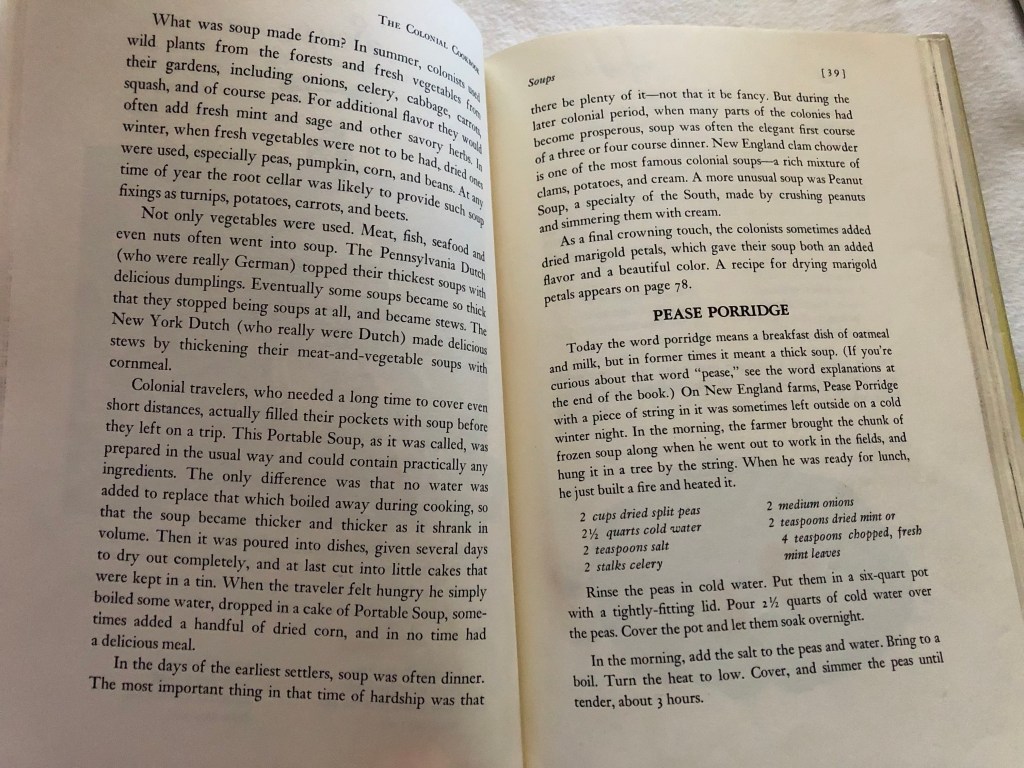
The book provides a variety of recipes, organized by type. Most of the recipes in the book do not look too difficult, although some call for more unusual ingredients, like rosewater. You can still find it, although I’ve usually seen it at specialty cooking stores or import stores. The categories are soups, meat, poultry, seafood, vegetables, puddings, breads, sweets, drinks, and sauces and relishes. Not all of the recipes look like things that would interest modern children. I don’t imagine that many children would be excited at the idea of making Scalloped Oysters, for example. (Seafood was an important food source for early colonists.) Even though children might recognize Pease Porridge from the rhyme, I’m not sure that a thick pea soup would be something that they would be excited to eat, either. Hasty pudding is mentioned in the song Yankee Doodle, but the recipe itself is a little bland. The book does mention that you can flavor it with maple syrup, and there are other cornbread pudding recipes that contain spices and sweeteners in the book.

However, there are some recipes that I think would be interesting to try. The book explains that pumpkins were a staple food for the early colonists, as shown by the old rhyme from the Plymouth:

We have pumpkin at morning
And pumpkin at noon
If it was not for pumpkin
We would be undoon.

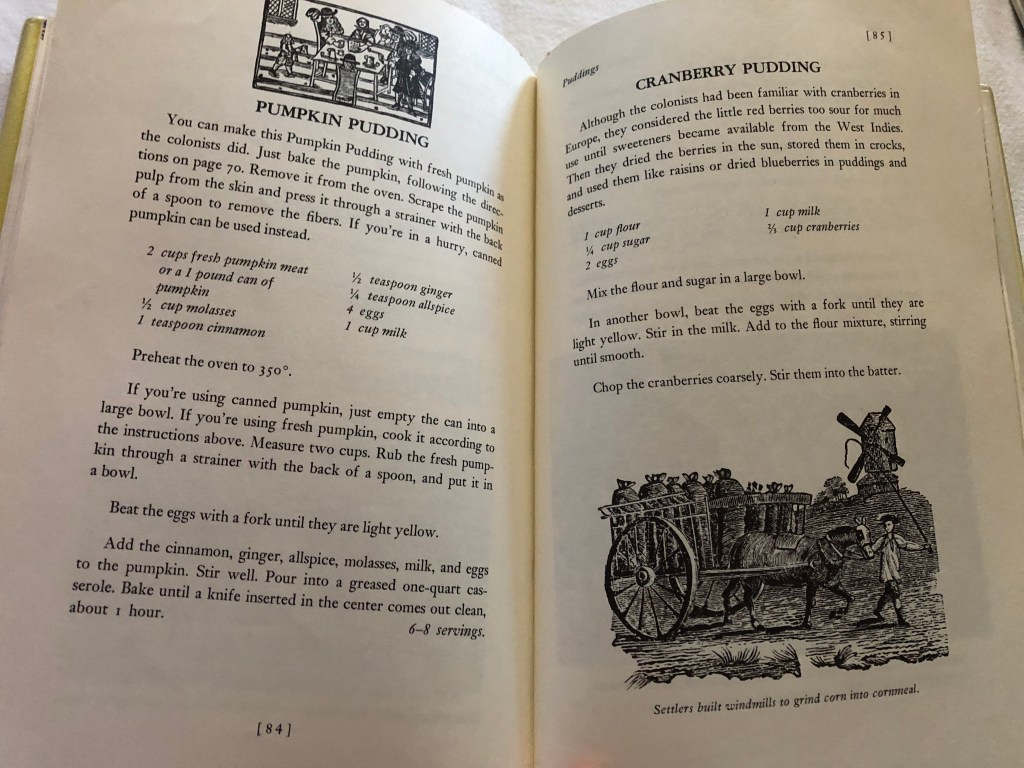
The book explains the different ways that colonists would prepare pumpkin. You can bake it and eat it in pieces with syrup, molasses, honey, or cream. The book explains how to cook it, and it also provides a recipe for Pumpkin Pudding, which can be made with either fresh pumpkin or canned pumpkin. I haven’t made it yet myself, but from the recipe, it reminds me of a pumpkin pie without the crust:

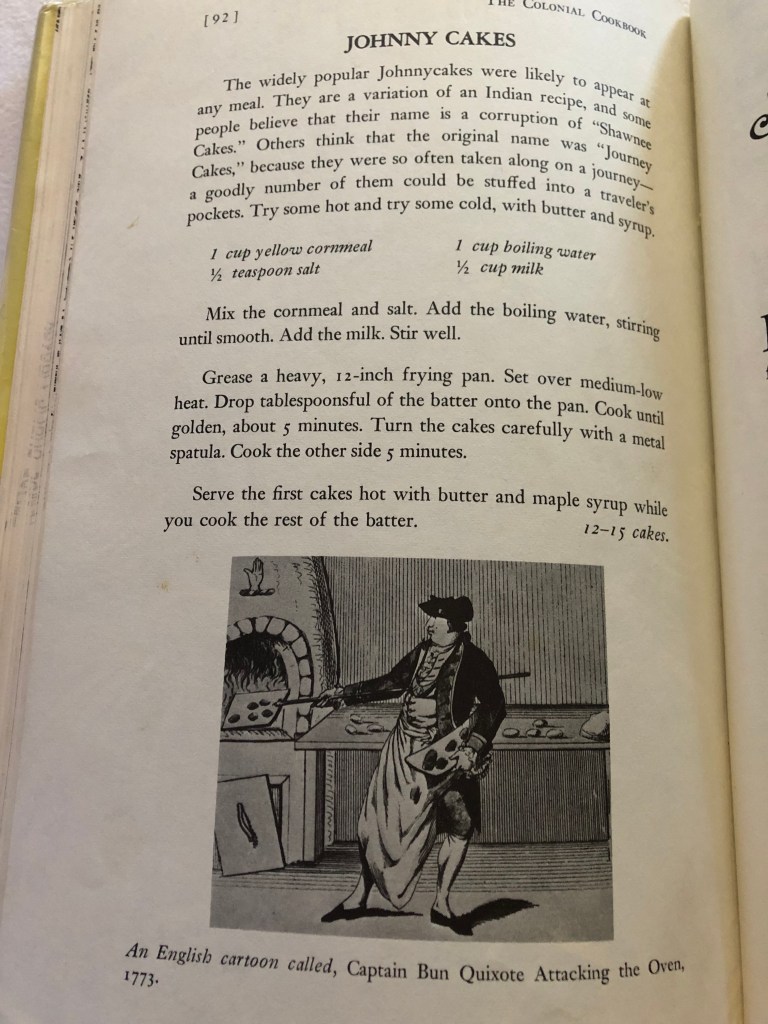
Johnny Cakes are a little like pancakes but made with cornmeal. The basic recipe is a little plain, but they can be served with butter and maple syrup.

This book was published in 1976, which was the United States’ Bicentennial celebration. Unfortunately, I haven’t been able to find an online edition yet.

Ten Little Rabbits

Ten Little Rabbits by Virginia Grossman and Sylvia Long, 1991.

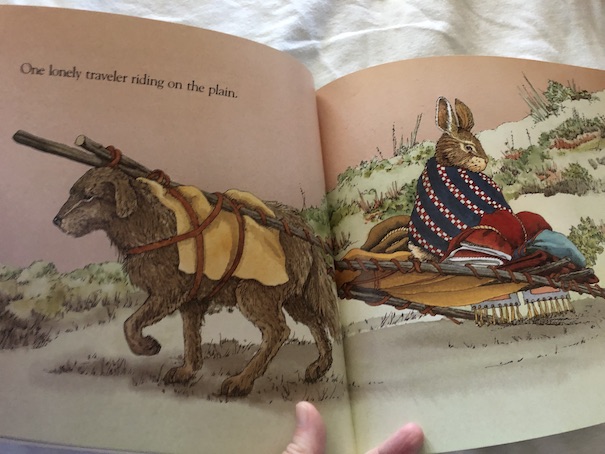
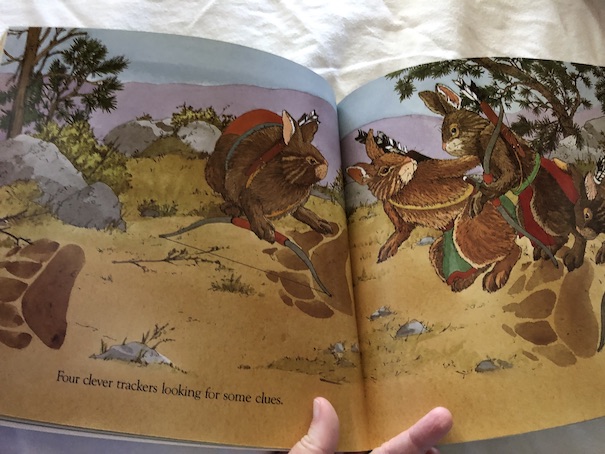
This picture book is loosely based on the Ten Little Indians counting rhyme, but with a twist. Instead of “Ten Little Indians,” it’s ten little rabbits. The rabbits in the pictures are dressed in traditional costumes from different Native American tribes. Also, unlike in some versions of the Ten Little Indians rhyme, none of the characters are eliminated during the course of the rhyme. The rhyme simply counts upward from one to ten.

The pictures are beautiful and detailed, and they do a good job of showing the rabbits in the poses of humans.

The book intentionally shows the rabbits acting out aspects of traditional Native American culture. Very young children might not fully appreciate what the book is trying to depict, but there is a special section in the back that explains which tribes the rabbits are supposed to belong to and what they are doing in the pictures.

The book is available to borrow and read for free online through Internet Archive.

The Day of the Ogre Kachinas

The Day of the Ogre Kachinas by Peggy D. Spence, 1994.

My Dog, Betty

First, I would like to apologize for the cover picture above. This book was in better condition when I first got it. Then, I accidentally left it where my dog could play with it. Oops. She greatly enjoyed this book, which was printed on high-quality and apparently tasty paper, and thought it was a lot of fun, although she found it very difficult to get through. In fact, she did not get past the cover. (Thank goodness.) I enjoyed it much more.

The story is set in a Hopi town in Arizona (my home state!) and features Hopi traditions about kachinas. The introduction to the book explains a little about kachinas, which are spirits that represent concepts in the natural world. In Hopi ceremonies, men dress up as these spirits and dance or act out certain rituals. The ritual in this book is that of the Ogre Kachinas, which is meant to influence children’s behavior, teaching them what their community views as right and wrong and letting them know when they have overstepped the boundaries of their community. (I don’t know if eating the cover of a book counts as overstepping, but I promise that no doggies were harmed or even frightened as part of this book or the reading of it.)

Judson Honyouti, a young Hopi boy, is not a bad kid, but sometimes, like many other kids, he does things that he shouldn’t do. Sometimes, he forgets things or loses his temper and fights with people. His parents and the other adults in his village try to teach him the right things to do, but sometimes, he needs a little extra help to remember.

Judson is nine years old, and he knows that when he sees kachinas in a ceremony, it is only some of the men in his village, wearing costumes. He hopes that when he is old enough, he may become one of the kachina dancers himself, but for that to happen, he must follow his people’s ways and be a good member of his community. To be a good member of his family, Judson helps his father to take care of their cornfield and helps to look after his little sisters, but he still sometimes gets into trouble.

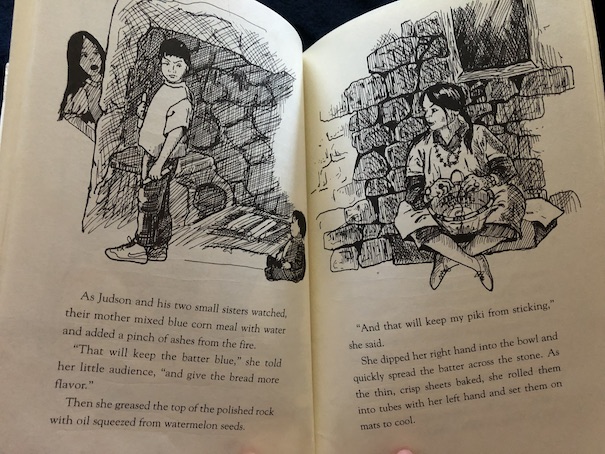
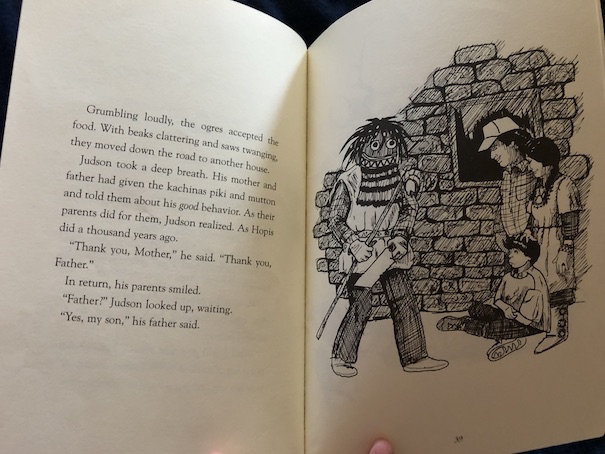
One day, Judson falls asleep while tending his family’s sheep, and most of them wander off. His father has to help him find the sheep again. Then, when his mother asks him to take some stew to his grandfather, Judson drops the bowl because he is playing and not paying attention. To make up for losing the stew, Judson gives his portion to his grandfather. Then, when Judson is supposed to be helping his mother to make piki (or paper bread) so that she can use it to trade in the market, Judson gives into temptation and eats too much. He has to help her make more.

In the market in the plaza, the Ogre Kachinas (really, men dressed up in costume), frighten the children and warn them that they must obey their parents. The Ogre Kachinas like to eat naughty children (but not really), and they say that they will return again soon to see if the children have been good. If they have been bad, the Ogre Kachinas might carry them away!

Even though Judson knows that the Ogre Kachinas are just human beings, their warnings worry him because he knows that he has been doing things wrong and has been getting into trouble. In spite of Judson’s attempts to do better, he still keeps getting into trouble. He fights with his sisters and even hits two other boys when he gets into fights at school. His father warns him that the ogres might come for him if he doesn’t behave, and sure enough, the Ogre Kachinas come one night.

The Ogre Kachinas dance around Judson and his parents and confront Judson with their knowledge of all of the things that Judson has been doing lately. They threaten to take Judson away and eat him because they like to eat bad boys! Even though Judson knows that the kachinas are just ordinary humans in disguise, it’s an alarming performance! However, as part of this tradition, Judson’s parents speak up for him and tell the Ogre Kachinas to leave Judson alone.

It’s true that Judson has done things that he shouldn’t have done, but in many cases, he also did something to try to make up for what he had done wrong, like when he gave his portion of the stew to his grandfather to make up for the portion that he had ruined. He gets into trouble, but he is also polite and helpful in many ways. His parents say that he is actually a good boy and would make the ogres sick if they tried to eat him. Judson is relieved to hear that his parents love him and value the good things he does, even when he isn’t perfect. The Ogre Kachinas not only remind children of what they are not supposed to do but provide an opportunity for the parents to explain that they value their children and what the children do right. As Judson’s parents give the kachinas gifts of food and send them away, Judson realizes that their parents must have done the same for them when they were children and that the same thing has also happened for all Hopi children for generations.

I like books that include a little history and interesting information about cultural practices, but I also like this book for its understanding of human nature. First, I grew up in Arizona (in the American Southwest, for those who live outside of the United States), where this story is set. Although I am not Native American and didn’t grow up on an Indian Reservation, like Judson, I knew about Kachinas and was fascinated by them when I was growing up. I read books about Kachinas, and I loved the display of Barry Goldwater’s Kachina doll collection at the Heard Museum when I was a kid. I used to remember more of the individual names of different kinds of Kachinas and could point out the different ones in the Goldwater collection, but I’ve forgotten some of them as an adult. These things slip away if you don’t reinforce them. The book describes how Kachinas function in Hopi culture. There are different kinds that perform different ceremonial functions, but the main ones in the story are the Ogre Kachinas, which are meant to help frighten children into good behavior.

The need for both positive reinforcement and negative reinforcement is a real part of the human condition. Negative reinforcement has a bad reputation in modern times for making people feel scared or ashamed, and I think that it isn’t enough to have just negative reinforcement (punishment or criticism for things that a person has done wrong) or just positive reinforcement (praise for doing things right) by itself; I think they function best as a pair, the way they do in this story. It isn’t enough to just tell people what not to do (negative reinforcement) because it often leaves them wondering what they should have done instead, and it’s not enough to just give them praise with no criticism because it leaves them with the feeling that they do nothing wrong, and they’re often surprised later when they find out that things they’ve been doing have been seriously getting on everyone’s nerves all along. I think an over-reliance on positive reinforcement alone is part of the modern phenomenon where people don’t realize that they’ve been acting like bullies or saying really inappropriate things for years because, somehow, no one clued them in earlier in life. I’m pretty sure that I know why that is: it’s difficult to be the bearer of bad news or criticism that someone has gone too far with their behavior, to play the role of the disciplinarian, the “rules police” who has to stop the game to tell someone they’re not playing right. In an odd sort of way, the Ogre Kachina costumes probably make it easier for the elders of the community to dish out the criticism and discipline because they’re not quite doing it as themselves; they’re doing it in disguise as the horrible “ogres.”

To help people understand how they’re really supposed to behave in society, they need to know both what they’re not supposed to do and what people really want them to do instead. Judson gets both kinds of feedback in the story during the Ogre Kachina ceremony. First, he is confronted by what he has done wrong, and then he gets to hear his parents explain what he has done right in order to emphasize both what they love about him while helping him to realize what he needs to fix in order to be a better person in their society. Having a child confronted by scary ogres that threaten to eat him for doing things wrong sounds pretty scary, but the book does note that Judson is old enough to know that the Kachinas are just people in costume. Even though he’s kind of scared at being confronted by them, and for a moment, he does feel like they’re really threatening to eat him, he is aware that they are not what they appear to be and realizes that it’s all part of the ceremony. It also means that he is old enough to accept the rebukes as the consequences of their behavior, and he finds his parents’ praise of his good deeds as a motivator to do even better next time, not as an excuse for the things he did wrong.

By the way, Betty the dog was not punished for eating the book cover. I just took the book away from her and gave her a toy she could chew on instead. She is a good doggy, and I should not have left the book where she could get it. Bad Tracy!

The book is available to borrow for free online through Internet Archive.

Knots on a Counting Rope

Knots on a Counting Rope by Bill Martin, Jr. and John Archambault, 1966, 1987.

The reason for the two copyright dates is that this book originally had somewhat different text and different illustrations.  I don’t have a copy of the original version, so I’m not sure how it compares to the 1987 version.

The story is told in the form of dialog between a young Navajo boy and his grandfather.  The story doesn’t explicitly say that they are Navajo, but they refer to hogans, which are a traditional type of Navajo house.  There are no words in the story other than what the characters say to each other, not even to indicate who is speaking, but you can tell who is speaking based on what they say.

The boy asks his grandfather to tell him the story of when he was born. The grandfather says that he already knows the story, but the boy persuades him to tell the story again.

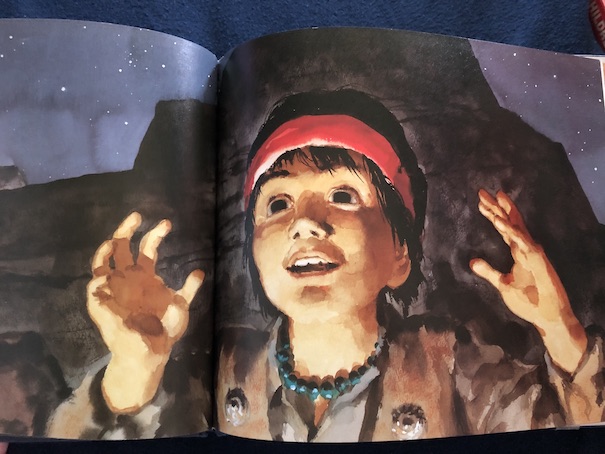
The grandfather tells him that, on the night he was born, there was a storm, and it sounded like the wind was crying the word “boy.”  The boy’s mother knew that she was going to give birth to a son.  The grandfather quickly brought the boy’s grandmother to be there for the birth, and when the boy gave his first cry, the storm suddenly stopped.

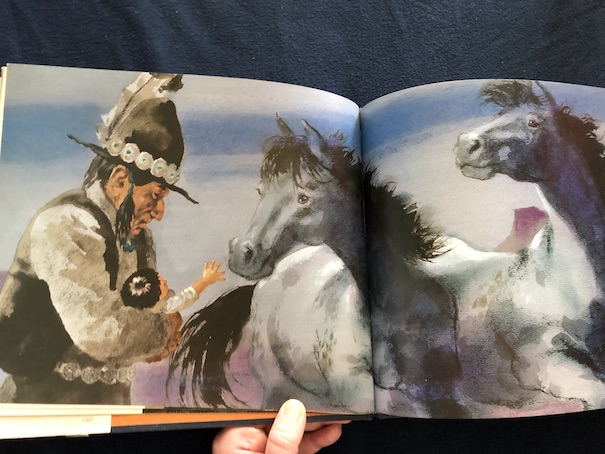
When the boy was born, he was very frail, and everyone was afraid that he would die.  Then, when morning came, the grandfather carried him outside, and although he did not open his eyes to the morning sun, he lived his arms up to two horses that had galloped by and stopped to look at him.  The grandfather took it as a sign that the boy was a brother to the horses and would live because he had the horses’ strength.  The boy did become stronger and was given the name of Boy-Strength-of-Blue-Horses.

However, the boy was born blind. It is a hardship that he will always have to deal with.  Even though the word “blue” in his name, the boy says that he doesn’t really know what “blue” is or what it’s like because he’s never seen it.  The grandfather describes it as being like morning because the sky in the morning is blue, and the boy says that he understands what mornings are like because they feel and sound different from night to him.

The boy has a horse of his own, and the two of them have a special bond.  The two of them perform well at races, and the horse acts as the boy’s eyes when he’s riding.  His grandfather says that it’s like the two of them are one.

As the grandfather tells the boy stories about himself, he ties knots on the counting rope.  He says that when the rope is full of knots, the boy will have heard the stories enough that he will be able to tell them himself.  The grandfather says that he will not always be there to tell the stories, and the boy is frightened, wondering what he will do without his grandfather. The grandfather says that he will be all right because his love will be with him.

The book is partly about the relationship between the boy and his grandfather and the grandfather preparing his grandson for the day when he will be gone, making sure that he knows the family stories about himself and the knowledge that he will need for the future. It’s also about the boy’s own struggles in life, which the grandfather refers to as the “dark mountains” that he must cross. Because of the boy’s blindness, he lives in a world of darkness, and there are things that are challenging to him that would be less challenging to a person with normal vision. Yet, the boy has innate skills which allow him to do things that some people with normal vision can’t do. Not everyone has the affinity for horses that the boy has. He shares a special bond with horses, and when he rides, he and his horse are a team. Because he has skills and a strong spirit, the grandfather knows that his grandson will be all right in his future, in spite of the challenges of his blindness.

The book was featured on Reading Rainbow, and it is currently available online through Internet Archive.