The School at the Chalet by Elinor M. Brent-Dyer, 1925.
This is the first book in the Chalet School Series. This series is uncommon in the United States. People from Britain or countries with heavy British influence would be more familiar with this series. It’s considered classic!
When
the story begins, Madge and Dick Bettany, who are brother and sister, a set of
twins, are discussing their family’s situation.
Their parents are dead, and they have very little money and no family
members they can rely on. Madge and Dick
are grown and are ready to begin making their own way in the world, but their
younger sister, called Joey, is still a child, and her heath has been
poor. Dick has a job, but he really
can’t afford to support his sisters.
However, Madge has had an idea: she wants to start a school. Dick worries that they don’t have the capital
necessary to start a school, but Madge says that she could start one in
continental Europe instead of England, where they are from, because the costs
would be lower. She even has a specific
place in mind, a chalet near a lake, close to a town called Innsbruck in the
Tiernsee (Austria). Joey could live with
her at the school and continue her education in the company of the other
students, and Madge thinks that the climate there might even be better for her
than England. She has already written a
letter to find out if the chalet is available, and it is. If they sell most of what they own in
England, Madge thinks that they’ll have enough to buy what they need in
Europe. Madge says that she thinks she
could handle about a dozen girls, between the ages of twelve and fourteen or
fifteen. She knows someone who could
help her teach, Mademoiselle Lepattre, and between them, they are qualified to
teach French, German, sewing, and music.
Dick is still a little concerned about whether or not Madge can pull off
the school, but he agrees that she should go ahead with her plans (since she
likely will anyway) and says that if she runs into trouble, she should contact
him for help.
Madge
even knows who her first pupil at the boarding school will be: Grizel
Cochrane. Madge has already had her as a
student, and she is friends with her family.
She knows that Grizel has been unhappy at home since her father
remarried because she and her stepmother do not get along. Grizel’s stepmother has already been
pressuring her father to send her away to boarding school, but he loves her and
has been reluctant to part with her.
However, Grizel has been miserable, and her father decides would be more
willing to send her away with someone he already knows. Grizel is pleased at the idea of joining
Madge and Joey at a school in Europe, and the Madge gains her first student.
Dick
and Mademoiselle Lepattre go to the chalet first to take the larger trunks and
belongings and begin getting settled, while Madge, Joey, and Grizel follow
them. Along the way, they see some of
the sights of Paris. By the time they
arrive at the chalet, Mademoiselle Lepattre’s young cousin, Simone Lecoutier,
has arrived at the school to be a pupil, and Madge has arranged to accept an
American girl named Evadne Lannis, who will arrive later. These four girls, Joey, Grizel, Simone, and
Evadne, are the school’s first boarders.
The school soon acquires a few day pupils who live nearby: Gisela and
Maria Marani (a pair of sisters), Gertrud Steinbrucke, Bette Rincini, Bernhilda
and Frieda Mensch (also sisters). Maria
is much younger than the other girls, only nine, but her mother asked that she
be admitted along with her older sister. There are public schools for children
in Innsbruck, but the father of one of the new local pupils thinks that the
Chalet School might be healthier for his daughter because, while he doesn’t
think much of English educational standards (Grizel takes exception to that
comment), they shorten the school day (compared to the average school day of
Austria or Germany of the time) and encourage participation in sports and
games. The local girls are curious to see what things are going to be like at
an English style school, and if it will be like other English schools they’ve
heard about. The school also soon gains
more students and boarders:
Margia and Amy Stevens – ages 8 and 11, their father is a foreign correspondent from London who needs to travel for his work, and the girls’ parents wanted to find a stable place for the girls to stay.
Bette Rincini’s cousins, who have come to stay with her family
A pair of sisters from another town across the lake
Two more children from a nearby hotel
Friends of Gisela from Vienna
Rosalie and Mary, two girls Joey and Grizel know from England
As the school grows and the girls settle into life at the school, they make friends with each other, although it’s awkward in some cases. Madge notices that Simone is often by herself and she asks Joey if she and the other girls are being nice to her. Joey says that they try, but Simone often sneaks off alone, and she doesn’t know where Simone goes. Joey tries to ask Simone if she’s unhappy, and Simone tries to deny it. The truth is that Simone is really homesick. Joey finds her crying by herself later and comforts her, and Simone finally admits how much she misses her mother. Simone also says that she feels left out because everyone else at the school has someone to be close to. Other girls at the school share nationalities with at least some of the other students. Simone is the only French girl at the school. The Austrian girls are close to home, and Joey and Grizel already knew each other before they left England. Seeing the other girls being such close friends makes her feel more left out. Joey apologizes for making Simone feel left out and assures her that she will be her friend. Simone asks her to be her best friend because she really needs someone to confide in, and Joey agrees, although she finds Simone rather needy and clingy.
It turns
out to be a difficult promise because Simone gets very jealous when Joey makes
friends with other girls, and she tries to convince Joey to only be friends
with her. Simone is very dramatic, and she
even ends up cutting off her long braid in an effort to impress Joey and get
her attention when she learns about the other girls who will be coming from
England. Simone is so desperately lonely
and finds it so difficult to make new friends that she is terrified that Joey
will abandon her completely when she has other friends. Joey gets fed up with her behavior and tells
her that she’s being selfish. Joey knows that Simone would find it easier to
make more friends herself if she would stop moping and being sad and gloomy.
After Juliet Carrick, another English girl, joins the school, Gisela is made head girl, and other girls are made prefects. Bette is a sub-prefect, and one day, when she tells Grizel to put her shoes away, Grizel is rude to her, and Juliet laughs. Gisela and the prefects discuss the situation and agree that Grizel, who wasn’t causing problems before, is now acting up because Juliet thinks that it’s funny. When Gisela sends someone to bring Grizel to the prefects’ room to talk about it, Grizel refuses to come and see them, and she realizes that something needs to be done. If the head girl and prefects let a girl get away with disrespecting them or not following the rules, the prefect system and student government would fall apart. Grizel feels a kinship for Juliet because neither of them has a happy home life. Juliet has been raised to believe that the English are superior to everyone else, and she has no shame in showing it. Juliet encourages Grizel to adopt her prejudices, but at a school in Austria with students of varying nationalities, that can’t be allowed. Madge supports the prefects, and Grizel is punished for her behavior.
Juliet is still a bad influence, sometimes encouraging other girls to act up with her. When Madge refuses to allow the girls to pose by the lake for some film makers, Juliet convinces some of other girls to sneak away with her and volunteer to be filmed without Madge’s knowledge. However, the father of one of the local girls catches them. He explains to the film makers that it would be inappropriate to film the girls because they don’t have permission from either the girls’ parents or teachers, and he takes the girls back to the school. Grizel’s temper and excessive patriotism also get the girls into trouble when they encounter a German tourist who makes it plain that she is disgusted at the presence of the English girls. (This is after The Great War, World War I, so that may be the reason.) While the German woman was being deliberately rude and insulting to the girls, Joey points out that Grizel’s hot-headed reply to her has now caused them more trouble. Grizel does apologize for not using more restraint.
Juliet’s home life turns out to be even worse than the other girls know, but they learn the truth when Juliet’s father sends a letter to Madge saying that he and his wife relinquish their custody of Juliet to the school. The letter says that Madge can do whatever she likes with Juliet. If she wants to keep Juliet at the school and have her work for her future tuition, that will be fine, and she is also free to send Juliet to an orphanage. The point is that her parents have left the country, they consider Juliet a burden that they would rather not bring with them, and while they might one day feel able to reclaim her, chances of that are not looking good. When Juliet learns about the letter, she cries and says that she had been afraid that they would do something like this. Her parents tried to abandon her at a different school once before, but the school had insisted that they take her back. Madge now has no idea where Juliet’s parents are. However, she can’t bear to turn Juliet over to an orphanage, so she promises Juliet that she will keep her and that she can help to pay for her tuition by working with the younger children at the school. Although Juliet’s behavior hasn’t been very good up to this point, Juliet is grateful to Madge and does earnestly try to please her and to maintain her place at the school. Before the end of the book, Juliet’s parents die in an automobile accident, giving Madge and the school permanent custody of her. Most of the other students (except for Joey) do not know that Juliet’s parents tried to abandon her before they died.
Through the rest of the book, the girls have adventures together and forge the new traditions of their school. They celebrate Madge’s birthday, get stranded in a storm and have to spend the night in a cowshed, start a magazine for the school, and play pranks on each other. When Grizel’s pranks and disobedience go too far and she is punished harshly for it, she gets angry and runs away from the school, becoming stranded on a nearby mountain. Joey goes after her to save her, and both girls are ill after their experience.
The book ends with Madge and a few of the girls caught in a train accident. Fortunately, they escape the accident without serious injury, and they also manage to help the German woman who had insulted the girls earlier. A man named James Russell helps them. The book ends at this point, and the story continues in the next book in the series. James Russell is a significant continuing character.
The book is currently available to borrow for free online through Internet Archive.
Sixteen and Away from Home by Arleta Richardson, 1985.
The year is 1889. Mabel O’Dell turns 16 years old at the beginning of the book, and her mother gives her a journal as a present. Soon, she and her best friend, Sarah Jane Clark, will be starting the final years of their education at the academy in town. Mabel worries about going to the academy, first whether they’ll pass the entrance exams, and then whether they’ll be homesick because they will have to board in town. Sarah Jane assures her that it will be okay because they’ll be going together, and they’ll probably be too busy at school to think about homesickness much. Mabel’s mother is a little worried about the foolishness that young women can get into when they’re on their own. However, the girls do pass their exams and are admitted to the academy, and their parents agree to let them go.
In town, the girls will be staying with Sarah Jane’s Aunt Rhoda. Aunt Rhoda’s housekeeper, Lettie, seems to resent the girls being there for reasons they don’t understand. When school begins, the girls are shocked to learn that they’ll have to wear bloomers for “physical culture” classes. The teacher gives them a sewing pattern so they can make the uniform themselves. The girls imagine that their parents would be shocked to see them running around without skirts on. Fortunately, Mabel and Sarah Jane will have all the same classes, along with all of the other first year students. They have to take Grammar and Rhetoric, Biology, Latin, History, Calculus, and Physical Culture (physical education or PE).
They also quickly realize that the class troublemaker is going to be Clarice Owens, who unfortunately sits near Mabel because they all sit in alphabetical order by last name. Clarice deliberately picks on Mabel and Sarah Jane for coming from the countryside, calling them “hayseeds.” Mabel is disgusted because she can never think of a good comeback until after Clarice walks away. (Yeah, I’ve been there before.) Sarah Jane thinks she’s jealous of Mabel for being prettier. Mabel doesn’t really believe that, but she appreciates the thought. Molly, one of the other town girls, is friendlier. She says that she knows Clarice has always thought she was better than everyone, but she’s not usually this deliberately mean. Mabel says that maybe it would help if they knew the reason.
Through the rest of the school year, Clarice tries one scheme after another to cause trouble for the girls, especially Mabel. Mabel tries to be as patient as she can with Clarice, trying to let her know that she’d rather be a friend than an enemy, but Clarice gets angry and upset when Mabel tells her that she forgives her for all the awful stuff she does. Mabel thinks that there’s something hurting Clarice and affecting her behavior, although Molly tells her that she shouldn’t waste her sympathy on Clarice because “she gets what she wants.” Molly thinks that they should just be grateful for those times when Clarice isn’t immediately stepping on them to get what she wants because that happens, too.
When Mabel is injured in a sledding accident and has to stay in bed for awhile, she worries about falling behind in her classes. Lettie talks to her and brings into question the reason why she’s so concerned about her standing in class. Is it really because she loves learning, or is it because she’s trying to compete with the other students? Mabel starts to consider how too much competitiveness can spoil a person’s attitude and take the enjoyment out of things. Competition has much to do with Clarice and her attitude.
Things get worse when Clarice’s grandmother becomes ill and her parents arrange for her to stay in the house with Mabel and Sarah Jane while they go to see her grandmother. Clarice is rude to the servants in Aunt Rhoda’s house and sneaks out of the house during the night. Lettie tells the girls that Clarice’s mother was strong-willed as a girl, and she’s given a lot of her attitude to Clarice. There was a boy that Clarice’s mother had always wanted for herself, but he married someone else. Although Clarice’s mother also married and had a child, she never completely got over losing her first choice to someone else. Since the man she originally loved has a son the age of her daughter, Russell Bradley, she might be hoping that Clarice will marry him. Clarice certainly is interested is Russ … who is apparently more interested in Mabel.
Mabel considers that allowing Clarice to be with Russ and not trying to compete with her would help settle things between them, but as Sarah Jane says, Russ’s feelings on the issue matter. To get the most out of her education, Mabel needs to focus on her love of learning instead of comparing herself to her classmates, and to get the most out of their relationships with other people, all of the girls need to focus on caring about other people and their feelings.
The book is part of the Grandma’s Attic series. It is available to borrow and fread for free online through Internet Archive.
My Reaction
The problem with Clarice and her mother and their attitudes and expectations is that they do not take anyone else’s feelings into account other than their own and don’t even inform people of what they really want, yet they expect everyone else to somehow accommodate their wishes and feel toward them exactly how they want them to feel. These are not reasonable expectations at all. For most of the book, Mabel is completely unaware that Clarice’s meanness comes from the fact that she sees her as competition, and even then, it’s not really clear at first what Clarice is trying to compete for. Mabel didn’t ask or agree to be Clarice’s competitor in anything, and she’s not even trying to be. In fact, she’s been trying everything that she can to avoid it. Russ also apparently has no idea what Clarice is really after because he doesn’t have the same feelings about Clarice that she has about him. He’s just trying to live his life and focus on his own feelings and interests, and as far as he’s concerned, Clarice doesn’t really enter into it. Russ has no obligations to Clarice and her mother, and even Mabel doesn’t have the right to tell him how to feel or what to do to get rid of Clarice’s ire.
When Clarice pulls one last trick on Mabel, and she still forgives her, Clarice finally tells her that she gives up because, “You can’t go on disliking someone who refuses to be disliked.” I have to admit that I found the end to be a bit unbelievable. I’ve never encountered anybody who was that much of a pain and who ever let someone else’s kind behavior stand in the way being a pain. The response that I’ve usually seen is that they congratulate themselves on finding someone who’s never going to fight back and use that opportunity to run roughshod over them. They usually blame the kind person for making it easy to take advantage of them. As even the book says, people cannot decide how anyone else should feel or force them to feel anything in particular. It just doesn’t work. Mabel cannot “refuse to be disliked” because what Clarice likes or dislikes is all in her own mind. All that Mabel can decide is how she feels and what she’s going to do about it.
What Mabel really does decide is that, whether she likes or dislikes Clarice, she’s not going to compete with her and try to fight or match her meanness. It isn’t so much a matter of likes and dislikes in the end as Clarice discovering that she’s running a race with no other runners. If there’s no one to race against, there isn’t really a race at all, and no one cares if you walk off with the trophy or not. Maybe there was never even a trophy there to begin with.
If I’ve said it once, I’ve said it a million times, I don’t like bullying or one-upmanship, and I have no interest in sympathizing with anyone who does those things. Part of the trouble I have with overly-competitive personality traits is the same trouble that actors sometimes suffer when they’re out in public: they don’t always know when to stop acting, stop posing, or stop performing. Overly-competitive people don’t know went to stop competing. Where does the one-upmanship end and the human person actually begin? Or is that their personality all by itself? Do they have any interests outside of being competitive, or are they only about competition just for the sake of competition? Do they wan to be good at something for a purpose or because they just love it, like the love of learning, or is everything they do just about trying to look better than someone? I was reading this article recently, about how trying to keep up an image all the time too often leads to a person having no real substance or sense of self.
By herself, Clarice doesn’t present much to connect with or sympathize with. Clarice doesn’t really seem like a real person to me. She’s rather a one-dimensional character. This is a problem with a lot of bullies in children’s books. She apparently has very generic family issues that are supposed to explain her behavior with little insight into how she really feels about anything. At least, that was how she seemed to me. The explanation behind these family issues comes from a youthful romantic trauma of her mother’s, but what does that really mean to Clarice herself? She seems to have some kind of fear of being second-best, possibly because her mother has pushed her in that direction, but again, we return to the question of second-best at what? Is it that she fears being rejected by classmates or potential boyfriends, or does she fear not living up to her mother’s expectations? If her mother is still pining for her first boyfriend, what does that say about her parents’ relationship with each other? Does her mother view her own husband as second-best, the consolation prize in the contest of life, and what does that mean for Clarice’s relationship with her father? What does Clarice really want out of life and what, specifically does she want to be the best at doing? The idea of romance with Russell may be wish-fulfillment for her mother, but what do she and Russell really have in common? What does she have in common with anybody, when we mainly see her in competition with everyone?
I wouldn’t have nearly as much patience with her as Mabel because, when it comes right down to it, I wouldn’t see Clarice’s friendship as a prize worth winning. Mabel went through quite a lot to get through to Clarice, but her efforts only pay off right before the end of the book, so we don’t really see much of what Clarice is like after she says that she’s giving up the competitive mean girl act. Apparently, Mabel will get the benefit of not having to put up with Clarice’s mean tricks from now on, which is something, but if Clarice isn’t being mean and sneaky, what is she? Who is she, really?
In real life, people have hobbies, interests, and life goals, but Clarice doesn’t seem to have much that really interests her. Are Clarice’s goals really hers or her mother’s, as they hint? What does Clarice want, or has she even thought about what she wants? In modern times, a sixteen-year-old still has years of education ahead of her because more people attend college these days, but once Clarice finishes at the academy in town, her education is likely over. She only has a couple of years left to think about a direction for her life before she has to get on and live it as a full adult. Even if her destiny seems to be someone’s wife and mother, connecting with someone emotionally to the point where they would want to be married and sharing a life with her would be difficult for someone who has no real interests to connect to or a sense of how to build a shared life with someone else. For a while, she seemed to do well at memorizing the reading from Alice in Wonderland that she was going to perform with Mabel at the end of the school year, but that was just another part of her tricks so that she could back out at the last minute and let Mabel down. It was all part of an act by itself. Does Clarice really like acting? Does she like books? Does she like anything?
Clarice doesn’t even seem to have any close friends of her own, which is very unlike the real-life bullies I’ve known. Most of them do have friends and hangers-on who enjoy their mean humor (the thing that often binds them together and bolsters their bad behavior) or who put up with it because of some other benefit they get from that friendship, but Clarice doesn’t seem to have anybody and isn’t really offering anything. It just doesn’t seem realistic and makes me feel like Clarice is there mostly to be the cardboard cut-out of a nemesis. That may be why she gives up so easily in the end.
I would have found her change more believable if Russ had straight-up told her that her mean tricks and selfish attitude are the reasons why he doesn’t like her and isn’t interested in her. That would have been motivation for Clarice to change because it would give her both something to lose by not changing (Russ and others getting angry and saying they’ve had enough of her attitude) and something to gain by taking on different habits (like the possibility that Russ might change his mind if she can demonstrate that she can do as many unselfish deeds as Mabel, something that might actually appeal to Clarice’s competitive personality). I would also have found it believable if Clarice changed her mind about Russ because she ultimately realized that Russ is what her mother wants for her, not what she wants for herself, and that there are other possibilities that she likes better. I would also have liked it if Clarice had been planning to back out on the reading of Alice in Wonderland in order to ruin the presentation for Mabel but changed her mind at the last minute because she realized that she loves the story or performing so much that she just can’t bring herself to miss the event, that she has found something that she loves doing more than causing problems for someone else. Reassessing the consequences of behavior or finding different goals are the kinds of self-motivation that provoke real people to change.
On the other hand, maybe the real issue is Clarice has sensed that she’s fighting a losing battle for Russ, and as Sarah Jane noted, you can’t control the way other people feel. If Russ doesn’t love Clarice, he’s just not going to love her. Perhaps she can tell, even when he’s with her, that he’s not thinking of her and just isn’t going to be interested in her the way she is with him. There’s only so much effort that a person can pour into getting someone’s attention before it starts to get really awkward when they don’t get the attention they’re looking for. Even if Russ doesn’t spell it out for her, she can probably tell that she doesn’t want to be with someone who clearly doesn’t want to be with her. Clarice still might not know quite what she really wants yet, but she might have figured out that’s one thing she doesn’t want, to be with someone who doesn’t think of her as his first choice or even much of a choice at all. All along, she’s been trying to compete with someone who doesn’t even want to compete for a prize that doesn’t want to be won by her because he’s already picking another winner. It brings us back to the idea of one person attempting to run a race all alone. It’s not really a race, it’s just one person running down the street, getting sweaty and tired, with no real prize to win, and who is there to care when they start or stop? That might actually be the most believable explanation of them all.
The books in this series have Christian themes, including this one. As the characters discuss the problem of Clarice and other situations, they often turn to the Bible for inspiration, sometimes discussing specific quotes that relate to the concepts they consider, like forgiveness and revenge.
On a fun note, I liked the description of the Halloween party activities. I was born around Halloween, and I often have a Halloween-themed birthday party. I’m sometimes fascinated by the traditions of Halloweens past. In the book, they call it a Halloween party, but the activities are more harvest-themed than spooky. They bob for apples and run races with apples balanced on their heads, and they also play tug-of-war and Skip to My Lou.
I want to talk about the subjects of honesty and plagiarism because a site that just liked one of my posts and now wants to follow my blog has made me aware that we need to have this discussion. It’s very nice that you just liked a post of mine, but the feeling isn’t mutual.
I don’t want to mention this site’s name or provide a link to it, but I want to explain that this is one of those businesses that sells essays to students so that they don’t have to write their own. Whether or not this type of business is allowed to operate isn’t my decision, but I don’t support it. This isn’t the kind of attention I want or the type of friends I really want to have.
I describe the plots of many vintage children’s books, including some that are used in schools, but I’m not doing this so that students can avoid doing their own work, or worse, trying to claim credit for work done by someone else. (Hint: I say a lot about what goes on in these stories, but I haven’t told you how much I’m not saying. There are always details of these stories that you won’t find in my reviews, and teachers will know what I’ve left out.) If a child (or adult college student) learns nothing else from their education, it should be that they, and they alone, are responsible for their own work. Accepting responsibility is part of adulthood, and the sooner you get used to it, the better. A person who copies the ideas and opinions of someone else or pays someone else to come up with ideas for them is either a person who has no ideas or opinions of their own or lacks the ability or guts to say them. I’ve been a busy college student myself, with honors classes and a job, but no matter how busy I was, I never lacked the time to do what I knew I needed to do, show what I learned because I really did learn things, and share my own thoughts about it all because I always had plenty of thoughts to share. People make time for what’s important to them, and if thinking and doing work aren’t important, it says a lot about your character. A student who can’t or doesn’t want to do these things might want to take some time to consider why they’re in school in the first place, especially at the college level.
College requires an enormous amount of time and money, and one of the main purposes behind it is to open your mind to new ideas and broader aspects of life and the rest of the world. It’s ironic, when you consider that was one of the main themes of Daddy-Long-Legs, and I discussed that in my post, the very post that this essay-selling business liked. I strongly suspect that, just like their clients don’t want to do their own reading or homework, this site didn’t do its reading or homework when it picked which post to like. Probably, they just picked up on the “college” keyword in that post and didn’t read any further than that. I can’t say that I’m really surprised. But, that being the case, they’re probably too lazy to read the rest of what I have to say about this as well. That’s not going to stop me from saying it.
Not taking a full part in the classes that make up college life is a lot like paying for tickets to a concert just to get your hand stamped at the door when you know that you’re not going to stay to listen to the music. All of the monetary investment, a portion of the time investment, and none of the benefit from doing any of it. Sure, you can gain some time by paying someone to do your work for you and maybe a fancy piece of paper that says you did well when you didn’t (assuming that you can pull it off), but your favorite essay-writing business isn’t going to be there for you when you’re out in the real world. You can’t always pay someone to do all your work or your thinking for you, and there are often some solid reasons not to. People don’t have much respect for someone who can’t handle their own work or do their own thinking, and these people aren’t doing you any favors. At some point, you need to face the music.
There’s also the question of stealing. Plagiarism is basically stealing someone else’s thoughts and ideas, and not having any of your own isn’t much of an excuse for doing that. When you use someone else’s words or ideas without giving them credit, it’s a form of theft because you have taken something that didn’t belong to you, something made by another person through their time and effort.
It takes me a long time to read all of these books and write about them, and I do it because I enjoy discussing them (and because I’m studying web design and wanted an excuse to set up a new website on a topic that I knew I could discuss so I could play with the features of WordPress). I am not being paid to do this, by anyone. I have not made any money off it. I want to make it clear that no one should be making a profit off of my words here by selling them to anyone else or reprinting them under someone else’s name. I have not sold any of my words, reviews, or essays to anyone. I have not given anyone permission to use my reviews in their name. I will never grant permission to anyone to use these reviews under someone else’s name, and I am not interested in selling them for that purpose.
I don’t mind if people cite my reviews in other book discussions on other blogs, and I allow reblogs of some of my posts for that purpose. I often link to other people’s work to provide more information about certain topics, and I expect links to my work now and then by others who are discussing the same topics. I like people giving me suggestions for books to review, but the reviews themselves are still all mine. I would resent anyone who attempted to claim credit for my work, whether they made a profit from it or not.
I would also like to point out that copying my reviews in an attempt to get out of class book reports would also not be very smart. Finding my reviews isn’t that hard because that’s what I’ve been aiming for all along. The best web designers want people to see their work, as many people as possible. Anyone who can see the WordPress Reader can see my work, which is how this essay-writing business found me in the first place. My posts also show up in Google search results, and some of them are among the first that show up for certain books. I’ve been studying SEO as part of my web design studies, and I have further plans to improve my standing in search results. Remember, this site was built for the purposes of experimentation, and I’m always making improvements so that I can show off what I’ve been learning. If you didn’t think of that, understand that I did. I’m not the kind of person who pays someone else to think for me, and I know how to actually do my own work. Know who else can do that? Any teacher who knows how to put a phrase or sentence into Google and see what comes up. I’m making it as easy for them to find me as possible. I’ll be sure to say hi if your teacher contacts me, and I would be happy to discuss all of this with him/her honestly.
Addition: So, the essay writing service keeps trying to follow this blog. I’ve kicked off the follow three times already, and it’s only been two days. Sigh. I think this is my life now. Not only that, but this idiot can’t even spell his own name right. What kind of fool sells writing for a living and can’t even spell his own stupid name? Actually, a better question is, what kind of fool pays someone for writing when that person can’t even spell his own stupid name?
Seventeen-year-old Jerusha Abbott has spent her entire life at the John Greer Home for orphans. She has no memory of her parents and no experience of life outside the orphanage. Usually, when an orphan has not been adopted and has finished his or her education at the basic level provided by the orphanage, which does not always include high school, the orphanage and its trustees arrange for the child to be placed in a job so he or she can begin earning a living. Jerusha Abbott has stayed longer than most. She is bright and finished her studies early, so she was allowed to attend the local high school, helping out with some of the younger children at the orphanage to help earn her keep. However, now that she is about to graduate from high school, the orphanage and trustees have been trying to decide what to do with her. After the most recent meeting of the trustees, the matron of the orphanage calls Jerusha into her office to tell her what they have decided.
Jerusha has done well in high school, and her teachers have given her excellent reports. In particular, Jerusha has excelled in English class. One of her essays for English class, entitled “Blue Wednesday,” is a humorous piece about the difficulties Jerusha has preparing the young orphans in her charge for the monthly visits of the trustees: getting them nicely dressed, combing their hair, wiping runny noses, and trying to make sure that they all behave nicely and politely to the trustees. Jerusha hadn’t expected the matron or the trustees to ever read it. The matron thought that the essay was too flippant and showed ingratitude toward the orphanage that raised her, but one of the trustees in particular appreciated the quality of writing and the humor of the piece. This particular trustee is one of the wealthiest, although he usually prefers to remain anonymous about his donations and uses the alias “John Smith.” “John Smith” has helped some of the boys leaving the orphanage by funding their college educations, but so far, he has not done the same for any of the girls, not apparently thinking much of girls or their continued education. Jerusha Abbott and her essay cause him to change his mind. He thinks that Jerusha Abbott could make a great writer, and he is willing to fund her college education. Although the matron thinks that he’s being overly generous with Jerusha, this benefactor has arranged to pay for her college tuition and boarding at an all-girls college and will even provide her with a regular allowance like the other students at college will have from their parents. In return, he still wants to remain anonymous and doesn’t want to be embarrassed with too much thanks, but he does insist that Jerusha write monthly letters to him, updating him about her progress in school and what is happening in her daily life. Not only is he interested in her progress, but he also thinks that the letters will provide her with good writing experience.
Most of the book, aside from the early part that explains about Jerusha’s past and how she is able to attend college, is in the form of Jerusha’s letters to her mysterious benefactor. (This is called epistolary style.) They cover her entire college education, from her arrival at the campus to her graduation and what happens after. The letters in the book are only Jerusha’s, with no replies from her benefactor shown because her benefactor does not write to her until almost the end, only sending money and an occasional present (like flowers, when she was sick).
In spite of the matron’s instructions to keep her letters basic and to show proper respect and gratitude, Jerusha’s lively personality comes through and is often a bit irreverent, just the style that her benefactor prefers. In her first letter, she describes her very first train ride to the college and how big and bewildering the college campus is to her. She also confides the matron’s final instructions to her about how she should behave for the whole rest of her life, including the part about being “Very Respectful.” She says that she finds it difficult to be Very Respectful to someone who goes by the alias of “John Smith.” It bothers her that it’s so impersonal. She’s been thinking a lot about who “John Smith” really is and what he’s really like. She has never had a family, and no one has ever taken any particular interest in her before, and now she feels like her benefactor is her family. She tells him that all she knows about him is that he is rich, that he is tall (from a brief glimpse she had of him as he was leaving the orphanage), and that he doesn’t like girls (from what the matron told her). Based on these qualities, she chooses the one that yields the best nickname, that he is tall and has long legs, and gives him the more personal nickname of “Daddy-Long-Legs.” All of her letters to him from this point forward are addressed with this nickname. At one point, she says that she hopes that the comments she makes about her previous life at the orphanage don’t offend him, but she knows that he has the advantage of being able to stop paying her tuition and allowance if he decides that she’s too impertinent. That knowledge doesn’t stop her from making occasional jokes or flippant comments about life at the orphanage.
Jerusha loves college and begins making new friends, particularly a girl who lives in the same dorm, Sallie McBride. Sallie is very friendly, and but her roommate, Julia Rutledge Pendleton, is more stuffy and standoffish. Julia comes from a very wealthy family, one of the oldest in New York. Julia doesn’t notice Jerusha right away. She is too wrapped up in her family’s prestige, and she seems to be bored by everything going on around her. By contrast, Jerusha is excited by everything because everything is a new experience to her. Sallie gets homesick, but Jerusha doesn’t because she doesn’t have a regular home to miss. For the first time, she gets new clothes, not hand-me-downs or not the standard gingham that the orphans wear. Jerusha also gets a room to herself, for the first time in her life. Jerusha realizes that she can be completely alone whenever she wants to and spend time getting to know herself without other people.
One of Jerusha’s first moves to get to know herself and establish her personal identity is to change her name to Judy. Jerusha was a foundling who came to the orphanage without a name and was named by the matron. Jerusha knows that the matron chooses children’s last names from the phone book, and she picked Abbott for her right off the first page. The first names that the matron gives are random, and she happened to notice the name “Jerusha” on a tombstone once. Jerusha has never liked her name, and she thinks that “Judy” sounds like a girl “without any cares,” which is the kind of girl she would like to be and wishes she was. She is also pleased and amazed when her teachers praise her creativity and originality because, at the orphanage, the 97 children who lived there were dressed and trained to behave as if they were 97 identical twins instead of 97 individuals. Creativity and nonconformity were not generally encouraged.
One of the most difficult and embarrassing parts of college for Jerusha/Judy is that the other girls there know many things that she does not because the orphanage never thought it was important to teach her those things. Most of them are cultural references, like who Michelangelo was or that Henry VIII was married multiple times. (That part actually surprises me. Jerusha did attend a public high school, and my high school covered these subjects. We also read some of the books that Jerusha says that she never read, and we are told that she did well in English class. It makes me wonder if, by “English,” they mean that the class focused only on writing the English language and did not study literature at all.) At the orphanage, Jerusha was never introduced to the childhood classics that the other girls know, like Mother Goose rhymes, fairy tales like Cinderella, or stories like Alice in Wonderland or Little Women. She has not read any of the popular novels or classics like those by Charles Dickens, Robert Louis Stevenson, or Rudyard Kipling. Before she came to college, she didn’t even know who Sherlock Holmes was. Sometimes, when the girls make jokes about certain things in popular culture, Judy doesn’t understand, and she can tell that people notice when she misses the point of the discussion or doesn’t get the joke. Sometimes, she feels like she’s visiting a foreign country where people speak a language she doesn’t understand. Some people may say that studying things like art, history, and literature are not important, but there are benefits to understanding history and a shared culture, and Jerusha feels the lack of that in her life.
Jerusha/Judy is afraid to tell the others that she grew up in an orphanage because she doesn’t want to seem too strange to them. Instead, she just says that her parents are dead and that a kind gentleman is helping her with her education. Later, when Julia begins to take an interest in her and to press her for details about her family, Judy makes up a name for her mother’s maiden name because she doesn’t want to have to explain her past to Julia while Julia brags about her own pedigree. One of the reasons why Judy doesn’t show much gratitude toward the people who raised her at the orphanage and its trustees is because she has been raised differently from other children. The orphanage fed, clothed, and educated her in a basic way, but their care for her was minimal. She wasn’t really loved there, and in some ways, they have not adequately prepared her for the outside world. Outside of the orphanage, she feels like something of an oddity and just wants to be like the other girls.
At one point, a local bishop visits the college and gives a speech, saying that the poor will always be with us and the reason that there will always be poor people is to encourage people to be charitable. Although Judy can’t say anything, she gets angry at the speech because it implies that poor girls like her are basically like “useful domestic animals,” that they exist for no other reason than to be of use to other people to improve their character by enabling them to be charitable to someone lesser than themselves. Judy wants to be thought of as her own person, someone who is deserving of the good things in life because she is a person, not just someone who serves a purpose for someone else to show off their largesse. The fact that she feels comfortable enough to let even her benefactor, who is giving her largesse, know how she feels about these things shows how deeply Judy feels these issues and how much she needs someone to understand her feelings. Since no one else knows about Judy’s background, she feels compelled to tell her benefactor what she can’t tell others. Judy is grateful for her benefactor’s help and generosity, enabling her to attend college, but her gratitude has limits. At no point does the money she receives change her personality, her personal feelings about poverty, or her feelings about her benefactor himself. Judy knows that the benefactor’s generosity will end with her graduation, and she is mindful that, from that point on, she will be expected to be her own person, make her own way, and manage her own life.
At various points in the book, Judy becomes philosophical and discusses serious issues and the way that she sees life, offering her views and remarks on topics like socialism, the vanity and burden of fashion (yet the need women have to consider it and how it can make a difference in a woman’s life and attitude), the concept of wealth and the narrower topic of personal finances and debts, family lineage and what it can mean for individuals, self-determination and personal freedom, education and culture, and toward the end of the story, romance and marriage. When Judy meets her benefactor (without knowing at first that he is her benefactor) and gets to know him, she finds that they have similar attitudes about many of these topics, although there are times when he tries to tell her what to do and she rejects his orders, acting on her own initiative. As I said before, Judy is aware, increasingly so throughout the book, that she is her own person, and while she is grateful for her benefactor’s help, she has limits on that gratitude, feeling that there are some things that her benefactor has no right to insist on. Her independence grows particularly toward the end of the book, when Judy must seriously consider her life after graduation, when she expects that her benefactor’s generosity will end. One of the purposes of a college education is to expose students to new ideas and experiences, opening new channels of thought and giving them the chance to establish their identities and views on particular subjects. For Judy, everything is a new experience, but she learns quickly and establishes definite views and her own strong personality.
Judy’s letters are full of humor and are often accompanied by little sketches of her activities. She discusses her classes and her joy at being accepted on the girls’ basketball team. (There were women’s and girls’ basketball teams back in the early 1900s and 1910s, when this book was written. These pictures show what their uniforms looked like.) She catches up on all the books that she has missed reading before, and she loves reading them. The more she reads, the more she understands what the other girls are talking about when they mention their childhood favorites or make jokes about the things they’ve read. When Judy reports what she’s studying in her classes, she often does so in a creative way, like when she describes Hannibal’s battle against the army of Ancient Rome as though she were a war correspondent. She does very well in English and gym classes, but fails her Latin and mathematics courses and needs tutoring.
Over Christmas, Judy stays at the school with a fellow student named Leonora. They treat themselves to a lobster dinner at a restaurant, Judy buys herself a few presents with the Christmas money sent by her benefactor, and they have a molasses candy pull (people used to make that kind of taffy candy at parties with other people) with some other students.
Gradually, Judy begins being more friendly with Julia, even though she still thinks that Julia is a snob, and she becomes friendly with Julia’s uncle, Jervis Pendleton, who comes to visit the college. Jervis is Julia’s father’s youngest brother, a handsome, wealthy, and good-natured man. He is very kind to Judy when they meet, and he later sends Julia, Sallie, and Judy some candy. His age is never given, but Judy comments in one of her letters that she imagines that he is much like her benefactor would have been 20 years earlier, believing her benefactor to be a much older man, although she has not been told his age.
When it’s time for her first summer holidays, Judy actually tells her benefactor that she cannot face going back to the John Grier Home and would rather die than go back for the summer, even though the matron has written to say that she will take her if she has nowhere else to go. Judy loves being free from the orphanage and can’t stand the idea of going back and being pressed into service to take care of the younger children again. Instead, her benefactor arranges for her to spend the summer at a farm owned by Mr. and Mrs. Semple in Connecticut. The Semples tell her that the farm used to belong to Jervis Pendleton and that Mrs. Semple was his nurse when he was a child. He gave the farm to her out of fondness for her. If you haven’t guessed already, this is an important clue to the identity of Judy’s mysterious benefactor.
Recounting all of Judy’s adventures during the rest of her college education would take too long, but she does become roommates with both Julia and Sallie during her sophomore year. This gives Judy more opportunities to see Julia’s Uncle Jervis. She visits Sallie’s family at Christmas, getting a taste of happy family life, and she meets her brother, Jimmie. Jimmie seems fond of Judy, but Judy’s mysterious benefactor doesn’t allow her to spend the summer with the McBride family, where she would be going to dances with him and his college friend. Instead, he insists that she go to the farm in Connecticut again, so she is there when Jervis Pendleton drops in for a visit. (Another important clue.) Judy does disobey her benefactor’s orders and gets a job and goes to see Jimmie the following summer instead of going on a trip to Europe that he had originally arranged for her.
Judy also furthers her writing ambitions, winning a writing contest and sending stories and poems that she writes to magazines, eventually selling some and writing a novel that will be published in volumes. She is a published author by the time she graduates from college.
At the end of the book, Judy’s benefactor reveals his true identity, which Judy had not guessed, only after Judy reveals her feelings regarding him in her letters. Initially, before she knows the identity of her benefactor, she turns down the offer of marriage he makes to her in person, but as she reveals in her letters to Daddy-Long-Legs, the reason is that she thinks that he knows nothing about her past, and she doubts that a wealthy man like him would marry a poor orphan if he knew. The book ends with Judy’s letter to her benefactor/fiance after she goes to meet him at his home and he tells her the truth. When she realizes that he does know all about her past and has loved her all along for the person she really is through her letters and his periodic visits, she agrees to marry him.
This book is available to borrow and read for free online through Internet Archive. The book has been adapted for stage and screen many times over and in different countries around the world. There is also a sequel called Dear Enemy, which focuses on Sallie McBride and what she does after graduating from college.
My Reaction and Spoilers:
I realized that I couldn’t give my full opinion about the book without revealing the identity of Judy’s benefactor, although probably most people would have guessed it already. Judy’s benefactor throughout the book is Jervis Pendleton, Julia’s uncle. I’ve read other reviews of the book where people find the romance between Judy and Jervis to be somewhat creepy, both because of the difference in their ages and because of the benefactor relationship between them. It is a relationships of two people who are not equals, and that can create some awkwardness, but I don’t think that it’s quite as bad as some reviewers suggest for several reasons.
As I said, Jervis’s age is never given in the book. Judy is in her late teens in the beginning of the story, and by the end of her college education, she is in her early 20s. Judy is old enough to get engaged and married by the end of the book, so it’s not a case of an adult taking advantage of a minor. From the descriptions of Jervis, the fact that he is older and more mature than Jimmie, and Judy’s estimate on meeting him for the first time that he is like how she imagines her benefactor might have been 20 years before (because she imagines her benefactor as a middle-aged or older man), my guess is that he is probably somewhere in his 30s. He could be as young as late 20s, a few years out of college, but I’m inclined to think that he’s older because he is very well-established in life and has apparently been making donations to the orphanage for at least several years. He could be as old as his 40s, but I’m thinking that he’s probably younger than that because he is supposed to be much younger than Julia’s father, and I think that Julia’s father is probably in his 40s, based on her age. It makes sense to me if Jervis is in his 30s, perhaps 10 to 15 years older than Judy. It’s a significant age gap, but not as creepy as a 50-year-old man being interested in a 20-year-old girl. From the descriptions given, Jervis is definitely older than Judy but not old enough to be her father.
Some people in other reviews wondered if Jervis was specifically grooming her to be his wife from the very beginning by funding her education, which would be creepy, but I don’t think that’s the case. Jervis is supposed to be something of an eccentric, which is why he doesn’t seem particularly close to the rest of his family, like Julia. He is given to acting on whims, and since the matron at the orphanage said that he’s never shown any particular interest in the female orphans before, I don’t think he’s the kind of man who is attracted to young girls in a creepy way. I think all that the story was trying to portray was that Jervis, as an eccentric, just really enjoyed Jerusha’s essay in the beginning, that it appealed to his odd sense of humor, and since he was there to bestow a donation on the orphanage anyway, decided to make Jerusha the beneficiary of his donation because the oddity of the situation appealed to him. People don’t usually fall in love on first acquaintance, so I doubt that he started thinking about that just by reading a funny school essay. More likely, that idea evolved later. My guess is that he thought that the whole thing was funny at first, paying her way through college while occasionally showing up as Julia’s uncle, maintaining his secret identity as “Daddy-Long-Legs.” It probably started out as a kind of game for a rich eccentric, but it turned into something more serious along the way, as he really got to know Judy. Judy’s letters are humorous, but they also have their serious side, and they discuss some very serious subjects. As I said, Judy and Jervis discover that they actually have some similar attitudes about a number of serious things in life, and that is one of the factors in a good, long-term relationship.
Because their relationship is one of unequals, particularly early in the story, there could be the concern that Judy might feel obligated to agree with Jervis and even love him out of gratitude, but Judy’s irreverent attitude and belief that gratitude has limits make that less of a concern. Jervis is older than Judy and definitely richer, but he doesn’t always call the shots in her life, even though he sometimes tries. Judy resents when he tries to keep her from associating with Jimmie (presumably, Jervis had started developing some romantic feelings toward her at that point and was trying to separate her from a rival), and she actively defies his orders when she refuses to go on a trip to Europe her benefactor had arranged and gets a job instead. Remember that Judy was not expecting her benefactor to support her after college. Getting a job and establishing friendships and romantic relationships in her life were perfectly natural steps for a person preparing herself for an independent life. Judy sees these things as being more practical to her future than a trip to Europe, which is actually reasonable. Jervis was disappointed, but I think that he probably had to acknowledge, partly through Judy’s explanations in her letters and some internal reflection that we don’t get to see because we never hear his thoughts in the story, that Judy is being reasonable, especially because at that point, she doesn’t know his real identity or how he is beginning to feel about her. I think Judy’s acts of defiance also help to make her more of an equal to Jervis by the end of the book, although not completely because he is still older and richer. What puts Judy on a better footing with Jervis is that she has come to realize the benefits of her education and that she is now her own person. She doesn’t have to marry Jervis because of his money because she is starting to establish her own life. She has become a published writer and has had independent employment experience, and there are young men who find her interesting. She could have chosen to pursue Jimmie instead, but at that point, she really didn’t want to. Choosing Jervis was a real choice for her because she did have other options, and when she made that choice, she was unaware of his status as her benefactor, making that not a factor in her choice.
One other thing that I’d like to mention is that, at no point in the story, does Judy ever discover her parents’ true identities. When I read a book that features an orphan with an unknown past, I often find myself wondering who her parents are and if that backstory will be revealed in the course of the story. In this book, it is not revealed, and Judy never expects that it will be. She has always lived at the orphanage, and at her age, she has no expectations that her parents will suddenly come looking for her. She feels the absence of family and relatives in her life because it makes her different from other people, and she wants someone close to her to confide in, but she has no expectations of meeting any blood relatives. She makes no attempt to find them and doesn’t spend much time speculating about who they are. Jervis has no more idea who Judy’s parents are than Judy does, and it doesn’t matter to him. In the end, the story isn’t about what Judy came from or who her family was but about the person that Judy becomes.
Samantha and her family are spending the summer at their summer home at Piney Point. Besides Grandmary, Uncle Gard and Aunt Cornelia will be there. Cornelia has also brought her younger sisters, a set of twins named Agnes and Agatha. They are close in age to Samantha. Grandmary’s friend, Admiral Archibald Beemis, is also visiting from England.
The family’s summer home isn’t just a single house. They have a lodge in the style of a log cabin and separate guest cottages. This summer, Samantha and the twins will get a cottage to themselves with no adults. The girls have fun exploring the area around the lake together. However, there is one place that Samantha is afraid to go, the island in the lake called Teardrop Island. The only way to get to the island is by boat, and there are sharp, treacherous rocks in that part of the lake. That was where Samantha’s parents had their boating accident and drowned during a storm. To Samantha, Teardrop Island is a place of sadness and danger.
One rainy day, the three girls go up to the attic of the lodge to look for more paintbrushes so they can paint pictures. In the attic, they find old clothes and pictures of Samantha’s family. They also find Samantha’s mother’s old sketch book, labeled “Happy Memories of Teardrop Island.” In the sketch book, she drew pictures of Samantha and her father as they had picnics and played by a waterfall. Samantha was a very young child at the time, and she has no memories of having been on the island with her parents. From the pictures, it looks like it used to be her family’s favorite place.
Seeing the pictures makes Samantha want to visit the island once more, hoping to bring back memories of her earlier visits and her parents. The next day, the three girls go out to the island and try to find the places that Samantha’s mother drew in her book. Teardrop Island turns out to be a beautiful place, and Samantha loves it. The more time she spends there, the more she feels like she has been there before, although her memories are vague and dream-like.
However, the girls forgot to tie up their boat, and they find themselves stranded on the island! A storm comes, and the girls are afraid. When the Admiral tries to come out to the island to help them, he is injured, and the girls realize that they are going to have to find a way to save him! Can they make it home through the storm, or will they meet the same fate as Samantha’s parents?
In the back of the book, there is a section with historical information about how people would spend their summers during the early 1900s. Wealthy families like Samantha’s would go to summer homes in the countryside to escape the heat of the cities.
The book is currently available to borrow for free online through Internet Archive.
Samantha attends Miss Crampton’s Academy for Girls in Mount Bedford. She is doing well and has some friends at school, but she misses her friend Nellie. She knows how poor Nellie’s family is and worries about how they are doing.
One day, Samantha comes home from school to a surprise: Nellie has returned to town with her family. Samantha’s grandmother recommended Nellie’s family to a friend, Mrs. Van Sicklen, who has hired Nellie’s father as a driver and Nellie’s mother as a maid. Nellie and her sisters will also be helping with household chores. They will also get the chance to go to school, although they will be attending public school and not the private school that Samantha attends.
When they begin attending school, Nellie’s younger sisters do fine in the first grade, where they are expected to be beginners, but Nellie herself has trouble in the second grade. Nellie is a little old for second grade, so the other children make fun of her for being there, and she is so nervous that she makes embarrassing mistakes in front of her teacher and the other students. Nellie thinks that perhaps she’s too old to start going to school, but Samantha realizes that what she needs is a little extra help.
Samantha talks to her own teacher and explains the situation. She says that she would like to help teach Nellie what she needs to know, but she is not sure what Nellie needs to know in order to pass the second grade. Samantha’s teacher, Miss Stevens, thinks that it is nice that Samantha wants to help Nellie and gives her a set of second grade readers to study with pages marked for assignments. Samantha tells her grandmother what she is planning to do, and she says that it is fine, as long as the extra tutoring doesn’t interfere with Nellie’s house work too much.
Nellie accepts Samantha’s help at their secret, private “school” that Samantha calls “Mount Better School.” During their lessons, Samantha discovers that Nellie is very good at math because she used to have to help her mother with shopping and had to keep track of her money. Nellie cannot always come for lessons because of her work, but Samantha’s tutoring helps her to improve.
One day, when Samantha is walking home from school with Nellie and her sisters, a mean girl from Samantha’s school, Edith, sees them and criticizes Samantha for spending time with servants. She says that her mother would never allow her to play with servants. Samantha asks her grandmother what Edith means, and her grandmother says that Edith is a young lady. When Samantha asks why she is allowed to play with Nellie, her grandmother says that they are not really playing, that Samantha is helping Nellie, which makes it different. That explanation doesn’t entirely satisfy Samantha.
However, her grandmother is both understanding of the help that Samantha has been giving to Nellie and serious about the need to help others. When Edith’s mother and other ladies of the neighborhood come to visit and complain about Nellie’s family and how Samantha is spending time with them, Samantha’s grandmother defends them and says that Samantha is doing good.
Meanwhile, Samantha’s school is preparing for a public speaking contest with the theme “Progress in America.” To prepare for her speech, Samantha asks her grandmother, her Uncle Gard, and other people what they think about progress and what the best inventions are. They mention inventions like the telephone, electric lights, automobiles, and factories. Samantha is fascinated by the idea of factories and the variety of products that they can make. However, when Samantha reads her speech to Nellie, Nellie is not nearly so enthusiastic about factories as a sign of progress. Nellie used to work in a factory herself, and she knows that they are not pleasant places. She tells Samantha how factories are noisy and how dangerous the machines are for the workers. The factory workers are also very poorly paid, which is why the products they make are so cheap.
Nellie’s stories about factories bother Samantha. When it is time for the public speaking contest, Samantha delivers a changed version of her speech in which she discusses the dangers of child labor and how some form of progress, particularly ones that endanger children, are not good forms of progress. Samantha’s thoughtful speech wins the contest, and her grandmother understands that Samantha has been learning things from Nellie even while teaching her.
In the back of the book, there is a section with historical information about education and child labor during the early 1900s.
The book is currently available to borrow for free online through Internet Archive.
Samantha Parkington is a nine-year-old orphan. She belongs to a wealthy family and lives with her grandmother, called Grandmary, in the Hudson Valley in New York. Grandmary is often strict with Samantha, trying to teach her to be a proper young lady, but Samantha finds it difficult. Samantha’s grandmother loves her, but she has very old-fashioned ideas about how girls should behave. When Samantha wants to try making and selling boomerangs in order to earn money to buy a doll, using instructions from The Boys’ Handy Book, her grandmother stops her, saying that young ladies do not earn money. She would rather that Samantha earn the doll as a reward for doing what she is told and practicing her piano lessons. Samantha also has an uncle, Uncle Gard, who has a girlfriend named Cornelia. Cornelia is a more modern woman, who would see nothing wrong with Samantha wanting to earn some money.
One of her grandmother’s servants, a black woman named Jessie, is kind and motherly to Samantha. Jessie often patches Samantha up after her various escapades and mishaps. Jessie’s husband, Lincoln, is a train porter, and Jessie tells Samantha exciting stories about the places that Lincoln has seen in his work, like New Orleans. Sometimes, Lincoln brings Samantha post cards from these places.
Samantha soon learns that a new girl her age is coming to a neighbor’s house. She has been wanting a playmate, so she goes over to the neighbor’s house to introduce herself. The new girl’s name is Nellie, but she has come to be a servant for the neighbors, the Rylands. Nellie’s family is poor, so Nellie needs to work as a maid help her parents earn money and support her younger sisters. Samantha is surprised when Nellie describes her family’s circumstances in New York City. Samantha has never been poor, and she doesn’t know what it’s like to be cold and hungry. Nellie says that the air in the countryside is better for her, and she gets better food working for the Rylands. Nellie tells Samantha that she has never been to school, and Samantha offers to teach her.
Then, Jessie suddenly announces that she is leaving her job at Grandmary’s house. Grandmary doesn’t seem surprised, but Samantha is. Jessie offers no explanation for leaving, and when Samantha tries to ask, Grandmary and the other servants do not want to talk about it. Samantha tells Nellie about Jessie leaving, coming up with fanciful reasons why she might leave her job, but Nellie offers the practical explanation that Jessie might be having a baby. Nellie knows more about it than Samantha because she has younger sisters, but she acknowledges that adults of this time period do not like to talk about people having babies, particularly in front of children. Neither Nellie nor Samantha entirely knows why.
However, Samantha is still concerned about Jessie. Samantha doesn’t know where Jessie lives, but Nellie does. The two girls sneak out one evening to visit Jessie and learn for themselves what the matter is. This is the first time that Samantha has been to the part of her town where black people live, further opening her eyes to the lives of people from lower classes of society. Nellie is a little surprised at how Samantha, who is more educated, sometimes knows so little about the ways that other people live.
It turns out that Jessie does have a new baby. Jessie reassures Samantha that she and the baby are fine, but since her husband needs to travel because of his job as a train porter, she needs to stay at home with her baby now. Samantha thinks of a way to help Jessie keep her job and care for her baby at the same time, persuading her grandmother to let Jessie come back. Unfortunately, Nellie soon has to leave because Mrs. Ryland doesn’t think that she’s strong enough to work as a maid and decides to send her back to her family in New York City. Samantha gives Nellie her new doll as a going-away present, and she is very concerned about how Nellie and her family will manage.
In the back of the book, there is a section with historical information about how wealthy people and their servants lived during the early 1900s.
Something that occurred to me later is that Jessie is about the right age to be Addy‘s daughter, from another American Girls series. I don’t think that there’s a real connection between Jessie and Addy because the Samantha books were written before the Addy series. However, when I stopped to think about their relative ages (Addy would be about 49 years old in 1904, and Jessie is probably in her 20s), it occurred to me that if Addy had a daughter, she would probably be an adult at this time, and she might be doing something very similar to what Jessie is doing, working as a seamstress.
The book is currently available to borrow for free online through Internet Archive.
The year is 1925, and what 14-year-old Ida Bidson wants most is to graduate from her community’s small, one-room schoolhouse so that she can go to high school in a nearby city. She dreams of becoming a teacher when she grows up, and she knows that she can’t do that without more education. The problem is that, in her rural community in Colorado, not everyone thinks that higher education is important, especially for girls.
When their teacher’s mother becomes ill toward the end of the school year and the teacher has to leave, the man in charge of the local school board, Mr. Jordan, doesn’t want to bother to hire a new teacher to finish off the year. In fact, it seems a little dubious about whether they’ll even get a new teacher in the fall. Ida is crushed because, without a teacher, she can’t graduate this year as planned, and she had just about persuaded her parents to let her attend high school in the fall. Her friend, Tom, is in a similar position. More than anything, he wants to work with radio, the latest technological development of their time, and he also needs to attend high school. (So far, he’s just been teaching himself by reading Popular Mechanics – the magazine started in 1902 and is still in circulation today.) However, Tom comes up with a plan that could help everyone: What if Ida becomes their teacher?
Ida
knows that there’s no way that Mr. Jordan would actually hire her as the new
teacher. Everyone knows that he’s a
miser and that a large part of the reason they’re not getting a new teacher is
that he doesn’t want to have to pay for one.
Besides, what school board would hire a 14-year-old girl who hasn’t yet
graduated? After discussing it with the other
children, they make the decision to keep their school open secretly with Ida as
their secret teacher. Although Ida
confesses the truth about what they’re doing to her parents, most of the others
don’t, figuring that they’ll wait to tell them when the school year officially ends
in another month.
Although
it’s a daunting challenge, going from student to teacher while still continuing
her own studies, Ida sees it as the only way to get what she wants. She does her best to act out the part of
teacher, telling her friends to call her “Miss Bidson” when she’s teaching
instead of “Ida”, giving them their assignments to study, and checking their
work.
Most of
the other children agree to her terms as their new, secret teacher, although
one boy, Herbert, deliberately gives her a hard time. Herbert’s future ambitions don’t include
higher education, and he was originally looking forward to having an early
summer break. At first, he delights in
trying to push Ida, to see how she’ll deal with him as a discipline problem. Ida partly earns his cooperation by pointing out
with him that their secret school is voluntary, that no one is making him come,
that they had all voted to make her the teacher, and that if he makes problems
for the other students, they can also vote him out of the school. The thought of being rejected by his friends
for making problems keeps him more or less in line.
Then, a
woman from the County Education Office, Miss Sedgewick, comes to the school and
finds Ida teaching there. She is the one
who administers tests to graduating students, and she has come to ask how many
students will be tested this year. Ida
is forced to admit her circumstances to Miss Sedgewick. Miss Sedgewick is surprised to discover that
Ida is both teacher and student and says that she isn’t quite sure if she can
give the exams if the local school board has officially closed the school. She leaves, promising to look into the matter. What she eventually tells them is that they
can keep the school open with Ida as the teacher, but in order for the children
to get credit for their work, they will all have to take exams at the end of
the year, not just Tom and Ida.
As the
end of the school year approaches, Ida does her best to prepare the other
children for the exams and thinks about how her relationships with them have
changed. Tom, her best friend, has become
more her student and less her friend, which feels uncomfortable to her. She also has her own studying to do if she
hopes to pass the exams herself, which is difficult both with her teaching work
and the work that she must do on her family’s sheep farm.
Then,
Herbert’s father, who doesn’t value education at all and just wants Herbert
home to work their farm, finds out what they’re doing and gets Mr. Jordan to
shut the school down for good. Ida feels
like all her dreams and hard work have been for nothing. However, a talk with Herbert changes her
mind. Herbert knows that his father
fears his education. Herbert’s father is
afraid that Herbert will look down on him for not having as much education or
that Herbert will want to leave him.
Herbert admits that he’s been very unhappy at home because his father is
a bitter, angry man who doesn’t treat him much better than he does other
people. Herbert has actually learned
more than he pretends at school and really does have plans to leave home. Herbert also tells Ida that his father and
Mr. Jordan are planning a secret meeting to close the local school permanently,
purposely telling only people they know will agree about it, not local people
who value education.
Knowing about the secret meeting gives Ida’s parents, as well as other parents in the community who support their children’s education, to show their support for their children’s hard work. Faced with their opposition, Mr. Jordan agrees to let the school remain open while the children take their final exams. Ida not only does better on the final exam than she had feared, but she finds an ally in Miss Sedgewick, who will help her fulfill her wish to attend high school and become a real teacher.
The book is available to borrow for free online through Internet Archive (multiple copies).
Cassie is now in the fourth grade, and things are changing in her family. Cassie has come to love her little brother, John, called Jack, who is now a young child who likes to follow their grandfather around and imitate him. Caleb has gone away to school, and Anna is getting married, which is the major event of the story. Through the planning and anticipation that precedes the wedding, Cassie still keeps her journal, with its occasional flights of fancy.
Anna’s wedding brings new excitement to the family farm and thoughts of both the future and the past. Cassie, unlike her older half-siblings, has never been to Maine or met her relatives there, but Sarah’s brother and aunts are coming to the farm for Anna’s wedding. The others remember the last time they saw these relatives, and Cassie looks forward to seeing them.
Cassie wonders about why people get married, and she can’t imagine anyone she loves enough to marry and spend her life with, except maybe her dog. She tries to picture her own future wedding, with a dog as the groom, but it bothers her that she can’t picture her grandfather at her wedding. At first, she can’t quite figure out why she’s having trouble picturing him in the future, but the more she thinks about it, the more she realizes how old her grandfather is. He even comments on his age, saying that he’s getting older every day. Her grandfather seems to be increasingly feeling his age and his heart condition. Before Anna’s wedding, Cassie and her grandfather talk about her future wedding, and her grandfather tells her that he might not be there when she is married. Cassie tries to convince him that he will be, but he says, just in case he can’t, maybe they should have a wedding for Cassie now. He has Cassie put on the nice dress that she will wear to Anna’s wedding, and they stage a mock wedding for Cassie and their dog, Nick, so her grandfather can say that he was at Cassie’s wedding, too.
Anna’s wedding is beautiful, and Cassie and the others enjoy having Sarah’s brother and aunts visit. After the wedding, they have a picture taken of the whole family together. Sadly, it is the only picture of all of them together. Soon after, Cassie’s grandfather dies. All of the wedding guests are still visiting, so they attend the funeral. Jack is still a little boy and upset and confused by their grandfather’s death, but Cassie assures him that their grandfather loved them and that they won’t forget him. The title of the book comes from a little dance that their grandfather did for Jack earlier in the story, which Jack later imitates after his death.
In the back of the book, the author explains how her family was the inspiration for the family in the book. The grandfather in the story was based on the author’s father, and part of the dedication is to him. The author’s father died two years before this book was published. The farm and landscape around it are kind of a combination of the places where her family has lived in North Dakota, Kansas, and Wyoming, which is probably why the books in the series never specify which state they’re in.
More Perfect Than the Moon by Patricia MacLachlan, 2004.
This is the first book in the Sarah, Plain and Tall Series that is narrated by Cassie, the younger daughter in the family.
By this time, Cassie is about eight years old, and her grandfather, who rejoined the family in the previous book, has been living with them for a few years. Caleb has also found a girlfriend (Violet, Maggie and Matthew’s daughter). When Cassie writes entries in the family’s journal (started by Anna in the first book), they are partly fantasy, like when she thinks that Caleb and his girlfriend will someday marry and go to live in Borneo, where they will eat wild fruit. When Caleb tells her that the things she’s writing aren’t the truth, she says, “It is my truth.” (Oh, criminy! I hate it when people say that. Well, she doesn’t really mean it in the sense that I’m sick of hearing it. I like games of pretend, but only those where the people playing them realize that it’s both a game and pretend.) Fortunately, it’s just that Cassie is an imaginative child, and most of what she imagines is wishful thinking about things she would like to see happen. With Cassie, the journal becomes not just a documentary of family events but of her feelings about them and what she imagines.
As
Cassie grows more observant because of her writing, she notices that her mother’s
behavior is changing. Sarah is sleeping
a little more, and she doesn’t always want to eat. Cassie worries that she’s
sick. Then, one day, Sarah faints. Jacob takes Sarah to the doctor, and in the
journal, Cassie writes about how her mother is well and will bring home a perfect
present for her, “More Perfect than the moon,” in the hopes that it will come
true.
When
Sarah comes home and Cassie tells her what she wrote, Sarah says that it is
true because she is pregnant. Her
perfect present will be a new baby.
Cassie doesn’t think that a baby sounds like a perfect gift. She doesn’t want the baby because she doesn’t
want things to change. She is determined
not to love the new baby. Anna (who is
now engaged to her boyfriend, Justin) tells Cassie that she didn’t love her at
first, either, but she came to love her.
When Cassie asks Anna what made her love her as a baby, she says that
she couldn’t help it and that she’ll understand when the new baby arrives. All the same, Cassie can’t help but wish her
mother would give birth to a cute little lamb instead.
Then,
Cassie hears Sarah telling her friend, Maggie, that she thinks she’s too old to
have a baby. Cassie knows that Anna and
Caleb’s mother died giving birth to Caleb, and she worries that the same thing
could happen to her mother. She thinks
that the “terrible baby” is putting her mother’s life in danger. Sarah tells her that’s not really the case,
that she just thinks that it will be difficult to run after a young child again. Still, Cassie worries and tries to keep an
eye on her mother. Sarah tells her that
it isn’t necessary and that she will let her know when she needs her, like when
the baby is going to be born.
As everyone guessed, Cassie’s feelings about the baby change once he arrives and she sees him for the first time. At one point, Cassie admits to Sarah that some of the things she writes in her journal are nasty, but Sarah understands and says that one of the reasons to keep a journal is “To put down feelings. That way they don’t clutter up your head.” Sarah knows that Cassie has a lot of worries about the new baby and the changes that will come in their family, and she knows that the journal is a way for Cassie to sort out her feelings. Once Cassie gets her worries and bad feelings out of the way, she is better able to move on to better things. Journals can be therapeutic.



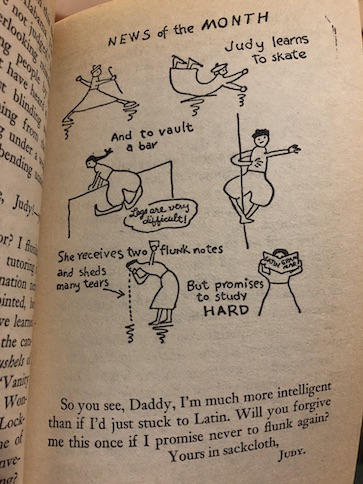


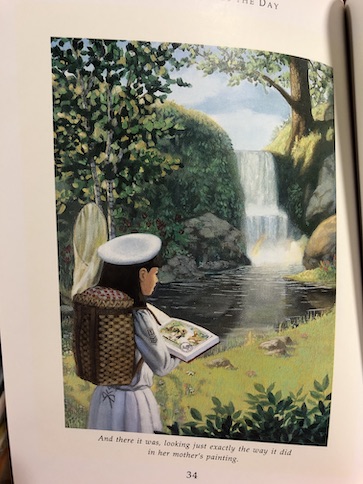
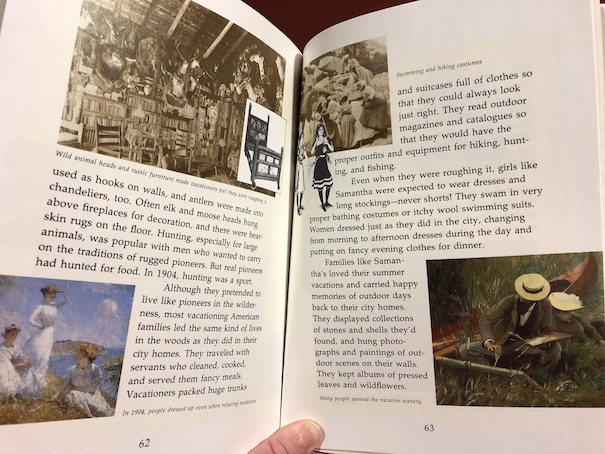


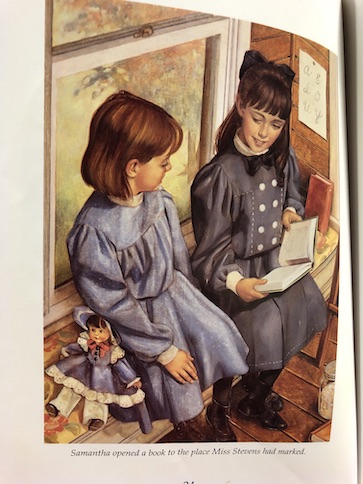
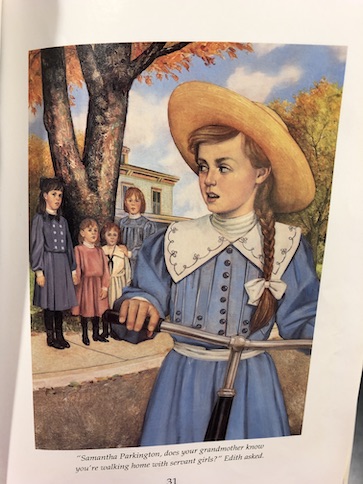


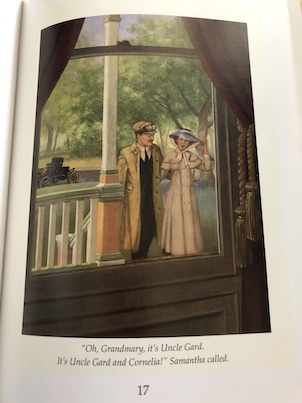


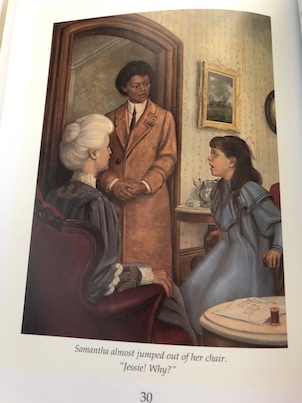
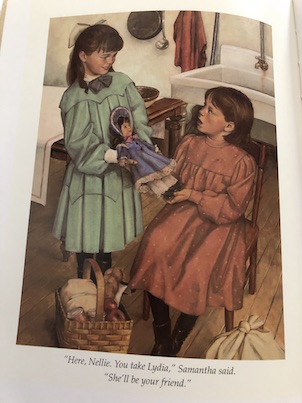



 Jestress's Forgotten Books and Stories