The Dragons Are Singing Tonight

The Dragons Are Singing Tonight by Jack Prelutsky, illustrated by Peter Sis, 1993.

This is a picture book of poems about dragons, but that description doesn’t quite do the book justice.

Jack Prelutsky is best known for his books of humorous poems for children, but not all of the poems in this book are funny. Some of them are humorous or have humorous twists, but others are just about the magic and wonder of the idea of dragons, some of which only exist in the imagination. Sometimes, just believing in magic or imagining it can be magical by itself!

The pictures are all excellent, colorful, and fanciful, and they really bring the poems to life. The book is larger than average, and the pictures span full pages.

The book is currently available online through Internet Archive.

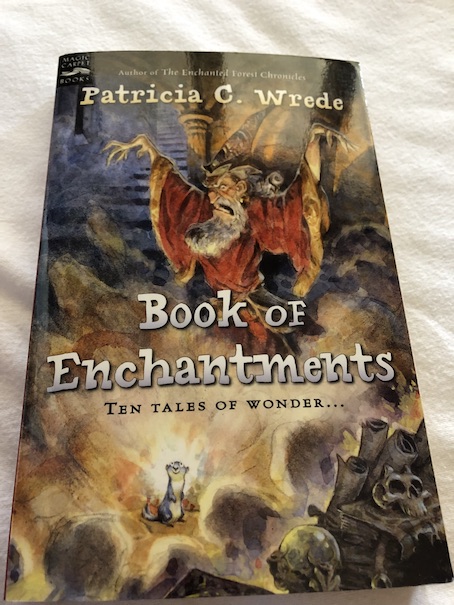
Book of Enchantments

Book of Enchantments by Patricia C. Wrede, 1996.

This is a collection of short fantasy stories, some of them based on other writings and series by the same author.  Many of them are also humorous. There is a section in the back of the book that explains the stories behind the stories and how they relate to her other works.

The stories included in this book:

Rikiki and the Wizard – A greedy wizard, unsatisfied with his success in life, attempts to summon a god to make him even more wealthy and famous so that he will never be forgotten. In exchange, he offers his daughter in marriage to the god who will help him.  Most of the gods recognize the wizard’s greedy and selfish purposes and refuse to cooperate, but Rikiki, the blue chipmunk god, is rather absent-minded and shows up to answer the summons. However, Rikiki, although having the powers of a god, is mostly obsessed with finding nuts, and how he interprets the wizard’s wishes (in exchange for the nuts the daughter feeds him, not for marrying the daughter) technically fulfill the requests but not in the way that the wizard had hoped.

The Princess, the Cat, and the Unicorn – This story takes place in The Enchanted Forest from one of the author’s series.  Things don’t go as expected for fairy tales in the fairy tale kingdom of Oslett, and it often bothers the king’s councilors.  Even though the princesses of the kingdom have a stepmother, she is a very kind and motherly person instead of the wicked stepmother usually found in folktales, and the princesses love her.  The princesses even get along well with each other instead of having the usual rivalries and jealousies between the oldest princesses and their pretty younger sister.  The middle princess, Elyssa, gets tired of being nagged about what the councilors think she should do and says that she’d like to go out and seek her fortune.  It’s not usually a thing for the middle princess to do, but well in keeping with what goes on in their kingdom.  She is accompanied on her journey by a talking cat who directs her to The Enchanted Forest, where the stuff of fairy tales happens.  There, the princess must escape the clutches of a vain unicorn, who is looking for a princess to adore it, and help the cat, who is not quite what he seems.

Roses by Moonlight – A modern retelling of The Prodigal Son story in a modern setting and with sisters instead of brothers and a fantasy twist.  Adrian is jealous of the party that her family is giving for her sister Samantha, the prodigal daughter returned.  As she sulks outside, her mother talks to her about her sister and the choices people make in life and enigmatically says that, while she is satisfied with her own choices and life, it occurs to her now that there may have been other choices that she had never considered before.  Instead of asking Adrian to come back inside and try to enjoy Samantha’s party, she asks her to stay outside for a while and see if someone shows up, mysteriously adding that if she is offered a choice, she should be careful and not choose too quickly.  Adrian does indeed meet a strange woman who offers her the choice of her destiny.  In a magical rose garden, Adrian may pick a rose which will represent the course that her life will take.  She is allowed to smell each one first and see what they have to offer.  Given the choice of any possible future, what will she choose?

The Sixty-Two Curses of Caliph Arenschadd – Also in A Wizard’s Dozen.

Earthwitch – A king whose kingdom is besieged appeals to the Earthwitch for help. He learns that the current Earthwitch is his former lover, and while the magic of the earth can help solve his problem, it will cost him to use it.

The Sword-Seller – A strange merchant gives a swordsman a free sword at a fair and recommends a woman to him who needs to hire a swordsman to accompany her on a journey to see her aunt, apparently fleeing problems with her other relatives. Her other relatives seem to behave oddly about the journey, and the swordsman isn’t sure why. He agrees to take the job and discovers the real reason why the merchant was willing to give him the sword.

The Lorelei – On a class trip, a girl has to save her classmate from the call of the Lorelei.

Stronger Than Time – This story is about what would have happened if the prince had been killed before rescuing Sleeping Beauty.

Cruel Sisters – A retelling of an old folk tale about jealous sisters, one of which evidently killed the other.  The story is told from the point of view of their other sister.

Utensile Strength – The last story in the Enchanted Forest Chronicles. When an enchanter makes a mistake while trying to make a magical weapon and accidentally casts the spell on a frying pan, the king and queen of the Enchanted Forest hold an unusual tournament of warriors to find the person who is destined to wield this very strange but powerful weapon.  The story is followed by the winning recipe from the cooking portion of the tournament, Quick After-Battle Triple Chocolate Cake.

The book is currently available online through Internet Archive.

Talking to Dragons

Talking to Dragons by Patricia C. Wrede, 1985.

This is both the fourth book in the Enchanted Forest Chronicles and the first book in the series that was written.  The author wrote this story before the others and then wrote the other three to explain how the characters got to this point.  The first three books in the series focus on Princess Cimorene and her adventures, but this book focuses on her son, Prince Daystar.

Partly because this series is kind of backwards, with the last book being the first written, I’m going to start with a spoiler.  When the book begins, Daystar is unaware that he is a prince and that his father is the king of the Enchanted Forest.  He grew up in an ordinary cottage on the edge of the forest, so he is accustomed to the presence of all kinds of fantasy creatures and fairy tale characters.  He thinks of himself and his mother as ordinary poor folk.  However, his mother has taught him not only reading and writing but other skills that are more unusual for peasants, like music, fighting, and even a little magic.

When Daystar is 16 years old, a wizard named Antorell comes to their house.  Daystar’s mother, Cimorene, seemed to know him, and he knows her.  Antorell demands “the sword” and the boy, and Cimorene casts a spell to melt him.  (“’No! Not again!’ he screamed.”  If you’ve read the other books, you already know why.  But, again, this book was written first.)

The next day, Cimorene gives Daystar a sword that he’s never seen before but which seems to draw him to it, and she starts giving him instructions.  The instructions are vague, but Cimorene insists that Daystar is to go into the Enchanted Forest and not to come back until he can explain why he had to go in there in the first place.  Also, he is not allowed to draw the sword from its scabbard unless he really needs to use it.  Cimorene says that she can’t explain more because it might “ruin everything.”  Not knowing what else to do, Daystar starts into the Enchanted Forest.  When he glances back, Cimorene and the cottage have suddenly disappeared.  Daystar has no idea why, but he has no choice but to keep going.

In the forest, Daystar meets a talking lizard called Suz, who claims to know everything about the Enchanted Forest and what goes on there (a tall claim, considering everything that goes on there).  When Daystar asked him if he knows anything about the mysterious, magical sword that his mother gave him, Suz tells him that it’s the Sword of the Sleeping King and that everyone has been looking for it.  Daystar knows nothing about it, which surprises Suz.  To Daystar’s surprise, both the sword and Daystar’s lack of knowledge agitate Suz, who says that he must get Kazul, who will know what to do.  Before he then runs off, leaving Daystar wondering who Kazul is, Suz tells him that he’s going to have to learn about the sword by himself because there are certain rules associated with magic, but that he should follow the sword to find out.

The next person Daystar meets is a red-haired girl who is stuck in a hedge.  She is surprised by how easily Daystar can get into the magical hedge, and at first, she thinks that he is a wizard.  She is relieved when she finds out that he’s not.  The girl, Shiara, tells Daystar that wizards have been chasing her because she burned the Head Wizard’s staff.  Most people could never accomplish that because wizards’ staffs are extremely powerful and have protective spells on them, but Shiara is a fire-witch.

As the two of them talk, Daystar learns that, while fire-witches are extremely rare and powerful come by their powers naturally, Shiara’s abilities are more unpredictable than most.  She has trouble casting spells on purpose, but when she gets mad, she can do some extremely powerful ones without really trying.  Fire-witches tend to have tempers, and Shiara is no exception.  Because of that, she doesn’t have many friends.  Most people are afraid to be around her because they never know when she’ll lose her temper and accidentally set things on fire.  Even worse, for Shiara, is knowing that most fire-witches are able to do very impressive spells and are almost invulnerable, but yet, she can’t even burn her way through a hedge when she tries it.  The wizards are very interested in her because most fire-witches are immune to their spells.  When they learned that she was a fire-witch who couldn’t cast her own spells, they tried to kidnap her in order to study her magic, which she how she ended up setting the Head Wizard’s staff on fire.

Daystar and Shiara finally get out of the magical hedge when Daystar suggests that Shiara try being polite to it instead of losing her temper.  Creatures and objects in the Enchanted Forest tend to respond well to politeness.  When they’re out of the hedge, a wizard shows up and tries to kidnap Shiara again, but Daystar defends her with his sword.  However, Daystar’s hand is injured when he tries to pick up the pieces of the wizard’s staff, and it explodes.

Daystar and Shiara seek help from Morwen, a witch who lives nearby.  It is from Morwen that Daystar begins to get a sense of what his sword is capable of doing.  He also meets up with Suz again, who tells him that he should go to the castle and that Kazul will meet him there.  Daystar still doesn’t know what he’s walking into, but missions in the Enchanted Forest can’t be ignored, and he has a mission to complete that everyone has been waiting for since before he was born.

By the end of the story, Daystar has learned what he needs to do to rescue his father, and Cimorene and Mendanbar are reunited.  Shiara ends up getting what she wants, partially, because she gains the ability to use her powers, but is forced to be polite in order to do so, which really irritates her.  She becomes Kazul’s new princess, where she will learn both the personal skills and magical skills she needs to control both herself and her ability.  Cimorene believes that Shiara will end up marrying Daystar eventually and becoming the next queen of the Enchanted Forest.  However, the series ends here, and the future is left to the imagination.  Morwen also decides to marry Telemain, a character from the previous books.

Like other books in this series, this book contains a lot of humor and parodies on popular fairy tales and fairy-tale creatures. Personally, I like the first two books in the series the best, but this one is also fun. There is a mild touch of romance to it, which is also nice.

The book is currently available online through Internet Archive.

There is one more story after this series, a short story in the collection Book of Enchantments that features Daystar and both of his parents but does not have Shiara.

Calling on Dragons

Calling on Dragons by Patricia C. Wrede, 1993.

This is the third book in the Enchanted Forest Chronicles. Cimorene is now married to Mendanbar and expecting their first child.

Morwen, a witch living in the Enchanted Forest, realizes that something strange is going on when she encounters a rabbit that is more than six feet tall. The rabbit, called Killer, has no idea how he managed to grow so big. It just happened suddenly that morning while he was eating some clover. Morwen goes to investigate the clover patch in the hopes of finding what might be responsible for the change. She discovers a wizard’s staff nearby, which is never a good sign.

She contacts King Mendanbar, Queen Cimorene, and her friend Telemain, a magical theoretician. Part of what they discover is that one of the wizards has shrunk himself in size. Mendanbar also discovers that someone has stolen the sword that he uses to control the threads of magic in the Enchanted Forest. The sword helps to maintain the protective spell around the Enchanted Forest that keeps wizards out. If the wizards have it, they may be able to enter the forest and soak up its magic. Mendanbar wants to go with the others to get it back, but Telemain points out that he can’t because he’s the other main focus of the protective spell; if he leaves the forest, it will be completely vulnerable. Even worse, they don’t have much time to retrieve the sword because whenever it’s outside of the Enchanted Forest, it leaks magic. Although Mendanbar doesn’t want to let Cimorene go on the mission to retrieve the sword while she’s pregnant, he has to let her go with the others. Before the book is over, Killer, who accompanies them on their mission, changes from a giant rabbit in to a flying blue donkey.

Among the fairy tale parodies that the characters encounter on their journey are a farmer named MacDonald (E-I-E-I-O) and a sorceress named Rachel who lives in a tower that can only be entered via a chair which Rachel lowers to bring people up (“Rachel! Rachel, send down the chair”). They keep in touch with Mendanbar in the castle using a magic mirror (“Mirror, mirror on the wall, I would like to make a call.”), until, for some reason, they are unable to reach him.

They are able to retrieve the magic sword, but the wizards capture Mendanbar and seal him inside his castle, trapped in a transportation spell to keep him safe yet contained. They don’t want to kill him because the Enchanted Forest would be plunged into chaos by his death, and they can’t keep him prisoner in a normal way because his friends would rescue him. Cimorene and the others know that the sword has the power to break through the shield spell on the castle, but the problem is that only a member of the royal family can wield it to do so. The sword allows Cimorene to carry it because she is Mendanbar’s wife, but only a blood relative can use the sword to break the spell . . . which mean that they have to wait for Cimorene’s baby to be born and become old enough to do it.

Although I like this series and think it’s a lot of fun, I’m not really fond of the last two books because of Mendanbar’s years of imprisonment. He’s okay when they finally get to him, but I still don’t like it. The ending of this book leaves things hanging until the fourth book.

This book is currently available online through Internet Archive.


Searching for Dragons

Searching for Dragons by Patricia C. Wrede, 1990.

This is the second book in The Enchanted Forest Chronicles, continuing the adventures of Princess Cimorene, although the story is told from the point of view of Mendanbar, King of the Enchanted Forest.  The Enchanted Forest is no ordinary kingdom, and Mendanbar is no ordinary king.  To be King of the Enchanted Forest means being a skilled enchanter.  Mendanbar can use the forest’s magic directly, making him more powerful than wizards.  Most of the creatures in the forest obey him, and unlike ordinary people, he can find his way around the forest almost automatically, even though things in the forest tend to move around.

At the beginning of the story, Mendanbar’s steward, Willin, pesters him about the subject of getting married.  Mendanbar hasn’t given the matter much thought since his father died three years earlier, but then, there’s been a lot to do.  Queen Alexandra has several daughters, any of which would be considered “suitable,” but Mendanbar doesn’t like any of them.  Mendanbar is annoyed because he’d just gotten the elf clans’ feud settled and was looking forward to a period of relative calm, so he decides that he’s going to give himself the day off, for a change.

He decides to take a stroll by the Green Glass Pool to relax, but on the way, he encounters a princess.  That’s not too unusual for the Enchanted Forest (home to many fairy-tale creatures and the events that make up fairy tales), but this princess strikes Mendanbar as a particularly scheming and ambitious one.  She tells him a great tale of woe in which her wicked stepmother cast her out that Mendanbar can tell is carefully rehearsed and might have even been the idea of the stepmother in question, with the idea of hooking an adventurous prince.  (Royal families do things like that, see the previous book in the series.)  However, Mendanbar is puzzled because the forest usually keeps out people who are obviously selfish.  Then, the princess mentions crossing an area of waste to get into the forest, and Mendanbar is alarmed because there shouldn’t be a wasteland there.  Forgetting about the princess, he hurries off to investigate.

Sure enough, Mendanbar discovers that a section of the forest is actually missing, destroyed to the point where there are just dead stumps.  Even the magic is gone.  Upon further investigation, Mendanbar finds dragons scales.  He isn’t sure why the dragons would want to attack the Enchanted Forest because they haven’t had any quarrels and mostly leave each other alone.  On the advice of a nearby talking squirrel, Mendanbar goes to see the witch Morwen.

After examining the dragon scales, Morwen demonstrates that, although they appear to be different colors and look like they’re from different dragons, they have actually been disguised.  They are actually from one dragon only.  Morwen also doubts that a dragon was really responsible for the damage to the forest.  After all, why would a dragon waste time disguising his scales when he could just pick them up?  Also, healthy dragons don’t shed that many scales.  Morwen is a friend of Kazul, who is the current King of the Dragons, and she advises Mendanbar to go see Kazul. 

Morwen also chides Mendanbar for not visiting Kazul when she became the king the year before.  Mendanbar feels a little guilty, saying that he’s just been very busy, which is true.  However, Morwen points out that what he could use is more effective help to organize things in the kingdom, not just making lists of things for him to do, like his steward does.  It’s part of the reason why people are saying that Mendanbar should get married.

Before Mendanbar can visit Kazul, he gets an unexpected visit from Zemenar, the Head Wizard.  Zemenar says that the wizards have been having problems with the dragons (again, see previous book) and that the dragons will not let them enter the Caves of Fire and Night.  He hopes that Mendanbar will allow them access from the Enchanted Forest.  Mendanbar doesn’t really trust the wizards, and he refuses the request on the grounds that he has something important to discuss with the King of the Dragons himself.  Zemenar tells Mendanbar about Kazul’s princess, Cimorene, blaming her for the the “misunderstanding” between the wizards and dragons.  Mendanbar at first imagines that Cimorene is much like the scheming princess he met that morning, but soon discovers that she’s anything but.  Taking the enchanted sword that only the kings of the Enchanted Forest can use with him, Mendanbar goes to visit the dragons.

At Kazul’s cave, Mendanbar meets Cimorene, who informs him that her official title is now Chief Cook and Librarian.  She tells him that part of the point of advertising this title is that it cuts down on the number of princes who come around.  Lots of princes want to rescue a princess, but few people want to rescue a Chief Cook and Librarian.  Mendanbar finds Cimorene a surprising change from the other princesses he’s met.  Mendanbar also makes a positive impression on Cimorene by using his sword to fix a broken sink, even if she describes the magic as being a bit “flashy.”

However, all is not well among the dragons.  Although Cimorene is reluctant to admit it at first, Kazul has mysteriously vanished.  She was planning to go out and search before Mendanbar showed up.  Kazul had been visiting her grandchildren when she decided to go by the Enchanted Forest to investigate someone growing dragonsbane.  Mendanbar shows Cimorene the dragon scales he found, and she indentifies them as belonging to Woraug, a dragon who was changed into a frog in the previous book.

It doesn’t take the two of them long to realize that the wizards are back to their old tricks and scheming.  However, what would they really have to gain by setting the Enchanted Forest and the dragons against each other?  And where is Kazul?

Like the other books in this series, this book is full of humor and a touch of mystery.  There are many parodies on fairy tale tropes, including an Wicked Uncle who’s not very wicked and does both a favor and an evil deed for his nephew by sending him to boarding school instead of abandoning him in the forest to have an adventure, as he’d hoped.  There is also romance between Cimorene and Mendanbar.  As you might have guessed, Cimorene is just the kind of practical princess Mendanbar needs to help him manage the magical chaos that is the Enchanted Forest and Mendanbar is the kind of king who is happy to find an intelligent princess who can do magic and rescue dragons.

The book is currently available online through Internet Archive.

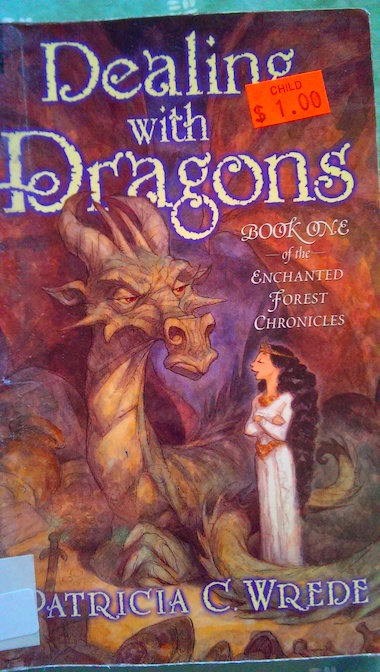
Dealing with Dragons

Dealing with Dragons by Patricia C. Wrede, 1990.

This is the first book in the Enchanted Forest Chronicles.  The fun thing about this series is that it parodies many popular fairy tales and their tropes.  Some of the books in the series also take the form of fantasy mysteries with some puzzle or nefarious happenings that the characters have to figure out.

From when she was a young child, Princess Cimorene of Linderwall has been bored with the kind of life that is expected from ordinary princesses.  Unlike her six older sisters, Cimorene doesn’t have golden curls.  She has black hair, and she’s way too tall for a cute little princess.  She’s also very stubborn.  When Cimorene gets bored of the usual princess lessons involving dancing, embroidery, and etiquette, she pushes other people in the castle into giving her different types of lessons.  First, she convinces the armsmaster to give her fencing lessons.  Then, she gets the court magician to give her magic lessons.  She also arranges Latin lessons, cooking lessons, economics lessons, juggling lessons, and so forth.  Each time her parents find out about her unusual lessons, they put a stop to them because none of the subjects that Cimorene finds interesting are “proper” for a princess to study. 

When Cimorene’s parents try to arrange for her to marry a prince that she doesn’t like, she finally decides that enough is enough.  Cimorene meets a talking frog in the castle pond, and after talking over her problem with him and saying that she’d rather be eaten by a dragon than marry the prince, the frog recommends that she run away.  He even gives her directions on where to go after she leaves the castle.  Not having any other plan, Cimorene takes his advice . . . and ends up at a dragon’s lair.

It works out for the best, though.  Rather than being eaten, Cimorene asks the dragons in the lair if they are in need of a princess.  She isn’t quite sure what princesses who are taken captive by dragons do, but she can cook (as part of her earlier cooking lessons) and do other chores.  Although one of the dragons, Woraug, wants to just eat her, the dragon called Kazul takes her on as her princess.

Cimorene finds it interesting being a dragon’s princess.  She cooks for Kazul and also helps to organize her treasure hoard and library.  As is expected when word gets out that Cimorene is a dragon’s princess, knights come to try to rescue her.  They are shocked when Cimorene turns them away, and it takes awhile before Cimorene is able to convince them that she’s really happy with the dragons and doesn’t want to be rescued.

Cimorene even makes new friends.  Morwen, a witch friend of Kazul’s, comes to visit and teaches Cimorene more about magic.  Morwen is also very practical and suggests putting up a sign (something like “Road Washed Out”) to discourage knights from approaching Kazul’s lair.  It is while Cimorene is putting out the sign that she means the wizard Zemenar.  His presence in the area is suspicious because wizards and dragons do not get along.  Wizards do not use their own magic but use their staffs to soak up magic from magical places or magical beings – like dragons.  When wizards take magic from dragons, they actually take part of their essence, and give them a reaction that’s similar to allergies.  Zemenar is also head of the Society of Wizards, so it’s doubly suspicious if he’s been hanging around a dragon’s cave.  When Cimorene tells Kazul and her friends about seeing him, they become concerned, wondering what he’s after.

Cimorene also meets other princesses who are the captives of other dragons: Keredwel, Hallanna, and Alianora.  At first, they also have trouble believing that Cimorene actually volunteered to be a dragon’s princess and that she likes it.  Cimorene doesn’t like the arrogant attitudes of Keredwel and Hallanna, but Alianora is pleasant, and the two of them become friends.  Alianora tells Cimorene that, although she was taken captive by Woraug, her family basically set her up for it.  Like Cimorene, she was under a lot of pressure to do the things that everyone expects of fairy tale princesses, but she wasn’t much good at them, and things never turned out as one might expect.  The wicked fairy who came to Alianora’s christening when she was a baby didn’t curse her; she just enjoyed the party and had a wonderful time.  Alianora also didn’t prick her finger on the spinning wheel that her busy-body aunt gave her, and when she tried to spin straw into gold, she got linen thread instead.  When various fairy tale schemes failed to work for Alianora, her interfering aunt arranged for her to visit a village, knowing that Woraug was going to ravage it.  As Morwen noted, princesses who are taken captive by dragons and then rescued can expect to make good marriages.  Although being abducted by a dragon was a shock, Alianora says it’s not so bad; Woraug mostly ignores her since she doesn’t know how to cook, and it’s a relief for her to get away from her nagging aunt.  The only downside is that the other, more conventional princesses are really annoying.  Alianora and Cimorene bond over their unconventional lives as fairy tale princesses.  Cimorene gets the idea to send some of her knights and princes to go rescue Keredwel, thus taking care of two problems at once.  Alianora also helps Cimorene with her efforts to find a fire-proofing spell to protect the princesses from accidental burning from the dragons, and later becomes her ally when things get more serious.

Zemenar returns to Kazul’s cave and, while Cimorene tries to subtly pump him for information, he sneaks a look at a book about the history of dragons.  He seems to be interested in the section about how they settled in the Mountains of Morning, how they chose their king, and the Caves of Fire and Night, where they found the special stone that they use to choose their king.

Then, the king of the dragons is murdered, poisoned by dragonsbane.  The wizards have a confederate among the dragons themselves, and they want something that only the king of the dragons can give them.

By the time the murder is committed, Cimorene and Kazul have a pretty good idea of who the conspirator among the dragons is.  The wizards think that they’ve found a way to rig the ceremony for choosing a new king so that the dragon who supports them will win, giving them what they really want.  However, Cimorene foils their plan with the help of her friends.  The mystery/conspiracy elements of the story are great and help add weight to balance out the lighter, fairy tale parody elements.

The book is currently available online through Internet Archive.

The King’s Equal

The King’s Equal by Katherine Paterson, 1992.

Everyone dreads the day that Prince Raphael will rule the kingdom instead of his father.  Prince Raphael is good-looking and highly educated, but he’s also selfish and greedy.  His one outstanding characteristic is that he’s arrogant.  He assumes that no one knows as much as he does about anything and no one is as deserving as he is . . . of anything.  Knowing that, as the old king lies dying, he makes his final decree that the prince will not wear his crown until he is married to a woman who is his equal.

When the prince hears that, he immediately becomes angry, saying (as his father guessed he would) that there could not possibly be any woman in the world who is his equal, who is as rich, intelligent, or beautiful as he is.  After his father dies, the prince immediately begins looting the kingdom for his own gain and generally abusing his subjects (as they had also guessed he would).  Still, he doesn’t have the one thing he really wants: his father’s crown.

The prince orders his councilors to find him an appropriate bride but (as the councilors feared), the task proves impossible.  No matter what options they place before the prince, the prince finds something about them to nit-pick.  Princesses of fabulous wealth are not beautiful or intelligent enough for him.  Princesses who have amazing beauty either aren’t beautiful enough or don’t know enough.  Princesses with amazing knowledge are still lacking in some area of knowledge or are just plain ugly in the prince’s eyes.  One by one, he dismisses them all.

Meanwhile, a farmer in the prince’s kingdom, has sent his daughter, Rosamund, to live in the mountains with their goats to avoid having the prince confiscate their only livestock, which he has done with everyone else.  During the winter, Rosamund and the goats almost starve, but they are saved by a magical Wolf.

The Wolf assures Rosamund that her father is alive and well, and Rosamund says that she is worried about what is happening in the kingdom.  The Wolf tells Rosamund that the kingdom would be saved if the prince finds the princess that he is looking for and that she should go to the capital and present herself as that princess.  Rosamund doesn’t see how she can do that because she is definitely not as wealthy as the prince, and she doesn’t think of herself as particularly beautiful or clever.  However, the Wolf tells her that her mother, who died when she was born, had blessed her, that she would be a king’s equal.  To fulfill her dead mother’s wish, Rosamund does as the Wolf tells her.

To Rosamund’s surprise, the prince falls in love with her beauty at first sight.  She also impresses him with her intelligence when she tells him that she knows what no one else does, that he is actually very lonely.  (Which is natural, since he thinks that no one can be his equal or true companion.)  Although she cannot demonstrate that she possesses great wealth, she can demonstrate that there is nothing in particular that she wants while the prince still feels like he is lacking things he needs (like his father’s crown).  The prince is satisfied that Rosamund has passed all the necessary tests to be his equal, but Rosamund turns the tables on the prince by pointing out that his description of her has made her more than his equal, challenging him to prove to her that he is worthy of marrying her.

It is in meeting Rosamund’s challenge, taking care of her goats in the mountains for a year, Raphael learns humility from the Wolf.  While he’s away from the palace, Rosamund tends to the kingdom, ruling more compassionately than Raphael had.  When Raphael returns, he is humble enough that he doesn’t think that he is worthy of marrying Rosamund, but his humility is precisely what makes him worthy, and they do marry.

My Reaction

Overall, I liked the story, although I wish that we could see a little more of the conversation between Rosamund and Raphael when she explains to him who she really is. They still get married, so whatever Rosamund told Raphael must have persuaded him, but it’s left to the imagination how she explains it. How I picture it is partly based on the fact that, during the last year, Rosamund has lived as a princess, even though she was originally a goatherd, and Raphael has lived as a goatherd, even though he is really a prince. By the time the year is over, they have each lived in the other’s place, and that is what really makes them each other’s equal. Raphael was callous and arrogant because he never thought about how other people lived until he tried it himself.

I don’t know if Rosamund really learned anything from her experiences as a princess, which bothers me a little because I think that she really should have because it was so far outside of her experience. We don’t really hear about that because the focus is on Raphael’s changing character. Personally, I’d like to think that part of what Rosamund may have learned is that running a country is a big, difficult job, and that, while her rule was better than Raphael’s for being more compassionate, it’s not a job that she would like to do alone, emphasizing that she and Raphael would be better ruling as a team than either of them would be by themselves. If Rosamund and Raphael really both need each other, it would be fitting for a story about equals.

Magician’s Ward

Magician’s Ward by Patricia C. Wrede, 1998.

This is the sequel to Mairelon the Magician.  When the book begins, it has been about a year since Kim and Mairelon’s previous adventures.  Kim has been living with Mairelon as his apprentice, and he has been teaching her both reading and magic.  (In the previous book, Kim was living on the streets of early 19th century London.  She did not know how to read, and at the end of the previous book, she learned that she had the ability to become a wizard, prompting Mairelon to take her on for training.)  Although Kim enjoys spending time with Mairelon and appreciates what he’s teaching her, other aspects of life with Mairelon’s wealthy family are less appealing.  Kim gets bored reading by herself while Mairelon continues his work with the Royal College of Wizards, and Mairelon’s aunt, Mrs. Lowe, is trying to turn Kim into a proper young lady.  The pressures of the social niceties and obligations wear on Kim, and even more worryingly, Mrs. Lowe has been considering Kim’s marriage prospects.

In order to be socially-acceptable, Mrs. Lowe thinks that Kim should be considering a socially-acceptable marriage for her future.  For most of her life, marriage was about the last thing on Kim’s mind.  She spent most of her youth pretending to be a boy in order to be safer on the streets.  Since she became Mairelon’s apprentice, the challenges of reading and magic have occupied most of her time.  When Mrs. Lowe brings up the subject of marriage, the idea seems ridiculous to Kim.  With her poor background, she can’t imagine what kind of “respectable” man would want to marry her, and she can’t imagine anyone among the upper-class people of London she would want to marry.  However, she sees Mrs. Lowe’s point that she won’t be able to stay Mairelon’s apprentice and ward forever.  At some point, she will need to decide what to do once her training with Mairelon is complete.  It’s a little worrying to her that Mairelon (known to most people by his real name, Richard Merrill) hasn’t discussed the future with her and doesn’t seem to be making any plans.

Then, one night, Kim overhears someone breaking into the library in their house.  At first, Kim can’t imagine what someone would want in the library.  She interrupts the thief, and he manages to escape.  After colliding with her in the hallway, the thief leaves behind one of his buttons and a small piece of wood that seems to be magic.  When Mairelon examines the wood, he says that it appears that someone stored a spell inside it temporarily, to be used by someone else.  Also, whoever put the spell together didn’t do a very good job and probably didn’t really know what they were doing.

As for what the thief was looking for in the library, Mairelon discovers that he was particularly looking through a collection of books that his father purchased years ago from a French wizard who had come to England after fleeing the French Revolution.  In particular, the thief seems to be trying to obtain the memory book that belonged to the wizard’s wife.  A memory book is exactly what it sounds like – a book that that keeper would carry around with him or her and use to record certain things that he or she would particular want to remember, a little like a journal but often containing bits of important instructions, like notes about favorite recipes or cold remedies (not necessarily the entire recipe, just general reminder notes) or, in the case of a wizard, notes about important spells.

As they investigate further, they learn that the wizard and his wife were part of a larger society of wizards in France before the Revolution and that someone has been trying acquire all of their old books and notes to learn the secret of one of their spells, specifically a spell for sharing magical power.  The person who wants this knowledge has a nefarious purpose for it, and when Mairelon tries to interfere with his plans, he uses the knowledge he has acquired to block Mairelon’s own magic!  This spell and its power-hungry master has already harmed other magicians, and now, Mairelon is in danger, too.

Meanwhile, Mairelon and his family have decided that, in order for Kim to truly be accepted in society, she must have a coming out party.  The mystery and intrigue of the story mix with Kim’s new lesson in dancing, fashion, and social etiquette and the unexpected attention that she receives from young men as she begins truly mingling with the upper classes of society.  Part of the mystery actually does involve the tensions between social classes, social mobility, and the extent to which birth and natural ability influence both.  As Kim discovers that she is more acceptable in society and desirable to at least some of the upper-class young men, she also finds herself becoming jealous of the attention that Mairelon receives from young women in search of a good husband.

Like the first Mairelon book, this one is a nice mixture of mystery, fantasy, history, and comedy of manners.  Both of the Mairelon books are a fun mixture of intrigue and humor, and this one also has a nice romantic element as Kim realizes that the only man she could ever see herself marrying is Mairelon.  He’s eccentric and sometimes aggravating, but she loves him, and he has loved her all along, from the time when she was just a thief in the marketplace to her beginnings as a wizard and her transformation into a young lady. The book ends with Kim and Mairelon engaged to be married, and I’m sorry to say that there are no more books in the series after that. I really wish that there were because I think that there’s a lot more room for character development.

The villain’s plot in this book hinges on the earlier established principle that wizards are born, not made.  Only certain people have the ability to use magic.  For some people, like Kim, the ability to use magic can lift them to higher positions in life, and it can be a source of real power.  For a person who is unable to use magic, there aren’t as many options.  The villain in this book thinks that he’s found a way around the problem, but as Mairelon guessed from the first, he doesn’t really know what he’s doing.

Even though this book has been a favorite of mine for years, I noticed something this time that hadn’t really occurred to me before.  Mairelon’s aunt and mother in the book look at fashion and social obligations in a similar manner to people in high society and the business and legal professions (categories that overlap) in modern society, whereas Mairelon, who is considered pretty eccentric for a man of his family’s social standing, and other wizards seem to look at fashion and social obligations more like modern day academics, engineers, computer programmers, and other tech experts (at least, the ones I know because those are the kind of circles I tend to move in).  Within each of these categories, some of these characters are more knowledgeable about fashion or more socially adroit or intuitive, but I noticed that there are two basic schools of thought going on here.  For the high society types, fashion is essential and social activities are their main focus in life because that is how they build their connections, make the best possible marriage matches, gain support from others, and generally move up the social scale, always aiming to do a little better that they did before or set the stage for their children to move up.  For the wizards and academic types, fashion and social obligations are of secondary importance because what makes the biggest difference in their lives is knowledge and skill.  They even say that wizards are always considered socially acceptable because of their abilities and professional standing.  Because of that, they’re socially allowed some eccentricities in personal habits and dress, and many of them take those liberties as much as possible because most of them are kind of socially introverted and prefer either the privacy of their own studies or the company of others who share their professions and interests. 

At first, Mairelon doesn’t do much about Kim’s social education because it is not a subject that’s important to him and he knows that she can go pretty far in the field of magic by putting most of her efforts into building her magical skills.  However, what Mairelon’s mother and aunt try to impress upon both Mairelon and Kim is that they both need some social skills in order to function in wider society.  This is kind of like how tech experts may have some great ideas for creating new software or a new form of online business, but in order to get their ideas off the ground, they have to have some business knowledge or connections.  Wizards may be allowed to be a little less social or more eccentric than other people, and it’s generally understood and expected, but they do much better if they learn to balance their preferences with society’s expectations.  Because the people who normally occupy high society love the latest fashions and attending prestigious social events, they can’t understand why other people don’t. As the story says, they would leap to the assumption that a wizard, who is always acceptable in society, would naturally want to participate in society, and if the wizard didn’t, it must be that they are either not really a wizard or at least not a good one.  In other words, they would assume that something was wrong with the person or their skills, not recognizing that their choices are simply a matter of personal taste.  In order for Kim and Mairelon to truly rise in their professions, they also have to learn to manage their social obligations.

In the book, Renee is an example of a character who has learned this type of social, professional, and personal balance.  She is a wizard, and as a single female, is regarded as something of an eccentric, but she understands that social skills are important.  She is a longtime friend of Mairelon’s, and she lectures him somewhat on his social obligations and acts as something of a big sister/fashion mentor to Kim, along with Mairelon’s female relatives.

The book is currently available online through Internet Archive.
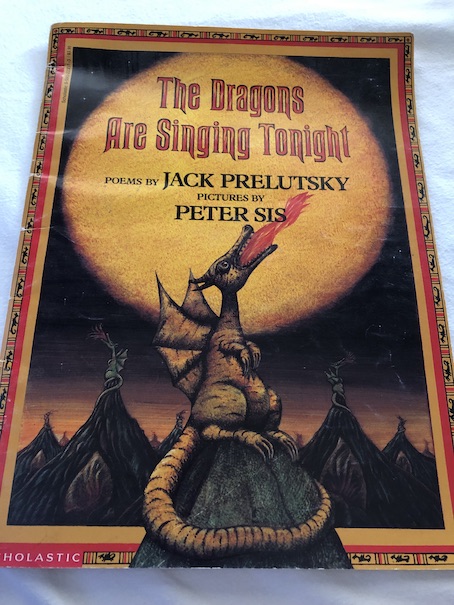
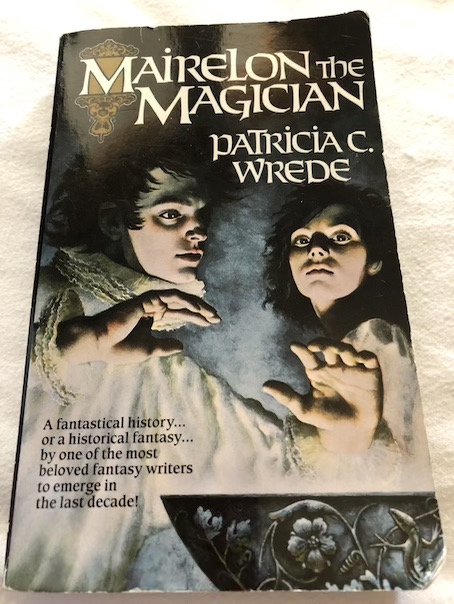
Mairelon the Magician

Mairelon the Magician by Patricia C. Wrede, 1991.

This young adult book takes place in an alternate history version of Regency England.  In this world, magic is a normal and accepted part of society.  “Wizard” is an accepted profession, and there is even a Royal College of Wizards dedicated to magic.  Not everyone can be a wizard because not everyone has the ability to use magic.  It is a skill that people are either born with or born without, similar to people who have an innate talent for art or music, compared to people who are born tone-deaf or color-blind.

In this early 19th century world, there is a teenage girl, Kim, who lives on the streets and survives by her own wits, taking whatever jobs she can and committing a little petty thievery whenever she needs to.  She has spent most of her life dressing like a boy and pretending that she is one because life on the streets is even more precarious for a girl.  For a time, she was part of a gang of child thieves run by a woman call Mother Tibb.  As far back as Kim can remember, Mother Tibb was the only one who took care of her as a child.  Kim has no memory of her parents or any knowledge about what happened to them.  She doesn’t even have a last name.  However, before the story begins, Mother Tibb was caught and hanged for her crimes.  Some of the other child thieves were apprehended and put in prison or exiled to Australia, but Kim managed to escape.  Since then, she has been on her own.  So far, she has managed to avoid being pressured in to joining up with other gangs or turning to prostitution to survive, but the fear of that haunts her. Her future is uncertain.

At the beginning of the book, Kim is hired to sneak into the wagon of a traveling magician who is performing in the market and to see what he keeps among his belongings.  The man who hired her doesn’t want her to take anything, but he is particularly eager to see if the magician has a particular silver bowl in possession.  It’s a strange request, but the money that the man offers Kim is too good to pass up.

However, the magician, who calls himself Mairelon, isn’t quite what he seems.  He is not just an ordinary traveling entertainer using some sleight of hand to amuse people in the market.  Kim discovers that he can do real magic as she searches his wagon and is knocked unconscious by a real magical spell that Mairelon uses to protect his belongings.

When Kim wakes up, Mairelon and his servant, called Hunch, have tied her up.  Unlike Hunch, Mairelon has also realized that Kim is actually a girl, not a boy.  The two of them question Kim about why she sneaked into the wagon, and she tells them the truth about being hired to do it.  When she describes the man who hired her, it seems that Mairelon recognizes the description.  The part about the silver bowl also unnerves him.

Surprisingly, Mairelon makes Kim an offer to come with him and Hunch when they leave London.  He is fascinated by Kim’s skills in picking locks, even the lock on the booby-trapped trunk that knocked her unconscious, and he thinks that Kim might be useful to him and Hunch, perhaps helping with the magic act.  In return, he offers to teach Kim some of his magic tricks.  Hunch is dubious about Kim because she has obviously been a thief, and Kim also isn’t sure what to make of Mairelon.  She knows that he’s hiding something, but she isn’t sure what.  No one with real magical abilities like him would ordinarily be making a living with simple magic tricks in the market. 

However, Kim does accept the offer because she’s been worried about one of the major criminals in the area, Dan Laverham, who has been showing too much interest in recruiting her. He is heavily involved with a number of criminal activities, and he knows that Kim is a skilled lock pick.  If he found out that she was a girl, he would probably also press her into prostitution. Dan Laverham would be a good reason to get out of London for a while.  Also, Kim realizes that if she learns a few magic tricks from Mairelon, she might be able to set herself up as an entertainer and make an honest living, safe no matter who finds out that she’s female.  Besides, Kim realizes that if she’s not satisfied with the situation, she could always run away later.

Before leaving London with Mairelon, she returns to the man who hired her, at Mairelon’s suggestion, and tells him that she didn’t see a silver bowl in Mairelon’s wagon (which is true because she was knocked unconscious and didn’t see anything in the trunk).  The man is angry, but Mairelon, who followed her in disguise, helps to create a distraction so that she can get away from the man.  They leave London in the middle of the night because Mairelon says that he was spotted by someone who recognized him when he went out to get magic ingredients.

On the journey, Kim gradually gets to know Mairelon and his situation.  The silver bowl, which Mairelon does have, is actually part of a set of magical objects which, when used together, can compel people to tell the truth without interfering with their ability to answer questions intelligently.  Mairelon’s real name is Richard Merrill, and he is, or was, part of the Royal College of Wizards.  Years earlier, the Royal College of Wizards was analyzing this particular set of magical objects and the unique spell that they control, when they were suddenly stolen, and Merrill was framed for the theft.  At the time, Merrill was unable to prove his innocence (at least not without sounding as if he had done something inappropriate with a lady, which he also did not do – they were just together at the time of the theft because she was helping him and another friend with a magical experiment), but he was also recruited by his friend in the government to be a spy against the French, so the story of his supposed theft gave him a plausible reason for wanting to leave the country.  In the time since then, he and his friend have continued to look into the matter of the theft, and they have made some progress in tracking down the other pieces of the magical set.  At the time that Kim met him, he was on his way to the next piece of the set, a silver platter.

To their surprise, however, they soon discover that someone has been making copies of the platter.  The copies are not magical, but they do confuse the issue.  Who is making the copies and why would they want copies, since they do not have the powers that the original has?  As Kim and Mairelon investigate, they crash a house party at a lavish country estate and spy on a meeting of a rather inept society of druids.  All the while, they are getting closer and closer to finding the original thief.

I loved the combination of mystery, fantasy, history, and humor in this book!  It’s one of my all-time favorites.  It has a happy ending with Mairelon’s name cleared and the thief caught.  They also discover that Kim has the ability to use magic, and Mairelon offers to take her on as his apprentice, saving her from the streets forever.  There is a sequel to this book called Magician’s Ward, about Kim’s life and adventures as Mairelon’s student.  The hints of romance in this book are also much stronger in the next one.  There are only two books in this series, which is disappointing because the characters are so much fun, and I think that there is a lot more room for their development.  By the end of the next book, Kim’s future is looking more certain, but her past is still murky.  Originally, I had expected that there would be secrets revealed about Kim’s past because of her ability to use magic, possibly something that was passed on to her by her parents.  However, by the end of the second book, Kim still doesn’t know who her parents were/are, and it doesn’t look like there’s any chance that she will ever know.  Perhaps it doesn’t really matter. Sometimes, secrets are more tantalizing when you imagine the answers than when you actually find out.

The book is currently available online through Internet Archive.
The Cabin Faced West

The Cabin Faced West by Jean Fritz, 1958.

Ten-year-old Ann Hamilton hasn’t been very happy since her family decided to move West.  Her family lives in 18th century Pennsylvania, and moving West means homesteading in an area where there are few other families, none of which have girls Ann’s age.  Her father and brothers love the adventure of starting over in a new place on the western frontier (what is considered the frontier for their era), but Ann is lonely, surrounded by boys, and missing their old home.  When her father built their cabin, he purposely placed it so that the door faces to the west because he says that’s where their future lies.  Ann’s brothers, Daniel and David, also make up a rule that no one can complain about the west (partly because Ann had already been doing a lot of complaining), saying that anyone who does so will get a bucket of water poured over their head, and they make a game out of trying to catch each other complaining about something.  So, there is nothing Ann can do but suffer in silence and write in her diary, a present from her cousin Margaret when the family left Gettysburg.

There’s a boy close to her age who lives nearby, Andy McPhale, but Ann doesn’t think much of him.  He makes jokes about her being “eddicated” because she can read and write.  Sometimes, he seems like he wants to play with her, but she’s a girl, and he doesn’t want to play girl games.

Andy McPhale also worries about his mother.  His father believes in hunting and trapping more than planting.  Rather than grow some of their food, Andy’s father goes off for days at a time on hunting expeditions, leaving his family with very little while he’s gone.  Ann’s family thinks that this is a sign of poor planning for the future and don’t think highly of Andy’s father for it.

Later, they meet a young man named Arthur Scott who has just arrived in the area and is looking for land to settle on.  When Mr. Scott first arrives, he meets Ann on the road.  Ann has allowed the hearth fire to go out, and she is on her way to her aunt and uncle’s house to borrow some from them because she doesn’t know how to start a fire by herself.  Understanding her problem, Mr. Scott gives Ann a ride home on his horse and helps her to restart the fire, promising not to tell her parents.  They invite him to stay for lunch, and he talks about his time at Valley Forge with Washington’s soldiers when he was only 13 years old.  He was too young to fight, but he volunteered to drive an ammunition wagon.  Ann thinks of George Washington as a hero, and she finds it thrilling that Mr. Scott served with him.

Arthur Scott becomes a friend of the Hamilton family, and Andy McPhale seems jealous of him and the attention that Ann pays to him.  Then, Andy tells her that his family has decided to go back to town for the winter.  In the spring, they will return to the area and try farming, persuaded by their experiences working with the Hamiltons.  To Ann’s surprise, Andy offers for Ann to come with them.  She could visit Gettysburg and stay with her cousin Margaret again.  Ann has been lonely, being the only girl in the area, and it’s a tempting offer.  However, Ann feels like she must stay for her family’s sake and so she won’t feel like a deserter.  When a storm destroys a good part of her family’s crop, she feels terrible and wonders if it’s all really worth it.

In the end, there is a great surprise coming for Ann: she gets to meet her hero, George Washington, when he comes to see some land that he has purchased nearby.

The book is currently available online through Internet Archive (multiple copies).

My Reaction and Addition Information

I first read this book when I was a kid in elementary school. As the cover of the book says, the author won the Laura Ingalls Wilder Medal, which honors authors and illustrators for children who have made long-term contributions to children’s literature. Laura Ingalls Wilder was the author of the semi-autobiographical Little House on the Prairie books, but because those books contain uncomfortable racial language and situations, her name were removed from the award in 2018. The award still exists, but it’s now called the Children’s Literature Legacy Award, which is more descriptive of its purpose.

I liked this book as a kid, although I had forgotten many of the details before I reread it as an adult, and I’m not sure if I fully understood the history behind the story when I was a kid. I think stories actually become more interesting when you know the background, so I’d like to discuss the history a little.

The story is based on the real life of Ann Hamilton, the great-great-grandmother of the author of this book, who did get to meet George Washington in 1784. The author is essentially retelling an old family story. The real Ann Hamilton married Arthur Scott when she grew up.  The place where they lived, called Hamilton Hill in the story, is now called Ginger Hill. In fact, it seems that a member of the Hamilton family caused the name change, although that story isn’t really one for children.

One of the parts of the story that I always remembered from when I read it in school as a kid was the part where Ann talks about “mother’s fried wonders”, basically describing a fried donut. People in the 18th century did make various types of fried pastries, varying in style and name depending on where they lived. For an example of early American donuts, see this video by Townsends about 18th century doughnuts, where they make doughnuts and talk about the history and evolution of American “dough nuts” (they talk about the name and how it seems to come from the original shape – nut-shaped pieces of dough).