#1 Dinosaurs Before Dark by Mary Pope Osborne, 1992.
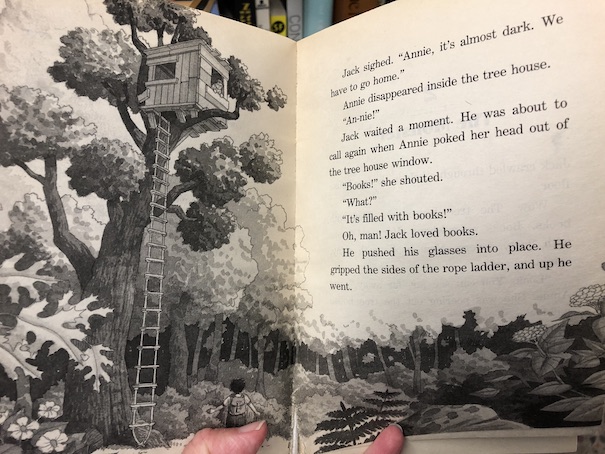
Eight-year-old Jack is walking home with his seven-year-old sister, Annie, when Annie spots a tree house in the woods that they’ve never seen before. In spite of Jack’s warnings, Annie climbs up into the tree house and yells down that there are a bunch of books in there. Jack loves books, so he also climbs up into the tree house to see what she’s found.
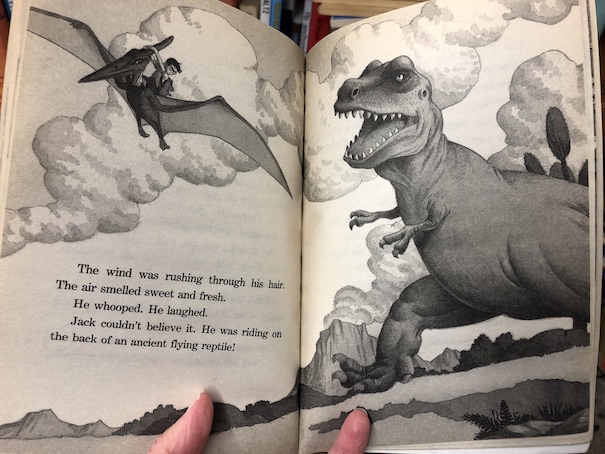
There are books in the tree house about all sorts of interesting times and places. When Jack starts looking at a book about dinosaurs, he wishes that he could see one himself. Suddenly, the tree house takes the kids back in time to a land filled with dinosaurs. The two of them have some hair-raising adventures as they try to figure out how to get back home, getting some help from a friendly Pteranodon when they need to escape from a Tyrannosaurus Rex.
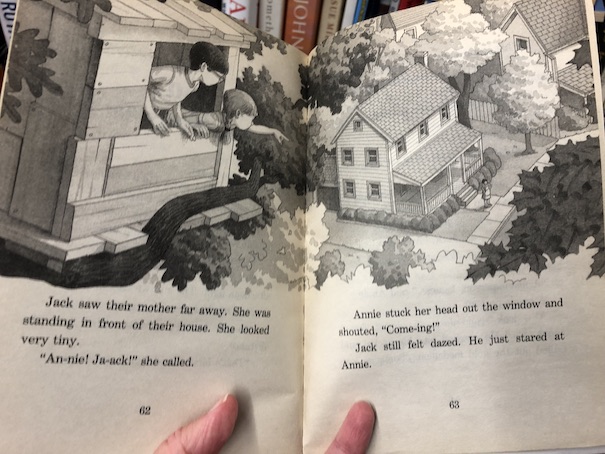
The kids figure out that the tree house will take them anywhere they want as long as they look at a picture of the place in one of the books and wish to go there. There is a book about Pennsylvania in the tree house with a picture of their home town in it, so all they need to do is to look at it and wish they were there in order to go home.
While they are still in the land of the dinosaurs, Jack finds a gold amulet with the letter M on it. He thinks it belongs to whoever owns the tree house, so he picks it up and brings it back with them, although by the end of the book, the kids still don’t know who it really belongs to. The ownership of the tree house is something that they eventually figure out through their adventures with it. (See book #4 in the series for the answer.)
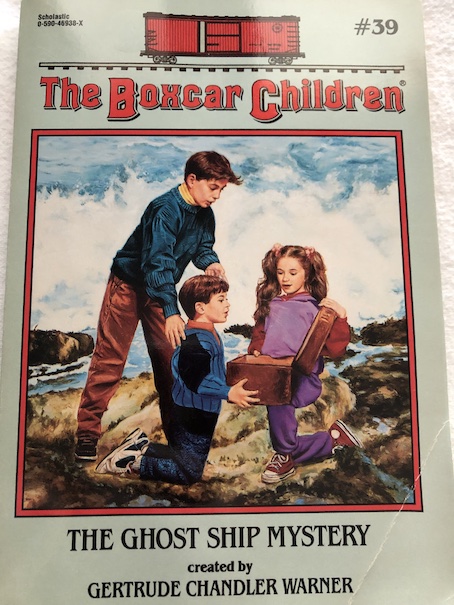
#39 The Ghost Ship Mystery by Gertrude Chandler Warner, 1994.
The Alden children are visiting the New England seaside town of Ragged Cove while traveling with their grandfather on a business trip. They enjoy visiting the sea, but on a stormy night at the inn where they are staying, they learn that the town has its own ghost story about a ship called the Flying Cloud that sank off the coast years ago. When storms are coming, people see strange lights that some people think might be the spirits of the people on the Flying Cloud.
As the Aldens soon learn, the events of the Flying Cloud are still affecting people who live in the town. When the ship was wrecked, the only member of the crew who made it to shore was a cabin boy, who died shortly afterward, mumbling about how one of the crew members had taken command of the ship away from the captain in an apparent mutiny. The descendant of the ship’s captain, a woman who manages the small local museum, is bitter toward the descendant of the man who apparently led the mutiny, who now gives whale watch tours.
The Aldens find it strange how events of the distant past can still mean so much to people who are still living, but they find themselves caught up in learning the real secrets of the Flying Cloud when they go on a whale watch tour and their guide, Captain Bob, also takes them scavenging for wreckage after the storm. They make an amazing discovery of a sailors’ post box, a metal box where sailors used to leave messages for each other or objects that they wanted to have delivered home before they would arrive themselves. This particular box has been untouched in a niche in a rock for years, and it has information about the Flying Cloud. At first, Captain Bob is reluctant to part with it, but the Aldens persuade him that it should go to the museum. Captain Bob says that they should take it there on his behalf because the woman who runs the museum won’t want to see him.
The woman who runs the museum is amazed at the find and is eager to explore the contents of the box. However, when the Aldens leave her alone with it for a short time, they notice that a leather book that was in the box suddenly disappears. The woman denies that it was ever there, making the Aldens suspicious. Then, they later hear that someone broke into the museum and stole the entire contents of the box. Who is really responsible for the break-in, and what really happened on the Flying Cloud all those years ago?
Part of the mystery concerns how people deal with history, especially history that concerns them in a very personal way, when new information is uncovered that changes the story. That the woman who runs the museum is responsible for the book that disappears is obvious because she denies its existence when the Aldens know that they left it with her. The book turns out to be the log book of the Flying Cloud with its final entry, left behind in the post box when the crew began to doubt if they’d make it safely home. The story about the woman’s ancestor, the brave captain who was apparently the victim of a mutiny, isn’t quite what she had always believed, what her family told her, and what she herself had reported in a book that she wrote about the incident. It was partly true, but the final log entry contains new information that puts the whole situation into a different light. The woman struggles not only with the changing story but how that story affected her own behavior, and she worries that what she wrote in her book was a lie. A friend of hers comforts her by saying that it wasn’t a lie, it was the truth as they all understood it for years, just not the complete story, as it turns out. Benny’s proposal that the woman write a new book with the new information makes her feel better.
(Spoiler: It’s not really a mutiny if the captain is incapacitated, and the captain had already died of a severe illness by the time that the ship was wrecked. The person who was blamed for the mutiny wasn’t really at fault.)
The story also explains a little about scrimshaw for an educational element. They describe various objects that sailors could make from scrimshaw. When I first heard of it, it was described as being decorative, but the book talks about useful things, like sewing needles and pie crimpers, that were made with scrimshaw.
Mystery of the Pirate’s Ghost by Elizabeth Honness, 1966.
Abby
and Kit Hubbard’s mother has just received a letter telling her than her half
brother, Jonathan Pingree, has died and left her the old Pingree mansion. He has left over bequests to other family
members as well, and money to be held in trust for Abby and Kit. It’s exciting news, and the family may move
to live in the mansion they have inherited, although it partly depends on Mrs.
Hubbard’s other relatives.
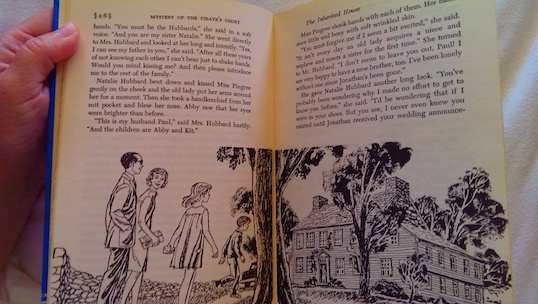
Mrs. Hubbard, who was born Natalie Pingree, has never met her half-brother or half-sister. They were her father’s children, from his first marriage. She doesn’t know much about her father’s early life because he died when she was very young, and all that she knows about him is what her mother told her. Apparently, her father’s first marriage was not a happy one. He stayed in that marriage long enough for his first two children, Jonathan and Ann, to become teenagers. Then, he made sure that his first wife and children were settled comfortably enough in the family home and left them to move to Philadelphia to start a new life by himself. Sometime later, his first wife died and he married Natalie’s mother, who was much younger. After his death, Natalie and her mother moved in with her mother’s sister, Aunt Sophie. When Natalie got married, Aunt Sophie sent a wedding invitation to Johnathan and Ann, but they never came to the wedding or made any reply. Natalie assumed that they felt uncomfortable about their father’s remarriage and didn’t want to see her, which is why she’s so surprised about Jonathan leaving the family home to her. The only reason she can think of why he would do that is that neither he nor his sister ever married or had children of their own, so there was no one else to leave the house to. Both of them were more than 30 years older than Natalie, and Ann is now an elderly woman, still living in the house. Jonathan’s will has made provision for her as well, and the Hubbards go to see her at the Pingree mansion.
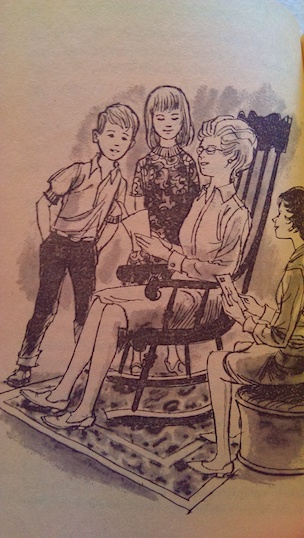
Mrs. Hubbard is pleasantly surprised that Ann is actually happy to see her. Ann Pingree explains that the reason why she and Jonathan never replied to the wedding invitation was that, until that invitation arrived, neither of them had known that their father had another child, and they felt awkward about it. However, Ann has been lonely since Jonathan’s death, being the last of the Pingrees, and she is glad to have Natalie and her husband and children with her and is eager to have them move into the mansion and live there. (Ann doesn’t live in the old mansion itself, but she does live nearby.)
Aunt Ann shows the family around the old mansion and explains more about its history and the history of the Pingree family. It turns out that the house, which has existed since Colonial times, although it has been burned, remodeled, and expanded over time. The house also has a number of secrets. Apparently, there used to be a tunnel running from the basement of the house to the beach that was used to bring in smuggled goods during the Colonial Era. There is also a hidden room behind a fireplace upstairs where the children of the family could hide during Indian attacks. (It doesn’t say how often that happened.) To the family’s surprise, Ann also tells them that the mansion is supposed to be haunted. The kids think it all sounds exciting, although Ann doesn’t explain much about the ghost the first time she mentions it. (Kit uses the phrase, “Honest Injun?” when asking Aunt Ann if she really means it when she says that the house is haunted. This isn’t a term that people use anymore because it isn’t considered appropriate.)
Mr. Hubbard is able to get his job transferred to a different branch of the company he works for, so the Hubbard family decides that they will move into the Pingree mansion. The kids like living by the beach, and their parents tell them that they can use the old ballroom of the house as a kind of rec room. Soon, they meet a couple of other children who live in cottages nearby, Chuck and Patty, and make friends with them. Chuck and Patty have already heard that the Pingree house is supposed to be haunted, although they’ve never seen anything really mysterious, just a light in the house once when they thought that the house was supposed to be empty.
The next time Aunt Ann comes to visit, the four children ask her to tell them about the ghost, and she tells them the story of the first Pingree to live at Pingree Point. This ancestor, also named Jonathan Pingree, built the original house in the late 1600s. He was a shipbuilder who owned several ships of his own, and he wanted to live near the sea. Later, he also became a privateer. When the kids call Jonathan a pirate, Aunt Anne agrees and explains that, unlike a pirate, Jonathan’s position as privateer was all perfectly legal because he had a Letter of Marque. (Yes, privateers operated within the law, but yes, they were also essentially pirates who raided other ships for their goods. In other words, they did the same things, but privateers did it with permission whereas ordinary pirates didn’t get permission. Historically, some privateers continued their pirating even after permission was revoked, so as Aunt Ann says, “the line between that and piracy was finely drawn.”) His son, Robert, was sailing on one of his father’s ships when it was taken by other pirates, and Robert was forced to join their crew. The family never saw Robert again and only found out what had happened from a fellow crew member who was set adrift and managed to make it back home. What happened to Robert is a mystery. His family didn’t know if he had really taken to the life of a pirate and couldn’t return home because he couldn’t face his family, if he had been killed in some fight, if he had been hung for piracy because he had gotten caught and couldn’t prove that he was forced into it. However, members of the family claimed that Robert’s spirit did return to the house and that he knocks at doors and windows, begging to be let back into his old home. Aunt Ann says that she’s never seen the ghost herself, but old houses can make all kinds of noises on windy nights, and that’s what she thinks the “ghost” is. As Chuck and Patty leave, they say, “we hope that old ghost doesn’t show up to frighten you.” Of course, we all know that it will because otherwise this book would have a different title.
One day, Kit is bored and starts playing around in the secret room, pretending that he’s hiding from American Indians. While Kit is in the secret room, he overhears the servants, John and his wife Essie, who have worked for the family for years, talking. Essie seems very upset and wants John not to do something that might risk their home and jobs, but John says that it’s too late and that they’re already “in it” and “can’t get out.” Kit tells Abby what he heard. That night, Abby hears banging and wailing during a storm and fears that it’s the ghost. Soon, other strange things happen, like a desk that mysteriously disappears and a cupboard that also mysteriously appears in its place. The children like John, and they don’t want to think badly of him, but he’s definitely doing something suspicious. One night, the children try to spy on him, and Abby once again hears the wailing and sees a mysterious, cloaked figure in the fog. Is it the ghost?
There are some interesting facets of this story that make it a little different from other children’s books of this type. For one thing, the children confide their concerns to their parents almost immediately, and the parents immediately believe them. In so many children’s mysteries, either the children decide to investigate mysterious events on their own before telling the parents or the parents disbelieve them, forcing the children to investigate on their own. It was kind of refreshing to see the family working together on this mystery. It actually makes the story seem more realistic to me because I can’t imagine that I would have been able to keep worries about mysterious things secret from my parents as a child, and they would have noticed if I was sneaking around, trying to investigate people, anyway. Abby and Kit do something dangerous by themselves before the story is over, but they also confide what they’ve done to their parents at the first opportunity and do not take the same foolish chance again.
The truth of John’s activities comes to light fairly quickly, although it takes a little longer for the family and the authorities to decide how to handle the situation. Investigating John brings to light some of the Pingree family secrets, and Abby and Kit soon discover the fate of Robert the pirate and the truth of his ghost. I’ll spoil the story a little and tell you that the ghost that Abby sees is apparently real, but it isn’t very scary. Once they learn the truth of what happened to Robert and see that his body gets a decent burial, the ghost appears to be at peace.
One thing that bothered me was the way that the characters talk about Native Americans in the book. It’s not the talk about Native American sometimes abducting children because I know that happened. It’s more how they picture that would happen. In the scene where Kit was hiding in the secret room, Kit imagines that the Indians were attracted to the house by the smell of his mother’s cooking and that he went into hiding while his mother fed them to avoid being abducted. As part of his scenario, he imagines that his mother would have wanted to “hold her nose against the Indian smell.” What? Where did that come from? There are all kinds of tropes about Native Americans in popular culture, from the “noble savage” image to that silly “Tonto talk” that actors did in old tv westerns, but since when are they supposed to smell bad? I’ve never seen characters in cheesy westerns hold their noses before, so what’s the deal? I tried Googling it to see if there’s a trope that I missed, but I couldn’t find anything about it. I’m very disappointed in you, Elizabeth Honness.
This book is currently available online through Internet Archive.
The Secrets of the Pirate Inn by Wylly Folk St. John, 1968.
One day, Jack, Amy, and Sally’s mother receives some surprising mail for her deceased father. The children never met their grandfather, who died before they were born, but the letters concern their grandfather’s Uncle Will. Uncle Will is an 88-year-old man, and one of the letters is from Miss Dibble from the Welfare Department in Port Oglethorpe, Georgia, the seaside town where Uncle Will is living. Miss Dibble is concerned that Uncle Will is no longer in his right mind and not capable of taking care of himself, and she is hoping that his family will persuade him to go live in a retirement home.
The children’s mother says that Uncle Will was an adventurer and a wild character even in his younger years, always playing games and doing eccentric things, so the situation may not be as bad as Miss Dibble thinks it is. The mother has never met Uncle Will, either, because her grandmother disapproved of him and discouraged him from hanging around the rest of the family years ago. She knows that her father always thought of him as being a fun uncle and that he used to own some land in North Georgia, where he found a priceless diamond.
The
second letter comes from Uncle Will himself.
It contains a strange rhyme and a letter to his deceased nephew, saying
that he sold his land and that the money from that sale and his diamond will go
to him upon his death. Uncle Will says
that Miss Dibble is pressuring him to turn over his money to the state and to go
live in the old folks’ home. He’s been
resisting her efforts, but he admits that he has gotten absent-minded and has forgotten
where he hid his money and diamond. He
knows that the rhyme he wrote down is a clue that he made to remind himself of
the hiding place, but now he’s confused, and he’s hoping that his nephew can
help him figure it out because it’s based on a game they used to play years
ago. Because it’s been so long since he
last spoke to the family, he has no idea that his nephew has died. Uncle Will also says that he is currently
living in an old pirate’s inn near Port Oglethorpe that has its own secret
passage where pirates used to shanghai sailors.
The children think that Uncle Will and his pirate’s inn sound exciting, and they’d like to go meet him. Their mother says that she’ll have to talk to their father about it, but she thinks that it might be a good idea for them to go and check up on Uncle Will and talk to Miss Dibble. She makes up her mind when Miss Dibble sends an urgent telegram in which she says that Uncle Will is under the delusion that someone is now hiding in his house and trying to kill him for his money. The mother and the children decide to go see Uncle Will, although the father of the family can’t go because he has a business trip.
Of course, Uncle Will isn’t delusional, and there is someone after his hidden money. The old inn where Uncle Will lives is called The Bucket of Blood. When the children and their mother arrive, Uncle Will pretends to be an old pirate parrot, calling out “Pieces of eight! Pieces of eight!” (Yes, he’s definitely an eccentric, and it’s a little more understandable why Miss Dibble thinks he might not have all of his faculties.) They introduce themselves to Uncle Will, and Uncle Will is sorry to hear that his nephew is dead, but he is pleased to meet his nephew’s daughter and her children. The children tell him that they want to help him to solve the rhyme and find his money.
The inn is full of fascinating things, although it’s lacking in modern conveniences. The mother asks Uncle Will if they can stay there, saying that they’ve brought sleeping bags with them. Uncle Will tells them that they can use the bedrooms upstairs but warns them that he’s worried that someone might be hiding somewhere upstairs (as Miss Dibble had said earlier). Uncle Will rarely goes upstairs these days because he finds it difficult to climb up there. However, the children realize that Uncle Will is not deluded when they notice footprints in the dust on the stairs, meaning that someone has been there recently. However, the footprints seem to be only going up, not down. When the search upstairs, they don’t find anyone. Where the footprints left by a ghost? Was someone really hiding in the inn, and if so, how did they leave?
There is a live action made-for-tv Disney movie based on this book. You can see the entire movie online at Internet Archive. The movie is different from the book in a number of ways. In the movie, there are three children, but it’s two boys and a girl (a brother and sister and the brother’s friend) instead of two girls and a boy (all siblings), and none of them are related to the old Irish sea captain living in the old inn. (Note: The child characters in the movie, Scott, Tippy, and Catfish, also appeared in another made-for-tv Disney movie called The Strange Monster of Strawberry Cove, which was also based on a book for children, The Mad Scientists’ Club, but that book was written by a different author, and none of those children actually appeared in either this book or that one.) The old captain in the movie has recently inherited the inn from his brother. The location was moved to Louisiana instead of Georgia, and the treasure they’re looking for was hidden by the pirate Jean Lafitte. There are rhyming clues to the treasure’s location, but they’re not the same as the rhymes in the book. The money and the diamond are also hidden in separate locations in the book. In fact, although the bulk of the money is in one place, some of it is hidden in other places.
In the book, there are also extra characters, a man named Miles who is staying with Uncle Will while he’s working on writing a book and a young runaway nicknamed Hop who is afraid that he will be sent to another foster home like the one he ran away from if Miss Dibble catches him. At first, I suspected one of these characters of being the villain of the story, trying to steal Uncle Will’s money. However, the real villain is someone we don’t really know until the end, although he has connections to other people in the story. This is different from the movie, where the villain is a suspect we meet and see often before his guilt is established. Because of this, I think that the movie was playing more fair with the readers about the mystery.
Near the beginning of this book, the characters reference The Joyous Season by Patrick Dennis (also the author of Auntie Mame), which was published only a few years before this book was. Sally thought that the book was hilarious, but Jack thought that it was boring because the boy in the story, who was his age, “didn’t have a thing to do every day but listen to grownups talking.” I think this is meant to be a sign that the children’s parents are pretty modern and progressive, letting their children read a book about divorce and mixed-up family life in the 1960s. At one point, the mother tells Jack not to use euphemistic swear words like “Cripes!” just because characters in books to it. It gets on the mother’s nerves because she thinks that “They sound even worse than the words they’re being used to avoid.” She actually tells Jack, “When you’re old enough to swear by any words you like, I hope you’ll manage without euphemisms.” I mentioned in my page of 1960s children’s books that the 1960s were a turning point both in society and children’s literature, and this is an example of people’s changing attitudes. Sally, the oldest of the children, is allowed to wear lipstick, and Amy, who is twelve, is also allowed to wear it, although she thinks of it as being too much trouble to bother most of the time. (I can relate. I still sometimes throw out old make-up that I just plain forgot that I had because I’m too busy and preoccupied most of the time to think about it.)
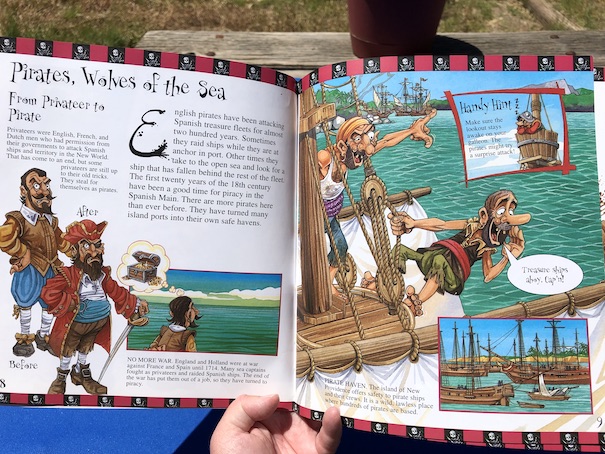
You Wouldn’t Want to Be a Pirate’s Prisoner by John Malam, 2002.
This
picture book, which is part of a series, explains what it would have been like
to be a pirate’s prisoner in the 18th century. It sets the stage by casting the reader in
the role of a Spanish ship captain in 1716.
The reason why the reader is cast as a Spanish captain, captured by English pirates, is because England and Holland had been at war with Spain until 1714. During the war, the government of England (as well as Holland and France) authorized some ship captains to act as privateers, conducting raids on Spanish ships and outposts. When the war ended and the privateers were dismissed from service, some of them continued to act as independent pirates.
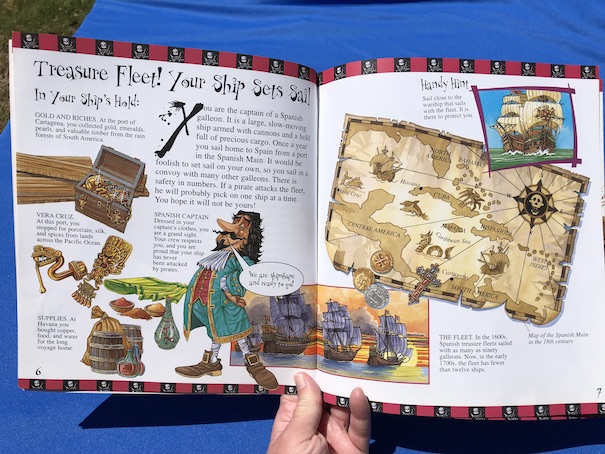
The book explains the geography of the “Spanish Main,” the area between the southern coast of North America and the northern coast of South America – basically, the Caribbean Sea and its islands and the Gulf of Mexico. Spanish galleons in the 18th century carried gold and treasures from the Americas to Spain as well as timber from the rainforests and goods that were transported to the Americas across the Pacific Ocean, such as spices and silk. All of these goods made Spanish treasure ships tempting targets for English pirates.
As a Spanish ship’s captain, there were a few precautions that you could take against pirate attack. One of the most basic was traveling as part of a convoy because pirates would be more likely to attack a lone ship than one that was part of a group. A fleet of ships would have a warship traveling with them for protection, and the closer your ship sailed to the warship, the less likely a pirate ship would try to separate you from the group and attack.
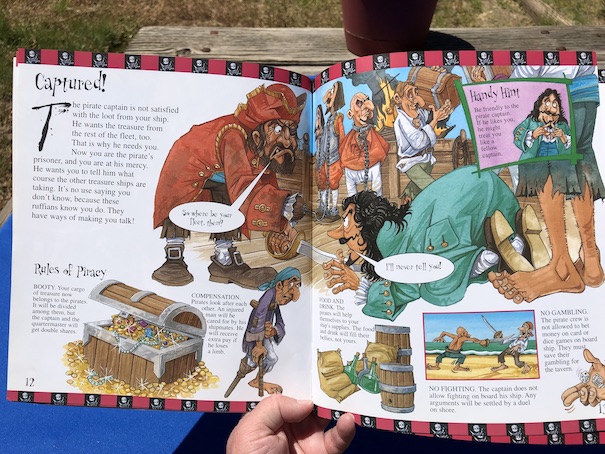
If the
worst situation happened and the ship was taken by pirates, a captain could try
to dress like other members of the crew to disguise his rank, but that didn’t
always work. The captain of the ship was
in danger of being taken captive because he might have information that the pirates
would find useful, like the exact route of other ships in a convoy.
The gruesome part of this book (and the source of the title, because this series basically focuses on the gruesome parts of history) is the part where they describe different forms of torture that pirates might use on a ship’s captain to convince him to tell them what they wanted to know. Besides the direct physical abuse, pirates could also keep a captive in squalid conditions to make him weaker, more vulnerable, and exposed to disease. In the end, they might simply decide to maroon the captive somewhere, even if they got the information they were after.
However, pirates could also face gruesome fates if they were caught. They could be hung and their bodies displayed publicly, as a warning to others.
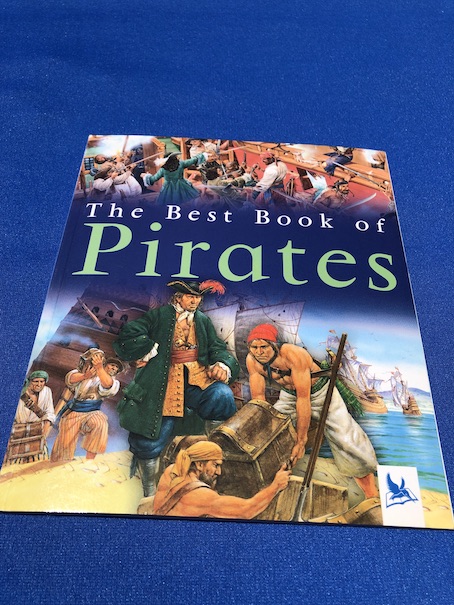
The Best Book of Pirates by Barnaby Howard, 2002, 2006.
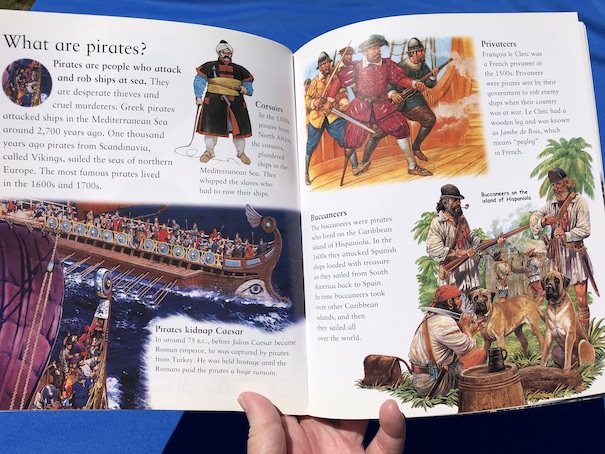
This is an easy and informative non-fiction picture book about pirates. Rather than focusing on any particular time period or geographic area, the book gives a broad overview. In the beginning, it explains a little about different groups of pirates through history, including Vikings, Corsairs, Buccaneers, and Privateers. There is also a brief explanation of the Pirate Round, a sea route often taken by pirates during the late 17th century and into the 18th century. The route led from North America and the Caribbean to Africa, circling the coast of South Africa to Madagascar and on to the Middle East and India. (If you’ve seen the movie Cutthroat Island, the crew will basically be taking this route when the movie ends, heading from the Caribbean to Madagascar.)
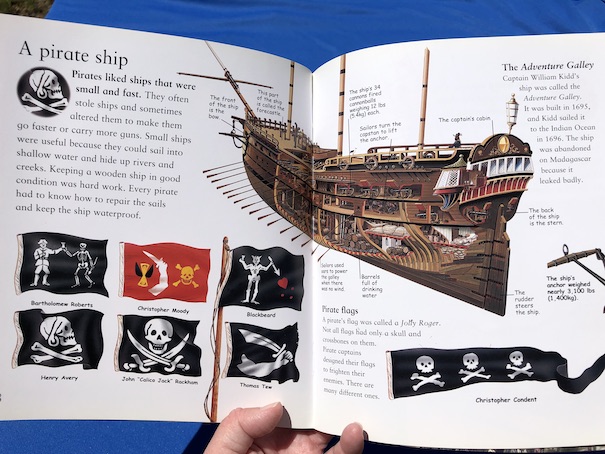
There is a diagram of a pirate ship from the late 17th century, showing what it would have looked like on the inside, and there are also examples of Jolly Roger flags, which were designed by individual pirates as personal identification, typically including skulls and skeletons to frighten their victims. There is also some general information about what life would be like on board a pirate ship and the types of weapons they might have.
Then, the book begins to focus more on groups of pirates that operated in specific geographical areas and some of the more famous pirates from history. The Barbary pirates (also called Barbary corsairs) were Muslims who raided Christian ships along the coast of North Africa and the Mediterranean during the 1500s. Among the most famous Barbary pirates were a pair of brothers called Barbarossa (“Red Beard”). Sometimes, European and American pirate ships that went to Africa to find gold and ivory also entered the slave trade.
In the section about the Spanish Main, it explains how privateers and pirates raided Spanish ships taking Aztec treasures from Mexico to Spain. Buccaneers were specifically pirates who raided ships in the Caribbean. Their name came from the type of fires they used when cooking meat (boucan or buccan).
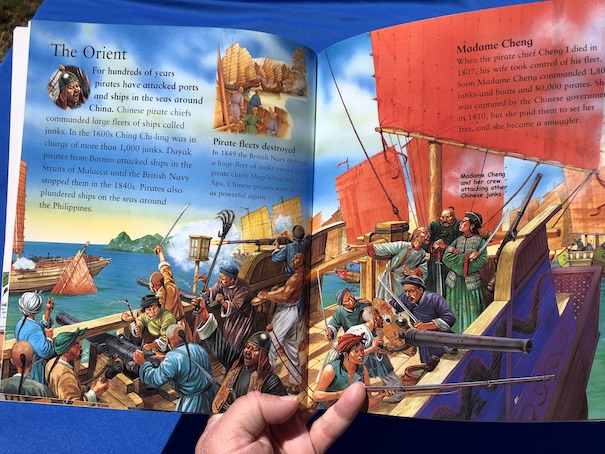
There were also Asian pirates who raided the coasts of China and the Philippines and areas around the Indian Ocean. Chinese pirates and Dayak pirates from Borneo were powerful in the region until the 1840s, when the British Navy destroyed many of their ships.
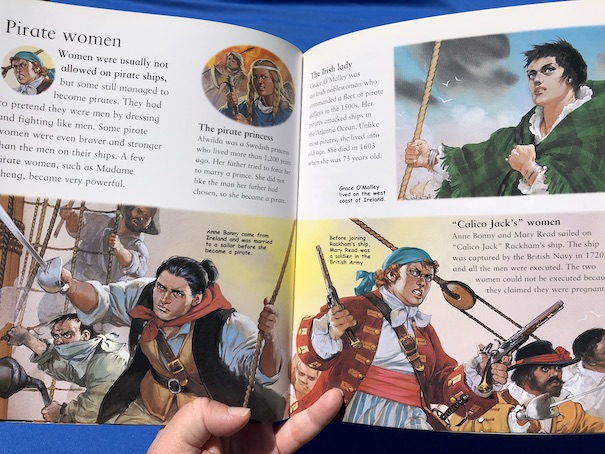
There is a section in the book specifically about female pirates. Mary Read and Anne Bonny, who sailed with “Calico Jack” Rackham, were famous. Grace O’Malley was a famous Irish pirate who was also an Irish noblewoman. Madame Cheng was a Chinese pirate who took over her husband’s fleet after his death (but because this is a children’s book, it doesn’t mention her previous career). Alwilda was a Medieval Swedish princess who turned pirate after her father tried to make her marry a man she did not want to marry (although her story may only be legend).
The
book also talks about the famous stories of pirates burying treasure, although
it says that pirates would usually spend their money quickly, sell items for
money they could spend, or gamble it all away.
At the end of the book, there is a short section about modern pirates and how their goals and tools of the trade have changed.
The book isn’t very long, but I think that it provides a good, general overview of the subject of pirates throughout history, and the pictures are fascinating and detailed.
The book is currently available online through Internet Archive.
Meet the Men Who Sailed the Seas by John Dyment, 1966.
This book is part of a series of historical biographies for children. Unlike other books in the series, the book doesn’t focus on a single person, talking about the lives of many famous sailors and explorers with some historical information about sailors and sailing ships in general.
When I was a kid, I went through a phase where this was a favorite book my mine, and I carried it around and read it constantly. It’s a little surprising that I became so attached to this particular book because I grew up in Arizona, in the middle of a desert, miles from the nearest ocean. I was seven years old before I even saw an ocean and a sailing ship in real life, and even then, it was a matter of years before I saw these things a second time. Because of that, as a child, I wasn’t particularly attracted to boats or interested in ocean travel. I wasn’t even a very good swimmer (liked it, just not good at it because I didn’t get a chance to do it much when I was young), and I was kind of afraid of deep water. We learned about Christopher Columbus in school, but I thought that Columbus Day was the most boring holiday on the calendar (there was no candy and no dressing up in costumes, and I’m not even sure that we got that day off of school, which were my requirements for what made a really good holiday), and Christopher Columbus was not remotely my most favorite historical character. So what was it about this book that caught my attention? Why did I like it so much?
There are a number of things about this book to like. When I was a young kid, I wasn’t fond of nonfiction books because it was a little too much like school, but this book was different. It was one of the first nonfiction books that I really wanted to read. The large, friendly type is encouraging to younger children who are just starting to read nonfiction chapter books, and the detailed drawings are fascinating. Best of all, it’s a journey through time as well as across oceans. I always liked history.
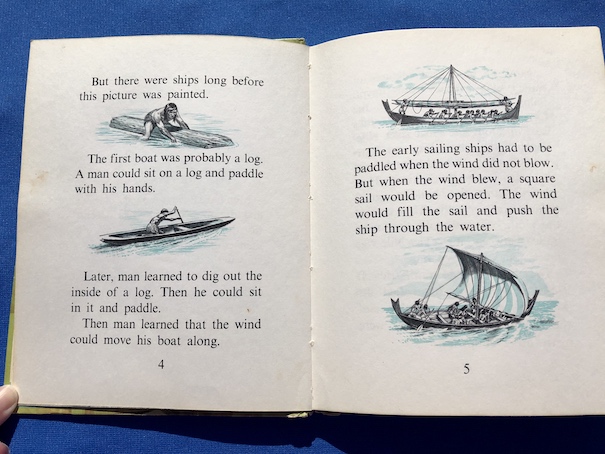
The book starts off by explaining how early sailors might have traveled. It speculates that people first realized that they could travel by water by floating on logs and then realizing that they could carve those logs into canoes and paddle them to move in the direction they wanted to go, eventually adding sails to move even faster with less effort.
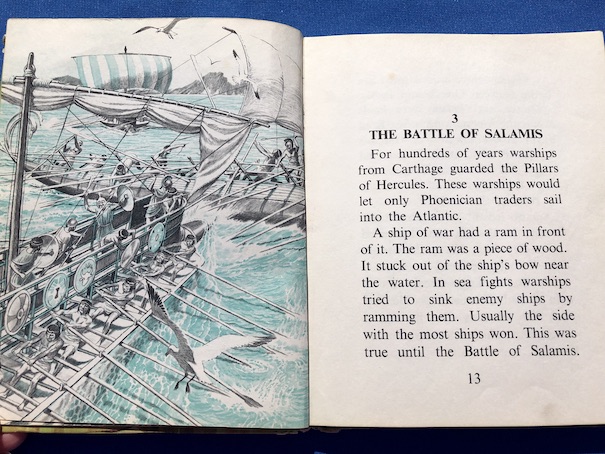
It then describes how ancient civilizations such as the Egyptians and Phoenicians traveled by ship. There is a chapter about Hanno of Carthage, a Phoenician who commanded a fleet of ships and was known for sailing around the coast of Africa. (That section and the next one use the old name for the rocks at the Strait of Gibraltar, the Pillars of Hercules.) The next chapter describes the Battle of Salamis between Greece, led by Themistocles, and Persia, led by Xerxes. This battle is particularly notable because the Greeks defeated the Persians through a clever trick even though they were out-numbered, proving that a good battle strategy could allow even smaller fleets to gain the upper hand in battle. There is also a chapter about Pytheas, a Greek sailor who sailed to Britain in search of tin and “Thule” (it’s not completely clear what he meant by Thule, although it was apparently a place north of Britain) and wrote a book about his travels.
In the early Middle Ages, Viking raiders began attacking Britain. The chapters about Vikings describe Eric the Red and his adventures in Iceland and Greenland, where he founded a colony of people from Iceland. Vikings also established a colony in the Americas that they called Vinland. However, they eventually abandoned Vinland because of conflicts with the people they called Skraelings (Native Americans). (The exact location of Vinland was in dispute for some time, and some people speculated that it might actually refer to multiple locations, but the likely site is at L’Anse aux Meadows in Newfoundland.)
The other explorers and adventurers described in the book are Marco Polo, Christopher Columbus, Ferdinand Magellan (known for sailing around South America to the Pacific), Francis Drake (his section includes an account of the battle with the Spanish Armada), and Captain Cook (known for sailing to Australia and New Zealand and claiming them for England and for insisting that his sailors eat cabbage and onions to prevent scurvy, later killed in Hawaii).
The book also discusses the Mayflower and Pilgrims, and there are chapters about American ships and sailors, like John Paul Jones, and the roles they played in the American Revolution and the new United States shortly after. Because the focus of the book focuses on sailing ships, it ends with Robert Fulton‘s steam ship, the Clermont, and Joshua Slocum, who sailed around the world alone.
So, the reason why I’m still kind of attached to this book, which was old even when I first read it, is that it was my introduction to a world that I wasn’t even really interested in at first, a world that became more interesting after seeing the history and other countries connected to it. I’m still more of an armchair explorer than anything else, but this book added a dimension to my early armchair travels that probably wouldn’t have occurred to me before. As a side note, I don’t think that the book mentions that the navigation instrument that one of the men on the front is holding is an astrolabe, but I now own one of these myself. If you want to try one, you can make a simple version at home yourself. They can be used on land as well as sea!
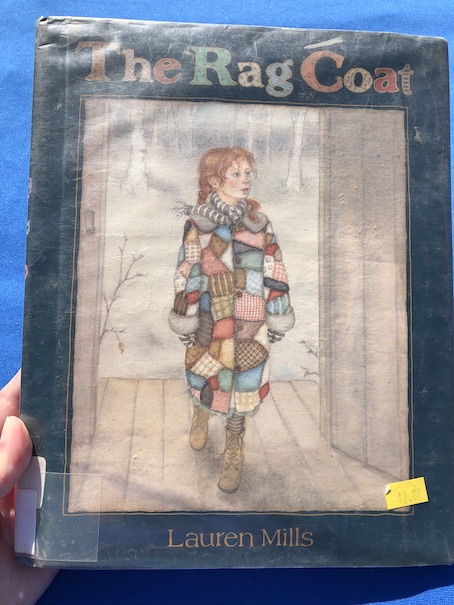
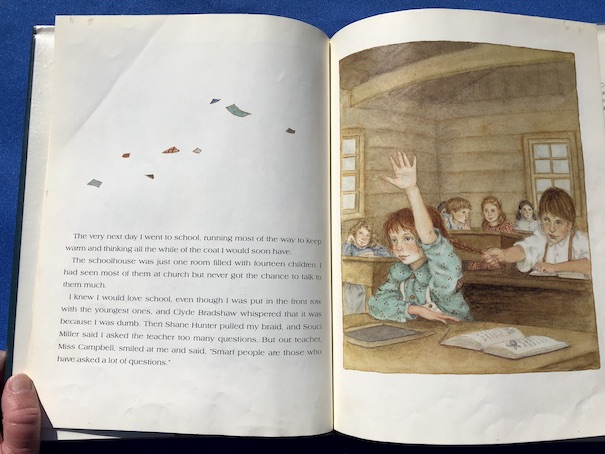
Minna is a poor girl, the daughter of a coal miner. Her father has been ill with the miner’s cough, so Minna has to help her mother to make quilts that the family can sell for money. She wants to attend school, but she can’t because she is needed at home and her family can’t afford a warm coat for her when winter starts. It’s too bad because Minna really wants to make some friends her own age, and she would meet other children at school. Her father says that he will find a solution to the problem, but he dies before he can.
After Minna’s father’s death, some of the other women in the community come to the house to work on making quilts with Minna’s mother. When the women say that the quilt pattern they are using is named after Joseph’s Coat of Many Colors, Minna wishes again for a coat. When the other women, who are mothers themselves, realize that Minna cannot go to school until she has a coat, they decide to make one for her. They don’t have much money, but they do have plenty of quilting scraps. They decide to make a new, quilted coat for Minna out of their old scraps.
Minna starts going to school and does well, although she gets some teasing because, as a new student who has never been to school before, she has to sit with the youngest children, and Shane pulls her braid. Something that Minna particularly likes at school is Sharing Day (what my school always called “Show and Tell”), where students are given the chance to show special things to the class and talk about them. Minna decides that when her coat is ready, she will show it to the class during Sharing Day.
As the coat is being made, Minna admires all of the beautiful colors of the cloth scraps in the coat and adds a piece of her father’s old jacket as well. Each of the other scraps in the coat also has a story that goes with it. The cloth pieces come from old clothes and blankets that people in the families of the quilting mothers have used, and they memories attached to them. The mothers tell Minna all of the stories as they work on the coat, and Minna loves it.
However, when Minna wears the coat to school for the first time, the other kids make fun of her for wearing rags. Minna is really upset and runs away into the woods. After thinking about it, Minna remembers what her father said about how people really need other people, and she decides to go back to school. There, she tells the other students that the rags in her coat are actually their rags, and she begins reciting the stories that go with them.
One of the scraps is from Shane’s old blanket from when he was a baby. He was born so small that everyone was afraid that he’d die, but the blanket kept him warm, and he later carried it around with him until it fell apart. Shane is happy, seeing the scrap of his favorite blanket again in Minna’s coat. Everyone else gathers around Minna, looking for their scraps in the coat and listening to the stories behind them. Each of the scraps in Minna’s coat is like an old friend that none of them ever thought they’d see again. The other children apologize to Minna for their teasing and Minna says that friends share and that it took all of them to make her coat warm.
My Reaction
The book doesn’t say when this story is supposed to take place, but based on the children’s clothing, I think it’s about 100 years ago or more. It doesn’t say exactly where this story takes place, either, but a note on the dust jacket says that it takes place in Appalachia. The author said that she was inspired by Appalachian crafts that she learned from the women in her family and a patchwork coat that she wore as a child. However, years later, the author revisited this story and rewrote it in a longer version, and some of the explanations that accompany the new version of the story elaborate more on the background.
The author rewrote this story in a longer, novel form called Minna’s Patchwork Coat (2015). In the back of that book, the explanation behind the story mentions that the year of the story is 1908. It also discusses some cultural references and songs included in the expanded version of the story that were not part of the original. It states that the inspiration for this story came not only from the author’s experiences but from a song written by Dolly Parton, Coat of Many Colors, which was made into a picture book itself after the publication of this book.
There is also an expanded retelling of the story called Minna’s Patchwork Coat, and I’d like to talk about some of the differences. For example, the ending message of the story is slightly changed in the longer version, or at least the emphasis of the moral is different. The original book emphasized how much “people need people” and how the goodwill of many people (in the form of the quilting mothers and their hard work and scraps, cast-off from all of their children) changed Minna’s life. They emphasize it at the end, talking about how Minna’s coat is the warmest of all of them and that it took a lot of people to make it that way. However, in the expanded version, Minna also explains that when she started school, she liked her classmates better than they liked her because, thanks to their mothers’ stories as they made her coat, she already knew who the other children were, but none of them really knew anything about her. The message of the expanded version is that it is important to learn others’ stories to learn who they really are and to become friends with them.
Actually, I don’t like the second version of the story as well as the original. I thought that the moral and the story were stronger when the focus was on how people benefit from having relationships with other people because people can do great things when a lot of people contribute a little. Remember, it took a lot of people to make Minna’s coat warm because each of them contributed at least one scrap to it and others took the time to put them all together. It was their stories that made the coat special, more than just an ordinary coat. The expanded story has that element, too, but more emphasis is placed on Minna needing to share her story with the other children to win their respect and approval. I didn’t like the notion that Minna needed to win their approval by telling her story. Also, this story takes place in a small mining community. I find it difficult to believe that the other kids wouldn’t basically know her story already. Her mother knows their mothers. Their families see each other at church before Minna goes to school. The disease that took her father’s life isn’t terribly unusual for coal miners, and probably, a number of the other children are the children of coal miners as well. It seems to be the major industry in the area. Minna’s family might be more poor than the others’ since her father’s illness and death, but I don’t see why their circumstances would be so different and incomprehensible to people who must have seen her and her family around and who knew them from church or through their parents’ associations. One thing that small towns and communities are known for is everyone knowing everyone else and their business, so why didn’t they all know Minna’s story already? Even if the quilting mothers didn’t talk about helping to make the coat for Minna, the other kids should have known about the family’s money circumstances and the tragic death of Minna’s father. I don’t see why the other kids would have known so little about her or thought that she was so unusual.
The expanded version of the story also features a Cherokee midwife and a biracial friend for Minna who did not appear in the original story. This friend, Lester, is also something of an outcast among the other children, and Minna and the stories from her coat help the other children to be more accepting of him as well. It’s a nice thing, I guess, but it felt a little artificial to me because I knew that it wasn’t part of the original story. I hesitate to criticize it too much because the basic message of the story isn’t bad, but I guess that the way the second version came out just doesn’t have the same feel to me. The author put things into it that weren’t in the original, and with that change in emphasis on the ending, it makes the story and characters feel a little less natural to me now. I often feel the same way when I see a movie version of a story that adds things that weren’t in the original book.
The Quilt Story by Tony Johnston and Tomie dePaola, 1985.
A woman
(at some point in the 1800s, from the pictures) makes a special quilt for her
young daughter, Abigail. It has Abigail’s
name on it and a pattern of falling stars.
Abigail loves it!
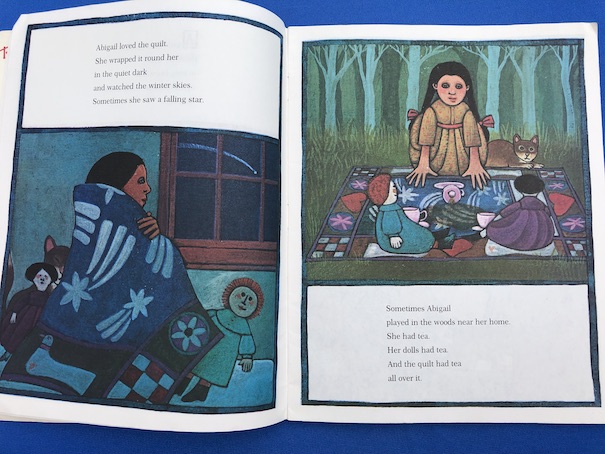
Abigail uses the quilt all the time, not just in bed. She has tea parties with her dolls on the quilt, hides under it when playing hide-and-seek, generally taking it everywhere and playing all kinds of games with it. The quilt gets worn and torn in the playing, but her mother mends it when necessary.
Eventually, Abigail and her family move to a new home, traveling in a covered wagon. Everything in their new home seems strange to Abigail, but her old quilt comforts her.
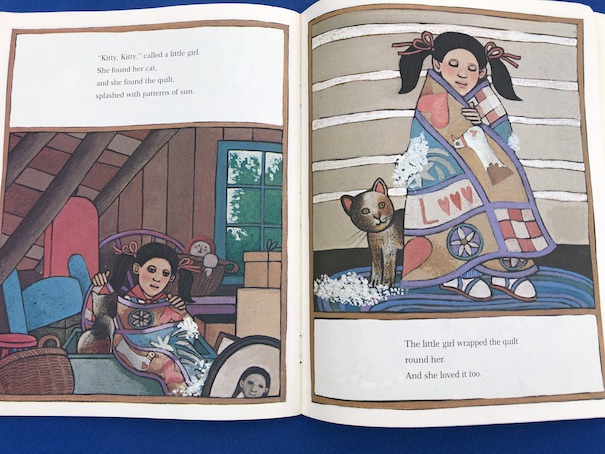
Eventually, when Abigail is older, she puts the quilt away in the attic, and people forget about it. Still, animals use the quilt. A mouse makes a nest it in. A raccoon hides food in it, and a cat naps on it. Then, one day, another girl finds the quilt in the attic. She loves it and brings it to her mother to be repaired.
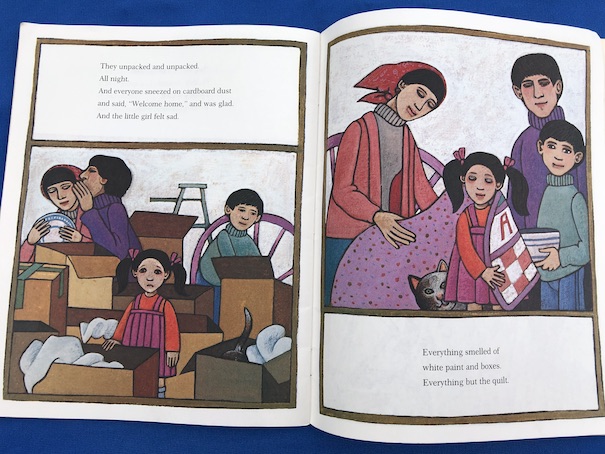
Like Abigail, though, the modern girl’s family soon moves to a new home, where everything seems new and strange. However, the old, familiar quilt comforts the girl once again.
This is a gentle, comforting story that would make nice bedtime reading or a story that could be read to a young child who is moving or has recently moved, reminding them that, even in a new place, you can bring a sense of home and the familiar with you.
The book is currently available online through Internet Archive.
When I Was Young in the Mountains by Cynthia Rylant, illustrated by Diane Goode, 1982.
This nostalgic picture book is based on the author’s experiences living with her grandparents in West Viriginia when she was young. It paints a vivid picture of Appalachian life in the past. The story doesn’t give any particular years to describe when it takes place, but the author apparently lived with her grandparents during the 1960s, although from the pictures, it would be easy to believe that the story takes place in a much earlier time. Partly, the style of the clothes and stoves give that impression, but for me, it was really the cloth cover over the camera that made me think it was during the first half of the 20th century. You can still get these covers, but they’re not as common in modern times.
In the story, the author describes various aspects of Appalachian life, starting each section with “When I was young in the Mountains . . .” She remembers her grandfather coming home after working in a coal mine and how they would all have cornbread, fried okra, and pinto beans for supper.
For fun, the kids would go swimming in the swimming hole. They would also use the swimming hole for baptisms. They would also use the schoolhouse as their church.
She describes the general store where her family would go for groceries and how they would have to heat water on the stove for baths.
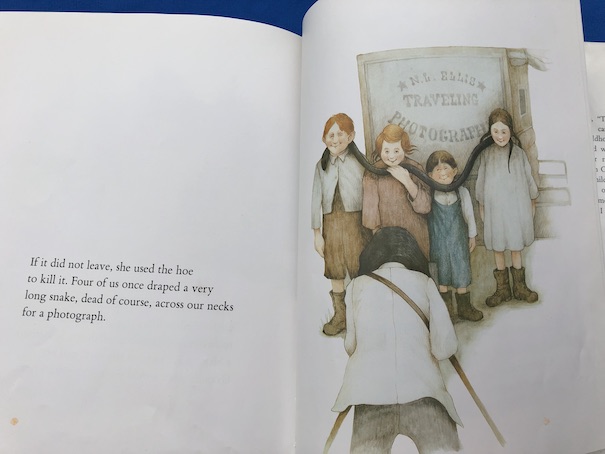
Sometimes, they had to deal with snakes, and once, when their grandmother killed a particularly big one with a hoe, they took a picture of the children with it.
Overall, the story is about enjoying the simple pleasures in life in a place you love, surrounded by people you care about.
This is a Caldecott Honor Book. It is currently available online through Internet Archive. Sometimes, you can also find people reading this book aloud on YouTube. I particularly like this reading because I think the reader has a good accent for reading this story, and she comments on her own experiences growing up in the country.























 Jestress's Forgotten Books and Stories