Linda Craig and the Clue on the Desert Trail

Linda Craig

Linda Craig and the Clue on the Desert Trail by Ann Sheldon, 1962.

Linda and her friend, Kathy, are exploring Olvera Street in Los Angeles before a horse show when Kathy notices a strange man watching them.  While the girls were shopping, Linda bought a small horse statue that reminded her of her own horse.  As the girls finish lunch, Linda notices an odd symbol on the statue that looks like an arrowhead, but before she can study it more, the man grabs the horse and runs off.  Linda tries to chase him down to get the horse back, but the man drops it and breaks it.  Linda picks up the horse’s head and decides to go back to the shop where she bought it to see if she can get another one.

The shop doesn’t have another horse like the one Linda bought.  It was unglazed, and the others are glazed.  Disappointed, Linda goes on to the horse show, where she is taking part, along with her brother Bob and his friend Larry.  At the show, they see the mysterious man again, and he apparently steals the broken head of the horse statue that Linda had kept.  Bob thinks that maybe the man is some kind of smuggler and that there was something hidden in the head that Linda hadn’t noticed.

Linda goes back to the shop to talk to the owner again, and he tells her that the horse was a special order from Mexico for a man named Rico.  Rico said that he was a traveling salesman and that he would collect the horse at the shop, but when he didn’t turn up to get it, the shop owner decided to sell it. Linda asks the shop owner to send her another horse statue like the broken one if one comes into his shop and reports all of this information to the police.  Then, when she returns to the horse show, she finds a threatening message, warning her to “Beware. Stay away from C. Sello.”  The note is signed with the symbol of an arrowhead, similar to the one on the horse statue.  Linda also reports this note to the police, but she can’t resist trying to figure out who C. Sello is and how this person fits into the mystery of the possible smugglers.

Soon after, the shop owner calls Linda to say that another horse statue did come into the shop and that he has sent it to her but now someone has broken into his shop and smashed every horse statue he has. Realizing that what they wanted was not in the shop, the bad guys are soon on Linda’s trail, even kidnapping one of her friends by mistake, thinking that it’s her. They even try to poison Linda’s horse!

At the end of a desert trail, the Mojave Trail, there is a ghost town with sinister characters and old cliff dwellings with Native American petroglyphs that may hold part of the secret to the mystery.

The story contains some anecdotes about California history, which is interesting. I have to admit, though, that I thought that the warning note for Linda was pretty silly. C. Sello turns out to not be a person but a clue about what the smugglers are smuggling, and they didn’t have to tell Linda what it was because she hadn’t heard about it at that point and wouldn’t have any reason to know what they were talking about. If they really wanted to get her to leave them alone, they could have left a more vague warning that didn’t include any clues like “Go home!” or “Go away!”

The Mystery of the Crimson Ghost

The Mystery of the Crimson Ghost by Phyllis Whitney, 1969.

Janey Oakes loves horses and wishes that she had one of her own.  Her family lives on Staten Island in New York, so they don’t have room to keep a horse.  The only horses that she has ridden are rented ones.  However, her parents are now considering moving to the countryside in northern New Jersey, where Janey’s Aunt Viv lives.  If they do, there will be room for Janey to keep a horse, so she is hopeful.

Janey’s parents take her to visit Aunt Viv during the summer, while they decide if they want to move.  Along the way, they stop to ask directions at a half-ruined house.  The people there, Mrs. Burley and her grandson Roger, aren’t too friendly, and when Janey thinks that she hears a horse there, they seem oddly resentful and say that she should ask her aunt about it.

Aunt Viv seems oddly evasive on the subject of horses when Janey asks, saying that she doesn’t ride anymore.  She does tell Janey more about the strange, half-ruined house.  It was once a hotel for people who came to take the spring waters.  However, it eventually lost its popularity and was partly destroyed in a fire.  Mrs. Burley’s husband died in the fire, but she has remained living in the part of the house that is still standing, raising a couple of grandsons there after the death of her younger son.  Her older son is a doctor in New York City.  Aunt Viv says that she used to be friends with the younger of the two grandsons, Denis, but that ended when she did something wrong and something bad happened which she doesn’t want to talk about.

Aunt Viv introduces Janey to a girl who lives nearby named Coral, in the hopes that they will be friends.  Coral isn’t interested in horses, but when Janey questions her about the Burleys, she confirms that they do have a horse called the Star of Sussex.  She takes Janey up to the Burleys’ house again (partly in the hopes of seeing the older Burley boy, Roger, who she has a crush on).  There, Denis and Roger each explain to Janey that their grandmother had hoped to train Star as a racing horse.  Star is an excellent horse and had a lot of potential for racing, but Denis allowed Aunt Viv to ride her one day, and the horse stepped in a woodchuck hole and injured her leg.  The leg has healed, and the horse is able to gallop, but she still limps and can’t run at the same speeds she used to, ending Mrs. Burley’s racing hopes.  Since then, Mrs. Burley has been very bitter, especially toward Aunt Viv.  She behaves strangely, driving people away, and is also angry toward Denis for allowing Aunt Viv to ride the horse in the first place.  It was just an accident, but she blames them both.  Roger realistically thinks that they should sell Star for breeding because she has a good bloodline, and Denis’s real interest lies with airplanes, which fascinate him in the same way that horses fascinate Janey.  Their differing interests seem to support what Aunt Viv says about how the family should move and that the boys would probably have a better life away from the old, ruined hotel and Mrs. Burley’s obsession with the past.

Coral also tells Janey about a ghost dog that supposedly appears on nights when a strange red light appears on the Burleys’ property.  Later, Janey hears the howling at night. Aunt Viv doesn’t think it’s a ghost.  She says that people have tried to talk to Mrs. Burley about her dog, but she denies having one and gets really angry with people for accusing her of having one.  Yet, the howling does seem to come from the Burleys’ property, and Denis even says that he’s seen the ghost dog, that it seems to be covered in flames.  He claims that it’s the ghost of his grandfather’s dog, who died in the fire years ago.  Aunt Viv thinks that Denis is just saying that to try to protect his grandmother and because he can’t handle what other people have come to believe about her: that she’s losing her mind.  Mrs. Burley’s behavior is undeniably odd, and she’s prone to sudden mood swings.  People are worried that she’ll drive newcomers away from the area and drive down property values, and they think that she might need professional help.

Janey doesn’t think that Mrs. Burley’s mind is gone as much as people believe.  When she sneaks over one day to visit Star, Mrs. Burley is angry but notes that she has a good manner with horses.  To Janey’s surprise, Mrs. Burley agrees to let Janey ride Star.  Denis almost ruins things by making Janey believe that Mrs. Burley has changed her mind about the invitation and also by not telling his grandmother that Janey asked to meet at a later time.  Janey isn’t sure why Denis seems to have a grudge against her, although it might have to do with his own guilt for allowing the horse to be ridden and injured in the first place; his own grandmother still seems to have a grudge against him for that.  Neither one of them tells Janey that Star has a particular trick for throwing riders, even though she had specifically asked if there was anything that she should know about the horse or if it had any tricks.  After she’s thrown by the horse, however, Janey gets back on and proves to both the Burleys and to Star that she’s not intimidated and not going to fall for the trick again.  (The Burleys have deep, personal hurts, but I wouldn’t call them nice people.  There are people who would probably view this is a test of Janey’s skills and her ability to stick with a challenge, but I think that their lies and deliberate deception when Janey was asking the right questions show only their immaturity.  It may not bother some readers as much as it did me, but I have a very low threshold of patience for such things, and the characters lost a lot of my sympathy right there.)

Mrs. Burley warms up to Janey after that and confides in her some of the reasons why she has been so unfriendly, trying to drive people away, and why the horse meant so much to her.  Years ago, she and her husband made quite a lot of money, raising racing horses.  Star is from the same bloodline as their original horses.  Mr. Burley lost quite a lot of their money on various business ventures that didn’t work out, even before the hotel fire that killed him, but for a long time, Mrs. Burley was always able to keep one horse from that bloodline, hoping to get at least one last racing horse.  Star is an excellent horse who really would have made a good racing horse, but Mrs. Burley’s hopes were destroyed when Star was injured.  Mrs. Burley thinks that she’s too old now to raise another, that she wouldn’t live to see any of Star’s offspring become racers.  Janey still thinks that Star has the potential to be a racer, but Mrs. Burley says that the effects of her injury won’t let her get the speed she once had.  Mrs. Burley resents outsiders hanging around because she fears their “interference” in her life, and the injury of Star while Aunt Viv was riding her seems to prove that her fears are justified.

Janey tries to talk to Mrs. Burley about the ghost dog, but she gets angry with Janey for believing the things that people have been saying about her.  Worse still, Roger tells her that Mrs. Burley will probably sell Star soon.  She needs money badly and has been refusing to let anybody help her, even her son in New York.  Her pride at her independence may be her undoing.  Now that Janey has ridden Star successfully, she can’t bear the thought that the horse might be sold and sent away.  If only she could unravel the mysteries surrounding the Burley family, the strange red light, and the ghost dog!

My Reaction and Spoiler

Toward the end of the story, one of the characters talks to Janey about Mrs. Burley’s attitude, saying that “it’s important in life to have something to fight for.  Something we care about and want.  I don’t mean fight for with our fists, but something to try for, struggle for.  Something we can do that uses whatever we are to win the fight.”  He means that people need a purpose in life, something like a cause to believe in or a way of life to pursue that is suited to their talents. Janey says that she doesn’t like struggles, but the person points out to her that everything in life that you want involves a struggle, including the horses Janey loves. Janey has focused mostly on the struggle of getting her parents to agree to let her have a horse and Mrs. Burley to agree to let her ride Star, but even if she ended up owning a horse, including Star, there would still be the struggle of caring for the horse, devoting time to keeping the horse happy and healthy. Janey might enjoy that kind of struggle because it appeals to her talents and interests, but it would still require time and sacrifice on her part. Mrs. Burley loves horses as much as Janey does, and she loves the area where she lives to the point where she can’t image living anywhere else. All of her efforts focus on allowing her to continue living in the place she loves, although she feels like her horse dreams are lost.

Much of the emphasis of the book is placed on Mrs. Burley’s determination to maintain her independence as part of the lifestyle she loves, but I wish that there was a little more emphasis on the methods that people use to get what they want in life because that is central to the secret of the “ghost.”  That the “ghost” isn’t really a ghost isn’t too much of a spoiler, but while people in the area think that Mrs. Burley is faking the ghost because she’s mentally unbalanced, the real culprit is someone who wants Mrs. Burley to leave because there’s something that he wants very badly and doesn’t think that he’ll get it otherwise.  Once his scheme is exposed, the others make sure that he doesn’t get what he wants because, after what he has done, he doesn’t deserve a reward.  However, I wish that they had explained a little more plainly that there were other ways of getting what he wanted besides the scheme he planned.  The culprit thinks that no one was listening to him and what he wanted, but from my perspective, what he wanted was simply a matter of time, and he wasn’t willing to wait.  His scheme would have ended with Mrs. Burley being declared mentally incompetent and being put away in a home, which is a cruel thing to do to someone.  The other characters tell him that, but I wanted someone to explain to him that harming others for his own benefit would make him no better than someone who robs a bank because they want money.  That is, crime and fraud are still wrong even if they succeed because the ends don’t justify the means.  In some ways, I think that Mrs. Burley was selfish, but she still didn’t deserve to be labeled as crazy, and even if people weren’t listening to the culprit and taking him seriously as much as they should, the scheme still wasn’t his only option. 

To say more would be to tell you who the culprit is, and it’s not as obvious as it might seem. It was one of my favorite suspects, but I changed my mind a few times, going back and forth between suspects up until the end. In the end, Mrs. Burley is prepared to forgive the culprit and start over again, and there are hints that he may get what he wants in the future if he behaves better.  Personally, I think he probably would have gotten it eventually, anyway, so his situation is relatively unchanged, although he is now under pressure to prove his behavior to everyone. 

As for Star, she does become Janey’s horse as a gift from the one person who is in a position to give the horse to her while making sure that Mrs. Burley gets the money she needs.  Because of Janey’s help in revealing the culprit to Mrs. Burley and because of her devotion to the horse, Mrs. Burley is fine with the arrangement.

The Secret of Stonehouse

Stonehouse

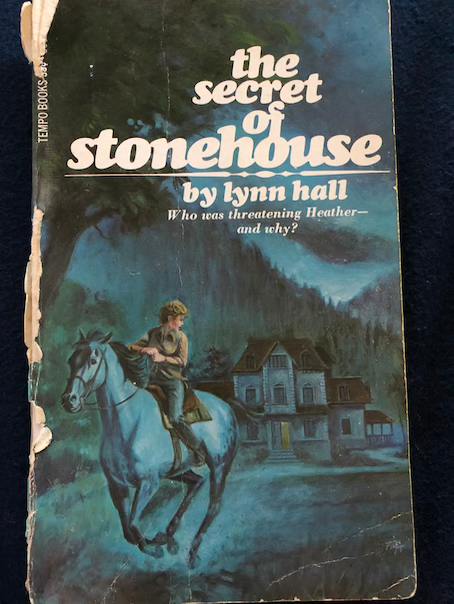
The Secret of Stonehouse by Lynn Hall, 1968.

Heather has lived her entire life (as far as she can remember) in Scotland with her grandmother and her uncle, Donald.  Donald has raised her since she was small.  He’s been like a father to her, and she loves him like a daughter.  However, he recently decided to move the two of them to the United States, taking them to a small town in Wisconsin.  Heather can’t understand the reason for the move, and for the first time in her life, it seems like Donald is keeping secrets from her.

Donald seems oddly concerned that Heather shouldn’t tell people that she is adopted, something that he’s never seemed concerned about before.  Heather has asked him about her parents before, but all he can tell her is that his wayward brother Ewen brought her to the family farm in Scotland, saying that she was his daughter and that her mother was dead.  Ewen simply left her with Donald, never trying to see her or talk to her again and never sending her any money. Heather also knows that, although says that he’s going out to search for a new job, he’s been hanging out in other places, spending time with the mysterious Mr. Worley.

Heather makes friends with a boy named Gus who lives nearby.  Gus lets her ride one of the horses that his family owns, Cloud, and invites her to go riding with him sometimes and participate in local riding events called “shodeos.”  Heather loves horses and enjoys their rides together.

On one of these rides, the two of them go near a large, old, stone mansion that gives Heather a strange feeling.  Gus’s family tells her the tragic story of the family who used to live there, the Selkirks.  They were wealthy, but young John Selkirk was killed in an accident the day that his beautiful young wife, Molly, gave birth to their only child, a little girl named Hebron.  John’s parents never recovered from the loss of their son and passed away soon after, leaving just Molly and the baby.  However, when Hebron was only three years old, she was apparently abducted for ransom and later murdered, and her mother died soon after.  The story makes Heather uneasy, and the house gives her a strange feeling, like she’s drawn to it.

However, other sinister things start happening.  Someone in a car that looks disturbingly like Donald’s tries to run her and Cloud off a bridge.  When Donald spends the night away from home “on business”, someone sneaks into the house.  Heather begins to realize that someone is out to get her, some mysterious person means her harm.  Memories, dangerous ones, are beginning to surface in Heather’s mind, and someone is determined to try to keep her from remembering.

Part of the mystery is pretty obvious (at least, I thought it was, and you might guess it from my plot description), but the part that I didn’t guess was who was behind it all.

Lauren’s Treasure

Sleepover Friends

#8 Lauren’s Treasure by Susan Saunders, 1988.

The Sleepover Friends have volunteered to take part in an archaeological dig on the site of an old mansion, which is also on land where a Native American tribe once lived.  Other students from their school and a school in a nearby town will also be taking part.  Stephanie isn’t sure that she’s going to like being part of the dig because she doesn’t really like getting her hands dirty and she thinks it would be gross if they uncovered the bones of dead people during the dig.  The others are more excited about the dig, but at first, it doesn’t turn out as well as expected for Lauren.

First, Lauren’s hair is weird on the day of the dig because the other girls tried to give her a perm at a sleepover and it didn’t go well.  Then, she attracts some unexpected attention from Walter, a new neighbor of Stephanie’s.  Walter is in the fourth grade, but only because he skipped a couple of grades to get there.  He’s only eight years old, but he’s something of a child genius.  He’s not really a bad kid, but when he starts following Lauren around and acts like he’s got a crush on her, Lauren is embarrassed because he’s so much younger than she is.

Then Lauren makes an exciting discovery on the dig: a carved rabbit charm.  The archaeologist in charge of the dig is excited because its presence, along with some yellow paint, means that they’ve found a Native American burial spot.  She takes the younger children off the dig and has her grad students continue searching for the grave itself.  Lauren is pleased at being the one to make an exciting find, but the charm mysteriously disappears at the dig.

The archaeologist thinks that, most likely, the charm fell out of the tray Lauren was using to collect things on the dig when everyone started pushing to get a look at the spot where it was found.  She says that she and the grad students will keep an eye out for it as they continue the dig.  For Lauren, it just seems like another piece of bad luck in her bad luck streak.

Walter continues paying too much attention to Lauren at school, and later, writes an anonymous note, asking her to meet him at a local pizza place.  At first, Lauren thinks that the note was writing by Jenny Carlin, a rival at school, because of a series of pranks they were playing on each other earlier.  When Jenny denies being responsible for the note, Lauren goes to the pizza place and sees Walter.  Unfortunately, Jenny and her friend Angela show up there, too, curious to see who was meeting Lauren, and they tease her and Walter.  Lauren is embarrassed at having a kid so much younger than she is (genius or not) chasing after her, and she hates the teasing that she gets at school about it, but she’s not quite sure what to do about it, other than ignoring Walter as best she can.  However, Walter is actually the key to solving the mystery of what happened to the rabbit charm.

You might guess at this point that Walter was the one who took the charm in the first place.  I thought it was pretty obvious myself.  Walter wasn’t trying to cause trouble.  He explains to Lauren that he was trying to get her attention, and his first plan was to pretend that he found the missing charm after a search so that he could look like a hero to her.  He just never got the chance to give it back because he got interrupted, and then Lauren started avoiding him because of the teasing.  It all works out for the best because Lauren gives the charm back to the archaeologist, who doesn’t press her too closely about where she found it, and Walter gets a crush on a different girl who is a little closer to his age. 

Getting a crush on someone who either doesn’t feel the same way or just isn’t available is a normal part of life (if it wasn’t, it wouldn’t appear so often in tv shows, movies, and books – people find this type of situation relatable), and so is being the subject of a crush from someone you don’t love or find unsuitable (again, that’s why this situation comes up often in fiction – it happens often enough in real life that people understand the feeling).  When it comes to getting boyfriends or girlfriends, one of the people involved has to be the first to stick their neck out and say that they’re interested, and there’s no guarantee that the feelings will be returned.  It’s not easy, but this is a part of how relationships start.  When the feelings aren’t returned, which is bound to happen from time to time, there’s always some awkwardness.  The first person is usually disappointed, and there might be a struggle for the other person as they try to find a way to turn the other person down without hurting their feelings.  The situation in this book is especially awkward because precocious young Walter is so young, and it’s likely a first crush for him.  Lauren has also never had to deal with a situation like this before and isn’t quite sure how do handle it. 

In a way, having Walter simply lose interest in Lauren feels a little like a cop-out for the situation so neither of them really has to confront the situation directly, but there are a couple of things that Walter has come to realize by the end of the story that may be useful.  One good point is that there are limits on the things people should be allowed to do to get someone’s attention and start a relationship with him.  When Walter was just trying to strike up a conversation with Lauren or be helpful to her at the dig, it wasn’t bad.  It didn’t get Lauren’s approval for him, but it wasn’t because his behavior was bad (more about this later because it’s important).  The bad part came when he stole the charm to get her attention.  When Walter’s mother later finds out about his theft of the charm, she grounds him and makes him give the charm back and confess to Lauren what he did.  Learning that life has limits and that some behaviors don’t get you the kind of attention you’re really looking for is a good life lesson.  Some people do come on too strongly when they’re seeking attention, and I’m not just talking about kids who aren’t experienced enough to know how to behave; even adults don’t always know the best way to approach romantic relationships or understand others’ limits and boundaries regarding them.  I’m no relationship expert, but I think that the solution is partly developing a kind of situational awareness and an ability to empathize with other people and read their reactions.

Before the story is over, Walter learns more about reading other people’s reactions and understanding how his actions fit into the larger situation from someone else’s viewpoint.  At first, Walter doesn’t seem to sense Lauren’s discomfort, and her friends criticize him for not taking a hint.  Lauren felt a little awkward about his helpfulness at the dig not because it was a bad thing (he was really trying to be nice and there was nothing objectionable about what he said or did until he took the charm – I want you to understand that she wasn’t rejecting him for being a nice guy or anything like that) but because she had reservations about getting too involved with someone so much younger than herself, and she felt like his attention put her in an awkward position.  Walter is a genius, but he is still physically and socially about three years behind the other kids in the story, and at first, he can’t see why that would create awkwardness in a romantic relationship, especially for kids who are only just starting to get old enough to be interested in romance.  The difficulty for Lauren and the reason why she was so irritable with the situation was that she found it difficult to tell a younger kid who was being so nice to her that she didn’t welcome his attentions when he wasn’t doing anything really wrong and didn’t want to hurt his feelings.  As I said, an awkward situation.  Sometimes, even a person who is trying to be nice can unintentionally create awkwardness if they don’t understand the other person’s circumstances, and that’s something that adults do as well as children.  This is basically what’s at the heart of a situation where “nice guys” get rejected or “friend-zoned.” It’s not about the “nice guy” doing anything wrong so much as a case of the wrong relationship at the wrong time with someone who isn’t quite as compatible with them as they thought.  

In a romantic relationship, both of the people involved have to agree to it equally, one isn’t enough.  When Jenny and her friend start teasing Lauren and Walter after the incident at the pizza place, Walter comes to see why a relationship with him would make things awkward for Lauren because of their age difference and the reactions of the other kids.  If they were in their 20s or 30s, an age difference of two or three years wouldn’t mean anything, but for where they are in their lives now, as kids in elementary school, it means a lot.  At the end of the story, Walter’s new love interest is a little closer to his age, making less of a problem, and he has developed enough social awareness to use his age difference to get a little revenge on Jenny for her teasing by publicly asking her about meeting him at the pizza place later, as if she were interested in dating him.  Walter could have been hurt and insulted about being rejected and teased because of his age (and it would have been understandable), but he has realized that, under the circumstances, it would be better to move on and find someone who is more suitable for him and who might be more open to a relationship with him.  In the end, he feels good enough about the situation to use his age for the joke on Jenny, and his other classmates approve of his humor and the well-deserved jab at Jenny’s teasing.

The one thing that I really wish they had added to the story would be for Lauren to learn how to gracefully turn down an offer of a relationship when she isn’t interested because I think that would be an important life lesson for her and for young readers. Socially awkward situations occur in life, but there are ways of handling them to minimize the embarrassment for everyone involved. In the story, Lauren’s main tactic is trying to ignore Walter and hope that he’ll take it as a hint until he finds someone else, and in real life, that’s not good enough. I’m not sure what she would have said if Jenny and her friend hadn’t interrupted her and Walter at the pizza place, but I would hope that it would have been something like, “I appreciate the help you gave me at the dig, Walter, and you seem pretty nice, but I just don’t think that we have enough in common. I think that there is too much of an age difference between us, and I’m not interested in that kind of relationship.” The rejection still might sting, but some simple honesty would at least be more respectful than ignoring him and hoping that he’ll take that as a hint.

I read this book years ago when I was a kid, although there was only one part that really stayed with me, and for a long time, I thought that I was remembering the incident from one of the Baby-Sitters’ Club books.  The scene that stuck in my memory was from the sleepover at the beginning of the book.  The girls were angry at Jenny for some mean comments that she made, so they requested a song on the radio called “You’re a Jerk” by the Lurkers and dedicated it to her.  When they made the request, they told the radio station that they were “well-meaning friends” instead of giving their names, and the radio DJ made a joke about it when he played the song.  It was this incident that started off the series of pranks that Jenny and the girls play on each other throughout the book.  I think part of the reason this scene stuck with me was the “well-meaning friends” phrase and part of it was because I had always wondered if the song they requested was a real song.  I don’t think it is because I can’t find it on the Internet. The Lurkers are a real band, but I can’t find anything about that song. If that song actually exists and someone can find a video of it, let me know, and I’ll link to it!

The book is currently available online through Internet Archive.

Kate’s Camp-Out

Sleepover Friends

#6 Kate’s Camp-Out by Susan Saunders, 1988.

Kate’s family is spending the weekend at a cabin at Spirit Lake, and Kate is allowed to bring her Sleepover Friends with her.  However, what promised to be a fun and exciting weekend soon comes with complications.  First, Kate discovers that the Norwood family will be in a cabin nearby.  Dr. Norwood is a colleague of her father’s, but his two sons, Sam and Dave, are pests who like to play practical jokes.  When they arrive at the cabin, there is also no electricity (a problem that they fix the next day), and they learn that the reason the lake is called Spirit Lake is because there are some scary stories about the place.  Kate’s father tells the girls a story before bed about an old fur trapper who murdered another fur trapper for his money.  The ghost story is interrupted by Dr. Norwood, who comes over to see if everything is all right because there have been some break-ins in the area recently.

The girls are spooked by the ghost story, but the next day, they also encounter the Norwood boys and realize that they’re every bit as awful as Kate remembers them.  First, Sam and Dave trick a couple of the girls into wading out into a deeper area of the lake so that they’ll fall in and get wet.  Then, when the families meet for a barbecue, the boys give a couple of the girls worms in a bun instead of sausages.

Because of their bad experiences with the boys, the girls are allowed to go back to their cabin while the others finish the barbecue.  While the girls are at the cabin, they accidentally find a secret hiding place in the fireplace with a pouch of old coins inside!  The girls wonder if that could be the stolen money from the ghost story, but Stephanie, who has been reading a book about ghost stories from the area, says that the dates on the old coins are later than the story took place.  According to the book, a ghost child was once seen around their cabin, but the girls can’t figure out why a child would have hidden so much money.

While the girls wait for the adults to return from the barbecue, they fix dinner for themselves and decide to hold a séance to contact the spirits.  They don’t really believe that the séance will work when they try it, but without any tv or radio, they don’t have anything else to do, and they can’t get their minds off the ghost stories. 

To the girls’ surprise, they actually hear strange knocks in reply to the questions that they ask the spirits.  Then, a child’s giggle convinces them that it’s just the Norwood boys, spying on them and trying to scare them again.  It’s the last straw, and the girl plot how to get even with the Norwood boys!

The book is currently available online through Internet Archive.

My Reaction and Spoilers

This is one of those stories that has a somewhat ambiguous ending. When the girls try to catch the Norwood boys playing ghost, they instead discover the identities of the people behind the recent break-ins at the cabins. Later, they learn that Sam and Dave actually have alibis for the time that they heard the ghost noises, leaving them wondering if the knocking and giggling could have actually been a ghost. The girls do manage to play a prank on the boys before the end of the story, but they never learn the story behind the old coins.

I liked the part where they never firmly establish whether or not there was a ghost because it’s fun to leave people wondering. People who like ghost stories can imagine that the girls did hear a ghost, but if you don’t like the scary explanation, you can imagine that there’s another explanation for the noises. However, I found the lack of resolution behind the presence of the coins a little disappointing. The owner of the cabin they were using lets each of the girls keep a single coin as a souvenir (and the coins really are valuable collectors’ items) and gives the others to a local museum. I think I would have liked the story better if the girls found an explanation for the presence of the coins at the museum, so at least part of the story would be resolved.

There are two main theories that I have behind the events in the story. One is that the thieves in the area hid some stolen coins in the cabin for some reason and they were the ones trying to scare the girls during their seance. The other is that the mystery of the coins ties in with the child ghost in some way, hinting at dark unknown deeds from the past. Alas, there is no confirmation about which of these theories, if any, is true.

The Camp-Out Mystery

The Boxcar Children

#27 The Camp-Out Mystery by Gertrude Chandler Warner, 1992.

The Alden family has decided to go on a camping trip to a campground at a state park.  From the moment that they arrive, though, strange things seem to be happening.  When they stop for supplies, a woman Mr. Alden knows, Doris, seems oddly evasive when he tries to ask her about her sister, Hildy, and she makes the odd comment that she hopes nothing will spoil their trip.  As they pull into the state park, they discover that the arrow on the sign pointing to the rangers’ station has been reversed to point the wrong way.  Mr. Alden shrugs the incident off as a prank, but it’s only the beginning of the strange happenings.

The Aldens get to their camp site and notice that the place is a mess.  Either the previous campers were pretty messy, or they left in a hurry.  The Aldens clean up the site and set up their tents.  (The description of how they set up camp is actually somewhat educational because they talk about things to look for when choosing a campsite, how they have to check the ground for rocks and tree roots before setting up their tents and why they should avoid places where it looks like rain water might pool and why it can be dangerous to set up a tent under a tree if there is a lightning storm.)  Later that night, Violet is woken by the sound of music.  At first, she thinks that it must be some nearby campers, but it sounds too loud and too close.  When she and Jessie get up to investigate, the sound stops.

Later, the kids see strange lights in the woods, and things disappear or are moved around at their campsite.  When Mr. Alden realizes that someone has been sneaking into their camp and taking things, he suggests that they might want to leave the park, but the kids say that they’d rather stay because they’re still enjoying themselves.  Then, Mr. Alden injures his ankle when he’s startled by another blast of loud music and part of the path he’s on gives way because the dirt was loosened by rain.  The children are prepared to leave when their grandfather is injured, but to their surprise, Mr. Alden says that he’d rather stay, too.

Who is doing all of these things and why?  Is it the unfriendly Hildy, who lives alone in a cabin and wants everyone to leave her alone?  Or maybe her seemingly-helpful neighbor, Andy, for reasons of his own?  Could Doris be responsible?  What about the Changs, a family camping nearby who seemed disappointed that they didn’t have the campground to themselves?

There are some environmental themes and lessons in the story.  The Aldens frequently pick up litter that other campers and hikers leave behind.  There is also an explanation that the reason why part of the path Mr. Alden was on collapsed due to erosion because there are no trees along that section of path; tree roots help secure the soil so that it doesn’t wash away.  After the mystery is solved, Mr. Alden decides to donate some trees to the park, and the kids talk about adding more trash cans and a recycling center to help solve the litter problem.

The book is available to borrow and read for free online through Internet Archive.

The Yellow House Mystery

The Yellow House Mystery by Gertrude Chandler Warner, 1953, 1981.

This story in the Boxcar Children series picks up the following spring after the previous book.  The children’s cousin, Joe, is arranging for the excavation of the cave where the children found their Native American artifacts.  They’ve decided to use dynamite to blast open the roof of the cave to make excavation easier (I’m not sure if this is really the best way to get at artifacts that were sheltered safely for years in their cacve and were easily being dug up by children in their current situation, but okay), and although he had told the children that they couldn’t be there for the blasting, he’s changed his mind.  He’s even going to let seven-year-old Benny be the one to push down the handle that will set off the blast.  (Because this is one of the early books in the series, the children are aging from the first book in the series – Henry is sixteen years old, Jessie is now fourteen, and Violet is twelve.)

One of the people who will be working on the excavation is Alice, an old school friend of Joe’s.  Everyone can tell that Joe is in love with her, and soon, he proposes to her.  They get married and decide to spend their honeymoon camping out in the barn on the island, just like the children did the previous summer.

However, the children have started to wonder what the story is about the old yellow house on the island.  For some reason, it makes their grandfather sad, and he doesn’t like to talk about it.  Eventually, their grandfather tells them that their housekeeper, Mrs. McGregor, used to live in that house with her husband, Bill.  Bill used to take care of Mr. Alden’s father’s race horses.  He was a nice man, but weak-willed.  His brother, Sam, and his brother’s disreputable friends were often able to persuade Bill to do things that would get him into trouble, and Bill was never able to stand up to them.  One day, he vanished mysteriously from that house, and neither his wife nor the Aldens have any idea what happened to him.  There are only two clues about the reason for Bill’s disappearance.  One is money that Bill was supposed to give to Mr. Alden’s father for the sale of two horses that he managed on his behalf.  Mr. Alden assumes that Bill’s brother did something with the money and that Bill probably left because he was afraid to face Mr. Alden without the it.  Sam died soon after Bill disappeared, so they were unable to ask him about what he knew.  The other odd thing that happened before Bill disappeared was that Mrs. McGregor heard strange sounds in the night.  When she went to investigate, her husband was apparently just reading a newspaper, and he claimed that the noise was nothing unusual.  But, what was Bill really doing?

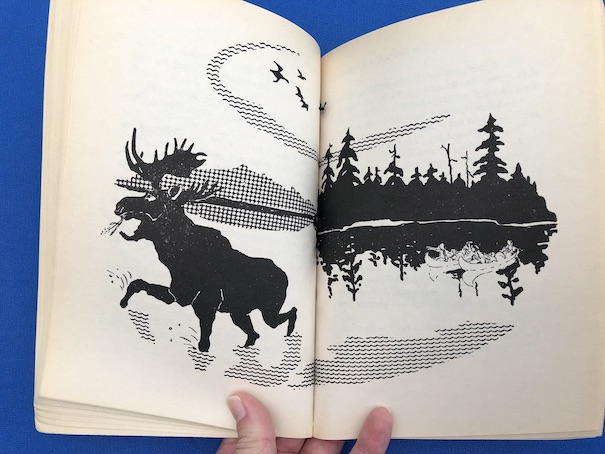
The kids want to investigate Bill McGregor’s mysterious disappearance, and their grandfather and Joe and Alice enter the house with them to have a look for more clues.  In a hiding place behind one of the fireplace bricks, they find a letter from Sam to Bill about the money from the horse sale.  Sam promised Bill that he would be able to pay him back more than the money he owed and tells Bill to meet him at a house in Maine near Bear Trail.  The kids persuade their grandfather to let them to go Maine with Joe and Alice over the summer to try to find the house on Bear Trail so they can find out what happened to Bill.  The trip will involve camping, hiking, and canoeing, but they’re up to the challenge!

Joe is familiar with Bear Trail because he used to work as a trail guide when he was in his teens.  They are also joined by another trail guide, Mr. Hill, and have adventures that include a storm and a real bear.  However, the real answers to the mystery lie at the Old Village at the end of the trail.

The book is available to borrow and read for free online through Internet Archive. There are multiple copies of the book. In order to check out a book through Internet Archive, you need to sign up for an account. The account is free, and you read the books in your browser.

My Reaction

In a number of ways, this book is more adventure than mystery.  It doesn’t take long for the kids to realize discover Bill McGregor’s new identity.  However, what happened to the money is more of a puzzle.  Even Bill has been unable to find where his brother hid it years ago.  Benny discovers it by accident while watching a toad. 

One thing that had made me uncomfortable was how long Bill had stayed away from his wife.  When the kids confront him about his real identity, it turns out that Sam’s disreputable friends had lied to him, telling him that his wife had died shortly after he disappeared.  He is overjoyed to discover that she is still alive, and she is glad to see him when he finally returns home.

Surprise Island

The Boxcar Children

Surprise Island by Gertrude Chandler Warner, 1949.

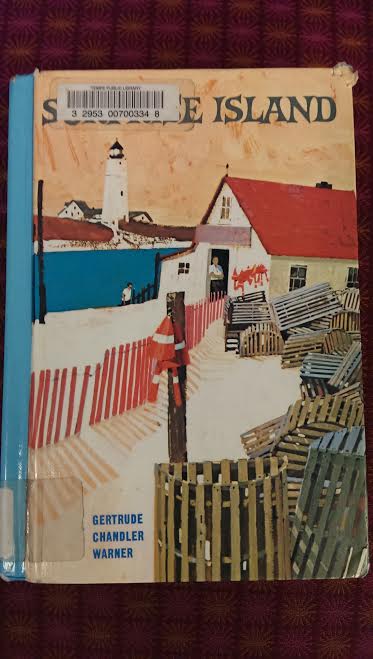
Mr. Alden has promised his grandchildren a special surprise for their summer vacation. He tells them that, years ago, his father bought a small island because he kept horses and wanted a quiet place for them.  The island has only one little yellow house, a barn, and a fisherman’s hut where Captain Daniel lives.  Captain Daniel operates the motorboat that can take people to the island.  Mr. Alden plans to take his grandchildren to the island to look over the house, and if they like, they can spend the summer there.  The children think that it sounds like fun.

When they get to the island, the children decide that they want to stay in the barn instead of the house.  Captain Daniel also tells them that he has a young man staying with him, a friend who hasn’t been feeling well.  The Aldens’ old friend, Dr. Moore, has come to see the island with them, so he looks in on the young man.  It turns out that the young man was in an accident and had lost his memory for a time, although he has been gaining it back.  He says that he used to live with an uncle but that he didn’t want to go home again until he was sure that he was completely well.  He is going by the name of “Joe”, which is short for his middle name, Joseph.  Captain Daniel says that he’s known the young man all his life, and Dr. Moore also seems to know him, but Joe doesn’t seem to want to talk about himself to Mr. Alden.

The kids enjoy setting up housekeeping in the barn.  It reminds them of when they used to live in an old boxcar.  They use old boxes for furniture, dig for clams, and eat vegetables from the garden that Joe and Captain Daniel have tended for them.  Their grandfather allows the children to stay on the island in Captain Daniel’s charge, but they are mostly allowed to take care of themselves.  Joe sometimes brings them supplies that they ask for from the mainland.  (One of the themes of the Boxcar Children Series is self-sufficiency.  At one point, Jessie comments about how much better things seem “when we have to work to get it.”)  For fun, they go swimming, and Joe spends time with them, telling them about different types of seaweed.  They are surprised at how knowledgeable Joe is.

Henry gets the idea that they can set up a kind of museum of interesting things that they find on the island, like samples of different types of seaweed, shells, flowers, pictures of birds that they’ve seen, etc.  The other children think that it sounds like fun, and they begin thinking about the different types of things that they can collect.While they’re searching for things to collect and add to their museum, the children find a cave and an old arrowhead and ax-head.  They are authentic Indian (Native American) relics!  When they show Joe what they’ve found, he gets very excited, especially when they tell him that they saw a pile of clam shells, too.  Joe explains to the children how Native Americans used to use shells as money called wampum.  He thinks that what they saw was wampum, which the people who used to live there might have made after drying the clams to eat later.  Joe explains to the kids some of the process they would have used to turn the shells into wampum.  He’s eager to go to the cave and look for more Native American artifacts with them, but he urges them not to say anything to anyone else about it because other treasure hunters will probably show up if they do.  The children agree to keep their find a secret until their grandfather returns.

When they return to the cave with Joe, they make an even more incredible find: a human skeleton with an arrowhead inside.  It looks like they’ve found the bones of someone killed by an arrow!

The book is available to borrow and read for free online through Internet Archive.

My Reaction

As with some other vintage children’s mystery series, the early books in the series were more adventure than mystery.  The most mysterious part of this book concerns the real identity of the young man they call “Joe.”  The truth begins to come out when a strange man who calls himself Browning comes to the island in search of a young man who disappeared the year before while doing some exploring for him.  The young man he’s looking for worked for a museum.

This is the book where Violet first learns to play the violin.  This is a character trait that stays with her for the rest of the series.

The Boxcar Children

The Boxcar Children

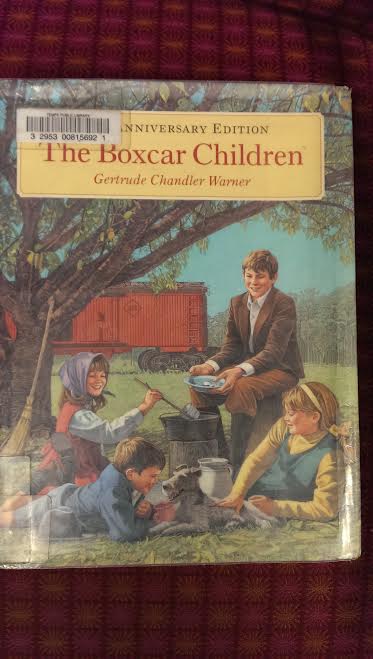
BoxcarChildren#1 The Boxcar Children by Gertrude Chandler Warner, 1924, 1942.
“One warm night, four children stood in front of a bakery.  No one knew them.  No one knew where they had come from.”

These are the words that begin not only this story but a series that has been loved by generations and continued well beyond the death of the original author.

The four Alden children are on the run following the deaths of their parents.  Their nearest remaining relative is a grandfather they have never met, and although he should have custody of the children now, none of the children want to go live with him.  All that they know about him is that he is apparently a mean old man who opposed their parents’ marriage.  Henry, the eldest at fourteen, and Jessie, who is twelve, have taken charge of the two younger children, ten-year-old Violet and seven-year-old Benny.  They have a little money, and they’re now traveling on foot in search of a new home.

The first place they stop is a bakery in a nearby town where no one knows who they are.  They don’t have much money, but they know they are going to need supplies for their journey.  The stingy baker and his wife agree to give the children some food and a place to sleep for the night in exchange for some help in their shop.  The children are willing to work and accept the offer.  However, Henry and Jessie overhear the couple talking about them.  They like having the children to help in the shop, but Benny is too young to be of much help.  They are considering taking Benny to an orphanage and keeping the others.  Not wanting to be separated, Henry and Jessie wake Violet and pick up Benny, moving on.  Now, they have a second set of people they’re avoiding, besides their grandfather.

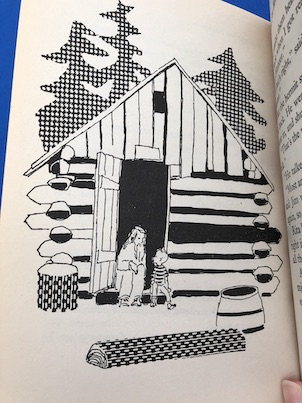
Seeking a place where they can stay while not being noticed by people around them, the children eventually find an old, abandoned boxcar on a disused piece of train track on the edge of some woods.  They take shelter there from the rain and decide that they can turn it into their new home.  There are blackberries growing nearby that they can eat and a stream where they can keep milk cold.  Henry finds odd jobs in a nearby town to earn more money, and the others discover an old dump where they retrieve some old, cracked dishes and other useful items.

It seems like an idyllic life at first.  The children are free of adult control, although they do have to work to create a household for themselves and find food.  They adopt a stray dog they call Watch (he’s their new watchdog), and Henry makes friends who appreciate what a hard worker he is.  However, some of these new friends start to wonder about Henry, where he comes from, and where his parents are.

The children soon realize that someone is spying on them.  Is it someone from the town?  Could the baker and his wife still be looking for them?  Or is it someone sent by their grandfather?  When Violet is suddenly taken ill, the others realize that they need help and someone to trust.

Getting help for Violet does mean that the children’s secret is revealed to everyone, although they learn some important things in the process.  They discover who was spying on them and why and also discover that their grandfather is a nicer person than they thought and truly cares for them.

Although this series is very popular, most people don’t know that the story they read as children was actually a shortened version of the original story that was written in 1924.

The newer, popular version of the book is available online through Internet Archive.  The older version is now public domain and available online through Project Gutenberg.

Comparisons to the Older Version and My Reaction

Along with shortening and simplifying the story from original the 1924 version, the newer version from 1942 changed some of the characters’ names (the children had the same first names, but their family name was originally Cordyce, not Alden) and removed some parts that might be objectionable for young children.

Although the original story doesn’t completely clear up some questions that were left unresolved in the current version, like what the children’s parents were like, precisely how they died, and why they quarreled with the children’s grandfather in the first place, it did supply a few more details in the first chapter.  The original story begins when the children move to a new town with their father.  No one knew exactly where they came from, and the children pointedly refuse to say.  However, they do tell their neighbor, a baker, that their mother is already dead.  Their father is drunk, and the baker thinks that he looks like he’s in such bad condition that he isn’t likely to last much longer.  That turns out to be true when he dies (apparently from alcohol-related causes) soon after.  When they question the children about whether or not they have other relatives, young Benny blurts out that they have a grandfather before the others silence him.  The adults press the children for answers, and they reluctantly admit that there is a grandfather, but they say that he did not like their mother and would treat them cruelly if they were sent to him (or so, apparently, their parents had led them to believe).  The only one of the children who has even seen the grandfather is Jessie (actually called Jess in this version of the story), and it was only from a distance because her father happened to see him passing by and pointed him out.  Later, the children hear the baker and his wife talking, saying that they have no choice but to try to find the grandfather, and the children decide to run away to avoid going to live with him.  The questions of how their mother died and why the grandfather didn’t like her in the first place are never answered.

James Cordyce (the children’s grandfather in the original book, their grandmother is also apparently dead) is a wealthy man who owns steel mills, and he is impressed by the children’s ingenuity and resourcefulness at managing their own affairs while living on their own.  He tells Henry that he wants him to take over the steel mills one day, and the book says that Henry does so when he grows up and does a wonderful job of managing them.  Mr. Cordyce tells the other children that he wants them all to go to college, and then they can do whatever they like when they grow up, which the book says also happens.

Although the books never actually say so, my theory is that Mr. Cordyce/Alden was a hard-headed businessman, particularly when he was younger, driven to succeed and not emotionally demonstrative, and that this attitude caused a rift between him and his son, who may not have shared his father’s business skills and interests.  The grandfather may have wanted his son to follow in his footsteps when the son had other ambitions.  The son may have seen his father as a cold and ruthless businessman and conveyed that impression to his own children after marrying a woman his father disapproved of (Because her family was poor? Because they were unambitious?  Because she had some objectionable personal habit?  There’s no telling), but because he may not have told the children the whole reason why he thought that the grandfather was cruel, the children imagined that he was worse than he really was.

We don’t know what the children’s father did for a living after his feud with his father or exactly where they lived (perhaps in Greenfield or close by so that Jessie was able to catch sight of her grandfather one day).  Why the father took to drinking is also never explained, but I think it may be implied that he did so out of grief for his dead wife.  I think that Henry and Jessie probably had to manage the household for their parents following their mother’s death (and maybe before that if she suffered from ill health), which is part of the reason why the children are so self-sufficient and seem more tied to each other than to any adult.  In any case, the original book says that Mr. Cordyce is interested when the doctor who befriends the children says that Henry and Jessie have business management skills, so I think it sounds like he was thrilled to find out that he might have more in common with his grandchildren than he did with his son and hopeful that Henry would make a better successor in the family business.  But, that’s just the way I read it.

One other point that the original book covered was Watch’s origins.  The later version just has Watch as a stray who the children adopt, but the original story explained that he had just been purchased from a kennel by a wealthy woman when he was lost.  The kennel owner tries to reclaim the dog (kennel name Rough No. 3) on behalf of the woman, but the grandfather offers to buy the dog for much more than the original price.  The kennel owner says that it’s up to the woman who bought him, and they invite the woman to the house.  After hearing how attached the children have become to Watch, the woman allows them to keep him.

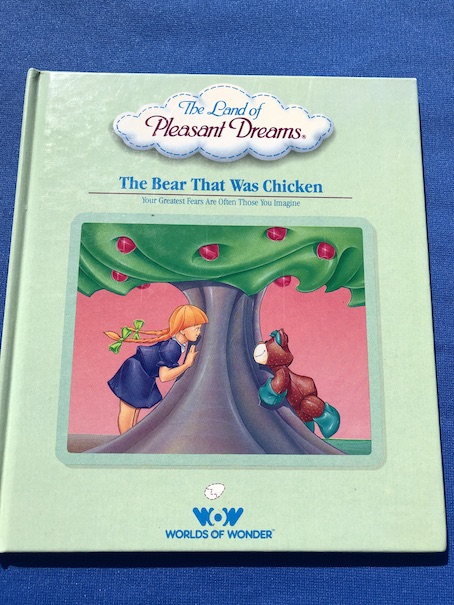
The Bear That Was Chicken

The Land of Pleasant Dreams

The Bear That Was Chicken by Ane Weber, Ron Krueger, Tony Salerno, 1986.

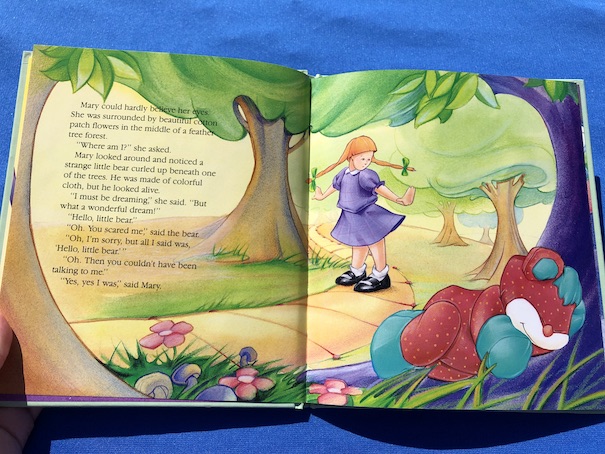
In her dream, Mary meets Threads the Bear.  When she meets him, he’s trying to sleep under a tree.  He’s sad and tells Mary that he thinks he’s a chicken and that all of his friends say so.  (It’s not a nice thing for friends to say, and I wish the story had said so.  There’s a song about it on the tape that accompanies the book with the words given in the book, but it bothers me because calling people “chicken” is something that I associate with people who are trying to goad people into doing things that they really shouldn’t do. I don’t think that it’s good to teach children to react to being called “chicken” or any other insulting names.)

Mary thinks that Threads’ imagination is getting the better of him and that’s why he’s so afraid of so many things.  However, Threads tells Mary something that isn’t imaginary: there are some strange eggs in his cave that appeared there suddenly and mysteriously.  That’s why he’s sleeping in the forest, because he doesn’t know where the eggs came from or what they are.  Mary bravely offers to go with him to have a look at the eggs.

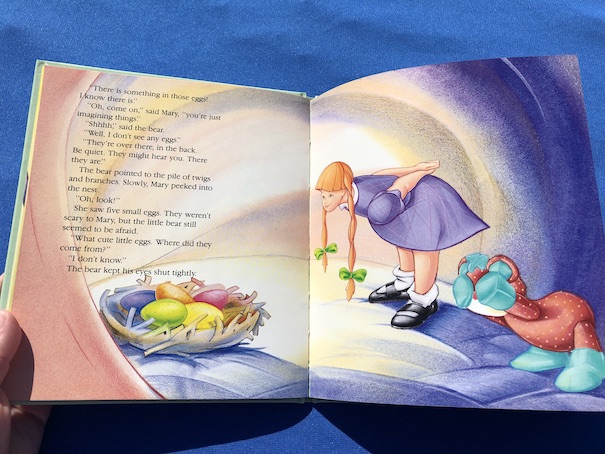
When they go to look at the eggs, Mary thinks that they look pretty harmless.  They’re kind of cute and colored like Easter eggs.  Threads is still worried about them and what they might hatch into.  Mary says again that Threads is imagining the worst and volunteers to sit with Threads while he takes his nap and keep an eye on the eggs to see what happens.

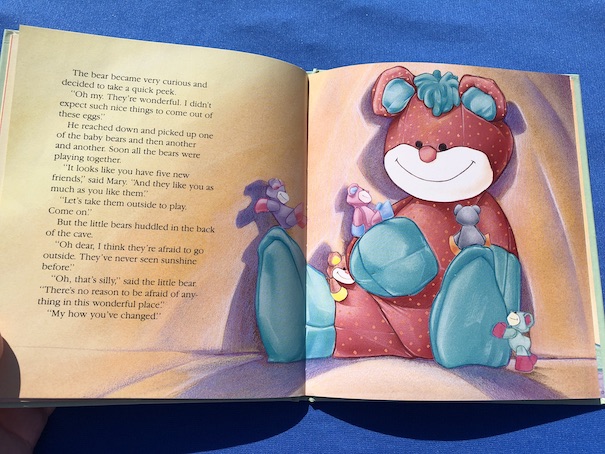
The eggs do hatch, and it turns out that they contain tiny teddy bears, very much like Threads.  When Threads sees the little bears, he loves them and thinks that they’re adorable.  The little bears seem worried when Threads wants to take them outside to play, but Threads encourages them, telling them that there’s nothing to be afraid of.

Moral: Your Greatest Fears Are Often Those You Imagine.

The main message of the story is that it’s better to face your fears than imagine the worst. However, I found some of this story a little confusing as a kid, and some of the implications are a little alarming when you begin to analyze it.  Where did those little bear eggs come from?  Did Threads lay them himself in his sleep? Are those little bears his children?  Did Threads lay eggs because he was a “chicken”?  But, Threads is a boy bear!  Then again, this is supposed to be a dream, so I guess it doesn’t really have to make sense.

I still don’t like that the story uses “chicken” as an insult and in a way that implies that people who are called “chicken” should try to prove that they’re not. This just seems like a recipe for disaster, encouraging children to accept dares.

The book is available to borrow and read for free online through Internet Archive. This book is currently available online through Internet Archive. It was made into an episode for the tv show version of this series with puppets.