Toby Tyler

TobyTylerToby Tyler; Or, Ten Weeks with a Circus by James Otis, 1881.

Toby Tyler is an orphan who lives with a church deacon he calls “Uncle Daniel.” Uncle Daniel isn’t really his uncle, but he raised Toby after he was abandoned as a baby. Toby doesn’t know anything about his parents. Uncle Daniel is stern with him and says that Toby eats more than he earns, making it a hardship to care for him. Toby is cared for, but life with Uncle Daniel isn’t exactly happy.

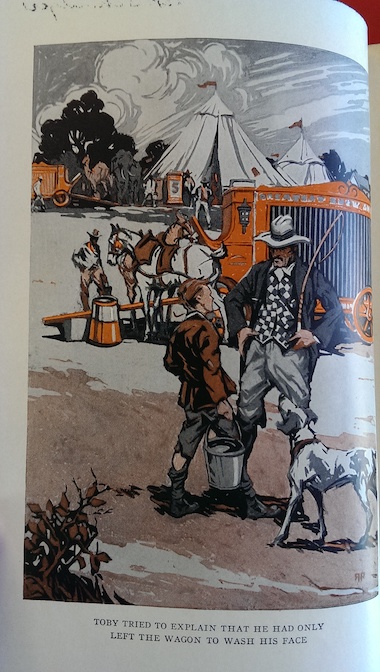
Toby has a fascination for the circus, although Uncle Daniel says that the show isn’t any good, and it’s all a waste of time and money. The circus is certainly cheap, as Toby can see from the first. When he tries to buy some peanuts, he only gets six for the penny he gives, and all or most seem to be bad. The lemonade is basically water with lemon peel in it. But, to Toby’s surprise, the man who sells the snacks at the circus, Mr. Lord, offers him a job. He says that people who work for the circus get to see the show as often as they like, and he could use a boy to help him as an assistant.

TobyTylerPicToby think that it sounds like an exciting offer, and Mr. Lord persuades Toby that the best way would be for him to sneak away at night because his Uncle Daniel might disapprove and stop him from taking the job. Not taking that as a warning, Toby agrees. Toby feels a little guilty about running away and surprisingly homesick, but he decides to stand by the agreement he made with Mr. Lord and see what possibilities life with the circus might have for him.

Life with the circus turns out to be very different from what Toby is used to and what he expects. It’s noisy and dirty, and no one seems to particularly care about Toby or his welfare. Mr. Lord also turns out to be even sterner than Uncle Daniel, not even telling Toby what he expects him to do, just expecting him to do it. Toby works hard, and Mr. Lord acknowledges that he’s better than the other boys who have helped him, but he’s still a temperamental man and hard to please. Like Uncle Daniel, he fusses about how much Toby eats. Toby also has to sell snacks inside the big top under the watchful eyes of Mr. Jacobs, who threatens him with violence if he doesn’t make sales or if people try to cheat him.

However, Toby does succeed in making a few friends in the circus. The first friend he makes is a monkey that he calls Mr. Stubbs. Mr. Treat, who plays the part of the Living Skeleton in the circus sideshow, and his wife, who is the Fat Lady, have seen Mr. Lord mistreating other boys, and they intervene to make sure that Toby is all right, giving him food when Mr. Lord doesn’t. Unlike everyone else Toby has known, Mrs. Treat lets him eat as much as he wants without worrying, saying that some people just need more food than others. Like her husband, Toby seems to have the ability to eat a lot while still being small and skinny.  Mrs. Treat herself maintains an enormous size while hardly eating anything. She says that’s just how some people are.

When Mr. Castle teaches Toby to do trick riding, his status goes up in the circus, and he is no longer under Mr. Lord’s thumb. As far as the Treats are concerned, Toby could stay with them forever. However, life in the circus isn’t what Toby had once thought it was, and Toby can’t get rid of the thought that he’s made a terrible mistake by running away from Uncle Daniel. He wants to go home and make things right with him.

In the Disney movie, Toby stays with the circus, doing well with his trick riding act and having happy adventures with his monkey friend. Unfortunately, in the book, Mr. Stubbs is accidentally shot by a hunter and dies. The book was meant to teach moral lessons about responsibility, whereas the movie was just about fun and adventure.

In the end of the movie, Toby stays with the circus even while being reunited with the people who raised him and missed him when he ran away, giving an all-around happy ending. In the book, Toby feels terrible about the death of Mr. Stubbs (although it wasn’t really his fault), and the hunter who shot him is very sorry because he hadn’t realized that he had shot someone’s pet. To make up for it, he helps Toby to get back to Uncle Daniel. At first, Toby is unsure that Uncle Daniel will want him back, but he misses his old home so much that he says he doesn’t care if Uncle Daniel whips him for running away. However, Uncle Daniel has also missed Toby since he disappeared. As stern and harsh as he could be before, Uncle Daniel genuinely cares about Toby and welcomes him back with open arms.  The ending implies that Toby’s future with Uncle Daniel will be happier than the past because they have much greater appreciation for each other now.

The book is now in the public domain and is available on Project Gutenberg.

The Lottery Rose

LotteryRoseThe Lottery Rose by Irene Hunt, 1976.

Young Georgie Burgess has been abused his entire life by his mother, Rennie, and her boyfriend, Steve (who is not Georgie’s father, whose identity is unknown, Rennie says that she is a widow).  Rennie is an alcoholic, and she and Steve (who is the source of most of the violence in Georgie’s life) once deliberately burned the side of Georgie’s face when he was a baby because he wouldn’t stop crying and they were angry that they had run out of whisky.  Sometimes, they tie him up in a closet for days at a time with no food.  Other times, they beat him, even leaving scars.  When Rennie is confronted by the school nurse about Georgie’s injuries, she claims that Georgie is a problem child who gets into fights.  Georgie’s teacher believes that because Georgie is always acting up and doesn’t appear to learn anything, although he is actually smarter than he pretends to be.  Because the other adults in Georgie’s life either do not see his condition for what it is or do not want to acknowledge the truth of it, it is a long time before he gets the help he really needs.

Georgie’s early life is bleak, and at first, his future seems equally bleak.  The only people who seem to care about him at all are the school librarian and Mrs. Sims, who works at the grocery store.  Georgie’s real love in life is flowers.   He likes to borrow a book from the school library about flowers, and one day, he enters a drawing at the store and wins a rose bush of his very own!

It’s the best thing that ever happened to Georgie, but shortly afterward, Steve beats him so badly that the police are finally called.  Georgie is taken away from his mother, and for the first time, his life becomes different.  Georgie insists on bringing his precious rose bush with him when the police take him away, and it becomes instrumental in helping him reshape his life.

For a time, Georgie has to stay in the hospital to recover from his injuries, and then he stays with Mrs. Sims.  Unfortunately, as much as Mrs. Sims and her husband care for Georgie, they can’t afford to take care of him.  Instead, Georgie is sent to a Catholic boarding school with his new teacher and guardian, Sister Mary Angela.  Sister Mary Angela assures Georgie that he will be taken care of at the school and so will his rose bush.

Georgie thinks the school is ugly, but there is a beautiful house nearby with a beautiful garden.  It belongs to Mrs. Harper, who lost her husband and one of her sons in a tragic car accident.  Although Georgie isn’t supposed to go there, he can’t help himself.  It seems like the the perfect place for his rose bush . . . and maybe even for himself.

The tragedies and descriptions of child abuse in this story make it inappropriate for young children.  This would be a good book for kids at the middle school level, probably age twelve and up.

Georgie, who has never really known kindness in his life, blossoms like a rose at the school, making new friends for the first time and coming to terms with his past.  At the same time, Mrs. Harper, who is still suffering from the loss of her husband and son and also loses her other son (a child with developmental disabilities) during the course of the book, finds her heart warmed by Georgie.  Georgie has desperately needed a mother who acts like a real mother and really loves him, and Mrs. Harper comes to realize that she also needs a boy like Georgie to love.  While he is not a replacement for the sons she has lost, he does help to fill an empty place in her life, and the two of them become the family that each of them needs.

The book is currently available online through Internet Archive.

Annie’s Promise

AnniesPromise

Annie’s Promise by Sonia Levitin, 1993.

This is the final book in the Journey to America Saga.  Annie, the youngest of the Platt girls, is more of a tomboy than her older sisters.  Her father thinks that she’s been growing up too wild in America, running around and climbing like a boy.  This summer, in 1945, while her best friend goes to visit their family’s farm in Wisconsin, Annie’s father wants her to stay home and help him with sewing for his coat business, and Annie’s mother has a list of chores for her to do.  It all sounds so boring and dreary.  Twelve-year-old Annie longs for excitement, but because of her recent appendix operation and her migraine headaches, her parents worry about her health.

Then, Annie gets the opportunity to attend summer camp.  She wants to go and do all the fun summer camp activities that other girls do, but her parents worry at first.  They worry about Annie’s health, and they don’t know who is running the camp or what they do there.  Annie’s older sisters, Ruth and Lisa, tell their parents that it’s normal for girls in America to go to summer camp and that the experience might do Annie some good.  When the family doctor says that Annie is healthy enough to go, her parents finally agree.

At first, camp is hard.  Annie faints soon after her arrival, and she worries that maybe her parents were right about her being delicate.  However, one of the counselors tells her that these things happen and that she was probably just overtired, overheated, and still suffering from the rough bus ride to the camp and that she will be fine after she rests.  Annie is physically fine, although one of the other campers, Nancy Rae, makes a big deal about the incident, calling Annie a “sickie” and other names.  Nancy Rae is a terrible bully, and Annie nearly drowns in the lake after accepting a dare from Nancy Rae to swim across it, in spite of not being a good swimmer.  Annie overhears the counselors saying that Nancy Rae should probably be sent home for goading Annie into a dangerous stunt, but they know that Nancy Rae comes from a bad home and that her father abuses her.  For her own sake, they decide to give her another chance.

However, even knowing Nancy Rae’s troubled history doesn’t help Annie when Nancy Rae keeps picking on her and a black girl named Tallahassee (Tally, for short).  Nancy Rae calls Tally and her younger brother (who is also at the camp) “nigger” and says that Annie is a “nigger-lover” when she tries to protect the younger brother from one of Nancy Rae’s tricks that could have really hurt him.  (Note: I’m not using the n-word here because I like it. I’m just quoting because I want you to see exactly how bad this gets.  Nancy Rae uses this word multiple times, and so do others when quoting her. This book is not for young children.  Readers should be old enough to understand this word and beyond the “monkey see, monkey do” kind of imitation some kids do when they learn about bad words.  The management assumes no responsibility if they aren’t.)  Nancy Rae is a thrill-seeker, who frequently does wild stunts to get attention and tries to make other girls hate Annie as much as she does.  At one point, she snoops through Annie’s things and tries to take her diary.  Eventually, she figures out that Annie is Jewish and makes fun of her for that, painfully reminding Annie of what it was like living in Nazi Germany and of her relatives, who died in the concentration camps.

Finally, Annie reaches the breaking point with Nancy Rae.  At a camp talent show, she arranges with other kids to dump horse manure on Nancy Rae’s head after she finishes singing a song.  Nancy Rae is so humiliated by the experience that she ends up leaving camp.  Annie is relieved that she is gone, but one of the camp counselors, Mary, makes her feel guilty about her revenge because she sees Annie as being stronger and more talented than Nancy Rae and wishes that she could have made Nancy Rae her friend instead, giving the bully a chance to improve herself.  (I disagree with what the counselor says, but I’ll explain more later why.)  Annie feels badly about how things turned out, but the incident blows over, and the rest of camp is a great adventure for her.

At camp, Annie mixes with different kinds of children from the ones she usually sees in her neighborhood and at school, and everything is a learning experience.  She becomes friends with Tally and gets a crush on a boy named John.  There is an ugly incident in which an assistant in the camp kitchen tries to molest Annie when he finds her alone (this really isn’t a book for kids), but the camp counselors dismiss him for what he did.  Annie and Tally talk about many things together, and Tally is very understanding.  The incidents with Nancy Rae and the kitchen assistant bring up the subjects of people who try to victimize others and how to deal with them.  Annie resents that people like that force others to be on their guard, limiting them in ways that they can behave in order to avoid being victimized, but Tally says that there’s no help for that.  As long as people like that exist, she says, protecting yourself is a necessity.  They also compare the way Annie feels when John gives her a little kiss to the repulsed and frightened way that she felt when the kitchen assistant tried to force himself on her.  Both incidents involved a kiss, but the way it was delivered and the person delivering it made each experience feel very different.  In the end, Annie’s crush on John turns into friendship rather than love as she realizes that the kiss was just a friendly gesture.  It is a little disappointing to her at first, but it is still a learning experience for her.

Annie learns that everyone at this camp has been through something bad in their lives.  Annie’s family are war refugees, but Tally’s father has been married three times, and she’s often the one to take care of the house and her younger brother, while her current stepmother cleans other people’s houses for money.  Other kids are poor or orphans or have fathers in jail.  The camp gives them a chance to get away from their problems for awhile, to make new friends, and to develop talents that they can be proud of.  Annie really blossoms at camp, learning to ride horses and work on the camp newspaper.  As Annie’s session at camp comes to an end, Mary offers Annie a position as a junior counselor for the final session of camp, helping the young children.  Annie is enthusiastic about the prospect, but family dramas at home threaten to derail her plans.  Ruth’s fiancé is shell-shocked from the war and has broken off their engagement.  Lisa is tired of arguing with their parents about every small piece of independence in her own life and has decided to move to a place of her own.  With all of this going on, and their parents upset about everything, what chance is there that they will sign the permission slip that Annie needs to become a junior counselor?

This book shows how much the lives of the girls in the Platt family have changed since they first left Germany for America.  It’s partly because they are living in a different country, partly because times and habits are changing everywhere, and partly because all of the girls are growing up and making decisions about what they really want to do with their lives.  The older girls in the family, Ruth and Lisa, are women now and thinking about careers and marriage.  As the girls suffer disappointments and changes of heart, their parents suffer along with them, and Annie realizes that she has to make up her own mind about what she really wants.  As Annie tries to decide what she really does want, her parents struggle to cope with all of the changes in their daughters’ lives and in the changing world around them.  They fight against it in a number of ways, and when things go wrong, whether it’s Annie’s illnesses or the older girls’ romantic problems, they tend to get angry or panic.  As the book goes on, it becomes more clear that what the parents really feel is helplessness.  More than anything, they’ve wanted life to be better for their daughters in their new country, and it upsets them when things don’t work out.  They want to help guide their daughters and make their futures work out for the best, but in the process, they often come across as too controlling or making the wrong decisions because they don’t fully understand the girls’ feelings or situations.

Ruth and Lisa each suffer romantic disappointment before they settle down.  Ruth had a fiancé, Peter, who went away to fight in World War II, but having seen the prisoners in the concentration camps, he has returned disillusioned and dispirited.  He was Jewish, but now comes to associate his religion and heritage with pain and suffering and wants to give it up, breaking off his engagement to Ruth in the process.  At first, Ruth is angry with him, saving that it’s like he wants to give up on his whole life, on the whole world.  The girls’ father says that he wants to kill Peter for leading his daughter on, but part of his feelings turn out to be his own feelings for somehow failing his daughter, that he is somehow to blame for allowing this disappointment.  When Lisa is upset because the young man that she’s been seeing says that he doesn’t want to get married, she argues with her parents about the course of her life and leaves home to live on her own.  Her parents see that as turning her back on their love and protection, but Lisa says that she just wants the independence that other girls have.  Even Annie feels abandoned by Lisa because Lisa was always there to comfort her as a sister and help her persuade their parents to listen to her, but Lisa says that she has to deal with problems on her own and that Annie will understand someday, when she’s in the same position.  Annie realizes that, in a way, she already is in the same position.

The one time that Tally comes to visit Annie at her house and the girls go to the beach together, Annie’s parents make a scene when she gets home because she’s left sewing all over the house and eaten more food than she should have.  Tally was going to apply for a sewing job with Annie’s father, which would have helped both of them, but Annie’s parents send her away, thinking that she’s a bad influence who encouraged Annie to goof off.  Then, Annie hears her own parents use the n-word.  It’s the final straw for Annie, and she runs away to camp.

The people at camp are glad to have her because they need her help, but being there, helping them, and thinking about her own life and future help Annie to realize what’s really important to her.  She’s been feeling bad about the hate she got from Nancy Rae and the hate that she felt from her parents with their insults to her friend.  However, her parents don’t really hate her, and in spite of what they’ve done, she doesn’t really hate them.  She realizes that, before she does anything more with the camp, she needs to go back and see them.

Annie rethinks what Nancy Rae was really about, how she was filled with hate for everyone, dealing out hatred because of all that she’d received from everyone else.  The counselors realized that she needed love more than anything, but Nancy Rae’s own hateful behavior pushed away the people who would have given her more positive attention and Annie’s revenge (although provoked) ended her camp experience.  Annie realizes that she doesn’t want to go down the same path and that she must mend her relationship with her family.

I said before that I disagreed with the counselor’s approach to the problem of Nancy Rae and what she said to Annie about her revenge.  I see what they were trying to do with giving Nancy Rae another chance, but what bothers me about it is that they act like Annie was in a much less vulnerable position to Nancy Rae and that she should have been strong enough to take what Nancy Rae dished out without hitting back, and I don’t think that’s true.  All of the kids at the camp were there because they had something troubling in their lives, some vulnerability, including Annie.  To say that Annie was more fortunate and more talented and that it should have been enough was to discount the harm that Nancy Rae was doing.  I know that the counselors were trying to make the camp experience positive for Nancy Rae, but she was making the camp experience more negative for everyone else around her and needed to be stopped.  Everyone suffers from something in life (as this book also demonstrates), but not everyone chooses to become a bully because of it.  Nancy Rae made that decision herself, within herself, and for herself alone.

Part of the problem, I think, was that there were no obvious consequences for Nancy Rae’s bad behavior, and therefore, she had no reason to stop doing what she was doing.  The lack of punishment and the inequity of the situation was what finally sent Annie over the edge with her.  Since the counselors didn’t make it obvious that Nancy Rae was in the wrong, Annie felt that she had to, and that says to me that there was a lack of responsibility and accountability.  I think that life is a balance and that both positive reinforcement (giving rewards to people who do good) and negative reinforcement (punishment for bad behavior) are necessary.  I believe in plain speaking, and if I were in the counselors’ position, I would make it plainly and specifically clear that no campers were to use the n-word, to mess with others’ belongings, or to do the other things that Nancy Rae was doing and that there would be consequences for doing so, telling them exactly what those consequences were so that no one could say that they were surprised.  I would also make it clear to Nancy Rae that I knew exactly what she was doing and why she was doing it and that it was unacceptable.  When we choose what we do and say in life, we all consider (or should consider) what we want to happen in life, and I would put it plainly to Nancy Rae how she really expects others to react to her and how their reactions would change if she did things differently.  Clearly, no one has ever told her that in her life before, and it was about time that she heard it from someone.  I suppose we could guess that the counselors may have said something of the sort to her out of hearing of the others, but I would also say the same thing to Nancy Rae’s victims.  Letting them know that I’d dealt with her adequately might head off their attempts to deal with her themselves and talking about what our behavior might lead others to do might also discourage revenge.

Also, the counselors were counting too much on the idea of friendship with Annie to get Nancy Rae to stop treating her badly, but that’s not at all the way that bullies work.  One of the primary reasons why people bully is that they know that there are a lot of people who like mean humor, and they use their bullying to bond with those people, not their victims.  Their friendships are formed on mutual contempt for the victim and the fun of humiliating that person.  They’re getting everything they want through their bullying, so there’s no reason for them to stop until someone else gives them consequences and puts an end to their bully support network.  I think that the counselors should have also talked to the people Nancy Rae was trying to bond with, explaining that they know what Nancy Rae is attempting to do and telling them that they would also be punished if they tried to help her, further cutting off one of Nancy Rae’s incentives to keep doing what she’s doing.

I’m not saying that it’s a perfect solution or that it would be guaranteed to work, just that I believe in being direct rather than letting things slide and just hoping that people will someday see the light.  Sometimes, people just need to have things spelled out for them in no uncertain terms.  If they chose to ignore what you say, then it’s on their own head, and they can’t say otherwise because you were clear and backed up your words exactly how you said you would.  I do think that the counselors were right that, in the long term, revenge never turns out well.  It often turns into a vicious cycle, as Annie later considers.  However, in this case, some proper handling in the first place, with consequences as well as words, might have headed off the situation before it got that far.

We don’t know what eventually happened to Nancy Rae by the end of the story, but I’m not sure that Annie is right to think that she wronged her.  In fact, she might have actually done her some good.  Sometimes, seeing others react badly to bad treatment can make a difference to someone’s future.  In my experience, people sometimes don’t realize that they’ve pushed another person too far until that other person finally reacts and says or does something.  Realizing that they’ve pushed someone too far can give them a reason to change because they realize that people won’t put up with their behavior forever.  Part of me thinks that maybe, at some point in the future, Nancy Rae might look back on this experience and quietly admit to herself that she had provoked it, being more careful the next time not to pick fights because she can be humiliated or excluded when people get fed up.  It might even help Nancy Rae to realize that she doesn’t have to put up with her father’s ill treatment forever because she also has the right to lose patience with bad treatment, too.  At least, I hope that this was a learning experience for her.

Annie realizes that both her parents and Nancy Rae are angry and hateful because of what they’ve suffered in their lives, but the problem is that both of them are taking it out on the wrong people.  Annie’s parents, at least, seem to realize that what they did was going too far and taking out their feelings on someone who didn’t deserve it.  By the time that Annie arrives home, they are also ready to make their peace with her and even support her return to the camp as a junior counselor, if that’s what she really wants to do.

The final days of World War II frame this story, beginning with the reports of Hitler’s death in the late spring of 1945 and ending with the bombings of Hiroshima and Nagasaki and the Japanese surrender in August.  With the end of the war comes a new chapter in the lives of the Platt family.  They’ve been through a lot together, but in spite of the girls growing up, moving out, and arguing with their parents, they still are a family.  There are no more books in the series, but Annie explains that Lisa gives up the dream she once had of being a dancer because she doesn’t think that she’s star material and because she decides that what she really wants is to get married and have children of her own.  In the end, she and her boyfriend get married, and she is happy with her life.  Similarly, Ruth, who is now a nurse, meets a new love when she visits Annie at camp and later marries him.  Annie realizes that she has found what she loves most in teaching young children, taking care of animals, and writing, and these things will form the basis of what she does with her future life.

I Am Fifteen and I Don’t Want to Die

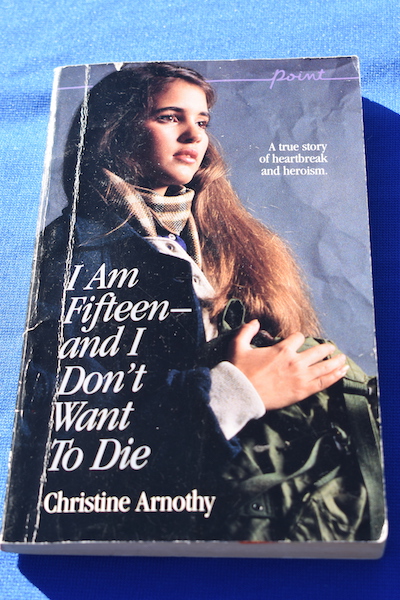
I Am Fifteen – And I Don’t Want to Die by Christine Arnothy, 1956.

Christine Arnothy was a fifteen-year-old girl during the siege of Budapest during World War II.  In this book, she recounts her memories of that time, based on diaries that she kept.  Following the war, she worked in a bookstore in Belgium before writing her memoirs.  This book was awarded the Prix de Verities, which is a French prize for nonfiction.

When the book begins, Christine and her parents are hiding in a cellar during the siege of Budapest along with their neighbors.  It is difficult for them to keep track of the time because they must remain in the cellar and limit lights that could give their location away.  After living in such cramped quarters for many days, everyone is getting on everyone else’s nerves.  They quarrel over scarce resources and hoard things for their own families, worried that their neighbors will take too much.

For a time, a young ex-soldier they call Pista (although he has another name) comes to stay with them, and he goes out to scavenge goods for them from ruined parts of the city.  While he does this, it raises their spirits and hopes for survival.  Unfortunately, death is all around them, and Pista is eventually killed by a mine.  There are scenes in this book that would make it frightening and disturbing for young readers.  Christine is fearful for her own life, worried that she will die in the cellar that has been their shelter.

When the German and Russian soldiers arrive, there is more slaughter.  Eventually, Christine and her family are able to get out of the city and go to the villa where they had originally hoped to go to escape the bombings.  They had already stocked the villa with provisions and were allowing some refugee friends of theirs to use it.  When they arrive, they discover that their “friends,” believing that they were killed in the bombings, have appropriated their belongings and actually seem disappointed to find that they are alive and want some of the provisions that are left.  Christine reflects on how quickly morals and ethics can be put aside in wartime.  Their supposed “friends” are not so friendly when resources are scarce and their deaths would have meant that they could keep more for themselves.

Transportation has been disrupted, but they are finally able to board a train to get to a small house they own in the countryside.  They remain there for three years before deciding that they need to leave entirely.

I found the story difficult to read because of all the sad and gruesome parts, but I found it interesting that Christine reflects that the part of her that died in the cellar in Budapest was the child that she used to be.  At the end of the story, she realizes that she has become an adult and, although she is worried about the life that she may be heading for, she is ready for a new life.

The book is available to borrow and read for free online through Internet Archive (multiple copies).

Make a Wish, Molly

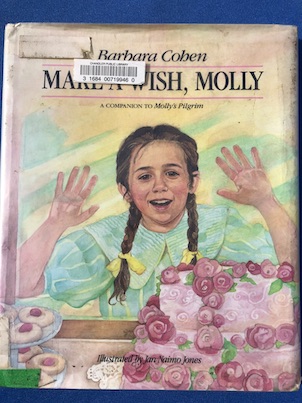
Make a Wish, Molly by Barbara Cohen, 1994.

This book is the sequel to Molly’s Pilgrim.

Things have improved for Molly in Winter Hill since she and Emma became friends.  Now, Molly doesn’t feel quite so alone as she once did.  However, Emma is still friends with the nasty Elizabeth (resident mean girl from the first book).  Molly has learned that a major part of Elizabeth’s resentment toward her is that Elizabeth is used to being the teacher’s pet and the center of attention at school.  In both first and second grade, she always seemed to be the favorite student.  Now, in the third grade, Elizabeth thinks that their teacher prefers Molly, and she can’t stand it.  So, she tries to make trouble for Molly whenever she can and make others not like her, too.

Emma tries to ignore Elizabeth’s nastiness and invites both girls to her birthday party.  Molly is excited because she’s never been to a birthday party in America before, and birthdays are celebrated very differently in America from the way they were in Russia.  Emma and Elizabeth (in her condescending way) explain how birthday parties are, that the birthday girl receives presents from her friends and gives them small party favors in return, and that there is cake and ice cream for everyone.  Molly has never had a cake like the ones that the girls look at in the bakery window and is eager to try it.  But, there’s a problem.

Molly’s mother says that it’s fine for her to go to the party and is willing to make some doll clothes for Emma’s birthday present, but she says that Molly cannot try the cake because the party will take place during Passover, and Jewish families like theirs cannot eat leavened foods during that time. Leavened foods are those that include rising agents, like yeast, baking powder, and baking soda, which includes cakes and breads. For Passover, Molly and her family are limited to things which don’t have these ingredients.

Instead, Molly’s mother packs a snack for Molly to take and eat while the others have the cake.  At first, Molly thinks maybe she could disobey her mother just this once and try the cake anyway without her noticing and without feeling different among the other girls, but when a piece of cake is placed in front of her at the party, she can’t bring herself to eat it.

Of course, Elizabeth takes advantage of Molly’s inability to eat the cake to make her feel bad and look bad in front of the others.  Elizabeth says that Jewish people don’t like to eat in Christian homes.  Molly tries to explain that isn’t the problem and to tell them about Passover, but Elizabeth ignores her explanation and just says that Molly’s reluctance to eat proves that what her mother told her about Jews was true.  (Let me just say that when a kid is as awful as Elizabeth is routinely, I always assume that the parents are exactly the same way.  I decided that Elizabeth’s mother was probably a bully and a snob back in the first book, so hearing that she’s been spewing anti-Semitic comments is no more than what I would have expected.  I view this type of behavior as an off-shoot of a bullying mindset, so I would completely expect that a person who is prone to one type of bullying would also engage in another. The apples never fall far from the tree.)  Molly knows that she can’t make the other kids understand the situation, so she just leaves in embarrassment.

When she gets home, Molly tells her mother about what happened.  Her mother says that everyone is a little different from other people, and there’s no use in pretending that they don’t live different types of lives from some of their neighbors.  However, Molly also has a birthday coming soon, and Molly’s mother thinks that if they invite some of the girls from Emma’s party to their house for a celebration, they will see that Molly’s family isn’t quite as different as they might think.

At first, Molly isn’t sure that it will be such a good idea, but it turns out better than she expects.  Her birthday is full of wonderful surprises.  There’s no cake, but Molly’s mother bakes other wonderful goodies, like rugelach (pastries with apples, raisins, and nuts).  Emma and another girl, Fay, try them and like them, but Elizabeth still refuses.  She also just looks defiant when Molly’s mother proves to her that Jews will wash and reuse plates that Christians have eaten from, not throw them away, like Elizabeth’s mother said before.  Once again, the issue with Elizabeth isn’t how correct or incorrect she (or her mother) was in whatever she said but whether or not she happens to look better than someone else at the current moment.  All Molly’s mother’s demonstration means to her is that she just lost another opportunity to look better than someone, and that annoys her.  But, Molly doesn’t care so much about Elizabeth’s lingering nastiness at that point because she knows that Emma is still her friend and Fay has just become a new friend.

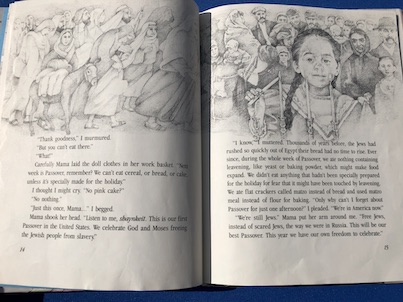
There is also a movie version of this book, although the story was altered slightly so that the girl who insults Molly at the party says that it was her aunt who told her all the bad stuff about Jews, not her mother.  Also, the movie takes place in a time contemporary with when it was made.  The original book takes place in the past, judging by why the reasons why Molly’s family had to leave Russia and the clothes that the girls wear in the pictures.

Steal Away

StealAwaySteal Away by Jennifer Armstrong, 1992.

Most of this story is framed as a flashback, actually two of them.  In the beginning, during the late 1800s, a girl named Mary is taken by her grandmother, Susannah, to visit an old friend of hers who is dying.  The friend, Bethlehem, is a black woman who is a teacher in Canada and has a student living with her, a young black girl named Free, who is about the same age as Mary.  At first, Mary doesn’t completely understand who Bethlehem is and why they are there to see her, and Free is somewhat aloof and suspicious of these white people, but together, Bethlehem and Susannah explain to both the girls about their unusual friendship and a shared history that changed both of their lives forever.  As they explain, Mary writes down their story.

Years ago, before the American Civil War, Susannah was a young teenage orphan.  She traveled from her home in Vermont to the home of her aunt and uncle in Virginia, her new guardians.  Homesick, missing not only her deceased parents but the friends she left behind, especially a boy who is her best friend (and who eventually becomes her husband, Mary’s grandfather), Susannah finds life in Virginia strange and unpleasant.  Her aunt and uncle own slaves, which is something that makes Susannah uneasy.  She was raised not to believe in slavery, but her aunt and uncle give her a slave of her own to take care of her, a girl about her age named Bethlehem.  Susannah is extremely uncomfortable with the situation, not really being the kind of person to get others to do things for her or order anyone around, and Bethlehem isn’t happy about being saddled with this sad, somewhat weak and clueless, white girl.

Bethlehem already has serious problems.  Susannah’s older, male cousin has taken a liking to Bethlehem and pursues her, trying to force his attentions on her.  Bethlehem resists but knows that one day she might not be able to stop him because she’s in his family’s power.  They own her and have authority over her.  Susannah is unaware of this situation at first, being a rather naive girl.  However, Susannah’s unhappiness at her new home increases, and more and more, she longs to return to her real home in Vermont, and her desire to escape also becomes Bethlehem’s ticket to freedom.

Both of the girls long for freedom, although each craves a different kind of freedom and has in mind a different kind of life they long to live elsewhere.  Together, they team up to run away in disguise as boys, although Bethlehem does not trust Susannah at first because she resents white people and the slavery that has been forced on her for her entire life. However, with their common interest in escape, they learn to rely on each other.  They come to trust and understand one another much better during the course of their journey.  It is an eye-opening and life-changing experience for both of them.  Then, when it comes time for them to say goodbye and go their separate ways, it is one of the hardest things that either of them have had to do.

It is a story about lives with separate directions but which crossed in unexpected ways to the benefit of both of them.  Because Susannah and Bethlehem have different destinies and different things that they want in life, they cannot live their lives together and do not see each other again for many years after their adventures, but because of their shared experiences, they still share a bond that lasts across time.

After Bethlehem’s death, Mary becomes concerned about the young student of Bethlehem’s, Free, who was living with her as a part of her family, but Free doesn’t want their help.  Susannah tells Mary that they have to let her live her life and establish her own independence in the way she wants, just as Susannah had to let Bethlehem go her own way years before as a strong, independent young woman who only wanted the freedom to choose her own course in life.

In the end, Mary, as an adult looking back on the one and only time she met her grandmother’s old friend, just before her death, realizes that she has also learned much from the experience, not just about her grandmother’s history, but about herself, other people, racial differences and attitudes, and some of the realities of the world, absorbing vicariously some of the lessons her grandmother learned years ago through her story and Bethlehem’s.

This isn’t really a happy story.  The ending kind of leaves readers with an unsettled feeling because there are many things left unanswered and unresolved.  The book does explain a little about what happens to the characters at the end, but for the most part, they all kind of go their separate ways.  Although they’ve had an effect on each other, nothing is clear-cut, and they share moments together more than lives.  I have to admit that I felt like some of the story dragged in places and others were downright depressing, making this a difficult book to get through.  However, it is interesting for showing a part of history, a life-changing event from different points of view, and some poignant thoughts about caring but letting go.

The book is available to borrow and read for free online through Internet Archive.

I Like Things

I Like Things by Margaret Hillert, illustrated by Lois Axeman, 1982.

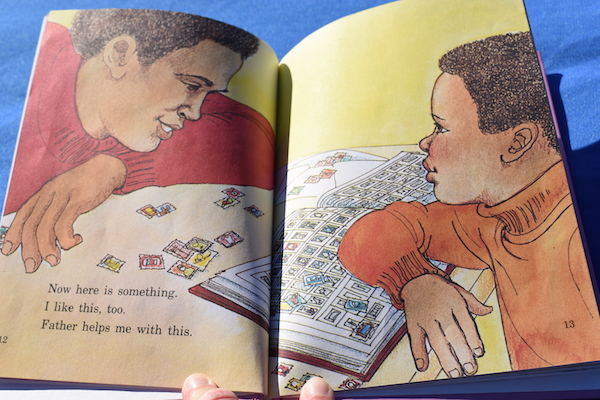
This is a cute little picture book about the fun of collecting things.  A young girl talks about the things that she collects and why she likes them.

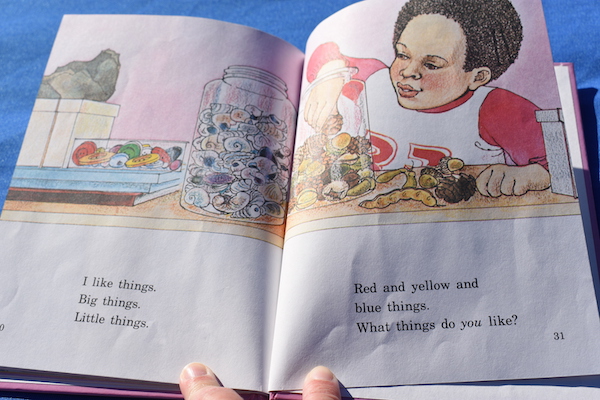
She enjoys collecting all kinds of things with different shapes, sizes, and colors.  Sometimes, she likes to sort the things in her collections, like buttons, by color or size.

Sometimes, her father helps her with her stamp collection.  She also likes to find seashells and rocks at the beach.  Sometimes, she and her friend trade sports cards from their collections.

At the end of the story, the girl asks readers what kinds of things they like, so adults can use the story to get kids to talk about what they like to collect.

I thought it was interesting how the girl put one of the bigger rocks in her collection into a jar that was partly full of water so that the water would act as a magnifier, making the rock look bigger.

One thing I noticed is that the girl never refers to the objects in her collections by name.  Mostly, she just talks about what she does with them using very simple words.  I think that’s to make the book easier for younger children.  There is a word list in the back of the book of all of the words used in the story, and there are only 64 different words.

Mufaro’s Beautiful Daughters

Mufaro

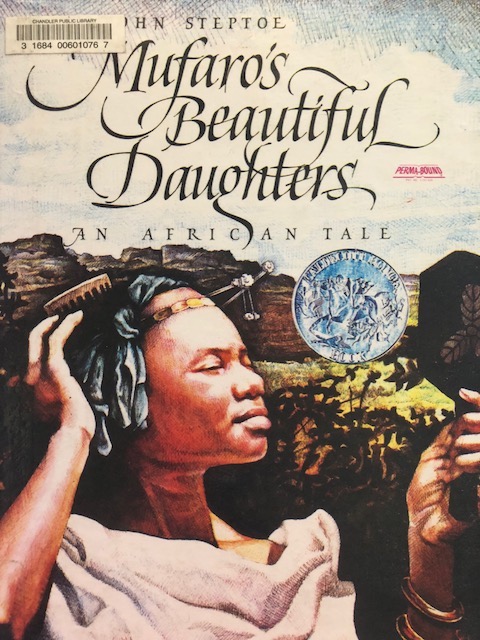
Mufaro’s Beautiful Daughters by John Steptoe, 1987.

This story, based on an African folktale, is somewhat similar to other folktales and fairy tales from other parts of the world such as Cinderella, Mother Holle, and Vasilisa the Beautiful, where a girl with a kind, hard-working nature triumphs over a mean sibling because someone in authority recognizes her good nature and rewards it.

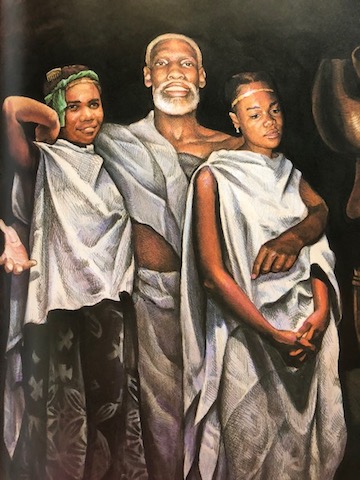
In a small village in Africa, a man named Mufaro has two daughters, Manyara and Nyasha.  Both girls are beautiful, strong, and clever, but they have very different natures.  Nyasha is kind, gentle, and patient.  Manyara is bad-tempered, jealous, and self-centered.  She frequently taunts Nyasha about how, one day, she will be the queen and her sister will be her servant.  When Nyasha asks her why she is so mean, Manyara says that she hates the way people praise Nyasha for her kindness.  She thinks that Nyasha is their father’s favorite child, and she wants to prove that Nyasha’s “silly kindness is only weakness.”

MufaroSisters

Since there is nothing that Nyasha can do to change her sister’s mind or attitude, she just continues doing her usual chores and being kind to people and animals.  In particular, she makes friends with a small garden snake, knowing that his presence in her garden will keep away pests.

Manyara is sneaky and always behaves herself when their father is present, so Mufaro doesn’t know about the troubles between his daughters.  When a messenger arrives, saying that the Great King is seeking a wife and that beautiful, worthy girls are summoned to his city so that he can choose from among them, Mufaro is proud and eager to present both of his beautiful daughters.  Manyara tries to persuade her father to send only her, but Mufaro is firm that both girls must present themselves for the king’s decision.

Manyara decides that the only way to get the better of her sister is to be the first to arrive and present herself to the king, so she slips out in the middle of the night and begins the journey alone.  However, both the journey and the king are not what Manyara thinks they are.  Along the way, Manyara encounters various strange characters who ask for help or offer advice, but thinking that a queen doesn’t need to pay attention to others or do anything she doesn’t want to, Manyara ignores them all.

Nyasha, on the other hand, gets ready to leave at the appointed time in the morning.  Everyone worries about Manyara but decides that the best thing to do is to follow her to the city, since she seems to have gone on ahead.  As Nyasha travels with the rest of their friends and family, she listens to the people Manyara ignored and shows them kindness.

MufaroCity

When they finally reach the city, Nyasha encounters a terrified Manyara, who hysterically insists that when she went to meet the king, she found a horrible monster instead.  However, like everything else, it’s just another part of the test, and Nyasha is the one who passes because she, like her sister, has actually met the king before, but unlike her sister, she actually paid attention to him.

MufaroSnakeKing

The pictures in the book are beautiful and colorful.  A note in the front of the book says that the buildings in the illustrations were based on an ancient city in Zimbabwe that is now ruins.  The note in the book also explains that the names of the characters in the story come from the Shona language.  The meanings of the names are clues to the characters’ natures.  Manyara means “ashamed”, and Nyasha means “mercy.”

The book is a Caldecott Honor Book.  It is currently available online through Internet Archive.

MufaroWedding

The Goggles

Goggles

The Goggles by Ezra Jack Keats, 1969.

Peter and his best friend, Archie, live in a big city (probably New York City), and they often play in empty lots between the apartment buildings.  One day, Peter and Archie are playing in a lot filled with old, discarded junk, when Peter finds a special prize: a pair of motorcycle goggles!

GogglesFinding

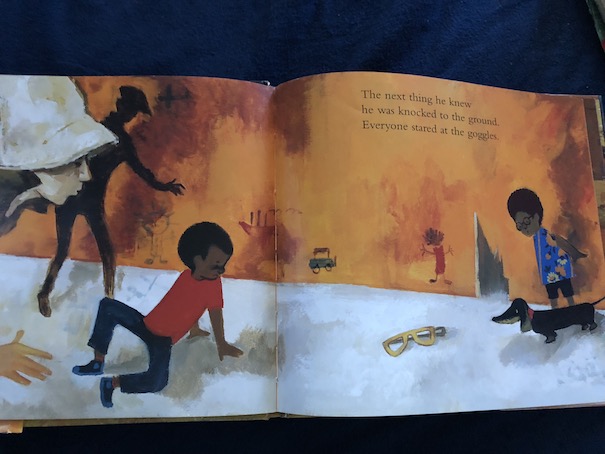
The boys have fun playing with the goggles, but then they’re spotted by a gang of bigger boys.  The bigger boys try to make Peter give them the goggles, one of them even knocking him to the ground when he attempts to take them.

GogglesBullies

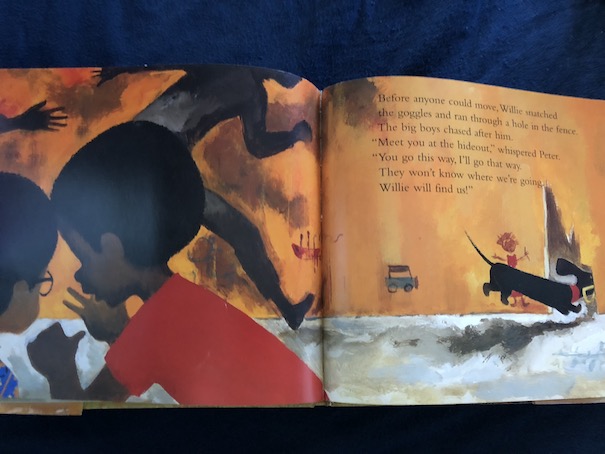
Peter’s dog, Willie, runs off with the goggles, and the boys split up to get away from the bullies, meeting back at their “hideout” in the vacant lot.

GogglesRunning

However, the big boys are still looking for Willie and the goggles.  What can Peter and Archie do to get rid of them?

GogglesTrick

Peter’s Chair

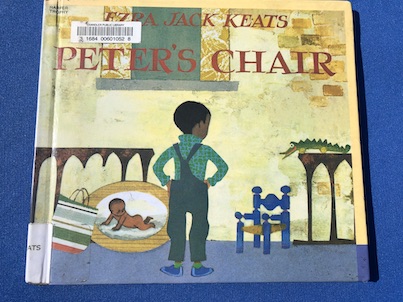
Peter’s Chair by Ezra Jack Keats, 1967.

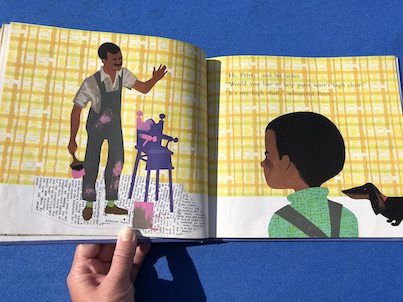
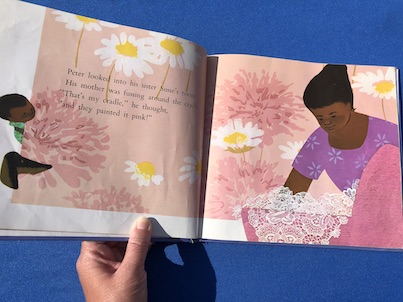
There is a new baby in Peter’s family, his little sister, Susie, and things are changing for Peter.  He is no longer the baby of the family.  He must play quietly to avoid disturbing the baby, and his father is painting all of his old, blue baby furniture pink for little Susie.

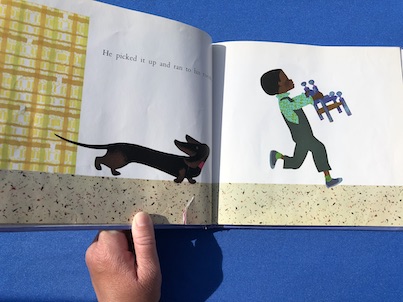
Peter feels badly, seeing the baby getting all of his old things.  Spotting his old baby chair, which hasn’t been painted yet, Peter runs off with it, taking along some of his other old things.

However, what Peter eventually realizes is that he has grown too big to fit into his old chair.  Nobody stays a baby forever, and Peter’s old baby things are of no use to him anymore.

Seeing that he is out-growing these old baby things helps Peter to be willing to let go of them and help his father repaint them for his little sister.

This is a cute story about change and growing up and the worries that children sometimes have about their siblings taking their place in the family. The art style of the book is also interesting because it includes pieces of patterned or textured paper for things like wallpaper, people’s clothing, the newspapers under the furniture being painted, and the baby’s lacy blanket. Other books by the same author also use this technique, such as Jennie’s Hat.