Edward the Emu

Edward the Emu by Sheena Knowles, illustrated by Rod Clement, 1988.

Edward the Emu lives in a zoo, but he finds it boring.  He is so bored that he decides to try living with and acting like the other animals. 

First, he envies the seals who live in the pen next to his and always seem to be swimming and having fun.  So, one night, he jumps out of his pen to join the seals.  The next day, he hangs out with the seals, lying in the sun and balancing a ball on his nose.  It’s much more fun than his boring old pen, but then he overhears a zoo visitor say that the lions are “the best thing to see at the zoo.”

Edward once again switches pens, deciding that he’ll try to be a lion.  He spends the next day growling and snarling while the lions roar.  It’s a lot of fun, but then another visitor comments that he likes snakes the best. 
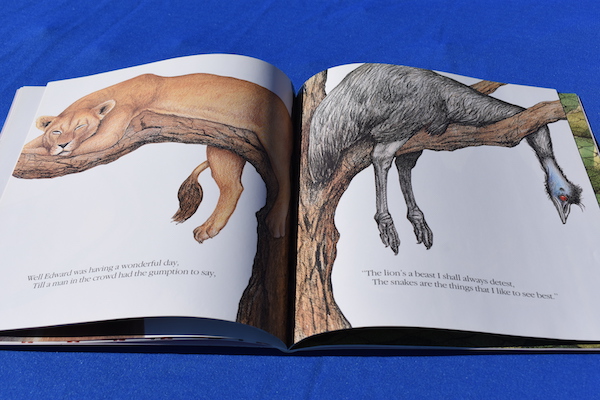
Once again, Edward switches pens and tries being a snake.  This time, someone comments about great emus are.  Feeling better about himself, Edward decides to return to his own pen. 

However, to Edward’s surprise, there is another emu in his pen, his replacement because he disappeared!  It’s not a problem, though, because the new emu, Edwina, is glad to see him, and Edward is less likely to be bored now that he has a friend.

A friend sent me this cute picture book from Australia.  The story is told in rhyme, and the pictures of Edward trying to be different types of animals are fun.

The Dancing Goat

The Dancing Goat by Bonnie Book, 1966.

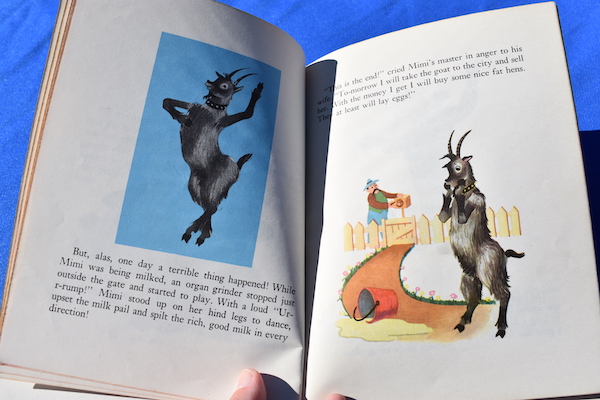
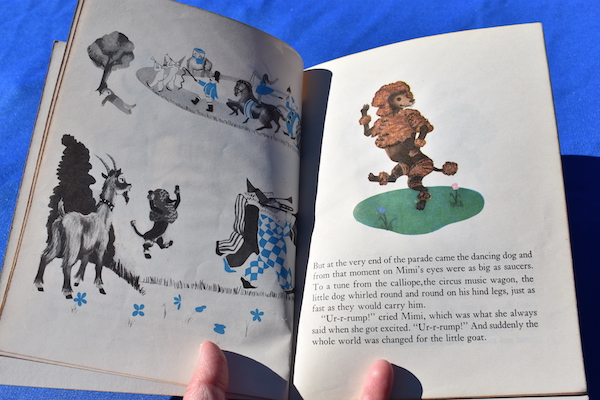
Mimi is a good little goat who lives with a poor farmer and his wife.  They like her and take good care of her, and in return, she provides them with milk that they sell to help make their living.  However, things change for Mimi when she happens to see a circus parade with a dancing dog.  From that moment on, all Mimi wants to do is to dance!

It wouldn’t matter so much except that Mimi develops a bad habit of dancing when the farmer is trying to milk her, spilling the milk.  Eventually, the farmer concludes that he can no longer afford to keep Mimi, even though he and his wife don’t really want to part with her.  Mimi is upset at the thought of losing her home, and when the farmer takes her to the market to sell her, she starts to cry.

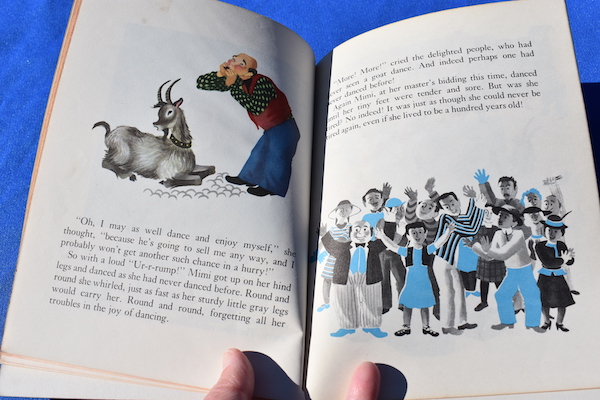
The people at the market don’t want to buy a crying goat and think that something is wrong with Mimi.  To cover up the noise of Mimi crying, the farmer starts to blow a tune on his comb.  Hearing the music, Mimi starts to dance again.

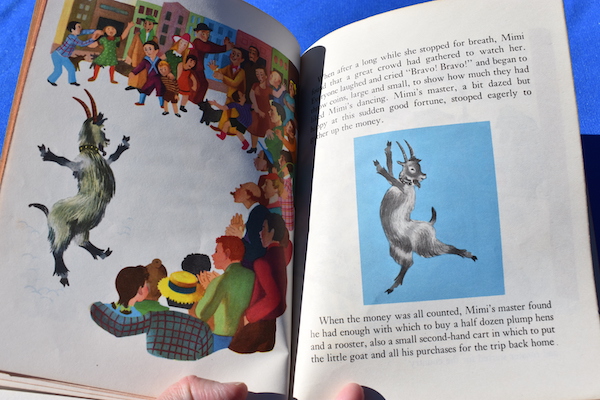
To the farmer’s surprise, everyone in the market loves Mimi the Dancing Goat, and they throw coins.  With the money that Mimi makes with her dancing, the farmer can now only afford to keep her but buy other livestock as well.  From then on, the farmer regularly takes Mimi to the market to show off her dancing and earn some extra money.  He plans to buy another goat to keep Mimi company, and he hopes that the new goat turns out to be a dancer, too!
I usually don’t like “animal almost loses their home” type stories because I always feel too sorry for the poor little animal, but the risk in this story is over pretty quickly, which helps. It also helped that the farmer and his wife genuinely liked Mimi and were only going to part with her reluctantly, so it wasn’t difficult for the farmer to change his mind as soon as Mimi showed that she could bring in money to help earn her keep.

The Large and Growly Bear

The Large and Growly Bear by Gertrude Crampton, 1961.

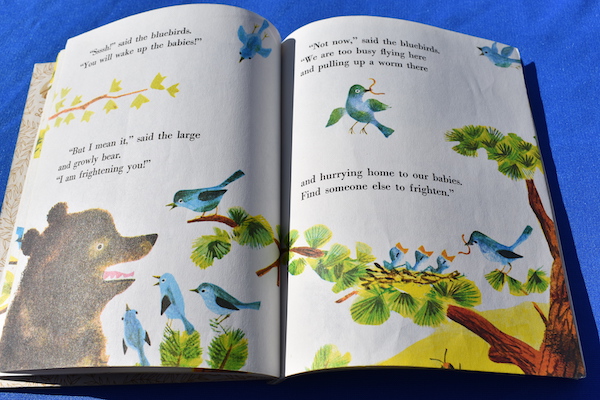
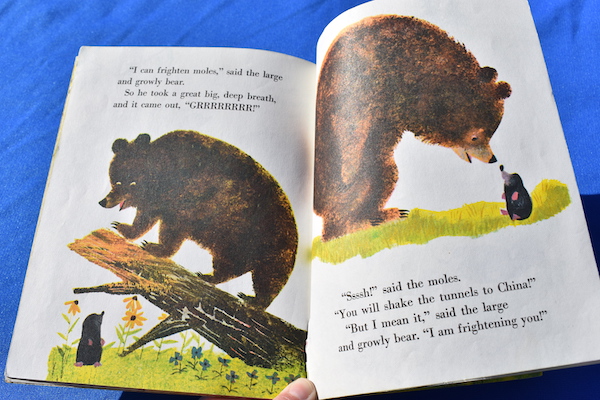
One spring day, a large and growly bear is bored.  What else can a large and growly bear do but find someone to scare with his growling?  But, finding someone to scare proves harder than he thought it would be.

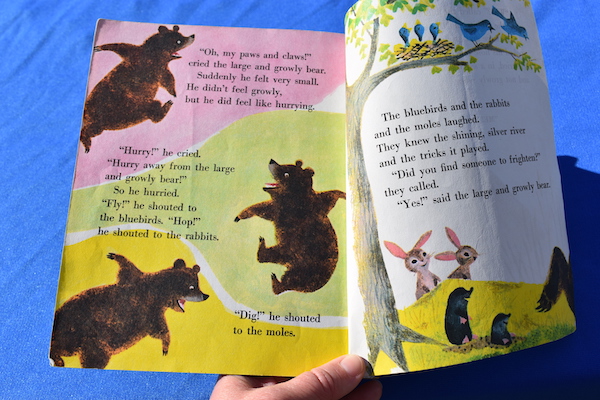
As the bear goes through the forest, trying to scare different types of animals, he discovers that they’re all too busy to be frightened of his growling.  The birds are busy feeding their babies, the rabbits are busy jumping around and counting their bounces, and the moles are busy digging tunnels halfway to China. All of them tell the bear to go find someone else to scare.

Eventually, he gets the idea of trying to scare the fish because fish just swim around and aren’t too busy to be scared, but when he gets to the river, he’s in for a big surprise! The easiest target to scare is . . . himself!

My Reaction

This is just a cute story that my brother really liked as a kid. It has repetition that kids like as the bear repeatedly tries to frighten different types of animals with the same disappointing result, and then a funny twist ending when it turns out the only animal who even has the time to be frightened by the bear is himself.  It’s a Little Golden Book.

Caps for Sale

CapsSale

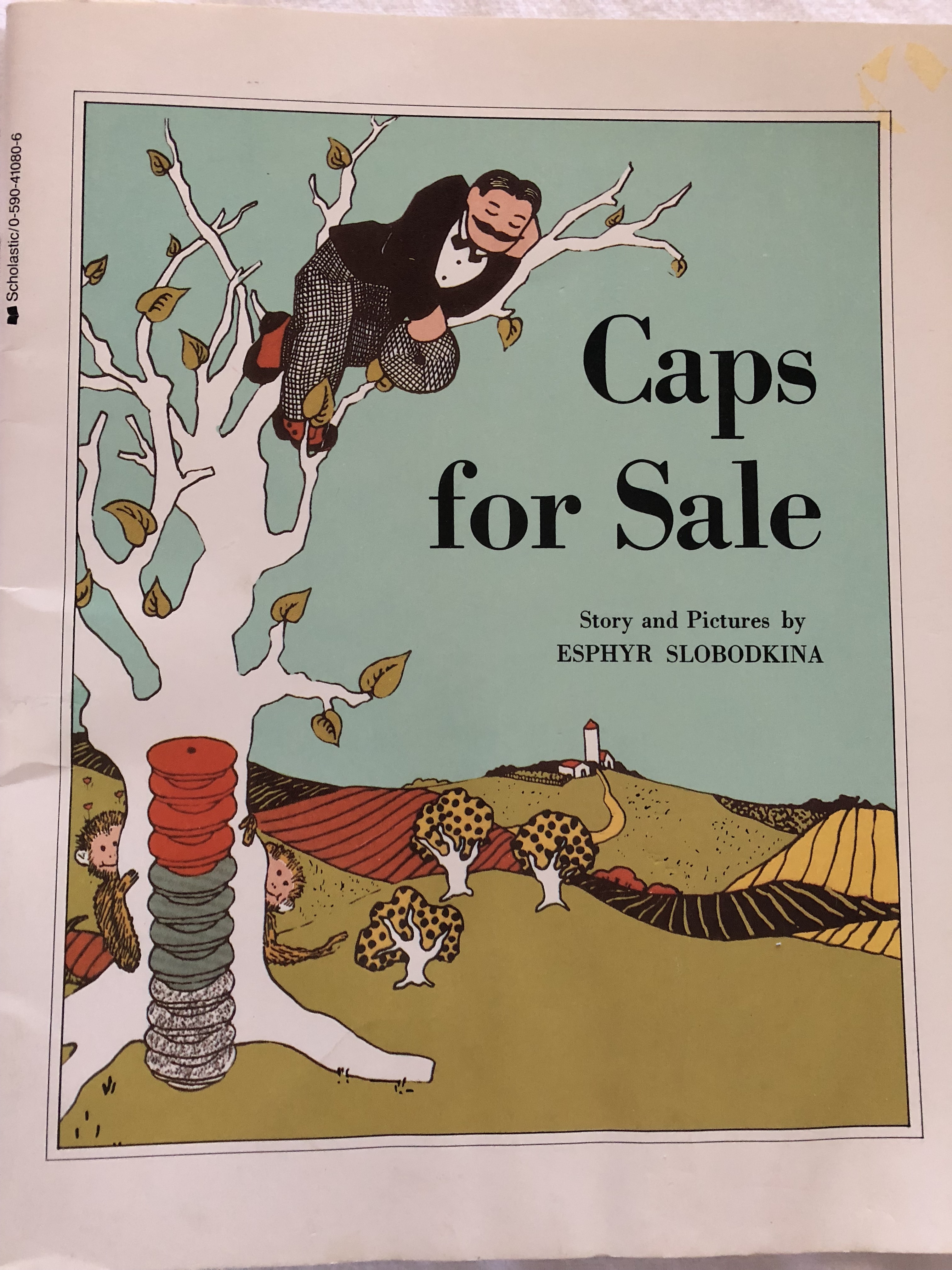
Caps for Sale written and illustrated by Esphyr Slobodkina, 1940.

A peddler who sells caps likes to carry his wares on top of his own head, stacked in order of color.  One day, when he has trouble selling his caps, he decides to take a nap under a tree.  When he wakes up, he is astonished to see that all of his caps are gone!

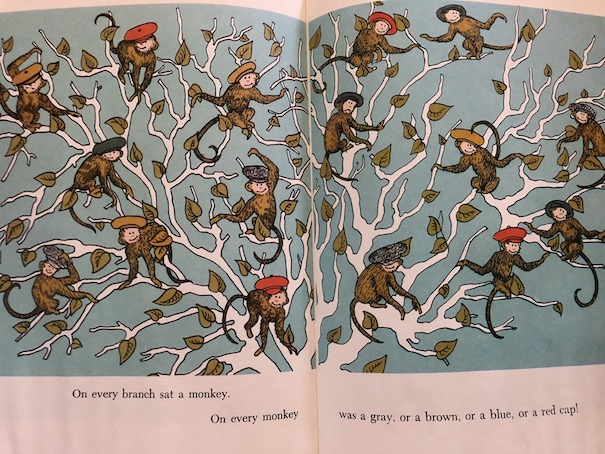
He looks around frantically for his caps and realizes that the tree is full of monkeys, all wearing his caps!  At first, he doesn’t know what to do about it.  He tries shouting at the monkeys, shaking his fists, and stamping his feet, but it doesn’t help.  The monkeys just imitate everything he does.

CapsSaleMonkeys

Finally, in frustration, he throws his own cap to the ground, and the monkeys do that same thing, giving him back his caps.  The peddler is able to reclaim all of his caps, and he goes on his way.

This book is considered a children’s classic!  The story is simple, but the repetition of the peddler’s attempts to get his caps back and the “monkey see, monkey do” imitation are fun for kids.

The book is currently available online through Internet Archive.

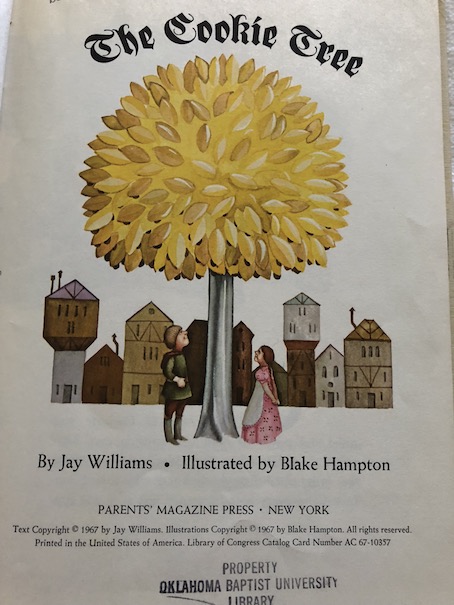
The Cookie Tree

CookieTree

The Cookie Tree by Jay Williams, 1967.

Owlgate is a very orderly little village.  Everything has a purpose and a place, and nothing unexpected happens . . . until the day the cookie tree appears in the middle of town.  The tree is silver and gold and has chocolate cookies.

CookieTreeOwlgate

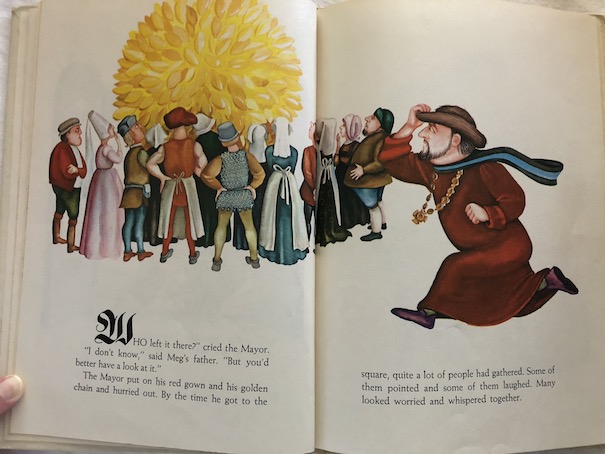
A girl named Meg notices it first, but her parents refuse to allow her to pick a cookie from the tree because they’re worried about where it came from. For all they know, the cookies could be poisonous!  Meg’s father gets the mayor to come look at the tree.

CookieTreeTownspeople

Eventually, everyone in town comes out to see the tree.  The miller thinks that the whole thing is probably a big joke, but most of the other adults are worried because it’s weird.  Some of them think maybe it’s some kind of bad omen.  Little Meg’s theory is that a magician sent it as a present for the village, just to give them cookies.  However, the adults reject that explanation, saying that it doesn’t make sense and they don’t any reason see why a magician would send them a cookie tree.

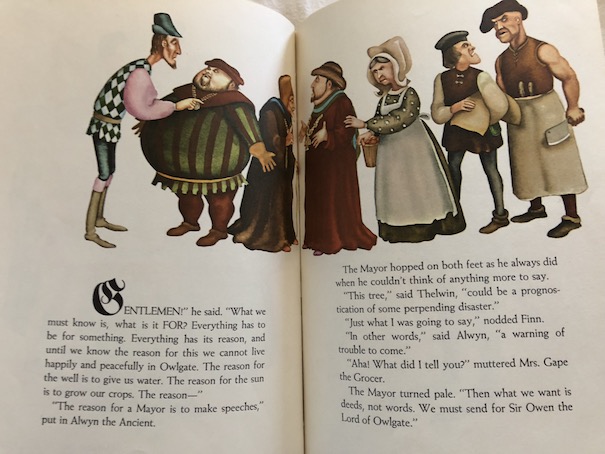
The mayor consults with the Village Councillors, but they don’t accomplish much other than to establish that there are indeed chocolate cookies growing on the tree when one of them samples a cookie.  The adults argue back and forth about what to do about the tree, but by the time they come up with a plan, the tree has vanished!

CookieTreeDebate

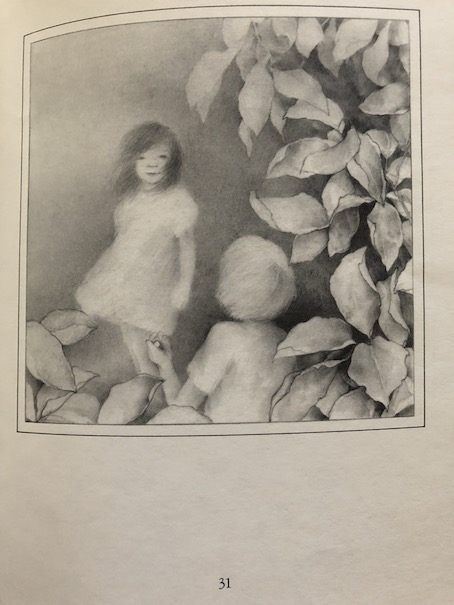
While the adults’ backs were turned, the children of the village ate all the cookies, and once the cookies were gone, the tree disappeared.  Apparently, Meg’s theory about the magician sending the tree just to give them cookies was correct.

One of the things that people sometimes praise children for doing is seeing things for what they are. Adults have a tendency to over-analyze things, looking for hidden meanings that may or may not exist. Sometimes, things really are just what they appear to be, and over-analyzing just confuses the issue. It can be like that with children’s books. Adults worry about every little thing in stories and possible messages being sent to children, but when people start over-analyzing stories, they can find themselves making up hidden messages and reading things into stories that aren’t really there.  Sometimes, stories and other things are just for fun, and you might as well simply enjoy them for what they are!

The book is currently available online through Internet Archive.

The White Marble

WhiteMarble

The White Marble by Charlotte Zolotow, 1963.

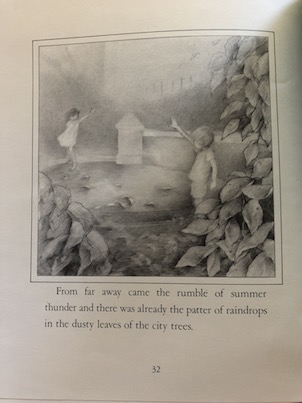
WhiteMarbleGoingToPark

It’s a hot night in the city, and John Henry’s parents decide that they should go to the park to cool off.  John Henry is a little thrilled to be out with his parents at night, stopping to pick up a beautiful white marble he finds as they enter the park, but disappointed when he realizes that he is the only child there.

Then, a little girl he knows from school, Pamela, comes to the park with her mother.  John Henry is pleased to see her because only another child could understand how magical this night in the park really is.  He calls to her to come run with him, and the two children run off to play in the park together.

WhiteMarbleTwoKids

The children kick off their shoes and run barefoot in the cool grass.  They lie in the grass for awhile, drink water from a fountain, and have ice sticks (we always called them popsicles when we were kids) from the ice cream man.

John Henry shows Pamela the little white marble he found.  Pamela thinks it’s as beautiful as he does, and John Henry realizes that no adult could understand how beautiful a small, simple thing like that could be, only another child.  That’s what binds John Henry and Pamela together.  As children, they can still appreciate the simple pleasures of life and the beauty and magic of small, ordinary things that adults take for granted, like a small white marble someone forgot in a park or how nice an evening can feel as rain moves in after a hot day.

WhiteMarbleGoodNight

When it’s time to go home, John Henry gives Pamela the white marble, a memento of this special night.

The pictures in this edition of the book are different from the ones that I remembered from the first time that I read it as a child.  This edition of the book, available through Internet Archive, shows the pictures that I remember.  The pictures in the later edition of the book are black and white, but the ones in the original edition are done in three colors: black, white, and blue.  Of the two, I really prefer the original drawings.  They capture the magic of a lovely night shared with a friend.

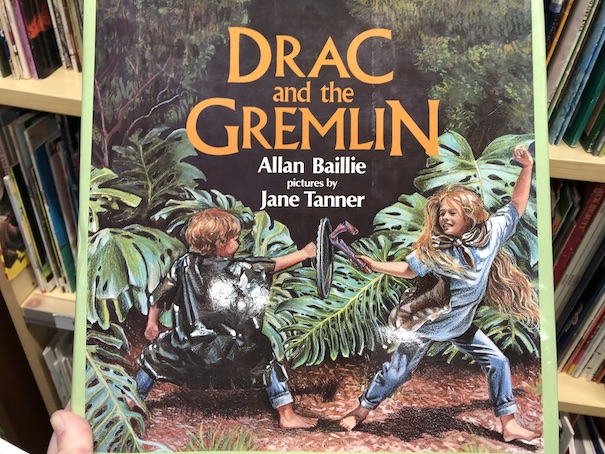
Drac and the Gremlin

Drac and the Gremlin by Allan Baillie, pictures by Jane Tanner, 1988.

The great thing about this book is that you really need to look at the pictures in order to get the full story.  If you read the text alone, it sounds like a magical space adventure story, but when you see the pictures, you realize that it all takes place in a girl’s imagination as she and her younger brother play in their backyard.  The book never mentions the children’s names (or directly talks about reality at all).  The girl calls herself “Drac, the Warrior Queen of Tirnol Two”, and her younger brother “the Gremlin of the Groaning Grotto.”

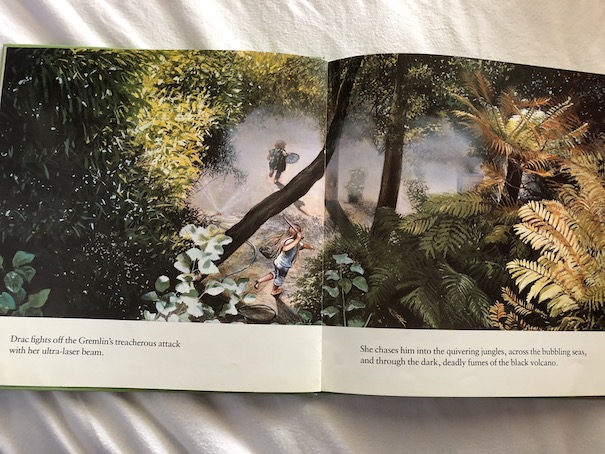
DracGremlinChase

Drac begins by trying to capture the The Gremlin.  She pursues him across the jungles, but when she finally traps him, she receives a message from the White Wizard.  The White Wizard is being attacked by “General Min” (their cat, Minnie) and desperately needs her help!  Drac persuades the Gremlin to help her.

DracGremlinCapture

The two of them get into Drac’s “anti-gravity solar-powered planet hopper” and race to the rescue!  They arrive just in time to save the White Wizard in her current form (a moth).

DracGremlinPlanetHopper

But, they are soon facing another peril: “The Terrible Tongued Dragon” (their dog)!   Drac is almost overcome by the dragon, but the Gremlin saves her just in time!

DracGremlinRescue

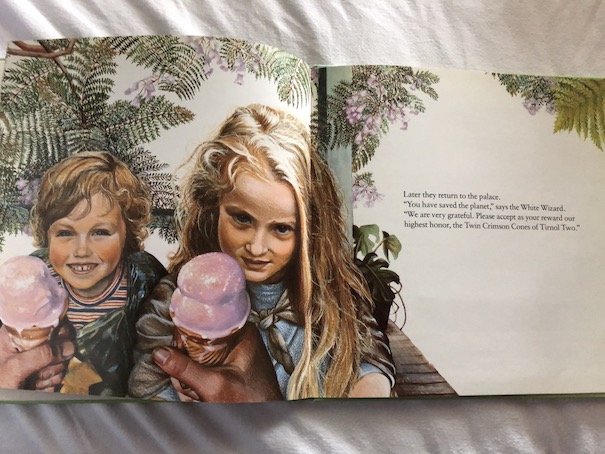
Their adventure ends at the palace, where the “White Wizard” (their mother) rewards them with “the Twin Crimson Cones of Tirnol Two” (ice cream).

DracGremlinReward

I love the way that the adventure unfolds in the children’s minds and the pictures show what is actually happening to the children, as their mother and everyone else sees them.  The pictures are beautiful and realistic.  The book was originally published in Australia, and I recognize some of the plants from pictures that a friend of mine there has sent me!

The book is available to borrow and read for free online through Internet Archive.

Drac

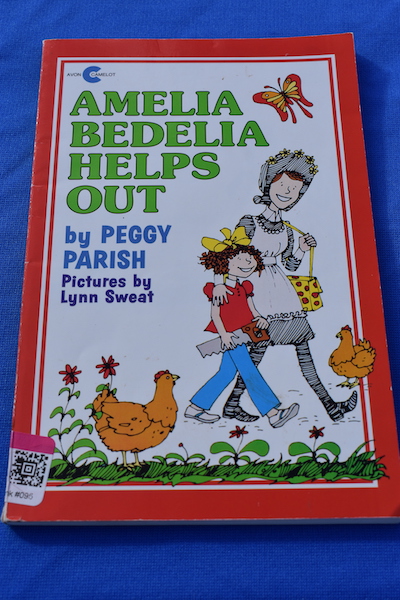
Amelia Bedelia Helps Out

Amelia Bedelia Helps Out by Peggy Parish, 1979.

Mr. and Mrs. Rogers are loaning their maid/housekeeper, Amelia Bedelia, to a friend, Miss Emma to help her with a few things around her house.  Amelia Bedelia also has her niece, Effie Lou, with her to give her a hand.  Effie Lou doesn’t quite know what her aunt does for a living, but although Effie Lou’s first instincts seem to do the normal thing with the instructions that Miss Emma gives them, Amelia Bedelia quickly “corrects” her niece to do things in her quirky, literal-minded way.  For example, when Miss Emma tells them to weed the garden, Effie Lou starts to pull the weeds, but Amelia Bedelia convinces her that they are supposed to add more since Miss Emma didn’t say “unweed” the garden.

From there, Amelia Bedelia interprets Miss Emma’s order to “stake” the beans in the garden as tying bits of steak to them.  They also give the chickens Miss Emma’s quilting scraps instead of food scraps and sew grass seeds onto thread instead of “sowing” them into the ground.

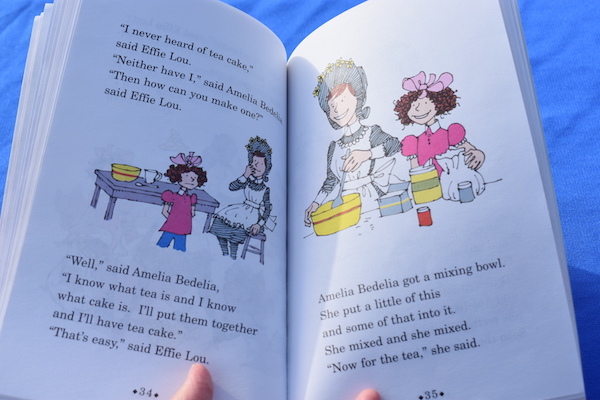
Is Amelia Bedelia a bad influence on her niece?  Maybe, but once again, her baking skills come to the rescue.  Miss Emma asks her to bake a “tea cake” for some guests who will be coming over. 

Now, depending on where you live, “tea cake” actually can mean different things.  Sometimes, it’s just a small cake that’s served with tea, and other times, it’s a special kind of cookie or biscuit (the distinction is regional).  The way Amelia Bedelia interprets it is a cake that actually includes tea as an ingredient.  Surprisingly, though, everyone loves it, even more than the nut cake she also baked.

The book is currently available online through Internet Archive.

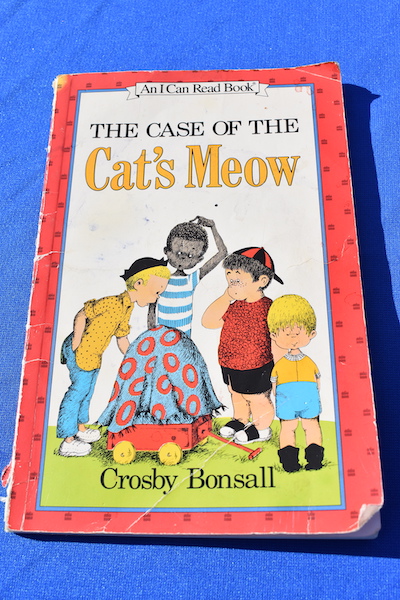
The Case of the Cat’s Meow

The Case of the Cat’s Meow by Crosby Bonsall, 1965.

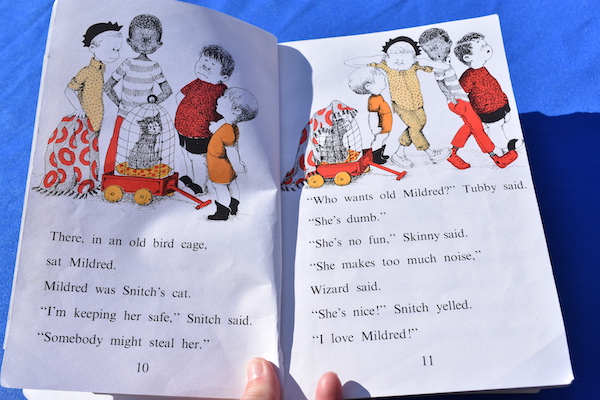
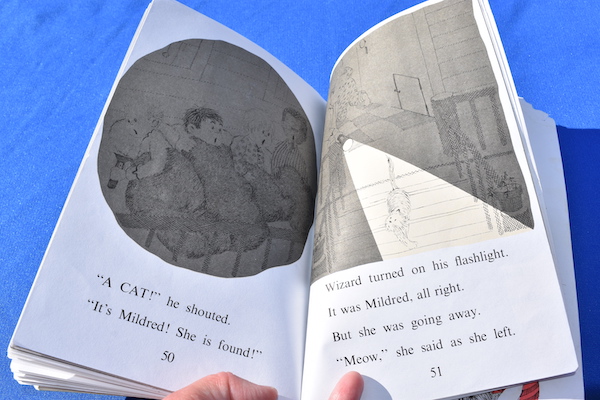
Four neighborhood friends, who call themselves by the nicknames Wizard, Skinny, Tubby, and Snitch, have their own private detective club.  Their club meets in a backyard clubhouse.  One day, Snitch gives them a case when he becomes worried that someone might try to steal his cat, Mildred.  The other boys think that’s unlikely because Mildred is noisy, and the other boys don’t think that she’s that great, but Snitch loves her and is worried.  The boys decide to keep her in their clubhouse with a special booby trap rigged up in case anyone tries to abduct her.

However, the next day, Mildred disappears.  Snitch is convinced that someone stole her, although the others don’t believe it.  The boys start asking around the neighborhood to find out if anyone has seen her.  When that doesn’t work, they try putting food out for Mildred, but they end up with every cat in the neighborhood except Mildred.

Eventually, they realize that Mildred has been coming back at night to visit her food bowl.  When they keep a watch for her, they discover where Mildred has been hiding and the reason why. 

Seeing Mildred’s adorable new kittens makes the other boys discover a new love of cats and take back all the disparaging things they said about Mildred earlier.

The book is currently available online through Internet Archive.

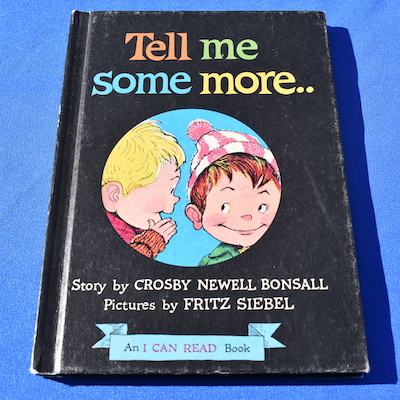
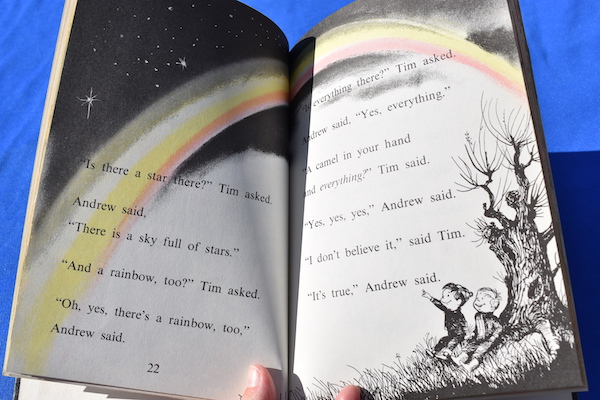
Tell Me Some More

Tell Me Some More by Crosby Newell Bonsall, 1961.

I liked this picture book when I was a kid.  It’s one of those books that plays on the power of children’s imaginations.

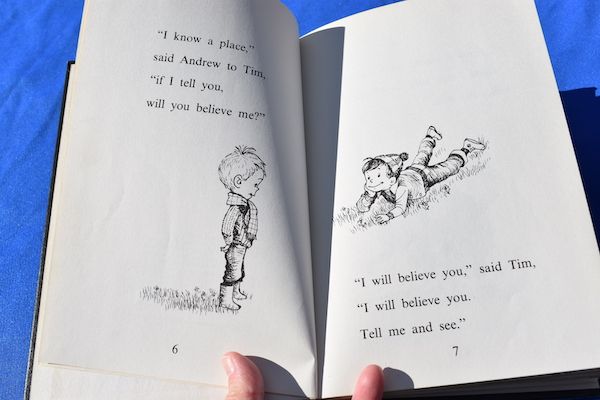
Two friends, Andrew and Tim, are talking, and Andrew starts to tell Tim about a mysterious “place” he knows about.  Andrew doesn’t say right away what the place is, but he makes some amazing claims about it.

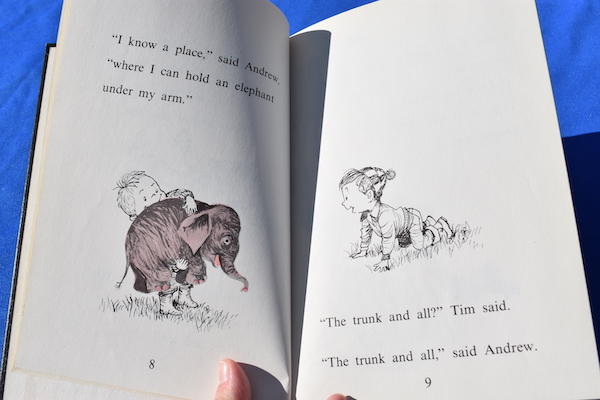
Andrew says that at this place, a person can hold an elephant under his arm and a camel in his hand.  With each new claim, Tim says, “Tell me some more.”

Many of Andrew’s claims involve animals, but he also says that in his place, he can be taller than a tree, that he can pick up a river without getting wet, and that there are all sorts of wonderful things there, like mountains, kings, trucks, and lakes.  Basically, this place has everything.

When Tim says that he doesn’t believe it, Andrew says that he’ll take him there and show him.  The “place” is the public library.  All of the amazing things that Andrew described are in the books.  You can pick up and carry around elephants, camels, and rivers easily when they’re in book form.

As the boys walk home, they talk about the giraffe, elephant, rocket, and steam shovel that they’re bringing home in book form as if they’re really full size.  When they get home, Tim starts talking to his sister, Tansy, like Andrew did to him earlier, introducing her to the library.

The book is currently available online through Internet Archive.