
Magic by the Lake by Edward Eager, 1957.
Jane, Mark, Katharine, and Martha are finally going to spend the summer at a lake with their mother and their new stepfather! The children were never able to do that before because their widowed mother always had to work during the summer. When they arrive at the cottage by the lake that their stepfather, Mr. Smith, has rented, there is a sign that says, “Magic by the Lake.” The children think that it could just be the name of the cottage because sometimes cottages are giving interesting or amusing names, but having had experience with magic before (this being the second book in the series), they consider the idea that they could be headed for more adventures. Of course, they are correct, but it turns out to be the lake that’s really magical, not the cottage.

The children are playing by the lake when they wish for more magic, and a talking turtle comes up to tell them that, because of their wish, the entire lake is magic. That sounds amazing, but too much magic all at once can be overwhelming. Fortunately, the turtle is also magical, and he has some ability to influence magic in the lake. The children make a deal with him that he can arrange for them to have adventures with magic in the lake, but only one at a time, because that’s what they feel that they can handle. Also, the adventures won’t happen every day, so they can have a chance to rest in between. The grown-ups around them won’t notice any of the magical happenings, and little Martha insists that nothing truly scary will happen to them. Jane protests at that request because she thinks that it will make their adventures as boring as overly-tame children’s books, but the turtle says not to worry because what he thinks of as “not scary” isn’t necessarily what Martha would think of as “not scary.” The turtle tells the children that when they’re ready for adventure, they should think about what they wish for and then touch the lake, and if the time is right for it to happen, it will.
That sounds simple enough, but what they consider the right time and what the lake considers the right time aren’t always the same thing, and just as before, their wishes and adventures don’t go quite as planned. In their first adventure, a mermaid takes them to an island of pirates, the stuff of high adventure. The children are delighted when they discover that the pirates, being adults, can’t really see them, as per their earlier wish for adults not to see their magical activities. It opens the potential for playing dirty tricks on rotten pirates, who seem to perceive them as some sort of ghosts. It’s all fun and games until the pirate captain decides to see if he can make ghosts walk the plank. Their turtle friend saves them by turning them into turtles, which, while magical, makes the rest of the day rather difficult for them because they have to go home and on errands with their mother. Walking on land can be difficult for turtles, and their mother has no idea that they’ve changed at all, still seeing them as children. Whatever magic the children get during the day seems to last until the sun sets, even when they wish it would end sooner.
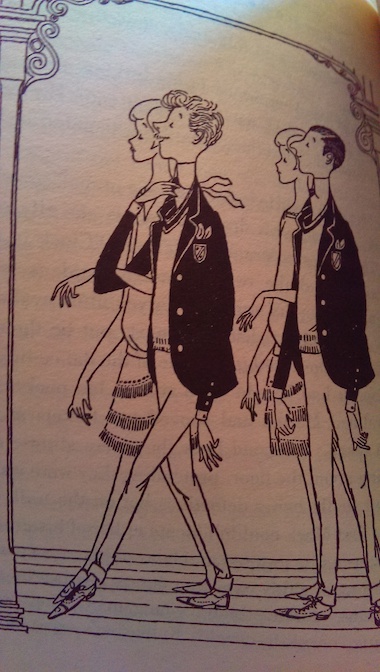
Then, while watching their mother and Mr. Smith at a dance, Jane and Katharine wish that they were old enough to join in, about age sixteen. Suddenly, the two of them are teenagers in evening dresses, getting attention from some teenage boys. The girls seem to enjoy the romance of it, but Mark and Martha follow them around, trying to convince the boys that the girls are really younger than they seem to be and dreading the moment when they will inevitably change back to themselves.
The children discover that they don’t even need to be at the lake in order to make the magic happen as long as they’re touching water from the lake. On a rainy date, when the roof of their cottage is leaking, the children realize that the rain water is also lake water. By making a wish on that, they end up at the South Pole in time to save a lost explorer and help him make an important discovery.
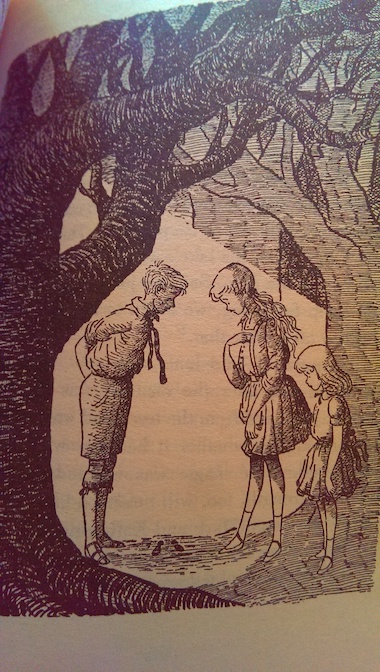
The children enjoy their adventures, but they become worried about Mr. Smith, who has been making the commute back and forth from the lake to his bookshop, and it seems that business hasn’t been good at his bookshop this summer. They consider the idea of using the magic of the lake to solve Mr. Smith’s problems, perhaps by going back to the island where they saw the pirates bury a treasure chest. They figure that if they could bring Mr. Smith an entire chest of pirate treasure, he wouldn’t have to worry about money anymore.
But, of course, that idea doesn’t go as planned. When Martha argues with the others and goes to the island by herself to get the treasure, she breaks all the rules associated with the magic. Because the rules that previous protected her and her siblings are gone, there is nothing to prevent her from being captured by the cannibals that live on the island. When her brother and sisters try to save her, they are also captured. It’s only the sudden appearance of Martha’s future children and Katharine’s future daughter (although they don’t know it yet), who are on a magical adventure of their own, in a cross-over from another book in the series, The Time Garden.
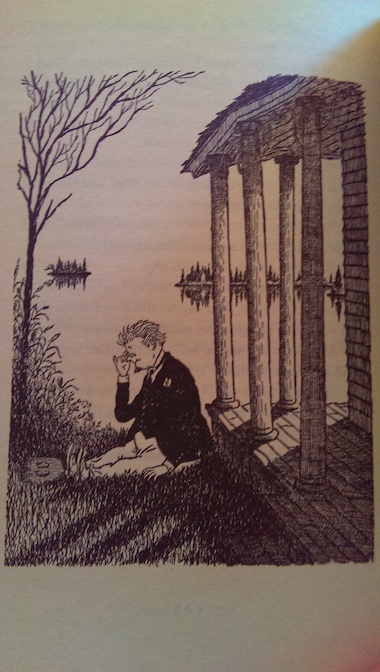
The children make one more attempt to get treasure for Mr. Smith in a kind of Arabian Knights adventure, but that doesn’t work, either. However, although the children seem to have used up their wishes on the lake, they have the feeling that the magic might allow them one last opportunity to get what Mr. Smith needs. It does in a way that may or might not be magical, although the buried treasure that they find and get Mr. Smith to dig up may be a representation of the pirates’ treasure and not of the old miser (now deceased) who was said to have lived at the old, abandoned cottage by the lake that the children decide to explore. It does seem like quite a coincidence that the old miser’s initials would match those of the pirate captain, and they are carved on the stone over the buried treasure, just like the marker the pirate captain left.
In the scene with the cannibals on the island, the cannibals are stereotypical “savage natives” (or “native savages”, or something generic of that sort, since the terms are used pretty interchangeably in the story). You find things like this pretty commonly in old children’s books, especially prior to the 1960s. But, what made this more palatable for me was that the entire scene is written as a joke on the usual stereotypical books that children of the era would have read. The cannibals speak kind of like American Indians in cheesy old Westerns, using words like “heap” for “very” and randomly adding “-um” to end of words. You know that it’s not really how anybody, even cannibals living on some remote island in an indeterminate ocean, would talk, but it might be how children raised on adventure stories and movies from the 1920s might imagine they would (adding to my earlier theory from the last book that at least some of the children’s adventures might actually take place in their own minds, not in their “real world”). It may also be a reference to things in tv shows from the 1950s, the time period when the story was written. The best part for me is when the children try to remember what shipwrecked explorers do when confronted with cannibals in some of the stories they’ve read. They start throwing out random words that are meant to sound impressive combined with some gobbledy-gook in an effort to communicate/impress the cannibals. Then, Mark tries to convince them that he’s a powerful god with the ability to control fire. The cannibal chief is unimpressed, telling him that he recognizes what Mark has as an ordinary safety match, which he blows out. So much for the old adventure stories.
The book is currently available online through Internet Archive.
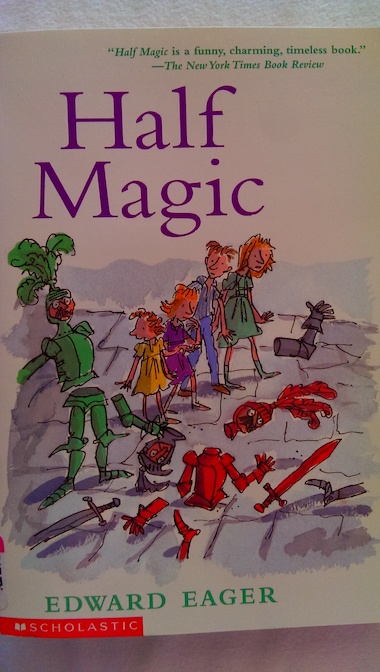 Half Magic by Edward Eager, 1954, 1982.
 These early experiences and a series of odd wishes Mark makes when he doesn’t realize that he has the coin demonstrate to the children not only that the coin is magical but that they have to be extremely careful what they wish for when they have it. They have to word their requests very carefully, asking for twice as much of anything they want in order to counteract the half magic of the coin. Even so, they can’t help but make mistakes and get themselves into trouble.
 There is one more disastrous experience when the children go to the movies (a silent film because this is 1920s), and Martha accidentally wishes that she wasn’t there while touching Jane’s purse, which holds the coin. Martha, of course, ends up being only halfway “not there,” almost like a living ghost, which terrifies onlookers. Straightening out that mess brings them into contact with Mr. Smith, the nice man who gave their mother a ride home. He owns a bookstore, and he enjoys fantasy stories as much as the children do. He becomes the only adult who knows that the children have been using magic, and he’s fascinated by it, enjoying witnessing their adventures.
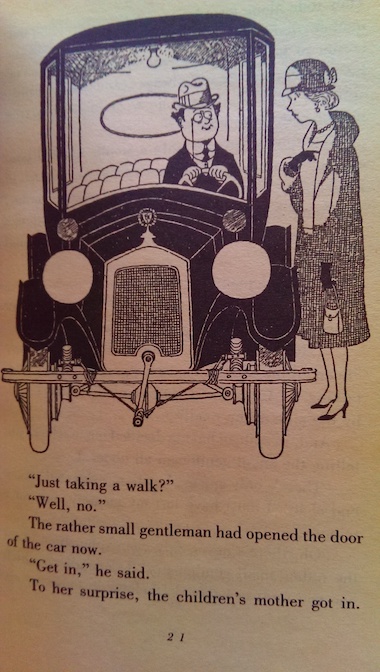 When Jane argues with the other children about Mr. Smith and rashly wishes that she belonged to another family, the other children call upon Mr. Smith to help them rescue Jane from her foolish wish, her unsuitable new family, and from herself.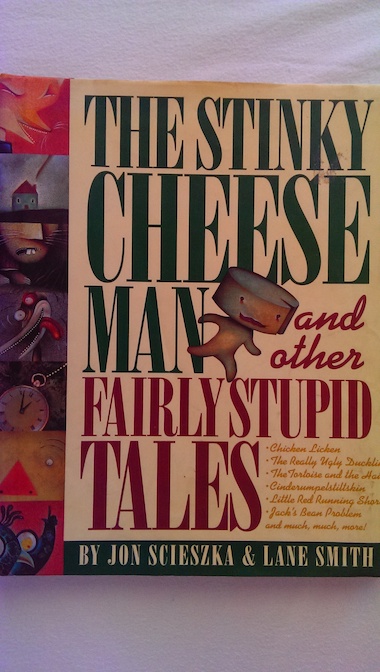
 This book is a spoof on a number of classic fairy tales. As it explains in the introduction, the short stories included in the book are more Fairly Stupid Tales than Fairy Tales, giving the example of Goldilocks and the Three Elephants: A girl smells peanut porridge and wants to enter the elephants’ house to eat some and try out their furniture, but elephant furniture is too big for her to climb up on, so she just leaves, The End. That incredibly short story isn’t found anywhere else in the book, but it’s a good example of what the other stories are like.
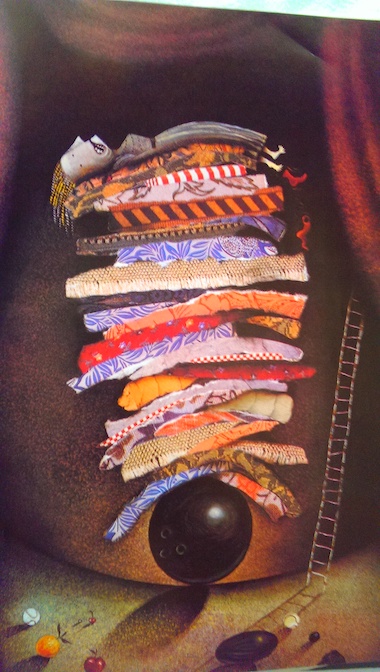 Chicken Licken – As described above
 So, why isn’t there a Little Red Hen story listed? At the end of the book, she shows up to complain about how she had to do everything herself to make the bread and nobody even saved space for her story (because Jack had to sneak away from the Giant after he fell asleep). The Giant wakes up and decides to make a chicken sandwich with the bread.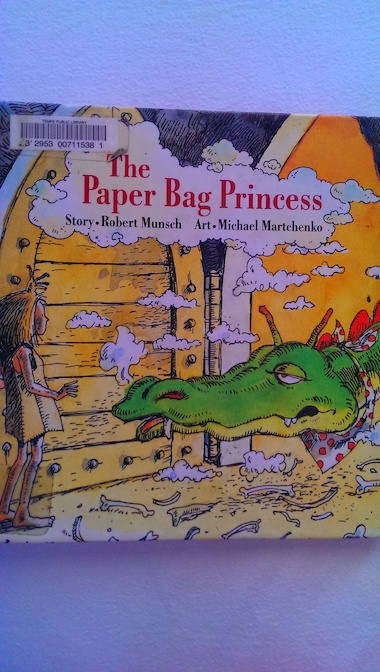


 The modern fairy tales in this book (these are not traditional stories or folktales, although they are written in the style of old fairy tales) feature brave and clever girls. These are not just damsels in distress who need to be rescued, but girls who play heroic parts in their own stories. However, I don’t want you to think that the stories get too preachy about girl power. Some of the men in the stories may seem less than heroic at, but each of them is clever in their own way, and they are sometimes the main characters in the stories as well. The stories don’t lecture you about how “girls are just as good as guys and maybe even better“ or try to make the girls look smarter by making everyone else look dumb or things like that (in spite of the name, “Stupid Marco”, Marco really isn’t all that bad). They’re just fun stories in a fairy tale style with interesting heroines. The best part is that the stories also have a sense of humor.
 Stupid Marco
 Petronella
 The characters in the stories, Emperor Akbar and his friend and advisor
  Akbar had a great love of learning, but unfortunately, was dyslexic at a time when people didn’t understand the condition very well. (To put it into context, Akbar was a contemporary of Elizabeth I of England.) Even though, like the European Emperor Charlemagne (who lived much earlier but was also apparently dyslexic), he wanted to learn to read, he struggled with it throughout his life because of his condition. Akbar didn’t want his reading difficulties to interfere with his learning or his love of the arts, so he found another way around the problem. In a way, it’s similar to what Charlemagne did, surrounding himself with learned advisors who would read to him and discuss important topics with him, verbally teaching him whatever he wanted to know. Akbar chose his advisors very carefully, seeking out people who had demonstrated excellence in subjects that were important to him. Akbar’s advisors became famous for their fascinating and unusual skills and personalities. He had nine special advisors who were close to him, which is why they were called, “The Nine Jewels of the Mughal Crown.” Legends grew up around these men and their abilities:
 There are many more stories about
  From then on, Birbal gains a reputation for his ability to mediate disputes and find unusual solutions to problems. His favored position at court gives him some jealous enemies, but he handles them with the same cleverness that he uses to solve every problem.
 In another of my favorite stories, Birbal determines who is the true owner of a coin purse when a flour merchant and an oil merchant each claim that it belongs to them. He pours the coins into a pot of boiling water and notes the oil that bubbles to the surface. Because the coins are covered in oil, they obviously belong to the oil merchant. If they had belonged to the flour merchant, they would have been covered in flour.
 Ella is a happy baby elephant in India. Her mother takes good care of her, and she enjoys moving with the herd. However, Ella’s carefree life with her mother ends abruptly when the herd is captured by humans!







 Jestress's Forgotten Books and Stories