Jennie’s Hat

JenniesHat

Jennie’s Hat by Ezra Jack Keats, 1966.

When Jennie’s aunt tells her that she’s going to send her a new hat as a present, Jennie is excited.  She imagines that her new hat is going to be big and fancy and covered with flowers.  However, when the hat arrives, it’s just a very plain, ordinary hat with a single ribbon.

JenniesHatGift

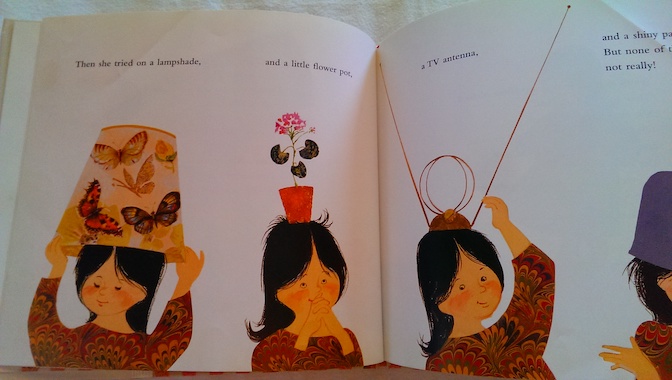
Even though her mother thinks the new hat is nice, Jennie wishes for something fancier, more unusual.  She tries on various other things, like a basket, a lampshade, and a pot to see how they would be as hats.  Of course, none of them really work.

JenniesHatExperiments

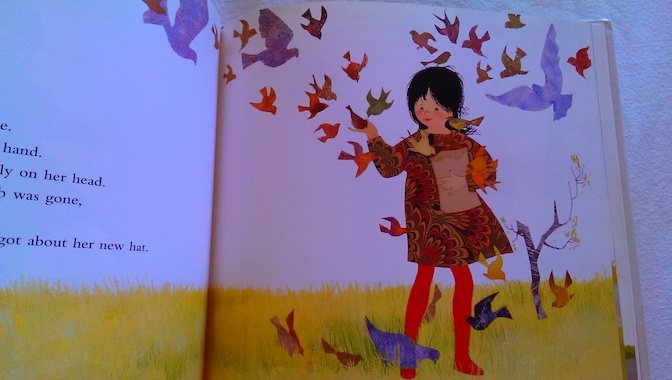
Jennie has a habit of feeding the birds, and while she’s coming home after feeding them one day, she wishes out loud that her hat could be fancier.

JenniesHatFeedingBirds

Her bird friends, hearing her wish, decide to help her.  The next day, as she is leaving church, they bring her the things she’s been wishing for so that she can have the hat of her dreams!

JenniesHatChurch

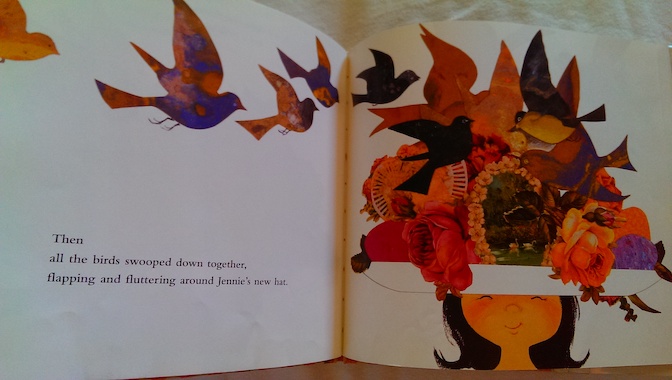
The best part of the story is Jennie’s friendship with the birds and how they repay her for feeding them.  The pictures of all the amazing things they give her for her hat are fun, too!

JenniesHatDecoration

I also liked the unusual artwork style.  Jennie’s clothes are often a cutout of a patterned piece of paper, while the rest of her body is drawn in.

Papa Gatto

PapaGatto

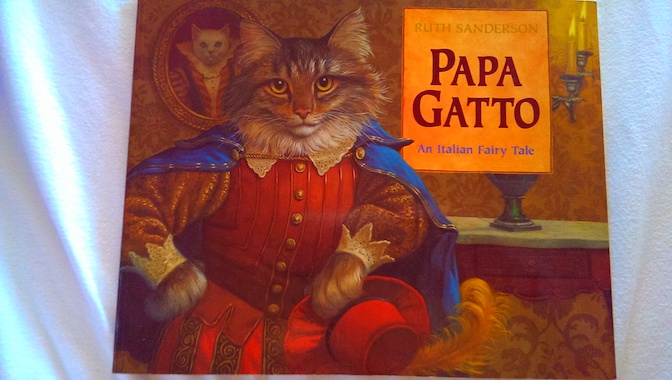
Papa Gatto by Ruth Sanderson, 1995.

This beautiful picture book, set in a fairy-tale Italy, is based on several folk tales, as the author explains on the page with the publishing information.  Among the tales that served as inspiration for this story is The Colony of Cats, which is from Andrew Lang’s The Crimson Fairy Book.  In some ways, this story is similar to Cinderella and Mother Holle, with its wicked stepmother and stepsister.

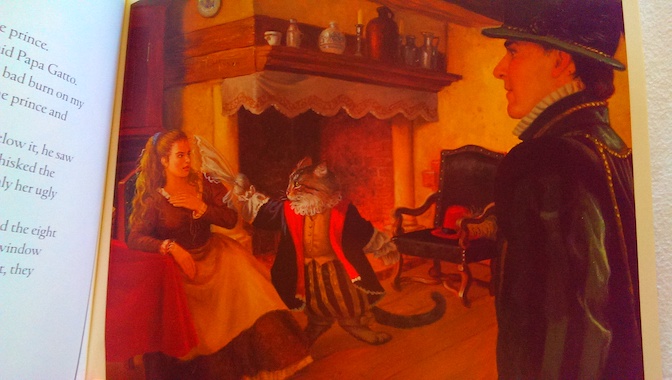
In the distant past, so the story says, it was common for animals to talk, and one of the wisest cats was Papa Gatto, who served as an adviser to the prince.  Papa Gatto had a lovely wife and a beautiful mansion, but soon after the birth of their eight kittens, his wife died.  Needing someone to help care for the motherless kittens, Papa Gatto decides to advertise for someone to help.

PapaGattoAdvertises

In the town, there is a widow who has a daughter named Sophia and a stepdaughter named Beatrice.  As in many fairy tales, the widow favors her own daughter, who is lazy and spoiled, while giving all of the hard work to her stepdaughter, who is much nicer.  When they hear about Papa Gatto’s advertisement, Beatrice feels sorry for the young kittens and wants to help.  However, the widow, thinking of the generous fee that the wealthy Papa Gatto is offering, decides that she wants it for Sophia.  Sophia doesn’t want the job, but at her mother’s urging, she goes to see Papa Gatto anyway.

PapaGattoSophia

Papa Gatto gives Sophia the job tending his house and family while he’s away on a trip, but Sophia doesn’t know how to work hard and has no real intention of doing a good job.  She simply makes herself at home in Papa Gatto’s lovely mansion, trying on his dead wife’s jeweled collars as bracelets and neglecting the housework and kittens.  When Papa Gatto returns home and sees what she’s done, he sends her away in anger.

When Beatrice hears that Papa Gatto is once again looking for help, she goes to see him without telling her stepmother about it.  Papa Gatto sees how interested she is in the kittens and how gently she treats them, he gives her the job, reassured that she will do it well.

PapaGattoBeatrice

Sure enough, when he returns from his next journey, he sees that Beatrice has taken good care of the house and kittens and rewards her with the jeweled necklace/bracelet that Sophia had admired.  Needless to say, Beatrice’s stepmother and stepsister are angry with Beatrice when she returns home, and Sophia takes the bracelet for herself.

Meanwhile, Papa Gatto has told the prince about Beatrice.  The prince has been thinking about marrying, and he says that he would like to meet Beatrice.  Papa Gatto tells him that she will probably be at the coming fair in town, and the prince should attend and look for the girl with the bracelet.

At first, the prince mistakes Sophia for Beatrice, a deception that she and her mother encourage.  However, when the prince speaks to Papa Gatto again, Papa Gatto realizes the deception and sets things right.

PapaGattoRevelation

The pictures in this book are beautiful!  And, of course, there’s a happy ending.

I liked it that Beatrice didn’t accept the prince’s offer of marriage immediately, saying that she’d like to get to know him first.  It’s more sensible than the fairy tales where they get married right away.

PapaGattoHappyEnding

The Cuckoo Clock

CuckooClockStolz

The Cuckoo Clock by Mary Stolz, 1987.

Erich was a foundling, taken in by the Goddhart family as a baby after he was found on their doorstep. Frau Goddhart has a reputation for kindness, but sadly, that reputation is really all she has. She is outwardly kind, participating in local charities, only to enhance her reputation. At home, she is selfish and cruel, ruling the house with an iron fist and having tantrums when things don’t go her way. She sees Erich as an unwanted responsibility, only grudgingly raising him along with her own children because if she refused, it would ruin her reputation. Her husband is kind to Erich, but Frau Goddhart treats him more like a servant.

Erich only comes to know real love when he becomes Ula’s assistant. Ula is the town clockmaker, a master in his craft. Ula teaches Erich his craft and how to play the violin.


When Ula dies, leaving Erich his carving tools and his violin, the selfish Frau Goddhart tries to take them away, thinking that such things are too good for a mere foundling, a charity case. Before she can get these precious things, Erich runs away to seek his fortune elsewhere, but he leaves behind something that convinces the town that, although he may be the ungrateful wretch that Frau Goddhart says that he is, he has a talent that will lead him on to greater things.


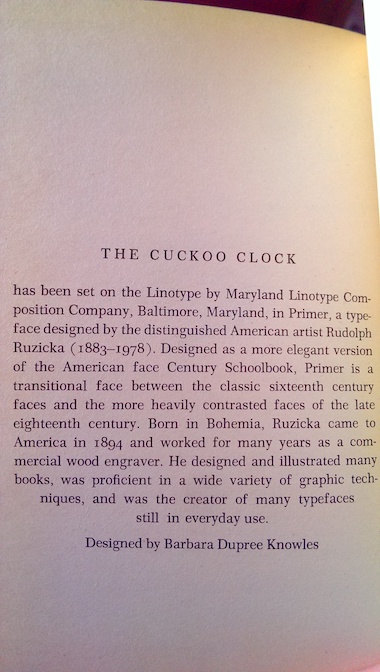
One of the fascinating things about this book is the pictures, which are charming pencil drawings in a realistic style.  There is also a note in the back about the unusual typeface of the book.

CuckooClockStolzType

General Butterfingers

GeneralButterfingersGeneral Butterfingers by John Reynolds Gardiner, 1986.

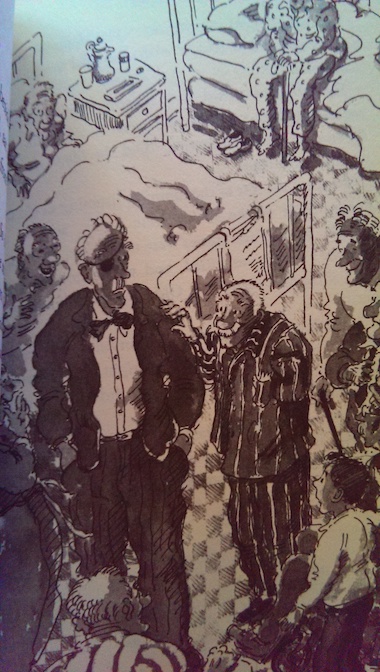
Years ago, the Spitzers, an elite rescue force in the armed services, saved the life of General Britt.  To thank them, he invited the surviving members of the team to live with him in his house, taking care of them until his own death, along with his housekeeper Mrs. Wilson and her son Walter.  Walter is a bit of a klutz, so the old men kid him about being a “Butterfingers.”  But, Walter likes the old men and admires them.

After the General’s death, the General’s nephew, Ralph, claims his estate as his only living relative.  Unlike his uncle, Ralph is mean and selfish and sees the old men as nothing but leeches, using his uncle’s house and money.  He fires Mrs. Wilson and tells the old men that they only have a few days to get out of the house.  The old men have no other place to go except for the Veterans’ Hospital, and no one likes it there.  The men who are currently in the hospital keep hoping that the Spitzers will somehow figure out a way to rescue them.

GeneralButterfingersChessMrs. Wilson and Walter talk to a lawyer, but he says that, since the General apparently didn’t leave a will, the estate has to go to his nearest relative, which is Ralph.  As far as he’s concerned, there’s nothing they can do about, even though the General made a verbal promise to the men that they could stay in his house for the rest of their lives.

Walter tries to talk to Ralph and appeal to his better nature, but that doesn’t work, either.  Ralph has always been a selfish person, disliked even by his own family, and now, he’s bitter about it.  He sees Walter’s attempts at kindness just as a ploy to get the house and money and sends him away.

The more he thinks about it, the more Walter’s convinced that the General must have left a will somewhere.  When he and the men try to visit the General’s safe deposit box at the bank, they discover that someone using the General’s name visited the box on the day that the General died.  Walter realizes that it must have been Ralph.  He is convinced that Ralph knew that the General had left a will, but he stole it so that he could claim the General’s estate himself.  The question is, how are he and the men going to prove it?

GeneralButterfingersHospitalIn some ways, you could feel sorry for Ralph, who is a very unhappy person.  Because of his meanness and selfishness, his father spent years giving him pretty much anything that he wanted on the condition that he not come around to see him.  Ralph is hurt at his family’s avoidance and disdain for him, which is why Walter, at one point, invites him to come for dinner and be their friend.  However, Ralph’s motives are always selfish, and that causes him to suspect that the same is true of everyone, so he refuses their kindness.  It gives the impression that he’s probably done the same for many others over the years, for the same reasons.

Ralph wanted everyone’s approval, especially his family’s, but because of his self-centered nature, he never had any idea of how to go about earning it.  He didn’t know what would matter to others and earn their respect because he was only ever concerned with what mattered to him and what he wanted.  At one point, he angrily tells Walter that his uncle was impossible to impress.   He once tried proving to him that could fight, thinking that would impress an old soldier.  When he further elaborates that his “fight” involved beating up a girl solely to impress his uncle, it leaves little question of why his uncle was unimpressed.  So, Ralph was never able to relate to other people and what mattered to them, which is the root of his problems, but still entirely his own fault.

Ralph has stolen his uncle’s will as a last act of revenge, getting the better of his uncle and acquiring all of his uncle’s things because his uncle would never give him his respect.  In the end, however, his uncle did outsmart him.  Because he didn’t trust his nephew, he left a second will, which is discovered when Walter and the Spitzers stage a last battle against Ralph for their house.  But, the General left them more than just the house.  It turns out that Ralph, who says that he doesn’t believe in charity, has been living on his uncle’s charity for years.  The General’s final legacy allows the Spitzers not only to save themselves but all the other veterans in the hospital as well.

Kathleen: The Celtic Knot

KathleenKathleen: The Celtic Knot by Siobhan Parkinson, 2003.

Twelve-year-old Kathleen lives with her family in Dublin, Ireland in 1937. Like the rest of the world, Ireland is suffering under the Great Depression, and Kathleen’s father has been having trouble finding work. Her mother helps to support the family by working as a midwife.

One day, when Kathleen’s mother is off delivering a baby, Kathleen accidentally burns the porridge at breakfast, making her and her sisters late for school. Although they should have been marked as being on time, they are considered one minute late because the nun’s watch was fast. Discipline is harsh at the Catholic school they attend, and after a harsh lecture to Kathleen, the headmistress, Mother Rosario, calls for a conference with her mother. Kathleen is very upset about it, but Mother Rosario softens somewhat and says that she merely wants to see that everything is alright with Kathleen’s family because a nice girl like her shouldn’t be acting up.  Kathleen still worries because she knows that the nuns look down on poor families like theirs and consider their authority higher than the parents of the children they teach.  They are often unaware of the circumstances that families live in.

However, Kathleen’s mother isn’t fazed by the nuns’ attitude and is blunt with the Mother Rosario, telling it like it is. The headmistress does show that she has some compassion and is somewhat aware of their circumstances because she says that Kathleen’s lateness was only part of the reason she wanted this meeting. She has guessed that Kathleen’s father is looking for work, and there is a position for an assistant gardener open at the school. It doesn’t pay much, and it’s not as good as her father’s old job was before the factory where he worked closed, but he agrees to take it because it’s better than nothing.

The headmistress also says that she has noticed that Kathleen is musically-talented. She likes to sing and has a good voice. Mother Rosario thinks it would be a good idea for her to take piano or dance lessons. The family doesn’t have a piano, so the headmistress suggest that Kathleen join the Irish dancing lessons because it’s a wholesome activity that reflects her heritage and that would keep her out of trouble. Kathleen’s mother isn’t big on heritage, but she agrees that dancing might be a good activity for Kathleen.

Kathleen isn’t happy about the dance lessons at first because the other girls who are involved are snobs. But, once she tries it, she realizes that she actually loves dancing. The problem is that the lessons aren’t free, like the other girls told her. At first, Kathleen feels cheated, finding out that she loves something that she can’t have after all, but her teacher says that she’s talented, so she offers Kathleen some free lessons anyway. She’s been looking for new talent so that her dancers can do well in the next dancing competition, and she doesn’t want to let a promising dancer like Kathleen slip through her fingers.

The snobby girls in class are all the more irritated when Kathleen is among those chosen to enter the next competition, but everyone also knows that there is one more obstacle for Kathleen: she doesn’t have a proper dancing costume or any money to buy one. She prays for one, even promising God that she’d become a nun if he gives her the costume she wants. Her mother has her eye on some beautiful cloth that she hopes to buy as a remnant, but the cloth gets snapped up by some of the wealthier, snobby girls, and her mother comes down with a serious illness shortly before the competition.

Kathleen begins to think that she was wicked for being so concerned about dancing and costumes when there are much more serious things in life. However, her aunt, Polly, understands how she feels and comes up with a plan to make the needed costume for Kathleen, using her favorite book, Gone With the Wind, as inspiration. Remember what Scarlett O’Hara did when she needed a new dress and couldn’t afford one?
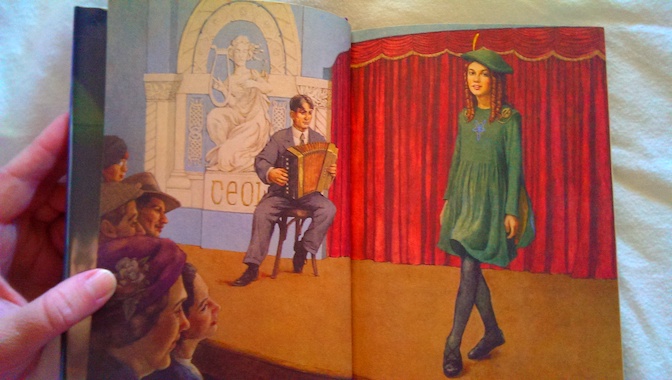
KathleenDancing

One of the themes that runs through the story is questions and answers. Kathleen has a lot of questions about life. She knows that her mother deliveries babies for money, but she doesn’t really understand much about it, and her mother doesn’t answer the questions she asks. In fact, Kathleen notices that most of the adults she knows (with the exception of her father) brush aside her questions about the way the way the world works or the things people do because they simply don’t want to be bothered with them. They have too many concerns of their own, and they don’t really know most of the answers themselves. It kind of contrasts with the answers that Mother Rosario demands from Kathleen and immediately dismisses upon getting. Most of the time, she doesn’t really want to bother with answering questions or even dealing with the answers to questions she’s just asked. Only once does she answer a question that Kathleen had asked about St. Patrick, and Kathleen is astonished at getting an answer about something.

I have to admit that the attitudes about questions and answers from most of the adults in the story really irritated me, especially the way Mother Rosario demanded answers from Kathleen about her lateness and then dismissed everything that Kathleen said, angry that she had “answers.”  I’ve met people like that before in real life, and they’re just as illogical and crazy-making as this headmistress. I’m not talking about teachers who refuse to listen to flimsy excuses like “the dog ate my homework,” but people who get angry at others who have real explanations just because they have real explanations. People who demand to know the reasons why things happen and then immediately reject any explanation offered without a real reason for doing so are obnoxious. I’ve encountered people like that before, and it’s hard to have anything resembling a meaningful conversation with them.   They don’t want to talk to you; they just want to yell or lecture at you.  They don’t really care what the answers or explanations are for anything, and no answer would make any difference to them because what they really want is for the other person to just feel bad. It’s an unethical one-upmanship tactic, and it loses my respect the moment I hear someone use it because I recognize what they’re attempting to do. It’s so obvious, but frustrating at the same time (Kathleen in the story wonders why Mother Rosario is trying to torture her in this way) because there’s nothing you can say to stop the other person once they start (at least, I haven’t figured it out). Kathleen’s approach was probably the most effective.  She just stopped talking and prepared herself for the headmistress to hit her, which caused the headmistress to wake up a bit to the fact that the message that she was sending to Kathleen was that her only intentions were to hurt her.  Fortunately, those were not her only intentions, but I have to admit that I never really had any respect for Mother Rosario after that, in spite of what she did to help Kathleen’s family.  You can tell this is one of my pet peeves.  One-upmanship really bothers me in all of its forms, and I have even less time for that kind of nonsense than these characters do for answering a twelve-year-old’s questions.  At least you can talk to a twelve-year-old. Getting back to that, part of Kathleen’s trouble with some of her questions is that her elders often underestimate her, thinking that she’s really too young to understand anything, but the fact that she’s asking questions says that she’s really not. In fact, she might even be putting more thought into some issues than the people who have decided that some things aren’t worth thinking about in the first place.

Another theme of the story is growing up and changing goals in life. By discovering her talent as a dancer, Kathleen has found something that she would like to dedicate her life to, and if she becomes a dance teacher herself, it would give her a job to do in her future that could make her life better. Her aunt, Polly, who is twenty years old, also changes her mind about what she wants in life. As a single young woman, she likes to go out and have fun with her small earnings, hoping to meet a man as elegant as Rhett Butler.   However, when her latest young man turns out to be a cad, she accepts a proposal from the very shy but much nicer young man who she had previous thought wasn’t handsome enough. Polly’s experiences make her realize that handsomeness by itself isn’t much, and she and her new husband have plans for building a life together. At first, Kathleen is disappointed because she and Polly had talked about leading a carefree life together as single ladies when Kathleen was grown, but Polly explains to her that things will be better this way and that grown-ups have to build real lives for themselves, not live on dreams alone. Kathleen is still in the process of discovering the possibilities that life might hold for her and the talents that she can use to build her life.

I also found the parts about Irish history and politics during 1930s interesting.  One of the reasons why Kathleen’s family isn’t big on the Irish heritage movement is because her grandfather fought during World War I and wasn’t treated well as a veteran when he returned. During the meeting with Mother Rosario, Kathleen’s mother is blunt about her views on things, and Mother Rosario is surprised how much she understands of politics, showing that she looks down on poor people (possibly the source of her general rudeness and bullying tactics, even when she’s trying to be helpful – she’s decided that she’s superior and will remain so, whether she’s right or wrong), thinking that they aren’t smart enough to understand what’s going on around them.  The story makes it clear that the nuns at school are often out of touch with what ordinary families go through in their daily lives.  They underestimate what people know or read about, they have trouble understanding their daily struggles with money and how they are barely able to keep food on the table, and they seem unable to grasp what it’s like to be part of a family where any family member’s actions can affect all of the others.  For me, they were far more aggravating than the snobby little girl characters because I usually expect adults of a certain age to have grown out of some of these behaviors.

While reading the story, I was kind of comparing Kathleen’s circumstances in Ireland in the 1930s to life in America during the Great Depression, and many of their struggles were the same.  I was also kind of fascinated by Polly’s fascination with Gone With the Wind because it shows how pieces of culture and entertainment could become popular in other countries during this time.

This book is part of a series by the same publishers of the American Girls Books.  There is a section in the back of the book with historical information about the period.
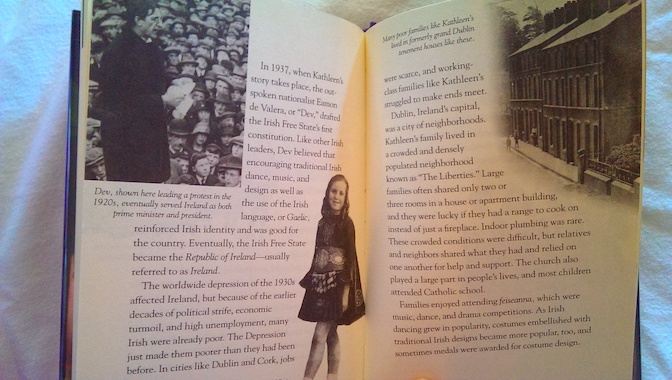
KathleenHistorical

Clever Tom and the Leprechaun

CleverTom

Clever Tom and the Leprechaun by Linda Shute, 1988.

This picture book is based on an Irish folktale, The Field of Boliauns.

Tom Fitzpatrick thinks that his fortune is made when he is lucky enough to catch sight of a leprechaun one day.  If a person can manage to catch hold of a leprechaun and frighten him, the leprechaun will hand over his gold.  Tom thinks of himself as a clever man, so he doesn’t see how he could fail.

CleverTomCapture

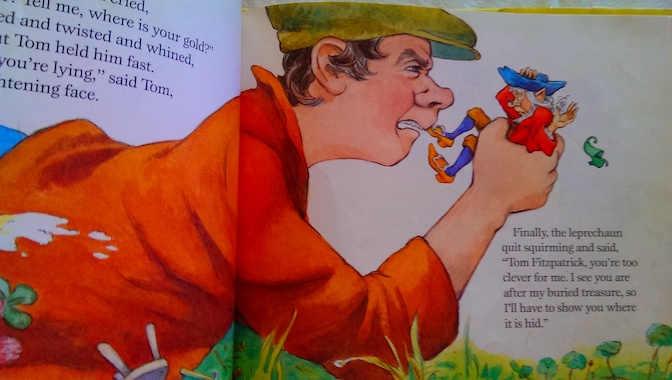
Tom does capture the leprechaun, and the leprechaun does promise to show him where his treasure is buried.  The leprechaun directs Tom to a field of boliauns (a kind of weed, also known as ragwort or ragweed) and points out the plant which marks the place where he buried his treasure.

CleverTomField

Tom needs to get a shovel to dig for the treasure, but he worries about whether he’ll correctly remember the spot when he gets back.  He takes off one of his red garters and ties it on the plant so he’ll be able to find it again, making the leprechaun promise not to touch it while he’s gone.

CleverTomGarter

The leprechaun promises not to touch the garter, but Clever Tom isn’t quite as clever as the leprechaun.  When Tom gets back to the field with his shovel, he’s in for an unpleasant surprise.

CleverTomTrick

Clever Tom might not have his fortune made after all, but he has a great story to tell to the younger generation.

CleverTomTaleTelling

In the back of the book, there is a section with more information about the folk tale, Irish legends and leprechauns, and Irish culture and history.  One of the things I found interesting was the explanation that the leprechaun in the picture book is wearing a red coat because that’s how they are described in Irish folklore.  It’s usually the Trooping fairies who are described as wearing green, like we often see leprechauns depicted in St. Patrick’s Day decorations.  The stories of buried gold left by leprechauns may also may also be based on treasure hoards left by Viking raiders during the Early Middle Ages.  The leprechaun in this story also has ale made from heather, which is something that only Danish Vikings were said to know how to make.

Gila Monsters Meet You at the Airport

GilaMonsters

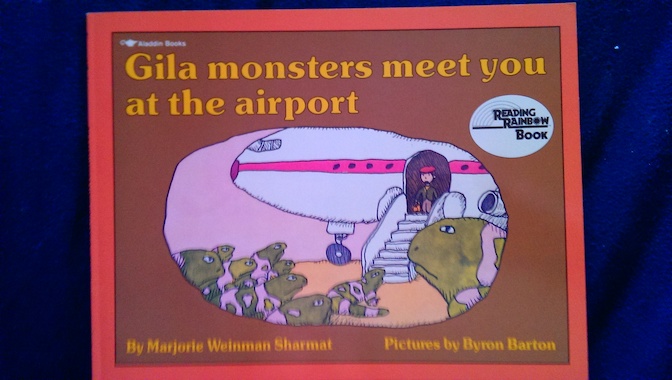
Gila Monsters Meet You at the Airport by Marjorie Weinman Sharmat, pictures by Byron Barton, 1980.

This is a humorous picture book about a boy moving from one side of the United States to the other and his misconceptions of what he’s going to find when he goes west.

At the beginning of the story, the boy lives in an apartment in  New York City.  As far as he’s concerned, he could live there forever, but his parents decide that they’re going to move “Out West.” (The book never really says what state they’re moving to, but it seems to be somewhere in the Southwestern United States, like Texas, New Mexico, or Arizona.)

GilaMonstersMoving

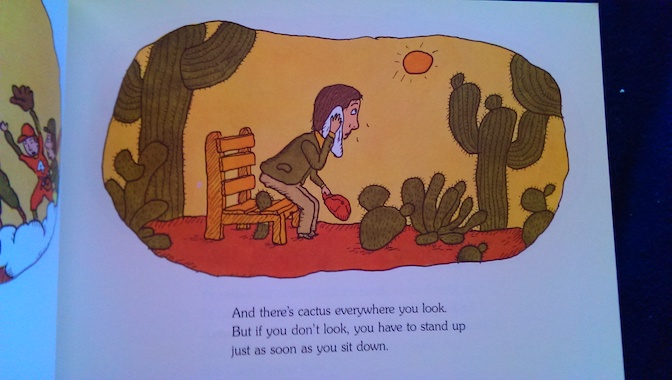
The boy thinks he’s going to hate his new home.  He thinks of all the things that he’s heard about the West, like there’s cactus everywhere so you hardly know where to sit down, everyone dresses like a cowboy and rides horses everywhere, all he’ll ever get to eat is chili and beans, and he’s bound to die of heat exhaustion in the desert.  His best friend in New York, Seymour, told him that Gila monsters would meet him at the airport.

GilaMonstersCactus

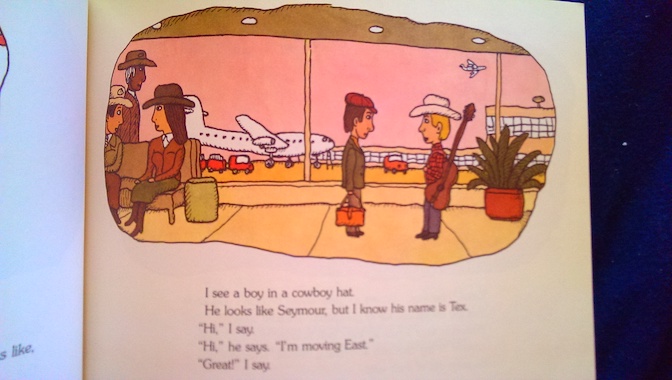
Of course, there aren’t any Gila monsters at the airport when the boy gets there.  Instead, he meets another boy whose family is moving East.  The two boys talk to each other for awhile, and the Western boy starts telling him that he’s not looking forward to heading East because he’s heard that it’s always cold there, the cities are overcrowded and full of gangsters, the buildings are so tall that airplanes fly through the apartments, and there are alligators in the sewers.  He expects to find alligators waiting for him at the airport.

GilaMonstersAirportBoy

Of course, things aren’t as bad as either boy is expecting.  The boy from New York realizes that Seymour and his other friends back East don’t know much about the West, and he starts realizing that things in his new home are actually pretty good, some of them not all that different from home.

GilaMonstersArrival

This book was featured on Reading Rainbow.

Alexander and the Terrible, Horrible, No Good, Very Bad Day

Alexander

Alexander and the Terrible, Horrible, No Good, Very Bad Day by Judith Viorst, 1972.

Everything is going wrong for Alexander today, from the very moment when he wakes up.  When he wakes up with gum in his hair and trips on his skateboard getting out of bed, he can tell that this isn’t going to be a good day at all.

AlexanderCereal

From getting crammed into the middle seat on the way to school to getting things wrong in class to fights with friends, things just get worse as the day goes on.  He sees other people getting good things and doing things right, but nothing works for him.

AlexanderDay

His bad luck continues all day long, right up to when he goes to bed.  His mother consoles him a little, saying that “some days are like that.”  Alexander threatens to run off to Australia to get away from everything that’s bothering him, but it won’t work because people can have bad days anywhere, even in Australia.

AlexanderDentist

The book doesn’t offer any real tips to avoiding bad days, mostly just sympathy, showing that bad days can happen to anyone, and they usually do at some point.  Sometimes, there’s nothing to be done about it except try to get through the day as best you can and hope that tomorrow will be better.  Readers can sympathize with Alexander because his problems are the kind of problems that everyone has had at some point, from little things like seeing siblings and friends get treats that he can’t share in to things like fights and cavities at the dentist.

AlexanderBedtime

There is a movie based on the book, but, of course, it’s a much longer story.  In the movie, when everything seems to be going wrong for Alexander and no one seems to care, he makes a wish that everyone could experience a day like the one he’s been having.  The next day, everyone in his family has everything going wrong for them.  It’s one chaotic event after another all day, but dealing with their problems together helps bring them closer.  In an odd sort of way, some of the pieces of bad luck end up working out for the best.

This book is the first of a series and was also featured on Reading Rainbow.

Mrs. Armitage, Queen of the Road

ArmitageRoad

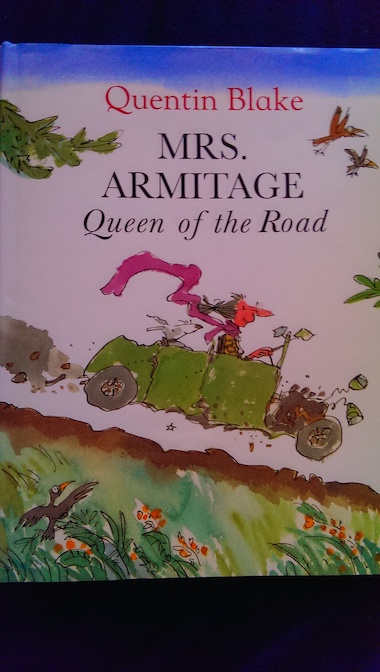
Mrs. Armitage, Queen of the Road by Quentin Blake, 2003.

When Mrs. Armitage‘s Uncle Cosmo decides to get a new motorcycle, he lets her have his old car.  However, it isn’t in very good condition.

ArmitageRoadCar

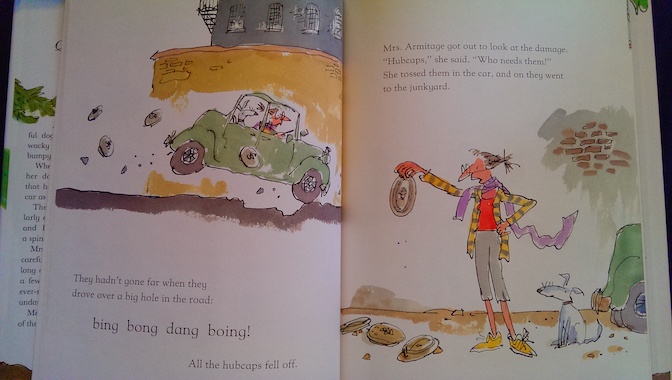
Mrs. Armitage and Breakspear decide to try it out, but as they drive along, pieces of the car fall off.  Some of it is because the car is in bad repair, and some is due to accidents Mrs. Armitage has.  First, the hubcabs, then the fenders fall off.  Mrs. Armitage shrugs it off , saying, “Who needs them?”

ArmitageRoadHubcaps

Eventually, the car goes almost entirely to pieces, but who needs it all?

ArmitageRoadWreck

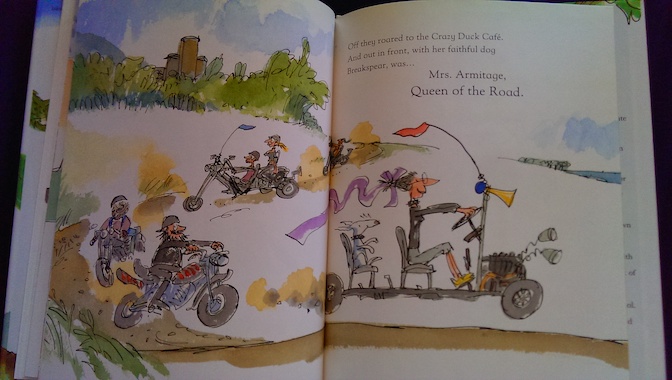
When Uncle Cosmo shows up with his friends and their motorcycles, they help her fix up what’s left of the car into one amazing machine!

The book is available to borrow and read for free online through Internet Archive (multiple copies, including one in Spanish).

ArmitageRoadMachine

Mrs. Armitage and the Big Wave

ArmitageWave

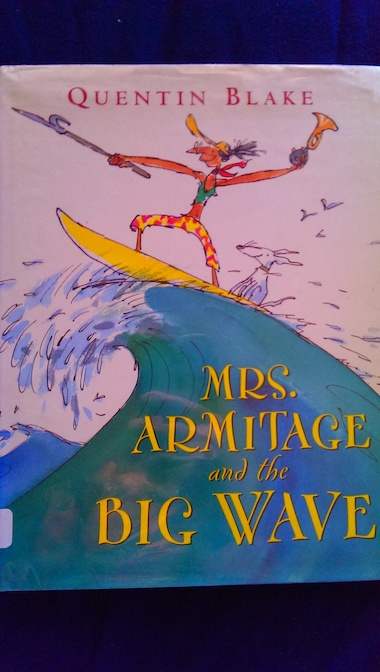
Mrs. Armitage and the Big Wave by Quentin Blake, 1997.

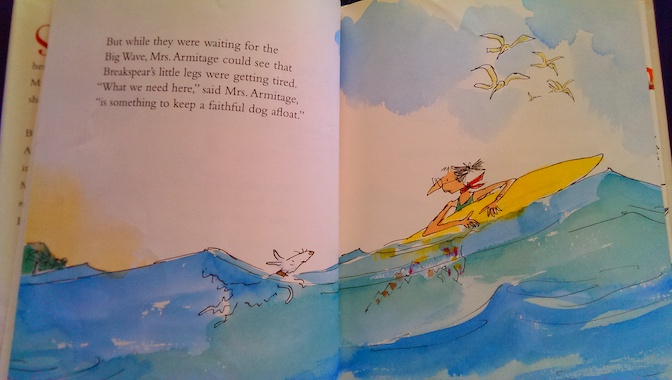
Mrs. Armitage goes the beach with Breakspear in order to go surfing.  She explains to Breakspear that they have to swim out and wait for the “Big Wave.”  But, waiting takes longer that Mrs. Armitage expected, and soon Breakspear is tired, and they’re both hot.

ArmitageWaveDogTired

Of course, Mrs. Armitage finds a solution for everything.  With an inflatable toy for Breakspear to ride on and some protective gear, they wait some more.  Needless to say, Mrs. Armitage doesn’t stop there.  As they wait for the perfect wave, there are plenty of other things that they need to keep themselves busy and make themselves more comfortable.

ArmitageWaveFloaties

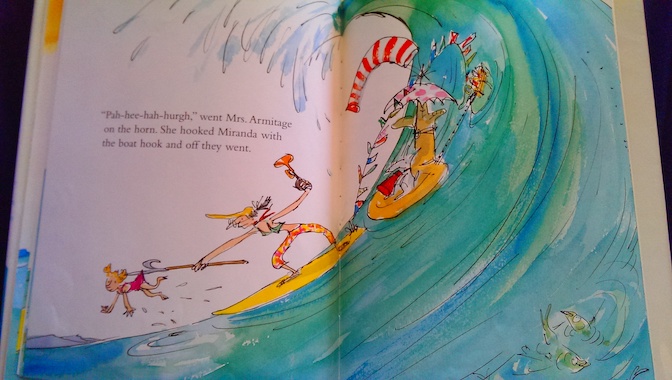
When the Big Wave finally comes, Mrs. Armitage not only makes an incredible show, but she also has what she needs to save a little girl who swam out too far and needed to be rescued.

The book is available to borrow and read for free online through Internet Archive (multiple copies, including one in Spanish).

ArmitageWaveRescue