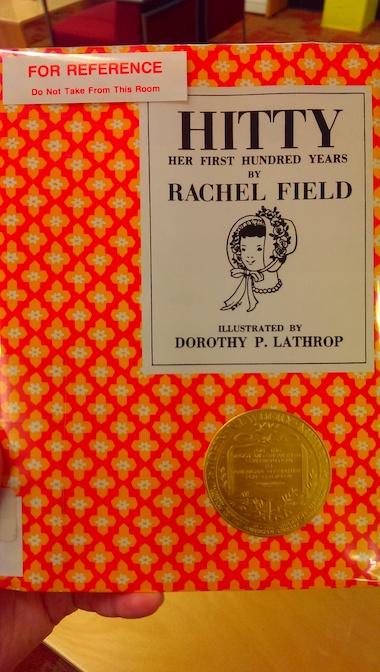
Hitty, Her First Hundred Years by Rachel Field, 1929.
Sometimes, I debate about how much detail I should use when describing the plots of books, but since this is such an old book and a more recently released version has altered the events in Hitty’s life significantly, I’ve decided to cover it in detail. I do not have the updated version and haven’t read it, so what I describe below is the older version. The book is episodic in nature, following the life and travels of a small doll named Hitty. This book is a Newbery Award winner and is currently available online through Internet Archive (multiple copies).
These are the memoirs and adventures of a hundred-year-old wooden doll, which she writes as she lives in antique shop. She doesn’t recall exactly when she was made, but she knows that it was about a century earlier and that she was carved by a peddler in Maine for a little girl named Phoebe Preble.
 The peddler did some odd jobs for the Preble family on their farm that winter, while the weather was too bad for him to travel. They named the doll Mehitabel (a Biblical name from the Old Testament), and Phoebe nicknamed her Hitty. At her mother’s insistence, Phoebe made clothes for Hitty and embroidered Hitty’s name on the doll’s petticoat. Phoebe’s mother says that as long as she has her name on her clothes, she’ll always know what it is, whatever happens to her. Phoebe doesn’t see what could happen to Hitty because she wants to keep her forever, but Hitty is destined to live an adventurous life.
Phoebe misplaces Hitty more than once during their time together. The first time, she accidentally leaves her at church (when she wasn’t even supposed to bring her there in the first place). Then, Phoebe takes Hitty out to play one day, but she and her brother are frightened when they see some American Indians. (Phoebe lives in the early 1800s.) When they run away from the Indians, Phoebe accidentally leaves Hitty behind. Then, Hitty is picked up by a curious crow and carried to the tree next to the Preble house. She hangs from a tree branch for awhile before they realize that she is there and rescue her.
 Then, Phoebe’s father, who is the captain of a whaling ship, convinces his family to join him on a voyage. Life aboard ship turns out to be both exciting and perilous. One day, the ship catches fire, and the Preble family and all the crew abandon it. Hitty, once again, is unfortunately left behind. Although Hitty sees Phoebe gesture back at the ship and knows that Phoebe wants to return for her, it is too late for that.
However, luck is with Hitty, and instead of being burned, she is washed overboard as the ship goes down. Miraculously, she is washed ashore and found once again by the Preble family, who are now castaways on an island. They hope for rescue but fear the “natives” on the island. (Yep. “Savages”, “natives”, etc. These are sadly a common feature in vintage children’s literature. See Edward Eager’s Magic by the Lake for a funnier spoof version. The scene in this book is the sort of generic “savage natives” or “native savages” scenes he was making fun of, except that nobody tries any silly ooga-booga talk to communicate with them, and they don’t turn out to be cannibals. But, it does occur to me that if this book had been written in modern times, people would have insisted that the author give the proper name for the civilization on this island instead of just calling them “natives” and thoroughly research their actual habits and customs and present them in an informative, realistic way for the education of children reading this book, while writers and parents during this period didn’t seem to care about any of that. Keep this in mind the next time someone tells you that younger generations are lazier and not as well-educated.)
One day, the natives come to have a look at the castaways, and their leader catches sight of Hitty and demands (through gestures) that she be handed over to him. Phoebe doesn’t want to give up her doll, but her father tells her that she has to. It turns out that the natives think that Hitty might be an idol that gives the castaways power, which is why they want it for themselves. Hitty is taken back to the natives’ village, and they use her as an idol themselves, making a little shrine to house her.
Hitty probably would have remained there if she had not been stolen from the temple by some curious monkeys and once again found by members of the Prebles’ party, who return the doll to Phoebe. Fortunately, the family sees a passing ship and manages to get rescued before the natives can come after Hitty again.
However, Hitty’s adventures are still not over. The ship that rescues them is going to India, and unfortunately, this is where Hitty and Phoebe are permanently separated when Phoebe loses her in a bazaar. Instead of being found by Phoebe or her family again, Hitty is found by a snake charmer, who uses her in his act, positioned near the snake. Even though Hitty is made of wood and not vulnerable to snake bites, she still finds the experience frightening.
From this point on (we’re about halfway through the story), Hitty changes hands repeatedly, gaining and losing owners every few years or so. Most of her new owners give Hitty a change of clothes, but they always keep her petticoat with her name still embroidered on it so, as Mrs. Preble once said, Hitty and her new owners always know her name.
An American missionary couple spot Hitty with the snake charmer and realize that her design looks like dolls in America. They have no idea how she got to India, but they buy her from the snake charmer and give her to their daughter, Thankful. Hitty lives with Thankful for a couple of years, and she enjoys her time with her, even though she really misses Phoebe.
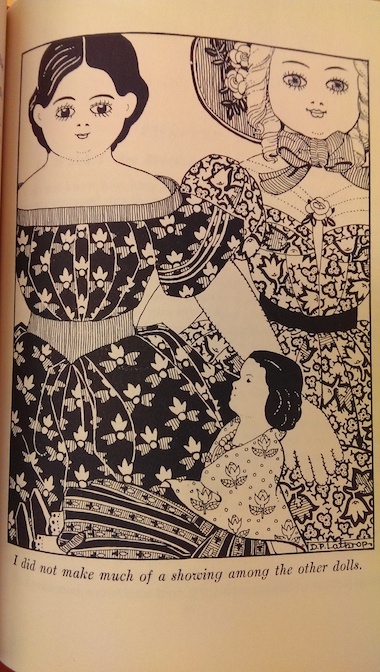 Then, Thankful gets sick, and her parents decide that it might be time to send her home to the United States to stay with her grandparents. Thankful takes Hitty with her when she goes home to Philadelphia. Because Thankful’s early life was spent entirely in India, she has been unaccustomed to spending time with American girls her age, and she doesn’t know how to behave around the American children she meets when she first arrives in Philadelphia. When the some of these (still 19th century) American girls first meet Thankful and Hitty, they think that Thankful is strange and make fun of her for her unusual habits and the way she dresses, telling her that her doll is ugly, too. Hitty has to admit that she isn’t as fancy as the other girls’ dolls. Thankful is so embarrassed by what the other girls say that she decides to hide Hitty in a sofa. After that, the sofa is taken up to an attic for storage, so Hitty remains hidden for a number of years.
 During her time in the attic, Hitty resents Thankful for abandoning her, in spite of all the charitable talk of her missionary parents. However, when Thankful is grown, Hitty is finally found by one of Thankful’s younger cousins, Clarissa Pryce, who really appreciates her. She doesn’t know how Hitty came to be in the attic, but thanks to the name still embroidered on Hitty’s petticoat, knows what to call her. Clarissa is a quiet, conscientious girl in a family of Quakers. She dresses Hitty as a Quaker girl, and Hitty lives with her for many happy years, learning to write as Clarissa goes through her schooling.
By now, the time of the Civil War is approaching, and Clarissa’s family are abolitionists. Hitty doesn’t really understand what the war was about, but she remembers being with Clarissa and watching soldiers march off to war. (This is where the updated version of the book differs greatly. In the older version, Hitty doesn’t witness the war directly, but in the newer one, she does when she is sent to Charleston.)
Eventually, Clarissa gets older and is sent away to boarding school. Hitty is put into storage for awhile and then sent to the Pryces’ relatives in New York, along with some other things. However, Hitty’s package is misdirected and ends up being delivered to the wealthy Van Rensselaer family by accident. There, she is found by Milly Pinch, a seamstress doing some sewing for the Van Rensselaer family. Miss Pinch makes some stylish new clothes for Hitty, although she still lets her keep the petticoat with her name on it.
The Van Rensselaers’ young daughter, Isabella, sneaks into Miss Pinch’s room one day and finds Hitty, and a debate ensues about who really owns her. Mr. Van Rensselaer, on hearing where Miss Pinch found Hitty, says that rightfully, Hitty belongs to their family but that the clothes she is wearing are obviously Miss Pinch’s because she made them. Miss Pinch is gratified that he is being fair about it, but because Isabella really wants both the doll and clothes together, the family purchases them from Miss Pinch and gives her an excellent employment recommendation for her sewing.
Isabella is rather spoiled and has several dolls already, but she genuinely likes Hitty and takes care of her. Unlike Thankful, she even speaks up for Hitty when others say disparaging things about her plainness. While living with Isabella, Hitty even gets the chance to meet Charles Dickens. However, Hitty is stolen from Isabella by a gang of mean boys.
One of the boys in the youth gang takes the doll home with him and gives her to his younger cousin, Katie. The family is poor, but Katie loves her and gives her plenty of attention. When Katie gets sick and goes to live in the country for awhile, Hitty is accidentally lost in some hay and spends a long time in the barn, living with the mice.
When she is finally found, a pair of traveling artists are staying at the farm, and one of them keeps her to use as an artist’s model. He uses her to amuse children when he paints their portraits and even adds her into still life paintings. Hitty worries about how her painted features have faded, but the artist thinks that she’s much easier to paint than newer china dolls because the light doesn’t glare off of her. She stays with him for many years while he travels around the country, but he eventually leaves her with a pair of spinster ladies, Miss Hortense and Miss Annette, in New Orleans when he rents a room from them.
 While living with these ladies, Hitty learns that Miss Annette’s fiancé died young, fighting for the Confederacy in the Civil War, and she still feels bitterly toward the North because of it. From her time with Clarissa, Hitty knows that many people in the North could say the same about the South, but of course, she can’t actually say so out loud. The ladies make new clothes for Hitty, dressing her as a bride, with her clothes made from an heirloom handkerchief, and put her on display at the Cotton Exposition (aka the 1884 World’s Fair). From there, Hitty is stolen by a little girl named Sally, whose father is the captain of a riverboat that carries cotton up and down the Mississippi River.
Hitty learns that Sally is a lonely child who travels with her father frequently because her mother is an invalid and cannot always take care of her. Sally knows that it was wrong for her to steal Hitty, but she so badly needs a companion that she is even willing to risk jail if it means that she can keep Hitty. However, after attending a revival meeting where there are warnings against the evils of theft and getting caught in a sudden thunderstorm, Sally panics, thinking that God may be about to strike her down for her sins, and throws Hitty into the river. (I found this scene a little disturbing because, when Sally fears that God will smite her with lightning for stealing, she not only makes a desperate apology but asks if anyone has to be struck, couldn’t it be one of the newly-baptized kids, who are sinless and would know that they were going to heaven? The fearful apology is understandable, but it’s a little disturbing to hear this little girl try to throw someone else under the bus like that.)
From the river, Hitty is rescued by a couple of black boys (the book says “Negro” because it was written in the 1920s) who are fishing. One of them gives Hitty to his sister, “Car’line.” (Her name is probably really Caroline, but Hitty just says the name as she hears it, and the boys have a Southern accent. This is one of those books where they try to give the impression of accents with odd spellings like, “How you come by dat doll?” It’s not the worst example I’ve seen of this, but I have to admit that I’ve never really liked the use of odd spellings like that.) Car’line’s family is the poorest one that Hitty has ever lived with, with a fairly sizable family living in a small cabin. However, Hitty likes the way Car’line treats her and how close her family is, and she loves the music that they sometimes play and the old spirituals that they sing.
At Christmas, Car’line’s family goes to a big party at a house that was apparently once an old plantation. The wealthier owners of the house give presents to the poor children of the area, like Car’line. While they are at the party, one of the women at the house, Miss Hope, recognizes Hitty from a newspaper report that a doll in heirloom clothing had disappeared from the Exposition in New Orleans. Car’line is upset when Miss Hope tells her that the doll really belongs to someone else and should be returned, but Miss Hope understands Car’line’s feelings toward Hitty and soothes her by giving her the doll she had played with as a child, a fancy French doll named Mignonette, as a replacement for Hitty.
As the end of the book draws closer, Hitty changes hands more often than before, and she doesn’t describe her time with new owners in as much detail, partly because her new owners tend to be adults and mostly display her, not play with her. Miss Hope attempts to return Hitty to the ladies in New Orleans, but since the heirloom handkerchief clothes are ruined, they decide that she should really be returned to the artist who had her before. When they try to mail Hitty to his address in New York, it turns out that he has moved without leaving an accurate forwarding address. Hitty spends some time as a package in the postal service, ending up in the dead letter office, where she is sold off, along with other undeliverable packages, to people who are willing to take a chance that there might be something interesting or valuable in them. She doesn’t spend much time with the man who bought her because her package is accidentally left behind at a tobacconist’s shop, where she is accidentally delivered to a house with an order of pipes. The lady of the house has been wanting to try a craft project for turning a doll into a pincushion, so she adds padding to Hitty and puts some pins in her (terrifying but not actually painful for Hitty). From there, Hitty is sold at a craft sale, where she is bought as a present for someone’s great aunt. The great aunt doesn’t think much of the pincushion, but her friend collects dolls and recognizes that Hitty is a collectable. For awhile, Hitty lives happily with the friend as part of her collection, until she is lost out of a car on her very first automobile ride. Then, she lays alone in the countryside, fearful that this is going to be the end for her, until she is found and rescued by some picnickers.
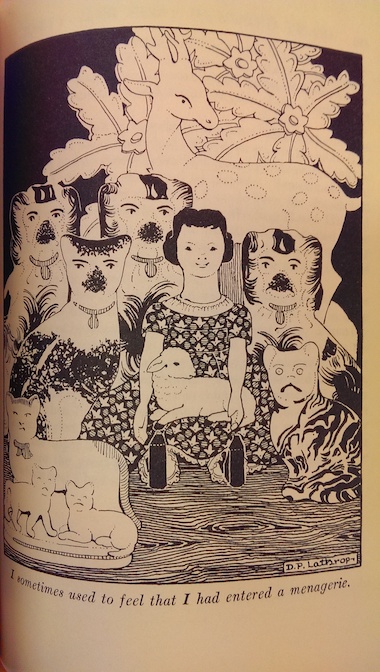 It is at this point that Hitty learns something astonishing: not only is she now about a hundred years old, but she has actually managed to make it back to her home state of Maine. To her further astonishment, she even returns to the Preble house where she originally lived, which is now the summer home of an elderly woman. Hitty knows that it’s far too late for her to have any hope of seeing Phoebe Preble again, and she never learns what exactly happened to Phoebe in her later life (which I thought was kind of a shame, bu it fits with the story of a doll, drifting from one owner to the next, unable to control her destiny or ask any questions of the people around her). The elderly lady collects antiques, and Hitty becomes a part of her collection, although the lady has no idea that this is Hitty’s original home.
Eventually, the elderly lady dies (it’s implied, but not stated – one summer, she simply never comes back), and her collection is auctioned off. Hitty is again surprised when she discovers that people view her as a valuable antique now. An Old Gentleman buys her at the auction, and when he takes her with him to New York, he comments that he supposes that it’s probably the first time she’s been outside of Maine and that her travels are about to begin. Hitty is amused.
At the end of the story, it is revealed that the Old Gentleman has purchased her for Miss Hunter’s antique shop, which is where she is now writing her memoirs. Miss Hunter and the Old Gentleman are delighted by Hitty and consider her a “museum piece.” Even though they could sell her, they don’t seem anxious to do so. She has become their shop’s mascot, and many people who visit the shop like to say hello to Hitty. Still, Hitty knows from her experiences that change is a part of life, and she is looking forward to seeing more changes in the world around her and the new adventures she may have with future owners!
My Reaction
In some ways, I was surprised by how much I enjoyed this story. The length may seem a little daunting at first (262 pages about the adventures of a doll!), but the reading time is faster than you think, partly because of the episodic nature of Hitty’s life. Books that are episodic can sometimes be a drag because, no sooner are the characters out of one situation, they plunge straight into another. If it isn’t done right, it can leave the reader feeling like it’s all getting tiresome and repetitive and wondering where it’s all heading. It’s a little different with Hitty, partly because the writing quality is good and partly because her owners and their lives are so varied. I didn’t think much of the whole “natives” episode (because I never like “savage native” scenes in anything), but her other owners are a eclectic range of people, young and old, who have different interests and uses for Hitty. Hitty ends up in some worrying situations, but you can feel reassured that she is going to be all right in the end because you know from the beginning that these are her memoirs that she is writing during the course of the story.
Hitty is unable to move around much on her own, which is part of the reason why she moves from place to place because of accidents or intentionally being carried or shipped by people. However, she does seem to have the ability to move by herself in some small ways, such as writing her memoirs and when she tries to imitate Isabella’s dancing lessons, only to discover that she can’t quite do it because a doll’s legs aren’t jointed in the same way that human ones are.
Apart from the “savage native” scene, I don’t think the book was too bad, racially speaking. I can’t recall any really objectionable terms being used. Black people, when they appear, are called either “black” or “Negro”, and nothing insulting is said about them. They are not treated cruelly in the course of the story. Hitty enjoys her time as Car’line’s doll and doesn’t think badly of her or hold her in lesser esteem than other owners because she was poor. The people in India aren’t described too badly, either, although Hitty thinks that the snake charmer was weird, and she seems to think well of the Indian nurse who took care of Thankful. Thankful’s parents never discover that the Indian nurse gave her additional herbal remedies when she was ill, but Hitty appreciates the nurse’s devotion to the girl, doing everything she could to help her. Hitty even says that she doesn’t know which medicines helped Thankful the most or if it was really the combination of all of them that saved her from her illness.
Some of Hitty’s owners are obviously nicer than others, with Thankful being arguably among the worst of them. Even though Thankful’s upbringing is very religious, she and her new American friends are apparently rather shallow and thoughtless. Even though her new “friends” in Philadelphia aren’t even nice to her, Thankful still worries about how she looks to them and is ready to chuck her beloved doll to please them. Even spoiled little Isabella takes better care of Hitty and is more loyal to her, standing up to mean people as best she can instead of trying to appease them.
Mostly, Hitty prefers to be owned by young girls because she likes it when they play with her and carry her around, but she does enjoy being with adults who pay attention to her and treat her as a personality instead of as a mere object. I was glad that none of the children Hitty lives with dies young, which could have been a risk in real life but would have been tragic. Even with the elderly owner who presumably died, which was probably why her collection was being auctioned, Hitty never sees her die and doesn’t explicitly know that she is dead. Whether Hitty will ever be owned as a child again now that she is considered an antique is unknown, but the author leaves the end of the story open, so just about anything could happen in Hitty’s future.
In a way, though, Hitty’s fate is already known. Great Cranberry Island is the part of Maine where Hitty is supposed to have come from, and the Preble house is based on a real house. The story was based on a real doll that the author found in an antique store. This doll is now at the Stockbridge Library Museum in Stockbridge, Massachusetts. There is also a cafe that is named after Hitty. There are fan sites dedicated to Hitty, some of which have tips for creating a doll very much like her.
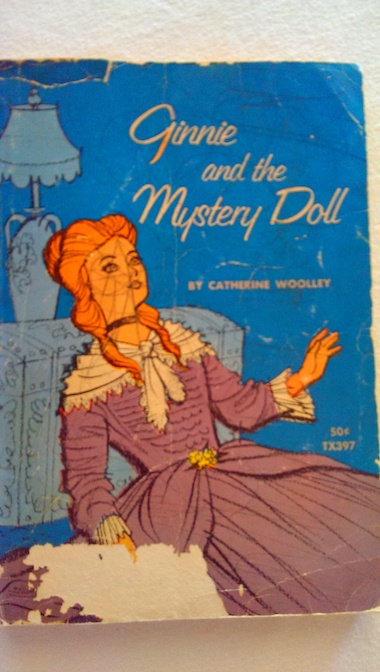
 The girls ask Miss Wade about the doll, and she says that she knows the one they mean, but she no longer has it. Her mother’s uncle was the captain of a ship and used to bring her presents from around the world. The doll, called Lady Vanderbilt, was very fancy, and Miss Wade describers her costume to the girls. However, she says that the doll disappeared after she rented her house out to a family one summer while she was traveling. She never found out what happened to the doll, but she assumed that the children of the family probably found her and either took her or broke her. Miss Wade said that she didn’t think that the doll was worth making a fuss about, so she never asked the family about it. The girls note that Miss Wade doesn’t seem to know anything about a precious jewel in the doll, but they decide not to say anything about it since Miss Wade doesn’t have the doll anymore.
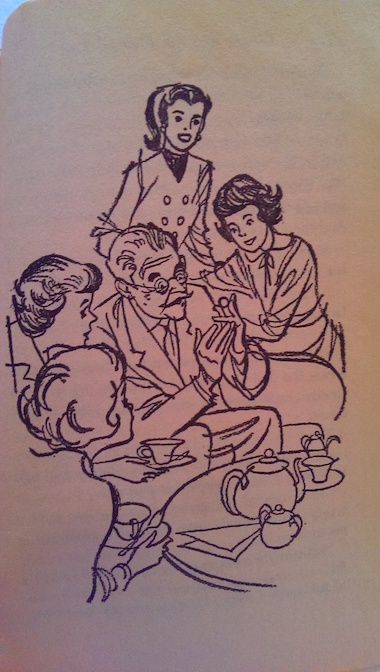 The girls tell Miss Wade and their mothers about the doll, but when they try to ask the people in charge of the auction where the doll came from and who bought her, they learn that the woman who was in charge of organizing the toys has already left on vacation. The only clue that the girls have is that the woman who bought the doll left the auction in a red Jaguar.






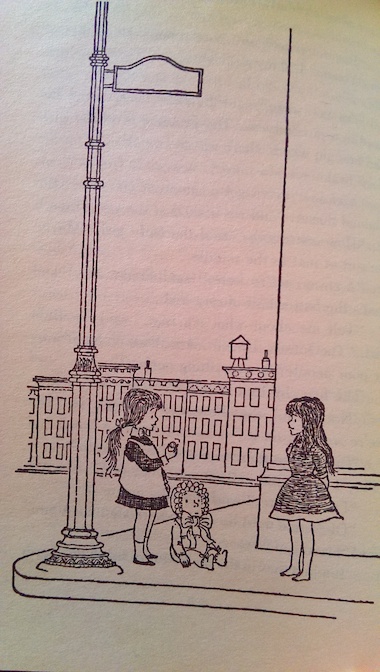


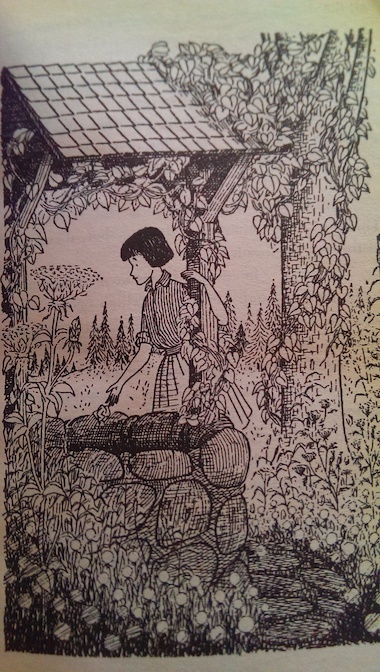
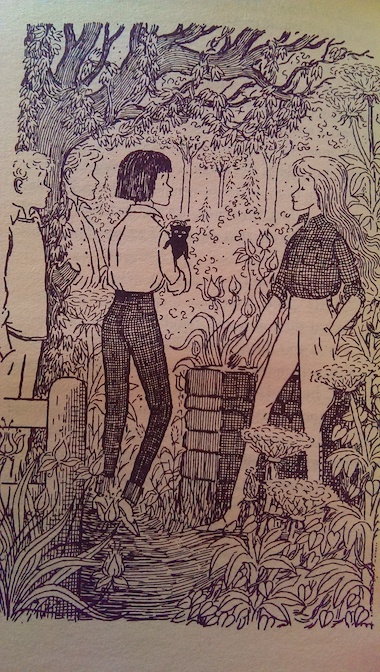







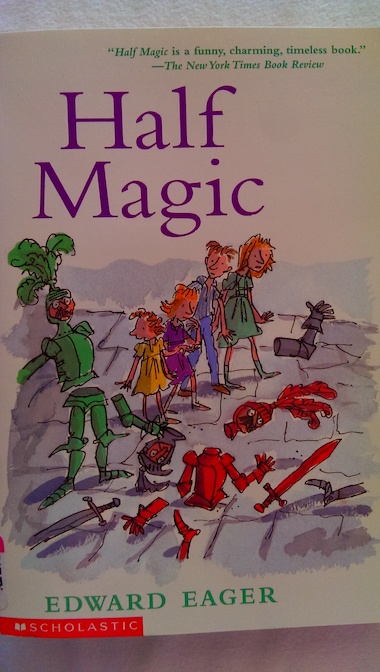 Half Magic by Edward Eager, 1954, 1982.
 These early experiences and a series of odd wishes Mark makes when he doesn’t realize that he has the coin demonstrate to the children not only that the coin is magical but that they have to be extremely careful what they wish for when they have it. They have to word their requests very carefully, asking for twice as much of anything they want in order to counteract the half magic of the coin. Even so, they can’t help but make mistakes and get themselves into trouble.
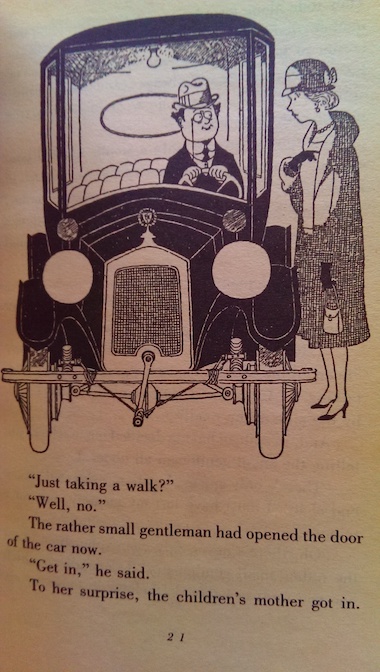
 There is one more disastrous experience when the children go to the movies (a silent film because this is 1920s), and Martha accidentally wishes that she wasn’t there while touching Jane’s purse, which holds the coin. Martha, of course, ends up being only halfway “not there,” almost like a living ghost, which terrifies onlookers. Straightening out that mess brings them into contact with Mr. Smith, the nice man who gave their mother a ride home. He owns a bookstore, and he enjoys fantasy stories as much as the children do. He becomes the only adult who knows that the children have been using magic, and he’s fascinated by it, enjoying witnessing their adventures.
 When Jane argues with the other children about Mr. Smith and rashly wishes that she belonged to another family, the other children call upon Mr. Smith to help them rescue Jane from her foolish wish, her unsuitable new family, and from herself.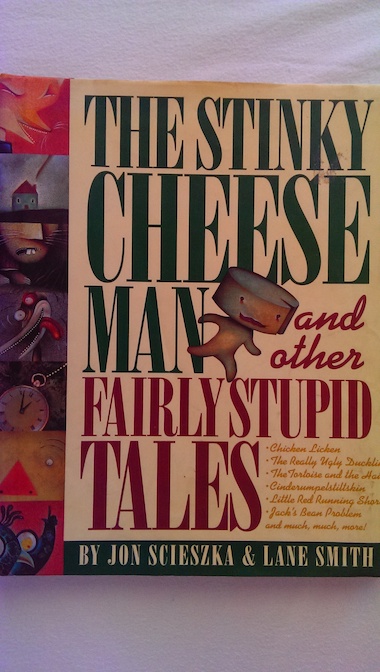
 This book is a spoof on a number of classic fairy tales. As it explains in the introduction, the short stories included in the book are more Fairly Stupid Tales than Fairy Tales, giving the example of Goldilocks and the Three Elephants: A girl smells peanut porridge and wants to enter the elephants’ house to eat some and try out their furniture, but elephant furniture is too big for her to climb up on, so she just leaves, The End. That incredibly short story isn’t found anywhere else in the book, but it’s a good example of what the other stories are like.
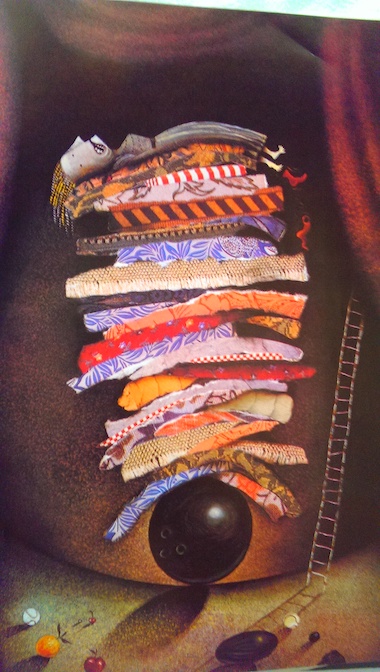 Chicken Licken – As described above
 So, why isn’t there a Little Red Hen story listed? At the end of the book, she shows up to complain about how she had to do everything herself to make the bread and nobody even saved space for her story (because Jack had to sneak away from the Giant after he fell asleep). The Giant wakes up and decides to make a chicken sandwich with the bread.
 Jestress's Forgotten Books and Stories