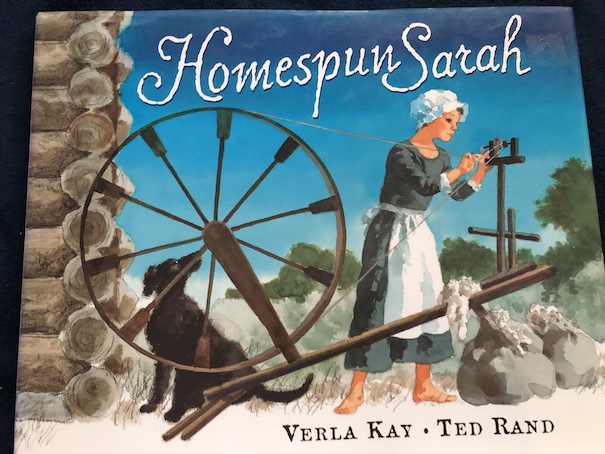
Homespun Sarah by Verla Kay, illustrated by Ted Rand, 2003.
This picture book tells a story in rhyme about a girl living in 18th century Pennsylvania and what she and her family do to make her a new dress when she begins outgrowing her old one.

As Sarah gets dressed one morning, her old dress is noticeably tight, and it’s beginning to get too short for her. Because her family lives on a farm, they must produce most of what they need themselves, and that includes clothing. For Sarah to have a new dress, they must make one themselves entirely from scratch, which is what “homespun” means – they make the dress from homemade cloth from yarn that they have spun themselves.

Various family members carry out different household chores, and as the story continues, readers see how everything they do is not only a part of the family’s daily life but also contributes to the creation of the new dress. The family raises sheep, so they must start by sheering the sheep to get the wool for the dress.
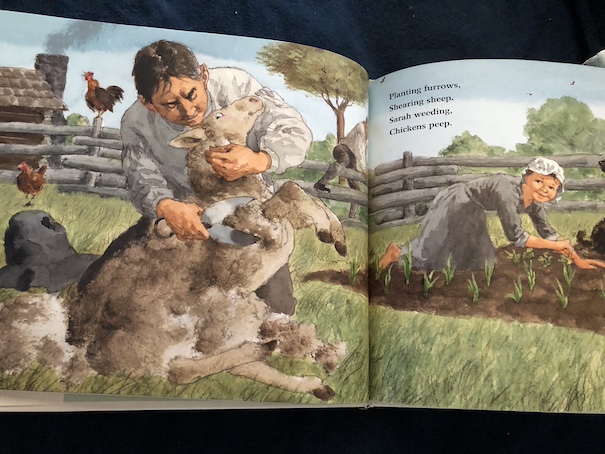
In between doing routine chores, like doing the laundry and making new candles, they card and comb the wool and spin it into yarn with their spinning wheel. The family also owns a large loom, which is how they weave the wool yarn and flax into cloth called linsey-woolsey. The cloth they make is blue and red, dyed using plants that they have produced and gathered.
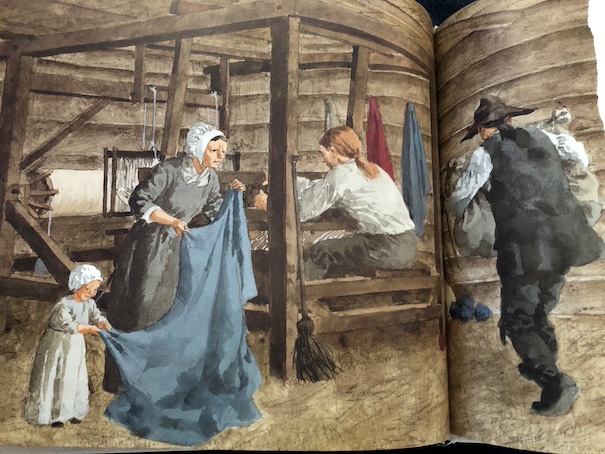
Once they’ve made the homespun cloth, Sarah’s mother measures her to plan the size of the dress and sews the dress. Sarah gets a new red dress, while her younger sister gets a blue one. Sarah is excited about her new dress, which fits her much better than the old one, and spins around to show it off!

The author’s note at the beginning of the book says that the story is set in Pennsylvania during the 1700s, and she wanted to show how people lived during that time, having to produce everything or almost everything they used by themselves. It also shows various aspects of family life, from where and how they slept to what they ate. The characters in the book, even the children, are shown drinking beer, but the author explains that is because water wasn’t considered entirely safe to drink. The beer they drank back then was very weak and “barely alcoholic”, which was why the children could have it. (We have water treatment facilities and devices available in the United States in modern times to ensure the quality of the water, so this isn’t something that we typically do now, especially with children, and I have more to say about this in my reaction.)
The book is available to borrow and read for free online through Internet Archive.
My Reaction
When I was a kid, I often skipped over prefaces and author’s notes because I just wanted to get to the story, but the author’s note really adds some historical depth and helps to clarify some aspects of the story that children might misunderstand. For example, I thought that the clarification about the mention of the characters drinking beer was important. Alcohol, chemically speaking, is actually a mild poison. It’s mild enough that humans can have it in small amounts without dying or even becoming ill (although we can get sick or die from large amounts, and some people have a greater or weaker natural tolerance to it, compared to each other), but even weak alcohol might kill germs in water and make it safer for humans to drink. This is the way it’s being used in this book. Because this book is for children, it’s helpful to explain this so that child readers understand that what the characters have isn’t quite the same as modern beer and that it’s not okay for children to drink modern beer in the same way. I think this is good book for parents or other adults to read with kids, so the adults can point this out to kids and help them to understand other historical elements of the story that they might miss or misunderstand.

The author’s note also explains that, because people during the time the story is set, had to make their own clothes by hand, and making was a very time-consuming, labor-intensive process, people had far fewer clothes back then than they do now. It was common for someone to have only one set of clothes that they wore every day until they were no long usable. Getting a new set of clothes was an exciting occasion, and that’s what the story in the book tries to capture. When readers see what this family goes through to create just one new dress for a girl who is outgrowing her last one, they can understand how much that dress means to the girl who receives it.
I love books that show how things are made, so I appreciated this book for the process it shows. However, because the story is told in short, simple rhymes and focuses on the how the process would look to a casual observer without getting too detailed, I felt like there were many parts of the process that were implied rather than stated. For example, they don’t explicitly mention that the red and blue dyes for the cloth came from the red berries the girls gathered or the blue flowers of the flax plant, but it’s implied by the earlier mentions of these plants and the way the book showed the characters gathering them. That could be enough for a casual reader, but I’m the kind of person who likes hearing the details of the process, so I would have liked more detailed explanations.
I did appreciate the way the book showed aspects of daily life in the 18th century. Some of them are explained in the author’s note, but there are also other parts of daily life to notice in the pictures. One of my favorite ones was the way that the youngest child in the family is tied to her mother or older sister’s apron strings to keep her from wandering away and getting into trouble while they’re doing their chores.






 In 1707, a man living in Massachusetts named John Noble bought some land in Connecticut which had recently been purchased from a tribe of Indians (Native Americans) living nearby. He planned to move his family there and start a new homestead, but with his children so young and the baby somewhat sickly, it was decided that he would travel to the new land ahead of his family and start building a new house there. The only family member to accompany him was his eight-year-old daughter, Sarah, who came along to cook for him. Before they leave home, Sarah’s mother tells her to “Keep up your courage,” something which Sarah repeats to herself from time to time.
 On the way to their new property, Sarah and her father have to camp out in the wilderness, although they do manage to stay one night with a family called Robinson. The Robinson boys tease Sarah, saying that where she’s going, the Indians will probably chop off her head and eat her or do other horrible things. Their sister tells Sarah not to worry because her brothers just like to tease. Sarah’s father and Mistress Robinson also reassure her that the Indians in the area are friendly and that they sold their land knowing that new people would come there.
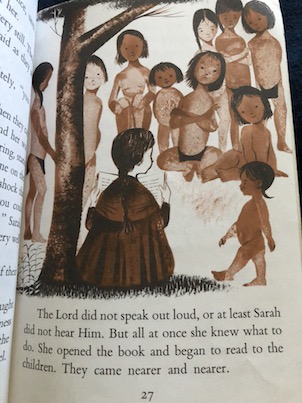 When Sarah and her father reach the land that is to be their new home, they take refuge in a hollow place in a hillside, and John begins building their new house. However, Sarah is still very nervous and lonely. Then, while Sarah sits, reading the Bible, some curious Indian children from the nearby tribe come to see her. She reads a Bible story aloud to them, and they listen, but she when she finishes the story, she can tell that they didn’t understand what she was saying. Sarah can’t understand them, either, when they try to talk to her. She gets impatient and snaps at them for not knowing English, and they run away from her. Sarah is sorry about that because she realizes that she shouldn’t have been so irritable, and even if they couldn’t talk to each other, it was still nice to have people around.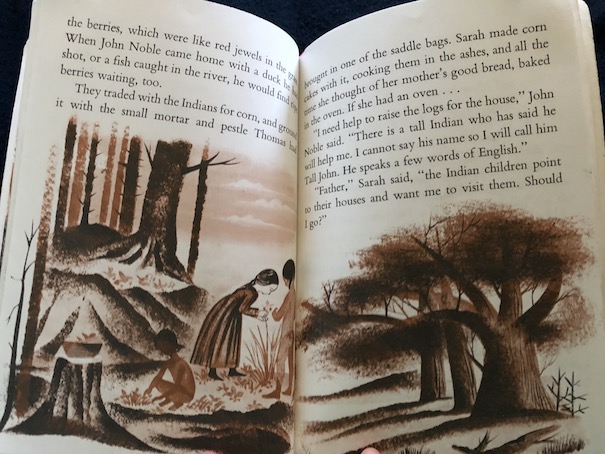


 This is part of the
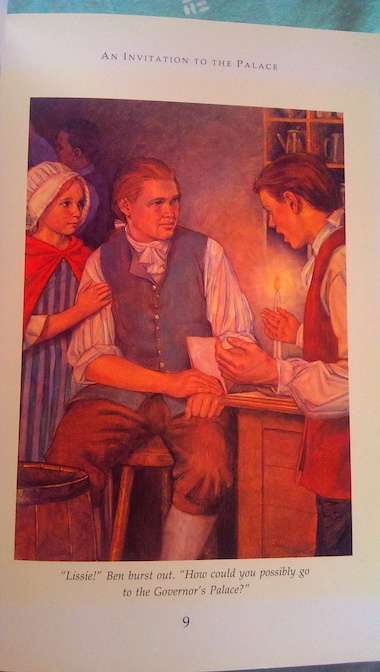
  At Miss Manderly’s the girls start having dancing lessons, and Felicity wishes for a new gown, like the one on the elegant doll at the milliner’s shop. Since Felicity is usually not very interested in clothes, her mother decides to grant her wish.


 This is part of the
  However, on the way home, something frightening happens. Felicity sees Elizabeth’s father, a known Loyalist, talking to a British soldier. She ducks into a bush so they won’t see her, and she hears them talking about the governor removing the gunpowder from the Williamsburg arsenal so the colonists can’t use it in the rebellion that has been threatening to come for some time.
 Jestress's Forgotten Books and Stories