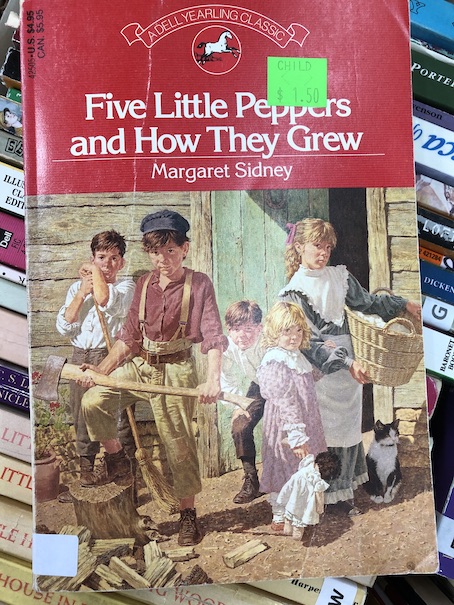
The Ghost of the Gracie Mansion

Mysteries in Time

The Ghost of the Gracie Mansion by Susan Kohl, illustrated by Ned Butterfield, 1999.
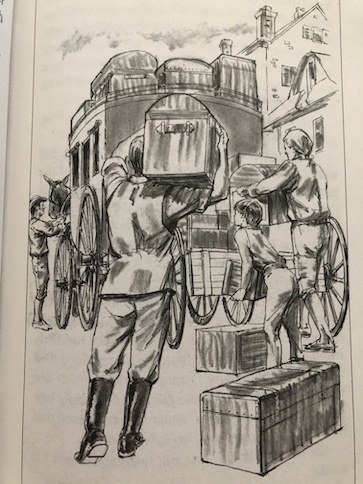
The year is 1803, and the Gracie family has decided to temporarily leave New York City because of the Yellow Fever Epidemic. William Gracie, the eldest son of the family, is disappointed because he has started working for his father’s shipping business, and he was looking forward to being promoted to clerk this spring. He wants to follow in his father’s footsteps, and he’s serious about wanting to learn the business. The trip that they’re taking to their new country home at Horn’s Hook, north of the city, seems to delay his plans because it’s so far away from everything, from his father’s business and from the Tontine Coffee House, where businessmen and other important people meet to discuss the issues of the day. However, William can’t help but admit that the situation in New York is serious. People are dying of Yellow Fever every day, including children, and his parents just want the family to be safe.
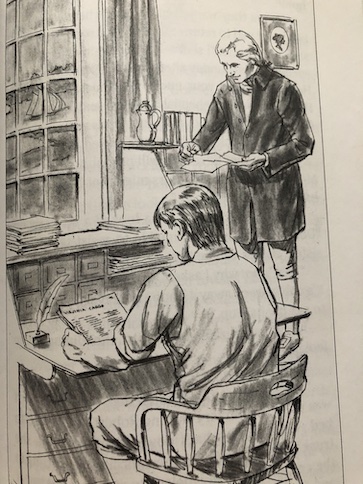
William begins to feel a little better when his father tells him that he’s arranged for them to work together from the family’s country mansion. His father says that captains of the ships he owns will stop at Horn’s Hook on their way to New York Harbor to report to him, and William will help him to prepare the cargo lists and timetables for the ships. Their temporary exile from New York hasn’t put a stop to their business or William’s education in that business; they’re just going to be doing things a little differently until the crisis is over.

While the family is traveling to their new country house, Mr. Gracie tells them about the history of the place. There used to be another house on that land, but it was destroyed during the American Revolution (an event still in relatively recent memory at the time this story takes place) as the British and the Patriots struggled to control it because that location is a strategic spot on the Harlem River. Mr. Gracie says that their new house is built over the basement of the old house, and that’s important because he’s aware that the former owners had a secret tunnel that led out of their basement in case they needed to use it as an escape route during the war. He told the builders to look out for it while they were building the new house, but if any of them ever figured out where it is, they never admitted it. The Gracie children are excited about the idea of their new house having a secret tunnel, and they’re eager to find it!

The new Gracie house is beautiful, really more of a mansion than just a house. However, there is something strange going on there. Soon after they arrive, William’s younger sister Sarah sees someone in the house dressed all in white. Sarah thinks that she saw the ghost of the person who owned the house that used to be on their property. The others don’t believe her because Sarah has a vivid imagination and is always making up stories, but Sarah insists that she saw someone.

When things start disappearing from the house, the rest of the family begins to believe that there may be some unknown person in their house. Sarah still thinks it’s a ghost, but William thinks maybe someone has found the secret passageway into the house. Who is this mysterious intruder?

The book is available to borrow and read for free online through Internet Archive.

My Reaction
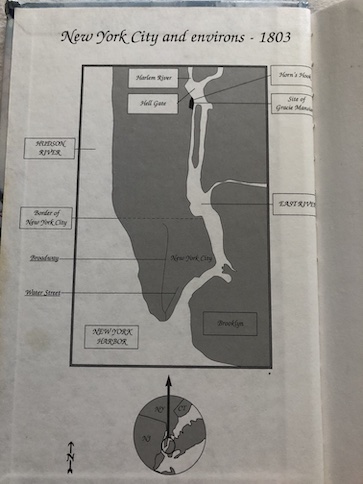
I always like historical novels, particularly historical mysteries, and I really enjoyed this one. The mystery is meant for children in elementary school, and it isn’t too difficult, but it’s fun to see the Gracie children searching for the secret passage and trying to learn who is sneaking around the family’s country mansion. I also enjoyed that the story offers history lessons on multiple levels. The immediate situation for the characters is the yellow fever epidemic of 1803, but the story also touches on the American Revolution. The solution to the mystery is also related to Revolutionary War history. The Gracies, headed by father Archibald Gracie, were a real family who made their money in shipping, although the events in the story are fictional. There is a section in the back of the book that explains more about the family’s history. They associated with prominent people in New York in the early 19th century, and Alexander Hamilton makes an appearance in the story when he visits the Gracie Mansion. The Gracie Mansion is a real place. When it was first built, it was in the countryside outside the limits of New York City, but since then, the city has grown around it. It is now used as the home of the mayors of New York City.
Although this book was published before the coronavirus pandemic of the early 2020s, I also appreciated the part of the book at the beginning, where William is concerned that the current epidemic has changed his plans and impacted his ability to learn his father’s business. However, his father explains to him that they are still in business, and he has made arrangements for them to continue working in a different way during their time away from the city. People who lived through the quarantines and lockdowns of the covid pandemic will understand how it impacted the way people worked or continued their education and how people had to find ways to work around the problem. I appreciated that this story shows how people have had to deal with public health crises before in history and how they have always had to find creative solutions to deal with problems of this nature.

In this particular situation, the Gracies are a wealthy and privileged family, so their options for escaping from the crisis and working from outside the city are greater than other people of their time. Not everyone had a countryside mansion where they could go to escape the disease, and not everyone had employees who could report to them wherever they were. What Mr. Gracie and his son are doing during the course of the story is the early 19th century equivalent of “working remotely”, pre-Internet, and they accomplish it through people coming to report to them and taking goods and information into the city on their behalf. Even though the Gracie family can stay outside the city, they are still sending their ships into the city’s harbor because the cargo the ships carry is necessary there. There are people in the city who are waiting for the supplies the ships are carrying. The crews of the ships are what people in the 2020s came to call “essential workers” – the people whose type of work was necessary, no matter the circumstances, and who could not perform their duties from a remote location. The same is true for all the other people who must remain in the city because their jobs require them to work with or on behalf of the people who are still there.
An Early American Christmas

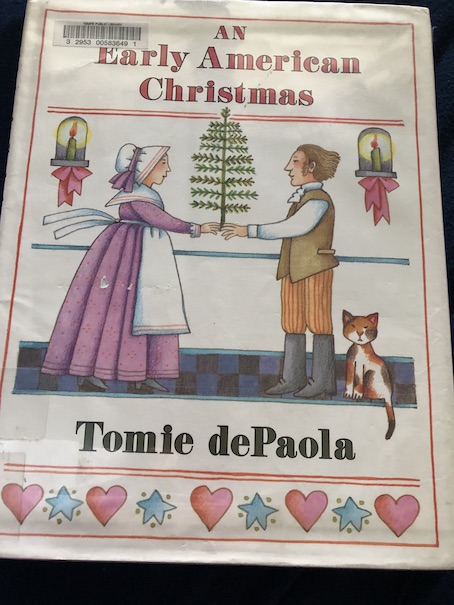
An Early American Christmas by Tomie dePaola, 1987.

A note at the beginning of the book explains the story behind the book, which is based on the history of early Colonial America. Although Christmas is now a popular American holiday with lavish celebrations, many early colonial groups didn’t celebrate Christmas much at all. Even among Christian groups, Christmas was not regarded as a major holiday. In particular, groups like the Puritans, Presbyterians, Quakers, and Baptists tended to avoid celebrating Christmas, seeing it as a frivolous sort of celebration. However, there were other groups, like Catholics, Lutherans, and Episcopalians, who did celebrate the holiday in a festive fashion. The author of this book imagines what it would have been like for a family that celebrates Christmas if they moved to a New England community that didn’t during the early 1800s. In particular, he used New Hampshire as his inspiration.

The beginning of the story describes a New England town that doesn’t celebrate Christmas with decorations or songs. Then, a new family comes to the village. They were originally from Germany, and they had lived in Pennsylvania before coming to the village. (This would make them Pennsylvania Dutch.) They are usual because of their festive Christmas celebrations.

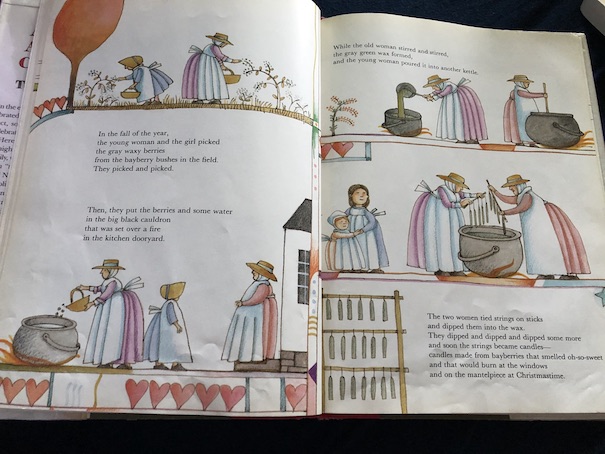
They begin planning for their Christmas celebration in the fall. The women and girls pick bayberries and use them to make candles. They say that bayberry candles bring good luck when they’re burned on Christmas.

The men and boys gather the crops that they will need for their feast. The grandfather of the family carves figures for their manger scene.

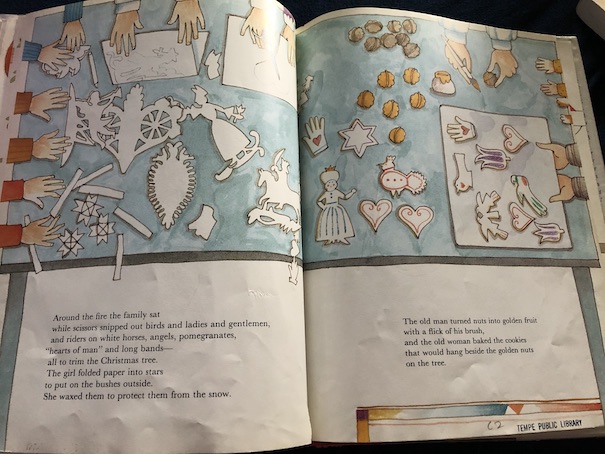
In December, the whole family makes paper decorations and specially-shaped cookies. I liked the variety of baked goods that they show in the pictures. They pick out a tree and make strings of popcorn and dried apples.

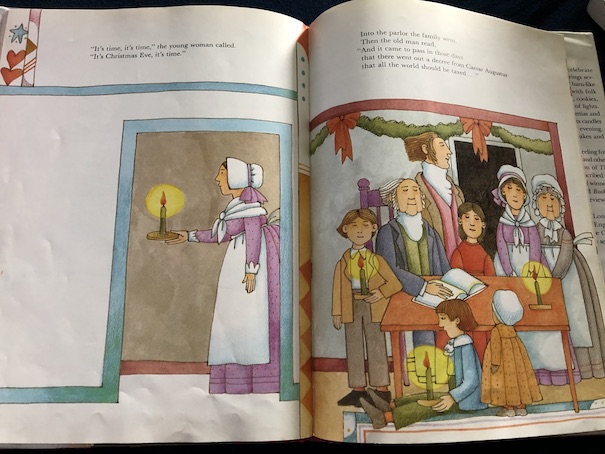
On Christmas Eve, they read the story of Jesus’s birth and decorate their home with all of the decorations they have prepared.

As the years go by and other people in town see what the Christmas Family is doing, they begin to celebrate Christmas, too.

The book is available to borrow and read for free online through Internet Archive.

Through the Looking Glass

Through the Looking Glass by Lewis Carroll, 1871.

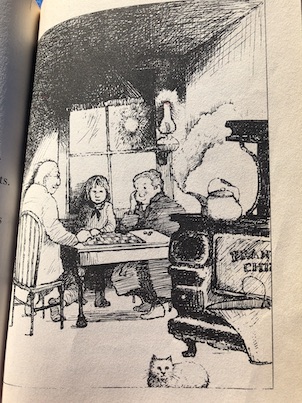
The story of Alice in Wonderland is over 150 years old, and the sequel, Through the Looking Glass, is now 150 years old, as of 2021. These books have been reprinted in many different languages and editions. The edition that I’m using for this review is actually a combined edition of the two from 1960 with added notes by Martin Gardner. (Although I used a cover image from a different edition above.) I like editions with added notes because there is quite a lot to explain about both Lewis Carroll and his stories.

I explained a lot of Lewis Carroll’s background and some of the controversies surrounding his life in my review of Alice in Wonderland. One important point about the Alice stories is that they are full of puzzles, riddles, word games, in-jokes, and parodies of poems that were popular in the author’s time. Lewis Carroll (real name Charles Dodgson) was a mathematician and scholar at Oxford, and he liked to play with logic puzzles and word games. Sometimes he would hide people’s names within poems or parts of the story by rearranging the letters of their names or using them as the beginning of lines in a poem, as an acrostic. There is an acrostic poem which is dedicated to Alice Liddell, the real girl who inspired Alice in Wonderland. This poem is printed as part of some editions of Through the Looking Glass, including the one that I’m using. The acrostic poem also references Row, Row, Row Your Boat, which is apparently older although its origins aren’t completely certain. If you read down the beginning letters of the poem, you find out that Alice’s middle name was Pleasance.

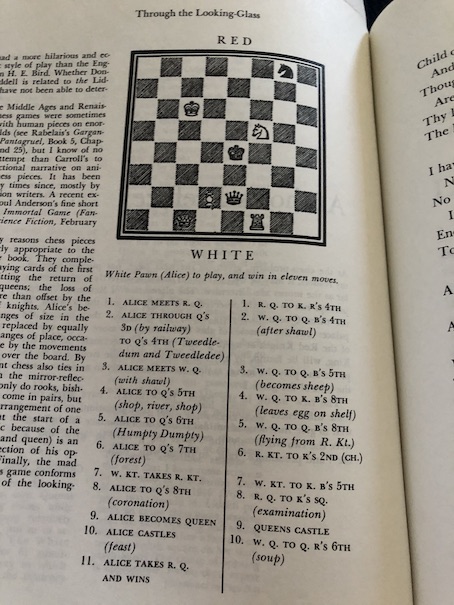
The chess game in Through the Looking Glass is meant to be part of an actual chess game with real moves that can be mapped out on a board. The game and the moves in the story are explained in the preface of my copy of the book. Alice begins as a white pawn in the game, but when she reaches the other side of the board, she becomes a queen, which is part of the rules of chess – pawns that successfully reach the opponent’s side may be exchanged for other pieces. The colors of the chess pieces in Alice’s game are red and white instead of black and white because red and white are old traditional colors. Although black and white are common today, many different color combinations have been used, and the red and white combination dates back to the Middle Ages.

The story begins on the day before Guy Fawkes’ Night. (Alice has been watching the bonfire preparations out the window.) Alice is trying to wind some yarn, and her pet cat Dinah’s little black kitten keeps playing with it. Alice chastises the kitten, and then begins talking to the kitten about the way it was watching her play chess earlier in the day. Alice likes to play games of pretend, and she starts to pretend that the kitten is the red queen from the chess game. The kitten doesn’t cooperate in posing like the chess queen, so Alice holds it up to a looking-glass.

As they look in the mirror, Alice gets the idea of a “Looking-glass House” – a house on the other side of the mirror that can be reached by stepping through it. Alice starts to imagine what it would be like to enter the world on the other side of the mirror. She gets up on the mantle over the fireplace and steps through the mirror into the looking-glass house to see what is there.

Things in the looking-glass house are very strange. The clock and the pictures seem to be alive, and so are the chess pieces. Alice helps the pieces back onto their table after they’ve been knocked off, but they don’t seem to understand what has happened and are alarmed. Alice then picks up a book on the table near the chess board and reads the poem Jabberwocky, which is about the defeat of a horrible monster. The poem is written in backwards writing, and Alice has to hold it up to a mirror to read it. The poem is a nonsense poem that contains many made-up words, which are explained later on in the story.

Alice decides to see what is outside the house. She discovers that the flowers can talk to her, but they are rude and insulting. Then, Alice encounters the Red Queen, who has grown taller than she was in the house. (The flowers say that it’s because of all the fresh air outside.) The Red Queen is both commanding and contradictory, but she gives Alice directions to other “squares”, addressing her as a chess pawn.

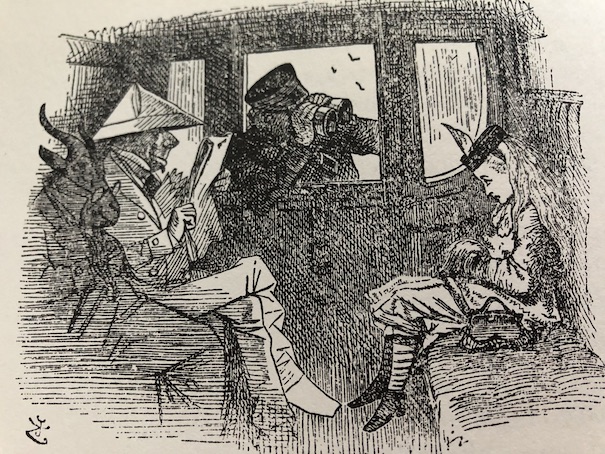
Pawns get to move two squares on their first turn, so Alice gets to go by train. In the train carriage, Alice meets many strange characters, including a gentleman dressed in white, a Goat, a Beetle, and a Gnat, who keeps whispering in her ear and suggesting that she make jokes based on puns. Through the Gnat, Alice meets other strange insects, like the snap-dragon-fly, the rocking-horse-fly, and the bread-and-butterfly. The Gnat tells Alice that the creatures in the woods don’t have names, and when Alice goes through the woods, she temporarily forgets her name, getting it back again on the other side.

Soon after, Alice meets Tweedledum and Tweedledee. (Lewis Carroll didn’t invent these characters. They are nursery rhyme characters.) They ask Alice if she likes poetry, and they tell her the tale of The Walrus and the Carpenter. (This is one of the most-quoted poems in the Alice stories – many people remember the part where they “talk of many things” – “Shoes and ships and sealing wax and cabbages and kings.”) At the end, Alice can’t decide which of the two characters she likes the best because both are sneaky and eat the oysters that trusted them, so she decides that she doesn’t like either of them. (Yeah, I can think of others stories where I’ve felt the same way.) Alice hears a strange sound, and they tell her that it’s the Red King snoring and that the Red King is actually dreaming about her right now. Tweedledum and Tweedledee insist that Alice isn’t a real person, only part of the Red King’s dream, and that she’d disappear if he were to wake up, which upsets Alice. Alice starts to cry, which she thinks is proof that she’s real, but they claim that those aren’t real tears. Finally, Alice decides that they’re just talking nonsense and that there’s no point in crying over it. Tweedledum and Tweedledee want to have a battle (as in their poem), but a large crow interrupts them and frightens them away by producing a great wind.

Alice catches hold of a shawl that was being blown away by the wind and returns it to its owner, the White Queen. The White Queen speaks very strangely, and she says that it’s an effect of living backwards. Because she lives backwards, her memory works both ways, and she can remember things that haven’t happened yet. The White Queen screams with pain before she pricks her finger, so she doesn’t have to do it again after her finger is hurt. Alice cries when she talks about how lonely she is in the woods, and the White Queen distracts her by telling her to consider things because no one can think of two things at once (which is true). The White Queen talks about considering and believing impossible things (sometimes she believes “six impossible things before breakfast” – one of the most famous lines that is often quoted from this story).

As Alice asks the White Queen if her finger is better, she suddenly and inexplicably finds herself in a shop and talking to a sheep, who asks her what she wants to buy. Alice tries to look around, and the Sheep asks her if she’s a child or a teetotum (a kind of spinning top used in old games, sometimes by itself and sometimes as a replacement for dice or a spinner – dreidels are a kind of teetotum) because of the way she’s turning around. The Sheep is knitting and keeps picking up more needles to knit with. For awhile, the shop disappears, and Alice finds herself in a boat with the Sheep, but then the shop returns, and the Sheep asks her again what she wants to buy.

Alice decides to buy an egg, and the egg that she buys turns into Humpty Dumpty when she approaches it. Humpty Dumpty is a bit rude and insults Alice’s name because he doesn’t think it means anything. Alice mistakes Humpty Dumpty’s cravat for a belt because he’s egg-shaped and doesn’t have a true neck for wearing a tie. Humpty Dumpty reveals that the cravat was an un-birthday (a concept that Lewis Carroll invented) present from the White King and Queen. All through the conversation, Humpty Dumpty uses words in unusual yet strangely nit-picky ways, making words mean only what he wants them to mean in the moment. Because he’s so particular about the meanings of words, Alice asks Humpty Dumpty about all the strange words in the Jabberwocky poem, and he explains what the made-up words mean. Humpty Dumpty recites another poem for Alice that doesn’t seem to have a true ending and then abruptly dismisses her.

As Alice leaves, she meets the king with all of his horses and men (from the Humpty Dumpty nursery rhyme) and is introduced to one of his messengers. Alice is amused by the name and description of the messenger and starts playing a game of “I Love My Love” out loud with the messenger’s name. (The two messengers are called Haigha and Hatta and are shown looking like the March Hare and Mad Hatter from Alice in Wonderland in the illustrations.) The messenger informs the king that the lion and the unicorn are fighting for the crown again (another nursery rhyme reference). The king says that it’s all a joke because the crown is his and neither one of them is going to get it no matter which of them wins the fight.

The unicorn is amazed to meet Alice because he never knew that children were real before. As at the end of the rhyme, they are given plum cake, and they hand the dish to Alice for her to cut the cake. However, Alice finds that she can’t cut it, so they ask her to hand the cake around first and then cut it afterward, which surprisingly works.

After the others are drummed out of town, also as part of the rhyme, the Red Knight attempts to capture Alice, but the White Knight shows up to save her. The White Knight tells Alice all about his inventions, none of which make any sense, and sings her a song which apparently has several names and is set to the tune of a song Alice recognizes as “I give thee all, I can no more” (which is another name and the first line of the song which is really titled My Heart and Lute, which is part of the on-going joke about the song’s real name).

Then, Alice reaches the final square of the board and becomes a queen, finding a crown suddenly on her head. The Red Queen and the White Queen appear suddenly, and the Red Queen tells her that she must pass an examination before she can truly become a queen. The queens ask her a series of questions that are supposed to be math questions but are actually a combination of riddles and nonsense. Their general knowledge questions are a combination of nonsense and puns. Eventually, the Red Queen and White Queen both fall asleep to a parody of “Rock-a-bye Baby.”

Alice finds herself in front of a door labelled “Queen Alice,” but the old frog who comes to the door doesn’t seem to want to let her in. Alice enters anyway and sits next to the Red Queen and White Queen. They introduce her to the food being served at the feast, but they don’t actually allow her to have any because it isn’t polite to cut and serve something you’ve been introduced to, and the plum cake verbally protests when Alice tries to serve it anyway.

The White Queen tells Alice a riddle in poem form about fish. The riddle is never answered, but everyone drinks to Alice’s health. The Red Queen tells Alice that she should make a speech, and as she gets up, many strange things begin happening in the room. Alice thinks that the Red Queen is responsible and grabs hold of her, threatening to “shake her into a kitten.” Alice suddenly wakes up, holding her little black kitten.

Like in Alice in Wonderland, everything that Alice experienced was a dream. However, the end of the book poses the question of whether the dream was Alice’s or the Red King’s. The question is never answered; it’s just something to make the readers think. That’s actually what I like most about the Alice stories, that they are partly meant to make the reader think. The stories are somewhat disjointed and constantly changing, kind of like dreams do, but I appreciate all the references and parodies in the stories.

The book is now public domain and is easily available online through Internet Archive and Project Gutenberg.

Shadow in Hawthorn Bay

Shadow in Hawthorn Bay by Janet Lunn, 1986.

Mary (or “Mairi,” they spell it both ways) Urquhart and her cousin Duncan had always loved each other.  They were always close as children, feeling more like two parts of one person than separate people, and they always imagined that they would spend the rest of their lives together.  Then, Duncan’s parents, Mary’s Uncle Davie and Aunt Jean, decided that they wanted to travel to Canada, while Mary and her parents stayed at home in the Scottish Highlands.  Duncan hadn’t really wanted to go.  He was only eleven, and he promised Mary that when he was older, he would work hard to earn enough money to come back.  However, Duncan never came.  He only sent Mary a brief letter about the dark forest where he now lives.  Mary feels like the Duncan she knew is gone forever.

Four years later, in 1815, when Mary is fifteen, she has a strange feeling, like Duncan is calling to her from across the ocean.  All of her life, Mary has had a strange gift for seeing into the future or reading others’ minds.  The “gift of two sights,” people call it, but Mary doesn’t feel like it’s a gift.  It makes her uneasy, and she can’t control it.  She hears Duncan’s calls to her through her “gift,” but she is afraid because she doesn’t want to leave Scotland.  She wants Duncan to come to her.

However, she is unable to resist Duncan’s calls.  She asks her parents for help with money for her passage to Canada, but they tell her that she is wasting her time and that, even if they sold their family’s most precious heirloom to give her the money, there would not be enough for the return journey.  A family friend gives her the money instead, and although Mary doesn’t really want to accept it and doesn’t really want to go, she can’t help herself.

The journey to Canada is miserable, and when she finally arrives at the place where her aunt and uncle live, alone and without money, she learns something which she thought she had sensed during the journey: Duncan is dead.  Duncan committed suicide while Mary was still on the ship to Canada.  Mary has arrived too late.  To make matters worse, one of the family’s neighbors, Luke Anderson, tells her that her aunt and uncle gave up the idea of farming in Canada and have already begun the journey back to Scotland.  Mary has no money to follow them, and they have no idea that she’s now in Canada, alone.

Luke takes Mary to Mrs. Colliver, who tells Mary a little about her family and their life in Canada and why they decided to leave.  Mary is devastated by the loss of Duncan and tries to tell Mrs. Colliver about how she felt that Duncan had been calling out to her, but Mrs. Colliver tells her that she doesn’t believe in ghosts or things like that.  Although Mary knows that her “gift” is real and so are spirits, she learns that others in the community share Mrs. Colliver’s no-nonsense, disbelieving attitude toward such things.  Mary, in her despair, wants to rush straight back to Scotland, but Mrs. Colliver, with her practicality, points out that Mary can’t possibly get there without money.  She tells Mary that she can stay with her family, that she will give her room and board in exchange for help with chores and that she can earn extra money for weaving and spinning.  Mary is clumsy at household chores because she was always better with animals at home, but when Mrs. Colliver sees Mary’s skills with animals, she is appreciative.

Life is hard in the small farming community.  Mrs. Anderson, Luke’s mother, explains to Mary that most of the people who live there are refugees.  When they were young, their families moved there from the Thirteen Colonies that now make up the United States because they were Loyalists.  When the Revolution came, they couldn’t stay, and so had gone north to Canada, where they struggled to establish a new community for themselves with their small homesteads. During her time there, Mary witnesses the death of a baby and the hardships of this strange place, seeing why Duncan didn’t like it there.  They tell her that Duncan was a strange boy who would seem bright and happy one day, but black with depression the next, something Mary remembers in him even before he went to Canada. 

The people are kind and welcoming to Mary, although they find her a bit strange.  As Mary struggles to make a life for herself, hoping to earn enough money to return home, she slowly comes to appreciate Luke’s kindness and help.  She learns healing arts and the use of herbs from another woman in the community, developing new skills.  In helping others, she earns their appreciation and a place in their community.  Luke Anderson becomes very fond of Mary, but she still mourns for her lost Duncan.  In spite of his kindness, she doesn’t see how she can make this strange, hard, dark forest of Canada her home, where it doesn’t even seem like the spirits she believed in and that seemed to protect her when she lived in Scotland exist.

Mary is melancholy and feels like she doesn’t belong in Canada.  It distresses her that she can no longer feel Duncan’s presence . . . although she can oddly hear him calling to her sometimes.  Mary also unnerves people when she makes predictions that come true and speaks about ghosts and spirits.  When she almost gives in to her homesickness and depression and kills herself, lured to the spot where Duncan drowned himself by his ghostly calls to her, she finally sees Duncan’s death for what it really was and finds the courage to refuse to follow him down the dark path that he chose for himself and to fight for the life she has been building, the one she really wants to live.

The book is available to borrow and read for free online through Internet Archive.

My Reaction

This book is part of a loose trilogy, involving ancestors and descendants of the Anderson and Morrisay families.  All of the books take place in or near Hawthorn Bay in Canada, but at different time periods.  Some of the characters are psychic, like Mary, or have the ability to travel through time, like Susan in The Root Cellar, who is apparently Mary’s granddaughter.  The connection between Mary and Susan is never stated explicitly, but it’s implied by their last name, shared psychic abilities, and comments that a friend makes about Susan’s grandmother in The Root Cellar.  In this series, the characters from each of the books generally don’t appear in any of the others (except, perhaps, for Phoebe, who appears briefly in this book and is the main character in the third story).  Most of the time, you only know about the family connections by reading the books and taking note of the last names.  The books go backward in time as the series progresses, and the connection between the Anderson and Morrisay families is only obvious in The Root Cellar.

With the deaths that occur in the book, discussions of suicide, and the influence of Duncan’s selfish, malevolent spirit, this is not a book for young kids. I’d say that readers should be middle school level or older. There is also some implied sex and pregnancy out of wedlock when one of Luke’s brothers gets one of Mary’s friends pregnant. Her friend doesn’t give the details of what happened, but from what she says, it’s implied that Luke’s disreputable brother forced himself on the girl and that she went along with it because she didn’t know what else to do. The description of that incident is minimal, but older readers will understand what happened. There is a scandal in the community because of it, and the disreputable brother leaves rather than face the consequences of his actions.

Themes and Spoilers

I enjoyed the book for its references to Scottish folklore, which Mary believes in and seems to be in touch with through her “gift” and for Mary’s growing confidence in her abilities and more mature understanding of what her cousin was really like and what her relationship with him really was.  In some ways, I do feel sorry for Duncan because he seems to have been suffering from some kind of mental illness, possibly bipolar disorder or manic depression, which would explain how his moods could shift so abruptly and dramatically.  However, Duncan was also a selfish and controlling person.  Although Duncan’s death was sad, Mary realizes that his end was of his own making, and it’s not the future she wants for herself.  There are some disturbing scenes in the story.  Mary witnesses the deaths of others, including a baby, because it is a harsh environment, where people sometimes succumb to sickness or bad weather, although these deaths are not described in too much detail. 

There are also some frightening moments, like when Duncan’s ghost almost convinces Mary to kill herself and when he similarly lures a young boy, Luke’s younger brother, to the spot where he drowned and almost kills the boy because Mary finds the little boy comforting and Duncan doesn’t want her to be comfortable and happy.  In the beginning, readers see Duncan through Mary’s fondness for him, so the true darkness of his personality isn’t immediately apparent, although I had some misgivings about him from Mary’s first description of how they played together as children.  I didn’t like the way she described how he would tease her until she became angry or hurt and then he would sulk until she comforted him.  She says that wasn’t really fair, but to me, it was disturbing because I have seen that kind of selfish personality before, and it’s never a good sign.  It shows right from the first that Duncan doesn’t really care about Mary’s feelings.  He cares only about his own feelings, and he has no interest in changing his behavior out of consideration for her.  In fact, the very idea that he should consider her feelings seems somehow insulting to him, even though he supposedly loves her.  He just thinks that she needs to reassure him that everything he does is fine whether it is or not.  In his view, Mary is obviously wrong to feel hurt even when he tries to hurt her because he has more right to his feelings than she has to hers and he should be able to behave any way he wants with no consequences.  That’s what Mary’s first description of Duncan said to me.  As soon as I saw that, even though some might consider it just the actions of an immature child, I had some suspicions about him.

My suspicions were somewhat confirmed before Mary left home. Her mother told her that she didn’t think Duncan was worth chasing after, calling him sulky and thoughtless, but the full truth of that doesn’t strike Mary until she confronts his spirit where he died. Because people in Canada don’t like to talk about Duncan much, when Mary first hears about his death, it isn’t immediately clear that he killed himself or how.  At first, it’s just somewhat implied, but when Mary is almost lured to her death, she sees the full truth about Duncan. 

Mary comes to realize that, although everyone, including Duncan and herself, felt like the two of them were two parts of the same person, they really weren’t.  Mary sees that not only can she live without Duncan, she has been living without him for years.  She lived without him for a time in Scotland, and she’s been living without him in Canada, and she can continue to live without him wherever she chooses to live the rest of her life.  When she was younger, she had thought of Duncan as being the stronger of the two of them because he was not plagued by the same “gift” she was, but she realizes that she is actually the stronger of the two of them.  Duncan’s “love” for her had also always been a selfish one.  He couldn’t bring himself to work hard and return to Scotland for her sake, but he expected her to give up everything, even her own life, to join him in Canada and in death.

When Mary realizes all of this, Duncan’s spirit loses its hold over her, and she comes to see that the darkness in him was darker than the forests that had seemed so frightening to her before.  Free from the shadow of Duncan’s death and his selfish spirit, Mary is able to see the beauty of Canada and to be more open to the good people around her, forging a new future with a better man.

Twin Spell

This book was originally called Twin Spell but was renamed Double Spell in reprintings.

Elizabeth and Jane Hubbard, a set of twelve-year-old twins, can’t really explain what made them stop to look at the little wooden doll in the window of the antiques shop.  Ordinarily, they probably wouldn’t have noticed it at all, but something seemed to draw them to it while they were supposed to be going home to look after their little brother.  The woman in the shop wasn’t going to sell the doll to them, either, but for some reason, she said that she felt that she ought to do it because it seemed like the doll belonged with them.

Buying the old doll starts off a chain of mysterious events in the twins’ lives.  On impulse, still forgetting that they’re supposed to go home and baby-sit, the girls decide to visit their Aunt Alice and show her the doll.  Aunt Alice had been living in England, but she had recently moved back to Toronto to live in the girls’ grandmother’s old house.  Aunt Alice doesn’t know what to think of the doll, except that it might be worth something as an antique.  She shows the girls around their grandmother’s old house, but Elizabeth has a sudden fall down the stairs, breaking her leg.  Strangely, a week later, Aunt Alice suffers a similar accident, breaking her hip.

Because of her accident, Aunt Alice decides that the big old house is a bit much for her to handle, and she tells the twins’ parents that they can have it to live in instead.  With five children in the family, including the twins, they could really use the larger house, and the children are excited about going to live there.

The twins find themselves thinking of odd things, as if they were old memories.  They suggest taking a “sick basket” of goodies to their aunt, thinking that maybe their mother had done something like that for someone before or maybe they had dreamed something like it.  Their brothers can’t remember any such thing happening, and it would be pretty weird for both of the girls to have the same dream.

However, the children think that a basket of goodies for their aunt would be a good idea.  They put together some stuff from their kitchen and what they can buy with their money, and they decide to include a book that she can read while she’s recovering.  Unfortunately, the book they choose from their shelves turns out to be a rare copy of a book about the history of Toronto that their father was using for a research project, so they have to get it back.  They do, and Aunt Alice tells them that she enjoyed it and that she had forgotten that an uncle had written it.

As the family moves into Aunt Alice’s old house, the twins keep thinking that there is something strange about their doll, that it seems to be influencing them, giving them visions of the past.  Besides the “sick basket” dream they both had, they have visions of a house and a blonde girl in old-fashioned clothes.  They start to think that the doll, which they both have the impulse to call “Amelia,” might be magic or something.  Jane is the more sensible of the two, and she insists that there must be some other explanation, like imagination or coincidence.  Elizabeth, the dreamier twin, insists that it’s the influence of Amelia, that they’re somehow seeing Amelia’s memories of the past.

After the girls argue about the doll and the source of their odd visions, Jane starts ignoring Elizabeth.  Elizabeth continues thinking about what they’ve seen, and the blonde girl, who she is sure is called Hester and was the former owner of Amelia.  Eventually, Jane starts agreeing with Elizabeth about Hester being the doll’s former owner, but she is dubious when Elizabeth says that Amelia wants to find the house where she once lived with Hester.  Jane doesn’t know how the two of them can do that.

They ask their father for his advice, and he suggests that they start at the museum.  There, they learn by studying the styles of old clothes that Amelia is from the 1840s.  They find an area of town with houses similar to the one they’ve seen in their minds, where Amelia once lived, but they have trouble finding the exact house they’re looking for.

Jane becomes increasingly afraid, though.  More and more, she begins to feel like something is trying to take the doll away from them.  Something that is mean and doesn’t like her is in their attic.  Something like a ghost.  Jane has an awful feeling that something horrible is about to happen.

When the Jane looks at the history book her father has been reading, the one written by her great-great-uncle, Jane suddenly has a startling revelation. The house they have been seeking in actually their house, changed over the years by new additions. Amelia came from their house, and that is where she really belongs. Through the visions, they see an old tragedy in their family reenacted, a tragedy that puts Jane’s life in danger.

The book is available to read for free online through Internet Archive. There is no need to borrow this copy and no time limit; you can just read it in your browser.

The girls had made a mistake when they first started receiving their visions.  They had assumed that Hester was Amelia’s original owner, but she wasn’t.  The glimpses they got of Hester weren’t through the doll’s eyes, but those of the doll’s real former owner.  The doll was one of a set of two that originally belonged to another set of twins in the girls’ family, Anne and Melissa.  Hester was their cousin, and she was not a nice girl.  Both Jane and Elizabeth sensed it pretty early.  During an argument with Anne years before, Hester accidentally lit Anne’s dress on fire with a candle she was holding, causing Anne to die.  Hester hadn’t actually meant to harm Anne.  The whole thing was just an accident, but Hester’s guilt and Melissa’s anger and grief at her twin’s death had caused Hester’s spirit to linger in the house.  By learning the circumstances of Anne’s death and assuring Hester that they understand that she had not meant to kill her cousin, that it was all an accident, and that she couldn’t save Anne because she was just too frightened and didn’t know what to do, they help Hester’s spirit to finally rest and to reunite Amelia with her doll twin, which Hester had hidden years before.

The scene where the girls see Anne’s death is a little scary, but mostly sad.  Hester lived on after the incident, but it was not a happy life.  She ended up having to live in Anne and Melissa’s old room, where Anne died, because she never married and had to live with family.  Aunt Alice remembers knowing her as a young child, when Hester was a bitter old woman.  Perhaps if Hester hadn’t been carrying that guilt around for so many years, her life would have been much happier, although being a nice person had never particularly been her nature.  However, the twins’ acceptance of Hester’s tragedy and assurance that they understand and forgive her for what happened set her spirit at peace.

The genealogy in the story is a little confusing, partly because certain family names repeat through the generations, but there is a chart in the back of the book to help.  There are some other loose ends in the story which are also never completely clarified.  The girls admit that they will probably never know how the doll Amelia came to be in the antiques store, but it doesn’t particularly matter because Hester, Anne, Melissa, and Amelia all seem to be at peace now.

Voices After Midnight

Voices After Midnight by Richard Peck, 1989.

Three children, Heidi, Chad, and Luke, are traveling from their home in California to spend a couple of weeks in New York during the summer because their father has to do some work for his advertising firm there.  Heidi, the oldest child, didn’t want to go on the trip.  She would rather have stayed at home with her best friend, but her parents insisted that she go because she borrowed her mother’s car without permission and took it out driving without an adult in the car even though she only had a learner’s permit, not a real driver’s license, and barely even knew where the car’s controls were (she took her younger brothers along just so they could tell her about the controls, which shows her level of driving skill).  The resulting accident she had took out a flower bed.  Although her parents didn’t find out about the accident, she decided that perhaps it would be a good idea to get out of town for awhile while the whole incident blows over.

Chad is the narrator of the story, and he explains that his father’s company has rented a house for them to live in while they’re in New York, or rather, part of an old house.  It’s a very old house, and it’s five stories tall.  There is an old cage elevator that has been repurposed as a telephone nook.  It’s a nice place, but there’s something strange about it.  Even before they arrive in New York, both Chad and Luke begin dreaming about snow.  Then, on their first night in the house in New York, Chad hears voices in the house after midnight.  It sounds like a man and a woman.  They are trapped somewhere, and they are cold.  Even the family’s dog, Victoria Alexandrina (Al for short) is frightened in the house.

Luke loves old houses and places with history, and he seems to have an odd ability to sense the past, even being able to describe what places looked like in the past without doing any research to find out.  Luke tries to tell Chad that he has the same ability to get in touch with the past, but Chad doesn’t believe it at first.  Luke thinks that they have a special mission in New York, to resolve some kind of unfinished business, although he’s not sure what. 

Then, Luke admits to Chad that he’s been hearing the voices in the house, too.  The two of them sneak up to the upper floors of the house, the part that they haven’t rented, and they see that the rooms are all empty and in bad repair.  When they look out of the windows, they see the landscape as it was years ago, with buildings being constructed that are already old in modern times.  Heidi finds them up there and becomes fascinated by a dress that they find in an old trunk.

The boys’ abilities to see the past keep getting stronger, and more strange things happen in the house.  A bouquet of flowers suddenly appears in Heidi’s room with a message from a mysterious admirer, and then almost as suddenly, the flowers wilt and the card with the message fades, as if they had aged suddenly.  The boys keep seeing people and things from the past all over town as they explore New York City.

At night, Chad and Luke find themselves going back in time in the house’s history.  Chad is frightened, but Luke knows that they’re looking for an event in the house’s history, something that must be changed.

Back in the late 1800s, the Dunlap family lived in the house, with two teenage children, Emily and her older brother, Tyler.  Their family is fairly well-off, but not as wealthy as the family of the girl Tyler has a crush on.  One night, Chad and Luke witness a conversation between Emily and her mother about Tyler’s marriage prospects.  Emily thinks that Tyler is making the wrong choice, pursuing the wrong girl in his romantic life.  It doesn’t seem like an earth-shattering tragedy, but events are moving closer to an even greater tragedy.  It is Emily and Tyler’s voices that the boys have been hearing after midnight in the house.

Chad finds their trips into the past unnerving and he fears that he and Luke might accidentally become stuck in the past.  He wants to stop, but Luke insists that they keep going.  The situation becomes more urgent because Heidi has also found her way into the past and is falling in love with Tyler!  When Chad and Luke go into the past, they are invisible to the people there, but Tyler not only sees Heidi but dances with her at a New Year’s ball.  From then on, Heidi is also involved in the adventure.  Like Luke, she has a sense that there is something that they need to do in that house, in the past.

Something bad is going to happen to Emily and Tyler.  Somehow, they are going to die.  Cold.  Trapped.  During the Great Blizzard of 1888.  The kids are not sure quite what exactly is going to happen until almost the end, but they can feel it coming.  It has already happened in the distant past, but they need to find the right moment in time to stop it from happening again!

All three of the children, Chad, Heidi, and Luke, have psychic abilities and are able to see and travel through time, although Chad and Heidi have mostly worked to ignore it in their lives, trying to just be normal kids.  When they succeed in saving Tyler and Emily Dunlap, they not only change the past but the present, eventually meeting some of Tyler’s descendants (who he marries is a bit of a surprise, although it’s not either of the girls that Emily had expected it to be).  There is a kind of odd time loop, though.  At the end of the story, they learn about their own, special, previously unknown connection to the Dunlap family and the possible reason why they are gifted with their time-traveling abilities.  In saving Tyler and Emily, they are also saving themselves, which oddly, begs the question of how real they were before . . . but, maybe they were always fated to succeed.  In the end, the house in New York is still “haunted”, but the final joke (unknown to the current owners) is that Heidi becomes the beautiful but mysterious “ghost” who appeared at the right time and then suddenly disappeared and whose story has been passed down through the generations.

The book is available to borrow for free online through Internet Archive.

Anna, Grandpa, and the Big Storm

Anna, Grandpa, and the Big Storm by Carla Stevens, 1982.

The story takes place during the Great Blizzard of 1888. Anna’s Grandpa is visiting her family in New York City, but he thinks the city is boring. He says that there isn’t much there for him to do. One day, Anna is worried about getting to school because it is starting to snow heavily. Anna’s mother says that she can stay home, but Anna is supposed to be in a spelling bee, and she doesn’t want to miss out. Grandpa volunteers to take Anna to school on the elevated train.

As the two set out, Anna begins to get scared because the storm is getting worse. Grandpa urges her on, and the two make it onto the train. Before they can go very far, the tracks freeze over, and the train gets stuck. Anna and her Grandpa are trapped in the train with a bunch of strangers, waiting for rescue.

Anna and Grandpa make friends with the other people on the train, finding ways to keep themselves moving and warm while they wait for help to arrive, like playing “Simon Says.”  Even though Anna doesn’t make it to school for the spelling bee, their adventures turn out to be good for the people they are able to help and the new friends they make.  Grandpa sees a different side of life in the city and decides to stay for awhile longer so he can spend time with some new friends.

The story is based upon actual accounts of the famous blizzard when many other people were trapped on the elevated trains around the city. The book is available to borrow and read for free online through Internet Archive.

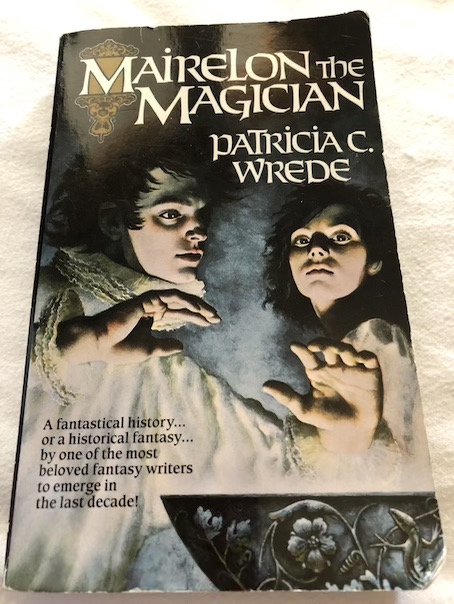
Mairelon the Magician

Mairelon the Magician by Patricia C. Wrede, 1991.

This young adult book takes place in an alternate history version of Regency England.  In this world, magic is a normal and accepted part of society.  “Wizard” is an accepted profession, and there is even a Royal College of Wizards dedicated to magic.  Not everyone can be a wizard because not everyone has the ability to use magic.  It is a skill that people are either born with or born without, similar to people who have an innate talent for art or music, compared to people who are born tone-deaf or color-blind.

In this early 19th century world, there is a teenage girl, Kim, who lives on the streets and survives by her own wits, taking whatever jobs she can and committing a little petty thievery whenever she needs to.  She has spent most of her life dressing like a boy and pretending that she is one because life on the streets is even more precarious for a girl.  For a time, she was part of a gang of child thieves run by a woman call Mother Tibb.  As far back as Kim can remember, Mother Tibb was the only one who took care of her as a child.  Kim has no memory of her parents or any knowledge about what happened to them.  She doesn’t even have a last name.  However, before the story begins, Mother Tibb was caught and hanged for her crimes.  Some of the other child thieves were apprehended and put in prison or exiled to Australia, but Kim managed to escape.  Since then, she has been on her own.  So far, she has managed to avoid being pressured in to joining up with other gangs or turning to prostitution to survive, but the fear of that haunts her. Her future is uncertain.

At the beginning of the book, Kim is hired to sneak into the wagon of a traveling magician who is performing in the market and to see what he keeps among his belongings.  The man who hired her doesn’t want her to take anything, but he is particularly eager to see if the magician has a particular silver bowl in possession.  It’s a strange request, but the money that the man offers Kim is too good to pass up.

However, the magician, who calls himself Mairelon, isn’t quite what he seems.  He is not just an ordinary traveling entertainer using some sleight of hand to amuse people in the market.  Kim discovers that he can do real magic as she searches his wagon and is knocked unconscious by a real magical spell that Mairelon uses to protect his belongings.

When Kim wakes up, Mairelon and his servant, called Hunch, have tied her up.  Unlike Hunch, Mairelon has also realized that Kim is actually a girl, not a boy.  The two of them question Kim about why she sneaked into the wagon, and she tells them the truth about being hired to do it.  When she describes the man who hired her, it seems that Mairelon recognizes the description.  The part about the silver bowl also unnerves him.

Surprisingly, Mairelon makes Kim an offer to come with him and Hunch when they leave London.  He is fascinated by Kim’s skills in picking locks, even the lock on the booby-trapped trunk that knocked her unconscious, and he thinks that Kim might be useful to him and Hunch, perhaps helping with the magic act.  In return, he offers to teach Kim some of his magic tricks.  Hunch is dubious about Kim because she has obviously been a thief, and Kim also isn’t sure what to make of Mairelon.  She knows that he’s hiding something, but she isn’t sure what.  No one with real magical abilities like him would ordinarily be making a living with simple magic tricks in the market. 

However, Kim does accept the offer because she’s been worried about one of the major criminals in the area, Dan Laverham, who has been showing too much interest in recruiting her. He is heavily involved with a number of criminal activities, and he knows that Kim is a skilled lock pick.  If he found out that she was a girl, he would probably also press her into prostitution. Dan Laverham would be a good reason to get out of London for a while.  Also, Kim realizes that if she learns a few magic tricks from Mairelon, she might be able to set herself up as an entertainer and make an honest living, safe no matter who finds out that she’s female.  Besides, Kim realizes that if she’s not satisfied with the situation, she could always run away later.

Before leaving London with Mairelon, she returns to the man who hired her, at Mairelon’s suggestion, and tells him that she didn’t see a silver bowl in Mairelon’s wagon (which is true because she was knocked unconscious and didn’t see anything in the trunk).  The man is angry, but Mairelon, who followed her in disguise, helps to create a distraction so that she can get away from the man.  They leave London in the middle of the night because Mairelon says that he was spotted by someone who recognized him when he went out to get magic ingredients.

On the journey, Kim gradually gets to know Mairelon and his situation.  The silver bowl, which Mairelon does have, is actually part of a set of magical objects which, when used together, can compel people to tell the truth without interfering with their ability to answer questions intelligently.  Mairelon’s real name is Richard Merrill, and he is, or was, part of the Royal College of Wizards.  Years earlier, the Royal College of Wizards was analyzing this particular set of magical objects and the unique spell that they control, when they were suddenly stolen, and Merrill was framed for the theft.  At the time, Merrill was unable to prove his innocence (at least not without sounding as if he had done something inappropriate with a lady, which he also did not do – they were just together at the time of the theft because she was helping him and another friend with a magical experiment), but he was also recruited by his friend in the government to be a spy against the French, so the story of his supposed theft gave him a plausible reason for wanting to leave the country.  In the time since then, he and his friend have continued to look into the matter of the theft, and they have made some progress in tracking down the other pieces of the magical set.  At the time that Kim met him, he was on his way to the next piece of the set, a silver platter.

To their surprise, however, they soon discover that someone has been making copies of the platter.  The copies are not magical, but they do confuse the issue.  Who is making the copies and why would they want copies, since they do not have the powers that the original has?  As Kim and Mairelon investigate, they crash a house party at a lavish country estate and spy on a meeting of a rather inept society of druids.  All the while, they are getting closer and closer to finding the original thief.

I loved the combination of mystery, fantasy, history, and humor in this book!  It’s one of my all-time favorites.  It has a happy ending with Mairelon’s name cleared and the thief caught.  They also discover that Kim has the ability to use magic, and Mairelon offers to take her on as his apprentice, saving her from the streets forever.  There is a sequel to this book called Magician’s Ward, about Kim’s life and adventures as Mairelon’s student.  The hints of romance in this book are also much stronger in the next one.  There are only two books in this series, which is disappointing because the characters are so much fun, and I think that there is a lot more room for their development.  By the end of the next book, Kim’s future is looking more certain, but her past is still murky.  Originally, I had expected that there would be secrets revealed about Kim’s past because of her ability to use magic, possibly something that was passed on to her by her parents.  However, by the end of the second book, Kim still doesn’t know who her parents were/are, and it doesn’t look like there’s any chance that she will ever know.  Perhaps it doesn’t really matter. Sometimes, secrets are more tantalizing when you imagine the answers than when you actually find out.

The book is currently available online through Internet Archive.

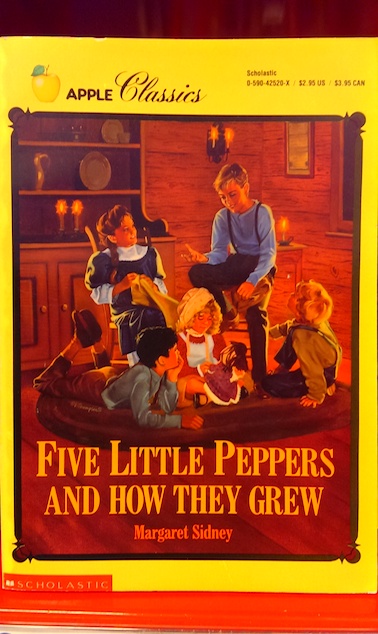
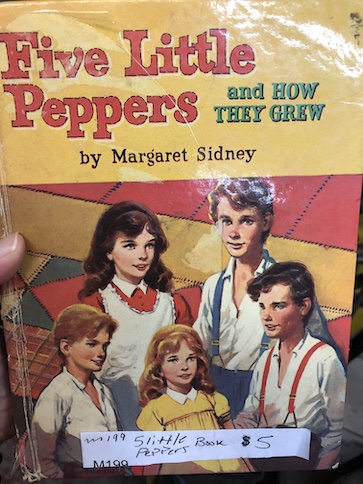
Five Little Peppers and How They Grew

FiveLittlePeppers

Five Little Peppers and How They Grew by Margaret Sidney, 1881.

Mrs. Pepper is a widow who lives with her five children in a little brown house.  Since her husband died when their youngest was a baby, she has supported the family by sewing.  The children try to help, but they are still very young.  The oldest, Ben, is eleven years old, and Polly, the next oldest is ten.  Their mother worries about providing them with an education, but they are barely scraping by as it is.

The family manages to get by, helping each other through crises, such as the time when everyone was catching measles.  Sometimes, they also get help from friends.

One day, when Phronsie (short for Sophronia), the youngest Pepper, about four years old, wanders off by herself, she is found by a boy named Jasper King and his dog, Prince.  They look after her until her brother, Ben, comes to take her home.  Jasper enjoys meeting the Pepper family.  He doesn’t have any siblings himself, and he thinks that it must be fun to live in a family of five.  Jasper and his father are spending the summer at a hotel in nearby Hingham, and Jasper thinks that it’s dull.  The Pepper children invite him to come visit again, saying that they will teach him how to bake like Polly does.

Jasper isn’t able to return to their house right away because he gets a cold, and Jasper’s father has been ill.  Phronsie thinks that it would be nice to make him a gingerbread man.  Together, the children make up a little basket of goodies for Jasper and his father.  The Kings are charmed by the gift, and Mr. King decides that he would also like to visit the Pepper family.  Unfortunately, due to Mr. King’s poor health and some business he has in “the city”, their visit to the area is cut short.  The Pepper children are sad that Jasper will be leaving so soon, but they invite him to return next summer.

Jasper continues to write letters to the family while he’s in the city, studying with the private tutor he shares with his cousins.  He remembers the Pepper children telling him that they don’t really celebrate Thanksgiving or Christmas because they never have enough money to buy a feast or Christmas presents.  However, he urges them to try to celebrate Christmas this year, even if it’s only in a small way.  The Pepper children make small presents for each other, like paper dolls, doll clothes, toy windmills, and whistles, and put some greenery around for decoration.  Jasper also sends the family some surprise presents.

However, Jasper’s father says that he doesn’t want to visit Hingham again because he doesn’t think that the climate there is good for him.  Instead, Jasper persuades his family to let him invite Polly for a visit.  It takes some persuasion for the Peppers to agree because Mrs. Pepper is hesitant to accept favors and Polly worries about homesickness, but they are persuaded when Jasper says that he has been unwell and that Polly’s visit would cheer him up.  In the city, Polly gets her first taste of formal education, even having a music teacher.  However, she does get homesick, so the King family sends for little Phronsie to cheer her up.  The King family is charmed by both of the girls, and Mr. King gives Phronsie many dolls to play with.

One day, when Polly realizes that she has forgotten to write a letter to their mother because she was so busy with her lessons, Phronsie decides that she will write one herself and mail it.  She doesn’t really know how to write, but she scribbles something as best she can and slips out of the house to find the post office.  She is almost run over in the street, but fortunately, Mr. King finds her and brings her home.  She isn’t hurt, but the incident worries Mr. King.

After some thought, Mr. King decides to invite the rest of the Pepper family for a visit.  The day that the rest of the Peppers arrive, Phronsie surprises a pair of thieves in the house.  The thieves get away, and the excitement from the incident makes the Peppers’ arrival less exciting than it should have been.

The Peppers fit so well into the household that Mr. King invites the family to live with them permanently.  He offers Mrs. Pepper a job as housekeeper and says that he will help the children with their education.  Mrs. Pepper accepts, and it leads to the surprising revelation that Mrs. Pepper and John Mason Whitney, the father of Jasper’s cousins, are actually cousins, making them all cousins of the King family as well.

This book is mentioned in the book Cheaper By the Dozen as a book that Mrs. Gilbreth liked to read to her children.

The book is currently available online through Internet Archive. It is part of a series.

Steal Away

StealAwaySteal Away by Jennifer Armstrong, 1992.

Most of this story is framed as a flashback, actually two of them.  In the beginning, during the late 1800s, a girl named Mary is taken by her grandmother, Susannah, to visit an old friend of hers who is dying.  The friend, Bethlehem, is a black woman who is a teacher in Canada and has a student living with her, a young black girl named Free, who is about the same age as Mary.  At first, Mary doesn’t completely understand who Bethlehem is and why they are there to see her, and Free is somewhat aloof and suspicious of these white people, but together, Bethlehem and Susannah explain to both the girls about their unusual friendship and a shared history that changed both of their lives forever.  As they explain, Mary writes down their story.

Years ago, before the American Civil War, Susannah was a young teenage orphan.  She traveled from her home in Vermont to the home of her aunt and uncle in Virginia, her new guardians.  Homesick, missing not only her deceased parents but the friends she left behind, especially a boy who is her best friend (and who eventually becomes her husband, Mary’s grandfather), Susannah finds life in Virginia strange and unpleasant.  Her aunt and uncle own slaves, which is something that makes Susannah uneasy.  She was raised not to believe in slavery, but her aunt and uncle give her a slave of her own to take care of her, a girl about her age named Bethlehem.  Susannah is extremely uncomfortable with the situation, not really being the kind of person to get others to do things for her or order anyone around, and Bethlehem isn’t happy about being saddled with this sad, somewhat weak and clueless, white girl.

Bethlehem already has serious problems.  Susannah’s older, male cousin has taken a liking to Bethlehem and pursues her, trying to force his attentions on her.  Bethlehem resists but knows that one day she might not be able to stop him because she’s in his family’s power.  They own her and have authority over her.  Susannah is unaware of this situation at first, being a rather naive girl.  However, Susannah’s unhappiness at her new home increases, and more and more, she longs to return to her real home in Vermont, and her desire to escape also becomes Bethlehem’s ticket to freedom.

Both of the girls long for freedom, although each craves a different kind of freedom and has in mind a different kind of life they long to live elsewhere.  Together, they team up to run away in disguise as boys, although Bethlehem does not trust Susannah at first because she resents white people and the slavery that has been forced on her for her entire life. However, with their common interest in escape, they learn to rely on each other.  They come to trust and understand one another much better during the course of their journey.  It is an eye-opening and life-changing experience for both of them.  Then, when it comes time for them to say goodbye and go their separate ways, it is one of the hardest things that either of them have had to do.

It is a story about lives with separate directions but which crossed in unexpected ways to the benefit of both of them.  Because Susannah and Bethlehem have different destinies and different things that they want in life, they cannot live their lives together and do not see each other again for many years after their adventures, but because of their shared experiences, they still share a bond that lasts across time.

After Bethlehem’s death, Mary becomes concerned about the young student of Bethlehem’s, Free, who was living with her as a part of her family, but Free doesn’t want their help.  Susannah tells Mary that they have to let her live her life and establish her own independence in the way she wants, just as Susannah had to let Bethlehem go her own way years before as a strong, independent young woman who only wanted the freedom to choose her own course in life.

In the end, Mary, as an adult looking back on the one and only time she met her grandmother’s old friend, just before her death, realizes that she has also learned much from the experience, not just about her grandmother’s history, but about herself, other people, racial differences and attitudes, and some of the realities of the world, absorbing vicariously some of the lessons her grandmother learned years ago through her story and Bethlehem’s.

This isn’t really a happy story.  The ending kind of leaves readers with an unsettled feeling because there are many things left unanswered and unresolved.  The book does explain a little about what happens to the characters at the end, but for the most part, they all kind of go their separate ways.  Although they’ve had an effect on each other, nothing is clear-cut, and they share moments together more than lives.  I have to admit that I felt like some of the story dragged in places and others were downright depressing, making this a difficult book to get through.  However, it is interesting for showing a part of history, a life-changing event from different points of view, and some poignant thoughts about caring but letting go.

The book is available to borrow and read for free online through Internet Archive.