Tom Brown’s School Days

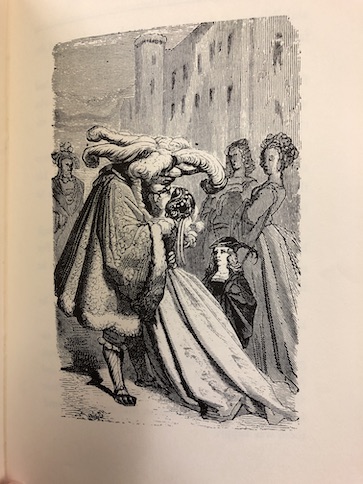
This classic children’s book from the mid-19th century is famous as the story that popularized the concept of British children’s boarding school stories, although many people in the 21st century haven’t read it themselves.

Young Tom Brown was brought up in a very close family, although they are often given to quarrels and drama among each other. He is the eldest of his parents’ children and spends his early young life in the vale where he was born, raised by his family and his nursemaid, Charity. Tom’s mother has a talent for training young servants. She is kind and patient with servants in training, treating them almost like older children of the family. Charity is rather clumsy and not too bright, and she has her hands full with young Tom. He is a strong and rebellious little boy. Charity’s relatives have a farm nearby, and she takes him there to pick up supplies for the Brown household. The people on the farm are kind to Tom, and they also help raise him. Because Tom resists training and supervision from women, the Brown family eventually hires an older servant, Benjy, to take care of Tom from about age four. Benjy takes little Tom fishing and tells him stories about the history of the Brown family. Generally, Tom’s early childhood is pleasant and easy.

As Benjy gets older, he is troubled more by arthritis and finds it harder to keep up with young Tom. Tom gets a governess at home, and when Tom begins lessons at the local school, he begins to calm down at home because he spends his energy at school and playing with the local boys in the village. Being friends with other boys his own age is good for Tom because they share the same interests and levels of energy. They play games and wrestle with each other for fun. Then, when Tom is nine years old, his family sends him away to boarding school. There are some sad goodbyes from the local boys in the village, and the other boys give him some little toys as going-away presents. This is the first time that Tom has ever been away from home, and this is where the story of Tom’s education really starts.

Tom spends about a year at a private school before going on to a public school. The author pauses here to explain the differences between British private schools and public schools. Unlike in the United States, “public” schools are still schools that require school fees, but private and public schools differ in who is accepted as a student and how the students are treated in their time outside of class. In the author’s time and young Tom’s time, students at private schools are more closely supervised in their off hours, with the idea that molding the students into good citizens (which is considered a higher goal in their education than the subjects taught in the classroom) cannot be adequately accomplished in classroom time only and that most of it takes place outside of the classroom. At public schools, the author says, the boys have more freedom and less supervision outside of class.

The boys at the private boarding school Tom attends are supposed to be supervised by school ushers, who monitor their behavior, resolve quarrels, and set a good example for them. Unfortunately, the ushers at Tom’s school aren’t very well educated or good at their job, and they have little interest in doing their job properly. As a consequence, the older students bully the younger ones, students are encouraged to tattle on each other, and physical punishments are used to keep the students in line. In spite of this and some homesickness, Tom actually has a pretty good time at school with his new friends at school. They have some adventures (some of which involves cruelty to animals they find, and the author makes it clear that he doesn’t endorse this and thinks that the bee stings they get are earned) and delight in scaring each other with ghost stories at night. However, this school isn’t really the best treatment or education Tom can get, so it’s just as well that he is sent to a public school after this.

Tom’s change in school comes when there’s an outbreak of disease in the area, and the schoolmaster of the private school is one of the people to become ill. All of the boys are sent home to their families. Since Tom has already told his father that he would rather attend a public school and since school at the private school is canceled for the rest of the term, Tom’s father decides to send him to Rugby. When Tom goes to Rugby, his father talks to him about his school experiences. Tom’s father says that he is going to Rugby at a younger age than he had planned to send him, and if schools are still like they were when he was young, he’s going to see people doing many cruel things and will hear bad talk from other people. He urges Tom, whatever happens at school, to be brave, kind, and truthful and, no matter what other people say, to not say anything he wouldn’t be willing to have his mother or sister hear him say. If he does these things, he won’t have to feel ashamed to see his family when he comes home from school, and they won’t be ashamed of him. This talk and the thoughts of his mother make Tom a little emotional, although he tries not to show it too much.

Tom’s father privately reflects on the reasons why Tom is going away to school. Partly, Tom is going to school because Tom really wants to go and have that experience. The fact is that Tom’s father doesn’t really care too much about Tom learning subjects like Latin, and his mother doesn’t care too much about academics, either. Tom’s parents aren’t too concerned about what kind of scholar Tom is. What Tom’s father really wants for Tom is what he has already told him to be. He wants his son to be brave and truthful, and he wants Tom to be a good and helpful English gentleman and a Christian. Basically, he’s more concerned with his son’s character and life choices than with his son’s grades. He thinks about whether or not he should warn Tom about various temptations he might experience at school, but he decides not to because Tom is still just a boy, and he thinks he wouldn’t understand.

Tom takes a stage coach by himself to school, nervous about what the school will be like but excited about the the experiences he is about to have. When Tom arrives at Rugby, a more experienced student, Harry East, helps Tom get settled and acts as a mentor to Tom about school life. East’s aunt is an acquaintance of Tom’s family, and she knew Tom would be coming to Rugby, so she asked East to hemp Tom. He explains the school grounds and uniform pieces to Tom, describes student activities and sports to him, and answers his questions.

Tom loves sports and is eager to play Rugby football, but East tells him that he won’t be able to play until he learns the game. Football is different at Rugby, and it’s a much rougher game than other schools play. East says players often get hurt and break bones. There is a match that day, and Tom finds it exciting to watch, especially since their house wins! After the match, East says that he doesn’t have any allowance money right now, so Tom buys some food they can have for tea, and they share some of it with some of the other boys from their school house. Tom starts making friends with the other boys, and they all talk about the match together.

After tea, East says that it’s time to join their house for singing. Tom is surprised, but East says that group singing among the students is a regular school activity. There are also speeches from other students at the school singing. Today’s speech is about their house’s victory at the football match. One of the students speaking, Brook, praises the players and congratulates them for their victory on behalf of the house, with all the other boys cheering. He says that their house won the match because their house has the best house spirit and team spirit, and they know they can depend on each other. However, he also issues a warning to the students about bullying in the house. Some of the older students have been picking on the younger ones. He doesn’t want to encourage tattling among the students, and he says that learning to deal with bullies is a valuable skill that makes a boy tougher, but at the same time, bullies are cowards, they encourage cowardly behavior among others, and they break up house spirit and bonds of teamwork among the students. He cautions everyone that too much bullying and allowing bullying to continue will destroy the house spirit that helped them win today, so if they want to continue winning and enjoying house victories, they’d better cut it out. Some of the younger students look at the older students have been doing the bullying, especially a boy called Flashman.

Brook also cautions the other students against drinking in the local pubs and talks to them about their new headmaster. Some of the students haven’t been happy with him because he’s changing some of the school customs. Students have been grumbling and would like to see the new headmaster gone, but Brook points out that Brook isn’t going anywhere and that the “customs” he’s been changing have been destructive pranks and other habits that were also causing problems. The new headmaster hasn’t touched some of the customs that really matter to the students, like their sports, and in fact, the headmaster was also watching the match today. There are mixed feelings among the boys at this part of the speech because they like the idea that the headmaster, who they call “the doctor”, was watching the match, but at the same time, the boys don’t really know him or trust him yet.

The author notes that the new headmaster found the school in a state of disorder and mismanagement when he took his position, and the changes he’s been making are about restoring order to the school. The boys, not knowing the difference between a more orderly and well-managed school and the one they got to know when they first arrived, don’t appreciate the doctor’s wisdom of kindness yet. Tom first encounters the doctor when he leads the students in prayers.

Before bed, Tom and the other younger boys meet with some bullying from Flashman and Flashman’s cronies. Some of the other boys are terrified, but Tom and East allow themselves to endure the bullying, being “tossed” by the older boys so the other boys will be spared. The other boys are grateful to them for this, so they start to hold Tom in high regard.

This eventful first day is a good introduction for Tom about what life at Rugby School will be like for him. Sports, bullying, pranks, fighting, camaraderie among the other students, singing, speeches, and the new headmaster are going to be major themes for him in his education. Like other younger students, Tom has to act as a servant and do chores for older students, part of a tradition called “fagging” (more about that below in my reaction). Tom does well in his classes at school because he has already had a good grounding in his subjects, and he is generally positive about his life at school, in spite of the bullying. He loves participating in the school sports and physical games, like Hare and Hounds.

However, things do get harder for Tom at school. Because he is doing so well at his grade level, he is quickly promoted to the next. When he gets there, with some of his new friends, like East, Tom becomes less studious and more unruly, like the others. Also, the older boys who were trying to set a good example for the others and protect the younger students from the bullies graduate from the school, leaving bullies and less conscientious students as the senior students. The bullying gets worse, and as Brooks had predicted, it breaks the spirit of teamwork in Tom’s house. The students in the house start dividing into factions of bullies and bullied, the younger students against the older.

The younger students get increasingly resentful of the ill treatment and bullying of the older students and start getting rebellious against the system of “fagging” at the school, with Tom and the others declaring that they simply won’t serve the older students anymore. When students like Flashman the bully call for them, they just pretend they don’t hear and refuse to answer them. Flashman and the others try to physically break into Tom and East’s room when they refuse to come, but Tom and East barricade themselves inside. Their success against the older students encourages other students to rebel. Tom considers going to the headmaster about it, but the others discourage the idea. None of the students want to go to the schoolmasters unless absolutely necessary because the students think that the right thing to do is to work out their own problems with each other.

Diggs, one of the older students who is nicer tells the others that, when he and Flashman were younger students, the students in their grade also rebelled against the older students to teach them not to bully them, but Flashman didn’t rebel with the others. Instead, he ingratiated himself to the older students, continuing to serve them and bribing them with treats he got from home. He has evaded discipline and consequences for his behavior by making himself into a useful toady for the students with more authority. Now, Flashman and his cronies increasingly bully the younger students and use physical hurt to subdue them. The younger students retaliate against them with pranks. Tom and East become Flashman’s particular enemies because they live close together in their house and because Tom and East started the rebellion and have been open and accurate in their criticism of his cowardice, refusing to be subdued by the beatings he gives them.

Matters with Flashman come to a head over a lottery, when Flashman pressures other students to turn over their tickets to him. Tom refuses to part with his, and Flashman and his cronies beat him and burn him, hurting him so badly that Diggs intervenes, worrying that they might kill Tom. Diggs shows Flashman to be a coward when he confronts him over the incident and hits Flashman, but Flashman doesn’t fight back because he’s afraid of getting hurt himself. This doesn’t end Flashman’s aggression against the younger boys, and when he starts getting worse again with Tom and East, Diggs urges the two boys to gang up on Flashman. For them to fight him singly wouldn’t be a fair fight because Flashman is several years older than they are and bigger, but Diggs considers it fair for both of them to stand up to Flashman at once. To Flashman’s shock, the two boys do gang up on him. He’s much bigger than they are but not as good at fighting and pretty cowardly about fights where he doesn’t have some obvious, overwhelming advantage. Tom and East win the fight, giving Flashman a cut on his head that bleeds. At first, Tom and East are worried about whether they’ve hurt Flashman badly, but Diggs has a look at the wound and tells Flashman off for being dramatic about how hurt he is. Flashman has only skinned his head a little, and he’s done much worse to the younger boys. Flashman never physically fights the boys again. He eventually leaves the school, being sent away by the headmaster after he becomes disgracefully drunk at a nearby pub one evening. The headmaster was already displeased with Flashman, and this was the last straw. The younger boys are glad to see the bully gone, although some of the older students bear some resentment against the younger ones for their rebellion and their triumph over someone from their level.

Tom and East are emboldened by their victory and for moving up at school, and they become regular rule breakers. They never consider the justice or reasons behind school rules, taking them more as challenges. They get into trouble for trespassing on someone else’s land to go fishing, and the land owner’s gamekeeper brings Tom before the headmaster. Later, Tom and East climb onto the roof of the school and carve their names on the minute hand of the school clock. They are caught because they accidentally change the time on the clock, and when someone investigates why the clock is wrong, finds their names.

Later, they sneak into town against the headmaster’s orders and get caught. They are both taken before the headmaster for this, and they receive floggings for their stunts. The headmaster also gives them a lecture about the dangerous nature of some of their stunts, pointing out that they could have fallen and broken bones from the clock stunt. He points out that they never think about the reasons why rules exist, thinking of them only as whims of the schoolmasters, which isn’t the case. The rules exist for good reasons, and they apply to everyone at the school, including Tom and East. The headmaster says he doesn’t want to keep giving them floggings for their stunts, and if they can’t gain some maturity and reform their behavior, he’ll send them both away from the school. Tom and East are shocked because they never thought that they might have gone far enough to risk their positions at the school. They love their lives at the school and don’t want to be sent home in disgrace. The headmaster tells them to think about their futures at the school seriously when they go home for a term break.

Privately, the headmaster has a word about the boys with one of the other schoolmasters. The headmaster is concerned that, if they continue their irresponsibility and recklessness, they will fail their studies, get into some really serious trouble, and possibly turn into thoughtless bullies of the younger children as they get older. The other schoolmaster acknowledges that they are not the best students and they are a problem, but he thinks that they’re not really bad boys and could still be turned into decent young men. He says to the headmaster that what these boys need is something to give them a sense of responsibility and suggests making each of them responsible for a younger boy at school. Protecting a new boy from the older bullies could settle them and make them more serious and responsible and prevent.
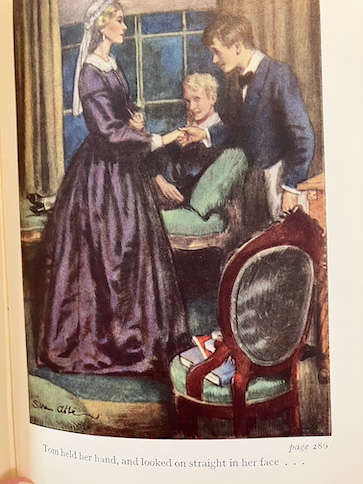
When Tom returns to school for the next term, he expects that he and East will be allowed to share a room and study, which is something that they’ve hoped for. They’ve been making plans for all the ways they can have fun and goof off in their own space. Instead, the school matron introduces Tom to a new boy who will be sharing his room and who will be Tom’s responsibility. George Arthur is a pale, timid, skinny boy, and Tom can see that he’s just the sort of boy who would be picked on by the others. Tom is annoyed at having his plans with East spoiled, but the matron stirs his sense of sympathy by telling him that George Arthur’s father is dead and that he has no brothers. Tom can see that young Arthur will probably be made miserable at school by bullies unless someone stands up for him and teaches him how to handle life at school, so he agrees to take responsibility for him.

The schoolmaster is correct that looking after little George Arthur changes the way that Tom looks at himself, his fellow students, and his education. The change starts when Arthur says his prayers openly at night, getting him a teasing from the other boys, who take any sign of weakness or sentiment as an opportunity for teasing. Tom defends Arthur from them. He also feels a twinge of shame because he remembers, for the first time in a long time, that he had once promised his own mother that he would always say his prayers at night, and he has become neglectful about this, specifically because he wanted to avoid the teasing or bad opinion of the other students. It shames Tom a little to think it, but he realizes that, although Arthur may be physically weaker than he is, he has displayed more moral courage than Tom has simply by saying his prayers, regardless of what the other students think.

Looking after Arthur gives Tom a sense of responsibility, as the schoolmaster hoped, and Tom appreciates feeling like he has a purpose. He enjoys seeing timid Arthur beginning to develop as a student and start to make a new friend on his own. However, Arthur also has things to teach Tom. Tom’s friendship with Arthur helps his own personal development and causes him to consider sides of himself he hasn’t thought about much. As Arthur opens up more to Tom, he explains that he is serious about religion because his late father was a clergyman. When he was alive, his father used to read the Bible with him. Inspired by Arthur’s example, Tom becomes more serious and starts exploring his religious side, although he takes some teasing and criticism from the other students over this budding sentimentality and defense of little Arthur. Tom and East start participating in Bible readings and study with Arthur, considering some of the deeper questions of life and religion that they’ve never considered before. They begin to think even more deeply about life and death when a disease spreads through the school. Arthur becomes ill and another boy dies. Tom is relieved when Arthur recovers, but his near death and the other boy’s death cause Tom to really consider life and death seriously for the first time.

As Tom develops a deeper understanding of life and religion, he finds himself a little at odds with East, who still doesn’t take life seriously. Fortunately, the two of them respect each other enough as friends to talk about their views seriously with each other. Tom doesn’t consider himself as knowledgeable about the subject or as good as explaining it to others as Arthur, but through their conversation, East realizes that he does actually care about the subject and goes to talk to the headmaster about his feelings and about confirmation. The headmaster’s kind understanding and reassurance is an inspiration to the boys, and they come to respect him, although Tom doesn’t fully understand the headmaster and what he’s done for the boys until he is a young man.

At the end of the story, Tom is with some college friends when he hears that the old headmaster has died, and he feel compelled to visit Rugby School again to pay his respects and reflect on his old headmaster.

The book is now in the public domain. It is available to read for free online through Project Gutenberg and Internet Archive (including an audiobook version). Tom Brown’s School Days has been made into movies and tv films and miniseries multiple times. There is also a sequel to this book called Tom Brown at Oxford, which focuses on Tom Brown’s university experiences.

Although it was not the first book set at an English boarding school, this 19th century book is famous for being the book that popularized the trend of British boarding school stories, which has continued for over 150 years since! There are also references to this specific story in other books, and I have to admit that it gave me a giggle to recognize the scene that Terry Pratchett parodied in his novel Pyramids. The story is semi-autobiographical, based on the experiences the author, Thomas Hughes, had when he attended Rugby School as a boy during the 1830s. There is now a statue of Thomas Hughes outside the Rugby School Library.

The headmaster in the story is only called “the doctor” for most of the story, until the very end, when Tom learns of his death and his last name is given as “Arnold.” Tom’s headmaster is based on Thomas Arnold, who was the real, historical headmaster of Rugby when the author of the book was a student there himself. The real Thomas Arnold did die suddenly of a heart attack at age 46 in 1842, and this book is an homage to his memory as well as the recollections and thoughts of the author on the subject of education. The real life Thomas Arnold did reform the habits and organization of Rugby School, like the headmaster in the story, focusing on the religious and character development of students and creating a system of prefects called “praepostors” as student monitors, something that is referred to in the story. Other British boarding schools copied and built on his ideas and practices. (Added fun fact: Thomas Arnold was the great-grandfather of the author Aldous Huxley, known for Brave New World.)

The book requires some patience for modern because the author spends some time setting the scene and explaining the background of Tom’s family and early childhood before really getting into the story. Part of the reason for that is that the author, Thomas Hughes, based the story on his own childhood and youth, and he spends some time comparing the childhood and conditions of life in young Tom’s time with life at the time he wrote the story.

Hughes admits that he doesn’t like the direction the social situation has been heading in his time, and he feels that his time period is at a changing point. He sees many of the old ways of life falling aside, and he partly blames the new upper classes, who take advantage of the working class, using them to enrich themselves (“buying cheap and selling dear”). He’s describing an increasingly industrialized and urbanized society with a significant wealth gap between the wealthiest members of society and the working class, which was characteristic of Victorian society. Hughes notes that some members of the upper classes profess to be trying to reform the lower classes, but the author says they don’t really understand the working classes at all. There is part of the story, early in the book, after he describes young Tom’s experiences at a local fair, where he delivers a lecture to the younger members of these rising upper classes on the subject. Hughes was a social reformer in the Victorian era, so he has many thoughts about how to improve society and a pretty accurate understanding of social conditions during his lifetime, and he works them into the story of Tom’s education.

It’s interesting to see Thomas Hughes’s descriptions of Rugby School and boarding school life and education in the 1830s. I’ve never been to a boarding school before, and neither have most of the other readers who enjoy boarding school stories. It’s getting to see a type of school that most of us will never attend that makes stories of this kind fascinating. Seeing them as they looked in the past is especially fascinating. I’ve read other books and seen documentaries about boarding schools in Britain, and it was interesting to note the aspects of school life that are the same or different from what someone might encounter in a modern school. From what I’ve learned about British boarding schools, extracurricular activities, like sports and singing, are still major features of British boarding schools that have stood the test of time. However, modern schools have cracked down on bullying and abuse from older, higher level students.

A couple of words that appears in the story, “fags” and “fagging” sound like derogatory terms from modern times, but it has nothing to do with homosexuality in this context. “Fagging” was a tradition at British public schools of this time and earlier, where senior students used younger students as servants, giving them menial chores to do. The “fags” described in the story are younger students, who are described as performing various tasks, like fetching things for the older students, cleaning, carrying messages, or arranging furniture for singing. The problem with the tradition of fagging was that it often led to bullying and abuse of younger boys at the hands of the older students, and this is something that’s addressed in the story. The bullying and abuse associated with this tradition is what led to the end of the tradition in modern times.

There are also other student habits which would seem odd by modern standards, including some which would definitely not be allowed for boys of this age. The students at the school are about 11 to 19 at the oldest, but they routinely drink beer, even the younger boys, although I think it’s probably a weak version. The ways the students are treated with regard to money and how they spend their money are also odd by modern standards. Their allowances may be withheld from them as a punishment. There are times in the story when students in need of money auction off some of their own belongings, a subject that appears in A Sweet Girl Graduate, although the boys don’t get in trouble for this as the girls in A Sweet Girl Graduate did. The older boys also impound the allowances of the younger boys for a lottery at one point, using the funds to purchase sweepstakes tickets on a horse race. The younger boys are not consulted about their participation in the gambling, and the only problem that arises from it is when Flashman tries to bully them out of their tickets to get ones he thinks are likely to win.

As the author reflects on his time at school, his experiences with friends and classmates, and the inspiration of his old headmaster, he also offers advice to other boys and his thoughts on what it means to be a man and to take charge of ones own development. I don’t think modern parents and teachers would agree on all of his advice, but he makes it clear what experiences from his school days have led him to believe what he does about how boys and men should conduct themselves.

At one point, he says that he has no problem with the idea of boys fighting with each other because he sees fighting and struggling as just part of the role of men in life. He says his only concern is whether or not they’ve chosen the right side to fight on. Flashman serves of an example of how bad people can actually be quite popular, at least among their cultivated cronies, and are often supported by the social system or know how to use the system to their advantage. The author warns other boys not to see another person’s popularity or social position as a sign that they are good people or that they are in the right in a situation because the opposite is very often true. What is good and right is independent of popularity, power, and money and is determined by other factors. He admits, through the character of Tom, that he has developed a soft spot for underdogs and says, even if you think the underdog is wrong in his beliefs, he shouldn’t be scorned but respected for his willingness to fight for what he believes, even knowing that he doesn’t have popular support.

At the end of the story, when the headmaster dies, the character Tom despairs because, although he has moved on from Rugby School, and he realizes that many of the boys who are there now don’t know who he is and wouldn’t recognize him as one of them, the headmaster was a guiding light in his life and spiritual development. He still feels ties to his old school and headmaster because his time there and the headmaster’s influence set him on the course for his life and development. The author reflects that Tom the character was still someone self-centered at this age, and in the first shock of hearing about the headmaster’s sudden death, he thinks of the loss of the headmaster as a personal loss that no one else would understand. However, when he returns to Rugby and thinks about it further, he realizes that he is not the only one whose life was touched by the man, remembering that he left behind a wife and children and that the headmaster cared about all of his students and influenced them all in different ways. Tom the character sheds some of his self-centeredness and realizes that it’s time to move on in his life. The author also says that there is a flaw in looking to mortal men, even the kindest and greatest among them, as the ultimate source of guidance because no mortal man lives forever. Tom the character will tend to his own spiritual development from this point forward and look to God Himself for guidance. In this way, it seems that young Tom the character has developed into the kind of young man his father wanted him to be in the beginning, making his education successful.

Before Tom learns of the headmaster’s death, he discusses his future ambitions with an old schoolmaster, saying that he wants to make a difference in the world as well as earn a good living. The schoolmaster cautions him to be certain of his priorities and know which of those two goals is more important. There are many people who spend their lives making money but do nothing of lasting importance for the world and other people, and there are many people who do good in the world without making much money. If Tom focuses too much on making money, he may sacrifice the goal of doing good in the world, so he needs to remember what he really wants to accomplish in his life and what he wants to prioritize.

Thomas Hughes went to Oxford after his time at Rugby School, like his character, and he became a lawyer, social reformer, and member of Parliament as well as a writer. Among his books are books about religion and the nature of manliness. The themes of Tom Brown’s School Days really were the themes of his life, and he genuinely means the advice that he offers to young men in the story.

Kirsten’s Cookbook

Kirsten, An American Girl

This cook book is one of the activity books that was written to accompany the Kirsten series that is part of the American Girls franchise. The American Girls books were written to help teach American history (as well as sell the accompanying dolls and accessories), so this book has recipes of the type that people would have eaten on the American frontier during the mid-1800s, when the character of Kirsten lived, and some historical information.

The book begins with some historical information about cooking on the frontier. Pioneer families like Kirsten’s family ate what they grew themselves and things they could gather from the woods around them. They ate certain foods only in the season when they could get them, and it was hard work to produce food and process it before using it in recipes. There were certain types of food that they had often because the ingredients were simple and often available, like potatoes and bread, and they rarely had time to prepare special or elaborate meals. However, they would take the time to make some special treats for holidays.

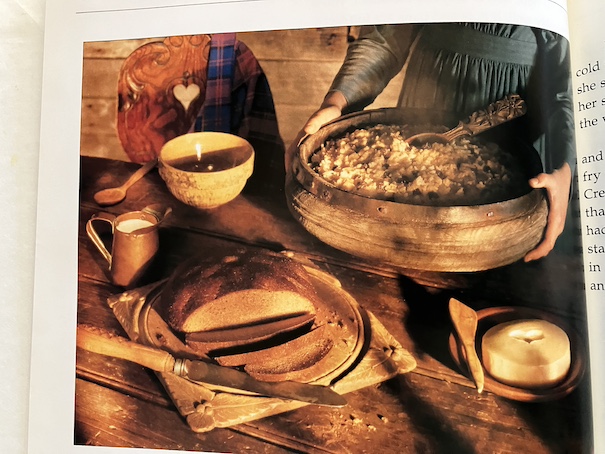
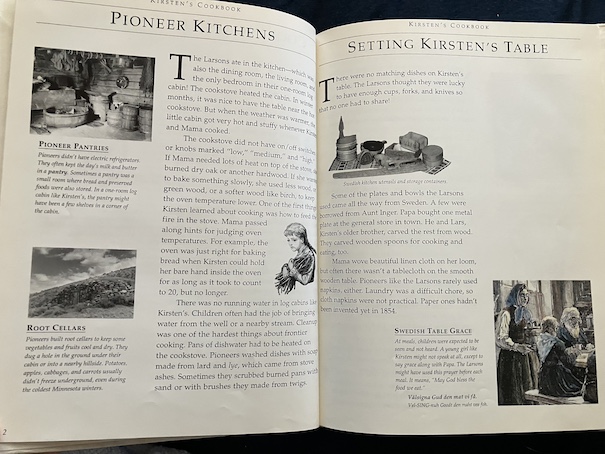
There are special sections that describe what pioneer kitchens were like and the dishes and table settings they would use. Pioneer families like Kirsten’s lived in one-room cabins, so her family cooked, ate, and slept all in that one room. They had a wood-burning cookstove, but stoves like that did not come with temperature settings. (This is why you don’t see temperatures specified in old recipes from the 19th century, although this book does include that information for modern readers.) People learned to judge roughly whether the temperature was right to bake bread or cook other recipes by feel, and could regulate the approximate temperature through the type or amount of wood they burned.

There is also a section of cooking tips and kitchen safety tips for modern child readers. Then, the recipes are organized by type of meal with a section of Kirsten’s favorite recipes. Each section and recipe is accompanied with additional historical information and trivia.

  • Pork sausage patties
  • Hard-boiled eggs
  • Swedish rice porridge
  • Round rye bread
  • Homemade butter
  • Ginger cookies – Although cookies seem like an odd thing to see at breakfast, a pioneer family might have them and save some for a snack in the mid-morning, before lunch, or as they called it, dinner.

“Dinner” is usually the biggest meal of the day, but depending on when and where you live, that might be either the midday meal or the evening meal. In modern times, it tends to be the evening meal, after a family or individuals are home from work or school and have more time for a large meal. Modern people sometimes use the terms “dinner” and “supper” (the evening meal) interchangeably for that reason. In Kirsten’s time and, sometimes, in rural areas even in modern times, the biggest meal is the midday meal, what most of us would call “lunch.”

  • Baked ham slice
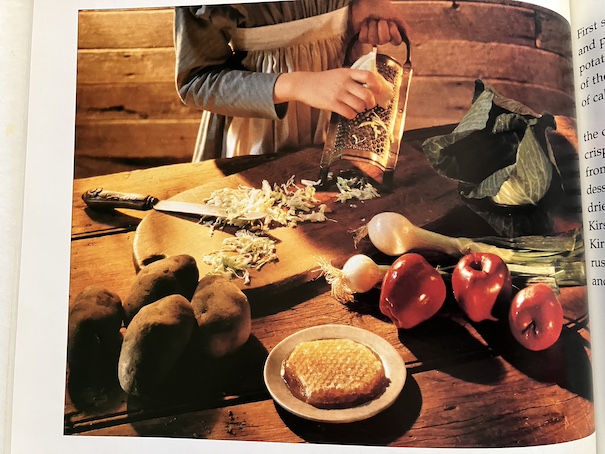
  • Swedish potatoes
  • Cabbage and apple salad
  • Fruit Soup
  • Swedish Almond Rusks – Swedish rusks are crunchy sweet breads, a little like biscotti.

This section just has an assortment of recipes for Kirsten’s favorite foods. Some of them are traditional Swedish foods, and others are more American. There is a mention in this section that pioneers learned how to make maple syrup from “Indians”, meaning Native Americans.

  • Potato soup – Soup with bread and cheese was a popular supper meal for farming families in the 19th century.
  • Swedish meatballs
  • Fresh applesauce
  • Swedish pancakes – These thin pancakes are rolled and filled with jam.
  • St. Lucia buns – These special buns are topped with raisins, and it’s a tradition in Sweden and other Scandinavian countries to serve them on St. Lucia Day, December 13.
  • Pepparkakor cookies – These are thin, spicy cookies that are cut into shapes and served at Christmas.

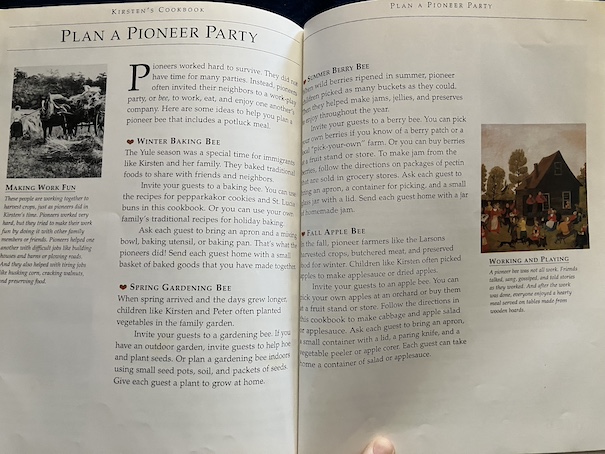
The book ends with a section of tips for having a pioneer-themed party. When real pioneers had parties, they were often organized around chores they had to do or tasks to accomplish. They called these work-play parties “bees”. Besides accomplishing a task, friends and neighbors would also bring food and share a meal, talk, and have fun. The suggestions in this section are organized seasonally. A Winter Baking Bee could involve everyone getting together to bake holiday treats, like the ones included in this book for St. Lucia Day and Christmas, or whatever the guests want to bake. At a Spring Gardening Bee, guests can get together to plant a garden or potted plants, with plants for guests to take home themselves. For a Summer Berry Bee, guests can pick berries (if they grow locally or at a “pick-your-own” farm) or make jam, with some for everyone to take home. For a Fall Apple Bee, guests can pick apples and make recipes with apples, like applesauce.

The book is available to borrow and read for free online through Internet Archive.

Stories of Rainbow and Lucky: Rainbow’s Journey

Stories of Rainbow and Lucky

This is the second book in the Stories of Rainbow and Lucky series. I’ve covered the first book this series, and I have to do all five books in a row because the series is set up like a mini-series. That is, none of the books in the series can stand alone; they are all installments of one, longer story. It’s an unusual series from the mid-19th century, written on the eve of the American Civil War, by a white author with a young black hero. Rainbow is a teenage black boy who, in the previous installment of the story, is hired by a young carpenter who is just a few years older than he is to help him with a job in another town. The rest of the series follows the two young men, particularly Rainbow, through their adventures, learning life lessons, even dealing with difficult topics like racism. (Lucky is a horse, and Lucky enters the story later.) The story is unusual for this time period because it was uncommon for black people to be the heroes of books and for topics like racism to be discussed directly. It’s also important to point out that our black hero is not a slave, he is not enslaved at any point in the series, and the series has a happy ending for him. People don’t always treat him right, but he does have friends and allies, and he manages to deal with the adversity he faces and builds a future for himself. Keep in mind along the way that there are a lot of pun names in this series and that people’s names are often clues to their characters.

This book is easily available to read online in your browser through NINETEENTH-CENTURY AMERICAN CHILDREN & WHAT THEY READ, I’m going to do a detailed summary below. If you’d rather read it yourself before you read my review, you can go ahead, but some people might want to know what it’s like in more detail.

For most of the last story, the focus was on Handie, his family’s financial problems, the inheritance he receives from his uncle, and how the lawyer who is the executor of the estate arranges for Handie to use the estate to his best advantage. Because Handie is 19 years old, he is still considered a minor. (The legal age is 21 during this time period and would stay the legal age until about halfway through the 20th century.) His uncle’s will specifically stated that Handie cannot take full ownership of the farm that he left to him until he is 22 years old. Uncle that time, the lawyer, Mr. James, will manage the estate on his behalf, using the money provided with the estate to hire someone to fix up the farm to rent it out to a tenant until Handie is old enough to take it. The Level family’s money problems are because Handie’s father is not good at managing his money, and Handie’s uncle knew that if Handie’s father got his hands on his son’s estate, he would probably blow the money and end up having to sell the farm to cover his debts, leaving Handie with nothing.

In the previous book, Mr. James discusses the situation with Handie, and they work out another solution to the Levels’ debt problems. He helps Handie take steps to separate the money he earns from his father’s money, and he hires Handie as the carpenter to work on repairing the farm he inherited on behalf of his own estate. It’s a somewhat odd arrangement because Handie is effectively being hired to work for himself but will be paid by Mr. James on behalf of the estate. Under the circumstances, it’s the best system for solving the family’s money problems and setting Handie up for a better future. 

Because Handie will need a little help while he’s working on the farm, Mr. James also provides money from the estate so he can hire an assistant. Handie offers the job to 14-year-old Rainbow. Rainbow doesn’t have any carpentry experience, but he’s strong for his age and a good worker, and Handie would rather bring someone he knows with him rather than trying to find someone else when he arrives at this new town. At the end of the previous book, Handie offers Rainbow the job as a carpenter’s assistant and tells him that they will be living in the town of Southerton for about 2 or 3 months during the summer while they do the job. The job will involve hard, physical work, but Rainbow can handle it, and this job could give him some good work experience. Rainbow accepts the job offer, with his mother’s permission, and they begin preparing for the journey.

When this story begins, Handie and Rainbow are about to leave the village where they both live. It’s a summer evening with good weather, and they will be traveling by stage coach. When Handie offered Rainbow the job, he didn’t explain that the farm where they will be working actually belongs to him, but word of Handie’s inheritance has spread around town since. Rainbow is astonished at the idea of someone so young having a farm of his own, and he decides that he will ask Handie more about it later, although he knows he should be careful to be polite about asking because he doesn’t want to seem rude by prying. Although these boys are friendly with each other, having grown up in the same small town, they also have a professional relationship now, and Rainbow’s mother impressed on him that he needs to treat Handie respectfully as his employer. They are becoming young men and venturing out into the world for the first time, so they need to learn how to behave professionally with each other, as befits their new, professional relationship. Neither of the young men is experienced with traveling anywhere, and they’re both looking forward to this exciting journey.

Things seem to be going well at the start of the journey, but then, the stage coach driver, while chatting with Handie mentions that he doesn’t like the look of one of the passengers. At first, Rainbow worries that the driver is talking about him because he’s accustomed to people making comments about him, ridiculing him, or telling him that he isn’t welcome among them for being black. Even though they are from a small village, and many people there like Rainbow for his good nature and helpfulness, he’s already seen his share of discrimination. However, the driver is talking about someone else. He explains that there’s a man on the stage coach called Burkill, who is wearing a bright waistcoat. He’s met Burkill before, and he knows that the man is trouble. 

Right now, Handie and Rainbow are riding on the top of the stage with the driver, but when Burkill joined them, he made a fuss to the driver about whether or not Rainbow would be riding inside the coach, objecting to the idea of riding with a black person. The driver, Trigget, who knows Rainbow and doesn’t like Burkill anyway, told him that Rainbow has paid his fare and will ride wherever he wants to: “I don’t pay any attention to the different shades of complexion of my passengers … Rainbow is suitable company for any honest man. You can judge best whether he is suitable company for you or not, and act accordingly.” It’s a bit of a slam. He’s implying that, if Burkill can’t get along with Rainbow, he’s probably not an honest man, and the driver already has reason to think he’s not, so he’d better not make a big deal about it. The other passengers also know Burkill’s reputation, so they get the joke and laugh at Burkill. Embarrassed, Burkill just gets on the stage coach without saying anything else. All of this happens before Handie and Rainbow get on themselves, and they don’t hear any of it, so their choice to sit up with the driver was just by preference, not because they were required to sit there. Trigget just tells them about it later, as they ride along.

(Note: I’m using the term “black”, and so did Burkill when he was speaking, but the driver corrects him, using the word “colored” because “colored” is considered the more polite word at the time this story was written. I’ve explained before that “colored” and “Negro” used to be considered more polite terms prior to the Civil Rights Movement in the mid-20th century. At that point, “black” became the accepted generic word, where it had once been considered somewhat rude, and “African American” became the polite, formal term. I’ve been using “black” in the modern generic sense for the purpose of these reviews because I think the modern audience will find it easier to follow, but this series was meant to be educational for 19th century children, like the author’s other books, so there are points in the story where the characters actually discuss which racial terms are more polite. The general rule they establish is that the best thing to call someone is whatever they would like to be called, and I think it’s a pretty good, general rule. I’m just explaining because it’s a plot point, and the racial words that people use are clues to their characters. Characters who use the wrong racial words are either ignorant or antagonistic, and Burkill falls into the second category. We haven’t know him long, but we’ve already established that Burkill is disreputable and a trouble-maker, and he also uses the wrong racial words and has a racist attitude. Basically, he’s bad news all the way around, and this incident is establishing his character for readers and setting the scene for further misbehavior from him.)

The author of this series likes to include detailed information about daily life in his stories for educational purposes, which is a boon to modern people who like learning about the details of life in the past. Some of what he says might have once been common knowledge to 19th century people, but it’s really helpful for people studying history. In this case, we leave off the racial talk to talk about the trials and tribulations of travel in the mid-19th century. 

While they ride with Trigget, Trigget asks Handie about his journey to Southerton and the inheritance he’s heard about. Handie explains to him about the farm he’s inherited and his arrangements with the lawyer, so Rainbow gets the rest of that story without needing to ask. Trigget explains that the stagecoach needs to be in Southerton by 4 o’clock because there’s a train that leaves Southerton at that time. Some of his passengers will want to be on that train. However, he’s also carrying mail on the stagecoach, and it’s even more important for the mail to make it there on time than the human passengers. 

Handie asks if people shouldn’t be considered more important than letters, and Trigget explains, “the passengers go at their own risk. We get them through if we can, but if we can’t it is their misfortune. We don’t absolutely engage to get them through at such a time. But as to the mail, it is different. We contract with the government to deliver it, without fail, at four o’clock at the station, and if we don’t do it we have a heavy fine to pay.” In other words, there are laws and consequences to guarantee that the mail gets to its destination on time, but nobody’s imposing consequences for delivering people safely to their destination, so the people just have to look out for themselves. That sounds worrying, but Trigget further explains that he can’t wait for people who just have to finish the story they’re telling at a stagecoach stop. The coach has to leave each stop at a specific time to make it to its destination on time for the sake of the mail, so the passengers need to make sure that they’re ready to go, or they’ll be left behind. It’s not much different from missing a bus, a train, or a plane today.

When Trigget says that they will reach Southerton at four o’clock, he means four o’clock in the morning. They set out in the evening, and this stagecoach travels all night. As they pass through the countryside and towns along the way, they notice that lights in houses start going out around 10 o’clock, the usual time for people in the countryside to go to bed, although the author notes that lights in the towns stay on for longer because people stay up later there.

Along the way, they stop at the post offices in various small towns and villages to sort the mail. The post offices are sometimes in buildings by themselves, but in some places, they’re located inside another business, like a store or a tavern. At each stop, they have to leave behind the mail for that particular area. At one point, they change horses on the coach, and Rainbow says that he might want a job like that someday, caring for horses. Each stop only takes a few minutes, but Trigget tries to keep things moving quickly so they can be at the next stop on time. He plans for an extra hour on his journey in case anything goes wrong, and they are about to need that extra time.

After the coach is moving again, Trigget suddenly realizes that the boy who harnessed the horses has accidentally left the reins on the right sides of the horses’ mouths unbuckled on the lead horses. It’s serious mistake because, when Trigget pulls on the reins, he’s pulling the lead horses off to the left instead of evenly on both sides, causing the entire team and coach to turn. When he tries to stop the horses from moving, he loses control of them, and they’re coming to a place where a dangerous turn could wreck the coach!

In desperation, Rainbow decides to try a dangerous stunt. He climbs out over the backs of the moving horses to reach the lead horses to fix the problem with the reins. At first, the horses are nervous with Rainbow climbing on them, but Rainbow is good with horses and manages to calm them. Unfortunately, he doesn’t manage to get the reins completely fixed before disaster strikes. They hit the turn that Trigget feared, and the coach overturns!

Fortunately, Rainbow manages to escape injury. He swings down from the horse he’s riding and manages to calm the horses down. The horses are uninjured, but the coach is on its side, and the passengers are in a panic! Trigget and Handie are also unhurt, and they begin helping the other passengers out of the overturned coach and assessing them for injuries. One of the young women who was in the coach is unconscious. The other passengers fear that she may be hurt very badly and will need a doctor, but Trigget thinks that she has only fainted from the shock. The axle-tree of the coach is broken, so they can’t merely right the coach and continue traveling. Trigget asks Rainbow to take one of the horses and ride back to the last stop and get some help and a wagon to pick up the mail and baggage from the coach. Trigget’s first concern, as he said before, is to keep the mail moving. Once someone comes to take the mail bags on, he turns his attention back to his passengers.

The unconscious girl revives, and she is not badly injured. When Rainbow returns with another wagon, they load all the luggage on it, and the entire party returns to the last tavern they passed, where they stay for the rest of the night. The owner’s wife, Mrs. Norton, gives the young women a room upstairs, but she doesn’t have enough unoccupied rooms for everyone. She suggests that Rainbow stay in the barn with the man who manages the horses, and Handie says that he’ll stay there with Rainbow, too. Mrs. Norton is grateful that they’re willing to take this lesser accommodation, and she gives them both sheets and blankets to use. The man who manages the horses, Hitover, offers his bed to Handie, and he says that Rainbow can use his assistant’s bed because the assistant, Jex, is the one who is currently taking the mail to its next stop. However, the boys decide that they would prefer to sleep on the hay with their sheets and blankets. Handie shows Rainbow how to shape the hay into a more comfortable bed, rolling up some to make pillows. (I thought that part was interesting because I’ve read about people sleeping on hay in other books, but I think this is the first story I’ve read that explains how to make an improvised bed in hay.) Then, they say their prayers and go to sleep.

Rainbow has a more difficult time going to sleep than Handie does, thinking about everything that’s happened and how strange it feels to be away from home. Both of the boys are becoming young men and venturing out into the world without their families for the first time, but in some ways, Rainbow’s position feels more precarious than Handie’s because he never knows how the people he meets might react to him, just because of his race. The book says:

Besides, the going away from home of a colored boy like Rainbow is a much more momentous event for him than such a change is for a white boy. A white boy, if he is of an amiable disposition and behaves well, even if he goes among entire strangers, soon makes plenty of friends. The world is prepared every where to welcome him, and to receive him kindly. But a boy like Rainbow feels that his fate is to be every where disliked and shunned. In every strange town that he enters he expects that the boys, instead of welcoming him as a new companion and playmate, will be ready to deride him, and to point at him, and to call him opprobrious names; so that, when he goes out into the world, there is no bright side of the picture to relieve the regret which he feels at leaving his home. He expects, wherever he goes, and however bright and beautiful may be the outward aspects of the novel scenes through which he may pass, that every thing human will look dark and scowling upon him, and that all who have loved him, or will love him, or care any thing about him, are left behind.

The one point of reassurance for Rainbow is Handie. Handie is kind to him, and he’s also Rainbow’s link to what’s safe and familiar to him. When he falls asleep, Rainbow dreams that he’s riding a wild horse. 

At one point during the night, Rainbow wakes up and sees Burkill sneaking around. Burkill hides a carpet bag under some hay, not seeing that Rainbow is awake and watching. Rainbow tells himself that he’ll have to mention it to Handie, and he goes back to sleep.

The next day, Handie goes to see about breakfast, and Rainbow gives Hitover some help with the horses. While Rainbow is helping with the horses, Burkill comes to the barn again, and he starts hassling Hitover about getting him a horse and wagon so he can get to Southerton faster. Hitover says that Burkill has been giving him a lot of trouble about that since the coach party arrived after the accident, but he keeps telling Burkill that he can’t help him. They only have one wagon, and Trigget will probably need it for handling his passengers and their baggage. When Trigget returns after getting the broken stage coach to a blacksmith, he says the same thing. Burkill tries to persuade him to forget about the other passengers because he’s willing to pay more, but Trigget says that he has a duty to all the passengers. Out of curiosity, Rainbow looks under the hay and sees that the carpet bag is still hidden there.

When Rainbow next speaks to Handie, Handie tells him that everyone’s bags and trunks will have to be searched because some things have been stolen. Handie’s pretty sure that he knows who will be most reluctant to have his bags searched, but he doesn’t say so aloud. (I think we all know at this point who the thief probably is.) While the search is being conducted, Rainbow quietly tells Trigget about Burkill’s hidden carpet bag. Trigget tells him not to say anything to anyone else yet. 

Instead, while Burkill is pressing him again about getting the wagon and leaving, Trigget says that he needs to get John Easterly and Handie to come to the barn with him first to talk about some hay he wants to buy. Burkill, worried about the possible discovery of the bag, goes with them without being invited. Trigget asks Rainbow to move some of the hay with a pitchfork, and Burkill tries to distract them from looking in the spot where the bag is hidden. When Rainbow uncovers the bag, Burkill admits that the bag is his and claims that he put it there to keep it from being lost. He tries to keep everyone from examining the bag, but Trigget says that, if he doesn’t show them what he has in the bag, they’ll all assume that he has the stolen goods, and they’ll fetch an officer to search the bag. For a moment, Burkill pretends that he’s lost the key to the bag, but Trigget finds it and opens the bag. Burkill does have John Easterly’s stolen watch in his bag, and he tries to claim that he just happened to find it and didn’t know who it belonged to, but nobody believes him. They fetch an officer, and Burkill is arrested. They can’t find the money that was taken from the young women on the coach, but everyone assumes that Burkill took that, too. Since the girls lost their money, Handie offers to lend the girls some money so they can continue their journey, and they accept.

Trigget says that he’s having the coach repaired, and any of the men (except for the arrested Burkill) who wants to wait for it can go with him that night. He is arranging for the girls to continue on immediately in the wagon, but if the men don’t want to wait for the coach, he will refund part of their coach fare, and they can make their own travel arrangements. Trigget says that they can continue to Southerton on foot, if they wish, and he’ll bring their baggage later, so Handie decides that’s what he and Rainbow will do. They’re about 20 miles away from Southerton at this point, and Handie says they can walk the distance and get there by five o’clock, maybe around seven o’clock in the evening, if they stop for a couple of hours on the way. That means that they will still get there faster than if they waited for the coach to be fixed. They remove a few things from their bags that they will need until Trigget can bring them their luggage in Southerton. Then, they set off on their way.

While they walk, they pass the place where the coach was wrecked. They look around to see if maybe the girls’ wallet with their money fell out somewhere. They don’t find it, and they consider going by the blacksmith’s shop to see if it’s still in the coach. The problem is that, when they come to a crossroads, they realize that Southerton is one way, and the blacksmith’s shop is another. They have to decide if they’re willing to go out of their way to visit the blacksmith and see if the girls’ wallet is in the coach. Handie doesn’t want to delay their journey too much because he doesn’t have much money. He gave what he could spare to the girls, and a delay in the journey would cause them to have to spend more money for food or accommodation. However, he feels like they ought to try looking for the purse anyway because he wants to feel like he did all he could for the unfortunate girls.

At the blacksmith’s shop, the blacksmith gives them permission to search the coach for the wallet. It doesn’t take them long to find it. When they do, Rainbow says that they ought to check if the money is there and maybe take what they need to pay themselves back what Handie lent to the girls, but Handie doesn’t think it’s right to look in the wallet without the girls’ permission. He thinks that it would be only right to deliver it to the girls intact. In fact, after he thinks about it, he decides that he should show it to the blacksmith, since the coach was in his custody, and that he will also seal it up for security. (The narrator says at this point that he’s not sure himself whether Handie is being truly right in this level of scrupulousness or just being overly particular. Rainbow thought this was going too far, but he didn’t want to say so. The narrator invites child readers who are unsure about the right thing to do in such a circumstance to discuss it with their parents or a trustworthy adult, which sounds like the advice that teachers typically gave us in school when I was a kid and anything came up on which they didn’t want to render an opinion or didn’t think it was their place to discuss.)

Handie shows the wallet to the blacksmith, and they discuss the proper way to handle it. The blacksmith says, in a way, he wishes that Handie hadn’t found the wallet because it does create an ethical quandary about which of them is the best person to handle it, since it doesn’t really belong to any of them, and he doesn’t want there to be any question about whether he might have taken any money from it himself, since it was in his possession. Handie suggests that they wrap the wallet up in paper and seal it, and he’ll write on the outside that they found it but didn’t open it and that they all sealed it up together. Then, the blacksmith can give it to Trigget when Trigget comes for the coach, and Trigget can deliver it to the girls. The blacksmith is satisfied with this arrangement.

After they’ve resolved that matter, Handie and Rainbow talk about how Trigget was wrong that Burkill stole the money, and Handie says, “And it shows us that we ought to be pretty careful how we judge and condemn people, even when we know that their characters are bad.” (I also took the lesson from it that a person like Burkill has made the kind of reputation for himself where nobody believes him on those rare occasions when he is telling the truth, so it’s also his fault when people don’t believe him. I mean, it’s hard to convincingly argue that you haven’t stolen something when people have already caught you with a different thing you just stole, lied about, and tried to conceal in the same 24 hour period, but that’s not where the story puts its emphasis.)

They continue on with their journey, and when they come to the next tavern, Handie decides to see if they will give them dinner in exchange for work instead of money, so he can save the money they still have. The tavern owner, Mr. Dorling, is a little “slack”, as one of his neighbors puts it. He’s not very on top of things, but his daughter, Margery, minds the business, and she can think of some things for Handie to fix around the place. Margery is very pleased with their help and considers that they have paid for their dinner many times over. Handie thinks that they probably still owe some money for dinner, so he asks Margery’s father what he thinks is fair. At first, it seems like Margery’s father still insists on them paying for most of the cost of their meals, which doesn’t seem fair, but then, they realize that they’ve misunderstood what he said. Mr. Dorling means that he will give them not only the promised meals but almost enough to buy two more meals for themselves. In other words, he’s the one who owes them more money, not the other way around. In fact, they’ve done such good work that Margery proposes that Handie and Rainbow stay the rest of the afternoon. There is more work to do, they can have their evening meals at the tavern, and Margery will also arrange for a wagon to take them to Southerton so they will arrive there at about the time they had planned. Handie accepts the offer, and they continue their work.

The boy who will be taking them to Southerton in a wagon, Tolie, says that he can drive them when he’s done bringing the cows in from the pasture, and they can go sooner, if Rainbow will help him finish the task. Rainbow and Tolie go out to the pasture together, and while they’re out there, they decide that they both want some lilies from the pond. Rainbow often helped younger children from his village get pond lilies and a couple of them have asked him to send some lilies from his journey, so he’s happy to help Tolie. When they collect the lilies, Tolie says he doesn’t see how Rainbow can send lilies back to his town without them wilting on the way. Rainbow does his best to get lilies with their roots intact, and he asks Handie if he can think of a way to send them home undamaged. Handie thinks about it, and he remembers that there’s an empty paint keg in the shed that the Dorlings probably don’t want anymore. He says they can ask the Dorlings if they can have it, and then, Trigget can pick up the lilies and carry them home when he passes this way again. Margery says it’s fine for them to have the paint keg, and she’ll make sure that Trigget picks up the lilies. Trigget is happy to do Rainbow the favor of delivering the lilies because Rainbow was so helpful during and after the coach accident.

Tolie is a little later in leaving with Handie and Rainbow than they originally agreed, and Handie talks to him about the importance of punctuality, telling him a little story about some boys trying for a job and how the one who planned ahead against accidents making him late was the one who got the job. They discuss the story a little, and then, Handie asks Tolie some questions about Southerton and what he knows about the Three Pines farm. Tolie says that Southerton is a small town but pretty nice. He is familiar with the Three Pines farm because boys in the area like to go fishing in a stream nearby. The Three Pines farm used to be very nice, but it has become run down. It was originally established by a man name Captain Stanfield, an early settler in the area. There really are three pine trees on the farm. Tolie says that Captain Stanfield deliberately left the three pine trees there when he cleared the land for planting, and there’s supposed to be a story about why he did that, but Tolie doesn’t know what the full story is.

Handie’s plan, on arriving in Southerton, is to get a room for himself and Rainbow at the local tavern. He only plans to stay at the tavern for a day or two, while he and Rainbow check out the farm, see what condition the buildings are in, and arrange a place for them to sleep there while they’re repairing the farm. Handie doesn’t expect to find furniture at the farm, so they stop at a farm on the way and buy some straw that they can use to make beds at the farm, if they can’t find anything else.

This volume of the story ends at this point, mentioning that Handie and Rainbow had other adventures in Southerton before they finally settle at the farm house and make beds for themselves from the straw they bought. The story promises that it will explain what happened in the next volume. It also explains that, when Trigget comes to bring them their luggage, he also brings them the girls’ wallet they found and turns it over to Handie to return to the girls, telling him to write to them about it. When he does, the girls tell him to take the money from the purse to pay himself back what he loaned them (so he might as well have done that in the first place). They say that he can mail the wallet to them, but instead, he arranges to send them the remaining money and purchases the wallet from them, with their permission. He finds a piece of poetry in the wallet along with the money and tries to ask the girls which of them actually owned the wallet, but they refuse to say. Handie keeps the poem as a keepsake.

Meanwhile, Burkill goes to trial for his theft of the watch, and Rainbow is called as a witness in court. We do not get to see the trial in the story, but we are told that Burkill is found guilty and sent to prison, and the rest of the story has to wait for the next installment in the series.

I liked this installment of the series better than the last one because it had more action to it! The last installment established the reasons for this journey and how Handie came to hire Rainbow as his assistant, but much of it focused on the money problems in the Level family and Handie’s negotiations with the lawyer handling their affairs. In this part of the series, we see Handie and Rainbow setting off on their journey by stage coach! We get to see them riding on top of a stage coach, a daring stunt by Rainbow to try to prevent an accident, and the aftermath of the accident when he isn’t successful. Everyone gives Rainbow credit for risking his neck to try to save the situation, and nobody regards it as his fault when the accident happened anyway. He didn’t do anything to cause it, and he was brave to try to save everyone. Fortunately, there were no fatalities or serious injuries from the accident, so it’s exciting without anyone having to feel scared or too sad about the outcome. 

Then, we also have a theft among the stage coach travelers. It’s not much of a mystery who committed it because we have one very definite shady character in the group, and Rainbow sees that person doing something suspicious, which gives it all away. For a while, I was afraid that someone would blame Rainbow for the theft or that our suspicious character might try to claim that the bag he was hiding actually belonged to Rainbow. I half expected it because parts of this series focus on racial issues, so I could see why some characters might be tempted to try to use Rainbow as a scapegoat. Fortunately, that doesn’t happen. It might not have worked even if someone tried because everyone knows who owned which bags because they were loaded on the stage coach in front of everyone, and both Handie and the driver know Rainbow, but I was glad to avoid the stress of a false accusation. Instead, the other characters believe what Rainbow saw, and the real thief is caught with the stolen goods, and we are told that Rainbow is later called as a witness against him in court. There is a definite point where racism enters the story, specifically from the suspicious character, but I want to talk more about racial issues below.

Even the parts of the story that are more educational were pretty interesting. As I said, the author liked to describe parts of daily life and how things work for the education of his young readers, and this is very helpful to people in the 21st century as information about how people lived and worked in the 19th century. In this installment, we really get a look at Handie’s work skills for the first time when he does some work at a tavern to pay for their food. We see him mending a broken door, a window, and a leak in a roof, and before that, we also see him fixing the tavern owner’s tools because they haven’t been well-maintained and Handie’s tools are with the rest of his luggage, waiting to be taken to the next town. The details of Handie’s work are minor details in the narrative, but they’re interesting for people with a fascinating for DIY skills.

When you’re reading the parts about racism and the people who stand up for Rainbow or correct the way that other people talk about black people, I’d like to remind you again that this book was written in the late 1850s. This book is pre-Civil War, not just in its setting, but when it was actually created. It was written about 100 years before the Civil Rights Movement. The author of this book, Jacob Abbott, did not live to see the Civil Rights Movement and never heard the term “woke” in its 21st usage or about Black Lives Matter, with all the emotional baggage those carry.

However, like many 19th-century children’s authors, he was very concerned with children’s education. He specifically wrote children’s books for educational purposes, not just pure entertainment. In his books, he explains to children how the world works around from, from the details about travel and mail delivery to the notes about when people habitually go to bed in the countryside vs. the towns to the ways people look at black people, speak about them, and treat them. These things are all parts of the world his child audiences were growing up in, and he wrote about them both to explain what children were seeing around themselves and also to teach the children some lessons about how he and others wanted them to behave and respond to situations they might encounter. Along with the lessons about the importance of hard work, money management, and prudent living (the main focus of the first installment in this series), there are lessons about the polite ways to address black people, how to treat them, and how to respond to someone who isn’t speaking or behaving well. The language that the author uses as polite racial terms isn’t what we would expect in the 21st century, as I explained above, because he didn’t see some of the cultural shifts that inspired the change in the terms that people use. For his time, “colored” and “Negro” were among the more polite words, and the generic “black” we use today was discouraged. However, I think his attitude that it’s best to call people what they want to be called or what they call themselves is generally in keeping with modern principles.

One of the reasons why I want to emphasize that this story, and its author, are from the 1850s, pre-Civil War, is to make sure that readers keep historical events and attitudes in perspective and in their proper order. People like Jacob Abbott existed before the Civil War. He wasn’t the only one who believed in principles of treating other people, including people of different races, with politeness and consideration. There were always people like that. They may not have always said it or shown it in precisely the same way, but there were people with similar attitudes and similar principles in Abbott’s time and even before that. They were there every step of the way, and it matters that they were because none of what happened next would have happened without them, and we wouldn’t be where we are today without their influence behind us. 

When I said that his principles are generally in keeping with modern principles, I’m not saying that Abbott was a man ahead of his time. The point that I’m really trying to make was that he was very much a man of his time. The Civil War was looming, tensions about slavery and treatment of black people had been building for some time, the country was sharply fractured, it was discussed openly, hostilities had already taken place, and people could see the war coming. This was the atmosphere in which Abbott was writing for children, and that’s why I find it intriguing that he was writing about racial issues. He is writing not to prepare the children for the coming war but for the little, everyday battles of their lives, for the times when they will live and work alongside people of different races and must learn to get along together. It matters because the man who fusses about where the black boy will sit on the stage coach aren’t that much different from the 1950s/1960s issues about who would sit where on a bus. When the stage coach driver says that Rainbow has paid his fare and can sit where he wants, he’s not that much different from people who defied segregation in restaurants by saying that one paying customer’s money is just as green as another’s, and that’s the color that matters. Different day, but same issues. 

The people who stood up against segregation and racism were partly fueled by other people who came before them, people like Abbott and books and magazines with themes like the ones in this story. The children who read this story were children during the Civil War. Their children lived during the second half of the 19th century, through increasing westward expansion and industrialization. Their grandchildren lived through the Jim Crow eras and segregated schools, seeing the popularity of Birth of a Nation in 1915 and the resurgence of the Ku Klux Klan in the 1910s and 1920s. Their great-grandchildren and great-great grandchildren would have been alive around the time of the Civil Rights Movement and the end of segregation, but what may have helped determine how they felt about all of these issues and how they felt about them in their daily lives was how their families felt about these things for all the generations leading up to those points when situations came to a head and whether they passed on those principles, generation after generation. Those children who read stories like this, absorbed the lessons, and believed in the principles probably also passed on those attitudes, even if they didn’t give their kids the same books to read. 

The Rainbow and Lucky Series isn’t well-known today, but I think it’s just one of those little pieces of the bigger puzzle. It’s the little things that add up to bigger ones later on. Even if later generations of the family didn’t read the same books, they might have been told by parents and grandparents not to call people impolite names or things they don’t like to be called. They might have been taught that people who are behaving themselves and paying good money for services should receive good service in return, no matter what they look like. There were white people who were against slavery long before the Civil War, there were white people who were supportive of the Civil Rights Movement in the mid-20th century, and there are still people in the 21st century who are determined to do what they can to help people suffering from forms of discrimination. Stories come and go, but the lessons we learn along the way and see our families and friends acting out in small, daily ways can stay not just for one lifetime, but the ones that follow. Major changes don’t happen overnight, and it can take generations for them to build, but it’s all the steps and all the people along the way who get us there and keep us moving forward. What I’d like people to remember is that this children’s series is one of those steps. You may not remember every step on the staircase as you go up, but each one gets you a little further up than you were before.

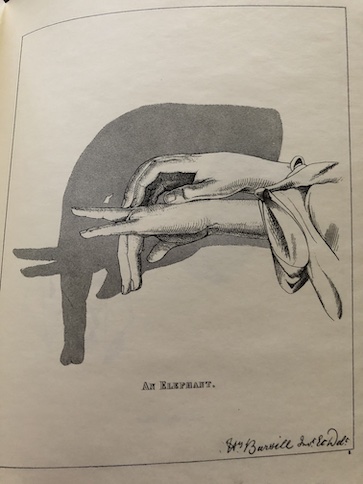
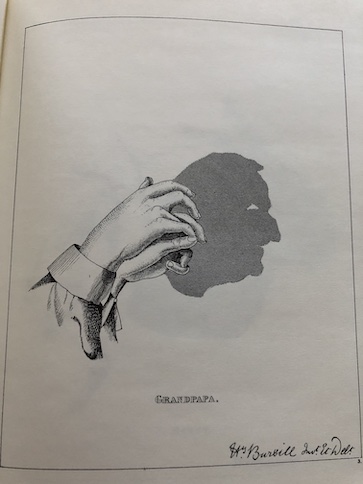
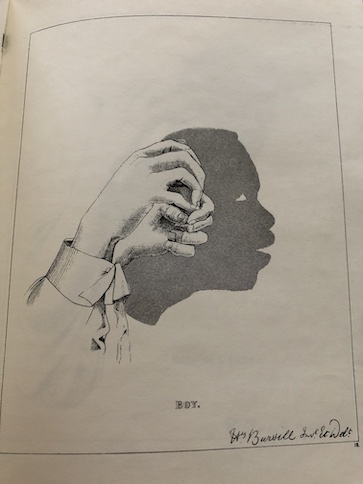
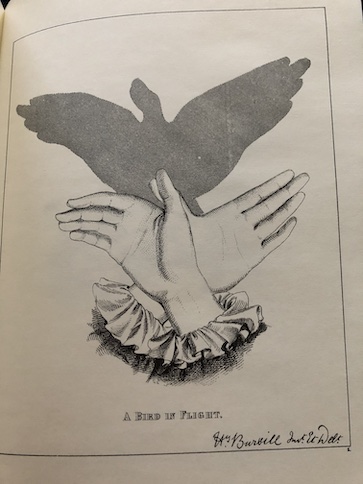
Hand Shadows

When I first read and started playing with this book as a kid, I didn’t stop to read the preface in the book or look at the publishing date, so I completely missed the fact that this is a reprint of a book from the late 1850s. The author, Henry Bursill (link repaired 9-11-24), was a professional artist

In the preface, Bursill refers to a well-known print from the early 19th century called The Rabbit on the Wall, which shows a father making shadow figures on the wall with his hands to amuse his children. Bursill says that there have been other books about hand shadows before his, but he emphasizes that his book is not the same as theirs because he has worked out his own hand shadows through experimentation. He says that it will take some practice for people making hand shadows to get them perfectly, but he encourages people to practice and not be afraid to work out new hand shadows of their own through experimentation. Bursill did the illustrations for the book himself, and he says that he began sketching some of the designs during his time as an art student and that he would amuse some fellow students by making hand shadows on the wall of his studio.

Other than the preface, the only words in the book are the captions on each of the pictures. I’ve tried some of the hand shadows in the book, and I had a more difficult time than the preface makes it sound. The only ones I’ve really been able to do well were the bird and the greyhound. I haven’t given up on mastering some of the more difficult ones someday, though!

The book is available to read for free online through Project Gutenberg and Internet Archive (multiple copies).

Brother Eagle, Sister Sky

Brother Eagle, Sister Sky: A Message from Chief Seattle with paintings by Susan Jeffers, 1991.

This is a picture book, but not one for very young children because of the serious subject matter. It’s a profound book with beautiful pictures, but before presenting it to children, adults should be sure that the children are old enough to understand the background of the book.

The book begins with some information about its background. It describes the variety of “Indian” (Native American) tribes that have lived in the Americas for thousands of years and how, after white settlers arrived from Europe, they were killed and pushed off their ancestral lands by the new arrivals. It’s historically true, but also dark subject matter, which is why it’s important for the children reading the book to be old enough to understand it. Most of the book is the text of a speech made by Chief Seattle (who lived c. 1786 to 1866) to the Commission of Indian Affairs for the Territory and other government employees when the US government wanted to buy land from his tribe. The historical details concerning this speech from the mid-1850s are complicated, and accounts of it might not be completely accurate, and there is a note in the back of the book that addresses that. I consider the spirit of this speech something worth preserving, so I won’t get too hung up on that right now. I just mention it for the sake of people interested in going deeper into the history.

Susan Jeffers particularly wants readers to consider the environmental message of the speech and how relevant the message is today for a society that has endangered itself by placing a higher priority on the acquisition of land, resources, and wealth than on preserving the land and environment that makes life itself possible. This book was written in the early 1990s, and having been a child at that time myself, I know that these themes were increasingly becoming topics in schools and in children’s entertainment during that time. I’d like to point out that I, and others who are younger than me, have heard similar messages about environmental concerns from an early age. This has given us different priorities from earlier generations who did not, although it’s also worth pointing out that many of us came to care more about the environment as children because of the influence of adults who already did.

Chief Seattle questioned the concept of buying land because of the absurdity of buying aspects of nature, like the sky or rain. Land and nature had sacred spiritual meaning for Chief Seattle’s people.

Chief Seattle’s speech was full of poetic imagery, as he explained how his people felt like they were part of the land and it was part of them. He said that they looked on animals like they were brothers.

The land also connected them to their ancestors and the memories of their people.

Chief Seattle questioned what would happen in the future, when the land was filled with people and all of the animals either killed or tamed, painting a bleak picture of a land deprived of life.

The speech ended with the thought that people didn’t “weave the web of life, we are merely a strand in it.” Chief Seattle called on the people wanting to buy the land to love it, care for it, and preserve it because “Whatever we do to the web, we do to ourselves.”

The environmental themes of the message are poignant for modern times because people have become increasingly aware of the consequences of environment pollution and careless use of natural resources.

The book is available to borrow and read for free online through Internet Archive (multiple copies, including English and Hindi).

The Enchanted Forest

The Enchanted Forest by La Comtesse de Segur, translated by Beatrice Schenk de Regniers, 1856, 1974.

This is an English translation and retelling of one of La Comtesse’s stories.  I can’t read French, and I’ve never read the original version of the story, but the translator, Beatrice Schenk de Regniers, had a note in the book that she altered the story slightly from its original version.

King Goodheart has a lovely little daughter named Goldenhair, who he loves very much.  Unfortunately, his wife dies, and his people urge him to remarry.  His new wife, Queen Meanette, is as mean as her name sounds, and she does not like Goldenhair at all.  The King, realizing this, does his best to keep her away from his daughter and puts his daughter in the care of some trusted servants. 

Meanette, still jealous of the love and attention the King gives Goldenhair, plots to get rid of her.  One of the princess’s attendants is a boy who takes her out in her little carriage in the garden every day.  The boy is greedy for sweets, and the queen bribes him into tricking the princess into going into the enchanted forest.  People who go into the forest have been known to disappear forever.  When the princess becomes lost in the forest, she is befriended by a cat who takes her to a palace where he lives with a doe.  They are very kind to her, but Goldenhair still longs for a way to return home.

One day, while Goldenhair is living with the cat and the doe in their palace, a parrot comes and claims that he knows a way that the princess can return home.  He insists that she leave the palace, against the doe’s wishes, and pick a single rose that grows in the forest.  What the girl doesn’t know is that the parrot is an evil wizard in disguise.  When the girl picks the rose, the doe’s palace is destroyed, and the evil wizard reveals himself. 

Thinking that she has killed her friends, Goldenhair wanders, lonely and miserable, through the forest.  Then, a large tortoise comes and tells her that her friends are still alive and that she can find out what happened to them if she’s willing to take a long journey on the tortoise’s back without saying a single word the whole time.  Goldenhair does so and arrives at a fine palace where she learns that the doe was really Fairy Kindheart and the cat was really her son, Prince Charming.  They had been turned into animals by the evil wizard, and they had been freed when the princess picked the rose.  However, the princess had then fallen under the spell of the evil wizard, and the other trials were necessary to free her.  Fairy Kindheart takes the princess home to her father, who is overjoyed to see her.  The King marries Fairy Kindheart, and Goldenhair marries Prince Charming, and they all live happily ever after.

The book is currently available online through Internet Archive.

My Reaction and Further Information

The life of La Comtesse de Segur, the original author of this story, is almost like a fairy tale itself. Her first name was Sophie, and she was born in 1799 in Russia.  Her father was a Russian Count, and she grew up with her seven siblings on his vast estate.  However, even though her family was wealthy, her mother believed that children shouldn’t have life easy.  Sophie and her brothers and sisters had to sleep on small, hard beds and were never given much food to eat or any sweets.  When she was 18, Sophie went to live in France, and she married a French Count named Eugene de Segur.  It was not a particularly happy marriage, but she had four daughters and four sons and many grandchildren.  She wrote stories for them and became the most popular children’s writer of her time in France.  She died in 1874, but her stories are still popular with children in France.

I found the story of La Comtess’s life even more interesting than the story in the book, although the story in the book isn’t bad. It seems like a pretty obvious variation on the story of Snow White, but it is a charming story.

Kat the Time Explorer

KatTimeExplorer

Kat the Time Explorer by Emma Bradford, 1998.

KatTimeExplorerTrain.jpgTen-year-old Kat is going to be living with her Aunt Jessie for the next year.  Her parents are botanists, and they are spending a year in South America, studying rain forest plants.  Aunt Jessie lives in a house in the same town as Kat and her parents so, by staying with her, Kat can continue going to the same school and see her friends.

Like Kat’s parents, Aunt Jessie is also a scientist and teaches physics at the same college where her parents teach when they’re not doing research abroad.  She inherited her house from their Great-Uncle Malcolm, who was an inventor.  Malcolm never invented anything that made much money or got much attention, but Jessie has been going through his things and discovered something interesting among his unfinished projects: a time machine.  The time machine seems to be nearly complete, although Jessie isn’t quite sure how to operate it or what should power it.  There is a drawing of a strange medallion in Malcolm’s notes, and Jessie found one with the same markings among Malcolm’s belongings, but it’s unclear whether this medallion is supposed to play any role in the time machine’s function or if it’s completely unrelated.

Then, Kat discovers another medallion in Malcolm’s old room, one with identical markings but made out of a different type of metal.  There is a space on the time machine for each of the medallions to fit.  When Kat experiments with how the medallions can fit into the machine, she activates it, transporting herself and Jessie back in time to England in 1851.

They find themselves on a train with other travelers heading to The Great Exhibition in London where people from around the world will be displaying new developments in industry and technology.  No one notices Jessie and Kat’s sudden arrival because the train is packed with people and the time machine has somehow altered their clothing and other small objects in their possession to ones that are appropriate to the period.  They also seem to be able to understand people speaking other languages neither of them knew before.  The time machine itself is packed into an ordinary-looking bag.  The two of them decide that they can’t use the time machine on the train where everyone will see them, and besides, they are both curious about the time they find themselves in.  After a temporary mix-up where they are separated at the train station, they find each other again and manage to locate a woman who will rent a room to them for a couple of days.

Unfortunately, when they start unpacking in their room, they discover that their bag was accidentally switched at the station for an identical one.  They no longer have the time machine and can’t get home!  Inside the bag they have, they find articles of men’s clothing, a small spring of some kind, an incomplete sketch of some kind of invention, a ticket to the Exhibition, and a letter written to someone named Edward from his brother Sidney about the Exhibition and the invention they plan to demonstrate there.  The brothers are very concerned about the success of their demonstration and are depending on results to make some money and save their family’s estate.  With those clues, Jessie and Kat must track down these inventors and find their time machine, saving not only themselves from being stuck in the past but the future of the two brothers!

There is an educational section in the back that explains about the Victorian Era and the Great Exposition.  It also discusses Victorian manners and tea parties.  There are tips for making little sandwiches of the kind people would eat at tea parties.

This book is part of the Stardust Classics series.