
The Princess and the Goblin by George MacDonald, illustrated by Jessie Willcox Smith, 1872, 1920, 1986.
“But, Mr. Author, why do you always write about princesses?”
The Princess and the Goblin, Chapter 1: Why the Princess Has a Story About Her
“Because every little girl is a princess.”
“You will make them vain if you tell them that.”
“Not if they understand what I mean.”
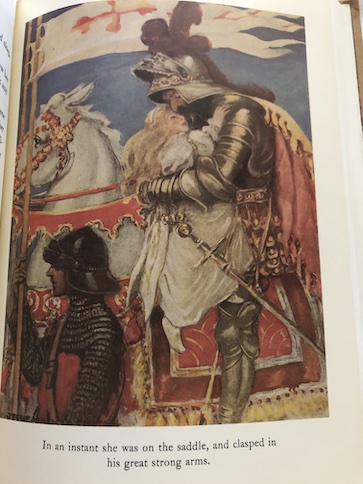
This is an enchanting fairy tale-type story about a princess. One of the best parts comes at the beginning of the book, when the reader supposedly interrupts the author as he starts to tell the story, asking him why he likes to tell stories about princesses. The author explains that princess stories remind every little girl that she is a princess, that they are all the daughters of kings (apparently in the sense that any man can be the king of his family with all the dignity and wisdom that implies, and it reflects well on them when their daughters behave well, as if they were raised with the manners of royalty), even if they sometimes forget that and behave in very un-princesslike ways. He wants to remind them that they are all princesses and can behave with the grace and dignity of princesses, and he can also pamper them a little because, in the course of the story, he can give them every beautiful thing he wants all the little princesses of the world to have. There’s kind of a behavioral caution in that explanation, but also a sweet sentiment. Even if you’re just an ordinary girl, you can still act with royal dignity and grace, and through the story, you can vicariously enjoy all the riches and adventure that a fairy tale princess can have.
The princess in the story, Princess Irene, is about eight years old, being brought up in a castle or manor house in the countryside because her mother was not physically strong when she was born and is now dead. She is largely raised by her nurse and only sees her father, the king, occasionally. Her father spends his time traveling between his castles and manors, visiting various parts of his country to make sure that everything is in order. Princess Irene cannot go with him because she is still too young to travel that much.
There are caverns under and around the castle-like manor house where Princess Irene lives. There are mines in the area, and the caverns are inhabited by creatures like kobolds or goblins. The story says that there are legends that these creatures once lived above ground, but having some quarrel with requirements imposed on them by the king or human society, they retreated underground to live there in secret. From generations of living underground, they have become physically altered into deformed creatures, but they have also acquired arcane knowledge and delight in playing mischievous tricks. Because of fears of the goblins coming out at night, Princess Irene is kept safely indoors before the sun goes down and has never seen the night sky by the age of eight.
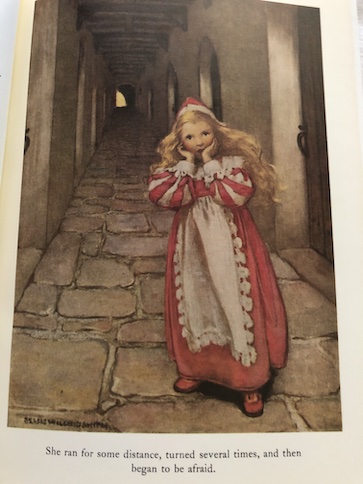
One rainy day, Princess Irene is sitting in her nursery, bored. She has many fabulous toys (so amazing that the author of the book declines to describe them and cautions the illustrator against attempting to draw them, so readers can imagine any fabulous toys they like), but Irene in not in any mood to be amused by anything. Princess Irene is restless and doesn’t even quite know what she wants. When her nurse leaves the room, Irene takes the opportunity to run off and explore parts of the castle she has never before explored. She runs up some stairs into a passageway full of doors. She continues running through the passageways with doors leading to rooms with nobody in them until she becomes lost and confused. The corridors are empty, and there is no sound but the rain. One of my favorite quotes from this book says, “It doesn’t follow that she was lost, because she had lost herself though.” Just because Princess Irene doesn’t know where she is or where she’s going doesn’t mean that she isn’t heading in the right direction, where she needs to be.
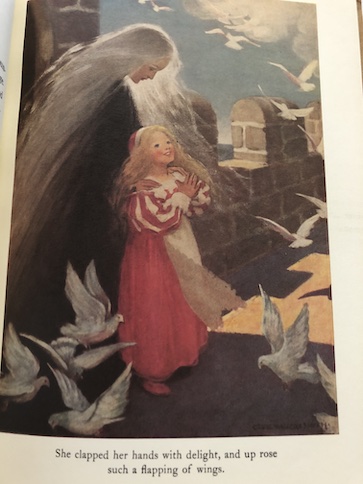
Frightened, Princess Irene tries to find her way back to the nursery. Eventually, she finds her way to a room where she hears a humming sound. When Irene enters the room, she finds a beautiful old lady with silver hair sitting at the spinning wheel. Irene isn’t sure how old the lady is because she seems almost ageless. The lady notices that she’s been crying and asks her why, and Irene explains that she is lost. The lady is kind to her, washing her face and hands, and she introduces herself as Irene, too. She says that she is the princess’s great-great-grandmother and that Princess Irene was named after her. Princess Irene wonders why she’s never seen her before, and the elderly Queen Irene says that no one else knows that she is here. She shows Princess Irene the pigeons she keeps and promises that Princess Irene will see her again. Then, she guides the little girl to the stairs back to the nursery.
When Princess Irene is back in her nursery, her nurse is relieved because she’s been looking for her. The princess explains that she was with her great-great grandmother, but her nurse doesn’t believe her. Princess Irene is offended that her nurse thinks she made up the whole story. The next day, Princess Irene tries to find the old lady’s room again, but she can’t. She almost starts to wonder if she did just dream about her.
After the rain is over, the princess and her nurse spend some time outside. They wander farther than they should, and the nurse realizes in a panic that they cannot get back to the castle before the sun sets. The nurse grabs the princess’s hand and begins running for home. She becomes even more panicked when the princess thinks she sees little men and hears a sound like laughing. In their haste and panic, they get lost. The princess doesn’t understand why her nurse is so panicked because no one is supposed to scare her by telling her about the goblins.
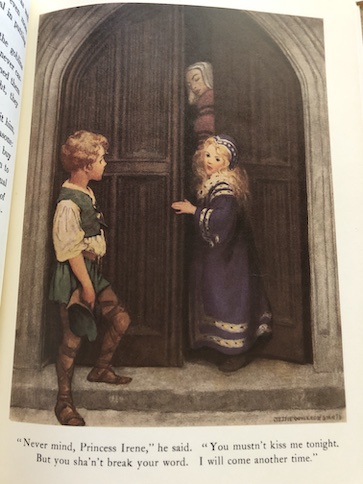
Fortunately, they meet up with Curdie, a young miner boy. It scares the nurse that Curdie is singing about goblins, but Curdie says that goblins can’t stand singing. Goblins don’t bother Curdie because he’s used to them and doesn’t let them frighten him. This is the first time Princess Irene learns about the goblins. When the nurse tells him who the princess is, Curdie says that they wouldn’t have gotten lost if they weren’t frightened and that it was a bad idea to say the princess’s name because the goblins might have heard and will recognize her if they see her again. Curdie guides them back to the castle before anyone realizes that they are missing. Irene likes Curdie and wants to give him a kiss for helping them, but the nurse stops her. Curdie tells her that there will be another time, and she can keep her promise of a kiss later.
Curdie can tell that the goblins are angry with him for interfering with their pursuit of the princess by their behavior toward him the next day. It doesn’t bother him much because he knows exactly how to deal with them. Goblins are intimidated by songs and rhymes, probably because they can’t make any themselves. Miners who are good at remembering songs and rhymes or making new ones for themselves don’t need to worry about the goblins, and Curdie has a talent for this sort of thing.
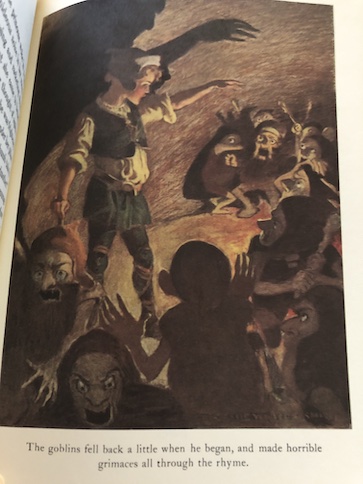
While Curdie is in the mine after the other miners have left, he overhears a goblin family talking, and he learns some useful things. First, he finds out that goblins’ feet are a vulnerable point on their body. Their heads are very hard, but their feet are very soft, and they have no toes. The only one who wears shoes is the goblin queen, and the goblins say that’s because the goblin king’s first wife wore shoes, and the second queen doesn’t want to seem inferior to the first. The goblin king’s first wife was a human woman, who died giving birth to their son. Second, the goblins are building new homes further away from where the miners have been mining. Third, the goblins are planning some kind of disaster against the miners. Curdie secretly follows the goblins to find out where the goblin palace is and learn more of their plans. At the goblin palace, he hears them discussing their plans. They don’t offer many new details, but it is clear that they are planning some sort of revenge against humans.

Princess Irene finds her way to her great-great-grandmother’s room again one night. This time, the old Queen Irene shows Princess Irene what she is spinning. She is spinning spiderwebs to make something for Princess Irene. She heals a wound on the princess’s hand and invites her to spend the night with her. When Princess Irene wakes up, she is back in the nursery, but she now believes that it wasn’t just a dream.
Later, the princess is frightened by a horrible goblin creature that enters her nursery through a window that the nurse left open when it was getting dark. Terrified, Princess Irene runs out of the castle into the darkness (somehow missing the extra guards that her father left at the castle for her protection). Fortunately, her great-great-grandmother sends her a magical lamp that guides her back to the castle. There, she gives the princess the present that she has finished making: a ball of finely-spun spider silk. She also gives Princess Irene a ring with a fire opal. She tells the princess that these things will guide her to safety any time that she is frightened.

The magical spider silk thread helps Princess Irene to find Curdie when he is captured by the goblins. Curdie has been trying to learn more about the goblins’ plans. Curdie discovers that the goblins are planning to kidnap Princess Irene as both a hostage and a bride for their half-human, half-goblin prince. Worse still, if their plot to abduct the princess doesn’t work, they plan to flood the mines and drown the miners!
This book is in the public domain. It’s available to read online through Project Gutenberg (multiple formats) and Internet Archive (multiple copies). You can also hear a LibriVox audio reading of this book online through YouTube and other audio recordings at Internet Archive. The story was made into an animated movie in 1991, and you can see it online through Internet Archive. There is only one sequel to this book, The Princess and Curdie. Personally, I think the original is better than the sequel.
My Reaction
This is a classic children’s fantasy story! The princess is sweet, the villains pose a real threat, and the story doesn’t shy away from the goblins’ evil. When they’re describing what to do with the princess when they get her, they talk about how they’re going to make her toes grow together so she’ll be like them. As princess stories go, this one isn’t as sparkly and pink as many modern princess books. Still, as the author notes in the beginning, this story allows all little girls to think of themselves as princesses and imagine themselves going through the adventure with Princess Irene.
As with many other Victorian era children’s stories, there are moral lessons in this one. The author periodically reminds readers about how princesses should behave with bravery and should keep their promises. There are also various other morals in the story, like the value of hard work and duty to others, learning to understand other people and give them the benefit of the doubt, and having the courage to admit mistakes and make them right. All of these values are described as being noble, and it’s implied that Curdie might have princely blood for exhibiting these values. The book uses royalty or the behavior of princesses and princes as a sort of metaphor for moral behavior.
Princess Irene’s great-great-grandmother is never fully explained. At one point, Princess Irene brings Curdie to see her, but he can’t see her, even when the princess is sitting on her lap. However, the king himself goes to see her without the princess. The princess knows that’s where he’s going because he’s heading in that direction. He is aware that the old Queen Irene is there, but he doesn’t share that knowledge with anyone else. When Curdie tells his mother that the princess tried to show him her great-great-grandmother but nobody was there and he thought that she just made it all up, his mother tells him that there is something very odd about the royal family. She says that they’re not sinister, but there are rumors and implications that there is something magical about them or that they are not quite normal humans. At the end of the story, we never get a firm answer about what Queen Irene really is. When I first read this book, I thought that she might be a ghost because, as an ordinary human, she shouldn’t be alive anymore, and I figured that she only shows herself to members of her own family. However, that doesn’t fully explain her magic, and from what Curdie’s mother says, maybe she’s some kind of fairy or elf or maybe a powerful sorceress, who can either live forever or for a long period beyond the normal human lifespan.
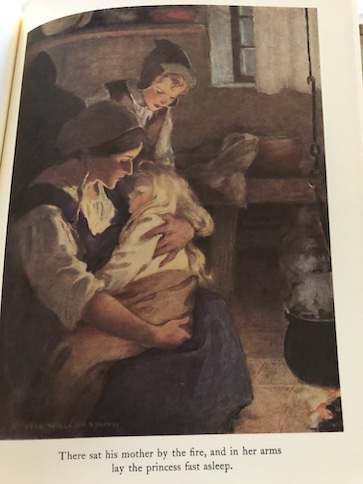
One of the parts that I always liked best about this book is the illustrations. They’re charming and magical! These particular illustrations were made by Jessie Willcox Smith, a famous illustrator of children’s books in the early 20th century, in 1920.




 Jestress's Forgotten Books and Stories